The star Arcturus, or Hokule'a


In the previous post, we took a brief look at the amazing wayfinding prowess of the mariners who steer the double-hulled ocean-going canoe Hokule'a on voyages from the islands of Hawaii to destinations as far away as Tahiti, Aotearoa (New Zealand), Rarotonga, Nukuhiva, the West Coast of North America including Alaska, the coral atoll of Satawal in the Caroline Islands, and Japan, and which is scheduled to undertake a circumnavigation of the globe beginning in 2012.

Hokule'a is named for the star Arcturus, which is called Hokule'a ("Star of Gladness" or "Star of Joy") in Hawaii and Polynesia. Arcturus has added significance to Hawaii and celestial navigation such as that used by the ancient Polynesians because of its location in the celestial sphere at a declination of +19° 10' 56", which indicates the circle that it traces each day in relation to the celestial equator (positive declinations are towards the celestial north pole from the celestial equator, while negative declinations are towards the celestial south pole from the celestial equator).

This is significant to the Hawaiian Islands because they are situated on the globe at a latitude between just under19° north latitude and just over 22° north latitude. Because of this fact, Arcturus (or Hokule'a) is at zenith for observers at 19° north latitude, which includes observers in Hawaii. To understand why this is, think of the north star, which is at a declination of +90° (the celestial equator is designated as 0° declination, just as latitude on earth is measured from the 0° line of the terrestrial equator).

At the north pole on earth, which is 90° north latitude, the north star will be directly overhead. (actually, the earth's current north star is located at just over +89° declination, so an observer at the north pole would actually observe it making a tiny circle around the true celestial north pole). As an observer moves further south from there, the north star will begin to sink towards the horizon. After moving 10° south from the north pole, to 80° north latitude, the stars that will cross the zenith for an observer at that latitude will be those which are situated at a declination of +80°. Such as star will not stay directly overhead all the time (the way the north star would stay directly overhead for an observer at the terrestrial north pole), because it will make a circle in the sky as the earth turns. The circle made by a star at the same declination as the observer's terrestrial latitude will be a circle that goes through the zenith point of that particular location on earth.

For Hawaii, Arcturus moves along a circle which passes directly overhead, through the zenith, once every twenty-four hours (well, actually four minutes earlier each day, due to earth's progress around the sun, as explained in this previous post). For an outstanding discussion of the way that traditional wayfinders use the rising and setting of the stars to navigate across the open ocean without compasses or other modern equipment, see the series of web pages on the Polynesian Voyaging Society website (this page describes "Holding a Course" and contains diagrams showing the rising point of Hokule'a / Arcturus in the section entitled "Steering by the Stars" almost halfway down the long page; other web pages relating to Wayfinding can be located using the links in the menu along the right-border area near the top of the long web page).

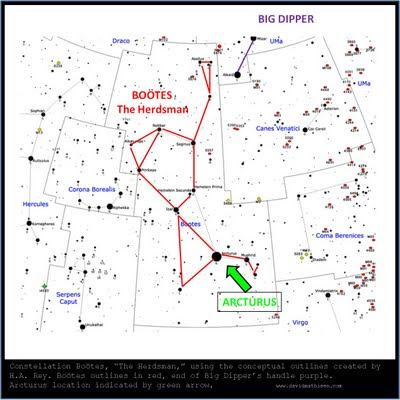
If you are not familiar with the star Arcturus or Hokule'a, it is actually very easy to find throughout the year. Arcturus is the fourth-brightest fixed star in the sky (not counting the sun, which is not a "fixed star"), and the brightest in the ancient constellation Boötes, or "The Herdsman" (see illustration above). It is also known as Alpha Boötis.

To locate Arcturus, simply follow the "arc" of the handle of the Big Dipper (the final two stars in the Dipper's handle appear in the star map above, connected by a purple line; the rest of the Dipper is located in the direction of the words "Big Dipper" at the top of the diagram). Arcturus has an orange-red glow.

The rest of Boötes is easy to see, and it is a large and interesting constellation that will become increasingly familiar as you look for it in the sky each evening. This is a case in which the conceptual outlines created by the great H.A. Rey are particularly valuable: his outlines (added to the diagram above as red lines) make the constellation far easier to spot and far more memorable than do the flowery allegorical diagrams used in previous centuries (for an example of one of those for Boötes, see here) or than do the geometric and abstract outlines used by many modern star books and websites (for an example of the typical geometric outline of Boötes, see here).

In the outline created by H.A. Rey, the Herdsman is smoking a long-stemmed pipe which points towards the Big Dipper and actually comes very close to the Dipper's handle. You can see it on a dark night (the stars in the "pipe" are very faint).

Now you know more about Arcturus, or Hokule'a, the namesake of the famous vessel of the Polynesian Voyaging Society, and about the way its location in the sky relates to the location of the islands of Hawaii.

Below is a video of the great Israel Kamakawiwo'ole (1959 - 1997) singing "Hokule'a Star of Gladness."
Some thoughts on the Hokule'a


The above video contains an interview with master navigator and President of the Polynesian Voyaging Society, Nainoa Thompson, discussing the ocean-going double-hulled waʻa kaulua, Hokule'a.

In the video, he describes some of the traditional navigation techniques he uses to guide the vessel, as well as the importance of the Hokule'a in helping to restore a spirit that had been all but lost due to oppression. He also describes this voyaging canoe's role in refuting the demeaning theories of scholars who over the centuries had argued that the Polynesians drifted through the oceans unintentionally and only accidentally discovered the islands of the vast Pacific.

The amazing voyages of the Hokule'a are undertaken without modern navigational equipment such as GPS devices, and even without compasses: ancient traditional navigation techniques are employed instead. In a remarkable book entitled The Wayfinders: Why Ancient Wisdom Matters in the Modern World, author and National Geographic Society Explorer-in-Residence Wade Davis describes in compelling prose the techniques used on these journeys:
Enshrouded by the night, the canoe itself became the needle of a compass that was the sky. Behind us sat the navigator, a young woman named Ka'iulani, Nainoa's protege. She would remain awake for twenty-two hours a day for the entire voyage, sleeping only for fleeting moments when the mind demanded a rest.

Ka'iulani, like Nainoa and all of the experienced crew, could name and follow some 220 stars in the night sky. She knew and could track all the constellations, Scorpio and the Southern Cross, Orion, the Pleiades and the North Star, Polaris. But for her the most important stars were those low in the sky, the ones taht had just risen or were about to set. Nainoa explained: As the Earth rotates, every star comes up over the eastern horizon, describes an arc through the sky, and then sets on a westerly bearing. These two points on the horizon, where a specific star rises in the east and sets in the west, remain the same throughout the year, though the time at which a star emerges changes by four minutes every night. Thus, as long as one is able to commit to memory all the stars and their unique positions, the time at which each is to appear on a particular night, and their bearings as they break the horizon or slip beneath it, one can envision a 360-degree compass, which the Hawaiians divide conceptually into thirty-two star houses, each a segment on the horizon named for a celestial body. Any one star is only dependable for a time, for as it arcs through the sky its bearings change. But by then there will be another star breaking over the horizon, again on a bearing known by the navigator. [. . .]

[. . .] The navigator by day conceptually divides the horizon ahead and behind, each into sixteen parts, taking as cardinal points the rising and setting of the sun. Thus by day he or she replicates the star compass of the night. The metaphor is that the Hokule'a never moves. It simply waits, the axis mundi of the world, as the islands rise out of the sea to greet her. 57-58.
It is remarkable that the stars were so vitally important and so well known by the ancient civilizations whom condescending scholars also have long said could not possibly have navigated the oceans. Just as Nainoa Thompson in the video above is saddened and angered at the racism of those who once said that the Polynesians "didn't have the intelligence" to navigate more than 100 miles, we should be saddened and angered by any scholars whose conclusions are based upon racist suppositions.

I argued in my previous post that there appears to be clear evidence (or at least evidence that should be discussed more thoroughly and not dismissed out of hand) that ancient voyagers from many of the families of mankind came to the Americas from Europe, Africa, and Asia. That men of different ethnicity and physical characteristics may have dwelt together in peaceful coexistence at some point during that time is one possible conclusion suggested by the many different sculptures found in sites belonging to the mysterious ancient Olmecs. And yet to suggest today that such ancient voyages took place is dismissed as racism and ethnocentricity. This is unfortunate.

In a previous post I have argued that to assert that the ancient timeline of mankind may have been different from what we are taught today should not automatically be considered some form of racism or ethnocentricity, unless someone moves from saying "X may have happened thousands of years ago" to saying "because X happened thousands of years ago, group Y or Z is better / worse / more valuable / less respectable than group A or B." It is true that some people do say or think or suggest such conclusions, but that does not mean that everyone who suggests an alternative theory from the consensus intends to take away or detract from one group or another.

Wayfinders author Wade Davis argues that Thor Heyerdahl's theories are objectionable in this very manner, because he interprets Heyerdahl's theories as denying the culture of Polynesia its greatest achievement, which is "the ultimate insult" (47). We have examined the theories of Thor Heyerdahl in several previous posts (see here and here) and it is hard to see why arguing that the Polynesians may have come from the east to the west (as many of their own legends state and as Heyerdahl believed took place) rather than from the west to the east (as most historians today assert) means that one wants to deny them their achievements.

Thor Heyerdahl clearly believed that the Polynesians were incredible mariners who were capable of deliberate voyages from Hawaii to Aotearoa and all points in between. He himself relates the oral traditions of Polynesia describing voyages from Hawaii to Tahiti and back and says he believes they took place, and he notes the accuracy of the directions given for sailing from Aotearoa back to Hawaii, and states that he thinks such oral traditions demonstrate the ability to make such voyages deliberately and not by accident.

The fact is that nobody knows for certain what took place in mankind's distant past. We are very much in the position of detectives examining clues and piecing together theories, some of which appear more plausible than others. To declare that a culture or a people could or could not do something based on presuppositions of any sort is very unwise. This blog has already discussed numerous items of solid evidence for the likelihood that ancient cultures could and did know and do things that scholars and historians dismiss as impossible (there is evidence that the builders of the Giza pyramids and of Stonehenge knew the size and shape of the earth, for instance, and that the builders of Avebury Henge knew about earth's naturally-occurring telluric energy, and additional evidence that Avebury may have functioned as a training complex for open-ocean navigation). These are possibilities that scholars adamantly deny, and yet the evidence is at least worth further consideration, as is the evidence that ancient cultures from multiple continents visited the Americas.

Such possibilities are not brought up in an attempt to take anything away from any family of mankind. In fact, it is quite clear that the true story of mankind's ancient past, if it ever could be known, would show that the wisdom and accomplishments of our distant ancestors surpass anything we attribute to them today. The parts of that wisdom which have somehow been preserved, or revived, such as the ancient knowledge that enables the magnificent voyages of the Hawaiian navigators (and the techniques handed down through the generations to the late master wayfinder Mau Piailug) should humble the proud attitudes of those who believe that "modern technology" makes those who possess it superior to everyone else, and competent to judge what other cultures could or couldn't do.

There appears to have been an extremely sophisticated understanding of the stars and their importance that was shared across a very wide variety of cultures, and which was preserved in certain parts of the world long after it had been stamped out and forgotten in Europe (if indeed it was ever shared there beyond a limited circle). It is highly possible that this knowledge was connected with open-ocean navigation.

The intrepid men and women who pilot the Hokule'a today have proven beyond a doubt that very ancient techniques, based upon deep understanding of the stars and other signs present in the sea and sky, can enable deliberate and successful voyages across vast distances to very small targets.

Whether these capabilities are somehow connected to the little-understood capabilities and astronomical knowledge of other ancient civilizations and cultures is not certain, but where we find evidence of similar extreme awareness and understanding of the stars and the sun, we might be wise to remain open to possibilities that the consensus rejects as impossible.

More evidence of ancient transcontinental contact in Central American sculpture


In the previous post, we examined the newly-discovered guardian lion from the citadel at Tell Ta'yinat which shows that as many as 3,000 years ago in Asia Minor, lions were considered guardians of gates and doorways, and noted that this tradition is clearly present in classical China and in the ruins of Central America as well. In fact, we noted that archaeologists have found evidence of maned lions serving in a similar "gate-guardian" function in ancient Maya art and that maned lions (or at least "bearded jaguars") were depicted by ancient Olmecs in pre-Columbian Central America as well.

In that previous post, we argued that the use of maned lions as gate guardians may well have arrived in ancient Central America from another continent, since maned lions did not exist in the Americas. We said that those who deny the possibility of ancient contact across the bluewater oceans must allege that:
those ancient artists just happened to stumble upon a made-up creature that looks startlingly like an animal that they had never seen, but which lives on other continents and just happens to have been commonly depicted guarding gates and doorways on those continents as well. What lucky guessers those ancient pre-Columbian artists were: in addition to somehow dreaming up and carving lions that they had never seen, they also depicted men with features typical of men that they had never seen either, including Europeans, Asians and Africans.
While many readers are familiar with the existence of numerous ancient pre-Columbian sculptures in Central America that appear to accurately depict the distinctive characteristics of Europeans, Asians and Africans, here are a few that illustrate the point.

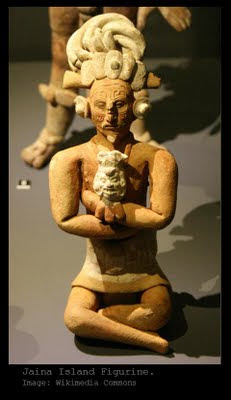
Above is an image of one of the famous figurines of Jaina Island, a pre-Columbian Maya site containing extensive burial sites and a high number of exquisite ceramic figurines. These figurines exhibit incredible artistic talent and a high degree of individuality, including differences in age, social rank, and even -- apparently -- ethnicity. Some of the figurines appear to depict features common to Native Americans of the area, while others -- such as the one shown above -- have beards and mustaches.

The figure above depicts distinctive facial tattooing or scarification, typical of that found among some tribes of North Africa and among the Maori of New Zealand. The Jaina Island figurine in this image exhibits even more distinctive characteristics not commonly associated with the Indians of the Americas including not only beard and mustaches but also facial structure and appearance. However, their clothing, headgear and jewelry clearly indicate that these are not images depicting Europeans after the arrival of the Spanish in the 1500s.

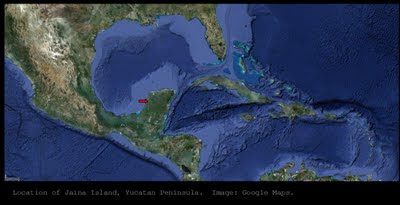
Below: the location of Jaina Island on the Yucatan Peninsula of Mexico.


As noted in the previous blog, not only must historians who deny the possibility of ancient trans-oceanic contact assert that Central American artists just happened to guess what Old World lions looked like (and just happened to use lion sculptures to guard gates and doorways in the same way that they were used in ancient Mesopotamia, Egypt, and China), and that they just happened to create sculptures that looked like Europeans (although they never actually saw a European), but they must also maintain that the ancient artists of Central America created sculptures that accidentally depicted features common to Africans and Asians as well, without ever seeing men from those continents.

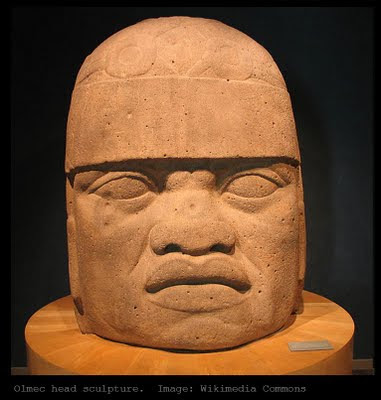
Below is one of the famous Olmec heads, which some observers believe exhibit features more indicative of African warriors than of the Native American Indians of the region.


Other observers believe that these sculptures look more like Polynesian warriors than like African warriors. If so, this may provide additional support for the theory of Thor Heyerdahl that the Polynesians originated in the Americas rather than in Malaysia or Southeast Asia.

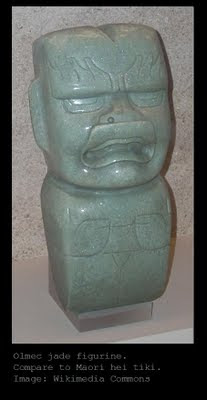
Also of interest is the fact that the Olmecs created exquisite artifacts of serpentine greenstone and jade, such as the one shown below.


The similarity to the greenstone carvings of the Maori, discussed in this previous post, is striking, and provides further data in support of the theories of Thor Heyerdahl which suggest that the Polynesians originated in the Americas. Of course, the theory that the voyagers to Polynesia originated in the Americas does not preclude the possibility of previous contact by voyagers from Africa, Asia and Europe with the civilizations of Central America.

Below is another Olmec jade artifact which appears to depict Asian facial features.


The above mask (of jade, which has long been prized by artists in Asia as well as in the Americas and in ancient New Zealand) is featured on a Wikipedia page entitled "Olmec alternative origin speculations," as if the suggestion of contact with Europe, Asia or Africa based on the above archaeological artifacts is "speculative" rather than based upon solid evidence. The discussion on that page states that such suggestions "contradict generally accepted scholarly consensus" and are "not considered credible by the vast majority of Mesoamerican researchers."

The Wikipedia article states that the suggestion of ancient contact with other continents is not only speculative but actually vicious. It declares that "The great majority of scholars" actually "regard the promotion of such unfounded theories as a form of ethnocentric racism at the expense of indigenous Americans." In other words, it is not racist to argue that ancient Asians or Africans lacked the ability to have visited Central America and been the sculptors or at least the subjects of the artifacts depicted above. Or, to put it another way, it is fine to take away from the possible ancient achievements of some races but not of others, according to the arguments of these misguided modern academics (although we do actually not accept the premise that allowing for ancient trans-oceanic contact "takes away" from the accomplishment of anyone).

So, according to the "scholarly consensus," the clear evidence of the above-depicted artifacts (which are not isolated artifacts but are representative of many others like them) must be ignored, and instead we must swallow the theory that the artists who crafted them simply dreamed up facial features that would suggest men from other regions of the world that they had never actually seen. Not only is this position ludicrous, but the reader can judge for himself whether or not it is more demeaning of the artistic abilities of the "indigenous Americans" to assert that they were accurately depicting Africans, Asians and Europeans in their art, or to assert that they were so incompetent that their attempts to depict Native Americans ended up looking like men of other continents whom they never actually met.

While it is (barely) possible to assert that ancient art does not actually indicate ancient contact across the oceans long before Columbus, it is more difficult to make the same arguments about human remains. Mayan and Olmec sculptors could, theoretically, construct sculptures that look like maned lions, or men from other continents whom they had never seen, but it is much more difficult to argue that mummies found in the Americas with distinctly European features did not actually come from Europe. In light of the fact that hundreds of such pre-Columbian mummies have been found, it is astonishing that "the great majority of scholars" apparently regard the possibility of ancient trans-oceanic contact as "unfounded theories" based upon "ethnocentric racism at the expense of indigenous Americans."

The sculptures discussed in this post are extremely convincing evidence of ancient trans-oceanic contact between the continents, but they are by no means the only such evidence. It is high time that open-minded investigators of this evidence ask themselves why the "vast majority of Mesoamerican researchers" refuse to follow the clear implications of this evidence, and what ideologies are coloring their conclusions, even as they label as "ethnocentric" and "racist" anyone who disagrees with their pronouncements.


Why do lions guard gates around the world, even on continents that had no lions?


This beautiful stone lion sculpture was recently discovered by archaeologists of the University of Toronto at the site of the ancient citadel of Kunulua at Tell Ta'yinat in southeastern Turkey. It is believed to date back to the period of the neo-Hittite kingdom of Patina, between 950 BC - 725 BC, and thus may be almost 3,000 years old. You can read more about the discovery in this article from Science Daily.

The article quotes the director of the University of Toronto's Tayinat Archaeological Project, Professor Timothy Harrison, discussing the well-preserved work of art:
The lion is fully intact, approximately 1.3 metres in height and 1.6 metres in length. It is poised in a seated position, with ears back, claws extended and roaring. [. . .] The presence of lions, or sphinxes, and colossal statues astride the Master and Animals motif in the citadel gateways of the Neo-Hittite royal cities of Iron Age Syro-Anatolia continued a Bronze Age Hittite tradition that accentuated their symbolic role as boundary zones, and the role of the king as the divinely appointed guardian, or gatekeeper, of the community.
Lions are found guarding gates throughout the world. Lions in a similar "seated position with ears back, claws extended and roaring" commonly guard important gates and doorways in China, and have done so for centuries.

Interestingly, there is evidence of lion sculpture being used to guard gates in the Yucatan Peninsula in modern-day Mexico, at the ruins of Chichen Itza. In Before Columbus: The New History of Celtic, Phoenician, Viking, Black African, and Asian Contacts and Impacts in the Americas before 1492 (1980), by Dr. Samuel Davey Marble, the author discusses these anomalous artifacts:
A similar cultural anomaly is found in the portrayal of lions in the sculptured reliefs of the pyramids of Chichen Itza in Yucatan. Why lions, you ask, when there are no lions in North or South America? For the Egyptians, the Abyssinians, the Persians, and Israelites, the lion had been a symbol of power, force and fear. [. . .] To have a lion on the pyramid at Chichen Itza is a borrowed idea just as much as a statue of an anteater would be on the entrance of the US Supreme Court. The introduction of such forms, shapes and symbols into the life of the Olmecs was certainly a product of trans-Atlantic migration. 134.
The mention of the Olmecs is significant, for although Chichen Itza itself is a Maya site, the Olmecs famously depict "bearded jaguars" in their artwork, giving the jaguar which does not have a mane a distinctly leonine mane.

One pre-Columbian lion sculpture positioned in a doorway at Chichen Itza can be seen in this collection of photography from Robert Tingley. The blocky head of the feline suggests that the original artist was indicating a mane, and the proportions of the body are more suggestive of an African lion than a Central American jaguar or ocelot.

However, if that particular sculpture is not convincing enough of the proposition that ancient pre-Columbian artists depicted maned lions not indigenous to the Americas, check out the two photographs of an Aztec lion sculpture found on this website. That website is discussing the alleged "face on Mars," but if you scroll down a little over halfway through the long page, to the section entitled "The Feline Side of the Face on Mars," you will see a "figure 3" which shows two different views of a statue that any child could identify as an Old World lion.

Conventional anthropologists and historians absolutely refuse to admit the possibility that ancient mankind was capable of cultural contact across the mighty oceans thousands of years ago. They must therefore come up with explanations for such "bearded jaguars" as fanciful artistic depictions of jaguars having human beards, despite the fact that the Aztec and Maya typically did not have facial hair.

In their fanciful creations, according to this theory, those ancient artists just happened to stumble upon a made-up creature that looks startlingly like an animal that they had never seen, but which lives on other continents and just happens to have been commonly depicted guarding gates and doorways on those continents as well. What lucky guessers those ancient pre-Columbian artists were: in addition to somehow dreaming up and carving lions that they had never seen, they also depicted men with features typical of men that they had never seen either, including Europeans, Asians and Africans.

The newly-discovered lion of Tayinat points to the cultural commonalities shared by people who, according to the fables commonly taught as history today, never had any contact with one another. The lion art of Central America is just one small clue in a huge pile of other evidence pointing to the fact that the ancient timeline of mankind was far different from what we have been taught. Other evidence of long-standing ancient contact with the civilizations of Central and South America is discussed in the Mathisen Corollary book.

It is rare that a day goes by without some new discovery or item appearing in the news that supports the conclusion that modern theories of geology and history need to be radically revised.

Thoughts on the movie The Eagle (2011)


Released earlier this year, The Eagle tells the story of a young Roman commander's quest to recover the eagle lost by his father's legion during a defeat in northern Britain twenty years before at the hands of fierce Celtic tribesmen.

Based on the historical novel The Eagle of the Ninth by Rosemary Sutcliffe, published in 1954, the movie does a fine job of portraying the dynamics of military command, especially the tension every new leader feels in his first command, when his orders are being warily evaluated by the unit and they are weighing what kind of a commander he will be. The movie also brings to life the "atmospheric" feel of the Roman outpost, the windswept hills of the Roman frontier, and the swampy forests pregnant with the potential for ambush at any moment.

The film takes place around the year AD 140, twenty years after the loss of the legion that is purported to have been the impetus for the construction of Hadrian's Wall, which was begun in AD 122. During this time period, the "Persian Mysteries" had become the dominant religious cult among the Roman legions, and the movie conveys the hero's faith in Mithras, even featuring a small image of a tauroctony among his personal items (for more on the Mithraic mysteries, see this previous post).

In all, the film does an admirable job of immersing the viewer in the period of the Roman Empire in a different part of the world than is usually portrayed in epic films set in ancient times. The viewer gains a gut feel for the central aspect of the Roman approach to battle, in which the primacy of the organization over the individual was supreme. The contrast to the approach of the Celts, in which the initiative and importance of the individual was primary, is stark -- never more so than when the Celtic Esca asks the Roman Aquila (in the trailer clip above), "How can a piece of metal mean so much to you?"*

A modern analogy might be the difference between the style of play of college basketball in the US (in which teams that follow rigorous drills and play as a single unit are much more common) and the style of play in the NBA (in which the initiative of individual players is often much more central to the offense). These are of course gross generalizations, but may provide a helpful insight into the tension between the culture of the Celts and the culture of Rome and what each valued most highly.

It was an important diametric opposition, and one that has played itself out in many aspects of western culture since the second century setting of The Eagle, and one which in fact continues to this day. Even in the United States, where the rights of the individual are privileged to a degree rarely found anywhere else or at any other time, the tension between what we might call "the Roman" and "the Celtic" turns up in many aspects of life and many of the great questions of our time.

The Celtic warriors of the movie are portrayed as typical "noble savages" -- proud, heroic, ferocious in battle, deeply spiritual, and wanting only to be left alone by the invaders who are despoiling their homelands and destroying their way of life. During the movie at critical points, the soundtrack features beautiful and mysterious Celtic song or chant, adding to the atmospheric elements that are one of the movie's greatest strengths (for more on the importance of chanting and song, see this previous post).

However, this portrayal of the Celts emphasizes only one side of their culture. By all accounts (including the accounts of the Romans, who greatly admired their bravery), the ancient Celts, including those in Britain, were in fact proud, heroic, ferocious in battle, and deeply spiritual. However, they were also learned and technologically advanced -- in some ways, more than the Romans (who defeated the Celts by virtue of their unmatched ability to forge military units that functioned like precision machines, rather than because of superior technology). In his description of the Celts in the region that is today France, Julius Caesar wrote that the Gauls (as they were also called) and in particular their Druids were extremely learned, not only about "the heavenly bodies and their movements" but also about the "size of the universe and the earth" (see the discussion and quotation from Caesar's Gallic Wars in this previous post).

Additionally, Caesar makes clear that the Celts were able to construct enormous and beautiful swan-ships which were superior to the ships of the Romans in every way -- the Romans could only defeat them in battle by destroying their masts and dropping gangplanks onto their ships so that the Roman soldiers could march aboard and defeat the Celts with army tactics rather than with naval tactics (the nautical capability of the ancient Celts is discussed in more detail in the Mathisen Corollary book). The level of civilization required to create ships of the type that awed Caesar is never portrayed in movie versions of the Celts that the Romans faced.

Finally, the Celts are depicted as basically pagan in the film, just as they are depicted in most other modern fiction. In fact, there is some historical evidence that many Celts of the British Isles adopted Christianity at a very early period -- according to some ancient sources, within the first century AD.

It is quite clear that the Apostle Paul evangelized among the Galatians: Gauls or Celts who had settled in Asia Minor after being brought in as mercenary fighters centuries earlier. Some authors believe that these Gauls may have spread their faith through western Europe and even the British isles when Roman pressure on them increased in Galatia and some of them returned westward along the fringes of the Empire.

Other ancient authors actually maintain that Paul himself went to Britain, and that the Aristobulus whom he mentions in Romans 16:10 was a bishop of Britain. This assertion was made by Dorotheus of Tyre (AD 255 - 362). Dorotheus also maintains that Simon the Zealot, one of the original Twelve Apostles mentioned in the Gospels, was martyred in Britain.

Medieval legends assert that Joseph of Arimathea actually spread Christianity to Britain even before the arrival of apostles and other missionaries. The ancient support for this assertion is somewhat lacking. Nevertheless, it does appear quite likely that the Celts of Britain and the Continent were exposed to Christianity quite early. Tertullian, who lived from AD 155 - 222, declared: "The extremities of Spain, the various parts of Gaul, the regions of Britain which have never been penetrated by Roman arms have received the religion of Christ."

While modern critics might argue that Tertullian, as a Christian theologian, had a motive in advertising the success his faith had achieved among even the most ferocious enemies of Rome, the fact that he lived at a period very close to that shown in The Eagle argues that his readers and listeners would have been aware that violent conflict was still going on between Celts and Romans, and that he would have had a difficult time passing off such a bold statement among other learned readers if it were not at least partly grounded in the truth.

The Eagle certainly does not treat the Romans as the unequivocal "good guys" in the film, and shows real sympathy to the virtues of the Celts, much the way modern Westerns often depict the American Indians in the face of an unstoppable if morally debased encroaching civilization. It is therefore probably not surprising that the movie basically imagines the Celts as Britannic versions of the Native Americans depicted in the movie versions of Last of the Mohicans or Dances With Wolves. We should be careful, however, not to project the events of the nineteenth century in North America, where one side did have vastly different and superior technology, onto the conflict between the Celts and the Romans, in which the technological differences may actually have been tilted the other way.

Nevertheless, The Eagle is a worthwhile film. Seeing good actors dramatizing the struggles of the individuals who lived in the ancient world can bring us closer to those ancient civilizations than can simply reading about them in books.


* The name of the protagonist Aquila, as summer stargazers in the Northern Hemisphere know, is Latin for "eagle," which gives us a fairly obvious play on words in the title of both the movie and the book and causes us to ask ourselves, "Is the movie about 'The Eagle' as in 'the standard of the legion that was lost and that Aquila seeks to recover,' or is the movie about 'The Eagle' as in 'Aquila himself'?" Ultimately, of course, the answer is the second, and the movie succeeds because of it.

The Perseid Meteor Shower, 2011


The Perseid meteor shower takes place each year during the month of August, and is by most accounts the best meteor shower of any of the meteor showers located on earth's annual orbit around the sun (for a comparative list of meteor showers, click here).

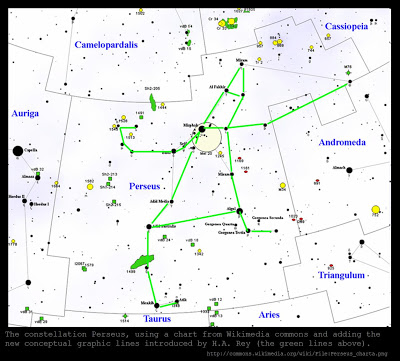
We previously examined the reasons why meteor showers have calendar dates and constellation names, in conjunction with the June Lyrid meteor shower earlier this year. That meteor shower appears to originate or radiate from the constellation Lyra, while the Perseids of course radiate from the constellation Perseus. Above is a diagram of Perseus using an unlined star chart and adding the lines created by author H. A. Rey in his excellent book The Stars: a New Way to See Them (originally published in 1952).

To find Perseus, look between the "W" of the constellation Casseiopeia, which is among the "imperishable stars" or circumpolar stars that never set except for viewers at latitudes near the equator, and the constellation Taurus the Bull.

Perseus is often depicted in ancient mythology wearing a special cap called a "Phrygian cap," the peak of which curves forward or "flops over" at the front. The importance of this particular type of headgear is discussed in detail in Professor David Ulansey's work on the ancient Cult of Mithras (also known as "the Persian Mysteries" among the ancients themselves), which is discussed here.

As can be seen from the constellation outline above, this mythological detail may well have originated from the constellation in the sky, if you believe along with the authors of Hamlet's Mill that the figures in ancient mythology came from the stars and planets, rather than the conventional opinion that the ancients peopled the figures they saw in the night sky with characters who already existed in their mythology (an extremely important distinction, and one that is discussed in greater detail in this previous post).

While the Perseid meteor shower is at its peak, however, the moon is waxing (currently in its first quarter -- which is a half-moon -- on its way to becoming a full moon). The bright reflected light from the moon acts like a street-light in the sky when it comes to observing meteors. Therefore, star-gazers may want to look for the Perseids after the moon has set. A good discussion of the best way to do that, as well as help on determining the time of moonset in your location, can be found in this post from the Urban Astronomer.

Enjoy the show!

Sirius heliacal rise


We recently published a post detailing the mechanics of the heliacal rising of a star or constellation. The heliacal rising of Sirius is currently taking place (on days that vary slightly depending upon your latitude on the earth) -- an extremely important event in ancient civilization.

For observers at about 35° north latitude and an elevation at sea level, Sirius rises on August 7th at 5:32 am. It continues to rise about four minutes earlier each day, a phenomenon described in this previous post.

At the same latitude and elevation, the sun rises on August 7th at 6:16 am. It continues to rise about a minute later each day (in the northern hemisphere), as the earth proceeds along its orbital path from the summer solstice (which already took place back in June) towards fall equinox (in September) and ultimately to winter solstice.

Until its heliacal rise, the sun was rising earlier than Sirius. However, as Sirius rises earlier and earlier, it eventually begins to rise earlier than the sun (and as it keeps rising earlier and earlier its rise will continue "into the night" and further ahead of sunrise). When Sirius first begins to rise earlier than the sun, the sky is still too bright to observe Sirius. However, as Sirius continues to rise earlier, it is higher in the sky each day when the sun comes up. Another way of thinking about this is that the sun is lower and lower below the eastern horizon as Sirius comes up over the eastern horizon each morning (because Sirius is rising earlier and earlier). Eventually, Sirius will rise prior to the sun at such a point that the sky is not bright enough to drown it out, and Sirius will be visible in the early morning sky above the eastern horizon, which will be lit by the sun's rays but not enough to drown out this brightest of fixed stars. When Sirius rises above the horizon and the sun is still 7° below the horizon, Sirius will be bright enough to be seen.

Fainter stars than Sirius must continue rising earlier before they are seen on their dates of heliacal rise, meaning that the sun would have to be further below the horizon than 7° before they would be visible for the first time. However, Sirius can be seen when it rises far enough ahead of the sun to crest the horizon when the sun is still 7° below the horizon. These conditions are beginning to be met for Sirius this week (on August 7th in most of the latitudes of the continental United States).

In their seminal text Hamlet's Mill: An Essay on Myth and the Frame of Time, Giorgio de Santillana and Hertha von Dechend discuss the incredible importance of the star Sirius to ancient civilizations -- including the ancient advanced civilization that they believed must have predated Sumer, Babylon and dynastic Egypt, and bequeathed to them a highly sophisticated understanding of astronomy, mathematics and science.

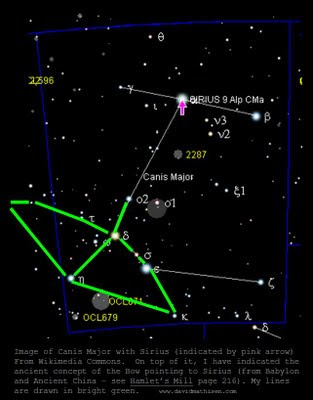
They point out that Sirius was associated with a plethora of ancient mythological images and themes. In addition to being the star of Isis the consort of Osiris, Sirius was also identified (among other things) with a celestial bow and arrow (216). De Santillana and von Dechend show that ancient Babylonian star descriptions identified the stars that we associate with the lower legs and tail of the constellation Canis Major with a drawn bow pointing to Sirius, which became the "Arrow Star."

The constellation is shown below, with the positions of the stars that form the bow pointing to Sirius connected by bright green lines:


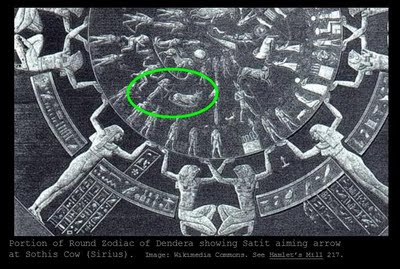
That this bow pointing to Sirius was very ancient is confirmed by its depiction in ancient Egyptian imagery, such as the Round Zodiac at Dendera (see detail below):


The great emperors of Ancient China were also depicted pointing the bow and arrow at a celestial dog or jackal, clearly indicative of the Dog Star Sirius, as shown in the image below (a similar image is reproduced in Hamlet's Mill between pages 216 and 217, as is the Dendera Zodiac shown above):


The authors of Hamlet's Mill explain that Sirius was also associated in some way with the depths of the sea, citing for example an ancient Babylonian New Year's ritual addressed to the "Arrow Star, who measures the depths of the sea" and the sacred texts of Zoroastrianism, the Avesta, which names the arrow Tishtriya and addresses it as "Tishtriya, by whom the waters count" (358). They also cite also numerous myths in which a goddess or a maiden who shoot an arrow from a bow into the midst of the ocean -- or to "the navel of the ocean" -- including a myth from the Northwest Indians of British Columbia (318).

In his book Sirius Matters, astronomer Dr. Noah Brosch notes that in the past, "the heliacal rising of Sirius was an outstandingly favorable time for the gathering of medicinal herbs" (26). He also records that in the time of the ancient Greeks, the men of the island of Kea (Ceos) in the Aegean each year "would dress up in armor and ascend a hill to witness the heliacal rising of Sirius" (25).

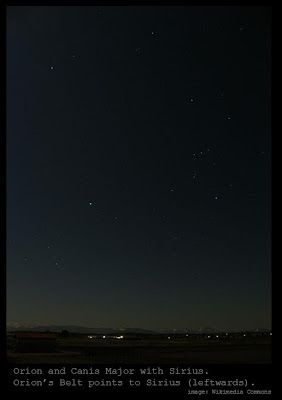
If possible, be sure to rise early this week and look for the brilliant star Sirius before the sunrise, low in sky by the eastern horizon. Look for Orion and use the belt, drawing a line through the belt stars towards the horizon. The image at the top of this post shows Orion and Sirius to the left of the belt stars -- in the morning, when Orion is just rising, the constellation will be oriented more horizontally than pictured above (to orient the picture above the way you will see it in the sky before dawn, just mentally rotate the image above counterclockwise almost a quarter turn, for viewers in the northern hemisphere).