Mystery Hill, New Hampshire


In the previous post, we discussed some aspects of the mysterious stone structures found in the Americas which must be added to the other varied forms of evidence pointing to the possibility that ancient civilizations could and did cross the oceans.

While conventional archaeologists and historians generally insist that these stone sites were the product of colonial European settlers (at the earliest), the astronomical alignments of many of these sites argues strongly against a colonial European origin. The conventional view is that these are nothing more than "root cellars" built by early European settlers to store their root crops, or perhaps to keep their beer cool or to dry out sheep hides for vellum in some cases. When site after site is shown to contain astronomical alignments, however, it is more and more difficult to make the case that these alignments are simply coincidental.

The alignments at a site called Mystery Hill in New Hampshire contains numerous such alignments and provides further evidence that these stone sites of New England may have been Celtic or Phoenician (or even Minoan) in origin.

First reported in 1826, the stone structures were found on a broad hill that had not been previously used by colonial settlers. The site contains numerous stone chambers and structures, including some which incorporate very large slabs, and one very large flat stone with a deep groove carved all the way around its perimeter -- presumably a task which would take significant time and effort.

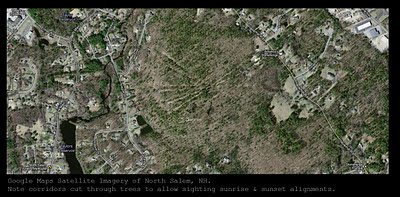
Perhaps most interesting, however, was the discovery of large, irregular standing stones among the many stone walls criss-crossing the site -- standing stones that observers in the 1960s began to suspect might have indicated significant astronomical events, such as solstice sunrises or sunsets. Beginning in 1970, these suspicions were confirmed, and now it is clear that the large angular standing stones positioned around the central structures on Mystery Hill indicate the rising points of the summer solstice sun, the equinoctial sun, and the winter solstice sun, as well as the setting points of the summer solstice sun, the equinoctial sun, and the winter solstice sun. Further, there is a standing stone which indicates true north from the central location as well.

This feature of Mystery Hill raises the possibility that at least some of the innumerable stone walls that are found all over New England predated the colonial settlers as well, and may have astronomical significance.

Those who dismiss Mystery Hill as a hoax, perhaps the product of early twentieth-century eccentrics who wanted attention, as some have suggested, must explain why those fraudsters did not point out these solstitial and equinoctial alignments if they created them, and why those alignments were not discovered until the 1970s.

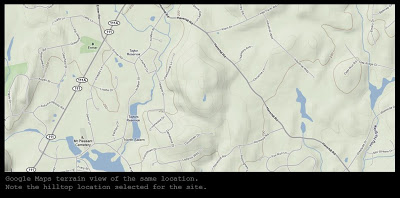
If it is argued that laborers in the 1970s erected these stones (which nobody has suggested, since the site had been well known for too long by that point in time), it can be pointed out that Mystery Hill was constructed on the best vantage point in the area for such a solar observatory (see terrain map below) and it stretches credulity to suggest that one set of pranksters created structures in the exact point that would work best for astronomical observations, and that seventy or a hundred years later some other set of pranksters took advantage of that fact by erecting stones that would mark such observations. Besides, tree stumps with roots that go down through some of the structures were found to antedate 1826, demonstrating that they were not made by anybody after that time. Carbon dating of charcoal and other organic material found around the site indicates the probability that the stone structures were put together much earlier than that -- perhaps hundreds or even thousands of years BC.


The astronomical alignments present at Mystery Hill can be seen in the diagram on the final page of the Tour Guide Map available at the site and on the "America's Stonehenge" website (the owners of the property renamed Mystery Hill "America's Stonehenge" in 1982). Studying the descriptions of the astronomical alignments on that fourth and final page should convince the reader that the alignments at Mystery Hill are authentic and that they were not created by modern fraudsters. An examination of the standing stones themselves clearly indicates that they were not brought there in the 1970s. Many have modifications which enable a more accurate observation of the rising or setting sun, such as a "gunsight" V-notch in their upper edge, or a shallow scoop in their upper edge into which the sun would settle, or distinctive fingerlike points in their uppermost corner. These features were not carved recently, as the stones are now of a uniform color and often overgrown with various lichens.

A visit to Mystery Hill to see it for yourself is well worthwhile. On the solstices, equinoxes, and cross-quarter days, the site is open until sunset to enable solar observations (open sunrise to sunset on the solstices and equinoxes).

Gungywamp


In previous posts, we have discussed the extensive evidence which strongly supports (we might almost say "clearly confirms") the theory that ancient civilizations were capable of crossing the Atlantic and Pacific Oceans and that members of ancient civilizations from Europe, Africa, and Asia carried on extensive contact with the Americas and probably lived there as well.

This evidence comes in many widely varying forms, which makes it more difficult to attribute to wishful thinking or to later forgery. Some of the evidence is in the form of clear mythological parallels in mythologies from cultures separated by the oceans, parallels that are very difficult to attribute to coincidental development in complete isolation (see for example here and here).

Some of the evidence is in the form of archaeological connections between massive structures such as pyramids (discussed for example in this blog post).

Some of the evidence is in the form of sculptures accurately and artistically depicting individuals of ethnic types that should not have been known in the Americas according to conventional theories (see for example here and here -- and there are so many more that this form of evidence becomes very difficult to ignore or to explain with the ridiculous assertion that these sculptures were simply artistic flights of fancy that accidentally resembled men the artists knew nothing of and had never seen).

Some of the evidence is in the form of writing systems that are known to have been used in the Old World which appear to show up in the New World (see here and here).

Some of the evidence is in the form of human remains -- perhaps the most difficult type of evidence to explain away, and a type of evidence that certainly cannot be attributed to forgery (see for example the discussions in this post and in this post).

Yet another form of evidence, very different from the most of the above examples, comes in the form of stone chambers, stone circles, and stone markers found in the Americas which parallel very closely similar stone structures built in Europe and typically associated with the Celts and the Druids. We have touched on the existence of such North American stone monuments previously, in posts such as "Magnetic polarity at Avebury Henge" and "What are cross-quarter days?"

There are literally hundreds of these in North America, including many in the United States, many of which are discussed (with photographs) in America BC: Ancient Settlers in the New World, by Barry Fell.

One of these fascinating sites is Gungywamp, located in Connecticut. The term itself (which almost sounds like something out of Australia, but which is apparently Native American in origin) is pronounced with the initial "g" hard and the second "g" soft. Barry Fell spells it "Gunjiwaump" in the caption to a photograph from the site on page 201 of his book, and his index (which may have been prepared by a different person) spells the word "Gunjiwomp," both of which more closely indicate the spoken pronunciation. Locals in the area seem to pronounce the final syllable more like "wump," although this may have something to do with the typical northeastern accent (my good friend and West Point classmate from Boston refers to the fast-food restaurant Popeye's as "Pup-eye's," which sounds very strange but which is linguistically identical to the pronunciation of "Gungywamp" as "Gungy-wump").

Because there is no instrument known today which can be pointed at a stone structure and tell us when the stones were placed on top of one another, the origins of the structures at Gungywamp remain a mystery and a controversy. It is quite certain that their construction resembles that used in Celtic stone chambers found in Europe and the British Isles. Also, the existence of celestial alignments tends to argue against the conventional explanation that the stone structures found in the northeastern United States are all colonial constructions meant to house vegetables, beer, or sheepskins. It is certainly possible that colonial beer cellars could accidentally line up with celestial events, but the fact that time after time these chambers are found to contain celestial alignments (chambers built in widely varying locations) argues against coincidence.

At Gungywamp, for example, there is a magnificent chamber mound -- pictured above -- known as the "Calendar Chamber," the entrance to which is oriented to the east and which contains a "light-box" or stone-framed aperture in the rear which admits the light of the setting sun on the afternoon of the equinoxes. The square of light which enters the chamber on those days illuminates a distinctive recessed side chamber (which is small and low to the ground on the right when you enter the Calendar Chamber).

Like the much larger passage mounds of the Boyne River Valley in Ireland which were described by Martin Brennan in his must-read book The Stars and the Stones, the Calendar Chamber is covered with dirt (and is almost invisible from any angle except from the front). The ceiling slabs are massive and completely flat on the bottom, and they span the entire distance from wall to wall, fitted together with an impressive degree of skill. Some excellent diagrams and drawings of the Calendar Chamber can be found on the "Gungywamp Virtual Tour" website, towards the bottom of the long web page.

A nearby chamber, much smaller, apparently was not discovered until fairly recently in 1950, when a hurricane knocked down a tree, exposing the entrance to the chamber which had been buried beneath the roots. This chamber, referred to by some authors as "The Tomb" and by others as "The Ice House" (under the theory that it was meant to keep beer cool) faces to the south. The descending afternoon sun can be seen between the trees in the photograph below, taken on the 2nd of October 2011 and thus about nine days after equinox. The beams from this descending sun are heading towards the light-box aperture of the Calendar Chamber, which is located only 30 or 40 feet to the east of this smaller chamber.


Like the Calendar Chamber, this smaller chamber has impressively large slabs forming the roof, and the stone which forms the inward-leaning right wall is also quite large and probably weighs at least 500 pounds.

Near both this small chamber and the Calendar Chamber is a beautiful and justifiably famous stone circle, an image of which can be found on Wikipedia and another photograph of which can be found in Barry Fell's America BC. It is uphill and north of the smaller chamber, and it is west and a little north of the Calendar Chamber. Below is a photograph of the stone circle taken from the south looking to the north.


It is indeed possible, and in fact highly likely judging by the similarity to ancient Celtic sites in Europe, that Gungywamp is very ancient and possibly important evidence of ancient trans-Atlantic contact. By any estimation, it is a true "world heritage site" containing historic evidence of bygone cultures which should be respected and preserved.

Sadly, like so many of the stone structures scattered throughout North America, it is not protected and is subject to desecration at the hands of vandals. When one sees the garbage left there, and the evidence of campfires right among the ancient stones, the secrecy that surrounds the exact directions to this archaeological treasure becomes understandable.

The fact that the academic and conventional historical community stubbornly refuses to consider any explanation for these sites that includes ancient civilizations from other continents dooms these areas to obscurity and discourages their examination by large numbers of talented thinkers who might otherwise contribute some valuable perspectives to their study. Even though there are many such sites that have been photographed and written about, there are no doubt many more which are unreported by landowners who see no benefit to talking about them, but who see several disadvantages to doing so (especially when reporting their existence invites disrespectful trespassers who deface the ancient sites and leave their junk and charred firepits all over the area). It is also a sad reality that many of these ancient stone sites have no doubt been dismantled over the centuries to furnish materials to build other structures, to clear farmland or grazing land, or simply to get them out of the way.

The cavalier treatment these important sites have received from an academic and archaeological community that jeers at any explanations other than the approved solution is a true disservice to those who wish to pursue the truth. Typical of the dismissal that alternative explanations receive are the disclaimers on the website of the Gungywamp Society, which declares:
Also, there is NO evidence within any part of the Gungywamp area that there was ever any pre-Columbian Celtic or Norse (Viking) occupation. No Ogham or Celtic inscriptions in stone nor any European Bronze Age artifacts have ever been found in the Gungywamp area. There are no "ancient Indian stone temples" in the Gungywamp area since it is a well known fact that nomadic and semi-nomadic Native Americans in the region did not construct temples of hewn or field stone (the colonial and Early American stone foundations, mill site, stone chambers, etc., in the Gungywamp area are not "ancient Indian stone temples"). All artifact and document research gives evidence of only paleo and woodland Native American, European colonial and European post-colonial/Early American occupation. With this in mind, please do not request a tour asking volunteer tour guides to show you the "ancient Celtic, Norse, Egyptian, Phoenician, UFO," etc. sites or "ancient Native American stone temple sites" because these do not exist in the Gungywamp area. (emphasis in the original).
While it is certainly possible that the authors of the above sentences don't actually believe their own statements but instead are mainly trying to discourage visits from those who might leave the Gungywamp site in worse condition than they found it, if that is the intent, I would venture to guess that such statements probably do little to discourage those who vandalize and damage the place.


If, however, those pronouncements represent the true feelings of the Gungywamp Society, which calls itself an "educational research organization," then it is sad that they are so close-minded and so ready to slam the door on valid possibilities such as ancient Celtic or Phoenician presence on these shores, when it is quite obvious that nobody has proven anything about the origin of the structures at Gungywamp and the hundreds of other such sites in the New World.

In this situation it is perhaps appropriate to close by repeating the quotation by Edgar Smith Craighill Handy, cited approvingly by Thor Heyerdahl in 1953: "There is such a variety of possibilities open in the matter of relationships and derivations that my own feeling is that there is only one sure way of being in the wrong, and that is by asserting dogmatically what is not true" (cited in American Indians in the Pacific 8).


Reflections after a 20-year reunion


As we have noted in previous discussions, the authors of the 1997 text The Fourth Turning argue for a more cyclical approach to studying history in contrast to the very linear and progressive approach that dominates much of what is ingrained in our thinking from grade school upwards ("progressive" in that we are generally given a picture in which progress is seen as a given and the whole sweep of human history is painted as a slow and fairly steady climb from primitive to modern, with us at the top).

I am sympathetic to this argument because I have argued that the linear approach to history may well turn out to be both wrong and dangerous (see for instance the discussions in this previous post and this previous post), and because I believe this linear approach is a byproduct of the cult-like Darwinian mentality which crept into nearly every branch of academic inquiry beginning in the late 1800s and tainted almost every model that was adopted from that time forward (including the geological models that we take for granted today).

Note that the authors of the Fourth Turning do not assert that they are against Darwinism or that they believe there were extremely advanced ancient civilizations -- these are positions asserted in this blog and in the Mathisen Corollary book -- but the work that they have done detailing cycles and asserting the validity of a more cyclical approach to history and the dangers in the dominant linear and progressive approach opens up valuable new perspectives for those who are interested in the subjects treated in the Mathisen Corollary.

In their book, authors William Strauss and Neil Howe explain that there is a connection between the four generational patterns that they find recurring throughout the ages and what they call the "saecular rhythm of alternating Crises and Awakenings" that they find repeating roughly every 100 years (Strauss and Howe, 70).

The authors note that roughly every hundred years, a pattern of four stages tends to play itself out between Crisis and Awakening, with a post-Crisis and post-Awakening period after each Crisis and Awakening. They observe that every fifty years or so, a world-defining Crisis tends to erupt, in which the direction and even the very existence of a civilization is challenged. They identify World War II as the most recent of these, and note that based on their research we are about due for another one (which they predicted would arise between 2005 and 2025).

Conversely, they identify the opposite of a Crisis as an "Awakening," and identify the period of the 1960s and 1970s as the most recent of these (we have discussed some of the musical artists who were influential during that period, and also noted that the concept of the "Age of Aquarius" is of course directly related to the precession of the equinoxes, which is explained in numerous previous posts such as this one).

To complete the four cycles, the authors identify two "shadow" periods after a Crisis and after an Awakening. After each Crisis there is a post-Crisis "high" which tends to set the stage for the next Awakening, and after each Awakening there is a post-Awakening "unraveling" which tends to set up a Crisis.

Connected to this cyclical pendulum swing between Crisis and Awakening, according to Strauss and Howe, is a cycle of generations which are profoundly impacted by their experience and stage of life during the Crisis or the Awakening. For example, one generation is below the age of twenty during a Crisis, and will be shaped by watching it from the general vantage point of childhood -- think of those too young to fight during World War II, for instance (of course, many fought as young as sixteen during that conflict, but these are general age groupings, not hard and fast lines). Another group was in their prime years of young adulthood (roughly from 21 to 41) during World War II and were thus shaped quite differently by the experience. Those between the ages of 42 and 62 are generally at a different stage of life -- they are generally directing the efforts of those young adults in the generation behind them, since those between 42 and 62 are in the years in which they generally hold the reins of power.

During the years after the Crisis was resolved, these generations would continue to exhibit the traits that were stamped upon them during the Crisis itself, so that those who had been between the ages of 21 and 41 during the Crisis generally exhibited patterns that the authors of the Fourth Turning call the Hero generation, while the generation that was basically in childhood during the Crisis exhibit a pattern that they call the Artist generation.

After the Crisis is resolved, there will be a saecular "high" period for those who are flush with victory, and the children of this period will tend to grow into a generational pattern that Strauss and Howe call the Prophet generation -- this is the generation that will come of age during the next Awakening period, and corresponds to the Baby Boom generation that was born after World War II. During the Awakening period (two turnings after the Crisis), those who were the Hero generation in their 20s and 30s in the Crisis have moved into what Strauss and Howe call "elderhood" (roughly ages 63 - 83) and a new generation that is twenty and younger during the Awakening (old enough to observe it without participating in it directly) arises which Strauss and Howe call the Nomad generation (corresponding to "Generation X" after the Baby Boomers).

When this Lost Generation begins to enter young adulthood (ages 21 to 41) and the generation that was in young adulthood during the Awakening moves into positions of power and world leadership, there is a period that Strauss and Howe call an "unraveling" which precedes the next Crisis. According to Strauss and Howe, this was the period that we have been moving out of and the end of the unraveling is characterized by intense discontent, distrust of institutions, pessimism and lack of confidence -- all of which describes the present time quite accurately.

In the image above, I have attempted to illustrate the interconnected cycle-patterns that Strauss and Howe describe using an image of an old "Monstrance clock" or "mirror clock" from the 1500s, which had two interconnected dials to indicate the time. We can think of the upper dial in this illustration as showing the "saecular" cycles that Strauss and Howe identify (they use the term and the spelling to indicate a period of roughly a hundred years, and note that this concept goes back to the ancients). We see that this dial moves from a Crisis to a post-Crisis period (Strauss and Howe call this period a "high") and then into an Awakening followed by a post-Awakening period (Strauss and Howe call this an "unraveling").

Meanwhile, each of us has a dial that corresponds to our own stage of life, during which we generally fall into different roles as we move from childhood (ages 0 - 20) to young adulthood (21 - 41) to midlife (42 - 62) to what Strauss and Howe call "elderhood" (ages 63 - 83). If we were in childhood during an Awakening, we will be in young adulthood during the post-Awakening period (which ends with a great unraveling and ushers in a Crisis). Those who were in young adulthood during this unraveling move into positions of greatest power during the Crisis itself (the generals in World War II were mainly in young adulthood during the Roaring Twenties and early 1930s). Those who were in childhood during the post-Awakening (or "unraveling") become the Hero generation of the Crisis, when they are in the period of young adulthood from about 21 to 41.

We can see what Strauss and Howe mean more clearly by thinking of specific individuals who have lived through these different periods during the past 100 years of history, such as John F. Kennedy, who was in the Hero generation that served as the fighters during World War II (ages 21 to 41 during that conflict) and then moved into positions of primary leadership during the post-Crisis "high."

I recently had an opportunity to reflect on this entire model of cycles as I attended the twentieth reunion of the graduating West Point Class of 1991 (which explains the lack of posts over the past several days). In the brass clock pictured above, a twenty-year reunion for a West Point class falls pretty close to the point at which the marker is moving from young adulthood (ages 21 - 41) to midlife (ages 42 - 62) in the stages identified by Strauss and Howe. Returning to the familiar landscape of West Point provides the chance to "turn the dial back" twenty years and consider things that were said and done at the entry to young adulthood, and to perceive just how different one is at 41 or 42 from the person who was doing and saying those things at the age of 21 or 22.

Meanwhile, it is sobering to consider just how the upper dial has moved from where it stood in the years my class was at West Point (from 1987 to 1991). At that time, the cycle that Strauss and Howe believe is ending now was just getting underway. The first members of the Baby Boom generation were just preparing to enter the positions of greatest power on the world stage (for example, Bill Clinton became the first member of the Baby Boom generation to become the President of the United States during the election of 1992).

According to Strauss and Howe, the same twenty years that have moved my West Point class to the beginning of a new stage of life have also moved the upper dial to the brink of a new saecular turning, which they predict will be a Crisis.

Thoughts on the winged man of Uppaakra


Recently, an excellently preserved and exquisitely detailed find from the archaeological site in Uppaakra, Sweden was unearthed. Photographs of the unique artifact reveal a man with a pointed beard and beautiful wings -- which he is grasping with his hands -- and a bird-like fan-tail between his outstretched legs.

Hat tip to Swedish archaeologist Dr. Martin Rundkvist for posting some fantastic images and discussion of the artifact on his blog, Aardvarchaeology (especially for those of us who don't speak Swedish).

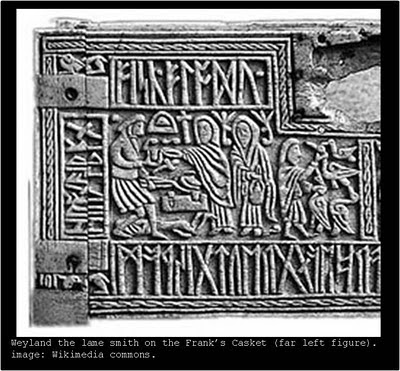
Dr. Rundkvist points out that the winged man is unlikely to represent a Christian angel, as the period of its archaeological context predates Christian influence in the area. He notes that Norse mythology does offer the connection of either Freya and her falcon cloak or Weyland the Smith, who was such an accomplished artificer that he was able to fashion wings using the feathers of birds to escape his torment and imprisonment in some of the stories surrounding the episodes of his life.

Dr. Rundkvist finds the Weyland connection to be especially compelling, and it is noteworthy that the authors of Hamlet's Mill spend a good deal of time discussing the importance of smiths such as Weyland in their text. Often, a godlike smith will be described in ancient myth as being lame or crippled in the legs or feet -- the most familiar example to most readers being Hephaestos or Vulcan from Greek or Roman mythology. Weyland the Smith, however, was also lame in his legs, having been deliberately hamstrung by his cruel captor and forced to craft items at his forge for his tormentors. He later escapes by fashioning wings and flying away.

In Hamlet's Mill, as we have discussed many times previously, the thesis is put forward (with extensive supporting evidence from myth around the world) that these myths encode sophisticated astronomical understanding by ancient civilizations, often pertaining to the precession of the equinoxes.

The concept of a creator deity who is lame fits in with the delay in the appearance of Orion (in particular -- a constellation associated with Osiris in ancient Egypt, who was drowned and also mutilated by his brother Set) which is caused by precession. Each year, constellations near the plane of the ecliptic should appear above the horizon for the first time when the earth is in the same spot on its annual orbit. However, due to precession, this annual first appearance is delayed by a tiny amount (by only one degree per 71.6 years). This delay can be metaphorically likened to being "held down below the horizon" (or drowned, as Osiris is drowned), or it can be metaphorically likened to delay due to being hamstrung or lamed in the feet.

Note that Osiris is avenged for the wrongs done to him by his son, Horus -- the falcon god. This suggests a connection to Freya and his falcon suit which Dr. Rundkvist mentions! Weyland is also avenged of his wrongs and rises above his torment in the wings that he forges.

That these Norse and ancient Egyptian myths are parallel and related to precession is discussed by Jane Sellers in her outstanding discussion of the subject in Death of Gods in Ancient Egypt (in which she follows Giorgio de Santillana and Hertha von Dechend's assertions in Hamlet's Mill, while going further and adding many new insights of her own). She writes:
My neglect in naming Orion forger of a new Mill must be forgiven. He can be likened to the Anglo-Saxon hero, Wayland Smith, described in myths as wearing a shortish kilt that showed his lameness. In illustrations Wayland's left hand grasps a pair of tongs and his right is outstretched to two females who face him. He was said to own a wondrous sword -- and he, like Osiris, was made to go into exile. Wayland's banishment was considered by him as a wrong done to him which he avenged by cutting off the heads of the King's two sons. Then he 'rose in the air on wings he had made.'

This is just one of many stories that could be recalled as the dual concerns of precession and eclipse is insisted upon. There are many lame heroes, and more than a few blind Samsons, who bring the old Mill down. But at least one time, in the story of a young herdsman of Phrygia, the hero lost his maleness, which recalls the story of Isis collecting the scattered pieces of Osiris's cut up body, finding all but his sexual organs. I would hazard a guess that it was the two testicles that the tellers of the tales had in mind. There are even references to a lame Egyptian god. Plutarch wrote that Harpocrates, (Horus), the son of Osiris and Isis, conceived after Osiris's death, was 'weak in his lower limbs.' Spell 168 of the Book of the Dead has a veiled allusion to 'what is written concerning the legs of Osiris.' 199-200.

A final thought that may be helpful in the interpretation of this amazing new artifact of the winged man is the fact that in shaman traditions around the world, the shaman is usually able to take on the form of a bird in order to ascend through the nine worlds (note that Norse mythology also has nine worlds -- we discussed the probable origin of the number nine for celestial worlds in this previous post).

The shaman was sometimes depicted as having wings -- more commonly, as having fringes or tassels on his or her garments, even in rock art, which represented and suggested wings and the power of flight. These long fringes are very familiar to most of us from the fringed shirts and other garments of Native American Indians (such as in the Nez Perce shirt below, circa 1820).


These observations are not mutually exclusive -- in other words, the possibility that the winged man of Uppaakra may be related to Weyland and to shamanism are not two distinct possibilities. We have already seen that the shamanic tradition appears to reflect and preserve many aspects of the same cosmological and spiritual beliefs encoded in ancient Egyptian "mythology" (the same ancient Egyptian mythology that is clearly connected to Norse mythology and to the stories of Weyland the Smith and perhaps to Freya and her falcon cloak as well).

All of these threads should be carefully considered by those who are now examining the startling new artifact of the winged man unearthed at Upppaarka in Sweden.


Neutrinos, the speed of light, and the Big Bang theory


On Friday, representatives from an international team of 160 physicists announced to the world the results of experiments conducted at the CERN particle accelerator in which neutrinos launched from Geneva, Switzerland arrived at a cavern underneath Gran Sasso, Italy -- 454 miles away -- faster than a beam of light would have.

This result was so shocking and unbelievable that the physicists conducted over 15,000 tests for about six months to verify their results, and even after all that they still don't believe it. In announcing these anomalous findings to the physics community, they explicitly invited the help of any and all comers to discover what they could have done wrong. Even after extensive testing, they are far more ready to admit that they must be overlooking something, anything, than to admit that anything in the universe can travel faster than the speed of light.

The assumption that the speed of light is a constant, and that nothing can travel faster than the speed of light, is an absolutely foundational concept for modern physics and the understanding of the universe. The implications of this discovery, if it proves to be correct and not the result of some kind of error or oversight, are enormous. Some recent articles describing the consternation of the physics community (as well as describing the experiments that led to Friday's announcement) can be found here: New York Times, Wall Street Journal 1, Wall Street Journal 2.

Not only does the possibility that neutrinos can travel faster than light throw modern physics (and Einstein's theory of relativity) into disarray, but it also has implications for the assumptions and models that gave rise to the Big Bang theory for the origin of the universe. As explained in the first Wall Street Journal report on Friday's announcement (linked above), "The light-speed notion is also partly the basis for Einstein's theory of gravity. That, in turn, is the starting point for existing theories about how the universe evolved."

That article cites physicist Dr. Neil Turok, director of the Perimeter Institute for Theoretical Physics in Ontario, Canada, as saying about this neutrino speed record: "It would be the biggest physics discovery in a century because we'd have to completely revise everything from subatomic physics to what we know about how the universe evolved." Dr. Turok (like most physicists not involved in the original experiments themselves) is skeptical of the findings.

That article also points out, however, that scientists at the Fermilab in Illinois apparently clocked neutrinos traveling faster than the speed of light in research a few years ago. Those experiments, however, were "below the threshold of precision needed for making a scientific claim," according to Dr. Robert Plunkett, who was involved in that earlier work and who will now go back to revisit the results. The more recent CERN experiment was not below the necessary "threshold of precision."

One of the first to point out the stunning implications of this new research for the prevailing theory of the Big Bang (which itself is a central dogma in the prevailing cult of Darwinism that currently dominates most of Western academia) is international social reformer Vishal Mangalwadi, who with his wife has labored since 1976 for the empowerment and liberation of the peasants and lower castes of India. In an email yesterday entitled "Will the 'Big Bang' Theory Blow Up Now?" he points out that the assumption that nothing could travel faster than the speed of light in a vacuum was "one of the bases for calculating the age of the universe to be 13.7 billion years," and that:
The new observations – if confirmed – will send the scientific community back to the drawing board. They will need to question their fundamental assumptions and only if one or more assumptions gain general acceptance they could re-start constructing models totally different than we have taken for granted for decades. Scientists may have to now slaughter sacred cows of the 20th century science.
In his groundbreaking work on the hydroplate theory, Dr. Walt Brown (a graduate of West Point and MIT) discusses several scientific reasons that the Big Bang theory may be flawed, none of which have to do with this startling new neutrino study (all of them published before this new possibility about the speed of light became public).

He points out that the evidence usually cited as "proving" the Big Bang has serious problems (including the famous "red shift" data, the Nobel-prize winning Cosmic Microwave Background Radiation data, and the data on the amount of helium in the universe). Further, he notes that although astrophysicists interpret this data as indicating that the Big Bang took place 13.7 billion years ago, the models of stellar evolution based on the Big Bang indicate that some stars in extremely distant galaxies would have to be at least 16 billion years old -- a finding which calls the entire model physicists are using into question.

He also points out that the Second Law of Thermodynamics (which so far has not been shown to have any flaws) would mean that the universe in the far distant past was more organized and more complex than it is today (since the Second Law -- the Law of Entropy -- states that everything tends to deteriorate and grow less organized rather than the reverse). It is contradictory to argue that the universe was more organized immediately after the Big Bang than it is today, and the Big Bang theory does not argue that it was, but if not then the Big Bang theory is in conflict with the Law of Entropy.

Dr. Brown suggests that:
Evolutionists can undoubtedly resolve these time contradictions—but at the cost of rejecting some cherished belief. Perhaps they will accept the possibility that light traveled much faster in the past. Measurements exist which support this revolutionary idea. [See page 377.]
In other words, even before this new possible finding from the neutrino experiment at CERN, Dr. Brown noted that the contradictions in the current scientific models regarding the origin of the universe suggest that the speed of light may not be a constant the way modern physics assumes that it is. Even if the recent findings about neutrino speeds are proven to be mistaken, the Big Bang theory still has king-sized problems.

The larger point to be taken from this specific series of CERN experiments is that the most cherished assumptions which undergird modern theories (many of which the defenders of orthodoxy declare are "proven," "settled science," "established fact," and things that we "know" -- such as the quotation above from Dr. Turok regarding "what we know about how the universe evolved") should be open to examination, experimentation, and possible revision. If this is true about something as supposedly settled as the speed of light, how much more so for the dogmatically held theories about mankind's ancient past, which are based on far less rigorous science?


The Gate of Cancer


The moon has been rising later and later (as it always does due to the mechanics explained in this previous post) and it will soon be overtaken again by the sun to create another new moon (on the morning of the 27th).

Over the next few mornings, it can be seen rising in the east before sunrise, and will be an important signpost that can help point the way to the planet Mars in the constellation Cancer near the constellation Leo in the predawn sky. To see an excellent diagram of the eastern horizon as it appears 90 minutes before sunrise, check out this link to Sky & Telescope's discussion of the celestial events through the 24th.

Note that the sun is now coming up later and later each morning, which should help you get up before the sun and get to a place where you can witness this predawn show (you don't have to rise quite as early as you did in the middle of summer in order to see the eastern constellations before the sun). Morning twilight is now beginning around 0626 and sunrise around 0651 for observers at latitude N 35°.

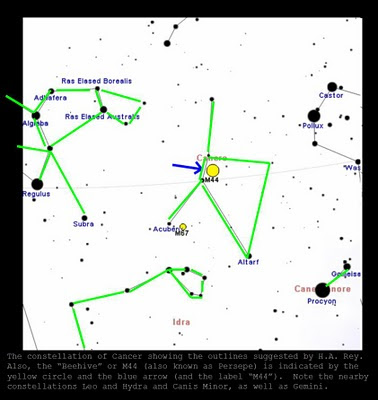
In the diagram from Sky & Telescope linked above, you will see that the moon helps point the way to Mars, and that the great constellation of Leo the Lion is rising up not far away. While not indicated on the diagram from Sky & Telescope, Mars itself is in the constellation of Cancer the Crab, the faintest of all the zodiac constellations. You can see where Cancer is situated in relation to Leo and to Hydra by looking at the illustration at the top of this post -- from that, you can go back to the Sky & Telescope illustration, which does depict both Leo and Hydra (note that Leo is rising upwards before sunrise, so that the illustration at the top of this blog post must be rotated counterclockwise in order to orient it to the predawn sky).

Cancer is very faint and difficult to make out, but if you get used to where it is located, then you can keep an eye out for it as it rises earlier and earlier and eventually marches through the wee hours of the morning. When it does so, you can use your binoculars to look for the Beehive cluster, marked in the illustration above. The Beehive is designated as Messier Object M44 by astronomers, and is also known by the Latin name Praesepe, or "the manger."

Giorgio de Santillana and Hertha von Dechend tell us in Hamlet's Mill that Cancer (which, as can be seen from the illustration above, is also near to the constellation Gemini) was thought of as the gate of one end of the Milky Way band (opposite to the Scorpion and Sagittarius, who guard the other end of the Milky Way).

They relate that the important ancient philosopher Macrobius (AD 395 - 423) provided a record of the ancient belief that the souls of the departed ascend into the Milky Way by way of the Scorpion and Sagittarius (and Capricorn, which is adjacent to Sagittarius), and that eventually, they descend again to be reborn through the "Gate of Cancer" (de Santillana and von Dechend, 242, citing Macrobius' commentary on the Dream of Scipio).

It is quite significant that the authors of Hamlet's Mill find this very same tradition preserved in various forms (all recognizable) among the Indians of North America and Central America as well as among the Maya, and also among the Polynesians (see 243-244).

The Milky Way is well worth viewing through binoculars and it is very visible now (especially with the moon mostly out of the way for late evening viewing). Then, in the morning, rise up early and bring your binoculars again to look for the stars of Cancer between Leo and Gemini and above Hydra, and take in the waning crescent moon and the planet Mars. With a little practice, this end of the Milky Way -- near the important the Gate of Cancer -- can become as familiar as the other side that is guarded by the Scorpion and Sagittarius.

The equinox and the plane of the ecliptic


The earth is approaching the point on its orbit known as the September equinox (autumnal equinox for observers in the northern hemisphere, where it is autumn, although it is spring in the southern hemisphere).

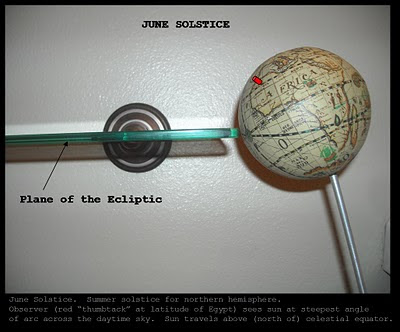
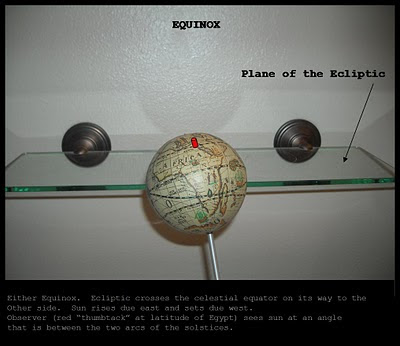
The diagram above is an attempt to diagram the cause of the solstices and equinoxes a little differently than they are usually shown. The horizontal glass plate represents the "plane of the ecliptic" -- that is, the plane upon which the orbit of the earth takes place around the sun. Imagine the sun as being to the left on this image.

Note that the sun itself will trace out a path across the daytime sky along this plane, but it will not be "horizontal" to an observer on earth. To understand why, take a look at the above diagram, in which an observer is represented by a red "thumbtack" pushed into the earth (OK, it's a low-tech computer generated thumbtack). To this observer, the sun will actually arc high across the sky, but always at an angle less than 90 degrees, and tilted towards the southern horizon.

The earth in the image above is at the June solstice, so the north pole is aligned towards the sun (as directly "pointed at" the sun as it ever gets). Note that the antique-style globe in the image has an equator depicted -- this equator can be projected into the celestial sphere to give the "celestial equator" (90 degrees from the celestial north pole -- for more discussion of the celestial sphere, re-visit the web pages of the Polynesian Voyaging Society and the blog post here). During the day (looking towards the plate of glass in the photo above from the observer's red thumbtack on the globe) the sun will be above the celestial equator, but at night (looking out into space toward the right in the photo) the ecliptic path (which the planets generally follow as well, since they are orbiting the sun very close to this same plane of glass) will be below the celestial equator.

In the image below, the globe is shown at the position of the December solstice, and now the north pole is pointed left and the sun would be located to the right of the photo (along the plate of glass or "plane of the ecliptic").


Notice that our observer is still represented by a red "thumbtack" pushed in to the same latitude (the latitude of Egypt, home of those ancient celestial observers). Look at how much shallower the path of the sun will be across the daytime sky for this observer. It will be much closer to his southern horizon. It will cross the sky south of the celestial equator -- it will follow a path between the celestial equator and the southern horizon. Note that at night, when the earth rotates our little red observer to the left and he gazes left into the night sky (away from the sun) he will see that the ecliptic path of the planets and zodiac constellations is actually above the celestial equator (towards the north celestial pole).

These two diagrams should help to illuminate the reason that the sun's arc does not remain at the same tilt throughout the year -- if the sun's arc were a rainbow, the rainbow would be tilted at a steeper angle through the sky on the summer solstice and at a much shallower angle (tilted way more towards the horizon) on the winter solstice. This fact was depicted in a diagram from a post back on the time of the June solstice this year (that diagram is reproduced again below).


Armed with this understanding, we can now understand that the equinoxes take place when the earth is going around the plane of glass in the diagrams and the sun is "broadsides" to the earth (if the earth were a ship and the north and south poles were the bow and the stern, the ship would be going past the sun such that the sun was directly off the starboard or larboard side). Because of this, as the earth rotates, the sun will rise precisely in the east and as it continues to rotate the sun will set precisely in the west. The diagram below shows the earth going by the sun on an equinox -- think of it as a ship if that helps.


Naturally, if the sun moves in an arc through the daytime sky that is north of the celestial equator on the June solstice (in the northern hemisphere) and south of the celestial equator on the December solstice (in the northern hemisphere), then at some point the sun's daily path must cross the celestial equator. This event takes place twice each year on the equinoxes. For observers in the northern hemisphere, the September or autumnal equinox is the day the ecliptic crosses the celestial equator from the north to the south, on its way to the December or winter solstice. Likewise, the June or spring equinox for the northern hemisphere is the day the ecliptic crosses back from the south to the north of the celestial equator.

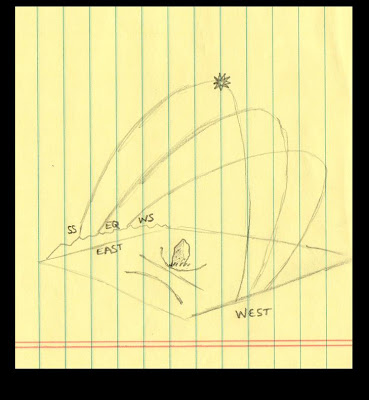
In the yellow notepad drawing above, note that the sunrise points move to the north and to the south during the year, reaching the northernmost rising point on the summer solstice (marked "SS" in the drawing) and the southernmost rising point on the winter solstice (marked "WS"). On the equinoxes, the sun's rising coincides with the point that the circle of the celestial equator strikes the horizon -- due east. From the autumn equinox, the sun's rising point will then continue to march south towards the winter solstice rising point further south along the eastern horizon.

This year, the ecliptic crosses the celestial equator on the morning of September 23 (the date is a function of the Gregorian calendar, so the date shifts a bit from one year to the next until the next leap year keeps the dates from drifting too far).

Considering the plane of the ecliptic helps give a greater understanding of the mechanics of the solstices and the equinoxes.