Capella, precession, and the end of the Golden Age


In the previous post, we discussed a method for locating the constellation Auriga the Charioteer in the sky, as well as his connection to the myth of Phaethon. We also cited the authors of Hamlet's Mill concerning the deep importance of this myth, and its apparent connection with the end of the mythical "Golden Age" that appears in so many legends around the world.

The passages cited may be a little mysterious (it often seems as though the authors of Hamlet's Mill are deliberately mysterious), so a little more elaboration may perhaps be in order.

In Chapter XIX, Giorgio de Santillana and Hertha von Dechend devote an entire chapter to the myth of Phaethon and its importance. They explain that the myth of Phaethon is clearly connected to the Milky Way, and they cite many ancient poets who explain that the dusty white path of the Milky Way across the sky represents the "burned over" region made by Phaethon in his rash and disastrous attempt to drive the Chariot of the Sun.

In the passages which follow, keep in mind that the term "the Galaxy" is used interchangeably with the more familiar term "the Milky Way" to indicate the visible phenomenon we see from our vantage point on earth as we look "edge-on" at the galaxy we live in, which at night is seen as that visible glowing white band guarded by Scorpio and Sagittarius on one end, and Gemini and Cancer on the other, as we discuss in this previous post and this previous post.

On page 258, they tell us "The Galaxy was and remains the belt connecting North and South, above and below." As we saw in those two previous posts, this path was linked in many cultures to the way between the realm of the living and the dead (with the South representing the world of the dead, and the souls of the dead going to the realm of Scorpio to pass into the world of the dead, and coming out again to be reborn in the north). This is what de Santillana and von Dechend mean when they say "North and South, above and below."

The authors continue:
The Galaxy was and remains the belt connecting North and South, above and below. But in the Golden Age, when the vernal equinox was in Gemini, the autumnal equinox was in Sagittarius, the Milky Way had represented a visible equinoctial colure; a rather blurred one, to be true, but the celestial North and South were connected by this uninterrupted broad arch which intersected the ecliptic at its crossroads with the equator. The three great axes were united, the galactic avenue embracing the "three worlds" of the gods, the living and the dead. This "golden" situation was gone, and to Eridanus was bequeathed the galactial function of linking up the "inhabited world" with the abode of the dead in the (partly) invisible South. Auriga had to take over the northern obligations of the Galaxy, connecting the inhabited world with the region of the gods as well as possible. There was no longer a visible continuous bond fettering together immortals, living and dead: Kronos alone had lived among men in glorious peace. 258-259.
This is significant indeed, and the reader who has taken the time to locate Auriga as described in the previous post is now in a position to understand it, and a lot more besides. As shown in the diagram at top, the authors are referring to the Age of Gemini as the Golden Age, when the Galaxy or the visible Milky Way stretched from the constellation that had its heliacal rise on the spring equinox (Gemini) to the constellation that had its heliacal rise on the autumnal equinox (Sagittarius).

As can be seen from the rough sketch of the situation above, the sun is rising in Gemini on the Spring Equinox in the Golden Age, and Orion is rising as well (as we have seen, Orion is associated with Osiris and with the ruler of the Golden Age who retires beneath the waters).

The phenomenon of precession, however, delays the rising of the constellations over a very long period of time (over the course of an Age), as we have also discussed before. Over time, the preceding constellation in the zodiac will take over the heliacal rising on the spring equinox (hence the term "precession"). In this case, Taurus will take over from Gemini (you can clearly see in the diagram that Taurus precedes Gemini in the nightly turning of the constellations through the sky, as this diagram is looking east at the constellations rising, and Taurus is visible above Gemini; if you go out tonight and find them, you will discover that you can see Taurus rising long before Gemini rises into sight).

Below is an illustration of the Age of Taurus, when the sun is now rising in Taurus on the spring equinox instead of Gemini (which has been delayed -- held beneath the surface of the earth, metaphorically speaking).


Note that because of the position of the constellations in the sky, it is possible to see Auriga as "taking over" for Gemini, and to see Taurus as "taking over" from Orion (or rather, usurping Orion's position, as it was more often encoded in mythology). Strictly speaking, Taurus took over from Gemini, because the path of the ecliptic rises at an angle (an angle related to one's latitude, as discussed in this previous post). However, mythologically speaking, we find Auriga and Orion playing roles in the stories which the ancients used to preserve the record of this mighty shift from Gemini to Taurus.

De Santillana and von Dechend go further in presenting evidence that this celestial phenomenon is exactly what is being encoded in the myths surrounding Auriga. They delve into the mythological connections of Auriga's brightest star, Capella, which we mentioned in the previous post as being the sixth-brightest star in the entire sky (after Sirius, Canopus, alpha Centauri, Arcturus, and Vega).

They note that the name "Capella" means "female goat" or "she-goat" in Latin. As you can see from the nineteenth-century constellation diagram for Auriga shown below, Capella was associated with a she-goat, and the two small stars nearby (which H.A. Rey uses to form the very base of the nose of the Charioteer instead, using Capella pretty much as an eye) were thought of as her kids (and named Hoedus I and Hoedus II, which is Latin for a goat-kid).


What could this possibly have to do with the end of the Golden Age and the precessional shift from Gemini to Taurus? Well, bear in mind that this shift separated the equinoctial colure (there is much more on the colures, what they are and how they function, in the actual book the Mathisen Corollary) from the Milky Way, removing the pathway and ending the "golden" condition in which the realms were connected and gods and man dwelt in harmony, according to de Santillana and von Dechend.

They note that this famous star, named for a she-goat, is associated in mythology with none other than the remarkable goat Amaltheia, who nursed the infant Zeus in a cave on Mount Ida (where his mother Rhea hid him from Kronos, who was swallowing all his children), and out of whose skin the mighty Aegis worn by Zeus was later fashioned. From her two horns came Nectar and Ambrosia (the food of the gods).

The authors cite "two shreds of Orphic tradition which seem to be revealing, both handed down to us by Proclus" (259). This is what they say:
The first says that Demeter separated the food of the gods, splitting it up, as it were into a liquid and a solid "part," that is, into Ambrosia and Nectar. The second declares that Rhea became Demeter after she had borne Zeus. [. . .] Demeter, when she "arrived," split up the two kinds of divine food having its source in alpha Aurigae. In other words, it is possible that these traditions about Demeter refer to the decisive shifting of the equinoctial colure to alpha Aurigae. 259.
This is all de Santillana and von Dechend will say here, but the idea of "separating" is clearly related to the major shift in the heavens which they just described (which severed the equinoxes from the Galaxy arch). The transformation of Rhea into Demeter at the birth of Zeus could clearly be connected with the end of the reign of Kronos at the end of the Golden Age, which is one mythological encapsulation of the end of the Age of Gemini.

Thus, the constellation of Auriga is important indeed, as is its most prominent star, alpha Aurigae or Capella. It is important in conjunction with the other constellations close to it in the sky, most prominently Gemini, Taurus, and Orion.

It is also interesting to note as an aside that the concept of the "horn of plenty" or "cornucopia" that is associated with Thanksgiving in the United States probably has its origin in the horns of Amaltheia the miraculous she-goat.

It is also interesting, in light of the fact that the she-goat found in the constellation of the Charioteer has two kids, that the Norse god Thor drove a chariot pulled by two young goats.
The constellation Auriga and his importance in ancient myth


The constellation Auriga, "the Charioteer," is now prominent in the eastern sky after sundown, rising just after 6 pm and making his way upwards towards his transit (highest point) around 3 am, before beginning to arc downwards to the west. Thus, during all of the hours after sundown this important constellation can be easily located just below Perseus, with excellent viewing anytime after 8pm as he climbs through the sky (the sun is setting near 6 pm and twilight ends about a half hour later).

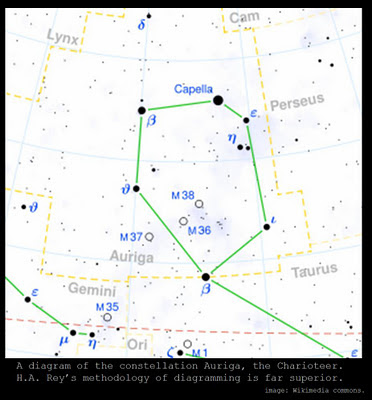
Unfortunately, diagrams like the one above won't be much help for those looking for Auriga if they are not already familiar with the constellation. The irregular hexagon depicted above using the stars of Auriga (and borrowing one from Taurus) is not a very intuitive way to search out a charioteer in the sky.

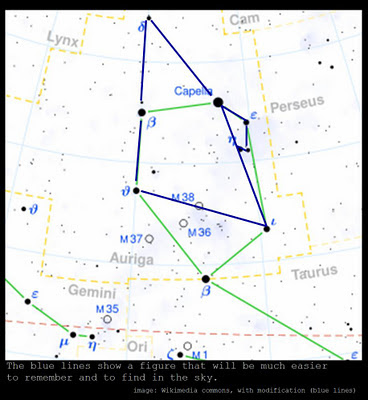
As usual, the more conceptual outline methodology of H.A. Rey will be much more useful in remembering what stars to look for when you are outside, and much more helpful in tracing out the stars of Auriga once you are actually looking at them. His diagram of the Charioteer looks more like the head of a lantern-jawed chariot-driver in profile, and can be seen in the diagram below, where his method of connecting the stars has been superimposed in blue lines:


Fortunately, the constellation Auriga is made up of fairly bright stars, and they form a pretty distinctive group in an area of the sky where they are quite easy to see. The trickiest part is the fact that one of the brighter stars of Taurus (beta Tauri, aka El Nath) is located so close to the stars of Auriga that it is easy to think it is part of the Charioteer (and indeed, the diagram at top uses beta Tauri as if it were part of Auriga). The discussion which follows should help clear up all confusion about this important constellation.

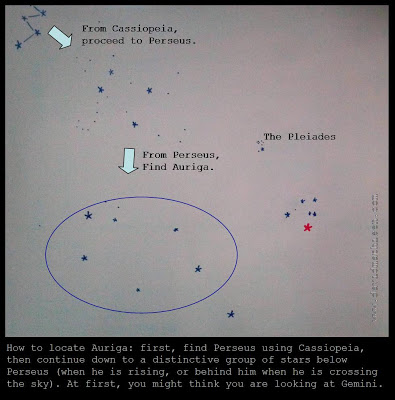
As Auriga is rising in the east, he can be seen below Perseus, who can be located using the distinctive "W" of Cassiopeia, as described in this previous post about the Pleiades (which are located near Perseus' lower foot as he rises). The diagram below shows the vicinity of Auriga, drawing a large circle around the most noticeable stars of Auriga, plus beta Tauri/El Nath (since when you first look for Auriga you will no doubt notice El Nath in the same glance):


Auriga's brightest star, Capella (alpha Aurigae), is one of the brightest in the sky (the sixth-brightest, in fact), and because it is adjacent to the constellation's second-brightest star, beta Aurigae, you can be excused for thinking you are looking at Gemini (the Twins) when first finding the stars of Auriga (especially since Gemini is actually nearby, still below the horizon in the diagram above but rising right below Auriga).

The trick to differentiating the stars of Auriga from the stars of Taurus, and thus the trick to "seeing" Auriga, is to recognize the two long "horns" of the Bull.


By finding the V-shaped or wedge-shaped cluster of the Hyades (shown in the diagram above -- it contains the brightest star in Taurus, reddish Aldebaran or alpha Tauri, marked above with an alpha and drawn in red) you will be able to see the unmistakable long horns of the Bull that are indicated by the stars beta and zeta Tauri (marked above with the Greek letters beta and zeta).

Once you have identified this portion of Taurus, you can easily distinguish between the stars of Taurus and the stars of Auriga, and trace out the Charioteer's profile (the star at the very peak of his triangular cap is very faint, but visible).

Auriga is an important constellation for the thesis of Hamlet's Mill. In chapter XIX, "The Fall of Phaethon," Hamlet's Mill authors Giorgio de Santillana and Hertha von Dechend explain that Auriga is associated with the extremely significant myth of Phaethon, the rash son of the sun-god Helios who asked to drive his father's chariot of the sun and could not be dissuaded despite the pleas of his father. When, in spite of all the advice Helios had given him, Phaethon lost control of the horses of the sun, the runaway chariot began to burn great swaths of earth, and Phaethon had to be destroyed by a thunderbolt from Zeus.

De Santillana and von Dechend explain, "Phaethon falls into the river Eridanus where, according to Apollonios Rhodios, the stench of his half-burned corpse made the Argonauts sick for several days when they came upon it in their travels (4.619-23)" (251-252). The connection with Eridanus is immortalized when Phaethon is placed among the stars: "Thus tradition holds that after the dreadful fall of Phaethon, and when order was re-established, Jupiter 'catasterized' Phaethon, that is, placed him among the stars, as Auriga (Greek Heniochos and Erichthonios); and at the same time Eridanus was catasterized" (255).

The authors show that the fall of Phaethon is so important because it is associated with the end of a world-age, the Golden Age presided over by Kronos/Saturn and his parallels in myths all over the world, and his fall is associated with the fall of Kronos/Saturn.

We have already seen that this lost Golden Age is associated with the precessional shifting of the celestial realm, and specifically with the transition from the Age of Gemini to the Age of Taurus -- see for instance the discussion in previous posts such as "Celestial imagery in the cave paintings of Lascaux," "Jupiter," "Don't miss Saturn this month," and "The conjunction of Jupiter and Saturn and the mythology of Saturnian figures such as Osiris, Ptah and the Oannes."

This connection makes Auriga an important constellation indeed. Further, de Santillana and von Dechend reveal that the same Phaethon myth seems to appear in the legends of the Native Americans of the New World, including a very clear parallel in the myths told by the Nuxalk nation of the area now known as British Columbia (de Santillana and von Dechend refer to them as the Bella Coola and discuss their version of the Phaethon legend on page 253). While it is remotely possible that the startlingly similar stories could have arisen in both the Old World and the New World, this parallel is another important clue that there was ancient contact with the Americas, denied by the conventional historical paradigm (see links to other such clues here).

For all these reasons, Auriga is well worth locating in the eastern sky as it rises this time of year (especially the next few days when the moon is low in the west before midnight on its way to setting, although it grows larger and fuller and sets later and later and becomes more and more dominant in the night sky as it approaches the full moon on November 10).

As an added bonus, the majestic constellation of Orion begins to rise around 9:30 pm and makes a truly awe-inspiring sight as he emerges from the horizon below the stars of Taurus shown in the diagram above.


Scary ghost story (West Point)


If you're looking for a spine-tingling ghost story for Halloween this year, look no further than the current issue of West Point magazine, published by the West Point Association of Graduates.

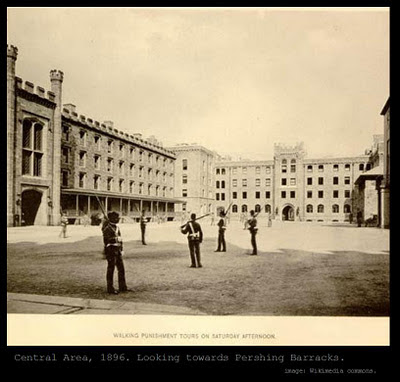
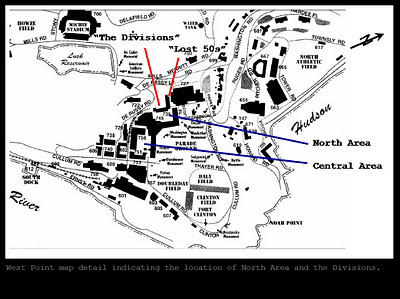
In a story entitled "Ghosts of West Point Past," found on pages 20 through 23, it describes the well-known story of paranormal events in the "47th Division," which every cadet hears from his classmates or upperclassmen ("The Divisions" are an older section of barracks, officially called "Scott Barracks" after General Winfield Scott, located on the west side of North Area facing east, and so named because they are designed with a single entrance leading to a series of vertical floors connected by a staircase with landings and rooms on each landing, so that each vertically-connected section is effectively divided-off from the others to its left and right; each division is numbered, and there is an additional wing folded around the back and not facing North Area, with numbers above 50, known as the "Lost 50s" -- see map detail below, from the West Point area map available online here).

This particular article, however, contains the first-hand account from Cadet John Feeley, West Point Class of 1973, which I had never actually heard before.

I will have to tell the Association of Graduates to stop sending me their quarterly magazine if it continues to contain such frightening material.

The possibility of the existence of spirits, of course, must be vehemently denied by conventional Darwinism. There is no Darwinian explanation involving gene mutation or natural selection that would explain the process of evolving something called a spirit (or at least none that most academic biologists would admit). Spirit beings have no place in a completely materialistic or "naturalistic" Darwinian worldview (see the previous discussion entitled "Supernatural or Extraterrestrial" for related musings on this topic).

The story above provides one possible explanation for the occurrence described by the cadets in October 1972: a case of sleep paralysis accompanied by hypnogogic hallucinations. This explanation raises the epistemological question of how we know anything. In other words, if our minds experience something, does that mean that it is real? If our minds can register sensations as if we were perceiving them with our sensory organs (including our eyes or the nerves in our hands and fingers), how do we know there is anything actually originating those sensory signals?

Shakespeare probed epistemological questions like these (and several much deeper epistemological questions related to them, such as how we know who we are and how solid this idea of "our identity" really is) in most of his works, including perhaps most famously Hamlet, where such questions are also initiated by the disturbing experience of seeing a ghost.


Important cross-quarter day approaching!


We're approaching another "cross-quarter day" in the earth's annual orbit around the sun. It is, in fact, the most famous of the cross-quarter days for modern cultures, due to the tradition of Halloween, which is the most famous and most actively-celebrated surviving remnant of the cross-quarter day festivals that took place to mark these important stations of the year in many ancient cultures.

We've examined the concept of cross-quarter days in previous posts such as this one. To shed some more light on the subject, and the upcoming day in particular, let's take a look at the paths of the sun through the sky as marked out by the unknown builders of the observatory at Mystery Hill, New Hampshire (in the United States).

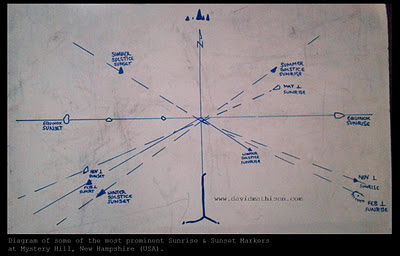
The diagram above shows that the builders of this observatory placed stone markers at points aligning with the rising and setting of the sun on certain important days of the year, including the two solstices (the summer solstice being the point of northernmost rising and setting, and the winter solstice the point of southernmost rising and setting of the sun along the eastern and western horizons each year) and the equinox (a point between these northernmost and southernmost points, where the sun will rise and set on the two equinoxes as it passes through on its way north to the summer solstice and south the the winter solstice points each year).

As explained in the previous post discussing Mystery Hill (linked above), this site was first reported in 1826, but it was not until the 1960s that astute observers began to suspect that it contained astronomical alignments, and not until the beginning of the 1970s that they began to be demonstrated conclusively.

The diagram above is laid out such that north is upwards (and indicated by a north-seeking arrow, which the ancient builders also marked with a series of fang-shaped stones drawn in the top of the diagram, the central "tooth" being the largest and indicating north, the the auxiliary stones to either side thought to represent markers indicating the direction of Thuban, a star in Draco which was located near the celestial south pole millenia ago). East in the diagram is therefore to the right, and west to the left, and south is indicated by a stone wall drawn in the diagram which is constructed of a long thickened "wall" of stones oriented due north-south in the observatory itself.

Of course, the earth turns towards the east, meaning that the diagram above moves towards the right during the course of the earth's rotation, causing celestial objects (including the sun) to trace out pathways from right to left in the diagram -- from the east to the west. The sun will thus rise on the eastern horizon (beyond the diagram) on the right, and will do so at its northernmost point on the day of summer solstice. The rising point on that day each year is indicated by a large triangular standing stone indicated on the diagram.

During the day, as the earth turns, the sun will trace out an arc in the sky, always remaining between the observer and the southern horizon at this latitude (this fact can be understood from the next diagram below), and will then set on the western horizon at its northernmost point, marked by another impressive standing stone which is indicated on the diagram above as well.

The sun reached the summer solstice -- or, more properly, the earth reached the point in its orbit that creates the summer solstice conditions -- back in June of this year (on the 21st), discussed in this previous blog post. As earth continued on its annual track, the sun's rising point progressed southward, moving towards the fall equinox and onward towards the winter solstice.

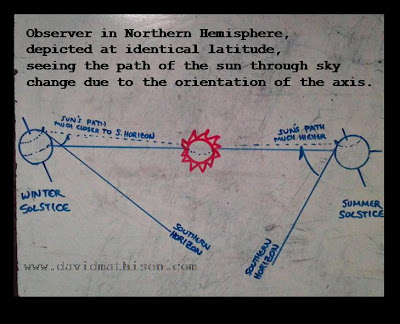
The reason the sun's rising and setting points move along the horizon is discussed in greater detail in the Mathisen Corollary book. A brief diagram, shown below, should give some explanation. It shows the earth tilted on its axis, going around the sun on a plane that is viewed "edge-on" so that it looks like a flat horizontal line. An observer on the earth is drawn in the northern hemisphere, and as the earth rotates he will see the sun only as earth's turning brings him around to face it each day (so "day" is when facing to the right for the observer on the "left earth" at winter solstice and "day" is when facing to the left for the observer on the "right earth" at summer solstice). The angle of the sun as it arcs through the sky will be very different for the observer on the earth at right (summer solstice) than at left (winter solstice), and its rising and setting points will be as well.


Between the solstices and the equinoxes (which divide the year into four portions and were thus also known as the "quarter days"), ancient cultures also tracked intermediate stations known as the "cross-quarter days," which fall on the approximate calendar dates of August 8 (after Summer Solstice on the way towards the September Equinox, halfway between the two), November 8 (after September Equinox, halfway to the Winter Solstice), February 4 (after the Winter Solstice, on the way towards the Spring Equinox and halfway between those two stations), and May 6 (halfway between the Spring Equinox and the Summer Solstice).

These dates are taken from Martin Brennan's essential book, The Stars and the Stones (page 39), discussed in this previous post. Of course, just like the solstices and equinoxes, the actual calendar dates drift slightly from year to year, as the calendar gets slightly out of line with the orbiting earth and then is brought back again by the insertion of a day during the leap year).

In addition, the ceremonies and festivals associated with the cross-quarter days have generally been moved to the first of the month in Europe, so that they are now most closely associated with traditions centered around the first of August, the first of November, the first of February, and the first of May, or the day following (such as in the case of Ground Hog Day) or the night immediately before (such as Halloween).

The Celtic festivals and ceremonies associated with the cross-quarter days are Lughnasad (the early August cross-quarter day), Samhain (the early November cross-quarter day), Imbolc (the early February cross-quarter day), and Beltane (the early May cross-quarter day). These names all have various spellings and variations.

The Catholic church incorporated the cross-quarter days as Lammas (August 1), All Saint's or All Hallow's Day (November 1), and Candlemas (February 1).

The cross-quarter days were also associated with the start of the seasons of summer and winter, which is why the solstice dates were known as Midsummer and Midwinter. This website discussing the cross-quarter days aptly points out that if summer didn't start until Summer Solstice (June 21 or 22), then it would make no sense to call the summer solstice Midsummer.

That site also notes the parallels between the cross-quarter days of November and May, in that the night before each one was associated with the thinning of the barrier between the world of the living and the dead, such that both October 31st and April 30th were thought to be nights of witches and spirits. The two cross-quarters are connected in that the October-November cross-quarter marks the beginning of the darkest segment of the year (in the northern hemisphere), containing at its mid-point the winter solstice, and the April-May cross-quarter marks the beginning of the brightest segment of the year (in the northern hemisphere), containing at its mid-point the summer solstice.

Because these cross-quarter days were very important to the ancient Celts and Druids, the presence of observatories in the New World with clear markers for both the quarter days and the cross-quarter days is noteworthy. It is, of course, possible that these stone observatories are the creations of native peoples of North America, and that their marking of the cross-quarter days arose in isolation of the attention paid to the cross-quarter days in other cultures in other parts of the world.

However, this is not the only possibility, nor is it necessarily the most likely possibility, in light of other evidence of ancient trans-oceanic contact that is rarely mentioned by conventional histories (see for example the discussions here and here). It is very possible that sites such as Mystery Hill, New Hampshire were created by Celtic visitors or settlers in the New World thousands of years ago, or perhaps that the builders were influenced by relatively brief contact with ancient Celtic travelers. Since it is also possible that the Celtic culture was influenced by another ancient culture, it is also possible that another ancient culture other than a Celtic culture built or influenced the building of the sites in North America which preserve markers of the quarter days and cross-quarter days.

In any case, it is worth taking the time to understand the celestial mechanics that create the quarter days and the cross-quarter days, and how the stone observatories preserve these heavenly activities with markers on the ground. If you have access to a suitable piece of ground, you could designate a central observation point and then mark the sunrise and sunset points on the quarter and cross-quarter days for yourself. Since a significant cross-quarter day is about to arrive, this is an excellent time to start just such an observatory, if you are so inclined!


The Parshah Noach


In Judaism, there are regular weekly scripture portions or passages known as parshiyot, in which the entire Torah is divided up into 54 portions to be read throughout the year.

The second of these portions is the Parshah Noach ("the portion of Noah") which covers Genesis 6:9 through 11:32, and it falls this week. That passage of scripture tells of a cataclysmic worldwide flood, the preservation of Noah and seven other people in an ark with animals and birds, and the repopulation of the world afterwards.

In previous posts, we have examined extensive evidence that a cataclysmic worldwide flood in fact did take place and that such an event in fact explains the geological evidence we find around the world better than do other theories. Much of this discussion follows the work of Dr. Walt Brown, whose book on the subject can be read online in its entirety. A partial list of the evidence we have examined includes:
  • The evidence for earth's "Big Roll" found in Antarctica, the Arctic, and 90° East Ridge. One amazing piece of evidence is the presence of unfrozen lakes trapped deep beneath the ice of Antarctica.
  • The strata found around the world.
  • The Grand Canyon and the extensive piles of petrified wood found in the same part of the world.
  • Findings of dinosaur fossils and other fossils which still contain soft tissue.
  • The presence of difficult-to-explain fossils of creatures such as jellyfish.
  • Extensive submarine canyons found all over the world which were probably carved by runoff from the flood event before they were covered up by the ocean.
  • The findings of what may be undersea ruins of human civilizations at depths that cannot be explained simply by sea level rise after an Ice Age.
  • The existence of an Ice Age in earth's past at all, which is difficult to explain with conventional theories but which is quite clearly accounted for in the conditions after a world-wide flood as postulated in the hydroplate theory.
  • Certain clues in other bodies in the solar system, including the moon, asteroids, and comets.
Additionally, there appears to be extensive evidence from ancient civilizations which can be best explained by this geological theory of a great flood, which is the subject of the Mathisen Corollary book and many other posts in this blog.

Certain clues raise the possibility that this cataclysmic flood took place only thousands of years ago rather than millions or hundreds of millions of years ago, including the presence of the soft-tissue fossils mentioned above and also the presence of ancient writings which appear to indicate first-hand human knowledge of some of the events that took place in the aftermath of the flood, including the draining of the Vale of Kashmir.

Regardless of whether you agree that such a flood took place within human memory, accepting the possibility of a global flood would cause some fairly obvious and quite severe problems to the traditional Darwinian explanation of biological origins (which is no doubt the prime reason that the very suggestion that a global flood took place on earth is vehemently denied and savagely ridiculed by conventional academia).

A global flood within the past several thousand years would cause even more severe problems for Darwinian theory.

However, we have already discussed other evidence which indicates that belief in either supernatural origins or extraterrestrial origins are more reasonable alternatives, in light of the evidence, than the storyline proposed by conventional Darwinism.

A discussion of the Jewish cycle of reading Torah portions throughout the year can be found at this website. Note that the description there begins with this very notable declaration: "Each week we read (or, more accurately, chant, because it is sung) a passage from the Torah."

Isn't that interesting? The passage is not actually read but rather it is chanted or sung! Where have we encountered that idea before?


How much time do you spend chanting praises?


In this previous post, we considered the teachings of the Hopi elders who consented to pass on their sacred traditions in the 1950s for the benefit of others, which Frank Waters and Oswald White Bear Fredericks recorded in The Book of the Hopi (1963). We saw that, according to the oral tradition, the world had been destroyed three times in the past, and that at the commencement of each new age after each successive cataclysm, the Creator gave to his people the same two commands:
First, respect me and one another. And second, sing in harmony from the tops of the hills. When I do not hear you singing praises to your Creator I will know you have gone back to evil again. 16.
What is it that is so important about singing praises to the Creator in harmony from the tops of the hills that this would be one of two strict commands, the neglect of which would bring as a consequence another world-ending catastrophe? If this command is so important, should we perhaps be paying more attention to it?

It turns out that singing praises in harmony to the Creator is held to be extremely important in other places where very ancient teachings are remembered as well. Above, we see a video of the late Swami Buaji (whom we met in this previous post). In it, he begins a very interesting chant, which contains words which can certainly be described as "singing praises to your Creator," to wit:
Relax your body!
Relax your mind!
Mentally massage your body.
Give a mental massage!
Pray to God, Almighty.
The Creator of the universe.
Pray to him to give you your long life
Your healthy life
Your disease-free body
Health and strength
Strength and stamina
Vigor and white energy (?)
Peace and prosperity
He is the doctor of doctors
He is the father of fathers
He is the architect of this human being (?)
He is the engineer of this human machine
He alone can give you whatever good you require
Therefore, pray to him
Surrender to him
Take shelter under him
Seek perfection under him
Seek asylum under him
He is the Creator
He is the protector
He is the (?)
He is the survivor
He is the sustainer
He is the preserver
He is the designer
He is the (?)
He is the requirer of all wisdom (?)
He alone can give you whatever good (?) you require
Therefore, remember him always
Forget him not
[. . .]
Not only are these words themselves noteworthy, but the tone in which they are sung or chanted is extremely noteworthy as well. They are not simply spoken, but rather intoned. The sing-song pattern of this "singing" or "chanting" appears to be important, because it is found in other ancient sacred chanting as well. Compare the pattern to the singing or chanting in the following videos.


And again here:


And here:


It appears that some people are remembering the importance of chanting (and specifically, "singing in harmony" and "singing praises to your Creator," as expressed by the Hopi elders), while many of us have forgotten it.

Without rushing to any conclusions presumptuously, it is at least possible to say that in light of all of the above, it might be wise to consider the possibility of the ongoing importance of chanting. It might also be possible to conclude that the actual language one uses is not as important as other aspects of this kind of singing -- the video of Swami Buaji indicates that it can even be done in English!

It is certainly possible that these similar patterns of expression sprang up independently around the world. On the other hand, it is also possible that they preserve some common heritage of mankind that is very ancient (we have seen previously, such as here and here, that John Anthony West provides extensive evidence that "harmonies" -- including audible harmonies -- were considered to be of great importance by the ancient Egyptians as well).

This seems to be a subject worthy of further exploration.

The Ganges Fan, the Indus Fan, and the Great Flood


In the previous post we discussed the lengthy undersea ridge pointing towards the region of the Himalayas and how this ridge provides powerful supporting evidence for the validity of the hydroplate theory of West Point and MIT graduate Dr. Walt Brown.

The northern section of that huge ridge sits right next to another enormous geological feature which likewise supports the hydroplate theory: the massive Ganges Fan (also known as the Bengal Fan), a tremendous network of canyons carved in a pattern resembling a mighty river-system on land, but stretching across the floor of the Bay of Bengal at depths of 2000 meters to over 5000 meters beneath the surface, starting at the mouth of the Ganges and running all the way down at some points to well south of the equator, terminating in the Ceylon Abyssal Plain near the Anafasiy Nikitin Seamount.

On the other side of India, in the Arabian Sea, a similar fan can be seen emanating from the terminus of the Indus River and stretching across the entire Arabian Basin at the bottom of the Arabian Sea, at depths well in excess of 4000 meters in its southernmost regions.

The Ganges Fan can be seen in the map on this web page (labeled in French) which discusses the formation based on conventional tectonic theory, and both the Ganges Fan and the Indus Fan can be seen in the 1967 National Geographic Indian Ocean Floor Map linked in the previous post (which allows some zoom-in capability when you hover your cursor over the map itself).

These submarine canyons -- and the many others found around the world such as the Monterey Canyon discussed in this previous post, as well as those cutting into the continental shelf beyond the mouth of major rivers such as the Hudson, the Amazon, and the Congo -- pose a real difficulty for conventional geological theory, which eschews catastrophic explanations for geological features and cannot possibly admit to the possibility of a worldwide flood. These steep-sided canyons resemble those carved on land by the rushing waters of rivers, but they are beneath the ocean's surface at great depths.

The conventional explanation currently popular is that "turbidity currents" that carry mud and sediments under the sea somehow gouged out these enormous fan systems -- a fairly ridiculous explanation. Discussions of how this might work can be found on the Wikipedia entry for "submarine canyons" under the heading "formation," as well as in more scientific discussions such as the one found in this report from 2000.

Dr. Brown's hydroplate theory proposes a much more plausible explanation. After the catastrophic flood event and the sliding and buckling of the continents and the deepening of the ocean basins (particularly the Pacific Basin), flood waters rushed off of the continents towards the oceans, carving the river basins we see today on land, and pouring off the continental shelves (which were still above sea level) and carving the submarine canyons we see today as they did so.

The ocean levels were much lower then than they are today, and the continents and their continental shelves much higher -- over time, the weight of the thickened continents would cause them to sink into the crust, which had the effect of raising the sea levels by thousands of feet. We have discussed this gradual process in previous posts, as well as the fact that this theory would explain the undersea ruins -- some of them at great depths -- which explorers may have found in several places around the world (and why this explanation is superior to an explanation that relies entirely on ice-age melt).

The hydroplate explanation is clearly superior to the current attempts to explain these undersea canyons and fans using non-catastrophic mechanisms. Dr. Brown highlights some of the problems with the current roster of non-catastrophic explanations in this page of his online version of his book:
Submarine Canyons. The ocean floor has hundreds of canyons, some that exceed the Grand Canyon in both length and depth. One submarine canyon is ten times longer (2,300 miles), so long it would stretch nearly across the United States. Many of these V-shaped canyons are extensions of major rivers. Examples include the Amazon Canyon, Hudson Canyon, Ganges Canyon, Congo Canyon, and Indus Canyon. How were canyons gouged out, sometimes 15,000 feet below sea level? Did ancient rivers (or major drainage paths) cut these canyons when sea level was lower or the ocean floor was higher? If so, why did those elevations change? Swift rivers supposedly cut most continental canyons. However, currents measured in submarine canyons are too slow, generally less than one mile per hour. Frequently, the flow is in the wrong direction. Submarine landslides that produce dense, muddy currents sometimes occur. However, they would not form the long, tributary patterns that characterize river systems and submarine canyons. Furthermore, experiments with thick, muddy water in submarine canyons have not demonstrated any canyon-cutting ability.
Note that these submarine canyons which were carved by floodwaters rushing off of the rising continents are very different from oceanic trenches, which pose different problems for tectonic theorists and which Dr. Brown addresses on that page and on following pages as well.

Few people in the general public are even aware of the existence of these massive submarine canyons, or of the networks of canyons such as the Indus Fan and the Ganges Fan (aka the Bengal Fan). However, they are yet another in a long list of geological clues which indicate fatal problems with the reigning non-catastrophic theories of earth's past.