An important discovery by a modern professor of astronomy opens a window on ancient civilizations


Here's a link to a story about an extremely interesting development from the professional work of Dr. Bradley Schaefer, a professor of astronomy and astrophysics at Louisiana State University in the US.

Entitled "Ancient Astronomers were No Fools" by Camille Carlisle, the article (published in Sky & Telescope) explains a finding presented by Professor Schaefer at a recent meeting of the American Astronomical Society, in which he argues that ancient astronomers including Ptolemy and Hipparchus appear to have corrected for "extinction" -- the dimming of a star seen closer to the horizon, which is caused by the fact that an observer on earth must look through a greater thickness of earth's atmosphere when observing a star lower in the sky and closer to the horizon -- when compiling their star catalogs.

As the article explains,
Extinction happens because starlight has to pass through Earth’s atmosphere in order to reach us. But the effect isn’t uniform: if you spend time stargazing you’ve probably noticed that a star high up in the sky’s dome looks brighter than it does as it slides toward the horizon. That’s because light coming to us from near the horizon passes through more atmosphere than if it shines straight down from overhead. (The Sun looks redder at sunset and sunrise for the same reason.)
A diagram in the linked article illustrates that an observer looking to the heavens at a 90° angle to the ground he is standing on (looking straight up) only has to look through "one air mass" (the thickness of the atmosphere). However, the same observer looking out towards the horizon at an object situated only 10° up from the horizon will be looking through 5.6 air masses.

Professor Schaefer has done innovative research in the past related to the work of the ancient astronomer Hipparchus (c. 190 BC - c. 120 BC), and is widely known for his analysis of the constellations depicted on the Farnese Globe (in another extremely important piece of detective work, Professor Schaefer concludes that the constellations depicted on the globe are accurate enough in their placement to indicate consultation by the sculptor with the star catalog a learned astronomer, and that their placement is consistent with the epoch of Hipparchus, meaning that this sculpture preserves vital information about the lost star catalog of Hipparchus; this assertion has been contested).


His current work also resulted from an investigation related to Hipparchus: Professor Schaefer was trying to answer the age-old question of whether the later astronomer Ptolemy (c. AD 90 - c. AD 168) derived some of his star information found in his Almagest from the earlier work of Hipparchus.

As Camille Carlisle explains in her Sky & Telescope description of Schaefer's latest analysis:
It was the Almagest that Schaefer began with — but his goal wasn’t to determine if astronomers in olden days accounted for extinction. He wanted to use the brightnesses reported in it to decide a long-standing debate over who wrote the catalog in the first place, Hipparchus of Rhodes (circa 150 BC) or Ptolemy of Alexandria (circa AD 150).

Some researchers have looked at the positions reported for the Almagest’s 1,000-plus stars to try to distinguish between the theories, but the differences aren’t conclusive. So Schaefer decided to try using atmospheric extinction to crack the case. Rhodes is at 36° north latitude and Alexandria at 31.2° N, which means the same stars will appear lower in the sky (and therefore dimmer) in Rhodes than they will in Alexandria. The star Canopus, for instance, is by modern calculations the second brightest star in the sky, after Sirius. Canopus should have looked 4th or 5th magnitude to Hipparchus but 2nd magnitude to Ptolemy, Schaefer says. (Astronomers’ magnitude system is also ancient, based on Hipparchus’s work: a magnitude 1 star is 2.5 times brighter than a star of magnitude 2.) By comparing the Almagest brightnesses against modern magnitudes — which are extrapolated to how they would appear outside the atmosphere — Schaefer should have been able to tell by the growing difference between the two values where the observer was. But he soon discovered a problem.
Carlisle explains that Schaefer's comparisons of magnitude indicate that the ancients were compensating for the atmospheric phenomenon of extinction. Professor Schaefer says: "You would expect that as you look further south the Almagest magnitudes would start … going up and up and up. But when you look and see the real data, you see that they are not going up and up and up. Somehow somebody corrected the Almagest magnitudes for extinction. It’s the only way."

Since the ancients apparently never wrote about the phenomenon of extinction (at least, not in any texts that survived or that were cited by authors of texts that survived), historians had not previously credited precise understanding of extinction to mankind prior to the eighteenth century. Professor Schaefer explains the surprise caused by the indication that the ancients may have actually possessed a fairly advanced understanding of this phenomenon: “it’s rather surprising that [the ancients] did a sophisticated and pretty accurate correction for something they don’t talk about and no one ever knew they knew about.”

The work of Hipparchus and Ptolemy is extremely important in the story of mankind's understanding of another extremely important celestial phenomenon, the phenomenon of precession. Hipparchus is widely credited with being the first astronomer to deduce what was going on, and Ptolemy also discusses the phenomenon in his Almagest (probably based on the work of Hipparchus). The importance of the work of Hipparchus and Ptolemy is discussed extensively in the Mathisen Corollary book, as is the phenomenon of precession itself (along with extensive diagrams and explanation to enable all readers to feel confident in understanding precession for themselves).

In fact, the debate over whether Ptolemy based his star catalog on the earlier work of Hipparchus is touched on in passing on pages 74-75 of the paperback version of the Mathisen Corollary, in which I explain that:
Most of the works of Hipparchus are no longer extant. The only surviving text penned by Hipparchus himself is a critical commentary on the astronomy contained in the poem Phaenomena by Aratus of Soli, who died about fifty years before Hipparchus was born. [. . .] From his commentary on the poem of Aratus, we can deduce much about Hipparchus' understanding of the heavens, which he brought to bear on the work of Aratus. Even further, we can observe the impact of his thought in references to his work in surviving texts, especially in Ptolemy's "Great Treatise," the Almagest.

Otto von Neugebauer (1899 - 1990) [was] one of the most important modern scholars of the story of astronomy from Babylon to the time of Isaac Newton [. . .]. Neugebauer, following the work of Irish astronomer Robert Stawell Boll (1840 - 1913), believed that Hipparchus' catalog contained the positions of no more than 850 individual stars (fewer than the 1,022 stars of Ptolemy's catalog in the Almagest), and that based on the surviving details in the commentary [of Hipparchus] on Aratus, Ptolemy's star location details were arrived at independently from those of Hipparchus, rather than being simple derivations of them as is commonly believed (285). Neugebauer also provides evidence that Hipparchus was in possession of and familiar with the extensive records of the earlier Bablyonian astronomers, who had compiled copious arithmetical tables of the intervals between various celestial events. 74-75.
My discussion of Hipparchus and Ptolemy centers around the extensive evidence (provided throughout my book, based upon evidence noted by other analysts including de Santillana and von Dechend, Graham Hancock, Martin Doutré, and Jane Sellers, as well as some evidence I have not seen discussed elsewhere) that ancient civilizations understood precession thousands of years before Hipparchus and Ptolemy, and to a greater degree of precision than either Hipparchus or Ptolemy apparently achieved.

Based upon the evidence, it is clear that the ancient Sumerians, Babylonians, and Egyptians must have had an extremely accurate and sophisticated knowledge of the stars and their behavior, which is a requirement for figuring out precession. It is therefore quite likely that the knowledge of the phenomenon of extinction also predated Hipparchus and Ptolemy by tens of centuries as well, although I do not have direct evidence for this logical deduction (note however the comment quoted above that Neugebauer found evidence that Hipparchus possessed extensive ancient Bablyonian astronomical texts and records).

As for Professor Schaefer's surprise that the ancients display a pretty accurate and sophisticated understanding of a concept that "they don’t talk about and no one ever knew they knew about," the question of why certain astronomical knowledge (including the understanding of precession) was not explicitly declared in ancient texts is a fascinating topic. It is one that has been examined previously in this blog, such as in the post entitled "If the ancients really knew so much, why didn't they just come out and say it?"

As John Anthony West (whose thoughts on the subject are discussed in that post) has written in his outstanding treatise Serpent in the Sky, much of the scientific knowledge supposedly "discovered" by the ancient Greeks was actually secret knowledge that they got from the ancient Egyptians. The Egyptians were just better at keeping a secret. He writes, "But perhaps unfortunately, Egypt was also much better at keeping her secrets than the loud-mouthed Greeks -- so very good that Egyptologists refuse to believe she possessed them" (36).

We hasten to point out that Mr. West is no doubt referring here to the ancient Greeks, and that his remarks are not to be taken as applicable to any specific group today.

Professor Schaefer's discovery, that the ancients apparently understood extinction to a high degree, is yet another piece of evidence in a growing pile of evidence indicating that ancient civilizations possessed an extremely advanced science long before conventional history as taught for the past several decades has been prepared to admit. His important work also opens up a host of other issues about ancient astronomical knowledge, and invites us to ask how much older this knowledge might be.

We should all be grateful to Professor Schaefer for his ability to use astronomy to provide important new perspectives on human history, and his willingness to advance hypotheses which go against the current conventional thinking.

Across the (Electric) Universe


The botanist John Christopher Willis (1868 - 1958), one of the preeminent botanists of his time, believed in evolution but rejected the Darwinian mechanism of mutations plus natural selection.

He wrote several books densely packed with evidence from the world of plants which cast grave doubt upon the origin of species by natural selection, to which we shall return to consider in a future post. For today, however, what I find quite intriguing is the alternative mechanism that J. C. Willis proposed.

In a book entitled The Course of Evolution by Differentiation or Divergent Mutation rather than by Selection (1940), after almost two hundred pages of careful argument, he reaches the following conclusion:
There is thus very strong evidence that evolution has gone on without any direct reference to natural selection so far as we can at present see. [. . .]

Evolution goes on, but we can see no reason at present that will determine that it shall go in any particular direction, especially in one that shows greater adaptation. The mere fact of the survival of the "lower" forms in such numbers, like mosses, ferns, and liverworts, is against the idea of any rapid progress in adaptation, but probably when an "adaptation" appears, such for example as climbing habit, it will be allowed or encouraged to survive, though why it should appear is at present a mystery.

It is an inspiring thought that so great a process as evolution must have been has not been a mere matter of chance, but has behind it what one may look upon as a great thought or principle that has resulted in its moving as an ordered whole, and working itself out upon a definite plan, as other branches of science have already been shown to do. Darwinism made the biological world a matter of chance. Differentiation, backed by the universal occurrence of the hollow curves, shows that there is a general law, probably electrical, at the back of it.
The entire text can be read online in a beautiful online version here. To find the passage quoted above, which is on pages 187 to 188 of the original pagination, slide the pointer at the bottom of the screen to page 198 of the online version.

This is an extremely noteworthy conclusion by a man who did not reject Darwinian natural selection out of religious motivation but rather based upon an extraordinary and distinguished career of examining countless plants from around the globe. He was by no means an idle dreamer but a rigorous and incisive analytical thinker, a man who rose to the top of his profession and was accorded the highest honors of the scientific circles in which he moved.

In the passage cited (you can read the entire discussion, beginning on page 186, and if interested all the supporting evidence in the pages that lead up to it), Dr. Willis affords a place for natural selection, but not as the mechanism of evolution. He in fact argues that Darwin had the "direction" of evolution wrong, and that radical new genera which diverge widely and radically from previous forms arise by some unknown force and then subsequent generations become less and less divergent (the opposite of the Darwinian model -- see discussion in the final paragraph on page 186).

Dr. Willis frankly admits that neither he nor anyone else has a conclusive idea of what could cause these divergences, which he says appear to him to be purposeful rather than random (see the passage cited). He declares that the evidence points to "a great thought or principle that has resulted in its moving as an ordered whole, and working itself out upon a definite plan."

He then proposes that whatever this force or principle is that causes evolution to move "as an ordered whole" that is "working itself out upon a definite plan," that force or principle (or "general law") is "probably electrical." This conclusion is startling and noteworthy.

We should not look down upon these arguments just because they were put forward over 70 years ago, and just because they run contrary to all of the assertions of the Darwinian sect that has controlled the levers of power for the past one hundred or more years. In fact, there are plenty of reasons to believe that the Darwinian model is fatally flawed.

It is also fascinating that Dr. Willis sees some electrical law as being behind the origin of the differentiated families of living things. He could not have known then what we know today: that 99.999% of the visible universe is made up of powerfully ionized gases known as plasmas. Electricity is incredibly important, and incredibly pervasive, and its role in the universe is still only dimly understood.

However, it is perhaps understandable that a man of his obvious analytical ability and with such a deep understanding of botany would perceive the possibility that electricity has more to do with the mysteries of life as we know it than the Darwinists knew. Take a look, for example, at the image above of the plasma z-pinch (which was featured in this previous blog post) juxtaposed with the branching structure of an oak tree in winter in California.

Scientists are only recently beginning to delve into the mysteries of plasma science, but it is certainly safe to point out that there may be some relation between the "general law" governing the behavior of the arcing branches of electrical discharge in the left image and that which is influencing the growth pattern displayed by the branches and twigs in the tree in the right image.

In previous posts, we have looked at some of the work of researchers such as David Talbott, who is working with others on what is known as the Electric Universe Theory. The proponents of this paradigm believe that electricity is the key lens through which to view almost everything. The implications of their analysis is far-reaching -- some of the directions that it leads can be seen in the web page linked above and its related pages linked within, as well as on this different Electric Universe website which has its own set of pages with discussions.

I personally do not subscribe to all of the conclusions reached by these researchers, and have given some of my reasons for that in previous blog posts as well as in some of the Graham Hancock Message Board discussions linked in this post. Nevertheless, I believe the work that Mr. Talbott and other Electric Universe pioneers are doing is vitally important, and commend them for their willingness to challenge the existing paradigm and to follow the evidence where they believe that it is leading. They are working to push human knowledge forward, and whether or not all of their conclusions turn out to be right, it is critically important that these new leads are pursued and their implications explored.

I also do not agree with all of the conclusions reached by Dr. Willis in his analysis of an "electrical" mechanism of evolution. I am not at all convinced that evolution is necessarily responsible for the diversity of life on earth. However, I believe that his arguments about the problems with the currently accepted mechanism for evolution are compelling, and that his sense that there appears to be some "great thought or principle" at work in the universe and behind the diversity of life is probably correct.

His perception that electricity seems to be connected to the same "general law" as that which drives the forms which living organisms take in their endless variety is a unique one, and appears to be quite insightful, and one which cutting-edge research of recent decades is showing to be quite forward-thinking.

These are fascinating topics to ponder. This direction of inquiry has certainly not been exhausted, but represent a field that is still perhaps in its infancy, and one that invites interested analysts to explore it in the years to come. Perhaps you will be one of those who blazes new trails in this promising and fascinating area of study.


The lowly amphora (and ancient contact across the oceans)


Professor Elizabeth Lyding Will (1924 - 2009, obituary here) was one of the world's leading authorities on amphoras, an ancient two-handled container that her research demonstrated to be vitally important for tracing ancient trade patterns and for opening windows on tremendous amounts of information about ancient life and commerce.

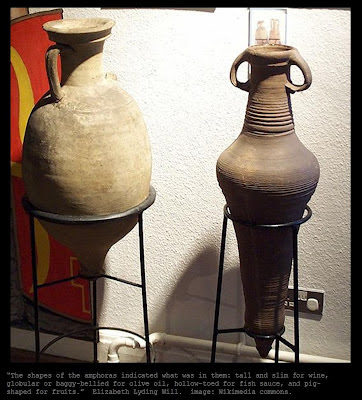
In a 2000 article entitled "The Roman Amphora: learning from storage jars," she discusses the diverse uses of "the lowly Roman amphora—a two-handled clay jar used by the Canaanites, Phoenicians, Greeks and Romans to ship goods," describing both its main usage for the transportation of liquids including wine, olive oil, and fish sauce, and its many other auxiliary uses, from funerary urn to acoustic enhancement device in theaters.

It makes fascinating reading, but the most intriguing aspect of the article, perhaps, comes in the final paragraph, in which Professor Lyding states that she has in her possession a fragment from one of the controversial amphoras found in Guanabara Bay outside of Rio de Janeiro, Brazil, and that she believes its characteristics may indicate a date of the third century AD.

This 1985 article from the New York Times explains that the bay is littered with shipwrecks, but that a particular submerged reef within the bay is known for the ancient jars that local fishermen have reported hauling up in their nets for years (hence the informal moniker, "Bay of Jars"). In the 1970s, the article reports, "a Brazilian diver brought up two complete jars with twin handles, tapering at the bottom, the kind that ancient Mediterranean peoples widely used for storage and are known as amphoras."

This piqued the interest of Florida author Robert Marx, who obtained permission to dive at the site in late 1982, and found the remains of over 200 broken amphoras as well as several complete amphoras. However, the article goes on to explain that Mr. Marx alleges that the Brazilian Navy abruptly rescinded his permission to dive after these artifacts were brought up, because (in the words of the article's author): "proof of a Roman presence would require Brazil to rewrite its recorded history, which has the Portuguese navigator Pedro Alvares Cabral discovering the country in 1500."

He says that officials of the Brazilian government told him, ''Brazilians don't care about the past. And they don't want to replace Cabral as the discoverer.'' The Brazilian Navy then dumped masses of silt over the site of the wreck and buried the remaining amphoras, according to Mr. Marx.

This article from the site "rogueclassicism" argues that the amphoras found in Brazil should not be taken as conclusive proof of ancient trans-Atlantic commerce (or even an ancient accidental crossing), casting doubt on the credibility of Mr. Marx as well as pointing out that "that amphorae were used by the Spanish in the 15th, 16th, and 17th centuries to transport olive oil (and other purposes, I would imagine)!" thus raising the possibility that the amphoras in question might have been lost in the bay much later than the ancient era.

While this possibility should certainly be examined, the analysis of Dr. Will, one of the foremost authorities on amphoras and their dating, should certainly carry significant weight. It is mere speculation to argue that these amphoras could be from the 15th, 16th or 17th centuries, while Dr. Will's opinion was based on actual examination of artifacts and her very extensive experience.

Nevertheless, it is important to note that the possibility of ancient trans-oceanic contact should never be pinned on any single artifact or "data point." The fact is, there is an enormous pile of evidence pointing to ongoing ancient crossing of the oceans -- there are literally thousands of data points in addition to these particular amphoras. A list of some of the others can be found in this previous blog post.

Regarding amphoras, it also appears that the amphoras found near Rio are not alone: David Hatcher Childress reports in Lost Cities of North & Central America that "A Carthaginian shipwreck containing a cargo of amphorae was discovered in 1972 off the coast of Honduras" (15).

The possibility that amphoras and shipwrecks found in the Americas might be of Phoenician origin rather than necessarily of Roman origin is significant. Note that in the first quotation from Professor Will cited at the top of this blog post, she describes an amphora as "a two-handled clay jar used by the Canaanites, Phoenicians, Greeks and Romans to ship goods." This excellent discussion of ancient Roman wine and viticulture (from the University of Chicago) explains that the Romans appear to have learned about growing wine grapes and making wine from the Phoenicians (or at least from their captured texts on how to do it).

The same website also contains some discussion of amphoras, along with a photograph and a diagram of various amphora shapes. That site declares that "The replacement of amphorae, which were airtight, by wooden barrels in the second century AD meant that vintage wines would not reappear until the seventeenth century, with the development of the glass bottle and cork."

Amphoras, then, are extremely important artifacts. The fact that ancient amphoras may have been found under the waters off the coastline of the Americas is hardly well-known among the general population, but it is yet another important clue pointing to the fact that ancient civilizations were capable of far more than we give them credit for.

Bob Marley, February 6, 1945 - May 11, 1981


February 6 is the birthday of Bob Marley, born this date in 1945.

More than anyone else, he is responsible for the worldwide popularity of reggae music.

I remember the first time I heard one of his songs, when I was in the 7th or 8th grade, and tried to describe it to a friend who finally figured out what I was talking about, and he exclaimed with surprise: "You like reggae!"

That song was "Buffalo Soldier." Later, in the Army, I learned about the Buffalo Soldiers (the US Army 10th Cavalry Regiment) and spent some time at Fort Leavenworth (not in Fort Leavenworth) where a monument to the Buffalo Soldiers is located (the Fort Leavenworth museum also contains much historic material related to the Buffalo Soldiers).


Bob Marley's "Three Little Birds" (among others) helped me get through the US Army's Ranger School, where I would "listen" to reggae songs in my head, which I discovered are perfect for keeping time during long night movements through the desert or the woods (walking for several hours on end through the darkness and counting paces to determine how many kilometers we'd covered and how many more there were to go before the objective).

Music is profoundly important, in ways that we do not completely understand. There is evidence that ancient advanced civilizations were aware of the power of music and its relation to harmonic concepts in mathematics and architecture -- perhaps more aware of it than we are today! Previous posts have explored this subject from various angles (see for example here, here, and here).

Take some time today to listen to some of the timeless music of Bob Marley.

Respect.

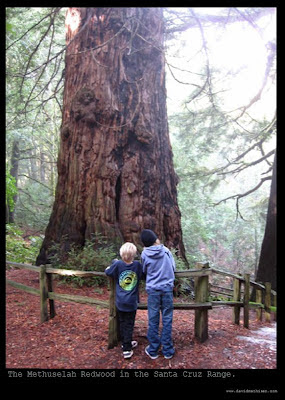
The Methuselah redwood

The Methuselah redwood

The California redwood (also known as the coast redwood, Sequoia sempervirens) is the tallest species of tree on earth, reaching heights of well over 300 feet*.

Redwoods are found along a stretch of the Pacific coast about as far south as San Luis Obispo and as far north as Oregon. They thrive along a fairly narrow strip of the coast close to the ocean, obtaining about forty percent of their necessary water from the fog generated by the interaction between the cold Pacific waters and the air.

Redwoods can live for thousands of years, but due to the extensive logging that took place from the early nineteenth century through the mid-twentieth century, almost all of the original "old-growth" redwoods were cut down for their valuable timber.

This webpage from the US National Park Service explains that about 96% of the original old-growth redwood forest was cut down, and much of the remaining old-growth redwood forest is located in the Redwood National and State Park in the very northernmost part of the state of California.

Around the mighty stumps of the ancient redwoods that the loggers cut down throughout northern California, "daughter rings" have grown up, and today there are thick forests containing trees between one hundred and one hundred fifty years old, many of which are well over a hundred feet tall, although not as massive in girth as the old-growth trees, which had more than a thousand years to grow before the loggers arrived in the early 1800s.

In the redwood forests that blanket the Santa Cruz mountains, however, there are one or two old-growth trees which were spared from the logging operations of the previous centuries (often because they were in inaccessible locations or because the tree itself exhibited undesirable characteristics, as explained in this 1996 article on logging in the Santa Cruz mountains).

One of the only old-growth trees remaining is the Methuselah Redwood (shown above), a massive and gnarly redwood with a base circumference of about 45 feet. Its height was estimated to have been 225 feet before its top broke off in 1954, leaving the tree almost ninety feet shorter.

The tree's name refers to its great age, estimated at over 1,800 years. It is not as well known, perhaps, as another tree bearing the same name, a Bristlecone Pine known as the Methuselah Tree (also in California but located in the mountains farther south and east, between Mono Lake and Death Valley and close to the border with Nevada). With an estimated age of over 4,800 years, the Methuselah Bristlecone is the oldest known individual non-clonal tree.

However, the Methuselah redwood shares more than its name with the Methuselah Bristlecone, and that is the fact that the location of both trees remain deliberately unpublicized due to the likelihood that vandals will deface or otherwise damage them. This is a sad statement about human nature and about the times we are living in, and brings to mind the discussions found in previous posts such as "Gungywamp" and "How does barbarism win?"

In spite of the fact that the location of the Methuselah redwood is not marked by any signs visible from the road, I have been saddened to find new evidence of vandalism (large squares of the tree's thick bark cut away so that despoilers could carve initials in the tree) on subsequent visits over the years (there were no such cuts the first time I ever visited this lonely survivor in the woods).

In their disrespect for this old-growth tree, these vandals are worse in some ways than the clear-cutters of previous centuries, operating as they do out of petty ugliness, and living as they do in a time when the damage done in the past is obvious and well-known, and the need to preserve the remaining few old-growth trees far more pressing.

Finally, the use of the name Methuselah is notable, because it points to the extreme length of lifespans recorded in the book of Genesis for those who lived prior to the flood (and, to a lesser degree, those who lived after the flood). None of the lifespans recorded is as long as that of Methuselah, who was the grandfather of Noah and who is said to have lived 969 years.

These lifespans are so long that they are widely dismissed without much thought as completely legendary by many readers today, but Walt Brown notes that the decline in lifespans given in Genesis immediately following the flood follows a mathematical curve typical of an exponential decay: quite remarkable if the recorded lifespan lengths were simply dreamed up as a fiction or legend.

He posits that, if a catastrophic flood took place the way his theory describes it (and the way that hundreds of pieces of evidence around the world suggest that it did), then the events surrounding that flood would have created most of the radioactive isotopes on earth, and that radioactive isotopes may have been almost nonexistent beforehand: this could be connected to a dramatic decrease in lifespan after the flood.

Such a theory, if true, would have incredibly far-reaching implications.

* One of the best books to depict and discuss the size and mass of the largest species of trees (most of which are found in North America, with the exception of the mighty kauri trees of New Zealand) is Forest Giants of the Pacific Coast, by Dr. Robert van Pelt of Humboldt State University.

We're busting into undisturbed Lake Vostok why?


It could happen at any moment now.

Human drillers (in this particular instance, from Russia) are poised to break through to Lake Vostok, sealed beneath miles of Antarctic ice for thousands of years (millions, according to the conventional theories).

This moment has been delayed for years, due to concerns about contaminating the pristine, undisturbed body of water, but the drilling team has finally convinced the Antarctic Treaty Secretariat to allow them to proceed, and now the probe is now only 40 feet from the buried lake.

The method selected has been designed to safeguard the lake as much as possible: this article explains that the plan calls for the mechanical bit to be replaced by a "thermal lance" which will get close enough to the lake to enable the water pressure to push water upwards towards the borehole. This water will then be allowed to freeze into ice (presumably sealing the breach again) and a sample taken of the newly-frozen ice (which will give scientists an opportunity to analyze the water of the lake (now frozen) without contaminating the lake itself.

Why on earth would we decide to disturb this pristine environment, one of the last places on earth to avoid human contamination? Read just about any article describing the operation, and you will see some variation of these two reasons offered:

1) the lake may be home to microbes that have been living in these extreme conditions for a very long time: because the lake is such a unique isolated environment, these microbes may shed light on "the earliest life" on earth, similar to microbes which may have been the ancestors of all other forms of life on earth.

2) the lake and its extreme conditions are the closest on earth to the conditions on extraterrestrial bodies Europa (a Galilean moon of Jupiter) and Enceladus (a moon of Saturn), so understanding of the life found in and around Lake Vostok could strengthen the case for extraterrestrial life on those heavenly bodies.

In other words, the main rationale for risking the contamination of this precious undisturbed lake consists of questionable Darwinist theories about life on earth and life on planets in the solar system.

What if the theory of Darwinian evolution is completely incorrect? It will certainly not be the first time that entrenched paradigms (which "everyone knows" have been "proven beyond a doubt") will turn out to be totally mistaken (see here and here, for instance).

In fact, the originator of the hydroplate theory, West Point graduate and retired Colonel Walt Brown (also a graduate of MIT) has theorized that the origin of the water spewing out of Enceladus may in fact be earth itself -- Enceladus may be composed of materials launched violently into space during the initial rupture of the earth which unleashed a global flood (see the discussion in point 8 of "Question 7" towards the bottom half of this web page from the online edition of Walt Brown's book).

In this case, it seems quite possible that the two primary reasons driving the rush to break into Lake Vostok include a mistaken theory about the history of life on earth, and a mistaken theory about the origin of life elsewhere in the solar system.

On the other hand, if the hydroplate theory proves to be correct (or much closer to the truth than any theory so far to date), then Lake Vostok is a precious time capsule preserving evidence from the time after the flood, prior to earth's "Big Roll," evidence we don't want to destroy or compromise.

It would be tragic to despoil Lake Vostok under the auspices of two theories which future generations may look back on as deeply flawed and in error.

----

update: Today, some news outlets are reporting that the team drilling at Lake Vostok has been out of radio contact for over five days, and scientists are becoming concerned for their safety. We of course join in wishing them safety even if we disagree with their mission, and are confident that they will be safe, even if their communications equipment fails. We have great confidence in the ability of human beings to survive incredibly severe ordeals: we are far more amazing than we usually even realize.


Groundhog Day is a cross-quarter day


For those readers who have been holding their breath all day to find out the decisions of the various groundhog prognosticators, it appears that there will be six more weeks of winter, except in Nova Scotia and Ontario, which are heading into springtime early this year.

Here's a link to a playful article on the tradition, written by Jan Vykydal of Canada's National Post.

The author of that article correctly points out that this modern ceremony (dating back to at least the first half of the 1800s) descends from traditions surrounding the more ancient calendar day of Candlemas, which also has its associated traditions regarding the weather on that day in connection with the arrival of spring -- as well as a badger tradition in Germany which parallels the groundhog tradition in the US and Canada.

The original importance of the date is solar -- it is one of the four "cross-quarter days" which mark the midpoints between the four stations that "quarter" the year on earth's orbit: the December and June solstices, and the March and September equinoxes. Candlemas / Groundhog Day (along with Halloween, May Day, and Lammas) is located near the actual cross-quarter days. This cross-quarter day (close to the beginning of what we call February) was celebrated as Imbolc among the ancient Celts and Druids.

For further discussion of the importance of cross-quarter days, be sure to check out this previous post about the stone markers of Mystery Hill in New Hampshire, one of which aligns with the setting sun for this month's cross-quarter day.

That ancient stone site suggests that the migration of the traditions surrounding the cross-quarter days from the "Old World" to the shores of the "New" may have started long before the birth of Punxsutawney Phil!


Also, a very special Happy Birthday to my sister, Krista!
Many happy returns of the day!