Further meditation on Huo Yuanjia


Here in California it is still January 18, and I am still continuing the direction of thought from the previous post honoring Huo Yuanjia.  

Huo Yuanjia's achievement in founding the Jingwu Athletic Association in 1909 cannot be underestimated.  In their 2010 book Jingwu: The School That Transformed Kung Fu, authors Brian Kennedy and Elizabeth Guo demonstrate that the establishment of this school marked a significant change in the way that kung fu was taught, one that would reverberate to this day, and one with very important implications.

They write:
The first public martial arts school where one could just walk in the door, pay a fee, and sign up was the Jingwu Association, which opened in 1909 and ushered in a new era in Chinese martial arts training.  The Jingwu's most influential time ran from 1909 to 1924.  The founding of the Jingwu Association, with its focus on "walk in, sign up, and learn Chinese martial arts as a form of exercise and recreation" marks the single most important turning point in Chinese martial arts -- the transition from being a manual trade associated with the military, militias and bodyguards to being a form of cultural recreation.
In fairness, it should be mentioned that there were other privately funded martial arts groups in China who were doing the same things that the Jingwu Association was doing.  But these other groups, for whatever variety of reasons, were all short-lived and not particularly influential.  3.
Earlier in the book (page x), they noted the other significant "firsts" that the Jingwu Association should be credited with:
  • The first public Chinese martial arts training facility.
  • The first to teach Chinese martial arts as a sport or recreation.
  • The first to place women's programs on an equal footing with men's programs.
  • The first to use books, magazines and movies to promote Chinese martial arts.
In other words, Huo Yuanjia's vision (and by all accounts he was central in the founding of the Jingwu Association) in large part created the transition to the way we think of martial arts training today, a vision that clearly established four aspects still very much present in the landscape around the world to this day.

In short, I believe it is no great stretch to deduce that Huo Yuanjia and his fellow founders of this new association believed that martial arts are an important aspect of life, one that goes along with other forms of learning.  In fact, as Brian Kennedy and Elizabeth Guo inform us, the Jingwu Association was not only devoted to training its members in the martial arts, but in providing other forms of learning, including "cerebral activities" including playing chess and learning from books (xi).  In other words, its founders clearly saw a connection between the mental and physical disciplines and the importance of each.

If you study the martial arts, it may be of some interest to think that Huo Yuanjia seems to have wanted you to be able to have the opportunity to do so, and to have believed that such an opportunity is as important to human development as any other form of learning.

In any event, it is also noteworthy that the movie Fearless (2006), which features Jet Li as Huo Yuanjia, takes its name from a line in the Tao Teh Ching of Lao Tzu (33): 

Mastering others is strength --
Mastering yourself makes you fearless.


Birthday of Huo Yuanjia


January 18 is the birthday of Huo Yuanjia, born this day in 1868.

He became one of the most famous and legendary martial artists in China before his untimely death at the age of 42.

Huo Yuanjia was memorably portrayed by Jet Li in the 2006 film, Fearless.  The film does introduce what seems to be gratuitous and upsetting violence during the first half of the movie, including the murder of Huo's family and children. Descendants of Huo Yuanjia have understandably complained that they are disturbed by the tremendous liberties taken in the portrayal, particularly this incident, which did not take place, and it does seem that the film could have been made without that particular consequence being used as the incident that leads to the realization by the hero that he is on the wrong path and needs to change his ways.

Nevertheless, the film is remarkable in its portrayal of the martial artist and his development as a human being, from a rather unsympathetic character to one who embodies a superlative virtue in addition to his superlative skill.  

The film's most memorable moment (I think) comes not in the final fight scene but in the tea ceremony between Huo Yuanjia and his final opponent, which takes place before the match.  The words that are spoken there are worth considering deeply, invoking as they do the question of our purpose here in this world:

ANNO TANAKA:  In your opinion, is one style of wushu superior to another?

HUO YUANJIA:  I don't think so.

TANAKA:  If no particular style is superior, why have so many competitions?

HUO YUANJIA:  I believe no single style is superior -- it's just that the people who practice them have different skill levels.  Competitions can help uncover our weakness, and lead us to a path of self-discovery.  For our true enemies are but ourselves.

TANAKA:  Your words are poignant.

It is well worth watching the entire film to see this moment in context.  One could, it seems, do worse than to make a habit of watching Fearless on January 18 and considering the memory of Huo Yuanjia.

Respect.


Incredible new spider with an absolutely astonishing skill


Here's a link to a recently-released video which, if it is confirmed, is pretty incredible.  It shows the actual footage in the rainforest at night of the discovery of a new spider, and one with an amazing talent. 

The discovery of this new spider and its incredible sculpting ability was reported last month in Wired magazine, in an article entitled "Spider That Builds Its Own Spider Decoys Discovered."  That article describes how this tiny spider, believed to be a member of the species Cyclosa, uses leaves, debris and bits of dead insects to fashion a much larger spider-shaped "sculpture" in the middle of its web.  As the video above shows, the image crafted by these spiders actually has the correct number of spider-legs, and the tiny builders even go so far as to give their artistic creations distinguishable abdomen and cephalothorax body sections.

But that's not all: the tiny spider artists will then pluck the strands of the web in order to cause their creation to jiggle and dance as if alive.  More information on the discovery of this tiny (5mm) spider in the Peruvian Amazon can be found on the blog of Phil Torres, a biologist and one of the discoverers in the video.

This behavior is completely astounding.  

Although biologists are already speculating that the spiders build these incredible decoys as a defensive measure, perhaps to scare off or divert predators, they really do not know yet what these spiders are really up to. While some may attribute this incredible "effigy-building" ability to natural selection, and call it an "adaptation" (implying that some web-building spiders who could not create self-portraits existed in some long-distant past, and then they "adapted" their web-building to include the construction of large spider sculptures in the middle of their webs), this discovery may one day come to rank as one of the most challenging pieces of evidence in the natural world for the theory of natural selection, if examined impartially.

Is it really plausible to argue that the existence of spiders building accurate spider-effigies in the middle of their orbs came about by random mutations in the genes of this line of spiders, resulting in spiders which now are born with the ability to gather dead leaves and bits of insect carcasses and bind them together into large spider shapes complete with the correct number of legs and a definable abdomen and cephalothorax?

Are we to believe that the ancestors of these spiders were the ones who built their effigies with eight legs, while the line of genes representing orb-spinners who built sculptures with only five, six, or seven legs (or nine, ten or eleven legs) all died out?  Did some ancient spiders get genetic mutations which caused them to construct effigies depicting elephants or dolphins, but because those shapes were not as effective at scaring off predators, those hapless arachnid artists were eaten before their genes could come down to the present day?

Although the Darwinian mechanism of natural selection is triumphant among conventional academicians today, this does not mean that it is correct.  In fact, previous posts have explored the extensive evidence which suggests that natural selection may be entirely wrong.  While some believe that supernatural creation is the only alternative to acceptance of the Darwinian (or neo-Darwinian) theory of natural selection, this is not entirely true (although it is of course one possible alternative).

It is at least as possible to believe that aliens or other advanced beings capable of genetic engineering tampered with these spiders to impart this ability to them (for some reason we can hardly fathom, perhaps just for fun) as it is to believe that natural selection gave them such a trait.  In fact, we have already discussed the fact that genetic engineering by beings with advanced abilities (whether human beings or alien beings) is at least as plausible an explanation for the existence of domesticated animals and grain crops as is the unlikely idea that a bunch of hunter-gatherers selected the right species to try to domesticate and then embarked on a project that would take dozens of generations (at least) of selective breeding (and even dozens of generations of selective breeding probably would not be able to do the trick: does anyone think that humans could simply breed the mighty American bison aka buffalo into something akin to domestic cattle?  It cannot be done that way).

There have also been respected scientists who have believed in some sort of evolution while rejecting the Darwinian mechanism of natural selection, such as botanist J.C. Willis (1868 - 1958).  He pointed out numerous reasons, mainly using his field of botany, that natural selection is an unsatisfactory model for explaining the evidence that we find in nature.  He proposed a very different model of evolution, propelled forward by the general laws of the universe, and speculated that the law which created new species was "probably electrical" (and in doing so, he can be seen to have anticipated the importance of electricity in the universe, the centrality of which is only now beginning to be fully appreciated by cutting-edge research in the field of plasma science and related subjects).

The building of astonishingly accurate effigies by this species of spider in the Peruvian Amazon may also be interpreted as a piece of evidence that seems to support the idea that there is "consciousness" that exists separately from the physical bodies of the beings on this planet (including the human beings) and which "works its way out" through us, much in the way that a radio or television signal can be received or displayed by a radio or a television, even though it is not produced by the radio or the television.

One could argue that these spiders are manifesting "spider consciousness" in a way that has never been seen before, but that might now start popping up in other spiders around the world!  If it does, that would be a powerful piece of evidence supporting Rupert Sheldrake's "morphic resonance" theory.  Even if these Amazonian effigy-builders are the only spiders that ever are observed to build such detailed spider sculptures in their webs, they can still be seen as a piece of evidence which may support the "transmission" or "manifestation" of consciousness theory.

We might also offer the possibility that these spiders are watching one another and learning how to do it, although that doesn't explain where the behavior came from in the first place, and it is also probably quite easy to disprove by isolating a spider from birth and seeing if it builds these types of web designs (it probably will).  There is already plenty of evidence that spiders build the distinctive web of their species by instinct, not by observing the webs of other spiders.

All of these possibilities are certainly worth pursuing.  The only reason they seem to be "on the fringe" is that the establishment has fully bought into the Darwinian theory, and refuses to countenance any alternatives.  This is both unfortunate and unscientific. 

All that discussion aside, the discoverers of this new and incredible spider are to be congratulated, and we should all be grateful that they were so observant while trekking through the Amazon in the dark!


How long until this log jam pushes itself up into a massive vertical pile-up?


In the most recent edition of Dr. Walt Brown's remarkable book explaining his hydroplate theory, which is available for reading on line here (although you may enjoy reading the hardcopy, as I do, and wish to order one at his website here), Dr. Brown provides an extremely vivid and helpful analogy to help explain a major flaw in the tectonic theory that has been taught for the past thirty years as the "settled science" explanation for earth's geology.

The hydroplate theory provides an alternative explanation for the evidence we see on the earth around us (and beyond earth in the rest of the solar system as well), and one that is very different from the tectonic explanation.  The tectonic explanation is basically "uniformitarian," meaning that it assumes that the same processes working today -- at roughly the same rate and strength that they are operating today -- could if given enough time create nearly all of the geological features we find on the earth, including the highest peaks in the Himalayas and the deepest submarine trenches in the Pacific.  The hydroplate theory is "catastrophic," meaning that it argues that nearly all of the major features on earth were created by an unusual event or series of events which brought to bear forces that are entirely extraordinary and nothing like the processes that we see around us today.

Specifically, the hydroplate theory argues that these extraordinary forces were unleashed by a global flood of massive proportions, and that they acted at a rate and at a level of force that is magnitudes greater than the forces going on today.  Dr. Brown provides example after example of features on earth that cannot be explained by ordinary forces operating at ordinary rates and magnitudes, even though supporters of the uniformitarian theories (of which tectonics is the most recent and current manifestation) argue that, given enough time, steady application of ordinary forces can accomplish almost anything.

In a footnote at the bottom of this page of his online version of the book, footnote 132, Dr. Brown discusses the fallacy that, given enough time, tectonic drift could and did lift up mighty mountain ranges including the Himalayas.  He writes:
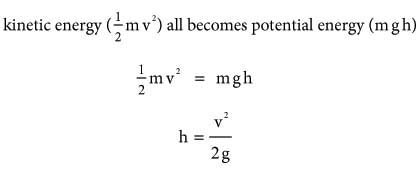
A tectonic plate of mass m moves with a velocity v. If all its kinetic energy were used to elevate the plate and no energy was lost due to such things as friction, how high, h, could the entire plate rise?
liquefactionzz-buckling1.jpg Image Thumbnail
Today, crustal plates move at about 4 cm/year—the rate a fingernail grows. [See Figure 90 on page 167.] Therefore,
liquefactionzz-buckling2.jpg Image Thumbnail
where g is the acceleration of gravity (or 980 cm/sec2) and 31,556,736 seconds are in a year. Even if just the central 10% of the plate rose, as in buckling or crushing, it would rise only 8.2 × 10-17 cm. Therefore, today’s velocities of crustal plates couldn’t possibly push up mountains.
Could millions of years of steady, but slight, pressure of one plate on another eventually push up mountains? Not anymore than logs in a river’s log jam might steadily crush or buckle up over millions of years (assuming the logs did not disintegrate). Until the compression of one plate against another reaches a very high threshold—not even remotely reached by plate tectonics—the plates will not crush, buckle, or lift one iota. However the compression event, at the end of the flood, easily explains how earth’s major mountains were pushed up in hours.
Dr. Brown's inspired metaphor for the supposed action of plate tectonics -- "logs in a river's log jam" -- helps us to wrap our minds around the problem for the tectonic theory.  If the river is only flowing at a very slow rate, it is not going to push the logs (representing the plates floating on top of the supposedly "circulating mantle") up into mountainous shapes, no matter how much time we give it.  

In the image above, a photograph of a log jam taken around the year 1937, the men walking around on the floating logs are not at all concerned that the logs will suddenly buckle upwards into huge piles of vertical logs -- if they were, they probably would not be walking about on them.  Nor will the logs slowly work their way into a vertical position over time, if the river continues to creep along at a "uniformitarian" pace.  We would not expect to go back to this same river today, seventy-six years later, and expect to see a veritable mountain of logs piled up, unless a huge wave of water had somehow been released upon them in a "catastrophic" event of some sort in the intervening years.

This argument by Dr. Brown, supported by the laws of physics as explained in the footnote, is yet another powerful piece of supporting evidence for the conclusion that the plate tectonic theory is fatally flawed.

There are literally many hundreds of other pieces of evidence offered by Dr. Brown to support the same conclusion.  Many of these have been discussed on the pages of this blog -- some of them are referenced below for ease of review by interested readers.  In addition, I have argued that if the plates have been uniformly drifting at rates proposed by the advocates of the tectonic theory, precisely-aligned ancient monuments such as the passage mounds at Newgrange, the shafts of the Great Pyramid, the incredibly precise "windows" to specific sunrises and sunsets built into Stonehenge from many different angles, and the ancient megalithic temples on the islands of Malta (among many other ancient aligned sites around the globe) would no longer be so precisely aligned, and yet they absolutely are in every case (consideration has to be made for precession, but not for tectonic drift).

The next time someone tells you that tectonics has been absolutely "proven" and that catastrophic explanations for the geological features you see on the planet all around you are ridiculous and only "the stuff of legends" or "unscientific," just think about the log jam analogy, and perhaps ask what it would take to push a log jam of horizontal logs on a relatively placid body of water into a violently up-heaved mass.  The answer is a catastrophic event.
 
Below is a selection of just a few of many previous blog posts detailing geological evidence on the earth that poses enormous problems for the conventional tectonic theory, but which the hydroplate theory explains quite well:


The staggering implications of the ancient inscriptions at Hidden Mountain near Los Lunas, New Mexico


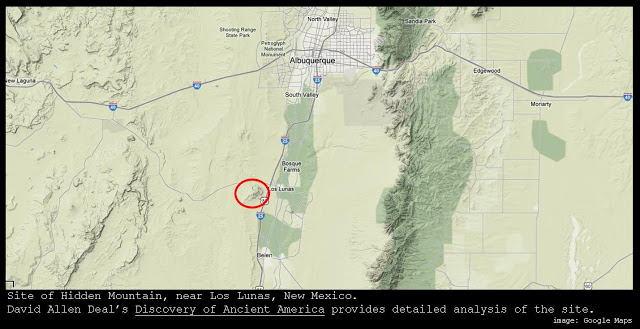
On a stark mountain in New Mexico west of the town of Los Lunas (south of Albuquerque) is extremely strong archaeological evidence of ancient trans-oceanic travel, evidence which completely upends the conventional isolationist paradigm of human history.  David Allen Deal's 1984 book Discovery of Ancient America provides an outstanding in-depth analysis of this site, as well as its implications.

Known as Hidden Mountain, or Mystery Mountain, or "Cerro los Moqujino," the site contains rock inscriptions which are indisputably Hebrew, but a form of Hebrew prior to the adoption of the more-familiar "square" letters.  This "Paleo-Hebrew" alphabet was still retained for the writing of the Tetragrammaton in some of the Dead Sea Scrolls, as Mr. Deal shows with photographs in his book, even though those extremely ancient scrolls already used the square Hebrew letters for the rest of the words in their texts (for a bit more on the Dead Sea Scrolls, see this previous post).  

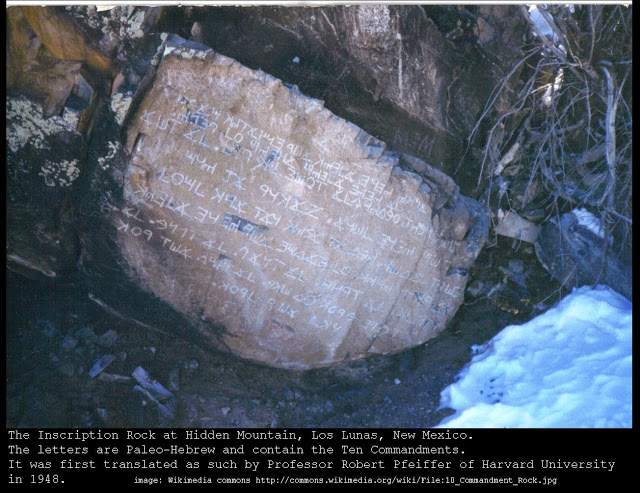
The stunning aspect of the rock inscriptions at Los Lunas / Hidden Mountain is not only the fact that these inscriptions are one of the few remaining lapidary inscriptions with Paleo-Hebrew lettering, but that the main inscription (shown above) is a rendering of the Decalogue, or Ten Commandments -- in the middle of the New Mexico desert.

Mr. Deal provides many photographs, plus a full table of corresponding letters (modern Hebrew to Paleo-Hebrew to Roman letters of our current alphabet), so that the reader can follow the inscription for himself or herself (the inscription reads from right-to-left).  He also provides a full translation including reference to the Strong's Number for each Hebrew word.  The inscription above, rendered from left-to-right, is as follows (adapted from the translation given on page 6 of Discovery of Ancient America):
line 1:  I [am] YHWH your mighty one who has brought you out from the land
line 2:  Not shall there be mighty ones any other besides me
line 3:  Mizriam [Egypt] from the house of bondage ^ [here, as Mr. Deal explains, the ancient inscriber actually inserted a caret symbol, which you can see in the third line from the top, because he left out the end of the first sentence in the first line, and inserted it after he finished his second line -- we can almost hear his frustration when he first discovered his error after carefully and painstakingly carving the neat letters of his first and second lines, but perhaps he was one of those ancients who believed in never showing anger; see the link above to the Dead Sea Scrolls discussion] Not shall you make for yourself a graven image.  Not shall take
line 4:  you the name of YHWH in vain.  Remember you day
line 5:  the Sabbath to keep it holy.  Honor you your father and your mother so that
line 6:  may be long your days on the land which YHWH your might one
line 7:  is giving to you.  Not shall you murder.  Not shall you commit adultery.  Not shall you steal.  Not
line 8:  shall you testify against your neighbor a witness false.  Not shall you covet wife of your neighbor's 
line 9:  or anything which to your neighbor [belongs]

Let's just look again at the map where this Paleo-Hebrew inscription is located and let that sink in:


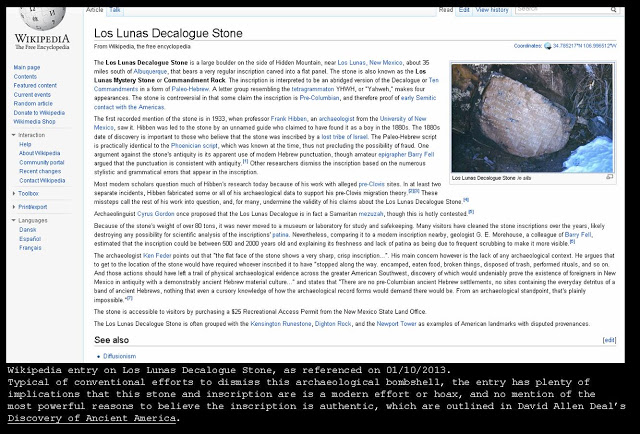
The implications of this inscription are enormous.  That is why defenders of the conventional paradigm are at pains to dismiss these inscriptions on a lonely 5,800-foot mountain in the middle of the American southwest as fraudulent.  This Wikipedia article is typical of the treatment the inscription stone receives: numerous aspersions about those who found it, along with references to unnamed "researchers" who doubt its authenticity, contrasted with "amateur archaeologists" who allege it is authentic, followed by hints that it was not found until after it was possible to translate and forge such a text, and no mention of some of the most powerful pieces of evidence in favor of believing that it is no forgery, which Mr. Deal details in his book and which are discussed in brief below.

Here is an image of the Wikimedia entry for the Decalogue Stone, as referenced on 01/10/2013 (perhaps they will improve it in the future, but as of now it is a thinly-veiled sneer at the "amateur" idea that this stone could overturn the historical paradigm, and comes complete with a link to "pseudoarchaeology" at the end of the article, in the "See Also" section):


While that Wikipedia entry says that the stone was not discovered until the 1880s, Mr. Deal in his book points to an account from a former resident of the Los Lunas area named Florencio Chavez, Sr. who stated that he was shown the rock by his maternal grandfather, Simon Serna, who was born around 1829 and who had been shown the rock by his own father, who said he had seen it as early as 1800.

Further, while the Wikipedia article declares that "The Paleo-Hebrew script is practically identical to the Phoenician script, which was known at the time, thus not precluding the possibility of fraud," no evidence is presented to explain who in the barren desert of New Mexico with knowledge of Paleo-Hebrew chose to painstakingly scratch it onto the side of an 80-ton boulder -- with a misplaced line and a later correction with a caret, a symbol which can be shown to have been used in antiquity for inserting missing text, by the way -- as a fraud.  It is one thing to say someone could have made a fraudulent inscription out there, but it is an entirely different thing to provide a suspect and a motive for such an elaborate fraud in such a remote spot.

Further, and also completely ignored by the debunkers, is the fact that the inscriptions at Los Lunas / Hidden Mountain, use a form of the Paleo-Hebrew symbol for "Q" which was unknown to nineteenth-century scholars until 1884, a key piece of evidence which Mr. Deal explains in his outstanding and thorough analysis of the argument over its authenticity.  The typical Paleo-Hebrew symbol for "Q" was a circle roughly bisected by a vertical line (which we can readily see relates to the capital letter Q still in use in our alphabet).  In the inscriptions at Los Lunas, a different form of "Q" is used, one that looks like an angular "figure 8," or like two triangles stacked with their points together in the middle (like an hourglass symbol).  

This version of a "Q" appears in the fifth line of the text on the Decalogue Stone, in the second word from the far right, the second letter from the right in that word and the sixth from the right in that line.  It is part of the verb "to keep it holy," referring to the Sabbath day.  Unfortunately, it is a bit difficult to see in the photograph above, but can be easily seen on other photos and in the Deal book.

As Mr. Deal explains:
This letter first became known to modern scholars in the latter half of the 19th century.  The earliest work in which it can be found is a publication in 1884, referred to by E. Hubener in 1893 (see Jensen, Sign Symbol and Script, p. 290, fig. 247).  Even if we discounted the claims of the local Indians and the story of Simon Serna's father, which would place the site in existence at least as far back as the early 1800's, and dismissed the good word of Frank Huning, the respected and honorable man who claims to have been shown the site in 1871, it is difficult indeed to also set aside the claims by other settlers that it was in place in 1883 -- a full year before any knowledge of the letter [hourglass-shaped symbol] was known to the world of scholars.  How could a forger have produced a letter style not yet known?  25.
Further, as Mr. Deal explains in great detail along with numerous photographs and diagrams, the Hidden Mountain site also contains a rock inscribed with a beautiful star-map depicting the zodiac constellations Sagittarius, Scorpio, Libra, and Virgo along with nearby constellations Ophiuchus, Cygnus, Aquila, Hercules, Cassiopeia, Cepheus, Draco, Bootes, Leo, and the Big and Little Dippers (for help fiinding these constellations in the sky, and their significance, use the search window at upper left corner of this blog to search for previous posts containing those constellations).  According to Mr. Deal's painstaking analysis, the rock accurately depicts the location of a total solar eclipse that took place in September of the year 107 BC, and the stone is properly oriented towards the sky scene that it depicts!  

Somehow, any mention of this incredible piece of supporting evidence is completely ignored on the Wikipedia entry.  Mr. Deal also details aspects of the site's layout which support the idea that it was a military outpost with observation posts and an animal enclosure for a period of time before it was abandoned.  He compares this evidence to known archaeological sites in the Old World to support his argument.  All of this supporting evidence makes a strong case for the authenticity of the inscriptions at Los Lunas.

The full explanation of this zodiac stone is worth the price of Mr. Deal's book alone.  However, he provides extensive analysis of the possible historical context for the crossing of the oceans by ancient peoples during the centuries in question, and supports his hypothesis with numerous quotations from ancient historians, from Herodotus to Strabo.  His hypothesis is extremely well laid-out and is in fact one of the most compelling I have seen.  It demands more attention and study.

Finally, it should be noted that the inscriptions at Los Lunas, as revolutionary as they are, are by no means the only evidence of deliberate, routine, and long-lasting contact between the Old and New World by sea-going ancient cultures capable of crossing the oceans.  Many other pieces of evidence have been discussed in previous blog posts, as well as in my own book.  For previous blog posts on this topic, see also "The Calixtlahuaca Head" and its list of links to other posts, as well as other posts written since that one on the same topic (such as this one about ancient copper mines in Michigan, or this one about the possibility that stone monuments found on both sides of the Atlantic contain coded "maps" to help ancient mariners navigate the sea-lanes), as well as the extensive analysis in Mr. Deal's book.

Given the numerous pieces of evidence which support the conclusion that the inscriptions at Hidden Mountain in New Mexico are authentic, and the fact that Hidden Mountain is just one of a plethora of archaeological finds in the Americas that point to the ancient ability to cross the oceans, it appears to be a powerful clue that mankind's ancient past is far different than we have been led to believe.

We should all be extremely grateful to Mr. Deal for his outstanding examination of this critical and overlooked historical treasure in the rugged terrain of New Mexico south of Albuquerque, as well as to those ancients who adorned their lonely outpost with such dramatic inscriptions and diagrams which still speak to us across the gulf of centuries.





"Only flux and motion"


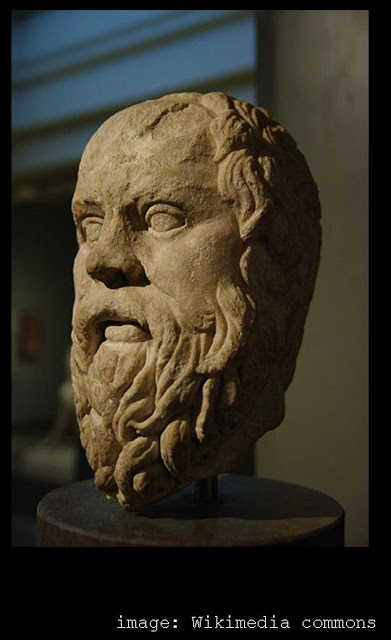
SOCRATES:  By the dog of Egypt I have not a bad notion which came into my head only this moment.  I believe that the primeval givers of names were undoubtedly like too many of our modern philosophers, who, in their search after the nature of things, are always getting dizzy from constantly going round and round, and then they imagine that the world is going round and round and moving in all directions.  And this appearance, which arises out of their own internal condition, they suppose to be a reality of nature; they think that there is nothing stable or permanent, but only flux and motion, and that the world is always full of every sort of motion and change.  The consideration of the names which I mentioned has led me into making this reflection.
The above passage from Plato's Cratylus, translated here by Benjamin Jowett and available in the collected dialogues of Plato edited by Edith Hamilton (page 447), appears to be more important than Socrates (and Plato) are letting on. 

I would even guess that the interjection which starts this brief passage, "By the dog of Egypt," is meant to carry a hidden message.

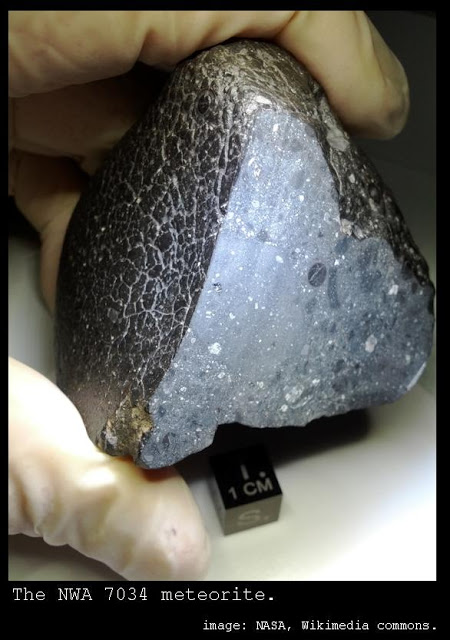
NWA 7034


Yesterday, January 3, a paper was published online in Science Express entitled "Unique Meteorite from Early Amazonian Mars: Water-Rich Basaltic Breccia Northwest Africa 7034."  

The paper, by a team of NASA-funded scientists who have been studying this particular meteorite (known as NWA 7034, because it was found in Northwest Africa) for over a year, concludes based on the meteorite's mineral composition and other characteristics that it came to earth from Mars, and that based on its high water content it must have formed during Mars' distant past.  The paper's authors report that its water content is an order of magnitude greater than any of the other thirty or so meteorites collected on earth which scientists believe to have come from Mars.

The oxygen isotopes in the meteorite also differ from other meteorites thought to be from Mars.  This oxygen evidence leads the scientists to hypothesize that "oxygen reservoirs" may exist in some parts of Mars, in the thin Martian atmosphere.

All of these findings are consistent with the reports sent to Edgar Rice Burroughs from John Carter and other earth-men who had managed to make the leap to Mars (or Barsoom), which he published in his fantastic Mars series, beginning in 1912.  Readers of those books know that Mars once had mighty oceans (now all dry) and that the thin Martian atmosphere was enriched with oxygen from an oxygen factory, which kept the Barsoomians alive.  Some have argued that these works were science fiction stories made up by Burroughs himself, although they seem too real for that.

Readers of this blog will also know that there is actually abundant evidence that water once flowed on Mars in large quantities, and that this fact is explained quite well by the hydroplate theory of Dr. Walt Brown, while posing challenges for conventional theories (see the discussion in this previous post entitled "Let's Go to Mars").  

According to the hydroplate theory, the origin of all or almost all meteorites which land on the earth today is the earth itself, which explains a great many aspects of meteorites (including the water and oxygen in NWA 7034).  In this webpage from the online version of his book, Dr. Brown explains that the force of the water erupting from beneath the surface of the earth (the "fountains of the great deep" described in Genesis and recorded in the sacred traditions of numerous peoples around the globe) launched fragments into the air with such velocity that some of them escaped earth's atmosphere.  He explains that many meteorites are apparently pillar fragments from the subterranean pillars that existed before the catastrophic flood event, which explains the iron-nickel composition of many meteorites, a composition that is extremely difficult to explain using other theories of meteorite origin.

In his recent Christmas letter (sent out before the publication of yesterday's paper about NWA 7034, of course), Dr. Brown mentions this aspect of his theory in conjunction with a discussion of the Curiosity rover:
The 7th and 8th editions explained how, during the early weeks of the flood, the fountains of the great deep launched water, rocks, and vegetation; bacteria accompanied the vegetation.  Some of that material impacted Mars, our neighboring planet.  The bacteria's food source, primarily vegetation, came with them.  (I know many reasonably intelligent people, relying on intuition, who have balked at the thought that the fountains could have been that powerful.  The 9th edition clearly explains the physics.
The 9th edition is the edition which Dr. Brown graciously makes available for reading online for no charge on his website.  Other aspects of Dr. Brown's remarkable Christmas letter from last month are discussed in this previous post.

In spite of the fact that his theory provides a scientifically supportable explanation for water and oxygen on Mars long ago, Dr. Brown does not believe that any meteorites which have landed on the earth originated from Mars.  In spite of the confident declaration that NWA 7034 originated from Mars made in articles published about this meteorite in the media, such as this one, or on NASA's own website (here), the scientists themselves admit that they have to deduce the origin of the meteorite, just as they do with all other meteorites (no meteorite so far has come stamped with a "Made on Mars" label).  

Here is an earlier scientific paper written by five of the same scientists who wrote the paper linked above, entitled "Basaltic Breccia NWA 7034: New Ungrouped Planetary Achondrite," in which they discuss the characteristics of the meteorite that help them surmise its origin, and give their arguments for the conclusion that it came from Mars.  The paper argues that its characteristics in many ways resemble the other meteorites that have been determined by scientists to be from Mars, but concludes with a final paragraph that begins with the word "if" in the sentence beginning "If NWA 7034 is a martian meteorite [. . .]"  

The scientists are now more convinced that NWA 7034 is in fact from Mars, but in a different part of his book, Dr. Brown provides some strong arguments against the conclusion that any meteorites found on earth actually came from Mars, including the meteorites these scientists used for comparison as they tried to determine where NWA 7034 came from.  See his discussion entitled "Are some meteorites from Mars?" at the bottom of this webpage in his online book.

Some of the arguments Dr. Brown gives against the possibility of Martian meteorites include:
To escape the gravity of Mars requires a launch velocity of 3 miles per second. Additional velocity is then needed to transfer to an orbit intersecting Earth, 34–236 million miles away. Supposedly, one or more asteroids slammed into Mars and blasted off millions of meteoroids. Millions are needed, because less than one in a million111 would ever hit Earth, be large enough to survive reentry, be found, be turned over to scientists, and be analyzed in detail. Besides, if meteorites can come to Earth from Mars, many more should have come from the Moon—but haven’t.112 Furthermore, all the so-called Martian meteorites are magnetic,113 whereas Mars has no magnetic field.113

For an impact to accelerate, in a fraction of a second, any solid from rest to a velocity of 3 miles per second requires such extreme shock pressures that much of the material would melt, if not vaporize.114 All 30 meteorites should at least show shock effects. Some do not. Also, Mars should have at least six giant craters if such powerful blasts occurred, because six different launch dates are needed to explain the six age groupings the meteorites fall into (based on evolutionary dating methods). Such craters are hard to find, and large, recent impacts on Mars should have been rare. 
These are serious objections to the hypothesis that NWA 7034, or any other meteorite, came from Mars.  They are by no means all of the objections that Dr. Brown presents -- interested readers are invited to go to his website using the link above and read all of his arguments on this subject.

It is important to realize that many conclusions which are presented to us as "fact" or "settled science" in the media and on the webpages of government agencies such as NASA are actually based upon the analysis of evidence by people who are doing the best they can based on the evidence that they have available and the paradigms or models that they are using to understand the universe.  Those paradigms or models may be flawed, and they certainly employ assumptions when necessary.  Analysts approaching the evidence using a completely different paradigm or model (and different assumptions) may well come to an entirely different conclusion.

In the case of the idea that meteorites could have somehow "broken free" from the surface of Mars and made the lonely voyage through space to land in Morocco in North Africa, it may be that more analysis is necessary by those who have reached this tentative conclusion. 

My recommendation would be to investigate the "Gridley wave" device described by Edgar Rice Burroughs, by which he was able to receive communications from Barsoom over a sort of ticker tape in Morse Code -- with such a device, we might be able to ask the Barsoomians if they know of any forces which might have been capable of launching rocks from Mars into space at a velocity sufficient to escape the Martian gravity and at a trajectory capable of intersecting Jasoom (their name for our planet).

Barring that, I would suggest that they consider the explanation -- backed by extensive evidence -- offered by Dr. Brown in his work.