Jupiter in Gemini


The stars in the morning sky before dawn are always a special treat, well worth the effort of rising early to see them while the sky is still black or beginning to lighten into deep blue in the east, without drowning out the constellations.

Right now, the constellations before dawn feature some of the most glorious constellations in our sky, well worth getting out to see them if at all possible.  

Orion is high in the sky before dawn, in fact reaching his highest altitude on his arc-shaped journey across the southern heavens (for viewers in the northern hemisphere) at about 5:45 am.  Orion is the constellation with the greatest percentage of bright stars out of all the constellations, and he is also extremely important in ancient legend and sacred tradition (see previous discussions on this topic including "The importance of Orion," "Orion and the Winter Circle of mythologically important stars,"    "Leo, the Lion King, Hamlet and Osiris," and "Capella, precession, and the end of the Golden Age," among many others).

Even more spectacular, however, may be the sight of the brilliant constellation of Gemini (the Twins), with the enormous planet Jupiter passing through.  The Twins are located close to Orion, and are therefore you don't have to decide who is the most spectacular -- the entire panoply is spread out in breathtaking glory in the hours before sunrise begins to color the east with red.  Orion, along with his consort Sirius, and the Twins with Jupiter are all near their highest point in the heavens beginning around five o'clock in the morning, and the effect is truly magnificent.  

If you are somewhat unfamiliar with the precise location of Gemini, some of the links above contain diagrams that can be helpful, as does this previous post ("Gemini, Canis Minor, and the Hairy Twin") which contains a good image showing the location of the Twins with respect to Orion.  It only shows the head and shoulders of Orion -- his famous belt would be located lower and below the margin of the bottom of the image -- but you should be able to locate both Orion and the Twins using that image along with some of the others of Orion contained in the links above.

Jupiter is currently passing through Gemini and is actually located at delta Geminorum right now, the star known as Wasat.  The name "Wasat" comes from an Arabic word meaning "the middle," and Wasat is right at the middle of the lower of the two twins, as you can see from the diagram above, where Wasat is marked with the numerals "55."  Wasat is marked with the lower-case Greek letter delta in this diagram.  This discussion of Wasat on Wikipedia reveals that the star is actually part of a triple-star system.

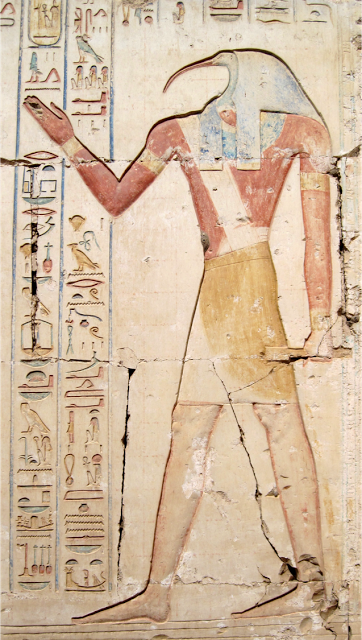
The constellation of the Twins is extremely important in ancient legend and sacred tradition as well.  This web page contains a collection of excerpts from ancient sources which mention the legend of the Twins, known as Castor and Polydeuces or Castor and Pollux in ancient Greek and Roman mythology.  Pollux is the name of the brightest star in the constellation, the head of the lower of the two figures in the diagram above (marked with the numerals "78").  Note that the line of the ecliptic passes primarily through the figure of Pollux, who of the two Twins in legend was the immortal of the pair and the son of Zeus.  

As discussed in numerous previous posts, such as this one and this one, there is substantial evidence to suggest that the ancient myths and sacred traditions describe the motions of the stars and heavenly bodies, rather than the conventional view that the myths came first and the ancients later named the constellations and planets after their mythical gods and heroes.  Thus, from the above discussion we can see why the myth of the Twins describes Pollux as the immortal and the son of Zeus: his star is brighter, and the ecliptic path -- and hence the gods -- pass through his figure and not much through Castor (just barely going through the stars of Castor, which may be why he is granted only a very partial sort of immortality in the legend).  

Zeus, of course, is the same god as Jupiter (the Latin name of whom may well mean "Zeus Pater," according to some analysts).  Thus, the passage of the planet Jupiter through Gemini that we are witnessing now may well be encoded in the myth of the Twins by the fact that -- of the two -- only Pollux is the son of Zeus.

Due to the complex motions of the planets as they whirl through the solar system in conjunction with the motion of the earth and our speeding sun, the path of the planets along the general line of the ecliptic is not exactly the same from year to year, although their path stays in the general vicinity of the light-blue line representing the ecliptic which is seen in the diagram above.  For a truly outstanding diagram of the path of Jupiter as it moves through the constellation Gemini this month and in following months, check out this chart from Naked Eye Planets.  The full website of Naked Eye Planets, by Martin J. Powell, is located here.

Finally, no mention of the ancient sacred traditions of the Twins would be complete without a reminder that a pair known as the Hero Twins also played a central role in the sacred traditions of the great civilizations of the Americas.  In this previous post, I examine the iconography of the Maya steles at Izapa (a site which also has abundant evidence of ancient Olmec activity) and argue that the depictions of the Hero Twins along with certain fantastical birds are most likely meant to convey celestial connections.  In fact, the imagery has very strong similarities to specific iconography used in ancient Egypt and ancient Babylon, imagery so specific that it is difficult to argue that they arose coincidentally without any sort of ancient contact.  

For this reason, the Twins may be an important clue supporting "diffusionist" paradigm over the conventional "isolationist" history that is taught in school.

You may find it enjoyable to consider all these connections as you gaze out into the heavens in the predawn sky to see the passage of Jupiter through Gemini.

October 6 is the birth-date of Thor Heyerdahl


October 6 is the birthdate of Thor Heyerdahl (1914 - 2002).  His insights, analysis and expeditions provided some of the most important evidence for what is often called the "diffusionist" theory versus the "isolationist" theory.  

The diffusionist theory argues that ancient peoples had the capability of deliberately and repeatedly crossing the oceans, including the Atlantic and the Pacific, and that they did so as far back as the time of the ancient Egyptians.  It thus stands agains the isolationist theories taught by most conventional academicians today, which categorically rejects any suggestion of the possibility of cultural contact between peoples from different continents in ancient times, despite abundant evidence around the world that seems to suggest such ancient contact.  

Thor Heyerdahl entered into this momentous question by several happy circumstances beginning in his early life, which -- when brought into contact with his boundless curiosity and irrepressible optimism and adventurous spirit -- led to several famous adventures and discoveries of tremendous significance.  

This webpage from the Kon-Tiki museum explains that as a young student at the University of Oslo, Thor Heyerdahl met Bjarne Kroepelien, who had traveled to the South Pacific, a part of the world that had fascinated Heyerdahl since childhood.  Kroepelien assisted the young Thor Heyerdahl when Thor and his new bride Liv decided to try to live on an undeveloped island (Fatu Hiva) in the Marquesas to study the local flora and try to determine the route that had brought the various species to the island.  

It was Kroepelien's letter to the Tahitian Chief Teriieroo which enabled Thor and Liv to spend a month with Teriieroo on Tahiti, for practical training in the traditional methods of living off the land.  They stayed a year but insect-borne disease forced them to seek medical attention on neighboring Hiva Oa.  There, another Norwegian who had permanently settled there on a coconut plantation showed Heyerdahl some stone statues in the jungle, which -- along with his friend's suggestion that similar statues could be seen in Colombia, in South America -- fired Thor Heyerdahl's imagination and started him on the pursuit of theories that went against the settled opinion of the historians and anthropologists of his day, and launched him on the many adventures and investigations that would become his life's work.

Heyerdahl became convinced that the islands of the Pacific had been peopled originally by people from South America, perhaps a people who were the predecessors of the Inca, who had traveled eastward on balsa rafts, and who were later joined by another wave of people from the northwest tribes of North America, who had traveled southeast on double-hulled canoes.  These two peoples later mixed (sometimes peacefully and sometimes violently) on the various islands of the wide Pacific, leaving a distinctive Polynesian culture that stretched all the way from Easter Island (Rapa Nui) to New Zealand (Aotearoa).  

Meeting solid opposition from those who said this theory was impossible, Heyerdahl in 1947 undertook his most famous adventure, the Kon-Tiki expedition, to prove that long-distance travel over the open ocean in balsa rafts was not only possible, but extremely practical.  In his best-selling account of that expedition (still thrilling reading today), he explains the origin of the expedition's now-famous name:
Virakocha is an Inca (Ketchua) name and consequently of fairly recent date.  The original name of the sun-god Virakocha, which seems to have been more used in Peru in old times, was Kon-Tiki or Illa-Tiki, which means Sun-Tiki or Fire-Tiki.  Kon-Tiki was high priest and sun-king of the Incas' legendary 'white men' who had left the enormous ruins on the shores of Lake Titicaca.  The legend runs that the mysterious white men with beards were attacked by a chief named Cari who came from the Coquimbo Valley.  In a battle on an island in Lake Titicaca the fair race was massacred, but Kon-Tiki himself and his closest companions escaped and later came down to the Pacific coast, whence they finally disappeared oversea to the westward. . .  18-19.  
Heyerdahl explains that the existence of strong traditions as far away as the Marquesas of a founding anscestor named Tiki, who had come to the islands "from a mountainous land in the east which was scorched by the sun" (18).  Hence, his voyage and the vessel he and his companions used in order to prove such a direction of travel was possible, even over the vast distances and mighty ocean swells of the broad Pacific, was dubbed the Kon-Tiki.

Later in his life, Heyerdahl undertook similar voyages across the world's largest oceans in ships built of traditional materials and design, including the Ra voyage across the Atlantic and the Tigris voyage across the Indian Ocean.

For previous posts referring to some of Thor Heyerdahl's arguments against the isolationist theories, see also:
For a partial list of some of the overwhelming pile of evidence which supports the "diffusionist" theories and casts serious doubt on the "isolationist" theories, see the links in this previous post entitled "The Calixtlahuaca head."

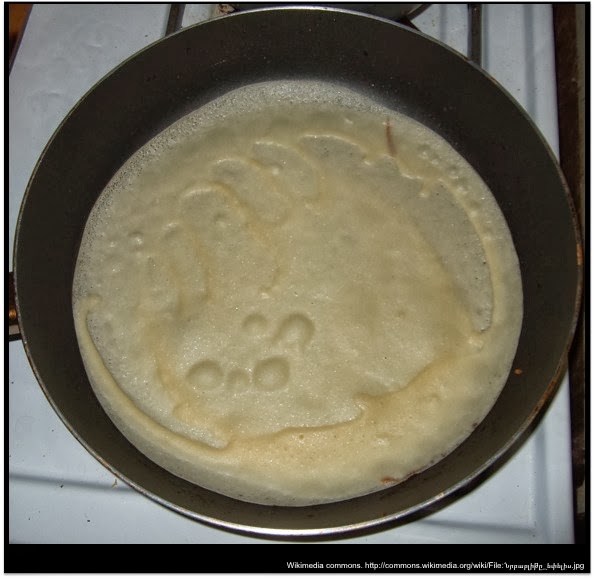
Also, while October 6 is an important date because of the birthday of Thor Heyerdahl, October 5 (still the date here in California as this is published) is even more important, as it is the birthday of my father -- Happy Birthday!  He taught me to make Norwegian crepes, which I had for breakfast this morning.  He also introduced me to the love of looking at the stars, beginning with the wonderful book Find the Constellations, by H.A. Rey -- and plenty of trips outside together to look up at the night sky and try to find the constellations ourselves.


Human internal organs connected to solar system planets?


In the system of Chinese medicine, which has ancient origins stretching back thousands of years, each of the internal organs of the human body has connections to either yin or yang, to specific periods during the daily rotation of the earth, to the energy typical of one of the five elements (discussed below), to different emotional states, and -- interestingly enough -- to one of the different planets of our solar system.

This website, for example, lists the organ correspondences of each of the five visible planets, proceeding through each of the five traditional Taoist elements, or "Five Elemental Energies":

Planet: Jupiter
Element: Wood
Yin Organ: Liver
Yang Organ: Gall Bladder

Planet: Mars
Element: Fire
Yin Organ: Heart
Yang Organ: Small Intestine

There is actually a second set of organs also associated with Fire and Mars -- the pericardium (the sac around the heart -- a yin organ), and the "triple burner," which is not a physical organ but an energetic system associated with three channels in the thoracic and pelvic cavities, along which energy flows as water flows in an old water-wheel that turns a millstone (the triple burner is a yang organ).

Planet: Saturn
Element: Earth
Yin Organ: Spleen
Yang Organ: Stomach

Planet: Venus
Element: Metal
Yin Organ: Lungs
Yang Organ: Large Intestine

Planet: Mercury
Element: Water
Yin Organ: Kidneys
Yang Organ: Bladder

In his book, A Handbook of Chinese Healing Herbs, Daniel Reid provides some excellent introductory discussions of the concepts of yin and yang, the Five Elemental Energies, and the Traditional Chinese Medicine understanding of the organs.  He writes:
The Great Principle of Yin and Yang is the first and foremost law of the manifest universe.  It delineates and defines the opposite yet complementary poles that lie at the heart of all dynamic forces, initiate all growth and transformation, and maintain the balance and harmony of the vital energies on which human health and longevity depend.  Yin and yang are not different types of energy but, rather, complementary poles of the same basic energies of the universe, such as the hot and cold of heat energy, the bright and dark of light energy, and the positive and negative of electromagnetic energy.  The vital organ-energies of the human body also function as complementary couples of yin and yang: the yin heart is functionally linked with the yang small intestine; yin liver is paired with yang gallbladder; yin kidneys are coupled with yang bladder; and so forth. 13-14.
Of the Five Elemental Energies, he says, beginning with a quotation from the ancient text whose principles still infuse much of Chinese medicine:
"The Five Elemental Energies of Wood, Fire, Earth, Metal, and Water encompass all the myriad phenomena of nature.  It is a paradigm that applies equally to humans," states The Yellow Emperor's Classic of Internal Medicine.  As functional manifestations of yin and yang, the Five Elemental Energies are the fundamental forces of nature whose constant transformations and interactions "make the world go 'round."  As another ancient Chinese text puts it, "The Five Elemental Energies combine and recombine in innumerable ways to produce manifest existence.  All things contain all Five Elemental Energies in various proportions."

The Five Elemental Energies transform, manifest, and maintain their own natural equilibrium through an automatic system of checks and balances based on the creative and control cycles, or mother-son and victor vanquished relationships. [. . .]
The creative cycle [see black arrows in the diagram below] is one of generation and stimulation: Wood generates Fire; Fire generates Earth; Earth generates Metal; Metal generates Water; Water generates Wood.  The control cycle [see white arrows in the diagram below] dominates and sedates: Metal sedates Wood; Wood sedates Earth; Earth sedates Water; Water sedates Fire; Fire sedates Metal. 14-15.
The diagram below is similar to one shown in Daniel Reid's book, and illustrates the creative cycle and the control cycle:


Much more could be written about these elemental correspondences, and the fact that the organs which power our bodies and sustain life in each one of us have characteristics which correspond to these Five Elemental Energies, but it seems that one of the most intriguing and significant aspects of this ancient wisdom is the connection of our vital organs with a corresponding planet in the celestial realm as well.  

How can it be that the organs in our body have connections to the mighty orbs which whirl silently through space, the closest of which (Venus) is around 25 million miles away and the furthest of which (Saturn) averages around 890 million miles away, and sometimes reaches distances of over a billion miles from us?!

The materialist philosophy currently in vogue admits of no possible connection between the aspects of the planets and the functioning of the vital organs inside the bodies of the billions of people on our planet, and dismisses much of the teachings of Chinese medicine as well.  However, such wisdom does not survive for thousands of years, in constant practical application among the people, without some level of validity.  

Further, there is evidence that the ancients around the world, including in "the West," once acknowledged the connection between the celestial heavenly objects and the vital organs of the human body.  For example, this previous post touches on the fact that the ancients believed that each of the zodiacal signs was most closely associated with different parts of the human body.  It was taught that Libra, for instance, rules the kidneys, and Gemini the lungs. 

This concept is clearly related to the teaching of the microcosm / macrocosm (discussed in that previous blog post just referenced, as well as this one and this one) which is the teaching that each individual is a reflection of the cosmos, that each person is in fact a microcosm, simultaneously containing an entire cosmos within the individual, while at the same time reflecting and responding to the motions of the macrocosm: the Earth, the Sun, the Moon, the planets, and the wide universe.

This concept has been largely forgotten in "the West," but it has survived in other parts of the world.  The understanding of the connections between the planets and our vital organs is one manifestation of that ancient wisdom.


For other discussions which mention the very worthwhile works of Daniel P. Reid, see also:

John Michell on dragon current or lung-mei


In New View Over Atlantis (1969), John Michell points out that a knowledge of what Alfred Watkins called "ley lines" in England survived in China right up to the modern day.

He writes:
Stories of the magic location of sacred sites are not confined to Britain, but refer to a geomantic tradition once universally known.  All over the world the centres of spiritual power were discovered by means of a system which combined science, astrology and intuition.  Above all, in China, not only was every sacred building magically sited, but the Chinese geomantic principles are known; for the practice of divining the sites of houses and tombs was carried on well into this century.  59
He goes on to explain:
A hundred years ago the practice of Chinese geomancy first became generally known in the West through the complaints of European business men, who found inexplicable resistance to their rational plans for exploiting the country.  Continually they were informed that their railways and factories could not take certain routes or occupy certain positions.  The reasons given were impossible to understand, for they had no relevance, economic, social or political to the problem of laying out an industrial network.  The Europeans were told that a certain range of hills was a terrestrial dragon and that no cutting could be made through its tail.  59.
Interestingly enough, these lines of "dragon current" were believed to be generated not only by the geological formations and alignments of energy in our own planet Earth, but also by the influences of the Sun and the Moon as well as the five planets.  John Michell explains further:
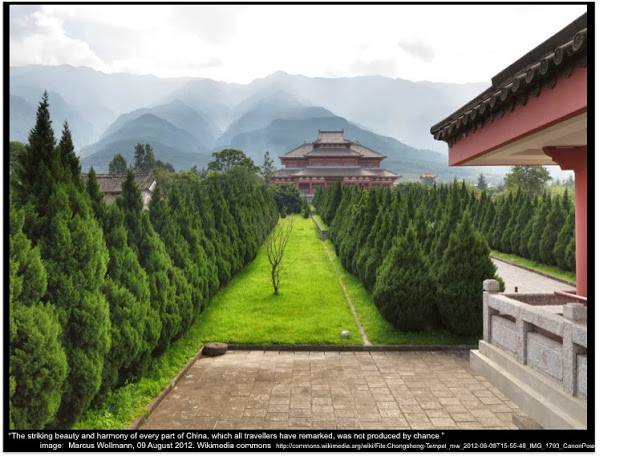
In China until recently, as long ago in Britain, every building, every stone and wood was placed in the landscape in accordance with a magic system by which the laws of mathematics and music were expressed in the geometry of the earth's surface.  The striking beauty and harmony of every part of China, which all travellers have remarked, was not produced by chance.  Every feature was contrived.  The main paths of planetary influence, determined by thousands of years of astronomy, were discovered in the landscape, the smaller lines that ran between them reproduced in the crags and fissures of the earth.  These were the lines of dragon current or lung-mei.  The various parts of the earth each fell under a particular planetary influence passed down through the lines which ran above them.  Besides their lunar or solar, yin or yang, characteristics, certain lines were related to one of the five planets, Jupiter, Mars, Venus, Mercury or Saturn.  These planets correspond to the five materials, wood, fire, metal, water and earth.  Their colours are yellow, red, blue, white and black.  Other correspondences link the planets with the materials of the body, with the internal organs, and with the fortunes of men.  Even the shape of hills should conform to their astrological position.  Steep mountains with sharp sides and peak pertain to Mars; those with top broken off to Jupiter.  Hills under Saturn have a flat summit, those under Mercury are low and dome shaped, and hills of Venus are dramatically high and rounded.  62-63.
The entire discussion, as well as John Michell's insightful elaboration on the topic and startling conclusions, is well worth reading in its entirety.

For previous posts which touch on the subject of earth energy lines and the influence of the planets upon our lives, see also: 

Back from a month in China


Apologies for the extended radio silence -- spent a little over a month in China, meditating in this secluded location.

No access to blogs or blogging.

Back in California now.

Every human life is precious


Corpus Hermeticum:

Of all beings that have Soul,
only man has a two-fold nature.
One part, called 'The Image of Atum,'
is single, undivided, spiritual and eternal.
The other part
is made of the four material elements.
One comes from the Primal Mind.
It has the power of the Creator,
and is able to know Atum.*
The other is put in man
by the revolution of the heavens.

Man is the most divine of all beings,
for amongst all living things,
Atum associates with him only --
[. . .]

To speak without fear,
human beings are above the gods of heaven,
or at least their equal --
for the gods will never pass
their celestial boundaries
and descend to Earth,
but a man may ascend to heaven,
and what is more,
he may do so without leaving the Earth,
so vast an expanse can his power encompass.
[. . .]

Man is a marvel,
due honour and reverence.
He takes on the attributes of the gods,
as if he were one of their number.
He is familiar with the gods,
because he knows he springs
from the same source.
He raises reverent eyes to heaven above,
and tends the Earth below.
He is blessed by being the intermediary.
He loves all below him,
and is loved by all above him.
Confident of his divinity,
he throws off his solely human nature.
[. . .]

There are then these three --
Atum, Cosmos, man.
The Cosmos is contained by Atum.
Man is contained by the Cosmos.
The Cosmos is the son of Atum.
Man is the son of the Cosmos,
and the grandson, so to speak, of Atum.
Atum does not ignore man,
but acknowledges him fully,
as he wishes to be fully acknowledged by man,
for this alone is man's purpose and salvation --
the ascent to heaven
and the Knowledge of Atum.

-- The Hermetica, new version by Timothy Freke and Peter Gandy (1999), 73 - 76.

* "Although we have used the familiar term 'God' in the explanatory notes which accompany each chapter, we have avoided this term in the text itself.  Instead we have used 'Atum' -- one of the ancient Egyptian names for the Supreme One-God.  We felt that using this unfamiliar Egyptian name would allow the reader the opportunity to build up their own conceptual picture of what Hermes means by the term, free of any associations they may have with the word 'God'" (Freke and Gandy, xxxiv).

Catastrophic formation of the Grand Canyon: still more evidence, this time from the Mojave Desert


If Dr. Walt Brown's hydroplate theory is correct, and the Grand Canyon is a result of the rapid release of millions of tons of water that had been trapped in two massive inland seas (Grand Lake and Hopi Lake, shown in the image on this page of the online version of his book), then the release of so much water should have left evidence all the way along its path to the ocean.  The evidence of such an event would look very different than the evidence that we would find if the Grand Canyon was carved slowly over tens of millions of years by the action of the Colorado River (the conventional explanation).  

The previous discussion presented just that kind of evidence, in the form of six thousand cubic miles of sediments along the northern basin of the Gulf of California.  However, diving down to the floor of the Gulf of California is not an easy undertaking.  Fortunately, we should expect to find plenty more evidence in between the Grand Canyon and the Gulf of California which could provide clues as to the mechanism behind the Canyon's formation -- evidence that would look very different depending on whether its formation was caused by massive amounts of water moving at very high velocity after huge lakes breached, or whether its formation was instead caused by a relatively small river moving at normal speeds over millions of years.

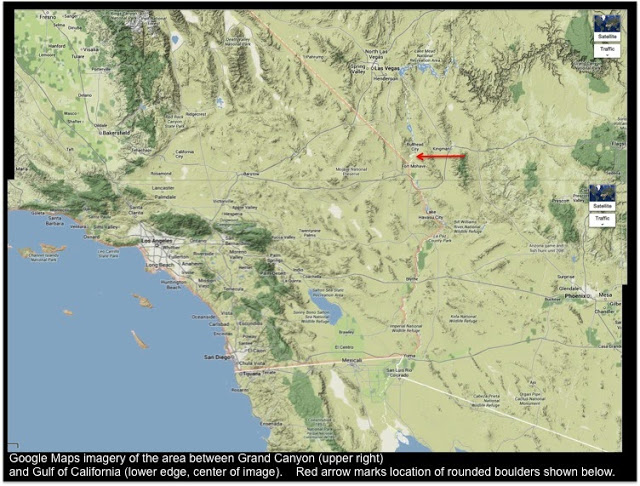
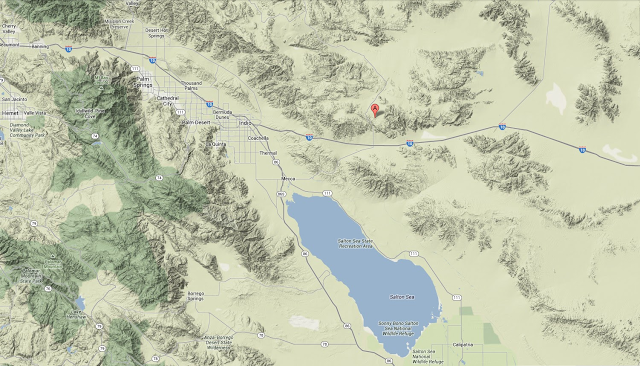
The image above, from Google Maps, shows the distinctive terrain between the two features (Grand Canyon and Gulf of California), a desert region resembling a vast flood plain, marked by ridge line features that resemble lines of dirt left over by a drainage event.  This area is part of the larger "Great Basin" region, and contains the Mojave Desert.  If you can imagine lining the bottom of a bathtub with dirt, then filling it up with water, and then blowing a hole in the side of the bathtub with a large firecracker (like an M-80) [don't try this at home -- this is only a thought experiment], you might be left with a similar pattern of dirt "eddies" along the floor of the bathroom after all the water flowed out of the tub and out of the bathroom (assuming the water had someplace lower to run towards).

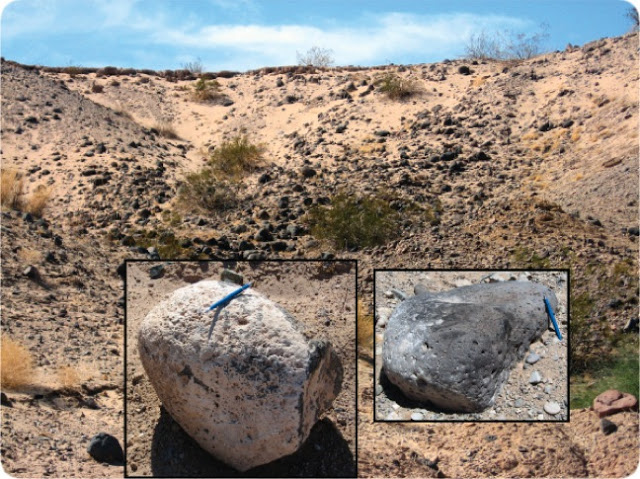
If you explore the terrain shown above in person (and I have spent quite a bit of time crawling around in the regions shown in the map) you will find that it is full of very interesting terrain, and that most of the ridge line features that rise up out of the desert are full of a mix of rocks and boulders of all sizes and shapes.  Some of these have been rounded into spheroid shapes by some process.  According to Dr. Brown's interpretation of this evidence, these provide further support for the hypothesis that the Grand Canyon was the product of massive volumes of high-velocity water, which removed thousands of cubic miles of sediments and flowed towards the Gulf of California like a massive tsunami.  

In figure 136, which is found on this page of Dr. Brown's chapter on the Grand Canyon (under paragraph 13, "Missing Dirt"), he presents a photograph of two such spheroid boulders, located south of Bullhead City, Arizona about a mile east of the Colorado River and a hundred feet in elevation above that river (see image below).  The approximate location of this photograph is marked in the map above with a red arrow.  


What could have rounded these boulders into their smooth shapes?  One possibility is the action of high-velocity water, moving them along the bottom for miles at a rapid pace, and depositing them far from the present river and at an elevation high above it.

These boulders shown in Dr. Brown's book (the same image can be seen in the hardcopy version of his book, on page 205 of the 8th edition) are by no means anomalous to the region.  Other similarly rounded boulders can be seen in the Coachella Valley, far to the west and south of the red arrow in the image above, but still in the area that would have been flooded by the rapidly-moving water from the breaching of Grand and Hopi Lakes, if the hydroplate theory is correct.  See for example the photograph at the top of this page (linked) showing very spheroid boulders, some piled on top of one another with large gaps in between them.

There are a few possibilities for explaining the boulders in that image, which are located in Joshua Tree National Park at the approximate location of the marker (the red marker, with the letter "A" on it) in the image below:


That location can be found on the map at the top of this post as well -- it is just north of the Salton Sea and Interstate 10 (you can find the Salton Sea on the map at the top of this post -- it is about center from the left and right sides of the image, but closer to the lower edge of the image).

Those boulders could have been carved into spheroid shapes by the wind, although this explanation seems somewhat unlikely (especially as they are piled on top of one another -- the wind would not be expected to deposit large boulders on top of one another in that manner).  They could have been ejected from an ancient volcano in this spheroid shape and left in a pile as shown in the photograph (while this possibility does not seem to be the correct one, especially given the composition of the rocks themselves, it is a possible explanation).  Or, they could have been eroded into a spheroid shape by rolling for miles at the bottom of a huge flow of water, and left in the location we find them today by that water as it coursed down through the maze of mountainous terrain features towards the Gulf of California.

In his discussion of the evidence (again from paragraph 13 on this page of his online book), Dr. Brown writes:

At least 2,000 cubic miles of Mesozoic sediments were stripped off the layers surrounding and above what is now the Grand Canyon. Only then could the 800 cubic miles of sediments be removed from inside the Grand Canyon. All that dirt was spread downstream from the Grand Canyon, primarily into the northernmost 220 miles of the Gulf of California.
Relatively few sediments were deposited along the Colorado River as it flows south toward the Gulf of California. Rounded boulders mixed with sand and clay are often seen where today’s side streams have cut channels 100–200 feet deep. Those rounded boulders show that they were tumbled and transported by high-velocity water. Unsorted mixtures of sand, clay, and boulders show that the turbulent, muddy water suddenly slowed, depositing the unsorted mixture. [See Figures 136 and 137.]

Clearly, if the Canyon were carved by the normal action of the Colorado River over millions of years, we would have to find another explanation for the location and condition of these boulders.  It would be difficult (if not impossible) to explain this evidence by saying that the river has been flowing at a fairly uniform rate and volume for millions of years.

If you read further in paragraph 13 on the web page cited above from Dr. Brown's book, you will find a reference to a recent (2011) study of the very area under discussion, which looked at the geology of the area shown in the map above and said that although the sediments in the area in question have been widely studied for over a hundred fifty years, "their origin remains unresolved and their stratigraphic context has been confused" (Stratigraphy and Depositional Environments of the Upper Pleistocene Chemehuevi Formation along the Lower Colorado River, Malmon, Howard, House, Lundstrom, Pearthree, Sarna-Wojcicki, Wan and Wahl, 2012 -- link to full report).

They offer a new theory for the origin of the sediments in the vast flood plain between the Grand Canyon and the Gulf of California, namely "a single major episode of fluvial aggradation, during which the Colorado River filled its valley with a great volume of dominantly sand-sized sediment."

While it is nice to see conventional geologists arguing for an extraordinary event to explain evidence that clearly calls for such an explanation (and note that their study was published long after Dr. Brown wrote the discussion quoted above, which can be found in his 2008 hard-copy 8th edition, minus the reference to the 2011 study), their explanation still fails to explain the rounded boulders shown in the two locations discussed above.  A flooding river might move large rocks, but it would not be expected to have the velocity to roll them along for miles at high speeds and round them into spheroids, nor would it be able to pile them up in the jumble shown in the Joshua Tree image.

In short, the evidence on the ground in between the Grand Canyon and the Gulf of California appears to support the hydroplate theory, and to refute the conventional explanations.  And that is in addition to the tons of sediments at the bottom of the Gulf of California (which suggest a rapid high-volume dumping, because if those sediments were deposited by a river over millions of years, it would have been expected to build up a large river delta, which is not present at the north end of the Gulf, as discussed in the previous post and in Dr. Brown's books).

All of this evidence can be added to the massive amounts of evidence in the vicinity of the Grand Canyon itself, which suggests that this incredible terrain feature is the product of a catastrophic event involving huge volumes of high-velocity water, and not the action of a normal river moving with normal volumes and normal velocities over the course of millions of years.  And yet teachers in school responsible for the education of children from the youngest grades through graduate school, as well as all the guides at the Grand Canyon itself, continue to insist on presenting the conventional theory as if it were settled fact, and as if anyone suggesting an alternative explanation is way out of bounds.