Surveillance and self-enslavement


[note: as of 12/2013, the above video introducing Argentina's SIBIOS surveillance system has been removed from YouTube.  A version of the same video, with English subtitles, is available here.]

The study of human history -- and the study of the overwhelming evidence from around the globe which argues that the truth about ancient history is far different from what we have been led to believe by those promoting the conventional storyline -- is fascinating enough for its own sake, but takes on a far more profound importance when we realize that the story of mankind's ancient past has a direct connection with the subject of human consciousness.

Many authors and analysts and alternative theorists have demonstrated that the question of consciousness was of tremendous importance to our ancient ancestors.  John Anthony West has gone so far as to assert that the ancients believed that "we human beings are not accidental glitches in an accidental universe, but rather that we have a specific role to play, which is the acquisition of a level of consciousness that we are not born with, but that we have the potential to reach, and that this is what in Egypt is called 'The Doctrine of Immortality.'"

This quotation from John Anthony West was discussed in previous posts "John Anthony West on the meaning of human existence" and the subject was explored further in "John Anthony West on creativity, discipline, and consciousness."

However we define this "consciousness" that John Anthony West (rightly) asserts we should seek to acquire during our sojourn in this life, it should go without saying that enslaving human beings does violence to their pursuit of "the acquisition of a level of consciousness that we are not born with."  There appears to be some evidence to support the idea that there are elements who actively seek to thwart the pursuit of consciousness by others.  It is even possible that the deliberate suppression of the truth about ancient history is part of this war on consciousness.

The ability of modern technology to enable the state to impose constant surveillance on men and women adds a dangerous new level of intensity to the war against consciousness.  In the name of providing "security," technology is now being deployed which can use "biometric" identification to track individuals wherever they go, and which can listen to and record their every conversation or spoken word.

The video above describes the biometric identification system being deployed by the state of Argentina to monitor the movement of citizens.  It explains that the collection of the faces and fingerprints of all citizens will form the foundation of the system, which will then allow facial recognition by cameras linked to computers, as well as the creation of biometric identification which is linked to a database containing information on each individual, allowing one's fingerprints to serve the same function as the "papers" that some notorious states in the past have required everyone to carry to present to state agents upon request.

The video, which was obviously produced by the government, shows smiling citizens giving a "thumbs-up" to this new system, and it begins with the slogan (shown at the 0:03 mark): "Si nos conocimos mejor, nos cuidamos mas" (which basically means, "If we know ourselves better, we protect ourselves more."

A year ago, Wired magazine published an article entitled, "Public Buses Across Country Quietly Adding Microphones to Record Passenger Conversations."  The article reports that in the United States, cities are receiving millions of dollars in funding from the Department of Homeland Security to deploy buses containing advanced audio-visual monitoring and recording systems, capable of pairing audio recordings of individual conversations with images captured by cameras installed in several places on the buses, "in order to produce synchronous recordings."  The article states that:
Audio and video can be monitored in real-time, but are also stored onboard in blackbox-like devices, generally for 30 days, for later retrieval.  Four to six cameras with mics are generally installed throughout a bus, including one near the driver and one on the exterior of the bus.
According to some reports cited in the article, these microphones are technologically enabled to have the capability of "distilling clear conversations from the background noise of other voices, wind, traffic, windshields wipers and engines," which basically means that someone monitoring the systems or sifting through the data later can zero-in on everything you say while on the bus (or even outside the bus).

This is not something that is being debated or being considered: this technology has already been rolled out and is in use in the United States right now (see image below, taken on a public transit bus equipped with this new technology).

This pervasive surveillance, both in the US and in Argentina, is a clear violation of the inherent rights of men and women.  Placing people in a situation in which they know that their every conversation is being recorded is a violation of their freedom and dignity as human beings.

Some will argue that those who are not committing any crimes have nothing to worry about from such monitoring, and that these systems can help the state respond more rapidly to criminal activity or to a sudden health problem.  While it may be possible to think up scenarios to support such a position, the possibility that someone else will commit a crime is no justification for treating every passenger as a potential criminal whose every conversation, whether with their spouse, their boyfriend or girlfriend, their son or daughter, or just with a friend or even a stranger next to whom they happen to be sitting, is fair game for recording by unseen supervisors.  This reduces free men and women to the status of children in a playroom, supervised by authority figures, or to the status of convicted criminals, supervised by their guards and wardens.

Some also argue that conversations in public have no expectation of privacy, and that because the cameras and microphones are not hidden (and because their presence is announced by signs and placards), they are perfectly legal and even moral.  This argument is also false.  If my neighbor is yelling down the street, he has no right to expect his shouting to remain private.  But if I use sophisticated technology to snoop on him -- and to record him -- while he is sitting on the curb having a private conversation with his wife, or while he plays baseball in a public park with his children, I am doing violence to the freedom which is his birthright, and which is the birthright of every human being.  People do not suddenly get the right to electronically eavesdrop on other human beings just because they put on a certain costume and give themselves a title -- in other words, the state and the agents of the state do not get a pass to trample on the natural rights of another man or woman, any more than private individuals get a pass to trample on the natural rights of their neighbors.

Furthermore, announcing constant surveillance does not somehow make it any less of a violation.  Even if one is not actually doing anything wrong, the knowledge of constant surveillance will cause the individual under surveillance to start to second-guess how his or her words might be perceived, not by the person to whom he or she is talking (someone who probably knows him well), but by some invisible, and possibly hostile, agent of the state.  The individual under surveillance will thus begin, consciously or unconsciously, to alter what he or she says, to make sure nothing can be misconstrued by the unseen listener.  The unseen listener, in fact, may even be a computer software application, which might certainly misconstrue the conversations of human beings.

This means that the person under surveillance will begin to self-censor himself or herself.  He or she will refrain from saying things that might be taken the wrong way.  He or she will avoid certain vocabulary.  In time, this process of self-censorship will begin to be applied (perhaps unconsciously) to that person's thoughts themselves.  As the person under constant surveillance by the unseen, shadowy agents of the state begins to avoid saying certain words or figures of speech or topics of conversation, that person will actually begin to self-censor thoughts.

Thus, constant surveillance is actually a form of oppression, and even potentially a form of mind-control.  It is a form of violence.  It is a form of enslavement.  It is absolutely a violation of human rights.  It is also a manifestation of the war against consciousness.

Now, it is certainly true that oppression and violence against the natural rights of mankind have been going on for centuries, and that we do not have to wait for such oppression to disappear completely in order to pursue that "acquisition of a level of consciousness that we are not born with" which John Anthony West describes in the quotation above.  If we had to wait for a perfect environment in which to pursue consciousness, we might have to wait forever.  Men and women have pursued consciousness in conditions of terrible oppression.

However, this fact of history does not mean that we should focus only on the pursuit of consciousness and passively accept the violation of the rights of others or ourselves.  If someone next to you is being violated, and you have any ability to stop it from taking place, you have a moral duty to do so, and not to stand idly by and work on your own pursuit of consciousness.  In fact, it may well be the case that your own pursuit of consciousness specifically involves your standing up to the violation that you see taking place at that moment.

When it comes to violations that are being inflicted by a state, the most effective way to stop those violations may well be the withdrawal of support for the state, along with the expression of outrage at the violence that is taking place, and an explanation to others of why those actions are an outrage.

Those working at companies making such technology (some of which are listed in the Wired article, but there are many others) should be given a clear explanation as to the immorality of the use their technology is being put to, and the leaders of those companies should be asked to desist from the sale of such equipment to those who will use it to do violence to the rights of others.  If people at those companies became convinced of the immorality of such use, they themselves would pressure their leaders to stop allowing it to be used for oppression.

Standing up against violence and the violation of human rights is not always easy.  It is not always comfortable.  It is not always convenient.  However, the immortal words of Chief Sitting Bull Tatanka-Iyotanka quoted in yesterday's post warn against the acceptance of enslavement, or (even worse) of the act of self-enslavement, when he said to his fellow free-born Lakota:  "You are fools to make yourselves slaves to a piece of fat bacon, some hardtack, and a little sugar and coffee."







A November 11th meditation, 2013


If you had been alive in the United States during the years 1868 to 1876, would you have uncritically "supported the troops" who were providing the force of arms that backed up the policy of stealing the land of the American Indians such as the Lakota Sioux and deliberately destroying their way of life, so that others could take what they wanted from them (which turned out to be basically everything)?

Would you have given up your seats in the first-class section of the train and given them to the troops coming back from the "Indian campaigns," the way people today give up their seats in the first-class sections of airplanes for members of the US military?

Would you have reflexively said, "Thank you for your service" whenever you met someone who had participated in those campaigns?

In 1868, representatives of the US government (namely General Sherman, General Harney, General Terry, General Augur, and others) signed a treaty with the Lakota Sioux acknowledging the right of the Sioux to all the territory from "the east bank of the Missouri river where the 46th parallel of north latitude crosses the same, thence along low-water mark down said east bank to a point opposite where the northern line of the State of Nebraska strikes the river, thence west across said river, and along the northern line of Nebraska to the 104th degree of longitude west from Greenwich, thence north on said meridian to a point where the 46th parallel of north latitude intercepts the same, thence due east along said parallel to the place of beginning," which basically included all of what is now delineated as the state of "South Dakota" located to the west of the Missouri River.*

The treaty stipulated that the country named would be "set apart for the absolute and undisturbed use and occupation of the Indians" and, further, that "the United States now solemnly agrees that no persons, except those herein designated and authorized so to do, and except such officers, agents, and employees of the government as may be authorized to enter upon Indian reservations in discharge of duties enjoined by law, shall ever be permitted to pass over, settle upon, or reside in the territory described in this article, or in such territory as may be added to this reservation for the use of said Indians."  This treaty was ratified by the US Senate.

In spite of this treaty, however, in 1874 an army unit under General Custer went into the Black Hills (sacred to the Lakota and called Pa Sapa in their language, and within the area off limits as described in the above treaty) to confirm the presence of gold there, after which prospectors began to pour into the region, demanding military protection by the US Army from the Sioux.

There followed negotiations in which the US government tried to buy back the Black Hills, but the Lakota declined.  So, the US government decided to declare war on the Sioux, after which they "began to look around" for an excuse to justify going to war, according to Stephen Ambrose in Crazy Horse and Custer, who cites former Director of the Bureau of Indian Affairs George Washington Manypenny (1808-1892).  On page 396 of that book, Ambrose writes: "After making the decision to declare war (according to George Manypenny, a former commissioner of Indian affairs), the government then began to look around for a causus belli."  They found one in a report of a raid by the Sioux agains the neighboring Crow: "Although such raids had been going on since time out of mind, the government announced with a straight face that it was reluctantly making war on the wild Sioux in order to protect the Crows" (396).

In other words, the United States was involved in a grave injustice, one which would lead to the death and misery of an entire nation of people, and the soldiers who engaged in backing up that policy by force were also involved in a grave injustice.  The attitude of the military leaders can be seen in a letter from General Sherman, a lead signatory of the treaty which had been signed in April of 1868, to General Sheridan, written in October of 1868, just a few months after he signed the treaty, in which Sherman said: 
Go ahead in your own way and I will back you with my whole authority.  If it results in the utter annihilation of these Indians, it is but the result of what they have been warned of again and again.  [. . .] I will do nothing and say nothing to restrain our troops from doing what they deem proper on the spot, and will allow no mere vague general charges of cruelty and inhumanity to tie their hands, but will use all the powers confided to me to the end that these Indians, the enemies of our race and our civilization, shall not again be able to begin or carry out their barbarous warfare on any kind of pretext they may choose to allege.  Cited in Ambrose, 303.
These are hideous statements and hideous sentiments.  While not everyone under Sherman's command may have harbored sentiments as odious and inhuman as those expressed in this letter from Sherman to Sheridan, the fact is that every single one of the soldiers in that campaign, and in many others like it which took place against other tribes throughout the American west as the United States expanded into territory that it wanted to take away from the people who had lived there for hundreds or thousands of years before them, was involved in a completely unjust and immoral violation of natural law.  By extension, so was the public that provided support to the government that was carrying out these acts.

What would have been the proper thing to do if one were in the military of the US at that time?  It would have been to renounce participation in such an immoral and unjust action and to tender one's resignation.  Likewise, the proper response of the public should have been outrage at this shameful and illegal use of deadly force to steal the country of the American Indians and destroy their way of life.  

Every individual aware of what was going on should have registered this outrage in the strongest terms possible, should have attempted to explain what was going on to others, should have removed their approval and support from the government that was perpetrating this atrocity until the situation was rectified, and should have encouraged others to remove their approval and support from that government as well.

Instead of providing automatic and reflexive words and displays of approval and encouragement to the individuals in the military who were under the command of men such as Sherman, citizens should have clearly and plainly told them that what they were doing was utterly wrong, and helped them to understand why it was wrong, and why the only proper course of action was the immediate renunciation of any support or participation in the ongoing criminal violence.

It was absolutely justified for the Lakota Sioux to resist with force of arms the unjust incursions of the US Army, even though their resistance was ultimately doomed to failure.  In 1876, led by Tatanka-Iyotanka (Sitting Bull, pictured above) and Tashunka-Witko (Crazy Horse, whose stated policy was never to be photographed and of whom no undisputed photograph exists), warriors of the Lakota and other allied tribes completely annihilated a force of the US 7th Cavalry led by General Custer at the Battle of the Little Bighorn.

In exhorting his people to continue their free way of life rather than consent to being made into slaves who were bound to obey the dictates of others, Sitting Bull said:
I don't want to have anything to do with people who make one carry water on the shoulders and haul manure.  The whites may get me at last, but I will have good times till then.  You are fools to make yourselves slaves to a piece of fat bacon, some hardtack, and a little sugar and coffee.  17.
In explaining the difference between those who believe they have the right to tell others what to do (and enforce those orders with violence, even to the point of killing), Crazy Horse's fellow Oglala warrior He Dog (pictured below) related these words of Crazy Horse:
I said, 'Does this mean that you will be my enemy if I move across the creek?'  Crazy Horse laughed in my face.  He said, 'I am no white man!  They are the only people who make rules for other people, that say, "If you stay on one side of this line it is peace, but if you go on the other side I will kill you all."  I don't hold with deadlines.  There is plenty of room; camp where you please.' xv.
Both leaders in these admirable quotations are expressing disgust at those who enslave others, or enslave themselves.  They were willing to fight against the violation of natural law that was being perpetrated against them and their people.  That is admirable; to fight on the side that is violating natural law is despicable.

Ultimately, however, there was no way that the Lakota could militarily resist the overwhelming numbers that the US government could muster, nor the wholesale destruction of the buffalo herds on which their traditional way of life depended.  The only thing that could have stopped the US government from pursuing its unjust policy would have been widespread outrage and removal of support from the people on whom the US government relied for its existence, and on whose sons it relied for its military.

That widespread outrage and removal of support never happened.  Every human being today should carefully consider this fact, and commit to memory the quotations of the two Lakota leaders cited above, and the view of mankind and the natural rights of every living soul expressed in those words from the past.


* the size of the portion of country ceded by the US to the Sioux including the entire state of South Dakota to the west of the Missouri River can be seen on any map of the US; the "104th degree of longitude west" describes the western north-south running boundary of modern South Dakota, and the "46th parallel of north latitude" describes the northern east-west running boundary of modern South Dakota.

What do you know? Astronomers discover an asteroid that acts like a comet, active asteroid P/2013 P5 (it's a UFLO)


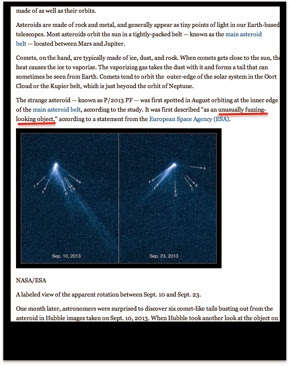
In August of this year, astronomers monitoring the Pan-STARRS telescope in Hawaii discovered a space object in the asteroid belt which was described as "unusually fuzzing-looking" -- a rather strange description and one that perhaps coins a new word ("fuzzing").**

The use of this strange new word, used in a way that seems to defy normal grammatical and syntactical conventions, may have been appropriate in this case, because the strange new object seems to defy normal assumptions about our solar system.  Less than a month later astronomers using imagery from the Hubble Telescope were astonished to observe the object, which was orbiting with asteroids along the inner edge of the asteroid belt, ejecting as many as six comet-like tails!  The object, which was designated "active asteroid P/2013 P5" or simply "P5" for short (a rather ungainly moniker, which might have been better left as the "UFLO," or "unusually fuzzing-looking object") seemed to combine characteristics of an asteroid and a comet, completely defying conventional models of either comets or asteroids, and causing lead investigator Professor David Jewitt to say that he and his team were "literally dumbfounded." 

The reason this asteroid-shaped object, located in the main asteroid belt but spewing tails that resemble comet tails, causes difficulty for many adherents of conventional models is that those models propose very different mechanisms for the origin of comets and the origin of asteroids.  An object located among the main asteroid belt exhibiting some comet-like properties exposes problems with the conventional model for the origin of both comets and asteroids.

The paper published today (November 07) in Astrophysical Journal Letters by Dr. Jewitt, along with Jessica Agarwal, Harold Weaver, Max Mutchler, and Stephen Larson entitled "The Extraordinary Multi-Tailed Main-Belt Comet P/2013 P5" does a good job of explaining the problems that this UFLO poses for the conventional models.  

The paper explains that P5 has an "asteroid-like orbit and comet-like appearance" (page 2).  The ejection of streams of vaporous matter can be explained for comets, which contain ice as well as mineral particles and which are thought to come from the "Oort cloud," a hypothetical shell of orbiting comets situated extremely far from the sun, but scientists are at a loss to explain how a comet from the Oort cloud could have possibly ended up in an asteroid-like orbit among the other asteroids in the main asteroid belt. 

Similarly, the Kuiper Belt (which is much closer to our sun than the hypothetical Oort cloud) contains ice and other gasses, as well as rocky objects, but again it is difficult to explain how anything from the Kuiper Belt could have joined the asteroid belt in an asteroid-style orbit like the orbit of P5.  In fact, the physics appear to rule out the possibility of either an Oort Cloud object or a Kuiper Belt object ending up following the path around the sun that P5 is following.  In their paper, Professor Jewitt et al. explain the problem:
No known dynamical path connects the main-belt to the Kuiper Belt or Oort cloud comet reservoirs [page 2 of the paper by Jewitt et al.]. [. . .] Neither is it likely that P5 could be a comet captured from the Kuiper Belt or Oort cloud comet reservoirs; numerical simulations show that such capture is effectively impossible in the modern solar system (Fernandez et al. 2002 [page 5 of the paper by Jewitt et al.].
This is a king-sized problem.  If this object, which appears to be behaving like a comet by spewing out long tails of matter, did not and could not have come from the outer fringes of the solar system (or far beyond the outer fringes, in the case of the proposed Oort cloud) where scientists believe that comets originate, then where did it come from?  Are we to suppose that comets can come from the inner solar system?  "Preposterous!" say the supporters of the conventional models.

But if P5 is not a comet (since comets can only come from the Kuiper Belt or even further away), then its comet-like tails must be explained as material that an asteroid or other solar system object might throw off, and the difficulty is in explaining how an asteroid could throw off the comet-like tails that P5 exhibits. 

Comet tails are composed of icy particles that can stretch for tens of millions of miles through space (or even longer).  The problem that P5 poses is that conventional models for the formation of asteroids in the main belt do not admit to the presence of enough water or ice to create comet-like tails.  The paper by Dr. Jewitt et al. explains that:
The orbit of P5 lies near the inner edge of the asteroid belt, in the vicinity of the Flora family of S-type asteroids.  These objects have been associated with the LL chondrites, which themselves reflect metamorphism to temperatures ~860o C to 960o(Keil 2000).  As such, P5 is an unlikely carrier of water ice, and sublimation is unlikely to account for the observed activity.  5.
With water or ice removed as an option for explaining the tails of fuzzing-object P5, the scientists have to come up with another hypothesis.  They suggest that impacts could raise dust clouds, but the problem is that P5 has been observed for some time now and the ejections are continuing.  See the two images from the Hubble Telescope above, which are available here, along with press releases and other discussion from NASA.   

After rejecting these explanations, the paper's authors conclude: "The surviving hypothesis is that P5 is a body showing rotational mass-shedding, presumably from torques imposed by solar radiation" (6). I other words, the sun is causing the asteroid to spin and the spin is causing it to disintegrate, and as it disintegrates the disintegrating particles are streaming out and looking like six comet tails.

Hmmm.

How exactly that is taking place, and why it would look the way it does in the images, is not explained, and the paper's authors note that such a "rotational mass-shedding" has not yet been quantitatively modeled, and has some problems associated with it as an explanation (such as, how fast would the particles really be coming out of an asteroid that is spinning in the way that this hypothesis proposes?)

Not surprisingly, if the scientists were to consider the work of Dr. Walt Brown, whose hydroplate theory posits a very different mechanism for the origin of comets, they would find solutions for all of the above problems.  Dr. Brown's theory contains detailed chapters on the "The Origin of Comets" and "The Origins of Asteroids and Meteoroids," and it argues that both originate from the same source and are in fact related!  In other words, the discovery of a bizarre hybrid like P/2013 P5 is not astonishing at all -- on the contrary, it is exactly the sort of thing that the hydroplate theory would have predicted!   

First of all, the hydroplate theory argues that comets do not come from a hypothetical and currently-unobservable "Oort cloud."  The huge problems with the Oort cloud theory are discussed in this previous post entitled "Comet origins and the mysteries of mankind's ancient past," where former Chief of Celestial Mechanics at the US Naval Observatory Dr. Tom Van Flandern is quoted explaining some of the extremely improbable aspects of the Oort cloud theory.

Instead, the hydroplate theory argues that comets -- and asteroids and meteoroids -- are all products of a violent catastrophic event that rocked one of the planets of the inner solar-system, spewing both rock and water (which froze into ice) deep into space.  That planet of the inner solar-system is the one you are sitting on right now as you read this (unless you have an extremely unusual internet connection using a technology the rest of us do not know about yet). 

In the chapter on comets linked above, Dr. Brown explains why this hypothesis for the origins of comets fits the observed evidence, evidence which causes nearly insurmountable problems for all the other current theories, including the conventionally-accepted theories held by most academics today.

Furthermore, in the chapter on asteroids and meteoroids linked above, Dr. Brown explains that the asteroids in our solar system, including those in the main belt where P5 is orbiting, came from the same catastrophic inner solar system event.  He also explains that many large asteroids are not really solid space rocks, but are instead composed of many smaller particles which have clumped together and which are held together by a relatively weak glue of water ice, and which also contain a lot of empty space.  All of this discussion is supported by physics, which Dr. Brown cites.

This explanation by Dr. Brown explains a plethora of evidence surrounding both comets and asteroids, evidence which causes major headaches for proponents of the conventional theories.  Interestingly enough, Dr. Brown's explanation also explains the "problems" posed by P5 cited in the paper published today.

For starters, if comets do not originate in some very faraway Oort cloud, or even from the Kuiper Belt (both points of origin which cannot get a comet into the orbit P5 follows), then one of the biggest problems that P5 poses goes away immediately.  If comets originated from earth (and the evidence suggests that they did, as Dr. Brown's chapter on comets and as numerous previous posts on this subject -- see this post, this post and this post, for instance -- have illustrated), then the idea that a comet-like object could have ended up in the asteroid belt becomes quite possible.

Further, the fact that comets and asteroids are really all related clears up some of the other difficulties cited in the P5 paper published today as well.  As noted above, Dr. Brown believes that many asteroids contain water-ice, especially the larger asteroids which rotate more slowly (smaller asteroids which rotate very rapidly are probably solid chunks of rock, but large and slow-rotating asteroids are probably big aggregates or conglomerates of smaller chunks, held together by a glue of water ice).  

But what about the difficulty cited in the paper of having water ice on an asteroid, which contains chondrites indicating the rock experienced extremely high temperatures in the past?  Does Dr. Brown's theory deny the presence of these chondrites, or that they indicate extremely high heating and even metamorphism in the past?  

Not at all!  

Dr. Brown's theory explains in great detail that, prior to the catastrophic earth event which launched the rocks and water into space, rock within earth's crust was under tremendous pressure.  Some of the astonishing by-products of the forces at work are examined in the chapter entitled "The Origin of Earth's Radioactivity." It is perfectly consistent with the laws of physics to believe that the pressure and heating that created the signatures cited in today's paper took place while those rocks that are now in asteroids were still part of earth's crust.  

When they were violently launched into space, out of the orbit of the earth (but still in orbits around the sun, with many widely varying paths), along with tons of supercritical water from the earth, the water and debris ended up as today's comets and asteroids and meteoroids.  That water is now frozen, but the presence of frozen water alongside rocks that were once heated up to the point of producing chondrites does not cause any problems for advocates of the hydroplate theory.  It only causes problems for the conventional theories, but the conventional theories have all kinds of other problems that Dr. Brown outlines in his book, problems that involve evidence available for examination long before the discovery of P/2013 P5.

The discovery of P5 only serves as yet another dramatic piece of evidence which suggests the fundamental flaws of the conventionally-accepted theories.  

It also serves as yet another dramatic piece of evidence which suggests that Dr. Brown's theory, explaining the observed evidence on our planet and in our solar system through the mechanism of a catastrophic event in earth's past, has tremendous predictive and explanatory power.  The ability to make correct predictions, and to be able to explain new discoveries that were not even known when the theory was first put forward, may well be the most critical acid test for a scientific theory.

Why hasn't Dr. Brown's theory received the recognition it deserves?  Why haven't scientists flocked to examine it more closely?  Why is it not at least given a place as one of the "surviving hypotheses" when scientists come across new evidence which their favored theories have no way of explaining?

The obvious answer is that Dr. Brown's theory involves a global flood, in line with the flood described in the Old Testament.  This alone places his theory "beyond the pale" and ensures that conventional scientists will not touch it.  However, that is ridiculous behavior.  Accepting the possibility of a catastrophic event in our planet's past does not automatically require those who accept that possibility to suddenly adopt a literal understanding of the entire Old Testament (let alone the New Testament), any more than it requires them to suddenly adopt a literal understanding of the sacred traditions of ancient Egypt, ancient Greece, or of the Ackawois people (of the part of South America that is today called Guyana), or the Hopi people, or any number of other people around the globe who have also believed in a flood.

The fact that Dr. Brown's theory sheds tremendous light on the newly-discovered "active asteroid P/2013 P5" should cause astronomers and scientists around the world to take note and look into his arguments more carefully.  

Refusing to even consider it as a possibility is just an example of "fuzzing-thinking." 


** At least, that's the way it was quoted in this article, which contained links to sources, none of which actually contained the phrase "fuzzing-looking."   It may be that this was just a typo, or it may be that someone coined a new (awkward) descriptor to go along with a new (awkward, at least for conventional solar system models) space object.   See screenshot below:


Plutarch on why priests of Isis wear linen garments


In his very important discussion of Isis and Osiris in his collection of essays Moralia, Plutarch discusses the reason that the priests of Isis wear linen garments.  He writes:
It is true that most people are unaware of this very ordinary and minor matter: the reason why the priests remove their hair and wear linen garments.  Some persons do not care at all to have any knowledge about such things, while others say that the priests, because they revere the sheep, abstain from using its wool, as well as its flesh; and that they shave their heads as a sign of mourning, and that they wear their linen garments because of the colour which the flax displays when in bloom, and which is like to the heavenly azure which enfolds the universe.  But for all this there is only one true reason, which is to be found in the words of Plato: "for the Impure to touch the Pure is contrary to divine ordinance."  No surplus left over from food and no excrementitious matter is pure and clean; and it is from forms of surplus that wool, fur, hair, and nails originate and grow.  So it would be ridiculous that these persons in their holy living should remove their own hair by shaving and making their bodies smooth all over, and then should put on and wear the hair of domestic animals.  We should believe that when Hesiod said,
Cut not the sere from the green when you honour the gods with full feasting,
Paring with glittering steel the member that hath the five branches,
he was teaching that men should be clean of such things when they keep high festival, and they should not amid the actual ceremonies engage in clearing away and removing any sort of surplus matter.  But the flax springs from the earth which is immortal; it yields edible seeds, and supplies a plain and cleanly clothing, which does not oppress by the weight required for warmth.  It is suitable for every season and, as they say, is the least apt to breed lice; but this topic is treated elsewhere.
From the Frank Cole Babbitt translation published in 1936 in the Loeb Classical Library, available online here.
Note that among the possible reasons that Plutarch says people give (but which he says are incorrect) for the priests' refusal to wear wool is "because they revere the sheep," which may be referring to terrestrial sheep but may also be referring to the heavenly sheep found in the zodiac, which we know as the constellation Aries.  In the passage above, however, Plutarch refutes those other reasons (at least he seems to refute them), and argues that the real reason that the priests of Isis do not wear fabrics made from the hair or wool of other creatures has to do with a belief about the nature of matter and the body, no doubt having to do with a particular doctrine about the sojourn of the soul and spirit within the fleshly material of this world, and from their desire to avoid routine contact with and contamination from "excrementitious matter" (either by wearing it or by eating it).

Interestingly enough, in a recent interview on "Radio 3Fourteen" (a production of Red Ice Creations), Lana Lokteff interviews Brian and Anna Marie Clement, of the Hippocrates Institute, and during the interview they give their opinion that among natural fibers to wear as clothing, linen is one of the best!

In that interview, Brian and Anna Marie Clement present evidence that synthetic clothing, often made from petrochemicals and treated with other powerful chemicals and dyed and coloured with still more chemicals, are very damaging to the environment during manufacturing, can have detrimental health effects on the body and brain, and can potentially "off-gas" chemicals for years and years after being first worn.

Reading up on the processes used to produce synthetic fibers does confirm the routine use of some pretty powerful chemicals.  For instance, one of the steps in the production of acrylic fibers may include dissolving polymers in a solution of N,N-dimethylformamide, which some believe can be linked to cancer in humans.  The production of spandex generally requires the mixing of a macroglycol with a di-isocyanate monomer -- and isocyanates are made by treating amines with phosgene, a poisonous gas which was infamously used as a chemical weapon during the First World War.

Brian and Anna Marie Clement instead recommend seeking out clothing made from organic materials (such as silk or linen) and manufactured using natural processes.  For more information on their views and research on this topic, see their 2011 book, Killer Clothes.

In a different essay, "On the eating of flesh," Plutarch argued that eating meat was a form of "slandering the earth" by implying that "she cannot support you" with the grains, fruits and vegetables that grow for food, asking:
Why slander the earth by implying that she cannot support you?  Why impiously offend law-giving Demeter and bring shame upon Dionysus, lord of the cultivated vine, the gracious one, as if you did not receive enough from their hands?
Perhaps he would use the same arguments for the creation of synthetic fabrics, had he known of such things, asking the same questions and arguing that nylon and rayon and polyester indicate a lack of faith in the earth to provide natural fibers for our clothing.

In any event, it is interesting to consider Plutarch's arguments for the wearing of linen, which "supplies a plain and cleanly clothing."


A terrific time of year to view the crucial constellation of Aries, the Ram

This is a terrific time of year to view Aries the Ram in the dark hours before midnight, and with the  waning moon rising at 3:25 am (and later as the days go on), the sky is currently giving us the perfect levels of darkness needed to make out the fainter stars in this crucially-important constellation.

Aries may not be a very familiar constellation, because it does not really "leap out" at the casual observer of the night sky.  Most of the stars of Aries are very faint, but it does have two bright stars, and they are very easy to find at this time of year.  In his indispensable book The Stars: A New Way to See Them, the beloved author H.A. Rey explains how:
RAM (ARIES):  This constellation is rather inconspicuous and would be less famous if it were not in the zodiac.  Its two brightest stars, in the Ram's head, can be spotted easily halfway between the Pleiades and the Great Square of Pegasus.  42.
So, to find the Ram, the two landmarks that H.A. Rey gives us are the Pleiades and the Great Square of Pegasus.  Both have been discussed previously in this blog (see discussion below), and both are very easy to find, especially this time of year, when Taurus the Bull along with the Pleiades are prominent in the eastern sky after the sun goes down in the "prime-time" viewing hours before midnight, and the Great Square of Pegasus is almost directly overhead between 10pm and midnight (and climbing pretty close to directly overhead in the hours before that).   

To find the Pleiades, you can use the brilliant constellation of Perseus (use the diagrams in previous blog posts here and here), as well as the constellation Taurus (see the diagram in the second of those two Perseus links).

To find the Great Square, see the diagrams in these two previous posts: "The Great Square of Pegasus (and more evidence for ancient contact across the oceans)" and "Aquarius."

Once you have located those two landmarks (Pleiades and Great Square), you will be able to easily locate the two brightest stars of Aries halfway between the silvery cloud of the Pleiades and the unmistakable Square of Pegasus.  Those two stars make up the head of the Ram.  

In the diagram above,  the size of the dot indicates the brightness of the star.  The two largest dots in the chart of Aries are marked with the Greek letters alpha and beta, and their names are shown as Hamal and Sheratan, respectively.

From here, you may be able to trace out the rest of the Ram, especially if you have a nice dark sky.  The constellation stretches from the triangular head down towards the Pleiades, where the Ram's little tail sticks up towards the upper foot of Perseus.  In fact, locating the upper foot of Perseus is helpful in pointing towards the lower (faint) stars which make up the hind part of the constellation Aries the Ram. You can see both of the feet of Perseus coming into the diagram above from the top-left quadrant of the chart.  The "upper" foot is to the right in that chart, and the "lower" foot is to the left.  

I am calling them "upper" and "lower" here because if you go looking for Aries in the hours before midnight, the foot on the right in this chart will be higher in the sky and the foot on the left as you look at this chart will be lower in the sky, closer to the eastern horizon.

Below is a chart without the outlines of H.A. Rey, oriented with the Ram rising up towards the zenith head-first, as he will appear in the hours before midnight.  Note that the feet of Perseus are now "upper" and "lower" (all descriptions here are northern-hemisphere-centric, with apologies to my brothers and sisters in the southern hemisphere).


(mobile users please keep scrolling down for the rest of the post)


Note that there is one more very recognizable landmark near Aries, and that is the constellation marked "Triangulum" on the charts, located above the shoulder of the Ram (or to the upper left of the shoulder, when Aries is rising through his upward arc across the eastern part of the sky).  This constellation is very easy to find and can also help you to trace out the rest of Aries, using the charts above.

In spite of the fact that Aries is not extremely easy to trace out in the night sky, doing so is very satisfying, both in its own right and because (as H.A. Rey hints in the passage cited above) Aries is actually an exceedingly important constellation.  For Aries is a member of the zodiac -- those constellations occupying the band of the ecliptic, through which the sun appears to pass as we rotate on our axis -- and not just any member of the zodiac, either.  Aries is from ancient times the acknowledged leader of the zodiac band, the first of the twelve constellations who encircle the heavens along the same burning path traced out by the sun during the day.

For this reason, Aries the Ram figures prominently in almost every sacred tradition of the ancient world.    The connections are too many to mention here -- only a few examples from Hamlet's Mill will be cited to give an idea of the importance of this leader of the zodiac.  The authors of Hamlet's Mill assert on page 318, for instance, that the voyage of Jason and the Argonauts in Greek myth, in their search for the Golden Fleece, was "undertaken in all probability to introduce the Age of Aries" (when the inexorable motion of precession brought the heliacal rising on the March equinox into the house of Aries after an age in the house of Taurus).

They also note that Heimdal of Norse myth is in some way associated with Aries, pointing out that:
Grimm rightly says that it is worthy of remark that Hallinskidi and Heimdal are quoted among the names of the ram.  Heimdal is the "watcher" of the much-trodden Bridge of the gods which finally breaks down at Ragnarok; his "head" measures the crossroads of ecliptic and equator at the vernal equinox in Aries, a constellation which is called "head" also by Cleomedes, and countelss astromedical illustrations show the Ram ruling the head (Pisces the feet).  158-159.
In this important passage, we see that the "gateway to heaven" (which Heimdal guards, Asgard in this case being a type of heaven) is associated with the head and with Aries, and (as the authors of Hamlet's Mill point out), Aries is associated with the head.  You can read more about this important subject, and see a diagram in which the zodiac constellations are paired with their associated part of the human body, in this previous post.  It is also worth noting that Heimdal is described as the "son of nine mothers," and we have just seen that the constellation of Aries rises up from a point just above the stars of the Pleiades.

For much more on the importance of the constellation Aries, the interested reader is encouraged to view the numerous enlightening videos of Santos Bonacci, who explores the subject in great detail. 

For all these reasons, it is well worth the effort to get out and view Aries in person at this time of year, if at all possible.  It is a constellation of ancient and enduring significance.

John Anthony West on creativity, discipline, and consciousness


In his groundbreaking book, Serpent in the Sky: the High Wisdom of Ancient Egypt (1979), John Anthony West explores a host of vital topics, but one extremely important subject he discusses is the relationship between creativity, discipline, and consciousness.  

In his examination of the incredible art of ancient Egypt, he explains that creativity and discipline are intimately connected.  We might at first think that discipline, implying rules and even restrictions, would be the antithesis of creativity, but John Anthony West explains that this is not so: it is in fact the discipline which enables the expression of the individual's creativity.  

He writes:
In Egypt, the anonymous sages were the artists, in our modern inspirational sense.  They designed the temples and the statues and the wall friezes.  The sculptors, painters and masons were but interpretive artists, this is true.  But there is no ignominy in this position.  We do not think the violin virtuoso 'repressed' because he must play Beethoven's or Bartok's notes.  Moreover, within the restriction of the imposed piece, there is ample opportunity for the exercise of creativity -- otherwise all virtuosos at a given level of professionalism would sound the same.  And if the virtuoso is a real virtuoso, then he will share in Beethoven's revelation.  90.
It was this combination of discipline and creativity that enabled the development of the individual artist, who by the long path of his particular discipline was enabled to express creativity at a very high level.  In John West's analysis, Egyptian art and architecture was "a continuous exercise in the development of individual consciousness" (90).  

This discussion of the interplay between discipline, creativity, and consciousness is extremely interesting.  It is only through years of discipline, for example, that basketball players can reach a level at which their playing can actually become an expression of individual creativity -- a level of artistry and self-expression (within the highly-defined boundaries of the sport) that can be described as the level of a virtuoso.  The same can be said of many other pathways for expressing creativity -- whether music, or painting, or sculpture, or the martial arts, or surfing, or yoga, or rock-climbing, or the craft of pottery, or of woodworking, or of glassblowing, or endless other examples which we can call to mind.

We could even venture to say that the simple act of making tea (which is -- at least in theory --  easier to prepare than coffee) can become a discipline which can eventually enable an extremely high level of artistic expression (and, of course, in some cultures it has).  

Interestingly, John Anthony West suggests that together, the interplay of discipline and creativity can lead to "the development of individual consciousness."  In an important 2008 interview on Red Ice Radio (discussed in this previous blog post, with a link to an online video containing the entire interview), John Anthony West elaborates on the importance of creativity and discipline to life.  

While the entire interview is worth listening to, the really focused discussion of "consciousness" and the role of creativity and discipline begins around the 1:15:00 mark in that video.  During that discussion, he again expresses the view that creativity -- which can be expressed in an enormous variety of disciplines, including hard work as "a carpenter, or a cooper" (1:17:22) -- is fundamental to consciousness.

In the same discussion, he expresses the view (also found on pages 90 and 91 in Serpent in the Sky) that modern civilization makes it much more difficult to pursue this path, particularly in our daily work lives.    But, in the same discussion, he notes that this should not be cause for complete despair -- it is still possible to pursue this path, although perhaps one will have to make a living doing something else at the same time.  Beginning at about 1:32:15, Mr. West explains:
It's very difficult to find that life path that will actually prove nurturing in and of itself -- but it doesn't mean that you can't do it: everyone has to make a living, so, not everybody can be a writer or a painter or an artist or a creator in that sense, especially nowadays -- but as long as the message is driven home, and there are -- as I said, there are -- my own focus is the Gurdjieff work but, that's, you know, that's a small thing -- it's not a small thing, it's a big thing, but it's not that well known -- but there are disciplines, legitimate disciplines, out there, that can be followed -- it's hard to do by yourself, you almost need a class to do it -- it's like learning the violin by yourself -- you can learn it, but you're much better off with a teacher -- you can learn it by yourself and then when you get to a certain point you have to get a teacher to teach you what you're doing wrong so that you can do it right.  So there are schools in which you can pursue that path -- but without the discipline it's just in your head -- it's a lot of New Age malarkey -- but without that there's no possibility of a civilization.  [. . .] First you have to recognize that the path is there -- then it has to become visceral and practical, and not just in your head, and that's the difficult part, unfortunately -- but without that there is no civilization nor can there be.  Simple as that.  Without the understanding that we as human beings individually and collectively have a destiny to fulfill -- nothing can happen.
Once again, we see the theme that "creativity" without any discipline at all, may not really be creativity but actually "malarkey."  But there are paths, legitimate paths, which are open to us to pursue, and which can connect us to something that, in John Anthony West's analysis, the ancient Egyptians were also pursuing -- pursuing with a single-minded purpose, in fact.

This seems to be an extremely important subject, and one upon which John Anthony West's insights are supremely valuable and worthy of careful consideration.

California's Old Stone Face, pareidolia, and Carl Sagan's demon-haunted world


Located along the California coastline, roughly halfway between San Francisco and Los Angeles, near the town of Los Osos, is a rugged boulder known as the "Old Stone Face."  As you can see from the image above, it clearly resembles a human profile, staring silently off in the direction of the Pacific Ocean, towering above the other boulders nearby.

If we ask ourselves how this boulder came to resemble so closely the profile of a human face, the first and most likely explanation is that we are simply "reading into" the natural shape of a rocky outcropping and finding a human face.  The ability to see forms in the random patterns of nature, such as in clouds, is called "pareidolia," and some have suggested that the ability to find faces among random shapes and figures is an evolutionary trait which has become "hardwired" into the human brain.  

For example, in his book the Demon-Haunted World (1997), Carl Sagan wrote:
Humans, like other primates, are a gregarious lot.  We enjoy one another's company.  We're mammals, and parental care of the young is essential for the continuance of the hereditary lines.  The parent smiles at the child, the child smiles back, and a bond is forged or strengthened.  As soon as the infant can see, it recognizes faces, and we now know that this skill is hardwired in our brains.  Those infants who a million years ago were unable to recognize a face smiled back less, were less likely to win the hearts of their parents, and less likely to prosper.  These days, nearly every infant is quick to recognize a human face, and to respond with a goony grin.  
As an inadvertent side effect, the pattern-recognition machinery in our faces is so efficient in extracting a face from a clutter of other detail that we sometimes see faces where there are none. 45.
Note that Sagan here is pawning off his explanation for the origin of our "pattern-recognition machinery" as the only possible explanation -- he is declaring authoritatively that this skill is a byproduct of the need for parental attention in mammals in order to survive.  One wonders whether whales and dolphins (who are also mammals and nurse their young) evolved their own "inadvertent side effect" similar to ours, and now see the faces of their own species in random groupings of waves or drifting seaweed.  

Sagan's fable about babies who respond with "a goony grin" having better odds of survival is just that: a fable.  One might still believe in evolution but argue that the ability to recognize a face in the jungle could help save you from an ambush, and that therefore early humans who could spot a face hiding among the rocks or the leaves (even if camouflaged) would be more likely to survive and reproduce.   But no -- Sagan authoritatively declares that his smiling infant explanation is the reason for our ability to  see faces, and that is the end of the matter.  It is, of course, also possible that our amazing "pattern-recognition machinery" is something that did not come about by evolutionary pressures at all (here is a link to a series of posts on the topic of evolution and alternative possibilities).

In any case, whether you agree with Sagan's explanation above or not, one possible explanation for the Old Stone Face shown in the (un-retouched, un-altered) photograph above is that it is simply another example of our incredible ability in "extracting a face from a clutter of other detail."  This is certainly the simplest explanation, and therefore has much to commend it.  In fact, using the principle of "Occam's razor," it must be considered the reigning hypothesis unless and until enough other pieces of evidence can be found which indicate that a different explanation should be entertained.

However, just because humans do have a remarkable ability to "extract a face" from random clutter does not necessarily mean that the boulder above was not subtly altered to more closely suggest a human head.  In fact, there are several examples from around the world of stone profiles which were altered by ancient humans -- indicating that the practice of shaping stony prominences into human faces was a deliberate activity that marked many different cultures, or perhaps one culture that traveled to many different locations on our globe.

For example, in the post entitled "Aligned stones, V-shaped notches, and massive but subtle sculptures found in India, New Zealand, and Peru," we examined evidence from three widely separated places where ancient sky-watchers created stone circles with astronomical alignments, as well as sight-lines to surrounding terrain features (some of which have conspicuous V-shaped notches aligned to important solar and lunar rising and setting points), and -- in each case -- the ancient stone builders of these complexes seem to have done some additional manipulation of large stones nearby in order to create monumental sculptures, often of craggy bearded faces.

At the important site of Ollantaytambo, in modern-day Peru, for example, there is a massive stone face measuring over 300 feet in height (see below).  Its profile features frowning brows, an angular jawline, and a nose very similar in shape to the Old Stone Face on the California coastline shown above.


Due to the other obvious signs of advanced stoneworking present in the area, as well as the very obvious shape of the eye and the nose, I would venture to state that even Carl Sagan would not argue that the face at Ollantaytambo is the product of our "hardwired" human ability to "see faces where there are none."  It was certainly sculpted by ancient artisans, perhaps because the cliff already had some natural resemblance to a human face, for reasons of which today we can only speculate: possibly for fun, and possibly for much more serious purposes.

The previous post linked above also made reference to a massive craggy bearded face found in a rock cliff at Whangape, on the north end of the North Island of New Zealand (Aotearoa).  This enormous face is discussed by Martin Doutre in his excellent Ancient Celtic New Zealand website, where it can be seen in two photographs at the very bottom of this page in his "articles" section.

Of that stone face, Mr. Doutre writes:
The clearly carved face is huge, and gazes towards the general positions of the Summer Solstice and Equinox rise points of the sun.  The face itself was carved to be very deliberately fluted or channeled, causing a high degree of shadow play across the face between the time of the Summer Solstice to the Winter Solstice and throughout each day of the year.  The Winter Sun would leave very long shadows on the face and an adept reader of the interplay between light and shadow would be able to fairly accurately determine both the time of year and the time of day.  The pyramidal marker stone atop the head would have served the function as an observatory position for solar rises and sets.  Accurate fixes on the Solstices (Summer & Winter) and Equinoxes (Vernal & Autumn) would have been calculated from that position and the calendar kept accurate accordingly.

Like the face of the old bearded man of Tokatoka, Ruawai, mentioned in Waitaha oral traditions, the face at Whangape sits adjacent to a deep navigable channel to the sea. These huge carvings obviously represented Tangaroa, god of the sea and ocean migrations.  It seems reasonable to assume that mariners heading to the open sea would say prayers to Tangaroa and, upon a safe return, express their thanks.
Interestingly enough, the Old Stone Face on the California coast is also found very close to a deep harbor with a channel leading to the Pacific Ocean.  Is it at least possible that, given its apparent similarities to the faces at Whangape and Ollantaytambo, it is the product of an ancient practice of subtly altering large stone outcroppings?

It is important to note that it is very possible that people in all parts of the world altered stone outcroppings independent of one another to create sculptures.  However, there are certain strong similarities in these faces which suggests the possibility that the people who created them were in some way connected (we can entertain this possibility for the cultures that produced the faces at Ollantaytambo and Whangape, whether or not we believe the Old Stone Face in California was manipulated by humans in the past).

As mentioned in the previous blog post linked above, the practice of subtly altering stone formations to resemble profiles is found in many other parts of the world as well.   This page from the website of Subhashis Das contains outstanding photographs of some of the wealth of ancient megalithic sites still surviving today in India.  If you scroll far down through the page, you will see boulders which have been subtly altered to resemble a huge iguana and the flukes of a diving whale.  On a different page, entitled "Did India and Britain have a contact in the deep past?" Mr. Das presents numerous photographs of dolmens, holed-stones, and labyrinth-patterned carvings in both India and the British Isles which strongly suggests that they are all the products of a single ancient culture, or at least of cultures which had fairly close contact with one another.

The evidence from around the world clearly seems to suggest that there was in fact an ancient culture which left its imprint at points far removed across our entire planet, from the British Isles, to the Americas, to the South Pacific, and that this ancient culture for whatever reason enjoyed creating massive stone sculptures in such a way that their art looked almost as if it was the product of nature and not of a human artist.  Based on this evidence, the many stone faces which can be seen around the world (often near a waterway or a navigable coastline) should be carefully examined to see if there is any evidence to suggest that there are also deliberate astronomical alignments marked into the terrain nearby, or other evidence to connect them to sites such as Ollantaytambo and Whangape and some of the megalithic ruins in India.

Because of the evidence from other parts of the world, these stone faces should not be immediately dismissed as products of "pareidolia," or Carl Sagan's "hardwired pattern-recognition machinery."