The Osiris and the Winter solstice (December solstice) 2013


The earth is presently hurtling towards that instant in time when its axis points most directly away from the sun (for the axis "protruding" out of earth's north pole, in the northern hemisphere) and most directly towards the sun (for the axis "protruding" out of earth's south pole, in the southern hemisphere) -- that is to say, the moment of the December solstice.

For those in the northern hemisphere, this moment is the winter solstice, although it is the summer solstice for the southern hemisphere.

Previous posts discussing the solstices compared the earth to a sailing ship of old: if the north pole is the spar protruding from the bow of the ship, and the south pole is the lantern at the stern of the ship, then the December solstice is that moment in which the lantern points directly at the sun as the ship circles the sun (in this metaphor, the "ship" stays pointed in the same direction, even as it orbits the sun).  For diagrams see this previous post.  

For other posts discussing the mechanics of the solstices and equinoxes, see also "Winter Solstice 2011," "Important cross-quarter day approaching!" "Summer Solstice 2013," and "The Hobbit and Summer Solstice," among others.

Also, this excellent post from Deborah Byrd at EarthSky gives some good discussion of the mechanics of the solstices, as well as pinpointing the time that earth will pass through the December solstice this year: at 17:11 Greenwich Mean Time tomorrow (21 December), which will be 9:11 am the same day (21 December) for North America's Pacific coast (at least for those on California time).

For observers in the northern hemisphere, the December solstice is that point at which the sun's arc finally ceases its downward (southward) motion.  It has been rising further and further south (along the eastern horizon), and arcing across the sky at a lower and lower angle (closer and closer to the southern horizon) ever since it passed the point of the June (summer) solstice.  Now it ceases that "descending" motion and begins to ascend again -- back towards the summit of the summer solstice.

The ancient Egyptians symbolized this point of the sun's commencing its northward-upward journey with profound allegorical imagery.  The Sun embodied the life-giving principle, and its commencement of the return back towards the north and the plant-growing time of the year was described as the rising of the mummified god Osiris.  The line between the lowest point on the zodiac wheel (the winter solstice) and the highest point (the summer solstice) was like a pillar in their symbology -- and that pillar was described as the backbone of Osiris, the life-giving backbone which supported the whole world and in fact supports the whole universe.  

For diagrams of the wheel of the zodiac, see for instance the circular zodiacs shown in this previous post. Those zodiac wheels are discussing the ages-long "movement" of the solstice points through the different houses of the zodiac, which is a function of precession, but if you draw a vertical line from the lowest point on those wheels (at the line between the signs of Sagittarius the Archer and Capricorn the Goat, extending upward to the line between the signs of Gemini the Twins and Cancer the Crab, which looks more like a Lobster on those particular zodiac wheels) then you will have an idea of the ancient "pillar" which the ancient Egyptians described as the "backbone of Osiris."

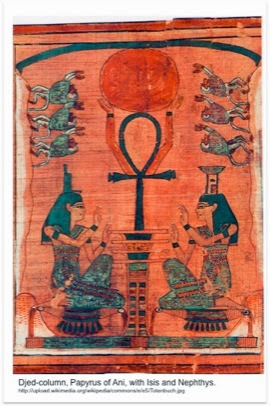
This pillar, a pillar of great importance -- a life-giving pillar -- was called the Djed column by the Egyptians.  Some early Egyptian scholars spelled it the "Tet" column or the "Tat" column, although they usually placed a small dot under both "t"s in the word, to show that they should be "voiced" (so that it would sound more like "Djed").

In Ancient Egypt the Light of the World, the insightful nineteenth-century scholar, thinker, and elucidator of the mysteries of ancient Egypt, Gerald Massey, says this of the Djed column:
[. . .] the tat pillar [. . .] was founded in the winter solstice as the figure of a stability that was to be eternal.  In the mythos the tat is a type of the sun in the winter solstice that has the power of returning from the lowest depth and thus completing the eternal road.  In the eschatology it is the god in person as Ptah-Sekeri or Osiris, the backbone and support of the universe.  Horus erecting the tat in Sekhem was raising Osiris from the sepulchre, the father re-erected as the son in the typical resurrection and continuity of the human spirit in the after life.  190.
The image above shows the Djed column, with its stylized "backbone" shape, surmounted by two arms (which often represent the ka), and an Ankh, the cross of life.  In this particular image, which comes from the Papyrus of Ani, which contains texts from the Egyptian Book of the Dead, the arms are holding up the Sun, and thus the symbology of the Djed pillar, the Ankh of life, and the now-ascending life-giving Sun all work together to convey the concepts discussed above and tend to validate the assertions of Gerald Massey regarding the backbone of Osiris and the winter solstice.

These are important things to understand and to contemplate on this December solstice, 2013.

Exposing the for-profit prison industry -- of orcas


Blackfish (2013) is a powerful and deeply disturbing documentary about the amazing whales known as orcas or killer whales, and the story of orcas in captivity.

The documentary centers around the life of a captive male orca named Tilikum, who was taken from the wild at a young age and turned into a performance whale.  The film explores the impact that decades of captivity and confinement have on the whale, and the tragic consequences.

The story of the capture of killer whales in the wild is heartbreaking, especially when the film documents the extraordinary loyalty and affection that orcas demonstrate within their family units (pods).  The scenes of the capture of baby orcas shown during the film is particularly disturbing in light of the descriptions given by Howard Garrett, an orca researcher and the co-founder and director of the Orca Network (bio on this page), beginning at about the 24:00 mark into the film (he can also be seen in the trailer clip above at about 1:09).  He explains:
They live in these big families.  And they have lifespans very similar to human lifespans.  The females can live to about a hundred, maybe more; males to about fifty or sixty.  But -- the adult offspring never leave their mother's side.  
Each community has a completely different set of behaviors.  Each has a complete repertoire of vocalizations -- with no overlap.  You could call them 'languages.'  The scientific community is reluctant to say any other animal but humans uses languages, but -- there's every indication that they use languages. 
Note that these aspects of orca society correlate very strongly with scientific research discussed in this earlier blog post entitled "Dolphins and Consciousness," in which dolphins appear to call to one another using specific "names" -- indicating that dolphins are aware of the individual identities of other dolphins, and that they are aware of their own identity as well.

Several scenes in Blackfish seem to demonstrate the same thing in killer whales -- only instead of the cries of joy and recognition which were recorded in the dolphin study, these orcas are seen issuing plaintive cries of bereavement and grief when their children or their mothers are taken from them.

The behavior of the orcas when being rounded up for capture indicates highly intelligent awareness and even levels of tactics which seem to indicate conscious thought -- and to indicate that the whales had learned from previous encounters with humans and formed plans that might be effective based on what they had seen before (Herman Melville described the same sort of deliberate tactical planning in Moby Dick):


Blackfish also centers its focus on the tragic loss of life of two young trainers when Tilikum deliberately seizes them and drags them under the waters of the tank -- incidents which took place at two different theme parks in two different countries, twenty years apart.  Another young person was apparently killed  when he snuck into the park and stayed overnight, and decided to enter Tilikum's tank.  It also focuses on the horrible death of another young trainer in a similar incident with a killer whale at a park in the Canary Islands, as well as other non-fatal attacks which are shown in horrifying video footage.  

The poignant reflections of former trainers who participated in performances with those whales and who now regret the treatment of these intelligent mammals by the theme-park industry is juxtaposed with callous and blatantly false statements and court testimony from the theme park's corporate representatives and executives, who are seen changing their story several times to try to cover up the systemic problems inherent in keeping orcas in captivity for decades and making them perform for handfuls of fish.  One of the park's representatives goes so far as to speak for the deceased trainer and say that if she were speaking today she would insist that the attack was her fault.

Blackfish is an important film on many levels.  

The film's ability to convey the absolutely eye-opening information about the sentience and level of individual care and affection which seems to characterize the relationships that these majestic animals form with one another is a tremendous achievement in and of itself.  

The bravery of the former trainers (and former whale-hunters) who told their stories, and who were big enough to admit in front of perhaps hundreds of thousands of people that what they did in the past, which at the time they thought was right, they now see as being wrong, is also profoundly moving.  

The expose of the cruelty of an industry which places animals in captivity for its own profit, and which forces the most intelligent of those animals to perform for audiences, and then tries to argue that the life these sentient beings have is better than what they would have in the wild, should ignite a firestorm of outrage and lead to people demanding change, as well as a lot of self-reflection as to how we (each of us) could ignore and even support such inhumanity without so much as a second thought.

But the film raises questions that go even beyond these.  The more we reflect on it, the more doors it seems to open onto other aspects of modern life which should elicit some soul-searching.  

The film's up-close profile of orcas might cause us to examine our whole relationship with animals, and the world-view which sees their exploitation for entertainment or a host of other purposes as completely acceptable simply because of their position in the "food chain."  For other posts which touch on some of these issues, see here and here.

The evidence presented in the film of callous attempts by corporate representatives to cover-up and sugar-coat the full truth surrounding the tragic deaths of the young trainers who were working for their company "on the front lines" (so to speak) invokes uncomfortable parallels with other hierarchical structures in which those at the top display little or no loyalty to those at the bottom of the pyramid.  The company's willingness to blame the trainers who lost their lives, saying it was their mistake alone and in no way indicates any kind of a systemic problem, is despicable -- but it is sadly not unfamiliar.  Readers of Tom Wolfe's classic nonfiction examination of the test pilot programs of the 1950s and 1960s, The Right Stuff, will find the automatic institutional blame of the deceased victim to be eerily familiar (and more recent examples could be mentioned, but viewers of Blackfish can probably come up with several on their own).

Finally, for all of us who have enjoyed killer whale shows -- either as children growing up or as parents taking our children to see them -- the film causes some very uncomfortable reactions.  Those shows cannot be all bad, can they?  There is something very magical about the interaction of human beings with wild animals, especially wild animals who are as beautiful and intelligent as orcas (or dolphins, or elephants).  But the revelation that these shows are built on a foundation of absolute imprisonment and exploitation of those majestic creatures is unavoidable after watching Blackfish.  

The cognitive dissonance that this realization generates should cause us to question what else in our world we accept uncritically -- hypnotized perhaps by the glamorous costumes, the thrilling music, the grandiose spectacle -- but which is actually built upon a foundation of absolute imprisonment and exploitation?


Gardening in this life, and the life hereafter


Here's a video of a TED Talk given by Ron Finley, about gardening.

It should inspire many people to get out and grow, even if they previously thought that they couldn't garden, for one reason or another.

Here's a link to Ron's website, which features some beautiful photographs, as well as information about Ron and his interests, and more information about urban "guerrilla gardening."  

It also features some quotations from Ron, including this one: 
Gardening is the most therapeutic and defiant act you can do, especially in the inner city.  Plus, you get strawberries.
This quotation, plus Ron's successful stand against agents of the State (in this case, the City of Los Angeles)  who tried to deny him his natural-law right to grow his own food in the premises of his own home, as well as the connection he draws in the video above between the destruction of health and the removal of food options by those who, in conjunction with the power of the State, exert enormous control over and restrictions of the available food choices worldwide, reveal that the issue of growing food is a profoundly moral issue that goes far beyond the thoughts most people have when they hear the word "gardening."

In this previous post, Thomas Jefferson (who had a few things to say about liberty and tyranny) was seen to have written back in 1785: "Was the government to prescribe to us our medicine and our diet, our bodies would be in such keeping as our souls are now."  

These are words to think about carefully, since the government (or, to be more accurate, the State) seems to be moving more and more in the direction of "prescribing to us our medicine and our diet," and has actually been doing so for quite some time.  That post also mentioned "guerrilla gardening" and London's Richard Reynolds (although at the time I was unaware of Ron Finley's work and his successful stand for gardening and against local tyranny).

On an even deeper level, it is also very noteworthy that the ancient Egyptian Book of the Dead ascribes a very high level of importance to the individual's ability to garden, a fact which does not seem to get the kind of publicity that it deserves.

In his explication of the significance of the 110th chapter of the Book of the Dead, Gerald Massey (whose analysis was discussed in this previous post) says:
This was the subterrestrial or earthly paradise of the legends.  When the manes comes to these elysian fields he is still in the earth of eternity, and has to prove himself an equal as a worker with the mighty khus (khuti), who are nine cubits high, in cultivating his allotment of arable land.  The arrival at Mount Hetep in this lower paradise or heaven of the solar mythos precedes the entrance to the Judgment Hall which is in the domain of the Osiris below, and the voyage from east to west in the Matit and the Sektit bark of the sun, therefore it is not in the ultimate heaven or the upper paradise of eternity upon Mount Hetep.  Ancient Egypt the Light of the World, 207.
In other words, the departed soul in its travels must be able to garden a plot of land, and apparently must do so in a kind of gardening competition or contest, in which its continued ascent towards the land  of light is at stake! Not only that, but the contest of gardening involves proving the ability to equal the work of beings who are nine cubits in height, and (as I have discussed in my 2011 book) there is evidence to suggest that the Egyptian cubit was 21 inches rather than the standard 18 inches, which means that these underworld gardeners are 15 feet, nine inches tall!

While we can be glad that chapter 110 does not tell us that we will have to prove ourselves equal in a game of basketball with the mighty khus or khuti, this information gives us a clear indication of the importance that skill at cultivating our allotted plot of land will have in the life to come, according to the ancient Egyptian sacred texts.  It also indicates that the Egyptians held a very high regard for the cultivation of the soil, and that they believed it was something that everyone should learn how to do, and that everyone should take the time to learn how to do well, if their physical circumstances permit it.

With all of this in mind, it would seem that we should all devote some time during this life in working the soil, wherever that soil may be, if our health and circumstances permit it.  As Ron Finley says, gardening is transformative: "It's amazing what a sunflower will do."


The mummy and the sevenfold soul


In Ancient Egypt: the Light of the World (1907), the prolific scholar of ancient Egypt Gerald Massey (1828 - 1907) makes the assertion that the reason that the ancient Egyptians practiced mummification was not, as most of us were taught, so that the deceased could use it again in the afterlife.  

Rather, as he argues in Book 4 of that work, entitled "Egyptian Book of the Dead and the Mysteries of Amenta," the creation of the mummy was a way of making the deceased into a type of the Osiris, "an image of durability and continuity, a type of the eternal, or of Osiris-karast in the likeness of a mummy" (216).

Massey explains that the journey into the afterlife did involve the soul of the departed in the form of a risen mummy, but that this was a spirit mummy, and not the physical mummy that remains in the tomb. Crucial to understanding this process is Massey's argument that the ancient Egyptians understood the human soul to be composed of seven stages or seven constituent parts, and that the unification of all of them must take place in the afterlife in order to make the image of the Osiris perfect or divinized in the image of Horus.  Only then could the just spirit be made perfect and experience the life everlasting.

Massey lists the seven constituent parts of the full permanent soul on page 203:
  1. The khabit or dark shade
  2. The ba or light shade
  3. The ab or breathing heart
  4. the sekhem or power to re-arise
  5. the sahu or soul-body
  6. the khu or glorified spirit
  7. the ka or higher soul
Massey declares that "it is a mistake to suppose with some Egyptologists, like M. de [. . .], that the new existence of the deceased was begun in the old earthly body" (213), and again that "it is entirely false to represent the Egyptians as making the mummy and preserving it for the return of the soul into the old earthly body" (215).  The departed received a spiritual or glorified form of the mummy, and ultimately sought to be united with the ka, and Massey explains that the preservation of the features of the departed (along with the very artistic portrayals of the deceased in the tomb) played a critical role in helping the spirit to remember its identity.

He writes: "His mortal personality having been made as permanent as possible in the mummy left on earth, the manes rising in Amenta now sets out to attain the personality that is to last forever" (208).  Unlike the body that is left behind in the tomb, the ka or higher soul accompanies the shade on its journey in the afterlife, and the goal of the departed is to pass from the state of a shade to the state of the ka, and reunify all the constituent parts of the soul.  Massey explains:
When the manes has become a khu, the ka is still a typical ideal ahead of him; so far ahead or aloof that he propitiates it with offerings.  In fact, he presents himself as the sacrificial victim that would die to attain conjunction with his ka, his image of eternal duration, his type of totality, in which the seven souls were permanently unified in one at last.  The ka has been called the double of the dead, as if it simply represented the doppelganger.  But it is not merely a phantom of the living or personal image of the departed.  It serves also for the apparition or revenant; it is a type rather than a portrait.  It is a type that was prenatal.  It images a soul which came into existence with the child, a soul which is food and sustenance to the body all through life, a soul of existence here and of duration for the life hereafter.  Hence it is absorbed at last in the perfected personality. [. . .] This is because the ka was the type of personality, seventh of the seven souls attained as the highest in which the others were to be included and absorbed.  In the vignettes to chapter 25 of the Ritual the deceased is shown his ka, which is with him in the passage of Amenta, not left behind him in the tomb, that he may not forget himself (as we might say), or, as he says, that he may not suffer loss of identity by forgetting his name.  Showing the ka to him enables the manes to recall his name in the great house, and especially in the crucible of the house of flame.  When the deceased is far advanced on his journey through Amenta, his ka is still accompanying him, and it is described as being the food of his life in spirit world, even as it had been his spiritual food in the human life.  203 - 204.
So an important part of the integration of all the sevenfold constituent parts of the soul into the the highest state in which all the parts were included and absorbed was the remembrance of the identity of the individual.  Far from a loss of the individual identity (or a re-absorption into a pantheistic state of undifferentiation), the goal of the unification and transformation of the soul in the afterlife included the affirmation of the individual's unique identity.

Massey states:  "Preserving the human mummy perfectly intact was a mode of holding on to the individual form and features as a means of preserving the earthly likeness for identifying the personality hereafter in spirit.  The mummy was made on purpose to preserve the physical likeness of the soul" (212).

Massey based these assertions on his close analysis of the Egyptian Book of the Dead, which in the 1800s and early 1900s was usually referred to as "the Ritual," and which Massey argued should be properly called "the Ritual of Resurrection".  Modern scholars often refer to it as the Book of Going Forth by Day.  But Massey, both in the passage above and elsewhere, emphasizes that its contents were not just for the eternal soul after death, but also during the life in this body as well.  In fact, the ancient Egyptians emphasized the memorizing of certain passages of the Book of the Dead during this life.

Even some of the most modern scholars emphasize the same things.  For example, in his excellent new  (2001) translation of and commentary on the Book of the Dead (using the Papyrus of Hunefer and also the Papyrus of Ani), Dr. Ramses Seleem states: 
The roads, ways, gates, hours, laws, and guardians of life after death are explained in detail in The Book of the Dead.  And even though a copy of the book is buried with the deceased, it is better to learn this divine knowledge by heart and live it in this lifetime, so the words can become flesh (truth).  Only then does The Book of the Dead in this life become the book of life in death.  15.
And again, and even more powerfully, he explains:
The spiritual concepts contained in The Book of the Dead explain life in its continuity and the condition of the reincarnated soul both in this life and in the Dwat.  This is in direct contrast to the emphasis on death and dead relics that can often be seen in modern museums. [. . .]
The Book of the Dead is, in reality, the Egyptian book of life -- life now, life hereafter, and life everlasting.  A copy was buried with the deceased to give the soul the tools to secure his or her future in the life hereafter.
The deceased entered Ementet (the land of the dead) with a papyrus scroll in one hand.  The question that lay ahead was how well the deceased person had established truth in his or her lifetime against the powers of evil.  12-13. 
All of these assertions correlate very well to the analysis of the self-taught Egypt scholar Gerald Massey, writing for the most part over a hundred years earlier.  Together, they should serve to awaken us to the importance of the concepts that the Egyptians were discussing.

It is also interesting to note that Gerald Massey's discussion of the sevenfold soul, and the discussion that these principles are just as important in this life as in the life hereafter, seems to have some potential correspondence with the fact that the Vedic and Hindu traditions assert that we have seven chakras and that it is vitally important to activate all seven.  This concept would also seem to connect to previous discussions about our vital organs and their connection to the visible planets.

Alvin Boyd Kuhn has stated that Gerald Massey is among the most discerning of the Egyptologists, and that he was "a scholar of surpassing ability whose sterling work has not yet won for him the place of eminence which he deserves."  Perhaps this discussion of the sevenfold soul and the importance of the Egyptian Book of the Dead will stimulate readers to examine his works for themselves.  An excellent list with links to many of his texts can be found here.

Imagine


John Lennon 1940 - 1980.

Thoughts on David Carradine, John Lennon, Bruce Lee, and the concept of enlightenment


December 8 is the birthday of actor David Carradine (1936 - 2009), who became famous as the star of the ground-breaking television series Kung Fu.

Previous posts have discussed the way that television series portrayed the use of physical force in a way that was entirely different than almost every television show and movie produced in the US up to that time (and, unfortunately, the vast majority of those produced since then as well).  One of the distinguishing features of that portrayal was the idea that the use of physical force is sometimes legitimate and even necessary, but only to prevent actual physical violence initiated by another.  


The show also attempted to explore some of the precepts of both Buddhism and Taoism, both of which have very ancient roots (and both of which seem to incorporate "precessional numbers" which are also found in ancient cultures from other parts of the globe, being incorporated for example into the Great Pyramid of Giza and the layout of Teotihuacan in modern Mexico).

One of the previous posts linked above explored some of these concepts in conjunction with Simone Weil's 1940 essay, "The Iliad, or the poem of force," which argued that one of the worst aspects of the use of violence is the fact that it turns another living soul into a thing, and that it ultimately does the same to the one who employs violence as well.  

In contrast, the Kung Fu series displayed a sensibility to the fact that a person is not a thing.  Many of the situations portrayed in the series involved displays of racial prejudice by "less-than-enlightened" characters hurling a variety of racial slurs against the main character (and others around him), such as the situation shown in this sequence from the "pilot episode" of the show.  Of course, the purpose of all such slurs, whether racist or otherwise, is to try to turn another person into a thing in much the same way that physical violence does.

Based on the above discussion, it is clear that the television series Kung Fu was actually exploring the concept of "enlightenment" in some way.  

One thought-provoking definition of "enlightenment" is offered by speaker and teacher Mark Passio in one of the many podcasts available on his What on Earth is Happening website.  In the podcast entitled "WOEIH Show #022" (which can be found on this page of his website), beginning at 1:19:15 Mark Passio says:
People ask me sometimes, "What is enlightenment?"  And I say: enlightenment is the full and complete understanding of every being's sovereignty and the total willingness to accept the responsibility to honor that complete sovereignty in all others.  That's enlightenment.  That is what enlightenment is.
It is interesting to consider this definition of enlightenment in conjunction with the various situations and scenes depicted in the Kung Fu television series.  It is also interesting to consider in light of the fact that the idea for that groundbreaking series almost certainly came from Bruce Lee, as discussed in this previous post, containing links to a 1971 interview in which Bruce Lee laments that up until that time, most kung fu pictures were "done mainly for the sake of violence."

In addition to being the birthday of David Carradine, December 8 is also the day that John Lennon was murdered.  Some have argued that there is evidence that the circumstances surrounding the deaths of both David Carradine and John Lennon may have been very different from the story that has been given to the public.  Some have argued the same thing about the death of Bruce Lee.  

There is no doubt that there are very powerful forces at work in the world which are diametrically opposed to the concept of "every being's sovereignty" and the "responsibility to honor that complete sovereignty in all others."  This fact, and the fact that these forces do not always act completely at random but sometimes act in concert and with great deliberation, makes the anti-violent messages of John Lennon, Bruce Lee, and David Carradine's Kung Fu, as well as the definition of violence from Simone Weil and the definition of enlightenment offered by Mark Passio, more urgent than ever.


Comet ISON rapidly approaching perihelion, and some thoughts on fear-mongering, manipulation, and thinking for yourself


Comet C/2012 S1 (ISON) is plummeting towards the Sun, and is now approaching perihelion (its closest point of approach).

The comet will slingshot around the sun at 2pm Eastern time on November 28th (which is 11am Pacific time, and since Pacific standard time is 8 hours behind Greenwich time, that means it will be 1900 Greenwich or Universal Time).

For intrepid observers who wish to try to observe the comet at or near perihelion, this helpful article from Sky & Telescope explains how to do it.  Note that you will have to block the Sun with a solid object, and use your naked eye.  Do not use a telescope or binoculars, which magnify the light and channel it right into your eyeball, and which can cause serious permanent damage.

Of course, you will have to be on a section of the globe that is facing towards the sun during the hours that Comet ISON is making its slingshot turn around the Sun -- that is to say, it will have to be daylight where you are, although if the Sun is just dropping below the horizon of the Earth's curvature, that would be a very handy "object" that you could use to block out the Sun and look for the comet.  If it is night-time where you are when the comet is reaching perihelion, you will be unable to see the comet's perihelion turn from that location using normal vision, since the entire bulk of our planet will be in your way.

That article also says that the comet will be within one "sun diameter" of our daystar during the three hour period from 1700 UT until 2000 UT (which is from 12 noon Eastern time or 9am Pacific standard until 3pm Eastern time and 12 noon Pacific).

Depending on the comet's condition after its "sungrazing" journey around the turn, it could become a spectacular object in the night sky (visible just prior to sunrise and just after sunset), and in some scenarios could become bright enough to see during full daylight.  And, as we have been told over and over, conditions could also lead to a scenario in which Comet ISON doesn't become very spectacular at all.

The video embedded above shows NASA footage of Comet ISON approaching the Sun over the  five-day period from 20 November through 25 November, composed of HD images snapped by the STEREO-A spacecraft and its Heliospheric Imager.  Here is a link to a page about the STEREO spacecraft (there are two of them, working in tandem, as you might expect) containing an outstanding graphic animation which shows where STEREO A was located when it took the sequence shown above.  The still-frame shot below shows where STEREO A was in relation to Comet ISON, the Sun, the Earth, and the planet Mercury on November 24 (near the end of the video sequence shown above).


Using the upper diagram, you can see why the Sun is located just out of the field of view to the right edge of the video above, and why Mercury is seen to the left and our planet Earth to the right.

In the video at top (not shown in the animation or the screenshot) you can also see very clearly Comet 2P/Encke, the comet with the shortest period of all known comets (only 3 years per round trip).  It is actually visible from the beginning of the video, heading "downwards" as if it wants to intersect the more "horizontal" path of Comet ISON.  Encke does not show much of a tail until towards the end of the video, so it looks in the video much the way a satellite looks moving through the night sky to a viewer on earth -- but it is a comet, not a satellite.

There are actually five comets visible in the night sky from the northern hemisphere right now for those using binoculars or small telescopes, including C/2013 R1 Lovejoy (the most easily-visible of them all right now, discussed briefly in this previous post, and currently visible to the naked eye in the pre-dawn morning sky near Bootes the Herdsman, who sits near the Big Dipper smoking a pipe which is very close to the handle of the Dipper),  Comet C/2013 V3 Nevski (just discovered this month!), Comet C/2012 X1 LINEAR, Comet 2P/Encke, and Comet ISON.  Descriptions of these comets, and directions for locating them in the sky, can be found on the Comet Chasing page from Skyhound, the makers of SkyTools 3 observing software.  The Comet Chasing page also describes a comet visible with small telescopes and binoculars to viewers in the southern hemisphere, as well as other comets visible only for those with larger telescopes.

Until the discovery of Comet Nevski, the appearance of four comets in the sky at the same time (with one of them, ISON, getting so much notoriety from various commentators) was prompting some comparisons to the Four Horsemen of the Apocalypse (who are found in the book of the Revelation or Apocalypse -- both words literally mean "the unveiling," although the word "Revelation" is the way to say "unveiling" that is descended from the Latin, and the word "Apocalypse" is the Greek way to say it).  They are described in Revelation chapter 6.

Here is an article from Clyde Lewis of Ground Zero Media that pulls together an impressive array of connections between the comets, predictions in the Revelation, the Maya calendar cycle that was the subject of so much discussion at the end of last year, and worrisome current events (including volcanic eruptions).  The article also points out that elsewhere in the Revelation (in fact in Revelation chapter 8:10-11), a great star is described which fell from heaven, "burning as it were a lamp, and it fell upon the third part of the rivers, and upon the fountains of waters" -- the name of this star is called Wormwood.

While not mentioned in that "Four Horsemen" article, there have been several troubling articles appearing on various internet sites arguing that dangerous levels of radiation or radioactive materials from the Fukushima nuclear power plant disaster are now reaching the west coast and beginning to play havoc with marine wildlife.  However, some analysts have challenged some of these sensationalist claims, such as this article from deep-sea biologist Andrew David Thaler published on the Southern Fried Science blog.  Personally, I do not buy all of Andrew Thaler's arguments in this article, and believe some of those arguments are not well supported (at one point, he engages in a blatant ad hominem attack with no other evidence cited besides the ad hominem attack itself).

This controversy highlights the importance of doing some of your own "due diligence" when it comes to investigating matters that might be of great importance to your future.  When it comes to questions about the status of the fallout from the Fukushima disaster or questions about whether the current array of comets (and Comet ISON in particular) have anything to do with ancient apocalyptic prophetic literature, it is probably advisable to avoid being swept up by those who want to stir up fear (for whatever reason).  At the same time, while being wary of "fear mongering," it is equally important to avoid making the opposite error of complacency, or of too-rapidly dismissing possible dangers that might really be associated with these events.  For instance, just because some articles about the impact of the Fukushima radiation might be deliberately misleading and designed to create the maximum amount of fear and uncertainty among the widest possible number of people, it does not mean that we can dismiss the dangers of Fukushima altogether, or brand everyone who sounds an alarm bell on the subject as a "fearmonger."

For the record, none of the above statements should be interpreted as an accusation that Clyde Lewis's "Four Horsemen" article is being deliberately misleading or engaging in speculative fearmongering.  His article draws a number of interesting connections to a variety of ancient and modern subjects, and he tells his readers several times during the article that it is not meant to be read as a declaration that the apocalyptic doom some were trumpeting at the end of 2012 was "off by a year" and due at the end of 2013, but that on the other hand he thinks all these matters are worth being aware of.  That seems to be a responsible enough way to approach the subject.

However, I personally believe that the Maya calendar event of December 2012 referred to an astronomical event caused by the phenomenon of precession, and that "end of the world" prophecies  in sacred traditions around the world and across millennia generally refer to the end of a precessional age, not to physical or geological catastrophes that take place on the planet (they are referring to events in the sky).  Previous posts explaining the concept of precession include this one (which contains a video) and this one (which should make the impact of precession on the position of the stars completely clear).  For discussions of the Maya Long Count and 2012, and the connection to precession, see "The Maya Long Count and Galactic Alignment: the work of John Major Jenkins," and "The Staggering Implications of the Maya Long Count," among other posts from last year.

Similarly, I believe that most if not all of the events described in the book of the Revelation (or the Apocalypse) also refer to celestial phenomena.  For some discussion of this subject, see "The Scorpion and the Smoky Abyss."  That article discusses some verses in Revelation which some have taken to be referring to literal events on earth (for example, identifying the "locusts" of Revelation chapter 9 as helicopters in some horrific modern war that was being described by a vision given in ancient times), but which probably refer to constellations (the locusts of chapter 9 probably refer to the zodiac constellation of Sagittarius).  As Clyde Lewis states in the article linked above, the Four Horsemen have very clear astronomical connections as well.

However, just because those ancient sacred texts may not have been written to be understood in a strictly literal manner does not mean that certain people might not be using them as a script to try to follow: after all, the fact that millions of people believe that those ancient texts refer to literal events could give a huge boost in potential "fearmongering impact" to anyone who wanted to manipulate current events in conjunction with widely-known ancient verses.

Here is a link to a recent interview on Red Ice Radio with Richard C. Hoagland, who states during the second half of the interview that he believes Comet ISON might actually have been manipulated by humans who have access to extremely advanced forms of space travel (the so-called "secret space program") in order to arrive on specially-selected dates at a location and elevation which would produce significant numbers when measured from the site of major ritualistic events in early 2014 (such as the opening ceremony of the Winter Olympics).

Whether or not you agree with this theory (I personally have not seen enough evidence to make a dogmatic assertion either way on that one, although it is certainly worth investigating), all of the above discussion seems to argue the importance of understanding the principles of the mechanics of the celestial objects whirling through our solar system, as well as the connections to the ancient sacred traditions of mankind, all of which reveal an extremely sophisticated scientific understanding of celestial phenomena, as well as a level of interest in these phenomena which implies their belief that these events are of more than just "academic interest" to men and women living on this planet.

When it comes to issues of major potential impact on our lives, we owe it to ourselves to do some analysis of our own and reach our own conclusions, and to avoid letting others tell us how to think, or manipulate us through fear.