Blackfish and mind control


The powerful documentary Blackfish is discussed in this previous post.

That post noted that Blackfish is an important film on many levels.  One of those levels, of course, is the question of the treatment of the orcas shown in the movie, especially in light of the evidence that these amazing and intelligent creatures are highly social, highly emotional, and -- by almost any definition of the word -- sentient.

But -- as important as that question is -- another very profound aspect of the film is the question of how this kind of treatment could have gone on for so long and been not only tolerated but bathed in a kind of wholesome glow by the public at large.  After watching the film, one asks oneself how it is possible for almost all of us to have collectively failed to see through the glamorous spectacle to the foundation of captivity and exploitation that propped it all up?

While there has always been a vocal but relatively tiny minority trying to bring attention to the moral issues surrounding the keeping of orcas and other intelligent sea mammals in captivity, most of us (and I include myself in that group) did not really think too much on the issue until the movie Blackfish came out.  So, one really important question that this fact raises, it seems, is the question of how something that (in retrospect) is so wrong could have gone largely unnoticed and unremarked-upon by so many for so long.  How could we all have been so collectively "hypnotized" that we didn't really "snap out of it" until the movie Blackfish snapped us out?

This question is related to the question of "mind control," which this previous post asserted can be thought of as the opposite of "consciousness" -- the kind consciousness which John Anthony West described as that thing whose acquisition the ancients believed was the goal of our existence in this life, during an important 2008 interview.  What techniques of hypnosis so clouded our judgment that it basically hid the question of captive orca shows behind a smokescreen and kept us from paying serious attention to it, until the film Blackfish blew the smoke away?

The question has important ramifications for other areas of our lives, especially if we suspect that there are other areas where we are collectively hypnotized and where the shouting of a vocal but relatively tiny minority seems to be having no effect.  Remember that in the previous post on mind control, master pickpocket and "gentleman thief" Apollo Robbins told us that "Actually, it's often the things that are right in front of us that are the hardest things to see -- the things that you look at every day, that you're blinded to."

One of the most powerful aspects of the Blackfish movie is the courageous testimony of the former trainers who, as young men and women, were employed to perform in the orca shows and who now have reached the conclusion that what they were participating in was wrong.  Their testimony about the experience is not one-sided, either: they talk about the remarkable experience of bonding with the animals, the excitement of participating in amazing shows in front of crowds.

I can very much relate to their mixed emotions as they reminisce about the good aspects of their time in an industry they now see as including a very dark underside, because I myself spent a large portion of my young adult years in the US Army, and can testify to the very same kinds of memories of camaraderie and amazing experiences, even though I now have a completely different perspective regarding the bigger picture of what the young men and women in the military are being used for.

Very early in the film (near the 2-minute mark, in fact) there are several interview clips in which trainers reflect on the circumstances that attracted them to the idea of becoming a trainer in the first place.

More than one of them mentions the spectacle of seeing a show themselves, when they were young (perhaps as a child, or as a teen).  One of them specifically tells about seeing "the night show at Shamu Stadium" and describes it as being "very emotional, you know, popular music, and I was very driven to want to do that."

The footage of the shows themselves gives the viewer a chance to see some of the components that he is talking about, and they are the same as those that surround the public face of the military in many countries (certainly in the US): there is music, there is costume (with all the trainers typically dressed in distinctive wetsuits, which are all the same), there is the attractiveness of youth (young men and women in their 20s or early 30s, fit and active and fearless in the face of danger).

What is it about this kind of pageantry that turns us from critically-thinking, analyzing, conscious human beings into a roaring crowd?  There is certainly something going on with these components of pageantry that are used by the producers of orca shows, or by the military in its parades.  Maybe it is related in some way to the concept Apollo Robbins discussed in his talk on "misdirection" and pickpocketing -- getting the part of our minds that he calls "Frank" to turn around, to access our memory bank, during which time "Frank" cannot monitor the incoming signals in the same way that he normally does.

This is not to say that spectacle, pageantry, or being part of a cheering crowd is inherently wrong -- it's not.  But seeing the way it can be used to throw up a sort of "smokescreen" to our analytical reasoning, it might be a good thing to be aware of its power as a potential tool for "mind control." If you happen to be watching Blackfish with teenaged children, for example, you might point out the fact that more than one trainer mentions such shows as having a very powerful impact on their career choice, and you might discuss together other areas where these elements might be used to turn off the critical judgment that seems to have been so sadly lacking in the analysis of the orca captivity question for so long.

Another mind control tool mentioned by a trainer in a powerful piece of testimony (shown in the clip above) is the use of ridicule to quell dissent and to shut someone up who is raising questions about the morality of behavior that they perceive to be wrong.

In the clip, which begins around the 36-minute mark in the film itself, former trainer Carol Ray is describing the heartbreaking story of the decision made by the park management to permanently separate the young whale Kalina (the first orca successfully born in captivity, on September 26, 1984) from her mother Katina, and the grief that Katina exhibited after they took her child from her.

Speaking of the young whale Kalina, Ms Ray ruefully relates:
It was decided by the higher-ups that she would be moved to another park when she was four, four-and-a-half years old -- and that was news to us as trainers that were working with her.  To me it had never crossed my mind that they might be moving the baby from her mom.  The supervisor was basically kind of mocking me: "Oh, you're saying 'Poor Kalina'?" You know: "What's she gonna do without her Mommy?"  And, you know, that of course just shut me up.
How many of us can relate to Carol's experience of having someone else shame them into going along with something that we knew was wrong, or not continuing to speak out against it?  The mocking that she is describing can be very powerful.  Again, this is the kind of thing that -- if you're watching Blackfish with your children, for example -- you might point out to them afterwards, so that they can be forewarned and forearmed when they come up against that sort of pressure in their own lives (and they most certainly will).  Children of even a fairly early age will probably already be able to relate to this subject from personal experience.

Radio show host and teacher Mark Passio has a lot to say about the subject of mind control in all of its various forms, and he discusses the subject extensively on his radio programs and videos.  His podcast archive contains hundreds of his previous broadcasts, and he gets into this subject almost right away in some of the very first episodes in the series.  If you go to his website and go back to the very beginning of his podcast archive, you will find that he gets into this subject right away, and that at around podcast number 12 he launches into a formal investigation of fourteen of the most common techniques of mass mind control -- fourteen!

One very attractive aspect of Mark Passio's talks is his willingness to utter what he calls "three of the most powerful words in any language: I WAS WRONG." They are words that I myself have had to admit about a lot of beliefs I have held in the past. The courage of the former trainers interviewed in the Blackfish video who, by their participation in the documentary, are effectively saying the same thing is to be commended, and cannot be overstated.

The very first mind control technique that Mark Passio discusses in his list of the fourteen most common is the technique of obfuscation -- making a subject seem complicated when it is really very simple.  Again, the Blackfish documentary provides an outstanding opportunity to study this very concept.

It might seem that the question of whether keeping orcas in captivity and forcing them to perform for their meals of frozen fish is a complicated subject, one with many nuances and not something that can be turned into a black-and-white, cut-and-dry issue.  After all, as some people bring up in the film, seeing orca shows at marine parks can inspire millions with a love of the oceans and of the magnificent marine life that they see at the marine parks but might otherwise never see.  In response to the film the major participants in the marine park industry have put forward some of these arguments, which you can read for yourself here and here.  You can also read about some other responses they have sent out through publicity agencies, and you can read some counter-arguments or rebuttals to their arguments here, and here, and here.

A great example of cutting through the obfuscation to get to the very heart of the issue can be seen in an interview that comes in the Blackfish film just after the Carol Ray discussion of Katina and Kalina shown above.  In that interview, which is found around the 38-minute mark in the film, former trainer John Hargrove is discussing another incident in which a young orca was separated from its mother, and the heartrending cries that the mother made when her baby was taken from her.  The whales in question were Kasatka (the mother) and Takara (her daughter):
When they separated Kasatka and Takara, it was to take Takara to Florida.  Once Takara had already been stretchered out of the pool, put on the truck, driven to the airport, Kasatka continued to make vocals that had never been heard before.  They brought in the senior research scientists, to analyze the vocals.  They were long-range vocals.  She was trying something that no one had even heard before, looking for Takara.  That's heartbreaking.  How can anyone look at that and think that that is morally acceptable?  It's not.  It is not OK.
John Hargrove is right.  The issue is just as clear and as simple as that.  And, by extension, the whole issue of keeping sentient, intelligent orcas whose natural habitat is the entire ocean for years and years in small constricted tanks (Katina has been in captivity since October of 1978) for our amusement is not morally acceptable -- it is wrong.  To say that some good outcome, whether it is "greater awareness" or "scientific research" justifies such long-term captivity and mental torture of the whales is reprehensible. In fact, to claim that the best way to foster widespread love of the oceans and of ocean life is to do the things to the whales that are revealed in the film Blackfish, and to imprison them for life, is grotesque.

These questions about the orca question are pretty well settled by the documentary.  But the questions that it raises about us, about our ability to be asleep to things about which we should be outraged, those questions are not settled by the movie at all.  They are stirred up and left for us to ponder.

About what other things going on right in front of our very eyes, day in and day out, can we ask with former trainer John Hargrove, "How can anyone look at that and think that that is morally acceptable?"



How to tell if you're under mind control


How to tell if you are under mind control of some form:

1.  You display any of the symptoms exhibited above by Danny Kaye aka Hawkins aka The Great Giacomo ("King of Jesters, and Jester of Kings"), from the 1956 motion picture The Court Jester.

2.  You attended any level of schooling in a modern nation-state after the year 1926.

3.  You are terribly concerned about your own personal contribution to global warming but completely oblivious to evidence pointing to ongoing geoengineering (and if anyone brings the subject up to you, you become agitated at them and call them an outrageous "conspiracy theorist," rather than exhibiting any outrage at the people involved in spraying chemicals from aircraft over populated areas, crops, your own home, etc).

4.  You can muster no sense of outrage over increasing surveillance of your everyday activities, and when told that the state now spends millions placing sophisticated video and audio recording devices in public places such as transit buses, or that they tap into your iPad using WiFi and record your cache of recent geophysical location data, you nod absently and forget you ever heard about it.

5.  You readily and uncritically accept media accounts of major traumatic events which always seem to point to the need for increased state authority over the individual, without conducting any of your own "due diligence," and you repeat phrases such as "more surveillance" or "every command" in a sort of absent, monotone voice.  You become agitated at the mention of possible alternative explanations and refuse to entertain them in your mind -- in fact, you act as though someone has convinced you that such thoughts might burn you if you touch them.

6.  You cannot entertain possible alternative accounts of ancient history, whether they involve advanced ancient civilizations whose accomplishments upset the conventional narrative of a generally unbroken line of steady Progress from primitive times to our modern superiority, or whether they involve catastrophic explanations for geological features rather than the tectonic paradigm that has become the only acceptable geological model.  Serious mention of such alternative possibilities causes you agitation and powerful negative emotional response.

Of course, if you were actually under the spell of a Griselda (Gri-who-lda?) the way "Giacomo" is in the video clip above, you would probably dismiss any suggestion that you were actually under any kind of outside influence whatsoever (angrily deny it, in fact).  Forms of mind control are really the opposite of what we might call "consciousness," and consciousness -- according to symbolist, Pythagorean, and illuminator of magical ancient Egypt John Anthony West -- is the goal of human existence according to all the ancient cultures and ancient sacred scriptures (see discussions here and here for example).

Since, based on the above list (and the list could go on and on) we're all under mind control to some extent, moving from a state of "hypnosis" to greater levels of consciousness should be one of the areas to which we pay a lot of attention in this world.

The video clip below shows a recent "TED talk" given by entertainer and "gentleman thief" Apollo Robbins, in which he demonstrates and discusses the art of "misdirection," or as he puts it, "controlling someone's attention" in order to be able to almost perfectly "predict human behavior."  

He begins his talk by saying that such an ability would be "the perfect super-power -- actually kind of an evil way of approaching it."  He then goes on to say that "Actually, it's often the things that are right in front of us that are the hardest things to see -- the things that you look at every day, that you're blinded to."


Apollo Robbins then gives an entertaining demonstration of his "super-power," proving to the audience that it really is possible (as he puts it at about the 2:30 mark in the video) to so manipulate the attention as to enable others to "steer your perceptions" and "control your reality."  He explains that there are proven techniques to "exploit" (his word) the "gateway to the mind" and by doing so to cause another person to miss things that are taking place right before his or her very eyes.

At the end of his remarkable demonstration, Apollo Robbins talks straight to the audience and says,
Attention is a powerful thing.  Like I said, it shapes your reality.  So, I guess I'd like to pose that question to you: If you could control somebody's attention, what would you do with it?
And on that note, throwing it back to all his viewers (including all of us through the magic of the web), he ends his presentation.


The discovery of vast offshore fresh groundwater reserves (i.e., under the seafloor)


Recently, in the journal Nature, scientists and researchers Vincent E. A. Post, Jacobus Groen, Henk Kooi, Mark Person, Shemin Ge, and W. Mike Edmunds published a study entitled "Offshore fresh groundwater reserves as a global phenomenon."  

The study can be read online here, which allows you to see the first page, and read the rest for a fee of $3.99, but you can also read some of the many articles discussing the importance of this new finding for free online, such as this one, and this one, and this one, and this one.

Reader Terry B., who has alerted me to important new discoveries many times in the past, notified me of this important new development soon after the study was published near the beginning of this month and noted that it seems to be yet another piece of evidence which supports the hydroplate theory of Dr. Walt Brown.  

Sure enough, Dr. Brown agrees that the new finding of large amounts of relatively fresh water (fresher than seawater) trapped underneath the seafloor along the offshore continental shelves around the world is a finding that is difficult to explain using conventional theories, but one that accords quite well with the hydroplate theory.  Dr. Brown has already mentioned this important new discovery, in the section on this page of his book (which is available in its entirety on the web, or for purchase in hardbound print edition here) entitled "Earth's Major Components," where he writes:
Low-salinity water is being discovered far below continental shelves worldwide.  Why would water, typically less salty than sea water, be found beneath the sea floor?
At the end of that question, he provides a footnote (footnote 6) to the article published earlier this month in Nature discussing the vast offshore reserves of fresh water being discovered below the surface of the continental shelves (at depths of up to 3000 meters beneath the seafloor).

While scientists had long known of the existence of some subsurface freshwater discharge from onshore reserves which penetrated out into the shelf offshore, it was previously assumed that such intrusions were fairly limited in scope, both around the world and in terms of how far out from the shore they could reach.  The authors of the new article conducted tests which indicate that the phenomenon of fresh water beneath the seafloor is extremely widespread, found on continental shelves around the globe, and that these trapped pockets of water can be found extremely far out from shore -- at least as far as 100 kilometers from shore, and possibly further!  

The amount of fresh water trapped beneath the surface on continental shelves may be 500,000 cubic kilometers, or 120,000 cubic miles of fresh water -- a hundred times more than all the water that mankind has extracted from aquifers beneath the surface onshore since 1900, according to lead researcher and author Dr. Vincent E. A. Post!  That much fresh water cannot be explained by simple groundwater discharge from onshore sources, the article explains, and so another mechanism must be proposed.  But what could account for so much fresh water trapped beneath the surface of the continental shelf, which itself is beneath the salty ocean?

The study's authors propose a possible mechanism: during ice ages, sea levels were much lower, and so areas now offshore were once on land.  These areas collected rainwater (called "meteoric" water), and then later when the ice ages came to an end (or, more precisely, an "interglacial" period in between ice ages), that meteoric groundwater was trapped below the surface as the sea levels rose -- and it is still there today.  For this reason, the recent article calls these newly-discovered freshwater reserves offshore "Vast Meteoric Groundwater Reserves" or VGMRs.

There may be some problems with this explanation, such as the question of how the ground that was porous enough to let the freshwater in during the glacial period, became such an excellent sealant that the freshwater was able to stay mostly fresh once the glacial period ended and the salty seawater filled back in over it.  Certainly that could have happened in some unique conditions, but how could it have happened over such a vast extent of the continental boundaries, and to distances of over 100 kilometers from the present shore?

We have already seen in previous discussions that the hydroplate theory does argue that the sea level was in fact much lower, in the centuries immediately following the catastrophic flood (the flood which left so much evidence around the planet that it is very difficult to deny that it took place).  During those centuries, the combination of warmer oceans and colder continents did in fact lead to much greater levels of precipitation, and to an Ice Age, and so some aspects of the proposed mechanism from the article in the journal Nature may have taken place.  But, such runoff would hardly explain the vast amounts of water being discovered today, and its ability to remain much less salty than the ocean above for so many years. 

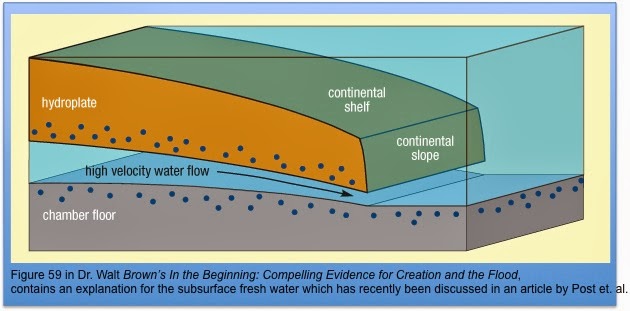
The hydroplate of Dr. Brown, which has a habit of already being ready to provide excellent explanations for evidence that scientists discover years after Dr. Brown published his predictions, has a very good explanation for the fresh water that is now being detected.  In the caption to Figure 59, found on this page of his online book and reproduced above, Dr. Brown explains where all that fresh water might have come from (and, at the same time, why continental shelves are found on the edges of the continents worldwide -- something that tectonics does not really have a good way of explaining).  Referring to the diagram shown above (in terms of "left" and "right" as the viewer looks at the image), he writes:
The velocity and erosion power of escaping SCW [supercritical water] increased to the right and as it jetted upward.  This beveled the edges of each hydroplate, forming today's continental shelves and continental slopes.  Because the water's pressure decreased as it approached the right edge, the hydroplate sagged downward, constricting flow and increasing erosion even more.
During the flood, thick layers of sediments blanketed the granite crust.  Included in those sedimentary layers were aquifers -- deep, permeable, sedimentary layers filled with generally salt-free water.  Today, some of those aquifers lie below the continental shelf which constitutes part of the sea floor.
Also, before the flood, much of the SCW water in the subterranean chamber migrated into the spongelike openings (blue dots) in the chamber's roof and floor.  As temperatures in the SCW exceeded about 840 degrees F (450 degrees C) its dissolved salt precipitated (out-salted, as explained on page 122).  Therefore, it should not be surprising that low salinity water is found under the sea floor, but most geologists are surprised.
Certainly more study of the newly-discovered phenomenon of VGMRs is warranted before we can tell which explanation is a better fit for the majority of the evidence.  However, it would certainly seem that the discovery of these vast reserves of fresh water may well constitute yet another example of a geologic phenomenon which causes conventional theories some difficulty, but which accords well with the events proposed by the hydroplate theory.  


A Christmas Eve thank-you to all my readers


This Christmas Eve, I would like to send out a heartfelt "Thank You" to all readers of the Mathisen Corollary blog around the world.  The winter solstice-Christmas season is a fitting time of the year for spending some time in reflection and gratitude, and as I do so I was prompted to write a post expressing my gratitude to all of you who have taken the time to visit and to share feedback through the years.

The Christmas story expresses the universal truth that the cosmic pattern, the Word or Logos, has been incarnated in the flesh of every man, woman and child: every one contains an immaterial spirit united with physical matter.  As Alvin Boyd Kuhn explains in Lost Light: An Interpretation of Ancient Scripture,  "It was a reference in ancient theogony to the descent of the Logos (the cosmic counterpart of the Christos in man) from the spiritual side of God's nature alone, as distinct from its progenation from the union of spirit with matter. [ . . . ]  We are assured again and again that we are all sons of God and sons of the Highest" (47).

He goes on to argue, as he does in all of his writings, that this same pattern is expressed by the "antecedent careers of such world saviors as Dionysus, Osiris, Sabazius, Tammuz, Adonis, Atys, Orpheus, Mithras, Zoroaster, Krishna, Bala-Rama, Vyasa, Buddha, Hercules, Sargon, Serapis, Horus, Marduk, Izdubar, Witoba . . ." (48).

Reflecting on this concept, one could hardly do better than to go out into the dark night this week, when the stars of the heavenly pattern are absolutely breathtaking.  Orion rises in the east in all his glory, followed by his consort the star Sirius, associated by the Egyptians with the goddess Isis the mother of Horus.  

In the photograph above, from an image taken by the Hubble Telescope, the stars of Orion can be seen in the right side of the frame, while the bright star Sirius is the enormous orb seen at the lower edge of the frame.  The bright star to the left at roughly the same level as orange Betelgeuse in Orion's shoulder is Procyon, the brighter of the two stars in Canis Minor, the Little Dog.  The band of the Milky Way also runs right between Orion and Canis Minor, and Orion's upraised arm (on the Betelgeuse side) extends right into it.

Nearby in the night sky, although not in the photograph above, you will also be able to see Taurus the Bull, the Pleiades pointing the way to Aries the Ram, Auriga the Charioteer near to the horns of the Bull, and the Twins of Gemini with the beautiful planet Jupiter nearby.  The Moon is rising later and later each evening (truly a spectacular sight in its own right), giving several hours of good stargazing after sunset, especially for viewers in the wintery northern hemisphere right now (moonrise is around midnight currently).

The ancients saw each individual man, woman and child as a microcosm of the macrocosmic pattern seen each night in the infinite heavens of outer space.  Several previous posts have examined this ancient truth, including this one which discusses the way this pattern takes on human form through the helix pattern of DNA.

This means that every person you encounter today is, according to the ancient wisdom recorded in the scriptures and sacred traditions of the world, an incarnation of the cosmic pattern, a unique individuated bearer in physical form of the Logos.  And this means, of course, that every reader of this is as well, which fills me with profound respect and gratitude for each one of you!


The Osiris and the Winter solstice (December solstice) 2013


The earth is presently hurtling towards that instant in time when its axis points most directly away from the sun (for the axis "protruding" out of earth's north pole, in the northern hemisphere) and most directly towards the sun (for the axis "protruding" out of earth's south pole, in the southern hemisphere) -- that is to say, the moment of the December solstice.

For those in the northern hemisphere, this moment is the winter solstice, although it is the summer solstice for the southern hemisphere.

Previous posts discussing the solstices compared the earth to a sailing ship of old: if the north pole is the spar protruding from the bow of the ship, and the south pole is the lantern at the stern of the ship, then the December solstice is that moment in which the lantern points directly at the sun as the ship circles the sun (in this metaphor, the "ship" stays pointed in the same direction, even as it orbits the sun).  For diagrams see this previous post.  

For other posts discussing the mechanics of the solstices and equinoxes, see also "Winter Solstice 2011," "Important cross-quarter day approaching!" "Summer Solstice 2013," and "The Hobbit and Summer Solstice," among others.

Also, this excellent post from Deborah Byrd at EarthSky gives some good discussion of the mechanics of the solstices, as well as pinpointing the time that earth will pass through the December solstice this year: at 17:11 Greenwich Mean Time tomorrow (21 December), which will be 9:11 am the same day (21 December) for North America's Pacific coast (at least for those on California time).

For observers in the northern hemisphere, the December solstice is that point at which the sun's arc finally ceases its downward (southward) motion.  It has been rising further and further south (along the eastern horizon), and arcing across the sky at a lower and lower angle (closer and closer to the southern horizon) ever since it passed the point of the June (summer) solstice.  Now it ceases that "descending" motion and begins to ascend again -- back towards the summit of the summer solstice.

The ancient Egyptians symbolized this point of the sun's commencing its northward-upward journey with profound allegorical imagery.  The Sun embodied the life-giving principle, and its commencement of the return back towards the north and the plant-growing time of the year was described as the rising of the mummified god Osiris.  The line between the lowest point on the zodiac wheel (the winter solstice) and the highest point (the summer solstice) was like a pillar in their symbology -- and that pillar was described as the backbone of Osiris, the life-giving backbone which supported the whole world and in fact supports the whole universe.  

For diagrams of the wheel of the zodiac, see for instance the circular zodiacs shown in this previous post. Those zodiac wheels are discussing the ages-long "movement" of the solstice points through the different houses of the zodiac, which is a function of precession, but if you draw a vertical line from the lowest point on those wheels (at the line between the signs of Sagittarius the Archer and Capricorn the Goat, extending upward to the line between the signs of Gemini the Twins and Cancer the Crab, which looks more like a Lobster on those particular zodiac wheels) then you will have an idea of the ancient "pillar" which the ancient Egyptians described as the "backbone of Osiris."

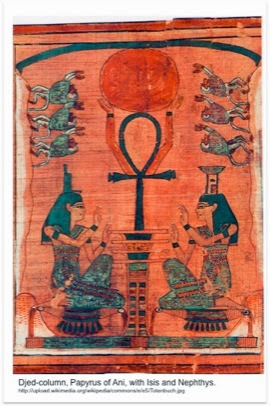
This pillar, a pillar of great importance -- a life-giving pillar -- was called the Djed column by the Egyptians.  Some early Egyptian scholars spelled it the "Tet" column or the "Tat" column, although they usually placed a small dot under both "t"s in the word, to show that they should be "voiced" (so that it would sound more like "Djed").

In Ancient Egypt the Light of the World, the insightful nineteenth-century scholar, thinker, and elucidator of the mysteries of ancient Egypt, Gerald Massey, says this of the Djed column:
[. . .] the tat pillar [. . .] was founded in the winter solstice as the figure of a stability that was to be eternal.  In the mythos the tat is a type of the sun in the winter solstice that has the power of returning from the lowest depth and thus completing the eternal road.  In the eschatology it is the god in person as Ptah-Sekeri or Osiris, the backbone and support of the universe.  Horus erecting the tat in Sekhem was raising Osiris from the sepulchre, the father re-erected as the son in the typical resurrection and continuity of the human spirit in the after life.  190.
The image above shows the Djed column, with its stylized "backbone" shape, surmounted by two arms (which often represent the ka), and an Ankh, the cross of life.  In this particular image, which comes from the Papyrus of Ani, which contains texts from the Egyptian Book of the Dead, the arms are holding up the Sun, and thus the symbology of the Djed pillar, the Ankh of life, and the now-ascending life-giving Sun all work together to convey the concepts discussed above and tend to validate the assertions of Gerald Massey regarding the backbone of Osiris and the winter solstice.

These are important things to understand and to contemplate on this December solstice, 2013.

Exposing the for-profit prison industry -- of orcas


Blackfish (2013) is a powerful and deeply disturbing documentary about the amazing whales known as orcas or killer whales, and the story of orcas in captivity.

The documentary centers around the life of a captive male orca named Tilikum, who was taken from the wild at a young age and turned into a performance whale.  The film explores the impact that decades of captivity and confinement have on the whale, and the tragic consequences.

The story of the capture of killer whales in the wild is heartbreaking, especially when the film documents the extraordinary loyalty and affection that orcas demonstrate within their family units (pods).  The scenes of the capture of baby orcas shown during the film is particularly disturbing in light of the descriptions given by Howard Garrett, an orca researcher and the co-founder and director of the Orca Network (bio on this page), beginning at about the 24:00 mark into the film (he can also be seen in the trailer clip above at about 1:09).  He explains:
They live in these big families.  And they have lifespans very similar to human lifespans.  The females can live to about a hundred, maybe more; males to about fifty or sixty.  But -- the adult offspring never leave their mother's side.  
Each community has a completely different set of behaviors.  Each has a complete repertoire of vocalizations -- with no overlap.  You could call them 'languages.'  The scientific community is reluctant to say any other animal but humans uses languages, but -- there's every indication that they use languages. 
Note that these aspects of orca society correlate very strongly with scientific research discussed in this earlier blog post entitled "Dolphins and Consciousness," in which dolphins appear to call to one another using specific "names" -- indicating that dolphins are aware of the individual identities of other dolphins, and that they are aware of their own identity as well.

Several scenes in Blackfish seem to demonstrate the same thing in killer whales -- only instead of the cries of joy and recognition which were recorded in the dolphin study, these orcas are seen issuing plaintive cries of bereavement and grief when their children or their mothers are taken from them.

The behavior of the orcas when being rounded up for capture indicates highly intelligent awareness and even levels of tactics which seem to indicate conscious thought -- and to indicate that the whales had learned from previous encounters with humans and formed plans that might be effective based on what they had seen before (Herman Melville described the same sort of deliberate tactical planning in Moby Dick):


Blackfish also centers its focus on the tragic loss of life of two young trainers when Tilikum deliberately seizes them and drags them under the waters of the tank -- incidents which took place at two different theme parks in two different countries, twenty years apart.  Another young person was apparently killed  when he snuck into the park and stayed overnight, and decided to enter Tilikum's tank.  It also focuses on the horrible death of another young trainer in a similar incident with a killer whale at a park in the Canary Islands, as well as other non-fatal attacks which are shown in horrifying video footage.  

The poignant reflections of former trainers who participated in performances with those whales and who now regret the treatment of these intelligent mammals by the theme-park industry is juxtaposed with callous and blatantly false statements and court testimony from the theme park's corporate representatives and executives, who are seen changing their story several times to try to cover up the systemic problems inherent in keeping orcas in captivity for decades and making them perform for handfuls of fish.  One of the park's representatives goes so far as to speak for the deceased trainer and say that if she were speaking today she would insist that the attack was her fault.

Blackfish is an important film on many levels.  

The film's ability to convey the absolutely eye-opening information about the sentience and level of individual care and affection which seems to characterize the relationships that these majestic animals form with one another is a tremendous achievement in and of itself.  

The bravery of the former trainers (and former whale-hunters) who told their stories, and who were big enough to admit in front of perhaps hundreds of thousands of people that what they did in the past, which at the time they thought was right, they now see as being wrong, is also profoundly moving.  

The expose of the cruelty of an industry which places animals in captivity for its own profit, and which forces the most intelligent of those animals to perform for audiences, and then tries to argue that the life these sentient beings have is better than what they would have in the wild, should ignite a firestorm of outrage and lead to people demanding change, as well as a lot of self-reflection as to how we (each of us) could ignore and even support such inhumanity without so much as a second thought.

But the film raises questions that go even beyond these.  The more we reflect on it, the more doors it seems to open onto other aspects of modern life which should elicit some soul-searching.  

The film's up-close profile of orcas might cause us to examine our whole relationship with animals, and the world-view which sees their exploitation for entertainment or a host of other purposes as completely acceptable simply because of their position in the "food chain."  For other posts which touch on some of these issues, see here and here.

The evidence presented in the film of callous attempts by corporate representatives to cover-up and sugar-coat the full truth surrounding the tragic deaths of the young trainers who were working for their company "on the front lines" (so to speak) invokes uncomfortable parallels with other hierarchical structures in which those at the top display little or no loyalty to those at the bottom of the pyramid.  The company's willingness to blame the trainers who lost their lives, saying it was their mistake alone and in no way indicates any kind of a systemic problem, is despicable -- but it is sadly not unfamiliar.  Readers of Tom Wolfe's classic nonfiction examination of the test pilot programs of the 1950s and 1960s, The Right Stuff, will find the automatic institutional blame of the deceased victim to be eerily familiar (and more recent examples could be mentioned, but viewers of Blackfish can probably come up with several on their own).

Finally, for all of us who have enjoyed killer whale shows -- either as children growing up or as parents taking our children to see them -- the film causes some very uncomfortable reactions.  Those shows cannot be all bad, can they?  There is something very magical about the interaction of human beings with wild animals, especially wild animals who are as beautiful and intelligent as orcas (or dolphins, or elephants).  But the revelation that these shows are built on a foundation of absolute imprisonment and exploitation of those majestic creatures is unavoidable after watching Blackfish.  

The cognitive dissonance that this realization generates should cause us to question what else in our world we accept uncritically -- hypnotized perhaps by the glamorous costumes, the thrilling music, the grandiose spectacle -- but which is actually built upon a foundation of absolute imprisonment and exploitation?