Does the Bible teach reincarnation?


Previous posts have presented evidence that the ancient scriptures and sacred teachings of the world are all founded upon celestial allegory -- see for example:

Previous posts have also provided evidence that one of the reasons that the ancient sacred traditions of the world chose to use the motions of the sun, moon, stars and planets to convey their esoteric message is that those motions provide an almost perfect analogy for the successive incarnation of the soul (when they set, plunging into the western horizon and hence into the mire and clay of the material realm), as well as the triumphant exultation of the soul as it rises again at the end of each successive incarnation into the freedom of the heavenly realm of air and fire.  For posts which lay out the evidence for this argument, see for example:
These posts provide plenty of exposition of the metaphors found in the ancient myths to support the thesis that they taught a vision of the human experience which involved the descent and incarnation of a pre-existing soul, the survival of that soul, and some number of repetitions of the incarnation process (i.e., reincarnation).

Those posts, and the new book The Undying Stars, also argue that the scriptures of the Old and New Testament reveal themselves to be close kin to the other sacred traditions of the world, in that they also consist of beautiful celestial allegories, and they also teach the descent and incarnation of a pre-existing soul, the survival of that soul, and some form of reincarnation.  

This thesis, of course, is completely at odds with the conventional teaching that the scriptures of the Old and New Testaments differ markedly from the "pagan" mythologies, in that (among other things) they purport to describe historical, literal personages (rather than gods, goddesses, and other supernatural beings who personify forces of nature, which is the way "pagan" mythology is usually described in the conventional view), and in that the Old and New Testament supposedly teach that men and women live only once, and afterwards face judgement followed by an eternity in either heaven or hell (some traditions would argue that the Old Testament does not teach such a doctrine, but it is safe to say that the vast majority of the literalist Christian traditions do teach such a doctrine, and have for centuries argued that the Old Testament scriptures support them in their teaching of that doctrine).

The thesis that the Old and New Testaments are also allegorical, celestial, and meant to convey an esoteric message which includes reincarnation breaks down the wall which the literalists have erected between their literalist faith and the ancient traditions of nearly all of the world's other cultures.

But, is it really possible to claim that the Old and New Testaments can be interpreted as open to the doctrine of reincarnation -- or even that they positively intended to convey such a teaching?

In fact, it is quite possible to support such a claim.  

First, as some of the discussions in the previous posts linked above should demonstrate, the evidence that the Old and New Testaments are built upon celestial metaphor is extremely strong, and almost impossible to deny.  Thus, even if one cannot find any literal expression of reincarnation teaching in the texts themselves, it is possible to argue that the esoteric interpretation of these astronomical metaphors involves the teaching of successive incarnation of the soul in a body, as the second set of previous posts linked above all argue.

Beyond that, however, there are passages in the scriptures of the Old and New Testaments which appear to indicate that reincarnation was once an aspect of the message they intended to convey, and that it was only later that the literalist doctrine -- with its full-scale denial of the doctrine of reincarnation, and declaration that such a doctrine constitutes heresy -- arrived on the scene.  

For instance, Chris Carter (author of Science and Psychic Phenomena, Science and the Near-Death Experience, and Science and the Afterlife Experience), points out in Science and the Afterlife Experience that "there are at least two references to reincarnation in the New Testament" (footnote on page 19).  He explains:
At one point the disciples ask Jesus if a blind man sinned in a previous life, and Jesus did not rebuke them (John 9:1-2); at another point Jesus describes John the Baptist as the prophet Elijah reborn (Matthew 11:11-15).  footnote, page 19.
Both of these examples are extremely notable, and worthy of careful consideration. Additionally, there is another passage in the New Testament in which Jesus has an opportunity to denounce the possibility of reincarnation, and again (as in John 9) does not do so, and that is the story concerning the "confession of Peter."  Here is the account as it is recorded in the gospel of Mark, chapter 8:
And Jesus went out, and his disciples, into the towns of Caesarea Philippi: and by the way he asked his disciples, saying unto them, Whom do men say that I am?
And they answered, John the Baptist: but some say, Elias; and others, One of the prophets.  Mark 8:27-28.
At this point, if the concept of reincarnation were truly as erroneous and dangerous as the literalist church later portrayed it to be, we might expect the text to inform us that Jesus set the disciples straight by saying words to the effect that the people were way off base with those speculations, and that there is no such thing as reincarnation, and he is very disappointed that anyone would think that he could possibly be Elias (that is, Elijah) or "one of the prophets," come back again in a new incarnation.  

But, the text does not say anything of the sort.  Instead, the next verse tells us that Jesus then asks them "But whom say ye that I am?" and this is answered by Peter in his "confession of Christ," in which Peter says: "Thou art the Christ" (Mark 9:29).

In Lost Light, Alvin Boyd Kuhn points to a very significant verse in the Old Testament prophecy of Isaiah -- a book which literalists often argue contains  a series of specific prophecies relating to the incarnation of a literal, historical Christ.  One of the oft-quoted chapters of Isaiah in this regard is Isaiah 53, a chapter which contains the well-known passage: "But he was wounded for our transgressions, he was bruised for our iniquities: the chastisement of our peace was upon him; and with his stripes we are healed" -- beautiful and comforting and timeless teachings, although perhaps misinterpreted by the literalists these many centuries in some of the applications to which that they put these scriptures and other scriptures.

Later in the same chapter, verse 9 tells us: "And he made his grave with the wicked, and with the rich in his death; because he had done no violence, neither was any deceit in his mouth."

Strangely enough, the translators of the 1611 Authorized Version (often called the "King James Version") place a textual note here at the word "death" in verse 9, where they are candid enough to inform the reader that the original Hebrew actually reads "deaths" at this point:
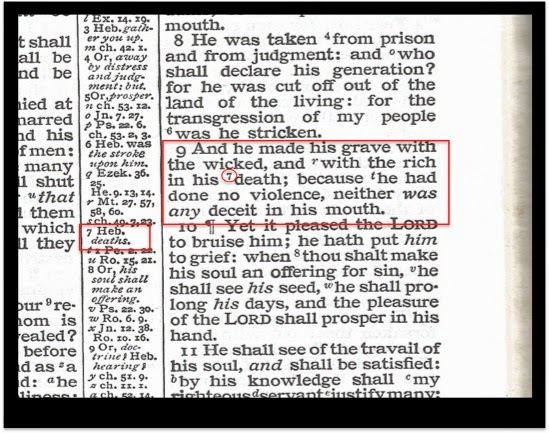


If the Hebrew text actually says "deaths," then why would the 1611 translators render it as "death" in their English translation, instead of "deaths" the way the original scriptures say? Isn't strict accuracy of translation of the original texts considered extremely important to many literalists?   

One extremely obvious possible reason that this word is translated as "death" instead of "deaths" (even though the original Hebrew text admittedly reads "deaths") is that such a translation clearly invites a re-incarnational interpretation!  Had the King James Translators used "deaths," the verse would read: "And he made his grave with the wicked, and with the rich in his deaths."

Alvin Boyd Kuhn remarks:
Here is invincible evidence that the word carries the connotation of "incarnations," for in no other possible sense can "death" be rationally considered in the plural number.  In one incarnation the Christ soul is cast among the wicked; in another among the rich.  This is a common affirmation of the Oriental texts.  And his body is his grave.  Lost Light, 173.
These prominent examples, from both the Old Testament and New Testament scriptures, strongly suggest that the scriptures as originally taught, and as originally understood, were intended to teach a message of reincarnation, or successive incarnation -- but that later doctrine (literalist doctrine) arose which sought to suppress their allegorical, esoteric nature and to instead substitute a rigid literal interpretation of all the teachings (a literal interpretation such as the doctrine of eternal punishment in hell, which almost certainly has an esoteric and non-literal meaning, if one knows how to read the scriptures according to the system of metaphor which they and all the world's other sacred traditions anciently employed, as discussed here).   

Even more powerful evidence in support of this theory (if more powerful evidence is possible than that described above) can be found in the ancient texts which were rejected by the literalists in the formation of their canon of the New Testament, for example in the various gnostic texts which were declared to be the "invention of heretics" by literalist leaders during their struggle to marginalize and anathematize gnosticism and the gnostic teachers.  

Some of these texts, most of them now completely unfamiliar due to the fact that they were condemned by the literalists in the fourth century and lost to humanity during all the intervening centuries, were unearthed at the base of a cliff near the current Egyptian village of Nag Hammadi in the middle of the twentieth century.  They were probably condemned and rejected from the canon by the literalists because their teachings are either openly gnostic or because some of the stories they incorporate are so bizarre that they cannot possibly be interpreted literally, and must be esoteric in nature.  Some of them rather strongly suggest that a doctrine of successive incarnation was part of early teaching among those that the literalists later suppressed.  

Whatever community cherished these texts in ancient times probably took them to that remote location, sealed them in a jar and buried them some time during the fourth century AD, the same time that the literalists were forbidding "heretical" texts and persecuting those who taught from them or even kept such texts.  Perhaps those who buried them hoped someday to come back and retrieve them, or perhaps they simply could not bear to destroy them.  For whatever reason, they apparently never did come back for the buried library of codices, and they were preserved in their secret location for sixteen hundred more years before coming to light.

For example, in the Apocryphon of John (a title which could also be rendered "The Secret Teaching of John" or "The Secret Revelation of John") -- which is found twice in the Nag Hammadi library, in two slightly different versions (not being literalists, those originally in possession of the Nag Hammadi library apparently had no problem having different versions of a similar story or account).  In this text, the author (taking the persona of John) describes a vision after the teacher has ascended in which the heavens appear to open and a being descends, whom the text says is "the Spirit" but to whom John puts questions, often addressing it or him as "Christ" (or, in some versions of the Apocryphon of John, as "Lord").  This divine teacher at one point expresses a teaching which appears to establish a doctrine of reincarnation.  

Here is the "short version" of the two found in the Nag Hammadi library, which matches a version of the Apocryphon of John which did in fact survive outside of the Nag Hammadi jar and had already been known to scholars (part of the Berlin Codex, BG 8502,2).  In section 23, for example, the text says:
I said, "Christ, when the souls leave the flesh, where will they go?"
He laughed and said to me, "To a place of the soul, which is the power that is greater than the counterfeit spirit.  This (soul) is powerful.  It flees from the works of wickedness and it is saved by the incorruptible oversight and brought up to the repose of the aeons."
I said, "Christ, what about those who do not know the All -- what are their souls or where will they go?"
He said to me, "In those, a counterfeit spirit proliferated by causing them to stumble.  And in that way he burdens their soul and draws it into works of wickedness, and he leads it into forgetfulness.  After it has become naked in this way, he hands it over to the authorities who came into being from the Ruler.  And again they cast them into fetters.  And they consort with them until they are saved from forgetfulness and it receives some knowledge.  And in this way, it becomes perfect and is saved."
I said, "Christ, how does the soul become smaller and enter again into the nature of the mother or the human?"
He rejoiced when I asked this, and he said, "Blessed are you for paying close attention!  
[. . .]"
Clearly, these teachings are conveying something that seems very alien to those familiar with the literalist interpretation of the ancient scriptures but unfamiliar with texts which the literalists long ago condemned.  Although there is much here that clearly pertains to more than just the topic at hand, the passage can certainly be interpreted as teaching the possibility of multiple incarnations.  Note the teaching that the souls of those who do not yet "know the All" after they leave the flesh are described as undergoing "forgetfulness" followed by being "again cast into fetters."  This phrase is almost certainly describing incarnation -- that is to say, "imprisonment" of the soul in this body of flesh and blood.  Following this passage, the divine speaker (Christ or the Spirit) explains the way the the soul which is cast again into incarnation can encounter "another who has the Spirit of Life in it," and can follow and obey and then "be saved," after which "of course it does not enter into another flesh."

There are other ancient gnostic texts which also demonstrate that the concept of successive cycles of incarnation was accepted and taught, prior to being suppressed by those who were promoting a new approach to the scriptures, one which rejected the fact that they are esoteric in nature, and who taught that they must be interpreted literally and not esoterically.  They worked hard to eradicate the teachings and the texts which would show that this literal approach was in actuality the novel approach, but some passages in the New Testament -- and especially the verse in the Old Testament scroll of Isaiah discussed above -- survive to tell the tale of how the original intent of the scriptures was not what we have been led to believe.

The fact that the Bible has clear signs of once containing a doctrine of successive incarnation -- and their employment of the very same system of celestial allegory (albeit with different actors playing the metaphorical roles, in different costumes and upon different "stage") -- shows that the ancient scriptures of the Old and New Testament are very much part of the same continuity of ancient wisdom which flows through the sacred myths of the ancient Egyptians, Sumerians, Greeks, the Norse, the Maya, the Inca, and the Pacific Islands, and which informs the teachings of the ancient civilizations of India, China, Tibet, and many other cultures around the world.

It is the literalist interpretation which is relatively "new" and which seeks to cut the Biblical scriptures off from the rest of humanity -- and that interpretation may not be sustainable based upon the scriptures themselves.

The Pythia

The Pythia

image left: Wikimedia commons (link).

The previous post discussed the centrality of ecstasy in the world's ancient sacred traditions, and featured a piece of ancient artwork thought to date to about 440 BC, depicting the mythical encounter between King Aegeus and the Pythia or priestess of Delphi.

This artwork is extremely beautiful in its own right, but it also opens an incredible window onto the ancient esoteric system discussed in the past several posts and in my most-recent book, The Undying Stars.

The priestess at the famous Temple of Apollo at Delphi was known as the Pythia, because ancient tradition held that the site was originally home to a female serpent or dragon known as Python, which Apollo slew with his arrows to claim the site for his own.  The Python slithered deep into a fissure leading down to the underworld and died in agony, and from her body issued fumes which (according to the myth) were responsible for putting the priestess into the trance-condition as she sat upon a tripod in the sacred cave over the fissure.  In this altered state of consciousness, she would pronounce her oracular sayings.  

In the ancient myths, the Pythia is sometimes described as carrying a disc of water from the sacred spring at Delphi, as well as a laurel-leaf (the laurel was sacred to Apollo), both of which were instrumental in achieving the condition of trance or ecstasy.

The symbology in the ancient artwork depicting the Pythia, above, is very revealing.  It clearly depicts the Pythia in the distinctive seated posture which recalls the stars of the constellation Virgo, which is shown in the upper right of the image above.  Note the extended hands of the Pythia, one of which holds the sprig of laurel and one of which holds the disc containing the sacred water, would be immediately recognizable as corresponding to the extended hand of Virgo to an ancient viewer familiar with this important zodiac constellation.

Below the star-chart of Virgo in the diagram above is a depiction of the goddess or titaness Rhea, who is also depicted in the same distinctive seated posture, and likewise has a hand extended in identical fashion to the constellation of Virgo.  She appears to hold a large hoop or disc above the bowl -- this can also be seen in other depictions of Rhea, such as this one and this one.  We have already discussed in this previous post that Rhea is almost certainly a manifestation of the Great Goddess, the Queen of Heaven, who is called Cybele, the Great Mother, and many other titles in many other ancient sacred traditions.

The disc held by Rhea or Cybele in these depictions corresponds in its location to the cluster of stars which can be seen in the same area (above the extended arm) in the star chart of the constellation Virgo.    The lion portrayed reclining at the base of Rhea's throne almost certainly represents the zodiac constellation of Leo, which appears to be a recumbent lion as drawn in many star charts, such as the one included in this previous post (third image down on that page), although I myself prefer the outline suggested by H.A. Rey which outlines a lion striding forward rather than reclining.  The fact that Virgo follows Leo across the sky each night explains the fact that many of the various manifestations Great Goddess are depicted in ancient artwork as riding in a chariot pulled by lions, or riding upon the back of a lion herself.

Returning to the image of the Pythia, then, we see that the disc of water in the ancient painting above appears to correspond to that same grouping of stars seen above the arm of Virgo in the star-chart, which also corresponds to the disc or hoop held by Rhea or Cybele. The sprig of laurel in the Pythia's other hand is also noteworthy, in that it is strongly reminiscent of the sheaf of wheat often associated with the constellation Virgo, and specifically with her brightest star, Spica.  This sheaf of wheat is of course also associated with the goddesses Demeter and Ceres.

What does all this mean?  The diagram below shows the now-familiar zodiac wheel, discussed in numerous previous posts, and one of the most-important keys to understanding the esoteric system of allegory which connects all the world's ancient myths.  The earth's annual circuit causes the sun to appear to rise in a different zodiac sign throughout the year, progressing through all twelve zodiac signs during the yearly voyage (for an explanation of this phenomenon using the analogy of the "dining room table," see this previous post and the YouTube video embedded therein).

One of the reasons that the constellation of Virgo is so important is that she is the only woman among the twelve zodiac signs, which probably explains why she plays so many different roles even within the same system of mythology (for instance, appearing as both Rhea and Demeter in the Greek myth-system).  Another reason that she is so important is her location on the zodiac wheel.  In the Age of Aries, depicted above, Virgo is located at the critical point of the autumnal equinox (indicated by the red "X" on the right-hand side of the diagram as you look at it).  As explained in this previous post, the ancient sacred traditions often allegorized lower half of the zodiac wheel, in which the nights are longer than days and in which the sun's path across the daytime sky is sinking lower and lower towards the southern horizon (for observers in the northern hemisphere) on its way to the lowest point of winter, as Hell (or as Sheol, Hades, Niflheim, Jotunheim, the underworld, the realm of the dead, the kingdom of Osiris, and in some myths as the depths of the sea).

Thus, the constellation of Virgo is located at the very entrance or gateway to Hell, or Hades, or the underworld, or the realm of the dead.  Returning again to the description of the Pythia, we note that she sits suspended over the underworld itself (the fissure, from which the fumes and vapors of the Python arise), just as Virgo is poised at the very edge of the underworld in the zodiac wheel.  The serpentine constellation of Scorpio, which can be seen to be two stations further down below the autumnal equinox, may correspond to the Python in the legend of Delphi, or the constellation Hydra which is also very close to Virgo in the night sky may correspond to the Python (my bet would be Scorpio).

The importance of all of this allegory, however, is very easy to miss.  Once you see the connection between the myth itself and the celestial drama of the sun, moon, stars and planets, it is important not to stop there.  The ancient sages who imparted the sacred myth-systems to humanity were not trying to trick us when they created these exquisite metaphors.  This wasn't just some exercise to hide a bunch of astronomy inside wonderful stories.  The stars and planets and signs of the zodiac -- as wonderful as they are to behold and as much as they fill us with awe when we gaze up into the infinite heavens on a starry night -- are not the ultimate focus of these treasures of ancient wisdom that make up the world's sacred scriptures and traditions.  They were designed to impart profound truths about the nature of the human condition, and the nature of the cosmos that we inhabit -- and to point us towards what is perhaps best described as "consciousness."

The lower half of the zodiac wheel did not only represent hell or the depths of the sea: it also represents incarnation, the state into which a human soul descends when it leaves the immaterial world of spirit (corresponding to the upper half of the zodiac wheel) and enters the material realm.  The endless cycles of the stars, planets, sun and moon, rising above the eastern horizon and crossing the sky only to plunge back down again beneath the western horizon, typed the progress of the soul plunging down into matter and incarnation to toil its way through this life and at the end to rise into the blessed realm of pure spirit, only to incarnate again several times in order to experience and learn the things which can only be learned by taking on a body.  Whether or not one actually accepts that this is a true description of the nature of human existence and the nature of the immortal soul, there is substantial evidence to support the assertion that this is exactly what the ancient myth systems of the world were intended to express, as discussed in previous posts such as this one, this one and this one.

The description of the Pythia, then, is one that teaches us something very profound about the human condition.  She is suspended over the chasm of the underworld, exposed to the deadly vapors of the body of the dragon, and she is described as one who is able to enter into a trance-condition and receive divine messages in doing so.  In this way, she is very much an allegorical or esoteric depiction of the human condition -- each one of us, in fact, is like the Pythia, suspended at the borderline between the world of spirit and the world of matter.  While it may not be correct to say that we should all be able to enter into the trance-state, like the Pythia, and cross over into the other realm, it is probably correct to say that we should acknowledge that we have both a spiritual component and a material component -- we are not only matter, as argued by the strict materialists who wish to deny any transcendent component to human existence or any spiritual side to men and women.

It is also true that, even if not every individual has out-of-body experiences or is capable of undertaking shamanic journeys, these are only the clearest manifestations of the fact that our minds have the ability to transcend the material realm.  Studies have revealed that positive thinking can have real impacts, for example, on human health -- which means that through something as non-material as thought we can actually create real changes in something as physical and material as our body and our health.  Quantum physics also demonstrates that human consciousness can actually impact and influence (in some fashion that is still not even close to being completely understood) the location, and even the past location, of small particles such as subatomic particles and even some molecules.  

All of these examples (and there are many more) demonstrate that even "ordinary" people have the ability to venture across that boundary between the material and the immaterial realms (just as the Pythia sits at that border between the material and the immaterial, and is capable of crossing it).  Some men and women can display more dramatic manifestations of this truth about the nature of human existence, but all of us seem to have some potential for it (and in this way, it is really true to say that there is no such thing as an "ordinary" person).

Understanding how to see the celestial metaphors contained in the world's sacred traditions is an important first step to perceiving the profound and incredible messages they were trying to teach us.  But once you see the connection (such as the clear evidence that the Pythia was depicted by ancient Greeks using symbology which points to the sign of Virgo the Virgin), it is important not to simply stop there and say, "OK, she's Virgo -- I guess that was the hidden message!"  That connection is just the beginning.

Clearly, the Pythia can still convey a divine message from the "other realm," if we listen to what she is trying to tell us.

The centrality of ecstasy, according to ancient wisdom


Aegeus consults the Pythia (c. 440 BC). Wikimedia commons.

In an important text entitled "Man in search of his soul during fifty thousand years, and how he found it!" poet and Egyptologist Gerald Massey (1828 - 1907) declares:
The ancient wisdom (unlike the modern) included a knowledge of trance-conditions, from which was derived the Egyptian doctrine of spiritual transformation.  [See section 17 of Massey's text].
This statement is worth careful examination.  First, judging by the second half of the sentence ("from which was derived . . ."), it is evident that Massey considers the ancient wisdom of which he speaks to have predated ancient Egypt, and to have been the even more ancient source from which the Egyptian doctrines were derived.  In other words, Massey is referring to a wisdom which predates one of the most ancient civilizations known to history.

Second, we see that the heart of his sentence is the declaration that this ancient wisdom concerned "knowledge of trance-conditions," and that this knowledge was somehow intimately involved with the concept of spiritual transformation.  

By "trance-conditions," the rest of the essay makes clear, Massey is referring to the process of "entering the spirit world as a spirit" and then returning to the material world of everyday life.  Even further, he explains that in trance one actually "enters the eternal state" (both quotations from section 17).  From this contact with the eternal state, one can gain the knowledge that comes only by personal experience, which the ancients called "gnosis."  

Note that in the previous post entitled "Wax on, wax off," describing the famous scene from Karate Kid (1984), it was pointed out that in the video clip that Mr. Miyagi never actually "explains" anything to Daniel-San: Daniel-San experiences it for himself (no matter how many times you have seen it in the past, or how well you think you know that scene, it is worth watching it again for its beauty and power).  Neither does Mr. Miyagi ask Daniel if he "believes" the moves will work: Daniel-San experiences that for himself too.  

Massey makes this very point in part 20 of the same essay where he asks:
What do you think is the use of telling the adept, whether the Hindu Buddhist, the African Seer, or the Finnic Magician, who experiences his "Tulla-intoon," or supra-human ecstasy, that he must live by faith, or be saved by belief?  He will reply that he lives by knowledge, and walks by the open sight; and that another life is thus demonstrated to him in this.  As for death, the practical Gnostic will tell you, he sees through it, and death itself is no more for him!  Such have no doubt, because they know.
In the first quote cited above, Massey declared that the ancient wisdom (in contrast to the modern) included this very knowledge: the knowledge of ecstasy, of leaving the "static" of physical realm ("ecstasy" comes from "ex-stasis," or outside of the static or solid).  The ancient wisdom was centered around the experiential knowledge -- the gnosis -- of the non-material realm: this is what distinguishes the ancient wisdom from the modern, which Massey plainly says is completely impoverished in comparison to the ancient gnostic wisdom.

The Undying Stars explores the evidence that all the ancient vessels containing the ancient wisdom (wisdom which predates even ancient Egypt) have ecstasy and gnosis as their central concern.  In other words, the ancient wisdom can in an important sense be described as being in some sense shamanic.  The ancient Egyptians appear to have possessed a shamanic tradition of out-of-body contact with "the spiritual realm" or "the eternal," as shown by Lucy Wyatt and other researchers who are cited in her book Approaching Chaos (2010).  The ancient Greek civilization had oracles who entered into a trance-state, including the most famous of the ancient oracles, the Pythia at Delphi.  There were also the ancient mysteria, found in many ancient cultures, which involved profound experiences and possibly altered states of consciousness, all designed to impart gnosis to the participants.  

There is substantial evidence of a similar centrality of "ecstasy" or "trance-conditions" in many other sacred traditions around the globe, including those whose shamanic wisdom survived right up through the nineteenth and even the twentieth centuries (and, in some more remote locations, survives to this day).

The Undying Stars further makes the argument that the esoteric texts which were incorporated into the Old and the New Testaments were also originally intended as vessels to convey this very same ancient wisdom, just like all the others.  It was the literalists who destroyed this understanding and who insist that their texts have no kinship with all the other closely-related sacred traditions of the world.  It was the literalists who denied the clear fact that these texts (those in the Old and New Testaments, just as much as those of ancient Egypt or of ancient Greece) are meant to be understood gnostically -- that is to say, esoterically rather than literally, perceiving that they are designed to convey the same knowledge born of the experience of the eternal.  And it was the literalists who labeled all the other sacred traditions of the world as "pagan" or "heathen" and who commenced a centuries-long campaign to destroy their ancient knowledge, convert their people at the point of the sword to the literalist religion, or kill them if they would not convert (see, for example, the history of the brutal campaigns of Charlemagne, who is pictured in this previous post).

In doing so, those behind the campaign against the shamanic and ecstatic and gnostic have robbed humanity of its ancient heritage, inflicting untold death and misery in the process.  Further, if the experience of the ecstatic is essential to the kind of knowing described above by Massey, they have robbed a large number of individual men and women of the opportunity to develop a vital gnosis of their own.  

But there is much more to the loss even than that, because the evidence also suggests that the ability to cross over into the other realm and return with the knowledge available there benefited the entire community or civilization, and may well be the source of technical and medical knowledge which could not be obtained otherwise, which shamanic cultures demonstrate (including that of the ancient Egyptians), and which conventional historical paradigms absolutely cannot explain.  If so, then the deliberate eradication of the shamanic, first in the areas conquered by the Roman Empire and then -- systematically -- in other cultures in other parts of the globe, may have stunted the civilizations that have developed ever since.  Who knows what shape cultures would take today, and what capabilities and peaceful arts we might enjoy, had the esoteric vessels that carried the ancient wisdom not been deliberately fouled by the literalists.

There is one more aspect of this discussion which is worth considering, and that is the logical possibility that those who deliberately suppressed the esoteric, gnostic, shamanic understanding of myths and sacred scriptures like those found in the Old and New Testament (and then destroyed the gnostic and esoteric and shamanic understanding of other cultures as well, forcing them at the point of a sword to accept the literalist religion) kept the ancient knowledge for themselves, while denying it to everyone else.  Given the evidence that the ability to cross the boundaries between the realms may have been connected with the inexplicable medical and architectural achievements of ancient civilizations (and some of the knowledge of modern-day shamanic cultures found in remote regions, such as isolated parts of the Amazon rain forest), there are some rather thought-provoking ramifications if that is indeed the case.

It may be that the first step towards regaining some portion of what was lost begins with the appreciation for the esoteric system of interpreting sacred traditions, scriptures, and myths, coupled with an awareness of how this esoteric approach points to the outlines of an ancient cosmology which understood the nature of the visible and invisible worlds (and our place in them).


Why St. Peter was crucified upside-down


As The Undying Stars discusses at greater length, the stories of the Old and New Testament -- although most certainly intended to convey profound truth -- were not intended to be interpreted literally.  That is to say, they were not intended to be understood as preserving the historical record of the lives of literal individuals, any more than the myths of Hercules or Osiris were intended to be understood as depicting literal events (although those myths, too, were designed to convey profound truth to men and women).

As asserted in previous posts, all these ancient sacred traditions and scriptures allegorize the motions of the celestial spheres -- the sun, moon, planets, and starry heavens.  This is as true of the scriptures which were selected for inclusion in what we call the Old and New Testaments as it is for the myths of the ancient Sumerians, ancient Egyptians, ancient Greeks, the Norse, the Celts, the Maya and Aztec and Inca and many other peoples of the Americas, the Hawaiians and Maori and other Polynesian islanders, Australia, ancient India, China, and other parts of Asia -- in fact, cultures across the planet.  

How exactly such a system became so widespread across so vast a geographic dispersion and so vast a span of ages (from the most ancient civilizations at the dawn of recorded history to cultures which managed to maintain their traditional sacred wisdom right into the twentieth century) is a tremendous mystery, and one which completely confounds the conventional historical paradigm which the educational systems are dedicated to preserving.  Such a fact is so damaging to the conventional paradigm, in fact, that it is rarely if ever mentioned.  

Beyond the question of how it happened is the question of what this universal system of allegory actually means -- what profound truths it was intended to convey.  It might also be phrased as the question of why the motions of the stars and planets would be considered so mightily important.  This question is explored more fully in The Undying Stars, and some aspects have been touched upon in previous blog posts, including:
and
To illustrate that the stories of the New Testament were not intended to be understood literally, one need only consider the example of the apostle Peter, the first among the apostles, the apostle who is given the keys to heaven, and who according to very ancient tradition was crucified like his savior, but insisted upon being crucified upside-down because he was not worthy of the same death as his lord. 

The fact that there are twelve disciples (a number which recurs frequently in myth) should immediately alert us to the possibility that, instead of literal flesh-and-blood people, Peter, Andrew, James, John, and all the rest personify houses of the zodiac, and the characteristics of that part of the year in which the sun is rising in their particular sign (using the arrangement of the Age of Aries, for reasons outside the scope of this post but discussed in the book and by previous authors referenced in the book -- and covered as well in the excellent teaching videos of Santos Bonacci).

Using the same diagram shown in the previous post entitled "No hell below us . . ." (in which it was argued that the doctrine of a literal hell is yet another example of the misinterpretations which arise from a literal approach to the scriptures, and a harmful one at that), we can immediately see that Peter's portrait in the stories of the New Testament point to the strong possibility that he represents the sign of Aries itself, the leader of the twelve zodiac signs during the Age of Aries, and the sign which stands at the very "gates" of the upper half of the zodiac wheel:


As explained in that previous post which opposed the literalist doctrine of hell, the horizontal line in this diagram indicates the line of the celestial equator, which the sun crosses twice per year in its annual ascent towards the "summit" of the summer solstice and then in its descent towards the "pit" of the winter solstice (for more explanation of what causes this, see for instance here, here and here).  

Each of these "crossing points" are marked with a large red "X" in the above diagram: these are the two equinoxes.  The "X" on the left side of the diagram as you look at it, between the Fishes of Pisces and the Ram of Aries, is the spring equinox.  The gold arrows indicate the direction of the sun's travel through the signs in its annual circuit, and so you can see that the sun is heading up towards the summit of the year when it passes the spring equinox (left X in the diagram).  Conversely, the "X" on the right side of the diagram, between the Virgin of Virgo and the Scales of Libra, is the fall or autumnal equinox.  Here, the downward-arcing arrow indicates the path of the downward-arcing sun as it passes through the fall equinox and into the lower half of the year, all the way to the very "Pit" of the winter solstice (allegorized as the very Pit of Hell).  

From this discussion, we can immediately perceive why Peter is depicted as the leader of the apostles -- he personifies the first sign of the new year, located first after the point of the spring equinox.  We also note that Peter is depicted in the gospel narratives as being somewhat "headstrong," as befits a personality who is allegorizing the Ram of Aries.  We can also see why Peter is depicted as being given the keys to the kingdom of heaven, for he stands at the very "gates" of the upper half of the year (the half in which days are longer than nights, and the half that stands for heaven if the lower half of the year stands for hell).

Peter maintains this position as guardian of the "pearly gates" in popular culture, such as in countless jokes, as well as in US Army "running cadences" in which various military characters are described as having "met Saint Peter at the Pearly Gates," where they are usually told to drop and knock out some push-ups!

As the discussion in The Undying Stars explores at greater length, the "crossing points" of the equinoxes are often allegorized in the ancient celestial metaphor system (of numerous mythologies and ancient cultures) as being places of sacrifice.  Some of this discussion can be found in the first three chapters of the book, available for preview online here.  

In the New Testament, of course, these sacrifices at the equinoxes take the form of crucifixions.  The primary crucifixion of course is the crucifixion of Christ, which is surrounded by imagery consistent with the crossing in the autumn, when the sun and the year are sliding downwards towards the lower half of the year.  There is, however, evidence in the canonical scriptures themselves of another crucifixion at the spring equinox (after which Easter is celebrated) and it is surrounded by imagery consistent with spring and the signs of Pisces and Aries.  

Further, there is strong evidence in early Christian tradition that Peter was crucified.  This tradition is apparently attested to by Origen of Alexandria, an early Christian but one who may well have taken a gnostic approach to the stories of the New Testament -- that is to say, strongly non-literalist.  Origen lived before the final triumph of the literalists and the purging of non-literalist scriptures and teachings (and probably of non-literalist teachers as well), and he was anathematized (condemned as a heretic) by later literalist theologians after his death.  He would certainly have understood the esoteric reasons why Peter, who represents a zodiac sign located at the sun's crossing of the celestial equator, would be appropriately depicted as having been crucified.

Further, according to ancient sources (including Origen), Peter insisted on being crucified "upside-down" -- inverted -- because he did not think it appropriate to be crucified in the same manner as the Lord.  Looking again at the diagram above, and understanding that the crucifixion of Christ is primarily surrounded with autumnal imagery (bread and wine, for instance) and described in the "Apostles' Creed" as being crucified and then descending into hell ("he was crucified, dead and buried; he descended into hell"), we can understand that the crucifixion of Peter was on the opposite side of the wheel from that of his lord.  From this fact, we can understand why Peter was depicted as being crucified upside-down: why he in fact insisted upon it, according to the ancient accounts.  In this way, the position of Peter as being located on the opposite side of the wheel is reinforced and graphically depicted.

All of these details were clearly intended to convey the message that these events are not to be understood literally, but rather are meant to be understood esoterically.  They are like the proverbial "finger, pointing a way to the moon" -- but tragically, we have been strictly instructed for seventeen hundred years to concentrate closely on the finger, and to ignore the glorious heavenly truths to which the finger is trying to point us. 


Why would I care about this esoteric stuff?


image: Charlemagne.  Wikimedia commons

Regular readers of this blog probably do not ask themselves, "Why would I care about this esoteric stuff, anyway?"  However, they may at times find themselves trying to answer that question to a friend or family member.  

In order to provide a few answers to that question and two related follow-up questions -- and to help journalists, bloggers, and other writers wondering if The Undying Stars might be of interest to their readers -- here follows a list of some of those reasons (many more can be added to this list, but to make it less overwhelming, this particular list is limited to three groups of three):

Why would I care about this stuff?
  • This may well be the biggest conspiracy in history, the one which ties up the loose ends of many others, the conspiracy which created the "noble" families of Europe together with a religious system designed to accumulate vast material wealth and power.  That wealth and power still drives world events and political decisions that impact your daily life.
  • This conspiracy involves the creation of a literalist Christian religious system which threatens people with eternal damnation in a literal place called hell if they do not accept the existence and authority of a literal historical savior and his twelve disciples: that threat is still used to command obedience to this day, and yet it can be conclusively shown to be based upon a completely incorrect approach to the ancient scriptures of the human race.
  • This literalist misinterpretation causes people to miss the fact that the human race once shared incredible ancient wisdom, wisdom that may help to explain the mysterious ancient monuments found around the globe (such as Stonehenge, Easter Island, Tiahuanaco, Giza, Angkor Wat, Nazca, and many others).
What new perspectives does The Undying Stars bring to this discussion?
  • Clearly shows how ancient scriptures -- focusing especially those of the Old and New Testaments, but connecting them with the sacred traditions of other ancient civilizations -- consist almost entirely of esoteric allegories which depict celestial events: the motions of the sun, moon, stars and planets.  Other writers have discussed this in the past, but The Undying Stars clearly explains the way this system works, and does it with clear prose and over seventy illustrations.
  •  Goes beyond just showing the celestial connection and explores the obvious next question of Why?  The Undying Stars explores the likelihood that these ancient sacred traditions were designed to convey secrets that the literalist misinterpretation has kept from humanity for at least seventeen centuries.
  • Provides a detailed theory explaining the rise of literalist Christianity, and the use of a two-pronged strategy using both the secret Mysteries of Mithras and the open religion of literalist Christianity to take over the Roman Empire from the inside.  This aspect of the book draws heavily on the work of historian and analyst Flavio Barbiero, but connects his theory to the subject of the esoteric allegories and what they mean, a connection which has not previously been explored.
What are some of the implications, if this theory is correct?
  • First of all, you probably don't have to worry about "going to hell when you die"! (or, to say it a bit differently, at the end of this particular incarnation).  The Undying Stars shows that the threat of a literal hell is based upon a misunderstanding of the esoteric nature of the ancient scriptures which came to be included in what is today called the Bible.  In fact, most of what the literal interpreters have been teaching for centuries can be shown to be very different from what the authors of those ancient scriptures actually intended to teach.
  • If this theory is correct, it completely rewrites European history, or at least explains that history very differently from what almost everyone has been taught.  It reveals that a group of families which gained incredible wealth and power during the Roman Empire have been pursuing goals connected to the suppression of the information outlined above ever since the first century AD -- and almost certainly continue to do so today.
  • Not only that, but it completely rewrites world history, especially very ancient history, and shows that there was an awful lot going on before the arrival of the first historically-known civilizations than we have been led to believe.  There are very good reasons that certain people would like to suppress the real history and replace it with a fictional narrative that, when examined closely, is full of king-sized contradictions and logical inconsistencies.


The undying stars: what does it mean?


Once it can be demonstrated beyond a reasonable doubt that the ancient scriptures and sacred traditions around the world consist of celestial allegory, with each story describing the motions of the sun, moon, stars or planets, the next question which naturally arises is: Why?  Why would the cultures of the world ascribe such importance to the circling heavens, so much so that they encoded those motions at the very heart of their most sacred art, literature, and cultural rituals?  (For some discussions of the evidence supporting the conclusion that the ancient sacred traditions are all founded upon celestial allegory, see previous posts such as this one, this one, and this one, as well as much more evidence discussed in The Undying Stars, the first three chapters of which can be read online here).

One possibility, much in vogue since the nineteenth century, would be that primitive humans were so over-awed by the glory of the heavens that they worshiped the sun and moon and stars and planets as deities, and that the sacred traditions and ancient scriptures of the world are simply the more-civilized versions of those early religious impulses from the days of the hominids.  This theory argues that, beneath the accretions added by later civilizations, one can still detect the outlines of the earliest and most primitive sun-and-star worship, and this fact (in their view) reinforces the storyline of mankind's long and generally linear progress from "early humans" to "primitive hunter-gatherers" to "pastoral herdsmen" to "neolithic farmers" and ultimately to the building of the first true civilizations (and further progress from there).

This explanation, however, either overlooks or deliberately obscures the evidence for the existence of a very sophisticated ancient civilization (or civilizations), with capabilities we still do not fully understand -- capabilities such as the construction of megalithic structures using huge stones, quarried from great distances, set at precise angles, and aligned with great precision to subtle astronomical phenomena.  The combination of these subtle alignments and the massive stones transported from great distances implies that the designers of these sites knew exactly what size stones they needed to obtain before they quarried them.  Further, these sites often incorporate dimensional measurements and ratios indicating that their designers understood the subtle celestial mechanics of precession, and even the size and shape of planet earth!  The existence of such monuments, many of them from great antiquity (predating the earliest known civilizations) tends to upend the conventional storyline (briefly outlined in the previous paragraph) of mankind's progression from primitive humans subsisting as hunter-gatherers and pastoral herdsmen prior to the earliest civilizations.

Further, these incredible ancient monuments (whose construction is still in many cases unexplainable by conventional academics and either un-duplicate-able or extremely difficult to duplicate using today's technologies) are not simply amazing on their own: their relationship to one another forms what can only be described as a "world-wide grid" which indicates that their designers were far more advanced than the conventional timeline can possibly account for.   

The profundity of the wisdom preserved in the ancient scriptures and traditions of mankind likewise argues against the theory that they are simply the glorified remnants of the awestruck deification of the sun, moon, stars and planets by "primitive humans."  Of these manifestations of ancient wisdom, already evident in some of the earliest writings known to history (such as the Pyramid Texts), Alvin Boyd Kuhn declares: "They were the products, not of early man's groping tentatives to understand life, but of evolved men's sagacious knowledge and matured experience.  On no other ground can their perennial durability and universal power be accounted for" (Lost Light, 30).

To conclude that just because the ancient myths and sacred traditions (including the scriptures of the Old and New Testaments) are full of allegorical descriptions of the motions of the circling heavens they must ultimately be about the circling heavens themselves is to commit a colossal error.  Many traditions of Buddhism contain the metaphor of the "finger pointing to the moon" and advise the listener not to concentrate on the finger or risk missing the heavenly glory of the moon to which the finger is pointing; however, it would be a ridiculous mistake to use this fact to conclude that Buddhism is all about the rocky sphere which orbits our planet! 

Likewise, just because it can be conclusively demonstrated that the scriptures of the Old and New Testament describe celestial metaphors, this by no means necessitates the conclusion that those scriptures are all about the heavenly bodies.  In fact, just like the moon in the Buddhist saying about the finger and the moon, the motions of the starry heavens are themselves a metaphor for higher truths regarding the human condition and the nature of existence in this material realm.  

One aspect of this metaphor, discussed in some detail in this previous post, entitled "A Hymn to the Setting Sun, and the ultimate mystery of life," teaches that each human soul is immaterial and undying, incarnating in successive material bodies and then successively returning to the spirit realm.  That post explained:
One of the metaphors which the ancients used in order to convey this vision of human existence as a cycle of incarnation in matter followed by re-ascent into the spiritual realm was the cycle of the heavenly bodies, including that of the sun, which plunges nightly beneath the horizon (matter) only to rise again each morning clothed in fire into the upper realm of the heavens.
This same illustration of the successive incarnation and re-ascent is also provided by the motion of the individual stars, which plunge into the western horizon to become "enfleshed" in earth and water (the lower elements), only to appear again on the eastern horizon to rise again into the heavens -- the realm of fire and air (the higher elements).  In doing so, they perfectly allegorize the incarnation of the soul in a body of earth and water (often described as a body of "clay" in the ancient scriptures) and its subsequent re-ascent into the freedom of air and fire, followed by another descent into matter. 

This (apparent) daily turning of the stars across the (apparent) crystal dome is depicted below, showing the course of the stars for an observer located at about 30 degrees north latitude:


(This diagram has been published in an earlier blog post from August of 2011, entitled "Listening to the greatest navigators our globe has ever seen").  In the diagram, because the observer is located at about 30 degrees north latitude, the pole star about which the heavens appear to turn is located at about 30 degrees elevation above the horizon (the horizon in the above diagram is depicted as the dotted line around the edges of a flat grey disc, out of which the heavenly bodies such as the sun, moon, planets and stars will appear to rise in the east and into which the same heavenly bodies will appear to sink in the west).  

Please note that stars which are close enough to the pole star will never actually sink below the horizon (although they will be blotted out by the brilliance of the sun each day when the day-star is above the horizon itself).  Those stars which are closer to the pole star in the above diagram (that is, any star located between the smallest circle in the diagram and the pole star itself) will not plunge below the horizon.  These stars the ancients (particularly the ancient Egyptians) called the "imperishable stars," or the "undying stars."  For an observer at 30 degrees north latitude, these would be the stars which are within about thirty degrees of arc from the north celestial pole.  

The diagram below from an old US Air Force manual depicts the stars near the north celestial pole in the modern epoch, with the north celestial pole marked by a small cross and the letters "NCP" in the center of the wheel.  Very close to the true north celestial pole is the star Polaris, at the end of the handle of the Little Dipper (Ursa Minor).  Pointing to the pole star Polaris are the "pointers" in the bowl of the Big Dipper (an arrow is drawn from the two "pointers" towards Polaris, to help illustrate the concept).  Very helpful rings are drawn on the chart, each ten degrees greater from the central point of the north celestial pole (NCP).  These are marked with degrees of elevation above the celestial equator: the NCP is at 90 degrees, the first circle from the NCP is marked as 80 degrees, the next circle is marked as 70 degrees, and so on.  For an observer at 30 degrees north latitude, all the stars within the first three circles would be considered "the undying stars," and would never dip below the horizon (of course, mountains and trees along the horizon would cause some stars on the edges of the outer circle to dip below the horizon at times).

In his 1940 book Lost Light (which can be read online using links found in this previous post), Alvin Boyd Kuhn explains that one interpretation of the metaphor of the imperishable or undying stars in ancient mythology would be spirits which never have descended into mortal incarnation, but another would be spirits who have, through successive incarnations, surpassed the cycle of reincarnation.  He writes:
Among the ancients the stars that dipped beneath the horizon were emblematic of souls in physical incarnation, in contradistinction to those that never set [. . .] The redeemed souls rejoiced in the Egyptian Ritual (Ch. 44) at being lifted up "among the stars that never set."  115.
Later in the same text, Alvin Boyd Kuhn explains that in ancient Egypt, 
The souls having attained the resurrected state in shining raiment were called the Khus or the glorified. [. . .] the Egyptian Khemi, or Akhemu, the dwellers in the northern heaven, as never-setting stars or spirits of the glorified, the Khus or Khuti.  587.
This is not to say, as textbooks often authoritatively declare to schoolchildren, that the ancient Egyptians literally believed that they would go dwell in the physical starry heavens at some point, or that when they said "the dwellers in the northern heaven" they believed that this was the physical location of the spirits of those who had surpassed the cycle of incarnation.  Such an assertion falls into the trap of literalism: of believing that the texts must be read literally and that the authors of those texts intended for them to be read only this way.  

These teachings were using metaphor and esotericism to teach profound truths regarding the nature of human existence -- not literal directions to the location of disincarnate souls.  

As The Undying Stars discusses further, these celestial metaphors may also have been preserving and conveying a sophisticated understanding of the nature of our physical universe, one which anticipates modern quantum physics by many thousands of years and which teaches (as does modern quantum physics) that human consciousness actually impacts and in some way causes to manifest the apparently physical world we inhabit in this incarnation.

Ultimately, these ancient scriptures can also be said to teach that all stars are really "undying stars" or "imperishable stars," in that they do not cease to exist, even after many successive cycles of incarnation, and in that they represent undying souls who will one day overcome the cycle of incarnation and join the Akhemu, "the dwellers in the northern heaven, as never-setting stars or spirits of the glorified."


Weaponization


The above Red Ice Radio interview with Darrell Hamamoto, published on May 02, 2014, explores some extremely important subjects.

Professor Hamamoto is a full professor at the University of California at Davis (aka "UC Davis"), in the Department of Asian American Studies, and the author of the recently-published book, Servitors of Empire, which relates to the material discussed in the above interview and examines a host of thought-provoking and timely topics.  

One of the most interesting aspects of the interview, and one which could be seen as the thread which runs through the numerous different subjects that Professor Hamamoto and host Henrik Palmgren examine during the course of the discussion, is the concept of "weaponization," which Professor Hamamoto first introduces in the context of his own department.

He notes that, while there are undoubtedly injustices which have been perpetrated in the past against men and women because of their ethnicity and origin (in the case of his particular field of focus, the history of Asian Americans in the United States, who have been discriminated against, exploited, and even physically incarcerated by the state during World War II) aspects of which continue to this day, he draws a clear distinction between the legitimate study of such injustices, study which is intended to prevent injustice and enhance human freedom, and (on the other hand) the weaponization of "ethnic studies" departments in academia, which are not actually intended to prevent injustice but which instead are intended to drive wedges between people, beat down or silence opposition to some particular agenda, and in fact to agitate for the restriction of human freedom instead of for the expansion of human freedom.

This is an incredibly important distinction, and one that Professor Hamamoto then expands upon throughout the rest of his talk.  In outlining this distinction, he says during the first hour of the interview (beginning at approximately 28:20 in the above video):
So I would have to say that I am partly complicit, since I'm in Asian American Studies, in advancing these notions, which are good in and of themselves: they're innocuous, they're harmless -- it's great to be proud to be Swedish, or Japanese, or Canadian, that's fine.  But, as I said, getting back to an earlier insight that I had, the social engineers and the mind managers -- very smart PhD-type people at the high levels of planning -- they figured out how to weaponize this sort of ethnic and national pride.  And they are able to exploit it and use it, against the . . . not just the American people but the people of the world.  
How can we further clarify this concept of "weaponization"?  Clearly, from the above discussion, it has  to do with the exploitation of something that is originally intended for good, concepts or intentions which are good in and of themselves: something intended to increase human freedom, identify and prevent injustice, and generally promote what I would call natural, universal law, which is discussed in numerous previous posts such as this one and this one.  In short, "good" in this sense means "expanding individual freedom, dignity, and enjoyment of the individual's natural-law rights."

Under the cover provided by these commendable ideals, weaponization actually aims to diminish human freedom, dignity, and the enjoyment of natural-law rights.  It takes something good, and twists it into something that is the opposite.

Again, definition of terms is important to examining this topic, and so we can say that by "good" is here meant: "designed to help others be more universally recognized as fully human, and more capable of exercising  their inherent, natural rights as a man or woman."  Discrimination on the basis of national origin or ethnicity obviously opposes the goal of helping others become more universally recognized as fully human, and seeks to inhibit their ability to exercise their inherent, natural rights as men or women -- so opposition to such discrimination is "good," as used here.

Weaponization, on the other hand, takes something that could and should be used for "good" and turns it against individuals, and in doing so tries to make them less fully human, less conscious, and less capable of exercising their rights as free men and women.  When someone seeks to use violence (including the force of artificial law) to prohibit another's ability to speak an opinion in a nonviolent way, that is an opposition to human freedom and the inherent natural rights of others.  To the extent that "gender studies" programs promote the shutting down of someone else's right to express their opinion in a nonviolent manner, they can be described as having been weaponized.

Further, to the extent that such programs promote the objectification of people by their race or national origin (lumping them together on the basis of some categorization or another) and in doing so treat them as an object and not as fully human men or women, then they can be described as having been weaponized.

This concept is very closely related to the vitally important essay by Simone Weil, written during the Second World War and published in 1940, entitled "The Iliad, or the Poem of Force," discussed in this previous post.  In that essay, she argues that the use of violence (describing most specifically the use of physical violence, but which we could expand to encompass all violation of another's natural-law rights) can best be described as "that x that turns anybody that is subjected to it into a thing."  She then goes on to demonstrate, using the poetry of Homer in The Iliad, that the very act of trying to turn someone else into "a thing" (to treat him or her as less than human, and to deny his or her natural, universal, inherent rights as a man or woman) turns the perpetrator of that violence into a thing as well, making the perpetrator less than human at the same time.

Her essay is clearly very pertinent to the discussion of weaponization in general, to the extent that we  can define weaponization as the subversion of something that is originally intended to affirm the humanity of another man or woman, and using it to deny their humanity instead ("turning them into a thing").

Professor Hamamoto provides examples from his own experience, and from his own subject-matter expertise as a professor in the Asian American Studies department of the University of California at Davis, that this weaponization is taking place in ethnic studies departments across the country (and probably in other countries as well).

But the discussion does not stop there, because he then applies the concept of weaponization to other extremely important areas that he has personally observed.  He demonstrates that in some ways, one could describe the entire university experience as having been "weaponized" -- and to the extent that education is clearly intended to be something "good" as defined earlier (intended to help people more fully recognize their own humanity and that of others, and to exercise their own freedom and that of others), if it is being used to diminish the recognition of one's own humanity and that of others, or of one's own rights under natural universal law and those of others, then it is indeed being weaponized.

Professor Hamamoto discusses the ways in which the agricultural science research at UC Davis (California's primary agricultural sciences university) is used to promote the development of genetically-modified crops -- the potential dangers of which are discussed in numerous previous posts on this blog, including this one, this one, this one and this one.  This research can obviously be described as the weaponization of food.

Professor Hamamoto discusses the ways in which the literature and humanities departments have adopted Marxist theory and applied it to the study of great works of literature, often to the exclusion of any other perspectives on those works of art.  To the extent that this practice silences opposition, and subverts the affirming, freeing messages of those works of art, and instead "turns those subjected to it into a thing," this is a weaponization of literature.

Professor Hamamoto discusses the proliferation of psychiatric counseling on campuses, which are overly-eager to prescribe psychotropic drugs to students -- to the extent that an overwhelming majority of his students admit to having been prescribed such medications at some point during their college career.  Again, while such medication may in appropriate situations be beneficial to those who need it, the over-eager prescription of mind-altering drugs to young men and women can be described as the weaponization of medicine.

Professor Hamamoto discusses the technological advances of the information technology revolution, which obviously can have tremendously positive effects when put to peaceful uses, and which can enhance people's lives.  However, to the extent that these technological advances are used to control men and women, rather than to liberate them -- as detailed in this and this and this previous post, for example -- this can only be described as a weaponization of technology.

Professor Hamamoto's definition of the concept of weaponization is obviously incredibly important, and incredibly pertinent to the changes we see taking place around us, and which threaten the exercise of natural-law rights by free men and women.  

And there is another area of human experience which is threatened by what can clearly be seen as the "weaponization" of something that was originally intended for human good, and that is the area that we can call the "weaponization of consciousness."  My most recent book, The Undying Stars, examines extensive evidence that the ancient scriptures of the human race, stretching from ancient Egypt to the Americas, and across the Pacific from Rapa Nui and Hawaii to Aotearoa and Australia, and from ancient China to ancient India, and even to the scriptures that found their way into the Old and New Testaments of the Bible, were all intended to point the way to increased human consciousness and the greater exercise of all the things defined as "good" in the preceding discussion -- especially the awareness of the beauty and dignity of all men and women.

But somewhere along the way -- and the evidence points to a very specific event in the first century which continued to develop over the next three hundred years, in the lands controlled by the Roman Empire -- the ancient scriptures were deliberately subverted, and in fact weaponized.  They have since been used to excuse the suppression of human freedom, and even the wholesale extermination of certain peoples and their way of life.  This weaponization can be shown to continue to this day.

We all owe Professor Hamamoto a debt of gratitude for his courage in exposing the weaponization of the university that he sees taking place, the impact of which is not confined to the university campus.  His decision to speak and write about this subject must certainly expose him to some significant pressure, criticism, and perhaps even professional consequences in his line of work.  His clear articulation of the important concept of weaponization is incredibly helpful, and can help us to identify such weaponization where it is taking place, and to more effectively speak against it (knowing that it often seeks to hide under the cover of a concept which is originally "good").

I will certainly be purchasing his most recent book and reading it with great interest, and encourage others to do so.