image: Marcus Aurelius (AD 121 - AD 180), Emperor from AD 161 - AD 180. Wikimedia commons (link).
The movie Gladiator (2000), starring Russell Crowe and Joaquin Phoenix, presents the transition from the rule of the Roman emperor Marcus Aurelius to the rule of his son Commodus as a crucial turning point in the history of the empire.
In the film, Marcus Aurelius recognizes the pathological twist in his son's character and decides he will not appoint Commodus as his successor, instead desiring to return Rome to a republic, and appointing the virtuous Maximus to act as "protector" during the transition. As fans of the movie know, Commodus was none too pleased with this arrangement and took matters into his own hands, eliminating both his father and eventually Maximus as well, and ascending to the throne to become one of Rome's most megalomaniacal rulers.
While the above plot takes considerable historical license and inserts an entire series of fictional characters and events surrounding the memorable but entirely imaginary general-turned-gladiator, Maximus, the transition between Marcus Aurelius and Commodus was in fact an enormous turning point in world history, and one that is worthy of careful study and consideration.
According to the theory put forward by Flavio Barbiero in his 2010 book, The Secret Society of Moses, the transition from Marcus Aurelius to Commodus was critical in that Commodus was the first emperor who was an initiate into the secret society of Sol Invictus Mithras. As explained in my previous post entitled "Ten reasons to suspect a close connection between ancient Roman Mithraism and ancient Roman Christianity," and articulated at greater length by Flavio Barbiero in an online article entitled "Mithras and Jesus: Two sides of the same coin," there is evidence to support the thesis that the secret society of Sol Invictus Mithras was the primary vehicle through which the priestly families from Judea took over the levers of control of the entire Roman Empire.
Judea and Jerusalem fell to the Roman legions led by Vespasian and his son Titus in AD 70. Vespasian and Titus brought back certain members of the leading priestly families from Judea to Rome -- including the crucially important historical personage of Josephus. Once in Rome, according to the thesis expounded by Flavio Barbiero and backed up by extensive historical evidence (starting with the writings of Josephus himself), these priestly families began a secret campaign to gain control of the levers of power, beginning with the Praetorian Guard and then extending steadily to the centers of commerce, the bureaucracy of the empire, and of course the Roman army itself (especially the officer corps).
In order to accomplish this takeover, these families used the twin vehicles of Mithraism and literalist, hierarchical, ecclesiastical Christianity (which they created, and which slowly took over from and supplanted the earlier gnostic and esoteric forms of Christianity that had existed prior to the campaign of Vespasian and Titus and their destruction of the Temple at Jerusalem).
If that seems difficult to believe, remember that these families were extremely experienced at running a system which we could call a system of reality creation. Previous posts have explored the likelihood that the ancient esoteric wisdom which forms the foundation of all the world's ancient sacred traditions articulated a vision of our universe as one that is shaped at least in part by human consciousness, and taught that through consciousness we can actually create realities. As this previous post articulates, I believe there is evidence that this wisdom was intended for (and anciently used for) benevolent purposes, but it can also be used for purposes of control, domination, and the general suppression of human consciousness in others.
So, if the families that came to Rome after the fall of Jerusalem were experts in "reality creation," were they more disposed to use that knowledge for the more benevolent purposes of enhancing human consciousness and freedom, or for the more oppressive purposes of control and domination?
Well, there is clear evidence which demonstrates that most repositories of the ancient wisdom were destroyed after the arrival of these families in Rome, and in fact after the time that Sol Invictus Mithras began appointing emperors and thus demonstrating that it had gained control of the levers of power of the Roman Empire. Examples of this destruction of the esoteric ancient wisdom include the destruction and suppression of gnostic and esoteric texts within the Roman Empire itself (see discussions here and here and here), as well as the burning or seizing of ancient texts stored at the library of Alexandria. It also includes the shuttering of the sites that carried on the various mystery cults within the borders of the Roman Empire, which (as I explain in The Undying Stars) also appear to have preserved aspects of the ancient knowledge that the new order set about to suppress or eliminate (for a discussion of one of the most important of these ancient mystery cults, see this previous post exploring the Eleusinian Mysteries).
Based on the fact that these suppressions all took place within the Roman Empire after the time that Sol Invictus began appointing emperors, and especially after Constantine made literalist Christianity the official religion of the empire, it is safe to say that those expert practitioners of reality creation who took over the Roman Empire were generally more interested in the "control and domination" side of the art.
In his book, Flavio Barbiero points out that the use of the two-pronged strategy which included both the public-facing literalist-Christian vehicle and the private, exclusive, and extremely secret society of Sol Invictus Mithras was critical to the success of the takeover. The old Roman families, especially those who controlled the Senate of Rome until the Senate was slowly infiltrated by equestrian-class newcomers, never actually realized that the leaders at the top of Sol Invictus were the ones calling the shots. The representatives of the old Roman families generally saw Christianity as the threat, and tried to attack it instead -- thus the spread of Christianity served as the perfect distraction or decoy to misdirect their attention and enable the secret society of Sol Invictus to move its pieces across the chessboard until it was able to emplace emperors at will.
At first, the leaders of Sol Invictus used emperors who were from the old Roman families but had been initiated into the Sol Invictus cult (not knowing that they were only shown the "lower-level" activities of the secret society, and were not invited to the high-level inner-circle meetings where the real strategy was enacted). However, at some point, Sol Invictus had enough power (backed up by their control of the Praetorian Guard) to appoint descendants of their own priestly families to the office of emperor.
According to Flavio Barbiero's research, the first emperor to be a member of Sol Invictus was none other than Commodus, who took the throne in AD 177, just over one hundred years after the fall of Jerusalem and the arrival of Josephus and the other members of the priestly families in Rome.
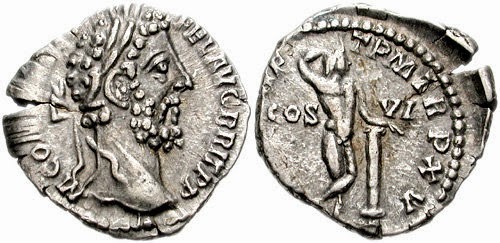
The fact that Commodus was closely associated with Sol Invictus is clear from several historical details. For one, he took the name "Invictus," and when he renamed the months of the year after his own several names and appellations (an example of his egomania which caused tremendous resentment among the traditional Roman families), he chose to name one of the months "Invictus." Another piece of evidence can be seen in the coin below (source), which has the image of Commodus on one side and the image of a solar god or figure on the obverse side, with legs crossed and leaning against a pillar: