Support your alternative media information-bearers!

Support your alternative media information-bearers!

I cannot emphasize enough how important I believe the new brand of "alternative media" platform, which has developed only very recently within the past decade or so, to be to humanity at this particular juncture in history.

That's right -- to all humanity!

Allow me to expand on this topic for just a moment in order to outline the reasoning for such a sweeping statement.

In a very tangible way, our "reality" is created by words, and by "narratives" which give us the lenses we use to view the events taking place around us, and to make sense of what we see (for a couple previous posts on this idea of the "narrative" and on the creation of "realities," see here and here).

For most of human history, at least in the centuries since the end of antiquity (and in the parts of the world which fell under the literalist narrative and became what has been broadly labeled "the West"), the ability of the average man and woman to examine the narratives was limited by several gigantic obstacles that made seeing the big picture very difficult. 

For one thing, literacy was generally very limited -- the ability to read and write was not a skill that was considered necessary for the "lower classes" who produced food and goods through hard manual labor -- nor was it considered a good idea to let these laborers have the ability to read and write. First of all, there were an awful lot of them (the production of food and other goods being very labor-intensive in past centuries), and if they could read and write they might "get ideas," which was also not considered to be a very good thing.

Only in recent centuries has there been a major change in this situation, with a wider and wider band of the population becoming literate (a product of the need for literacy as technology changed and the composition of the economy changed with it). In the past century, we have generally been able to take very high literacy rates for granted, but the control over the sources of information remained extremely narrow until even more recently, with the advent of the internet. 

Prior to the internet, it was theoretically possible to look up information and piece together an alternative viewpoint to the narratives handed down by the "official" media and the consensus of academia, but doing so was still very difficult unless you happened to have access to exceptional libraries and collections, and the time it would take to go visit special collections made piecing together "the big picture" much more difficult.

The internet has changed all of that -- and it has enabled the rise of the very important phenomenon of the alternative media platforms that are the subject of this post. Platforms such as Red Ice Creations (which was one of the pioneers of this model) and other pioneers (we are still very much in the pioneering stage of this development) such as The Higherside Chats

have an extremely important distinguishing feature that sets them apart from other media sources -- including other media sources enabled by the internet.

That feature is the fact that they are directly supported by listeners.

The importance of this feature also cannot be overstated. Consider how important that single difference is. Consider the fact that traditional media channels have usually been supported either by advertising or by direct government funding. 

Obviously, if a media platform is supported by direct government funding, it is unlikely to publish information which directly contradicts narratives supported by the government. If it does, a simple call from the government agency in charge of funding requesting (or even gently suggesting) the removal of any such objectionable information would carry tremendous weight.

Alternative media such as The Higherside Chats would not likely receive government funding to begin with (nor would such a program really want such funding, it is safe to say). But what about the other traditional method of funding a media platform -- advertising? Once again, that method places the content at the mercy of the advertisers to at least some degree, and potentially to a very large degree. 

If a young enterprising podcaster decided to make the providing of a platform where alternative views, no matter how divergent from the mainstream narrative, his or her full-time endeavor (because doing it right, with all the production as well as the preparation and research, might well take more time than someone could do in addition to working another full-time job), and decided to rely on advertising to pay the bills for such a platform, imagine what that might mean for the independence of the content being offered. 

Let's imagine that the enterprising founder of such a show manages to score a few big advertisers, and suddenly finds that the revenues from these advertisers pays for the cost of production and the people necessary to make it work. Then, one day, a guest on the show makes critical remarks about genetically-modified organisms in the food chain, and the biggest advertisers (who happen to be involved in an industry which would prefer less criticism of GMO food, for whatever reason) inform the founder of the show that if any other guests mention the topic in a critical fashion, they will take their advertising dollars elsewhere. 

We can imagine the same scenario playing out for a variety of other interests that would prefer certain aspects of certain narratives not be challenged on public forums (extremely important recent news regarding one aspect of the childhood vaccine narrative is receiving very little media attention outside of alternative channels, for instance).

For this reason, the business model pioneered by Red Ice Creations, in which about half the content is provided for free, and paying members subscribe directly and receive access to additional content, is a very important different approach. It enables providers of alternative media platforms to put in the full-time effort required to bring new and narrative-challenging content (and to take the time necessary to prepare for the interviews that help their listeners get an idea of what that content involves), and to do so in a way that does not place that content at the mercy of centralized interests.

Again, the importance of this fact simply cannot be overstated -- which is why I would personally encourage all of us who care about such content to support these platforms in whatever way we might be able to do so.

Because, as important as it is for researchers to actually go out and find the narrative-challenging information, it is equally important for those researchers to have platforms where they can present that information to the people who are looking for the clues. Alternative media channels make that connection possible. 

Not only that, but when a particular show (such as those already mentioned, and the many other excellent shows which are cropping up around the planet) has on multiple guests over an extended period of time (one after another after another after another for many weeks, months, and even years), then listeners get to hear many different perspectives, many different angles, many different theories -- some of which will contradict one another, and some of which will complement one another. This is the way that new theories can be pieced together; this is the way that mysteries are solved.

As I've said before, we all have our own individual backgrounds, experiences, areas of focus, strengths, weaknesses, subjects we are most drawn to, parts of the puzzle that we are most familiar with. Even Scooby Doo needed the different strengths and weaknesses of Shaggy, Fred, Daphne, and Velma to put the whole thing together -- and the mysteries that Scooby was solving were always pretty easy to figure out, once you'd watched a few episodes. For the kinds of mysteries that we face in the real world, it's going to take a whole lot of different personalities and backgrounds -- and one important way of bringing those different voices together is the kinds of media platforms that have developed only in the past several years.

We are living in a very important time. These types of shows were not even available just a few decades ago. We are also living in a time, as mentioned above, in which there is a very large, literate, well-educated "middle class" around the world, with the time and inclination to actually look into these things (in previous centuries, when just growing the crops took up a huge amount of labor and time, and did not really require everyone to know how to read or write, looking into these kinds of matters was simply not as practical as it is right now)*. The internet, and the arrival of this new type of directly-supported alternative media platform, arrived at a very fortuitous time in history, when there is a large number of people who may have hated a lot of the schooling they received but who can be thankful that it gave them the tools to start challenging the narrative in a way that simply was not possible just thirty or forty years ago (at least on the scale that it is possible now).

And so, once again, I would encourage everyone to try to support these new alternative platforms, or at least the ones that they themselves listen to the most (and also to try to find new and upcoming ones that seem to be worth helping to make it). One way to find them is to go to Twitter and look up a few (such as The Higherside ChatsRed Ice CreationsAlchemy RadioTruth WarriorMysterious UniverseThe Grimerica Show, and many others) and then see who those platforms are following -- often they follow other alternative media platforms, since after all they are in the same business. In this way, you can find five or ten to investigate.

You could also check out some of the platforms I'm grateful to have interviewed on, such as:

Truth Warrior (and see also The World Was Meant to be FreePure Momentum and the aforementioned THC and Red Ice.

To finish up where this conversation started -- if our reality is shaped by narratives, then false narratives which go unchallenged and unexamined can lead us down paths that go in the wrong direction and end up causing enormous harm, suffering, and trauma. Seeing through those false narratives is of absolutely critical importance -- to each of us individually but really to all humanity (we can easily go back through history and find examples of false narratives which have had negative consequences on a worldwide scale). Alternative, independent media platforms are an essential tool for the widespread examination of false narratives, and an essential tool for piecing together alternative hypotheses about what is going on in the world around us.

Please: Support your alternative media information-bearers!

-------------

* Credit to Michael Tsarion for expounding some of the argument presented above (regarding the obstacles in the past to seeing through false narratives and piecing together the "big picture," and the opportunity to do so today) during an Alchemy Radio interview with John Gibbons, as well as to Professor Darrell Hamamoto, who articulated some of the same points in a conversation I had with him this past year.

Mystic Man

Mystic Man

As we approach the September 11 anniversary of the horrendous criminal mass-murder destruction that took place in 2001 (that anniversary taking place on this coming Thursday), it is also appropriate to remember that another horrendous murder took place on September 11 in the year 1987, when the poet, prophet, songwriter, and musician Peter Tosh was slain in his home.

His albums are full of songs he composed himself, and each and every one of them is musically compelling, melodious, subtle, and pleasingly satisfying in its chord progression and resolution (some of them quite imaginative and unexpected). 

In addition, his lyrics speak powerfully against oppression and the kinds of violations of natural universal law discussed in the previous post

Based on the extremely incongruous details surrounding his murder (including the fact that he was apparently tortured before he was killed, that none of his possessions were taken by the perpetrators, and that two of the three killers were never identified despite the fact that others visited the house while Tosh was being held at gunpoint before being killed, and that one of the three perpetrators served time and was later released early, apparently without ever revealing the identities of the other two), the possibility that his murder was carried out by persons connected to those in power, who had been offended by the contents of his music and his statements against instances of oppression and injustice, must be considered (and the criticisms in his songs went far beyond criticizing the government of Jamaica, but to those he saw as running the entire world-order).

Obviously, murdering someone for his or her beliefs, statements, and verbal opposition to injustice is a gross criminal violation of natural universal law and can never be argued to be legitimate under any circumstances.

Many of Peter Tosh's individual songs are themselves worthy of thoughtful consideration for the insights and truths they contain and illuminate. An artist, songwriter and musician of his caliber can undoubtedly be suspected of being in touch with the other realm and to at times be bringing back glimpses of inspiration from it, to share with the people. We know, for example, that the ancient wisdom of the Greeks attributed such gifts to the Muse (or the Muses), as well as to Apollo (who was both the god of medicine and of music, and who was associated with the premier  oracle of the ancient world, the place where messages from the realm of the gods were most frequently sought, and which were delivered through the Pythia, as discussed in previous posts).

As seen in the video above, one of Peter Tosh's entire albums was entitled Mystic Man (released in 1979). The term itself, mystic, specifically refers to one who makes contact with the unseen realm (or one with whom spirits or entities from the unseen realm themselves initiate contact). 

All of the lyrics of the title track ("Mystic Man") are worthy of examination, and carry clear resonances with many of the concepts discussed previously in conjunction with the shamanic worldview, including a series of denunciations against alcohol, and against drugs created by concentration, purification, and enhancement of the alkaloids in the opium poppy (morphine and heroine) or the coca plant (cocaine). 

It is extremely revealing that a song entitled "Mystic Man," in which the lead singer declares he is a Mystic Man and thus one who makes contact with the spirit world, categorically rejects these substances: this tension strongly resonates with the topic discussed in the previous post entitled  "The heron of forgetfulness." 

Later in the song, there is a series of stanzas denouncing the consumption of fried chicken, frankfurters, hamburgers, and "soda pop" (and that was even before soda pop was filled up with sweeteners which are almost always derived from genetically-modified corn or sugar beets, as they are today). The fact that the list primarily denounces food items made by killing animals resonates with the many ancient philosophical arguments against raising and killing animals for food, some of which have been discussed in previous blog posts including "Ovid on Pythagoras and the abstention of eating the flesh of animals," "The ancients and the 'plant-based diet' debate," and "Plutarch's 'On the Eating of Flesh'." 

There was also an additional post which ties together both the subject of eating the flesh of animals and the subject of genetically-modified crops, exploring Plutarch's argument that to say "we cannot feed the world without them" is an insult to Demeter and Dionysus (see "Plutarch, Demeter, and genetically-modified food").

Below are the complete lyrics of the song (at least as I hear them). The italicized lines represent lines which are sung by the echoing responses of the accompanying singers, while the non-italic lines are those sung by Peter Tosh:

I'm a Mystic Man

Such a Mystic Man

I'm just a Mystic Man

Mystic Man

I man don't

I man don't, I man don't

I don't drink no champagne

Don't drink no champagne

No I don't

And I man don't

I man don't

Noooo

I man don't

I don't sniff them cocaine

Don't sniff no cocaine

'Cho brain

I man don't

I man don't

No I don't

I man don't

Don't take a morphine

Don't take no morphine

Dangerous

I man don't

I man don't, I man don't

I don't take no heroin

Don't take no heroin

No no no

'Cause I'm a

Man of the past

and I'm

Living in the present

and I'm

Walking in the future

Stepping in the future

Man of the past

and I'm

Living in the present

and I'm

Walking

in the future

Walking

Stepping in the future

I'm just a Mystic Man

Such a Mystic Man

Got to be a Mystic Man

Mystic Man

I man don't

I man don't, I man don't

Eat up your fried chicken

Eat up your fried chicken

Not lickin'

I man don't

I man don't, I man don't

Eat up them frankfurter

Eat up the frankfurter

Garbage

I man don't

I man don't, I man don't

Eat down the hamburger

Eat down the hamburger

Can't do that

I man don't

I man don't, I man don't

Drink pink, blue, yellow, green soda

Soda pop, soda pop

'Cause I'm a

Man of the past

and I'm

Living in the present

and I'm

Walking in the future

Stepping in the future

Man of the past

and I'm

Living in the present

and I'm

Walking

in the future

Keep on walking

Stepping in the future

Just a Mystic Man

Such a Mystic Man

Got to be a Mystic Man

Mystic Man

I man don't

No I don't

Play fool's games on Saturday

And I man don't

No I don't

Congregate on a Sunday

No I don't

Such a Mystic Man

Mystic Man

Such a Mystic Man

Mystic Man

'Cause I'm a

Man of the past

and I'm

Living in the present

and I'm

Walking in the future

Stepping in the future

Man of the past

and I'm

Living

and I'm

Walking in the future

Stepping in the future

Such a Mystic Man

Such a Mystic Man

Got to be a Mystic Man

Mystic Man

Just a Mystic Man

Such a Mystic Man

Such a, such a,

Mystic Man

Such a, such a

Mystic Man

Such a Mystic Man

Does writing something on a piece of paper make it a "law"?

Does writing something on a piece of paper make it a "law"?

"Whew! You sure gotta climb a lot of steps to get to the Capitol Building here in Washington. 

Well I wonder who that sad little scrap of paper is?"

And with those words began one of my childhood favorite Schoolhouse Rock videos, which used to be on television back in the early 1970s when I wasn't really old enough to have any idea what exactly they were all about, or why they would sometimes show up in between episodes of Superfriends, Speed Racer, or Sigmund and the Sea Monsters.

In  I'm just a bill," we witness the progress by which "that sad little scrap of paper" receives a fancy seal and a president's signature and becomes a law ("He signed ya, Bill: Now you're a Law!").

Although the video does an admirable job depicting some of the checks and balances contained in the US Constitution, through which the members of both houses of the legislature must agree to send the bill forward to the executive branch for final approval before any proposed bill is signed into law, it does tend to convey the impression that any "good idea" can be transformed into "a Law" through the magical process of being debated by important-looking men in impressive-looking buildings with lots of steps and Greek columns, on top of high hills (and filled with long rows of impassive US Marines in dress blue uniforms, and statues of distinguished statesmen from previous generations), signed by the president using a fountain pen, and affixed with a shiny-looking seal with a ribbon.

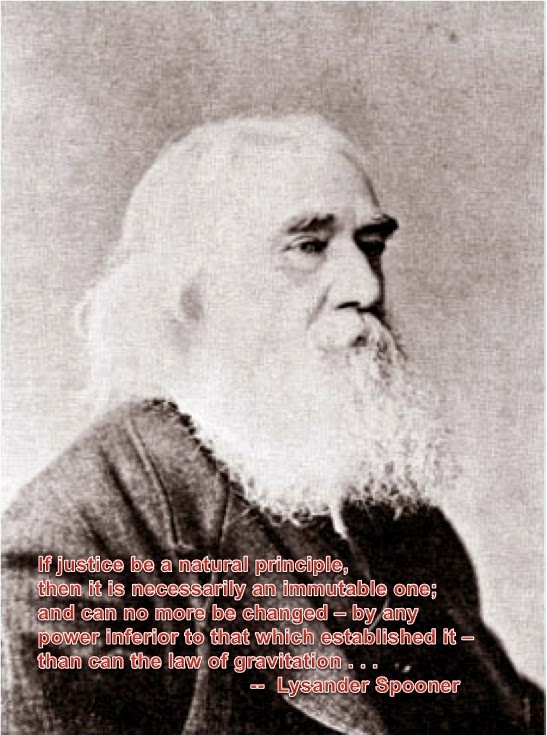
Nineteenth-century abolitionist, legal scholar and philosopher Lysander Spooner (1808 - 1887) would vehemently disagree that something becomes "a law" just because it goes through the above process and receives a president's signature and a fancy stamp. In fact, he published a treatise in 1850 entitled A Defence for Fugitive Slaves against the Acts of Congress of February 12, 1793 and September 18, 1850, in which he argued that an illegal law is no law at all, and confers no obligation on anyone to obey it, nor any authority to anyone desiring to enforce it.

He begins his treatise with the complete copy of each of the two acts in question, both of which were considered "law" in 1850, compelling men or women who knew of a "fugitive slave" to help catch that "fugitive slave" or face penalties including fines and imprisonment (the term "slave" is put in quotation marks here because Spooner argues that no person can ever own another person, and that there actually is no such thing as a legal slave or the legal condition of slavery, all so-called "laws" which make one person the property of another being illegal and criminal).

Those two so-called laws (the Fugitive Slave Act of 1793 and the Fugitive Slave Act of 1850) were both signed by the presidents of their day, George Washington in the first instance and Millard Fillmore in the second (they also bear the signatures of the respective Speakers of the House and Presidents of the Senate). But these signatures do not make them true laws, according to Spooner's arguments. Spooner demonstrates that holding anyone else as property is a crime, and that putting something on paper, stamping it with fancy seals, embellishing it with fancy legal language, and endorsing it with the signatures of people bearing impressive titles does not make it into law: it's still just a "sad little scrap of paper" in his eyes.

He even goes so far as to say that men and women have the right to resist illegal laws, in what is undoubtedly among the most important sections of his argument, found on pages 27 and 28. There, he powerfully dismantles the counter-arguments that he anticipates from those who would argue that once something is "a law," it must be obeyed until it is repealed.

If it were really true that an illegal or unconstitutional law must be obeyed until repealed, he reasons, then "there would therefore be no difference at all between a constitutional and an unconstitutional law, in respect to their binding force; and that would be equivalent to abolishing the constitution, and giving to the government unlimited power" (28).

Those who would disagree with Lysander Spooner on this point are invited to participate in a mental experiment, in which they imagine that the president has signed a law saying that if you in any way hinder the search for an escaped slave, or in any way assist a person who has been designated a "slave" and who has run away and is hiding from the authorities, then you yourself are a criminal and can be subject to enormous fines and imprisonment. Note that this is not just a hypothetical scenario: the first and the thirteenth presidents of the United States each signed such a proposition into "law."

Today, nobody reading this blog would likely argue that they would feel a moral duty to obey such a "law," or that they would have to actually support it until such time as they could eventually get it repealed through the same arduous process depicted in the Schoolhouse Rock video shown above.

Nearly every man or woman would agree with Spooner that the institution of slavery and "laws" enforcing one person's ability to "own" another are not laws but rather outrageous crimes, and would reject the notion that writing such a "law" down on a piece of paper, stamping it with a pretty seal and adding some flowery signatures suddenly turns it into something that must be willingly and voluntarily obeyed until it can be debated and eventually repealed.

Writing something on a piece of paper does not make it a law.

But, if this is true, then what does make something a law? Lysander Spooner argued that the actions of men and women cannot actually make anything a law, but that there is already an immutable or unchangeable universal law which he called "Natural Law" or the "Science of Justice." He believed that human society should only enforce natural law, and not dream up additional or "artificial" laws, and that trying to add to or subtract from the natural law is as foolish as trying to add to or subtract from other natural laws, such as the law of gravity.

He argued that men and women could voluntarily band together to help ensure compliance with this natural law among their group, but that they could not compel others to join that voluntary association. Even within such a voluntary association, he believed that people or groups could only rightly compel compliance with the natural law, which was generally extremely simple and basically entailed the command to "live honestly, hurt no one, and give everyone his or her due."

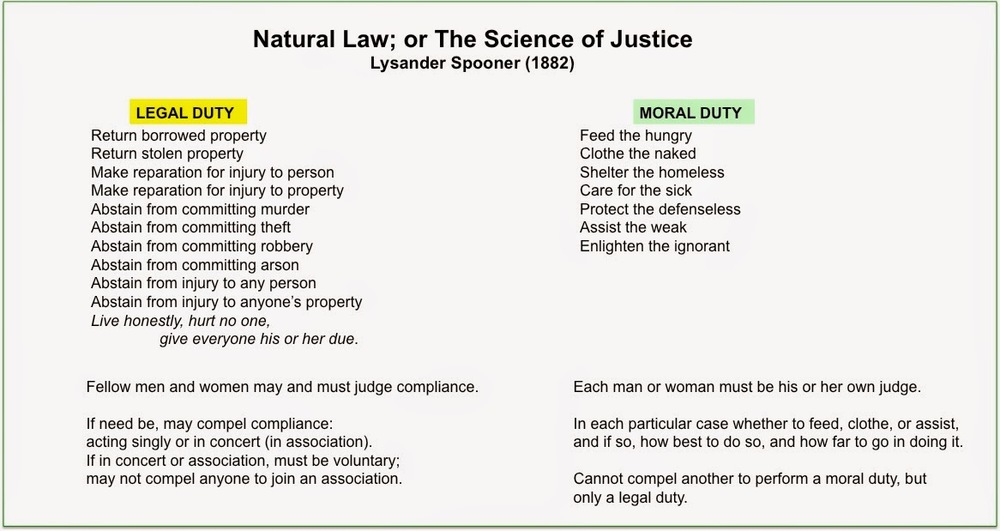
In an 1882 publication entitled Natural Law; or The Science of Justice, Spooner set out to explain the concept of natural law. In it, he made a distinction between those things that everyone has a legal duty to either do or to refrain from doing, and which others can and must compel in others, and those things which everyone has a moral duty to do but which must be left up to each person's own judgment and which no one has the right or duty to compel.

Below is a table based upon Spooner's 1882 text, generally following the order and wording of his argument:

The left column (labeled "Legal Duty" and highlighted in yellow), in Spooner's view, constitutes those things which are part of the natural law, and can actually be the only things which anyone can rightfully use force to uphold. He says that everyone has a duty to refrain from injuring others, and that force may and must be used when someone sees someone else in the act of injuring someone else. Spooner further argues in that 1882 text that nearly everyone understands these natural law prohibitions and duties before they are even old enough to know that "three and three are six, or five and five ten" (9).

The right column (labeled "Moral Duty" and highlighted in green), in Spooner's view, constitutes those things which we do have a moral duty to perform, but which no one else can compel us to do: we must judge the extent to which we are able to do those things, and how we wish to best accomplish them when we do decide to do them.

Thus, in Spooner's view, any so-called law that goes beyond the legal duties in the left column (or, worse yet, directly contradicts and violates those legal duties, as did the Fugitive Slave Acts) is actually no law at all and it can and must be disobeyed as illegal and criminal, regardless of whether it was written down on paper using legal-sounding language and passed by men and women in fancy buildings and stamped with fancy stamps and inscribed with fancy signatures.

At this point, the reader may be thinking that all of this is very nice, but what on earth does it have to do with the general subject matter covered in this blog?

The answer is: everything. 

Because, as insightful thinkers such as Mark Passio have articulated, violations of natural law are so contrary to our innate understanding of right and wrong (remember that Spooner says we know it before we even know that 3 + 3 = 6) that artificial laws which violate natural law must always be dressed up with various symbols and word-formulas designed to convey legitimacy, and reinforced by systems of mind control by which men and women who should know that those violations are immoral can somehow be made to believe that those violations of natural law are instead right and good and deserving of support.  

Institutionalized violations of natural law are nearly always accompanied by powerful forms of illusion, or the creation of "false realities" that enable those violations to appear legitimate, and to get people to go along with them. 

Therefore, seeing through these false realities is of absolutely primary importance. This blog primarily examines false realities which can be seen operating all around us, including in the realm of conventional history as taught in all the institutions of academia and reinforced by the organs of the conventional media (see for example "Piercing the fog of deception that hides the contours of history" and also the two short videos entitled "The importance of challenging false narratives").

These false realities or false narratives which cause people to accept gross violations of natural law are operating today with just as much force as they were operating in Spooner's day -- perhaps even more so.

False narratives assist in getting people to accept the premise that so-called "laws" permitting government surveillance of individual men and women at virtually any time and place are legitimate (see here and here). This is a violation of natural law in that it enables hidden enforcers and observers to treat individuals as criminals on the suspicion that they might do something to harm others, elevating some to the status of "prison guards" and demoting everyone else to the status of prisoners under constant suspicion and surveillance.

False narratives convince people to accept the idea that men and women can and should be locked up and denied their freedom for possessing certain plants or mushrooms known to induce a state of ecstasy. This is a violation of natural law in that it uses force to prohibit behavior that in no way harms the person or property of another or infringes on another's rights.

False narratives convince people to accept the idea that men and women representing the government and wearing military gear and driving military vehicles can point military weapons at people assembling in the streets to express themselves, or at people in their homes in a neighborhood where fugitives are supposedly hiding. These are clear violations of natural law in that such actions basically declare that force can be used against citizens whenever it is convenient for the government to say there is a need to do so, an idea which Spooner eloquently demolishes in pages 27 and 28 of his text against the Fugitive Slave Acts. In a passage labeled "Section IV" of his 1882 treatise on Natural Law, Spooner declares that the rights belonging to every human being by the unchangeable principle of justice "necessarily remain with him [or her] during life," and although these rights are "capable of being trampled upon" they are nevertheless "incapable of being blotted out, extinguished, annihilated, or separated from" each and every human being, and that there is no authority high enough to simply declare them null or void.

False narratives have even apparently convinced some people that it is somehow excusable to cover up evidence of the potentially harmful effects of vaccines on certain children in order to support "herd immunity."

All of the above examples, along with the many other violations of natural law currently taking place, are enabled and excused by a variety of false realities or false narratives, created and maintained in order to lend an air of legitimacy to these violations. So were many other horrendous violations of natural law which were enabled by false narratives and illusions throughout history, including the enslavement of Africans which Spooner argued against in the 1850s, to the destruction of Native American tribes in the western US after the end of the US Civil War and the seizure of their lands and their confinement to reservations or "agencies," to the seizure of the Hawaiian Islands and the Philippines in the years after that, and on and on right up to the present.

All of the above examples were enabled by lies, illusions, and false narratives or false realities.  For more on breaking through illusions and false realities, and creating new realities, see for example this previous post entitled "Jon Rappoport's talk on the trickster-god and creating reality."

It is one of Lysander Spooner's singular contributions that he perceived and forcefully argued that a criminal "law" is no law at all, and that men and women have the right and the duty to treat it as such, and to inform others of their right to do the same.

Putting something on paper doesn't make it a "law" -- even if it has been adorned with all the necessary stamps and signatures. As Spooner alludes in the writings linked above, the US Constitution as originally designed, and especially the Bill of Rights as originally conceived, were designed to safeguard natural-law rights in many ways, and to the extent that Schoolhouse Rock taught those principles to a new generation in the 1970s, it can be commended. Perhaps Spooner's arguments about an illegal law being no law at all could not really be expected to be squeezed into the "I'm Just a Bill" song.

But Lysander Spooner's arguments deserve to be brought into the modern era, in much the same way that the creators of Schoolhouse Rock tried to speak to the younger generation of the 1970s using the language and imagery of the 1970s. Spooner's arguments on behalf of the individual's rights under natural law -- rights which could never be abridged by any authority -- and his arguments against the creation of arbitrary "laws" which everyone has to obey just because a legislature or a president gave them the title of a "law" deserve examination, consideration, and thoughtful debate today more than ever.

And the false narratives supporting so-called laws which supposedly authorize some people to use violence against others, or to threaten violence against others, or to take away the freedom of others when those others have not done anything to harm anyone else's persons or property, must be shown to be the form of mind control that they are. No individuals or groups can give themselves the right to violate natural law and in doing so to infringe on anyone else's rights, simply by writing something down on a "sad little scrap of paper."

The heron of forgetfulness

The heron of forgetfulness

image: Wikimedia commons (link).

In the previous post entitled "How many ways are there to contact the hidden realm?" we saw the breadth and variety of the techniques which human beings have used around the world, across different cultures, and across the centuries to achieve a condition of ecstasy: of freeing their consciousness temporarily from the material anchor of the body and its normal senses.

While many of the techniques employed do indeed make use of substances including cannabis, tobacco, mushrooms and others, it is also notable that many of them do not. While many of the  consciousness-altering substances used in traditional shamanic cultures to induce ecstasy (including mushrooms, peyote, cannabis, and ayahuasca) have been outlawed over the years, it is similarly noteworthy that possession of "consciousness-altering drums" has also been widely and vigorously persecuted for centuries -- probably even more widely and for longer periods of time than have the consciousness-altering plants and mushrooms. 

Interestingly enough, in the Poetic Edda, where the account of the shamanic self-sacrifice of the Norse god Odin is described, the same section containing the account of Odin's vision-quest to obtain the knowledge of the runes (the Havamal) also contains a warning against intoxication (in this case, by drinking too much mead or beer). Beginning in stanza 13, we read:

13. Over beer the bird of forgetfulness broods,
And steals the minds of men;
With the heron's feathers fettered I lay
And in Gunnloth's house was drunk.
14. Drunk I was, I was dead-drunk,
When with Fjalar wise I was;
'Tis the best of drinking if back one brings
His wisdom with him home.
[. . .]
19. Shun not the mead, but drink in measure;
Speak to the point or be still;
For rudeness none shall rightly blame thee
If soon thy bed thou seekest.

The above lines can be found by scrolling down to the page marked [31] in the online version of the Elder Edda (Poetic Edda) linked above. That online version is not the easiest to navigate, but by looking for the bracketed "page-numbers" the above verses can be found.

These verses, coming as they do in the same section of the Edda in which the shamanic ordeal is mentioned, seem to establish a fairly sharp contrast between the idea of becoming intoxicated (discussed in primarily negative terms, and as a condition to be generally avoided) and traveling out of the body (the result of which, in Odin's case, is presented as positive, and the methodology of which is presented as necessary).

The image of the "bird of forgetfulness" brooding over the beer, repeated a couple of lines later as a heron which traps the intoxicated with the "fetters" of its feathers (perhaps we might call these the "fettering feathers of forgetfulness") is pretty unforgettable. It's powerful imagery, coupled with delightful alliteration (Norse poetry, as also Anglo-Saxon poetry, made much use of alliteration), and causes a pang or two of regret among those of us who have met that heron a few too many times.

Notably, however, there is within the warning lines (which generally present drunkenness in an entirely negative light) a reference to the mead of Gunnlod, when the speaker switches to first-person in stanza 14, indicating that it is now Odin who is speaking, and that the quest to obtain the mead of poetry (which has many aspects of a shamanic journey, especially the transformation into an eagle but also the descent into a hole in the mountain and the retrieval of hidden knowledge that could not be obtained in any other way) did involve intoxication as part of the process.

This tension between the consciousness-lifting process of crossing over to the other realm, and the generally consciousness-deadening condition of becoming "drunk, dead drunk" and imprisoned by the feathers of the bird of forgetfulness (forgetfulness being pretty much the polar opposite of the usual purpose of the shamanic journey, which is to obtain knowledge rather than forget it) is found in other cultures as well -- to the point that it is worth exploring further.

In Mircea Eliade's encyclopedic 1951 study of shamanic culture and practice (Shamanism: Archaic techniqes of ecstasy, also mentioned in the post cataloguing shamanic technique), some representatives of shamanic cultures seem to indicate that the need to use of mind-altering substances to induce ecstasy is seen in a somewhat negative light, at least in some cases and in some cultures. Eliade points to the existence of opinions and attitudes that: "Narcotics are only a vulgar substitute for 'pure' trance [. . .] the use of intoxicants (alcohol, tobacco, etc.) is a recent innovation and points to a decadence in shamanic technique. Narcotic intoxication is called on to provide an imitation of a state that the shaman is no longer capable of attaining otherwise" (401).

This attitude (part of a pattern Eliade finds stretching across numerous shamanic cultures of a belief in the "decadence of shamans," in other words, a belief or tradition in the shamanic cultures themselves that shamanic technique and capability had decreased over time) is extremely interesting: there appears to be some recognition that, while the use of intoxicating substances may be a path to the shamanic state of ecstasy, their use can also be a crutch -- and even worse, can lead to an imitation of shamanic ecstasy and not the real thing.

This tradition, from some of the shamanic cultures that Eliade and his other sources examined, would seem to be an important warning to those of us coming from "Western cultures" where knowledge of the shamanic was largely hunted down and violently suppressed for centuries. The danger posed by those offering "imitation" shamanic journeys, based more in intoxication than in the travel to the actual realm of the spirits, is one that we may want to keep in mind. 

It is also notable that the great Sioux leader Crazy Horse, whose own personal vision was recounted in this previous post, was known for his refusal to drink alcohol (as Stephen F. Ambrose points out on page 220 of his 1975 book about Crazy Horse, which is linked in that previous post).

And it is perhaps also worthy of noting that in the Ghost Dance movement, which used dancing and drumming late into the night on multiple nights in a row in order to enable participants to achieve a state of ecstasy, alcohol was similarly discouraged. It might even be worth pointing out that in Rastafari practice, while ganja is revered, alcohol was also traditionally frowned upon.

All of this is not to suggest that one method of achieving contact with the hidden realm is "good" while others are "bad," or to "privilege" one method over another -- far from it. In fact, the whole point of examining the incredibly multifarious array of methodologies utilized around the world and across the centuries was really to point out that men and women appear to be inherently designed to be able to make contact with the other realm by methods that will be available no matter what type of climate or environment or culture they happen to find themselves in. 

However, the fairly widespread evidence of a clear tension between paths that lead to "intoxication" or "forgetfulness," and paths that lead to what Eliade called "pure" trance (putting "pure" in quotation marks himself) suggests that we should carefully ponder the warning that these voices from traditional shamanic cultures are giving us, to be careful of shortcuts, "imitation ecstasy," and the feathers of that dreaded heron of forgetfulness.

image: Wikimedia commons (link).

The vision of Crazy Horse

The vision of Crazy Horse

image: Wikimedia commons ( link). Link to GFDL full text here. In light of the previous post discussing the tremendous variety of methods by which contact with the spirit world can be achieved, the vision quest of the famous Oglala warrior and leader Crazy Horse is noteworthy on several levels.

In one of his earliest and in my opinion most valuable and thought-provoking historical books, author Stephen E. Ambrose consulted primary-source accounts from Crazy Horse's fellow Sioux warriors who described what Crazy Horse told them about the vision quest in which Crazy Horse received his name and a powerful direction which would sustain and guide him for life.

Below are selected passages from Ambrose's Crazy Horse and Custer: The Parallel Lives of Two American Warriors, first published in 1975. Ambrose refers to Crazy Horse by the name "Curly" until Crazy Horse receives his vision and his adult name, explaining:

As he would not receive his real name until he had accomplished a notable deed or had a memorable dream, the Indians called him by various nicknames, all connected to his distinguishing physical characteristics. Sometimes he was "Curly Hair," sometimes the "Light-Haired Boy"; as he grew older he usually was called "Curly." 38.

In late August or early September of 1854, when young Curly was about thirteen years old (Ambrose puts the general time of the birth of the child who would later be called Crazy Horse as the fall of 1841, explaining his reasoning in endnote 2 to chapter 3 on page 487 of the edition linked above, but notes that a case can be made for a later year of birth between 1842 and 1845, or an earlier year of birth as early as 1838).

Here is the description Ambrose gives, based upon those to whom Crazy Horse later told his dream:

From the vision the Sioux drew their inspiration. Their dreams might lead them to become medicine men, or warriors, or horse catchers, but whatever the vision proscribed for the dreamer, it was wakan and never to be disregarded. [. . .]
[. . .]
The Sioux were not secretive about their dreams; indeed, they were anxious to tell them to others. Thus we know what Curly dreamed out on the prairie of the lake country in the Nebraska Sand Hills, for he later described it on a number of occasions to Indians and at least once to a white man. He also made a drawing of his vision in sand rocks after the Little Bighorn battle, twenty-two years later.
After two days of fasting and keeping himself awake by placing sharp stones under his body when he had to lie down, Curly began to fear that he had made a terrible mistake. No dream came, perhaps because he had not made the proper preparations, perhaps because he was not worthy. He had given up and started down the hill to his pony, which he had hobbled beside a lake, when the dream came (most likely, he had fainted). 
A man on horseback rode out of the lake. The horse kept changing colors, and it floated above the ground, so light was it, the man too, who sat well forward on the horse. He wore plain leggings and a simple shirt. His face was unpainted and he had only a single feather in his long brown hair. He had a small brown stone tied behind his ear. He did not seem to speak, but Curly heard him clearly nonetheless.
The man told Curly never to wear a war bonnet, nor to tie up his horse's tail (it was the Sioux custom to  tie up their ponies' tails in a knot), because the horse needed his tail when he jumped a stream and in summer time to brush flies. He said that before going into battle Curly should pass some dust over his horse in lines and streaks, but should not paint the pony. And he should rub some of the dirt over his own hair and body. Then he would never be killed by a bullet or by an enemy. But he should never take anything for himself.
All the while the man and horse were floating, brushing aside constant attacks from a shadowy enemy. But he rode straight through them, straight through the flying arrows and lead balls, which always disappeared before striking their target. Several times the man and horse were held back, it seemed by his own people coming up from behind and catching his arms, but he shook them off and rode on. A storm came up and on the man's cheek a little zigzag of lightning appeared and a few hail spots on his body. Then the storm passed, and the man's people closed in around him, grabbing and pulling, while overhead a hawk screamed. Then the dream faded and curly was awake. 67-69.

More than a year later, after Curly had achieved distinction both on hunting parties and raiding parties, his father, who was an interpreter of dreams, interpreted this vision for his son: "He said Curly must be the man in the dream, must do as he said, dress as he dressed, wear a single hawk feather in his hair, a small stone behind his ear. He must lead the people and never take anything for himself" (77).

This vision is remarkable and its implications are profound. Crazy Horse followed his vision, and by all accounts he was able to pass unscathed through the thickest volleys of arrows or bullets. Even more powerful is the possible interpretation of the gathering storm, and the implications of the man being grabbed and pulled. It is also noteworthy to remember that Sitting Bull, one of the other very important leaders at Little Bighorn along with Crazy Horse, also had a powerful and prophetic vision prior to the battle, which was widely told among the warriors  gathered along the Little Bighorn, and which played a prominent role in the events of that fateful conflict.

The account is also remarkable in that it shows that a vision was certainly not always obtained every time one was sought. The technique used to induce ecstasy in this case appears to have involved deprivation of sleep and food for multiple days until a vision came -- if one came. It was not induced by drugs, and it was by no means certain that a vision would come at all. In fact, Crazy Horse was basically ready to discontinue his vision quest before the dream finally came to him.

There is much more which could be said or learned from this powerful episode in the life of this remarkable leader, but it may perhaps be best for each to consider it and learn from it on their own. 

The only other point that I would offer is that the power and positive effect of such a vision for the life of the one who is granted it is undeniable -- and these benefits, I would argue, are not restricted to any single culture or people or century in time. Previous posts, such as this one, have presented evidence that argue that contact with "non-ordinary reality" is available to all human beings, and that the knowledge of the existence of the spirit world and of techniques to access that realm when necessary are in fact the common heritage of all humanity.

For other posts about the exemplary life and spirit of Crazy Horse, see here, here, and here.

image: Wikimedia commons (link).

How many ways are there to contact the hidden realm?

How many ways are there to contact the hidden realm?

image: Wikimedia commons (link).

Three recent posts have advanced the argument that the world's ancient scriptures and traditions share a common, unifying, and shamanic worldview: 

and

Together, they provide evidence that cultures around the world and across the millennia, from ancient Egypt to the steppes of Mongolia, and from the far northern boundaries of Scandinavia to the southern continent of Australia, at one time shared a worldview characterized by the understanding that our familiar, material, "ordinary" reality exists in conjunction with and is interpenetrated by another reality: the seed realm, the hidden realm, the realm of the spirits, the realm of the gods. 

This shared shamanic worldview was characterized not only by an awareness of this other realm, but by the understanding that it was possible in this life to deliberately undertake journeys to the spirit world in order to obtain knowledge or effect change that could not be accomplished in ordinary reality. 

There is also abundant evidence that this worldview has been deliberately stamped out over the centuries and that practice of shamanic techniques of ecstasy (or transcending the boundaries of the static, physical, ordinary reality) has been discouraged, stigmatized, and even prohibited by law in some places right up to the present day or very recent decades, and that the tools used to cross the boundary to the other realm -- the shamanic drum in particular -- have been outlawed, seized, and deliberately destroyed. 

The extent of this persecution of the shamanic worldview across both geographic space and historical time leads to the possibility that those responsible for the campaign are not persecuting this worldview because they believe that it is false, but rather because they know that it is true, and that there actually is knowledge which can only be obtained and change which can only be effected through shamanic techniques.

Mircea Eliade's Shamanism: Archaic techniques of ecstasy, first published in 1951, was the first text to attempt to attempt to map the outlines of the entire broad landscape of the phenomenon of shamanism, and to attempt simultaneously to situate the shamanic worldview within the history of human religion. As such, it contains many first-hand accounts describing shamanic technique from parts of the world where the old traditions were still relatively undisturbed.

Let's examine the various methods recorded in Eliade's work by which men and women from traditional shamanic cultures were able to journey to the world of the spirits and to return.

Eliade himself does not actually provide a single succinct list in his book, although he describes and comments upon a wide variety of methods from many different shamanic cultures. Here is a non-exhaustive list of some of the techniques he covers from page 220 of The Undying Stars, showing the wide range of methods employed by different people in different places and times -- below we will examine a few of them using quotations from Eliade's work:

In Shamanism: Archaic techniques of ecstasy, Mircea Eliade catalogues many of the rituals and practices used by shamans around the world to enter altered states of consciousness, including ecstatic dance, whirling, rhythmic drumming, chanting, songs, music involving various instruments and especially flutes, fasting, the use of entheogenic substances derived from plants, the use of difficult exercises or postures similar to or including Yoga, the undertaking of deliberate spirit quests, the use of constricted and enclosed spaces,  the use of very crowded spaces, the imposition of long periods of solitude, rubbing the body with rock crystals, rubbing together two stones for days or weeks on end, elaborate initiatory processes involving experienced guides, and many others, as well as many variations and combinations of the techniques listed here.

The same passage also notes that Eliade records evidence that some shamans gained the ability to cross into the spirit world as a result of accidentally being hit by lightning, bitten by a poisonous snake, or experiencing a traumatic accident or illness. As part of an examination of the possibility that the life-changing experience of those who participated in ancient mysteria such as those at Eleusis and the life-changing experience of those who have reported out-of-body experiences in modern settings are also related to shamanic travel (in other words, the possibility that they are all going to the same hidden plane of existence, the same unseen realm), I conclude:

The point to be made is that the techniques of inducing ecstasy in the human consciousness are profuse and multifarious -- suggesting that the human consciousness is perhaps designed to be naturally capable of achieving this state -- and that therefore the techniques that were used by the mystery cults may have included almost any combination of those listed, as well as many others.  220.

Below is a partial list of techniques of ecstasy, chronicled by Eliade, with quotations from his landmark study of the subject:

  • Use of drums and rhythmic drumming: "The drum has a role of the first importance in shamanic ceremonies. Its symbolism is complex, its magical functions many and various. It is indispensible in conducting the shamanic seance, whether it carries the shaman to the "Center of the World," or enables him to fly through the air, or summons and 'imprisons' the spirits, or, finally, if the drumming enables the shaman to concentrate and regain contact with the spiritual world through which he is preparing to travel" (168). The importance of the drum is indisputable, and it is used to accomplish the shamanic journey in cultures around the world. 
  • Use of other musical instruments, including rattles: "In North America, as in most other regions, the shaman uses a drum or a rattle. Where the ceremonial drum is missing, it is replaced by the gong or the shell (especially in Ceylon, South Asia, China, etc.). But there is always some instrument that, in one way or another, is able to establish contact with the 'world of the spirits.' This last expression must be taken in its broadest sense, embracing not only gods, spirits, and demons, but also the souls of ancestors, the dead, and mythical animals" (179).
  • Use of chanting: "He sways, chanting, his eyes half closed. First it is a humming in a plaintive tone, as if the shaman wanted to sing despite some inward pain. The chanting becomes louder, takes the form of a real melody, but still hummed. [. . .] The song is repeated ten, twenty, thirty times in succession, uninterruptedly, the last note being immediately followed by the first of the beginning, with no musical rest. [. . .] The shaman sings only a few measures by himself. At first he is alone, then there are a few voices, then everyone. Then he stops singing, leaving the task of attracting the damagomi to the audience. [. . .] As for the shaman, he meditates deeply. He closes his eyes, listens. Soon he feels his damagomi arriving, approaching, fluttering through the night air, in the bush, underground, everywhere, even in his own abdomen . . ." (305-306).
  • Use of dancing: "From the earliest times, the classic method of achieving trance was dancing. As everywhere else, ecstasy made possible both the shaman's 'magical flight' and the descent of a 'spirit'"(451). "The Kirgiz baqça does not use the drum to prepare the trance, but the kobuz, which is a stringed instrument. And the trance, as among Siberian shamans, is induced by dancing to the magical melody of the kobuz. The dance, as we shall see more fully later, reproduces the shaman's ecstatic journey to the sky" (175).
  • Use of masks or related face-coverings: "In some places the mask is believed to aid concentration. We have seen that the kerchief covering the shaman's eyes or even his whole face plays a similar role in certain instances. Sometimes, too, even if there is no mention of a mask properly speaking, an object of such nature is present -- for example, the furs and kerchiefs that, among the Goldi and the Soyot, almost cover the shaman's head" (167).
  • Use of the tobacco plant: "The apprentice shaman of the Conibo of the Ucayali receives his medical knowledge from a spirit. To enter into relations with the spirit the shaman drinks a decoction of tobacco and smokes as much as possible in a hermetically closed hut" (83). "Throughout the instruction period fasting is almost absolute; the apprentices constantly smoke cigarettes, chew tobacco leaves, and drink tobacco juice. After the exhausting night dances, with fasting and intoxication superadded, the apprentices are ready for their ecstatic journey" (129).
  • Use of the cannabis plant: "The kapnobatai would seem to be Getic dancers and sorcerers who used hemp smoke for their ecstatic trances" (390). "Herodotus has left us a good description of the funerary customs of the Scythians. The funeral was followed by purifications. Hemp was thrown on heated stones and all inhaled the smoke; 'the Scythians howl in joy for the vapour-bath'" (394). "One fact, at least, is certain: shamanism and ecstatic intoxication produced by hemp smoke were known to the Scythians. As we shall see, the use of hemp for ecstatic purposes is also attested among the Iranians, and it is the Iranian word for hep that is employed to designate mystical intoxication in Central and North Asia" (395).
  • Use of mushrooms: "After fasting all day, at nightfall he takes a bath, eats three or seven mushrooms, and goes to sleep. Some hours later he suddenly wakes and, trembling all over, communicates what the spirits, through their 'messenger,' have revealed to him: the spirit to which sacrifice must be made, the man who made the hunt fail, and so on. The shaman then relapses into deep sleep and on the following day the specified sacrifices are offered" (221). "In a number of Ugrian languages the Iranian word for hemp, bangha, has come to designate both the pre-eminently shamanic mushroom Agaricus muscarius (which is used as a means of intoxication before or during the seance) and intoxication; compare, for example, the Vogul pânkh, "mushroom" (Agaricus muscarius), Mordvinian panga, pango, and Cheremis pongo, "mushroom." In northern Vogul, pânkh also means "intoxication, drunkenness." The hymns to the divinities refer to ecstasy induced by intoxication by mushrooms" (401). Note that this linguistic analysis provides yet further support for the arguments put forth in previous posts about the N-K sound, in "The name of the Ankh" and "The name of the Ankh, continued: Kundalini around the world."
  • Use of ascetic disciplines: "The power of flight can, as we have seen, be obtained in many ways (shamanic trance, mystical ecstasy, magical techniques), but also by a severe psychological discipline, such as the Yoga of Patañjali, by vigorous ascetism, as in Buddhism, or by alchemical practices" (411).  "Finally, we will briefly point out some other shamanic elements in Yoga and Indo-Tibetan tantrism. 'Mystical heat,' which is already documented in Vedic texts, holds a considerable place in Yogic-tantric techniques. This 'heat' is induced by holding the breath and especially by the 'transmutation' of sexual energy, a Yogic-tantric practice which, though quite obscure, is based on pranayama and various 'visualizations.' Some Indo-Tibetan initiatory ordeals consist precisely in testing a candidate's degree of preparation by his ability, during a winter night snowstorm, to dry a large number of soaked sheets directly on his naked body" (437).

Even this dizzying list of widely varying techniques is by no means exhaustive: Eliade discusses and documents many others in his study. Further, those catalogued by Eliade are themselves by no means exhaustive: it seems that the methods for inducing ecstasy or trance are as widely varied as the human experience itself.

What can we conclude from the above examination of the techniques of shamanic travel found around the world? 

I believe we can conclude for certain that there is no single "right" way to initiate contact with the unseen realm. While some shamanic cultures utilize psychotropic or narcotic plants, these are by no means the only methodology used. While drumming appears to be one of the most widespread techniques of initiating shamanic journeys, Eliade notes that even drumming is not universally practiced even in some deeply shamanic cultures. It appears that there are an almost infinite variety of methods which can be used to make contact with the spirit world -- almost as if someone wanted to make sure that men and women would always have some method available to them, no matter where on the planet they might find themselves!  

The vastness of the range of techniques by which men and women in shamanic cultures have accessed the hidden realm also suggests the probability that human beings, by their very makeup, are inherently "wired for ecstasy." We can access the world beyond the five physical senses by so many pathways that it is no exaggeration to suggest that we seem to possess a sort of "innate shamanic sense" or "sensitivity."

This possibility is attested to by modern shamanic practitioners and teachers, who have guided hundreds of modern people from all backgrounds in their first experiences of contact with non-ordinary reality. In Shamanic Journeying: A Beginner's Guide, Sandra Ingerman states: 

I have never met a person who could not journey. However, I have met many people who tried journeying many times before they felt that something was happening. I suggest that you keep up the practice -- relax, keep breathing into your heart, open all of your senses beyond just your visual awareness, set an intention, and in time, you will be journeying. 42.

She explains those concepts in her books -- you can find the books and other information at Sandra's website here.

In The Shamanic Drum: A Guide to Sacred Drumming, Michael Drake (discussing the work of Mircea Eliade, and coupling it with his own experience of guiding and teaching shamanic drum and journeying for many years) declares: 

All people, therefore, are capable of flights of rapture. Ecstasy is a frequency within each of us. Like tuning a radio to the desired frequency, the drum attunes one to ecstasy. 14.

Michael Drake's website can be found here. On one of the pages of his site (this one), he reiterates his belief that virtually every man or woman is capable of such travel: "Researchers have found that if a drum beat frequency of around four-beats-per-second is sustained for at least fifteen minutes, most people can journey successfully, even on their first attempt."

The evidence from history -- and from the personal experience of longtime practitioners and teachers of shamanic journeying -- appears to be overwhelming: we are designed to be able to access the hidden realm of non-ordinary reality. This fact seems to fit well (fit perfectly) with the possibility that, as previous posts have explored, the testimony of the ancient wisdom inherited by virtually every culture on our planet, appears to declare a complementary message: that the ability to access the hidden realm is absolutely essential to human existence.

Welcome to new visitors from The Higherside Chats!

Welcome to new visitors from The Higherside Chats!

Welcome to new visitors (and returning friends) from THC! 

I recently had the opportunity to appear as a guest on Greg Carlwood's The Higherside Chats, and it was a real pleasure to hang out with Greg and be on a show that I've come to really enjoy since first learning about it at the Secret Space Program in San Mateo this past June.

I really appreciate Greg's style and the knowledge and preparation he brings to each interview. Greg's funny, he's positive, and he seems like someone who'd be fun to hang around with or go surfing with in San Diego. Plus he's created a great platform for allowing different viewpoints to be aired out and different perspectives offered on important subjects that affect everyone in this critical point in human history. And he's a professional, and one who has shown himself to be a perceptive judge of what's being offered in a genuine manner and what might be "less than completely genuine."

For those coming to this blog for the first time as a result of listening to the interview (or who maybe heard of my work for the first time as a result of THC), welcome!  Below are some links that may be helpful, or links that may elaborate on one or two of the subjects that we covered in the interview:

I also really appreciate the fact that Greg created a show called The Higherside Chats, because he is deliberately creating a counter to the "Fireside Chats" of history, which marked the first time that a US president used the "new technology" of radio to "create reality" and craft a narrative to serve as a lens through which the world would view events in the way that the government wanted the people to view those events.  

Although those original "Fireside Chats" are no more, the governments of the world certainly continue to use various forms of the media and the platforms offered by today's "new technology" to try to "create reality" and shape the narrative:

The Higherside Chats is an example of the people using that same "new technology" to question the narratives that are being offered, to examine other possible explanations for what they see going on in the world around them, and in fact to "challenge the reality" that is being created and even to create a new reality for the future!

It's interesting that even before I met Greg in late June or knew about the existence of The Higherside Chats, I created two short videos about "narratives," and used the old "Fireside Chats" as an example of the way narratives are created, handed out, and turned into "reality" by the engines of "reality creation" (you can view those two short videos here, embedded and linked in a blog post called "The importance of challenging false narratives").

Hope everyone enjoys the interview! Feel free to get in touch with me via Twitter or Facebook, and hope you'll come back to visit this blog soon.

above: trying to let my brain unwind after the interview.