image: Wikimedia commons (link).
On this day in history, Otis Redding and six others left this life in a tragic airplane crash, the cause of which remains unexplained.
Rest in peace. Respect.
image: Wikimedia commons (link).
On this day in history, Otis Redding and six others left this life in a tragic airplane crash, the cause of which remains unexplained.
Rest in peace. Respect.

That special time of year has finally arrived when many of us erect the Christmas tree in our homes.
There is something magical about the arrival of the tree each year, with its wonderful evergreen smell and the nostalgic connection to memories of Christmases past stretching back to when we were children.
Much has been made of the "pagan" origins of the Christmas tree (and many of the traditions surrounding the celebration of Christmas itself, including its specific date three days after winter solstice), and much ink spilled on both sides of this often-contentious issue, and yet the actual meaning of this ancient symbol is rarely if ever explained beyond the rather obvious connection between the use of an "evergreen" tree and the concept of "eternal life" or the eternity of the human soul.
That Christmas falls on one of the four most important solar stations on the great circle of the year, the lowest-point of the sun which is reached at the December solstice (for observers in the northern hemisphere) is simply undeniable. In fact, its celebration coincides to the very stroke of midnight at the beginning of the third day after the day on which winter solstice most commonly falls -- the stroke of midnight between the 24th and the 25th of December, three days after December 21st (the traditional date of winter solstice -- the day will occasionally wander to the 22nd due to the fact that the number of complete earth rotation or days does not fit perfectly into the space required to get back to the exact point of winter solstice each year, necessitating a leap year to bring the calendar dates back in line with the annual stations on the great wheel).
The three-day pause probably originates from the fact that the sun seems to linger at the lowest point before turning around, just as it does at its opposite highest point at the summer solstice each June. This phenomenon, and the reason that the sun does not linger at the equinoxes, is discussed in this previous post about the mechanics of the solstices and equinoxes.
Previous posts have explored at some length the evidence which supports the assertion that the great wheel of the year can be "quartered" by drawing two lines between these four very important stations of the year: a horizontal line between the two equinoxes (March and September) and a vertical line between the two solstices (December and June). A diagram illustrating this idea is shown below, and previous posts which discuss ancient myths which seem to support this "cross within the circle of the year" can be found here, here and here (among many others).

Note that this appears to have been a worldwide concept: the examples from those three posts span the sacred teachings of ancient Egypt, of the ancient Hebrew Scriptures in the Bible, of the ancient Greek Scriptures in the Bible, of the Vedas of ancient India, and of the Lakota of North America. I would argue that the traditions of many other cultures could be examined and found to contain a similar pattern.
The horizontal line between the equinoxes equates to the "casting down" of the spirit into the world of "the underworld," this world of incarnation. It is allegorically symbolized by the heavenly bodies which we see in the sky -- the sun, moon, planets and stars -- plunging down into contact with the horizon of earth or of water, as if these bodies which are native to the crystal spheres above have been thrown down into the mud of our earthly disc, there to plow through the underworld until they break free once again to rise into the sky on the other side.
This "casting down" took place at the equinoxes on the "Cross" of the circular year, because the equinoxes are the places where the ecliptic path of the sun "crosses" either above or below the celestial equator, creating the point of transition when days become shorter than nights (night prevails and the sun is figuratively in the "underworld" as we toil our way through winter) and the other point of transition when days again become longer than nights (and day prevails again, with the sun being figuratively released to dominate the sky once more, free from the clutches of the wintery months when night rules supreme).
In ancient Egypt, the god of the underworld was Osiris, and he was depicted as laid out horizontally like a corpse in many scenes, slain by his brother Set and bound in a sarcophagus, cast into the waters -- all of which are emblematic of our plunge into incarnate matter in these human bodies.

image: Wikimedia commons (link).
The Djed column itself (discussed in this previous post) was associated with the "backbone of Osiris," and it was figuratively "cast down" horizontally when Osiris was "laid out" in a sarcophagus like a corpse in the underworld (by the action of the sun's "crossing down" at the fall equinox). But Osiris was not destined to remain horizontal forever -- as the image above plainly intimates. He is destined to rise-up vertically, just as the shoots of grain shown rising from his body in the image above are doing. The raising of the mummified Osiris from the horizontal position to the vertical position was associated with the act of "raising the Djed column" from its "cast-down" horizontal position to its vertical orientation.
I believe that the raising of the Djed column is figured by the vertical line between the two solstices, shown in the zodiac-wheel diagram above. The raising of the Djed, the raising of the "corpse of Osiris," could be seen to take place when the sun stopped its descending path and turned back upwards: at that point of the very "bottom of the year."
This is why we erect the Christmas tree in anticipation of the turn that takes place at the absolute low-point of the year -- when the sun finally stops its descending path, arriving at winter solstice at December 21, and then it pauses there at its lowest point as if building up our anticipation for three days before starting back upwards towards the top of the year. If the point of fall equinox was figured as the "crossing point" of begin "cast down to the underworld," the turn that takes place at the bottom of the year is appropriate to be celebrated with the raising of a vertical pole, because that is the point where the Djed column begins to be raised back up, as the sun makes its turn from the dreadful downward plunge that it has been taking on its way to the December solstice.
If this interpretation is correct, the raising of the Christmas tree is symbolic of the vertical pillar that can be imagined running from the winter solstice at the bottom of the year and going up through the summer solstice at the very top of the year:

Indeed, there are many legends in which the corpse of Osiris is in fact imprisoned within the body of a tree, lending even more credence to this interpretation of the Christmas tree as commemorative of the raising of the Djed column at the winter solstice. In his discussion of the myth-cycle of Isis and Osiris, Plutarch says that the slain Osiris was imprisoned in a chest which floated out to sea and ended up making its way to Byblus (or Byblos). There, he writes (beginning in paragraph 15):
the waves had gently set it down in the midst of a clump of heather. The heather in a short time ran up into a very beautiful and massive stock [a "stock" as used here is a stump or a trunk of a tree], and enfolded and embraced the chest with its growth and concealed it within its trunk. The king of the country admired the great size of the plant, and cut off the portion that enfolded the chest (which was now hidden from sight), and used it as a pillar to support the roof of his house.
Thus, we see that the corpse of Osiris was in this legend "cast down" into a horizontal position within a chest, but then turned into a tree and was brought into a house (just as the Christmas tree is brought into our homes). His corpse (imprisoned within the tree) is eventually recovered by Isis and restored to life.
Elsewhere, we have explored the evidence suggesting that Isis taking the corpse of Osiris down from its prison inside the pillar in the palace of the king of Byblos is analogous to the pieta scenes in which Mary the mother of Jesus receives his crucified body back from the Cross, before it is raised up again at the resurrection.

image: Wikimedia commons (link).
If this interpretation of the "cross" of the year is correct, with the horizontal line between the equinoxes analogized in ancient myth as the "casting down of the Djed" and the laying out of the corpse of Osiris in his sarcophagus or on his bier, and the vertical line between the solstices analogized in ancient myth as the "raising up of the Djed," then the "raising up of a Djed" in our homes (in the form of a Christmas tree) would almost certainly be predicted to take place in anticipation of the "turn" of the year which takes place at the December solstice. And this is exactly when we do in fact erect the Christmas tree in our homes: in the days or weeks leading up to the point of winter solstice.
The fact that Osiris was explicitly described as being imprisoned in a tree, and brought into the palace when he was in the form of a tree, lends even greater strength to the argument that our tradition of bringing in the Christmas tree into our homes hearkens back to the symbology of the "vertical Djed column" associated with the vertical line that gets erected each year beginning at the low-point of winter solstice. Below is an image from ancient Egypt of the goddesses Isis and Nephthys raising Osiris to a vertical position between them -- this time, he is in his manifestation as Osiris-Re or Osiris depicted with the head of Amon-Ra:

image: Wikimedia commons (link).
The upsweep of the wide-spreading horns at the top of this "Djed-shaped" god (with the solar disc between them) are strongly reminiscent of the outstretched arms of the Scarab, which we have previously argued is connected to the outstretched arms of the zodiac sign of Cancer the Crab, who is located at the summer solstice point, at the top of the "vertical line" in the zodiac wheel that we are trying to establish as the "vertical Djed column."
Again, all of this evidence should strengthen the case that the tree we are erecting as we approach the bottom of the year is a representation of the divine spiritual component in the Cross of the year, the vertical line running from the winter solstice all the way up the summer solstice, the line that represents the lifting up of the "dead god" from his prison in the sarcophagus to the upward line which points up to the very summit of the year at the summer solstice, highest heaven.
Figuratively, this raising of the Djed column may well be indicative of our mission in this incarnation: to see beyond the merely physical or horizontal (difficult to do, trapped as we are in these bodies in the same manner that Osiris is bound in his mummy-wrappings), and to call forth the invisible, the spiritual, the vertical. For more on this thought, see the previous post entitled "Blessing."
Interesting additional confirmation of this identification of the Christmas tree with the vertical pillar of the Djed comes from the other Christmas tradition involving a tree-trunk, less commonly celebrated today but once taken very seriously: the tradition of the Yule log. Various accounts of the Yule log indicate that it was a huge trunk, the biggest that could be found, sometimes chosen from a type of tree seen as sacred, and hauled into the house to be burned in the fireplace, but only after it had been anointed with oil and salt and spices and prayed over first. It was often so large that only its "head" could fit into the fireplace, and the rest of the mighty log stretched out into the great room or family room.

image: Wikimedia commons (link).
Based on these descriptions of the tradition, it is difficult not to conclude that the Yule log represents not the Djed column "raised up" as with the Christmas tree, but the Djed column "cast down," since it was basically dragged around horizontally and then burned.
The fact of its being burned provides added confirmation that the Yule log is the "horizontal component" that represents the line between the equinoxes (as opposed to the vertical pillar connecting the solstices). The equinoxes, where the sun's ecliptic path crosses the celestial equator, were strongly associated with fire: in fact, as is discussed in this previous post, ancient Mithraic sculpture and bas-reliefs often depicted the two equinoxes as two youths, each holding a torch (one up for the equinox in which the sun is crossing up towards summer, and one down for the equinox in which the sun is crossing down towards winter).
The tradition of having the Yule log lit each year by the daughters in the household or by the
mother only strengthens this connection, since the "casting down" point of the year takes place a the autumnal equinox presided over by the sign of Virgo the Virgin. This fact also helps to explain the numerous depictions of the vertical Djed column in between the two goddesses, such as in the image of Osiris-Re shown above or in the image of the Djed column in the form of an Ankh (surmounted by the upraised arms) in between the same two goddesses.

image: Wikimedia commons (link).
The Djed column is the stylized "backbone"-shaped column supporting the Ankh-cross itself (you can see the "vertebrae" at the top of the Djed).
Based on this evidence, it appears that the symbology of the Christmas tree (and the now nearly-forgotten symbology of the Yule log) has extremely ancient roots. One could say that all of this evidence supports the argument that the familiar Christmas symbols are really "pagan" and not "Christian," but I believe this misses the real point, which is that the distinction between "pagan" and "Christian" is actually based upon an enormous misunderstanding, because all these sacred traditions the world over can be shown to be using the same system of celestial metaphor -- and that includes all the stories of the Old and New Testaments of the Bible. The symbols may change their outward appearance somewhat, but their core form remains recognizable, and their message (I believe) is fundamentally the same.
In writing about the symbology of the Christmas tree in his 1940 masterpiece Lost Light, Alvin Boyd Kuhn wrote that the fire atop the Yule log, or the glowing candles upon the Christmas tree, symbolizes the divine spark in each man and woman, hidden in the rough element of our physical form (317). Elsewhere in the same text he writes:
The savior is not nailed on the tree; he is the tree. He unites in himself the horizontal human-animal and the upright divine. And the tree becomes alive; from dead state it flowers out in full leaf. The leaf is the sign of the life in a tree. 416.
Thus both of these ancient symbols work together at this time of year to convey to us a profound message about who we are. We are both the Yule log "cast down" and the Christmas tree "raised up," the horizontal "human-animal" and the upright "divine."
This aspect of the symbology is usually absent from the annual discussions of the "pagan" origins of the Christmas tree and other symbols. Yet I believe the evidence is abundantly present to support such an understanding -- and I believe that it is an interpretation that makes these ancient symbols incredibly powerful to us even to this very day, even as they connect us back across thousands of years to the same sacred traditions from ancient cultures all around our planet.

image: Wikimedia commons (link).
While we're on the subject of the vital importance of critical analysis as an antidote to mind control, it is difficult to pass up the opportunity to cite a rather famous quotation from Thomas Jefferson (1743 - 1826) in which it can be argued that he stresses this very point.
In letter dated March 13, 1789 addressed to Mr. Francis Hopkinson, Jefferson responds to earlier correspondence from Hopkinson who apparently noted that Jefferson had been "dished up [. . .] as an anti-federalist" and wrote to ask Jefferson if such a characterization "be just" (as in, "is such a label justified?"). Thomas Jefferson responds:
My opinion was never worthy enough of notice to merit citing; but since you ask it I will tell it you. I am not a Federalist, because I never submitted the whole system of my opinions to the creed of any party of men whatever in religion, in philosophy, in politics, or in anything else where I was capable of thinking for myself. Such an addiction is the last degradation of a free and moral agent. If I could not go to heaven but with a party, I would not go there at all.
He then goes on to discuss the relative merits or demerits of the federalist and anti-federalist camps, which is interesting but not part of the scope of this discussion, which will focus on the sentiment expressed in the declaration: "I never submitted the whole system of my opinions to the creed of any party of men whatever in religion, in philosophy, in politics, or in anything else where I was capable of thinking for myself," that such "outsourcing" of the duty of thinking for one's self is "the last degradation of a free and moral agent," and that he would go so far as to proclaim that if he "could not go to heaven but with a party," he would not go there at all.
This ringing endorsement of the importance of thinking for one's self as "a free and moral agent" rather than submitting one's opinions on the important matters of religion, philosophy, politics and indeed every single subject in which it is possible to examine evidence and form one's own opinions is unfortunately absent from the teachings about Thomas Jefferson in the conventional schools (I personally managed to get through thirteen years of K-12 education in the US school system, plus four more years of undergraduate education at the US Military Academy [founded in 1802, while Jefferson was president], plus another two years of post-graduate study sufficient to earn a masters degree, without ever once encountering it or hearing it discussed by any teacher or professor), and it is probably safe to say that it is a far cry from the way most adults in the country of Thomas Jefferson form their opinions on important political matters (and some of the other areas he mentions) in many cases today.
Note that I do not exclude myself from that criticism: I can think back with chagrin at many times in my life in which I was as guilty of "submitting my opinions to the creed of some party" as anyone else.
Many reasons could perhaps be offered for the tendency to allow others to dictate our responses to important subjects such as those Jefferson mentions and the many others that he does not mention by name but alludes to with his reference to anything else in which we should be capable of thinking for ourselves.
It is evidently not simply a "modern" or "post-industrial" problem, since Jefferson is writing about it as early as 1789, although the level to which we tend to "specialize" and develop expertise in one specific area and rely on others to be "experts" in everything else on our behalf may well be exacerbated in "modern" or "post-industrial" society. But it was very much a subject of the 1780s as well: it is in fact a subject that was addressed specifically by the "enlightenment" writers of the very same decade, including Immanuel Kant (1724 - 1804) in his famous 1784 essay "An answer to the question: what is enlightenment?"
There, Kant gives an answer which is very much in keeping with Jefferson's answer to the question, "Are you an anti-federalist?" In his own answer to the question of "What is enlightenment?" Kant writes:
Enlightenment is man's emergence from his self-imposed nonage. Nonage is the inability to use one's own understanding without another's guidance. This nonage is self-imposed if its cause lies not in lack of understanding but in indecision and lack of courage to use one's own mind without another's guidance. Dare to know! (Sapere aude). "Have the courage to use your own understanding," is therefore the motto of the enlightenment.
The word "nonage" is literally the state of being "underage" (of "non-legal-age"), or being a "dependent." Kant's phrase "self-imposed nonage" is sometimes translated as "self-imposed immaturity," which is the way I am accustomed to seeing it. Either way, it is quite clear that Jefferson is expressing much the same opinion when he states that looking to the opinions endorsed by some party or another on any subject in which one is capable of investigating and making up one's own mind is a form of surrender of the responsibility to act as an independent agent and that it is a sort of self-imposed "degradation" or reduction in rank from the status of free actor to the status of a dependent.
This temptation, which Kant bluntly labels as a product of "laziness and cowardice," leads directly to being controlled and led about like (in Kant's own words) "stupid domestic cattle." In other words, failure to analyze for one's self leads directly to mind control. It can also be said from the tenor of their writings that Kant and Jefferson would both agree that critical analysis in which the individual spends the energy to examine, evaluate and decide for herself or himself forms a powerful antidote to such mind control.
And yet we can all (probably) think of several recent events in which we formed an opinion (perhaps we should say "subscribed to an opinion") without taking the time to fully examine the available evidence for ourselves, to ask ourselves "what are all the possible explanations for this evidence" and then go looking for the additional "data points" (or "clues," in a mystery story) that would help us determine which hypotheses seem to best explain the evidence, without initially rejecting any of them outright simply because "the authorities" had already told us how we should decide.
This tendency makes us very easy for others to lead around (by manipulating our minds and our opinions), just like Kant's "stupid domestic cattle."
And it is not just through our reactions to current events that we can be manipulated like cattle, even though immediate events are the most emotionally charged and the most demanding of our attention: I would argue that this tendency to, as Jefferson put it, "submit the whole system of our opinions" to others can and does operate in the realm of history, of past events, events of recent decades and even of history going back hundreds and even thousands of years.
It may be unusual to think that manipulating our opinions regarding the shape of ancient history could enable others to "lead us like cattle," but in fact our opinion of history has an enormous impact on our analysis of the present: an excellent metaphorical illustration of this concept can be seen in the classic 1968 original film version of The Planet of the Apes, in which the orangutans deliberately foisted an artificial version of "ancient ape history" which obscured the existence of technologically-advanced human societies -- a false version of history that was considered so important, the orangutans were willing to blow up evidence and even to kill in order to protect the historical illusion which formed an important part of the foundation of their power (and their system of mind control).
Thus, it may be that our understanding of history (whether history from twenty, thirty, fifty or seventy years ago, or history from many centuries ago) is one of those areas which Jefferson did not name specifically but which is included under the "anything" in which we are capable of thinking for ourself. This is not to say that we should not make use of the analysis of specialists in history, experts in one era or another, professional historians and researchers and academics. But it does argue that we should not simply submit our duty to use our own reason to the power of another, and that their valuable work should really be seen as helping to provide some of the possible hypotheses and helping to provide the "clues" and the "data points" of evidence, which we carefully consider as we weigh all of the possible hypotheses and analyze which hypotheses the multiple data points seem to best support.
Jefferson's final assertion in the quoted passage above raises one more very important aspect of this subject, and one that both Jefferson and Kant addressed directly in many of their writings, and that is the role of "religion" (broadly defined) in mind control. First, Jefferson specifically names it as one of the areas (along with philosophy and politics) in which every individual has an obligation as a free and moral agent to think for himself or herself, rather than simply submitting to the opinion of some group or some party. Then, Jefferson delivers a line which carries a considerable bit of shock-value: "If I could not go to heaven but with a party, I would not go there at all."
While perhaps this is hyperbole, especially if Jefferson himself did not believe in a literal heaven or literal hell, it nevertheless frames his position in some of the strongest terms available. He is declaring that if getting into heaven required blind subscription to the opinions of a group, he would prefer not to go to heaven at all (which is to say, he'd rather be damned, although it is more polite the way he chose to phrase it).
By choosing to use such phrasing, and to put it this way, Jefferson implicitly seems to be bringing up the undeniable fact that the promised reward of heaven, and the threatened eternal punishment of an afterlife spent forever in hell, was often used in his day as a means of bringing others to submit their opinions to the opinions promoted by some group -- and although times have changed in the two hundred-plus years since Jefferson's letter was written, such tactics are in some cases still used to this day.
If the imagined reward of heaven or threat of hell are sufficient to get men and women to submit "the whole system of their opinions to the creed" of another party (and hence to renounce their status as "free and moral agents," in the areas where they no longer perform their own analysis but instead submit to the opinions given to them by another), then they can be seen to be a way of controlling men and women through their minds, and thus can be categorized as tools of mind control.
This previous post discusses the threat of eternal punishment in a literal hell as a form of mind control, as well as evidence that the scriptures which supposedly support the idea of a literal hell were never intended to be understood literally but that they are actually (like the rest of Biblical scripture and in fact like the rest of sacred myth the world over) describing celestial motions using celestial allegory.
Finally, it should probably be stated that, like everyone else, Thomas Jefferson had plenty of flaws and shortcomings and areas of his life which are open to justifiable criticism. I believe it would be a mistake, however, to use such aspects of his life to discredit the many important ideas which he expressed on behalf of human freedom, including the excellent statements regarding critical analysis vs. mind control that we have been exploring here.
If there were a Sherlock Holmes story in which some character arrived to warn the people not to uncritically accept the story offered by any group, including the group known as "the authorities," but instead to look closely at the evidence, then it would be folly to reject that character's good advice simply because that character also exhibited human flaws and failings, no matter how egregious those might be.
In fact, those who wanted to shut such a character up might even seize on those flaws in order to tell people to ignore the advice -- but the fact remains that this advice could be very good, even if coming from a flawed source (and, in this material realm, we cannot afford to reject a hypothesis from someone just because he or she has human flaws, because every person we meet will have human flaws of some sort).
The full text of Jefferson's letter to Francis Hopkinson from March 13, 1789 can be viewed in Jefferson's own handwriting, in an image format online here (go to images 1168 through 1171). A type-formatted edition of the same can also be found here. Along with the essay published by Immanuel Kant five years earlier, these writings call out to us across the distance now of more than two centuries, urging us to act as fully-responsible free moral agents, and not to relinquish our duty to reason for ourselves, lest in doing so we suffer self-imposed degradation and remain in a state of self-imposed immaturity or nonage, and leave ourselves open to being led like domestic cattle.

In the 1998 film The Truman Show, whenever Truman begins to analyze anomalous evidence suggesting that his "big picture" view of the world he inhabits might be completely incorrect and in need of serious revision, the "voice of society" always arrives on the scene as rapidly as possible in order to "prevent any breach" to the false and illusory worldview.
Sometimes this voice comes in the form of one of his friends, or his wife, but one of the most pervasive (and most powerful) defenders of the illusion comes in the form of the media, represented in the movie by the omniscient, ever-present, soothing voice of the radio news commentator.
In the above clip, for instance, a stage light (evidently one used to simulate an extremely important star in Truman's artificial night sky) has plummeted from the bubble-like dome in which Truman is unknowingly imprisoned and crashed into the street, to Truman's astonishment. It constitutes a glaring piece of "anomalous evidence" that, if not "glossed over" immediately, could completely shatter the illusory worldview that is being offered to Truman in order to deceive him and to control his life.*
As Truman gets into his car, still puzzling over what he has just witnessed, the omnipresent voice of the radio announcer comes on to declare, "Here's a news flash just in -- an aircraft in trouble began shedding parts as it flew over Seahaven just moments ago . . . Wow! Luckily, no one was hurt -- but hey! How do you feel today?"
It is not much of a stretch to argue that The Truman Show can in many ways be seen as a metaphor exploring mind control (keeping people under control not through the use of force but through controlling their mind and what they are "allowed" to think), as well as the process of breaking out of mind control, and waking up to consciousness.
If so, then this exchange with the falling ceiling light (it is actually a "star" light) is most illuminating (ha!), because it illustrates the process of analysis and critical thinking which Truman begins to undertake as he encounters a piece of evidence which undermines the "big picture" (or paradigm, or world-view) to which he had previously subscribed: a process which, we can deduce from this scene, is absolutely essential to "waking up."
The scene also illustrates the forces which are deployed by the defenders of that paradigm to prevent the escape of those who are trapped within it -- forces very much opposed to unfettered analysis and critical thinking. This episode from the film seems to be telling us that among the most important of these forces arrayed against critical thinking and consciousness is that entity known as the media, represented by the voice on the radio, which can be understood more broadly to represent the many voices not just on the radio but in all the different forms that the media generally takes, including televised news and related shows discussing and debating current events, "history-channel-style" documentaries -- all of which can be seen as being more prone to telling viewers and listeners how to interpret what they see in the world around them than to inviting men and women to examine the evidence for themselves and apply analysis and critical thinking to see what that evidence might be trying to tell them.
The calm but friendly voice of authority coming out of Truman's radio tells him how to interpret the mystery of the smoking stage light in the middle of his street, shutting down consideration of all the other possible explanations (some of which would undoubtedly lead Truman right out of the illusion in which he has been kept his entire life).
This situation is very much analogous to the pattern seen over and over again in a Sherlock Holmes (or Scooby Doo) mystery: a crime has been committed, "the authorities" already have their theory and they are announcing it as if the conclusion is obvious and the case is already settled, the insightful Sherlock Holmes (or gang of kids with their comical dog) shows up on the scene and begins to examine the evidence and ask whether it might suggest some other possible explanations, and "the authorities" get very upset and generally try to run the newcomers (Sherlock Holmes, or Scooby and the gang) off the scene and if possible right out of town.
The authorities, whoever they might be, are always ready to foist an explanation for the evidence on those who are not willing to do the analysis for themselves -- and often it is an explanation which covers up the conclusion which, if pursued too far, would tend to undermine or even explode some of the questionable dealings or downright criminal activities (including the violation of the natural inherent rights of other men and women) which those same authorities would rather keep well out of sight.
From the foregoing, it is evident that critical analysis forms a powerful antidote to mind control.
What is this process of critical analysis which is so inimical to the power of mind control and illusion, and how do we practice it? At its most fundamental level, it is simply the process of examining the evidence for yourself (rather than taking the interpretation dished out to you) and asking what are all the possible explanations for this evidence?
In the example from The Truman Show, for instance, Truman can almost be seen running through the possible explanations as he cautiously creeps up to the alien light-fixture. There are many possible explanations -- including the one that is offered by the "all-knowing" voice on the radio (the voices promoting the conventional interpretation will often cloak themselves in the aura of absolute certainty and confidence, implying that no other explanation could possibly be entertained).
The second part of the process is to ask which of those hypotheses seems to fit the evidence the best -- and then to look at whether there is other evidence which can help to evaluate the fit of each hypothesis. One data point, such as the light fixture, can usually be explained fairly well by many different hypotheses -- but other evidence will usually help to "fill in the picture" more clearly. In the case of the light fixture, the radio voice's explanation of "an aircraft in trouble, shedding parts" seems to be at least as likely as the possibility that Truman is actually the victim of an elaborate constructed artificial reality involving a gigantic dome containing sophisticated lighting fixtures capable of simulating daytime, nighttime, and even starlight and constellations. But when he starts to evaluate the hypotheses in light of additional "data points" (such as the observation that the same pedestrians and Volkswagens keep going past his driveway in the same order every several minutes), the hypothesis that he is living inside of a gigantic artificial construct begins to look less and less ridiculous and more and more likely.
This is the same process of comparing all the possible hypotheses against multiple data points that can be seen in most mystery stories, such as those featuring Sherlock Holmes or Scooby Doo. The more data points, the better the analyst is able to compare the relative strengths and weaknesses of the various possible explanations -- and hence the extreme importance devoted to "looking for clues" in such mystery stories. The same holds true in the many other areas in which we have to exercise the process of analysis and critical thought in our lives, whether assessing the possible cause of an engine that won't start, or assessing the possible courses of action an enemy commander will take in a battlefield scenario, or assessing the possible causes of an ailment or a disease, or any of a number of other situations in which we are very comfortable exercising this type of thinking.
Sadly, however, there seem to be many important areas in which we are encouraged to reject certain hypotheses without even considering them -- areas in which we are actually encouraged to ridicule anyone who even explores the way in which those hypotheses might fit the evidence at hand! A moment's reflection will bring many such "forbidden" areas to mind: hypotheses to explain anomalies surrounding the conventional explanations of certain extremely violent and traumatic political events of recent decades, for example, or hypotheses to explain the evidence that the timeline and contours of ancient human history may in fact be very different from the conventional storyline that we have been led to believe (and which is constantly reinforced by a host of "Truman's radio" voices in university textbooks, National Geographic specials, and articles in respectable newspapers and magazines, whether online or in print).
Armed with the understanding of the inimical relationship between mind control and critical analysis that we have gained from this brief examination of the scene in The Truman Show, we can immediately perceive that the areas in which some hypotheses are "off limits" and immediately glossed over by the "voices on the radio" acting to keep us from thinking about them are probably the very areas in which mind control is being exercised over men and women, to try to keep them inside of a "Truman's dome," so to speak. They are areas in which open-minded analysis and critical thinking -- so natural in other areas of our lives -- might lead to "waking up," and the perception of the outlines of the carefully constructed, sophisticated illusion.
For whatever reason, people who would never allow a stranger to confidently tell them "You cannot -- must not -- consider that possible explanation for why your engine won't start" will happily go along with the "voices of authority" who tell them they cannot and must not consider all the possible explanations for other areas of equal or even far greater import than an engine that refuses to start (and an engine that refuses to start is pretty important, but these other areas are many times more important than that!).
Those are the areas in which we should suspect the presence of mind control. Those are the areas in which critical thinking and good analysis become vitally important.
Such thinking constitutes a powerful tool against mind control, and a doorway out of the "dome of illusion" under which we struggle to wake up, to perceive, to transcend the artificial barriers which can only hold us if we lend them our consent and our "belief."
The fact that the ceiling light which plummets so dramatically into Truman's world, like a messenger from outside of everything he believes to be real, is labeled "SIRIUS (9 CANIS MAJOR)," cannot possibly be an accident or a coincidence (OK, it could possibly be an accident or a coincidence, which was just unthinkingly inserted into the movie on a piece of masking tape written by some prop designer without any premeditation on the part of the writers of the movie; that is a possible hypothesis, but as we will see from a couple adjacent data points, that is not a very likely hypothesis at all).
That this visitor from outside of the "material construct" which Truman takes to be "his whole world" and "all that exists" is labeled with the name of the brightest "fixed star" in the heavens, the star in fact who was anciently associated with the goddess Isis, this unexpected messenger who arrives to help Truman to "wake up" and achieve a higher level of consciousness, ultimately leading to his transformation and his escape from imprisoning illusion, suggests that the creators of The Truman Show were very deliberately tapping into extremely ancient and extremely powerful mythological symbols which I believe were originally designed to point men and women towards "waking up" and seeing beyond both mind control and illusion.
In fact, immediately before Truman's world is split apart by this visitor from the realm of the stars, he is accosted by a dog named Pluto (the dog's name is stated twice, once by his owner, and once by Truman himself). The dog (a big dalmatian) gets up on Truman and places its forepaws on Truman's torso, so that it is basically standing up on its hind legs. Below is an image of the constellation Canis Major, which means "The Big Dog," the constellation which contains the brilliant star Sirius in its shoulder:
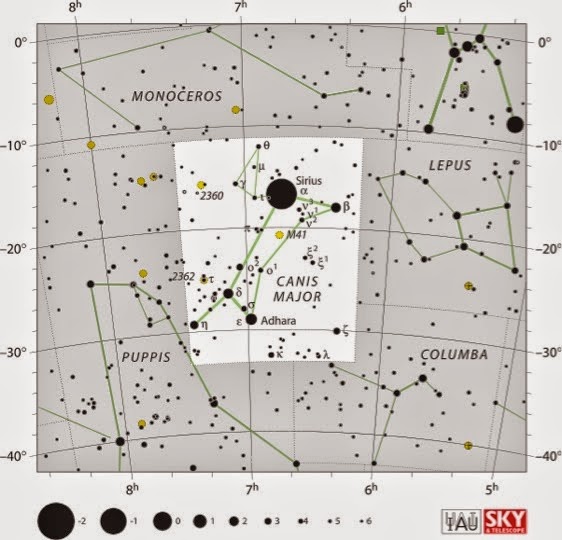
image: Wikimedia commons (link).
As can be seen from the row of black discs or circles, descending in size, along the bottom of the above star chart, the individual stars in charts like this are drawn as larger or smaller discs to indicate their relative brightness in the night sky: Sirius is shown as an enormous circle because Sirius is the single brightest star in the heavens, to an observer on earth (other than the sun).
The fact that a dog named Pluto gets up into the same posture displayed by the outline of the constellation Canis Major immediately before a light fixture bearing the words "SIRIUS (9 CANIS MAJOR)" plummets to the street can be interpreted as a fairly direct hint that the creators of
The Truman Show are trying to direct our attention to this part of the sky.
If we look upwards in the direction that the constellation is "leaning" (if it were actually a big dog, leaning against someone the way Pluto leans against Truman) we see that just up and to the right of the "forepaws" of Canis Major is the constellation of Orion -- you can easily make out his distinctive belt of three bright stars in the upper-right corner of the chart above. Orion was anciently associated (very strongly associated) with the Egyptian god of the underworld, Osiris: the god of the dead, the consort of Isis, and an incredibly important figure in esoteric tradition.
It is difficult to escape the conclusion that, by having the big dog rear up and place his paws on Truman the way they do, the creators of The Truman Show are implying that Truman at this point in the movie is enacting the role of Osiris, or that he is at this point trapped in the condition of Osiris. What might that imply? That he is "cast down" in an underworld (and, living as he does inside a dome, Truman does indeed exist in an underworld). That he is asleep (Osiris and other Osirian figures were often banished to a cave beneath the waves, to sleep away the eons until their promised return). That he is unconscious -- even, in a sense, "dead," because he is not really living. The remainder of the film will illustrate Truman's process of waking up, of "rising from the dead," of "raising up the Djed column that has been cast down" (the Djed column is a powerful symbol of ancient Egyptian mythos, associated with the "backbone of Osiris," and discussed in numerous previous posts, including this one).
The fact that the dog who gets up on Truman during this point of identification with Osiris is named "Pluto" is another major clue supporting the above interpretation: in addition to being a famous dog in the worlds created by that master of illusion and artifice, Walt Disney, Pluto is of course the name of the fearsome god of the underworld in the mythology of the ancient Latins, the god corresponding to the Greek Hades, the ruler of the dead and a fitting pointer to the entire underworld theme of Osiris outlined above.
If we need any further confirmation that The Truman Show is consciously and deliberately invoking these ancient myth-symbols, and doing so in a manner that demonstrates a high level of understanding of their power and import, we can take a look at the camera angle selected for the moment that Truman tentatively (or should we say, reverently?) approaches the light labeled Sirius and reaches out to touch it (see the video beginning at 0:47 in the above clip, and observe the chosen camera angle from that point until 0:58 or 0:59).
Notice anything significant about it? Truman is deliberately framed in between two pillars. This symbology is of course quite directly evocative of the scriptures of the Old Testament and the pillars of the Temple. It is also, according to the analysis of Alvin Boyd Kuhn offered in his masterful 1940 text Lost Light, symbolic of the "two pillars of the horizon" between which men and women labor in this incarnate existence, and hence symbolic of the "horizontal line" on the Cross symbol: the horizontal line of our material side, of our animal nature, as opposed to the "vertical line" of the spiritual component (see some of the discussion and Alvin Boyd Kuhn quotations in this previous post entitled "New Year's and the Egyptian Book of the Dead," for example, for further development of this topic).
The Temple, of course, can be associated with the human body in this incarnate life on earth, and the body is in fact plainly called "the temple" in some of the New Testament scriptures (both in the words of Jesus in passages such as John 2:19, and the words of Paul in passages such as 1 Corinthians 3:16, 1 Corinthians 6:19, and 2 Corinthians 6:16) -- this lends further confirmation to the interpretation that the "two pillars" refer to "this incarnate life."
We have seen that this horizontal line of the Cross, between the pillars of the equinoxes, represents "the Djed column cast down," or Osiris laid out as a mummy upon a funerary bed or in a sarcophagus, just as the vertical line represents "the Djed column raised back up." Ancient mythology thus implied that our being "cast down" into this "underworld" of incarnation, this "vale of tears," this world of illusion (in which we falsely believe that the world we see around us is all that there is, when in fact there is a "real world which is behind this one," just as there is in The Truman Show) is somehow a necessary step on our way towards raising the Djed back up, transcending the material, piercing the illusion, escaping the bonds of death or sleep or unconsciousness.
In fact, the use of Osirian imagery seems to be a deliberate symbol inserted into films which have to do with transcending the illusion, or breaking out of mind control (see previous discussions of the recent 2014 film Interstellar and of the 1968 classic Planet of the Apes). It may be said to be a kind of signal to alert us that what we are watching may well have something to say about the journey that each and every man and woman must make through this "underworld kingdom," and the important task of seeing through the veils of illusion and perceiving the truth, and raising the Djed that has been cast down.
It should be evident that doing so requires us to take personal responsibility for analyzing and thinking for ourselves -- to tune out the voices that tell us to accept (like a child) their illusory authority, and their "settled" interpretation of all of the most important matters. This seems to imply that no one else can "wake up for us" -- we have to do it ourselves (because if we simply accept the interpretation of someone else who has "woken up" on their authority, without examining the evidence and weighing the hypotheses and making the decision for ourselves, then we are still in pretty much the same condition that we were before, only substituting one authority for another).
Critical thinking and analysis are absolutely indispensable tools against mind control and for human consciousness.

* a "gloss" is a literary term for a helpful definition that is written above a word in a text from another language -- medieval monks in England, for instance, would sometimes write the English translation for an unfamiliar Latin word in a Latin text, to make it easier for them or the next reader who came to that word (so they wouldn't have to "look it up" again -- the definition was written right there above the word, or in the margin). Thus, to "gloss" something means to define it, or translate it: and to "gloss over" something is to "define away" any unfavorable meaning, or to "translate it" in a way favorable to some agenda. This usage of the word "gloss" shows just how powerful the control of language really is: controlling the words one uses and how they are defined often enables controlling the way people think (as George Orwell tried to tell us).
Of course, a "glossary" is a collection of "glosses," just as an "aviary" is a collection of birds or a "bestiary" is a collection of animals -- a "glossary" is a collection of short, handy definitions of words.
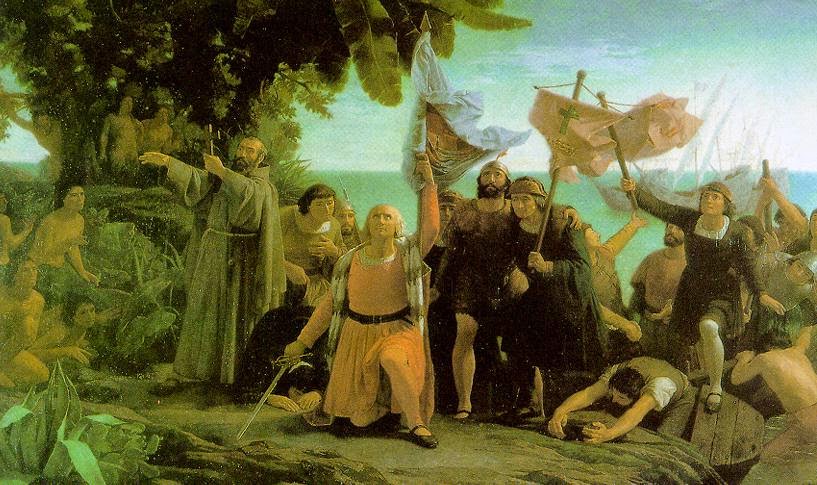
image: Wikimedia commons (link).
The previous post explored some of the important issues raised by Mark Plotkin's recent TED talk entitled "What the people of the Amazon know that you don't."
Specifically, it explored the contrasts offered in Dr. Plotkin's talk between those who are acting as part of the world-encompassing western system and those who have thus far managed to avoid being that system and whose people have called the Amazon rainforest their home for centuries or for millennia.
It suggested that contrast may spring from the fact that one group is characterized by harmony with the natural world and the spirit world (and indeed, it could be said that this group sees no hard-and-fast distinction between the visible, material, natural world and the invisible, immaterial, spirit world) and that the other group is characterized by a disconnection with the world of nature (if not an antagonism towards it) and an almost total disregard for the spirit world (if not an antagonism towards the very idea of a spirit world, as understood in shamanic cultures).
It further noted that this antagonism in earlier centuries stemmed primarily from literalist Christian dogma and in later centuries has stemmed from the "ideology of materialism" which has in some important western circles become a replacement religion for literalist Christianity).
This divide can be seen as central to the very different approaches highlighted in the TED talk between "western medicine" and shamanic healing, between living in harmony with the rainforest and clearing it out to create grazing land for a few skinny cows, between pursuing the old ways while avoiding western contact and pursuing uncontacted groups in order to take pictures with them, enslave them, or try to convert them to literalist Christianity.
Regrettably, there is a very real and ongoing doctrine among literalist Christians that they are under divine commission to reach every people group on the planet in order to attempt to replace the indigenous or traditional belief with literal Christianity. For an example of the seriousness of this ongoing belief, and the numerous groups that have been organized to pursue this "mission" or "great commission" of converting some members of every culture on earth to literalist Christianity, simply type the words "reaching the unreached" into a decent search engine and visit some of the links that come up as results.
This doctrine of a "great commission" to convert everyone is regrettable because, as it turns out, there is substantial evidence that the Biblical scriptures were never intended to be understood literally, being built upon a foundation of celestial metaphor (see for example this recent video, as well as some of the Biblical stories listed in this index of "Star Myth" explanations on this blog). Ironically, I believe that there is extensive evidence to suggest that this exact same system of celestial metaphor can also be shown to be the foundation of the sacred traditions of nearly every culture on the planet, including those in the so-called "New World" (some of those are discussed in the Star Myth index linked in the previous sentence).
For this reason alone (along with many others which have to do with not trying to conquer other men and women), I believe that the idea of aggressively working to teach "unreached" people to reject their traditional sacred knowledge and replace it with literalist interpretations of the Biblical scriptures is profoundly misguided.
Among some literalist Christians, this mission is also joined to an apocalyptic vision regarding the end of the world, the end of the age, and the prophesied return of the literal and historical Christ. This connection is generally based specifically on words attributed to Jesus in Matthew 24:14, which declare: "And this gospel of the kingdom shall be preached in all the world for a witness unto all nations; and then shall the end come."
In fact, it can be demonstrated that Christopher Columbus wrote quite extensively on his own belief that the scriptures teach that end of the world and the return of Christ require the conversion of the people of the new continent to the Christian faith, as well as the physical rebuilding of the Temple in Jerusalem -- and he believed that his voyages to the Americas were instrumental in both of those requirements (the second he felt would be aided by the opening of a new westward route to the Holy Land for the western European monarchs, bypassing some of the obstacles of the eastward route from western Europe, and aided as well by the gold which could now be brought back from the Americas and put to good use in facilitating the rebuilding of the Temple).
In his Libro de las Profecias ("Book of the Prophecies"), which Columbus wrote in the years 1501-1502 in Spain, in conjunction with a monk named Gaspar Garricio, he explains his belief that the Americas serve this important apocalyptic purpose in fulfillment of Biblical prophecy, and cites extensive scriptural references from the Old and New Testament to back up his claims, often commenting on them to tie them to his thesis. Strangely enough for a work of such apparent historic importance, it has only very rarely been translated into English, and even those translations can be difficult to obtain (it's not as though Columbus is some kind of marginal figure of minimal historical importance, so the scarcity of this work in easy-to-access online English translations is somewhat puzzling and perhaps worthy of comment -- especially in light of the fact that one of the most important sources Columbus cites in his work, the medieval Joachim of Fiore, is also rather difficult if not impossible to find in English translation as well).
But, the link above will take you to an online transcription of the original text as it was written in Spanish, albeit with frequent archaic spelling conventions (for instance, places in which the letter "i" would be used in the Spanish spelling of a word today often use the letter "y" instead, and some words which today would be spelled using the letter "v" contain the letter "b" where we would expect to see a "v," which is consistent with the pronunciation but not the modern spelling -- and that in some places we would expect a "b" we find a "v" instead). However, it is fairly readable for those who can read modern Spanish. There, you will find that Columbus declares that:
El abad Johachin, calabres, diso que habia de salir de Espana quien havia de redificar la Casa del monte Sion (see Folio 6, "B").
This translates roughly to: "The abbott Joachim [of Fiore], of Calabria, said that he has to come from Spain the one who is going to re-build the House of the Mount of Sion [or Zion]."
Earlier, at the end of the first side of Folio 5, Columbus states of the prophet Isaiah (according to the interpretations of San Geronimo and Saint Augustine) says that, "Este puso toda su diligencia a escrevir lo venidero y llamar toda la gente a nuestra santa fee catolica" which I translate roughly to mean "This one exerted all his diligence to write of what is coming and to call all the people to our holy catholic faith."
Columbus then begins to cite extensive passages from the scriptures on the subject of the end of the world, as well as passages from the writings of Augustine and others. When he gets to the important passage from Matthew 24:14 quoted above (regarding the requirement for the gospel of the kingdom to be preached "in all the world" and then "shall the end come"), Columbus comments:
<<En todo el mundo>>: es evidente que antes de la destruccion de la ciudad [Jerusalen] por Tito y Vespansiano, el evangelo fue predicado en las tres partes del mundo, es decir, en Asia, Africa y Europa, pues viviendo todavia Pedro, la fe fue predicada en Italia &c. Hay que inquirir [estas cosas], si le place a uno.
My rough translation of this passage might be as follows:
"In all the world": it is evident that before the destruction of the city by Titus and Vespasian, the gospel was preached in the three parts of the world, that is to say, in Asia, Africa and Europe: even more, within the life of Peter, the faith was preached in Italy etc. It needs to be examined, if it pleases him to [have it preached] in one more.
While it is undeniable that the historical context of the writing of this Book of Prophecies by Columbus included his desire for the rulers of Spain to send him back on another mission to the Americas, no one who reads it can come away unconvinced that Columbus was deeply versed in the scriptures and that he possessed a thoroughly-developed framework of eschatology, predicated upon the rebuilding of the Temple at Jerusalem and the conversion of all the unreached nations of the globe to the literalist Christian faith -- and that he could back up his vision with an interlocking lattice of verses from both the Old and New Testaments. It is difficult to argue that this vision was not dominant (or at least extremely important) in his desire to undertake voyages across the Atlantic from the outset.
In his most-recent book, Thrice Great Hermetica and the Janus Age, the insightful and extremely thorough researcher Joseph Farrell makes this very argument regarding the purpose of the voyage of Columbus: that it was part of a carefully-planned vision for bringing about the fulfillment of prophecy by powerful groups at the top of the power structure of western Europe (see pages 156-157 in particular). Of the reference to Joachim of Fiore, Dr. Farrell says:
Joachim, in other words, more than anyone else, is responsible for viewing prophecy as a code to be decrypted, and once decrypted, as a playbook or agenda to be followed by the power elite of his day. [. . . ] Thus, in terms of the hidden "prophetic" agenda driving Columbus and his backers, his voyage of 1492 was not a chance discovery, but a planned revelation whose every last detail was coordinated, including especially those details meant to exhibit "the fulfillment of prophecy." 156 - 157.
That there remain to this day those who continue to believe some version of this "playbook or agenda" and who see both the Americas and Mount Zion as important to that prophecy's ultimate fulfillment is hardly possible to doubt. Some of those who continue to hold to these beliefs may also tie the "reaching" of every last "unreached" culture into their vision of the fulfillment of such "end times" prophecies.
Again, I believe that there is extensive evidence from within the Biblical scriptures themselves to support the conclusion that they were not intended to be interpreted as literally and historically as they are often interpreted. For example, both Joachim and Columbus published specific predictions for the year in which the Apocalyptic events predicted in the scriptures would take place on earth -- and yet I believe that the scriptures in general and the Apocalypse of John in particular (often called the Revelation today) are celestial in nature and were intended to convey esoteric teaching and not historical or literal predictions.
Some discussion of the celestial foundations for the events described in the Revelation of John (particularly in chapter 9, where the celestial connections are very clear) can be found in this previous post, as well as in the three chapters of my book The Undying Stars, which can be read online here (see pages 9 through 13 of the book, which are part of the selection that is posted online).
Ultimately, I believe that the above discussion points to some of the very substantial evidence which suggests that literalist Christianity itself can be seen to encourage a kind of "colonizing mindset," in that literal misinterpretations of its content can lead to the regrettable conclusion that it should be "forced upon" others, either by persuasive or even aggressive arguments or -- in some extreme but by no means isolated instances -- by physical force or violence (see the record of Charlemagne in Europe, for example, as well as many other cases in later centuries). The connection between this mindset and the other forms of imposing the western world-system on others who might be more disposed to live without it or outside of it should be clear.
Further, I believe there is strong evidence to support the theory that literalist Christianity was deliberately designed as a vehicle for taking over the Roman Empire from the inside, and that it turned out to be a very effective vehicle for doing so (see previous posts such as this one and this one). If this theory is in fact correct, then we should hardly be surprised that it continued to be an effective tool for colonizing and taking over other cultures around the planet in subsequent centuries, and that it continues to do so today.
Some may object at this point by saying that there have been plenty of non-Christian examples of conquest at the point of the sword, and colonization and cultural takeover of one people by another throughout history, and of this there is no doubt. But it is also extremely notable that western Europe, where the literalists who took over the Roman Empire had the most power and influence for the longest period according to the theory mentioned above, has proven to be the most aggressive and most "successful" (if taking over the culture of others can be measured as a success) colonizing entity the world has ever known (at least, as far as history is known to this point).
It might also be pointed out that, unlike sheer physical conquest by the force of arms, if Christianity was designed to take over a culture from the inside primarily by tactics other than physical force, it can be said to have a powerful "built-in" propensity for what might be called "mental colonization" or "mental conquest" -- or, to use a term which has been defined more precisely in other posts: "mind control."
Thus, I believe that it is no small item that Mark Plotkin mentioned the efforts of Christian missionaries alongside the other deleterious impacts of the western world-system upon the human and natural ecosystems of the Amazon. In many ways, it can be said that literalist Christianity is at the heart of this entire pattern, and has been for many centuries -- stretching back to Columbus, and perhaps even for centuries before that.
Above is a sobering and thought-provoking and -- yes -- hopeful talk from ethnobotanist and Amazon conservationist Mark Plotkin, entitled "What the people of the Amazon know that you don't," given at TEDx in Brazil in October of 2014.
In it, he addresses many important subjects, all of them interconnected: the threat to the rainforest and the threat to the cultures of those who have lived there and whose ancestors have lived there for centuries or millennia, the relationship between the indigenous cultures and nature contrasted with the disconnect and even hostility towards nature exhibited by modern "western" culture, the shamanic wisdom that has been preserved and passed down in those cultures and the loss of that wisdom as members of the older generation leave this life, and the desire by some representatives of literalist Christian religious groups to convert uncontacted indigenous peoples to their literalist religion.
The issues that Dr. Plotkin addresses so movingly in his talk are important in their own right, as they apply to the specific situation of the Amazon rainforest and its precious ecosystems and the irreplaceable cultures and wisdom of the people of the Amazon. They are also illustrative, I believe, of the disconnectedness which has been an unfortunate aspect of literalist Christianity since its inception: by insisting that the scriptures of the Bible are literal and "historically true" in a way denied to all the other sacred traditions of the world, this literalist approach creates an artificial disconnect between the world's sacred traditions (when in fact they are all united by an incredible shared system of celestial metaphor -- including the scriptures in the Bible), and it also creates an artificial disconnect between humanity and the universe, between mankind and nature.
Dr. Plotkin provides powerful examples of the contrast between western medicine and traditional healing techniques derived from a deep connection to and knowledge of the plants and animals of the rainforest.
He provides stunning visual evidence of the contrast between the traditional stewardship of the rainforest and the devastation and destruction wrought by representatives of the western world-system.
And he describes the precarious state of uncontacted tribes. It is no accident that the people who have not come in contact with the source of the "disconnects" described above are described by Dr. Plotkin as the most connected, saying at 7:22 in the talk:
These are the people who know nature best. These are the people who truly live in total harmony with nature.
And it can be argued that the critical element in this contrast between connected and disconnected stems from the relationship to the spirit world, as evidenced by the frequent references to shamans and shamanic knowledge throughout this discussion. I would submit the possibility that the deep connection to and harmony with nature Dr. Plotkin describes among those who have not been absorbed into the western world-system cannot be separated from their sense of connection to the invisible world, a connection which the shamans embody and preserve for those shamanic cultures.
And I would submit the possibility that the disconnectedness from and hostile relationship with nature that characterizes the western world-system is also directly related to the deliberate rejection of the shamanic worldview and denial of the importance of the spirit world that is inherent in the western world-view (a rejection and denial which has remained the same whether driven by literalistic interpretation to the Bible or whether driven by the new western religion of "Science," which I have also called "the ideology of materialism," after a phrase in an essay by Dr. Neal Grossman).
This disconnectedness and hostility towards the shamanic worldview is perhaps most nakedly exhibited in the example of missionaries from literalist Christian religious orders who, as Dr. Plotkin explains at about 13:40 in the talk, "want to get in there and turn them into Christians." One can deduce from the expression in his voice that Dr. Plotkin has personally encountered this attitude and activity from missionaries during his many years of working to preserve the rainforests and the rights of the indigenous people of the rainforests.
Viewed in a wider context, I believe it is abundantly clear that the ongoing desire of some literalist Christians to make contact with and then attempt to convert men and women who have remained outside of the world-encircling western system and who have preserved their original shamanic wisdom and shamanic worldview is part of a pattern stretching back nearly two thousand years. Another example of the manifestation of this desire to spiritually conquer and colonize was discussed in the previous post entitled "Literalists against the shamanic."
Other examples can be found around the world, starting at the center of the Roman Empire in the second through fifth centuries AD and then spreading in ever-expanding circles worldwide from that point, first across western and northern Europe and ultimately across oceans and continents in successive centuries to reach nearly every corner of the planet. The depths of the Amazon are some of the few places that this system has yet to fully reach.
The good news is that this artificially-imposed disconnect is becoming harder and harder to pass off as legitimate or healthy. More and more people are realizing how much has already been lost, and realizing the urgency of preventing further destruction. Courageous individuals like Dr. Plotkin and his fellow-conservationists and researchers are helping to expose the world to this enormous issue, and to express it in terms of human rights, and to enlist aid and create groups and perform the hard work to defend the human rights of those who are most threatened by some of the worst aspects of the disconnectedness that is such a hallmark of the western world-system.
We should all do what we can to support that work and to help to spread that message. The website of the Amazon Conservation Team can be found here.