The Crossing of the Red Sea

The Crossing of the Red Sea

image: Wikimedia commons (link).

The response to a recent article in the Wall Street Journal entitled "How Did Moses Part the Red Sea? The science of tides may have saved the Israelites from the Egyptians" has been quite interesting. 

Since its publication on December 5th, it has been the "most popular" story listed in the right-hand column for several days in a row, and only today slipped to the "second-most-popular" position. Further, the story has stirred up an often-contentious train of reader comments now over six hundred in number. 

Clearly, the subject of the historicity of this story from the ancient Hebrew scripture, as well as the possible "mechanics" of this particular miracle, remains extremely compelling to many men and women to this day.

The article in question was written by Dr. Bruce Parker, former chief scientist of NOAA's National Ocean Service, now a visiting professor at the Stevens Institute of Technology, and author of a new book on The Power of the Sea: Tsunamis, Storm Surges, Rogue Waves, and Our Quest to Predict Disasters. The hypothesis he presents in his article, in short (please read his actual article for full details), is that Moses used his knowledge of the tides to spring a nature-based trap on the pursuing armies of Pharaoh:

Moses had lived in the nearby wilderness in his early years, and he knew where caravans crossed the Red Sea at low tide. He knew the night sky and the ancient methods of predicting the tide, based on where the moon was overhead and how full it was. Pharaoh and his advisers, by contrast, lived along the Nile River, which is connected to the almost tideless Mediterranean Sea. They probably had little knowledge of the tides of the Red Sea and how dangerous they could be.

Dr. Parker even speculates that Moses might have used the observation of the dust clouds thrown up by Pharaoh's army and their chariots, and used their progress to time his springing of the trap. He posits that Moses could have gotten all the people across to safety in advance, and then "sent a few of his best people back onto the temporarily dry sea bed to entice Pharaoh's chariots to chase them."

("It's a trap!")

As Dr. Parker is someone whose professional interests involve awareness and prediction of the powerful ebbs and flows of the sea, such an explanation would certainly seem to appeal to him, and his expertise in the area would make him capable of assessing the possibility that tides changes could have been involved. Predictably, however, his hypothesis has raised a chorus of protests from a wide variety of readers, many of them upset that he is suggesting a natural phenomenon to replace direct supernatural intervention, and many others upset at the suggestion that there is any history to the story at all, or that he is discussing the Red Sea as the body of water that Moses and the Israelites crossed in the Exodus story, rather than some other body of water such as the Nile delta.

Having just completed a series of posts arguing that critical analysis should include consideration of every possible explanation, and the examination of evidence in order to help determine which explanation best fits the evidence, I believe that Dr. Parker should be commended for offering a hypothesis and for bringing his professional knowledge and experience to bear on the question (those previous posts on the importance of analysis include "Analysis: Against mind control, for human consciousness" and "Thomas Jefferson and Immanuel Kant on reason, analysis, and mind control," plus my recent interview with Professor James Tracy of MemoryHoleBlog in which the same important subject was a topic of conversation).

While I don't believe this particular explanation is the best fit for the body of evidence available, I do not believe it should be rejected out of hand as some of the comment-writers seem to be doing, simply based on  commitment to a prior dogma, whether literalistic Biblical dogma, "ideology of materialism" dogma, or some other.

I believe that it can be demonstrated that the overwhelming bulk of the evidence strongly argues that the stories of the Old Testament and New Testament are esoteric metaphors built upon the motions of the sun, moon, stars and planets through the sky, and the daily, monthly, yearly, and even multi-year cycles created by these heavenly bodies.

Previous posts have outlined the numerous, detailed points of correspondence between the celestial actors and specific stories in the Old and New Testaments, including the story of Adam and Eve, the birth in the manger and the visit of the Magi, the events foretold in Revelation chapter 9, the story of Elisha and the two she-bears, the Ark of Noah and the dove, the episode Noah's sons Shem, Ham and Japheth, the episodes in the life of Samson, the sacrifice of Jephthah's daughter, the near-sacrifice of Isaac by Abraham, and many, many more.

Further, it can be demonstrated that myths from around the world also appear to follow the very same pattern of celestial metaphor!

This index lists many of those, along with links to previous posts discussing them -- and it is by no means exhaustive but merely scratches the surface of the available stories which could be examined and found to be built upon the motions of the heavens.

This evidence is absolutely astonishing. It suggests that the conventional paradigm of the ancient history of the human race may be grievously incomplete. It also suggests that the stories recorded in the Old and New Testaments -- like the sacred myths and legends from the other cultures around the globe -- are not a record of literal, historical events enacted by human actors upon the earthly terrain, but rather poetical, metaphorical, esoteric stories describing the stately motions of the majestic celestial actors upon the infinite stage of the heavens.

In other words, we do not actually need to get too narrowly-focused upon the details of Professor Parker's theory which tries to fit the events of the Red Sea crossing described in Exodus into the tidal mechanics of our terrestrial oceans and seas, if the overwhelming bulk of stories in the Bible contain abundant clues indicating that they are celestial in nature. We need not point out that the "tidal trap" theory requires the armies of Egypt to show up at almost the exact perfect moment to venture out into tidal flats and then get swallowed up by the incoming tide -- a rather unlikely scenario -- or that the region uncovered by the low tide would probably have been fairly uninviting for masses of chariots and horses in the first place. Such details do seem to argue against Dr. Parker's hypothesis, but they are actually quite tiny details once we "zoom out" to survey the much wider landscape composed of Bible story after Bible story after Bible story which each testify to their celestial foundation. To argue that this one story, the crossing of the Red Sea, was an historical event which somehow managed to be preserved in scrolls filled with celestial metaphors on either side of it as far as the eye can see would appear to be a bad fit for the majority of the evidence.

Further, the fact that we can find very compelling evidence within the Red Sea crossing narrative itself pointing to its own celestial nature provides even more conclusive proof that this crossing is a heavenly and metaphorical event, and not an earthly and historical-literal one.

In order to explore some of this evidence within the Red Sea episode, we must understand the important "zodiac wheel," which depicts the cycle of the year using the background of the twelve zodiac signs within which the sun successively appears to rise each morning on the eastern horizon as we progress throughout our annual circuit (for some visual discussion of what causes this, see the "dining room table" analogy depicted in this video I made some years back).

This annual circuit, with its backdrop of the twelve zodiac signs, is conveniently divided into four quarters by the important "station points" of the two solstices and the two equinoxes (numerous previous posts have tried to illustrate the mechanics behind these four points using various metaphors -- one metaphor I find to be helpful is the "earth-ship metaphor" described in this post).

Previous posts have already discussed the evidence that this ancient world-wide system of celestial metaphor often depicted the equinox points, where the sun's ecliptic path crosses back above the celestial equator during the day (initiating the half of the year in which days are longer than nights) and back down below the celestial equator during the day (initiating the half of the year in which days are shorter than nights) as places of sacrifice -- see for example this postthis post, and the discussion of the sacrifice or near-sacrifice of Iphigenia discussed on pages 34 through 37 in the online preview chapters from my book, The Undying Stars).

In those stories of sacrifice, which contain clues to indicate that they pertain to one or the other of the equinoxes, there is almost always a direction mentioned: the sacrifice is at a crossing going up (the spring equinox) or at a crossing going down (the fall equinox). Is it possible that the crossing of the Red Sea, in which the ancient scriptures tell us that Moses led the children of Israel up out of Egypt,* also represents an equinoctial crossing? I believe there is good evidence to suggest that this is the case.

Below is the zodiac wheel, with the two crossing points of the equinoxes marked with a red "X" at each equinox point. The horizontal dividing line separates the "lower half" of the year -- from the fall equinox through winter and then back to the spring equinox, the half of the year when days are shorter than nights -- from the "upper half" of the year, which stretches from the spring equinox up through the summer solstice and then back down to the fall equinox at the other "X":
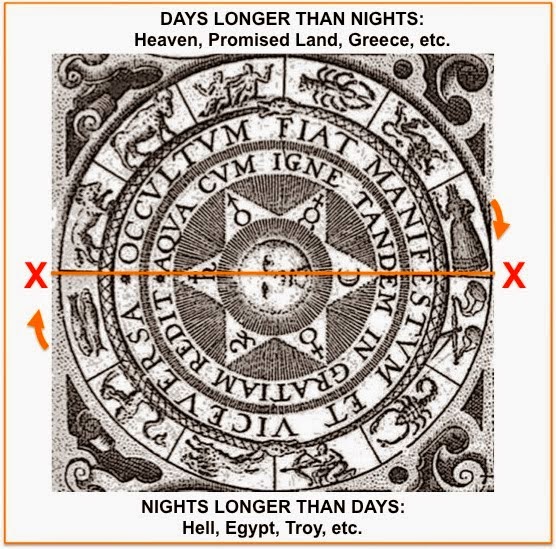
It can be demonstrated rather conclusively that the start of the year among many ancient cultures, including the ancient Hebrews, was associated with the point of crossing of the spring equinox (the "X" located on the left side of the wheel as laid out above). Thus, the zodiac sign that metaphorically could be said to "lead" all the other signs (the zodiac sign at the "start-point" of the circular train of signs) would be the one who was "leading" across that "starting line" at the spring equinox (the "left-side X" in the diagram).

In the wheel above, which depicts the Age of Aries, that leader is the zodiac constellation of Aries the Ram (you can see that it is the first sign "above the line" at the left of the diagram, at the equinox crossing-up point).

This is the sign who leads the "children of Israel" (the other eleven signs) up "out of the land of Egypt, from the house of bondage." In this version of the metaphor, the lower half of the year, the wintery half of the year, the half of the year in which the forces of darkness oppress the forces of light, is allegorized as the land of Egypt, "the house of bondage." In other myths, this lower half is allegorized as Hades, or Tartaros, or Sheol, or the land of Troy in the Iliad of Homer, and many other depictions in many different cultures.

Thus, Moses can be seen as playing the role of Aries the Ram in this particular story, leading his people up out of bondage (the lower half of the wheel) and making the upward crossing at the spring equinox over to the other side, where there is much rejoicing (days once again becoming longer than nights). Further evidence to support this reading can be found later, at the incident of the golden calf (Exodus 32), when Aaron the brother of Moses makes the idol of a bull-calf and tells the people that "These be thy gods, O Israel, which brought thee up out of the land of Egypt" (Exodus 32:4). Moses is furious at this declaration: Taurus the Bull is not the leader of the zodiac band: the precessional Age of Taurus preceded the Age of Aries, but it is over and now the declaration that the bull led them up out of Egypt is infuriating to Moses.

Further confirmation that this entire episode is metaphorical and based upon the zodiac wheel comes from an examination of the chariots and horsemen that the Exodus account is very careful to describe as being destroyed by the sea. The actual crossing of the Red Sea is described in Exodus 14, and in verses 18 and 19 the Egyptian army is twice described in identical terms, as consisting of "Pharaoh, his chariots, and his horsemen," as if we are to be very clear that horses are present. But this emphasis on the host of chariots and horsemen, as the Reverend Robert Taylor (1784 - 1844) points out in his Astronomico-Theological Lectures (see especially 393-394), creates a significant problem for those who take the Exodus account as intending to depict literal terrestrial events, because in Exodus 9 just a few chapters before, God declared in no uncertain terms to Moses to tell Pharaoh that the next plague visited upon Egypt would be upon "thy cattle which is in the field, upon the horses, upon the asses, upon the camels, upon the oxen, and upon the sheep" (Exodus 9:3), and that on the next morrow "all the cattle of Egypt died: but of the cattle of the children of Israel died not one" (verse 6).

It is possible, of course, to argue that the plague promised only sickened the horses of Egypt and did not kill them all, but even so it is rather astonishing to see the mighty armies of Pharaoh which pursue Moses and the children of Israel so full of chariots and horses -- unless the entire story is describing the celestial cycles involving the zodiac wheel and not a literal and historic event that took place on the earth.

Also, the following plague described in Exodus 9:19 and following -- the plague of hail -- would seem to be designed to kill off any remaining beasts from Egypt that were not killed by the previous plague just described. There, God tells Moses to have the children of Israel bring their beasts out of the fields, because when the plague of hail comes, "every man and beast which shall be found in the field, and shall not be brought home, the hail shall come down upon them, and they shall die" (Exodus 9:19). Between these two plagues, it is difficult to argue that many horses would be left in Egypt, and even if there were some left, they would hardly be in a condition to swell a mighty army to pursue Moses.

Again, however, this is only a problem if the event is not a metaphor -- and the evidence outside of this story, from many, many other stories within the Bible itself and from myth around the globe all argue that it is.

Now, we might ask ourselves: if the event actually is a heavenly metaphor, then why would there be such an emphasis upon there being horses and chariots in the army that is "left behind" to be buried at the bottom of the sea, when the children of Israel led by Moses "cross over" (or up) to the other side?

Following the analysis of Robert Taylor, I believe the answer can be found if we look again at the zodiac wheel, and at the very bottom of the lower half of the year (the half which I believe -- in this particular metaphorical telling -- represents the oppressive forces of Pharaoh) you will see the sign of Sagittarius, positioned at one side of the winter solstice point, the very lowest point on the entire zodiac wheel.

Sagittarius is a horseman, and archer (sometimes a centaur) -- and just as the Ram is crossing up over the horizontal line towards the "promised land" of longer days and the rule of light over darkness, Sagittarius is left below at the very bottom of the year: in fact, at the very bottom of the sea.

Further support for this interpretation is provided by the actions of Miriam the sister of Aaron, after the safe crossing is accomplished. In Exodus 15:20 and following, we are told that she "took a timbrel in her hand; and all the women went out after her with timbrels and dances," and sang that the LORD had triumphed gloriously, and "the horse and his rider hath he thrown into the sea" (Exodus 15:20 - 21). The text is here giving us a very strong hint that Miriam in this case is played by the important zodiac constellation of Virgo, whose constellation actually includes a faint circular disc of stars which is allegorized in ancient myth in many ways, but sometimes as a "timbrel" or "tambourine" (see discussion here).

If you look again at the zodiac wheel, you can see why Miriam is the one who "answers" the song of Moses (also presented in Exodus 15): she is the other constellation located "just above the line" which separates the "upper half" of the year from the "lower half," if she is indeed associated with the constellation Virgo (as her timbrel indicates that she is). If you look at the zodiac wheel diagram, you will see Virgo located across the wheel, just above the horizontal line and just before the "X" on the right-hand side of the diagram as we look at it on the page. Thus, she and Moses are "above" the line (they have "crossed the Red Sea," and escaped from Egypt) -- and both of them are glorying in the fact that the "horse and his rider" are "cast down" in the depths, below the line. They are almost certainly referring to Sagittarius in these verses.

Thus, I believe that the efforts to try to find "natural" explanations for the events of Exodus, including this episode of the crossing of the Red Sea, are misguided. In fact, the Greek philosopher Plato made much the same argument against the kind of explanations that Dr. Parker is pursuing in the article mentioned above, in the dialogue known as the Phaedrus (circa 360 BC).

In that dialogue, Plato has Socrates gently ridicule such efforts to use natural phenomenon such as unusual weather in trying to explain the myths (in this case, of course, Socrates discusses Greek myth and not Hebrew scripture). And, in doing so, Socrates also drops a hint as to what these celestial metaphors are actually to be used for instead.

In the Phaedrus, as discussed in this previous post, the young Phaedrus is walking with Socrates along the banks of the river Ilissus, and Phaedrus asks: "Tell me, Socrates, isn't it somewhere about here that they say Boreas seized Orithyia from the river?" Phaedrus then presses the question further, and gets to what he really means to ask, which is: "pray tell me, Socrates, do you believe that story to be true?"

Socrates gives a most revealing answer:

I should be quite in the fashion if I disbelieved it, as the men of science do. I might proceed to give a scientific account of how the maiden, while at play with Pharmacia, was blown by a gust of Boreas down from the rocks hard by, and having thus met her death was said to have been seized by Boreas, though it may have happened on the Areopagus, according to another version of the occurrence. For my part, Phaedrus, I regard such theories as no doubt attractive, but as the invention of clever, industrious people who are not exactly to be envied, for the simple reason that they must then go on and tell us the real truth about the appearance of centaurs and the Chimera, not to mention a whole host of such creatures, Gorgons and Pegasuses and countless other remarkable monsters of legend flocking in on them. If our skeptic, with his somewhat crude science, means to reduce every one of them to the standard of probability, he'll need a deal of time for it. I myself have certainly no time for the business, and I'll tell you why, my friend. I can't as yet 'know myself,' as the inscription at Delphi enjoins, and so long as that ignorance remains it seems to me ridiculous to inquire into extraneous matters. Consequently I don't bother about such things, but accept the current beliefs about them, and direct my inquiries, as I have just said, rather to myself [. . .]. From the translation of Reginald Hackforth (1887 - 1957), found in this edition of Collected Dialogues, page 478.

Note that Socrates, in Plato's telling of it, offers up a theory that he imagines might be current among "clever, industrious people who are not exactly to be envied" and who are in fact wasting their time. Instead, Socrates says it is better to just accept the stories and concentrate on the enjoinder of the famous inscription of Delphi: "Know thyself."

I believe it is entirely possible that this is Plato's way of telling us that the actual message and purpose of the myths is to help us to pursue that very command from the temple at Delphi: "Know thyself." The message of the myths has to do with understanding who we are, a curious mixture of spirit and matter, like stars cast down from the proper realm above (the spirit realm) to be plunged into this "underworld" of incarnation in the physical and material realm of earth and water (imprisoned in bodies of "clay," as Genesis describes it). This is the "house of bondage" below the horizontal line of the zodiac wheel, where we toil towards the point of ascent again into those "upper realms."

And, as we do so, we are in fact "crossing the Red Sea" -- we are toiling along as spirit-sparks encased inside a material body: a material body animated by the pumping tides of our own internal Red Sea. Alvin Boyd Kuhn elaborates on this interpretation at great length in his 1940 masterpiece, Lost Light.

This, at least according to Plato and Socrates, may be the real message of this story -- and naturalistic explanations involving "gusts of wind" may be superficially attractive, but ultimately they lead us off the trail. Unfortunately, this is what I suspect Socrates might say about the theory of Dr. Parker.

However, if we read the final lines of Dr. Parker's article in a more metaphorical sense, rather than the apparently literal sense in which they are written, perhaps they contain a profound message for us after all. He says: "If the tide was indeed involved in Moses' 'parting' of the Red Sea, it has to qualify as the most dramatic and consequential tide prediction in history."

In fact, Alvin Boyd Kuhn would argue that this "crimson tide" does indeed qualify as "the most dramatic and consequential" concept of them all, for he says:

It can indeed be said that the one sure and inerrant key to the Bibles is the simple concept of fire plunging into water, the fire being spiritual mind-power and water being the constituent element of physical bodies, -- as well as the symbol of matter. Soul (spirit) as fire, plunged down into body, as water, and therein had its baptism. Hence soul's incarnation on earth was endlessly depicted and dramatized as its crossing a body of water, a Jordan River, Styx River, Red Sea, Reed Sea. Since the water element of human bodies is the "sea" which the soul of fire has to cross in its successive incarnations, and it is red in color, the "Red Sea" of ancient Scriptures is just the human body blood. Esoteric Structure of the Alphabet and Its Hidden Mystical Language, 20.

And so, although this Red Sea is "just" the human body blood, it is indeed the "most dramatic and consequential tide" of them all, and the question of the meaning of this "crossing of the Red Sea" is the question of the meaning of our human existence here in these material bodies! And that is indeed a question that merits the kind of intense attention that this article by Bruce Parker has been getting this week, and that the question of the crossing of the Red Sea has commanded for millennia.

--------------------------

* Examples of verses in which the motion of the children of Israel out of Egypt is described as a motion up abound in the scriptures: see for example Numbers 32:11 ("Surely none of the men that came up out of Egypt . . ."), Amos 2:10 ("Also I brought you up from the land of Egypt, and led you forty years through the wilderness . . ."), and Joshua 24:17 ("For the LORD our God, he it is that brought us up and our fathers out of the the land of Egypt, from the house of bondage . . .).

The Undying Stars on James Tracy's Real Politik and MemoryHoleBlog!

The Undying Stars on James Tracy's Real Politik and MemoryHoleBlog!

Big thanks to Professor James Tracy for all that he does in the examination of what has been pejoratively labeled as "conspiracy theory" by those who oppose the kind of critical analysis demonstrated by "outsiders" such as Sherlock Holmes (or Scooby Doo and the gang) and which is often very much resented by "the authorities" both in mystery stories and in real life.

His website, the Memory Hole Blog, is an essential source for analysis of important events from perspectives that not only are not offered by the conventional media but perspectives that voices in the conventional media often tell us we must not even consider.

When we are told that certain hypotheses or explanations of the evidence are forbidden and may not even be considered as possibilities, we can be certain that critical analysis is not taking place -- and critical analysis is a powerful antidote to what we might broadly term "mind control" (more on the broad use of that term in a moment).

Professor Tracy teaches young men and women the value of good, open-minded analysis in his work as a university professor, and he provides an extremely important platform for alternative hypotheses, overlooked evidence, and critical examination to take place regarding major events which effect all of us.

The evidence that serious criminal deception may be taking place on a massive scale which is presented in many of the essays on his website is extremely compelling -- and it is not surprising given the evidence that I believe can also be seen connecting this pattern of deception to one with very ancient roots.

Recently, I had the opportunity to have a conversation with Professor Tracy on his weekly podcast-radio program, Real Politik with James Tracy, recorded on 11/23/2014 and which aired today (video above). You can listen to the recorded conversation by using the player found on the interview page here, and you can also download the audio file (mp3) to listen to it on a mobile device by "right-clicking" or "control-clicking" on the word "Download" on the interview page or in this sentence.

After our conversation, I continued thinking about some of the valuable subjects that he raised with his insightful questioning during the interview, and wrote a series of connected posts on the topic of critical, honest analysis as an antidote to mind control, including "Analysis: Against mind control, for human consciousness," which Professor Tracy was kind enough to post on the Memory Hole Blog website today (here).

The other recent essays related to the same train of thought inspired by that conversation include:

and

Visitors who are new to the general areas covered in my research, especially regarding "astro-theology" or "Star Myths" as well as some of the outlines of ancient history which I believe are extremely important and which tie in to all the issues discussed above may find the following links helpful, most of which relate to specific references that came up during the recent interview:

Also, during the interview, I explained that I am using the term "mind control" very broadly. The term "mind control" can refer to many different ideas, including some very specific techniques which themselves are clearly violations of natural law and human rights, but I am using a very broad definition of mind control here, which might be summarized as follows: "A range of primarily mental rather than physical techniques, often involving deception, illusion, emotion, and ideology employed on a wide scale in order to control large numbers of people, and especially in order to get them to acquiesce to violations of natural universal law perpetrated against themselves or others, support violations of natural universal law perpetrated against themselves or others, or even completely overlook and fail to see violations of natural universal law perpetrated against themselves or others."

I am indebted to the analysis and teaching podcasts of Mark Passio among others for many of the ideas contained in that definition, as well as my own reading of the work of Lysander Spooner on the subject of natural law. For a list of links to previous posts discussing this particular concept, see the links contained in this previous post. For two posts about Lysander Spooner and his work, see for example:

and

For those who wish to check out other interviews in which these and other topics are explored, there is an "Interview Archive" which contains video links as well as a collection of links to the mp3 files for easy downloading (the mp3 links are in the right-hand column of the page on most browsers).

There is also an internal-search window which can be used to search the hundreds of previous posts in this blog for specific key words or search terms, located in the upper-left corner of most desktop-style browsers. Also, please feel encouraged to get in touch with me via any of various possible methods, including the modest Facebook page and Twitter handle (@davidwmathisen) that I maintain.

Finally, it is notable that Professor Tracy has terrific taste in music, and likes to end his interviews with the inimitable strains of "Elephant Talk," by King Crimson (which is all about the power of language, by the way, as well as the mutability and playfulness of language, an incredibly important area for discussion, related to the "creation of reality," touched on in previous posts such as this one). I happen to have bought that album in the 9th or 10th grade of my indenture to the public school system, and I came across it recently while searching for a completely different album (which I didn't find, but that's ok because I wasn't even thinking about King Crimson when I went looking for that other album).

Here it is (for younger readers, that is called an ALBUM!!!):

O Christmas Tree, O Christmas Tree, thy Leaves are so unchanging

O Christmas Tree, O Christmas Tree, thy Leaves are so unchanging

That special time of year has finally arrived when many of us erect the Christmas tree in our homes. 

There is something magical about the arrival of the tree each year, with its wonderful evergreen smell and the nostalgic connection to memories of Christmases past stretching back to when we were children.

Much has been made of the "pagan" origins of the Christmas tree (and many of the traditions surrounding the celebration of Christmas itself, including its specific date three days after winter solstice), and much ink spilled on both sides of this often-contentious issue, and yet the actual meaning of this ancient symbol is rarely if ever explained beyond the rather obvious connection between the use of an "evergreen" tree and the concept of "eternal life" or the eternity of the human soul.

That Christmas falls on one of the four most important solar stations on the great circle of the year, the lowest-point of the sun which is reached at the December solstice (for observers in the northern hemisphere) is simply undeniable. In fact, its celebration coincides to the very stroke of midnight at the beginning of the third day after the day on which winter solstice most commonly falls -- the stroke of midnight between the 24th and the 25th of December, three days after December 21st (the traditional date of winter solstice -- the day will occasionally wander to the 22nd due to the fact that the number of complete earth rotation or days does not fit perfectly into the space required to get back to the exact point of winter solstice each year, necessitating a leap year to bring the calendar dates back in line with the annual stations on the great wheel). 

The three-day pause probably originates from the fact that the sun seems to linger at the lowest point before turning around, just as it does at its opposite highest point at the summer solstice each June. This phenomenon, and the reason that the sun does not linger at the equinoxes, is discussed in this previous post about the mechanics of the solstices and equinoxes.

Previous posts have explored at some length the evidence which supports the assertion that the great wheel of the year can be "quartered" by drawing two lines between these four very important stations of the year: a horizontal line between the two equinoxes (March and September) and a vertical line between the two solstices (December and June). A diagram illustrating this idea is shown below, and previous posts which discuss ancient myths which seem to support this "cross within the circle of the year" can be found herehere and here (among many others). 

Note that this appears to have been a worldwide concept: the examples from those three posts span the sacred teachings of ancient Egypt, of the ancient Hebrew Scriptures in the Bible, of the ancient Greek Scriptures in the Bible, of the Vedas of ancient India, and of the Lakota of North America. I would argue that the traditions of many other cultures could be examined and found to contain a similar pattern.

The horizontal line between the equinoxes equates to the "casting down" of the spirit into the world of "the underworld," this world of incarnation. It is allegorically symbolized by the heavenly bodies which we see in the sky -- the sun, moon, planets and stars -- plunging down into contact with the horizon of earth or of water, as if these bodies which are native to the crystal spheres above have been thrown down into the mud of our earthly disc, there to plow through the underworld until they break free once again to rise into the sky on the other side. 

This "casting down" took place at the equinoxes on the "Cross" of the circular year, because the equinoxes are the places where the ecliptic path of the sun "crosses" either above or below the celestial equator, creating the point of transition when days become shorter than nights (night prevails and the sun is figuratively in the "underworld" as we toil our way through winter) and the other point of transition when days again become longer than nights (and day prevails again, with the sun being figuratively released to dominate the sky once more, free from the clutches of the wintery months when night rules supreme). 

In ancient Egypt, the god of the underworld was Osiris, and he was depicted as laid out horizontally like a corpse in many scenes, slain by his brother Set and bound in a sarcophagus, cast into the waters -- all of which are emblematic of our plunge into incarnate matter in these human bodies.

image: Wikimedia commons (link).

The Djed column itself (discussed in this previous post) was associated with the "backbone of Osiris," and it was figuratively "cast down" horizontally when Osiris was "laid out" in a sarcophagus like a corpse in the underworld (by the action of the sun's "crossing down" at the fall equinox). But Osiris was not destined to remain horizontal forever -- as the image above plainly intimates. He is destined to rise-up vertically, just as the shoots of grain shown rising from his body in the image above are doing. The raising of the mummified Osiris from the horizontal position to the vertical position was associated with the act of "raising the Djed column" from its "cast-down" horizontal position to its vertical orientation. 

I believe that the raising of the Djed column is figured by the vertical line between the two solstices, shown in the zodiac-wheel diagram above. The raising of the Djed, the raising of the "corpse of Osiris," could be seen to take place when the sun stopped its descending path and turned back upwards: at that point of the very "bottom of the year."

This is why we erect the Christmas tree in anticipation of the turn that takes place at the absolute low-point of the year -- when the sun finally stops its descending path, arriving at winter solstice at December 21, and then it pauses there at its lowest point as if building up our anticipation for three days before starting back upwards towards the top of the year. If the point of fall equinox was figured as the "crossing point" of begin "cast down to the underworld," the turn that takes place at the bottom of the year is appropriate to be celebrated with the raising of a vertical pole, because that is the point where the Djed column begins to be raised back up, as the sun makes its turn from the dreadful downward plunge that it has been taking on its way to the December solstice.

If this interpretation is correct, the raising of the Christmas tree is symbolic of the vertical pillar that can be imagined running from the winter solstice at the bottom of the year and going up through the summer solstice at the very top of the year:

Indeed, there are many legends in which the corpse of Osiris is in fact imprisoned within the body of a tree, lending even more credence to this interpretation of the Christmas tree as commemorative of the raising of the Djed column at the winter solstice. In his discussion of the myth-cycle of Isis and Osiris, Plutarch says that the slain Osiris was imprisoned in a chest which floated out to sea and ended up making its way to Byblus (or Byblos). There, he writes (beginning in paragraph 15): 

the waves had gently set it down in the midst of a clump of heather. The heather in  a short time ran up into a very beautiful and massive stock [a "stock" as used here is a stump or a trunk of a tree], and enfolded and embraced the chest with its growth and concealed it within its trunk. The king of the country admired the great size of the plant, and cut off the portion that enfolded the chest (which was now hidden from sight), and used it as a pillar to support the roof of his house.

Thus, we see that the corpse of Osiris was in this legend "cast down" into a horizontal position within  a chest, but then turned into a tree and was brought into a house (just as the Christmas tree is brought into our homes). His corpse (imprisoned within the tree) is eventually recovered by Isis and restored to life.

Elsewhere, we have explored the evidence suggesting that Isis taking the corpse of Osiris down from its prison inside the pillar in the palace of the king of Byblos is analogous to the pieta scenes in which Mary the mother of Jesus receives his crucified body back from the Cross, before it is raised up again at the resurrection.

image: Wikimedia commons (link).

If this interpretation of the "cross" of the year is correct, with the horizontal line between the equinoxes analogized in ancient myth as the "casting down of the Djed" and the laying out of the corpse of Osiris in his sarcophagus or on his bier, and the vertical line between the solstices analogized in ancient myth as the "raising up of the Djed," then the "raising up of a Djed" in our homes (in the form of a Christmas tree) would almost certainly be predicted to take place in anticipation of the "turn" of the year which takes place at the December solstice. And this is exactly when we do in fact erect the Christmas tree in our homes: in the days or weeks leading up to the point of winter solstice. 

The fact that Osiris was explicitly described as being imprisoned in a tree, and brought into the palace when he was in the form of a tree, lends even greater strength to the argument that our tradition of bringing in the Christmas tree into our homes hearkens back to the symbology of the "vertical Djed column" associated with the vertical line that gets erected each year beginning at the low-point of winter solstice. Below is an image from ancient Egypt of the goddesses Isis and Nephthys raising Osiris to a vertical position between them -- this time, he is in his manifestation as Osiris-Re or Osiris depicted with the head of Amon-Ra:

image: Wikimedia commons (link).

The upsweep of the wide-spreading horns at the top of this "Djed-shaped" god (with the solar disc between them) are strongly reminiscent of the outstretched arms of the Scarab, which we have previously argued is connected to the outstretched arms of the zodiac sign of Cancer the Crab, who is located at the summer solstice point, at the top of the "vertical line" in the zodiac wheel that we are trying to establish as the "vertical Djed column." 

Again, all of this evidence should strengthen the case that the tree we are erecting as we approach the bottom of the year is a representation of the divine spiritual component in the Cross of the year, the vertical line running from the winter solstice all the way up the summer solstice, the line that represents the lifting up of the "dead god" from his prison in the sarcophagus to the upward line which points up to the very summit of the year at the summer solstice, highest heaven.

Figuratively, this raising of the Djed column may well be indicative of our mission in this incarnation: to see beyond the merely physical or horizontal (difficult to do, trapped as we are in these bodies in the same manner that Osiris is bound in his mummy-wrappings), and to call forth the invisible, the spiritual, the vertical. For more on this thought, see the previous post entitled "Blessing."

Interesting additional confirmation of this identification of the Christmas tree with the vertical pillar of the Djed comes from the other Christmas tradition involving a tree-trunk, less commonly celebrated today but once taken very seriously: the tradition of the Yule log. Various accounts of the Yule log indicate that it was a huge trunk, the biggest that could be found, sometimes chosen from a type of tree seen as sacred, and hauled into the house to be burned in the fireplace, but only after it had been anointed with oil and salt and spices and prayed over first. It was often so large that only its "head" could fit into the fireplace, and the rest of the mighty log stretched out into the great room or family room.

image: Wikimedia commons (link).

Based on these descriptions of the tradition, it is difficult not to conclude that the Yule log represents not the Djed column "raised up" as with the Christmas tree, but the Djed column "cast down," since it was basically dragged around horizontally and then burned. 

The fact of its being burned provides added confirmation that the Yule log is the "horizontal component" that represents the line between the equinoxes (as opposed to the vertical pillar connecting the solstices). The equinoxes, where the sun's ecliptic path crosses the celestial equator, were strongly associated with fire: in fact, as is discussed in this previous post, ancient Mithraic sculpture and bas-reliefs often depicted the two equinoxes as two youths, each holding a torch (one up for the equinox in which the sun is crossing up towards summer, and one down for the equinox in which the sun is crossing down towards winter). 

The tradition of having the Yule log lit each year by the daughters in the household or by the

mother only strengthens this connection, since the "casting down" point of the year takes place a the autumnal equinox presided over by the sign of Virgo the Virgin. This fact also helps to explain the numerous depictions of the vertical Djed column in between the two goddesses, such as in the image of Osiris-Re shown above or in the image of the Djed column in the form of an Ankh (surmounted by the upraised arms) in between the same two goddesses. 

image: Wikimedia commons (link).

The Djed column is the stylized "backbone"-shaped column supporting the Ankh-cross itself (you can see the "vertebrae" at the top of the Djed).

Based on this evidence, it appears that the symbology of the Christmas tree (and the now nearly-forgotten symbology of the Yule log) has extremely ancient roots. One could say that all of this evidence supports the argument that the familiar Christmas symbols are really "pagan" and not "Christian," but I believe this misses the real point, which is that the distinction between "pagan" and "Christian" is actually based upon an enormous misunderstanding, because all these sacred traditions the world over can be shown to be using the same system of celestial metaphor -- and that includes all the stories of the Old and New Testaments of the Bible. The symbols may change their outward appearance somewhat, but their core form remains recognizable, and their message (I believe) is fundamentally the same.

In writing about the symbology of the Christmas tree in his 1940 masterpiece Lost Light, Alvin Boyd Kuhn wrote that the fire atop the Yule log, or the glowing candles upon the Christmas tree, symbolizes the divine spark in each man and woman, hidden in the rough element of our physical form (317). Elsewhere in the same text he writes:

The savior is not nailed on the tree; he is the tree. He unites in himself the horizontal human-animal and the upright divine. And the tree becomes alive; from dead state it flowers out in full leaf. The leaf is the sign of the life in a tree. 416.

Thus both of these ancient symbols work together at this time of year to convey to us a profound message about who we are. We are both the Yule log "cast down" and the Christmas tree "raised up," the horizontal "human-animal" and the upright "divine."

This aspect of the symbology is usually absent from the annual discussions of the "pagan" origins of the Christmas tree and other symbols. Yet I believe the evidence is abundantly present to support such an understanding -- and I believe that it is an interpretation that makes these ancient symbols incredibly powerful to us even to this very day, even as they connect us back across thousands of years to the same sacred traditions from ancient cultures all around our planet.

Thomas Jefferson and Immanuel Kant on reason, analysis, and mind control

Thomas Jefferson and Immanuel Kant on reason, analysis, and mind control

image: Wikimedia commons (link).

While we're on the subject of the vital importance of critical analysis as an antidote to mind control, it is difficult to pass up the opportunity to cite a rather famous quotation from Thomas Jefferson (1743 - 1826) in which it can be argued that he stresses this very point.  

In letter dated March 13, 1789 addressed to Mr. Francis Hopkinson, Jefferson responds to earlier correspondence from Hopkinson who apparently noted that Jefferson had been "dished up [. . .] as an anti-federalist" and wrote to ask Jefferson if such a characterization "be just" (as in, "is such a label justified?"). Thomas Jefferson responds:

My opinion was never worthy enough of notice to merit citing; but since you ask it I will tell it you. I am not a Federalist, because I never submitted the whole system of my opinions to the creed of any party of men whatever in religion, in philosophy, in politics, or in anything else where I was capable of thinking for myself. Such an addiction is the last degradation of a free and moral agent. If I could not go to heaven but with a party, I would not go there at all.

He then goes on to discuss the relative merits or demerits of the federalist and anti-federalist camps, which is interesting but not part of the scope of this discussion, which will focus on the sentiment expressed in the declaration: "I never submitted the whole system of my opinions to the creed of any party of men whatever in religion, in philosophy, in politics, or in anything else where I was capable of thinking for myself," that such "outsourcing" of the duty of thinking for one's self is "the last degradation of a free and moral agent," and that he would go so far as to proclaim that if he "could not go to heaven but with a party," he would not go there at all.

This ringing endorsement of the importance of thinking for one's self as "a free and moral agent" rather than submitting one's opinions on the important matters of religion, philosophy, politics and indeed every single subject in which it is possible to examine evidence and form one's own opinions is unfortunately absent from the teachings about Thomas Jefferson in the conventional schools (I personally managed to get through thirteen years of K-12 education in the US school system, plus four more years of undergraduate education at the US Military Academy [founded in 1802, while Jefferson was president], plus another two years of post-graduate study sufficient to earn a masters degree, without ever once encountering it or hearing it discussed by any teacher or professor), and it is probably safe to say that it is a far cry from the way most adults in the country of Thomas Jefferson form their opinions on important political matters (and some of the other areas he mentions) in many cases today.

Note that I do not exclude myself from that criticism: I can think back with chagrin at many times in my life in which I was as guilty of "submitting my opinions to the creed of some party" as anyone else.

Many reasons could perhaps be offered for the tendency to allow others to dictate our responses to important subjects such as those Jefferson mentions and the many others that he does not mention by name but alludes to with his reference to anything else in which we should be capable of thinking for ourselves. 

It is evidently not simply a "modern" or "post-industrial" problem, since Jefferson is writing about it as early as 1789, although the level to which we tend to "specialize" and develop expertise in one specific area and rely on others to be "experts" in everything else on our behalf may well be exacerbated in "modern" or "post-industrial" society. But it was very much a subject of the 1780s as well: it is in fact a subject that was addressed specifically by the "enlightenment" writers of the very same decade, including Immanuel Kant (1724 - 1804) in his famous 1784 essay "An answer to the question: what is enlightenment?

There, Kant gives an answer which is very much in keeping with Jefferson's answer to the question, "Are you an anti-federalist?" In his own answer to the question of "What is enlightenment?" Kant writes:

Enlightenment is man's emergence from his self-imposed nonage. Nonage is the inability to use one's own understanding without another's guidance. This nonage is self-imposed if its cause lies not in lack of understanding but in indecision and lack of courage to use one's own mind without another's guidance. Dare to know! (Sapere aude). "Have the courage to use your own understanding," is therefore the motto of the enlightenment. 

The word "nonage" is literally the state of being "underage" (of "non-legal-age"), or being a "dependent." Kant's phrase "self-imposed nonage" is sometimes translated as "self-imposed immaturity," which is the way I am accustomed to seeing it. Either way, it is quite clear that Jefferson is expressing much the same opinion when he states that looking to the opinions endorsed by some party or another on any subject in which one is capable of investigating and making up one's own mind is a form of surrender of the responsibility to act as an independent agent and that it is a sort of self-imposed "degradation" or reduction in rank from the status of free actor to the status of a dependent.

This temptation, which Kant bluntly labels as a product of "laziness and cowardice," leads directly to being controlled and led about like (in Kant's own words) "stupid domestic cattle." In other words, failure to analyze for one's self leads directly to mind control. It can also be said from the tenor of their writings that Kant and Jefferson would both agree that critical analysis in which the individual spends the energy to examine, evaluate and decide for herself or himself forms a powerful antidote to such mind control. 

And yet we can all (probably) think of several recent events in which we formed an opinion (perhaps we should say "subscribed to an opinion") without taking the time to fully examine the available evidence for ourselves, to ask ourselves "what are all the possible explanations for this evidence" and then go looking for the additional "data points" (or "clues," in a mystery story) that would help us determine which hypotheses seem to best explain the evidence, without initially rejecting any of them outright simply because "the authorities" had already told us how we should decide. 

This tendency makes us very easy for others to lead around (by manipulating our minds and our opinions), just like Kant's "stupid domestic cattle."

And it is not just through our reactions to current events that we can be manipulated like cattle, even though immediate events are the most emotionally charged and the most demanding of our attention: I would argue that this tendency to, as Jefferson put it, "submit the whole system of our opinions" to others can and does operate in the realm of history, of past events, events of recent decades and even of history going back hundreds and even thousands of years. 

It may be unusual to think that manipulating our opinions regarding the shape of ancient history could enable others to "lead us like cattle," but in fact our opinion of history has an enormous impact on our analysis of the present: an excellent metaphorical illustration of this concept can be seen in the classic 1968 original film version of The Planet of the Apes, in which the orangutans deliberately foisted an artificial version of "ancient ape history" which obscured the existence of technologically-advanced human societies -- a false version of history that was considered so important, the orangutans were willing to blow up evidence and even to kill in order to protect the historical illusion which formed an important part of the foundation of their power (and their system of mind control).

Thus, it may be that our understanding of history (whether history from twenty, thirty, fifty or seventy years ago, or history from many centuries ago) is one of those areas which Jefferson did not name specifically but which is included under the "anything" in which we are capable of thinking for ourself. This is not to say that we should not make use of the analysis of specialists in history, experts in one era or another, professional historians and researchers and academics. But it does argue that we should not simply submit our duty to use our own reason to the power of another, and that their valuable work should really be seen as helping to provide some of the possible hypotheses and helping to provide the "clues" and the "data points" of evidence, which we carefully consider as we weigh all  of the possible hypotheses and analyze which hypotheses the multiple data points seem to best support.

Jefferson's final assertion in the quoted passage above raises one more very important aspect of this subject, and one that both Jefferson and Kant addressed directly in many of their writings, and that is the role of "religion" (broadly defined) in mind control. First, Jefferson specifically names it as one of the areas (along with philosophy and politics) in which every individual has an obligation as a free and moral agent to think for himself or herself, rather than simply submitting to the opinion of some group or some party. Then, Jefferson delivers a line which carries a considerable bit of shock-value: "If I could not go to heaven but with a party, I would not go there at all."

While perhaps this is hyperbole, especially if Jefferson himself did not believe in a literal heaven or literal hell, it nevertheless frames his position in some of the strongest terms available. He is declaring that if getting into heaven required blind subscription to the opinions of a group, he would prefer not to go to heaven at all (which is to say, he'd rather be damned, although it is more polite the way he chose to phrase it).

By choosing to use such phrasing, and to put it this way, Jefferson implicitly seems to be bringing up the undeniable fact that the promised reward of heaven, and the threatened eternal punishment of an afterlife spent forever in hell, was often used in his day as a means of bringing others to submit their opinions to the opinions promoted by some group -- and although times have changed in the two hundred-plus years since Jefferson's letter was written, such tactics are in some cases still used to this day. 

If the imagined reward of heaven or threat of hell are sufficient to get men and women to submit "the whole system of their opinions to the creed" of another party (and hence to renounce their status as "free and moral agents," in the areas where they no longer perform their own analysis but instead submit to the opinions given to them by another), then they can be seen to be a way of controlling men and women through their minds, and thus can be categorized as tools of mind control.

This previous post discusses the threat of eternal punishment in a literal hell as a form of mind control, as well as evidence that the scriptures which supposedly support the idea of a literal hell were never intended to be understood literally but that they are actually (like the rest of Biblical scripture and in fact like the rest of sacred myth the world over) describing celestial motions using celestial allegory.

Finally, it should probably be stated that, like everyone else, Thomas Jefferson had plenty of flaws and shortcomings and areas of his life which are open to justifiable criticism. I believe it would be a mistake, however, to use such aspects of his life to discredit the many important ideas which he expressed on behalf of human freedom, including the excellent statements regarding critical analysis vs. mind control that we have been exploring here. 

If there were a Sherlock Holmes story in which some character arrived to warn the people not to uncritically accept the story offered by any group, including the group known as "the authorities," but instead to look closely at the evidence, then it would be folly to reject that character's good advice simply because that character also exhibited human flaws and failings, no matter how egregious those might be. 

In fact, those who wanted to shut such a character up might even seize on those flaws in order to tell people to ignore the advice -- but the fact remains that this advice could be very good, even if coming from a flawed source (and, in this material realm, we cannot afford to reject a hypothesis from someone just because he or she has human flaws, because every person we meet will have human flaws of some sort).  

The full text of Jefferson's letter to Francis Hopkinson from March 13, 1789 can be viewed in Jefferson's own handwriting, in an image format online here (go to images 1168 through 1171). A type-formatted edition of the same can also be found here. Along with the essay published by Immanuel Kant five years earlier, these writings call out to us across the distance now of more than two centuries, urging us to act as fully-responsible free moral agents, and not to relinquish our duty to reason for ourselves, lest in doing so we suffer self-imposed degradation and remain in a state of self-imposed immaturity or nonage, and leave ourselves open to being led like domestic cattle.

Analysis: against mind control, for human consciousness

Analysis: against mind control, for human consciousness

In the 1998 film The Truman Show, whenever Truman begins to analyze anomalous evidence suggesting that his "big picture" view of the world he inhabits might be completely incorrect and in need of serious revision, the "voice of society" always arrives on the scene as rapidly as possible in order to "prevent any breach" to the false and illusory worldview. 

Sometimes this voice comes in the form of one of his friends, or his wife, but one of the most pervasive (and most powerful) defenders of the illusion comes in the form of the media, represented in the movie by the omniscient, ever-present, soothing voice of the radio news commentator.

In the above clip, for instance, a stage light (evidently one used to simulate an extremely important star in Truman's artificial night sky) has plummeted from the bubble-like dome in which Truman is unknowingly imprisoned and crashed into the street, to Truman's astonishment. It constitutes a glaring piece of "anomalous evidence" that, if not "glossed over" immediately, could completely shatter the illusory worldview that is being offered to Truman in order to deceive him and to control his life.*

As Truman gets into his car, still puzzling over what he has just witnessed, the omnipresent voice of the radio announcer comes on to declare, "Here's a news flash just in -- an aircraft in trouble began shedding parts as it flew over Seahaven just moments ago . . . Wow! Luckily, no one was hurt -- but hey! How do you feel today?"

It is not much of a stretch to argue that The Truman Show can in many ways be seen as a metaphor exploring mind control (keeping people under control not through the use of force but through controlling their mind and what they are "allowed" to think), as well as the process of breaking out of mind control, and waking up to consciousness.

If so, then this exchange with the falling ceiling light (it is actually a "star" light) is most illuminating (ha!), because it illustrates the process of analysis and critical thinking which Truman begins to undertake as he encounters a piece of evidence which undermines the "big picture" (or paradigm, or world-view) to which he had previously subscribed: a process which, we can deduce from this scene, is absolutely essential to "waking up."

The scene also illustrates the forces which are deployed by the defenders of that paradigm to prevent the escape of those who are trapped within it --  forces very much opposed to unfettered analysis and critical thinking. This episode from the film seems to be telling us that among the most important of these forces arrayed against critical thinking and consciousness is that entity known as the media, represented by the voice on the radio, which can be understood more broadly to represent the many voices not just on the radio but in all the different forms that the media generally takes, including televised news and related shows discussing and debating current events, "history-channel-style" documentaries -- all of which can be seen as being more prone to telling viewers and listeners how to interpret what they see in the world around them than to inviting men and women to examine the evidence for themselves and apply analysis and critical thinking to see what that evidence might be trying to tell them.

The calm but friendly voice of authority coming out of Truman's radio tells him how to interpret the mystery of the smoking stage light in the middle of his street, shutting down consideration of all the other possible explanations (some of which would undoubtedly lead Truman right out of the illusion in which he has been kept his entire life).

This situation is very much analogous to the pattern seen over and over again in a Sherlock Holmes (or Scooby Doo) mystery: a crime has been committed, "the authorities" already have their theory and they are announcing it as if the conclusion is obvious and the case is already settled, the insightful Sherlock Holmes (or gang of kids with their comical dog) shows up on the scene and begins to examine the evidence and ask whether it might suggest some other possible explanations, and "the authorities" get very upset and generally try to run the newcomers (Sherlock Holmes, or Scooby and the gang) off the scene and if possible right out of town.

The authorities, whoever they might be, are always ready to foist an explanation for the evidence on those who are not willing to do the analysis for themselves -- and often it is an explanation which covers up the conclusion which, if pursued too far, would tend to undermine or even explode some of the questionable dealings or downright criminal activities (including the violation of the natural inherent rights of other men and women) which those same authorities would rather keep well out of sight.

From the foregoing, it is evident that critical analysis forms a powerful antidote to mind control.

What is this process of critical analysis which is so inimical to the power of mind control and illusion, and how do we practice it? At its most fundamental level, it is simply the process of examining the evidence for yourself (rather than taking the interpretation dished out to you) and asking what are all the possible explanations for this evidence?

 In the example from The Truman Show, for instance, Truman can almost be seen running through the possible explanations as he cautiously creeps up to the alien light-fixture. There are many possible explanations -- including the one that is offered by the "all-knowing" voice on the radio (the voices promoting the conventional interpretation will often cloak themselves in the aura of absolute certainty and confidence, implying that no other explanation could possibly be entertained).

The second part of the process is to ask which of those hypotheses seems to fit the evidence the best -- and then to look at whether there is other evidence which can help to evaluate the fit of each hypothesis. One data point, such as the light fixture, can usually be explained fairly well by many different hypotheses -- but other evidence will usually help to "fill in the picture" more clearly. In the case of the light fixture, the radio voice's explanation of "an aircraft in trouble, shedding parts" seems to be at least as likely as the possibility that Truman is actually the victim of an elaborate constructed artificial reality involving a gigantic dome containing sophisticated lighting fixtures capable of simulating daytime, nighttime, and even starlight and constellations. But when he starts to evaluate the hypotheses in light of additional "data points" (such as the observation that the same pedestrians and Volkswagens keep going past his driveway in the same order every several minutes), the hypothesis that he is living inside of a gigantic artificial construct begins to look less and less ridiculous and more and more likely.

This is the same process of comparing all the possible hypotheses against multiple data points that can be seen in most mystery stories, such as those featuring Sherlock Holmes or Scooby Doo. The more data points, the better the analyst is able to compare the relative strengths and weaknesses of the various possible explanations -- and hence the extreme importance devoted to "looking for clues" in such mystery stories. The same holds true in the many other areas in which we have to exercise the process of analysis and critical thought in our lives, whether assessing the possible cause of an engine that won't start, or assessing the possible courses of action an enemy commander will take in a battlefield scenario, or assessing the possible causes of an ailment or a disease, or any of a number of other situations in which we are very comfortable exercising this type of thinking.

Sadly, however, there seem to be many important areas in which we are encouraged to reject certain hypotheses without even considering them -- areas in which we are actually encouraged to ridicule anyone who even explores the way in which those hypotheses might fit the evidence at hand! A moment's reflection will bring many such "forbidden" areas to mind: hypotheses to explain anomalies surrounding the conventional explanations of certain extremely violent and traumatic political events of recent decades, for example, or hypotheses to explain the evidence that the timeline and contours of ancient human history may in fact be very different from the conventional storyline that we have been led to believe (and which is constantly reinforced by a host of "Truman's radio" voices in university textbooks, National Geographic specials, and articles in respectable newspapers and magazines, whether online or in print).

Armed with the understanding of the inimical relationship between mind control and critical analysis that we have gained from this brief examination of the scene in The Truman Show, we can immediately perceive that the areas in which some hypotheses are "off limits" and immediately glossed over by the "voices on the radio" acting to keep us from thinking about them are probably the very areas in which mind control is being exercised over men and women, to try to keep them inside of a "Truman's dome," so to speak. They are areas in which open-minded analysis and critical thinking -- so natural in other areas of our lives -- might lead to "waking up," and the perception of the outlines of the carefully constructed, sophisticated illusion.

For whatever reason, people who would never allow a stranger to confidently tell them "You cannot -- must not -- consider that possible explanation for why your engine won't start" will happily go along with the "voices of authority" who tell them they cannot and must not consider all the possible explanations for other areas of equal or even far greater import than an engine that refuses to start (and an engine that refuses to start is pretty important, but these other areas are many times more important than that!).

Those are the areas in which we should suspect the presence of mind control. Those are the areas in which critical thinking and good analysis become vitally important.

Such thinking constitutes a powerful tool against mind control, and a doorway out of the "dome of illusion" under which we struggle to wake up, to perceive, to transcend the artificial barriers which can only hold us if we lend them our consent and our "belief."

The fact that the ceiling light which plummets so dramatically into Truman's world, like a messenger from outside of everything he believes to be real, is labeled "SIRIUS (9 CANIS MAJOR)," cannot possibly be an accident or a coincidence (OK, it could possibly be an accident or a coincidence, which was just unthinkingly inserted into the movie on a piece of masking tape written by some prop designer without any premeditation on the part of the writers of the movie; that is a possible hypothesis, but as we will see from a couple adjacent data points, that is not a very likely hypothesis at all).

That this visitor from outside of the "material construct" which Truman takes to be "his whole world" and "all that exists" is labeled with the name of the brightest "fixed star" in the heavens, the star in fact who was anciently associated with the goddess Isis, this unexpected messenger who arrives to help Truman to "wake up" and achieve a higher level of consciousness, ultimately leading to his transformation and his escape from imprisoning illusion, suggests that the creators of The Truman Show were very deliberately tapping into extremely ancient and extremely powerful mythological symbols which I believe were originally designed to point men and women towards "waking up" and seeing beyond both mind control and illusion.

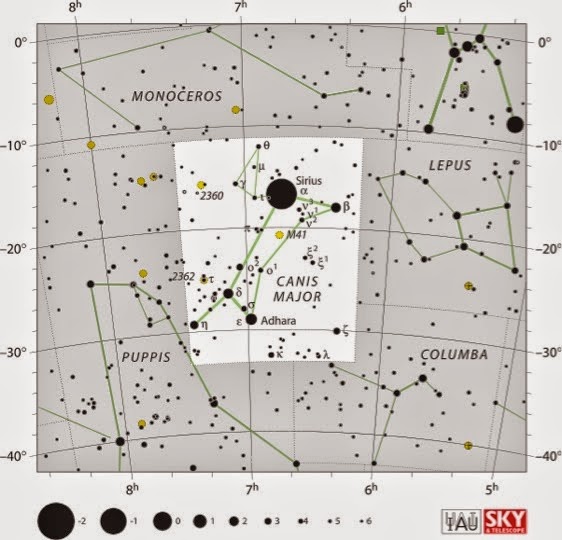
In fact, immediately before Truman's world is split apart by this visitor from the realm of the stars, he is accosted by a dog named Pluto (the dog's name is stated twice, once by his owner, and once by Truman himself). The dog (a big dalmatian) gets up on Truman and places its forepaws on Truman's torso, so that it is basically standing up on its hind legs. Below is an image of the constellation Canis Major, which means "The Big Dog," the constellation which contains the brilliant star Sirius in its shoulder:

image: Wikimedia commons (link).

As can be seen from the row of black discs or circles, descending in size, along the bottom of the above star chart, the individual stars in charts like this are drawn as larger or smaller discs to indicate their relative brightness in the night sky: Sirius is shown as an enormous circle because Sirius is the single brightest star in the heavens, to an observer on earth (other than the sun).

The fact that a dog named Pluto gets up into the same posture displayed by the outline of the constellation Canis Major immediately before a light fixture bearing the words "SIRIUS (9 CANIS MAJOR)" plummets to the street can be interpreted as a fairly direct hint that the creators of

The Truman Show are trying to direct our attention to this part of the sky.

If we look upwards in the direction that the constellation is "leaning" (if it were actually a big dog, leaning against someone the way Pluto leans against Truman) we see that just up and to the right of the "forepaws" of Canis Major is the constellation of Orion -- you can easily make out his distinctive belt of three bright stars in the upper-right corner of the chart above. Orion was anciently associated (very strongly associated) with the Egyptian god of the underworld, Osiris: the god of the dead, the consort of Isis, and an incredibly important figure in esoteric tradition.

It is difficult to escape the conclusion that, by having the big dog rear up and place his paws on Truman the way they do, the creators of The Truman Show are implying that Truman at this point in the movie is enacting the role of Osiris, or that he is at this point trapped in the condition of Osiris. What might that imply? That he is "cast down" in an underworld (and, living as he does inside a dome, Truman does indeed exist in an underworld). That he is asleep (Osiris and other Osirian figures were often banished to a cave beneath the waves, to sleep away the eons until their promised return). That he is unconscious -- even, in a sense, "dead," because he is not really living. The remainder of the film will illustrate Truman's process of waking up, of "rising from the dead," of "raising up the Djed column that has been cast down" (the Djed column is a powerful symbol of ancient Egyptian mythos, associated with the "backbone of Osiris," and discussed in numerous previous posts, including this one).

The fact that the dog who gets up on Truman during this point of identification with Osiris is named "Pluto" is another major clue supporting the above interpretation: in addition to being a famous dog in the worlds created by that master of illusion and artifice, Walt Disney, Pluto is of course the name of the fearsome god of the underworld in the mythology of the ancient Latins, the god corresponding to the Greek Hades, the ruler of the dead and a fitting pointer to the entire underworld theme of Osiris outlined above.

If we need any further confirmation that The Truman Show is consciously and deliberately invoking these ancient myth-symbols, and doing so in a manner that demonstrates a high level of understanding of their power and import, we can take a look at the camera angle selected for the moment that Truman tentatively (or should we say, reverently?) approaches the light labeled Sirius and reaches out to touch it (see the video beginning at 0:47 in the above clip, and observe the chosen camera angle from that point until 0:58 or 0:59).

Notice anything significant about it? Truman is deliberately framed in between two pillars. This symbology is of course quite directly evocative of the scriptures of the Old Testament and the pillars of the Temple. It is also, according to the analysis of Alvin Boyd Kuhn offered in his masterful 1940 text Lost Light, symbolic of the "two pillars of the horizon" between which men and women labor in this incarnate existence, and hence symbolic of the "horizontal line" on the Cross symbol: the horizontal line of our material side, of our animal nature, as opposed to the "vertical line" of the spiritual component (see some of the discussion and Alvin Boyd Kuhn quotations in this previous post entitled "New Year's and the Egyptian Book of the Dead," for example, for further development of this topic).

The Temple, of course, can be associated with the human body in this incarnate life on earth, and the body is in fact plainly called "the temple" in some of the New Testament scriptures (both in the words of Jesus in passages such as John 2:19, and the words of Paul in passages such as 1 Corinthians 3:16, 1 Corinthians 6:19, and 2 Corinthians 6:16) -- this lends further confirmation to the interpretation that the "two pillars" refer to "this incarnate life."

We have seen that this horizontal line of the Cross, between the pillars of the equinoxes, represents "the Djed column cast down," or Osiris laid out as a mummy upon a funerary bed or in a sarcophagus, just as the vertical line represents "the Djed column raised back up." Ancient mythology thus implied that our being "cast down" into this "underworld" of incarnation, this "vale of tears," this world of illusion (in which we falsely believe that the world we see around us is all that there is, when in fact there is a "real world which is behind this one," just as there is in The Truman Show) is somehow a necessary step on our way towards raising the Djed back up, transcending the material, piercing the illusion, escaping the bonds of death or sleep or unconsciousness.

In fact, the use of Osirian imagery seems to be a deliberate symbol inserted into films which have to do with transcending the illusion, or breaking out of mind control (see previous discussions of the recent 2014 film Interstellar and of the 1968 classic Planet of the Apes). It may be said to be a kind of signal to alert us that what we are watching may well have something to say about the journey that each and every man and woman must make through this "underworld kingdom," and the important task of seeing through the veils of illusion and perceiving the truth, and raising the Djed that has been cast down.

It should be evident that doing so requires us to take personal responsibility for analyzing and thinking for ourselves -- to tune out the voices that tell us to accept (like a child) their illusory authority, and their "settled" interpretation of all of the most important matters. This seems to imply that no one else can "wake up for us" -- we have to do it ourselves (because if we simply accept the interpretation of someone else who has "woken up" on their authority, without examining the evidence and weighing the hypotheses and making the decision for ourselves, then we are still in pretty much the same condition that we were before, only substituting one authority for another).

Critical thinking and analysis are absolutely indispensable tools against mind control and for human consciousness.

a "gloss" is a literary term for a helpful definition that is written above a word in a text from another language -- medieval monks in England, for instance, would sometimes write the English translation for an unfamiliar Latin word in a Latin text, to make it easier for them or the next reader who came to that word (so they wouldn't have to "look it up" again -- the definition was written right there above the word, or in the margin). Thus, to "gloss" something means to define it, or translate it: and to "gloss over" something is to "define away" any unfavorable meaning, or to "translate it" in a way favorable to some agenda. This usage of the word "gloss" shows just how powerful the control of language really is: controlling the words one uses and how they are defined often enables controlling the way people think (as George Orwell tried to tell us). 

Of course, a "glossary" is a collection of "glosses," just as an "aviary" is a collection of birds or a "bestiary" is a collection of animals -- a "glossary" is a collection of short, handy definitions of words.