Comet C/2014 Q2 (Lovejoy)

Comet C/2014 Q2 (Lovejoy)

image: Wikimedia commons (link).

I am a catastrophist: I believe that the existing evidence overwhelmingly supports theories which conclude that earth's geology was primarily shaped by one or more catastrophic events, rather than theories which posit that earth's geology as we see it today is the result of the same types of processes we see acting around us today, and that given enough time these "normal" processes could produce the geological features we see on our planet.

The question of whether our planet's features reveal evidence of catastrophe, or whether our planet's features were produced by "normal" processes acting in a "uniform" manner over eons and eons of time (the so-called "uniformitarian" category of theories, which arose in the eighteenth century among those who may have had ulterior motives for rejecting then-prevailing catastrophist thought), is important in its own right, of course.

But it is also important with regard to the mystery of humanity's ancient past.

Just as I believe the evidence overwhelmingly supports a catastrophist conclusion regarding the forces which shaped the features we find all around us on planet earth, in contrast to the "uniformitarian" explanations which have now become the dominant conventional position of most in academia, I believe that the evidence overwhelmingly supports a view of ancient human history which is radically different from the currently-accepted conventional narrative held by academia today.

For example, the ancient mysterious monuments found on the Giza plateau in Egypt (the Giza pyramids), the ruins of the Indus Valley civilization (in modern-day India), the Nazca lines (in modern-day Chile), the temples at the Angkor complex (in modern-day Cambodia), and Rapa Nui (Easter Island) are all located on a "great circle" -- indicating some kind of coordination which we cannot currently explain with the conventional paradigm of human history, as well as very precise and sophisticated ancient knowledge of the size and shape of our spherical earth.

There are many other ancient sites located along different great circles -- part of a body of evidence suggesting that the most mysterious monuments on our planet may all have been part of some kind of a vast worldwide grid, the purpose and design of which remains a mystery at this time.

The geological evidence of a catastrophe or catastrophes (which is generally rejected by the uniformitarian camp dominant in academia) may well be related to the mysteries of humanity's ancient past (which, judging by massive evidence which refutes the conventional academic view, was almost certainly very different from what we have been taught).

Comets may constitute an entire category of space-borne evidence of a tremendous catastrophe within our solar system long ages ago. Dr. Walt Brown, the originator of the hydroplate theory (a catastrophist theory involving a global flood, a theory which has tremendous amounts of evidence to support it, and which is the subject of numerous previous blog posts as well as my first book, The Mathisen Corollary), believes that numerous pieces of evidence indicate that comets are the modern remains of water which was violently ejected from earth at the start of the catastrophic flood event.

You can read about some of this evidence in numerous previous posts on comets, such as these "internal search" results for the word comet using the internal search window for this blog found in the upper-left portion of most desktop browsers, and you can read more about Dr. Brown's analysis of the evidence regarding the origin of comets in this chapter of the latest edition of his book, which he graciously makes available in its entirety online here (you can also order the physical version of the book here).

Right now is an exciting time, because a long-traveling spacefarer in the form of a long-period comet has entered the inner solar system and is streaking past the earth, close enough to be visible with the naked eye (although not very easily -- it is more easily visible with binoculars). It is Comet C/2014 Q2 (Lovejoy), discovered by Terry Lovejoy of Australia last year. This comet has an orbital period estimated by conventional scientists as approximately 14,000 years, which means that if they are right, it hasn't passed this way since around 12,000 BC, and won't be back again until around the year AD 14,000. 

There are some good reasons to suspect that the conventional estimates are somewhat flawed, which are discussed in this previous post about Comet ISON, which was based on Dr. Brown's discussion of Comet ISONin his book here. If Dr. Brown's theory is correct and the comets we see today are the remnants of a tremendous catastrophe which took place on earth thousands of years ago, it is possible that this is actually Q2's first return visit since that catastrophe took place. 

Those discussions also note that, due to the presence of mass at the outer reaches of our solar system, which might act to pull comets back a bit more quickly than conventional scientists currently calculate using their models -- which means that it might be a little less than 14,000 years before C/2014 Q2 passes back this way again. Nevertheless, an error of a few hundred years in an estimated orbital period of 14,000 probably won't make much difference to those of us living today -- and so we should probably make every effort to observe this long-traveling visitor this time around.

Fortunately, C/2014 Q2 is not difficult to locate, if you know where to look. It's not anywhere near as dramatic as was Comet Hale-Bopp, which was enormous even to the naked eye and looked exactly the way a "classical" comet would be expected to look. Q2 is very difficult to see with the naked eye, but it can be seen as a dim glow or fuzz with the naked eye, and with binoculars it can be easily perceived as what to me appeared to be a faintly-glowing tiny cloud, or perhaps what might be described as a very tiny flashlight shining towards us from behind a kind of blue fog.

But, while Hale-Bopp is also a long-period comet, its orbital period is nowhere near as long as that of C/2014 Q2. Hale-Bopp is expected to return in AD 4385 -- long before the next return of Comet Q2 -- and it had probably circled through the inner solar system at least once previously, in the 23rd century BC (there is some evidence that the ancient Egyptians may have recorded that previous visit). And so, Comet Q2, while much less visually spectacular, should inspire its own awe in the viewer, as we contemplate an object which has traveled so far, for so long, and which has streaked in towards us close enough to see from the almost-incomprehensible distance of 1,156 astronomical units (Halley's comet, a short-period comet, only gets out to 35 astronomical units before coming back, and it is due again in AD 2061).

Right now the moon is in its waning phase, on its way to a new moon on January 20. The moon is rising fairly late in the night (after 11pm, and getting later each night). So it is an excellent time to go out and look for Comet C/2014 Q2.

Below, I will present a series of images that will help you locate the comet, if you haven't been able to do so already. With apologies to my southern hemisphere friends, these will be "northern hemisphere-centric." 

First, head over to Sky & Telescope, where Alan McRobert has written an article containing two excellent star charts that show the path of the comet from one night to the next -- since we are now in January of 2015, you will want to use the second of the two charts (the very last chart at the very bottom of the article).

The arcing yellow line shows the comet's path from one night to the next, but you won't be able to actually see it moving -- look on the line for the little tick-marks indicating the comet's location by date, and find the mark indicating the current date to see where the comet should be along that curved line.

The images below should help get you "in the ballpark." 

I went outside and laid down on my back on the ground, and looked up at the sky using binoculars. If you happen to own a reclining lawn chair, that might be slightly more comfortable, although lying on the ground at night and looking up at the stars is also rather nice.

If it is not cloudy or foggy (or full of light pollution from city lights), you should have no difficulty observing the breathtaking panorama of winter stars, including Orion, Taurus, and the Pleiades. These will act as the pointers to direct us to the location of Comet C/2014 Q2.

The image below (from the excellent free open-source planetarium app Stellarium) shows the night sky as I observed it this evening, from a location that is about 35 North latitude, and looking to the south. You can clearly see Orion with his three belt stars, as well as Sirius in Canis Major to his lower left, inside the band of the Milky Way. To the right and up from Orion on the other side from Sirius, you can see the distinctive "V" of the Hyades, with orange-colored Aldebaran as their brightest star. Beyond the "V" of the Hyades you can see the gorgeous little cluster of the Pleiades. We will label these in a future slide, as we "zoom in" a little closer.
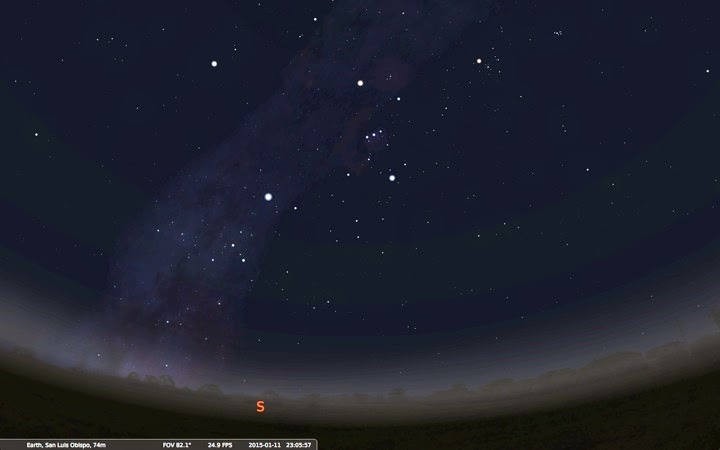
I would recommend using binoculars if you have access to some. While lying on the ground, try to observe the three belt-stars of Orion, without having to strain your neck at all (you should find that you can move the angle of the binoculars to "sweep" to different stars, without having to actually lift your head up off the ground or the reclining lounge chair). 

Check your focus -- see if they are clear and distinct. If not use the wheel to dial them into focus.

Then head up to the Pleiades. You should be able to see them all very distinctly. They are stunningly beautiful. You may want to just stare at the Pleiades for hours. They are often called the "Seven Sisters," but there are many more than seven, as you will see if you look at them with binoculars. Ensure your focus is nice and clear on the Pleiades.

Below is the same screen-shot as that shown just above, but this time I have outlined a rectangle that includes the area we want to focus on in order to locate Comet Q2:

This red rectangle shows the section of the sky that includes the "main body" stars of the constellation Orion, along with the "V" of the Hyades, and (in the upper-right corner) the cluster of the Pleiades.

Below is the area within that red rectangle:
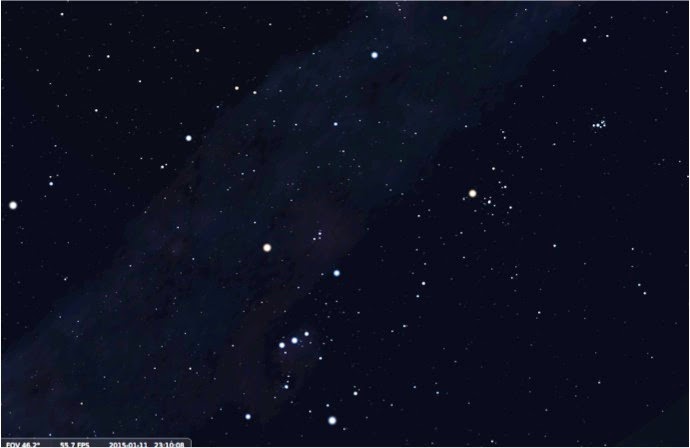
Can you find the constellation Orion, the "V" of the Hyades (with Aldebaran), and the tiny cluster of the Pleiades in the image above?

Below is the same image, with those three landmarks labeled for you:
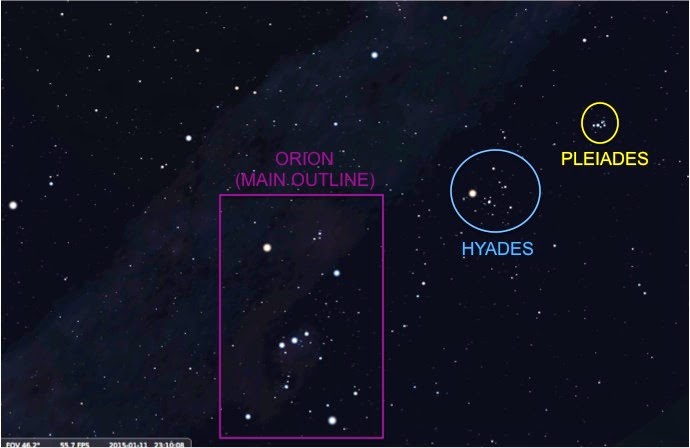
You should be able to find all three of these major sky landmarks with your binoculars and have good enough focus to make out the individual stars of the Pleiades or the Hyades before you try to find Comet Q2.

To find Q2, I believe the best way is to draw a line from the bottom of the "V" of the Hyades to the next star down from the "V." In other words, envision the "V" as a capital letter-"Y" instead of a "V." There is a star, clearly visible with binoculars, that you can find if you follow a line that bisects the "V" of the Hyades and if you follow that line through the point at the bottom of the "V" on across space until you reach a star that "turns the V into a capital-Y." The diagram below shows how to find this star:
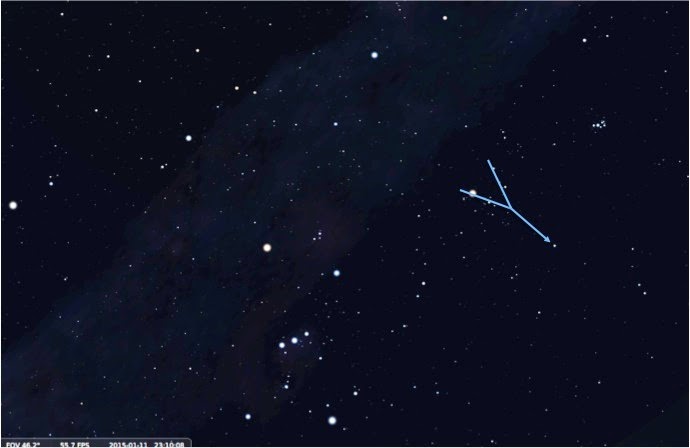
The arrow at the bottom of this letter "Y" is pointing right to the first star below the "point of the V" of the Hyades. This star is actually the star designated as lambda Tauri, sometimes known as the "Bull's chest." If you find it, you are well on your way to locating the comet.

Note, of course, that this will only work for the comet's location on the next couple of nights. As those charts from Star & Telescope illustrate, the comet's path continues to arc further to the north, at the top of the screenshots above, and so soon we will have to find a new "handrail" to get us in the vicinity of the comet's location.

However, right now this method should work very well to allow you to find Comet Q2.

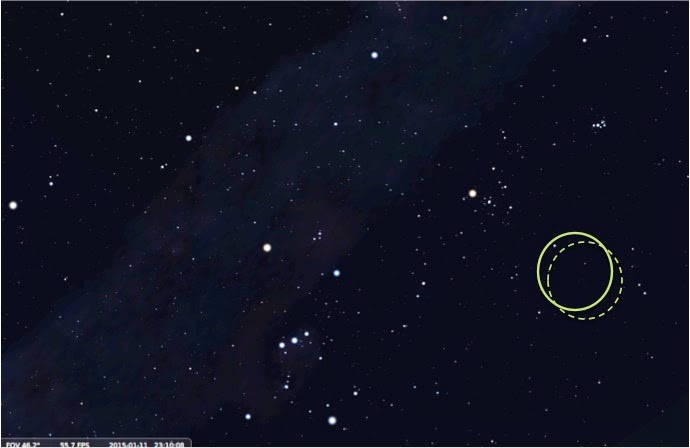
The comet is currently "down and to the right" from lambda Tauri, roughly along the same axis as the "arrow" shown in the screenshot just above. I found that if I continued in the same direction as the line formed from the bottom of the "V" of the Hyades through lambda Tauri

using my binoculars, lambda Tauri  would disappear from the "circle" of view of the binoculars just as the comet came into view (with lambda Tauri  disappearing to the "upper left" of the circle just as the comet appeared in the "lower right" of the circle).

Below, I have shown the "circle" of view as visible through my binoculars (10 x 24 with a 6 degree view). As I have tried to depict, if you continue down and to the right from lambda Tauri, you will get to a field that contains the comet just after lambda Tauri is no longer in the circle. The "dotted circle" would contain the comet:
As stated previously, the comet appeared to me as a kind of "glowing fog." It had a ghostly bluish color. It appears like an illuminated mist or haze, to me. I don't think you will mistake it for a star, if you have your binoculars in focus (use the Hyades or Pleiades to focus). The comet is currently at the location indicated by the red "X" below -- but remember that it will continue to travel north, and will be passing by the Pleiades on the 19th of January:
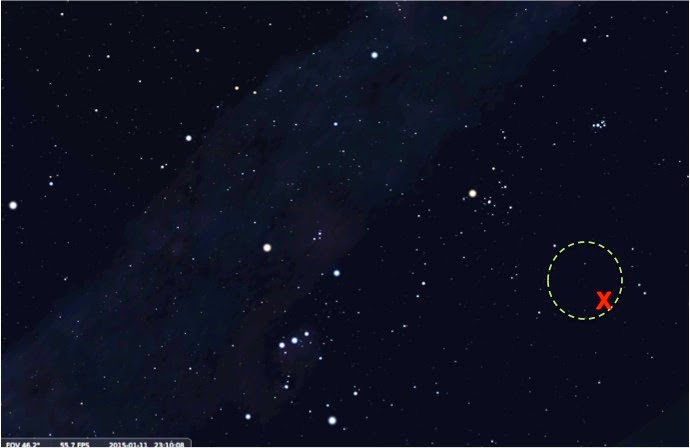
In the above image, you can see the "V" of the Hyades, then follow down the "Y" to the star lambda Tauri, and then continue moving the circular view of your binoculars a little further. You can see that the comet comes into the circle of the view as the star lambda Tauri is just outside the circle. 

Finally, I have created one more image in which I have attempted to create the "bluish glow" of the comet. This isn't really what it looks like "in person" -- the comet itself is much more magical looking, as if someone or something were illuminating a cloud or a fog. It is faint, but it is kind of ghostly-looking, as if it were glowing. The image below is simply an attempt to give the impression, in order to help you know what to look for. It also won't be this big -- not much bigger, in fact, than lambda Tauri or some of the other stars you will see as you make your way over to the comet's location, but possessing a very slight cloud around it.

I hope that this discussion gives you the motivation to go locate Comet C/2014 Q2 (Lovejoy), as well as the confidence to know that you can and will find it!

This long-traveling comet is awesome to contemplate: with a periodicity that approaches 14,000 years, it is like an ocean wave which crests only once every fourteen millennia, a drum that beats out a rhythm  only once every one hundred forty centuries.

Additionally, it may be a messenger from an ancient catastrophe of incredible magnitude, a catastrophe that left scars across the face of our planet (and elsewhere in our solar system), and one that may be tied up with the mysterious ancient history of humanity.

I hope that you will be able to see it!

"Wake up, gorillas! Don't perpetrate violence."

"Wake up, gorillas! Don't perpetrate violence."

I believe that the original 1968 Planet of the Apes film really has little or nothing to do with the idea of actual apes taking over the world in some imaginary future, but that its true purpose is to graphically depict systems of oppression and mind control in human societies in the present day

One of the most powerful messages conveyed by the film is that oppression and tyranny actually require the cooperation and complicity of three different categories of participants -- none of whom could actually be completely effective without the special skill-sets of the other two. 

In the metaphor of the movie, these three groups are graphically and memorably depicted as the orangutans, the gorillas, and the chimpanzees. 

Note well that it should go without saying that these different roles of "gorilla," or "orangutan," or "chimpanzee," are absolutely not intended to refer to different ethnicities or religions or other "labels" which are used to falsely divide us and turn us against one another and focus on externals instead of the fact that we are all spirit clothed in a body, and also to distract us from perceiving the real aspects of oppressive systems of control. No, the three different groups of apes depicted in the film represent different roles that any man or woman can find himself or herself playing in this world, if we are not careful (and sometimes even if we are). 

Far from being "typical" of any one artificial division of humanity, each of the special skills displayed by these three groups of apes in the metaphor of the film (and the 1963 book by French author Pierre Boulle, on which it is loosely based) seem to represent aspects of human nature common to all men and women, aspects we each possess to some degree.

Each of these aspects of our nature actually has a very positive role to play on behalf of human freedom and individual consciousness and empowerment. But each can also be twisted into the service of oppression and tyranny and the suppression of human consciousness -- and it is this twisted side that is on display in the 1968Planet of the Apes, where the tyrannical oppression is maintained by fraud, violence and cowardly collaboration, in a world that is portrayed as an inversion or 180-degree opposite of the way things rightfully should be (and which, the film implies, is the way our own society has somehow become).

The special skill of the gorillas, of course, is the application of physical combat power. This skill, it must be understood, is not inherently evil, but is in fact necessary  at times, in order to stop violence, which is a subset of physical force when applied in violation of someone's natural inherent rights. 

The application of physical combat force, whether with a weapon or without it, when used to protect someone from having their physical body damaged or violated by another, is not a violation and thus is not properly violence. If someone sees a person preparing to injure or violate another human being, and that someone uses physical force to stop that other person from perpetrating that violence, it is completely lawful and proper to do so. 

Thus, skill at applying physical force is admirable and good, when coupled with the understanding that such force is only rightly applied to protect oneself or others from violence. The "gorillas" in the film, of course, unquestioningly and happily employ force in the service of oppressing anyone who questions the absolutist vision of the orangutans -- and especially in the service of oppressing the terrified, persecuted, huddled masses of pathetic and voiceless humans. 

Were the gorillas to refuse to use their special skills in the service of the orangutans' criminal system of oppression, and instead devote themselves to only using force to actually protecting the helpless, the entire tyrannical system would cease to be able to oppress anyone. The orangutans are dependent upon the "muscle" of the gorillas and the special skill-set that the gorillas possess in order to impose their system upon the other apes and upon the degraded humans.

The orangutans, for their part, specialize in creating and maintaining the illusion upon which the entire fraudulent and criminally oppressive societal structure is constructed. It is extremely noteworthy that this fraudulent fabric of illusion depends upon a knowingly false narrative regarding the ancient history of the planet, and about the ancient capabilities and origins of humanity. It is also noteworthy that the orangutan system is built around religious dogmas, a literalistic adherence to certain ancient scriptures, and an ideological system that seeks to excuse and condone violence in support of this oppressive system -- to try to cloak that which is criminal and illegitimate in a "veil of legitimacy."

Once again, however, the special skills of the orangutans are not in and of themselves inherently criminal. The orangutans' special expertise is in the interpretation of symbol, in the examination of meaning and legitimacy, in the pursuit of that which gives purpose to existence and in warning against that which is wrong or harmful to oneself or others. 

It is clear that in the twisted, inverted world portrayed in the movie, the orangutans have chosen to use their special skills to divide, to conquer, to oppress, and to deceive. At least some of them know the truth (Dr. Zaius being the most obvious example) but choose to teach lies instead -- perhaps even from a partly-understandable belief that the truth, if known, would lead to chaos or self-destruction (an insufficient excuse for perpetrating fraud, violence, and oppression against others, but one that Dr. Zaius at least seems to believe and which at least partly informs his behavior).

What the orangutans should do with their special skill is use it in the service of the empowering message that the world of symbols was actually designed to convey. There are certain aspects of the invisible realm, of the spiritual side of existence, which can only be properly conveyed or grasped through symbol -- and the orangutans, with their special proclivity for understanding the fact that reality can be created, should be helping individuals to grasp those powerful and liberating truths and pointing them towards greater consciousness, which would almost certainly have profoundly positive effects on society as a whole, far outweighing any imagined danger.

The chimpanzees, of course, have a talent for investigating, for searching for knowledge, for noticing new evidence and analyzing it, for thinking of new and innovative ways to do things, for exploring new and innovative ideas, and also for organizing knowledge and sharing knowledge and recording knowledge and communicating knowledge for the benefit of society. They are actually portrayed doing some of this positive analysis and seeking after knowledge during the original 1968 film, even at some risk to themselves -- but the film clearly implies that the "chimpanzee class" is naturally somewhat fearful, eager to please the orangutans, and in general they are overly-ready to accept the religious and ideological interpretations handed down to them by the orangutans and to support the oppressive social structure that is built upon the orangutans' outright lies about ancient history and the artificial limits the orangutans seek to impose upon the freedom of other apes and of the voiceless masses of the completely dispossessed humans.

The chimpanzees as a whole are essential enablers of the tyrannical system of the orangutans, just as much as are the gorillas. In modern "human" society, we can think of a variety of human talents or aspects of society which correspond to the chimpanzees, including academia, those in the news media, those in middle management at corporations, those in entrepreneurial roles, many of those in public service at government jobs, those employed as bureaucrats in the vast machineries that make modern society run the way it does. 

If members of the media and of academia, for example, actively pursued anomalous evidence the way that Zira and Cornelius are shown to do in the film, the fictions upon which tyrannical oppression is built would dissolve. The gorillas might even begin to question what they were employing their special skill-sets to support. The message might get out that such skill-sets are properly employed only to stop violence, never to perpetrate it on the behalf of some ideology fabricated by orangutans defending their system. Anyone who doubts that the skills and roles denoted in the movie are not critical to systems of tyranny can try to think of any tyrannies in the era of mass media technologies (including radio and printing presses) that have not employed propaganda arms using those media. 

Finally, the humans in the metaphor that operates in the 1968 Planet of the Apes are perhaps the most intriguing of all. Because, just as the film warns us against falling into the trap of being too unquestioning (if acting in the role of the gorillas), too fearful and supportive of evil and fraud (if acting in the role of the chimpanzees), or too cynical to pursue higher consciousness for ourselves and to empower others to do the same (if acting in the role of the orangutans), it seems to also be warning us against accepting a vision of humanity that is completely animal, mindless, irrational, and focused entirely on bare survival and fulfillment of physical needs and functions. 

Of course, the humans in the film can also be seen as those "voiceless" members of society who are marginalized, exploited, and oppressed the most of all -- those who are brutalized by the gorillas, feared and despised by the orangutans, and seen as specimens to be studied or used by the chimpanzees. And that is certainly one aspect of the humans as portrayed in the metaphor of Planet of the Apes, and a powerful condemnation of the history of inhumanity and oppression and marginalization of huge numbers of people who should be allowed to reclaim their proper voice. 

And perhaps this fourth group is the best hope, if they can be empowered to see beyond simple survival and "creature comfort," and if they can reclaim their voice, because unlike the gorillas and the chimpanzees, they are not beneficiaries of the fraudulent tyranny of the orangutans that the gorillas and the chimpanzees are enabling.

But it seems that the humans in the film also represent the tendency in each one of us to forget that special aspect of our existence, of being a mixture of both "animal" and "god" (as Alvin Boyd Kuhn puts it, in some of his discussions of the symbol of the cross, which has a horizontal "animal" or purely physical component, and a vertical "divine" or spiritual component -- see here,

here, and here, for example). Remaining in ignorance or denial of our true human nature leaves us incomplete, and degraded.

The 1968 Planet of the Apes film is not exactly "uplifting" in its tone, but it is possible to perceive a very positive and uplifting message in what we are discussing. This post has focused on the film's unique and very memorable method of illustrating an important truth: that tyranny and injustice cannot really be perpetrated without the cooperation of people who are exercising skills from three different aspects of human nature: skills involving the use of force in actual combat (the gorillas), skills involved in the pursuit of knowledge, and its organization and dissemination (the chimpanzees), and skills involved in the creation of and interpretation of symbols and meaning (the orangutans).

This in itself is an important lesson, but it points to something else as well, and that is the fact that -- because each of these aspects of our own human nature can actually be used in a very positive way -- the entire system that is currently degrading humanity and perpetrating tyranny through fraud and through violence (because of the improper use of the orangutan, gorilla, and chimpanzee skills) could suddenly and smoothly become uplifting and empowering! 

If those with skills in the interpretation of symbols devoted themselves to pointing out the empowering message that the ancient symbols were really meant to teach, and if those with skills in the application of force devoted themselves to protecting innocent people from harm, and if those with skills in seeking knowledge and innovating and discovering devoted themselves to looking at all the possibilities and having the courage to follow the evidence where it leads and the courage to communicate what they have seen, then the upside-down world would be turned back right-side up. 

Of course, there will always be those who choose to try to gain mastery over others through fraud or through violence (or both), but the more "chimpanzees" society has who are ready to look for evidence and analyze it fearlessly and confront and expose falsehood, the more difficult it will be such fraud to remain unchallenged. And the more "gorillas" society has who refuse to use their skills for criminal ends and who instead pledge to use their skills only to stop actual perpetration of violence, the more difficult it will be for violent plots to stand a chance of success. And the more "orangutans" society has who are pointing people to the truth that they can do and be much more than they have ever been told they could accomplish, then the more difficult it will be for those who wish to use techniques of "reality creation" to enslave instead of to liberate and to empower.

Ultimately, this kind of shift will enable humans to be more human, and to exercise both halves of our unique human nature, to "bless" all things by identifying the spirit and seeing them as being more than simply physical, instead of "cursing" them by trying to reduce them to mere objects, lumps of material devoid of spirit.

We could perhaps distill the message of the 1968 Planet of the Apes (at least, the part of its message that we have been examining here) into a paraphrase that sounds something like this:

  • "Wake up, gorillas! Don't perpetrate violence."
  • "Show a little backbone, chimpanzees! Don't enable tyranny or propaganda."
  • "Point to the right Way, orangutans! Don't cynically substitute lies for truth, but instead help to uplift others and point them towards consciousness, which you are supposed to be doing."
  • "Find a voice, humans! Don't allow yourself to be told you are less than who you are."

Epiphany: revealing the hidden divine nature

Epiphany: revealing the hidden divine nature

image: Wikimedia commons (link).

The traditional celebration of Christmas continues for twelve days, beginning with the midnight birth of Jesus at the juncture between December 24 & December 25 (three days after winter solstice, which generally falls on December 21st most years, as discussed in this previous post) and ending with the celebration of Twelfth Night at the juncture between January 5 & January 6, with its ultimate conclusion celebrated at Epiphany on January 6th. 

Epiphany is a word which means to "show forth" and refers to the revealing of the divinity of the Christ in the gospels stories. 

The word epiphany itself contains the Greek prefix epi- meaning "to" or "towards" or "upon" (and which is found in the word epistle, meaning "a formal written letter or message" which combines the "to" prefix and the verb stellein, "to send;" and in the word epithet, meaning "a title or label given to someone or something," which combines the prefix epi- with the verb tithenai, "to place upon;" and in the word epitaph, meaning "an inscription upon a tombstone," which combines the prefix epi- with the noun taphos or "tomb") and the Greek verb phainein, meaning "to show" (and which is found in the English word diaphanous, meaning "of such a fine texture as to be transparent or translucent," which combines the Greek prefix dia- meaning "through" and the verb phainein meaning "to show").

The same day which is referred to as Epiphany in most western church traditions is referred to as Theophany in the eastern or Greek church traditions, which literally means "the revealing of God" or "the appearance of a god or goddess to a man or woman," from the Greek word theos, "a  god," and phainein, "to show". 

The day of Epiphany is traditionally associated with three specific events in the gospel accounts which have to do with the revelation or recognition of divinity in the Christ: with the visit of the Magi (or "Three Kings," who come and give honor to the Christ child and give symbolic gifts), with the baptism of Jesus by John the Baptist in the Jordan (in which the heavens open up, a voice proclaims "This is my son," and the Spirit descends like a dove), and in the wedding at Cana (in which the first public miracle is performed, in the changing of water into wine).

Some of the esoteric, symbolic, and celestial aspects of the visit of the Magi have been discussed in this previous post. There are indications that the baptism by John the Baptist in the Jordan, and the wedding miracle at Cana, both have celestial foundations as well -- and that their intended meaning concerns not the events of historical personages thousands of years ago, but rather the condition in which every man and woman finds himself or herself during this incarnate, material life.

[The remainder of this post will examine evidence that the stories in the Biblical scriptures were not intended to be understood literally. Those not comfortable examining such evidence may not wish to read further].

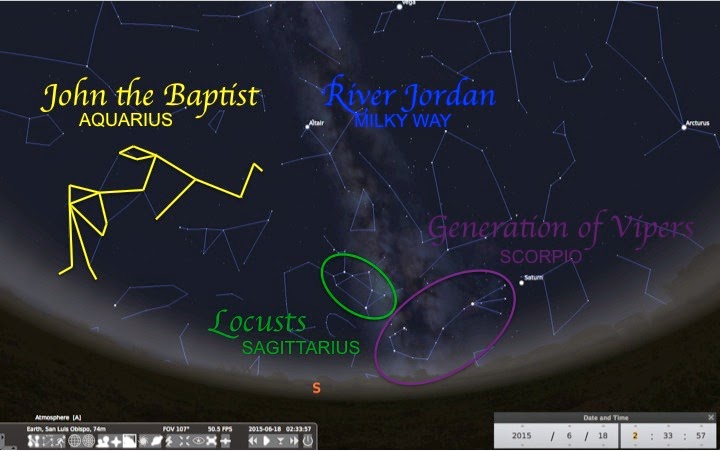
We have already examined evidence that the figure of John the Baptist has strong connections with the zodiac sign of Aquarius, a figure who is of course associated with water and the pouring out of water, and also with the beginning of the ascent back up from the lowest point on the "zodiac wheel." We have seen that the constellation of Aquarius in the sky appears as a man carrying a jug or jar of water, in a distinctly pitched-forward posture, with an outstretched forward leg (see star-chart below). 

This leaned-forward posture, we argued in that previous post, was also responsible for the story about John the Baptist losing his head, since when rising in the east his head would still be beneath the horizon when the body has already cleared the horizon, and when setting in the west there would be a point at which his head was still above the horizon when his body had already sunk below it.

That previous post also showed sacred art from centuries ago depicting the beheading of John the Baptist, in which the Baptist is painted in a kneeling, pitched-forward posture, with his hands bound and positioned about where the "forward leg" is located in the constellation above. One could even argue that the beheading legend might also come from envisioning the jug of Aquarius as the severed head of John, with the streams of water transformed into blood in that case (and, it must be admitted, the small diamond-shaped head of the constellation is quite faint, making this view of the constellation a very plausible possibility).

Based on this identification of John the Baptist and Aquarius in these specific episodes, it is certainly likely that the episode of the Baptism of Christ also derives from the figure of Aquarius as identified with John the Baptist, and that the pouring out of water from the vessel carried by Aquarius is the foundation for the baptism of Christ by John. 

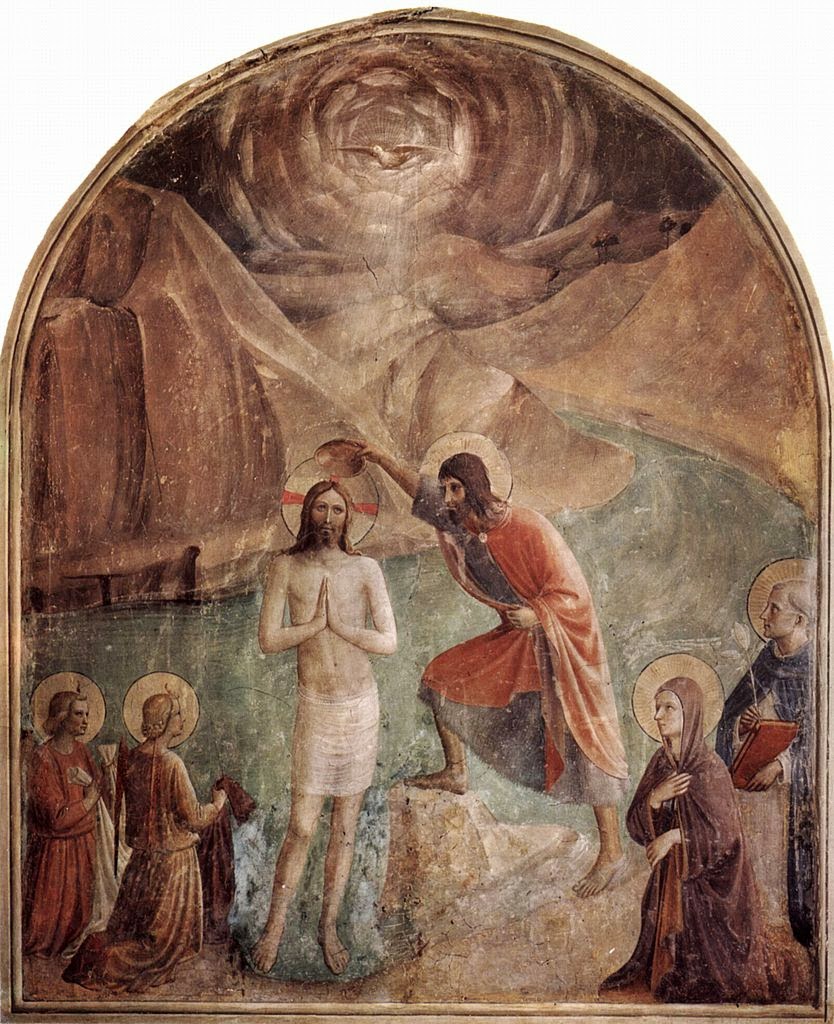
And, as it turns out, sacred art has for centuries depicted John the Baptist in the act of baptizing Jesus as having the same distinctive features of the constellation Aquarius, including the position of the legs, the upraised arms and water vessel, and the streams of water flowing down (see for example the image in the fresco at top, painted during the first half of the 1400s).

The constellation directly below the streams of water coming from the jug of Aquarius is the Southern Fish or Piscis Austrinis, which is discussed and shown in star-charts in this previous post from 2012. Interestingly enough, in the sacred art from previous centuries in which John is depicted with features of Aquarius, the figure of Jesus is often portrayed with his hands together in the anjali mudra (see discussion here), which is also a "fish-like" hand gesture and one that is sometimes used to depict a fish swimming in the water in some children's songs that use hand gestures, for example. The fresco at top demonstrates this hand position.

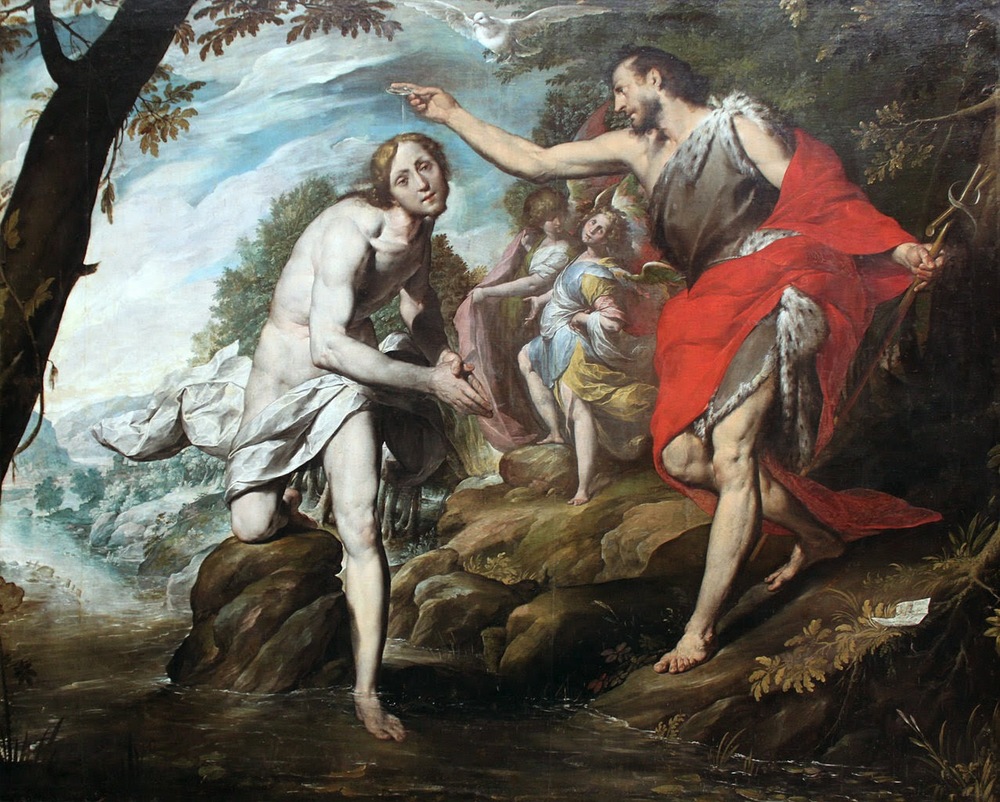
Sometimes, the figure of Jesus is shown as being even more "fish-like" in form, not just with the hand gesture but with the position of the body as well, such as in the image below, painted in 1601:

image: Wikimedia commons (link).

Sometimes, the figure of John is shown as having a long staff, usually surmounted with a cross-piece to make it cruciform: the image above shows such a crucifix in John's hand. This feature probably derives from the outstretched "forward leg" of the constellation Aquarius itself. Below is another image of the baptism scene, this one from the 1500s, in which John is shown with such a cruciform staff:

image: Wikimedia commons (link).

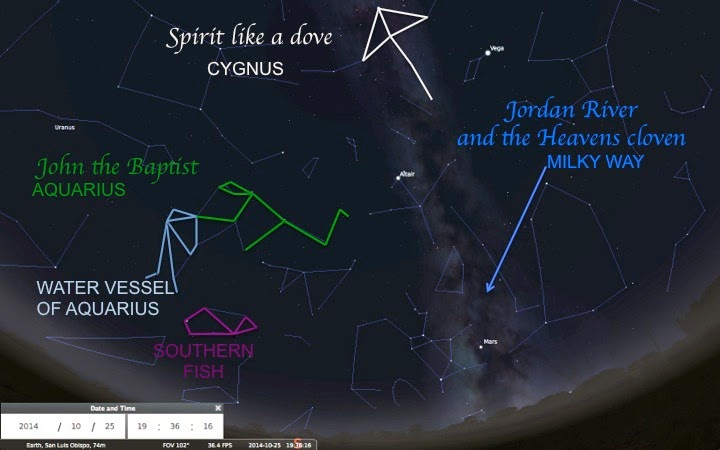
The Aquarius symbology should be evident in all three of the above figures of John the Baptist. The image of the descending dove in between the glowing clouds, present in all three images and in the scripture accounts of the baptism scene, should be evident enough: it is the important constellation Cygnus the Swan, flying "downwards" through the clouds of the Milky Way. Below is an image using the free open-source planetarium application from stellarium.org showing the constellations in question:

As the labels in the diagram indicate, the scripture accounts tell us that the descending Spirit appears and descends when "the heavens opened" -- literally when the heavens were "cloven" or "rent" (like a torn garment). See for example Mark 1:10, where the scriptures read: "And straightway coming up out of the water, he saw the heavens opened [or "cloven" or "rent"], and the Spirit like a dove descending upon him."

You can see from the Milky Way shown in the Stellarium application and the image above that this word "cloven" or "rent" is a very apt descriptor for the Milky Way as it rises up behind Aquarius and as the majestic constellation Cygnus flies "down" it. In fact, this feature of the Milky Way Galaxy which we can see from our observation point on earth is often referred to as the Galactic Rift or the Great Rift. This is almost certainly a clue included in the text to help confirm that the constellations indicated above are those being described.

There are reasons to believe that the Wedding at Cana, in which water is turned to wine, connects to the constellation Aquarius as well (for one thing, Noah was also described in the Old Testament as the first to make wine, and we have already examined evidence that he was associated with Aquariusas well).

It is possible that all these events and episodes actually represent literal and historic events, which just happen to also match up quite precisely to specific constellations that had been positioned in the sky long before they ever happened. It is also possible to argue that these events were foreseen and then were "pre-figured in the stars." 

However, both of these explanations are more difficult to maintain due to the fact that multiple scriptural accounts appear to match up to the same constellations. 

It appears much more likely that these scriptures, just like myths from virtually every ancient culture around the globe, were not actually intended to preserve literal and historical events which took place on planet earth, but that they are exquisitely-crafted celestial allegories designed to convey esoteric truths. If multiple stories around the world, and multiple stories within the Old and New Testaments themselves, can be shown to derive from the very samesets of constellations, then a very likely explanation is that the same constellations gave rise to many different esoteric myths which "dress up" those constellations in different ways, in order to convey profound knowledge which is difficult to grasp except through metaphor.

If so, then what could this series of stories connected with the Epiphany (or Theophany) be trying to convey?

For a possible answer, consider again the quotation from a 1936 lecture by esotericist Alvin Boyd Kuhn, cited in this previous post and discussed further in the subsequent post on the Three Kings (who are also closely associated with the Epiphany), in which Kuhn asserts:

The Bible is the drama of our history here and now; and it is not apprehended in its full force and applicability until every reader discerns himself [or herself] to be the central figure in it! The Bible is about the mystery of human life. Instead of relating to the incidents of a remote epoch in temporal history, it deals with the reality of the living present in the life of every soul on earth.

In other words, the Epiphany is about the mystery of human life, and it is not apprehended in its full force and applicability until you realize that you yourself are the central figure in it! 

The baptism scene, with its recognition or revelation of the divinity in the one whom the scriptures describe as descending into incarnate form, and then being "placed beneath the waters" in the baptism scene, describes and depicts the condition of every human soul which has plunged into incarnation, when we leave the realm of spirit (the realm of the upper elements of "air" and "fire") to be clothed in a body of "clay" -- that is, a body composed of the lower elements of "earth" and "water" (seven-eighths water, as we have been told).

These stories convey the message that each and every one of us carries within us a divine spark, which has been plunged into the water and obscured inside our material form. Immersed in this world of physicality and materiality, it is all too easy to be completely blinded to that "invisible realm" or realm of spirit, and to live as though we are completely material beings, denying or forgetting our spiritual nature altogether. One of the purposes of these texts is to cause us to remember -- and one of the purposes of the celebration of Epiphany, it seems, is to help us to remember that we ourselves, and every single human being we ever encounter, contain a "hidden god," a divine spark.

Although some of the centuries-old traditions and ceremonies which have accompanied the celebration of Epiphany in many cultures may not be familiar to all readers, many of them are very powerful and are still carried out to this day in some communities. Many of these old traditions seem to imply the message of the plunge of the divine spark into matter, where it is hidden, and where it must be found and then "raised up."

One of these is the ritual known as the Blessing of the Waters, in which a cross is taken to the ocean, or to a lake or large river, and immersed in the waters. In his masterful 1940 text Lost Light, Alvin Boyd Kuhn explains that the cross itself is a symbol of the incarnate condition of every man and woman in this material life: we have a physical component, represented by the horizontal bar of the cross, and a spiritual component, represented by the vertical bar of the cross. 

The placing of the cross into the waters represents our plunge into the material realm: the raising up of the cross from the waters represents the recognition or revelation of the divine nature which can be hidden and even forgotten but which can never be completely denied. One of our important missions in this life is to recognize and elevate this divine spark in ourselves, in others, and indeed in all of creation around us. Epiphany, which takes place on our annual cycle when the sun begins to climb back up out of the deep pit of winter solstice, is marked by rituals which convey this important task.

In many cultures, the cross is actually flung into the water, where youths then rush to be the first to find it and retrieve it -- raising it up from the depths. This ritual continues every year to this day. Below is a video showing one such ceremony, in a community within the Greek Orthodox faith (where Epiphany is called Theophany):

Alvin Boyd Kuhn gives his explication of the symbolism of the cross and the water -- and he makes clear that the cross has also long been used as a symbol in many "non-Christian" traditions, including those of the ancient Egyptians and of many of the cultures of the Americas:

In a very direct sense the cross is connected with the flood of water that must be crossed, with the baptism and the lower sea voyage. [. . .] This most ancient, perhaps, of all religious symbols (by no means an exclusive instrument of Christian typology) was the most simple and natural ideograph that could be devised to stand as an index of the main basic datum of human life -- the fact that in man the two opposite poles of spirit and matter had crossed in union. The cross is but the badge of our incarnation, the axial crossing of soul and body, consciousness and substance, in one organic unity. An animal nature that walked horizontally to the earth and a divine nature that walked upright crossed their lines of force and consciousness in the same organism. [. . .]
The Toltecs called the cross the Tree of Sustenance and the Tree of Life. [. . .] The cross is a symbol of life, never of death, except as "death" means incarnation. It was the cross of life on earth because its four arms represented the fourfold foundation of the world, the four basic elements, earth, water, air, and fire, of the human temple, and because it was an emblem of the reproduction of new life, and thus an image of continuity, duration, stability, an eternal principle ever renewing itself in death. The whisperings of esoteric fable report that the very tree on which Jesus was hanged was grown from a sprout or seed from the forbidden Tree of Life in Genesis! There are many instances of the cross burgeoning into fresh life. The savior is not nailed on the tree; he is the tree. He unites in himself the horizontal human-animal and the upright divine. And the tree becomes alive; from dead state it flowers out in full leaf. The leaf is the sign of life in a tree. The Egyptians in the autumn threw down the Tat cross, and at the solstice or the equinox of spring, erected it again. The two positions made the cross. The Tat is the backbone of Osiris, the sign of eternal stability. And Tattu was the "place of establishing forever." 414 - 416.

This passage explains that the ritual of throwing down the cross and raising it back predates literalist Christianity as it was formulated in the first through fifth centuries AD. It was a ritual in ancient Egypt associated with the Djed-column (Kuhn uses the form Tat, the older version of writing this same word in our lettering system -- today it is more commonly written as Djed). In fact, Kuhn explains that the Egyptians had a legend in which Isis lost the Tat column in the sea (Lost Light, 420-421) as well as a ritual in which they cast it down into the waters of the Nile (page 306). Also, in the video above you can see that the cross thrown into the water to be brought up again is wreathed in leaves, which relates well to Kuhn's discussion cited above about the cross blossoming with leaves as a sign of life.

After reading this and watching the video, the centuries-old paintings and frescoes showing John the Baptist in the river scene carrying a wooden staff in the form of a cross become even more full of powerful meaning.

Kuhn argues that the ritual of throwing down the cross into the waters and raising it up again represents the divine spark in each of us, thrown down into incarnation and hidden, which we must recognize and elevate. The rituals in which one swimmer finds the cross and brings it up, and then is recognized as special for the entire year, seems to drive home the lesson that "every reader [must] discern himself [or herself] to be the central figure" in the myth or sacred drama. In a very real sense, the concept of the epiphany or the theophany is "all about you" -- you are the "star" of the show, just as the swimmer who lifts up the cross first is the "star" of the drama for that year.

Other traditions from Epiphany or Theophany around the world which emphasize the same message include the tradition of baking a single black bean into a cake: the feast guest who finds the bean in his or her piece is "king" or "queen" for the festival. This again speaks to the symbolism of the "hidden god" or the "hidden divinity" inside each man and woman: this is the message of our human incarnation, conveyed in all the ancient scriptures of the world, according to this interpretation.

And here we return to the fact that in the paintings above showing the Baptism of Jesus, which is associated with Epiphany or Theophany or the revelation of his divine nature, the figure of Jesus is depicted with his hands in the distinctive position of "prayer," associated with the word "Amen" in Christian tradition, and with the benediction "Namaste" in India and other cultures.

This previous post explored the fact that the word "Namaste" means "I bow to you," and by extension "I bow to the divinity in you," and even "The divinity in me recognizes and acknowledges the divinity in you." Similarly, the word "Amen" which is associated with this very same position of the hands is the name of the ancient Egyptian god "Amun" or "Ammon" or "Amoun" -- the hidden god.

This confluence is most appropriate for Epiphany, in which the hidden divine nature is revealed.

We could go on and on contemplating the amazing and profound truths which this examination opens up for us to explore. However, one practical application which seems to be something we can think about every day (and one that I am working on in my own life) is the concept of blessing and not cursing. If we take seriously the fact that every man and woman we meet is possessed of an internal divine spark, then we should want to look at them with positive intentions, seeing beyond the physical and material and "animal" responses we might have when -- for example -- they cut us off in traffic (or stop at a green light long enough to get through it themselves and cause us to miss it).

It may seem strange at first, but reacting to such a situation with real thoughts of blessing towards them produces a whole different set of reactions than reacting with cursing (even if they never even know what was going through your mind or said in your car).

And there are many more applications much more profound than that one.

Previous posts have explored the definition of blessing as being related to the recognition and elevation of spirit, in ourselves, in other people, in animals and plants and streams and rocks and in entire the rest of the material universe.

And the concept contained in the ancient scriptures and traditions regarding Epiphany -- not just in the New Testament scriptures but in the sacred traditions of ancient Egypt and in other ancient cultures around the world -- seem to be pointing us in the very same direction.

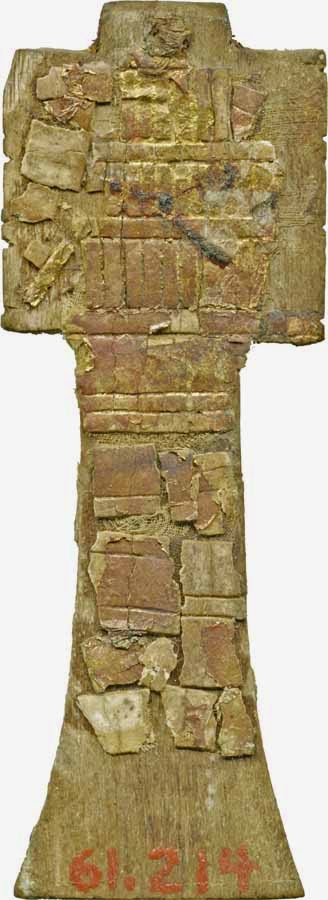
Remains of an ancient Egyptian Djed-column (or "Tat cross" as Alvin Boyd Kuhn and other earlier writers usually refer to it), Wikimedia commons (link).

The Judgment of Solomon

The Judgment of Solomon

image: Wikimedia commons (link).

In the book of the ancient Hebrew scriptures generally known today as the First Book of the Kings or simply 1 Kings, we find the account of the following famous incident:

16 Then came there two women, that were harlots, unto the king, and stood before him.
17 And the one woman said, O my lord, I and this woman dwell in one house; and I was delivered of a child with her in the house.
18 And it came to pass the third day after that I was delivered, that this woman was delivered also: and we were together; there was no stranger with us in the house, save we two in the house.
19 And this woman's child died in the night; because she overlaid it.
20 And she arose at midnight, and took my son from beside me, while thine handmaid slept, and laid it in her bosom, and laid her dead child in my bosom.
21 And when I rose in the morning to give my child suck, behold, it was dead: but when I had considered it in the morning, behold, it was not my son, which I did bear.
22 And the other woman said, Nay; but the living is my son, and the dead is thy son. And this said, No; but the dead is thy son, and the living is my son. Thus spake they before the king.
23 Then said the king, The one saith, This is my son that liveth, and thy son is the dead: and the other said, Nay; but thy son is the dead, and my son is the living.
24 And the king said, Bring me a sword. And they brought a sword before the king.
25 And the king said, Divide the living child in two, and give half to the one, and half to the other.
26 Then spake the woman whose the living child was unto the king, for her bowels yearned upon her son, and she said, O my lord, give her the living child, and in no wise slay it. But the other said, Let it be neither mine nor thine, but divide it.
27 Then the king answered and said, Give her the living child, and in no wise slay it: she is the mother thereof.
28 And all Israel heard of the judgment which the king had judged; and they feared the king: for they saw that the wisdom of God was in him, to do judgment.*

This scene, of course, is referred to as "The Judgment of Solomon," and is usually viewed as the premier example of his famous wisdom and discernment. It is recounted immediately after a passage in which Solomon has a dream after sacrificing upon the great high place of Gibeon, in which the LORD appears to him, and asks Solomon what Solomon desires to be given from God; Solomon asks for wisdom, saying:

7 [. . .] I am but a little child: I know not how to go out or come in.
8 And thy servant is in the midst of thy people which thou has chosen, a great people, that cannot be numbered nor counted for multitude.
9 Give therefore thy servant an understanding heart to judge thy people, that I may discern between good and bad: for who is able to judge this thy so great a people?

This scene directly parallels the famous Judgment of Paris in the Greek myths, in which Paris did not choose wisdom, and the result was the Trojan War and tremendous grief, loss of life, and ensuing tragedy for the survivors and their families. In this dream sequence, Solomon does ask for wisdom, and is told: 

11 [. . .] Because thou has asked this thing, and hast not asked for thyself long life; neither hast asked riches for thyself, nor hast asked the life of thine enemies; but hast asked for thyself understanding to discern judgment; 
12 Behold, I have done according to thy words: lo, I have given thee a wise and an understanding heart; so that there was none like thee before thee, neither after thee shall any arise like unto thee.
13 And I have also given thee that which thou hast not asked, both riches, and honor: so that there shall not be any among the kings like unto thee all thy days.

After hearing this, we are told that Solomon awoke, and made offerings (verse 15). Immediately after that verse comes the scene of the judgment between the two harlots described above, which begins with verse 16. Clearly, the judgment between the two harlots directly following the dream and the granted request for discernment are meant to be considered together in the scripture passage, and the judgment scene is given as the powerful illustration of the discernment granted to the king.

I believe there are many indications in this passage that, like nearly all of the sacred stories of the ancient wisdom found all the way around our planet, the accounts of King Solomon found in ancient scripture are intended to be understood esoterically and not literally or historically. The celestial foundation of many other stories in the scriptures of what we today call the Bible, as well as the celestial story of many stories from the sacred myths and traditions of many other cultures, has been demonstrated repeatedly in previous posts listed here -- and can be demonstrated for many, many more. 

There are strong clues that this story of the Judgment of Solomon is also part of this ancient worldwide pattern.

First, it is notable that in the passage of the dream-encounter at Gibeon in which he asks for wisdom that Solomon says "thy servant is in the midst of thy people which thou hast chosen, a great people, that cannot be numbered nor counted for multitude" (verse 8). This in spite of the fact that the children of Israel are often described as being outnumbered by their enemies and usually prevail in battle only by divine favor and against all that one would expect from a merely human or physical consideration. 

In other words, if the scriptures of the Old Testament are supposed to be literal history, then Solomon's description would seem to be somewhat contradictory to the situation as usually described. However, the description itself gives us a hint to ask whether this passage is really talking about historical people. The language in this verse distinctly invokes the stars of the sky: if these passages are actually describing events which take place in the heavens, then it is appropriate to say that Solomon stands "in the midst" of a people who "cannot be numbered or counted for multitude." Of course, this passage also hearkens directly back to the promise given to Abraham, that his descendants would be as the stars in the heavens -- if it is even possible to number them (Genesis 15:5, and many subsequent verses throughout the Hebrew scriptures after that).

Also, immediately after the passage describing the Judgment of Solomon, we are told that "Solomon had twelve officers over all Israel, which provided victuals for the king and his household: each man his month in a year made provision" (1 Kings 4:7). It can be amply demonstrated that the "twelve disciples of Jesus" and the "twelve tribes of Israel" are connected to the twelve signs of the zodiac in the wheel of the year. However, most people may not know that Solomon also has his own group of twelve: in this case, his "twelve officers over all Israel." As an added clue that these "twelve officers" are of a league with the twelve disciples and the twelve tribes, the verse informs us that each of the twelve "made provision" in his own moth of the year.

Thus, the famous Judgment itself is "sandwiched" between passages which contain clues indicating that we are dealing with celestial realities here, and not necessarily with literal history.

Examining the passage itself, the presence of a swordsman in this story might cause us to think back to another story in which a king is depicted raising a sword up -- the story from the Arabian Nights which was examined in two previous posts, here and here (spoiler alert: those two posts were presented as a kind of "puzzle" for the reader to figure out -- if you want to analyze the story from the Arabian Nights, you might want to go read those two posts in the order linked here before you read further in this post, since the discussion below will probably "give away" the celestial connections found in that story from the Arabian Nights, or at least give away my own particular interpretation of those connections).

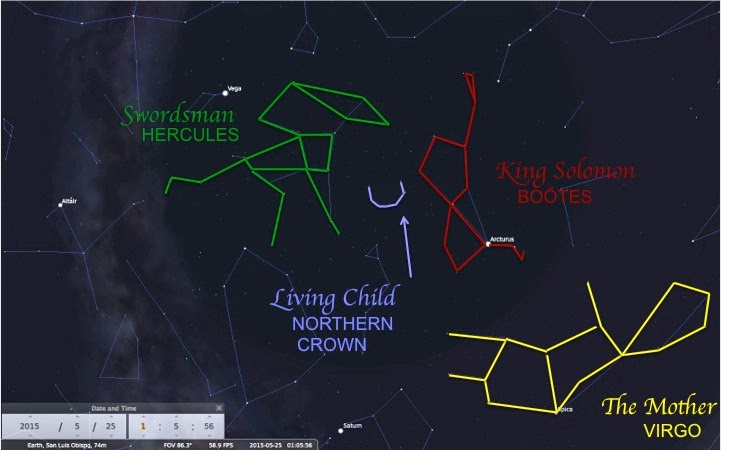
Let's examine a portion of the night sky in which we find a figure raising a menacing weapon of some sort -- a weapon which is often interpreted as a club, but which could just as easily be seen as a sword: the constellation Hercules. Not far away from this looming figure with his upraised sword, we find a constellation whose connection with a mother and an infant is very well-established, in numerous ancient myths: the constellation Virgo. Between these two, we find the constant companion of Virgo, the "seated figure" of Bootes the Herdsman, as well as the arc-shaped crescent of stars known as the Northern Crown, or Corona Borealis.

I believe these constellations could very well correspond to the players in the Judgment of Solomon. 

First, the constellation Virgo is almost certainly the mother (either one of them or both of them). We have seen evidence that the distinctive outstretched arm of Virgo, marked by the star Vindemiatrix, was anciently envisioned as a mother nursing a newborn infant -- including in artwork from ancient Egypt depicting Isis and the infant Horus, as well as the accounts of the Virgin Mary and the infant Jesus (and see the discussion of the Manger or Nativity scene from the New Testament in this video).

At first, I thought that the figure with the upraised sword might correspond to Solomon himself, and that would mean that the large-headed figure of Bootes might be the baby, since babies have fairly large heads in relationship to their bodies. However, if you read the passage closely, you will see that the king is clearly giving commands to someone, first to "Divide the living child in two," and then to stop and not slay the child after all -- and from this we can conclude that he is not the one wielding the sword (unless Solomon was given to talking to himself, which would render the scene somewhat more frightening than it already is). 

So, the figure of Hercules probably does not correspond to the king, but rather to the swordsman to whom Solomon is speaking in the passage. This means that Bootes is most likely King Solomon in this star myth -- and we have to then figure out who is the baby.

Interestingly enough, there is a clear tradition in artwork down through the centuries which depicts characters in these stories as having the distinctive characteristics associated with the constellations. This fact is extremely remarkable, and worthy of deep study by art historians. Who has been passing on these esoteric traditions to artists down through the centuries? 

We can see evidence of the clear correspondence between artistic renditions and the outlines of constellations in some of the previous discussions of star myths, such as the art shown in the discussion of Abraham's near-sacrifice of Isaac, the depiction of the daughter with outstretched arm and her timbrel in the horrible story of Jepthah's daughter, the depictions down through the centuries of the episode of the drunken Noah and his three sons, some of the depictions of the beheading of John the Baptist (see the one at the bottom of this post, in which aspects of the constellations Aquarius, Perseus, and Virgo are all clearly depicted in the three figures in the painting), and many others. 

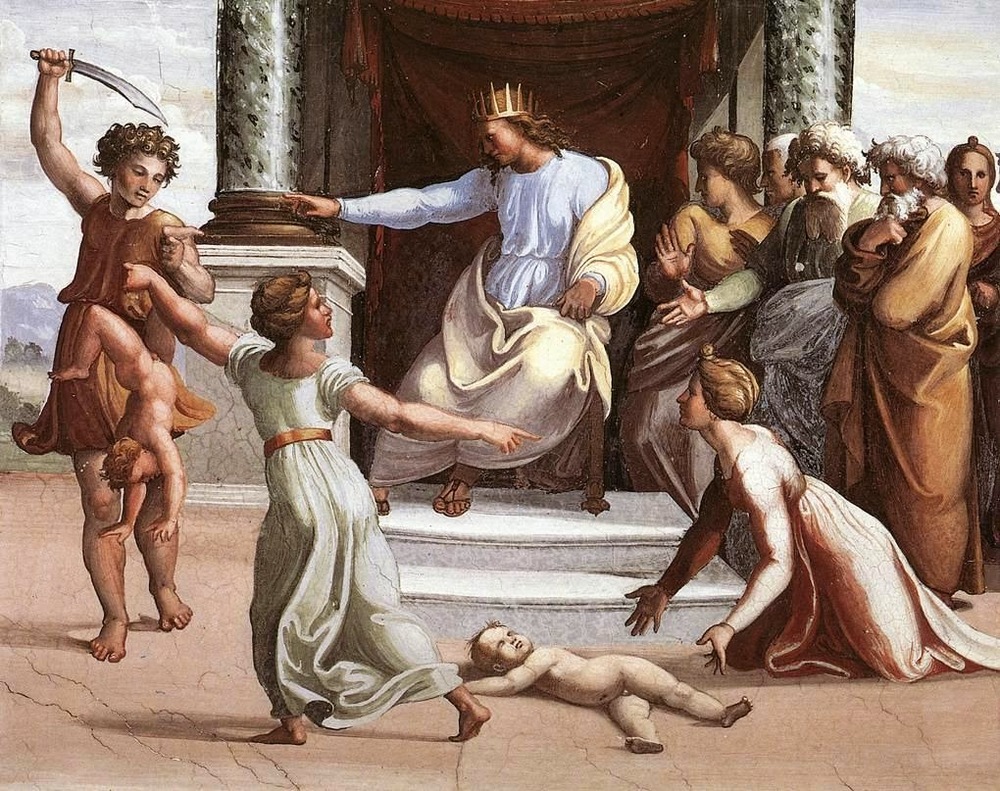
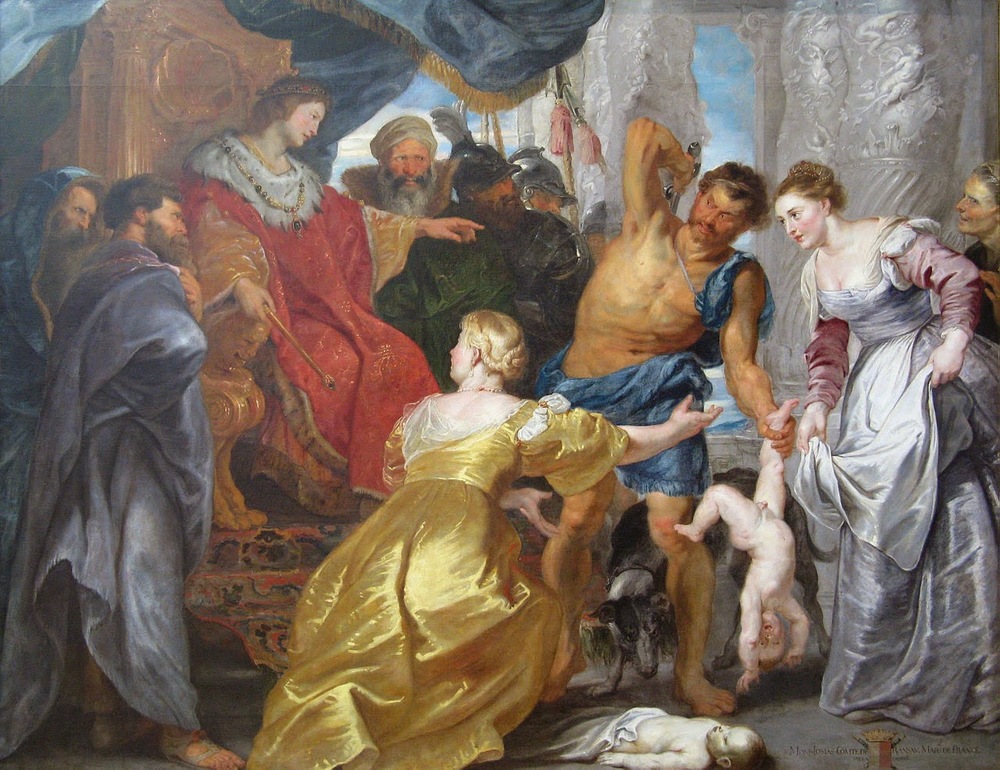
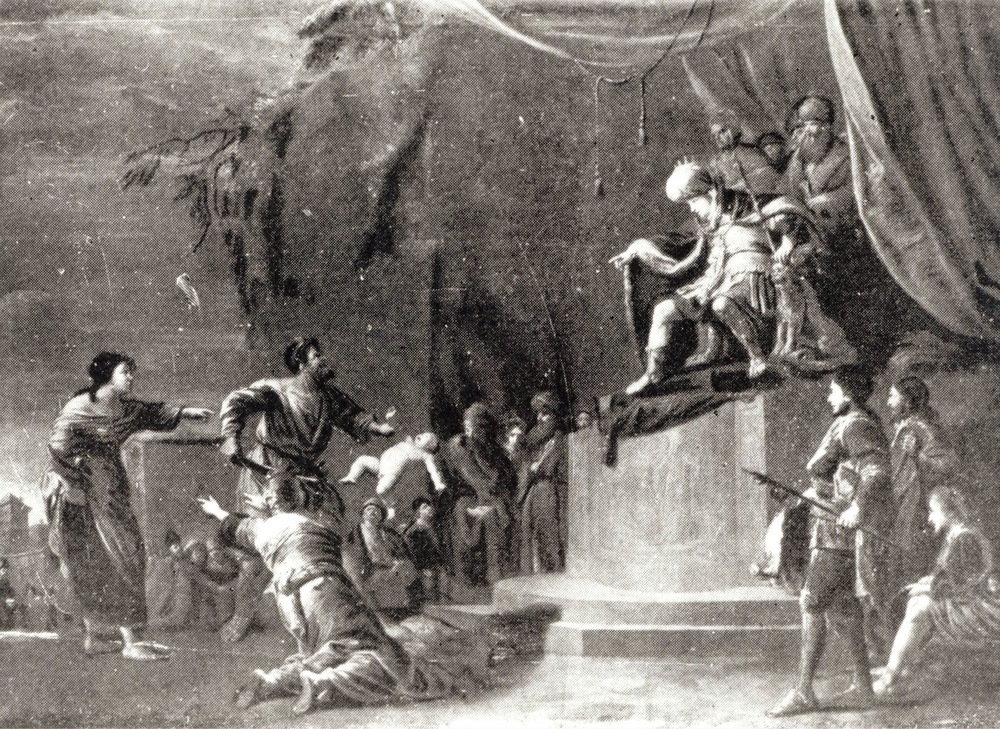
In artwork depicting the Judgment of Solomon down through the centuries, Solomon is very commonly depicted as seated, with one arm extended -- a clear parallel to the outline of Bootes, who is seated and who has a long "pipe" coming out of his mouth, which could also be envisioned as his arm extended and pointing forward. 

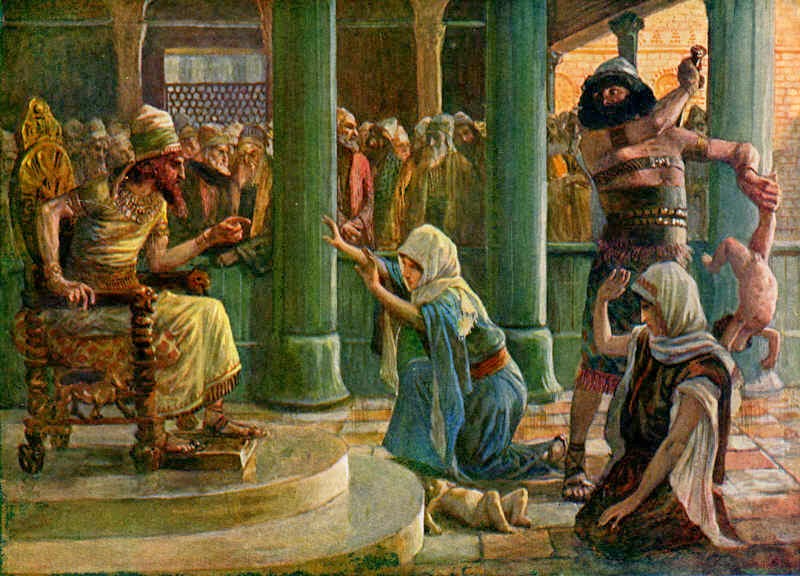
The living infant is often depicted as being held firmly by the swordsman who is menacing it, and as it is held (often by the ankle), it is arching its back strongly (as infants often do) -- see for instance the depiction of the scene at the top of this post. This arched aspect of the living child in the artistic depictions of the story is the clue that tells us that, at least according to the traditions apparently present in sacred artwork down through the centuries, the living infant was associated with the constellation of the Northern Crown, which is arching strongly just beneath the upraised sword of Hercules and which can easily be envisioned as being dangled by Hercules from his extended forward hand (the hand that isn't holding the upraised sword):

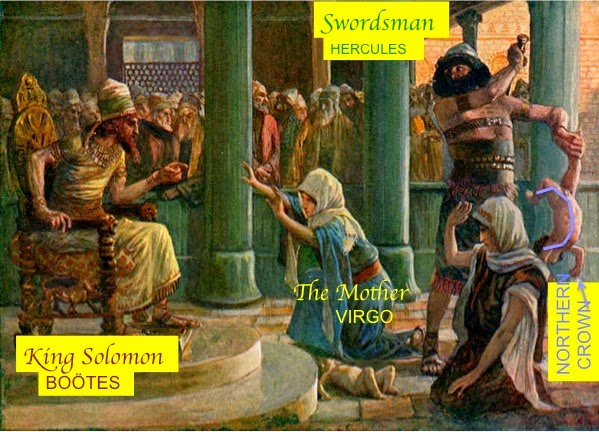
The celestial aspects of the figures in the artwork shown at the top of this post should be fairly clear to the viewer -- the Hercules figure of the swordsman, the Bootes characteristics of the king on his throne, the mother with outstretched arm, and the arching infant:

The actual outline of the arc of the constellation Corona Borealis (the Northern Crown) has here been superimposed upon the artist's depiction of the living baby dangled by the swordsman, in order to show the remarkable correlation between the child and the starry outline.

In order to show that these distinctive "constellation characteristics" are present in the artwork depicting this famous judgment scene down through the centuries, below are a few more examples of artists' depictions of the episode from this passage of scripture (look especially for the arching baby, the outstretched arm of the mother, and the pointing arm of the seated king, as well as the upraised sword of the swordsman):

image: Wikimedia commons (link).

image: Wikimedia commons (link).

image: Wikimedia commons (link).

The above images should pretty well establish the fact that at least someone down through the ages has seen this episode of the Judgment of Solomon as representative of the celestial events played out by the constellations Hercules, Bootes, Virgo, and Corona Borealis! Together, they are powerful evidence that the larger thesis described in this blog and in the book The Undying Stars -- that the stories of the Bible (together with the myths of nearly every other culture on earth) -- actually describe the actions of heavenly players upon the stage of the celestial dome of the sky.

But we would be remiss if we discussed this incredibly powerful story without at least meditating briefly upon the meaning that these precious texts were actually trying to convey to us. If they were not actually intended to record an event that happened in literal history, then what were they intended to record?

I believe that the quotation from Alvin Boyd Kuhn, cited at the end of this previous post and discussed again in this previous post, may help to guide our consideration of these profound ancient writings. 

There, an address entitled "The Stable and the Manger" is cited, in which Kuhn asserts:

The Bible is the drama of our history here and now; and it is not apprehended in its full force until every reader discerns himself [or herself] to be the central figure in it! The Bible is about the mystery of human life. Instead of relating to the incidents of a remote epoch in temporal history, it deals with the reality of the living present in the life of every soul on earth.

In other words, Solomon is a representation of each and every soul on earth, as are the other circling celestial players who daily enact their drama of rising into the heavens and the plunging down below the horizon, over and over in endless succession. The plunge (or the Fall) was seen as representative of our own plunge from the realm of spirit into the realm of matter -- depicted by the star's journey "between the horizons," in the realm of matter which each star and constellation encounters when it sets in the west and toils down here in "the underworld" before ascending again into the unencumbered realm of the sky (and pure spirit). 

And what is our task here in this difficult journey through "the underworld" of incarnation, in which we each find ourselves? 

Well, Solomon's dream, recounted above and placed immediately prior to the famous judgment scene, tells us quite plainly: it is not to "ask for ourself long life," neither for riches nor for power over our enemies, but rather "for understanding to discern judgment." We come here, the ancient scriptures seem to be saying, in order to seek wisdom (see previous postsregarding the famous ancient Oracle at Delphi, which was traditionally held to bear the inscription commanding "Know thyself"). If we seek after that, the other good things might well be added, but (as the disastrous Judgment of Paris warns us), to seek them first instead of pursuing wisdom is not recommended.

Lest some astute reader point out that this post's assertion that the ancient traditions tell us that seeking wisdom is our central mission seems to contradict other posts which argue that the ancient traditions tell us that blessing is our central mission, that apparent contradiction is easily reconciled. As the posts discussing the injunction "Know thyself" make clear, the ancient traditions seem to imply that seeking wisdom has to do with recognizing our true nature as spirit plunged into matter, and then in elevating spirit in ourselves and the world around us -- in other words, the very thing that the concept of blessing entails.

The wisdom we are talking about, in fact, is not necessarily wisdom for solving problems, despite the fact that the example of Solomon's Judgment seems to be a "problem-solving" example. But this episode is metaphorical, meant to convey higher truths and not simply recount a literal historical event. In the Judgment of Solomon, one mother wants to impart and preserve life -- even if it means giving up her child to another woman who is not the child's mother. The other harlot is happy to have the child cut in two -- even after the actual mother of the child screams out to give the baby to the other harlot (which doesn't actually make much sense, if you think about it: the real mother has just conceded the child, in verse 26, which is what the deceitful mother apparently wanted in the first place, and before the king even says anything, the deceitful mother says, "Forget that -- I didn't really want the child -- cut it up instead -- even though a minute ago I was trying to get custody of the same child, and the mother just said I could have it"). 

At one level, these two mothers can be seen as representative of the constant tension we face between life-giving blessing, and all that it entails, and the constant temptation to deny the divine spark in ourself and others, to give in to the physical, to objectify and to deaden -- in the words of Simone Weil in her famous 1940 essay, the impulse which, "exercised to its limit, [. . .] turns man into a thing in the most literal sense: it makes a corpse out of him" (6). 

This story seems to be saying that, if each sacred myth is really the story of each and every soul here in this physical incarnation, we are supposed to be somehow elevating that life-giving impulse -- bringing out and lifting up the "true mother" within our own personal domain (within ourselves, that is): the one who is giving, and selfless. We should also be trying to lift up and elevate this principle in the world around us, but without violating the proper "kingdoms" of all the other individuals around us, each of whom is his or her own Solomon (or, we might say, his or her own "Solomon-Sheba," since Solomon is paired up with the Queen of Sheba in a type of alchemical wedding that is beyond the scope of this particular essay; Sheba herself represents Wisdom, and her name "Sheba" [or "Seba"] invokes the number seven, which is directly related to Wisdom in Proverbs 9:1).

I believe it is very important to realize that, while each of us are supposed to see in Solomon-Sheba our own condition in this life ("I am but a little child: I known not how to go out or come in [. . .] Give therefore thy servant an understanding heart"), we must also recognize that everyone around us is also properly a Solomon-Sheba in charge of his or her own personal Temple of body, mind and spirit. Thus, it is appropriate to present evidence to others in order to give them as much good information to help them in their judgments as possible, but their judgments must be up to them (as long as they do not decide to go violate the temple of our body through violence, that is).

As a very practical example, I believe that the evidence that I myself have found regarding the celestial foundation of the Biblical scriptures and the other sacred traditions around the world is appropriate to present to those who are seeking this information, as they "make judgments" within the palace of their own minds, but it is absolutely not appropriate for me to tell them how they should ultimately judge. 

And I believe this principle applies in just about every other matter: we can offer evidence and arguments, especially if asked for our counsel, but to insist that another "judge" or "rule" on any matter in a way that we dictate is to violate their "kingdom" (again, the main exception would be cases in which someone's judgments lead them to acts of violence which violate natural or universal law -- we have every right to insist that others must not do physical violence to others or to ourselves, and while we can debate the extent of this prohibition, I believe it extends to prohibiting violence done to animals and to the natural world as well).

But, to the extent that others do not "invade," I think we must recognize them as their own King Solomon (and Queen of Sheba), just as we ourselves should recognize ourselves in this story, and the profound messages it has for us. It urges us to recognize the real nature of this physical existence: one that includes a spirit component, and that is not just lifeless matter. And it urges not just to recognize the life-giving force exemplified by the loving mother, the selfless mother, the compassionate mother, but to elevate that principle, to bring it out when it is hidden or obscured, to lift it up and exalt it in our own "court" and -- as much as is in our power, without violating the rights of others -- in the world around us as well. 

--------------------------

1 Kings 3: 16 - 28 (italics in the translation to indicate words not found in the original Hebrew text but added by the translators in order to soften the idiom or express it in a way more amendable to the way it would commonly be expressed in English).

Resolved: blessing and not cursing

Resolved: blessing and not cursing

image: Wikimedia commons (link).

My resolution as we contemplate the end of one year and the arrival of another is to engage in the act of blessing and not cursing.

As discussed in this previous post, the concept of blessing can be conceived of as the act of:

  • recognizing the spirit world which is behind all we can perceive here in the material world, and which in some sense can be said to generate everything we perceive here in the material world

and

  • awakening and bringing out that hidden, veiled, invisible spirit dwelling within everything and everyone we encounter here in this material world.

I am grateful to Sandra Ingerman and Hank Wesselman for articulating this wonderful definition of the act of blessing in the book Awakening to the Spirit World (pages 25 - 26). As they explain in that definition, it appears that our ongoing mission in this material world may well be the continuous act of recognizing and acknowledging and waking up and calling forth this hidden spark of spirit within ourselves and the rest of the material world around us: 

the physical plane appears to most as a camouflage universe where Spirit does not appear to exist [. . .]
many of us respond to the physical world by assuming a deep hypnosis, a deep sleep where we no longer recognize that Spirit is present [. . .]
So it is our job to wake up and to awaken all that is around us. This act of waking up could be called "blessing the world." 26.

Previous posts have spent a great deal of time examining the symbology found in the ancient wisdom around the world in various forms using various metaphors describing the "casting down" of spirit into matter and the subsequent "raising up" of spirit again. Symbols describing this dynamic include: 

  • the "casting down of the Djed-column" and the "raising it back up again," 
  • the entombment of Osiris in a sarcophagus and the subsequent standing back upright of the god, 
  • the ascent upon a central tree which is a foundational image in shamanic cultures around the world and can also be found in the Norse myth of Odin and in both the Old and New Testaments of the Bible, 
  • the symbol of the kundalini serpent rising along the central column of the body, which is also related to the symbol of the caduceus
  • the Vajra or Thunderbolt,
  • the widely-known symbol of the cross with its horizontal component (the spirit cast down into matter) and its vertical component (the spirit awakened and ascendant) 
  • the similar and related symbol of the Ankh, as well as the symbol of the Scarab, and
  • the annual "cross of the year" formed upon the zodiac wheel by the horizontal line of the equinoxes (between which the spirit is cast down into matter) and the vertical line of the solstices (topped by the sign of Cancer the Crab, whose upraised arms resemble the upraised arms of the Scarab beetle and serve the same symbolic function).
  • The concept of walking the north-south red road, which is crossed with the east-west black road in the Sacred Hoop of the Lakota.

The fundamental importance of these symbols in the sacred traditions found around the globe testifies to the profound centrality of the continuous process of acknowledging and recognizing and then calling forth and elevating the spiritual which has been veiled and hidden beneath or within this material covering that we perceive with our physical senses.

In other words, the act of blessing appears to be our central ongoing task, according to the world's ancient wisdom!

And yet how often and how easily this physical world can get us to lose sight of the world of spirit pulsing just beneath the surface of everything we see -- and how easily the sharp and sometimes painful exigency of the material realm can cause us to reverse the process just described, and fall into cursing when we are supposed to be blessing!

If cursing is the opposite of blessing, then the definition of blessing just discussed would seem to lead to a definition of cursing which involves the denial of the spiritual within ourselves and other beings around us, and flowing just beneath the surface of everything here in the physical realm. Instead of elevating spirit, cursing denigrates it, or degrades it, or diminishes it, or denies its existence altogether. Instead of seeing ourselves and others as spiritual beings immersed for a time within physical bodies, cursing objectifies, physicalizes, and profanes. 

The downward direction of cursing, driving down the spiritual instead of elevating it, seems to be very much related to the definition of violence offered by Simone Weil in her powerful 1940 essay entitled "The Iliad, or the Poem of Force," in which she famously defined physical violence as "that x that turns anybody who is subjected to it into a thing."

The curse words and phrases I am familiar with tend to emphasize violence, physicality, and the animal aspect of human existence -- they tend to focus on the carnal in a way that is stripped of any accompanying deeper meaning of spirit, to emphasize the bodily functions of the human body in a way that "turns anybody who is subjected to [incarnation] into a thing," and in doing so they obscure, or deny, or attempt to take our mind away from the dual spiritual-physical reality of human existence. It is a reality that we are always prone to forgetting or ignoring, as the quotation from Sandra Ingerman and Hank Wesselman cited above makes clear -- and as the ancient wisdom expressed in the teaching of the "hidden god" buried inside the material realm but hidden from sight and easily overlooked (see discussions here and here).

If you are anything like me, you know how easily the daily frustrations offered up by life inside the material realm and its unforgiving laws of physics can cause "cursing" in some form to erupt almost spontaneously, whether in thought or in actual expression. And yet how damaging this tendency is to our true mission of blessing rather than cursing.

This tension is expressed in many ancient scriptures -- the scriptures in the Old and New Testaments , as well as ancient sacred texts which were left out by the literalists when they assembled the New Testament, enjoin blessing rather than cursing, and warn us against the constant temptation to fall into patterns of cursing.

The text known as the general epistle of James memorably declares: "Out of the same mouth proceedeth blessing and cursing. My brethren, these things ought not so to be. Doth a fountain send forth at the same place sweet water and bitter?" (James 3:10-11).

Proverbs 11:11 declares: "By the blessing of the upright the city is exalted: but it is overthrown by the mouth of the wicked" (it is interesting to note that this passage associates blessing with "the upright" and that "uprightness" is associated in the ancient symbology catalogued above with the Djed-column raised-up, the Osiris raised to the vertical position, and the vertical portion of the universal cross -- all of them symbols of the elevation of spirit and hence with the concept of blessing).

In both texts known as the Gospel according to Matthew and and the Gospel according to Mark, Jesus is recorded as saying that it is what comes out of our mouths that can defile us, rather than what we put into our mouth, saying: "But those things which proceed out of the mouth come forth from the heart; and they defile the man [. . .] These are the things which defile a man: but to eat with unwashen hands defileth not a man" (Matthew 15:18, 20).

The same teaching is expressed in a text known as the Gospel of Thomas (an important Gnostic text found in the Nag Hammadi library), in which Jesus tells his listeners: "After all, what goes into your mouth will not defile you; rather, it's what comes out of your mouth that will defile you" (14). 

These passages tend to support the definition of "cursing" which we have derived above from our definition of "blessing" -- the concept of "defiling" means making profane, denying the sacred aspect, driving out the sense of the spiritual and emphasizing all that is most associated with the solely physical aspects of our incarnate existence. These passages seem to be enjoining us to be constantly blessing and not cursing: to be seeing the sacred and the spiritual in ourselves and in everyone and everything around us, and to try to bring it out -- as opposed to doing the opposite.

Of course, as we all know, maintaining this focus is not easy (if it were, there probably would not be so many passages in ancient scriptures enjoining us to do it).

That's why it is a resolution of mine, and something I hope to do more of in the coming year!

Blessings to you in this new solar year. Namaste.

"Are you not ashamed to mingle domestic crops with blood and gore?"

"Are you not ashamed to mingle domestic crops with blood and gore?"

image: MIT homepage of Dr. Stephanie Seneff (specific image link).

Many ancient philosophers presented philosophical arguments against the consumption of animal flesh and for the adoption of plant-based diets in one form or another, among them PlutarchOvid, and (at least according to long-established tradition) Pythagoras.

In one of his surviving treatises on the subject, Plutarch argues that resorting to the consumption of that which is (in his words) "contrary to nature" is a form of slander against the gods and the earth, implying that they cannot support us with their bounty. He asks:

Why slander the earth by implying that she cannot support you? Why impiously offend law-giving Demeter and bring shame upon Dionysus, lord of the cultivated vine, the gracious one, as if you did not receive enough from their hands? Are you not ashamed to mingle domestic crops with blood and gore?

A previous post from 2012 noted that, while Plutarch was applying these arguments to the consumption of flesh in an age long before the direct injection of foreign DNA into foodcrops, the same arguments could be applied with equal force to the creation and distribution of genetically-modified organisms for human consumption, a practice that has appeared only in the past two decades of human existence but which has increased exponentially since these GMOs were first introduced into the food chain.

Not only is it questionable and completely unproven to assert that the earth and the gods simply could not support human life without these newly-devised GMOs (and, Plutarch would say, slanderous and impious to say so, as well), but in light of data being presented by credentialed researchers, it may be that those who have been pushing GMOs into the food supply are also mingling domestic crops with, if not "blood and gore," a widespread increase in terrible neurological diseases and health problems.

Here is a link to a talk given on May 24, 2014, by Dr. Stephanie Seneff, a Senior Research Scientist at MIT who has focused her research in recent years on correlations between nutrition and health. The talk is long but critically important. In it, she presents evidence arguing that the sudden introduction of new, genetically-modified, herbicide-resistant corn and soy crops into the US food chain in 1991, and the corresponding massive increase in herbicide application on top of these food crops (see chart above) correlates almost one-to-one with the rise in autism diagnoses in the US (the red "line graph" or "mountain chart" line represents chemical herbicide applied to soy and corn, in thousands of tons, and the yellow "bar graph" columns represent the rising number of children identified as having autism). 

Her data further indicate a potential harmful synergy between this newly-prevalent herbicide and the increased exposure to aluminum, primarily through vaccines.

This previous post examines some of the powerful forces at work to marginalize anyone who questions the safety of the increased vaccine regimens for children, and the possible connection vaccines may have with autism.

Early in her talk, she also states that the lack of exposure to sunlight among children who now for various reasons may be spending too much time indoors and staring at screens instead of running around outside may also be a contributing factor, leading to dangerous deficiencies in natural vitamin D production from sunlight exposure on the skin and through the eyes. Interestingly enough, the health benefits of basking in the sun were known to the ancients and written about by various ancient authors and philosophers as well.

Dr. Seneff states that she has spent the past several years examining possible environmental factors that may be contributing to the rise in autism shown in the chart above. She notes that there is an argument that autism is only genetic, and a contingent of people who apparently do not want to take the time to examine hypotheses which include possible environmental contributors to this and other health problems. Beginning at about 0:00:40 into the talk, Dr. Seneff says:

So, people keep saying "Oh, yeah -- it's genetic; autism's a genetic disease." They're not spending the money they should be spending looking for environmental factors. And as much as you could try to think of increased diagnosis or whatever, you've still got a huge part that's unexplained, unclear, and that is almost surely environmental. I don't think this audience would disagree. So, I've been studying autism for about seven years now, reading extensively in the literature, and looking one by one at all the  different environmental toxins and all the environmental factors that might be involved in autism. And I've identified several. Certainly sun, insufficient sunlight exposure to both the skin and the eyes, was something I identified early on: people in northern latitudes have increased autism, for example. And poor diet I think is something that people are aware of. Nutritional deficiencies. Vaccines is something  this community's very are aware of. But there's another factor that I didn't recognize until about two years ago. I went to hear a talk by Don Huber, who's a professor -- retired professor -- from Purdue,  expert on plant physiology and plant pathology, who's been going around the world talking about the dangers of this, Roundup, and the damage that it's doing to our nation's health. And once I heard his lecture, I became a changed person, and I spent nearly all of my time studying this chemical, and understanding how it works biologically, and linking that to very many diseases and conditions that are plaguing us today: things like diabetes, and Alzheimer's, Parkinson's disease, various cancers, and you can see a very strong connection between this chemical and those diseases. 

Immediately after this, Dr. Seneff says that it is her hope that everyone listening to her will be convinced to investigate the evidence for himself or herself. This approach is a major differentiating factor between those who are encouraging real analysis (which I argue here and here to be an antidote to mind control) and those who argue that there is nothing to investigate, the issue is already settled, and their interpretation is the interpretation that must be accepted -- on faith, without doing your own research (which is the kind of argument that typifies those who seek to control others, exemplified in the original 1968 Planet of the Apes movie by the  characters of Dr. Zaius and the orangutans).

The safety of the food supply, and the application of honest, open-minded analysis of the evidence regarding the safety of the modifications and ethicality of giving genetically-modified foods to people largely without their knowledge, their consent, or their awareness of the potential health hazards that may be associated with such foods, is a subject of such fundamental importance that it demands all of our attention. I hope that everyone will take the time to listen to Dr. Seneff's presentation linked above (here's the link again).

We simply must engage our critical thinking and do our own analysis when we see data such as that shown in the graph and discussed in the talk, or we risk "mingling crops with blood and gore," as Plutarch puts it.

No one who does military analysis before a military operation would ignore such data points or dismiss them as not worthy of further investigation. No one who does stock analysis before investing in a stock would see so many red flags in the data and argue for buying it anyway. When the health and safety of others is on the line, we do not have the luxury of just sleepwalking forward with our eyes shut.

Dr. Seneff has bravely presented evidence and a hypothesis, based on seven years of research and a host of data -- of course, those who wish to offer a different hypothesis can and should do so along with their arguments of why their hypothesis might be a better fit for the data.

Here is an article from October of 2014 discussing Dr. Seneff's research.

Here is another article, published yesterday, also discussing aspects of Dr. Seneff's research.

For those who might ask what this topic has to do with the topics usually discussed in this blog, the answer is: plenty. 

First, and perhaps foremost, there is the question of natural law (or, as it might be better labeled, natural universal law). The doctrine of natural universal law argues that the prevention of violence to another's person is fundamental, that we always have the right (and in fact the duty) to stop violence being done to ourselves or to another human being, and that it is for this purpose that governments are established.

Related to the question of natural law is the important subject of "mind control" -- used in a broad and general sense in this case (there are other, narrower, and more technical uses of that term which are also valuable but not necessarily in view here). In this broad usage, we can define mind control as the propagation of illusions and ideologies which are primarily designed to mask or even try to legitimize the violation of natural universal law, often on a grand scale. In fact, some have argued convincingly that mass-violation of natural universal law is always necessarily accompanied by forms of mass mind control.

Further, as intimated in the opening paragraphs of this post, this question is by no means unrelated to the questions treated by the ancient philosophers, especially those prior to the arrival of literalist Christianity, who clearly saw food as a proper subject for philosophical discourse, and a topic with deep moral implications.

Finally, the debate over this subject, in which there is a consensus view being promoted and a clear marginalization of those voices which challenge the consensus view, directly parallels the pattern found in the subjects most-often examined in this blog and in my research. There is a clear failure among conventional academia to seriously consider the overwhelming evidence pointing to ancient trans-oceanic contact between the "Old World" and "New World," for example, or the abundant evidence that consciousness may in fact be independent of the physical body, and many more subjects which are just as critical to our health and well-being as is the question of what foods are best and most healthful and safest for us to eat.

The question of the safety of our food is one we really do not have the luxury of ignoring. I believe that for various important reasons, the others discussed on this blog are equally pressing. 

The possibility that the creation of what came to be known as "the west" (and that is today embodied in governments and other institutions that can be seen to be descended from the western Roman Empire) might have involved the deliberate creation of illusions and the adoption of ideologies that now threaten the entire food chain and entire ecosystems such as the Amazon rainforest (see for instance the discussion in this previous post) is certainly one of those issues. It may well be that this ideological pattern, which I believe began with a mistaken literalistic approach to ancient scriptures, which led to a deliberate rejection of the ancient wisdom as well as a false separation between human beings and nature, is directly related to the adoption of agricultural practices that could turn out to be very harmful to nature and to ourselves.

The massacre at Wounded Knee: December 29, 1890 -- and today

The massacre at Wounded Knee: December 29, 1890 -- and today

image: Wikimedia commons (link).

December 29 is the anniversary of the massacre of the Lakota at Wounded Knee by elements of the US Army, which took place in 1890. As painful as it is to read the details of this massacre, it is vitally important to know them. 

It is vitally important so that those whose lives were taken are not forgotten.

It is also vitally important because, as Lakota Holy Man Black Elk explains, a people's dream died there at Wounded Knee.

It is also vitally important because the mass murder that resulted in the crushing of this dream at Wounded Knee is also an example of mass mind control, in that an entire society was needed to support the army that did the killing in gross violation of natural law. It is vitally important that we understand how this could happen, and understand the illusions that were at work to enable members of that society to support those criminal actions, and to enable the soldiers and officers to perpetrate those actions, in gross violation of natural law.

It is also vitally important because the events which led up to the massacre fit into the pattern of centuries-long enmity by the descendants of the western Roman Empire and its literalistic religious and political systems against direct unmediated contact with the spirit realm.

We who are alive today should all consider the details of this massacre, as painful as it is to do so.

Lakota holy man Black Elk (1863 - 1950) describes the massacre at Wounded Knee:

It was now near the end of the Moon of Popping Trees, and I was twenty-seven years old (December, 1890). We heard that Big Foot was coming down from the Badlands with nearly four hundred people. Some of these were from Sitting Bull's band. They had run away when Sitting Bull was killed, and joined Big Foot on Good River. There were only about a hundred warriors in this band, and all the others were women and children and some old men. They were all starving and freezing, and Big Foot was so sick they had to bring him along in a pony drag. They had all run away to hide in the Badlands, and they were coming in now because they were starving and freezing. When they crossed Smoky Earth River, they followed up Medicine Root Creek to its head. Soldiers were over there looking for them. The soldiers had everything and were not freezing and starving. Near Porcupine Butte the soldiers came up to the Big Foots, and they surrendered and went along with the soldiers to Wounded Knee Creek where the Brennan store is now.
It was in the evening when we heard that the Big Foots were camped over there with the soldiers, about fifteen miles by the old road from where we were. It was the next morning (December 29, 1890) that something terrible happened.
[. . .]
I heard from my friend, Dog Chief, how the troubled started, and he was right there by Yellow Bird when it happened. This is the way it was:
In the morning the soldiers began to take all the guns away from the Big Foots, who were camped in the flat below the little hill where the monument and burying ground are now. The people had stacked most of their guns, and even their knives, by the tepee where Big Foot was lying sick. Soldiers were on the little hill and all around, and there were soldiers across the dry gulch to the south and over east along Wounded Knee Creek too. The people were nearly surrounded, and the wagon-guns were pointing at them.
Some had not yet given up their guns, and so the soldiers were searching all the tepees, throwing things around and poking into everything. There was a man called Yellow Bird, and he and another man were standing in front of the tepee where Big Foot was lying sick. They had white sheets around and over them, and eyeholes to look through, and they had guns under these. An officer came to search them. He took the other man's gun, and the started to take Yellow Bird's. But Yellow Bird would not let go. He wrestled with the officer, and while they were wrestling, the gun went off and killed the officer. Wasichus and some others have said he meant to do this, but Dog Chief was standing right there, and he told me it was not so. As soon as the gun went off, Dog Chief told me, an officer shot and killed Big Foot who was lying sick inside the tepee. 
Then suddenly nobody knew what was happening, except that the soldiers were all shooting and the wagon-guns began going off right in among the people.
Many were shot down right there. The women and children ran into the gulch and up west, dropping all the time, for the soldiers shot them as they ran. There were only about a hundred warriors and there were nearly five hundred soldiers. The warriors rushed to where they had piled their guns and knives. They fought the soldiers with only their hands until they got their guns. 
Dog Chief saw Yellow Bird run into a tepee with his gun, and from there he killed soldiers until the tepee caught fire. Then he died full of bullets.
It was a good winter day when all this happened. The sun was shining. But after the soldiers marched away from their dirty work, a heavy snow began to fall. The wind came up in the night. There was a big blizzard, and it grew very cold. The snow drifted deep in the crooked gulch, and it was one long grave of butchered women and children and babies, who had never done any harm and were only trying to run away. Black Elk Speaks, 194 - 201.

The basic details of the massacre described above are supported by the account of contemporary James Mooney, in his report published in 1896:

On the morning of December 29, 1890, preparations were made to disarm the Indians preparatory to taking them to the agency and thence to the railroad. In obedience to instructions the Indians had pitched their tipis on the open plain a short distance west of the creek and surrounded on all sides by the soldiers. In the center of the camp the Indians had hoisted a white flag as a sign of peace and a guarantee of safety. Behind them was a dry ravine running into the creek, and on a slight rise in the front was posted the battery of four Hotchkiss machine guns, trained directly on the Indian camp. In front, behind, and on both flanks of the camp were posted the various troops of cavalry, a portion of the two troops, together with the Indian scouts, being dismounted and drawn up in front of the Indians at the distance of only a few yards from them. Big Foot himself was ill of pneumonia in his tipi, and Colonel Forsyth, who had taken command as senior officer, had provided a tent warmed with a camp stove for his reception.
Shortly after 8 oclock in the morning the warriors were ordered to come out from the tipis and deliver their arms. They came forward and seated themselves on the ground in front of the troops. [. . .] It is said one of the searchers now attempted to raise the blanket of a warrior. Suddenly Yellow Bird stooped down and threw a handful of dust into the air, when, as if this were the signal, a young Indian, said to have been Black Fox from Cheyenne river, drew a rifle from under his blanket and fired at the soldiers, who instantly replied with a volley directly into the crowd of warriors and so near that their guns were almost touching. From the number of sticks set up by the Indians to mark where the dead fell, as seen by the author a year later, this one volley must have killed nearly half the warriors. [. . .]
At the first volley the Hotchkiss guns trained on the camp opened fire and sent a storm of shells and bullets among the women and children, who had gathered in front of the tipis to watch the unusual spectacle of military display. The guns poured in 2-pound explosive shells at the rate of nearly fifty per minute, mowing down everything alive. The terrible effect may be judged from the fact that one woman survivor, Blue Whirlwind, with whom the author conversed, received fourteen wounds, while each of her two little boys was also wounded by her side. In a few minutes 200 Indian men, women, and children, with 60 soldiers, were lying dead and wounded on the ground, the tipis had been torn down by the shells and some of them were burning above the helpless wounded, and the surviving Indians were flying in wild panic to the shelter of the ravine, pursued by hundreds of maddened soldiers and followed up by a raking fire from the Hotchkiss guns, which had been moved into position to sweep the ravine.
There can be no question that the pursuit was simply a massacre, where fleeing women, with infants in their arms, were shot down after resistance had ceased and when almost every warrior was stretched dead or dying on the ground. On this point such a careful writer as Herbert Welsh says: "From the fact that so many women and children were killed, and that their bodies were found far from the scene of action, and as though they were shot down while flying, it would look as though blind rage had been at work, in striking contrast to the moderation of the Indian police at the Sitting Bull fight when they were assailed by women" (Welsh, 3). The testimony of American Horse and other friendlies is strong in the same direction (see page 839). Commissioner Morgan in his official report says that "Most of the men, including Big Foot, were killed around his tent, where he lay sick. The bodies of the women and children were scattered along a distance of two miles from the scene of the encounter" (Comr., 35). The Ghost-Dance Religion and Wounded Knee, 869 - 870.

The diagram below from Mooney's report (unnumbered pages between 868 and 869) shows the gulch and the position of the Sioux and the soldiers, as well as the Hotchkiss guns upon a commanding rise. The flight along the gulley continued to the west, off of the page to the left.

From the descriptions above, one from Black Elk and one from Mooney and both based upon conversations with those present, it is fairly clear that one of the Lakota fired first, but then that noncombatants were brutally slaughtered, and that the slaughter went to undeniably criminal lengths, to the point of chasing down women and children to distances of up to two miles -- women and children who were trying to escape the massacre and were mercilessly tracked down and butchered.

While some might point to the fact of one of the Lakota firing first and argue that this situation was a "complicated" one, and one which is difficult to judge from this remove of over 100 years, there is more to the story which effectively removes such arguments. 

The band of Lakota who were "surrendering" consisted of a group that had fled from the reservations, where they had been rounded up and imprisoned, into the Badlands. It was one of many such groups who had fled into the Badlands that winter. The situation is described in this previous post, regarding the death of Lakota holy man Tatanka Iyotanke, Sitting Bull. That post also includes a map showing the various agencies, with the Badlands in between the agencies in the north and in the south. 

The reason that so many Lakota were fleeing the reservations into the Badlands, despite the bitter cold of the winter, was the sudden arrival of thousands of federal troops -- at least 3,000 in number -- a development that was understandably terrifying to the Sioux who had been rounded up and forced onto the reservations. Even before they fled into the Badlands, they had good reason to be afraid of the possible consequences of the arrival of so many soldiers. The massacre at Wounded Knee shows that their fears were well-founded.

And what precipitated the deployment of so many soldiers? 

As that previous post regarding the killing of Sitting Bull explains, the soldiers were called in to prevent the Lakota from participating in the Ghost Dance too frequently. Mooney provides plenty of detail regarding the escalation in tension that eventually led to the massive influx of federal troops, which caused hundreds to flee into the Badlands. He notes that the agents in charge of the individual reservations were nearly unanimous in their opinion that the Ghost Dance was not in any way violent, nor was it seen as a prelude to violence. There are plenty of written accounts demonstrating that its precepts, in fact, called for an end to making war against the whites (see for example Mooney, 780 - 783). But the US government wanted it curtailed.

Black Elk recalls:

While these things were happening, the summer (1890) was getting old. I did not then know all that was going on at other places, but some things I heard, and much more I heard later.
When Good Thunder and Kicking Bear came back in the spring from seeing the Wanekia, the Wasichus at Pine Ridge put them in prison awhile, and then let them go. This showed the Wasichus were afraid of something. In the Moon of Black Cherries (August) many people were dancing at No Water's Camp on Clay Creek, and the agent came and told them to stop dancing. They would not stop, and they said they would fight for their religion if they had to do it. The agent went away, and they kept on dancing. They called him Young-Man-Afraid-of-Lakotas.
Later, I heard that the Brules were dancing over east of us; and then I heard that Big Foot's people were dancing on the Good River reservation; also that Kicking Bear had gone to Sitting Bull's camp on Grand River, and that the people were dancing there too. Word came to us that the Indians were beginning to dance everywhere.
The people were hungry and in despair, and many believed in the good new world that was coming. The Wasichus gave us less than half the beef cattle they promised us in the treaty, and these cattle were very poor. For a while our people would not take the cattle, because there were so few of them and they were so poor. But afterwhile they had to take them or starve to death. So we got more lies than cattle, and we could not eat lies. When the agent told the people to quit dancing, their hearts were bad.
[. . .]
When I cam back from the Brules, the weather was getting cold. Many of the Brules came along when I came back, and joined the Ogalalas in the dancing on Wounded Knee. We heard that there were soldiers at Pine Ridge and that others were coming all the time. Then one morning we heard that the soldiers were marching toward us, so we broke camp and moved west to Grass Creek. From there we went to White Clay and camped awhile and danced. 
There came to us Fire Thunder, Red Wound and Young American Horse with a message from the soldiers that this matter of the ghost dance must be looked into, and that there should be rulings over it; and that they did not mean to take the dance away from us. But could we believe anything the Wasichus ever said to us? They spoke with forked tongues.
We moved in closer to Pine Ridge and camped. Many soldiers were there now, and what were they there for?
There was a big meeting with the agent, but I did not go to hear. He made a ruling that we could dance three days every moon, and the rest of the time we should go and make a living for ourselves somehow. He did not say how we could do that. But the people agreed to this. 191 - 193.

It should be noted that it was not alleged that the Ghost Dance was violent, or a precursor to violence. So, did the agents of the US government have a right to prohibit other men and women from participating in it?  What gives anyone legitimate permission to stop another person from dancing if he or she wishes to do so? The principles of natural law explain that people do not suddenly obtain legitimate permission to stop others from doing things simply by virtue of being called  an agent of a government. People have a right (and a duty) at all times to stop violence -- this is true whether or not they are acting in a position as an agent of government. But they do not have a right to stop behavior of others which is not violent, simply because they do not like it or think that it is unproductive. This becomes even more obvious if that behavior is part of the religious expression of another person, although there is no right to stop it either way.

The Constitution of the United States as originally enacted and ratified contains a clear statement acknowledging this inherent right of men and women, and denying the legitimacy of the government to infringe upon that inherent right. It is called the First Amendment and it declares: 

Congress shall make no law respecting an establishment of religion, or prohibiting the free exercise thereof; or abridging the freedom of speech, or of the press, or the right of the people peaceably to assemble, and to petition the Government for a redress of grievances.

The agents of the US government, in seeking to prohibit the right of peaceable assembly and the free exercise of religion of the men and women whom the government had forced onto the agencies, were clearly acting in all violation of natural law, and of the Constitution's recognition of the rights of individuals under natural law. The decision to deploy federal troops to back up these unconstitutional and unlawful and hence tyrannical efforts led directly to the flight of the Sioux into the Badlands despite the freezing conditions, and ultimately to the massacre at Wounded Knee as well.

It should be clear from the foregoing discussion that this opposition to the Ghost Dance, which involved the inducement of trance-conditions in large numbers of the participants, who afterwards would almost universally report visions of contact with the spirit world (see discussion in this previous post) fits into the pattern of opposition to direct contact with the spirit world that has characterized "the west" since the days of the western Roman Empire, when the Emperor Theodosius shut down the Eleusinian Mysteries and the Temple and Oracle at Delphi.

This raises the question of whether or not someone in western culture secretly believes that activities such as the Ghost Dance actually have an impact upon the spirit world, as those who participated in the Ghost Dance believed it to have. Note that Black Elk concluded from the opposition the US government demonstrated against the Ghost Dance: "This showed the Wasichus were afraid of something."

This opposition can be demonstrated to continue to this day. It can also be demonstrated to have frequently employed violence in its opposition to this direct contact with the spirit world (this direct contact with the spirit world being a hallmark of the shamanic worldview and of shamanic cultures). In addition to violence, the enemies of the shamanic can be shown to use a full spectrum assault on the shamanic culture that they wish to eradicate. This full-spectrum assault was employed against the Native peoples of the Americas with devastating effect.

After describing the events at Wounded Knee, Black Elk ends his narrative with these words:

And so it was all over.
I did not know then how much was ended. When I look back now from this high hill of my old age, I can still see the butchered women and children lying heaped and scattered all along the crooked gulch as plain as when I saw them with eyes still young. And I can see that something else died there in the bloody mud, and was buried in the blizzard. A people's dream died there. It was a beautiful dream.
And I, to whom so great a vision was given in my youth, -- you see me now a pitiful old man who has done nothing, for the nation's hoop is broken and scattered. There is no center any longer, and the sacred tree is dead. 207.

But Black Elk has not "done nothing." He has articulated his great vision, and shared it with the world. And he has testified to the criminal acts that were perpetrated against the men and women and children of his people, and by extension against the men and women and children of many other peoples around the world, not only in the Americas but also in Europe, in Africa, India, Asia, Australia, and the islands of the Pacific by those under the spell of the same illusions that enabled entire societies to support and even cheer for the destruction of the Native American cultures.

The question individuals living today must ask is: How can anyone look at such criminal actions and argue that they are excusable? 

What are the illusions that fool people into supporting criminal behavior on such a scale?

And to what extent are men and women today -- even men and women who might look back on the criminal acts perpetrated against the Lakota and the other peoples of the Americas in past decades or centuries -- buying into new illusions which hypnotize them into supporting other crimes that fall into this same hideous pattern, and which proclaim that the Massacre at Wounded Knee is not just an event from the distant past, but a terrible sign which speaks as loudly today as it did so many moons ago?