Joseph Hill and the Nazarite vow

Joseph Hill and the Nazarite vow

Culture: "Why am I a Rastaman?" from Humble African (2000).

January 22 is the birthday of Joseph Hill of Culture, born this day in 1949.

Some of his countless inspiring songs are mentioned in  this previous post from 2012.

Regarding the "big picture" of human experience, the ancient scriptures of the world depict our incarnation in this material world as a case of spirit being "crossed with" matter -- and explain that a major aspect of our mission in this life is to raise up the spirit (in ourselves, in others, and indeed in all of nature) that has been cast down and hidden by matter -- to elevate the spirit. This is the essence of "blessing," as discussed in this previous post.

The opposite would be to press down further into the material, to deny the spirit, to "force" ourselves and others to be more and more confined to the physical, to degrade -- in other words, "cursing."

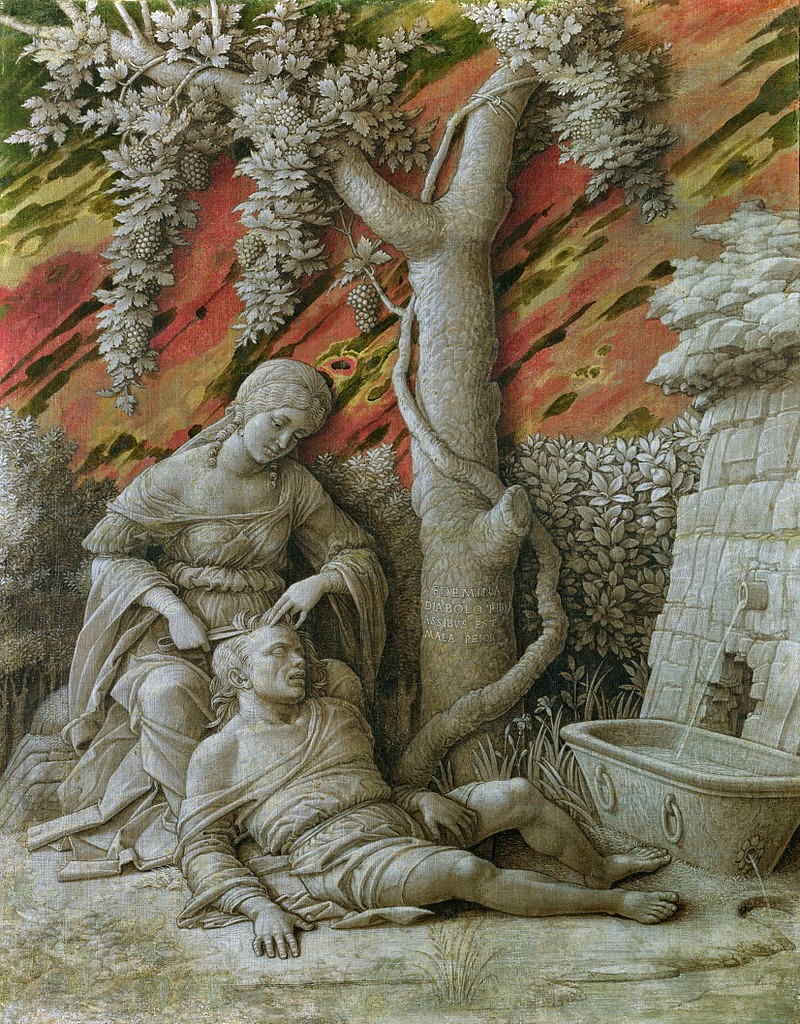
Here is post containing a video examining in depth the evidence that the story of Samson, in which his hair is shorn off but then begins to grow back, expresses the above concept in terms of the hair. The scriptures explain that Samson was consecrated to the Nazarite vow from before his birth, as part of the command of the angel who visited his parents (Judges 13:5).

That video and the discussion in this previous post both reveal that the hair of Samson metaphorically connects him to the rays of the sun, and esoterically to the invisible realm of spirit: when it is shorn off, it is emblematic of being plunged into matter, incarnated in a physical or "animal" body, represented in other symbology by the horizontal bar of a cross -- and when it grows back that is emblematic of raising the spiritual side, reconnecting with the invisible, immaterial aspect of who we are, which is represented in other symbology by the vertical portion of the cross.

Songs by Joseph Hill explicitly connect his music and the concept of Rasta with the Nazarite vow, and thus with raising the spirit, raising consciousness, and ultimately with blessing.

At the opening of the song "Babylon a-Weep," from the album Trust Me, he quotes Numbers 6 and beginning in verse 2, saying:

For it has been said: "When a man or a woman vow the vow of a Nazarite, no scissors nor razor shall be upon his head" . . . Jah Rastafari!"

In the song "Why am I a Rastaman?" from the album Humble African, he sings:

When I was a boy about eight years old,
There was a certain Rastaman,
And he love all the children
And he treated us like a man.
Even the children that no one cares for,
He call up every one,
And he gave us fruit and treated every one
With a special love.
Many people see I, Many people ask I:
"Why am I a Rastaman?"
For he taught I the love
To give to every one.
Many people see I, Many people ask I:
"Why am I a Rastaman?"
There is no better way to express my love
To each and every one
One Saturday morning
A special thing happen to this man
Here comes Mystery Babylon
To take away the Rastaman
So they root up him herb
And they beat off him fruit
And throw it in a van
And straight after that for three long years
I never see the Rastaman
They took him to general penitentiary
And they send him back as a bald man
But that could not change him
His mind was not in prison
It was only his body man.

From these verses it is very clear that in the songs of Joseph Hill, the concept of the Nazarite vow is emblematic of elevating the spirit, including over the degrading or down-pressing forces of poverty, imprisonment, racism, social rejection and marginalization (all of which focus on confining to the physical, rather than uplifting the spiritual), and that in his music and his life he taught that actively extending love and blessing to every one was the antidote to these forces.

It is also clear from the second song quoted that, although allowing the hair to grow is emblematic of that spiritual concept, it transcends the physical and in the case of the man whose hair was cut off, "that could not change him."

Music and singing, in fact, can also be seen as connecting us to the world of spirit, and have been seen that way around the world since ancient times.

Respect.

The Samson Myth is all about YOU

The Samson Myth is all about YOU

I have uploaded a new video diving into the profound message for each of us, hidden within the riddle of the Samson story.

Please share it with anyone whom you feel would be interested!

Blessings -- Namaste.

Samson and the seven locks of his head

Samson and the seven locks of his head

image: Wikimedia commons (link).

In the Book of Judges, we are told twice that Samson has "seven locks" of hair. In Chapter 16, beginning in verse 13, we read:

13 And Delilah said unto Samson, Hitherto thou hast mocked me, and told me lies: tell me wherewith thou mightest be bound. And he said unto her, If thou weavest the seven locks of my head with the web.
14 And she fastened it with the pin, and said unto him, The Philistines be upon thee, Samson. And he awakened out of his sleep, and went away with the pin of the beam, and with the web.
15 And she said unto him, How canst thou say, I love thee, when thine heart is not with me? thou hast mocked me these three times, and hast not told me wherein thy great strength lieth.
16 And it came to pass, when she pressed him daily with her words, and urged him, so that his soul was vexed unto death;
17 That he told her all his heart, and said unto her, There hath not come a rasor upon mine head; for I have been a Nazarite unto God from my mother's womb: if I be shaven, then my strength will go from me, and I shall become weak and be like any other man.
18 And when Delilah saw that he had told her all his heart, she sent and called for the lords of the Philistines, saying, Come up this once, for he hath shewed me all his heart. Then the lords of the Philistines came up unto her, and brought money in their hand.
19 And she made him sleep upon her knees; and she called for a man, and she caused him to shave off the seven locks of his head; and she began to afflict him, and his strength went from him.

The reader might be forgiven for questioning Samson's judgement here, in telling Delilah the real secret of how to successfully bind him and rob him of his great strength, in that every time previously that he tells her how to do so, she promptly tests it out on him. But, this story is clearly not meant to be understood literally, as we will see.

In Hamlet's Mill (1969), authors Giorgio de Santillana and Hertha von Dechend devote an entire chapter to the Samson story, and its echoes in other myths and sacred traditions around the globe. They offer compelling evidence that the events of the Samson myth are founded upon the constellations of the starry sky, and not upon actions that took place on earth among literal historical human beings. 

At one point in the chapter, they plainly state their belief that "Samson is Orion," one of the most important constellations in the heavens (166). And, while Samson's use of the "jawbone of an ass" as a weapon to slay his enemies (in Judges 15:15 - 20) can be plainly seen as connecting him to the figure of Orion, who is directly beneath the "V-shaped" Hyades, which almost undoubtedly represent the "jawbone" which Samson "puts forth his hand" to take as a weapon in verse 15, there are several reasons to believe that Samson does not merely represent one single constellation, but instead that he is the sun-god, rolling through all of the zodiac constellations in turn throughout the year.

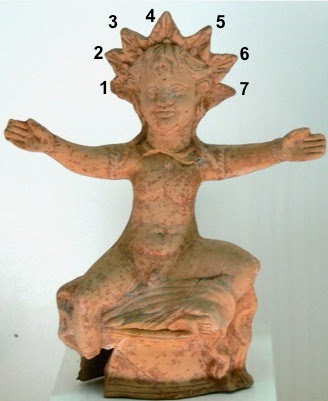
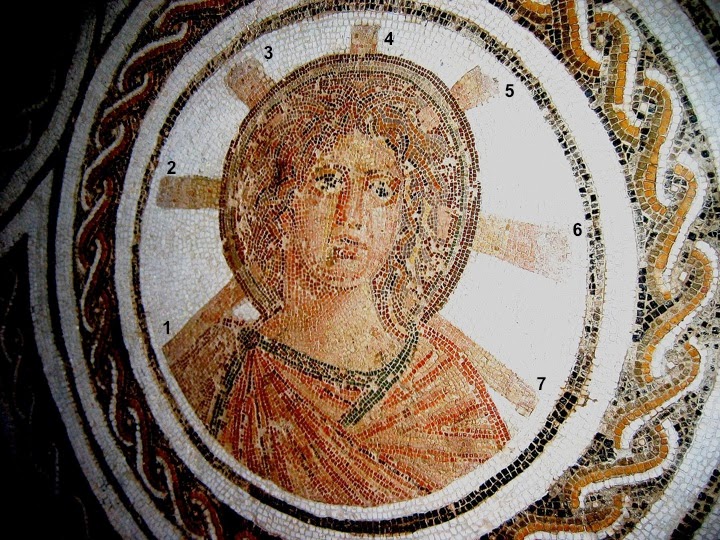
One of the clues that Samson may be the sun and not a single constellation is the fact of his "seven locks" of hair upon his head. It would be difficult to argue that the outline of Orion provides any support for this detail in the Samson story. However, ancient sun-gods were quite frequently portrayed with seven radiant beams of light emanating from their head -- a clear parallel to the number of locks Samson possesses.

Here is an ancient statue of the sun-god Helios, with seven distinct rays coming from his head:

image: Wikimedia commons (link). 

And here is an ancient mosaic depicting the sun-god Apollo with seven distinct rays as well:

image: Wikimedia commons (link).

And, in this passage from the Dionysiaca of the poet Nonnus of late antiquity, the sun-god Helios is described decking out his son Phaethon with the gear he will need to drive the solar chariot across the sky (Phaethon rashly demanded that his father allow him to drive the horses of the sun, in order to prove that he was really his father -- the authors of Hamlet's Mill devote another entire chapter to this important mythical event):

After this speech, he [Helios] placed the golden helmet on Phaethon's head and crowned him with his own fire, winding the seven rays like strings upon his hair, and put the white kilt girdlewise round him over his loins; he clothed him in his own fiery robe and laced his foot into the purple boot, and gave his chariot to his son. 291 - 297; page 113 in the Rouse translation linked above.

Anyone who sees these numerous ancient references to the seven rays emanating "like strings upon his hair" from the head of the sun-god must suspect that the "seven locks of his head" described in the Samson story might be a clue telling us that Samson is also a solar hero.

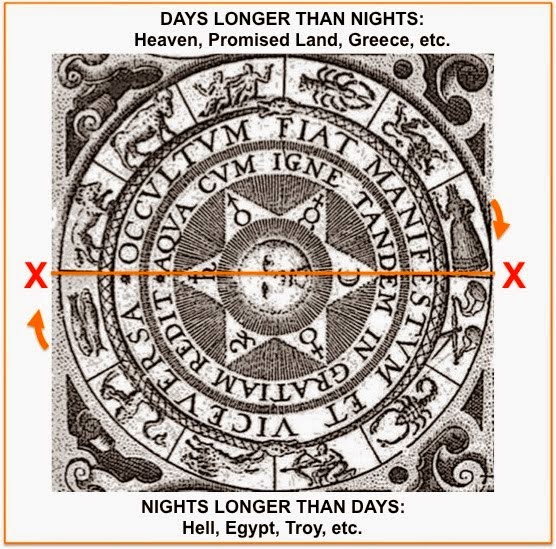
The identification of Samson as a solar figure makes sense, in that at the point of the year where the nights begin to be longer than the days, and the sun begins to arc downward towards its "weakest" point on the annual "wheel," there is in fact the figure of a woman, in the sign of the constellation Virgo:

You can see the sign of Virgo on this zodiac wheel, at the right side of the circle just above the horizontal line which separates the upper half of the year (where days are longer than nights) from the lower half of the year (where nights are longer than days). The fact that Samson has his power stripped from him by Delilah almost certainly refers to the sun passing through the sign of Virgo at the point of the year where night begins to take over as longer than day.  

Readers who are familiar with the outline of the constellation Virgo itself will also know that she does have a distinctive "lap" as she is seen in the sky, which probably accounts for the fact that Samson is described as going to sleep "upon her knees" in the scriptural passage:

The identification of Samson with the sun itself, rather than with one specific constellation, also helps to clear up some of the other episodes in the Samson story, such as the well-known incident in which he is on the way down to see the woman of Timnath and he encounters a young lion, which Samson slays with his bare hands (Judges chapter 14). If you examine the zodiac wheel shown above, you will see that the zodiac sign of Leo the Lion is found immediately prior to the sign of Virgo, and that the sun passes through Leo on the way "down" to the crossing point of the September equinox (marked on the diagram with the red "X" on the right side as we look at it), when the days are declining in length and the year begins to arc down towards the lower half of the winter months. 

In the same chapter of Judges, we are told that the next time Samson comes to the lion that he had slain, he finds that a "swarm of bees and honey" were now there in the carcass of the lion -- which is indicative of the Beehive Cluster found in the zodiac constellation Cancer, immediately preceding Leo on the wheel. As I explain in the first three chapters of The Undying Stars

(which are available to read online here), it was this correspondence between the events of Samson's story in Judges 14 to the order of zodiac constellations in the circle of the year which first began to really cause me to question whether the Bible was in fact intended to be understood "literally" (that is, as describing the literal events of the human lives of historical figures who lived on earth).

There are other clues in the Samson story that the events it describes are not intended to be understood literally. One of them is found not long after the story of the slaying of the lion and Samson's courting of the woman of Timnath, when Samson appears to go in to her in the time of wheat harvest, apparently after a long absence. At the beginning of Judges chapter 15, we read:

1 But it came to pass within a while after, in the time of wheat harvest, that Samson visited his wife with a kid; and he said, I will go in to my wife in the chamber. But her father would not suffer him to go in.
2 And her father said, I verily thought that thou hadst utterly hated her; therefore I gave her to thy companion: is not her younger sister fairer than she? take her, I pray thee, instead of over.
3 And Samson said concerning them, Now shall I be more blameless than the Philistines, though I do them a displeasure.
4 And Samson went and caught three hundred foxes, and took firebrands, and turned tail to tail, and put a firebrand in the midst between two tails.
5 And when he had set the brands on fire, he let them go into the standing corn of the Philistines, and burnt up both the shocks, and also the standing corn, with the vineyards and olives.

The authors of Hamlet's Mill correctly point out that this sounds more like a fairy tale than something that actually took place in history, perpetrated by actual historical actors (168). After all, it might be difficult to even find three hundred foxes in one geographical region, let alone catch all of them in any reasonable amount of time, and then somehow tie them "tail to tail" and put a firebrand in the midst of each pair! It is far more likely that, once again, this story has a celestial foundation, and that it has something to do with the sun's passage through the year.

In terms of zodiac constellations in which two animals are tied "tail to tail," the most obvious pick would be the constellation Pisces, which -- like Virgo -- is the zodiac sign found immediately prior to an equinox (look just below the horizontal line, on the left side of the wheel in the zodiac diagram above). The equinoxes were associated with fire in myth around the globe, because at the equinoxes the fiery path of the sun crosses over the celestial equator. You can see the discussion of the figures who mark the equinoxes with a torch held up (for the crossing upwards in the spring) and with a torch held down (for the crossing downwards in the fall) for further support of this connection.

However, the fishes of Pisces are not really foxes, even though they are tied together tail to tail and even though they are found right before the fiery crossing of the equinox. Furthermore, this scriptural passage actually tells us what time of year we are dealing with in this episode, and it is "the time of wheat harvest," which is not associated with the time of the spring equinox but rather with the fall equinox and with the constellation Virgo and her sheaf of wheat (associated with her brightest star, Spica).

Therefore, I think it is more likely that this episode relates to the constellations near Virgo, especially as we also have a character playing the woman's father, which is a common pattern in stories involving Virgo and usually refers to the constellation Bootes the Herdsman, located very close to Virgo.

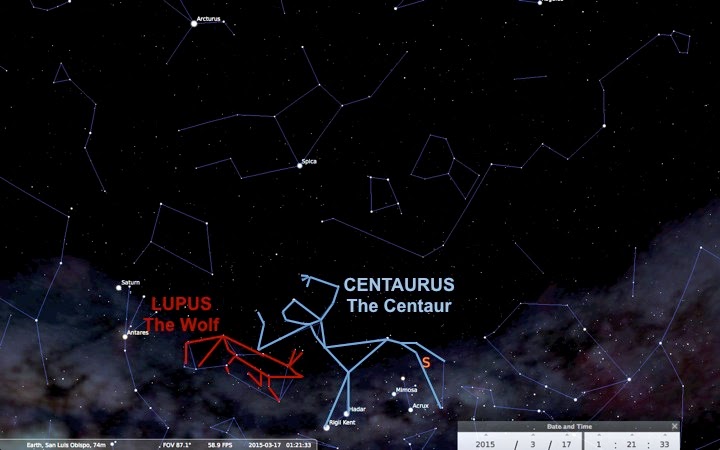
The most likely celestial foundation for the foxes of the Samson story, I believe, is the constellation Lupus the Wolf, located close to Virgo. In his essential book The Stars: A New Way to See Them, H.A. Rey describes this constellation: "the WOLF (LUPUS), quite wolf-like in shape, trots beneath one arm of the Centaur, who seems about to seize him" (62). In fact, the Centaur seems so "about to seize" the constellation of the Wolf that in some books on the stars you will find the Wolf referred to as the "Centaur's Victim." 

The outline of this constellation could certainly be seen as a fox, just as easily as it could be a wolf, with its long tail and two upraised ears. Below is an outline of the Centaur and the Wolf, using the same screen-shot from Stellarium.org which was used to outline the constellation of Virgo, above (so you can see how close in the sky they are to Virgo):

You can also see from this image that they are both located near or upon the smoky, silvery band of the Milky Way galaxy. The Milky Way plays a role as smoke rising from a fire in other myths -- notably, for instance, in the story of Abraham's near-sacrifice of Isaac, the celestial foundations of which are discussed here -- and so this story of the foxes setting alight all the fields of the Philistines is very appropriate for this constellation.

It is even possible that the outline of Centaurus was somehow seen as the "other fox" tied tail-to-tail with the constellation Lupus for this story.

The authors of Hamlet's Mill also point out that Ovid tells us in his poem called the Fasti that there was an ancient feast of Ceres in which a fox was set on fire to punish the species for once burning up the wheat-fields, after a fox was set alight by a wicked twelve-year-old boy in a story very reminiscent of Samson's act in the beginning of Judges 15.

Here is a link to Book IV of Ovid's Fasti, where that particular story is recounted. There, in the section entitled "April 19: The Cerialia," Ovid tells us:

She had a son: he was a playful child,
Who was already twelve years old.
In a valley, he caught, in the depths of a willow copse,
A vixen, who'd stolen many birds from the yard.
He wrapped his captive in straw and hay, and set fire
To it all: she fled the hands that were out to burn her:
In fleeing she set the crops, that covered the fields, ablaze:
And a breeze lent strength to the devouring flames.
The thing's forgotten, but a relic remains: since now
There's a certain law of Carseoli, that bans foxes:
And they burn a fox at the Cerialia to punish the species,
Destroyed in the same way as it destroyed the crops.

In the above story, the outline of Centaurus with its arms seizing the fox can certainly be detected in the lines which describe the boy as catching the fox and then the fox fleeing from "the hands that were out to burn her." The clear correspondences to the story of Samson in this account from the poet Ovid also argue that the Samson story is not a literal account from a human life but that it is a myth with episodes that are derived from the stars of the sky -- episodes which show up in other myths around the world as well.

One of the most interesting aspects of the Samson story as it is preserved in the scriptures of the Book of Judges is the fact that Samson himself frames the episode of the lion and the swarm of bees as a riddle to be solved, in Judges 14: 12 - 14. Framing it as a riddle invites the reader to ask "What does it mean?" and indicates at the same time that there is more going on than perhaps appears on the surface. 

As we have seen, one answer to the riddle appears to be: these events refer to the sun, making its way through the various signs of the zodiac, including Taurus (which provides the "jawbone of an ass" that Samson "puts forth his hand" to take and slay a thousand men), Cancer (which provides the "swarm of bees and honey"), Leo the Lion, and Virgo and the constellations surrounding Virgo including Bootes, Lupus, and perhaps Centaurus (as well as the entire Milky Way galaxy, if it represents the burning of the fields of the Philistines).

But, after we have arrived at that answer, we are still faced with the question: "What does it mean?" Why would the scriptures (and other myths around the world) spend so much effort encoding the motions of the stars in stories about people here on earth? 

The answer, I believe, is connected to the assertion of Alvin Boyd Kuhn cited in this previous post, and explored in that post and in this related post, and that is the assertion that, "The Bible is the drama of our history here and now; and it is not apprehended in its full force and applicability until every reader discerns himself [or herself] to be the central figure in it! The Bible is about the mystery of human life" (Alvin Boyd Kuhn, from a lecture entitled The Stable and the Manger, 1936).

In other words, this story is not really about someone named Samson, who lived in another part of the world in a time long, long ago: it is really about you! The drama of Samson's loss of his great strength, located at the point of the year at which the sun dives down from the upper realm towards the "underworld" of the winter months, describes our own plunge out of the realm of pure spirit and into the life of incarnation through which we are all currently toiling. 

The reason that the sun (and the zodiac stars) make such an excellent allegorical description of this process is that they themselves can be seen to arc through the upper realms but then plunge down into the western horizon -- where they are "buried" in the elements of earth and water, the same lower elements our bodies are composed of. The scriptures of the world tell of the fire of spirit being plunged down into, and incarnated in, earth and water. 

But they also intimate, in describing the human stories which mirror the motions of the stars, that we ourselves are stars and suns -- that the infinite cosmos are mirrored within each man and woman walking around here on earth.

Thus, while the story of Samson makes very little sense if we try to read it literally, when we realize that it is telling us a celestial riddle, and when we begin to detect the answers to that riddle, it becomes filled with profound meaning.

In the Samson story, his "seven locks" get shorn off, but then we are told that the hair of his head begins to grow again (Judges 16:22). In the same way, we have seen in other discussions of the zodiac wheel that after the "Djed column" is "cast down," it is then "raised up again" -- after we have been thrown down into the material realm, forgetting our true nature and our true origin and often even forgetting the existence of the spirit world, we then have the task of rediscovering spirit, and calling it forth, both within ourselves and -- to whatever degree we can -- in others and in the world around us as well (see also herehere, and here, among other discussions of this important subject).

Blessings.

----------------------

additional note, 01/22/2014: Just added a new video showing and discussing some of these concepts here.

Martin Luther King, Jr. (01/15/1929 - 04/04/1968): "But if not" and the moral law of the universe

Martin Luther King, Jr. (01/15/1929 - 04/04/1968): "But if not" and the moral law of the universe

Martin Luther King, Jr. was born this day -- January 15 -- in 1929.

Above is an audio track of the sermon entitled "But if not," delivered by Dr. King on November 05, 1967 -- only five months before his earthly life was violently ended by a cowardly criminal act of assassination.

Dr. King was a powerful and eloquent orator, and his words speak for themselves. If you have never listened to his sermons before -- and even if you have -- his birthday is an appropriate day to listen to them again, and this sermon is rightfully famous.

While Dr. King's message needs no elaboration or additional explanation, a few particular points impressed me as being especially worthy of brief comment (below -- you may prefer to listen to Dr. King's sermon first).

Here are a few brief comments for those interested -- but of course the entire sermon is deeply moving and worthy of careful consideration from start to finish. Longer direct quotations from the sermon are printed in a blue font in order to make it easier to distinguish those quotations:

  • The title of the sermon is taken from the scriptural passage in the Book of Daniel, chapter 3 and verse 18. There, the three Hebrew youths who have in their captivity been given the Babylonian names Shadrach, Meshach, and Abed-nego, famously declare that they will not bow down to the king's idols, and specifically they will not bow before and worship the golden image he has raised in the plain of Dura, and that they will trust their God for deliverance, knowing that he can save them -- "But if not," they concede (that is, even if he does not deliver them), they will still do what is right and obey the law of God over the arbitrary and tyrannical proclamation of the king. 
  • In this sermon, Dr. King points to this story as an example of civil disobedience. Beginning at 03:30 in the track above, he defines civil disobedience, saying: "Now I want you to notice first here that these young men practiced civil disobedience. Civil disobedience is the refusal to abide by an order of the government or of the state or even of the court that your conscience tells you is unjust. Civil disobedience is based on a commitment to conscience. In other words, one who practices civil disobedience is obedient to what he considers a higher law. And there comes a time when a moral man can't obey a law which his conscience tells him is unjust."
  • Without using the terminology of natural law as articulated by abolitionist and political philosopher Lysander Spooner in the 1800s, Dr. King draws the exact same distinction that Spooner draws, between artificial (or man-made) law and natural law (which Dr. King calls "conscience," "higher law," "moral law," or "eternal and divine law" in this sermon). In other words, both declare any immoral "law" to be no law at all -- Spooner using the example of the Fugitive Slave Acts in the United States, and Dr. King using the example of criminal acts perpetrated in Nazi Germany under Hitler which were "legal" but only in the sense of artificial law -- they were actually immoral and illegal and Dr. King declares he would have openly disobeyed them. Warming to this theme, he declares beginning at the 06:50 mark in the above audio: "And so it is important to see -- that there are times -- when a man-made law is out of harmony with the moral law of the universe; there are times when human law is out of harmony with eternal and divine law: and when that happens, you have an obligation to break it. And I'm happy that in breaking it, I have some good company!"
  • He later connects this obligation to resist man-made laws which oppose the moral and eternal and divine law with the statement by Shadrach, Meshach, and Abed-nego in Daniel 3:18 beginning with "But if not." Dr. King explains that our obligation to oppose immoral law is not dependent upon being spared from negative consequences in doing so, nor is it dependent upon being promised positive rewards for doing so: it must be done because it is the right thing to do. This leads him directly to his soaring and justly famous conclusion, a portion of which is quoted next, beginning just prior to the 17:00 mark in the above audio.
  • Notice that directly connected to his assertion that we must come to the place where we cannot but stand up for the moral law irregardless of reward or consequences is Dr. King's mention of the conventional doctrines of heaven and hell -- and he likewise declares that we do not simply decide to stand up for the right either for the promise of the one or the fear of the other. At 16:46, building to a crescendo, Dr. King proclaims: "What does this mean? It means in the final analysis, you do right NOT to avoid hell. If you're doing right merely to keep from going to something that traditional theology has called 'hell,' then you're not doing right. If you do right merely to go to a condition that theologians have called 'heaven,' you aren't doing right. If you are doing right to avoid pain, and to achieve happiness and pleasure, then you aren't doing right. Ultimately, you must do right because it's RIGHT to do right. You've gotta say, 'But if not.'"
  • It is impossible not to notice that Dr. King's framing of the concepts of heaven and hell as "something that traditional theology has called 'hell'" and "a condition that theologians have called 'heaven'" serve to call into question the traditional or conventional (that is to say, "literal") understanding of those two concepts, and to distance himself those traditional literal theological interpretations. The fact that Dr. King here appears to strongly call into question the traditional literal understanding of those two ideas is in keeping with the argument put forward in the preceding post (and elsewhere in other previous discussions), that the literal interpretation of the scriptures can be (and historically has been) used to control thought and behavior and even to oppress and enslave, whereas the sacred scriptures and ancient teachings of humanity (including those in the Bible) were actually intended uplift (and not oppress), to liberate (and not enslave). For further discussion of the likelihood that the concepts of both hell and heaven in the scriptures of the Old and New Testaments relate to celestial metaphors connected to spiritual teachings about our incarnate condition, rather than to literal places of eternal punishment or reward as they have been interpreted by literalistic theologians (and then used as convenient tools to control thought and behavior), please see "No hell below us . . ." and "A land flowing with milk and honey."
  • This aspect of Dr. King's sermon is very important, because the entire thrust of his sermon is to place the moral obligation of "doing right," including when necessary civil disobedience to immoral laws, upon an ancient scriptural foundation. Following other researchers, including Mark Passio, I have argued that widespread institutionalized violations of natural law must necessarily be accompanied by some form of mind control: those techniques which are used to "hypnotize" large numbers of people into (wrongly) believing that violations of natural law are actually right or good or moral or acceptable. Misinterpreted, the Biblical scriptures have in fact been used in the past -- and continue to be used -- as an instrument of mind control, to condone oppression of one group by another, for example, or to condone the use of force for reasons other than protection against violence. But, this does not mean that we should "throw out" the Biblical scriptures, or any of the other ancient scriptures and traditions of humanity, just because they have in the past been twisted around to try to support the opposite of what they really mean. On the contrary, these ancient teachings, properly interpreted, actually stand against mind control (I believe). Dr. King in the above sermon clearly evidences a high regard for the ancient scriptures -- in this case, the Book of Daniel from the Hebrew Scriptures (or the "Old Testament") -- and I believe he can be seen to be using them in a way that dispels mind control and promotes human freedom and natural law.
  • Ultimately, I believe that open, non-violent civil disobedience itself is designed to call attention to ongoing violations of natural law (or, as Dr. King puts it, "human law out of harmony with eternal and divine law"), and to remove the "veil of legitimacy" which techniques of mind control attempt to throw over those violations of the natural law. By his willingness to face consequences while non-violently doing actions which do not violate natural law (but which may indeed break these "out of harmony human laws") -- the same willingness he connects back to Daniel chapter 3 and verse 18 -- Dr. King helped to "wake up" those who had previously been too hypnotized to notice that those human laws were actually profoundly immoral.

At the end of this famous sermon (beginning around 18:20), Dr. King declares that "if you have never found something so dear and so precious that you will to die for it," or if

"some great opportunity stands before you and CALLS upon you to stand for some great principle, some great issue, some great cause," and you refuse to do it because you are afraid, you refuse to "take the stand" as he puts it, then you will die inside. He prefaces these stirring words by saying "you may be 38 years old, as I happen to be" -- but those of us who are already older than that need not think that it is already too late for us to find such a cause, whether we are 48, or 68, or 88 or 108 years old! There is never a lack of need for the kind of willingness to stand up for justice that Dr. King proclaims in this sermon!

I would humbly suggest that, if we are unsure of what "great principle" that we ourselves might stand for, we could perhaps hardly go wrong if we decide to stand for natural law, which is the same as the universal law, the eternal law, the divine law, and the moral law. 

From there, we can be alert to identify places in which human law is, as Dr. King puts it,

"out of harmony with the moral law of the universe,"

and then to stand against them and to show others how they are illegitimate and ultimately illegal. Unfortunately, there is no shortage of such human laws and actions going on today, any more than there was in 1967.

Martin Luther King, Jr. clearly understood natural law, and the fact that natural law is woven into the very fabric of our universe. He understood that, because of this fact, widespread institutionalized violations of such law actually require forms of mind control, to veil their illegitimacy. He clearly understood the importance of exposing this mind control, in order to dispel it, and he saw that nonviolent civil disobedience was a way to seize the moral high ground and expose the illegitimacy of actions which run counter to natural universal law.

He also understood the importance and power of the ancient scriptures, and held them in high esteem, and he saw that they teach resistance to illegitimate artificial laws, and that the scriptures actually illustrate non-violent civil disobedience, and provide a basis and foundation for it.

All of these lessons, and the sermons of Dr. King, are as vital today as they have ever been. And, they are vitally important for our own well-being as moral individuals.

Respect.

"Vision A" or "Vision B"

"Vision A" or "Vision B"

image: Wikimedia commons (link).

When Black Elk, a holy man of the Lakota people, expressed the difference between the life before the arrival of the European invasion and after, he said:

Once we were happy in our own country and we were seldom hungry, for then the two-leggeds and the four-leggeds lived together like relatives, and there was plenty for them and for us. But the Wasichus came, and they have made little islands for us and other little islands for the four-leggeds, and always these islands are becoming smaller, for around them surges the gnawing flood of the Wasichus, and it is dirty with lies and greed. Black Elk Speaks, 8.

There is a lot to notice in these two sentences. Black Elk chooses to characterize the difference between the two cultures by saying that his culture saw humanity as part of nature: they lived together with the earth's other creatures like relatives. In contrast, the bringers of the new culture clearly saw themselves as divided from nature, and created what Black Elk describes as "little islands" to physically separate people from the earth's other creatures.

This short passage also implies that directly related to these two opposite views of humanity's place in nature are two opposite views of nature itself: in the first, a vision of abundance, that "there is plenty for them and for us," and in the second, a vision of scarcity and a "gnawing flood [. . .] dirty with lies and greed."

I would argue that in these two sentences, Black Elk has pinpointed the most important negative consequence of the literalist twist that was imposed upon ancient scriptures in Europe (in the time of the Roman Empire) that actually changed their teaching from a message that is closer to the first position Black Elk articulates (we could call this "vision A" for ease of discussion) to the horrific vision of the "gnawing flood" and the ever-shrinking "little islands" described in the second half (we could call this "vision B").

In other words, the ancient scriptures actually articulate "vision A," but at a certain point in history they were twisted into "vision B." 

For example, this previous post discusses the Genesis account of Adam and Eve, as well as the Genesis account of Noah's three sons Shem, Ham and Japheth, and argues that if they are understood allegorically, or esoterically, they clearly convey a message that applies to all men and women equally, and a message that our physical form is only a "coat of skin" and that our common spiritual origin unites us all. Understood this way, they also convey a message that unites humanity with all of nature,  including the infinite starry heavens -- often expressed in the teaching "as above, so below."

However, the same stories when interpreted as describing literal and historic men and women named Adam and Eve, or Noah and his sons Shem, Ham and Japheth, have historically led to all kinds of racist ideologies, and have been used to divide men and women, to elevate one group and devalue another, and even to divide humanity from the other creatures (based on literalistic misinterpretations of the enmity with the serpent, the teachings that man has "dominion" over all the earth and its animals, and the teachings given to Noah about domesticating animals, for example).

In other words, the scriptures that became central to western European culture, and which should be seen as teaching "vision A," were given a literalistic twist at a specific point in history, which led to a culture that was largely guided by "vision B."

In fact, the Biblical scriptures when understood esoterically can be seen as teaching a vision of the natural world, and humanity's place in it, which can be accurately characterized as shamanic. This is because they actually can be shown to be clearly built upon the same foundation as the sacred stories and traditions found around the world, all of which contain clear shamanic elements and teachings.

The literalist takeover of these scriptures, and the campaign to deliberately eliminate texts and teachers who taught an approach which challenged this literalistic "vision B" view of the scriptures, can be demonstrated to have taken place during the years that western historians call the first four centuries AD.

It is very important to understand that, whatever good things western European civilization and culture produced in the centuries that followed (and it cannot be denied that it did produce many good things), this fundamental "vision B" understanding guided much of its development, and that it in fact continues to inform "western civilization" in very powerful and sometimes very destructive ways.

Because, as Black Elk so incisively explains in just two sentences, the vision that shaped "western" thought contains a powerful tendency towards self-imposed division of humanity from nature, as well as antagonistic division between humanity itself. Connected to this division, in Black Elk's view, is a vision of scarcity rather than plenty.

Perhaps nothing illustrates the ongoing influence of this "vision B" attitude better than the rush to create and release genetically-engineered plants and animals into nature. Previous posts have cited ancient philosophers, who wrote prior to the triumph of the literalist takeover, admonishing those whose vision of scarcity led them to horrible treatment of animals and mistrust of nature's bounty -- see for example the arguments of Plutarch and Ovid, both of whom articulate a vision of humanity as related to the animals and to the rest of nature.

Since those posts were written, a new and even more horrific example of what we might call a "runaway vision B" has emerged, with the deliberate creation of genetically-engineered mosquitos, which have already been released en masse in at least two parts of the globe, and which are slated for release in Florida in either January or February of this year (no word yet on whether that has actually taken place already, or if it is set to occur within the next couple weeks).

If there is a better symbol of the terribly misguided decisions that the self-imposed division from nature that "vision B" produces than the decision to genetically alter an insect that regularly feeds on human blood, I don't know what it is -- unless it is the decision to start releasing clouds of them into the wild in an act that can never be un-done.

But just wait a few months and there will probably be a new example even more ominous and un-natural than this one.

It should be starting to become clear to even the most unthinking adherent of the "vision B mindset" that something has gone terribly wrong. Black Elk saw the problem with crystal clarity more than a hundred years ago.

But, the good news is that "vision A" is actually the vision that is at the heart of the shared ancient heritage of all of humanity. It was treacherously supplanted by and replaced with "vision B" in a certain part of the world, in a single culture, many centuries ago -- and the results have been catastrophic for many other cultures around the world in the intervening centuries since that takeover. But if "vision B" could replace "vision A," then that means that there is hope that the process could be reversed -- perhaps even more rapidly than the original switch. 

People can and do change their entire outlook on the world, without violence and sometimes quite rapidly. I know this personally, as I have changed my own vision quite radically within the course of my own life.

The division from nature and from one another described above and in the quotation from Black Elk is clearly a self-imposed separation -- which means that it can also be "self-un-imposed."

We can still listen to the vision that Black Elk shared with the world -- before the gnawing dirty flood of lies and greed covers over the shrinking little islands altogether.

image: Wikimedia commons (link).

Comet C/2014 Q2 (Lovejoy)

Comet C/2014 Q2 (Lovejoy)

image: Wikimedia commons (link).

I am a catastrophist: I believe that the existing evidence overwhelmingly supports theories which conclude that earth's geology was primarily shaped by one or more catastrophic events, rather than theories which posit that earth's geology as we see it today is the result of the same types of processes we see acting around us today, and that given enough time these "normal" processes could produce the geological features we see on our planet.

The question of whether our planet's features reveal evidence of catastrophe, or whether our planet's features were produced by "normal" processes acting in a "uniform" manner over eons and eons of time (the so-called "uniformitarian" category of theories, which arose in the eighteenth century among those who may have had ulterior motives for rejecting then-prevailing catastrophist thought), is important in its own right, of course.

But it is also important with regard to the mystery of humanity's ancient past.

Just as I believe the evidence overwhelmingly supports a catastrophist conclusion regarding the forces which shaped the features we find all around us on planet earth, in contrast to the "uniformitarian" explanations which have now become the dominant conventional position of most in academia, I believe that the evidence overwhelmingly supports a view of ancient human history which is radically different from the currently-accepted conventional narrative held by academia today.

For example, the ancient mysterious monuments found on the Giza plateau in Egypt (the Giza pyramids), the ruins of the Indus Valley civilization (in modern-day India), the Nazca lines (in modern-day Chile), the temples at the Angkor complex (in modern-day Cambodia), and Rapa Nui (Easter Island) are all located on a "great circle" -- indicating some kind of coordination which we cannot currently explain with the conventional paradigm of human history, as well as very precise and sophisticated ancient knowledge of the size and shape of our spherical earth.

There are many other ancient sites located along different great circles -- part of a body of evidence suggesting that the most mysterious monuments on our planet may all have been part of some kind of a vast worldwide grid, the purpose and design of which remains a mystery at this time.

The geological evidence of a catastrophe or catastrophes (which is generally rejected by the uniformitarian camp dominant in academia) may well be related to the mysteries of humanity's ancient past (which, judging by massive evidence which refutes the conventional academic view, was almost certainly very different from what we have been taught).

Comets may constitute an entire category of space-borne evidence of a tremendous catastrophe within our solar system long ages ago. Dr. Walt Brown, the originator of the hydroplate theory (a catastrophist theory involving a global flood, a theory which has tremendous amounts of evidence to support it, and which is the subject of numerous previous blog posts as well as my first book, The Mathisen Corollary), believes that numerous pieces of evidence indicate that comets are the modern remains of water which was violently ejected from earth at the start of the catastrophic flood event.

You can read about some of this evidence in numerous previous posts on comets, such as these "internal search" results for the word comet using the internal search window for this blog found in the upper-left portion of most desktop browsers, and you can read more about Dr. Brown's analysis of the evidence regarding the origin of comets in this chapter of the latest edition of his book, which he graciously makes available in its entirety online here (you can also order the physical version of the book here).

Right now is an exciting time, because a long-traveling spacefarer in the form of a long-period comet has entered the inner solar system and is streaking past the earth, close enough to be visible with the naked eye (although not very easily -- it is more easily visible with binoculars). It is Comet C/2014 Q2 (Lovejoy), discovered by Terry Lovejoy of Australia last year. This comet has an orbital period estimated by conventional scientists as approximately 14,000 years, which means that if they are right, it hasn't passed this way since around 12,000 BC, and won't be back again until around the year AD 14,000. 

There are some good reasons to suspect that the conventional estimates are somewhat flawed, which are discussed in this previous post about Comet ISON, which was based on Dr. Brown's discussion of Comet ISONin his book here. If Dr. Brown's theory is correct and the comets we see today are the remnants of a tremendous catastrophe which took place on earth thousands of years ago, it is possible that this is actually Q2's first return visit since that catastrophe took place. 

Those discussions also note that, due to the presence of mass at the outer reaches of our solar system, which might act to pull comets back a bit more quickly than conventional scientists currently calculate using their models -- which means that it might be a little less than 14,000 years before C/2014 Q2 passes back this way again. Nevertheless, an error of a few hundred years in an estimated orbital period of 14,000 probably won't make much difference to those of us living today -- and so we should probably make every effort to observe this long-traveling visitor this time around.

Fortunately, C/2014 Q2 is not difficult to locate, if you know where to look. It's not anywhere near as dramatic as was Comet Hale-Bopp, which was enormous even to the naked eye and looked exactly the way a "classical" comet would be expected to look. Q2 is very difficult to see with the naked eye, but it can be seen as a dim glow or fuzz with the naked eye, and with binoculars it can be easily perceived as what to me appeared to be a faintly-glowing tiny cloud, or perhaps what might be described as a very tiny flashlight shining towards us from behind a kind of blue fog.

But, while Hale-Bopp is also a long-period comet, its orbital period is nowhere near as long as that of C/2014 Q2. Hale-Bopp is expected to return in AD 4385 -- long before the next return of Comet Q2 -- and it had probably circled through the inner solar system at least once previously, in the 23rd century BC (there is some evidence that the ancient Egyptians may have recorded that previous visit). And so, Comet Q2, while much less visually spectacular, should inspire its own awe in the viewer, as we contemplate an object which has traveled so far, for so long, and which has streaked in towards us close enough to see from the almost-incomprehensible distance of 1,156 astronomical units (Halley's comet, a short-period comet, only gets out to 35 astronomical units before coming back, and it is due again in AD 2061).

Right now the moon is in its waning phase, on its way to a new moon on January 20. The moon is rising fairly late in the night (after 11pm, and getting later each night). So it is an excellent time to go out and look for Comet C/2014 Q2.

Below, I will present a series of images that will help you locate the comet, if you haven't been able to do so already. With apologies to my southern hemisphere friends, these will be "northern hemisphere-centric." 

First, head over to Sky & Telescope, where Alan McRobert has written an article containing two excellent star charts that show the path of the comet from one night to the next -- since we are now in January of 2015, you will want to use the second of the two charts (the very last chart at the very bottom of the article).

The arcing yellow line shows the comet's path from one night to the next, but you won't be able to actually see it moving -- look on the line for the little tick-marks indicating the comet's location by date, and find the mark indicating the current date to see where the comet should be along that curved line.

The images below should help get you "in the ballpark." 

I went outside and laid down on my back on the ground, and looked up at the sky using binoculars. If you happen to own a reclining lawn chair, that might be slightly more comfortable, although lying on the ground at night and looking up at the stars is also rather nice.

If it is not cloudy or foggy (or full of light pollution from city lights), you should have no difficulty observing the breathtaking panorama of winter stars, including Orion, Taurus, and the Pleiades. These will act as the pointers to direct us to the location of Comet C/2014 Q2.

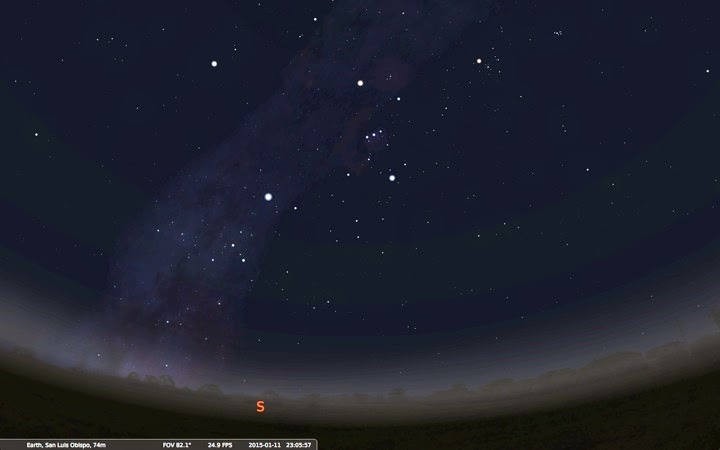
The image below (from the excellent free open-source planetarium app Stellarium) shows the night sky as I observed it this evening, from a location that is about 35 North latitude, and looking to the south. You can clearly see Orion with his three belt stars, as well as Sirius in Canis Major to his lower left, inside the band of the Milky Way. To the right and up from Orion on the other side from Sirius, you can see the distinctive "V" of the Hyades, with orange-colored Aldebaran as their brightest star. Beyond the "V" of the Hyades you can see the gorgeous little cluster of the Pleiades. We will label these in a future slide, as we "zoom in" a little closer.

I would recommend using binoculars if you have access to some. While lying on the ground, try to observe the three belt-stars of Orion, without having to strain your neck at all (you should find that you can move the angle of the binoculars to "sweep" to different stars, without having to actually lift your head up off the ground or the reclining lounge chair). 

Check your focus -- see if they are clear and distinct. If not use the wheel to dial them into focus.

Then head up to the Pleiades. You should be able to see them all very distinctly. They are stunningly beautiful. You may want to just stare at the Pleiades for hours. They are often called the "Seven Sisters," but there are many more than seven, as you will see if you look at them with binoculars. Ensure your focus is nice and clear on the Pleiades.

Below is the same screen-shot as that shown just above, but this time I have outlined a rectangle that includes the area we want to focus on in order to locate Comet Q2:

This red rectangle shows the section of the sky that includes the "main body" stars of the constellation Orion, along with the "V" of the Hyades, and (in the upper-right corner) the cluster of the Pleiades.

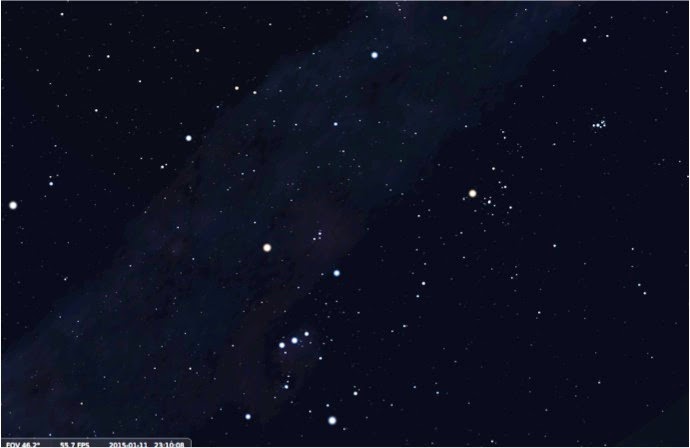
Below is the area within that red rectangle:

Can you find the constellation Orion, the "V" of the Hyades (with Aldebaran), and the tiny cluster of the Pleiades in the image above?

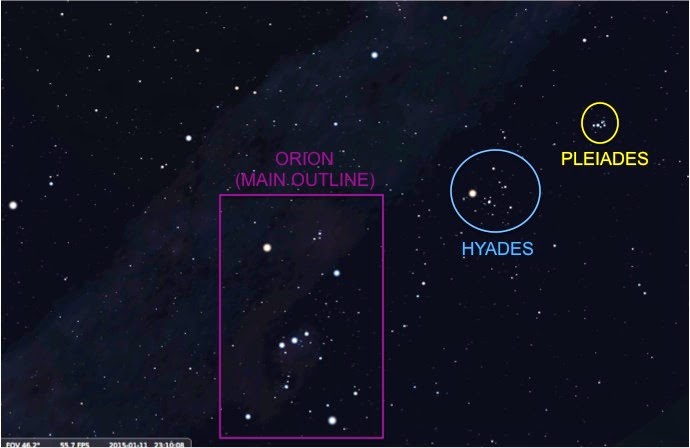
Below is the same image, with those three landmarks labeled for you:

You should be able to find all three of these major sky landmarks with your binoculars and have good enough focus to make out the individual stars of the Pleiades or the Hyades before you try to find Comet Q2.

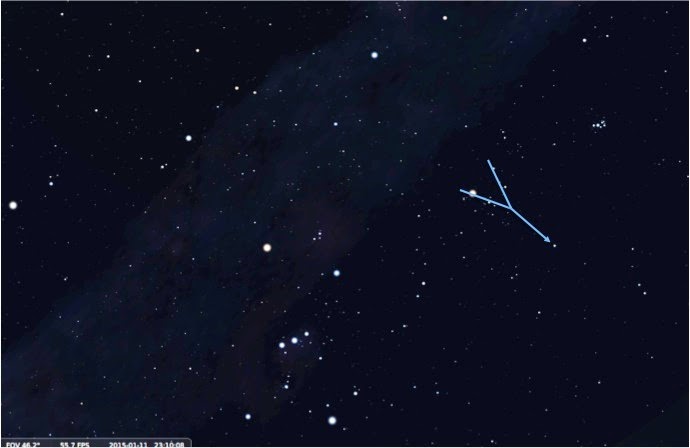
To find Q2, I believe the best way is to draw a line from the bottom of the "V" of the Hyades to the next star down from the "V." In other words, envision the "V" as a capital letter-"Y" instead of a "V." There is a star, clearly visible with binoculars, that you can find if you follow a line that bisects the "V" of the Hyades and if you follow that line through the point at the bottom of the "V" on across space until you reach a star that "turns the V into a capital-Y." The diagram below shows how to find this star:

The arrow at the bottom of this letter "Y" is pointing right to the first star below the "point of the V" of the Hyades. This star is actually the star designated as lambda Tauri, sometimes known as the "Bull's chest." If you find it, you are well on your way to locating the comet.

Note, of course, that this will only work for the comet's location on the next couple of nights. As those charts from Star & Telescope illustrate, the comet's path continues to arc further to the north, at the top of the screenshots above, and so soon we will have to find a new "handrail" to get us in the vicinity of the comet's location.

However, right now this method should work very well to allow you to find Comet Q2.

The comet is currently "down and to the right" from lambda Tauri, roughly along the same axis as the "arrow" shown in the screenshot just above. I found that if I continued in the same direction as the line formed from the bottom of the "V" of the Hyades through lambda Tauri

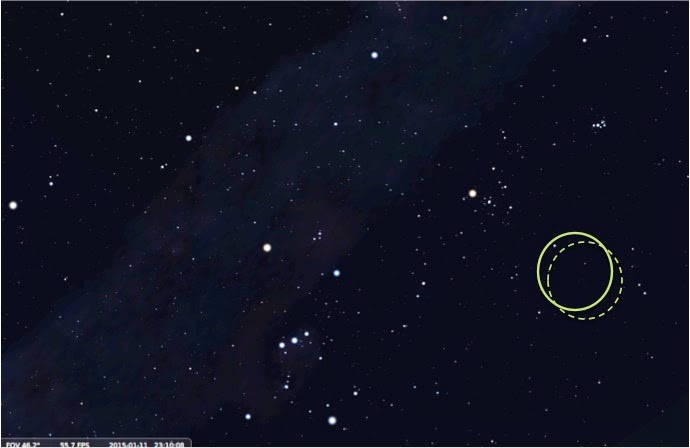
using my binoculars, lambda Tauri  would disappear from the "circle" of view of the binoculars just as the comet came into view (with lambda Tauri  disappearing to the "upper left" of the circle just as the comet appeared in the "lower right" of the circle).

Below, I have shown the "circle" of view as visible through my binoculars (10 x 24 with a 6 degree view). As I have tried to depict, if you continue down and to the right from lambda Tauri, you will get to a field that contains the comet just after lambda Tauri is no longer in the circle. The "dotted circle" would contain the comet:

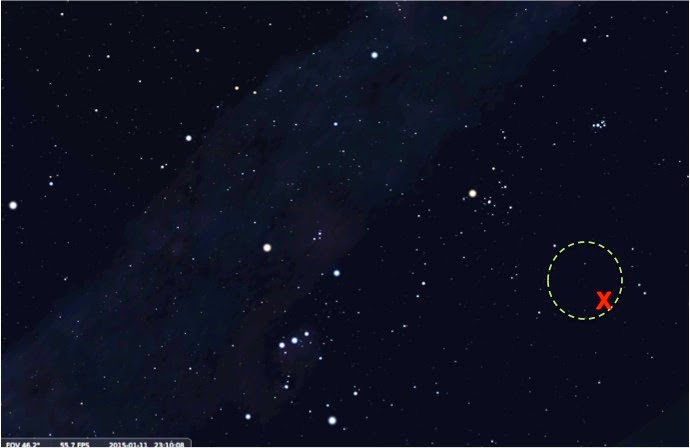
As stated previously, the comet appeared to me as a kind of "glowing fog." It had a ghostly bluish color. It appears like an illuminated mist or haze, to me. I don't think you will mistake it for a star, if you have your binoculars in focus (use the Hyades or Pleiades to focus). The comet is currently at the location indicated by the red "X" below -- but remember that it will continue to travel north, and will be passing by the Pleiades on the 19th of January:

In the above image, you can see the "V" of the Hyades, then follow down the "Y" to the star lambda Tauri, and then continue moving the circular view of your binoculars a little further. You can see that the comet comes into the circle of the view as the star lambda Tauri is just outside the circle. 

Finally, I have created one more image in which I have attempted to create the "bluish glow" of the comet. This isn't really what it looks like "in person" -- the comet itself is much more magical looking, as if someone or something were illuminating a cloud or a fog. It is faint, but it is kind of ghostly-looking, as if it were glowing. The image below is simply an attempt to give the impression, in order to help you know what to look for. It also won't be this big -- not much bigger, in fact, than lambda Tauri or some of the other stars you will see as you make your way over to the comet's location, but possessing a very slight cloud around it.

I hope that this discussion gives you the motivation to go locate Comet C/2014 Q2 (Lovejoy), as well as the confidence to know that you can and will find it!

This long-traveling comet is awesome to contemplate: with a periodicity that approaches 14,000 years, it is like an ocean wave which crests only once every fourteen millennia, a drum that beats out a rhythm  only once every one hundred forty centuries.

Additionally, it may be a messenger from an ancient catastrophe of incredible magnitude, a catastrophe that left scars across the face of our planet (and elsewhere in our solar system), and one that may be tied up with the mysterious ancient history of humanity.

I hope that you will be able to see it!

"Wake up, gorillas! Don't perpetrate violence."

"Wake up, gorillas! Don't perpetrate violence."

I believe that the original 1968 Planet of the Apes film really has little or nothing to do with the idea of actual apes taking over the world in some imaginary future, but that its true purpose is to graphically depict systems of oppression and mind control in human societies in the present day

One of the most powerful messages conveyed by the film is that oppression and tyranny actually require the cooperation and complicity of three different categories of participants -- none of whom could actually be completely effective without the special skill-sets of the other two. 

In the metaphor of the movie, these three groups are graphically and memorably depicted as the orangutans, the gorillas, and the chimpanzees. 

Note well that it should go without saying that these different roles of "gorilla," or "orangutan," or "chimpanzee," are absolutely not intended to refer to different ethnicities or religions or other "labels" which are used to falsely divide us and turn us against one another and focus on externals instead of the fact that we are all spirit clothed in a body, and also to distract us from perceiving the real aspects of oppressive systems of control. No, the three different groups of apes depicted in the film represent different roles that any man or woman can find himself or herself playing in this world, if we are not careful (and sometimes even if we are). 

Far from being "typical" of any one artificial division of humanity, each of the special skills displayed by these three groups of apes in the metaphor of the film (and the 1963 book by French author Pierre Boulle, on which it is loosely based) seem to represent aspects of human nature common to all men and women, aspects we each possess to some degree.

Each of these aspects of our nature actually has a very positive role to play on behalf of human freedom and individual consciousness and empowerment. But each can also be twisted into the service of oppression and tyranny and the suppression of human consciousness -- and it is this twisted side that is on display in the 1968Planet of the Apes, where the tyrannical oppression is maintained by fraud, violence and cowardly collaboration, in a world that is portrayed as an inversion or 180-degree opposite of the way things rightfully should be (and which, the film implies, is the way our own society has somehow become).

The special skill of the gorillas, of course, is the application of physical combat power. This skill, it must be understood, is not inherently evil, but is in fact necessary  at times, in order to stop violence, which is a subset of physical force when applied in violation of someone's natural inherent rights. 

The application of physical combat force, whether with a weapon or without it, when used to protect someone from having their physical body damaged or violated by another, is not a violation and thus is not properly violence. If someone sees a person preparing to injure or violate another human being, and that someone uses physical force to stop that other person from perpetrating that violence, it is completely lawful and proper to do so. 

Thus, skill at applying physical force is admirable and good, when coupled with the understanding that such force is only rightly applied to protect oneself or others from violence. The "gorillas" in the film, of course, unquestioningly and happily employ force in the service of oppressing anyone who questions the absolutist vision of the orangutans -- and especially in the service of oppressing the terrified, persecuted, huddled masses of pathetic and voiceless humans. 

Were the gorillas to refuse to use their special skills in the service of the orangutans' criminal system of oppression, and instead devote themselves to only using force to actually protecting the helpless, the entire tyrannical system would cease to be able to oppress anyone. The orangutans are dependent upon the "muscle" of the gorillas and the special skill-set that the gorillas possess in order to impose their system upon the other apes and upon the degraded humans.

The orangutans, for their part, specialize in creating and maintaining the illusion upon which the entire fraudulent and criminally oppressive societal structure is constructed. It is extremely noteworthy that this fraudulent fabric of illusion depends upon a knowingly false narrative regarding the ancient history of the planet, and about the ancient capabilities and origins of humanity. It is also noteworthy that the orangutan system is built around religious dogmas, a literalistic adherence to certain ancient scriptures, and an ideological system that seeks to excuse and condone violence in support of this oppressive system -- to try to cloak that which is criminal and illegitimate in a "veil of legitimacy."

Once again, however, the special skills of the orangutans are not in and of themselves inherently criminal. The orangutans' special expertise is in the interpretation of symbol, in the examination of meaning and legitimacy, in the pursuit of that which gives purpose to existence and in warning against that which is wrong or harmful to oneself or others. 

It is clear that in the twisted, inverted world portrayed in the movie, the orangutans have chosen to use their special skills to divide, to conquer, to oppress, and to deceive. At least some of them know the truth (Dr. Zaius being the most obvious example) but choose to teach lies instead -- perhaps even from a partly-understandable belief that the truth, if known, would lead to chaos or self-destruction (an insufficient excuse for perpetrating fraud, violence, and oppression against others, but one that Dr. Zaius at least seems to believe and which at least partly informs his behavior).

What the orangutans should do with their special skill is use it in the service of the empowering message that the world of symbols was actually designed to convey. There are certain aspects of the invisible realm, of the spiritual side of existence, which can only be properly conveyed or grasped through symbol -- and the orangutans, with their special proclivity for understanding the fact that reality can be created, should be helping individuals to grasp those powerful and liberating truths and pointing them towards greater consciousness, which would almost certainly have profoundly positive effects on society as a whole, far outweighing any imagined danger.

The chimpanzees, of course, have a talent for investigating, for searching for knowledge, for noticing new evidence and analyzing it, for thinking of new and innovative ways to do things, for exploring new and innovative ideas, and also for organizing knowledge and sharing knowledge and recording knowledge and communicating knowledge for the benefit of society. They are actually portrayed doing some of this positive analysis and seeking after knowledge during the original 1968 film, even at some risk to themselves -- but the film clearly implies that the "chimpanzee class" is naturally somewhat fearful, eager to please the orangutans, and in general they are overly-ready to accept the religious and ideological interpretations handed down to them by the orangutans and to support the oppressive social structure that is built upon the orangutans' outright lies about ancient history and the artificial limits the orangutans seek to impose upon the freedom of other apes and of the voiceless masses of the completely dispossessed humans.

The chimpanzees as a whole are essential enablers of the tyrannical system of the orangutans, just as much as are the gorillas. In modern "human" society, we can think of a variety of human talents or aspects of society which correspond to the chimpanzees, including academia, those in the news media, those in middle management at corporations, those in entrepreneurial roles, many of those in public service at government jobs, those employed as bureaucrats in the vast machineries that make modern society run the way it does. 

If members of the media and of academia, for example, actively pursued anomalous evidence the way that Zira and Cornelius are shown to do in the film, the fictions upon which tyrannical oppression is built would dissolve. The gorillas might even begin to question what they were employing their special skill-sets to support. The message might get out that such skill-sets are properly employed only to stop violence, never to perpetrate it on the behalf of some ideology fabricated by orangutans defending their system. Anyone who doubts that the skills and roles denoted in the movie are not critical to systems of tyranny can try to think of any tyrannies in the era of mass media technologies (including radio and printing presses) that have not employed propaganda arms using those media. 

Finally, the humans in the metaphor that operates in the 1968 Planet of the Apes are perhaps the most intriguing of all. Because, just as the film warns us against falling into the trap of being too unquestioning (if acting in the role of the gorillas), too fearful and supportive of evil and fraud (if acting in the role of the chimpanzees), or too cynical to pursue higher consciousness for ourselves and to empower others to do the same (if acting in the role of the orangutans), it seems to also be warning us against accepting a vision of humanity that is completely animal, mindless, irrational, and focused entirely on bare survival and fulfillment of physical needs and functions. 

Of course, the humans in the film can also be seen as those "voiceless" members of society who are marginalized, exploited, and oppressed the most of all -- those who are brutalized by the gorillas, feared and despised by the orangutans, and seen as specimens to be studied or used by the chimpanzees. And that is certainly one aspect of the humans as portrayed in the metaphor of Planet of the Apes, and a powerful condemnation of the history of inhumanity and oppression and marginalization of huge numbers of people who should be allowed to reclaim their proper voice. 

And perhaps this fourth group is the best hope, if they can be empowered to see beyond simple survival and "creature comfort," and if they can reclaim their voice, because unlike the gorillas and the chimpanzees, they are not beneficiaries of the fraudulent tyranny of the orangutans that the gorillas and the chimpanzees are enabling.

But it seems that the humans in the film also represent the tendency in each one of us to forget that special aspect of our existence, of being a mixture of both "animal" and "god" (as Alvin Boyd Kuhn puts it, in some of his discussions of the symbol of the cross, which has a horizontal "animal" or purely physical component, and a vertical "divine" or spiritual component -- see here,

here, and here, for example). Remaining in ignorance or denial of our true human nature leaves us incomplete, and degraded.

The 1968 Planet of the Apes film is not exactly "uplifting" in its tone, but it is possible to perceive a very positive and uplifting message in what we are discussing. This post has focused on the film's unique and very memorable method of illustrating an important truth: that tyranny and injustice cannot really be perpetrated without the cooperation of people who are exercising skills from three different aspects of human nature: skills involving the use of force in actual combat (the gorillas), skills involved in the pursuit of knowledge, and its organization and dissemination (the chimpanzees), and skills involved in the creation of and interpretation of symbols and meaning (the orangutans).

This in itself is an important lesson, but it points to something else as well, and that is the fact that -- because each of these aspects of our own human nature can actually be used in a very positive way -- the entire system that is currently degrading humanity and perpetrating tyranny through fraud and through violence (because of the improper use of the orangutan, gorilla, and chimpanzee skills) could suddenly and smoothly become uplifting and empowering! 

If those with skills in the interpretation of symbols devoted themselves to pointing out the empowering message that the ancient symbols were really meant to teach, and if those with skills in the application of force devoted themselves to protecting innocent people from harm, and if those with skills in seeking knowledge and innovating and discovering devoted themselves to looking at all the possibilities and having the courage to follow the evidence where it leads and the courage to communicate what they have seen, then the upside-down world would be turned back right-side up. 

Of course, there will always be those who choose to try to gain mastery over others through fraud or through violence (or both), but the more "chimpanzees" society has who are ready to look for evidence and analyze it fearlessly and confront and expose falsehood, the more difficult it will be such fraud to remain unchallenged. And the more "gorillas" society has who refuse to use their skills for criminal ends and who instead pledge to use their skills only to stop actual perpetration of violence, the more difficult it will be for violent plots to stand a chance of success. And the more "orangutans" society has who are pointing people to the truth that they can do and be much more than they have ever been told they could accomplish, then the more difficult it will be for those who wish to use techniques of "reality creation" to enslave instead of to liberate and to empower.

Ultimately, this kind of shift will enable humans to be more human, and to exercise both halves of our unique human nature, to "bless" all things by identifying the spirit and seeing them as being more than simply physical, instead of "cursing" them by trying to reduce them to mere objects, lumps of material devoid of spirit.

We could perhaps distill the message of the 1968 Planet of the Apes (at least, the part of its message that we have been examining here) into a paraphrase that sounds something like this:

  • "Wake up, gorillas! Don't perpetrate violence."
  • "Show a little backbone, chimpanzees! Don't enable tyranny or propaganda."
  • "Point to the right Way, orangutans! Don't cynically substitute lies for truth, but instead help to uplift others and point them towards consciousness, which you are supposed to be doing."
  • "Find a voice, humans! Don't allow yourself to be told you are less than who you are."