One Foundation

One Foundation

video link 

From the 1973 album Burnin' by The Wailers, these are the lyrics to "One Foundation," written by the immortal Peter Tosh. The words sung by Peter Tosh (lead vocals on this song) are in non-italicized  (upright) text, and those in italics are sung by the accompanying artists: 

Got to build our love

On one foundation

Got to build our love

On one foundation

Got to build our love

On one foundation

[or] There will never be

No love at all

There will never be

No love at all

Got to put aside

Man's segregation

Got to put aside

Them organization

Got to put aside

Them denomination

There will -- there will never be

No love at all

I mean there will never be

No love at all

Got to build our love

So build our love

on one foundation

On one foundation

We got to build our love

Come let us build our love

On one foundation

On one solid foundation

Got to build our love

Got to build our love

On one foundation

On one foundation

Or there will never be

A single drop of love

You won't have no

True freedom, yeh

Got to come together

We are birds of a feather

We got to come together

'Cause we are birds of a feather

We got to come together

'Cause we are birds of a feather

Or there will never be

Lord have mercy

No love at all

There will never be

Yeah yeah

No love at all

We also got to realize

We are one people

Yeah

We got to realize

That we are one people yeh

We got to realize

We are one people

Or there will never be

No love at all

There will never never never be

No love at all

Got to build our love

On one foundation

We got to build our love

On one foundation

Got to build our love

On one foundation

Got to build our love

On one foundation

Got to build our love

On one foundation . . . 

I believe it can be demonstrated that literalist interpretation of sacred texts tends to lead towards what this song describes as "man's segregation" and "them denomination," while esoteric interpretation tends to reveal the underlying unity between the messages of the ancient scriptures and mythologies of virtually all of the world's cultures.

This divisive tendency in literalist interpretation has been explored in some previous posts, including "The sacred celestial metaphors refute racism and sexism," "Shem, Ham and Japheth," "PTAH, JAH, TAO and BUDDHA," and "'Vision A' or 'Vision B'."

The reason that the literalist approach tends towards divisions, segregations, and denominations, is that when sacred texts are interpreted literally, this often leads to the conclusion that one group is literally descended from or blessed by the divine, to the exclusion of all others. 

It also leads very commonly to the conclusion that only those who accept the specific form of literal interpretation favored by that particular group can expect to be blessed in this life and especially in the afterlife, and that all others will be punished in the afterlife -- in some cases, eternally (for some discussion of the reasons I believe the doctrine of eternal punishment in hell is a misinterpretation of texts which are meant to be interpreted esoterically and metaphorically rather than literally, see "No hell below us . . .").

This represents a very severe form of dividing humanity, of setting some people outside of the "family" of those who are supposedly accepted and deserving of love and blessing -- and thus represents the very opposite of what is being urged in "One Foundation." And it can clearly be seen to be in operation among numerous groups to this very day.

The belief that some men and women are more valuable, more blessed, more worthy, or more connected to divine favor than others is actually a reprehensible teaching, and can and very often does lead to the sanctioning of violence (the violation of rights, including the right to security in their physical person) against those deemed to be less favored.

On the other hand, I believe that it can be demonstrated that the ancient scriptures and sacred traditions can be shown to teach that each and every man and woman is equally connected to the divine, that each in fact embodies the universe (each is a "microcosm" of the infinite "macrocosm"), each is inherently possessed of infinite and unmeasurable value. Such a realization, of course, would lead directly to the conclusion that violence against another such being is inherently wrong, and cannot be excused by any appeal to membership by one in some favored group to which the other does not belong.

It might be objected that such a doctrine of non-violence is unrealistic, in a world in which some (regardless of their actual inherent and inextricable connection to the divine) choose nevertheless to exercise violence against their fellow men and women. However, this does not follow at all: such a view would argue that the use of force is in fact permissible to stop someone who is in the act of inflicting physical harm upon another, and that such force is in fact only justified by the intrinsic value of each individual man or woman no matter who they are. Using force to stop violence is not a violation of anyone's rights but rather a protection of them (see further discussion in the post entitled "Why violence is wrong, even in a holographic universe").

Dogmas or ideologies which excuse the violation of the rights of other men and women can properly be described as a form of mind control, in that they are used to override our inherent knowledge that the violation of the rights of others is wrong (just as we inherently know that the violation of our own person and our own rights is wrong and unjust, and we naturally rebel against it, even from a very young age and without having to be taught it).

Such dogmas are not always based upon literalistic interpretations of ancient scriptures, but they certainly can be. And, to be fair, those who interpret scriptures literally do not always condone violence or the violation of the rights of others, or even the devaluation of some groups versus others. The point is that I believe that literalist interpretation can tend to invite such division.

"One Foundation" recognizes that these divisions between members of the human family are in fact artificial and based upon illusion, and that thus so are the reasons which are built up to excuse the violation of the rights of some men and women, or to excuse the elevation of one group at the expense of everyone else.

It smashes through these artificial divisions and segregations, and the man-made organizations which seek to institutionalize and enforce them. 

That is what great art does: it smashes mind control. 

So come let us build our love / On one foundation . . .

The celestial fire

The celestial fire

image: Wikimedia commons (link).

The Bibles of antiquity have but one theme: the incarnation. The vast body of ancient Scripture discoursed on but one subject -- the descent of souls, units of deific Mind, sons of God, into fleshly bodies developed by natural evolution on planets such as ours, therein to undergo an experience by which their continued growth through the ranges and planes of expanding consciousness might be carried forward to ever higher grades of divine being.    

-- Alvin Boyd Kuhn,

Esoteric Structure of the Alphabet and Its Hidden Mystical Language. 20.

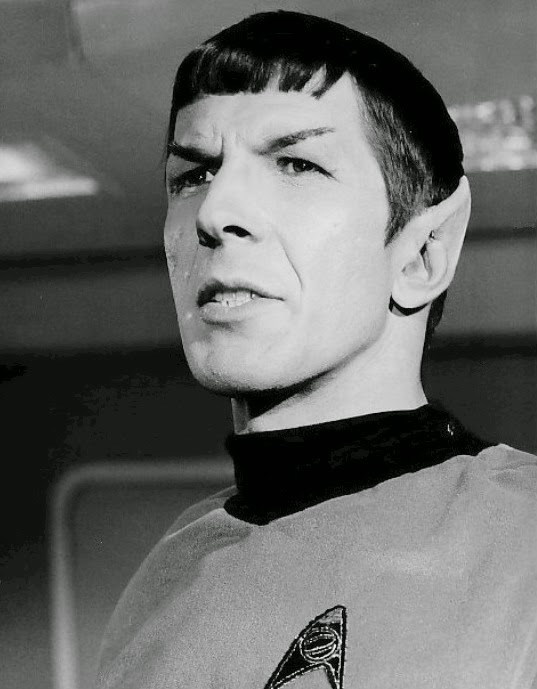
The world today is pausing to honor the life and work of Leonard Nimoy.

He is of course most closely associated with the character of Spock in the series Star Trek, a series which depicted travel across the stars but which was certainly no less concerned with the exploration of the human condition.

He is also inextricably connected with the concept and act of blessing

Blessing can be accurately said to be an essential part of his identity, one with which he is universally identified and remembered. 

The outpouring of response today to the news that Leonard Nimoy has sprung the bonds of earth to again be among the stars from which we all came has overwhelmingly referenced his blessing "Live long and prosper," which was delivered with his intrinsic dignity and sincerity and accompanied by the famous hand gesture which he introduced during the first season of Star Trek.

It is no secret that this hand gesture represents the Hebrew letter shin and that it has profound connection to the sacred act of blessing -- which has previously been argued within these pages to be the act of evoking the divine spirit which dwells in each being in the universe and indeed which infuses every aspect of the universe itself at all times and at every point.

Mr. Nimoy on many occasions related the story of the deep impression that the act of ritual blessing made upon him as a child, during which this hand gesture was extended as part of the invocation of the divine and the ceremony of blessing (see for example this video clip showing one such explanation he gave).

In seeking to understand more fully this benevolent or beneficent side of Leonard Nimoy -- this profound association with the act of blessing, which he connected to this particular hand gesture embodying this important letter shin and the expression "Live Long and Prosper" -- let us briefly explore just a few important aspects of this symbol.

In the relatively short treatise entitled The Esoteric Structure of the Alphabet and Its Hidden Mystical Language, Alvin Boyd Kuhn (1880 - 1963) says of alphabets that:

along with every other symbolic device of ancient meaning-form, even the alphabet embodied the central structure of all ancient literature, -- the incarnation, the baptism of the fire-soul in and under body-water. [. . .] The celestial fire emanated from primal source as one ray, but soon radiated out in triadic division, and finally reached the deepest heart of matter in a sevenfold segmentation. But in its first stage of emanation it was always pictured as triform. The YOD candle-flame being its type-form, the Hebrews constructed their letter which was to represent the fire-principle with three YODS at the top level, with lines extending downward to a base, on which all three met and were conjoined in one essence. This gives us the great fire-letter SH, shin, -- ש
21-22.

Kuhn then demonstrates that this letter is used in the Hebrew word for fire itself, which is esh but which he asserts on a linguistic basis is also related to AeSH and ISH, with ish being the word for "man, who embodies this single, double and triple fire" (22). The word ash, he notes, is the byproduct of fire in English, but also the great tree of life Ygdrasil in Norse mythology, the very tree upon which Odin had to hang in order to obtain the symbolic technology of writing, as well as the tree from which mankind was originally fashioned, according to some expressions of Norse myth (the reader may remember that in the past we have addressed the fact that Kuhn, writing in the early part of the 20th century, often used the terms "man" and "mankind" but explicitly stated throughout his writings that what he said applies to both men and women, and that we should not assume that he intended to refer to "men" when he used the term "mankind").

Going further with the significance of the letter shin, Kuhn explains that the Hebrew word for the sun, shemesh, also embodies the concept of spirit-fire plunging down into incarnate water and then rising back to the realm of spirit:

As a globe of fire its nature would be expressed most fittingly by the letter shin (SH), with its threefold candle flame, the three YODS, above; the place of water into which it nightly descends would be indicated by M, and the place of its final return, the empyrean above, by SH again. So the word thus constituted would turn out to be SH-M-SH (shemesh); and this is just what it is. It is the old basic story of divine fire plunging down into water, the universal trope figure under which all operation of spirit in and upon matter was dramatized. 30.

From the foregoing discussion, we can begin to understand why extending one's arm and hand with the form of the Hebrew letter shin, representative of the divine threefold fire which is plunged down into incarnation, can be a gesture of blessing: it is a reminder not to forget the divine fire within, our origin among the empyrean of the stars -- the spirit plane -- and it is a blessing that seeks to elevate the invisible spirit in each of us and in all creation itself, along with all the positive aspects connected to our "higher nature" (the opposite of cursing, which seeks to put the spirit down, to degrade others and make them less in touch with spirit and more under the control of matter and the "lower nature").

Elaborating upon the same line of argument, Kuhn says:

As a symbol designed to depict the immersion of fiery spiritual units of consciousness in their actual baptism in the water of physical bodies, the letter form that dramatizes the actual event, and the letter sound that onomatapoetically mimics the sound of fire plunging into water, this alphabet character shin is certainly most eloquently suggestive. 34.

And here we can begin to draw our analysis back to the well-beloved character whom Leonard Nimoy brought so memorably to life and whose expressions of blessing have become so powerful to a world in such great need of blessing. For Mr. Spock, of course, was a Vulcan, from the planet Vulcan -- named expressly and explicitly for the god of fire: Vulcan, known to the Greeks as Hephaestos (and who, by the way, was not only the god of fire but was also cast down to earth at one point by Zeus).

Coincidence? 

Not likely. Perhaps a manifestation of the benevolent synchronicity operating within a conscious universe, but such a connection between the hand gesture now so inextricably associated with Mr. Spock and the planet for whom his very people are named can hardly be written off as meaningless.

And, we can go even further. For, as countless previous posts have explained, the concept of the plunge into incarnation was represented in ancient Egyptian myth by the casting down of the Djed column -- where the divine spark was submerged in matter, forgotten and hidden. A major part of our work in this incarnate life was seen to be the raising up of the Djed column, which is to say the remembrance of the divine fire, the reconnection and elevation of the spirit and the elevation of the "higher aspects and impulses" of our being -- in short, all the calling forth of benevolent spirit associated with the concept of blessing!

Now, one whole series of previous posts explored the fact that the ancient Egyptian Cross of Life, the ANKH, was absolutely symbolic of this idea of raising the Djed column, elevating the spirit, and blessing (and, in fact, ancient Ankhs were often depicted as incorporating the symbolism of the Djed column in their vertical pillar). See for example "Scarab, Ankh and Djed." 

This same vitally-important symbolism of the raising of the Djed column can be seen operating in both the Old and New Testaments, in the symbol of the cross in the New Testament, for example, and of the lifting up of the brasen serpent by Moses upon a staff in the Old Testament. 

Now, you may have caught the fact that the Ankh-Cross itself was a symbol of life, a symbol of the giving of life, and thus a powerful symbol of blessing. This connects directly to the words of blessing which Spock -- and Leonard Nimoy -- would pronounce and with which he is so closely connected: "

Live long and prosper."

Two previous posts have explored at some length the amazing number of words which Alvin Boyd Kuhn believed could be linguistically and conceptually related to this powerful concept through the root sound of the ancient word Ankh -- see "The Name of the Ankh" and "The Name of the Ankh Continued: Kundalini around the world."

Now, what would happen if we combine the fire-symbol of the letter shin with the word Ankh itself? Alvin Boyd Kuhn has anticipated just such a question, and in fact he refers back to the earlier independent scholar Gerald Massey (1828 - 1907), who apparently also explored this avenue of thought:

Massey traces even the great name of mystery, the sphinx, from this ANKH stem, preceded by the demonstrative adjective P (this, the, that) and the starting S, thus: S-P-ANKH. Massey was well versed in the abstrusities of the hieroglyphics and his surmise on this is as good as that of others. The word thus composed would mean "the beginning of the process of linking spirit and matter," which indeed is the sphinx-riddle of the creation. The sphinx image does conjoin the head of man, spirit, with the body of the animal, lion, representing matter. It is precisely such values and realities that the sages of antiquity dealt with and in precisely this manner of subtle indirection. When will modern scholarship come to terms with this recognition! 38.

Now, this line of argument is most incredible, because in the above passage we practically have the name of Spock himself. Look at the term S-P-ANKH which Kuhn, following Massey, argues to be the linguistic and symbolic and esoteric origin of the word sphinx , and you will immediately perceive that if we emphasize the "velar fricative" sound of the KH (which became the voiceless velar fricative sound indicated by the letter "x" in the word sphinx) it will automatically de-emphasize the preceding sound of the "n" and give us rather directly the name of Spock!

Now, this is a rather incredible development, and the reader can be excused for exclaiming at this point that there is just no way that they were thinking of the esoteric origins of the word sphinx and S-P-ANKH when they came up with the character-name Spock!

And yet, we do not have to argue that "they" were thinking along these lines at all -- it might have been "the universe" that created this unbelievable synchronicity, independent of conscious human awareness, acting through creative human conduits.

But, it is most remarkable to note that one of the other extremely distinctive characteristics of Mr. Spock in the Star Trek series is his constant effort to present a dignified expression of calm, composed gravitas, almost never showing emotion and especially not grinning or laughing or smiling (except on very rare occasions): what can only be described as a most sphinx-like characteristic!

And so, we see that Leonard Nimoy and his blessing-speaking character Mr. Spock connect with us on a profound level, and impart to us wisdom which stretches back to a very ancient source. 

When Mr. Nimoy held up his hand in that symbol of shin, he was blessing. He was silently saying (if I may paraphrase, or interpret the symbolic content discussed above): "You are divine fire -- you have an inner spark -- you, and everyone you meet, contain this spirit-fire submerged in water, so to speak, plunged into matter, but you must not forget where you come from -- you come in a real sense from the stars -- you come from the realm of spirit, and you can remember that and elevate that -- Blessings."

It is an expression of reminder, of recognition, of elevation of the spirit and consciousness, and of blessing which is very much analogous to the gesture and greeting contained in Namaste.

And now, Leonard Nimoy has crossed over this plunge into water, this crossing of the Red Sea which is symbolic of our incarnation in this body. He has left us with these benevolent and beneficent blessings and teachings, beautifully and elegantly expressed. And he goes to be among the stars, the realm the ancient wisdom teachings of the world depicted as the realm of the stars.

We can all agree that he will not find that journey to be one with which he is unfamiliar or for which he is unprepared.

Peace and blessings.

Bodhidharma, Shen Guang, and the Shaolin Temple

Bodhidharma, Shen Guang, and the Shaolin Temple

image: Wikimedia commons (link).

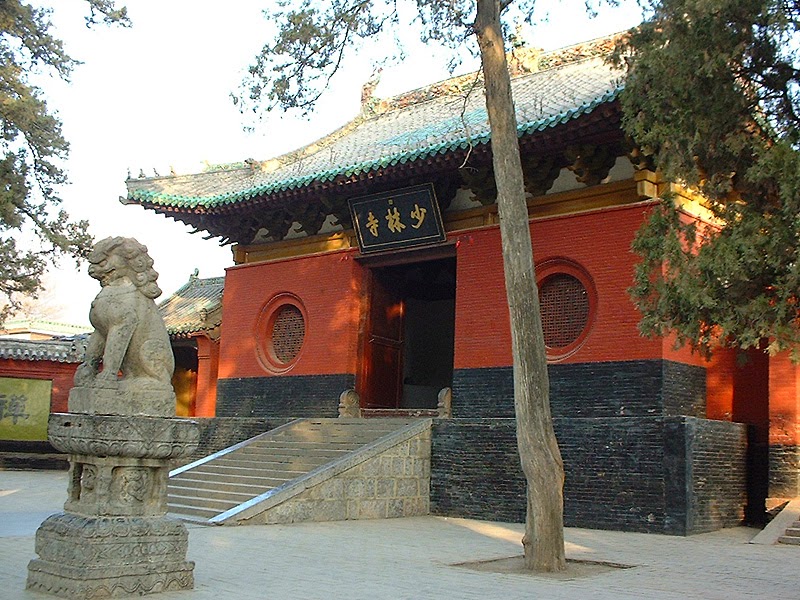
The historicity of many aspects of the famous Shaolin Temple* of China can be, and has been, a subject for study and debate.

As with many such debates, particularly those in which deep reverence or personal beliefs are involved, examination of this subject can sometimes become contentious.

Without entering directly into the "deep water" of such disputes or debates, we can at least agree that the tradition of the Shaolin Temple is itself indisputably connected with two very important traditions: Ch'an Buddhism (which is often spelled Chan Buddhism, and which is the direct predecessor of Zen Buddhism in Japan), and the martial arts.

Previous posts have explored the importance of the connection between these two, in that training in the use of force can cause us to fall into the error of "turning a person into a thing" (in the words of Simone Weil in her famous 1940 essay on The Iliad: or the Poem of Force), but meditation upon the spiritual content and value of every being we encounter and cultivation of the attitude of blessing others and wishing to see their spirit elevated has the exact opposite tendency and acts as a counterbalance, with the goal that what could be misused to "lower spiritual awareness in one's self and in others" (as engaging in the use of force in ways that violate the rights of others will inevitably do) is instead transformed into a practice which "elevates spiritual awareness in one's self and in others" (by reducing the practitioner's need to use force inappropriately, while enabling him or her to use force to protect one's self or others if necessary and thus prevent violence). 

Through this focus on spirit and blessing, the martial arts are (ideally) transformed into a spiritually uplifting discipline analogous to yoga and other practices designed to elevate spiritual awareness and bless and regenerate the world.

I would argue that the emphasis on the invisible world of spirit is coded into the traditions of Shaolin Temple through references to the celestial realm, used throughout the world to convey deep teachings regarding the spiritual component of human existence and of the universe in which we live, and their dual material and spiritual composition. 

For example, precessional numbers such as 72 and 108 are deeply embedded in numerous Chinese martial arts, and in the traditions of the Shaolin Temple. For example, Shi Yan Ming -- who grew up in the Shaolin lineage --  has written about the fact that the Shaolin Temple traditionally contained 72 rooms or chambers. Other traditions assert that in order to graduate as a Shaolin monk, a candidate had to pass through an elaborate hall containing 108 mechanical dummies which would each launch a different unexpected attack upon the candidate at a different point on the journey down the hall.

Some might argue that the incorporation of these numbers, 72 and 108, do not necessarily indicate an esoteric celestial aspect to these traditions. They might argue that, although these same numbers are found in the sacred texts and rituals of India, or in the dimensions of the pyramids at Giza in Egypt and in Egyptian myth, or in the Norse sagas, their presence in China could be attributed to mere coincidence, and that since those ancient cultures are separated by such vast distances, the use of 72 and 108 in China might be referring to something else entirely.

However, I believe there are additional very powerful reasons to believe that the very same celestial codes operating in the myths and traditions of cultures such as ancient Egypt or ancient India (or across the oceans in the dimensions of the monuments in Central and South America) can be shown to be operating in the esoteric traditions of Chan Buddhism as well, and that the conclusion that these numbers are a celestial and hence a spiritual code is well-founded.

image: Wikimedia commons (link).

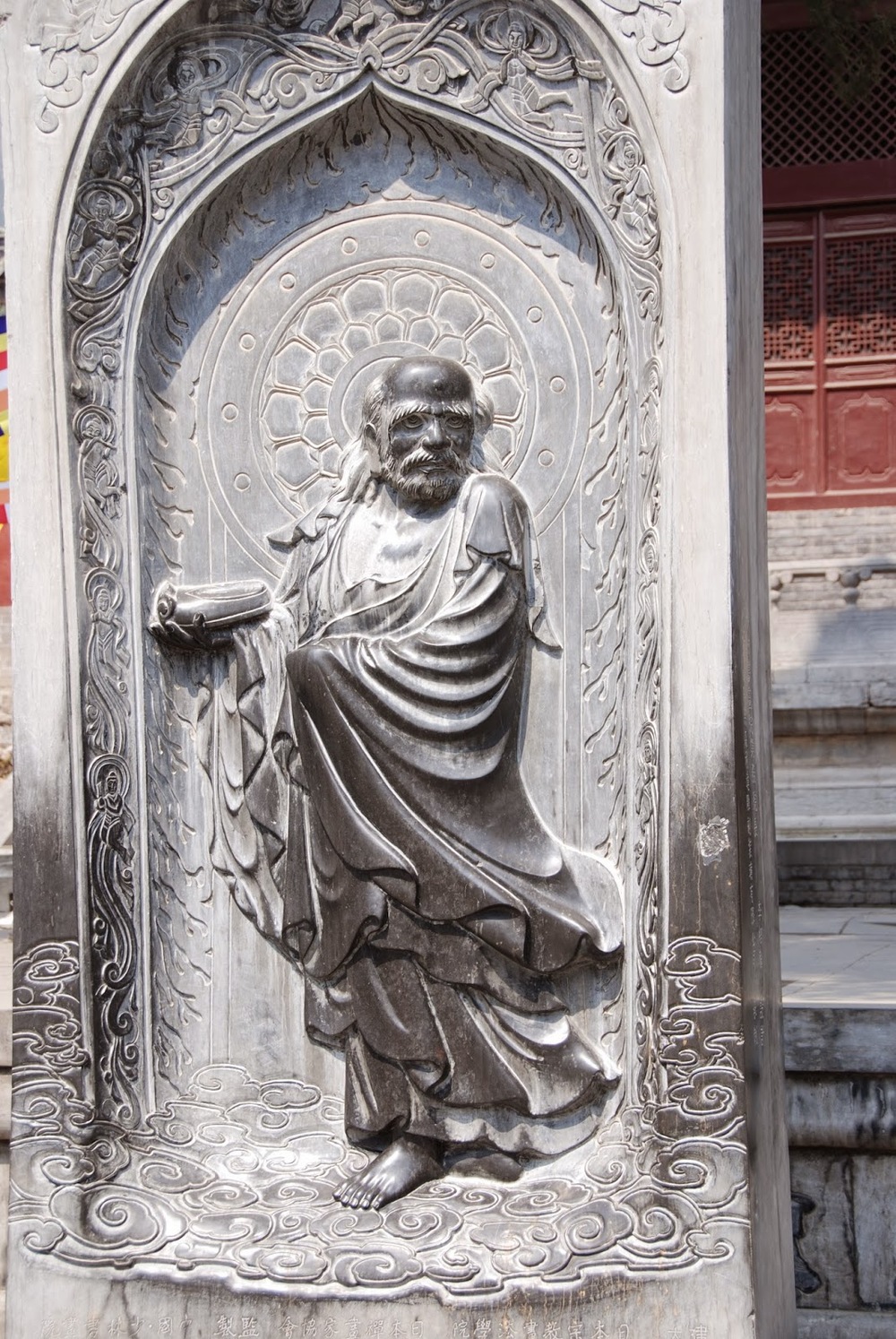
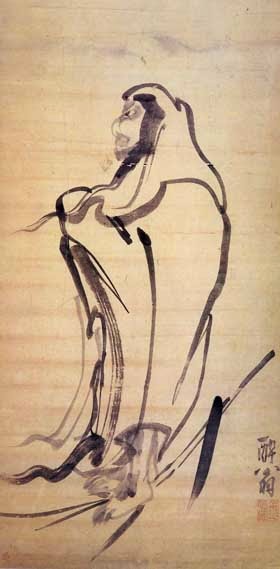
The ancient connection between Chan Buddhism and the practice of martial arts as a form of spiritual elevation and blessing can be traced directly back to the texts and traditions surrounding the figure of Bodhidharma, also called Da Mo in China, who according to tradition brought both to China.

Stories of the life of Da Mo can be found in early texts, most notably in the text known as the Ching-te Chuan Teng-lu (ways of spelling this text in English vary), or the "Transmission of the Lamp," which is itself a collection of various earlier traditions regarding Da Mo. The expression "Transmission of the Lamp" refers to the passing down of dharma or the ineffable teachings of Chan, which supposedly originated with Da Mo. 

Da Mo is often said to have lived between AD 470 and AD 532 (or 528). The Chuan Teng-lu was collected later, around the year AD 1000. See for some discussion of the compilation of the Chuan Teng-lu page 155 in this text entitled Zen Canon: Understanding the Classic Texts.

In the account of Da Mo given in the text itself (for instance, beginning on page 150 of this translation), we read the famous story of the transmission of the dharma from Da Mo to his first disciple, Shen Guang, in which Da Mo knelt motionless in meditation (in some accounts for nine full years), while Shen Guang stood guard over him in hopes of being noticed:

Staying at the Shaolin Temple on Mount Song, there he sat in meditation facing a wall, a whole day in silence. People couldn't understand it so they called him 'the wall-gazing Brahmin'. At that time there was a monk named Shenguang who was deeply learned and had lived for a long time near Luoyang by the Rivers Yi and Luo. A scholar well read in many books, he could discourse eloquently on the Dark Learning. Sighing frequently, he would say, 'The teachings of Confucius and Laozi take rituals as the Practice and customs as the Rule, while in the books of Zhangzi and The Changes the wonderful principle is still inexhaustible. Now I have heard that a great master, Damo (Bodhidharma), is residing at Shaolin. I must pay a visit to this peerless sage living not so far distant.' Then he went, visiting morning and evening for instruction. Master Damo was always sitting in a dignified posture facing a wall and so Guang heard no teachings nor did he receive any encouragement. Then Guang thought to himself, 'Men of old, on searching the Way, broke their bones to extract the marrow, let their blood flow to help the starving, spread hairs on muddy roads [to allow people to pass], or jumped off cliffs to feed a tiger. In days of old it was still like this, now what kind of man am I?' 150.

Finally, after a great snow fell and Shen Guang still stood motionless guarding Da Mo, the master spoke to Shen Guang and asked what he wanted. In some versions of the story, Shen Guang hurls a large block of snow and ice into the cave or chamber in which Da Mo was meditating, in order to get his attention. In any case, Shen Guang finally pulls out his sword and cuts off his own left arm in order to demonstrate his tremendous devotion and desire to learn what Da Mo has to show him (in some versions, Da Mo says he will only teach Shen Guang when red snow begins to fall from the sky, and so Shen Guang waves his own severed arm around his head and Da Mo finally relents and decides to take on this devoted disciple, who afterwards took on the name Hui-k'o). 

You can read some of the other aspects of this story, and the other adventures attributed to Da Mo and Shen Guang, in the account here on Shi Yan Ming's website, as well as in other texts in books or on the web, such as the version given in Thomas Hoover's 1980 book The Zen Experience, available on the web here through Project Gutenberg. See pages 28 and following of that online file.

Concerned readers can be comforted by the fact that I personally believe no arms were literally severed and waved around anyone's head in order to pass on the teachings of Chan Buddhism in the time of Da Mo and Shen Guang, but believe that this story -- like so many other sacred spiritual traditions around the globe -- can be convincingly demonstrated to be based squarely upon celestial metaphor, as are many of the other incidents and episodes in the traditional account of Da Mo.

The fact that this story is probably not literal is indicated by some of the other traditions surrounding the kneeling meditation of Da Mo, such as the detail that he remained in the kneeling meditation for nine full years without moving, facing the wall of the cave, until his image was actually transferred to the wall itself. Another aspect of the tradition (cited in Thomas Hoover's book above) states that when his eyelids became heavy and he felt he might be drifting off to sleep, Da Mo ripped off his own eyelids to continue his meditation. And another aspect of the story has him kneeling there so long that his legs actually fall off. 

Clearly, these aspects of the story can probably not be taken literally, and I don't believe the severing of Shen Guang's arm should be, either.  

In fact, I believe that familiarity with the constellations who take on similar roles in other myths and stories around the world will immediately suggest the probable celestial identities of both Da Mo (who kneels, meditating, endlessly until his very image or shadow is transferred to the cave wall) and Shen Guang (who stands silently guarding Da Mo, until at last in desperation he cuts off his own arm and waves it around to make the snow red and prove his devotion).

The diagram below shows the important constellation of Bootes, whom we have met in numerous other myths (see this index of stars and constellations and blog posts which discuss them). As you can see, the outline of Bootes resembles a kneeling figure -- and in fact the tiny "leg" which is drawn in this outline based on the system suggested by H.A. Rey is very faint, and the stars themselves could alternately be envisioned as a robed, kneeling figure with a bald head, as Da Mo is often drawn in art stretching back centuries.

Above the kneeling figure stands the vigilant figure of Shen Guang, played in this case by the celestial actor of the constellation Hercules, who appears to be brandishing an enormous sword, in his right hand (which is probably why it is his left arm that he cuts off in the story):

As for the bloody arm itself, I believe a good case can be made for the constellation Coma Berenices, or Berenice's Hair, in the role of the bloody arm. It consists of a vertical line between its two brightest stars, and then a myriad of "droplets" fanning out from one end of the vertical line (this constellation is described on pages 36 and 37 of H. A. Rey's essential book on the stars and constellations, The Stars: A New Way to See Them). In this case, it appears that the bloody arm is being waved right in front of Da Mo, in order to really get his attention.

There are, in fact, many other clues in the traditions of Da Mo which indicate to me that the above interpretation is very likely the correct celestial origin of the Da Mo story. One of the most well-known and oft-depicted episodes in his life is Da Mo's famous crossing of a wide river upon a broken reed, which is given to him in most accounts by an old woman at the near side of the river before he ventures across on the unlikely reed. 

As can be seen from the diagram above, the "bloody arm" in this case probably represents the broken reed in that aspect of Da Mo's mission, and the woman who provides the reed to him for this occasion is none other than Virgo, who can be seen with her arm outstretched, giving the reed to Bodhidharma for his crossing. 

Another episode from the story of Da Mo and Shen Guang has the impertinent Shen Guang taking his  won string of Buddhist beads from around his neck and flicking them at Da Mo, knocking out some of Da Mo's teeth in the process (the imperturbable Da Mo acts as though nothing untoward has happened, and walks away). In between Hercules and Bootes is the necklace-shaped constellation known as the Corona Borealis, or the Northern Crown. We saw that it almost certainly represents the gorgeous necklace of Freya in Norse myth, as well as a necklace in a famous Japanese myth about Amaterasu the sun goddess. 

In the star chart above, the Northern Crown is outlined in purple, and marked as a "Sandal (?)." This is because there is yet another tradition about Da Mo, depicting him as carrying a staff over his shoulder with a single sandal hanging from one end of the staff. In The Zen Teaching of Bodhidharma, we read on page xiv:

In his Transmission of the Lamp, Tao-yuan says that soon after he had transmitted the patriarchship of his lineage to Hui-k'o [that is, Shen Guang], Bodhidharma died in 528 on the fifth day of the tenth month, poisoned by a jealous monk. Tao-hsuan's much earlier biography of Bodhidharma says only that he died on the banks of the Lo River and doesn't mention the date or cause of death. According to Tao-yuah, Bodhidharma's remains were interred near Loyang at Tinglin Temple on Bear Ear Mountain. Tao-yuan adds that three years later an official met Bodhidharma walking in the mountains of Central Asia. He was carrying a staff from which hung a single sandal, and he told the official he was going back to India. Reports of this meeting aroused the curiousity of other monks, who finally agreed to open Bodhidharma's tomb. But inside all they found was a single sandal, and ever since then Bodhidharma has been pictured carrying a staff from which hangs the missing sandal.

If you note from the above diagram that Bootes has a long "pipe" that he seems to be smoking, you can instead imaging this pipe as a staff, and if it continues over his shoulder, then it would be perfectly positioned to imaging that the semi-circular arc of the Northern Crown is the other shoe or sandal hanging from the staff. In fact, the depictions of Bodhidharma's staff often seem to have a "crook" or bent part at the end -- in other words, depicting the staff as shaped somewhat like the pipe of Bootes with its wide end (see here or here or here, for example, and older art depicting him often uses similar symbology). 

So, I believe that the purple arc which functions as the Buddhist beads in the episode in which Shen Guang flicks beads at Da Mo may also function as the single shoe or slipper or sandal in the episode of Da Mo walking the hills with one shoe hanging from his staff after he was supposedly dead and buried.

All of this celestial metaphor within the story of Da Mo and the founding of Chan tradition and of the Shaolin Temple, I believe, serves as an esoteric pointer to the realm of the spiritual. The realm of the stars, for reasons discussed in other posts and in the book The Undying Stars, functions in myth around the world (including the stories in the Old and New Testaments of the Bible) as a pointer to the invisible world of spirit (just as this lower world of earth and water, into which the stars plunge as they sink down in the west, represents the realm of matter and incarnation).

I believe that this clear evidence of celestial metaphor also serves to validate the assertion that the celestial numbers 72 and 108 in many Chinese martial arts originally associated with the Shaolin Temple are serving a similar function (just as they do in so many other myths and sacred traditions around the globe).

And, finally, it points to a very important truth, which the ancient keepers of the traditions of both Chan Buddhism and the martial arts wished to impart to us: that while activities such as physical training and discipline and even the effective use of force may be a very important aspect of our time here in this physical realm of incarnation, we must not forget that we and everyone else we meet are also spiritual beings, and that ultimately our actions should serve to elevate the spiritual aspect of ourselves and others, rather than to put it down. 

Ultimately, these arts are about recognizing who we are, in a world which often seems to do everything possible to keep us from remembering or recognizing the truth.

image: Wikimedia commons (link).

* The characters usually translated "Shaolin" are

少  林

and mean "small forest."

In Mandarin this is xiăo lín and in Cantonese it is  síu làhm both of which mean "small forest" (in that order). 

You can see the characters in the image above (top), on the sign posted over the door, although they are written right to left, such that the symbol for "small" is on the right and "forest" is in the middle.

The symbol for "temple" (on the left as you look at the photo on the page) is:

Shang oracle bones: more evidence of humanity's shared shamanic heritage

Shang oracle bones: more evidence of humanity's shared shamanic heritage

image: Wikimedia commons (link).

Numerous previous posts, including

and

have advanced the position that what may be broadly termed the shamanic worldview belongs as a precious inheritance to all the world's people, and can be conclusively demonstrated to be the foundation of the nearly every ancient sacred tradition on our planet.

This thesis would include those cultures whose scriptures and sacred traditions are built upon the common system of celestial allegory seen operating in the myths and sacred stories used from very ancient times right up to the present day -- including those which form the basis for the sacred texts of the Old and New Testament of what today is called the Bible. For an index of previous posts discussing several dozen of these myths and sacred stories from around the world, see the list in this "Star Myth Index."

Although the definition of the term "shamanic" can be profitably discussed, and some may argue that its broad use is inappropriate for a term which has very specific and even "technical" applications, and which employs an actual Tungusic word originally used only in one particular part of what is today Siberia and Manchuria, I believe the word in its broad application does have value, in that there are in fact clearly-identifiable characteristics of what can be called the shamanic worldview which can be found in shamanic cultures around the world, and which can also be identified operating in the myths of (for instance) ancient Egypt, ancient Greece, the Norse myths, and many others.

In some of the posts linked above, the defining characteristics of this worldview have been summarized as:

the awareness of "the other realm" or "world of the gods" in addition to the world of ordinary reality, and the practice of techniques for actually traveling between the realm of ordinary reality and the realm of the gods in order to obtain knowledge or effect change not possible to obtain or effect through any other method.

Why would it be possible (and even necessary) to make contact with or journey to that invisible realm in order to gain information or effect change for this material realm? I believe the answer almost certainly relates to the view, expressed in many shamanic cultures which survived into recent centuries, as well as in shamanic scriptures and texts from ancient times, that this material world at all points is connected to and interpenetrated by the spirit world, and that in fact in some very real sense the material world is generated or projected from the invisible world.

In The Undying Stars, I also explore at some length the likelihood (suggested by other researchers as well) that the invisible or spirit world is closely related to the state of "potentiality" described by many modern theoretical physicists in response to the extraordinary results of certain experiments which led to the revolution in thought that is quantum physics. If so, then this would also help to explain why contact with that invisible realm could enable us to obtain information or effect change which impacts this ordinary or material realm, information and change not possible to obtain or effect through actions in this material realm alone. 

I believe that the evidence that the sacred traditions of the world's cultures were founded upon just such a shamanic worldview is overwhelming. So much of this evidence was already available by the end of the eighteen-hundreds for Gerald Massey (1828 - 1907) to declare (in a text linked and quoted in this one of the above-linked previous posts) that all of the ancient wisdom of humanity included a deep knowledge of entering "trance-conditions" in order to make contact with or even travel to the spirit realm, but that somehow this knowledge was interrupted and lost prior to the modern period in many parts of the world. 

In 1899, evidence not previously recognized (and which Massey probably never heard of) was added to the existing pile of evidence supporting such a claim: the recognition of the oracle bones of the Shang period of ancient China, which was the second-oldest ancient dynasty of China, following the Xia Dynasty of the near-mythical past (the benevolent "Yellow Emperor," Huangdi, whose story has many elements in common with "Saturnian" myths around the world was part of the Xia Dynasty). 

The Shang (traditionally dated 1766 BC to 1122 BC) were once thought by some scholars to have been mythical themselves, but in 1899 a scholar and chancellor of the Imperial Academy and collector of antiquities named Wang Yirong of Beijing recognized the script on bones which were being ground up and ingested as medicines as ancient script similar to that seen on Bronze Age antiquities, a discovery which led over time to the recognition of the oracle bones of the Shang, which now number in the many tens or even hundreds of thousands, but which had remained unrecognized and largely unknown for over three thousand years.   

The  techniques for crossing to the "other realm" or the "invisible world" and bringing back information are widely varied across different cultures, climates, and time periods -- almost as widely varied as human culture itself. A previous discussion of some of the many different "techniques of ecstasy" -- many of which are found in Mircea Eliade's landmark 1951 discussion of the subject of shamanism and ecstasy --  entitled "How many ways are there to contact the hidden realm?" suggests that the fact that humans seem to be able to find ways of contact with and even travel to the spirit world using whatever their local environment provides to them may indicate:

a) that we are designed or "hard-wired" to be able to access non-ordinary reality,
b) that this ability resides with us as human beings and is not dependent on access to specific external elements or implements, and
c) that this ability to access the hidden realm is absolutely essential to human existence itself. 

In his encyclopedic examination of the myriad techniques of communicating with the spirit world, Eliade does not appear to directly discuss the oracle bones of the ancient Shang, although he does discuss the use of oracular bones among shamanic cultures which survived to the present day, such as the Koryak of the Bering Sea / Kamchatka region, the Oirat / Kalmyk of western Mongolia and the lands to the east of the Caspian Sea, and others.

He also notes that some scholars in the past have suggested intriguing parallels between ancient Shang art and designs and those used by Native American tribes of Alaska and the northwest coast of North America, those found on monuments in Borneo, Sumatra, and New Guinea, and that some have also pointed out the fact that "the drawings on the Lapp drum are astonishingly reminiscent of the pictographic style of the Eskimo and the eastern Algonkin," suggesting the possibility of some very interesting correspondences between shamanic cultures from very different parts of the globe and across many millennia of human history (page 334 and also footnote on page 334).

In addition to their importance as evidence of very early contact between the material realm and the invisible world in ancient China, the oracle bones are also tremendously important as extremely early examples of Chinese script, and scholars have determined that many characters still used today are directly descended from those used by the Shang. The Wikipedia entry on the subject states that scholars today believe the Shang writing to be directly ancestral to the Chinese system still in use, and that the oracle bones constitute the earliest significant corpus of ancient texts through which to study the origins and evolution of the Chinese characters.

It is fascinating to consider the origin of the Chinese characters for "eye" and "king" from characters which can be seen on surviving oracle bones, or to note how the traditional character for "tiger" still has a tail which corresponds to the image used for "tiger" on the Shang bones, in which the figures were generally drawn as though "standing" on a surface which runs "up and down," or upon which (in other words) animals which would be facing to the left if the ground were imagined running horizontal or "left to right" are in the ancient inscriptions rotated so that their noses are upwards, their feet are to the left, and their tails are towards the bottom as we look at the bones.

It is also extremely significant to pause and consider that this fact of the oracle bones constituting the earliest examples of Chinese writing appears to indicate a very close relationship between writing and contact with the invisible realm -- just as the story of the origins of the Norse runes through Odin's self-sacrifice by hanging on the World Tree demonstrates in northern European myth and sacred tradition.

The method by which the oracle bones were used is described in many places on the web and in books about ancient Chinese history. Here is the description from A Concise History of China, by J.A.G. Roberts (1999):

Much of the information available on Shang society comes from inscriptions made on the shoulder-blades of oxen (scapulimancy), or less commonly on the shells of turtles (plastromancy). At one time such items were described as 'dragon bones' and ground up for medicine. In the late nineteenth century the bones and their fragments were recognized for what they were. Over 150,000 fragments of Shang oracle bones have now been identified and these provide a major source of evidence about the Shang state. Many of the inscriptions refer to future events and they have been translated as questions addressed to an oracle. Recently it has been argued that the inscriptions are not questions but statements or predictions and that the divination process formed part of a sacrificial rite. Once the bones had been inscribed, a heated bronze tool was applied to them and the cracks which appeared were interpreted as a response to the question or prediction. Some of the inscriptions relate to the actions of the king and his allies and from these information may be gleaned about the organization of the Shang state. Others refer to the weather, to the planting and harvesting of crops and to the siting of buildings. The inscriptions use a vocabulary of more than 3000 different glyphs and they include a dating system based on a 10-day week and a 60-day cycle. 5.

The video below does a fairly good job of presenting the outlines of the importance of the oracle bones and their initial discovery (or recognition) in 1899:

Other videos, some of which focus more on the question of how exactly Wang Yirong first recognized the importance of the inscriptions on the bones in 1899, and how scholarship regarding the bones has proceeded since then, can be found in this video (which appears to be part of a larger series), and in this video which is basically a podcast and contains some interesting discussion of the oracle bones.

The text from J.A.G. Roberts above continues in its discussion of the Shang, noting the presence of "very sophisticated" bronze vessels and implements from the Shang period which are remarkable because there is no evidence "of an earlier and more primitive stage of bronze work" (5), and then goes on to say:

From the evidence of the oracle bones and bronze vessels, and from the burial practices followed, some understanding may be obtained of Shang religion. The Shang people worshipped many deities, most of whom were royal ancestors, some were nature spirits, and others perhaps derived from popular myths or local cults. The veneration of ancestors was practised by much of the population, and it has remained an essential part of Chinese religious practice until modern times. It has long been assumed that Shang religion also had a single supreme deity, referred to as Di, who was part ancestral figure, part natural force, who presided at the apex of a complex Shang pantheon. A recent study has rejected the idea of Di as a high god, and has claimed that in Shang religion di was the term used to refer collectively to 'the gods,' and that it was only under the Zhou that the idea of a supreme god emerged. From the evidence of the tombs it is clear that the Shang believed in an afterlife, and divination may have been addressed to departed ancestors. The Shang court may have been attended by shamans, and the king himself was perhaps a shaman. 6-7.

Further evidence which appears to argue quite strongly that ancient Chinese culture exhibits elements of the shamanic worldview is explored by Stanford Professor of Chinese Culture Mark Edward Lewis in The Early Chinese Empires: Qin and Han (2007), part of a series of books called the History of Imperial China edited by Timothy Brook as general editor. Discussing the overarching understanding that our world consists of a visible and an invisible realm, and the points of contact and communication between them, Professor Lewis writes:

Religion in imperial China dealt with the realm of "spirits" (shen) and shadow (yin). From earliest times, the Chinese offered sacrifices to a spirit world that paralleled the human. The two realms -- the visible and invisible -- were roughly parallel, and the dying moved from one to the other. 178.

He then explores some of the many categories of contact between the visible and invisible realms, which he explains were "sometimes personalized (as in divination, dreams, or trances), sometimes localized (as in sacred places or shrines), and sometimes generally visible as omens but subject to disputed interpretation (as in prodigies such as comets, eclipses, droughts, or the raining of blood)" (178).  He quotes an evocative poem written by one of the consorts of the Emperor Gaozu, the founder of the western Han dynasty, who reined as emperor from 202 BC to 195 BC:

Floating on high in every direction,
Music fills the hall and court.
The incense sticks are a forest of feathers,
The cloudy scene an obscure darkness.
Metal stalks with elegant blossoms,
A host of flags and kingfisher banners.
The "Seven Origins" and "Blossoming Origins" music
Are solemnly intoned as harmonious sounds.
So one can almost hear
The spirits coming to feast and frolic.
The spirits are seen off to the zhu zhu of the music,
Which refines and purifies human feelings.
Suddenly the spirits ride off on the darkness,
And the brilliant event concludes.
Purified thoughts grow hidden and still,
And the warp and weft of the world fall dark. 179.

Professor Lewis says of this scene:

The sacred space blurred ordinary sense perceptions with smoke, incense, music, and the forest of banners. The chief sacrificer prepared for his contact with the spirits by fasting and meditation. This extended deprivation not only cleansed the body but also induced a mental state more susceptible to perceiving uncanny phenomena. In the atmosphere of the ritual scene, the carefully prepared participants could hear the spirits come to feast with their living kin and then see them depart before the world settled into blackness. Such scenes are described in some of the songs of the Zhou Canon of Odes (Shi jing), where spirits grow drunk on sacrificial wine. 179.

Finally, Professor Lewis provides the important insight that "Chinese divination was usually regarded more as a guide to action than as the report of a fixed fate. Divination provided not knowledge of a preordained future but understanding of trends so as to act upon events with the greatest efficacy" (183).

As something of an aside, we should note that this understanding of the spirit world, which Professor Lewis asserts characterized the ancient Chinese understanding of the spirit world, appears to harmonize quite well with the assertion made earlier that the realm of spirit may correspond in some way to what quantum theory describes as "superposition," in which very small particles cannot be described as having an "actual position" independent of its observation: in which they exist in a sort of world of "potentiality" until they are observed, at which time they "manifest" in a particular place (see the discussion, for example, in Quantum Enigma by UC Santa Cruz physics professors Bruce Rosenblum and Fred Kuttner, beginning on page 84 in the 2nd edition).

All of this evidence from China's ancient period speaks to a worldview which can be broadly included in the definition of the shamanic worldview as articulated above: a worldview which perceives the existence of an invisible world of spirit, and which understands the importance of communication between the two realms and which possesses techniques to effect such communication.

This evidence also argues that the concept of the shamanic is not restricted to pastoral or nomadic or hunter-gatherer societies, even though it is in such societies where shamanic practices appear to have survived most clearly into recent centuries.

Previous posts have noted the convincing arguments put forward by Dr. Jeremy Naydler and others, based upon extensive evidence, that the pharaonic civilization of ancient Egypt was built upon central principles and a worldview which also conforms to the broad definition of the shamanic.

The implications of the oracle bones of ancient China are actually quite profound for modern civilization here in the twenty-first century AD, over thirty-eight centuries after the start of the Shang civilization.

First, as has been hammered-upon throughout this post, the oracle bones provide still more evidence to the growing mound of evidence from around the world that the ancient wisdom of the human race was shamanic in nature, aware of the vital importance of the spirit world and of the need to contact and communicate with what has been called the realm of "non-ordinary reality" -- just as real as our ordinary mode of consciousness, but differing radically from our ordinary experience -- and which may be related to the state of "potentiality" described in the basic principles of modern quantum physics.

Second, the oracle bones yield important avenues for further examination when they are compared to other ancient cultures which themselves could be described as exhibiting a shamanic worldview. It has already been noted that the story of the "Sacrifice of Odin," in which Odin gains the spiritual vision needed to see the runes and thus obtain the gift of writing through the process of hanging upon the great tree Yggdrasil, suggests to us that writing itself -- an inherently symbolic activity -- has strong connections to and even origins within the invisible world.

We can now bring up another parallel from another well-known ancient point of contact with the invisible realm: the famous Oracle at Delphi. There, supplicants (including, according to the ancient texts, many kings and heroes) would present their questions to the priestess of Delphi, who was known as the Pythia, and she would enter into a state of ecstatic trance in order to convey a message from the other world. The parallels to the use of the Shang oracle bones should be quite evident.

What is extremely noteworthy in this regard, I would submit, is the fact that the Oracle at Delphi was associated not only with crossing over the barrier to the invisible realm, there to obtain messages and information not available through ordinary means alone, but also with the admonition "Know Thyself," traditionally held to have been inscribed prominently at the Delphic temple and referenced in that connection by many important ancient texts and authors, including notably by Socrates himself (at least as depicted in the dialogues of Plato) when discussing the origin and role of mythology!

What could it mean that in this most sacred point of this extremely important ancient culture we find juxtaposed a tradition of crossing over to the invisible world and an admonition to "Know Thyself"?

Could it not be that the command to "Know Thyself" entails the command to "understand our dual material/spiritual nature" and the simultaneous "dual material/spiritual nature" of this universe in which we dwell (and which we in fact reflect and embody, in the "macrocosm/microcosm" philosophy which can be seen to have been operating in the sacred teachings of ancient Greece, and in the scriptures of the Bible, and indeed in Chinese culture as well, where traditional Chinese medicine has from ancient times recognized a correspondence between the motions of the sun, moon, stars and planets and the internal organs and flow of energy within the human body -- and see here for more on that subject going back to ancient Egypt).

If so, then the growing evidence of the universality of the worldview and the practice of techniques which we might label "shamanic" has profound implications for our own self-knowledge and even for our own fulfillment and sense of completeness as human beings. There is a powerful quotation from Mircea Eliade, made during a discussion of the ecstatic journeying undertaken by the shamans of the Inuit, Inupiak, and Yupik peoples of far northern regions of North American continent (whose name for a shaman was angakok or angakut) in which he relates the assertion based the accounts of the angakok themselves that:

It is above all during trance that he truly becomes himself; the mystical experience is necessary to him as a constituent of his true personality. Shamanism, 293.

Such an assertion is very much in keeping with the foregoing observations of the near-universality of shamanic practice at the foundation of the world's various cultures and sacred traditions, with the great diversity of methods by which people around the world have found ways to make contact with the other world, and with the fact that it was at the Oracle of Delphi where the ancient Greeks chose to inscribe the grave command, "Know Thyself."

In light of such findings, we must ask ourselves whether there might not be negative consequences of a serious nature for a society which marginalizes and even criminalizes the universal human impulse to contact the realm of non-ordinary reality? For some discussions on that front, see previous posts such as "Outlaw drums," "Graham Hancock identifies war on consciousness," and "Literalists against the shamanic."

And, as we contemplate these subjects, we can be thankful for the recognition attributed to Wang Yirong of the significance of the inscriptions found upon the ancient bones which were being dug up from fields in which they had lain for so many centuries, silently proclaiming the shamanic worldview practiced during one of the earliest periods of Chinese history.

We can only wonder what other evidence of ancient shamanic practice around the world has disappeared into the dust of history without leaving a record which we can today read or examine.

And we can gaze at the ancient writings on the shoulder bones and tortoise plastrons, placed there by those wishing for a message from the other world, and ponder our own need for the same -- which connects us to them across the great gulf of centuries, and speaks to a universal human need which is every bit as real today as it was in the days of the Shang.

below are some other images of oracle bones

. . .

above image: Wikimedia commons (link).

above image: Wikimedia commons (link).

above image: Wikimedia commons (link).

above image: Wikimedia commons (link).

The Tao Te Ching: "Be like water"

The Tao Te Ching: "Be like water"

image: Wikimedia commons (link).

The preceding post presented evidence to suggest that the ancient wisdom which informs many of the sacred traditions around the world may have had a deep common source, or that while manifesting itself in different outward appearances in different cultures and time periods around the world, one stream can be detected surging through all of them.

In particular, that post and previous posts related to this discussion (such as this one and this one) argue that when these ancient traditions are understood to be esoteric and allegorical in nature, then their deeper unity can be perceived: different metaphors may be employed, but upon closer examination it is found that these varying metaphors are all attempting to convey a very similar message.

On the other hand, there is abundant evidence to support the conclusion that replacing the esoteric and allegorical approach with an approach that understands these texts primarily as describing literal and historic events and personages leads almost by necessity to divisions and separation and contentions.

These divisions can even lead to a cutting-off from the connection to the universe itself, and to the invisible flow of the universe referred to in some ancient texts as the TAO or the Way (a word which itself may, we saw, be linguistically related to a host of other sacred names around the world, including PTAH, JAH, BUDDHA, MANITOU, and others).

It is both interesting and valuable to examine some of the principles of Taoism and see how they resonate with principles in other ancient cultures seemingly far-removed from ancient China. One well-known passage from the Tao Te Ching, found in the section traditionally numbered 8 out of 81 (although earlier texts only discovered in the last decades of the twentieth century and discussed further below appear to have arranged the sections quite differently), reads as follows:

上 善 若 水
水 善 利 萬 物 而
不 爭
處 眾 人 之 所 惡
故 幾 於 道
居 善 地
心 善 淵
與 善 仁
言 善 信
政 善 治
事 善 能
動 善 時
夫 唯 不 爭
故 無 尤   (link).

This section has been translated:

Best to be like water,
Which benefits the ten thousand things
And does not contend.
It pools where humans disdain to dwell,
Close to the Tao.
Live in a good place.
Keep your mind deep.
Treat others well.
Stand by your word.
Keep good order.
Do the right thing.
Work when it's time.
Only do not contend,
And you will not go wrong.

Translation by Stephen Addiss and Stanley Lombardo (link).

The final character in the first line of traditional characters above, and the first character in the second line, is the symbol for "water": 

The passage says twice that water "does not contend." This is expressed by the traditional characters 

and

which mean "not" and "contend," the first symbol sometimes being described as a bird, flying up to a ceiling and not being able to fly out (therefore expressing the concept of "not") and the second symbol being composed of two characters stacked on top of one another, the top character resembling a "claw" and originally carrying that meaning (it looks like a horizontal bar with three "fingers" extending downwards) and the lower character being a symbol for "manual dexterity" and being derived from the basic character for "hand," which looks like this: 

Thus the symbol for "not contend" or "it does not contend" is composed of a symbol meaning "not" and a symbol that expresses "grasping" or "clawing" or using the hand to seize and clutch and grab.

We can readily appreciate that water in fact does not contend: it is a well-known and oft-stated aphorism that water always "seeks the path of least resistance." Water seeks the lowest places, something that this section of the Tao Te Ching points out, while commenting that these are the places where people (indicated by the symbol

人 

in the third line of characters as shown above) "disdain to dwell" -- and then saying that these places are somehow those that are actually "close to the Tao." 

This is interesting, because it is at this point that it becomes clear that the text is referring to something more than a literal concept: it is probably not telling us that in order to become "close to the Tao" we have to actually seek out certain low-lying swampy pieces of terrain and crouch down there. The text is referring to something that is invisible, something that is a principle related to the universe and the Way that it operates, through an examination of the principles that we can see in water.

From this rather famous passage from the text, we can perceive that aligning with the Tao seems to have something to do with "not contending," with emulating certain aspects exhibited by water in its efficiency and its lack of "grasping" or "clawing," and with aligning ourselves with the invisible energy of the universe and the direction that it takes us, rather than seeking out the things that are perhaps most highly sought after by society (the comment that water "pools where humans disdain to dwell" indicates that the things most highly valued by society may not always be the best guide or indicator of the direction we want to seek).

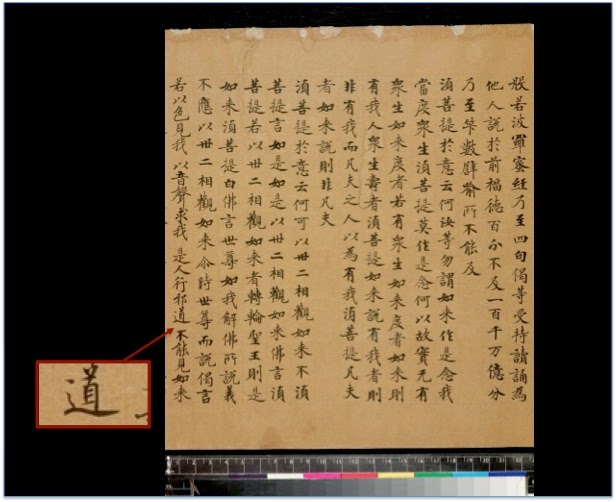
The character for the word "Tao" itself is actually composed of the symbol for a road and the symbol for a head (which itself is based upon the symbol for an eye), and appears in the computer version of the symbols in the text cited above in the following manner (you can see it at the end of the fourth line of characters):

This symbol looks rather prosaic as rendered by a computer, but when written by a calligrapher is a singularly beautiful and expressive character (below is an example from a manuscript of the Tang dynasty, which has been dated as written by a calligrapher in AD 676):

image: Wikimedia commons (link) -- I've taken the liberty of adding a cutout of an enlarged image of the character for "Tao" (Way or Road) from the text, and pointing out its location within the text. 

The word usually rendered into English as "Tao" which is indicated by the above character is actually pronounced dao in Mandarin Chinese (poutongwa), and douh in Cantonese (Guangdongwa) and means "way" or "road" (but also "Tao" and is also used to refer to Taoism in general).

It is interesting to think of this "Way" as being somehow akin to the path followed by water, which unerringly seeks out the most efficient and effective and least contentious Way, a Way that has no need for contending -- and then to think about examples in daily life that seem to embody this principle. 

For instance, one might think of a motion in a familiar sport, such as basketball or tennis: shooting a basketball is a fairly complex skill, as is striking a tennis ball effectively with a forehand or backhand or an overhand serve. There is a set of motions that is most effortless, most efficient, and generally most effective for shooting, say, a three-point shot in basketball or hitting a powerful forehand in tennis. 

However, when we first begin to try to perform these motions (or when we see someone who is just learning to do it, perhaps a child or a teenager or some other beginner), what often happens is that the beginner will find his or her way into using a set of motions which are not the most effective or efficient -- a set of motions which we might say are not, strictly speaking, "good form," but which give the person a sort of "artificial" success.

You might see children who are not quite strong enough to shoot a basketball properly at a full-sized hoop, for example, using a variety of "compensating" motions in order to get the ball to the proper height to go into the basket -- but which you realize are habits that must eventually be corrected as the child gets older and stronger, because they are actually not the most efficient motions or the motions that will produce the most consistently accurate shots, because they actually are motions that "work against each other" in some way. 

Sometimes, we ourselves (or people we see who are learning a sport such as basketball or tennis) will "hold on" to these bad habits, because they produce a modicum of success, and we are afraid of losing that success by unlearning those motions and replacing them with the more effective motions. Coaches sometimes see a lot of resistance from a player who is comfortable in some bad habits which the coach knows are holding the player's shot back in certain important ways. 

This may be a good example of the concept being expressed about being "like water" and "not contending" -- a shot which is using "bad form" is actually "contending" against gravity or against the principles of physics or some other principles "of the universe" in some way, which holds it back and makes it more awkward and more self-defeating than it should be.

Obviously, this rather "physical" example can then be applied to all kinds of non-physical aspects of our lives in which we are doing things in ways that are "contentious" or "not like water" or "not in alignment with the Tao" and which in doing things that way we create all kinds of "turbulence" between ourselves and those around us, or within ourselves, or both. We can even feel the resistance of the universe itself when we are stubbornly refusing to "align ourselves" with the principles of that flow, just as a tennis or basketball player can often feel the ways in which their refusal to align their shot with the principles of "good form" may be causing them to sabotage their own efforts.

Interestingly enough, calligraphy itself and the painting of traditional Chinese characters can be an expression of alignment with the Tao. Producing beautiful traditional characters such as the page of text from the Tang dynasty shown above requires alignment with certain principles which are every bit as demanding as those required in a basketball or tennis shot, and requires the practitioner to learn how to overcome bad habits and inefficient motions that can be every bit as self-defeating as those which players can develop in any sport. One can do a simple search for the words "Tao" and "calligraphy" on the web and find a host of interesting texts on the subject.

Even more intriguing is the fact that the desired characteristics of Taoist calligraphy are expressed in terms of the human body: the characteristics are categorized into the areas of "bone" (the actual structure and form of the characters, as well as their size and "posture"), of "blood" (the consistency of the ink, which is mixed by the calligrapher using a stick, a stone, and a small amount of water), of "flesh" (the thickness and flow of the strokes themselves, and their proportion in terms of being neither too "fat" nor too "skinny" in their conformation), and of "muscle" (movement, energy, spirit, and vital force) -- see for instance this text among many other possible discussions.

This itself expresses the concept of "microcosm and macrocosm," in that the letters themselves are acting a role as a "microcosm" of the human body and, by extension, the human life lived in alignment with the energy of the Tao or the universal flow. Alvin Boyd Kuhn discussed manifestations of this same principle in regards to the letters of Hebrew and Greek and other writing systems within the esoteric traditions of other ancient civilizations in other parts of the world.

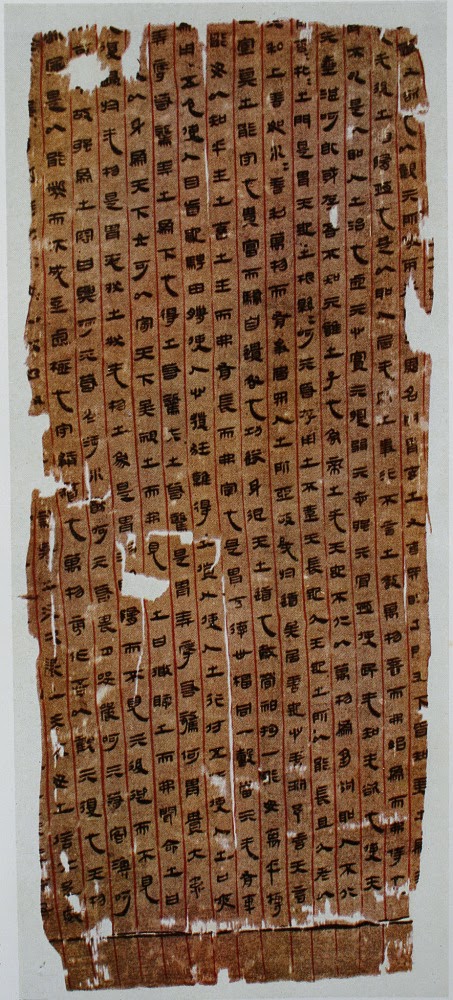
As alluded to above, during the 1970s previously unknown manuscripts containing the text of the Tao Te Ching were discovered in tombs in Ma-wang-tui (also frequently written as Mawangdui). These texts, sometimes known as the "silk texts" because they were written on sheets of silk, date to the middle or even the first part of the second century BC, and were much older than previous extant texts of the Tao Te Ching by about 500 years (since that time, in the 1990s, new and even older texts containing lines from the Tao Te Ching have been found in another tomb, this time on thin bamboo strips).

This discovery prompted one scholar of Chinese language and literature to decide that the Ma-wang-tui texts cast so much new light upon the text of the Tao Te Ching that it was worthy of a new translation and examination: the 1990 translation by Victor H. Mair. Towards the end of his edition, Professor Mair (the Chair of Chinese Language and Literature at the University of Pennsylvania) embarks upon some examination of the resonances within Taoist thought and expression to other ancient sacred texts and thought, including the texts of ancient India.

At one point he makes an extremely important observation concerning a passage from the sixth stanza of the Mundaka Upanishad and the section of the Tao Te Ching traditionally numbered 11 (but numbered 55 in Professor Mair's 1990 translation, based on the Ma-wang-tui texts):

The whole second khanda (section) of the Mudaka Upanisad has so many close parallels to the Tao Te Ching that it deserves the most thorough study by serious students of the Taoist classic. Here I shall cite only a part of the sixth stanza, which bears obvious resemblance to one of the most celebrated images of the Old Master:
Where the channels (nadi) come together
Like spokes in the hub of a wheel,
Therein he (imperishable Brahman as manifested in the individual soul [atman]) moves about
Becoming manifold.
The corresponding passage from the Tao Te Ching (chapter 55, lines 103) has a slightly different application but the common inspiration is evident:
Thirty spokes converge on a single hub,
but it is in the space where there is nothing
that the usefulness of the cart lies.
In one of the earliest Upanisads, the Chandogya, we find an exposition of the microcosmology of the human body that certainly prefigures Taoist notions of a much later period:
A hundred and one are the arteries (nadi) of the heart,
One of them leads up to the crown of the head;
Going upward through that, one becomes immortal (amrta),
The others serve for going in various directions. . . . (translation adapted from Radhakrishnan, p. 501). 156-157.

This correspondence, as Professor Mair makes clear, is most significant and most remarkable. The use of the imagery of spokes is common to both, and both clearly use the metaphor of the spokes of the wheel to refer not only to an aspect of the wider universe but also to the human body and to human life, connecting each of us not only to the universe but specifically to the invisible part of the universe, the "space within the wheel," where the invisible divinity is located, and who is also manifest within the human soul.  

Not only does this continue the "macrocosm-microcosm" theme which can be shown to be an absolutely fundamental aspect of virtually all the world's esoteric sacred texts and traditions (including the texts of the Old and New Testament), and not only does the concept of the "hidden divinity" have important connections to the concept of "Namaste and Amen" discussed in numerous previous posts (which also connects to the scriptures of the Bible, as well as to important themes present in ancient Egyptian sacred mythology), but it is very likely that these passages which Professor Mair here focuses upon also contain powerful echoes with the text of the extraordinarily important "Vision of Ezekiel" and the "wheels within wheels," which I have discussed at length as being a metaphorical description of an understanding of the motions of the celestial machinery -- the same understanding which is depicted in the models of the heavens known as armillary spheres. 

Note that in both of the passages cited above -- one from the Tao Te Ching and one from the Upanisads  -- the metaphor of a wheel with spokes is used, and in the Upanisad it is said that Brahma dwells "therein" or in the center of that wheel, exactly as the Most High is described as being enthroned upon or above the wheels in the Vision of Ezekiel

In fact, as I explained in the previous examination of the details of the description in the Ezekiel text, there the wheel is specifically described as being composed of "strakes," which is a very precise term from the old craft of wooden wheelmaking, describing the curved outer segments of a wooden wheel -- outer segments which would be a perfect metaphor for the twelve segments belonging to each sign of the zodiac within the great celestial band or "wheel" of the zodiac.

Notice that in the passage from the Tao Te Ching, the number of spokes on the wheel is specifically given as thirty

spokes: is it not significant that each of the sections of the zodiac wheel (each of the "strakes," if you will) would have exactly thirty degrees, if there are twelve signs of the zodiac and if the circle is divided into three hundred and sixty measurement units called "degrees"? 

Based on these correspondences, it is almost certain that there are direct parallels between the esoteric message being conveyed (albeit using slightly different metaphorical details, and different versions of the divine name) by the ancient texts of the Upanishad, the Hebrew Scriptures, and the Tao Te Ching.

This is all very important, and points to profound connections between the ancient sacred knowledge of the human race, and to the fact that we should all actually be united by our ancient heritage, and not divided.

One very practical implication of the foregoing is the realization that one can learn from and incorporate the profound lessons conveyed by different sacred traditions, because they are all using slightly different expressions to try to point towards the same truths. If one aspect of the metaphor provides better insight, or feels in some way more accessible, there is nothing wrong with learning from it. As we have already seen, Buddhism and Taoism are almost certainly names which have linguistically identical origins, and which probably share the same linguistic heritage with the divine names of JAH and PTAH and MANITOU and many others.

The Tao Te Ching has a unique power of its own, a unique voice in expressing and conveying the ancient wisdom.

It describes the ideas of aligning with the flow of the universe in a way that might be particularly helpful in all kinds of "simple" ways within our day-to-day life. 

Thinking about having "efficient good form" in a shot in tennis or basketball as being a good example of "aligning with the flow" and not going against it, we can then think about expressing that same kind of alignment and efficiency and "non-contention" in the way we drive a car, or wash dishes, or open a door, or interact with people around us.

When someone starts "contending" with us, we can see if they are acting in ways that are not aligned with that universal flow, and we can ask ourselves whether that is a good reason to allow ourselves to also get out into contention and turbulence, or if we prefer to seek to stay aligned with the Tao and act more like water in a stream.

Of course, since none of us is perfect and since this material realm is full of systems which seem almost purpose-built to jostle us out of alignment with the Tao, this is a process that can fruitfully provide us with rewarding challenges, even if we are performing what might otherwise seem to be the most mundane of tasks or jobs. And even if we have relative success on one day, we won't become bored because the next day will probably teach us how much we still have to learn in this regard.

Ultimately, as the deeper connections touched on above seem to indicate, I believe that the process of aligning with the Tao that is the subject of the Tao Te Ching involves the awareness of, the acknowledgement of, and some interaction with the reality of the invisible aspect of the universe, and not just its physical forces.

And, as we have seen in many previous posts, this seems to be one of the most central messages of the world's esoteric texts and traditions, all of which I believe should be viewed as our shared inheritance from the remarkable messengers who gave us this sacred ancient wisdom.

Gung-hei faat choih!

恭喜发财

PTAH, JAH, TAO, and BUDDHA

PTAH, JAH, TAO, and BUDDHA

image: Wikimedia commons (link).

The preceding post examined evidence found in the treatise on the Therapeutae, written by Philo of Alexandria sometime prior to AD 40 or 50, which suggests that -- in addition to pursuing an ascetic lifestyle characterized by a vegetarian diet, daily intermittent fasting, regular periods of longer fasting, long periods of meditation and prayer, simplicity of dress, lack of material possessions, and participation in a community of others who practiced the same lifestyle -- the Therapeutae studied ancient sacred writings with an eye to their esoteric content and message, and that at least some of the Therapeutae were able to enter a state of ecstatic trance in which they spoke messages which came from the realm of non-ordinary reality.

In that post, we also examined the arguments of Gerald Massey (1828 - 1907) regarding the importance of the many similarities between the ancient descriptions of the beliefs and practices of ascetic communities such as the Therapeutae and the doctrines described in many of the New Testament texts. 

Massey points out that early literalist Christian authorities such as Eusebius (c. AD 260 - c. AD 340) would sometimes try to argue that these similarities are evidence that the Therapeutae were very early communities of literalist Christians, but that in doing so those writers make a revealing error, because in doing so:

  • these writers admit the undeniable similarities between elements of the Therapeutae descriptions and the sayings attributed to Christ or taught in the New Testament Epistles, but that . . .
  • because the Therapeutae and other such communities -- and their teachings -- were in existence long before the time of the New Testament, this shows that they are part of a stream which is far more ancient, and which thus refutes the historical framework advanced by literalist polemicists such as Eusebius.

In other words, one way of expressing this thesis would be to say that surviving descriptions of ancient communities such as the Therapeutae contain evidence that places these ancient communities squarely within the current of the rest of the world's ancient wisdom traditions -- traditions which can also be shown to be founded upon esoteric sacred texts or mythologies, and to be founded upon a worldview which included ecstatic trance and which can be described as essentially shamanic -- but that the literalist-historicist system advanced by Eusebius and others during the subsequent centuries rejected both the esoteric and shamanic aspects and consciously and deliberately cut itself off from that same current of the world's ancient knowledge.  

Rather than representing a new and different teaching, the texts of the New Testament can be shown to be based upon the same system of celestial metaphor common to the rest of the world's sacred traditions, and to contain clear parallels to other systems of myth going back thousands of years (some previous posts discussing aspects of this evidence include "The shamanic foundation of the world's ancient wisdom," "Namaste and Amen," "Epiphany: revealing the hidden divine nature," "The Angel Gabriel," and many others). 

And, rather than representing an early example of a new Christian faith built upon a literal and historicist interpretation of these ancient scriptures, communities such as the Therapeutae can be shown to be part of a very ancient wisdom tradition, and one with strong parallels literally around the world. In other words, it fits into a stream which appears to connect humanity both across the distances of time and of space: one which not only flows back across time through millennia, but one which also appears to flow across vast stretches of geographical space, across continents and seemingly very different cultures.

And, when the literalists self-consciously cut themselves off from this stream, it can be said that they also in a way cut themselves off from a deep connection to the universe, insofar as their insistence on approaching the sacred texts as descriptive of literal, historical events which took place on planet earth can be seen as a deliberate repudiation of the celestial basis underlying all the stories of the Biblical scriptures, from Adam and Eve and the Serpent, to the story of Noah and his three sons, to the sacrifice of Abraham, the crossing of the Red Sea, the adventures of Samson, the horrible oath of Jephthah, the Judgement of Solomon, the events in the life of Elisha, the Vision of Ezekiel, and all the rest -- including the stories in the New Testament as well.

One important message conveyed by all of these stories is the connection between humanity and the wider universe -- the stories themselves depict stars, planets, constellations, and the sun and moon as human beings walking on earth and going through all "the heart-ache and the thousand natural shocks that flesh is heir to" (as Hamlet says). In doing so, they implicitly suggest that we ourselves and our "motions" in this mortal life are in some way connected to and reflective of the motions of those heavenly actors.

Indeed, as many previous posts and the book The Undying Stars discuss at length, the deeper esoteric message of the Star Myths found in the Bible and in the rest of the ancient sacred traditions and scriptures around the world may involve a view of the universe in which there is an unseen spirit realm in addition to the visible material reality with which we are familiar, and the message that the material realm is in fact connected to, interpenetrated by, and even projected from the unseen realm.

By cutting themselves off from this understanding, the literalists were in effect cutting themselves off from and setting themselves against not only all the other cultures and sacred traditions of the rest of humanity but also the very "flow of the universe" itself -- that concept which is expressed in Taoism as the eternal Tao.

The details of the Therapeutae described by Philo, and the attempts by later literalists such as Eusebius to co-opt them into literalist Christianity, provide an invaluable window through which to observe this important concept in action. For the literalist system advanced by Eusebius and his colleagues can be seen to have strongly rejected what are arguably the most vital aspects of the Therapeutae way as described by Philo: their allegorical and non-literalistic hermeneutic with regard to sacred texts (which, as I have argued above, convey an esoteric message involving a deep connection between our lives on earth and the motions of the heavens and of the earth on its course around the sun, and to the spirit world which interpenetrates and thus connects everything in this visible universe), their high regard for knowledge obtained while in a state of trance (which is a form of direct and unmediated revelation to the individual, and which provides immediate confirmation of the invisible connection just described), and even their decision to abstain from the eating of flesh (which evinces a sense of connection to the other creatures of our planet, rather than the belief that animals are created for humanity's exploitation, which has led to the situation today in which animals in the food industry are regularly treated in the most inhumane manner imaginable, a situation only possible in a society in which large numbers of people feel no connection to these animals at all).

All of these aspects of the Therapeutae can be seen as belonging to the family of teachings which seek to align with what we could describe as the flow of the universe, or the Tao -- and they are the very aspects of the Therapeutae way which were not incorporated into literalist Christianity, which is in keeping with the above observation that the literalist approach to the scriptures almost of necessity represented a self-imposed isolation not just from the rest of the world's wisdom traditions but also from the flow of the universe itself.

And here is where another insight from Gerald Massey opens up a whole new vista of evidence to support this assertion. Beginning most explicitly in the fourteenth paragraph of the treatise entitled "Gnostic and Historic Christianity" which was discussed in the preceding post, Massey argues that the Therapeutae seem to be part of a tradition stretching back to the Pythagoreans, and that this connection was indeed advanced by at least one important ancient author.

The reader may remember that the Pythagoreans were strongly associated in ancient times with the practice of a vegetarian diet (see discussions here and here, for example), as well as the fact that the Pythagoreans practiced a deeply esoteric approach to number, with the study of number and geometry functioning very much as an ancient "text" from which they derived profound truths regarding the nature of the universe and of human existence, in exactly the same way that other esoteric communities derived the same understanding from written texts or sacred myth. Thus, the possibility of a continuity of tradition between the practices of the Pythagoreans and those described by Philo among the Therapeutae appears to be well-founded. It obviously argues that the practices of the Therapeutae are part of a stream that is much older than the literalists such as Eusebius would have us believe.

There is also the abundance of ancient texts which declare that Pythagoras was an accomplished healer, and that he believed and taught the healing power of music, rhythm and vibration -- and that he in fact "tuned himself up" every morning with a period of singing, dancing, and playing the lyre! This connection provides yet another support for placing the Pythagoreans and the Therapeutae within the same ancient stream, because as we have seen from Philo's description, the Therapeutae also placed great emphasis on the importance of harmonic and rhythmic singing, and of course their very name has come to be associated with healing the body -- a very important aspect of this group which connects them not only to the Pythagoreans but to many other similar groups found in other cultures as well (and see also this previous post).

Whether of not Pythagoras was a literal and historical human figure is actually open to debate, but the traditions surrounding his life state quite clearly that much of his knowledge came from Egypt, where he is said to have traveled in order to gain access to the ancient wisdom kept by the Egyptian priests.

Massey then offers some linguistic connections which lead to some frankly mind-blowing possibilities. He argues that the root of the name Pythagoras most likely stems from the ancient Egyptian god Ptah, which can also yield Putha and Put, and which may in fact be the original source of the name of the Buddha, and even of the Therapeutae!

Now, this is truly a revolutionary insight. Because, as noted in the preceding post, some of the features Philo describes regarding the Therapeutae -- such as the abstention from eating meat, the simplicity of dress, and the giving away of all possessions -- are not really features associated with the literalist Christianity advocated by Eusebius and his colleagues, but they are indeed features strongly associated with many expressions of "Eastern" traditions including Buddhism, Hinduism, Taoism, and others. 

And, previous posts have made note of the parallels (which have been noted by other researchers as well) between some aspects of ancient Egyptian priests and priestesses (of Isis, for instance) and elements of Buddhist monasticism. Also, I believe Patricia Awyan in correspondence with me has mentioned the importance of the Ptah connection as well.

Taking the ball from Massey at this point and running with it a little further, so to speak, it can also be argued on linguistic principles that the word Tao could be said to have connections to the name of the invisible Ptah as well. And thus we see that the name of the Egyptian Ptah can be argued to have connections to Buddhism (if we insert a vowel between the first two consonants, which also leads to the connections to the name of Pythagoras) and to Taoism (if we do not).

Further, while some may protest such a connection, it is linguistically feasible to suggest a connection to the sacred name JAH along these same lines as well, which is the version of the divine name used in Psalm 68 and verse 4.

Additionally, we might also argue that there are sound reasons to suggest a connection between the name of Ptah and the Egyptian name Sahu, which was associated with the constellation of Orion. 

The likelihood that Orion was associated with the Egyptian god Osiris is well-known, has been argued for over a century by many researchers, and is I believe well-established by the evidence offered by researchers such as Hertha von Dechend and Giorgio de Santillana in Hamlet's Mill, and Jane B. Sellers in Death of Gods in Ancient Egypt  (see also the discussion in previous blog posts including "Dawn of the Golden Age," "Precession = the Key," "Hamlet, Hamlet's Mill, and Astro-Theology," and "Capella, precession, and the end of the Golden Age").  

However, there are strong connections between the characteristics associated with Osiris and many of the characteristics of the god Ptah, who was also anciently depicted as being swathed in mummy-clothes as was Osiris, and who fulfills a role very similar to that of Osiris within some aspects of ancient Egyptian theology, particularly that associated with Memphis which is sometimes known as the "Memphite theology." Further, in ancient depictions of Ptah, he is regularly shown holding a Djed-column scepter, which is a symbol that is also strongly associated with Osiris and with Orion. 

Thus, the possible connection between Ptah and Sahu -- already defensible on linguistic grounds alone -- appears to have further evidence to back it up. 

It can also be noted at this point that Osiris (and other "Osirian" figures in other myth-systems, including Saturn and Kronos) was a deity associated with grain, and with teaching humanity how to cultivate the fields for food (and, in some myths, with teaching humanity to refrain from eating one another as food -- he was a "civilizing" figure in many ancient myths, dwelling on earth and presiding over a Golden Age of peace). Thus, the fact that the Pythagoreans and the Therapeutae were practitioners of vegetarianism suggests that this proposed connection to Sahu in addition to Ptah is defensible from multiple angles.

We can even go so far (although this is, admittedly, wandering rather "far afield") and suggest the possibility that the word Shaman itself may somehow connect back to these shared sounds of Sahu, Tao, JAH, and Ptah. 

It is true that the word Shaman is of Tungusian origin, from a land and a people very far removed from ancient Egypt. And yet, it is equally true that one of the most essential characteristics of the Shaman, in cultures around the world, is his or her role as a healer. That this healing technique almost always involves singing, chanting, and the playing of harmonic flutes or rhythmic drums seems to argue some kind of parallel with the practices attributed to the Pythagoreans and the Therapeutae, and hence the possibility of a linguistic connection between these names is not too outrageous to make. 

It is also well-attested that Shamans around the world express their voyages to the spirit world in terms which are frequently celestial in nature, and in fact the evidence of possible shamanic aspects of ancient Egyptian sacred tradition and of some kind of connection between ancient Egyptian knowledge and shamanic technique found around the world is abundant, and worthy of careful consideration (some of it is discussed in previous posts such as this one and this one).

And so, what we are seeing is that there are strong arguments to be made for a connection between all of these different expressions of ancient wisdom, and of a consistent stream which stretches back deep into the time of ancient Egypt, and which can already be seen to potentially unite some aspects of Taoism, Buddhism, and Shamanic culture. The Therapeutae described in Philo's text appear to be squarely within that ancient stream, and the fact that their sacred texts sometimes express the sacred name in the form JAH can be seen as a connection to PTAH, TAO, and even BUDDHA. 

The chart below shows one way of outlining these connections:

This chart, following the argument of Massey, depicts the different linguistic permutations as being descended originally from the ancient Egyptian name of Ptah, and there are certainly good reasons to decide that ancient Egypt's incredible antiquity argues for Egypt as the original source and fount of all the others. After all, Ptah may be an even more ancient god than Osiris, and Osiris and his myth-series was already fully developed by the time the Pyramid Texts were inscribed, some of the most ancient  texts known to history, some of which were written as early as 2300 BC (which argues that the Osiris myths are even older than that, and the Ptah myths may be older still).

However, it is also certainly possible to posit that all of these different names descended directly from some still more ancient source, and that they all resemble one another only because they all resemble some original name from this now-unknown original source.

The diagram below shows this possibility, and adds yet more names from the world's sacred traditions which may serve to show how widespread and indeed universal this ancient stream really may be:

Here, in addition to the names already discussed, are added several more whose linguistic connections may be disputed, but which are certainly defensible as possibilities under the generally accepted principles of linguistic transmutation of related sounds.

In the first line we see the names PTAH, TAO, JAH and PUT, which have already been discussed. Below these are PytahgorasBuddha, and Therapeutae, but also Manitou, which is a name from the Native cultures of North America which can be used to describe both the denizens of the spirit world (the Manitous) but also when singular is used to indicate the Great Spirit.

In the next line below that, we see listed Sahu and Shaman, but also the Native American sacred name Ta-Iowa or Taiowa, which is a name which the Hopi elders used when they passed on their sacred traditions to Frank Waters and Oswald White Bear Fredericks in order to ensure that their ancient wisdom was not lost or forgotten, and which can be found in written form in The Book of the Hopi. The linguistic connections of this name to the sacred name of JAH can hardly be disputed. It is also difficult to ignore the fact that this name has been preserved as the name of one of the United States: the state of Iowa, discussed in this previous post.

These examples from the Native American sacred traditions shows that this stream not only stretches across millennia but that it also spans the globe. It is the stream within which the Therapeutae can be seen to be firmly planted, but from which the literalists such as Eusebius were consciously separating themselves.

That previous post on Iowa and the sacred name also discusses the likelihood that the names of Zeus and Jupiter (or Iu-Pater or Zeus-Pater) fit within this same family of names and can be shown to be linguistically connected to JAH and TA-IOWA.

The implications of all this apparent connection between the sacred myths and sacred scriptures of the world (to include those which ended up in the Bible, but which were radically reinterpreted by the literalists) are indeed profound.

This analysis would suggest that, although they have superficial differences, there are important fundamental connections between the worldviews that are expressed around the globe and across the ages in the messages of the Tao, of the Buddha, of ancient Egypt, of the Pythagoreans, of the Biblical texts esoterically understood, of Greek myth, of Native American spiritual teaching, and of shamanic cultures in general.

It also suggests that all of these traditions emphasize an interconnectedness of all creatures as well as an interconnectedness between individual men and women, and between humanity as a whole, and the rest of the earth and indeed the entire universe, including the invisible realm which flows through the entire universe and every being within it. 

We can also see in many of the specific descriptions and practices of groups such as the Therapeutae, the Pythagoreans, and many expressions of this spiritual stream in Buddhism and Taoism an emphasis on the importance of living in harmony with the invisible flow and energy of the universe, or with the Tao (to use the name given to this concept in one of these related traditions). The knowledge of ways to preserve or restore health to the human body which is obviously very central to many of these related traditions can be seen as a direct and logical aspect of this emphasis on trying to align with and remain in harmony with the energy of the universe or the Tao.

And, indeed, this emphasis can be clearly seen in the stories contained in the New Testament Gospels themselves.

However, although some literalist Christian writers try to argue that groups such as the Therapeutae represent early members of their literalistic system, the similarities are only superficial, and it is clear that the literalists rejected the most important features of the Therapeutae approach, the features that connect the Therapeutae to the wider and deeper current which flows also through the Pythagoreans, the ancient Egyptians, and connects even further to Buddhism and Taoism and to shamanic cultures around the globe.

In setting themselves against this ancient stream, the early proponents of literalism may or may not have realized that they were setting themselves against all of these things. And yet it is quite evident from the above analysis that this is in fact exactly what they did do. 

Because of this, and because of the fact that "western culture" can be seen to be directly descended from and most powerfully influenced by the heirs of Eusebius and the system that they put into motion, it can be clearly demonstrated that modern western civilization today is directly at odds with the flow of the universe in numerous important and world-threatening areas. 

Additionally, it can even be said that modern western society discourages harmony in many ways, and that it contains powerful structures which seem almost purpose-built to hinder individual men and women from aligning themselves with the Tao, and even some which seem purpose-built to actually act to the detriment of the health of their physical bodies in many ways -- the opposite of the goal of healers and healing communities such as the Pythagoreans or the Therapeutae.

And, it can certainly be said that modern western society is built around principles which are basically the exact opposite of the practice attributed to the Therapeutae of giving away their possessions and living with very little "stuff."

If we examine the scriptures themselves, we might ask ourselves which approach seems more in line with those ancient texts: that which resulted from centuries of literalist influence, and which we see manifested in modern western civilization today, or that pursued by the Therapeutae and other communities who lived prior to the rise of literalism, or who were far enough away from the Roman Empire to avoid falling under its sway in the subsequent centuries.

The good news is that, as the analysis above demonstrates rather conclusively (I think), it is really the divisions between us that are artificial: all cultures and all people (including those  whose connection to the ancient wisdom was stamped out by the rise of literalism in Europe during the Roman Empire and in subsequent centuries) are actually connected by this ancient stream, which exhibits different surface characteristics in different places and different time periods, but whose core practices or teachings can almost always be shown to share a few important common features. 

And, whether we recognize it or not, we are all actually connected one to another, as well as to the earth and to the infinite universe, and to the invisible realm which may in fact be the most important element which connects it all.

It is the self-imposed separation initiated by the literalists from the rest of the world's traditions, and from what we could hardly do better than to refer to as "the Tao," which is really the artificial separation, and indeed the illusory separation.

Even the very names show that this separation is an illusion, and that JAH, TAO, PTAH, TA-IOWA, BUDDHA, and all the rest reveal that we are all part of the same stream which flows around and through us all and connects us with one another and with the universe. 

The Therapeutae

The Therapeutae

image: Wikimedia commons (link).

The ancient philosopher Philo of Alexandria (c. 25 BC or 20 BC - c. AD 50), devotes the bulk of the text in one of his most well-known surviving works, De Vita Contemplativa ("On the Contemplative Life"), to discussing the important group of followers of the ancient Hebrew Scriptures who were known as the Therapeutae.

Some of the aspects of the Therapeutae as described by Philo include the following:

  • They lived in ascetic communities which were open to both men and women, although living most of the time separated by sexes and coming together for special meals and celebrations in which all participated.
  • Philo tells us that while such communities could be found in many countries, they were most prevalent in Egypt.
  • They gave away their possessions and left the bonds of society and of family, not (Philo explains) out of any misanthropy, but rather out of desire to benefit others by giving away their wealth and to be free of "undue care for money and wealth" and to devote their time to the pursuit of holy mysteries.
  • They typically sought out desert places in order to retreat from the crowded life of cities and pursue a spiritual path with a balance between solitary contemplation and communal activity.
  • They made their dwelling places far enough apart from one another to give themselves plenty of room for solitude and contemplation, but close enough together to be able to defend each other in the case of attack by robbers.
  • They held the ancient scriptures in extremely high regard and devoted much of their time to their study.
  • They spent much of their time in meditation and prayer, with prayer specifically mentioned as being offered at the time of the rising of the sun and the setting of the same.
  • They favored very simple clothing and food, nothing that was expensive or ostentatious.
  • They followed a vegetarian diet, bringing nothing to their table (Philo tells us) that has blood.
  • They did not drink wine but rather water.
  • They fasted regularly, and in fact seem to have fasted throughout the daylight hours each day according to Philo, saving food and drink for after sunset, as well as at times fasting for longer periods, such as three days or even six days.
  • They did not use slaves at a time when slavery was commonly accepted, but instead "look[ed] upon the possession of servants or slaves to be a thing absolutely and wholly contrary to nature, for nature has created all men free" and regarded slavery as a product of injustice, covetousness, and evil.
  • They had a high regard for singing and sang sacred songs, psalms, or chants, and that they did so with a dignified rhythm and sometimes with men and women all together, forming two choruses which at times sing different parts and at times all sing the same, and at times break into stately forms of dance and choreographic expression to accompany their singing. 

Translations of Philo's text are easily found on the web, where those interested can consult his descriptions for themselves -- one such site can be found here.

Readers who are familiar with some of the texts that have come to be known as the New Testament will recognize some of the characteristics attributed to these Therapeutae in some of the admonitions and recommendations in certain New Testament passages, including the singing of hymns, psalms and sacred psalms (urged in Ephesians 5 and Colossians 3), and the passage in Luke in which Jesus says his disciples must "hate" father and mother and wife and children and brethren (Luke 14:26), which is very similar to Philo's statement that those who left society to join these spiritual communities "desert[ed] their brethren, their children, their wives, their parents, their numerous families, their affectionate bands of companions . . ." 

Indeed, the later author and polemecist Eusebius (c. AD 260 or 265 - AD 339 or 340), who was a bishop in the hierarchical and literalist Christian church, recognizes so much in the descriptions given by Philo that Eusebius states very plainly that these ascetic communities described by Philo represented  the "multitude of believers" converted by the gospel author Mark when he traveled to Egypt: see chapter 16 of Book II of the Ecclesiastical History written by Eusebius (links to all the Books of the work are available online here, and the link to Book II is here). Eusebius further declares in Chapter 17 of Book II (which contains numbered paragraphs -- the paragraph numbers are preserved below in the quotation):

3. In the work to which he gave the title On a Contemplative Life or on Suppliants, after affirming in the first place that he will add to those things which he is about to relate nothing contrary to truth or of his own invention, he says that these men were called Therapeutae and the women that were with them Terapeutrides. He then adds the reasons for such a name, explaining it from the fact that they applied remedies and healed the souls of those who came to them, by relieving them like physicians, of evil passions, or from the fact that they served and worshipped the Deity in purity and sincerity.
4. Whether Philo himself gave them this name, employing an epithet well suited to their mode of life, or whether the first of them really called themselves so in the beginning, since the name of Christians was not yet everywhere known, we need not discuss here.

Eusebius is here plainly declaring that the Therapeutae and Therapeutrides were the first Christians, going by that name prior to the common use of the term "Christian" itself! 

This, Gerald Massey points out (whose arguments regarding the suppression of the original Gnostic nature of the Biblical scriptures by the later literalists was discussed in the preceding post, among other previous posts), is a "fatal admission" on the part of Eusebius, because in arguing that the description given by Philo indicates that the Therapeutae must have been early Christians, and in arguing (as he later does in paragraph 12 of Book II, Chapter 17) that the texts the Therapeutae esteemed so highly were very probably "the Gospels and the writings of the apostles, and probably some expositions of the ancient prophets contained in the Epistle to the Hebrews, and in many others of Paul's Epistles," Eusebius is either completely overestimating the speed with which all those "New Testament" writings were produced (since Philo's description of the Therapeutae was most likely published in AD 40), or else he is inadvertently revealing the truth that all those writings listed were in existence much earlier than AD 40, or were based upon texts that were in existence much earlier than AD 40 (see Massey's Gnostic and Historic Christianity, paragraph 34).

Now, let's examine this argument a little bit. It seems at first to be fairly flimsy: Massey seems to be placing too much weight on the writings of a literalist bishop who was writing sometime around the first two decades of the fourth century (probably completing it prior to AD 323), long after Philo wrote his De Vita Contemplativa. Of course Eusebius could have been making a mistake (or being deliberately disingenuous), so what's the big deal?

And, based on the timeframe of Philo's publication (not later than about AD 50, when Philo died), it would seem that Eusebius was "too hasty" in claiming the Therapeutae as early Christians, and in assuming that the texts they revered and meditated upon must have been early copies of the Gospels and the Epistles. From our perspective in history, it seems very unlikely that the "multitudes" of Therapeutae described by Philo could have possibly had time to spring up and develop the rather rigorous patterns and traditions of ascetic living and worship that Philo describes, and extremely unlikely to the point of impossibility that they could have been doing all that rigorous textual study and exegesis described by Philo upon New Testament texts like the Gospels and Epistles, since virtually no scholar today believes that all of those Christian texts were even written down by the time Philo penned his treatise. Certainly we can ascribe the remarks of Eusebius as simply overly-optimistic or over-zealous, and move on -- right?

And yet Massey, whose analysis often proves to be extremely penetrating, even if there are areas of his analysis with which I strongly disagree, sees in these assertions by Eusebius a "fatal admission" (meaning that Massey believes this admission is "fatal" to the historicist or literalist position which Eusebius held which treats the characters in the scriptures as literal historic persons, and which attacks "pagans," "Platonists," and those who do not share this literalist and historicist version of Christian faith).

Massey does not explain very much further to help us see why this position from Eusebius is so damaging to the historicist approach. He only states by way of explanation that:

it is impossible to claim the Essenic Scriptures [Massey presents arguments to support his conclusion that the Therapeutae and the Essenes were closely related or indeed the same general school] as being identical with the Canonical records, without, at the same time, admitting their pre-historic existence, their non-historical nature, and their anti-historical testimony. They could only be the same in the time of Eusebius by the non-historical having been falsely converted into the historical.

Again, it would seem that the rebuttal that "Eusebius just made an error" would defeat Massey's argument here . . . except for the fact that Eusebius himself identifies the actual actions and practices of the Therapeutae as obviously reflecting the teachings found in the Gospels and Epistles! 

In other words, even if the Therapeutae described by Philo did not have the texts

Eusebius says that they had (and there is no way that they could have, unless those texts were more ancient than the time period during which the Christ of the historicists was said to have lived, which is the possibility that Massey believes is the correct solution), the very fact that these Therapeutae were described by Philo doing things that would later be incorporated in the Gospels and Epistles (a couple examples of which were mentioned above) is a strong indication that the New Testament concepts and teachings pre-dated the historical period during which the literalist Christ is said to have lived. This is especially true because Philo, who probably wrote this treatise by AD 40 and certainly by AD 50, is describing these practices as though they are already long traditions.

This is why Massey believes that the descriptions in Philo's text are so damaging to the literalist position. Massey believes that the literalist approach was a later invention, in fact a subterfuge, through which a group of men converted a "non-historical" (that is to say, "allegorical" or "metaphorical" or "esoteric" or "Gnostic") set of spiritual teachings into a "historical" (that is to say, "literalistic, describing events that literally took place in history") faith. 

And, in fact, we can find some additional extremely interesting aspects of Philo's description of the Therapeutae which appear to add further powerful support to the argument Massey is making regarding the later appropriation by historicists such as Eusebius of teachings or practices that were essentially anti-historical or esoteric and Gnostic.

Interestingly enough, they are the same two characteristics that were argued in the preceding post which declared that the scriptures of the Old and New Testaments of the Bible are essentially shamanic! That is to say, the two features which that post argues generally go together: an understanding of the techniques of what can be termed ecstatic trance or shamanic out-of-body travel, and an understanding that the ancient scriptures of the world (to include those texts found in the Bible) are allegorical in nature and that their allegorical nature is intended to point to this shamanic understanding.

In Philo's description of the Therapeutae, he distinctly says more than once that their long study of the sacred texts, and their group exposition of the meanings of these ancient texts, involved an allegorical approach, and a search for the hidden (or esoteric) meanings in those texts. For example, in his description of their reading and interpretation of sacred writings, Philo says that the Therapeutae would finish their communal meals and then wait in great anticipation and an even deeper and more reverential silence than that with which their conduct is ordinarily marked as they waited for some one of their number to rise and carefully, patiently, and without any attempts at showy eloquence or cleverness, explain the deeper aspects of some passage of their sacred scriptures. The words with which Philo describes their approach to scripture exposition are significant:

the writings are delivered by mystic expressions in allegories, for the whole of the law appears to these men to resemble a living animal, and its express commandments seem to be the body, and the invisible meaning concealed under and lying beneath the plain words resembles the soul [. . .]

The approach to the scriptures as primarily containing mystic expressions in allegories, and the statement that their invisible meaning is concealed under and lies beneath the plain words, could not be more clear in indicating that the Therapeutae understood their sacred texts to be esoteric in nature.

This, all by itself, appears to demolish the attempts by Eusebius at co-opting the Therapeutae described by Eusebius into the literalistic faith that Eusebius and his colleagues were enforcing during the reign of Constantine. The approach as described is the opposite of the historicist approach. It would also seem to be highly unlikely to have developed to the degree described by Philo in such a short time after the publication of early New Testament texts, even if anyone still believed the Therapeutae could have gotten access to those texts at such an early date. The presence of the type of austere communities devoted to perceiving the esoteric meanings behind and beneath the plain words of the texts speaks to the fact that these texts were undoubtedly of great age themselves.

It is also significant that the Therapeutae appear to have contrasted the "plain words" (what is also called the "exoteric" sense of the passage) as perceived on the surface with the "spirit" that is invisible, and to compare the exoteric sense of the words to "a living animal." The metaphor Philo uses (and which he may well have repeated from the Therapeutae themselves) is most telling. Previous posts (such as this one and this one) have noted the penetrating arguments of Alvin Boyd Kuhn, who maintained that the ancient system used the symbol of the Cross in exactly the same way: with the horizontal component of the Cross symbolizing the "animal" nature of our material existence, when we are "cast down" into this physical world, with that horizontal bar running parallel to the ground in the same way that an animal does, and the vertical component of the Cross represents the spirit which is hidden inside each one of us and in fact within all of creation, and which -- while invisible -- is no less real and which is in fact the truly important aspect of our existence which must be remembered, recognized, and "raised back up," so to speak.

And, in a pattern found throughout the world, where allegorical myths can also be shown to be essentially shamanic in nature, these Therapeutae who valued the ability to seek out the invisible meaning of their sacred texts also appear to have valued and practiced the techniques of traveling to what has been called "non-ordinary reality" or by a host of other names, including the Invisible Realm, the Spirit Realm, and the Dreamtime, and brining back communications from that non-ordinary reality.

Philo tells us that among these communities:

Therefore they always retain an imperishable recollection of God, so that not even in their dreams is any other object ever presented to their eyes except the beauty of the divine virtues and of the divine powers. Therefore many persons speak in their sleep, divulging and publishing the celebrated doctrines of the sacred philosophy.

Philo does not go further than this, and at first glance it is easy to simply skip over it as a rhetorical exaggeration on Philo's part, going over-the-top in his idealized description of the Therapeutae to the point of saying that they even dream of only virtuous and spiritual matters (no impure or even simply mundane dreams among this community). 

But, while we might write these lines off as a clumsy and unbelievable embellishment by Philo, he doesn't merely state that they only dream of spiritual and virtuous matters: he states quite clearly that many persons speak in their sleep, and when they do so they divulge sacred matters which might otherwise have remained hidden.

When he adds that detail, it changes the tone of what Philo is saying altogether. He is not simply saying that the Therapeutae are so single-minded that they even dream about spiritual things: he appears to be indicating that many members of their communities regularly enter into a state in which they speak messages divulging hidden teachings. This mode of communication is strongly suggestive of the messages brought from the Invisible World by other practitioners of sacred ecstasy or trance, such as the Pythia of Delphi

Philo also states during his descriptions of their communal songs and chants and even dances that the participants seem to enter a state of "intoxication" at times (especially when they are continued all night until sunrise).

Both of these features -- an esoteric approach to sacred scripture, and a regular use of the techniques of ecstatic trance -- have been strongly condemned by the literalistic and historicist Christianity that polemicists such as Eusebius advanced (some might counter that church fathers including Eusebius did not deny the allegorical aspects of scripture, but no one can argue that they would have strongly condemned any suggestion that the scriptures were primarily or even exclusively allegorical, and that they were not intended to be understood literally and historically).

And this evidence appears to be powerful support for Massey's general argument, which is that the historicist bishops and polemicists, such as Eusebius, successfully stamped out a much older approach and co-opted many aspects of its teachings and many of its scriptures and turned them to their own ends.

In fact, Massey provides substantial evidence that the ancient wisdom that was historicized and co-opted by the literalists stretched back into much greater antiquity -- and that it can be clearly seen in some of the most ancient texts and teachings of Egypt in forms which suggest that the outlines of the doctrines of the Therapeutae, and the outlines of the texts that the literalists later appropriated, existed for millennia before showing up in the writings of Eusebius or Philo.

Indeed, it can hardly be denied that many of the features of the Therapeutae lifestyle shown in the list above have not characterized most of what we would recognize as "Christian teaching" through the centuries. 

Christianity is not generally associated, for instance, with vegetarianism. 

Christianity is not widely associated with an emphasis on communal living and the renunciation of possessions and property (with some notable exceptions from time to time). 

Christianity is not historically associated with the rejection of the idea of having slaves or even servants, and the teaching that to do so is evil and contrary to nature (again, with some important exceptions). 

While there are notable historical exceptions, which could be profitably examined and discussed, it cannot be denied that historic, literalistic Christianity has generally taught quite emphatically that the killing of animals for food, the amassing of property, and even the keeping of slaves are all explicitly condoned by the sacred scriptures (not condemned: condoned). 

However, there are some other traditions around the world where the above teachings were widely taught, and practiced, and where they influenced entire cultures and civilizations -- in some places (especially those which were not conquered by the Roman Empire, which by the time of Constantine was increasingly dominated by literalist Christianity) aspects of some of these teachings continue right down to the modern era.

Clearly, the descriptions of the Therapeutae by ancient authors (as well as the possibly-related sect of the Essenes, of whom more at a later time) constitute an extremely profitable line of study, and one which appears to contain powerful evidence to support the theory that a literalist re-interpretation was mistakenly -- or, as other evidence seems to suggest, deliberately and deceptively -- substituted for a far more ancient esoteric approach, and that this switch took place during the first four or five centuries AD within the Roman Empire.

Examining some further aspects of this line of investigation may well turn up some additional surprises, which will be the subject of future posts to follow!