Anastasis, Anabaptists, and Ecstasy

Anastasis, Anabaptists, and Ecstasy

image: Wikimedia commons (composite of images found here and here).

In his remarkably helpful essay Easter: The Birthday of the Gods, discussed previously here, Alvin Boyd Kuhn provides some penetrating observations regarding the Greek word for the Resurrection, which is Anastasis:

The Greek word for the resurrection is anastasis, the "standing up," the "up-arising." It has little if at all been noted that this anastasis is only by a little prefix distinguished from "ecstasis," our "ecstasy." With ec- (ex) meaning "out," the etymology here brings us face to face with an item of unrecognized moment, that our final dissociation of soul from body at the end of our last incarnation will bring us an experience of ecstasy. Human life, a dour struggle, will be measurably buoyed up in spirit if the peregrinating soul knows that at the long terminal his release will come with rapture beyond thought. If, as much religious philosophy has it, man enters into this world of objective existence in tears, his first utterance a cry, he will be strengthened throughout its long and toilsome way by the assurance that he will make his final exist from his "tomb" of the flesh in transports of Edenic bliss. His "up-standing" is also his "out-standing" from his grave of body. 7 - 8.

The fact that the Resurrection is described as an Anastasis in Greek, combining the prefix ana- (again) and stasis (standing, state), powerfully links this symbolic cycle with the cycle of Osiris, and specifically with the symbology of the "casting down" and "raising-up again" of the Djed column of Osiris, a connection which has been remarked-upon previously in this blog, perhaps most specifically here (with illustrations). 

The symbology of the casting down and raising-up of the Djed column is one way that this central concept manifested itself in the sacred mythology of ancient Egypt, but it is a concept which is found throughout the sacred traditions of the entire globe, in many different forms. 

It is also a concept which (as Alvin Boyd Kuhn points out in many of his writings) is linked to the annual cycle of the great cross of the zodiac, formed by the line of the equinoxes (where the Djed column is "cast down" to the underworld at the fall equinox, symbolized as well by the "horizontal bar" on the symbol of the cross found in many ancient sacred traditions) and the line of the solstices (stretching from the "bottom of the year" to the top, and together representative of the raising-up of Djed column, and of the calling forth and elevating of the invisible divine soul or spirit present in every human being and in fact penetrating and animating all of the material universe, and represented in the symbol of the cross by the vertical component pointing towards the heavens).

This vitally important concept through which an invisible reality was powerfully symbolized and allegorized for our gnosis is discussed in previous posts too numerous to list, but which would certainly include:

Equally important is the observation Kuhn makes about the connection between Anastasis and Ecstasis.  While the two are distinguished by different prefixes, they are clearly related. The concept of "ecstasy" describes the transcending of the material state and the powerful connection with everything that is symbolized by the "raised-up" Djed column or the vertical (spiritual) component of the year's great cross.

This previous post (among others) presents arguments that the understanding of -- and entry into -- the state of ecstasy was absolutely central to all of the world's ancient wisdom, left to humanity as a precious inheritance.

This connection shows that the concept of Anastasis / Ecstasis operates on many different levels. It certainly describes the cycle of descent into the material body and ultimate re-ascent to the world of spirit at the end of incarnate life, but it also clearly operates within the cycle of this life, and describes a process that is meant to be part of our life here and now: the connection with the realm of spirit, the raising of the spiritual component inside ourselves and the spiritual-material world around us, and the entry into the state of ecstasy on a regular basis

There is abundant evidence that human beings are absolutely hard-wired with the ability to do this.

Finally, the prefix ana- ("again") in the word Anastasis /Anastasia is fascinating in that it is also found in the name of the religious movement of the Anabaptists -- the "again baptizers" -- so called because they believed in adult baptism by immersion and baptism "again" as an adult even if one had been baptized as an infant (as was common practice for all infants during many preceding centuries in the parts of the "western" world that the Anabaptists were generally operating). 

It can be clearly demonstrated that the symbology of "baptism by immersion" is absolutely connected to the ancient symbolism of the "casting down" and "raising-up again" of the Djed column. I discuss and illustrate this connection in a new video entitled "The Djed Column of Osiris," embedded below.

This clear connection to the mythology of ancient Egypt as well as to concepts found in other sacred traditions around the world (including shamanic traditions) and to other mythologies built on celestial allegories (as are the stories in the Bible) is somewhat ironic, since the Anabaptists in general were (and still are, in their modern forms) very staunch practitioners of the literalistic interpretation of the Biblical scriptures.

Many of them would undoubtedly be shocked and perhaps offended by the suggestion that the same celestial wheel formed by the great cross of the solstices and equinoxes, and further sub-divided by the twelve signs of the zodiac, and embodied in the rest of the world's mythologies can be found to be the absolute bedrock foundation of the collection of texts and sacred stories that came to be included in what today is referred to as "the Bible."

Many historic Anabaptists might also have been opposed to the suggestion that there is in fact a profound connection between the "up-arising" of the Anastasis and the centrality of ecstasy within this earthly sojourn. So might many of their modern relatives who also follow a literalist-historicist interpretation of the scriptures (and who continue to work to actively convert cultures which retain ancient traditions involving ecstasy, such as the world's remaining Indigenous shamanic traditions, along with anyone else who does not share their literalist position).

This opposition does not change the overwhelming evidence which points to the conclusion that the scriptures of the world (including those in the Bible) are in fact esoteric, celestial, and indeed shamanic in nature.

Here is a link to an index of well over fifty examples, with clear diagrams showing the celestial connections. And, see this post and some of the links contained in it for arguments that "The Bible is essentially shamanic."

And it does not change the fact that the concept of Anastasis, as well as the powerful symbolism of the water-baptism ritual, clearly point to the shamanic-ecstatic-spiritual understanding that is symbolized elsewhere by the movement of the sun back upwards towards summer solstice, by the vertical portion of the cross, by the erecting of May-poles and Christmas trees and many other vertical posts seen in other traditions around the world, and that is present in all the deep layers of meaning embodied in the restoration of the Djed column of Osiris.

The Zodiac Wheel and the Human Soul

The Zodiac Wheel and the Human Soul

Here's a new video which explores one of the most important aspects of the celestial foundation of the world's ancient sacred mythologies and scriptures: the annual cycle delineated by the solstices & equinoxes, and subdivided further by the great circle of the zodiac wheel.

This video illustrates the celestial mechanics which cause the "background stars" to cycle through Aries, Taurus, Gemini, Cancer, Leo, Virgo and the rest . . . and then shows how that wheel created by this heavenly motion underlies so many of the ancient myths and stories in the world's sacred scriptures and oral traditions, and what it might mean.

Much of this information will already be familiar to regular visitors to this blog or readers of The Undying Stars, but I hope that this new visual discussion (including the animations using  the open-source planetarium application stellarium.org) will help make it "crystal clear." 

Ultimately, the great circle and its cross of solstices and equinoxes can be seen materializing in different forms in virtually every myth and sacred tradition around our planet -- in order to convey the same message of profound ancient knowledge about the nature of human life in this material-spiritual universe, entrusted to humanity as an ancient treasure in the precious esoteric allegories that animate the mythology of the world . . .

The Bible is about the mystery of human life. Instead of relating to the incidents of a remote epoch in temporal history, it deals with the reality of the living present in the life of every soul on earth.
                               -- Alvin Boyd Kuhn, The Stable and the Manger

image: Wikimedia commons (link). 

Easter: the Birth-Day of the Gods

Easter: the Birth-Day of the Gods

image: Wikimedia commons (link).

When we begin to realize that virtually every single story in the scriptures of the Old and New Testaments of the Bible, from Genesis to Revelation, is built upon celestial allegory -- especially if we have taken them literally for years, even decades -- it can at first feel like this knowledge "ruins" the great annual festivals that we once understood as commemorations of literal-historical events.

Especially the holidays of Christmas and Easter can suddenly feel strangely alien to us, because their celebration has been for so long promoted and controlled almost exclusively by those who insist upon celebrating these holidays as literal and historical, to the point that we "concede ownership" and unconsciously  adopt the mindset that the primary meaning of these annual events belongs to those who take them literally.

The unspoken assumption, if we were to put it into words or conscious thought (which we rarely ever do) is that these holidays have the most meaning for the literalists, and the idea that neither Christmas nor Easter has anything to do with literal, historical events which took place on planet Earth (although they can be shown to have taken place in the circling stars of the sky, and in fact are still taking place there, over and over each year) would be an unwelcome intrusion best kept quiet lest it "diminish" the meaning and sacredness of these special days. 

But what if, in fact, it is the literalist-historicist approach which is actually intruding upon the meaning of holidays such as Christmas and Easter?

What if the insistence upon seeing these stories as episodes in the life of someone else, no matter how revered and holy that one is, and no matter how well-intentioned we are in this insistence, actually ends up subverting their original meaning -- to the point that they are assumed to teach something that is almost "180-degrees out" from what they were originally intended to teach? 

Just such a radical assertion is argued by Alvin Boyd Kuhn in an essay entitled Easter: the Birthday of the Gods, and backed up by some of the clearest explanation found in any of Kuhn's thousands of pages of writing regarding the meaning and the purpose of the esoteric allegorical system which underlies the sacred scriptures and mythologies of the human race.

This blog has previously presented literally dozens of examples from the Old and New Testament scriptures which point very strongly to the conclusion that these stories, in common with other myths from all around the world, are esoteric in nature and that they are all united by a shared system of celestial metaphor as well as by a shared "shamanic-holographic" vision of this universe and our human experience within this earthly existence.

This shared esoteric, shamanic, and celestial foundation actually unites all of the world's sacred traditions, even as those who insist upon literalistic and historical interpretations of the scriptures almost invariably use their literalistic approach to divide humanity (generally into the two groups of "those who also interpret our scriptures our way" and "everyone else"). This fact in-and-of-itself gives us a hint that the literalistic approach tends to completely invert the conclusions reached by the esoteric approach and that it tends to wind up with conclusions that are "upside down" from the esoteric understanding.

It thus becomes very important to understand whether or not the world's ancient texts are actually literal, or if they are esoteric, and the two different approaches will lead to two very different understandings of the meanings of the stories themselves, and the meanings of the annual days associated with the different parts of the stories.

In Easter: the Birthday of the Gods (which can be read online in slightly less-than-complete form here and here, but which is so clearly and succinctly argued that everyone interested in these subjects might want to consider obtaining an actual physical copy for his or her own collection), Alvin Boyd Kuhn powerfully explains his view that all the world's scriptures and sacred stories are in fact esoteric, and his belief regarding the reason that the ancients chose to use metaphors from the natural world (to include the majestic cycles of the heavenly spheres) in order to convey their esoteric teachings.

On page 27 out of 31 in the second of the two online versions of Kuhn's Easter essay linked in the preceding paragraph, he writes -- speaking of those who gave the world their various ancient sacred traditions (whom he generally refers to as "the Sages" in all of his books and analysis) --

[. . .] those venerable Sages never wrote religious books in the form of veridical personal or national history. What they essayed to write was embalmed in forms of suggestive typist, such as myth, allegory, drama, number graphs and astrological pictography. By these methods they put forth the great truths of life and consciousness in forms of representation that would eternally adumbrate their reality to the human mind, however dull. Knowing that the essence of spiritual experience and the mind's realization of high truth are things that can not be expressed or conveyed by words alone, in fact never are fully communicable by language, they resorted to the only method that can impress true meaning even unconsciously on the brain. Every natural object and phenomenon in the living world is an objective pictograph of an elemental truth. Every object in nature mirrors a cosmic or spiritual truth. Man needs but to gaze at and reflect upon outer nature to find glyphs of the basic principles of knowledge appertaining to a higher world and level of consciousness. The laws and ordinances of spirit are adumbrated in nature's operations and spectacles.

The word "adumbrated" comes from the Latin word for "shadows" -- umbra -- along with the prefix "ad-" which means "toward" or "ahead of" and thus literally "foreshadowing" or "pre-shadowing" or (more expansively) "conveying ideas to us through shadows or representations or 'magic-lantern shows' so that we will grasp them through the 'fore-shadowing,' rather than trying to explain them to the mind in words, which does not work for some types of deep spiritual truths or concepts."

In other words, Alvin Boyd Kuhn is here expressing an idea which was also put forth in the writings of the esoteric scholar R. A. Schwaller de Lubicz, who asserted that the ancients did not use "esoterism" in order to hide truths, but rather in order to convey them! In a short but extremely helpful little book entitled Esoterism and Symbol (first published in French in 1960 as Propos sur Esoterisme et Symbole and translated into a first US edition in 1985), Schwaller begins his discussion with the proclamation:

Esoterism has no common measure with deliberate concealment of the truth, that is, with secrecy in the conventional sense of the term. [page 1; italics in the original].

Having told us what it is not for, Schwaller does not, however, proceed to tell us exactly what esoterism is for, in so many words . . . but as we follow his discussion throughout the rest of the book we realize that Schwaller is showing us that esoterism is designed to convey something he calls "intelligence-of-the-heart," which cannot be conveyed through the methods normally used for the purposes of "cerebral intelligence." The entire category of spiritual truths, Schwaller argues, were seen by the ancients as of a nature that is qualitatively different from anything that "cerebral intelligence" is able to grasp -- and that the esoteric was employed in order to impress these great truths upon the "intelligence-of-the-heart," bypassing the mechanism of the cerebral intelligence, which has its own proper sphere for which it is very useful but which becomes an actual obstacle when it comes to matters of spirit.

Schwaller writes:

Spirit is found only with spirit, and esoterism is the spiritual aspect of the world, inaccessible to cerebral intelligence. 3.

This is what Alvin Boyd Kuhn is also saying in the passage quoted above, in which he says that the ancient Sages used "myth, allegory, drama, number graphs and astrological pictography" in order to "eternally adumbrate their reality to the human mind, however dull." He is not, I believe, talking about some human minds being more or less dull than others, but rather saying that there is an aspect of human mind, in all of us, which is inherently dull when it comes to matters of spiritual understanding -- the aspect of our mind which Schwaller de Lubicz calls our "cerebral intelligence."

The cerebral intelligence has its place -- it is, indeed, an essential tool that we need every day of our lives -- but it "chokes" on certain types of learning.

This is exactly why, for example, Mr. Miyagi in the original Karate Kid chooses to teach Daniel-San through the unforgettable "wax-on, wax-off" method, in what may well be the best cinematic representation of the concept of "the esoteric" ever put into a movie -- and why martial arts are traditionally passed on through exactly this type of "esoteric" methodology. If Mr. Miyagi had instead tried to teach Daniel by sitting him down and explaining the angles of the arm and elbow and shoulder and body needed in order to stop a charging opponent's punch, Daniel-san's "cerebral intelligence" would have "choked" on the explanation, and spit it back out, and started firing off all kinds of questions about "what if this" and "what if that" and "will this really work" and "what about this other?"

Alvin Boyd Kuhn says that "the essence of spiritual experience and the mind's realization of high truth are things that can not be expressed or conveyed by words alone, in fact never are fully communicable by language." Instead, the esoteric is in fact "the only method that can impress true meaning even unconsciously on the brain."

And here we begin to perceive the reason that taking stories and rituals which are intended to be understood esoterically and instead turning our intelligence loose on them as if they are supposed to be understood as literal and historical events for us to analyze can lead us to do more than just "miss the point" of their esoteric significance: it can lead us to come up with a completely different conclusion altogether, and one which in fact undermines and even totally reverses the message that the stories are trying to convey.

And this, says Alvin Boyd Kuhn, appears to be exactly what has happened with the sacred myths collected in the books which make up what we call today "the Bible," and in particular with the Easter story.

And that terrible misinterpretation, Kuhn argues, is made infinitely more serious when we consider the wonderful truths which the Easter story is intended to convey -- for Kuhn has an extremely "high view" of the spiritual meaning of the Easter story, to the point that he says that when we grasp what it is telling us, words fall short and "the one remaining mode of expressing the profundity and the majesty of our uplift is song" (from page 2 of the version linked previously).

For, the Easter story as found in the stories of the so-called "New Testament" (which themselves are but a "re-casting" of the same themes found in slightly different form in the sacred mythology of ancient Egypt, and found in many other forms in the other sacred scriptures and myths of other cultures literally across the globe) expresses a very specific point in the cycles experienced by each and every human soul.

According to Alvin Boyd Kuhn's analysis:

Easter is the ceremonial that crowns all the other religious festivals of the year with its springtime halo of resurrected life. It is to dramatize the final end in the victory of man's long struggle through the inferior kingdoms of matter and bodily incarnation in grades of fleshly existence. Other festivals around the year memorialize the various stages of this slow progress through the recurring round of the cycles of manifestation. Easter commemorates the end in triumph, all lower obstacles overcome, all "enemies" conquered, all darkness of ignorance vanquished, all fruits and the golden harvest of developed powers garnered in the eternal barn of an inner holy of holies of consciousness, all battles won, peace with aeonal victory assured at last. 3.

In other words, he argues, it refers to a point towards which we all are working in our successive visits into this realm of incarnation, this realm in which our spirit-nature is "planted in" our physical nature as a seed is planted in the earth, in order to grow: it "adumbrates" that point when the work of such cycles of incarnation is complete, and the soul triumphantly soars into an entirely new realm of consciousness.

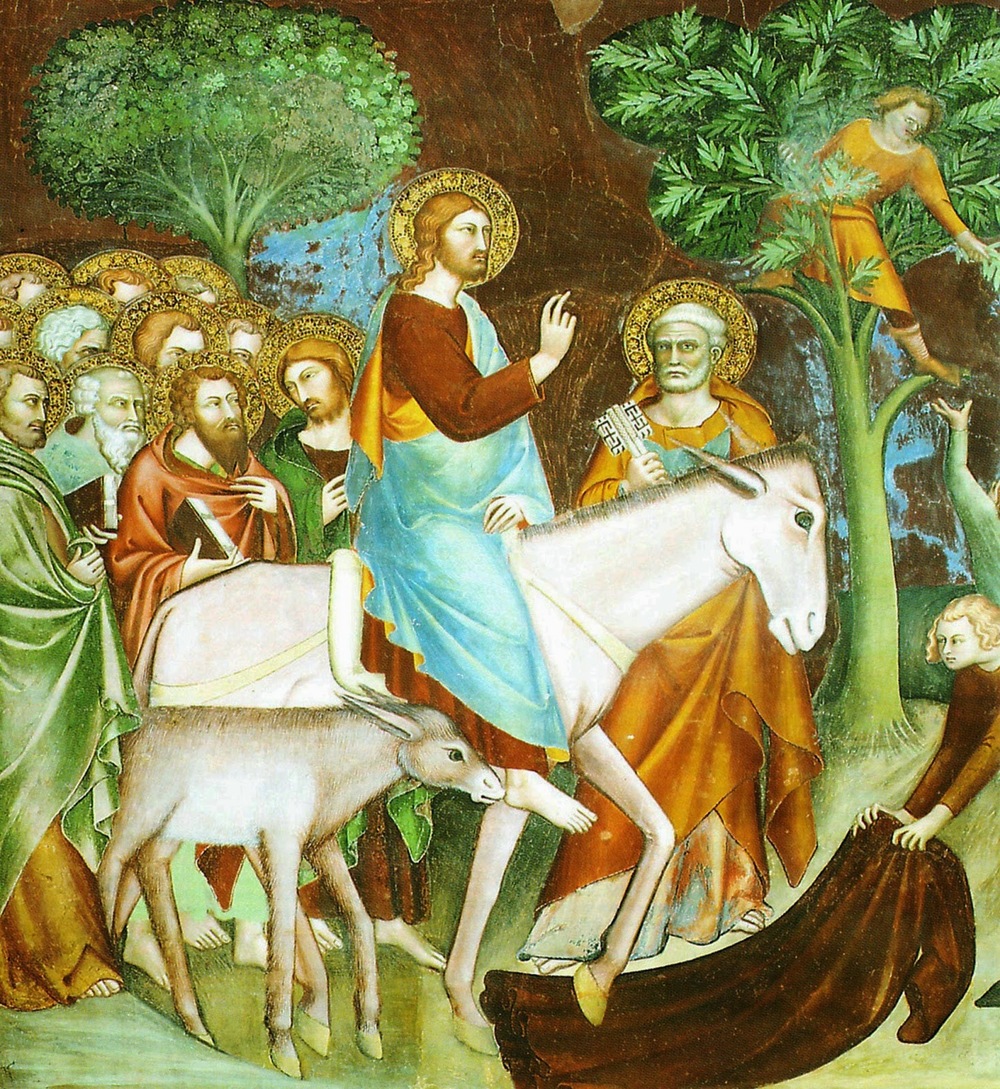
If all that seems just a little too much to swallow (if, in other words, the "cerebral intelligence" chokes upon encountering such assertions), Kuhn in this essay Easter: the Birthday of the Gods provides what may be the best, succinct explanation found anywhere in his extensive writings of the way that the esoteric celestial allegories found throughout the world's mythologies (and operating quite clearly in the Easter story, as discussed in the previous post about the zodiacal symbolism in the gospel accounts of the Triumphal Entry into Jerusalem and the Betrayal by Judas Iscariot).

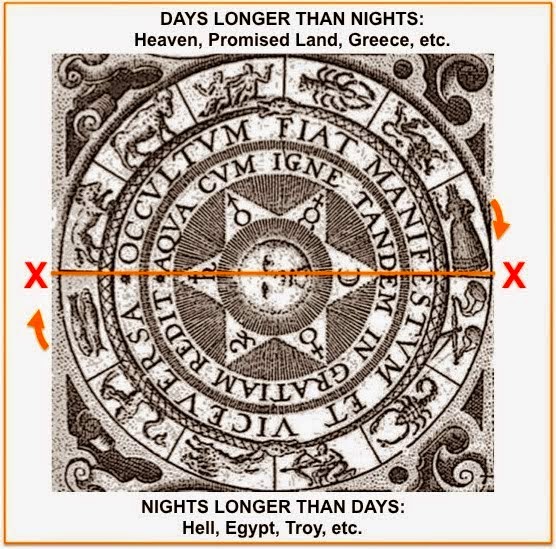
As you read through the extended quotation reproduced below from pages 4 and 5 of Kuhn's essay on Easter, you can follow along on the now-familiar zodiac wheel discussed in countless previous posts (see for instance hereherehere and here), which is arranged such that the June solstice (summer solstice for the northern hemisphere) is at the top or "twelve o'clock" position on the wheel (in between the signs of Gemini and Cancer, in the Age of Aries used in so many surviving ancient mythologies including those in the Old and New Testaments of the Bible), and the fall equinox is at "three o'clock" (between Virgo and Libra), the winter solstice is at "six o'clock" (between Sagittarius and Capricorn), and the glorious spring equinox after which Easter is celebrated (as is Passover from the Old Testament, both commemorations representing the successful crossing of the lower half of the year, which symbolized the physical incarnation here in this body of earth and water).

Both of the important equinoxes are marked with a red "X," because at the equinoxes the sun's ecliptic (along with the sun and also -- generally speaking -- all of the visible planets appear to travel) crosses over the celestial equator, and as it crosses either "down below" this line or back "up above" this line, the days either change over to being shorter than the nights (on the way "down" to the winter solstice) or to being longer (on the way back "up" towards the top of the year):

And here now is Alvin Boyd Kuhn's explanation of the esoteric or spiritual use to which the "venerable Sages" who gave the sacred stories to the various cultures of humanity employed the above awe-inspiring annual cycle:

Using solar symbolism and analogues in depicting the divine soul's peregrinations round the cycles of existence, the little sun of radiant spirit in man being the perfect parallel of the sun in the heavens, and exactly copying its movements, the ancient Sages marked the four cardinal "turns" of its progress round the zodiacal year as epochal stages in soul evolution. As all life starts with conception in mind, later to be extruded into physical manifestation, so the soul that is to be the god of a human being is conceived in the divine mind at the station in the zodiac marking the date of June 21. This is at the "top" of the celestial arc, where mind is most completely detached from matter, meditating in all its "purity."
Then the swing of the movement begins to draw it "downward" to give it the satisfaction of its inherent yearning for the Maya of experience which alone can bring its latent capabilities for the evolution of consciousness to manifestation. Descending the from June it reaches September 21, the point where its direction becomes straight downward and it here crosses the line of separation between spirit and matter, the great Egyptian symbolic line of the "horizon," and becomes incarnated in material body. Conceived in the aura of Infinite Mind in June, it enters the realm of mortal flesh in September. It is born then as the soul of a human; but at first and for a long period it lies like a seed in the ground before germination, inert, unawakened, dormant, in the relative sense of the word, "dead." This is the young god lying in the manger, asleep in his cradle of the body, or as in the Jonah-fish allegory and the story of Jesus in the boat in the storm on the lake, asleep in the "hold" of the "ship" of life, with the tempest of the body's elemental passions raging all about him. He must be awakened, arise, exert himself and use his divine powers to still the storm, for the elements in the end will obey his mighty will.
Once in the body, the soul power is weighed in the scales of the balance, for the line of the border of the sign of Libra, the Scales, runs across the September equinoctial station. For soul is now equilibrated with body and out of this balance come all the manifestations of the powers of consciousness. It is soul's immersion in body and its equilibration with it that brings consciousness to function.
Then on past September, like any seed sown in the soil, the soul entity sinks its roots deeper and deeper into matter, for at its later stages of growth it must be able to utilize the energy of matter's atomic force to effectuate its ends for its own spiritual aggrandizement. It is itself to be lifted up to heights of cosmic consciousness, but no more than an oak can exalt its majestic form to highest reaches without the dynamic energization received from the dart at its feet can soul rise up above body without drawing forth the strength of the body's dynamo of power. Down, down it descends then through the October, November, and December path of the sun, until it stands at the nadir of its descent on December 21.
Here it has reached the turning-point, at which the energies that were stored potentially in it in seed form will feel the first touch of quickening power and will begin to stir into activity. At the winter solstice of the cycle the process of involution of spirit into matter comes to a stand-still -- just what the solstice means in relation to the sun -- and while apparently stationary in its deep lodgment in matter, like moving water locked up in winter's ice, it is slowly making the turn as on a pivot from outward and downward direction to movement at first tangential, then more directly upward to its high point in spirit home. So the winter solstice signalizes the end of "death" and the rebirth of life in a new generation. It therefore was inevitably named as the time of the "birth of the Divine Sun" in man; the Christ-mas, the birthday of the Messianic child of spirit. The incipient resurgence of the new growth, now based on and fructified by roots struck deep in matter, begins at this "turn of the year," as the Old Testament phrases it, and goes on with increasing vigor as, like the lengthening days of late winter, the sun-power of the spiritual light bestirs into activity the latent capabilities of life and consciousness, and the hidden beauty of the spirit breaks through the confining soil of body and stands out in fulness of its divine expression on the morn of March 21. This brings the soul in a burst of glorious light out of the tomb of fleshly "death," giving it verily its "resurrection from the dead." It then has consummated its cycle's work by bursting through the gates of death and hell, and marches in triumph upward to become a lord of life in higher spheres of the cosmos. No longer is it to be a denizen of lower worlds, a prisoner chained in body's dungeon pit, a soul nailed to matter's cross. It has conquered mortal decay and rises on wings of ecstasy into the freedom of eternal life. Its trysting with earthly clay is forever ended, as aloft it sweeps like a lark storming heaven's gate, with "hymns of victory" pouring from its exuberant throat. From mortality it has passed the bright portals into immortality. From man it has become god. No more shall it enter the grim underworld of "death." 4-5.

These are incredible concepts, but there is little doubt that Kuhn's analysis as outlined above must be considered a very defendable explanation of the insistent personification of the "stations" of the great zodiac wheel, found in virtually every single ancient sacred tradition of the human race, on every continent of our planet and indeed on all the scattered islands of the great Pacific and other oceans as well, and that it may in fact be the reason why those unknown ancient Sages chose to employ it, and what they intended us to understand from these stories.

And, although Kuhn himself does not go this far, I can show you to my complete satisfaction (and I believe to yours as well) that it is equally evident that the events depicted in the Easter week contain this very cycle in its entirety, from the

  • Triumphal Entry at the beginning of the week, replete with imagery of the top of the zodiac wheel, to the 
  • Agony of Christ and the Crucifixion "outside the gates" of the city -- that is, at the point of the fall equinox, which is one of the two "gates" of the year through which the sun and all the visible planets must pass as they "cross over" the line of the celestial equator and descend down into the lower half of the year (or back up, at the other equinox), and which represents the throwing down of the soul into the "grave" of the incarnate body, to cross through this incarnate life in which we are all struggling on this earthly surface, and finally turning back upwards to the
  • Resurrection and the "rising up" out of the lower realm, which takes place on the other side of the year at the spring equinox, which is replete with imagery that has to do with both the fish of Pisces and the lambs and ram of Aries, and which represents the ultimate triumph of the soul, after the lessons and necessary consciousness-raising that take place during the cycles of incarnation in the "underworld" of this material realm.

Obviously, in the Easter week series of stories, the one point of the wheel which is not really emphasized is the point of the "birth of the Christ-consciousness," which is emphasized at a different special celebration on the annual calendar: at the sun's turning-point back upwards after the winter solstice, which is celebrated as Christmas. But the starting point of the summer solstice (in the Triumphal Entry and the "Upper Room"), followed by the "casting down" point of the fall equinox (with the Crucifixion) and the "raising up" point of the spring equinox (Resurrection) are all very clearly depicted and emphasized.

Now, in the above extended quotation of the passage found on pages 4 and 5 of Alvin Boyd Kuhn's Easter thesis, when he speaks of "the divine soul" or "the soul entity" or even "the soul power," he is referring to the individual soul of each and every person. He is not referring to something outside of any one of us: an examination of the bulk of Kuhn's work makes it abundantly clear that he believes that those who gave us the sacred stories intended for us to understand that they are not about ancient men, women, heroes or demigods, but that they are about each and every reader or hearer of the story: the "star" of every story is in fact your own soul.

In a different passage from a different essay by Alvin Boyd Kuhn, quoted at the end of this post from the time of the winter solstice, he writes:

Bible stories are in no sense a record of what happened to a man or a people as historical occurrence. As such they would have little significance for mankind. They would be the experience of people not ourselves, and would not bear a relation to life. But they are a record, under pictorial forms, of that which is ever occurring in the reality of the present in all lives. They mean nothing as outward events; but they mean everything as picturizations of that which is our living experience at all times. The actors are not old kings, priests and warriors; the one actor in every portrayal, in every scene, is the human soul.

Therefore, Kuhn asserts, we will necessarily go astray if we "externalize" or literalize the sacred myths: they must be grasped by, and applied to, each and every person for himself or herself.

And this again is where, according to Kuhn in the essay Easter: the Birthday of the Gods (and according to quotations which Kuhn brings in to his essay from psychologist and scholar of mythology Carl Jung, who says the very same thing), the externalization of the Bible stories, and their use to encourage the veneration of a supposed external and historical-literal figure -- even a figure so admirable as the figure of Jesus in the gospels -- can lead us seriously astray, to the point where we not only miss the actual message of the story but end up with a message that is directly opposite from the original esoteric message.

Because, as Kuhn discusses in the extended quotation cited above, during the discussion of the September equinox and the "casting down" into the Balance of Libra and the reawakening of divine consciousness at the nadir-point of winter solstice, our sojourn in the incarnate body is a time of our own soul's passing through the "Scales" between the horizons, and of our own need to awaken the higher divine spark of consciousness within: not a time to look at the external stories and conclude that someone else has passed through the balance for us and awakened consciousness so that we don't have to!

And yet, that is exactly how the stories are interpreted by the majority of the literalist-historicist camp, lo these past seventeen centuries: the one in the stories has done those things, so that we don't have to.  

It is exactly, if I might bring in some films which did not appear until long after Kuhn wrote this essay, someone were to watch the movie The Matrix(1999) or The Truman Show (1998), and conclude: "I'm sure glad that Neo took that Red Pill -- so that I don't have to!" or "I'm so happy for Truman, that he finally 'woke up' and walked out of that 'dome of illusion' -- now I don't have to!"

Such a response would undoubtedly confuse the creators of those films -- because the whole point of the movie is that you, the viewer, need to consider waking up like Truman to the illusionists manipulating the world within the dome, or waking up like Neo to the illusion of the Matrix.

The point is not to curl up inside your "pod" in the Matrix -- or inside your little house in the dome -- and say, "I'm sure glad Truman, or Neo, woke up for me!" And the makers of those movies would probably be both surprised and dismayed if everyone interpreted their films that way.

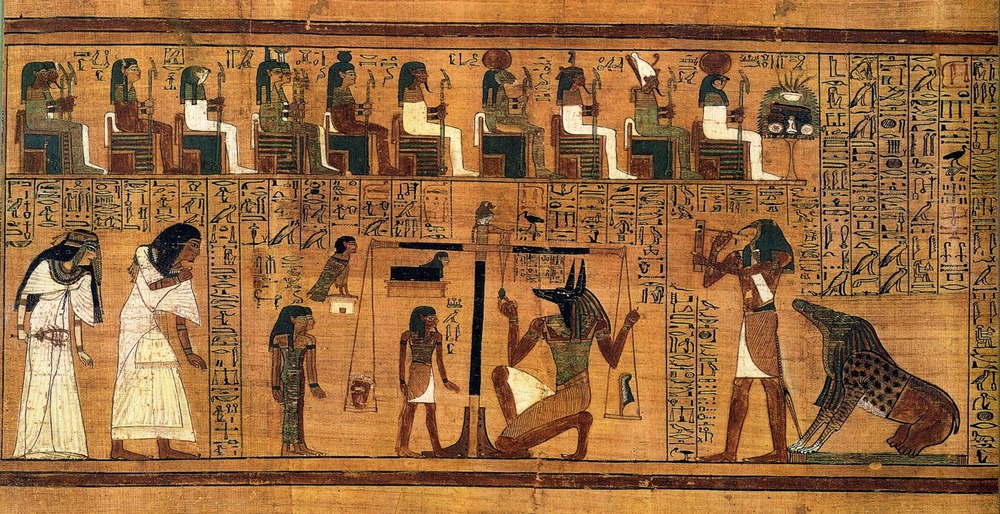
According to Alvin Boyd Kuhn, we are not at the point described by the Easter symbolism just yet: we are still on the Scales of the Balance, down here in this mortal existence: and what we do here has an enormous impact on the progress of our invisible soul. As he says elsewhere, everything we are doing "down here" in the body is making its mark upon the record of the mighty Scales, as depicted in many "vignettes" or scenes in the ancient Egyptian Book of the Dead, whose correct name as Kuhn notes in the Easter essay is in fact the Book of Going Forth by Day, envisaging the future point of Easter and the soul's "Day-Break" of triumph (scene from the Book of the Dead of the scribe-priest Ani is depicted below).

The danger of the literalist misinterpretation, in Kuhn's opinion, can be seen in the "dismal" record of literalist Christianity down through the centuries since it took hold, and since the tragic triumph of literalism over esoterism during the second and third centuries "A.D.": seventeen centuries of "bigotry, superstition, persecution, hatred, war and the most fiendish inhumanity ever to be entered into the world's annals" (Easter, 16).

Ultimately, Kuhn argues in this essay, the question of whether Easter is about what the literalists say it is about, or whether it is meant to depict one of the most glorious parts of the esoteric teaching outlined above thus becomes an incredibly important question. He says, as he draws towards his conclusion,

Easter meaning and Easter ecstasy will forever elude us if we can not understand it as the drama, not of one man's history long passed [. . .] but of our own life history, the scenario of our transfiguration yet to come. [. . .] if we for a moment permit it to lure us into the belief that another man's alleged conquest of death in the long past in any degree relieves us of the evolutionary task of achieving our own resurrection, the myth becomes the source of a tragic psychological calamity for us. For to the extent we look to a man, or a miracle, or any power outside ourselves, to that extent we will let the sleeping divinity within us lie unawakened. 28-29. 

And thus, it may well be that -- far from being those with an esoteric understanding of Easter (or Christmas) who are intruding upon holy ground that "belongs to" those who take these stories literally -- it is the literalist-historicist approach that has in fact intruded upon, and thrown over, the ancient sacred meaning of these significant annual days of commemoration.

To the extent that this overthrow has led to the teaching of something entirely the opposite of what the sacred stories were actually intended to teach, this is a tragic mistake that calls out to be remedied. It is very similar to the way that the stories of Adam and Eve or of Shem, Ham and Japheth

have both been used to divide humanity and pit men and women against one another, even though if these are understood as the esoteric celestial allegories which I believe they can be shown to be, they actually teach a message that should unite men and women instead of dividing them. 

And, to the extent that this overthrow has led to "persecution, hatred, war and the most fiendish inhumanity," the question of which understanding of Easter is a twisting of the message to mean the opposite of what it was intended becomes a very important question, and not a "merely academic" question at all.

If the esoteric understanding outlined above is closer to the intention of the "ancient Sages" who gave these sacred treasures to humanity so many millennia ago, as I believe that it is, then it is a very dangerous thing for the majority of the people to conclude that they can just "curl up in their pod in the Matrix," because Neo already woke up and achieved consciousness so that I don't have to.

Alvin Boyd Kuhn argues that Easter is one of the most beautiful symbols in all of the New Testament version of the esoteric myths. I believe that when we understand it esoterically, it actually becomes even more beautiful, and more meaningful for our lives, than ever.

image: Wikimedia commons (link).

Star Myths in the New Testament: the Visit of the Magi

Star Myths in the New Testament: the Visit of the Magi

CAUTION: The above video examines powerful evidence that the scriptures of the New Testament gospel accounts are based upon a system of celestial allegory rather than being accounts of literal terrestrial historical events. If you are not comfortable exploring this subject, please consider refraining from watching.

Here is a new video exploring the events described in the Gospel According to Matthew, chapter 2: the Visit of the Magi.

It asks a question which I believe poses a king-sized problem for the "literal-historical" school of scriptural interpretation: If the wise men described in Matthew 2:1 came "from the east to Jerusalem," but then explain that they "saw his star in the east" in Matthew 2:2 (which "stood over where the young child was," according to Matthew 2:9), how did they ever end up arriving somewhere in the west of where they began?

If you start east of somewhere, and then see a star in the east which is your guide, it would seem that you would then travel towards the east.

Did the wise men of Matthew 2 first travel across China, then across the Pacific Ocean to the west coast of the Americas, then across the Americas to the Atlantic Ocean, and then continue east until they arrived at the point that the star directed?

The texts do not support a literal-historical-terrestrial understanding of the episode, unless you believe that the wise men as described in the text were among the ancient circumnavigators of the globe . . . but they work perfectly well for the celestial approach, as we will see.

Also, while it would seem that this is a subject that is more appropriate to examine around Christmas-time, it turns out that the events of the Easter-story actually incorporate the full cycle of the great wheel of the zodiac and the year, and thus a very comprehensive message regarding the journey of the human soul of every man and woman -- as future posts (and possibly future videos) may have occasion to explore!

The celestial analysis of the Star of Bethlehem and Visit of the Magi which underlies much of the discussion in this video was first given by Robert Taylor (1784 - 1844) in a lecture entitled "The Star of Bethlehem" which was published posthumously in a book entitled The Devil's Pulpit in 1857, which  is available online in its entirety here (see in particular pages 42 - 44).

image: Wikimedia commons (link). 

Star Myths in the New Testament: from the Triumphal Entry through the Betrayal by Judas Iscariot

Star Myths in the New Testament: from the Triumphal Entry through the Betrayal by Judas Iscariot

CAUTION: The above video examines powerful evidence indicating that the scriptures of the New Testament gospel accounts are based upon a system of celestial allegory rather than being accounts of literal terrestrial historical events. If you are not comfortable with this subject, please consider refraining from watching.

Here is a new video in which I am testing out the "dry-erase board" technique for presenting information in video form (still have a few glitches to iron out! thanks for your patience with those!).

The video explores the New Testament story of the Triumphal Entry into Jerusalem and the subsequent Betrayal by Judas Iscariot, both of which are found in all four canonical gospel accounts (albeit from very different perspectives, as we might expect if the four Evangelists represent celestial beings -- i.e. stars -- who are located at the four different corners of the year).

The examination of some of the specific symbols surrounding the Triumphal Entry and the Betrayal by Judas Iscariot indicate very clearly that, as with the sacred scriptures and myths of nearly every culture around the globe, the stories of the New Testament gospel accounts are built squarely upon a foundation of celestial allegory.

This celestial basis indicates that the New Testament stories are in fact closely related to the myths of ancient Egypt, as well as those of the ancient Greeks, the Norse, and the peoples of Native America, all of which can be shown to share the same system of celestial allegory.

For an index of over sixty previous posts explaining the celestial allegory at the heart of other stories in the Bible as well as in other sacred scripture and myth from around the world, see the previous post entitled "Star Myth Index."

This commonality proves that far from being separate and distinctly different from the rest of the world's ancient sacred traditions, the original purpose of the scriptures in the Old and New Testament was almost certainly the same.

In other words, this understanding of scripture actually unites

rather than divides -- the very opposite of the way the scriptures are commonly understood and taught by the proponents of the literal-historical-terrestrial approach to their contents.

I have written at some length that, based upon extensive consideration of the evidence in these ancient wisdom traditions, the purpose of the esoteric myths was to convey an understanding that the  physical universe we inhabit is connected to, interpenetrated by, and even projected from an invisible realm -- the realm of spirit, figured in these stories by the realm of the sky and of the sun, moon, stars, and visible planets. Likewise, the same understanding applies to each and every man and woman (and creature, and even rock, tree, plant, and place) -- each has an invisible and spiritual component and connection to the invisible world and hence to everyone and everything else.

This celestial, esoteric, and allegorical understanding of the scriptures thus unites men and women with one another, with the rest of nature, with the entire universe, and with themselves -- while the literal and historical understanding tends to divide men and women against one another, against the rest of nature, against the entire universe, and ultimately even against and within themselves as individuals.

Thus, it is my conclusion that forcing a literal and historical reading upon these texts not only misses their true message but that this erroneous approach has actually been used to force the scriptures to teach something almost "180-degrees the opposite" of their original intended message.

As you will see in the above video, the episode of the Triumphal Entry into Jerusalem, and then of the Betrayal by Judas Iscariot which leads inevitably downwards to the Agony in the Garden and to the sacrifice upon the Cross, are both replete with imagery that has to do with the zodiac wheel and the motion of the annual cycles of the year, as seen in the motions of the sun and of the background band of the zodiac stars.

However, the actual celestial motions are not  (in and of themselves) the main message that we are supposed to receive from these sacred stories, according to my analysis of this subject for many years. I believe that these celestial motions were used as esoteric "teaching aids" to help us grasp something about ourselves -- about our human condition, about our connection to the universe and especially to its invisible spiritual source-bed, and about our soul's sojourn in these physical incarnate bodies, as well as our soul's constant connection with, and periodic return to, the realm of spirit and fire.

As Alvin Boyd Kuhn explains in an important quotation that has been discussed in previous posts (see herehere and here):

The Bible is the drama of our history here and now; and it is not apprehended in its full force and applicability until every reader discerns himself [or herself] to be the central figure in it! The Bible is about the mystery of human life. Instead of relating to the incidents of a remote epoch in temporal history, it deals with the reality of the living present in the life of every soul on earth.

The symbols of the Triumphal Entry and the Betrayal by Judas Iscariot relate to symbols and concepts explored in many, many previous posts. Some of those include the symbols of the Ankh and the Djed of ancient Egypt, as well as the "top of the year" and the Land Flowing with Milk and Honey (which is also the City whose streets are paved with gold).

And, because each individual man and woman reflects and embodies the entire infinite universe (a concept expressed in the saying "As above, so below" and in the terms macrocosm and microcosm), the top of the zodiac wheel accompanied by the symbols of the starry constellation of Cancer in the infinite heavens is also reflected in the "Upper Room" of every individual person: symbols that are connected in the Biblical passages.

From this we can understand that we do not have to go anywhere in order to connect to infinity: the depths of the universe are already right inside of us.

There are also strong connections here to the profound subjects discussed in the work of authors such as Peter Kingsley and his book In the Dark Places of Wisdom, as well as the worldview commonly described today as shamanic, which I believe is actually the understanding of the world and of the human condition which underlies virtually all of humanity's ancient wisdom and sacred traditions.

As such, although the symbols and concepts discussed in the above video may at first seem difficult to grasp or to follow, they are extremely vital, powerful, and liberating -- and thus worthy of careful contemplation and deep meditation.

One possible source of additional help regarding myths and symbols related to Cancer the Crab may be found in previous posts regarding that important zodiac constellation, such as this onethis one, and this one.

Those interested may also wish to go back and view the previous video which contains some discussion of Asellus Borealis and Asellus Australis in the constellation Cancer, entitled Star Myths: 1,000 times more precious . . .

1 And when they drew nigh unto Jerusalem, and were come to Bethphage, unto the mount of Olives, then sent Jesus two disciples,
2 Saying unto them, Go into the village over against you, and straightway ye shall find an ass tied, and a colt with her: loose them, and bring them unto me.
3And if any man say ought unto you, ye shall say, The Lord hath need of them; and straightway he will send them. Luke21:1-3. 
4 And they went their way, and found the colt tied by the door without in a place where two ways met; and they loose him. Mark 11:4.

image: Wikimedia commons (link).

How long? Not long! Because no lie can live forever

How long? Not long! Because no lie can live forever

image: Wikimedia commons (link).

March 25, 2015 marks the fiftieth anniversary of the culmination of the Selma civil rights marches, which finally arrived at the capitol of Alabama on March 25, 1965. 

Approximately twenty-five thousand marchers converged on the capitol building in Montgomery, Alabama and stayed there until they delivered their petition to the governor's representative.

There, Martin Luther King, Jr. delivered his famous speech referred to today by its rousing series of rhetorical questions during the finale: "How long? Not long!"

A written transcript of that speech can be read in its entirety here, and a portion of the actual speech given by Dr. King on that day fifty years ago can be heard and seen here.

And, on that same day fifty years ago, between 8:30 and 8:55 pm, Viola Liuzzo was murdered when the car in which she and Leroy Moton were traveling on highway 80 was fired upon by another vehicle.

Those not familiar with this terrible crime can (and should) seek to learn more -- a good start might be reading (or re-reading) the excellent examination of the sickening events of the murder and the events which led up to it and which followed afterwards, written by Mary Stanton, first published in 1998, entitled From Selma to Sorrow: The Life and Death of Viola Liuzzo.

Many questions remain regarding that tragic incident, around which many deliberate lies were fabricated for various reasons, all of them sinister.

It is clear that violence and deliberate deception are often used together in order to oppress people and to keep others from seeing the injustice that is being perpetrated.

It is clear that Martin Luther King was well aware of the central role which lies always play in the perpetration of such injustice and oppression -- and that he was aware that for those lies to lose their power, the truth must be made known.

In his speech How long? Not long! delivered on that day, fifty long years ago and yet not so long ago, he proclaims:

How long will it take? Somebody's asking: "How long will prejudice blind the visions of men?"
I come to say to you this afternoon, however difficult the moment -- however frustrating the hour: 
It will not be long.  Because truth crushed to earth will rise again.
How long? Not long!
Because no lie can live forever.
How long? Not long!
Because ye shall reap what ye sow.
How long? Not long! 

Fire and Water

Fire and Water

Many previous posts have explored Alvin Boyd Kuhn's assertion that the central theme of the ancient scriptures and sacred stories of humanity is the message that we are beings of spirit, mysteriously infused into a body of matter -- "fire plunged down into water" -- and inhabiting a universe which itself appears to be material but is at every point intertwined with, and even projected from and constantly sustained by, an invisible realm of spirit.

Most recently we examined this vitally-important theme in a post honoring a famous personage born of the admixture of parents from the planet Vulcan (named for an ancient god of fire) and from the planet Earth (a planet famous for its great oceans of water), a personage who is perhaps best known for pronouncing words of blessing while holding up his hand in a gesture that recalls a specific symbol associated with divine fire.

The fact that specific symbols which we call "letters" or "glyphs," designed to preserve words and thoughts in written form (whether lined or brushed onto paper, or carved into stone or wood or metal) can themselves be designed to convey that central message regarding the nature of human existence and the nature of the dual physical-spiritual universe we inhabit is most remarkable, and most worthy of further consideration. Alvin Boyd Kuhn, in fact, explored that very aspect of the symbolic vessels of written language in an essay he gave entitled The Esoteric Structure of the Alphabet, which was published as a book and is still available in hardcopy version here (a facsimile of the original imprint), and online in its entirety here.

There, we find some of Kuhn's clearest statements of this theme, that "the vast body of ancient Scripture [by which he means the sacred wisdom found in all the world's sacred myths and teachings] discoursed on but one subject -- the descent of souls" (20), "the old basic story of divine fire plunging down into water" (30), "the immersion of fiery spiritual units of consciousness in their actual baptism in the water of physical bodies" (34), all for the purpose of undergoing experiences which would serve their "continued growth through the ranges and planes of expanding consciousness" (20).  

In addition, he argues that this essential message can be found "not only in the scripts of religion, however, but also in a wide variety of other modes of expression [. . .] -- in ancient art, in architecture, in myth-making, secret society ritual, dramatic scenario, music, mathematics, anthropological science, logic, rhetoric, philosophy, astronomy, astrology, semantics, psychology, festival ordinances, social ceremonies and throughout the warp and woof of life generally" (4).

Then he reflects on one other supremely important way in which the ancients conveyed this central theme of our dual spiritual and physical nature:

Now, perhaps the strangest of all the channels through which it was given expression, comes the momentous revelation that the sagacious genius of antiquity had even insinuated a form of its basic outline into the very structure of that ground-base of all literature, -- the alphabet. 4.

He then proceeds to unpack the ways that the actual form of the letters in the Hebrew, Greek, and especially the Latin alphabets (the latter being the one used, for example, on this blog to convey these thoughts) remind us that we are divine fire plunged down into physical bodies for the purpose of expanding consciousness.  

In this way, Kuhn argues, our own familiar letters, which we typically regard as nothing more than random shapes (when we even think about them at all) are actually pictures, depicting invisible ideas in symbolic form: symbolic metaphors, reminding us of spiritual reality in a world that often conspires to obscure it. 

"They are," he writes, "true ideograms" (5). 

Amazingly, there is an extremely ancient form of writing, still in use to this day by billions of people around the world and even (in slightly modified forms) across many different cultures and languages, which is well-known to be composed almost entirely of "true ideograms" -- the Chinese characters which remain one of the most widely-used systems of writing in the world today.

As most readers are already aware, in this system of writing and its close relatives, each complete character stands for a complete word or thought, rather than for a sound or "phoneme" the way the letters in alphabetical systems do (it is logographic rather than phonologic).

Amazingly enough, there is some evidence that the assertions Alvin Boyd Kuhn made about the alphabetical systems of writing may apply to the characters of Chinese, which after all are extremely ancient and were in use when the other systems he writes about were in use further to the west.

Most remarkable, perhaps, is the Chinese character for the word "fire" itself, shown at top, above. The symbol for "fire" consists of the symbol for "person," shown immediately below and clearly symbolic of the human form, with two added "sparks" on either side, in the form of small strokes that (like flames) are nearly vertical:

Person: 

Fire: 

The connection of the symbol for "fire" with the symbol for a person would appear to be conveying very much the same message that Alvin Boyd Kuhn finds encoded in the very shapes and "ideograms" of the letters of the Hebrew, Greek, and Latin alphabets.

It is a message that reminds us that we ourselves, as well as every single person we meet, are like stars who have come down to this lower realm of earth and water for a time: even though we cannot see it, we are each in contact at all times with the divine infinite and are constantly connected to the infinite realm, even though we are prone to forget it. This is the message and the reminder conveyed by the expression Namaste, and it is the heart of the blessing accompanied by the hand-gesture of the Hebrew letter shin, associated both with fire and with the sound of fire plunging into water.

But what of this "plunging down into water" -- why would spirit be subjected to immersion in this physical world of incarnation, and what purpose could it serve?

It would seem to be a question in which we all can be said to have some interest or personal involvement, seeing that it is probably (probably) safe to assume that all of us who are looking at this page are presently in an incarnate form.

And as it turns out, Alvin Boyd Kuhn has ventured to explore that difficult question as well. In his 1940 book Lost Light, he argues that this is in fact the very question with which Paul wrestled in his famous seventh chapter of the epistle to the Romans. We come down from the invisible realm of spirit into the incarnate material body ("the body of death," as Paul says) because of something which he calls "the Law." This has been reinterpreted very differently by traditional (literal) Christianity, but Kuhn argues that it is the mandate which brings us into the body for our own spiritual growth and blessing, as well as for the ultimate blessing of others and of all the material creation.

Beginning on page 170, explaining his argument that Paul was indicating concepts which go far beyond those taught by literalist Christianity when using the words "Law" and "sin" and "death," Alvin Boyd Kuhn writes of Paul's seventh of Romans:

In this chapter Paul concatenates the steps of a dialectical process which has not been understood in its deep meaning for theology. It is concerned with the relation of the three things: the law, sin and death. He asks: "Is the Law equivalent to sin?" And he replies that sin developed in us "under the Law." What is this mysterious Law that the Apostle harps on with such frequency? Theology has not possessed the resources for a capable answer, beyond the mere statement that it is the power of the carnal nature in man. It is that, in part; but the profounder meaning could not be gained without the esoteric wisdom -- which had been discarded. This Law -- St. Paul's bete noir -- is that cosmic impulsion which draws all spiritual entities down from the heights into the coils of matter in incarnation. It is the ever-resolving Wheel of Birth and Death, the Cyclic Law, the Cycle of Necessity. As every cycle of embodiment runs through seven sub-cycles or stages, it is the seven-coiled serpent of Genesis that encircles man in its folds.
Now, says the Mystery initiate [he means by "the Mystery initiate" none other than Paul himself], by the Law came sin, and by sin came death. [. . .] Sin is just the soul's condition of immersion or entanglement in the nature of the flesh. And happily much of its gruesome and morbid taint by the theological mind can be dismissed as a mistaken and needless gesture of ignorant pietism. [. . .]
[. . .] Paul even says that at one time he lived without the law himself; this was before "the command" came to him. And what was this command? Again theology has missed rational sense because it has lost ancient cosmologies and anthropologies [that is to say, "ancient understanding of the nature of the universe, or cosmologies," and "ancient understanding of the nature of human existence in this universe, or anthropologies"]. The "command" was the Demiurgus' order to incarnate. It is found in the Timaeus of Plato and Proclus' work on Plato's theology. Then the Apostle states the entire case with such clarity that only purblind benightedness of mind could miss it: "When the command came home to me, sin sprang to life, and I died; . . ." He means to say that sin sprang to life as he died, i. e,. incarnated. And then he adds the crowning utterance on this matter to be found in all sacred literature: "the command that meant life proved death to me." He explains further: "The command gave an impulse to sin, sin beguiled me and used the command to kill me." And he proceeds to defend the entire procedure of nature and life against the unwarranted imputations of its being all an evil miscarriage of beneficence: "So the Law at any rate is holy, the command is holy, just and for our good. Then did what was meant for my good prove fatal to me? Never. It was sin; sin resulted in death for me to make use of this good thing." 170 - 173.

In order to understand the above explication, remember that by death, Kuhn avers, Paul is referring to incarnation in this body. When Paul speaks of the "command" that was given "to kill me," Paul means "the command -- the Law -- by which I incarnated in this body." That is to say, the Law which plunged him down into this human body, composed as it is of seven-eighths water: the Law that submerged his undying soul of fire within a material form.

And note that Paul expressly declares that this Law which impels us into incarnation is a good thing (a point he makes very strongly, and in a manner which shows that he anticipated that his listeners or readers would be wondering if such an impulsion might not be a very bad thing, rather than a blessing). But, as Kuhn explains in other parts of his book, and especially in a discussion on pages 573 and 574 regarding Paul's letter to the Corinthians, Paul explains that "What you sow never comes to life unless it dies" (i.e., "unless it incarnates") -- and that our incarnation in these physical bodies of death is exactly parallel in terms of being necessary for our growth: "What is sown is mortal, what rises is immortal; sown inglorious, it rises in glory; sown in weakness, it rises in power; sown in an animal body, it rises in a spiritual body" (574).

Note that we previously saw compelling arguments offered by Gerald Massey which suggest that Paul was not teaching the same thing that the literalists were teaching and that they would later claim he was teaching as well -- and that in fact he seems to have been teaching almost the exact opposite.

It is worth re-reading the above-quoted passage in light of this new understanding of the terminology, for the concepts Kuhn is exploring (and that the writer known as Paul may have been asserting, so many centuries ago) are of tremendous importance.

In fact, it is worth going to Lost Light itself and reading the entire chapters surrounding the cited passages above. However, since the scope of this particular discussion is actually about the fact that the very elements of writing contain this same message of spirit-fire submerged in incarnation as if in water,  let us examine one more Chinese ideogram which seems to beautifully express its meaning in its symbolic composition: the character for "Law" itself (shown below).

image: Wikimedia commons (link).

The Chinese character for "Law" is a composite, with a compressed or abbreviated version of the symbol for "water" on the left-hand side, and the symbol for "to go" on the right (the symbol for "water" is here rendered as only three small individual strokes, almost three "dots").

Law: 

On even a non-esoteric level, the fact that the character for "Law" is composed of the characters for "water" and "go" is worthy of remark, for it seems to express the idea of the "law of nature," the law that causes water to seek the paths along which it "goes" or flows. To create laws out of harmony with such a concept would be to make laws that would attempt to go against "the flow of the universe" -- and thus the symbol seems to embody a message that law is part of nature and cannot really be altered by artificial constructs which people try to pass-off as "law" (a concept which was forcefully articulated by "natural law" proponent Lysander Spooner in the nineteenth century).

But, even beyond that message, this character for "Law" would appear to incorporate the teaching that Kuhn believes Paul (whom Kuhn calls "the Mystery initiate," the participant in the knowledge passed on from remote antiquity through the various Mysteries) was articulating: that it is the Law of the universe which sends us along our Way, into this body of incarnation -- the Law which plunges fire into water.

That which Paul calls "the Law" is none other than the "Way of Water," beautifully contained in the Chinese character for "Law" as well: Water-Go.

It is most remarkable to consider that our familiar alphabet is in fact composed of ideograms, and what's more of ideograms which express the same central truth that was conveyed by the myths and sacred texts of antiquity, and by the symbols of ancient architecture and the ancient understanding of the meaning and message of the stars.

It is even more remarkable to consider that the actual ideograms of the ancient Chinese characters appear in at least some significant cases to be expressing the same profound concepts.

It is a message which we are prone to forget, and that we must therefore remind ourselves, which may explain why it was incorporated into everyday greetings (such as Namaste) and into the sacred forms of writing.

Indeed, in many ways, writing itself is a metaphor, in that it is in a real sense invisible thought taking physical form -- and thus it pictures the truth of who we are and of what this entire physical universe is, at its heart: a projection or embodiment in physical form of beings and realities which actually exist or have their origins in the invisible world of spirit.