The sacred fig tree, continued: Jonah and the gourd

The sacred fig tree, continued: Jonah and the gourd

image: Wikimedia commons (link).

The previous post on The Bodhi Tree examined the very strong evidence that the imagery of the sacred fig tree under which the Buddha is described as attaining enlightenment has powerful points of resonance with the "vertical Djed" symbology found throughout the mythology of the world, and associated with the invisible, divine, spirit-component in human beings and indeed in all the universe.

This "vertical component" symbology can be shown to be directly related to the "vertical component" of the great cross of the year which runs from the winter solstice (at the "bottom of the year") straight up to the summer solstice (at the very "summit" of the year), in contrast to the "horizontal component" that connects the two points of equinox and which represent the "crossing points" between the worlds of spirit and matter. In contrast to the vertical spirit-component of this great cross, the horizontal component almost always pictures the physical, animal, material nature into which we are "cast down" when we incarnate in this mortal life, during which time we are "crossed" in the human condition of being simultaneously spirit and matter, divine and animal, vertical and horizontal.

Hence, the vertical-component symbology of the bodhi tree under which the Buddha achieves enlightenment can be shown to be related to the reconnection with the divine and the transcendence of the dual and conflicted condition in which we find ourselves: a spiritual transcendence which can only be achieved by actually entering into the lower or material realm (in much the same way that plants  and trees which grow up towards the heavens must first begin as seeds planted in the "lower realm" of the earthy soil, as Alvin Boyd Kuhn frequently explains in his writings on the subject).

Readers who are familiar by now with the thesis that a common system of celestial allegory can be shown to run through virtually all of the world's ancient myth and sacred tradition may have already begun to question whether this sacred fig tree under which the Buddha achieves the height of divine consciousness has any echoes in other sacred traditions around the world -- and indeed we would probably be very surprised if a symbol of such central importance did not have echoes in other world mythology.

Students of classical literature, and especially those who love the Odyssey of Homer, might immediately think of the fig tree which saves Odysseus from certain destruction between the whirlpool of Charybdis and the ravenous snaking heads of the monster Scylla, in the Odyssey's Book 12 (particularly lines 464 - 478). This fig tree is almost certainly connected to the fig tree of the Buddha -- because I believe that in addition to being associated with the vertical "Djed column" which runs through the great circle of the year from the lowest point at winter solstice up to the highest point at summer solstice, the "fig tree" of sacred tradition can be shown to be associated with a very prominent feature of the starry heavens, the same feature that runs between Scylla and Charybdis, to which Odysseus is described as clinging to "like a bat" in order to escape being sucked down into the vortex.

Students of the Hebrew Scriptures may have read the previous post about the Buddha sitting beneath the sacred fig of the bodhi tree and been reminded of the numerous passages in which the promise that "every man should dwell safely . . . under his vine and under his fig tree" is given as a formula that describes the golden age under King Solomon in 1 Kings 4:25 and which is referenced in many other passages in the books of the prophets, including the scrolls of Isaiah and Micah and Zechariah.

Students of the New Testament scriptures may have considered the discussion of the Buddha underneath the bo tree and been suddenly reminded of the passage found only in the gospel according to John, in which Jesus calls Nathanael and tells Nathanael that he saw him "when thou wast under the fig tree," before Philip had told Nathanael to come and see Jesus (John 1:46 - 51).

In other words, fig trees feature prominently in myths and sacred stories around the world! There are many more like these, including from sacred stories in the Americas, some of which are examined in Hamlet's Mill (1969). Many readers will also have thought immediately of Adam and Eve, whose story certainly involves a central tree, and who are specifically described as making coverings for themselves out of fig leaves in Genesis 3:7.

What celestial feature might be playing the role of the fig tree in all of these celestial allegories?

Perhaps the most revealing passage which helps to decode this vitally important symbol, and one which was the first one that I myself thought of when reflecting on the image of the bodhi tree, is the story in the book of Jonah, which describes Jonah as taking shelter beneath a friendly kikajon, or vine, translated as a "gourd" in the 1611 English translation.

There, in the fourth chapter of Jonah, after Jonah has been persuaded (by a stint in the belly of the fish) to preach to the Ninevites (whom he begrudged God's grace and did not want to see spared), we read:

5 So Jonah went out of the city, and sat on the east side of the city, and there made him a booth, and sat under it in the shadow, till he might see what would become of the city.
6 And the LORD God prepared a gourd, and made it to come up over Jonah, that it might be a shadow over his head, to deliver him from his grief. So Jonah was exceedingly glad of the gourd.
7 But God prepared a worm when the morning rose the next day, and it smote the gourd that it withered.
8 And it came to pass, when the sun did arise, that God prepared a vehement east wind; and the sun beat upon the head of Jonah, that he fainted, and wished in himself to die, and said, It is better for me to die than to live.
9 And God said to Jonah, Doest thou well to be angry for the gourd? And he said, I do well to be angry, even unto death.
10 Then said the LORD, Thou has had pity on the gourd, for the which thou has not laboured, neither maddest it grow; which came up in a night, and perished in a night:
11 And should I not spare Nineveh, that great city, wherein are more than sixscore thousand persons that cannot discern between their right hand and their left hand; and also much cattle?

And on that note the book of Jonah ends.

There are certainly deep subjects being treated here in these passages, but it also seems that Jonah sitting under his gourd has some points of resonance with the Buddha sitting under the sacred bo tree, even though the vine that shelters Jonah is not specifically described as a fig (although other passages in the Old and New Testaments specifically indicate a fig and characters who sit underneath one, as we have already seen).

As with so many other sacred myths around the world, and so many other passages based on celestial allegory in the passages of the scriptures of the Old and New Testaments, enough "clues" have been included in the passage above for us to determine with some confidence just which celestial figures this ancient sacred story brings down to earth and clothes in "terrestrial form," so to speak.

Perhaps the feature of this story that does the most to unlock its celestial correlatives is the figure of "the worm" in verse seven, which is depicted as gnawing at or "smiting" the sheltering vine and causing its demise. If you are familiar with the night sky, you might immediately recognize this "worm" at the base of a glorious vertical tree or vine in the heavens as the sinuous constellation Scorpio, one of the most beautiful constellations in the heavens and one that is situated right at the very "base" of the thickest and brightest part of the shining band of the Milky Way galaxy, as it rises out of the southern horizon during the summer months (for observers in the northern hemisphere).

Below is my interpretation of the celestial figures depicted in the events of Jonah chapter 4, beginning with the "worm" of Scorpio, and working around to the rest of the events depicted in the chapter:

This is a modified Stellarium screen-shot of the night sky as it looks to an observer at a latitude of about 35 north, looking towards the southern horizon (almost due south), such that east will be to the left and west to the right. There, stretching upwards like a mighty tree, is the shining "trunk" of the Milky Way galaxy, and directly at its base or its "root" we can see the dreaded worm, in the zodiac constellation of Scorpio.

Just above Scorpio is a constellation we have not previously discussed on this blog (you can see a handy index of many of the stars and constellations that have been discussed in previous posts here), and we won't really discuss it at length in this post either, except to remark that its outline may well be the explanation for the line in Jonah 4:5 cited above in which we see that "Jonah made him a booth," in which to get a little shade as he sat looking towards Ninevah. The outline of Ophiucus is indeed somewhat suggestive of a "booth" or a narrow peaked tent, and although the interpretation of Jonah 4 does not stand or fall on the identification of Jonah's "booth" with the outline of Ophiucus, this correspondence appears to be a strong possibility. 

Just outside the "booth" (if that's indeed what it is), we see Jonah himself, sitting with his back to the vine. It is almost certain that the constellation of Bootes the Herdsman is playing the role of the seated  (and sulking) prophet Jonah in this chapter, and you can see that the constellation Bootes itself does indeed have a seated posture. In fact, the same seated posture can also be envisioned as being a posture of kneeling, or of sitting "cross-legged" or even in a "lotus position," if we envision a horizontal line connecting the two lowest points on the constellation as shown above.

We have already seen strong evidence that the constellation Bootes plays the role of the kneeling sage Bodhidharma or Da Mo, who knelt against a wall for nine years without moving (in some versions of the story, without even blinking), as discussed in a previous post entitled "Bodhidharma, Shen Guang, and the Shaolin Temple." 

I believe it is very likely that the seated prophet Jonah, the kneeling sage Da Mo, and the meditating figure of the Buddha underneath the bodhi tree, are all manifestations of one and the same celestial figure in the sky, the constellation Bootes beside the glorious vertical column of the Milky Way.

This identification, at least in the case of Jonah, is strengthened by the events described in verse 8, in which the worm has destroyed the gourd, and the sun comes up and beats upon the unprotected head of Jonah, who then faints. While the constellation Virgo located below Bootes figures in numerous Star Myths around the world as the wife or lover of the figure played by Bootes, such as in the story of Adam and Eve in which Bootes is almost certainly Adam and Virgo is almost certainly Eve, in this particular passage it seems quite likely that the figure of Virgo stretched out below Bootes represents Jonah having fainted from the sun beating down upon his unprotected head (and indeed Bootes does have a prominent and rather bulbous head, based upon the outline of the stars themselves in the constellation). The many places in Jonah chapter 4 in which Jonah says he might as well die or he is angry "unto death" would seem to add support to this identification in this particular part of the Jonah story.

Further confirmation that the fig tree of the world's sacred myths is indeed identified with this portion of the Milky Way can be obtained by considering again the story of Odysseus escaping from Scylla and Charybdis: in this story, Scylla is undoubtedly Scorpio, which appears to have multiple long heads emerging from its body on snaky necks, while the "top" of the Milky Way stretches towards the point of the north celestial pole, around which the entire "starry ocean" of the northern celestial sky appears to turn, just like a whirlpool.  

Between these two mortal threats, Odysseus is rescued by the friendly fig tree, to which he clings "like a bat" -- and you can easily confirm for yourself that just above the Scorpion in the shining path of the Milky Way there are two great bird-constellations, Aquila the Eagle and Cygnus the Swan, either of which might be playing the role of the hapless hero Odysseus, clinging for dear life to the fig tree in order to avoid being sucked down into the vortex of Charybdis (a vortex which is actually located in the "up" direction, for observers on earth, but not for players upon the great stage of the heavens, where "up" and "down" can take on different meanings in order to make the poetry work).

Still further confirmation is provided by the fact that the head of the constellation Bootes actually appears to resemble a "gourd," and is so described or depicted in many another Star Myth around the world. See for example the illustration of Da Mo shown on this page, (scroll down to the image in which Da Mo has a crooked staff over his shoulder, from which a gourd can be seen to dangle), or the image of Daikoku and Otafuku from Japanese myth shown and discussed in this previous post (scroll down for the discussion of the image, in which Daikoku represents Bootes and holds an enormous gourd, while Otafuku represents Virgo and holds a wand in one hand).

Thus, we have fairly strong evidence from literally around the globe to support the identification of Bootes with Jonah when Jonah is sitting "under the gourd," and fairly strong evidence from many of the world's myths to support the identification of the ubiquitous fig tree with the "vertical trunk" of the Milky Way as it rises up from the horizon.

Of course, the figure of the Buddha sitting under the bo tree achieving the state of highest divine consciousness, and the figure of Jonah petulantly nursing his anger that the LORD God has shown mercy to Ninevah could not present a greater contrast.

But note: the scroll of Jonah ends abruptly with the verses quoted above. We are not told anything more about Jonah. We only see that he is being admonished for his failure to have pity upon the people of Ninevah, whom he apparently hates because they are of a different family of humanity than he is -- and the divine voice tells Jonah in no uncertain terms that Jonah is wrong to think of them in this way.

We do not know at all whether or not Jonah ever achieved enlightenment, like the Buddha who likewise sat beneath the same celestial tree.

And here once again we must return to the incredibly helpful quotation from Alvin Boyd Kuhn, who reminds us that these stories are not about an external figure but that they are in fact about each and every man and woman on earth, and the experience of each and every human soul.  

In other words, we are both Jonah and the Buddha.

The depiction in one story describes one aspect of our journey, while the depiction in the other depicts another part of our ultimate experience. We should not spend too much time wondering about whether Jonah ever changes, and spend perhaps more time considering our own state of mind and consciousness. 

As well as our concern for our fellow human beings, whether they live in Ninevah or elsewhere. 

Blessing and not cursing.

Ultimately, these stories point us towards the concept of "raising the Djed" (or "the fig tree") and all that concept appears to have entailed, in the ancient system of sacred wisdom imparted to the human race.

image: Wikimedia commons (link).

The Bodhi Tree

The Bodhi Tree

image: Wikimedia commons (link).

The Buddha is traditionally said to have attained enlightenment while sitting and meditating underneath the bo tree, or bodhi tree.

The term bodhi is one word for enlightenment, and does not mean a specific type of tree: however, the bodhi tree itself is traditionally understood to have been a ficus religiosa or "sacred fig," also known as a pipal (in Hindi) and an ashwanth  (in Sanskrit). Buddhist monasteries in parts of the world in which this tree can prosper will almost invariably have one as one of their most sacred treasures

Additionally, in order to be designated a bodhi tree today, a tree is supposed to be descended from that original tree by direct propagation from it or one of its descendants. There are several such bodhi trees said to be descended in a direct line from the original bodhi tree under which the Buddha achieved enlightenment; one of those is pictured above.

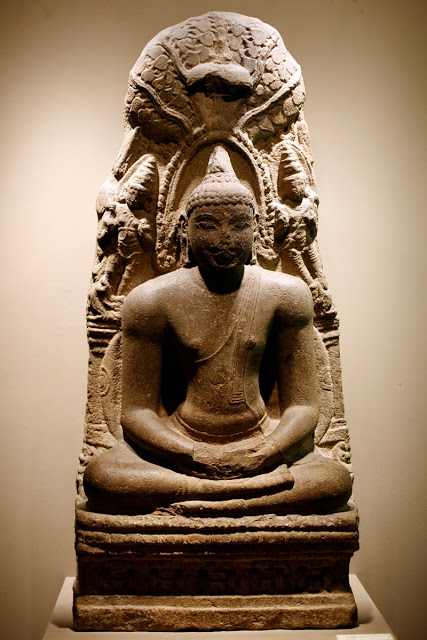
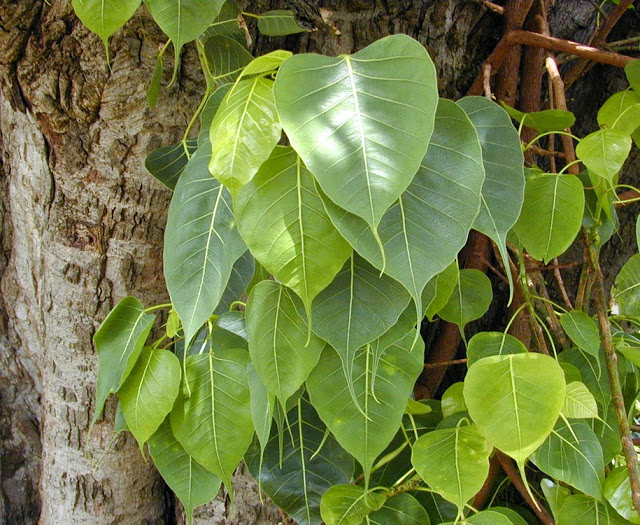
The sacred fig or ashwanth has a distinctive heart-shaped leaf, clearly visible in the statue of the Buddha under the tree shown below (from the first century AD):

image: Wikimedia commons (link).

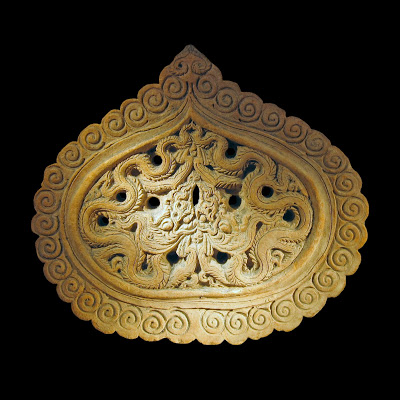
The shape of this leaf is so deeply associated with the achievement of this blessed state, and so imbued with meaning in Buddhist culture that this shape appears in stylized form even with no additional "explanation" necessary:

image: Wikimedia commons (link).

Now, what I find extraordinarily interesting and significant is the fact that the ashwanth or sacred fig, the very tree associated with the bodhi tree under which the Buddha achieves enlightenment, is associated in the ancient Vedic tradition of India with a specific celestial pair of stars, designated together by the name Pushya. 

You can see this ancient association between certain important Nakshatras (stars) and specific tree species attested to in various texts, for example in the scholarly publication of the Proceedings of the Seventh International Congress of Ethnobiology  for 2002, and particularly on page 90 of that collection, shown here

Now, you might be asking yourself which specific star or stars are associated with the Nakshatra known as Pushya! Self. . .

Astonishingly enough, Pushya is associated with two stars: the Northern and Southern Colts, Asellus Borealis and Asellus Australis, which flank the beautiful Beehive Cluster in the zodiac constellation of Cancer, and which we have already seen to have been associated with the Manger in which the Christ is born and also with the Triumphal Entry into Jerusalem in the New Testament scriptures.

We have also seen that the zodiac sign of Cancer the Crab is located at the very "top of the year" on the zodiac wheel, beginning immediately following the point of summer solstice, and that it is thus associated with the upraised Djed column and all that that powerful symbol was intended to convey, including the "raising up" of the invisible and divine spirit within the individual and within all of the material-spiritual cosmos through which we sojourn in this incarnate life. 

Due to this positioning at the "top of the cycle" which the great zodiac wheel symbolizes in its entirety, the upraised arms of the Crab (visible in the constellation itself) were associated in ancient symbolic art and in ancient myth with the upraised arms of the sacred Scarab, with the upraised arms of the ancient Egyptian god of the air (Shu), with the upraised arms of Moses when signaling victory, and with the upraised arms depicted on the sacred Ankh above the vertical Djed column, such as in one famous image from the Book of the Going Forth by Day (also more commonly known as the Egyptian Book of the Dead, or in previous centuries sometimes referred to simply as the Ritual) found in the Papyrus of Ani.

Now, the association of the bodhi tree of the Buddha with the stars of the zodiac sign of Cancer the Crab thus becomes incredibly important, and powerfully resonant with all the other manifestations of this same concept in the ancient wisdom of the world -- the concept which I usually refer to as the "raising of the Djed" with all of its myriad layers of significance. 

This association means that, in addition to all else that this "vertical element" in the great cross of the year represents (all that is "vertical" or spirit-elevating in our individual journey and all that brings forth the invisible spirit world that infuses and animates everything in the universe around us), it is also directly related to the concept of enlightenment, of transcendence of the "cast down" condition we experience when we enter into incarnate form and of profound connection with the infinite.

The bodhi tree can thus also be seen to have connections to the World Tree which Odin ascends and upon which he must hang until he is suddenly granted a vision into the invisible realm of the infinite, and to the tree which the shaman ascends literally in cultures around the world as part of the ecstatic journey.

Ultimately, this is a journey undertaken not just by Odin or the Buddha but in fact by every single human soul. I believe (and have quoted Alvin Boyd Kuhn on this specific point several times in the past) no ancient myth or cycle "is apprehended in its full force and applicability until every reader discerns himself or herself to be the central figure in it!" 

One need not journey to a specific location where an external Buddha is said to have achieved his enlightenment, nor visit a specific tree reputed to be descended from the very tree under which he sat when he achieved this union with the infinite (although there is nothing wrong with doing so, and it would indeed be a beautiful experience to be in the presence of one of the sacred ficus trees revered and lovingly tended by so many generations of fellow-journeyers through this vale of tears). The bodhi tree, and enlightenment, are in fact inside us at all times (see the tremendously helpful perspective shed upon this concept by Peter Kingsley, discussed here).

We can each sit under that very tree at any time, no matter where in the universe we happen to be.

Namaste.

(Note the two "small celestials" to either side of the Buddha, each of which I have indicated by a red arrow. I believe the Buddha and the bodhi tree in this image clearly relate to the "vertical line" running up from the winter solstice through the summer solstice, while the two flanking figures represent the two equinoxes and the horizontal line between them: the line of being "cast down" into incarnation, which the Buddha and the enlightenment under the fig tree overcome with the "raising back up" of the Djed. In this interpretation, the two flanking figures thus play the same role that Isis and Nephthys play in the Papyrus of Ani image linked before, while the Buddha and the Tree play the same role as the Djed column and the Ankh with upraised arms in that Papyrus of Ani image. This role is also played by Cautes and Cautopates in the Mithraic symbology discussed here).

image: Wikimedia commons (link).

The Djed Column every day: Ahimsa

The Djed Column every day: Ahimsa

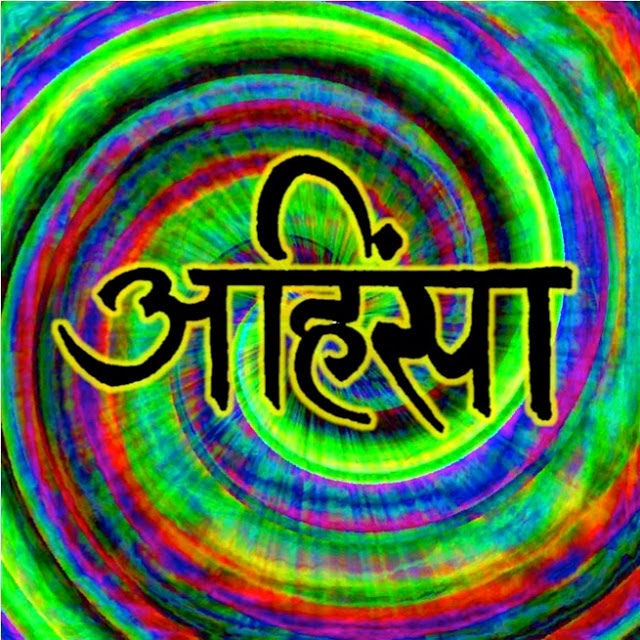
original image (background): Wikimedia commons (link). "Ahimsa" added by the author.

We've been exploring the concept of "raising the Djed" as part of daily practice, and have been examining some of the different paths from around the world which appear to be related to that idea.

As the preceding post discussed, the practice of Yoga may qualify as one of the most well-preserved of the great "streams" of ancient knowledge which has survived to the present day. It is a practice which contains in its broad current much more than the asanas or Yoga postures which are most commonly associated with Yoga, and it is a practice which has as part of its explicit aims the ultimate transformation of the consciousness and the elevation of the "divine flame within oneself" which is clearly very closely connected to that idea which appears to be so central to the world's ancient sacred traditions, which the ancient Egyptian symbolism described as the "raising back up" of the Djed of Osiris, and which is present in other forms in other myth-cycles, and in the Great Cross of the Year created by the "horizontal line" between the equinoxes and the "vertical line" between the solstices (see here).

While much more can be said about the significance of the Yoga asanas, their very ancient origin (some postures, indeed, being depicted on seals and miniature sculptures dating back to Mohenjo Daro and Harappa, circa 2500 BC, as discussed by Victor H. Mair in the important examination of parallels between concepts in the Taoism and Yoga found on page 158 in the appendix of his translation of the Ma-Wang-Tui texts of the Tao Te Ching, 1990, and other Yoga-like postures depicted in certain artistic representations from ancient Egypt, as discussed by John Anthony West in his indispensable 1979 study, Serpent in the Skyfor example on page 93), and while Yoga itself as a comprehensive system encompasses many important disciplines in addition to the asanas which can each be seen as disciplines for "raising the Djed" in daily life and which are also found in other streams of the ancient wisdom of the human race, we will here focus in on one particular facet of Yogic expression which all by itself can be seen as an essential distillation of the concept of elevating the spiritual aspect in this dual material-physical universe: the concept of ahimsa.

Ahimsa is a Sanskrit word which combines the negative prefix "a-" and the word himsa, which means "to do injury" or "to do harm," and which comes from a root word meaning "to strike a blow." Thus, ahimsa is often translated as meaning "non-injury," "non-violence," "non-harm," and by extension "compassion" and "beneficence towards all." It is often understood to go well beyond the idea of not actually doing physical violence to another, and to encompass also the idea of "not even wishing to do violence" or "not even harboring harmful intent at all."

In an essay on the wider concepts of "Yama and Niyama" published in 1903 (beginning on page 637 of this publication), Yogic and Vedic scholar Hirendra Nath Sinha wrote of this wider understanding of ahimsa:

What appears on the physical plane as an injury to another is from the stand point of spirit, really an injury to one's self. Every act and thought of ours recoils on ourself and affects our prospects. Non-injury has therefore been defined as not injuring another by thought, word or deed. [. . .] There should not be even the least shadow of ill-feeling in the one's mind. We may do a good deed or be charitable on the pressure of circumstances; but if the heart does not concur or the mind hesitates even for a moment we are far away from the realisation of Ahimsa. We generally do greater harm mentally than by words or acts, because our thoughts are not so very easily detectable as our words or acts and capable of being restrained. 645-646. 

Clearly, such an expression of beneficence and non-harm would be very difficult to achieve even for a fleeting instant, let alone for long stretches of the day, and thus the concept of ahimsa can certainly be seen to be a practice we can try to incorporate into the pattern of our lives, without worrying that we will achieve it very rapidly and have to search around for another goal to accomplish once that one's "out of the way"!

In fact, Mahatma Gandhi put a very high value on the practice of ahimsa, positing a symbiotic relationship between the pursuit of ahimsa and the pursuit of Truth, and he himself wrote about how elusive the pursuit of true ahimsa, even for a fleeting moment, was in his own life. He says in his autobiography, entitled The Story of My Experiments with Truth:

My uniform experience has convinced me that there is no other God than Truth. And if every page of these chapters does not proclaim to the reader that the only means for the realization of Truth is Ahimsa, I shall deem all my labour in writing these chapters to have been in vain. And, even though my efforts in this behalf may prove fruitless, let the readers know that the vehicle, not the great principle, is at fault. After all, however sincere my strivings after Ahimsa may have been, they have still been imperfect and inadequate. The little fleeting glimpses, therefore, that I have been able to have of Truth can hardly convey an idea of the indescribable lustre of Truth, a million times more intense than that of the sun we daily see with our eyes. In fact what I have caught is only the faintest glimmer of that mighty effulgence. But this much I can say with assurance, as a result of all my experiments, that a perfect vision of Truth can only follow a complete realization of Ahimsa. 453-454.

Clearly, this concept of ahimsa is very difficult to achieve in this dual physical-spiritual "vehicle," and yet it can undoubtedly be shown to be closely bound up with the concept of "elevating the spiritual" which is expressed in the symbol of the "vertical Djed column" (as also the vertical portion of the symbol of the cross, in contrast to the horizontal element of the cross), and thus with the concept of evoking or re-connecting with the invisible and divine spark that is present but unseen within us and all around us, and thus with connecting to "the ultimate" or with what Gandhi appears to be pointing towards above when he speaks of "Truth" which is also identified with "God."

(For further elaboration on the symbolism of the "vertical component" and the "horizontal component" as they relate to the concept of spiritual and physical and to the concept of the Djed column and to the symbology of the equinoxes and solstices that can be shown to be present in nearly all the sacred traditions, texts and mythologies of the world, see for example this previous post, as well as this video, among others).

We can draw out the connection between (on the one hand) the concept of "raising the Djed" that we have been exploring in all of the recent posts and (on the other hand) the concept of ahimsa by revisiting some of the previous discussions regarding the idea of violence, and the undeniable tendency of violence (whether physical, verbal, or even mental) to "objectify" the target of the violence, to "degrade," to "debase," and to "brutalize" -- that is, to deny or belittle or even to stamp out the presence of spirit and of the invisible and the divine within the object of violence, to reduce to the level of gross matter or to the level of the animal nature (the "horizontal component"), instead of trying to elevate and call forth the "vertical component," the spiritual component, the divine component, the invisible component (all of which is expressed in the "vertical Djed column" as opposed to the "cast-down Djed column").

Ultimately, of course, violence leads to the actual killing of the object of violence, which can be seen as the ultimate in "casting down" or "denying the vertical component," because it reduces the target of the violence to a corpse, a thing, an inanimate object (it seeks to beat down the "vertical" into the "horizontal," instead of lifting up the horizontal to the vertical again, which is the goal described and depicted in virtually all of the world's sacred traditions).

Previous posts which have dealt with the brutalizing or degrading aspect of violence include:

(among many others). Thus, the concept of violence which casts down or suppresses or seeks to deny the spiritual and the divine in others and in the universe itself can be seen to be analogous to the concept of cursing, and the concept of non-violence and even further of compassion and beneficence that is contained in the word ahimsa can be seen to have strong resonance with the concept of blessing, discussed in previous posts here and here.

And, while Mahatma Gandhi and others cited above testify to the elusiveness of the possibility of fully incorporating a spirit of true ahimsa into every minute of our waking life, it is certainly a practice which we can at least pursue whenever we can think to do so, and which would seem to have great benefits to ourselves and to others to the degree we do make it a daily practice in our lives.

Indeed, the Sanskrit epic known as the Mahabharata of ancient India (the origins of which probably stretch back at least as far as 900 BC, and possibly earlier) repeatedly enjoins the practice of ahimsa, saying at one point:

अहिंसा परमॊ धर्मस तदाहिंसा परॊ थमः

अहिंसा परमं थानम अहिंसा परमस तपः

अहिंसा परमॊ यज्ञस तदाहिस्मा परं बलम

अहिंसा परमं मित्रम अहिंसा परमं सुखम

अहिंसा परमं सत्यम अहिंसा परमं शरुतम

सर्वयज्ञेषु वा थानं सर्वतीर्देषु चाप्लुतम

सर्वथानफलं वापि नैतत तुल्यम अहिंसया

अहिंस्रस्य तपॊ ऽकषय्यम अहिंस्रॊ यजते सथा

अहिंस्रः सर्वभूतानां यदा माता यदा पिता

एतत फलम अहिंसाया भूयश च कुरुपुंगव

न हि शक्या गुणा वक्तुम इह वर्षशतैर अपि

ahimsā paramo dharmas tathāhimsā paro damah

ahimsā paramam dānam ahimsā paramas tapah

ahimsā paramo yajñas tathāhismā param balam

ahimsā paramam mitram ahimsā paramam sukham

ahimsā paramam satyam ahimsā paramam śrutam

sarvayajñesu vā dānam sarvatīrthesu cāplutam

sarvadānaphalam vāpi naitat tulyam ahimsayā

ahimsrasya tapo 'ksayyam ahimsro yajate sadā

ahimsrah sarvabhūtānām yathā mātā yathā pitā

etat phalam ahimsāyā bhūyaś ca kurupumgava

na hi śakyā gunā vaktum iha varsaśatair api [17]

which translated means in part:

Ahimsa is the highest religion.
Ahimsa is the highest self-control.
Ahimsa is the highest penance.
Ahimsa is the highest sacrifice.
Ahimsa is the highest friend.
Ahimsa is the highest happiness.
Ahimsa is the highest truth . . .
(source).

It should be noted that, while the concept of ahimsa has been interpreted in varying ways by various traditions that look to these ancient texts, and to other ancient texts and traditions which similarly enjoin the supreme importance of ahimsa, the understanding of ahimsa does not always entail what we might term "complete pacifism" -- that is to say, many commentaries (including ancient texts, such as parts of the Mahabharata itself) appear to teach that there is a distinction between not harming another, and using force in order to prevent someone else from harming another.

In other words, the concept of ahimsa or "not harming" does not necessarily teach that one may not use force in order to stop someone from being harmed (including one's self). Indeed, it may be seen to be consistent with the concept of ahimsa to use force to stop a violent intruder who has broken into one's household in order to do harm (although, in fairness, it must be noted that some interpretations of ahimsa would disagree).

Nor does it necessarily follow that anyone pursuing the concept of ahimsa must necessarily renounce completely all debates and discussions of what we might call "politics" -- indeed, it seems to follow rather logically that if one perceives that violence, injury, or oppression is being perpetrated against others, the concept of ahimsa would enjoin us to oppose that violence and seek to bring about its cessation.

It should also be said that such a situation -- the stopping of violence -- is the only "excuse" for the use of force, and that no one gets any special "license to kill" simply by virtue of donning a uniform, or quoting a scripture, or through any of the other forms of mind control used to condone violence in violation of ahimsa, which of course cannot be condoned or excused in reality and in the actual karmic laws of the universe.

Much more can of course be explored on this powerful subject. However, in the scope of this particular abbreviated examination of ahimsa, which focuses in particular on the concept ahimsa as it relates to the concept of the "vertical Djed column" and the "raising back-up" of the "cast-down Djed column," it is perhaps enough to simply say that there are many possible "life disciplines" which we can explore as options for connecting with and elevating the spiritual and divine spark that is always present in ourselves and in everyone and everything around us, and which we can choose to make a daily part of our own walk. The conscious cultivation of ahimsa would seem to be one very fundamental and vital "Djed-raising" mindset that we can consider pursuing more consciously and consistently, and one which is perhaps needed today more than ever.

However, in closing this particular discussion of ahimsa as it relates to the contrast between the "vertical component" and the "horizontal component" (both of which are present at all times in us during this incarnation, and both of which are manifest in the dual-natured universe in which we find ourselves), it might not be superfluous to point out that in our daily practice of ahimsa, as we cultivate not just the practice of not harming others but of not even desiring harm or imagining about harm, that we live in a point in time in which visual entertainment is perhaps more violent than at any time in history up until now.

Certainly it could be argued that the epics and sacred scriptures of the world are filled with descriptions of battle, but it can also be countered that describing a battle, even in poetic language, and depicting it along with copious CGI visual effects of gore and ballistic impacts in the visual medium of film are actually quite different in their impact on the brain (it can also be convincingly demonstrated, I believe, that those ancient epics and scriptures are almost entirely allegorical, and describe the "battles" created by the motions of the heavenly bodies and the cycles of the year, and of the sun, moon, stars, and visible planets -- rather than actual literal-historical conflicts in the vast majority of the cases; see examples of my analysis of a few dozen ancient "Star Myths" listed here, and there are many more such analyses which I intend to publish in the future).

But can one really imagine a guru or a serious practitioner of Yoga or of ahimsa actually enjoying the countless execution-style killings depicted in a television series such as the Walking Dead? Or the frenetic blasting apart of swarms of humanoid robots in movies such as the latest Avengers or its previous forerunners?

I mention these particular series, not to pick on them in particular, but to highlight what I believe is an extremely regrettable -- and perhaps an especially insidious -- aspect of these specific orgies of violence, and an aspect which relates directly to the distinction between the "horizontal" and "vertical" components of the Djed column which we are exploring in this discussion of ahimsa (and of the concept more broadly of "raising the Djed" or the spiritual and divine component), and that is that shows which graphically illustrate the repetitive blowing apart of "zombies" or of "robots" seem to be deliberately removing the spiritual or "divine spark" component from the victims of the violence, and thus reducing them to the status of "all horizontal and no vertical" right from the outset.

This "removal of the human spirit" from the victims can perhaps be argued to "make it OK" -- blowing apart robots (or zombies) doesn't really violate ahimsa at all, does it? A robot doesn't have a spirit at all, it's not even alive (neither is an undead creature like a zombie, I guess), and so blowing them apart with large-caliber weapons fired at close range (or other, even more creative ways of physically removing their ability to move around and cause trouble) is just good fun to watch, right?

The problem I see with this particular genre of cinematic mayhem, which is not just popular right now but practically ubiquitous in visual entertainment being offered at every turn, to viewers of all ages, all the time, is that these supposedly "soul-less" robots and zombies actually resemble human beings rather closely (that's part of what makes them so disturbing, after all). Watching the execution-style killing of zombie after zombie may be argued to desensitize the viewer to the fact that in point of fact there is no such thing as a zombie, and anyone being executed in real life is in fact a human being who does indeed have a spiritual component!

Could it not be argued that watching the super-speed blowing apart of what must be tens of thousands of human-shaped robots in movies such as the Avengers, or the agonizingly slow-speed execution-style "killing" of what must also be tens of thousands of "walkers" by now in that popular (and, it must be admitted, well-written -- from the one episode I did actually watch) series actually desensitizes people to the fact that everyone they will ever meet in this world actually does have a human soul (unlike a zombie or a robot), and that the very real and very horrific physical violence being perpetrated on human beings by artillery shells, high-caliber chain guns, depleted-uranium sabot rounds, bombs dropped from jet aircraft, or "hellfire" missiles fired from drone aircraft (to name just a few examples that have taken place in unspeakably large numbers in recent years, and which continue this very minute in various places on our planet) are actually tearing down the spiritual component in real "dual-nature" men and women and children, and reducing them to horizontal bodies?

In short, to what degree do such repeated depictions encourage us to identify with the protagonists, and view people around us as zombies, or soul-less robots? Doing so, of course, is the opposite of blessing and of ahimsa.

It seems that this argument could in fact be made, and that as entertaining as these films and television shows might appear to be, they are in fact very dangerous for our own souls, not to mention inimical to the "cause of ahimsa" in the world at large.

Namaste.

The Djed Column every day: Yoga

The Djed Column every day: Yoga

The past several posts have examined the concept of "raising the Djed" (cultivating and evoking and amplifying the spiritual, invisible, divine spark in ourselves and in the universe we travel through), the possibility that we can in some way incorporate this concept into daily life, and some of the multitude of practices for doing so which cultures from around the world have preserved from ancient times.

Part of the reason for this short survey is to bring the discussion of what may seem at times to be a very esoteric and philosophical topic "down to earth" and suggest that it is actually an intensely practical topic and one which may be tremendously beneficial to our seemingly mundane day-to-day existence.

Another reason to look at some different methods from different cultures is to show that no one method should be considered a "monopoly" -- that there probably dozens or perhaps hundreds of different ways that human beings can choose to pursue in this important area of life, and that although they do share some important similarities they are different enough that they can appeal to different people of different backgrounds or needs.

A third reason might be to familiarize readers with some techniques which may be less well known, such as previous "Djed-raising" disciplines explored in the previous posts on qigong and on Tantra and fong zhong shu. If just one reader who has not previously heard of a certain practice decides to examine it further and it becomes a beneficial part of his or her life for years to come, that would seem to justify the entire "mini-series" right there.

The next daily discipline probably cannot be classified as one that any reader has not yet heard about, because it is a tradition that is so strong and so rich in teachers and followers and the level of ancient wisdom which continues to be passed along in its broad and powerful stream, but it is very clearly related to the concept that the ancient Egyptians symbolized by the raising of the Djed, and by the symbol of life carried by almost all of the gods and goddesses, the Ankh -- which may in fact be linguistically related to the name by which this discipline has been known for millennia.

We're talking, of course, about Yoga -- a subject that could withstand a lifetime of deep consideration without ever exhausting its possibilities.

Previous posts which have touched upon the importance of the ancient wisdom and practical application that is preserved in Yogic tradition include:

While most of us upon hearing the word "Yoga" immediately think of the asanas ("postures") which are undoubtedly the most well-known aspect of Yogic practice, Yoga in fact is a very comprehensive discipline of transformation incorporating meditation, concentration, study of ancient texts and tradition,  true conduct in daily life, nonviolence, freedom from anger, and other practices designed to reawaken and elevate the spiritual, and ultimately to lead to deep contact with the divine and the ultimate. Asanas are an important aspect of Yoga but only one of its many "limbs."

In Light on Yoga, first published in 1966, B.K.S. Iyengar explains:

The word Yoga is derived from the Sanskrit root yuj meaning to bind, join, attach and yoke, to direct and concentrate one's attention on, to use and apply. It also means union or communion. [. . .]
In Indian thought, everything is permeated by the Supreme Universal Spirit (Paramatma or God) of which the individual human spirit (jivatma) is a part. The system of yoga is so called because it teaches the means by which the the jivatma can be united to, or be in communion with the Paramatma, and so secure liberation (moksa). 19 

The letter "s" in the final word, moksa, has a diacritical "dot" underneath it, indicating that the "s" is pronounced more like a "sh," and you will sometimes see the same word spelled moksha.

The video above, entitled Yoga Ruins Your Life, by Richard Freeman of Yoga Workshop in Boulder, Colorado, may make you want to take up Yoga, even if you have never wanted to try it out before (that is, if the above passage from Light on Yoga has not already led you to stop reading and start a search for a Yoga shala in your area).

During the video, we hear the perspective offered by someone who has pursued the path of Yoga for many years and who has dedicated a great deal of energy to passing it on to others and helping others on their own Yoga journeys:

So I've often said that Yoga ruins your life, and by that I mean it ruins your Samsaric life, because once you get a taste of Yoga, you kind of "lose interest" in all the things that are kind of dim reflections of that taste. [. . .] Yoga can also ruin your career, because you feel so nice when you do it that you're less aggressive, and you tend to like people more. And when you practice Yoga, you no longer take political extremes in your mind, and so . . . what are you going to fight about? Or, religious extremes either, because, you get to the -- kind of the root experience that all these different religions are looking for, but in a very generic and very natural, human way, so you don't have to clasp onto the fantastic or the otherworldly. 

There are several important concepts in that short video worthy of careful consideration and further examination -- far more than can be pursued here in one sitting. We will explore just a few here.

One concept which is expressed in the opening sentence (and in the provocative title of the video) is the idea that Yoga "ruins" your Samsaric life, the life of attachment to the physical and the temporary into which we are "cast down" upon our incarnation, what the video's description section calls our "auto-pilot" life. It is a vehicle for transforming and transcending the illusions of the material world -- but doing so in part through the vehicle of our incarnation in this material world.

This idea of being on "auto-pilot" for a certain part of our life in this world, and then beginning to wake up more and more to a higher reality is expressed in the extended passage of a lecture by Alvin Boyd Kuhn quoted previously in "Easter: the Birth-Day of the Gods," in which he traces the cycle of the soul which is "cast down" at the fall equinox (representative of being incarnated in the body) and continues to plunge downward even after that until it finally reaches a turning point at the winter solstice, the very point that creates the "vertical line" of the annual cross of the zodiac which represents the "raising back up" of the Djed column, and the point at which the inner divine is esoterically described as being "born in a manger." Kuhn says of the incarnate soul:

It is born then as the soul of a human; but at first and for a long period it lies like a seed in the ground before germination, inert, unawakened, dormant, in the relative sense of the word, "dead." This is the young god lying in the manger, asleep in his cradle of the body, or as in the Jonah-fish allegory and the story of Jesus in the boat in the storm on the lake, asleep in the "hold" of the "ship" of life, with the tempest of the body's elemental passions raging all about him. He must be awakened, arise, exert himself and use his divine powers to still the storm, for the elements in the end will obey his mighty will.

This "sleeping semblance of life," which Kuhn also says is life "unawakened" and "inert," "dormant," and "dead," is the condition that the video above promises that Yoga can "ruin."

In case you're new to this theory, Kuhn is arguing that the story of Jesus asleep in the boat on Lake Galilee in the storm, or Jonah asleep in the hold of the ship of Joppa bound for Tarshish, are both allegorical or esoteric stories intended to describe a condition which each and every one of us experiences -- the condition of our own soul upon being "cast down" into this life, wedded to a human body like Prometheus nailed to a rock (to use yet another picture from a different set of allegorical myths), and temporarily "unawakened," "inert," "dormant," and "in the relative sense of the word, 'dead'." From this condition, Yoga promises a path that leads to liberation, or moksa -- but in doing so, it "ruins your life" of comfortable dozing in the hold of the ship.

Those stories, Kuhn tells us, are not literal and historical accounts -- and they were never intended to be taken that way (they are, he says elsewhere, "a thousand times more precious" as myths than as supposed histories). They are pointing to a profound truth that is in many ways even more mysterious than any fantastic or otherworldly story -- a truth that you can experience for yourself and a truth that "all these different religions are looking for," in the words of the Yoga video above.

In the words of someone who has walked the path of Yoga for decades, in pursuing that path you get to actually "get to the root experience" that these sacred myths are pointing to. In doing so, you lose the need to "clasp" onto someone else's story about it, because you experience it for yourself -- you know it. This is the concept that was anciently contained in the word gnosis -- first-hand experience of the ultimate, rather than second-hand faith in it.

The same idea was expressed by Gerald Massey (1828 - 1907) in a passage cited previously hereand here, when he says:

What do you think is the use of telling the adept [. . .] that he must live by faith, or be saved by belief? He will reply that he lives by knowledge, and walks by open sight; and that another life is thus demonstrated to him in this. As for death, the practical Gnostic will tell you, he sees through it, and death itself is no more for him! Such have no doubt, because they know.

And yet, to make one more observation on the wonderful avenues of discussion that this subject opens up, those stories are not to be disdained on account of their being "fantastic" or "otherworldly" or simply "allegory" -- those powerful metaphors can help us to grasp the meaning of these spiritual concepts which deal with things that by their nature are invisible and which in fact are even beyond the ability of the mind to reason out using ordinary logic.

In fact, in attempting to convey the meaning of Yoga, B.K.S. Iyengar himself alludes to the "fantastic" or "otherworldly" story contained in the Bhagavad Gita, which is a portion of the ancient Hindu Mahabharata, in which Krishna expounds upon the meaning of Yoga to the disciple, Arjuna, and calls it a knowledge that the yogi (one who follows the path of Yoga) will experience that is "beyond the pale of the senses which his reason cannot grasp" (Bhagavad Gita 6.21, cited in Light on Yoga 19).

Interestingly enough, in a different part of the same Bhagavad Gita (a passage not, to my knowledge, cited by B.K.S. Iyengar, at least not in the book quoted above), Krishna tells Arjuna:

O Arjuna, now I shall describe different paths departing by which, during death, the yogis do or do not come back. Fire, light, daytime, the bright lunar fortnight, and the six months of the northern solstice of the sun; departing by the path of these gods the yogis, who know Brahman, attain nirvana. Smoke, night, the dark lunar fortnight, and the six months of southern solstice of the sun; departing by these paths, the righteous person attains lunar light and reincarnates. The path of light and the path of darkness are thought to be the world's two eternal paths. The former leads to nirvana and the latter leads to rebirth. Knowing these two paths, O Arjuna, a yogi is not bewildered at all. Therefore, O Arjuna, be steadfast in yoga at all times. Bhagavad Gita chapter 8, verses 23 - 27 (translation online here).

This is very noteworthy. Krishna has just revealed to us that the annual wheel, with its "upper half" consisting of the six months containing the summer solstice ("the northern solstice of the sun") and its "lower half" consisting of the six months containing the winter solstice ("the southern solstice of the sun," both of these expressions being geared towards an observer in the northern hemisphere) are esoteric allegories for two different paths through this life, one of which will lead to reincarnation (the cycle of Samsara) and one to liberation and nirvana.

This is the exact same cycle that we have seen formed the allegory of the "casting down" of the Djed column (into the lower half of the year) and the "raising up again" of the same (on the way back to the upper half of the year, and the summer solstice):

Clearly, Yoga is a discipline designed to "raise the Djed column" (to use the terminology of ancient Egypt) and ultimately to transcend the cycle of being "cast down" into the lower half of the wheel.

Elsewhere in Light on Yoga, and in reference to concepts described in other sacred ancient texts, we see hints that this "transcending of the lower half" involves transcending the "shifting forms" or the "endless changes" that characterize the material half of our dual universe and a reconnection with the realm of pure potential. B.K.S. Iyengar says that the Kathopanishad tells us:

When the senses are stilled, when the mind is at rest, when the intellect wavers not -- then, say the wise, is reached the highest stage. This steady control of the senses and mind has been defined as Yoga. He who attains it is free from delusion. 20.

Patanjali, Sri Iyengar notes, calls this condition chitta vrtti nirodhah, which means "the restraint (nirodhah) of mental (chitta) modifications (vrtti)," or the "suppression (nirodhah) of the fluctuations (vrtti) of consciousness (chitta)" (20).

And in the Bhagavad Gita, Krishna describes this concept to Arjuna thusly:

When his mind, intellect and self (ahamkara) are under control, freed from restless desire, so that they rest in the spirit within, a man becomes a Yukta -- one in communion with God. A lamp does not flicker in a place where no winds blow; so it is with a yogi, who controls his mind, intellect and self, being absorbed in the spirit within him. When the restlessness of the mind, intellect and self is stilled through the practice of Yoga, the yogi by the grace of the Spirit within himself finds fulfillment. Light on Yoga 19, citing Bhagavad Gita, chapter 6 and verses 18 - 20.

This concept appears to be very closely aligned and perhaps even essentially identical to the practice that Peter Kingsley discusses in his 1999 text In the Dark Places of Wisdom, and which Dr. Kingsley believes was being practiced and passed down through a "master to disciple" method of transmission in certain groups of mystic philosophers prior to Socrates and Plato, and including Parmenides (or Parmeneides). It is interesting that Yoga as well is traditionally passed down through just such a master-to-disciple relationship (the Guru, whose name literally means "light out of darkness," and the sisya, or disciple).

Fortunately, unlike so many other ancient traditions for the transmission of such profound transcendental gnosis, Yoga has survived into the present day, and can be followed as a means of daily transformation and "raising of the Djed."

Note, however, that B.K.S. Iyengar tells us that:

All the important texts on Yoga lay great emphasis on sadhana or abhyasa (constant practice). Sadhana is not just a theoretical study of Yoga texts. It is a spiritual endeavour. Oil seeds must be pressed to yield oil. Wood must be heated to ignite it and bring out the hidden fire within. In the same way, the sadhaka must by constant practice light the divine flame within himself. 30.

But, he also quotes the following encouraging passage, from the Hatha Yoga Pradipika, chapter 1 and verses 64 - 66:

The young, the old, the extremely aged, even the sick and infirm obtain perfection in Yoga by constant practice. Success will follow him who practices, not him who practices not. Success in Yoga is not obtained by the mere theoretical reading of sacred texts. Success is not obtained by wearing the dress of a yogi or a sanyasi (a recluse), nor by talking about it. Constant practice alone is the secret of success. Verily, there is no doubt of this.  -- Cited in Light on Yoga, 30.

So, that is encouraging, and argues that it is probably never to late to consider this ancient path.

Just beware that it may "ruin your life"!

------------------------------

Below we see Arjuna, in a typical "raising the Djed" posture (compare to the upraised arms on the Ankh in the image in this previous post -- an Ankh which surmounts a "vertical Djed column"):

image: Wikimedia commons (link).
The Djed Column everyday: Tantra and Fong Zhong Shu

The Djed Column everyday: Tantra and Fong Zhong Shu

image: Wikimedia commons (link).

If all the world's sacred scriptures and mythology actually consist of stories in which the motions of the celestial spheres take on the personalities of men, women, gods, goddesses, angels, demons, monsters, djinn, and other mystical creatures (and they most certainly do), then we are left with a very important question:

Why?

I believe the answer certainly includes as a central feature the profound teaching embodied in the Great Cross of the Year, formed by the solstices and equinoxes, and associated with the concept symbolized in ancient Egypt by the "casting down" of the Djed column of Osiris and the subsequent "raising-up again" of the same: an esoteric concept which depicts the entire nature of human existence as a divine soul thrown down into incarnation, while voyaging through, reflecting and in some mysterious way embodying the infinite universe at the same time -- a universe which is itself composed of both a visible realm and an even more important and subtle invisible realm.

Recent posts and videos which have attempted to outline this critically-important central teaching (found, I believe, in virtually all of the world's sacred traditions in varying depictions and disguises) include: 

and many others.

Those discussions presented evidence that the concept of "raising the Djed" conveys a powerful message regarding the long process of our realization of the infinite divine sleeping within ourselves and indeed within every atom of the living universe around us, a process which takes place during the entire cycle of our earthly existence and perhaps over the course of many successive "existences" -- but it is also (we saw) a message which appears to urge upon us the practice of "raising the Djed" every single day, through the practice of blessing, through the recognition and elevation of the divine in ourselves and others, and through the special form of spiritual elevation leading to the state of ecstasy or ecstatic trance, in which our perception actually transcends the physical body and makes contact with the invisible world (for more on ecstasy and trance-conditions see also herehere and here, among many other previous posts).

And, while the entry into the ecstatic state is perhaps the most intense and most transcendent of the forms of recognizing and reconnecting with and calling forth and raising up the infinite divine spiritual realm which is always present, around us and within us, we have also seen evidence that in addition to incorporating techniques of ecstasy into our lives on a regular basis, we can also practice other forms of "raising the Djed" into our lives as well, even when we are not in the ecstatic state (since it is not possible to exist in a state of ecstasy at all times). It seems likely that consciously incorporating more than one of these into our lives is quite possible and probably beneficial -- and that they are not at all "mutually exclusive" (incorporating one does not require that we renounce all the others, although there is obviously a limit to how many we can choose to really pursue seriously).

In order to simply provide a very cursory pointer towards some practices which have been developed in different cultures from very ancient times, for those who may wish to learn more about them on their own, I started a short "mini-series" of posts discussing a few such practices which seem to fit into the general category of "raising the Djed." The first one we mentioned briefly was the practice commonly called qigong or chi gung, which clearly involves contact with "the invisible" in some way (the "invisible within," the "invisible without," or both), and which enables its practitioners to directly and tangibly experience the fact that we are made of more than just physical substance.

The goal of this little mini-series is not to try to teach these practices, or even to point to specific teachers or resources where people can learn more about these practices, but rather to simply make people aware of the existence of these many different disciplines which fit into the general category of "raising the Djed" and which some readers may find very beneficial if they choose to pursue them. Many of these practices, while extremely ancient, are not well known in "the west" -- that is to say, in the parts of the world in which the ancient esoteric knowledge was largely replaced by a literalistic rather than esoteric understanding of the ancient sacred stories and myths.

Another discipline which clearly falls into this same category is the practice of techniques known in some cultures (especially India and Tibet) as maithuna and usually known in China and Taoism (or Daoism) as fong zhong shu or 

房 中 術

The above calligraphy shows traditional characters, but in simplified characters the final character above is changed to 术 (which is present in the middle of the traditional version of that character) and so the same phrase would be rendered as

房 中术

In either case, the three symbols stand for "bedroom - within - skill" (pronounced fong zhong shuin Mandarin and fohng jung seuht in Cantonese) and are usually rendered into English using the phrases "bedroom arts" or "art of the bedchamber" and corresponding very generally to what is often referred to in the west as "Tantra" (although apparently that word actually encompasses a much wider landscape of transformative disciplines involving meditation, mantras, mandalas, visualization, and other practices in addition to what most people in the west today envision when they think of Tantra).

In general, these related arts involve transformation through sexual ritual, a practice which can be seen to have been highly developed in ancient China, ancient Japan, ancient India, ancient Tibet, and many other cultures around the world, including some Native American cultures. There is some evidence that the spiritual potential of this aspect of human existence was also developed in "western" cultures in various forms prior to being largely rejected or suppressed with the advent of literalist Christianity.

Although still perhaps not so very widely known, excellent books on Taoist fong zhong shu have been available in English for many years, including the work of Daniel P. Reid and Mantak Chia, among others. 

Additionally, some of the ancient Chinese texts that traditionally formed the foundation for the preservation and development of the knowledge of fong zhong shu have survived in varying degrees of completeness.  

Of these, perhaps the most important, and almost certainly the most often-cited and well known is the Su Nu Jing, or 素女經.

The title is often translated as "Classic of the Plain Girl," but the three characters actually stand for "natural-colored [often used to describe natural-colored or undyed silk]" - "woman" - "classic or canonical text" and because the first word can also mean "plain" as in "unspotted" or "without markings" or simply "white, pure, or undyed," the same title is also sometimes translated as the  Classic of the "Immaculate Woman" or the "Pure Woman."

This figure appears in some aspects to be a goddess or divine figure, who is in some cases associated with grain and hence may connect to the celestial figure of Virgo (this would not be a surprise). Interestingly enough, this would also connect her to the Greek goddess Demeter, whom Plutarch uses as part of his powerful argument against the consumption of animals for food, and the same word and symbol sometimes translated "Plain" that is used to describe her in China is can also be used to mean "vegetarian." She is sometimes depicted as giving instruction to the Yellow Emperor or Huangdi (sometimes spelled Huang Ti), whom Hertha von Dechend and Giorgio de Santillana identify as a Saturnian figure in Hamlet's Mill.

So, Su Nu Jing means "Pure-Undyed-Silk Woman Classic" in Mandarin, and would be pronounced Seuh Neuih Ching in Cantonese, and the last word in the title (Jing or Ching) is the same word found in the title of the Tao Te Ching. It is certainly at least as old as the Sui Dynasty (AD 590 - AD 618) and may be even older, perhaps originating in the Han Dynasty (221 BC - 207 BC) -- and the knowledge it contains may of course have come from an even earlier source.

As explained in Sexual Life in Ancient China: A Preliminary Survey of Chinese Sex and Society circa 1500 BC till 1644 AD, by R. H. Van Gulik (1961), no complete original text of the Su Nu Jing nor of several other ancient Taoist fong zhong shu texts has survived. However, much of the text of the Su Nu Jing was preserved in a different text that quotes large portions of it, which is called the Tung-hsuan-tzu and which may have been written by the scholar Li Tung Hsuan in the 7th century AD.

The text of the Tung-hsuan-tzu begins as follows (as translated in 1961, when conventions were slightly different than they are today -- the modern reader may wish to mentally substitute "humanity" for the general "man," which in previous decades was generally used to mean all of humanity and not specifically men to the exclusion of women; they also seem to have been more tolerant of what is sometimes today called a "comma splice"):

Master Tung-hsuan said: Of all the ten thousand things created by Heaven, man is the most precious. Of all the things that make man prosper none can be compared to sexual intercourse. It is modeled after Heaven and takes its pattern by Earth, it regulates Yin and rules Yang. Those who understand its significance can nurture their nature and prolong their years; those who miss its true meaning will harm themselves and die before their time. 135.

This introduction is extremely significant, and author R. H. Van Gulik notes that most of the more ancient Taoist sexual texts also begin with an expression of the cosmological aspect of human sexuality, which was seen to "model Heaven and [. . .] Earth."

Later, we reach a portion of the text in which the Su Nu Jing is quoted extensively. In the introductory chapter, entitled "The Supreme Significance of the Sexual Act," the Plain Girl declares that in sex:

Woman is superior to man in the same respect as water is superior to fire. [. . .] The union of man and woman is like the mating of Heaven and Earth. It is because of their correct mating that Heaven and Earth last forever. Man, however, has lost this secret, therefore his age has gradually decreased. If a man could learn to stop this decline of his power and how to avoid ills by the art of Yin and Yang, he will attain immortality. 135 - 136.

Here we again see the explicit "macrocosm-microcosm" understanding that the motions of men and women on earth mirror the motions of the great cycles of the heavenly objects, and also mirror the motions of the earth which contribute to our interaction with the celestial mechanics in the heavens above. We are also introduced to one of the central concepts in Taoist fong zhong shu and related disciplines, which is the inherent superiority of the woman to the man, in that she is already capable of multiple, progressive, and basically unlimited orgasms (leading to the raising of chi, prana, or the kundalini, and ultimately to ecstasy), while the man must learn to achieve this capability and does not usually obtain it without the cultivation of fong zhong shu, primarily through the ability to separate orgasm and ejaculation and achieve multiple orgasms without ejaculation. 

Without going any further into the specifics of that subject, which interested readers can pursue for themselves, it is worth noting that in this ancient text, the Natural-Silk Woman or Immaculate Goddess uses the expression "as water is superior to fire." This phrase is loaded with esoteric symbolism, as we have explored previously in the post entitled "Fire and Water," where we saw that the concept of fire plunging into water is an esoteric metaphor for the process of incarnation itself, by which the divine spark of spirit is plunged into and submerged within the physical material realm and a physical material body.

Because of this understanding, we can then gain a better appreciation for the insistence in these ancient texts that human sexuality itself somehow "models Heaven and Earth" and becomes an esoteric symbol for our incarnation itself . . . and for our ability to be spiritually transformed and elevated by our experience in a physical body, an experience which ultimately leads to transcendence of the physical nature. 

Rather than being extinguished by and completely subsumed within the material nature in which we find ourselves, our task is to hold on to the spiritual, call it forth from within this physical world, and ultimately to transform both matter and spirit together -- "raising the Djed." It can readily be perceived that the arts that are often referred to as Tantric are esoterically and experientially involved in just this very purpose as well. 

Just as the myths themselves "bring the stars down to earth" by depicting the sun, moon, stars and planets as human beings and as gods and goddesses walking among humanity, rituals which we undertake that mirror and embody the motions of the heavens and the earth (as the Plain Silk Girl tells us that fong zhong shu most certainly does) connect us to the motions of the universe, and "bring the heavenly motions" down into the human realm, the microcosm reflecting and embodying the macrocosm of the infinite cosmos.

Finally, it is worth noting that here that, as in so many other places where the esoteric ancient wisdom has somehow been subverted, a practice and a body of knowledge which is clearly intended for the elevation and liberation and positive transformation of individual men and women has instead been turned too often into a negative force for degradation, dehumanization, oppression, and powerful feelings of shame, hurt, and alienation. 

The fact that, as we are told by the Immaculate Woman, in the bedroom "the woman is superior to the man as water is superior to fire" can lead to tremendous insecurity and resentment on both sides, when these ancient practices are not known and understood -- but when they are understood and put into practice, they can lead to tremendous security and empowerment for everyone involved.

This subject provides yet another example of how vitally important it is to understand what the ancient texts and the ancient treasures which were entrusted to humanity are actually trying to tell us, and how we can learn to incorporate them into our lives on a very practical level -- and what a great tragedy it is that this ancient inheritance imparted to the human race has somehow so often been turned completely upside down.

New Osiris video, and new "video archive" section

New Osiris video, and new "video archive" section

I've just added a new video to help illustrate some of the concepts discussed in the previous post.

The video is entitled "The Celestial Djed: Orion - Osiris" and is about five minutes and fifty-three seconds in length.

This is (I believe) a much clearer and better version than the video that was originally included with the previous post, and it was just posted this morning (Friday, April 24, 2015 in California -- although it is already April 25 in some parts of the globe), so if you have only seen the previous version you may want to have a look at this one (above).

Additionally, I have now added a new "Video archive" where you can find all of the previous "Star Myth videos" I have posted to help illustrate some of the concepts discussed in The Undying Stars. The link to the new video archive can be found in the right-hand column of the blog itself, as it displays in some browsers, and it looks like the image below.

Please drop by the archive and check out the many videos there, when you have a moment!

The Djed Column every day: Earendil

The Djed Column every day: Earendil

Orion rising on the eastern horizon (left), crossing the center of the southern sky (center, directly over the letter "S"), and sinking down into the west (right). (Click to enlarge). Planetarium app: stellarium.org.

In the previous post, we took what appeared to be a quick break from the discussion in the preceding posts regarding one of the central foundational themes of all the world's ancient myths: the dual physical-spiritual nature of human existence and indeed the dual physical-spiritual nature of the world / universe / cosmos in which we find ourselves, embodied in the great annual cross of the solstices and equinoxes, and in the "casting down" and "raising-up" of the Djed column of Osiris in ancient Egyptian symbology.

Previous posts explored evidence of that cycle operating in the Easter cycle in the New Testament, beginning with the scenes of the Triumphal Entry, followed by the descent that takes place beginning with the Last Supper through the Crucifixion and ultimately the Resurrection or Anastasis (a word which literally means "standing again"). 

Included in the examination was a video entitled "The Zodiac Wheel and the Human Soul" which attempts to illustrate some of the connections between the celestial mechanics involved in this worldwide mythological metaphor and the spiritual message that I believe it was intended to convey.

During that extended discussion, the assertion was made that this great foundational cycle was intended not only to explain important aspects of the "big picture" of our incarnation in this body (throwing light on central issues concerned with "the very meaning of life," if you will), but alsoto illuminate the importance of connecting with this cycle within the "shorter cycles" of our life here in this incarnate existence -- in fact, something we can and perhaps should be connecting with every single day, and maybe even throughout our waking and sleeping travels within each day!

One way that ancient sacred traditions around the world reminded themselves of the reality and immediacy of the invisible, divine, spiritual world that is present at all times in every single being and that in fact infuses and animates everything within the visible universe was certainly through the practice of what Mircea Eliade called "techniques of ecstasy" and which other researchers including Gerald Massey called "trance conditions" -- the practice of actually making contact with or entering into the invisible world, of projecting one's consciousness into the other realm. 

There is plenty of evidence that the scriptures that made their way into what we call "The Bible" are no exception (see for instance the previous post entitled "The Bible is essentially shamanic").

And, it is certainly possible to practice such techniques on a regular basis -- even every day. I initially began a "mini-series" exploring some of the methods which cultures around the world have used to enter into such a state, entitled "Ecstasy every day." However, it is not really practical to remain in such a state at all times. Therefore, I have decided that it is actually more appropriate to make a distinction between the concept of what can be called "raising the Djed" (of recognizing and remembering and elevating and evoking the spiritual aspect in ourselves and the world around us) and the practice of entering into "trance" or "ecstasy" itself (which is, in some sense, temporarily "crossing over" the condition of stasis into the realm of the spiritual to a greater or lesser degree). 

Both are important, but it may be that the condition of "ecstasy" is a special form of "raising the Djed," and that the broader concept of raising the Djed can be practiced more often -- even "all the time," while entering into a trance or ecstatic state cannot.

Therefore, I've decided to re-imagine that "Ecstasy every day" title to be a little more "broad" and examine "the Djed every day" instead. The first installment of that examination touched on the practice of qigong (or chi gung).

After that first installment, we took what seemed at the time to be a "quick detour" to explore the wonderful perspectives offered by The Lord of the Rings and the music of The Lord of the Rings. 

But as it turns out, upon further reflection, it wasn't a detour at all, because it can be satisfactorily demonstrated that the same fundamental theme is absolutely operating within Tolkien's story, on multiple levels -- which is not surprising, given the fact that J.R.R. Tolkien himself had a deep connection to ancient myth and was one of the most knowledgeable scholars in the world on certain families of mythology during his lifetime.

In fact, Tolkien's work provides a beautiful window which leads right in to the discussion of the vital importance of the Djed concept.

As some readers are already aware, the Djed column in ancient Egypt was associated with the god Osiris: it was known as the "backbone of Osiris" and the symbol of the Djed column itself was usually depicted with horizontal segments resembling "vertebrae" in a backbone (see for instance the images of the Djed from the Papyrus of Ani discussed here). 

In some ancient Egyptian art portraying episodes from the story of the murder of Osiris by Set and the recovery of the tamarisk tree containing his casket by Isis, such as the imagery discussed in this previous post, the tree with the casket is depicted as a Djed. The Djed column, in other words, was understood as a symbol of Osiris.

Readers are probably also aware that Osiris was strongly associated with the constellation Orion -- the constellation in the night sky with the highest ratio of bright stars to total stars, and one of the most-recognizable figures in the heavens, making it a fitting representation of the "lord of the underworld," if the heavenly realm is seen as a symbol of the incorporeal realms. The glorious nearby star Sirius, the brightest of all the fixed stars, was associated with Isis.

Once we understand that the Djed is symbolically associated with Osiris, and that Osiris is associated with Orion, then we can more readily understand that the motion of the constellation Orion itself illustrates the great theme of the casting down and the raising back up of the Djed. 

In his nightly motion, Orion can be seen rising in the east and tracing an arc across the sky prior to sinking back down into the west, just as the sun does during the day. During different times of year, of course, Orion rises at a different time due to the progress of the earth in its orbit, which means that at some parts of the year he is already far across the sky by the time the sun goes down (as he is now), but just considering his motion in general we can see how he embodies the casting down and the raising up of the Djed.

When Orion is first rising on the horizon, he appears in a nearly horizontal position, as can be seen in the image at the top of this post (in which the view is from the perspective of an observer in the northern hemisphere at about latitude 35 north, similar to the latitude of Egypt and the Mediterranean, and looking towards the south, with due south in the center, the eastern horizon to the left, and the western horizon to the right). As he arcs upwards into the heavens he becomes vertical. Then, as he sinks back down towards the western horizon he becomes horizontal again.

In the image above, the stars of Orion are shown in all three locations: rising in the east, vertical in the center of the sky at the high point of their arc across the heavens, and then sinking down into the west and becoming horizontal again. Readers who are able can go out this very evening after sunset and see the stars of Orion with his distinctive three-star belt sinking down towards the west.

Below, the same image is reproduced, but this time imagery of Osiris has been added, illustrating the way that the stars of Orion himself portray the "casting down" of the Djed (particularly as Orion sinks down into the west) as well as the subsequent "raising back up" (or Anastasis) of the god -- and a vertical Djed column is depicted directly above Orion's head in the central position:

To add further support, if any is needed, to the argument that the nightly motion of Orion was anciently associated with the casting-down of Osiris and the Djed and with the subsequent raising back up of the same, there are many examples of sacred art in ancient Egypt which actually depicts Osiris lying "cast down" on his funeral bier in the same striding posture that typifies the stars of Orion -- see for example here.

Since no one can, as a practical matter, stride around anywhere while lying upon a bier, and since the ancient Egyptians obviously knew that just as well as we do, the fact that they sometimes depicted Osiris in a horizontal position but with his feet apart as if walking purposefully forward is a major clue that these drawings depict the constellation Orion as he looks when he is near either of the two horizons: horizontal rather than upright, but still in the characteristic "striding" posture that Orion always has, whether he is straight up or lying down.

Below is one more set of images I've prepared in order to illustrate the identification of Orion with the celestial Osiris, and with the casting down and raising up of the Djed.

First, a closer "zoom" of the constellation as it appears on the horizon, to show that Orion really does look "horizontal" when he is near the horizons (the images above de-emphasize this fact, because of the fact that they "wrap" the horizon like a planetarium, and so the horizon itself on the left edge and right edge or east and west of the image, as well as constellations parallel to the horizons on the left and right sides of the images above, appear more "vertical" and upright in those images than they do along the actual horizon outside):

In the above image, you can see that Orion really does look as if he is lying on his funeral bier when he is located at the eastern horizon (rising), and the same is true after he crosses the sky and begins to sink back down into the western horizon (setting).

If we superimpose the outline of the "striding Osiris" on a bier as he is depicted in the Dendera Temple relief linked previously, we can see how this celestial figure represents the Djed of Osiris "cast down" (but preparing to rise again):

Below is another version of the "Orion in three positions" crossing the night sky, this time with the horizons left more "flat" (without the "planetarium wrapping effect"):

(Click to enlarge).

And one more time, with the outlines of Osiris added, to assist in locating the constellation Orion for those less familiar, as well as to illustrate the way Orion's motion embodies the "Djed cast down" and "Djed raised back up."

Now, to bring in the Tolkien connection to this subject, we must delve into the mythological traditions discussed by Giorgio de Santillana and Hertha von Dechend in their landmark examination of the celestial foundations of the world's myths, Hamlet's Mill (first published in 1969). There, they cite previous generations of scholars who demonstrate that the myths upon which Shakespeare's Hamlet are based, in which a king is murdered by his brother and must be avenged by his son, existed in northern Europe going back many centuries before Shakespeare, and that in the 12th century version discussed by Saxo Grammaticus, Hamlet's father's name is Horwendil. This same mythical figure also appears in the Eddas and in other myths, under names that are vary slightly but can clearly be seen to be linguistically related, as Orwandel, Orendel, Erentel, Erendel, Horvandillus, Horwendil, Oervandill, Orvandil, and Aurvadil (see Hamlet's Millpages 12, 87, 95, 155, and especially Appendix 2; an online version of the text is available here).

But the mythological pattern of the Hamlet myth goes back even further, as de Santillana and von Dechend demonstrate: in fact, it is clearly the exact same pattern as the Osiris myth, in which the rightful king  (Osiris) is killed by his malevolent brother (Set) and must be avenged by his son (Horus). Von Dechend and de Santillana demonstrate convincingly (with citations and references to numerous scholars of previous generations) that Orvandil the father of Hamlet represents a manifestation in mythology of the mighty archer in the sky, Orion, in the same way that Osiris does in the sacred traditions of ancient Egypt.

And, as some readers have perhaps already deduced, the name of this lost father of Hamlet -- Orvandil or Erendel -- is very close to the name of Earendil in the saga of The Lord of the Rings. In fact, there is abundant evidence that Tolkien imported this name directly from Old English, where it is found in a poem by Cynewulf, and a poem that Tolkien the premier scholar of Old English had commented upon as a personal favorite as early as 1913, forty years before the publication of the Ring story.

Specifically, Earendil is the spelling that Tolkien used for the very similar name Earendel, which is found in line 104 of Cynewulf's Christ part I (it is a poem which, like The Lord of the Rings itself, is broken into three parts). You can see it for yourself in the Old English on page 5 of the "poem" portion (after the lengthy "Introduction" portion) of this online version of Cynewulf's poem, which is actually page 115 of the online file (use the "slider" at the bottom of the "two-up" version and go to page 114 out of 421, which shows you pages 114 and 115 of the file). 

There, we read:

104 Eala Earendel, engla beorhtast
105 Ofer middengeard monnum sended

which is translated in Hamlet's Mill as follows:

"Hail, Earendel, brightest of angels, thou
sent unto men upon this Middle Earth . . ." (355).

and which is actually part of an extended section of the poem praising the Christ using many epithets. What is most interesting is that the Old English poet Cynewulf (who lived in either the 8th, 9th, or 10th century AD, depending on which scholarly argument you accept) is here clearly associating the Christ with the celestial figure of Orion, whether Cynewulf knew it or not (and one should not assume that poets of previous centuries knew less about these esoteric subjects than is known today -- in all likelihood, they knew much more).

Cynewulf is thus associating the Christ with a figure who is cast down and who rises again, and we have already seen from previous discussions, including some of those linked in the second paragraph from the start of this essay, that the Christ of the New Testament can be shown to have very clear Osirian parallels.

That Earendel in the poem is also a starry figure is fairly clear from the context -- and in fact this portion of the poem is translated by Charles W. Kennedy on the top of page 4 of the year 2000 translation available online here in unmistakably celestial terms, as follows:

Hail Day-Star! Brightest angel sent to man throughout the earth, and Thou steadfast splendor of the sun, bright above stars! Ever Thou dost illumine with Thy light the time of every season.

In The Lord of the Rings, Earendil is the ancient High Elven king who carried the light of the morning star on his brow to Middle Earth in the high and far-off times. This star is the most beloved star of the Elves, and a portion of its light is given to Frodo to help him in his quest, in the Phial of Galadriel. 

Earendil is also the father of Elrond the Half-Elven, which is extremely intriguing, and makes Elrond something of a Hamlet figure. And indeed, in the story, Elrond is a figure who is often shown as somewhat conflicted, able to see the future but in a way that nearly drives him to despair. He is also shown as bringing his daughter to tears by his harsh words, in much the same way that Hamlet in the Hamlet story drives Ophelia to tears (and worse).

Eventually, Elrond declares that the time of his people is over, and they must disappear into the west (which is exactly what Orion the celestial Earendil does as he sinks down into the western horizon).

So, we see that The Lord of the Rings appears to contain a reflection of the great Osirian cycle of the god who comes down to dwell among humanity (Osiris and other Osirian figures throughout mythology including Saturn, Prometheus, Quetzlcoatl, Kon-Tiki, and others are usually benevolent, civilizing figures credited with teaching men and women how to cultivate grain and in some cases how to stop eating one another) and who then disappears, often into the sea or into a cave beneath the ocean.

And, as has been argued in numerous previous posts, this moving story -- which is found in various forms in myths literally around the globe -- has an incredibly hopeful and uplifting message for us as human beings, in that it speaks not only of our "casting down" but also of our eventual "standing up again," and that it also conveys to us the message that within this life we should be going about the business of remembering who we are, and of recognizing that the visible and physical and material realities with which we are daily confronted are not the only reality or even the highest reality, that there is an invisible and spiritual reality within each and every one of us and that in fact interpenetrates every single molecule and sub-atomic particle of the universe around us, and that we can and should be actively engaged in "raising up" and bringing forward that positive spiritual reality within ourselves and within the rest of creation.

There are many, many ways that we can do this every day -- some of which involve the ecstatic state, and others which may not.

Previous posts have mentioned the practice of blessing and not cursing, the practice of aligning with and not contending with the flow of the universe (or the Tao), the practice of nonviolence on the many levels upon which that concept can be applied, and many more which each can be incorporated into daily life -- all of them related to the concept of "raising back up" as opposed to "casting down" (as opposed, that is, to degrading, debasing, objectifying, cursing, dehumanizing, and brutalizing).

Clearly, Tolkien was aware of this concept on some very deep level, and incorporated it into his beloved literary masterpiece.

Perhaps seeing these connections will cast additional light on the subject for all of us, and help us as well, in our own journey through this Middle Earth.

--------

Below is a short video I made showing the path of Orion across the sky and the connection to Osiris and the Djed, as a supplement to the illustrations included in this post. 

Also, here is a link to a previous post from all the way back in 2011 that discusses Tolkien, Orion, and Earendil.