
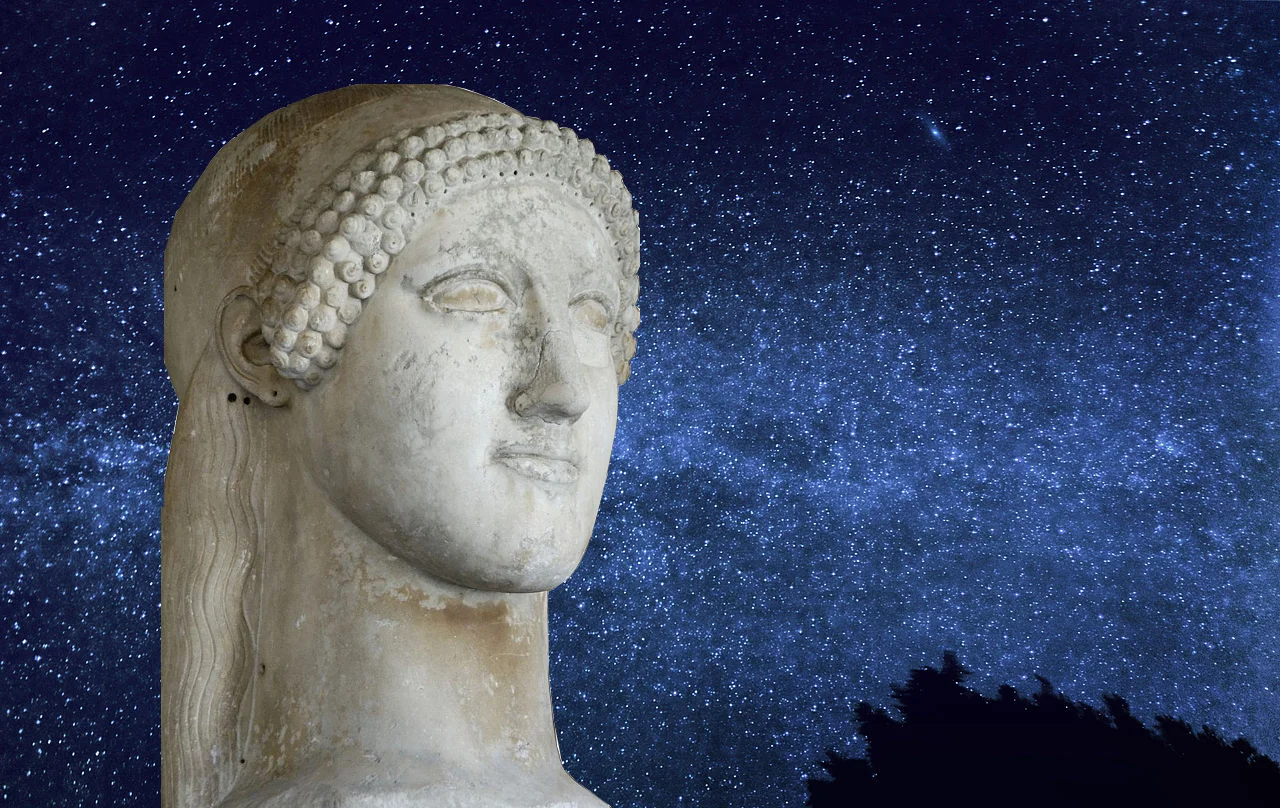
One of the clear messages of all of the Star Myths of the world is that you and everyone else you meet is a precious star, connected with, reflecting and containing the entire cosmos.
One of the clear messages of all of the Star Myths of the world is that you and everyone else you meet is a precious star, connected with, reflecting and containing the entire cosmos.
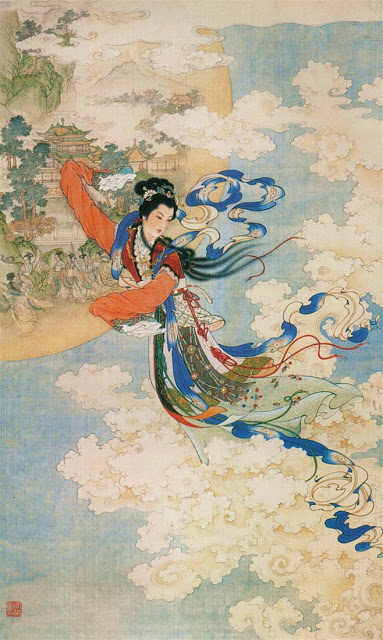
image: Wikimedia commons (link).
This Sunday, September 27, marks the beginning of the traditional celebration of mid-Autumn festival in China and Vietnam. It is a very ancient holiday, its observance stretching back to as early as 3600 years ago, and perhaps even earlier, and it is one of the most important holidays in Chinese culture. Great effort is usually made to travel and be with family on this day, much like Thanksgiving in the US, and for several days around the holiday many businesses and markets are closed as people make their way back to the places where they grew up, in order to celebrate with their extended families.
The Chinese characters for this holiday are 中 秋 節 which is pronounced Zhong Qiu Jie in Mandarin and Jung Chau Jit in Cantonese, and which translates literally into "Mid-Autumn-Day" or "Middle-Fall-Holiday" (or even more literally the "Mid-Autumn-Node").
Jung Chau Jit is celebrated on the fifteenth day of the eighth lunar month, the fifteenth day corresponding in general to the full moon in a lunar month (because a lunar month commences with a new moon, and the moon waxes for fourteen days to become full, which happens on the fifteenth day, and then wanes for fourteen more days to the point of another new moon), and so this festival always falls very close to or directly upon the day of a full moon, as it does this year.
Thus, the Mid-Autumn Holiday is also a Moon Festival, and is in fact often called the Moon Festival, and an important tradition during the days (weeks!) leading up to this holiday and on the day of the holiday itself is the giving of round "mooncakes," light gold in color and filled with a variety of different kinds of heavy, sweet fillings, and sometimes with a candied egg yolk:

image: Wikimedia commons (link).
These are traditionally served by being cut carefully into four equal quarters (a little combination cutting-and-serving implement, something like a small version of a cake trowel, is often included in commercially-sold mooncake boxes or packages), with each person present being given one section. The cakes themselves often have "blessing" words baked into the top of them.
Being a Moon Festival, the holiday is also closely associated with the Moon Goddess, pictured at top, whose name is 嫦 娥 which is pronounced Chang Er in Mandarin and Seung Ngo in Cantonese and translates rather directly into "Chang the Beautiful" or "Seung the Beautiful."
There is a legend about Seung Ngo and her husband, 后 羿 being banished from the heavenly realms by the Jade Emperor (whom we met in the earlier discussion of the Lantern Festival, which takes place in the first lunar month) and having to live down upon the earth as mortals (his name is pronounced Hou Yi in Mandarin and Hau Ngai in Cantonese, and it means something like "King Archer").
In the legend, he is distraught at the idea that his beautiful wife, having been banished from the celestial realms, is now faced with mortality, and so he seeks and eventually obtains an elixir of immortality which will restore their immortality to them. However, as so often happens in such myths, the plan goes awry, when she is forced to drink it all herself (either to keep it from a marauding robber who breaks in to steal it from her while her husband is away, or because she is overcome with curiosity while he is asleep, and drinks the whole elixir without knowing the consequences).
As soon as she does, she feels herself floating up into the heavens, without her unfortunate husband, who is left behind as a mortal. The two are thus separated forever, but Seung Ngo settles on the Moon, where she can look down upon Hau Ngai, and he can gaze up to her new home and think of her.
Having examined some of the most prominent aspects of this important ancient holy day, we are now in a position to benefit from the deep knowledge contained within its symbols and forms.
Because this poignant myth, and all the other symbols of the Mid-Autumn Festival, are powerful symbols which speak to truths about our incarnate existence, this existence in which we find ourselves crossing the "underworld" of the material realm in a physical body -- which is closely associated with the figure of the moon in the ancient system of celestial metaphor -- but doing so with the dimly-remembered awareness that we are separated from our true home (and disconnected from our higher "divine twin") during this earthly sojourn, and that we are in fact actually spiritual beings as much or more than we are physical beings.
The festival, positioned in the time of year next to fall equinox, contains the same symbols of a goddess and the fall from the celestial realm into the mortal incarnate life associated with the point of autumn equinox literally worldwide in the ancient myths.
Among them:

Clearly, then, the Mid-Autumn Festival preserves a great many symbols which carry a profound spiritual message, using the symbology of the moon (associated with incarnation), the casting down from the spiritual realms into incarnate existence (in the story of Hou Yi and Chang Er, or Hau Ngai and Seung Ngo), the myth regarding a married couple who are extremely close but who find themselves in the condition of one divine and one mortal (the "divine twin" pattern found around the world, including in the myth of Castor and Pollux but also of Jesus and Thomas and many others), the traditions of gathering with family and ordering our lives in accordance with the cycles of earth, sun, moon and stars, and the traditions of honoring our physical family and our parents, who brought us into this incarnate body in the first place.
It is also worth pointing out, in passing (although it could become a full-length examination and discussion) that a great many Chinese characters which use the symbol for "the moon" actually refer to our physical human body. The Chinese ideogram for "moon" is:
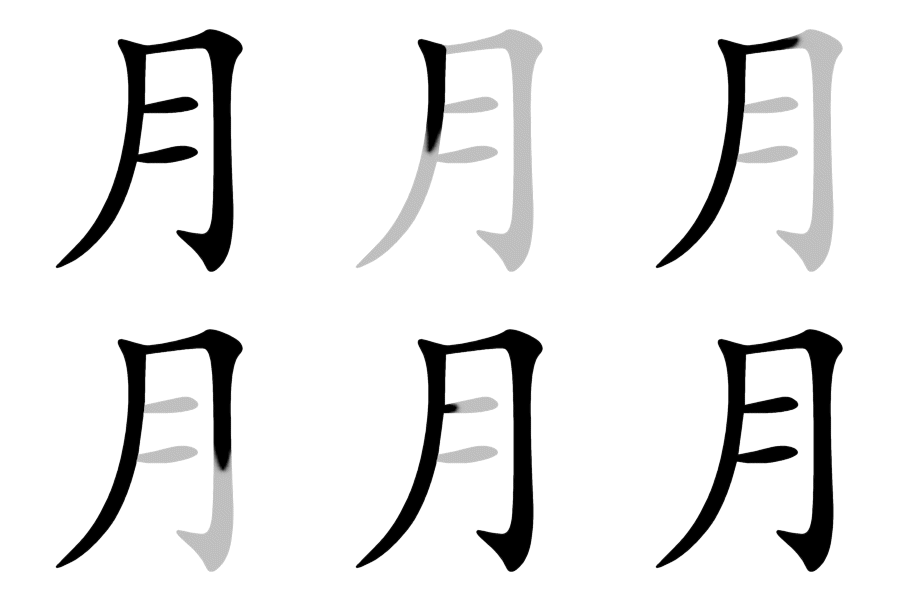
Other words whose ideograms use this as a "radical" in their Chinese character, and which relate to the physical human body, include:
The liver:
肝
The ribs or chest:
肋
The armpit, or arms:
肐
The elbow:
肘
Pelvis, groin or thighs:
胯
The diaphragm:
䐙
Internal organs, guts, viscera:
脏
A gland:
脃
Fat, plump, or obese:
䏜
And there are many others.
Some scholars or those familiar with Chinese radicals may argue that none of the above characters are actually connected with "the moon," even though the radical looks just like the Chinese symbol for the moon, because the actual radical for "meat" -- which looks like this --
肉
ends up looking like the symbol for "the moon" when it functions as a radical in a compound character.
That is a valid argument, but we must ask ourselves why that "meat" symbol turns into a "moon" symbol in all of these ideograms? The answer, of course, could very well be the fact that the ancient wisdom of the human race universally acknowledged an esoteric connection between the moon and the physical, corporeal, carnal ("meat") body.
And so it becomes clear that all of the symbology of the culturally significant and anciently-established Mid-Autumn-Festival can be shown to be connected to other mythological symbols used in other myths around the world -- all of them designed to impart to us profound gnosis regarding our human condition here in this incarnate life, including the fact that we are not merely physical beings but that our human nature consists of both a physical and a spiritual component, that our physical "moon" form (associated with water) is illuminated by our spiritual "solar" and divine nature (associated with fire and with air -- or spirit).
Now, very briefly, let us also note the fact that because the Mid-Autumn-Festival always falls on or very near a full moon, it will also periodically happen that this anciently-ordained observation will coincide with a lunar eclipse. Previous posts on the actual celestial mechanics of the moon phases (see here, here, and here) have explained why lunar eclipses must always coincide with a full moon, and why solar eclipses must always correspond to a new moon (not every full moon is a lunar eclipse, of course, nor every new moon a solar -- but every lunar eclipse occurs at full moon, and every solar eclipse occurs at new moon).
This September 27 full moon also happens to take place when the moon is passing through a "lunar node" (a "crossing point" with the plane of the ecliptic of the earth) and will therefore result in a total lunar eclipse visible for most of the Americas, Africa and Europe (see resources from Sky & Telescope regarding this eclipse available here).
Not only is this a total lunar eclipse, but it is also a total lunar eclipse which corresponds to the moon's closest approach on its orbit around the earth, when it is physically closer to us and thus appears physically larger in the sky -- all of which add up to the promise of a spectacular heavenly event this weekend.
This particular moon (all month long) is in fact known universally as the Harvest Moon (in China also), which is traditionally understood to be the brightest moon of the year.
All of these factors argue that this weekend's lunar eclipse should be worth going out and watching, if at all possible in your particular global location and circumstance.
As the moon enters the shadow of the earth, it will take on a dusky red hue -- which (only recently) has begun to be designated as a "blood moon" by some in the popular media and in certain evangelical circles (largely based upon a literalistic interpretation of certain Old and New Testament scriptures which I believe can be definitively shown to be esoteric in nature and not literalistic in nature). Scriptures in the Old and New Testament which describe the moon as turning to blood or being bathed in blood include the following texts:
Joel 2:31 "The sun shall be turned into darkness, and the moon into blood, before the great and terrible day of the LORD come."
Acts 2:20 "The sun shall be turned into darkness, and the moon into blood, before that great and notable day of the Lord come:"
Revelation 6:12 "And I beheld when he had opened the sixth seal, and, lo, there was a great earthquake; and the sun became black as sackcloth of hair, and the moon became as blood;"
Alvin Boyd Kuhn actually addresses many of these Biblical passages directly, and argues (with extensive textual evidence) that the description of the "moon becoming as blood" only emphasizes even more dramatically the esoteric symbolical connection between the moon and our physical body in this human life.
Discussing the passage cited above from Revelation 6, he explains among the metaphors given:
along with the darkness over the earth, the veiled sun, the blood-stained moon, is that "the stars from the heavens fell." In the same place we read that "when the message of the third angel was sounded forth, a great star went down from heaven and it fell upon the earth." Another star fell at the sounding of the trumpet of the fifth angel. The various legends, then, of falling stars become invested with unexpected significance as being disguised allusions to the descent of the angelic myriads to our shores , -- to become our souls. 116.
In other words, Kuhn here argues that the metaphors in Revelation 6 (and indeed throughout the Bible) all have to do with our incarnate condition, consisting of a "crossing" between spirit (symbolized by the sun) and matter (our material bodies, symbolized by the moon).
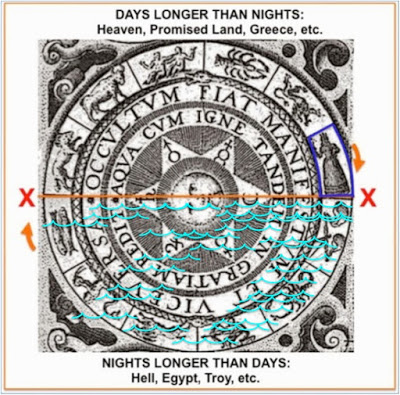
This interpretation (according to Alvin Boyd Kuhn) would include the metaphor of the earth being enshrouded by darkness -- because we plunge down to incarnation in the lower half of the zodiac wheel, as described in numberless previous posts. The lower half of the wheel is the half in which night triumphs over daylight (initiated by the fall equinox, when the hours of darkness begin to be longer than the hours of light, in each 24-hour period):
It would include (according to Kuhn) the moon being bathed in blood -- because the moon represents our incarnate condition, our sojourn in a body composed of water and blood and clay, our crossing of the "Red Sea" (which can be metaphorically seen to be the crossing which each and every human being undertakes, going through life in a human body through which courses the "red sea" of the blood in our veins and arteries).
It would include (according to Kuhn) the stars being cast out of heaven and forced to "fall upon the earth" -- for this is the very condition in which we find ourselves, as human souls who dimly realize that we come from a spiritual home, but who have been exiled (just like Hau Ngai and Seung Ngo) upon this material plane.
In other words, the passages in Revelation (and all the other esoteric Biblical scriptures) are describing our own human experience, our experience as divine beings who have been "crossed with" physical, material, animal bodies during this incarnate life.
And this is just what all the other Star Myths of the world are trying to convey to us as well! (Note that it can be conclusively demonstrated that the passages of the book of Revelation involving the opening of the seven seals are absolutely based upon metaphorical descriptions of the constellations in our night sky, as I demonstrate briefly in this previous post regarding Revelation Chapter 9: they are all allegorical celestial metaphors which use the awe-inspiring motions of the heavenly cycles to convey truths to us about the invisible realm).
Indeed, all of these metaphors and sacred scriptures are designed to convey to us the very same truths conveyed through the ancient metaphors connected to the Mid-Autumn-Festival celebrated in China and Vietnam and some other surrounding cultures from time immemorial.
As the day of the first full moon after fall equinox approaches, it is a time for contemplation and reflection upon our human condition in this incarnate life -- our "plunge into matter" which in ancient myth was associated with the point of the fall equinox, with the goddess at the edge of the ocean (or the goddess of the Moon), and with the "crossing" of our divine nature with a physical body.
And yet, even as we are plunged into this physical human form, we are given forms and symbols and myths and stories and scriptures to remind us that this material world that is visible and perceptible to our senses is not all that there is, and that this physical "animal" human body we inhabit is not all that we are.
Just as the moon is illuminated by the fire of the sun's life-giving rays, so our material nature is illuminated and animated by a higher spiritual self that exists "above and beyond" our merely physical carcass.
Just like the mooncake in the Jung Chau Jit celebration, which is divided and quartered into four equal sections, we ourselves are made up of a "cross," a "crucifix," a "quartered whole" consisting of both a horizontal line (between the equinoxes, and associated with matter) and a vertical line (between the solstices, reaching towards infinity, and associated with all that is spiritual, and with raising the spiritual aspect within ourselves and with calling it forth in those we meet and indeed in all of creation around us).
I sincerely wish you a very blessed Mid-Autumn Festival, and harmony between the microcosm and macrocosm. May all beings be freed from suffering and filled with peace and joy, love and light.
The ancient wisdom imparted to humanity in the myths, sacred stories, and scriptures found literally around the world is built upon a system that ties our motions in this incarnate life to the great cycles of the heavens -- the motions of the sun, moon, stars, and planets, and the multiple cycles of the earth including its rotation, annual orbit, and ages-long precessional motion.
Our lives here on earth, in our human bodies, reflect and echo the great movements of the celestial spheres -- and the motions of those celestial orbits can be seen as depicting the spiritual drama of each and every human soul journeying through this incarnate existence on earth.
All the sacred scriptures and stories of the human race can be shown to dramatize the great heavenly cycles in order to convey profound spiritual knowledge for our benefit during our human experience.
Amazingly enough, the very symbols and characters with which those sacred myths were recorded (for those that were written down in texts) also reflect and embody the very same heavenly cycles and the spiritual teachings conveyed by those celestial motions!
In other words, just as each individual man or woman is a "microcosm" who can be said to contain and reflect the entire infinite universe (that is to say, the "macrocosm"), so also each individual letter or hieroglyph or symbol can be seen to act as a sort of "microcosm" of its own, containing and conveying the same spiritual message that is found in the body of sacred scripture which is made up of all those individual letters and symbols.
Today, at a special point in the heavenly cycles seen as having great significance in the ancient myths of the human race, we will examine some ways in which the individual letters and symbols contain and reflect the same message conveyed by the ancient scriptures and myths themselves.
The earth will cross through the point of autumnal equinox at 01:22 am Pacific Time on September 23 this year (2015). This is the same as 08:22 am Greenwich time on September 23.
The "calendar date" of the solstices and equinoxes shifts slightly from year to year, due to the fact that the earth does not rotate on its axis an exactly-even number of rotations from one point of equinox or solstice to the next from year to year: in other words, it rotates 365.242 times before coming back to the same point relative to the sun from one year to the next, which is why measuring from solstices and equinoxes is actually more precise than using the various calendar systems when figuring out where we are relative to the sun, and why calendar systems have to use various types of "correction mechanisms" (such as intercalary days or leap-years) to keep the calendar days from "slipping" too far from the mechanics of the earth-sun relationship.
Because of this fact, we can expect the autumnal or fall equinox to occur on September 22 in most years, but it will occasionally take place on the 21st or the 23rd.
The point of fall equinox is a "crossing point" at which the ecliptic path of the sun during the day crosses below the celestial equator, after being above it through the summer months (in fact, from the point of spring equinox, up through the summer solstice, and all the way back down until reaching fall equinox). In other words -- and all descriptions here are for an observer in the northern hemisphere -- the arc of the sun's path through the sky has been higher than the celestial equator, which is that invisible line in the sky that traces an imaginary great circle 90-degrees down from the north celestial pole (very close to Polaris, the North Star).
The arc of the sun through the sky during the day has been north of that line (closer to the north celestial pole, higher-up from the southern horizon) as it traverses from east to west.
Now the arc of the sun will be lower than that celestial equator-line in the heavens, and closer to the southern horizon, and thus the angle of the sun's rays on the northern hemisphere will be less steep and more shallow, and the hours of darkness will begin to be longer than the hours of daylight. This effect will increase as we hurtle towards the point of winter solstice: the arc of the sun's path will be lower and lower, the angle of the sun's rays will be shallower and shallower, and the hours of darkness will be longer and longer.
(Of course, for observers in the southern hemisphere, this point of fall equinox for the northern hemisphere is actually their spring equinox, because as the sun's arc gets further and further south, it is actually higher in the sky for them, as it gets closer and closer to the south celestial pole, and higher and higher above the north horizon).
As has been explained in many previous posts on this subject, the ancient scriptures of the world used these awesome heavenly cycles to depict truths about invisible aspects of our simultaneously spiritual-material universe, and about our human condition as spiritual beings "cast down" into physical-material bodies here in this incarnate life.
The point of equinox, at which the sun's path falls below the celestial equator-line, plunging the world into the half of the year in which darkness dominates over daylight, was used as a metaphor to convey truths about our plunge down from the realm of pure spirit into the realm of matter. Here at the fall equinox, the upper half of the year (associated with the spiritual realm and the "higher elements" of Air and Fire) gave way to the lower half of the year (associated with the material realm and the "lower elements" of Earth and Water).
Below is a diagram, familiar to regular readers of this blog from previous posts such as this one, this one, and this one, showing the Great Circle of the year with the points of equinox marked with a red "X" at each equinox: the spring equinox for the northern hemisphere on the left (in the "9 o'clock position" if this was a clock face) and the fall equinox on the right (in the "3 o'clock position"). The progress of the earth through the year is clockwise in this diagram (from the spring equinox "X" at the "9 o'clock position," we proceed upwards to the summer solstice at 12 o'clock, and then start back downwards to the autumnal crossing point at 3 o'clock).

The "upper half" of this circle of the year is the fiery half, the heavenly half -- representative of the realm of spirit, the realm of the gods, and the spiritual part of our nature.
The "lower half," on the other hand, was the realm of matter and gross incarnation in bodies of "clay" (combining the "lower two elements" of earth and water) -- and it was often metaphorically connected with water, the ocean, the sea, the deep, and the underworld.
In the diagram above, I have attempted to illustrate this metaphor by adding watery ocean waves to the lower half of the circle.
The point of autumn equinox is the point at which we "plunge" down into this incarnate lower realm: the point at which we dive down into the sea, so to speak. And there, at the autumn equinox, guarding the gate to the incarnate realm, standing at the point of the plunge into the ocean, we see the zodiac sign of Virgo the Virgin (for the Age of Aries, which can be seen to be operating in many of the ancient myths of the world, although there are also abundant references to the earlier Age of Taurus and the even earlier Age of Gemini in the world's myths as well).
Interestingly enough, figures in the ancient myths associated with the sign of Virgo and with the plunge down into incarnate existence are often goddess figures, often mother figures, and often have names or mythological attributes which explicitly connect them with the sea or the ocean.
The most obvious of these, perhaps, is the New Testament figure of Mary (or Maria) -- whose name contains a root word mar or mare which means "ocean" or "sea" (and which can be found in many English words connected to the sea, such as "mariner" or "marine life" and even "to marinade").
Another example is Tiamat, a creator goddess of ancient Sumerian and Babylonian myth associated with the primordial sea, and whose name was similarly synonymous with the ocean.
Even the goddess Aphrodite or Venus was strongly associated with the sea -- and in fact, with the very "edge of the sea" or the "verge of the sea," and with the sea-foam in particular (the name Aphrodite, in Greek, was associated with the word aphros, meaning "sea-foam," although some scholars also attest there may be an etymological connection as well to the name of the goddess Ishtar or Astoroth or Astarte).
All of these heavenly figures are mother figures (Aphrodite or Venus was the mother of Aeneas, for example, the central figure in the Aeneid) and are simultaneously associated with the sea -- and this is appropriate for the fact that our plunge down into this incarnate life, this "lower half" of the wheel, this crossing of the Red Sea, begins for each of us at our human birth. Every person who ever lived has a mother, to whom we each are indebted for our material life, our very incarnate existence.
It is fascinating to observe that this connection between "mother" and "sea" or "ocean" is contained in the very letters or symbols with which we convey thoughts in the form of writing: for instance, the words for "mother" in many, many languages of the world begin with the sound we write in the alphabet that is derived from Phoenician, Greek, and Roman sources as "M" or "m" -- a symbol which is clearly reminiscent of waves of water or the ocean's rollers.
In the Chinese characters, this connection between "mother" and "ocean" is even more clearly visible, in the characters for "mother" and "ocean," of which the symbol for "ocean" is built from the symbol for "mother," with a "radical" known as the "three water dots" or drops added, as well as a kind of crowning symbol sometimes known as the "top of mei" radical (radical 20 in the chart of modern radicals).
Here is the Chinese character for "mother" (pronounced mu in Mandarin and mou in Cantonese, both of which preserve the "m-sound" associated with the word mother around the world):
And here (and also at the top of this post) is the closely-related Chinese character for "ocean" or "sea," which is pronounced hai in Mandarin and hoi in Cantonese, and can be found in words such as Shanghai and hoi sin sauce:
In other words, the Chinese characters themselves (which are very ancient) appear to convey the same connection between "mother" and "ocean" which is found in the figures of Mary, Tiamat, Aphrodite and many others, and which is connected to the celestial cycle associated with the fall equinox and the plunge down into this lower realm, this world of matter (the very word "matter," as has been pointed out by many observers, also being linguistically very close to the word for mother or mater from which we get modern English words such as "maternal").
The characters themselves contain "microcosmic" representations of the spiritual messages conveyed by the ancient myths and sacred stories.
Nor do the esoteric connections of the ancient Chinese characters stop there. If they did, some might argue that attempts to find spiritual messages in the characters are stretches of the imagination, built upon mere coincidence or the "random," undirected development of the characters over the centuries.
But, this same sort of connection can be seen in other Chinese characters as well.
For example, the character for a "temple" is composed of the character for "earth" (which interestingly enough is symbolized by a "cross of matter" upon a horizontal "ground" that is wider than the cross-bar of the cross) above the symbol for a Chinese "inch" -- an "inch of earth," so to speak. The "inch-measurement" symbol is shown below, and was apparently derived from a symbolic depiction of a thumb (appropriately enough, for the measurement of an inch):
So, that is the symbol for an "inch," and if we write the symbol for "earth" above that, we get the character for a "temple," shown below:
This connection of an "inch of earth" with a "temple" is full of important meaning worthy of careful consideration.
A temple is a sacred space -- a place which is set apart from the simply material and which is specifically designed to invoke the invisible realm, the world of spirit, the world of the divine. And yet it is clearly a space that is connected with the measurements and the motions of the great spheres of the heavens and the great sphere of the earth -- because we ourselves reflect and embody the infinite universe in our individual bodies, and because the teachings given in the various temples and sacred spaces around the world have to do with harmonizing our motions with the motions of the spheres and cycles of the heavens and of the earth.
The fact that the character for a temple in the Chinese calligraphy is composed of the characters for "an inch" of "earth" connects the idea of the sacred space with the measurements and motions of our planet and the cosmos. Note that a measurement of distance on our planet is always simultaneously a measurement of time: "seconds" and "minutes," for example, are obviously measurements of time, but they are also defined as a specific distance-measurements, and are intended to relate to the amount of distance the earth rotates in those periods of time.
We should not be at all surprised, then, to find that the Chinese character for "time" is composed of the symbol for "temple," with the addition of the symbol on the left (the radical) which represents the sun. Thus, a temple is connected not only to an "inch of earth" but also to specifically evoke the presence of the sun in addition to the rotation of the earth, and by extension could be though of as the space in which the rays of the sun move across the rotating earth. The ancient Egyptian Temple of Karnak comes immediately to mind.
Here is the character for "time":
Note, too, the significant fact that the word for "temple" in English contains the root temp which means "time" and which forms the basis for many other "time-related" words such as "temporary" or "tempo" or "tempest" or "temporal." In other words, both the Chinese characters and the western-language words for a temple preserve this connection between the sacred space and the majestic motions of the sun, moon, stars and planets which translate into our understanding and measurement of time.
Finally, it is also very interesting and significant that the character for "poem" or "metered verse" in the Chinese calligraphy once again contains the character for a "temple," this time adding the radical for "words," which is the flattened-square character symbolizing a human mouth, with four lines above it as if they are words or lines of speech floating upwards from the mouth, just the way that words or letters sometimes float up out of the mouths of characters on Sesame Street (and which, when I was little, I thought would visibly float up out of my mouth also, if I made the sound of a "z" for example).
And so this character seems to be telling us that poetry is a form of sacred speech, or speech for the temple, or words that connect to the invisible realm -- and indeed many ancient myths are written in verse form (from the Vedas of India and the Mahabharata with the Bhagavad Gita, to the poems of Homer and Pindar and Ovid, to the verses of many of the Biblical scriptures).
It is also indicating, of course, that poetry is a form of metered (or "measured") language, which is to say that it is language that has a "time component" to it (a certain number of beats per line), and which thus connects it to the motions of the spheres and to the temp in temple and tempo, as well.
Below is the Chinese character for poetry (the word shi in Mandarin and si in Cantonese):
In all of these investigations of the symbols used to convey and preserve the ancient wisdom of the human race, we can clearly perceive the thread of the same central teaching: that we have plunged down into a material world, but that the material world is only "half" of the circle, so to speak.
We are being reminded in all of these myths and in fact in the very letters and characters and symbols used to preserve the myths themselves that we are also spiritual beings, intimately connected to the heavenly realm, the spiritual realm, the realm of the divine, the realm of the infinite.
The ancient traditions involved aligning our lives to the motions of the planets and stars, in part through the recognition of certain special points on the great cycles -- including the point of the equinoxes, two of the most significant stations in all the motions of the heavens and the earth. The aligning of our microcosmic motions to the macrocosmic spheres involved the creation of and visits to sacred spaces, as well as the recitation of verses (sacred speech, or "temple speech" -- metered language) and the singing of certain songs (singing also being a form of poetry or special metered speech).
All of this ancient knowledge can be found literally around the globe, embodied not only in the myths and stories but also in the writing-systems and in the geometry and architecture and measurements and alignments used in the temples and monuments found all across our planet.
On this moment of autumnal equinox, we might all want to pause to reflect upon and be thankful for our own human mother, who gave us this human form we inhabit (the body being specifically referred to as a temple in ancient scripture) and indeed this very life itself.
Which brings us to one more Chinese ideogram, this one for the word "good," which is literally composed of the symbol for a "woman" (slightly different from but symbolically related to the character for "mother" that we have already seen) plus the symbol for a child (the mother first, on the left, and the child character found to the right). It is very good that we each had a mother, or we would not even be here in the first place! And so we should all be able to agree that depicting the character for "good" as a mother with child is extremely appropriate, and relates on some level to all of the other concepts that we have been exploring in this little study.
Below is the character for "good":
In all of the above calligraphy, I am indebted to the outstanding teaching found in the indispensable little volume, Learn to Write Chinese Characters, by Johan Bjorksten (1994), which examines the aesthetics and "design" of the characters, their balance and form and shape and harmony.
In it, he explains the tremendous importance of calligraphy in Chinese culture, and the great weight attached to writing the characters correctly. On page 2, he writes:
Calligraphy, the art of writing, is considered in China the noblest of the fine arts. At a very early stage in history it became an abstract and expressionist art form, where meaning is of secondary importance and aesthetic expression the prime concern. Many Chinese hold that calligraphy prolongs the writers' lives, sharpens their senses, and enhances their general well-being. By practicing calligraphy you can achieve a glimpse into Chinese aesthetics and philosophy and learn to appreciate an abstract art form.
He also explains that Chinese calligraphy is traditionally learned through writing-out classic poetry -- which clearly connects yet again to all the concepts we have been exploring here (i.e., the letters themselves are sacred and relate to the realm of forms, and they are explicitly connected to and practiced through the medium of poetry, which is a form of special metered speech, the very character of which is connected to the character for a temple).
Writing Chinese calligraphy, in fact, can be a form of meditation -- in which doubts and second-guessing will ruin the desired outcome and the best results require a kind of "action without action" described in the Tao Te Ching or the Bhagavad Gita. The structure of the characters themselves obey certain principles of balance and proportion and architecture, as Johan Bjorksten beautifully conveys in his text and his examples, and thus can even be thought of as "sacred spaces" all their own.
Any egregious errors or disharmony in the above examples of Chinese characters, of course, are entirely my own responsibility and no reflection on anyone else.
Wishing you harmony and balance at this moment of September equinox, 2015.

image: Wikimedia commons (link).
The Bhagavad Gita explicitly connects the state of "action without attachment to results" and the ability to bring the mind under the control of the Higher Self.
In order to achieve the state of acting without attachment -- which some verses also describe as "actually doing nothing at all" even while acting -- it says that the mind must be brought under control.
In the sixth verse of the sixth chapter of the Bhagavad Gita, Krishna tells Arjuna that, for the one who has learned how to control the mind, the mind is the best of friends -- but for the one who has not, the mind can resemble the worst of enemies.
The good news is that Krishna explains that we can, with practice, bring the mind under our control -- and that this practice is also the best way to come into contact with the Higher Self.
In chapter 6 verses 33 and 34, Arjuna expresses doubts about the ability to ever bring the mind under control, due to its flickering and unsteady nature.
"For the mind is restless, turbulent, obstinate, very strong, O Krishna," Arjuna says, "and to subdue it, I think, is more difficult than controlling the wind" (6.34).
Krishna acknowledges that it is "very difficult to curb" the mind, but also tells Arjuna that "it is possible by suitable practice and by detachment" (6.35).
He advises the regular practice of meditation in a secluded location, while alone, providing some very specific instructions which begin in verse 10 of chapter 6:
10 One perfecting the science of uniting the individual consciousness with the Ultimate Consciousness, consistently residing alone in a secluded place engaged in controlling the mind, desireless, free from proprietorship [translated here as "feelings of possessiveness"], should meditate on the inner self.
11 In a sacred and purified place after establishing a seat neither too high nor too low of kusa grass, deerskin or natural cloth;
12 thereupon sitting firmly on that seat controlling the mind and activities of the senses making the mind one-pointed; one in realization should meditate by the science of uniting the individual consciousness with the Ultimate Consciousness for purifying the mind.
13 Holding the physical body, head and neck straight, unmoving and stable, gazing upon the tip of the nose and not glancing in any direction, fixed in the vow of celibacy,
14 with an unagitated mind, fearless, completely subduing the mind; the renunciate should sit concentrating upon Me as the Ultimate Goal.
Thus, in verse 14, the Lord Krishna explains that the yogi should focus entirely upon Krishna -- while only a few verses later, in verse 19 of the same chapter, the Lord Krishna describes the mind thus concentrated as focused upon or resting steadily in the Higher Self:
19 As a lamp in a windless place does not waver, so the transcendentalist, whose mind is controlled, remains always steadying his meditation on the transcendent self.
From these passages, then, I believe we can make the case that the teaching described using the imagery of Arjuna and the divine Krishna is teaching very much the same thing as that which is being conveyed through the parallel imagery of Thomas and the Divine Twin found in the New Testament gospel of John and in texts found at Nag Hammadi such as the Gospel of Thomas and the Book of Thomas the Contender (see previous posts discussing these texts here, here and here).
Or, stated the other way around, the metaphor of Thomas Didymus (the Twin) is trying to give us the same understanding that Krishna is here imparting to Arjuna in the Bhagavad Gita.
The mind is always unsteady, prone to rushing off in different directions -- as is Thomas in the New-Testament-era texts discussed in the posts linked above. It is full of doubts, as is Arjuna in the Bhagavad Gita, when Arjuna expresses to Krishna his doubt that the mind can ever be controlled at all.
And yet, Thomas has a divine counterpart with whom he is already inextricably linked -- with whom he is "twinned," one who is already "closer than a brother" to him, although he does not always act like it. This is the divine twin -- the transcendent self or the Higher Self described in the Bhagavad Gita using different language, and described in the letters of Paul as the "Christ within."
We can catch glimpses of this unwavering, transcendent divine twin below or beneath the endless flickering of our mind as we learn to stop letting the mind carry us wherever it is "blowing" from one moment to the next -- and when this happens our mind stops becoming our "worst enemy" and begins to become a tool that we control instead of one that controls us.
Beginning each day by following some of the specific recommendations given in the sixth chapter of the Gita (such as the recommendations of using a meditation cushion, one that is neither "too high nor too low," assuming good upright posture, not closing the eyes completely but rather gazing downward in the direction of the tip of the nose [or, as 5.27 and 28 say, "keeping the eyes and vision concentrated between the two eyebrows," in the region of the third eye], and focusing the mind on one point, while "suspending the inward and outward breaths within the nostrils [5.27-28]) can help us to begin to gain control over the mind, which Lord Krishna tells Arjuna in 6.36 is -- in his opinion -- the most practical and appropriate path towards uniting with the Higher Self.
Interestingly enough, in light of the assertion being made that the allegory of Thomas and the Divine Twin is intended to convey the same message found in the Bhagavad Gita chapters 5 and 6, Krishna tells Arjuna that the one who gains full consciousness of the Higher Self -- the one who attains awareness of Krishna -- will "attain peace" (5.29).
It is quite evident from a reading of the New Testament scriptures that the Christ regularly greets his followers with the word "peace" and that he very memorably promises them his peace, such as in John 14:27.
The Bhagavad Gita suggests that it is only by bringing the mind out of its "flickering, doubting" mode and under the control of the Higher Self that we are able to achieve this peace, which is characterized by complete detachment from either the fear of the consequences of right action or desire for benefits from its successful outcome. Instead, we can simply focus on doing what is right, without being beset by doubt. In 5.25, for example, Krishna tells Arjuna:
Those who are beyond the dualities that arise from doubts, whose minds are engaged within, who are always busy working for the welfare of all living beings, and who are free from all sins [which 5.10 has already explained comes from freedom of attachment and surrender to the Supreme], achieve liberation in the Supreme.
Incredibly enough, the bringing of the mind beneath the control of the Lord, and the release from doubt through the surrender to the Supreme, appears to be exactly what is dramatized in the famous episode of "Doubting Thomas" found in John, chapter 20.
I believe that the Gita tells us how to pursue this uniting of the "Thomas-mind" to the Supreme Lord every single day, through very practical direction and the promise that, while at first difficult, with discipline "it is possible," through suitable practice and detachment.
When the two "twins" are united, then our mind can begin to become our "best friend" rather than our "worst enemy."
Because, as we learn to become less attached to the outcome and more in touch with the Higher Self, we are less "blown about by the wind" (the exact same metaphor used in the Bhagavad Gita 6.19, 33 and 34 is also used in the New Testament, in James 1:6), less wracked by doubt, and more prepared to do what is right, without attachment to the outcome.
And, Krishna also appears to be telling us in the Gita, this detachment is essential in order to be "always working for the welfare of all living beings," which is our duty.
Note that by explaining what I see in these ancient texts, I am not trying to imply (at all) that I myself have achieved this state! It is one thing to know what the texts are telling us, and quite another to achieve what they are describing.
But, even though Arjuna expresses his doubts to Krishna, and says that all of this seems to be harder even than controlling the wind, Krishna promises him that the path can be successfully followed -- and what is more, that eventually we are assured of success in this regard (although perhaps over the course of many incarnations).
(source link -- full transcript available here).
It is safe to say that the size, visibility, and intensity of the protest against the Vietnam War -- not only within the US but worldwide -- dwarfs anything that has developed during the fourteen years of US military action in the Middle East and elsewhere since 2001.
To say this is not to cast aspersions at those who are raising their voices for peace and against war in the present day -- far from it. It is simply stating an objective fact, impossible to deny, to say that the level of widespread turbulence that rolled through nearly every aspect of society during those years, focused primarily although not exclusively on opposition to that war, was on quite another level than anything seen since then, in terms of opposition to a war or military intervention.
For instance, there are a huge number of popular songs from that period which were seen as anti-war anthems. Just about anyone today, off the top of their head, could easily name one or more of the major antiwar songs from that period (especially if the person you ask is over the age of 40). On the other hand, trying to name an anti-war song with the same widespread impact from the past fourteen years would be much more challenging.
It is also a nearly undeniable fact that the size, breadth, and intensity of the anti-war sentiment during those years was a major factor in finally bringing about the end of the direct US military involvement in Vietnam.

image: Vietnam War protest, May 1970 (link).
If someone from 1967 who opposed that conflict were to be transported suddenly to today, he or she might be astonished at the lack of widespread voices for peace and against military intervention and war which continues with an intensity and level of destruction of human life that is as horrible as that which took place in that now-bygone decade.
The protests and outrage seem to have drained away between that era and this.
And yet many of the circumstances and US policy actions which led to the widespread moral outrage voiced from so many different outlets and from men and women of so many different walks of life during the 1960s and early 1970s can be applied directly to events taking place at home and abroad today.
In fact, when one reads the statements from some of the leading voices against the war from that time, such those delivered with such power by the Reverend Martin Luther King, Jr. in the speech above, from 1967, it feels as though they are talking directly to us today, and describing circumstances and actions and situations all too familiar.
For example, consider the following hard-hitting arguments found in the extended quotation from the speech below. Note first that one need not simply "read" the quotation -- you can actually hear Martin Luther King delivering them himself, in a recording made on the day he gave this speech in New York City, on April 4, 1967 -- exactly one year before the day he was murdered.
Most people have heard at least parts of his famous I Have a Dream speech. However, it is incredibly sad but true that far fewer have heard this speech, entitled Beyond Vietnam, at all -- let alone in its entirety. And yet, as Dr. King himself makes abundantly clear throughout this speech, he saw the issues he was speaking against with regard to the Vietnam War as stretching beyond Vietnam, and as related to all the other issues which he addressed and for which he is so well known.
They go so far beyond Vietnam that they apply very distinctly to this day and age in which we now find ourselves living.
The entire speech deserves to be heard in order to feel the full force of Dr. King's moral clarity, as well as to see the full scope of his carefully-developed argument.
If you have never listened to that speech which Martin Luther King gave on that day, I urge you to listen to it in its entirety. The full text and a link to the audio can be found here
(and other speeches by Dr. King are available at that same site, in a list found here).
You can also find it in the form of a file (options here) that could be downloaded to a portable device or onto a CD, in order to listen to it while driving, and by hearing it more than once gain a greater appreciation for the connections he is pointing out.
Lest some mistakenly protest that by speaking against the US war in Vietnam, Dr. King was displaying a lack of concern for the people of Vietnam, who had experienced severe oppression and brutalization under corrupt and criminal leaders, or for the "troops" -- the masses of largely conscripted draftees sent from the US and other countries to fight in Vietnam -- please consider carefully the following extended quotation from Dr. King's speech that day:
Now it should be incandescently clear that no one who has any concern for the integrity and life of America today can ignore the present war. If America's soul becomes totally poisoned, part of the autopsy must read: "Vietnam." It can never be saved so long as it destroys the hopes of men the world over. So those of us who are yet determined that "America will be" are led down the path of protest and dissent, working for the health of our land.
[. . .]
And as I ponder the madness of Vietnam and search within myself fro ways to understand and respond in compassion, my mind goes constantly to the people of that peninsula. I speak now not of the soldiers of each side, not of the ideologies of the Liberation Front, not of the junta of Saigon, but simply of the people who have been living under the curse of war for almost three continuous decades now. I think of them, too, because it is clear to me that there will be no meaningful solution there until some attempt is made to know them and hear their broken cries.
They must see Americans as strange liberators. [. . .] Now they languish under our bombs and consider us, not their fellow Vietnamese, the real enemy. They move sadly and apathetically as we herd them off the land of their fathers into concentration camps where minimal social needs are rarely met. They known they must move on or be destroyed by our bombs.
So they go, primarily women and children and the aged. They watch as we poison their water, as we kill a million acres of their crops. They must weep as the bulldozers roar through their areas preparing to destroy the precious trees. They wander into the hospitals with at least twenty casualties from American firepower for one Vietcong-inflicted injury. [. . .]
We have destroyed their two most cherished institutions: the family and the village. We have destroyed their land and their crops. We have cooperated in the crushing of the nation's only noncommunist revolutionary political force, the unified Buddhist Church. We have supported the enemies of the peasants of Saigon. We have corrupted their women and killed their men. [. . .]
At this point I should make it clear that while I have tried to give a voice to the voiceless in Vietnam and to understand the arguments of those who are called "enemy," I am as deeply concerned about our own troops there as anything else. For it occurs to me that what we are submitting them to in Vietnam is not simply the brutalizing process that goes on in any war where armies face each other and seek to destroy. We are adding cynicism to the process of death, for they must know after a short period that their government has sent them into a struggle among Vietnamese, and the more sophisticated surely realize that we are on the side of the wealthy, and the secure, while we create a hell for the poor.
Surely this madness must cease. We must stop now. I speak as a child of God and brother to the suffering poor of Vietnam. I speak for those whose land is being laid waste, whose homes are being destroyed, whose culture is being subverted. I speak for the poor in America who are paying the double price of smashed hopes at home, and dealt death and corruption in Vietnam. I speak as a citizen of the world, for the world as it stands aghast at the path we have taken. I speak as one who loves America, to the leaders of our own nation: Thegreat initiative in this war is ours; the initiative to stop it must be ours.
This is the message of the great Buddhist leaders of Vietnam. Recently one of them wrote these words, and I quote:
"Each day the war goes on the hatred increases in the hearts of the Vietnamese and in the hearts of those of humanitarian instinct. The Americans are forcing even their friends into becoming their enemies. It is curious that the Americans, who calculate so carefully on the possibilities of military victory, do not realize that in the process they are incurring deep psychological and political defeat. The image of America will never again be the image of revolution, freedom, and democracy, but the image of violence and militarism." Unquote.
If we continue, there will be no doubt in my mind and in the mind of the world that we have no honorable intentions in Vietnam. If we do not stop our war against the people of Vietnam immediately, the world will be left with no other alternative than to see this as some horrible, clumsy, and deadly game we have decided to play. The world now demands a maturity of America that we may not be able to achieve. It demands that we admit we have been wrong from the beginning of our adventure in Vietnam, that we have been detrimental to the life of the Vietnamese people. The situation is one in which we must be ready to turn sharply form our present ways. In order to atone for our sins and errors in Vietnam, we should take the initiative in bringing a halt to this tragic war.
I would like to suggest five concrete things that our government should do to begin the long and difficult process of extricating ourselves from this nightmarish conflict:
Number one: End all bombing in North and South Vietnam.
Number two: Declare a unilateral cease-fire in the hope that such action will create the atmosphere for negotiation.
Three: Take immediate steps to prevent other battlegrounds in Southeast Asia by curtailing our military buildup in Thailand and our interference in Laos.
Four: Realistically accept the fact that the National Liberation Front has substantial support in South Vietnam and must thereby play a role in any meaningful negotiations and any future Vietnam government.
Five: Set a date that we will remove all foreign troops from Vietnam in accordance with the 1954 Geneva Agreement.
Part of our ongoing -- [applause continues] -- part of our ongoing commitment might well express itself in an offer to grant asylum to any Vietnamese who fears for his life under a new regime which included the Liberation Front. Then we must make what reparations we can for the damage we have done. We must provide the medical aid that is badly needed, making it available in this country if necessary. Meanwhile -- [applause] -- meanwhile, we in the churches and synagogues have a continuing task while we urge our government to disengage itself from a disgraceful commitment. We must continue to raise our voices and our lives if our nation persists in its perverse ways in Vietnam. We must be prepared to match actions with words by seeking out every creative method of protest possible.
As we counsel young men concerning military service, we must clarify for them our nation's role in Vietnam and challenge them with the alternative of conscientious objection. I am pleased to say that this is a path now chosen by more than seventy students at my own alma mater, Morehouse College, and I recommend it to all who find the American course in Vietnam a dishonorable and unjust one. Moreover, I would encourage all ministers of draft age to give up their ministerial exemptions and seek status as conscientious objectors. These are times for real choices and not false ones. We are at the moment when our lives must be placed on the line if our nation is to survive its own folly. Every man of humane convictions must decide on the protest that best suits his convictions, but we must all protest.
Now there is something seductively tempting about stopping there and sending us all on what in some circles has become a popular crusade against the war in Vietnam. I say we must enter that struggle, but I wish to go on now to say something even more disturbing.
The war in Vietnam is but a symptom of a far deeper malady within the American spirit, and if we ignore this sobering reality -- if we ignore this sobering reality, we will find ourselves organizing "clergy and laymen concerned" committees for the next generation. They will be concerned about Guatemala and Peru. They will be concerned about Thailand and Cambodia. They will be concerned about Mozambique and South Africa. We will be marching for these and a dozen other names and attending rallies without end unless there is a significant and profound change in American life and policy. So such thoughts take us beyond Vietnam, but not beyond our calling as sons of the living God.
[. . .]
A true revolution of values will lay hand on the world order and say of war, "This way of settling differences is not just." This business of burning human beings with napalm, of filling our nation's homes with orphans and widows, of injecting poisonous drugs of hate into the veins of people normally humane, of sending men home from dark and bloody battlefields physically handicapped and psychologically deranged, cannot be reconciled with wisdom, justice, and love. A nation that continues year after year to spend more money on military defense than on programs of social uplift is approaching spiritual death.
America, the richest and most powerful nation in the world, can well lead the way in this revolution of values. There is nothing except a tragic death wish to prevent us from reordering our priorities so that the pursuit of peace will take precedence over the pursuit of war. There is nothing to keep us from molding a recalcitrant status quo with bruised hands until we have fashioned it into a brotherhood.
[. . .]
We can no longer afford to worship the god of hate or bow before the altar of retaliation. The oceans of history are made turbulent by the ever-rising tides of hate. History is cluttered with the wreckage of nations and individuals that pursued this self-defeating path of hate.
[. . .]
We still have a choice today: nonviolent coexistence or violent coannihilation. We must move past indecision to action. We must find new ways to speak for peace in Vietnam and justice throughout the developing world, a world that borders on our doors. If we do not act, we shall surely be dragged down the long, dark, and shameful corridors of time reserved for those who possess power without compassion, might without morality, and strength without sight.
Now, some readers may be wondering what yesterday's post and today's topic, as important as they are, have to do with the subject of ancient wisdom and the analysis of the sacred myths, traditions, and scriptures of humanity.
Let me take a moment to clarify the connection.
First, it is quite evident from Dr. King's speech that he was in large part motivated, moved, and compelled to take the stand that he took from his correct reading of the true message of the ancient wisdom of humanity, preserved in the scriptures of the human race.
I believe that a central message in the ancient myths, scriptures and sacred traditions (which we can refer to as the "ancient wisdom" for the sake of brevity) entrusted to the human race is the message that each individual man, woman and child is not just a physical, material, "animal" being but instead is a spiritual, invisible, immaterial, and in fact divine nature which is "crossed" with a physical and material component during this incarnate life.
That this invisible and spiritual component in each individual man, woman and child is in fact infinite in nature and reflects and resonates with the entire infinite cosmos -- a concept expressed in the principle of "as above, so below" and in many other allegorical ways that the ancient wisdom traditions use to try to convey this truth to us.
As such, each and every individual man, woman and child has inherent and inalienable dignity and inherent and inalienable rights, and that violence against the person or the dignity and rights of any individual man, woman or child is a crime against the entire balance of the universe, and is in fact a crime of infinite proportion (because the invisible and spiritual component in each person is infinite in nature, reflecting the infinite universe around and within him or her).
This message is so clearly present in the ancient myths that it hardly bears debate or discussion -- although it is true that mistaken and especially literalistic misinterpretation of the ancient wisdom of humanity can lead some to obscure, miss, or even totally invert that message (see for example previous discussions here, here, here and here).
I believe it can also be shown that another very central (and closely related) message in the collective body of scriptures, traditions and myths containing this ancient wisdom is the admonition to do what is right, without attachment to the consequences of doing what is right.
This aspect is of course related to the first aspect, in that doing what is right generally involves upholding and enhancing the dignity of others, working towards the elevation and acknowledgement of the spiritual aspect within ourselves and others and indeed in the rest of creation around us -- and simultaneously working against that which tends to degrade or deny or beat down the spiritual aspect and to "reduce to the physical" or "reduce to the animal" in ourselves and in others and indeed in the rest of creation around us.
This can also be expressed as blessing rather than cursing (a theme which is powerfully evident throughout the scriptures of the Old and New Testaments as well as throughout other containers of humanity's ancient wisdom found literally around the world).
The central message of doing what is right, without regard for the outcome can be found at the heart of the Bhagavad Gita, for example, where the Lord Krishna begins an extended teaching to Arjuna in chapter 6 with the words:
anasritah karma-phalam karyam karma karoti
yah sa sannyasi ca yogi ca na niragnir na cakriyah.
Which the translation found on this website indicates to mean (I paraphrase):
without expectation of the result of the actions
enacting obligatory prescribed actions
that one is truly a yogi
not one without prescribed duties (i.e. the definition of a yogi is not to be misunderstood to mean "one without prescribed duties")
nor one who merely follows the ascetic path of renunciation.
In other words, the path of ancient wisdom was not meant to be misunderstood as teaching "non-action" or abdication of one's duty and obligation towards the cosmos and other creatures and other human beings -- far from it.
The paradox of "non action" means "acting as if not acting" -- that is, as if completely unattached to the outcome in terms of "fear of consequences" or "hope for reward."
That is: Acting with the calm tranquility of one who is not acting. Not "not acting at all," but rather "acting with the calmness of one who is not even doing it."
Krishna spends much time elucidating this concept of "acting without acting" in the Gita, and the Tao Te Ching dwells upon the same message as well, using closely-related language and closely-related imagery, as explored by Professor Victor Mair in the afterword to his translation of the Tao Te Ching (an afterword which all by itself is worth more than the price of the book, even without counting the tremendous value of Professor Mair's translation of the Tao Te Ching, which of course is priceless).
Which brings us to the conclusion that the ancient wisdom imparted to humanity teaches us that we have a duty to do what is right, and teaches us to do that "without expectation of the result," or "without attachment to the result."
In that famous speech delivered in Riverside Church in New York City, the Reverend Martin Luther King, Jr. articulated a powerful message against the US war in Vietnam, and expanded that message to extend "beyond Vietnam" -- to encompass a duty to stand against brutalization and violence in other spheres of life including at home.
During that speech, he expressed the fact that he felt a duty to speak out about what he was seeing -- even while acknowledging that the issues were perplexing in their complexity, and that "the ambiguity of the total situation" and our own "limited vision" as human beings often brings us to "the verge of being mesmerized with uncertainty." He admits how difficult it is to move "against all the apathy of conformist thought within in one's own bosom and in the surrounding world" (and note that the Bhagavad Gita also portrays Arjuna as filled with doubt, mesmerized with uncertainty, acknowledging the doubts within his own bosom -- and it is here that Krishna meets him and explains to him about doing what is right regardless of and without attachment to the result).
And in that speech Martin Luther King also states quite explicitly what moves him to speak and act against the institutionalized violence and oppression he saw taking place, even in spite of all the internal resistance of doubt within his own bosom and in spite of all the external doubts expressed by others around him -- and he states quite clearly that it was the message he received from the ancient scriptures contained in the Bible, and the change that message had awakened in him, and the relationship he had with those teachings and with the personal divine force he encountered through them, that caused him to speak and to act, even in spite of all the misgivings from within and without him, as best as he could see to do from one day to the next.
And, to conclude (although much more could be said), Dr. King explicitly articulated the theme of the "Two Visions" which has been the subject of many previous posts. That is to say, the two different views of the world which come from the realization that we already have an internal connection to divinity, and thus everything that we truly need -- and the vision that comes from the loss of that knowledge, characterized by a chasing after of external substitutes, none of which can ever satisfy.
In the same speech cited above, Dr. King says:
We must rapidly begin, we must rapidly begin the shift from a thing-oriented society to a person-oriented society. When machines and computers, profit motives and property rights, are considered more important than people, the giant triplets of racism, extreme materialism, and militarism are incapable of being conquered.
This important speech, and Dr. King's genius in writing it and his courage in saying it, remain as relevant today as when it was first delivered -- or more relevant.
It is up to us to consider his words and the path we want to pursue.

image: Wikipedia (link).
Linked here are instructions on registering for the draft in the US, with conscientious objector status.

image: Ad Meskens, Wikimedia commons (link).
I graduated from West Point in 1991.
Upon graduation I was commissioned into the Regular Army in the Infantry.
Graduated from Ranger School in 1992.
Was a platoon leader and company executive officer and battalion staff officer in line platoons and line battalions of the 82nd Airborne Division's 504th Parachute Infantry Regiment.
Graduated from the 82nd Airborne Division's Jumpmaster Course and put plenty of paratroopers out the door on night mass tactical airborne operations (and then followed them out into the darkness).
As a platoon leader, usually had the privilege of jumping the platoon radio, as well as a variety of other interesting gear usually given to taller individuals to jump, such as the Stinger Missile Jump Pack or the notorious Steiner Aid.
Sometimes was the first one out the door on jumps, in which case I would occasionally find myself blowing towards the "heavy drops" of big equipment that had been pushed out ahead of me under their own parachutes, requiring rapid evasive action in order to avoid landing on an uncomfortable-looking artillery piece looming up out of the darkness below.
Later commanded two different line companies in the 4th Infantry Division's 22nd Infantry Regiment.
Upon graduation from West Point, along with the rest of my graduating class, I swore an oath to support and defend the Constitution of the United States, against all enemies -- foreign and domestic.

While at West Point, the single most oft-repeated theme of every lecture given to the Corps of Cadets from the Superintendent of West Point was the admonition to pursue a lifetime of service to the country and the Constitution -- and that this requirement does not end when you leave active duty.
You can ask any member of my graduating class from the Military Academy what was the one subject they remember from just about any given lecture from the Superintendent: you will hear a response that closely resembles the above.
Also while at West Point, the single most oft-repeated theme of every "honor class" exploring ethics and personal integrity was the admonition that there is no duty to obey an unlawful order: that is to say, it is neither right nor lawful to engage in a criminal act, an unlawful act, just because of "orders." On the contrary, one's duty was to oppose criminal orders and criminal actions, regardless of the "rank" of the person ordering criminal behavior or engaging in criminal behavior.
Again, you can ask any member of my graduating class from the Military Academy what was the predominant subject of any given "honor class" during their long years at West Point, from the very first summer to the final months before graduation, and they will probably tell you the very same thing that I just said (and they will probably mention the movie Breaker Morant, which was the usual film used to examine this subject, and which is discussed in a previous blog post here).
In light of that, I believe that it is not just optional but it is a duty of anyone who is supposedlysworn to support and/or defend the Constitution and the Bill of Rights enshrined therein, and that it is not just optional but an absolute duty of anyone who is receiving a paycheck to defend the individual man or woman's inherent and innate right to life and liberty and to all the rights spelled out in the Constitution and the Bill of Rights, to closely and critically examine the details of the events of September 11, 2001.
Because the events of that day were used, and continue to be used, to excuse and "justify" military invasions and occupations, the overthrow of other countries and their governments, and the destruction of life on a vast scale, without stopping, since that day fourteen years ago (now a longer period of time than the Vietnam War, which was called in a textbook I was issued while at West Point America's Longest War).
The events of that day have also been used to justify the passage of laws and Patriot Acts and National Defense Authorization Acts which excuse and "justify" the suspension or the violation of those same rights enshrined in the Constitution and the Bill of Rights -- used to justify massive increases in surveillance and the storage by state agents and agencies of conversations and video footage and "metadata," used to justify searches and seizures and detention without charges, and many more changes which would have been absolutely unthinkable prior to September 11th, 2001.
I continue to maintain that no one has a right to take your picture without your permission, and that the acceptance of the idea that we can be routinely and regularly filmed and monitored and recorded and have our license plate's location automatically photographed throughout the day and stored indefinitely would have been unthinkable and unacceptable to people in 1991 -- and yet today many people shrug this off as just "the facts of life" in the 21st century.
If no one has a right to take your picture or "surveil" you without your permission and without observing the specific provisions set out in the Fourth Amendment of the Bill of Rights, then the entire idea of flying drones over the heads of non-criminal men and women is unlawful (since drones can only fly by taking video constantly, whether using visible light or other parts of the spectrum to take that video).
And of course, there are intrusions and violations even more heinous than these which some would condone and excuse in the name of the conventional storyline of that significant and awful and murderous day.
If you are sworn to support and/or defend the Constitution and the Bill of Rights, or if you are supposed to be protecting the people on a local level as a law enforcement officer, then you owe it to the people you are serving (including any soldiers or subordinates you are supposed to be leading) to investigate all the evidence that you can find regarding the events of September 11, 2001.
To examine the events of September 11 as if you were Sherlock Holmes -- that is to say, without going in with a preconceived idea or conclusion that you are then going to force the evidence to support or "cherry pick" evidence to support.
In every Sherlock Holmes case, or every Scooby Doo episode, "the authorities" have their story that they want to say is the only explanation -- all other "meddling" around or looking for other possibilities is unwelcome.
Instead of accepting those stories, a critical thinking investigator should look at the evidence, and come up with all the possible explanations that could explain the evidence -- no explanation is off-limits.
Only then can he or she begin to weigh which of the different possible explanations have the most evidence in their favor.
I am not here to tell anyone else how to decide on this subject or on any other subject. I am arguing that the subject deserves an unbiased and very careful examination, because it is obviously of such tremendous importance.
I am not in the business of telling other people what they need to conclude. Where there is evidence that I believe is important to examine, whether that evidence fits the "conventional" storyline or tends to upset the conventional storyline, I try to present that evidence.
When it comes to the ancient history of humanity, I believe that there is absolutely overwhelming evidence that the conventional storyline is incorrect (and in fact, in some cases, not only does the evidence appear to show the conventional storyline to be incorrect but it may also demonstrate that "we've been lied to," deliberately, in some occasions and by some people who knew better, regarding the history of the past two thousand or more years). I try to present that evidence as clearly as possible here and in my books.
When it comes to the events of September 11, 2001, if the conventional storyline is massively incorrect, then the wars and the killing and the violation of human rights at home and abroad that have been predicated upon that conventional storyline are unlawful.
Not only do we have a right to not obey an unlawful order but we have a duty to not obey an unlawful order. And by extension we also have a duty to not support unlawful or criminal actions (such as by sending weapons and tax dollars to enable criminal actions). That means that everyone in the country (especially if old enough to vote or to pay taxes) has a duty to look into this question, just as much as those in the armed forces (who are actually called upon to go carry out those actions) have a duty to do so.
In fact, the rest of the world is very much dependent upon the people of the United States to be the ones to figure this out, if that is indeed the situation. Because people in France or in Kenya cannot vote in United States elections. And people in France or in Kenya are not in positions of leadership in the armed forces of the United States. They haven't taken oaths to support or defend the Constitution and the Bill of Rights of this country.
Of course, they can act through their own representatives to criticize criminal actions or withhold their support of criminal violence that tramples on human rights, but as far as deciding that an order saying to kill someone with a drone is an unlawful order, that is up to the person in that position, and no one from any other country can help them at that moment.
It is up to all of us who do live here, who do vote in US elections and who do receive paychecks as members of the armed forces or of law enforcement to figure it out.
Because, if it turns out that the evidence overwhelmingly points to the conclusion that the storyline of 9/11 that we have been told is not at all in line with the evidence, and that criminal behavior has been and continues to be predicated upon that "official" storyline, then those of us in the United States are in far better position to remedy the situation by our actions, our votes, our speeches, our demonstrations, and our refusal to obey unlawful orders or support unlawful killings, invasions, occupations, and coups, than people in just about any other part of the world.
Some places to start examining the evidence might include some of the following links (once again, if we are discouraged from or strongly criticized, reprimanded, or threatened for even looking at all the evidence, we might have to ask why that would be, and whether Sherlock Holmes would be suspicious if he found a lot of "authorities" in some particular case telling him not to look at the evidence for himself or form his own opinions).
You may or may not agree with any of the arguments presented in these particular sites (and these are just a very few examples).
But I believe it is not just optional but actually a duty to examine available evidence, track down the footnotes, go look at the sources, and do some critical analysis for yourself (each and every one of us):
Memory Hole Blog of Professor James F. Tracy.
Lecture content by David Ray Griffin from 2009, published on Global Research and republished today.
and many others.
There is a very famous closing section in the very famous "Patton speech" delivered by George C. Scott at the beginning of the movie Patton (1970), in which the general (speaking to a group of soldiers who are about to go risk their lives fighting against the fascist totalitarian regimes in the European theater of World War II) says these words:
There's one thing that you men will be able to say when you get back home -- and you may thank God for it.
Thirty years from now, when you're sitting around your fireside, with your grandson on your knee, and he asks you: "What did you do, in the great World War II?" -- you won't have to say:
"Well, I shoveled shit in Louisiana."
It's no longer the 1940s. We're actually well more than "thirty years along" from the conflict in which Patton and all the soldiers he was addressing in that film fought.
But if we might imagine how those who fought against totalitarianism then, virtually all of whom have now passed from the stage of this material life, might similarly admonish ustoday, perhaps echoing Patton's words in that famous speech, let us hope that we don't have to hear them say something like this:
Thirty years from now, when you're sitting around in whatever the world looks like in thirty years, and your descendants turn to you and ask, "What did you do, when people were deciding that we had to eviscerate the Constitution and the Bill of Rights that so many risked their lives to support and defend through all the different challenges that you had learned about from history when you were growing up?" -- you won't have to say:
"Well, I went along and enabled everything they were doing, because I didn't look into any evidence for myself: I just bought everything that I was being told."
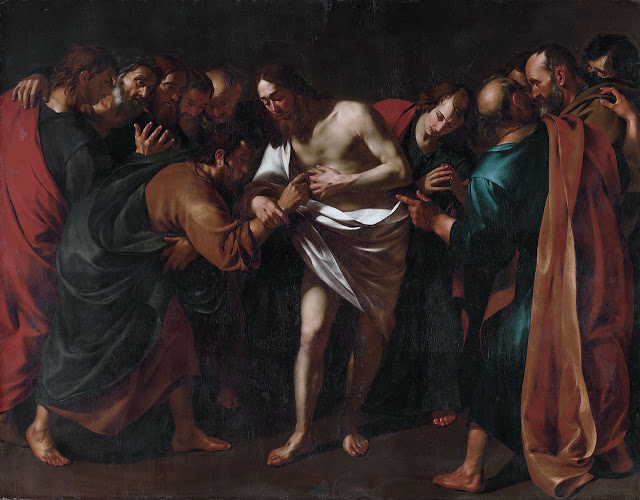
image: Wikimedia commons (link).
One of the more famous episodes in the New Testament resurrection story is the account of "Doubting Thomas," also referred to as "The Incredulity of Thomas" ("incredulity" meaning literally "the not-believing" of Thomas, or the "not-giving-credit [i.e., trust]" by Thomas).
The account of this episode is found in the Gospel According to John (and only there, out of the texts that were included in what came to be the accepted texts of the "canon"), and is there described as follows (in the 20th chapter of the Gospel According to John):
24 But Thomas, one of the twelve, called Didymus, was not with them when Jesus came.
25 The other disciples therefore said unto him, We have seen the Lord. But he said unto them, Except I shall see in his hands the print of the nails, and put my finger into the print of the nails, and thrust my hand into his side, I will not believe.
26 And after eight days again his disciples were within, and Thomas with them; then came Jesus, the doors being shut, and stood in the midst, and said, Peace be unto you.
27 Then saith he to Thomas, Reach hither thy finger, and behold my hands; and reach hither thy hand, and thrust it into my side: and be not faithless, but believing.
28 And Thomas answered and said unto him, My Lord and my God.
29 Jesus saith unto him, Thomas, because thou hast seen me, thou hast believed: blessed are they that have not seen, and yet believed.
This passage is often interpreted as being about belief or faith, particularly by those who assert that the texts were intended to be understood literally and historically (that is to say, those who believe the texts were intended to be understood as describing an encounter that took place in literal history between two literal and historical figures).
But what if that is not what this episode is actually about at all?
If the text is describing a literal event that took place after a literal resurrection, then it would make sense to understand this encounter with Thomas as being about believing that the literal resurrection happened in the manner described.
But we have already examined some evidence that the character of Thomas has a meaning that goes far beyond the common understanding of Thomas as a particular individual who lived a long time ago and had a particularly "incredulous" disposition and a particularly blunt way of expressing himself.
A major clue to the critical importance and true identity of this character "Doubting Thomas" is in fact found in the very passage cited above from the "canonical" text of the Gospel According to John: the information given in verse 24 of John 20 that Thomas (one of the twelve) was also called Didymus.
The word "didymus" is Greek in origin and means "twin" (the prefix di- is still found in many English words, many scientific in nature, which carry the meaning of "twin" or "two" or "twinned," such as a diode or a dipole or a diplodocus or a dichotomy or even a diploma -- diplomas apparently being so named because they were originally "folded in two" or "doubled" instead of being rolled up in a cardboard tube the way they are today).
The Gospel According to John is the only text among those admitted to the New Testament canon which uses the word Didymus (or didymos in the New Testament Greek) or reveals that Thomas was either an actual twin or was for some reason called "the twin" (even though Thomas is listed in the naming of the twelve apostles found in the books of Matthew, Mark and Luke, as well as in Acts of the Apostles). Neither John nor the others ever explain why Thomas is called that, or who his other twin might be.
But, as has already been discussed at some length in the previous post entitled "The Gospel of Thomas and the Divine Twin," there were other "New Testament era" texts which were specifically excluded from the New Testament canon but which were apparently preserved in a large sealed jar which in ancient times (in fact, during the same century that the current canon was being established and other texts not included in the canon were being marginalized or even outlawed) was buried beneath the sands at the base of a cliff near the modern-day village of Nag Hammadi in Egypt -- and one of these texts has Jesus addressing Thomas as "my twin and true companion."
This remarkable statement opens up an entirely different interpretation of the so-called "Incredulity of Thomas" episode -- and indeed of the identity and meaning of the character of Thomas altogether.
The statement simply cannot be understood literally, as in referring to a literal-historical twin of Jesus, since such an interpretation would then undermine a literal-historical interpretation of the descriptions of the birth of a single child (not a twin) found elsewhere in the New Testament scriptures.
But just because something is not literal does not mean that it is not true.
If we are not meant to interpret these scriptural passages as literal-historical, then how else could we be intended to interpret them? If the passage is not intended to describe a literal individual named Thomas with an incredulous disposition and a gruff manner of speaking, then what are we supposed to learn from it?
Something of tremendous importance and applicability to our daily lives -- something which makes Thomas a character of immediate and ongoing relevance to each of our individual journeys through this world, every single day (in a way, I would argue, that a Thomas who lived a couple of thousand years ago might not be).
In fact, I would argue that even those who take the scriptures as literal and historical probably do not find themselves thinking about Thomas and his importance to their lives multiple times every day.
But I would submit that after reading the esoteric interpretation of Thomas offered below, you might (at least I do).
Because if Jesus and Thomas are twins, and if out of the two of them Jesus represents the "divine twin" in the pairing (and, as we explored in that previous post on Thomas, there are many such "twins" in ancient mythology, including Castor and Pollux in Greek mythology and Gilgamesh and Enkidu in the mythology of ancient Sumer and Babylon), then what does that imply about the identity of Thomas?
Why, it could imply that Thomas is "the human twin."
And which one would that make us?
(This is a trick question).
The answer, of course, is: "both of them."
We are running around in this incarnate life with both of these "twinned" natures within us at all times (in fact, as has been explored at some length, the very symbol of the cross itself can be seen to represent the "crossing" of two natures in each and every human being -- a horizontal nature and a vertical nature, so to speak: see for example previous posts here, here and here).
To put it very plainly, I believe that the episode of "Doubting Thomas" is intended to teach us to get in touch with the divine Infinite.
And our "Thomas nature" -- while serving a very necessary function -- can be an obstacle to that connection with the Infinite, at least when overcome by doubt.
Having offered that interpretation, let's now take another look at the text itself to see if it is possible to find any support for such an assertion.
In verse 25, the other disciples say to Thomas: "We have seen the Lord."
Thomas replies in the same verse: "Except I shall see in his hands the print of the nails, and put my finger into the print of the nails, and thrust my hand into his side, I will not believe."
Let's just think about that for a second.
As noted above, the episode of the "Incredulity of Thomas" is usually interpreted as instructing belief or faith, and not doubt -- and hence a "negative spin" is imputed to this "incredulity" of Thomas (this failing to "extend credit" or trust to the account of the other disciples, on the part of "Doubting Thomas").
But is this statement from Thomas really something that we are meant to see in a negative light?
He did not say, "Even if I see the print of the nails, I will not believe."
He did not say, "Even if I thrust my hand into his side, I will not believe."
Thomas is actually displaying critical thinking, a desire to check things out and examine the evidence which supports one or another theory, or which might disprove one or another theory . . . even what we might call "the scientific method."
And this kind of thinking is actually indispensable in our daily life, from one moment to the next in this physical world (in fact, it is essential to our very survival from one moment to the next).
If a traffic light turns green, telling you that it is safe to proceed into an intersection, or a railroad crossing signal tells you that it is safe to proceed across the railroad tracks, and you don't exercise at least a very little bit of what Thomas here displays when he receives the report of the other disciples, there may come a day when those signals are telling you an untruth that could be extremely dangerous to you. It is advisable to just swivel your head to glance quickly up and down a cross-street or a train-track as you approach it, to "see for yourself" in the same way that Thomas might advise you to do.
In other words, critical thinking is critically important to anyone living in the material world.
It is the same critical thinking that enables us to categorize things into one category or another ("this" and "not that"), to communicate using language (which is built upon definitions of "this" and "not that," the very word definition meaning "to put a boundary or a limit around something"), and to analyze our situation and come up with possible hypotheses to explain what we see, and then examine the evidence that could help us accept or reject the different possible explanations or hypotheses.
All that being said, the scriptural passage itself does indeed appear to be telling us that all of this critical thought, while essential, can have a negative side (like any other good thing, especially when there is "too much of a good thing").
The very same essential and indispensable faculty that enables us to categorize, to hypothesize, and even to criticize ("this is good" versus "that was not so good" or even "that was a disaster") is exactly the same faculty that makes possible self-doubt, self-criticism, and even what we might term "self-imposed isolation from the divine twin."
If you haven't watched it already or don't remember the details of this previous post discussing the excellent conversation with Dr. Darrah Westrup at the mindbodygreen "Revitalize 2015" conference (her talk can be seen in this video clip beginning at about the 1:03:00 mark), please check it out or give it a re-look.
Because in her talk, after pointing out that animals do not typically walk around wracked with self-doubt, and that even if a cat makes a terrible failure of trying to leap somewhere, it doesn't seem to reduce its self-image or cause it to wonder if it is going to be a failure at it the next time, Dr. Westrup states that it is through language (and thus, I would argue, through the entire facility of defining into "this" and "not that") that we can let our minds "run away with us" with negative results.
In the same presentation, she explains that ancient practices such as meditation and ancient scriptures such as the Vedas seem to teach that what we call our mind is not the whole of who we are, but rather a very useful and indeed indispensable tool, one which we should view as occasionally detrimental: a sort of "over-eager office assistant" that will sometimes make absolutely terrible recommendations, from which we can learn to "stand aside" or "stand above" through disciplines and methods which were known to the ancients and which can put us in touch with something altogether different.
In the scripture passage from John chapter 20, the remedy or solution given to Thomas does not involve thinking or talking or reasoning at all: it involves feeling and seeing and experiencing and knowing. And it involves getting in touch with the divine twin.
Note that this does not mean "getting rid of the Thomas" -- as Dr. Westrup says in her talk about the "over-eager office assistant," we actually cannot get rid of that assistant, nor would we really want to.
Once we have the faculty of defining and critically thinking (and hence of criticizing and also of doubting) then we cannot ever get rid of that, nor would it be good to do so: but we can get in touch with something which is beyond defining, which cannot be "de-fined": something which is in fact In-finite (non-boundaried, non-bounded, non-finite).
Something which other traditions (such as the Vedic texts and epics and commentaries) call variously the Higher Self, the Supreme Self, the Brahman -- which is just as much a part of who we are as is the part we might call our Thomas-self. That's why they are described as twins. You can't separate them: they are both part of our identity.
In other words, the relationship between Thomas and Jesus implied by the word Didymus may be intended to convey the very same thing that the relationship between Arjuna and the Lord Krishna in the Bhagavad Gita is intended to convey.
And note that at the beginning of the Bhagavad Gita, Arjuna (who corresponds to Thomas) is racked by doubt.
Not doubt about the existence or divinity of his divine charioteer, Krishna, but doubt about himself, his worthiness, and whether it is right or not for him to engage in the upcoming battle of Kurukshetra.
And as we see in the Bhagavad Gita, Krishna reveals himself to be unbounded and infinite (just as the goddess Durga revealed herself to be unbounded and infinite immediately prior to the Bhagavad Gita, and in fact was addressed as identical to the Brahman, in the hymn to Durga uttered by Arjuna).
In those Vedic texts, which I believe were designed to convey the very same message being conveyed by the episode of "Doubting Thomas," the metaphor of a chariot is used, in which the horses are the senses and the desires, and the mind is compared to the reins, but the driver is the "divine charioteer," who in the Bhagavad Gita is Lord Krishna himself. Here, mind is shown to be an essential tool, but it must be guided by the divine charioteer, held in the hands of the divine charioteer.
In other words, I believe we need our critical-thinking "Thomas-faculty" nearly all the time during our waking hours, but there is a very real sense in which this aspect of our humanity gets in the way of our accessing something much deeper, something that is in fact infinite, and that can actually be properly described as divine (and that is described as divine in ancient sacred texts and traditions, including those of the New Testament, as discussed in previous posts such as "Namaste and Amen" and previous examinations of the teachings of the person called Paul).
And we are actually designed to be in touch with the divine Infinite in this life.
Many of us have in fact experienced moments when we seem to suddenly touch something that is beyond or beneath all of the mental chatter, perhaps in a sports situation when (looking back later) we realize we were playing "out of our head."
(Conversely, we can also probably recall situations in sports or other areas of endeavor in which we seemed to "self-sabotage" -- through a sudden onset of "doubting Thomas" self-talk -- a play or a catch that we normally would have been able to easily make).
Examples from daily life which we might put into the "uncontroversial" category could include parallel parking perfectly on the first try (even into a very difficult spot), or fetching the exact right amount of water to pour into a coffee-maker to come exactly up to the "max-fill" line without measuring (in an unmarked jug or pitcher that you use to fetch it), or even looking at the clock exactly at 3:33 on several different days, without even thinking about it (we might wonder what exactly was "ticking" in the back of your mind that seemed to be keeping track of the time, since it is clear in this example that it was not the conscious part of the mind that "reasoned out" the exact right moment to glance over at the clock on those different days).
But there are other examples that are far from "mundane" and which seem to evidence a sudden manifestation of the "hidden divine within" or the "unconscious connection with the Supreme Self," such as the incredible displays of timing caught on camera in popular videos such as the "Greatest 'Dad saves' ever" shown here (and there are many other collections along the same lines -- many showing situations that are clearly not staged, unless people are deliberately hazarding their infants to make these movies):
It should be pointed out that in nearly every one of these "Dad saves," the injury-saving action is completely unpremeditated and even apparently "unconscious" (without conscious thought). In some of them, the "save" even appears to be literally "unconscious," as in "he was half-asleep (or more than just half) and his arm reached out to save the baby."
It should also be pointed out that these kinds of difficult-to-explain displays of unconscious genius are not limited to "Dads," although saving a baby or a child does seem to be a common denominator. For instance, there was an incident in my own experience (known to me personally) in which a mother was in line at the grocery store, facing the clerk, and reached completely behind her back to grab the shopping cart and stop it from tipping over as her older son climbed onto the side of it while her younger son (an infant at the time) was inside of it. She was not looking in that direction at all when this took place: it was behind her and she was about to say "hi" to the clerk in anticipation of moving up to the check-out point.
As difficult to explain as such examples appear to be, there are some who would argue that even these displays of human response -- admittedly beyond our "day-to-day" way of behaving or reacting -- are still explainable within the realm of the "natural, material world" and do not require descriptions involving the words "divine" or "infinite" or connections to anything non-material or super-natural.
Perhaps they are just manifestations of highly-developed instinctual abilities on the same level as those which animals routinely display (untroubled as they are by anything resembling the "Thomas-mind" and the self-doubt that comes along with being able to think critically and maintain inner dialogues), and which we usually forget in our civilized setting, but which "pop up" from time-to-time when they are most necessary (a kind of "animal-like survival instinct" that is usually forgotten but occasionally awakens).
That is certainly a possible explanation, and one that our critical-thinking, scientific-method-following minds should consider.
But even if that is a valid explanation for some manifestations of behavior (like the "Dad saves" shown above) that fall completely outside of what we usually experience in what might be called "ordinary reality," there are other examples of human beings apparently accessing the fabric of non-ordinary reality for which even that explanation (already a stretch) seems to be completely inadequate.
For example, in this post from all the way back in January of 2012
, we examined an account of a daughter who was visited in dreams and who received information about the existence of a Buddhist monastery the existence of which she had previously been unaware, but which upon visiting she learned from the presiding abbott that her father had helped found that particular monastery, years before she had even been born.
It is difficult to explain that account as an example of "highly-developed human ability or instinct," because it involved information that came to a person (while unconscious, it should be noted) who could not be expected to know that information at all -- even subconsciously.
Or, see for another example the situation described in the account of Norman Ollestad in his book Crazy for the Storm, in which as a young eleven-year old boy, he had to make his way down a steep and icy mountain in what can only be described as a life-or-death situation.
In that book, we see an excellent real-life example of the "Doubting Thomas" phenomenon: young Ollestad must overcome his own fears, anxieties, self-criticisms and self-doubt -- both on the mountain and in the challenging situations he faced while growing up in the canyons and suburbs around Los Angeles and the California coast during the 1970s.
In order to overcome those doubts, he relies on the uplifting influence of his father, and on reserves of courage and resourcefulness inside himself that at first the boy might not even have known or realized were there.
However, that is not all that helps him survive, as those who have read the book (or who will read the book after this) see by the end. Indeed, in order to eventually make his way off the mountain, several events (including something that he is able to "see" which he later realizes he would not have been able to see based on actual terrain and line-of-sight) and "coincidences" took place which directly contributed to the author's survival on that awful day in 1979.
Although they might not be as dramatic, many of us can also think of "coincidences" or "synchronicities" in our own experience in which people who could not possibly have known that we were thinking about something or considering some course of action suddenly contacted us with information or suggestions that make it seem as though something from outside of ordinary reality is at work.
It is my belief that the episode involving the encounter of "Doubting Thomas" and "the risen Lord" is intended to describe this exact dynamic in our human experience: the fact that we ourselves are endowed with an important facility of critical thinking, which is well-suited for many aspects of day-to-day life (and which is in fact indispensable for our survival), but which can also be a hindrance to us, to the extent that it can lead to self-doubt, self-sabotage, self-destruction in extreme cases, and self-imposed separation from someone we are actually supposed to rely upon as absolutely vital to our experience in this life: our Higher Self, the "divine charioteer," the Christ within.
Indeed, while some readers may remain unconvinced by the analysis and examples offered so far (and especially those who are especially committed to a literal-historical interpretation of the sacred texts of the New Testament) -- even though I believe that the discussion so far should already be fairly convincing -- I believe there is actually a whole additional line of evidence which makes the above interpretation not only "likely" but nearly "indisputable."
The more I have studied the ancient mythology of humanity, the more evidence I have found that virtually all of it, from every single inhabited continent on our globe, and from millennia in the past right up to living traditions which have remained in practice into the present day, is built upon a common system of celestial metaphor, the purpose of which is to convey exactly the type of knowledge that we have been examining above regarding the human condition and the makeup of the natural world and the cosmos in which we find ourselves.
Knowledge regarding its dual material-spiritual composition: the existence of a Spirit World or an Infinite Realm which interpenetrates this material realm at all times and at all points, and with which we are actually in contact all the time ourselves, through our own inner divine spark, our own inner connection to the Infinite.
This inner connection may be often neglected, or even completely forgotten, but (as the embedded video and some of the other examples discussed above make clear) it is very real, and it is very powerful.
It absolutely transcends and blows away our limited understanding of what we ordinary think of as "reality."
But our normal facilities of thinking and understanding and analyzing (the "Thomas side" of our "twinned" existence) tend to doubt the very existence or reality of the divine nature, and when we listen to them enough we can miss out on something that is actually a huge part of who we really are.
A nice "contemporary film allegory" for this self-doubt and self-sabotage which keeps us from reaching our "non-ordinary potential" is the famous exchange between "doubting Skywalker" and Yoda in the famous "X-wing in the swamp" scenefrom The Empire Strikes Back (1980):
One way that we can help to confirm that the "Doubting Thomas" episode in the Gospel According to John was intended to be understood as an esoteric metaphor and not as a literal account of an event which took place in terrestrial earthly history is the fact that, like so many other events related in the scriptures of the Old and New Testaments of the Bible (see a partial list here), it incorporates clearly-identifiable celestial components.
In fact, I can find enough celestial components to this story and those which precede and follow it in John's gospel as to amply confirm to my own satisfaction that it is almost certainly a description of the heavenly cycles of the sun, moon, stars and planets (with which we ourselves are connected, and which serve throughout the world's mythology as an allegorical system which relies upon some of the most majestic and awe-inspiring aspects of our physical, material universe to discuss and explain aspects of the invisible, spiritual world) and not a description of anything that took place in terrestrial human history.
Very briefly, the Reverend Robert Taylor (1784 - 1844), who lived well before the discovery of the Nag Hammadi texts, and who spent considerable time discussing the identity of Thomas in a collection of his public sermons or lectures published in 1854 (ten years after his death) and entitled The Devil's Pulpit, makes much of the fact that the traditional observance of St. Thomas' Day was held on December 21st, the point of winter solstice and the point on the zodiac wheel which during the Age of Aries marked the beginning of the sign of Capricorn.
Since at the points of solstice ("sun-station" or "sun-stand-still") the sun appears to "pause" and rise at roughly the same point on the horizon for about three days before turning back around and moving in the other direction again, which is why the "birth" of the solar child is celebrated three days later (at midnight on the 24th of December, rather than on the solstice-day of the 21st of December), Robert Taylor argued that the 21st is a sort of "day of maximum doubt," when the sun has been rising successively further and further south since summer solstice in June, and tracing an arc that is lower and lower across the sky, and the hours of daylight each day have been getting shorter and shorter relative to the hours of darkness -- and that "unbelieving Thomas" is thus the figure who doubts that the sun will ever turn around again (Devil's Pulpit, 42).
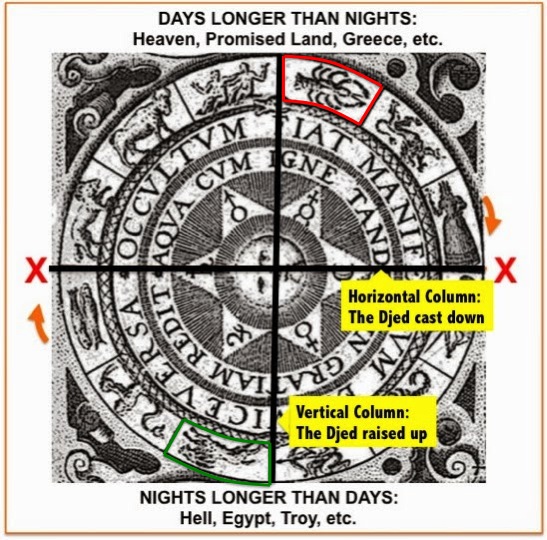
Zodiac wheel with positions of the signs of Capricorn (green) and Cancer (red) indicated, one beginning at the point of winter solstice (Capricorn) and the other beginning at the point of summer solstice (Cancer).
Interestingly enough, there are also traditions which associate the feast-day of Thomas with the 3rd of July, which is in the sign of Cancer the Crab, the sign which follows the sun's point of maximum arc and its northmost rising- and setting-points (as well as with other days of the year).
Robert Taylor incorporates all these details into his explanation, in which he argues that Thomas is associated both with the Goat of Capricorn (beginning at the sun's lowest point) and with the Crab of Cancer (beginning just after its highest) -- and also the related fact that he is called "the twin."
One look at the zodiac image above should be enough to perceive just how ingeniously the ancient myths (including those in the Bible) were crafted to impart their esoteric message, and how the majestic cycles of the celestial realms were employed in order to convey knowledge of spiritual truths -- in this case, the truth allegorized by the metaphor of Thomas and the Divine Twin, one enmeshed in the doubts and definitions of the "practical" struggles of the finite world, and the other completely free of the bounds of earth (passing easily through locked doors) and of the endless defining and analyzing of the "Thomas" side of our nature: the divine nature, at home in and representative of the realm of the Infinite.
Images of Thomas in this famous encounter with the Lord painted in previous centuries have in fact emphasized his Capricornian nature.
Now is a good time of year to observe the Goat of Capricorn in the sky (look to the west of the Great Square of Pegasus, or to the east of the distinctive "teapot" outline in the constellation of Sagittarius, which is currently still easily visible looking towards the south during the prime stargazing hours after sunset and before midnight, at the base of the rising column of the Milky Way).
Below is an image of the night sky as it looks to an observer in the northern hemisphere in the temperate latitudes, and looking towards the southern horizon (where the zodiac constellations make their nightly procession):
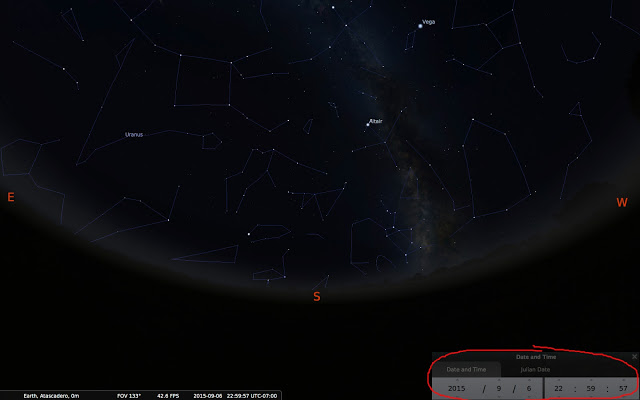
image: Stellarium.org
In the above image, you can see that the zodiac constellation of Capricorn the Goat (or the Sea-Goat) is actually reaching its highest point (its transit point) as it turns through the due-south celestial meridian-line (the highest point on its arc through the sky between rising in the east on the left and setting to the west on the right) right around 11pm. The outline of Capricorn is almost directly above the letter "S" marking due south.
Below is the same image, adding color to the outline of Capricorn as well as to the landmarks of the Great Square of Pegasus and the "teapot" in Sagittarius:
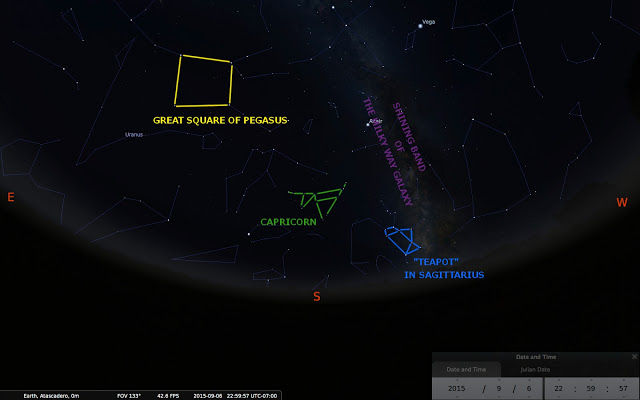
In the above image, the Great Square of Pegasus is outlined in yellow, the "teapot" formation in Sagittarius is outlined in blue, and the Goat of Capricorn is shown in green.
The general direction of the shining band of the Milky Way galaxy, which rises up from the southern horizon almost straight-up into the heavens at this time of year, is indicated with a label written in purple.
Please take special note of the outline of the stars of the Goat of Capricorn. In order to observe them more closely, a "zoomed-in" image of the Capricorn region and its constellation's stars is shown below:
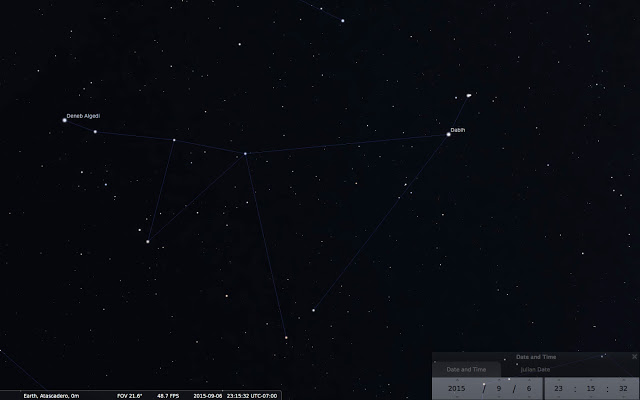
Note that the constellation suggests the shape of two "point-downward" triangles: one for the head of the Goat, and the other formed by Capricorn's two feet, which come together in a near-point, as if he is a rock-hopping mountain goat instead of a Sea-Goat as he is often portrayed.
It is also notable that he has some fairly formidable "goat-horns" pointing almost straight forward from his head, which are distinctly two in number: there are two stars to mark the tips of the Goat's horns (one is labeled in the image above, Deneb Algedi, and the other is just a bit further to the right and on a line slightly below Deneb Algedi in the sky).
Below is the same "zoomed-in" image of Capricorn, this time with green outlines to help make perfectly clear the line of the horns and the "two triangles" shape of the constellation:
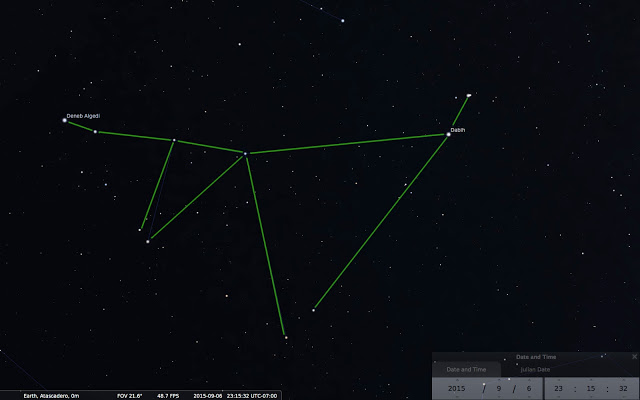
Having familiarized ourselves with the outline of Capricorn, let us now take a look at some of the images created by master artists over the centuries depicting the famous encounter between Thomas and the risen Lord in the episode of "The Incredulity of Thomas."
The first (and perhaps most revealing) is from Giovanni del Giglio, who lived from some time in the late 1400s through approximately 1557. It is entitled L'incredulita di San Tommaso:
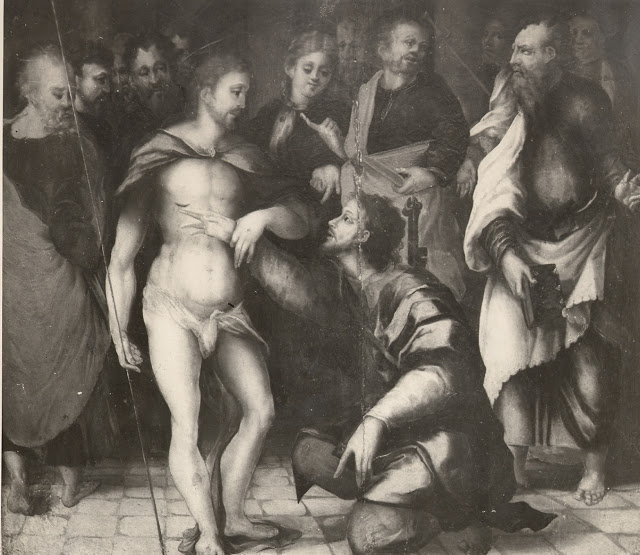
image: Wikimedia commons (link).
Take a close look at the hands of Thomas and the divine twin (the risen Lord).
If you have studied the images of the constellation Capricorn presented above, you will find that the unmistakeable features of the heavenly symbol are reproduced in this drawing and are associated with the probing fingers of Thomas (the horns of the Goat), the downward-facing triangle of the hand of Jesus (the head of the Goat), the bend of the arm of Thomas below the elbow of the risen Lord (the feet of the Goat), and the distinctive hand-symbol being displayed by the woman in the image (the tail of the Goat).
If you are having trouble seeing the correspondence between the image and the constellation, it is outlined in the identical image below, with Capricorn added:
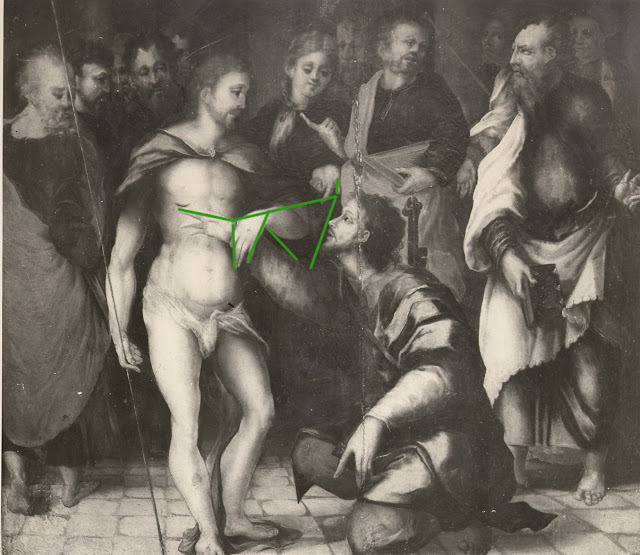
Below is another example, much more recent, from Tissot (1836 - 1902), which envisions the same scene but instead appears to use the bearded, downward-bowed head of Thomas himself to evoke the idea of the head of Capricorn, and the down-stretched arm and one leg of the apostle to suggest the front and back legs of the constellation which are nearly together in the outline of Capricorn in the actual night sky:
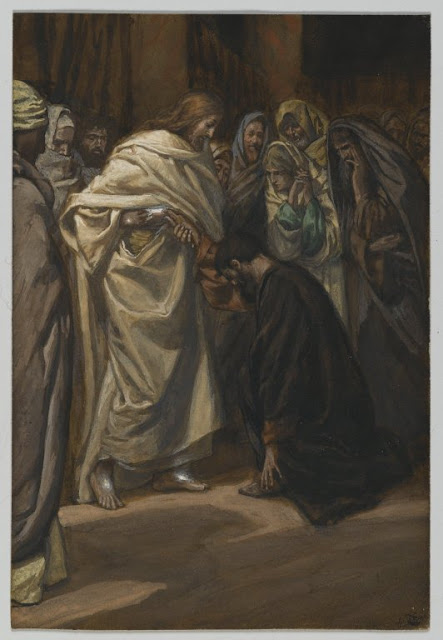
image: Wikimedia commons (link).
The examples could be multiplied on and on: the reader is invited to examine them for himself or herself to decide whether or not the identification of Thomas with the constellation Capricorn is valid in these examples, based on what we know of the outline of the stars themselves in the sky.
There is actually much more which could be added to the celestial metaphors at work in this particular scriptural event, and in the events which surround it in the John gospel, which act to confirm even more powerfully the fact that this story was originally intended to be understood esoterically rather than literally as an event taking place in earthly history.
One other important piece of evidence which Robert Taylor offers in his extensive analysis of the identity of Thomas is the fact that his name itself points to the connection between Capricorn and Cancer in this story (the signs marking the celestial low-point and the celestial high-point).
The name Thomas, he alleges (and others have made the same assertion) is related to the name Tammuz, which is both the name of an ancient deity and also of the fourth month of some ancient calendars (including the Hebrew calendar still in use today).
If you look again at the zodiac wheel reproduced above, and count to the fourth sign after the point of spring equinox (the beginning of the year in many ancient cultures), you will find that this count brings you to the sign of Cancer the Crab (1 - Aries; 2 - Taurus; 3 - Gemini; 4 - Cancer).
In other words, Thomas is associated with both Capricorn and Cancer: both the "doubting twin" and with the exalted Supreme Self (and some have even noted that his confession or exclamation "My Lord and my God" appears to refer to both human kingship and divinity, an expression of the dual nature of the Christ).
All of this appears to rather strongly confirm the powerful insight of Alvin Boyd Kuhn, quoted many times in previous posts (see here and here and here), that the ancient myths of the world (including those in the Bible) are not about ancient history but about our experience "here and now;" that they are not about "old kings, priests and warriors" but rather that in every scene they treat the experience of "the human soul."
"The Bible is about the mystery of human life," he says, "[ . . .] and it is not apprehended in its full force and applicability until every reader discerns himself [or herself] to be the central figure in it!" (Note that the two halves of the foregoing quotation are from different sentences in the same lecture by Alvin Boyd Kuhn, but by quoting them in this way I have not altered the sense of what he is asserting).
Indeed, when it comes to the story of Thomas the Twin (Didymus), we might alter Alvin Boyd Kuhn's quotation a bit further and say that this particular story "is not apprehended in its full force and applicability until every reader discerns himself or herself to be a twin in exactly the same way!"
The metaphor of Thomas and the divine twin is a metaphor to teach us a profound truth. It could be taught a different way, using a different metaphor -- such as the metaphor of Arjuna and the divine charioteer, in the Bhagavad Gita. In fact, there are endless different ways of expressing the same concept, found throughout the myths of the world, which collectively are the precious inheritance of humanity, intended for our benefit and use in this life.
We are each a twin in exactly the same way that Thomas is a twin: permanently 'twinned' with the 'divine twin,' who can appear in an instant no matter where we are or in what circumstance we find ourselves. No locked door can prevent the appearance of the divine twin, for we ourselves have within us -- always and in every circumstance -- an inner connection to the Infinite; we ourselves contain both Capricorn and Cancer: both twins, simultaneously. We are prone to doubting and to forgetting -- to saying with Luke in the swamp, 'I'll give it a try' -- cutting ourselves off from unlimited potential, when in reality we have access to all of it, all the time.
The fact that the story is a metaphor in no way means that it is "not true" (it just is not, at least in my understanding of it based on the evidence that I have seen for myself, literal or historical).
In fact, I believe it is profoundly true, and that it has daily practical applications for us in virtually every field of our human experience.
There are ways to learn these truths other than through the exquisite metaphors found in the world's ancient myths -- but when we have this incredible treasure which has been imparted to us for our good, it would seem to be a terrible waste to ignore these ancient teachings, or to turn them into something which they quite plainly are not (especially if we know what they are).
Who is "Doubting Thomas"?
Well, obviously, we have him with us every day.
But if we recognize his good aspects (incredulity, after all, can be a good quality), while avoiding the negative side of incredulity (self-doubt, over-criticism, over-haste in labeling defeat or failure, self-sabotage, and disconnection with the divine nature which is as much a part of who we are as is the Thomas-nature), we can touch the Infinite. Every day.
Namaste.
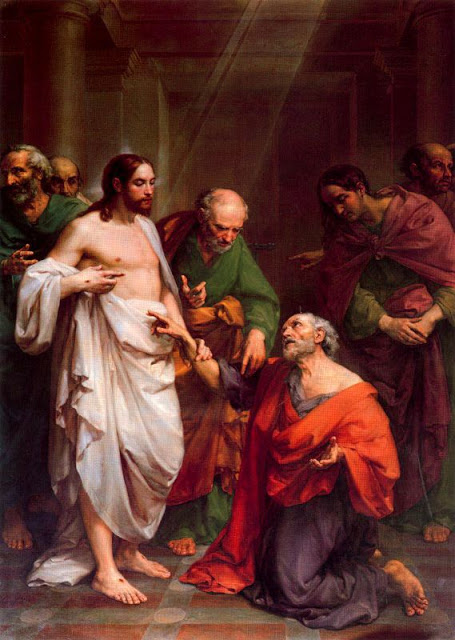
image: Wikimedia commons (link).
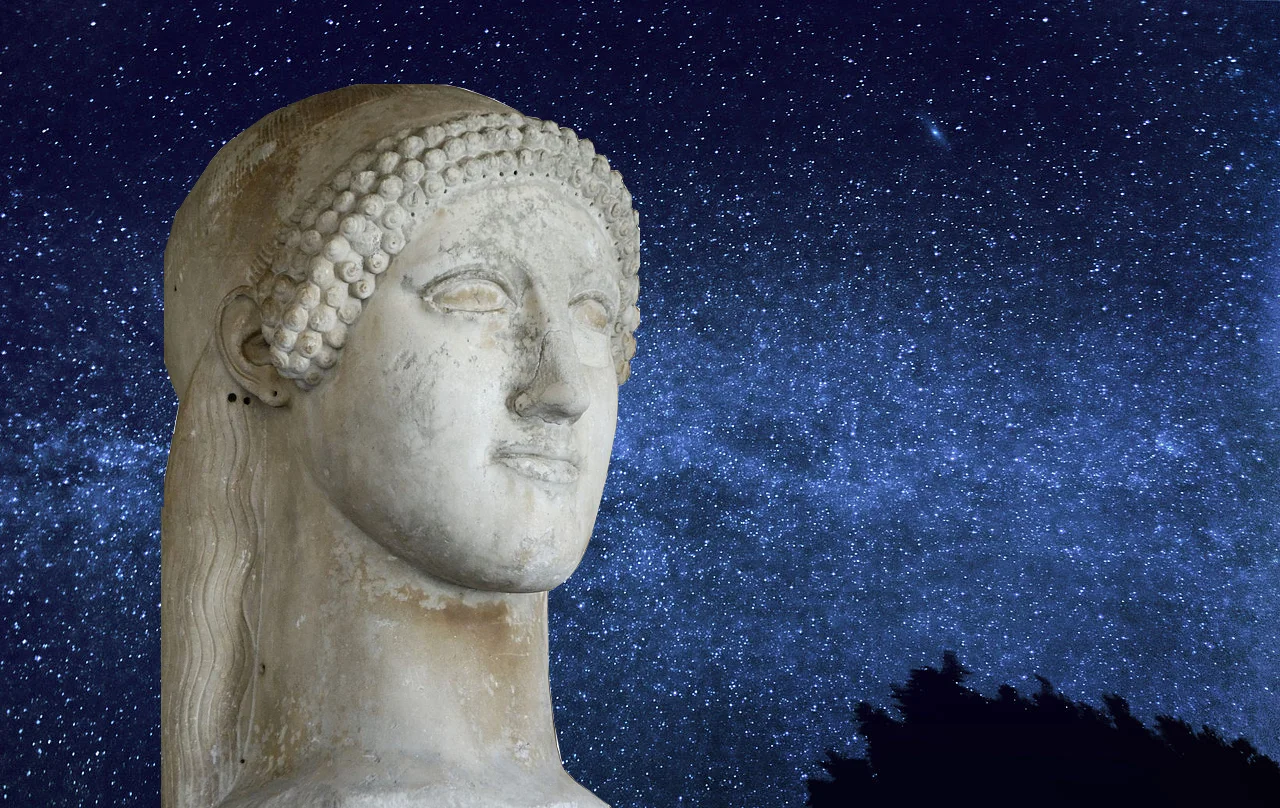
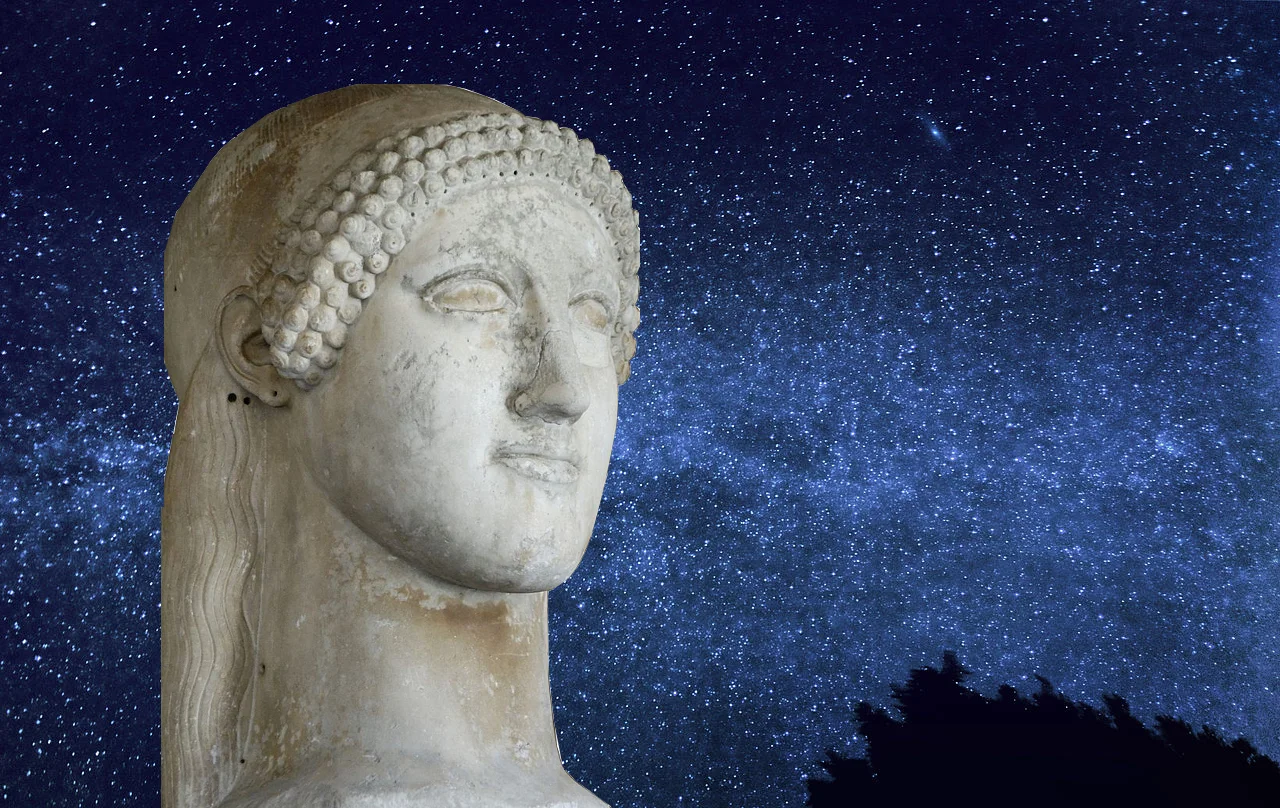
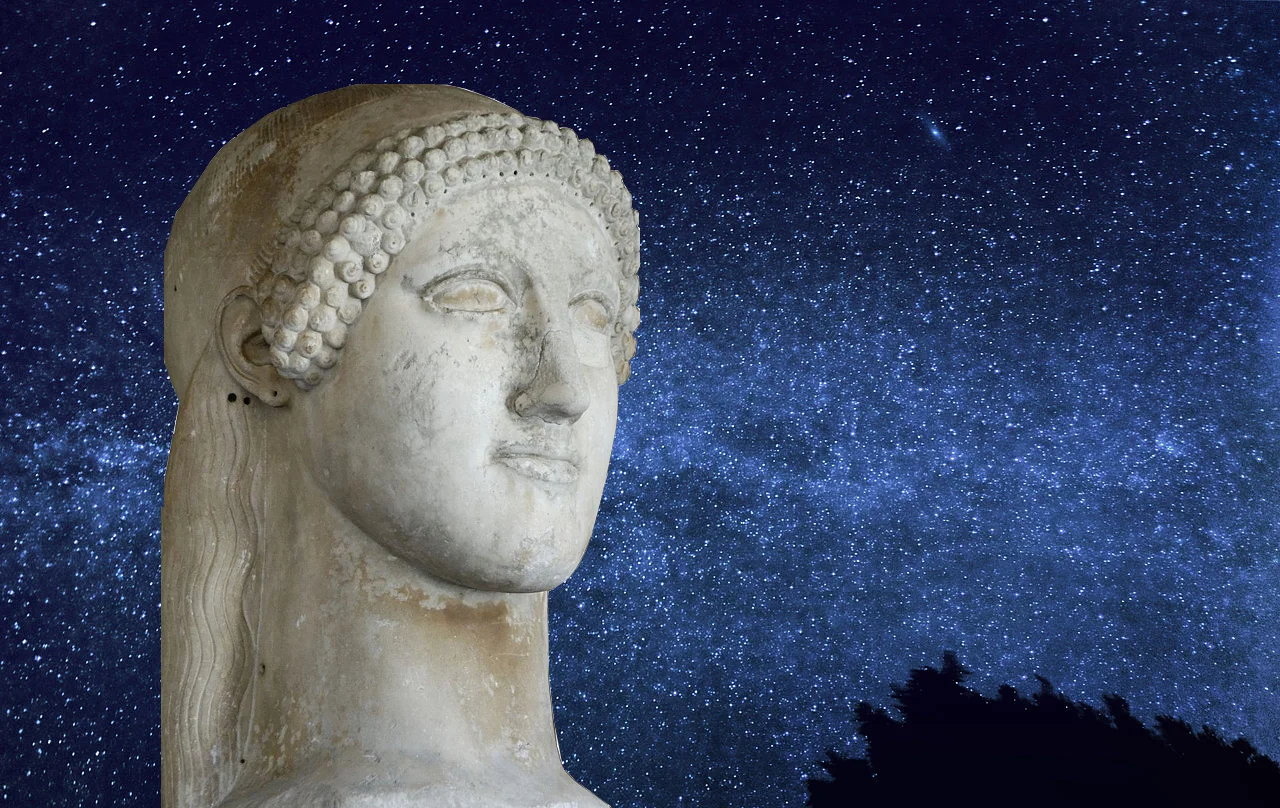
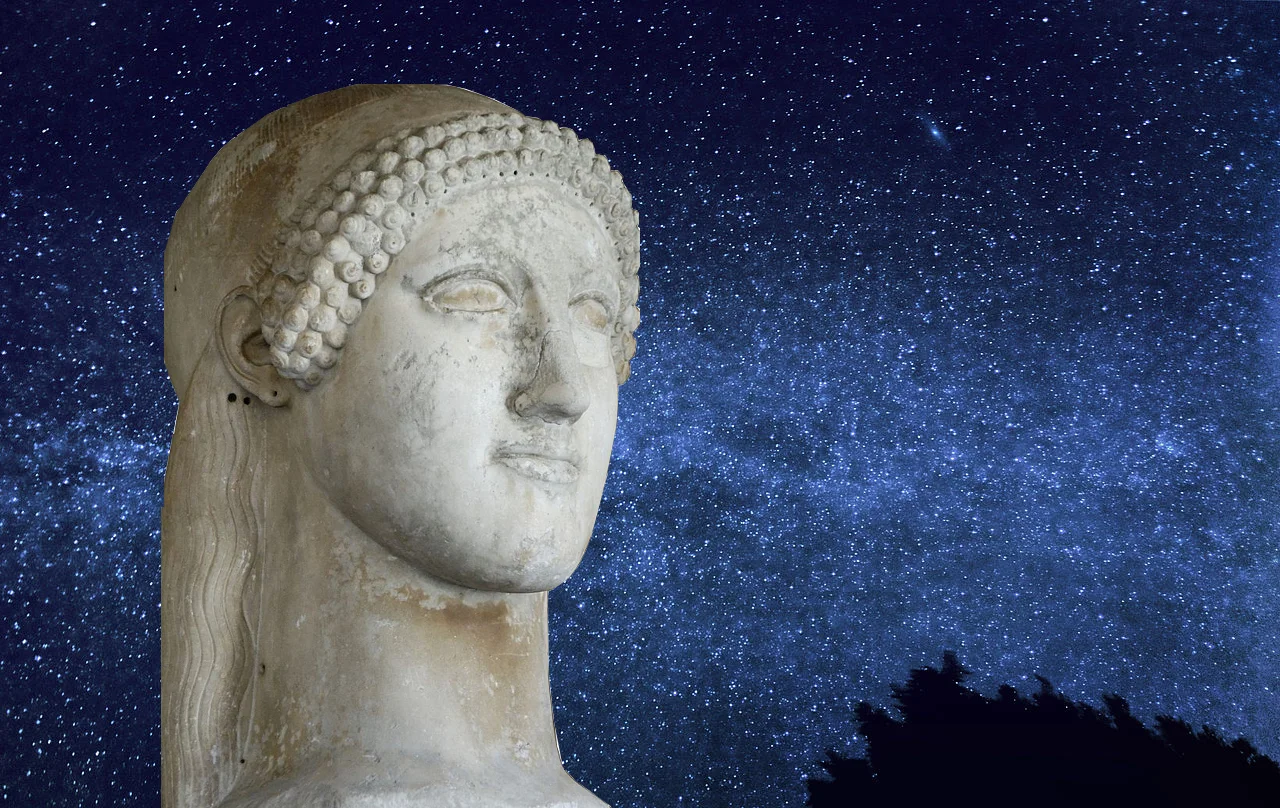
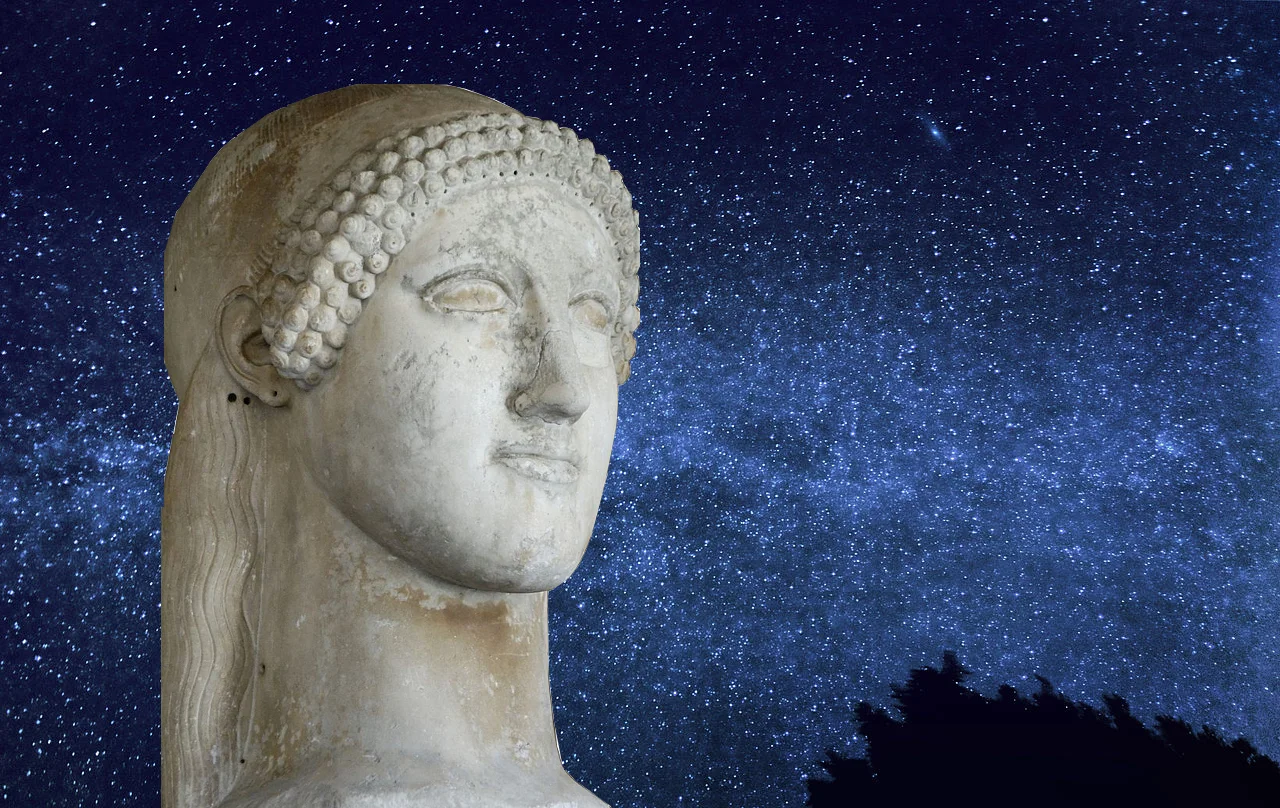
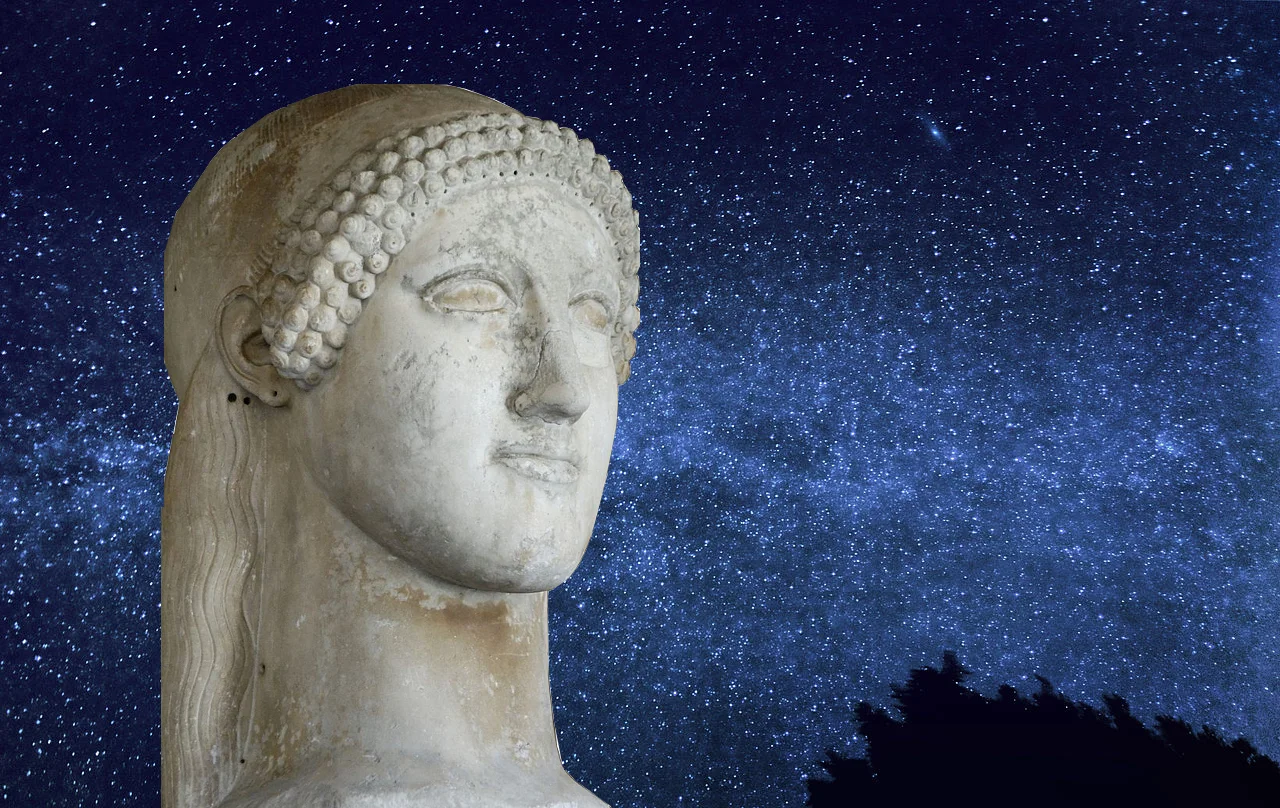
.jpg)
