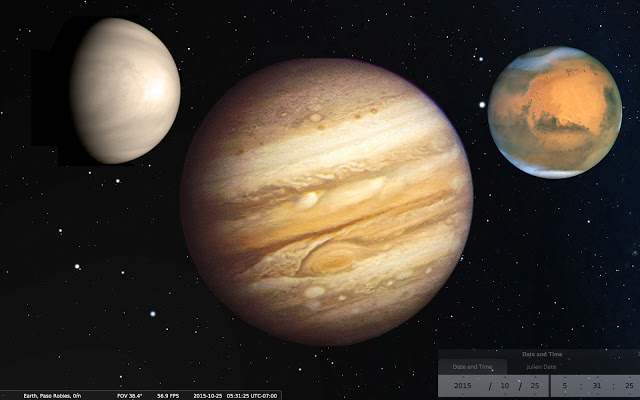
Dazzling conjunction of Jupiter, Venus and Mars in the pre-dawn sky

Dazzling conjunction of Jupiter, Venus and Mars in the pre-dawn sky

image: stellarium.org (background of stars), Wikimedia commons (VenusJupiter and Mars).

The important gods Jupiter and Mars and goddess Venus are staging a stunning confabulation in the early morning sky beneath the majestic form of the Lion, and if it is at all possible for you to do so, I highly encourage everyone to make the effort to rise early (two to two-and-one-half hours before sunrise should suffice)  and get to a location with a fairly dark sky and unobstructed views.

For observers in in the north-of-tropical latitudes of the northern hemisphere, observation times between 5:00am and 6:00am are ideal.

Not only are these planets particularly dazzling right now, but the pre-dawn sky is positively bursting  at this time of year with some of the most glorious stars and constellations that we on earth have available to us.

When you go outside in the pre-dawn hours right now and look towards the south [all instructions in this post are written from the perspective of an observer in the northern hemisphere; southern-hemisphere brothers and sisters please adjust all references accordingly, with my apologies for my northern-hemisphericentricity], the constellation Orion will be passing his highest point on his arc above the horizon at around 4:45am on the morning October 25th (a few minutes earlier each day after that, until he eventually makes his way into the "prime-time" viewing hours before midnight during our winter months), and from his high place at or near the top of his path, Orion will be surrounded by a host of other celestial luminaries and figures of great beauty and importance.

Below is a screen-shot from the open-source planetarium app stellarium.org showing the pre-dawn sky as it will look from the latitude of about 35.6N at around 5:30am on the morning of 25 October, facing generally towards the south (east is to the left and west is to the right when we face south):
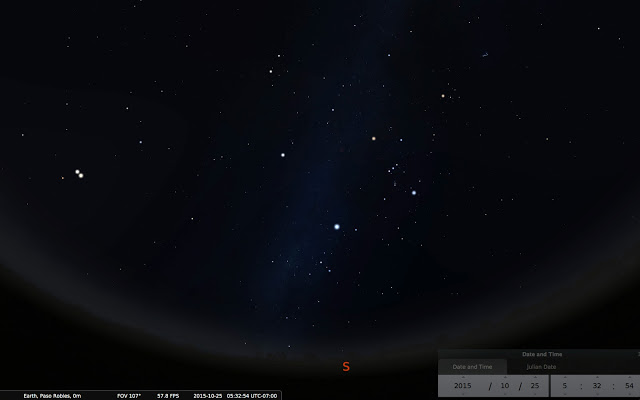
You can see that Orion with his distinctive three-star belt and hourglass shape of bright stars has already passed his transit point (his highest point, due south above the red letter "S" that is shown down at the horizon) and is proceeding downwards to the west, but still quite high in the sky. To the left of him is the shining band of the Milky Way galaxy, angling upwards slightly towards the right as it climbs towards the north, and just at its edge is the star Sirius -- the brightest fixed star in our heavens (Orion's belt points towards it if you extend the line of the belt's three stars to the "left").

Orion's outstretched arm towards the west is clearly visible holding its bow, and above this is the distinctive "V" of the Hyades, which form the "jawbone" of the Bull of Taurus.  Above Orion to the other side (left as we face the south) are the linear forms of the Twins of Gemini, with their heads marked by the two bright stars Pollux (brighter and lower) and Castor (dimmer and higher, stacked almost directly above Pollux), and then as we proceed towards the eastern horizon (where the sun will be rising) we pass over Cancer the Crab (difficult to spot but with the assistance of this blog you can find Cancer and its distinctive Beehive Cluster) and encounter the rising form of the mighty Lion, with the breathtaking Jupiter and Venus just beneath, and further down reddish and sullen Mars. 

Below is the same screen-shot as that presented just above, but this time with the constellations and planets just described marked for your easy identification:
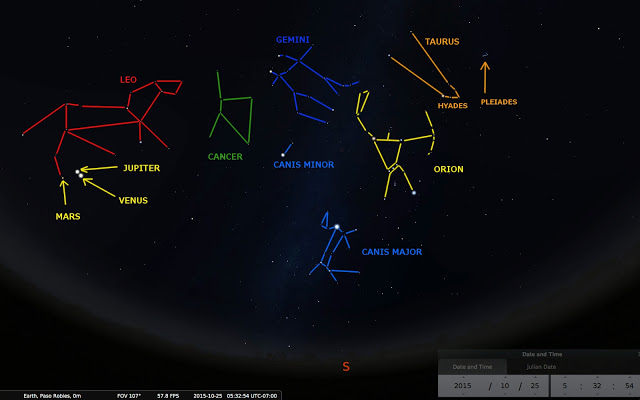
In this image, which shows the relative positions of the three planets as they will be on the morning of 25 October, Venus appears to be just "below" (closer to the horizon from) Jupiter, although please note that in order to try to present on a flat "page" the arrangement of stars that we see as occupying the "dome" or "vault" of the heavens, stellarium (and hence this screen-shot) curve the horizon upwards as you approach the left and right sides of the rectangular screen or image. In other words, the app is trying to create the effect of a planetarium or night-sky that wraps around the viewer on either side.  

Because of this, if you think about it, that means that all the "stuff" you see on the left and right edges of this image has to be "pulled downwards" in your mind in order to match what you would see if you went outside (or observed the same image while inside an actual vaulted or dome-shaped planetarium), which means that Leo is actually going to be much more vertical in his orientation in the sky than he appears in the "wrapped" (but flattened) image you see reproduced above. (Another way of saying this is to think of an observer standing in silhouette right on the horizon at the very left of the above image: because of the way the horizon is "wrapped," the person would appear to be almost horizontal, with his or her head pointing to the right, even though that person is really standing straight up-and-down. In the same way, Leo seems to be almost horizontal in this image, but when you go out to see him, he will be much more vertical in his orientation).  

What this means for the three planets marked on the planetarium app screen-shot is that they will actually form a triangle with Jupiter and Venus much more on the same level with one another, Venus to the right of Jupiter, and Mars below them.

We can actually see this more clearly if we just use the stellarium app and swivel our view towards the east (which means that now the screen's "wrap" effect will cause Orion and the stars on his side of the screen to warp inwards) and then we will see the Lion and the three planets in an orientation that will resemble more closely what you will see in the morning if you are able to go outside into the pre-dawn night:

Note that we've now rotated our view until we are looking about "due east" (placing the red letter "E" in the center of the horizon, which continues to wrap-upwards on the outer edges, where you still need to use your imagination for the "dome effect"). Stars along the "vault of the sky" directly ahead of us are thus positioned about the same way that you will see them in the morning: stars towards the edges require you to remember that you are looking at what is supposed to simulate a dome.

As you can see, Venus is actually just slightly higher in the sky and to the right of Jupiter, while Mars is a bit below them, clearly visible and forming a kind of "downwards-pointing isosceles triangle" with the brighter two planets.

Leo now appears as he will in the pre-dawn sky: rising up from the eastern horizon at a steep upwards-angle.  As always, the Lion is "geared" to the lower edge of the Big Dipper, which fits it almost like a puzzle piece that is lined up with Leo but separated by a stretch of sky (see previous discussion here). 

Below we see the same screen-shot, this time with labels and outlines for the planets and constellations just mentioned:
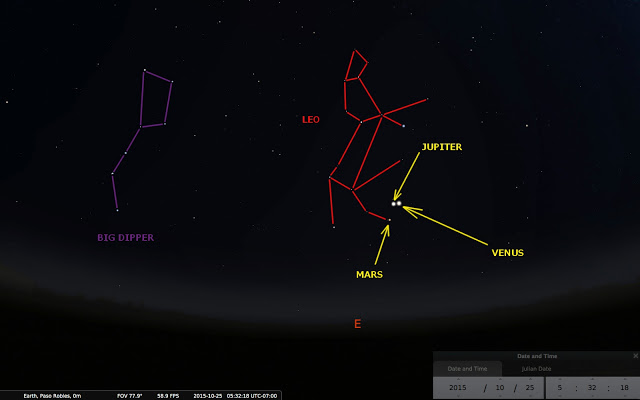
As earth progresses on our path around the sun, and as Venus, Jupiter and Mars continue on their own tracks around our central star, these relative positions will continue to change, rather dramatically from day-to-day. Venus will drop past Jupiter and soon be much lower than Jupiter in the sky. For additional diagrams showing the positions of these three divinities, check out this excellent discussion page over at Sky & Telescope

That discussion page shows as well the position of Mercury, who is also visible just before sunrise if you have a good view of the eastern horizon (in the screenshots above, Mercury is not visible yet, because it is still about two hours before sunrise).  

While you are out enjoying the gorgeous conjunction of these celestial wanderers (especially if you are able to go out while it is still dark, such as two hours before sunrise), you will have the opportunity to see the Pleiades, located in Taurus beyond the Hyades (about equal distance beyond the Hyades from Orion -- see the labeled south-facing image above that contains Orion).  You should also be able to continue past the Pleiades and locate Perseus, whose foot is pointing towards the Pleiades. Perseus is not marked in the images on this post, but several previous posts show you how to locate him (see herehere, and here for example).

Perseus figures in many Star Myths that have been discussed in previous posts (the first link in the previous paragraph takes you to one of them), as do the Pleiades, and the V-shaped Hyades mentioned earlier and clearly visible in the pre-dawn sky are also very important in myths the world over. For discussion of the role of the Hyades in the Samson-cycle of myths, see previous posts and video here and here.

In the episodes of Samson's life, an encounter with a lion features quite prominently, as does a certain swarm of bees which make their home in the carcass of the lion after Samson kills the lion with his bare hands. As the above discussion and video about Samson point out, I believe there is abundant evidence which indicates that the lion encountered by Samson is none other than Leo the Lion, and the swarm of bees is the beautiful Beehive Cluster in the zodiac constellation of Cancer the Crab, located almost directly in front of the mouth of Leo.

If you are able to go out to see Jupiter, Venus and Mars when the night is dark and clear, you should be able to make out the tiny silvery cloud of the Beehive with your naked eye. Previous posts have explained some techniques for finding the Beehive: see for example here and the second half of the video here. Once you have located the Beehive with the naked eye, you may also want to have a look at it with binoculars.

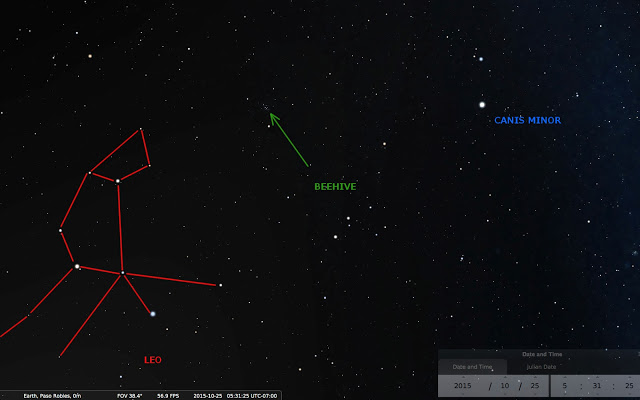
Below is a screenshot showing the location of the Beehive, in the constellation of Cancer the Crab and directly in front of the "jowls" of the face of Leo the Lion:
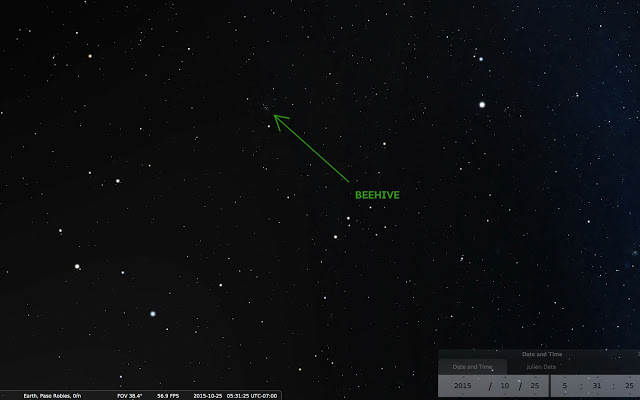
The Beehive is actually more visible outside in the night sky than it appears in the screenshots here. However, due to the way our eyes are designed, you may find that you can "see" the Beehive most easily when you are not looking directly at it. 

Instead, try sweeping the sky rather slowly and deliberately working from Leo towards Gemini, or back from Gemini to Leo. Just after you "pass" by the Beehive, you may see it or sense it or perceive it "out of the corner of your eye," even if you did not see it when you were looking directly towards the Beehive itself.

The constellations visible before dawn at this time of year are well worth the effort to try to view and become familiar with, if it is at all possible for you to do so. All of them figure prominently in multiple Star Myths from around the globe, and all of them are very beautiful in their own unique way. 

The conjunction of Jupiter, Venus and Mars in the eastern part of the sky just below Leo the Lion creates a special bonus and one that can be seen on successive mornings for some time (although it is arguably at its most dazzling right now). 

Planetary conjunctions also figure in ancient mythology -- previous posts have investigated some of these: see for instance herehere and here. The stars and the planets truly form the basis for all the incredible sacred myths, scriptures, and stories bequeathed to humanity as a precious inheritance. 

I believe that these esoteric allegories utilize the awe-inspiring celestial cycles in order to convey to us profound truths which are absolutely essential during our earthly sojourn and intended for our benefit, in much the same way that Mr. Miyagi used different physical motions (such as wax-the-car or paint-the-fence) to impart profound knowledge to Daniel-san, knowledge which was also intended for his benefit and which was essential for him to understand.

I truly believe that the more you are able to become familiar with the beautiful constellations and planets in our night sky, and their intricate cycles and turnings, the more you will be able to appreciate and understand the ancient wisdom which was given to you and to me and to all of humanity at some point now hidden behind the mists of time.
Fragments of a lost whole

Fragments of a lost whole

image: Wikimedia commons, "Landscape with Buddhist Temples," 16th century, unknown artist (link). Cropped.

In a justifiably well-known quotation from the introduction to the ground-breaking 1969 book  Hamlet's Mill: An essay on myth and the frame of time, Giorgio de Santillana quotes from an earlier essay of his which he wrote in 1959 (and which, although I may be incorrect on this, I believe was published in 1962 or 1963 as an article in a literary journal, under the title "In the High and Far-off Times").

Often quoted for its most memorable lines, the full quotation is worth considering carefully (from pages 4 and 5 of the edition linked above):

The dust of centuries had settled upon the remains of this great world-wide archaic construction when the Greeks came upon the scene. Yet something of it survived in traditional rites, in myths and fairy tales no longer understood. Taken verbally, it matured the bloody cults intended to procure fertility, based on the belief in a dark universal force of an ambivalent nature, which seems now to monopolize our interest. Yet its original themes could flash out again, preserved almost intact, in the later thought of the Pythagoreans and of Plato.
But they are tantalizing fragments of a lost whole. They make one think of those "mist landscapes" of which Chinese painters are masters, which show here a rock, here a gable, there the tip of a tree, and leave the rest to imagination. Even when the code shall have yielded, when the techniques shall be known, we cannot expect to gauge the thought of those remote ancestors of ours, wrapped as it is in its symbols.
Their words are no more heard again
Through lapse of many ages . . .

Think for a moment of the implications of what is being asserted in the above statements. The author is saying that all of the world's surviving myths, rites, and even fairy tales are "tantalizing fragments of a lost whole" -- in other words, that they are all connected, or were at one time.

But, he says, like the "mist landscapes" of Chinese art, vast portions of this "great world-wide archaic construction" are now hidden from our sight, and all the little pieces or bits of ground which we can see today seem at first glance to be disconnected. 

Now, with the great ancient structure now in ruins, we can only pick out "here a rock . . . there the tip of a tree," or perhaps the corner of a gable on a roof, or even some mysterious artifact whose original purpose is now unknown.

Modern "isolationist" theory, and most conventional understanding of ancient sacred scriptures, treats this landscape as if each part is not and never was part of a single unified whole, that they are not descended from some single vastly ancient unified design. 

It is as if someone were to stand on one little "island in the mist" in a Chinese painting and declare that they are part of their own separate landscape, and that they have no connection to what is going on over on the other side of the mist-covered parts of the same painting.

Or, to use the metaphor from the first line of the above quotation, it is as if a vast ancient ruin of great antiquity can be seen poking up in various places around our entire planet, sometimes scattered in the sands of deserts, or peeking out of the vines of jungles, or rising up out of lonely swamps or marshes or even windswept tundras . . . and all of it apparently once functioning together as a single overarching and interconnected structure. 

After making this remarkable assertion, the authors of Hamlet's Mill, both university professors, then proceed to fill hundreds of pages with evidence to back up their reconstruction of the now-vanished lines of connection, connections which are now obscured by thick mists, or which must be lying deep beneath the shifting sands and the jungle overgrowth between the few fragments of ancient ruins that we can still see above the surface. In support of their argument, they provide hundreds of examples from mythology, images of the stars and constellations and of artifacts and art from ancient times, and extensive quotations and footnotes from scholars during the twentieth and previous centuries in the fields of mythology, religion, anthropology, history, linguistics, and literary criticism.

The "great world-wide archaic construction" whose now-fragmented pieces they are examining appears to have encompassed aspects of measure (of distance and of time), of music, of art and proportion, of architecture, of history, of astronomy, of cosmology, of physics, of what the authors call a "kind of Naturphilosophie" (p70), of consciousness, of the gods and their realm . . . and perhaps of much, much more.

And of course, central to this structure in some way appears to have been the myths -- like pillars holding up the vast over-arching design, not one single pillar perhaps but numerous pillars located in every single part of the globe, all different in some way and yet all connected and all mutually-supporting.

Carrying further the work that von Dechend and de Santillana have done in tracing the interconnectedness of these myths and myth-systems and cosmologies, we can see that it becomes harder and harder to deny that all the world's sacred traditions appear to share a common system, an esoteric system, a system founded upon the heavenly cycles and on celestial metaphor.

Since first encountering Hamlet's Mill, I have over the course of many years of investigating and pondering and even dreaming about various ancient myths and stories,  begun to see the outlines of this system -- particularly in regard to the myths of the world -- more and more clearly, and now believe that its outlines and connections can be seen even more extensively than even was visible at the time that de Santillana and von Dechend were writing. In addition to the "rock here" and "tip of a tree there," additional features have occasionally emerged out of the flowing mist, to the point that the existence of this vast ancient system cannot be denied.

The preceding post, explaining in fairly extensive detail all the celestial connections and clues preserved for our understanding in the ancient Hebrew scroll of Numbers (part of the Pentateuch) and specifically in the story of Balaam and the Ass and their encounter with the Angel on the way, is just one more example of an analysis that could be repeated again and again and again, using other sacred stories from around the world, including from AfricaScandinaviaancient Greeceancient Indiaancient Egyptthe AmericasChinaJapan, and many more.

Significantly, the same celestial analysis can also be repeated again and again in the stories of the Old Testament and New Testament (see the partial list here -- and dozens more could be provided).

The fact that the very same system of celestial metaphor can be seen forming the foundation for the sacred stories of the Bible that forms the foundation for virtually all the other myths, scriptures, and sacred traditions, from every part of the planet, shows that -- far from being somehow set apart from the rest of humanity, as some literalist interpretations have maintained -- the ancient wisdom preserved in these particular scriptures, and the stories themselves, are almost certainly also fragments of the same ancient structure.

To maintain that they are somehow disconnected and independent and self-contained is akin to some isolated group dwelling amidst some small part of the remains of this vast world-wide construction, ignorant of its original ancient purpose, standing on top of their own local clump of ruined blocks, and declaring that their piece of the whatever it used to be is superior to all the others, and that their portion cannot possibly be connected to the rest of the ruins, because obviously there are now great sections of wasteland in between the various places, and they could never have once functioned all together (and besides, some of them even say, all those other ruins are fakes, or at best copies of this one section over here in our territory).

The question, then, of whether the myths are all fragments of an ancient whole thus becomes one of incredible importance, and the evidence (overwhelming in its abundance once the system begins to emerge) that they are all connected by a common system of celestial metaphor thus becomes evidence which argues that the myths of humanity actually unite us, rather than divide us.

Taken literally, the myths and stories tend strongly towards dividing us from one another. Their literal interpretation has been very frequently used in the past (and indeed right up through the present) to divide instead of to unite different groups and branches of the human family.

In part, literal interpretations tend strongly towards division because, taken literally, the myths are understood to be about external, literal, historical individuals and groups -- individuals who are the ancestors of some of us but not of all of us.

For example, the Old Testament story of Shem, Ham and Japheth has been used in previous centuries to divide all people on earth into the supposed descendants of one or another of these three sons of Noah -- and to justify all kinds of oppression, denigration and mistreatment of one or another supposed set of descendants based on a literal interpretation of what I believe can be shown quite conclusively to be based upon a celestial metaphor.

But when the story is seen to be, like virtually every other sacred myth or tradition from around the globe, a celestial allegory, then it can no longer be used to claim that some are descended from one or another of the figures (if the figures are constellations in the heavens). Once this allegorical aspect is perceived, then the esoteric meaning of the myths can begin to impress itself upon our understanding: they cannot be about human progenitors of various people-groups, and so they must be about something else -- and that "something else" that they are about, I believe, is our human condition as simultaneously spiritual and material beings, inhabiting a cosmos which is also simultaneously spiritual and material . . . and all the incredible ramifications of those twin aspects of our incarnate existence.

The Star Myths of humanity are not about someone else: they are about each and every one of us, and the motions of the stars and the other heavenly cycles were selected because they perfectly allegorize our own spiritual experience of descending from the spiritual "realms above" into this apparently-physical material existence, and the necessity of our remembering the spiritual realm from whence we originally came, and of reconnecting with it and elevating it both within our own lives and in everyone and everything else around us, while we are "down here" in this "valley below."

And if they are about each and every one of us, then again it is clear that the myths unite us. If their message is primarily esoteric, and applicable to each and every human soul, then they are about you, and for your benefit, and they are about me and for my benefit as well.

When taken literally, however, the opposite can tend to happen -- they are seen as and taught as being about and for one group, and not for anyone else. That group can be defined by supposed physical descent from this or that historical person (as in the case of Shem, Ham and Japheth cited above), or it can be based upon acceptance of one set of literal interpretations and assertions, in which case those who believe and accept those assertions separate themselves from everyone else who does not.

All of these literal misinterpretations can be seen as a form of "living in one part of the mist landscape, and denying its connection to the rest of the picture," of falsely dividing and isolating and, if you will, "getting lost in the fog."

They are also a form of "physicalizing" teachings that, properly understood, are spiritual and esoteric in nature. De Santillana strongly hints at this mistake when he says, in the original quotation cited above, that "Taken verbally . . . " [and by this I believe he means the same thing I am saying when I say 'taken literally' or 'literalistically'] these ancient myths were mainly incorporated into "bloody cults intended to procure fertility" and to bend the ambivalent forces of nature for one's own interests.

In other words, they were basically "physicalized" and turned towards material ends, almost towards "animal ends," rather than pointing us towards the invisible and spiritual truths and the elevation of the divine spark (although occasionally, as in the teachings of Pythagoras and Plato, their "original themes could flash out again" and light up the general darkness).

Today, thanks to the tireless work of many, many researchers in the decades since de Santillana and von Dechend wrote Hamlet's Mill (many of those researchers inspired in their own work very directly by the "tantalizing fragments" which they encountered in Hamlet's Mill), we can see even more clearly  than when that book was published that we do indeed stand within and among the mighty ruins of a great, world-wide archaic construction.

Indeed, new and astonishing aspects of the physical remains of that ancient construct continue to come to light -- such as Nabta Playa and Gobekli Tepe, neither of which were known in 1969 when Hamlet's Mill came out.

Much of this "mist landscape" still remains shrouded with mist, to be sure.

But the fact that these fragments are part of what was once some ancient and very sophisticated unified system of understanding is now almost impossible to deny.

The ramifications of this fact are extraordinary.

But we can be encouraged in the knowledge that at least one of the important ramifications of the assertions made in that quotation, so long ago, and the evidence which continues to be found in its support, is the fact that we are all connected, that all of us as human beings share an incredible (if still mysterious) past history, and that we are all inheritors of the precious treasure of the ancient wisdom that was preserved in the world's myths for our benefit -- an inheritance that belongs to us all, and not just to some.

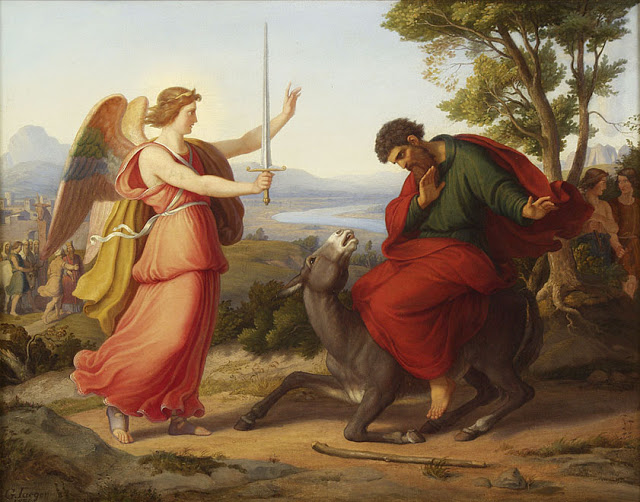
Balaam and the Ass

Balaam and the Ass

image: Wikimedia commons (link).

The position of the earth on its annual journey around the sun is currently bringing the part of the heavens into view which I believe forms the basis for the fascinating ancient scriptural incident of Balaam and his ass (or donkey).

The account of Balaam is found in chapters 22 through 24 of the Old Testament book of Numbers, and it involves a number of important themes, chief among them the theme of blessing versus cursing.

The story of Balaam probably does not get much focus from those devoted to a literalistic reading of the scriptures these days (and my own personal experience during the nearly twenty years I was devoted to such an understanding was attending churches teaching a literalist understanding supports that assertion), due to the fact that it poses some fairly significant difficulties for those trying to read it literally.

Chief among these problems is undoubtedly the climax of the story, in which Balaam's donkey turns around and speaks to him to complain about Balaam's inhumane treatment. Balaam doesn't help things, because he answers right back to the donkey as if it is the most natural thing in the world do be accosted by one's mount while out for a ride. The two get into a conversation.

This is actually not the biggest difficulty in the text, as we shall see. The biggest problem is probably the fact that God appears to become angry with Balaam even after he explicitly tells Balaam to go ahead and travel to Moab, as we'll see in the text below.

Another factor which has probably led to the decline in focus on this story is the fact that the older translations consistently refer to Balaam's mount as an ass, which is what it is, because it was apparently not until some time in the 1700s that the word donkey was even used in English to refer to one particular sub-variety of ass. The 1611 King James translation, which had an enormous impact on literature and culture, thus refers to the animal as an ass, and the story has generally been referred to through the centuries in English-speaking cultures as the incident of "Balaam's ass."

However, if we can just get past those superficial problems, we can see in this story yet another example of the incredible worldwide system by which the same celestial foundations were dressed up in myth after myth after myth, in order to convey profound truths to us for our benefit during this earthly sojourn.

Unfortunately, trying to force the ancient scriptures into a literalistic-historical framework can cause us to miss their beautiful message altogether, or to distort it into something that means the exact opposite of what they were actually intended to convey.

The story of Balaam begins in Numbers chapter 22:

1 And the children of Israel set forward, and pitched in the plain of Moab on this side Jordan by Jericho.
2 And Balak the son of Zippor saw all that Israel had done to the Amorites.
3 And Moab was sore afraid of the people, because they were many: and Moab was distressed because of the children of Israel.
4 And Moab said unto the elders of Midian, Now shall this company lick up all that are round about us, as the ox licketh up the grass of the field. And Balak the son of Zippor was king of the Moabites at that time.
5 He sent messengers therefore unto Balaam the son of Beor to Pethor, which is by the river of the land of the children of his people, to call him, saying, Behold, there is a people come out from Egypt: behold, they cover the face [literally "the eye"] of the earth, and they abide over against me:
6 Come now therefore, I pray thee, curse me this people; for they are too mighty for me: peradventure I shall prevail, that we may smite them, and that I may drive them out of the land: for I wot that he whom thou belssest is blessed, and he whom thou cursest is cursed.

The messengers from Balak come to Balaam and convey the message, but Balaam consults with God and is told in verse 12 not to go with them nor to curse the people, "for they are blessed."

Disappointed, Balak sends yet more princes to Balaam, even more honorable than the first messengers, and this time offers great honor and says that Balaam can name his reward if he agrees to come.

Balaam is again visited by God at night who tells Balaam that if the messengers ask Balaam to go with them, he should rise up and go, but only say the word which God gives to him (verse 20).

This brings us to the most famous part of the story (still in Numbers chapter 22):

22 And God's anger was kindled because he went: and the angel of the LORD stood in the way for an adversary against him. Now he was riding upon his ass, and his two servants were with him.
23 And the ass saw the angel of the LORD standing in the way, and his sword drawn in his hand: and the ass turned aside out of the way, and went into the field: and Balaam smote the ass, to turn her into the way.
24 But the angel of the LORD stood in a path of the vineyards, a wall being on this side, and a wall on that side.
25 And when the ass saw the angel of the LORD, she thrust herself unto the wall, and crushed Balaam's foot against the wall: and he smote her again.
26 And the angel of the LORD went further, and stood in a narrow place, where was no way to turn either to the right hand or to the left.
27 And when the ass saw the angel of the LORD, she fell down under Balaam: and Balaam's anger was kindled, and he smote the ass with a staff.
28 And the LORD opened the mouth of the ass, and she said unto Balaam, What have I done unto thee, that thou hast smitten me these three times?
29 And Balaam said unto the ass, Because thou hast mocked me: I would there were a sword in mine hand, for now would I kill thee.
30 And the ass said unto Balaam, Am not I thine ass, upon which thou hast ridden ever since I was thine unto this day? was I ever won't to do so unto thee? And he said, Nay.
31 Then the LORD opened the eyes of Balaam, and he saw the angel of the LORD standing in the way, and his sword drawn in his hand: and he bowed down his head, and fell flat on his face.

The angel then informs Balaam that, had it not been for the fact that the ass perceived the presence of the angel, the angel would have slain Balaam. Balaam offers to go back home, but the angel tells him to continue, repeating the previous admonition from verse 20 that Balaam is only to say what is given to him to speak.

So Balaam continues, and joins Balak, who takes him "up into the high places of Baal" (verse 41). Balaam instructs Balak to have seven altars prepared, for seven bulls and seven rams, which are made into a burnt offering (Numbers 23: 1 - 6). But when the time comes that Balak expects Balaam to pronounce a great curse, Balaam announces that he cannot curse what God hath not cursed, and concludes with words of blessing (23: 7 - 12). 

Balak is upset, but Balaam notes that he had said from the very start when first approached by Balak's messengers that he could only say what was given to him by God for Balaam to say.

Balak doesn't give up, however, and suggests they try another location, where seven altars are again constructed for seven bulls and seven rams. But the LORD meets Balaam and tells him exactly what to say, resulting in an even more eloquent blessing than before (this time replete with celestial imagery, particularly of a great lion). Balak isn't very happy about this and asks Balaam if he can just say nothing if he's not going to pronounce a curse, but Balaam explains that he must say what the LORD tells him to say (23: 25 - 26).

Balak decides to try one more time, and seven more altars are built as before, with similar results. This time the blessing is even more elaborate and takes up the first part of Numbers 24 (verses 5 - 9). The text also tells us that to deliver this message, Balaam falls into a trance, in which his eyes are open but in which he was given a vision of the Almighty (Numbers 24: 4). 

After this, Balak tells Balaam to flee back to his home, but Balaam asks Balak if he wouldn't like to know more, and goes into another trance to give more predictions -- all of which I believe have to do with the celestial realms and to have spiritual meaning for our lives here on earth, but which could be (and often are) misinterpreted as literal predictions of things that would happen in earthly history. After delivering this message, Balaam returns to his place (Numbers 24: 25).

Now, how can we be reasonably certain that this event, preserved in ancient scripture, is allegorical and not literal and historical?

Setting aside the fact that donkeys cannot actually carry on conversations with humans as Balaam's ass is literally described as doing, there are abundant clues in the story which indicate the exact set of constellations involved.

The best place to start is with Balaam himself. The specific detail that he has his foot crushed by his donkey's efforts to avoid the awe-inducing presence of the angel (Numbers 22: 25), gives us our first clue as to his identity -- and it is a very important one. There is one specific constellation who appears to have a severely twisted foot, and that constellation is currently rising brightly in the east during the "prime-time" viewing hours after the sun goes down: the constellation Perseus.

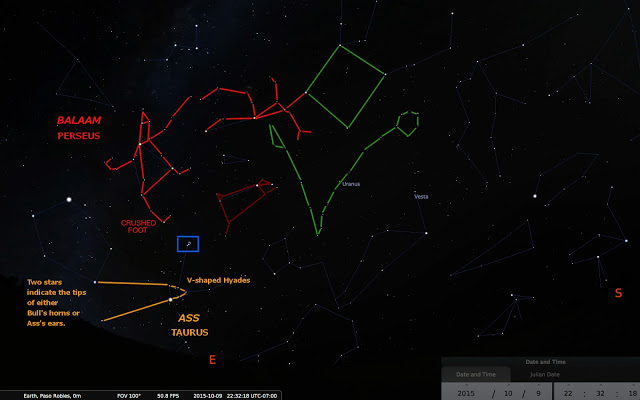
Below is a star diagram looking generally south and east, in which I have drawn in the outline of the constellation Perseus and several of the accompanying constellations surrounding Perseus which may also play a role in this story.

I've labeled Perseus as playing the role of Balaam in this story, and noted the location of the foot that was injured (ouch -- that looks pretty bad):

Now, if we're correct in identifying Balaam with Perseus (primarily on the basis of the crushed foot in the story, although there is plenty of other corroborating evidence that we will find shortly), then we need to find out which constellation is playing the role of Balaam's mistreated beast of burden in the story: the ass.

It just so happens that, directly beneath the figure of Perseus is the zodiac constellation of Taurus the Bull. Now, we know that this story has not come down through history as the famous tale of Balaam's Bull but rather of Balaam's Ass, so how can we possibly assert that Taurus could be playing the role of an ass in this story?

Well, as you can see from the diagram above (and the labeled diagram below, both of which indicate the outline formed by the brightest stars of the constellation Taurus using orange lines), the zodiac constellation of the Bull primarily consists of the brilliant V-shaped Hyades, and then there are two stars much further out above each of the "prongs" of the "V" which enable us to trace a long line in our imagination from the top of the Hyades to the ends of two mighty bull-horns.

These "horns" could also be envisioned as the ears of an ass.

The ass as a species can have some pretty long and impressive ears, as shown in the image collection below (all images from Wikimedia commons, links to originals hereherehere and here):

Looking again at the stars of the constellation Taurus, it is not hard to understand why the formulators of the world's ancient Star Myths sometimes chose to envision this outline as a long-eared ass:

In the diagram, I've indicated the location of the V-shaped Hyades, and then if you look directly to the "left" of the "V" you can see the two stars which form the tips of the horns (if playing the role of the Bull) or the tips of the ears (if playing the role of an ass, as in the story of Balaam).

But in addition to the fact that the outline of the brightest stars in Taurus can very easily be envisioned as fitting a story with an ass or donkey, there is also plenty of evidence from other myths which help to confirm that our interpretation of the story of Balaam is on the right track so far.

Perhaps the most powerful piece of confirmatory evidence comes from elsewhere in the Hebrew scriptures themselves, for the V-shaped Hyades feature prominently in another Star Myth which I have outlined and discussed in some detail: the Samson cycle of myths.

In the story of Samson, of course, Samson's chosen weapon for slaying thousands of Philistines is the famous "jawbone of an ass," which does not seem to make much sense if the story is taken as literal history. Perhaps Samson might use such an implement in a hurry for one or two opponents, but it hardly seems likely that he would continue to employ it over and over against literally a thousand: wouldn't he decide to pick up one of their weapons after slaying a few enemies who had swords or spears? (Unless, that is, all his opponents were also using jawbones as weapons that day, which seems unlikely).

The account is recorded in the scroll of Judges, chapter 15 and verse 15. I have explained in previous posts and in a video that the story of Samson is clearly not intended to be understood literally, but that it was almost certainly intended to convey powerful esoteric truths regarding our experience in this physical incarnate life (Samson was not a literal-historic character but in fact represents aspects of the incarnation of each and every human soul: in a very real sense, the story of Samson is all about you).

The understanding that Samson's jawbone-weapon is actually a group of stars -- that this jawbone is, in fact, the very specific V-shaped formation of the Hyades -- was one of the first breakthroughs in my own understanding that the stories in the Bible are built upon the very same celestial foundation that underlies all the other myths found in virtually every culture and every corner of our planet. This conclusion is explained by Hertha von Dechend and Giorgio de Santillana in their groundbreaking 1969 text, Hamlet's Mill, in which they present evidence that jawbone-weapons are described in myths from the Americas and from the Pacific Islands as well, and all of them relate to the Hyades (the Hyades are located above the constellation Orion, who can be seen "reaching out" towards them, just as Samson is described as "putting forth his hand" to grasp the jawbone in the book of Judges -- you can actually see a few stars of Orion peeking above the horizon in the star-diagrams presented here).

If the Hyades can function as a jawbone-weapon, and if that jawbone is described as "the jawbone of an ass" rather than "the jawbone of a bull" (as we might expect, since the Hyades are in Taurus), then this is very strong confirmatory evidence to support the proposition that Taurus is functioning as the ass in the story of Balaam as well.

Interestingly enough, as can be seen from the included diagrams here, Perseus is reaching out with one arm in the direction of another important constellation: the beautiful maiden Andromeda, whom Perseus rescues in the Greek myth based upon these same stars. In a moment, we will see that Andromeda is playing the role of the powerful angel in this Old Testament story, but first let us briefly note another important confirmatory piece of evidence from Greek myths which also involves the theme of "ass's ears," and that is the story of King Midas.

In that story, of course, Midas reaches out towards his daughter (played, I am convinced, by the same constellation of Andromeda who plays the heroine in the story of Perseus). It is very noteworthy that Midas was later given ass's ears as a sign of his foolishness, given the above discussion regarding the likelihood that Taurus functions as the ass in the story of Balaam in the Old Testament. The existence of another myth involving Perseus and Andromeda, and featuring ass's ears, indicates that myths involving Perseus and Andromeda can also feature nearby Taurus, but as an ass rather than as a bull in some cases.

Note also that there seems to be an element of greed or of overstepping proper bounds due to temptation of money in both the story of Balaam and (much more clearly) the story of Midas.

All of this evidence appears to indicate that we are on the right track in our analysis of the Balaam story. Let's proceed to the identity of the angel.

In the scriptural text, we are told that an angel blocks the path of Balaam, and that specifically (in Numbers 22: 24) the angel "stood in a path of the vineyards, a wall being on this side, and a wall on that side."

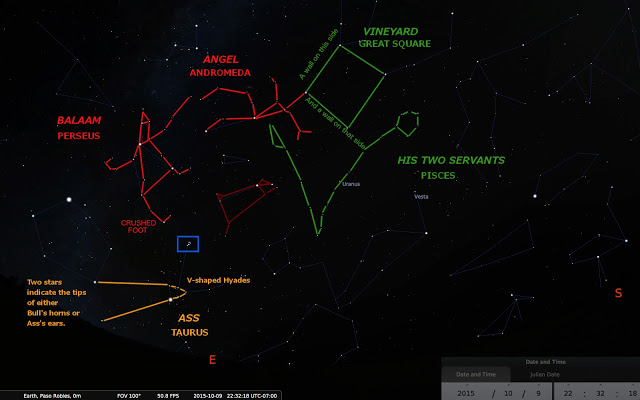
Andromeda is positioned between Perseus and the Great Square of Pegasus, and she is actually touching one corner of the Square itself. If the Square represents the vineyards that are mentioned in verse 24, then it is quite evident that indeed she has a wall on "this side" of her, and a wall on "that side" of her. In fact, I believe this is exactly what the scriptures intend us to understand (it is very common for Star Myths all around the world to contain this very kind of super-abundant evidence, pointing us towards a fairly clear understanding of which constellations they represent).

Just in case we are still in confusion, we can also take a look at verse 22, where the angel is first mentioned, and see that in that verse we are told that Perseus is traveling with "his two servants with him." Just beneath the Great Square of Pegasus is one of the notable "dual constellations" in the zodiac wheel: Pisces. I would argue that the twin fishes of Pisces are probably the "two servants" of Balaam, traveling along the road with him (the road, in this case, following the zodiac through the heavens, up from Taurus to Aries to Pisces to Aquarius).

In fact, I have previously outlined another very important Biblical Star Myth in which Andromeda plays the role of an intercepting angel: the story of Abraham and Isaac. In that story, Perseus plays Abraham about to sacrifice his son, and Andromeda is the angel who stays his hand and points the way to the substitute: the Ram of Aries (located below Andromeda). In fact, the artist who drew this image  included in that previous post does a very good job of depicting the characters as they are arranged in the sky -- Abraham standing with his arms out like Perseus, the angel flying in with outstretched arm in the location that Andromeda is found in the heavens, and the Ram trapped in the thicket just about where Aries is actually seen in the sky as well.

The fact that Andromeda plays an intercepting angel in another Biblical scripture is very strong confirmatory evidence that our interpretation of the Balaam story is on track.

Let's have a look at the analysis thus far:

All in all, the amount of details included in the scriptural account provide overwhelming evidence that the story of Balaam is a celestial allegory, and that it is specifically a celestial allegory involving the region of the heavens containing the constellations Perseus, Taurus, Andromeda, Pisces and the Great Square. To hold that all these celestial correspondences are "merely coincidental" and that the story is really supposed to be understood as a literal-historical account of someone named Balaam (who also happens to have a literal conversation with his donkey using spoken human language, when his foot is crushed because the animal sees an angel blocking the path) seems to be a very unlikely hypothesis at this point, because the texts themselves provide us with abundant evidence that they want to be read as celestial metaphor.

One more set of clues from the text is worth a brief mention, which is the construction of seven altars for seven burnt offerings, which Balaam requests to have built each time Balak takes him up to a high place. Of course, the number seven is fraught with many layers of significance and may be present in the story because of some other aspect of its numerical and symbolical import. However, a very strong argument can be made that the presence of seven altars in this story (a detail repeated over and over) is one more textual clue regarding the celestial origin of this episode.

Just beneath the twisted foot of the constellation Perseus can be found one of the most beautiful celestial formations in the heavens: the brilliant Pleiades. The importance of the Pleiades to cultures around the world is very well known, and has been explored in numerous previous posts on this blog over the years: see for instance

Much more could be written about the importance of the Pleiades in other cultures as well (such as across the Pacific Islands, from Hawai'i to Aotearoa).

The Pleiades is a dazzling cluster of bright and beautiful stars, unmistakeable once you know how to locate it in the sky. It is currently rising up above the eastern horizon in the hours after sunset, and just last weekend I was sitting on a beach in California with some good friends watching the Pleiades climb higher and higher above the horizon in some of the best star-gazing conditions I can remember seeing in a long, long time.

While the number of stars in the Pleiades cluster which can be visible to the naked eye under good conditions number far more than seven, the Pleiades in many myth-systems of the world are depicted as "Seven Sisters" or as related to the number seven (the brightest of the Pleiades are six in number, and sometimes there are stories about the "missing sister" as well, although as you can see from the NASA images and my own hand-drawn diagrams in the blog posts above, there are more than seven stars that you can probably identify for yourself in the Pleiades cluster).

Because of the strong connection between the Pleiades and the number seven, and because the Pleiades are located very near to Perseus (Balaam) and are in fact technically part of Taurus (the ass in the story), I believe it is very possible that the seven altars which are built in the Balaam story are a reference to the Pleiades.

This possibility gains further traction from the fact that we are told that the altars are the site of burnt offerings -- very appropriate for a cluster of glowing stars. 

Additionally, we are told that the burnt offerings are bulls and rams. Of course, the two zodiac constellations in this part of the sky are Taurus and Aries.

Below is our now-familiar diagram of the Perseus - Andromeda region of the sky, with a few final labels added to round out the details we've discovered in our analysis of this Star Myth:

With this many details, I believe we can make a very strong case to argue that the incident of Balaam and the Angel is entirely celestial in nature, and that its message is thus allegorical and not literal-historical.

But what does it all mean? That, of course, is open to interpretation, but previous posts have cited the assertion of Alvin Boyd Kuhn to the effect that the ancient myths are not

about fabulous kings, powerful warriors, or even enlightened sages and mystics, but are actually about the experience of each and every human soul in this incarnate life (see for instance herehere and here). In an important 1936 lecture entitled "The Stable and the Manger," Kuhn said:

The one actor in every portrayal, in every scene, is the human soul. The Bible is the drama of our history here and now; and it is not apprehended in its full force and applicability until every reader discerns himself [or herself] to be the central figure in it!

That means that we don't have to try to imagine an external literal-historical figure named Balaam having a conversation with his donkey -- the story is not really about anyone named Balaam at all! It is about each one of us. 

But we will not be able to figure out what it is trying to convey to us if we try to force the text to be about a literal-historical figure named Balaam. In fact, as we will see shortly, doing so risks inverting the esoteric message entirely.

To understand what I think the story of Balaam is intended to convey (or at least part of what it is intended to convey -- there is no doubt much more to this very deep metaphor, the depths of which each reader is invited to plumb on his or her own), we must understand that the specific part of the heavens which we have been examining in our analysis is very significant due to the sun's rising in the sign of Aries at the point of the spring equinox during the Age of Aries during which many ancient myths (and especially Biblical myths in the Hebrew scriptures) are set.

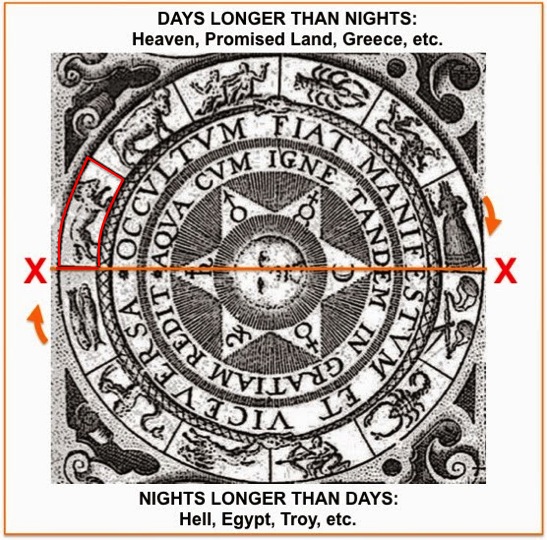
This is the point of "crossing upwards" into the upper half of the year, when hours of daylight begin to dominate again over hours of darkness, after the long winter months in which darkness dominated over day.

The constant interplay between the "lower half" and the "upper half" -- between the forces of "darkness" and the forces of "light" -- were anciently allegorized in myths around the world as a great struggle or battle. Previous examinations of the Mahabharata and the Bhagavad Gita, for instance, have discussed the evidence for this assertion, and the stories of the Trojan War in the Iliad as well as the crossing of the Red Sea in the Old Testament can be shown to relate to this same interplay.

But the myths are not "just" about the natural cycles of the year: they can be definitively shown to have used the great cycles to convey knowledge about spiritual truths. In other words, the myths use the most majestic physical models conceivable -- the mighty cycles of the heavens, the turning of the stars through the night, the progression of the zodiac signs and the planets through the year, the interplay of the seasons and the sun's path from equinox to solstice and back, the phases of the moon, and even the longer cycles of planetary conjunctions and the titanic precessional mechanism that grinds out the ages over the course of thousands and thousands of years -- in order to convey to our understanding truths about invisible matters.

In terms of the great zodiac wheel, at least on one level of metaphor, the upper half of the year is associated in myth with the invisible realm of spirit but also the spiritual and divine aspect in each and every incarnate human being, just as the lower half of the wheel is associated with our physical, material, animal, corporeal nature, into which we are plunged upon incarnation.

Much of the purpose of the myths of the world appears to have been to remind us that we are not merely physical, to awaken the spiritual within and point us towards the truth of our divine inner nature. Previous posts such as those linked above have connected this awakening of the "spiritual component" in ourselves, others, and in all the universe around us, with the concept of blessing

The opposite impulse, of course, denies the spiritual, seeks to degrade, debase, brutalize and otherwise reduce to the physical and the animal (which is why violence is so wrong, on any level). All forms of cursing can be seen to be connected to this opposite "physicalizing" and "brutalizing" impulse.

In the story of Balaam, the concept of blessing and cursing is clearly central to the narrative. In the allegory presented, Moab and her king Balak are representative of the lower half of the wheel, and the forces of darkness. The king, Balak, specifically wants cursing, and seeks to hire Balaam to do it.

The children of Israel in the metaphor are representative of the upper half of the wheel. In one part of the Biblical passage quoted, the text tells us that they "cover the face [literally the 'eye'] of the earth" (Numbers 22: 5). In other words, they are associated with the sun (the "eye of the earth") and with the half of the year in which the hours of daylight cover more and more of the hemisphere in question (the summer months, the upper side of the wheel).

The upper half of the year metaphorically represents the realm of spirit, and the re-establishment and re-affirming and uplifting of the divine present at all times in men and women (and in all of creation). It is  the same concept expressed by the raising-up of the Djed Column in ancient Egyptian myth-systems discussed in many previous posts and videos, such as here and here and here.

It should not have to be repeated at this point, but because literalism has so firmly entrenched itself in the cultural consciousness of the west for the past seventeen hundred years, it must be stressed that the children of Israel in this story do not represent historical or literal personages, any more than does Balaam (or, for that matter, King Midas). The text is a spiritual allegory. The children of Israel in this story represent a spiritual aspect of reality that is present in all of us -- not a group of literal or historical people (the allegorical understanding is inclusionary, not exclusionary as the literalistic understanding tends to be).

They (like the Danaans in the Trojan War) represent the upper half of the zodiac wheel, and allegorically the realm of spirit and the uplifting of the divine spark present in all human beings (and all nature as well). This is made clear in some of the "blessings" pronounced by Balaam in Numbers 22 - 24 (see for example the mention of the Lion in Numbers 23: 24, which is undoubtedly a reference to the sign of Leo, strongly associated with summer and the "upper half" of the zodiac wheel). None of us are literal descendants of any constellation -- but the idea of being descended from the stars conveys a an allegorical truth about our spiritual condition.

Moab and Balak represent the lower half of the wheel. The story is about spiritual matters, and not about historical and literal battles between different physical branches of the human family.

Thus, when Balaam is asked to curse the allegorical representatives of the divine spark, the invisible realm of spirit -- the very aspect of our dual human nature that we are supposed to be lifting up and calling forth -- he is being asked to deny the spiritual, the divine, and everything associated with the invisible realm.

Doing so would be to send the message that we are nothing but physical, animal, brutal beings, with no invisible, spiritual, divine component.

Of course, whenever Balaam gets in touch with the realm of spirit, with the realm of the divine, by going into a state of trance, he is strongly warned not to convey such a brutalizing, cursing message. He is instead given a message that raises up the spiritual -- and indeed a message that predicts the eventual and inevitable triumph of spirit over the brutal, the physical, the debasing and the degrading aspects of our physical incarnate condition.

Whenever Balaam is on the way to cooperate with the king of Moab, he is opposed by the angel, representative of the invisible realm (and indeed, invisible to Balaam until his eyes are opened). We watch as he grows more and more angry at his beast, more and more violent, more and more brutal, until his ass with her just questions appears to be at least as human as he is.

She is more in touch with the spiritual realm than he is, and she saves him from destruction even though he beats her for it.

Clearly, Balaam in this story is representative of our own human condition. And this helps us to understand one of the aspects of the scriptural passage which could give literalist readers major difficulties -- the fact that God told Balaam to go along with the messengers of the king of Moab, and then sent the angel to oppose Balaam (literalist interpreters often try to construe some kind of culpable motive to Balaam in his going along, even though he has just been told in a dream to do so).

If Balaam is representative of some aspect of our own soul's condition, here in this incarnate life, then our entry into incarnation is akin to "going into the kingdom of Moab" and it is ultimately for our own good and in thus in accordance with the divine will. In other words, we descend into this life from the realm of spirit for our own benefit. But our mission here is not to become brutal, not to become violent, not to become bestial, but rather to bless and to uplift and to reconnect with that upper half of our nature -- our spiritual and divine True Self.

When we understand this allegorical system, then the story begins to make sense in a way that it does not when we try to force a literal reading on the text. It is a story of hope and of the dignity and divinity inherent in each and every human being. We all are a combination of physical and spiritual, but we are told that the spirit will eventually and inevitably triumph, no matter how ugly the physical circumstances and situations may become, and no matter how our own spiritual blindness will often lead us to do stupid and even self-destructive things as we go up the path.

When we understand the story as esoteric and allegorical, then we see that it applies to each and every person, and that it teaches us to work to lift up the spiritual in ourselves and in others, and not to put them down.

But when it is taken as literal and historical, this message can become distorted, because when it is externalized then it can be mistakenly seen as a message which lifts up some groups and puts down others.

In fact, by externalizing the text, a literal reading can lead to some conclusions that are "180 degrees out" from the interpretation just offered. A "physical" message, so to speak, instead of a spiritual one.

But, when we see the clear and overwhelming evidence that the text describes the motions of the stars, it becomes clear that the literal and historical reading -- already very difficult to maintain in light of the incidents in this particular episode -- is almost certainly not the intended message of the ancient text.

The same exercise can be performed with virtually every single other story in the scriptures included in what we today refer to as "the Bible" (both the "Old" and "New" Testaments), and indeed with virtually every other myth and sacred story from around the world.

Leaving us with what I believe are several inescapable conclusions, among them:

that we are all connected,

that we are all primarily spiritual and that thus the external and physical should not be used to divide us from one another,

that we should pay attention to the invisible realm (as Balaam learned "the hard way" in the story, but as we ourselves also generally "learn the hard way" in this life),

that we should bless and not curse,

that we should lift up and otherwise draw forward the divine spark in others and, as much as possible, in the part of the cosmos that we can impact around us

(including by planting gardens, opposing degrading treatment of animals, and opposing the pollution of the air and land and waters around us),

and

that the side of uplifting will ultimately and inevitably win out, and that those who are on the side of cursing and debasing and brutalizing may seem to be powerful now but that in fact they are not.

Birthday of John Lennon (October 9)

Birthday of John Lennon (October 9)

The above interview selection comes from an interview conducted in September 1980 by David Sheff. A transcript of the full interview can be found at the following set of links:

page 1,

page 2,

page 3.

There, in addition to discussion that had to do with aspects of his own and Yoko's particular journeys through this life, John Lennon expresses some thoughts about the nature of the world's ancient wisdom. 

Towards the end of the interview, he says:

Well, you make your own dream. That's the Beatles' story, isn't it? That's Yoko's story. That's what I'm saying now.
Produce your own dream. If you want to save Peru, go and save Peru. It's quite possible to do anything, but not to put it on leaders and parking meters. Don't expect Carter or Reagan or John Lennon or Bob Dylan or Jesus Christ to come and do it for you. You have to do it yourself. That's what the great masters and mistresses have been saying ever since time began. They can point the way, leave signposts and little instructions in various books that are now called holy and worshiped for the cover of the book and not what it says, but the instructions are all there for all to see, have always been and always will be. There's nothing new under the sun. All roads lead to Rome. And people cannot provide it for you. I can't wake you up. You can wake you up. I can't cure you. You can cure you.

In other words, it appears that in this segment of the interview, John Lennon is expressing the view that the ancient scriptures are actually all about you, and that they have been either mistakenly or intentionally misinterpreted for their "cover story" -- externalized, so to speak, wrongly valued for the "outer layer" rather than for what is actually the message ("what it says"). He is also expressing the view that in fact their message is that you have the power to "wake you up" -- and that looking for an external figure to do that for you is futile.

However he and Yoko achieved this gnosis, I believe that in these words John Lennon very directly expresses a correct understanding of the world's ancient wisdom, an interpretation which I believe is actually supported by an overwhelming amount of evidence which can be demonstrated using examples from the ancient myths and sacred stories of just about every culture on our planet. See for example many of the discussions linked on this page, and discussed in videos I've posted such as herehere, and here, as well as numerous posts exploring the idea of "Two Visions," some of which are linked here.

I also believe that this understanding (that the ancient stories are not about something or someone external who saves or empowers us, but rather about the divinity contained in each and every person we encounter in this incarnate life, and about our own growth and "waking up") corresponds very clearly to the belief in the dignity and value of all human beings, and therefore to the principle of non-violence -- a philosophy John Lennon mentions elsewhere in that interview.

This vision also clearly harmonizes very well with the idea that people themselves can effect real and positive change in the world -- that they don't need to and (in fact) should not expect some external figure to do it for them. And this message was clearly expressed in his music and in his life.

The incredible importance of the INNER connection to the Infinite

The incredible importance of the INNER connection to the Infinite

image: Wikimedia commons (link).

The previous post discussing the significance of the Moon Festival explains (following the incisive and inspired analysis of Alvin Boyd Kuhn in Lost Light) that the moon is used in ancient myth and ancient wisdom the world over as the symbol of the body, which is illumined during the night by the light of the unseen sun, which is analogous in this particular metaphorical construct to the light of the divine, invisible spirit-fire.

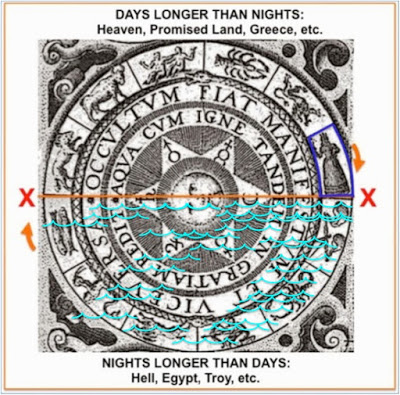
That and other posts have explained that the crossing down to the "lower half" of the year was analogous to the incarnation of the soul within the human form. The lower half of the year is the half of the year in which night-time dominates over daylight -- when nights "cross over" to begin to be longer than the daylight hours, on the way down to the very lowest part of the year, the very "pit" of the winter solstice.

This toiling across the lower part of the year, from the "crossing down" point at fall equinox to the "crossing up" point at spring equinox, was used to convey subtle and powerful truths about our human existence. This incarnate life, in other words, was analogized by the lower half of the year during which night dominates.

During the night, we cannot see the sun. But, we can see the reflected rays of the invisible sun (the sun being invisible to us at night-time). 

We can see the reflected rays of the invisible sun shining upon and reflecting out of the body of the moon. The moon actually has no light of its own, but it shines with a glory of light transmitted to it from the invisible sun.

In this way, the moon helps us to better understand our condition, for we are in a body that the ancient myths and metaphors associate with the moon, and yet we too are made alive by a light from the invisible and divine realm of spirit. 

We are crossing through the lower-valley, the valley of night and of the shadow of death, where the reality of the spirit world is hidden from our plain sight. And yet we are not without access to the power and the glory of the unseen world: just as the moon at night is illuminated by the rays of the invisible sun, we and everyone we meet in this incarnate world have access to the light and warmth of the divine rays which come to us from a world which we cannot presently see (at least not with our physical eyes).

But, although like the moon in having access to the divine light of spirit, our situation is unlike the moon in that our access is to a divine light that is in fact within us and not completely external to us (unlike the case of the actual moon in the heavens, which does receive light from an external sun outside of itself). The moon metaphor is helpful in that the sun is invisible at night, as is the source of the invisible divine light to which we have access (we cannot physically see the divine world, just as we cannot see the sun at night). 

But our connection to the Infinite is in fact internal and not completely external.

This is a very important point, and one that the ancient scriptures take great pains to explain and portray to us: the divine is within, and is not separate from you, not external to you. In the New Testament scriptures, for example, Jesus is portrayed saying, "For behold, the kingdom of God is within you" (Luke 17:21) and Paul's letters declare, "Know ye not your own selves, how that Jesus Christ is in you" (2 Corinthians 13:5).

As we have seen in many other discussions of this subject, this same message can be found being conveyed by various different sacred metaphors in myths the world over -- see for instance the specific discussion here, and a host of other related posts listed here

For instance, in the image above depicting an important episode in the Mahabharata, Kunti is reciting a mantra to summon the divine Indra, who appears to her in an instant (and who is depicted here with a halo, which ties in to the metaphor of moon and sun discussed above). Kunti is depicted with her hands together in the Anjali mudra, the gesture of namaskaram: the acknowledgement of deity. 

But note that this gesture is an acknowledgement of deity both in oneself and in another. 

Thus the artwork above contains the message that Indra appears to Kunti instantly because Indra is always present with Kunti -- and what is true for her is true for each and every man and woman in this incarnate existence. We have an ever-present and unbreakable inner connection to the divine Infinite.

As Alvin Boyd Kuhn explains at great length in a very early passage in Lost Light (beginning around page 45), it is very important to understand what this means and what it does not mean. To acknowledge our own divine spark is not to deny the existence of an external divine Infinite. Alvin Boyd Kuhn explains:

Ancient religion was suspected of having left the monotheistic God out of its picture. It did not leave it out, but it had the discretion to leave it alone! The sage theologists reverenced it by a becoming silence! [. . .] But the pagan world provided a contact with a god dwelling immediately within the human breast. [. . .] And this implied no spirit of vaunting humanism or affront to deity. It was just the recognition of deity at the point where it was accessible. The real heresy and apostasy, the gross heathenism, is to miss deity where it is to be had in the blind effort to seek it where it is not available. [. . .] The kingdom of heaven and the hope of glory are within. They lurk within the unfathomed depths of consciousness. Divinity lies buried under the heavier motions of the sensual nature and the incessant scurrying of the superficial mind. 45-46.

He goes on to argue that the

externalization

that took place through a literalistic interpretation of the ancient myths and scriptures moves all deity to someone or something outside of us, and thus "has left the rest of mortals unsanctified" by cutting us off from our own divinity (47).

This may seem like a philosophical, theological, or intellectual discussion -- but it has tremendous practical application and consequences.

Because it leads directly to the problem of the "Two Visions" which the Lakota holy man Black Elk described, between the vision of grasping and grabbing and chasing after the external (which leads to destruction of the earth around us, and ultimately to our own self destruction) and the knowledge that what we are really seeking is already available to us, all along (a vision of plenty, a vision of security, and a vision of peace and harmony).

Look again at the assertions that Alvin Boyd Kuhn articulates above. He says that externalizing the divine cuts us off from our divinity (the quotation is halfway down page 47). In the very next sentence he states that this externalization robs humanity at large of its birthright.

Cut off from accessing our inner connection to the infinite, we pursue it externally instead. And, I believe, under the vision of scarcity and lack that stems from the very concept we are here discussing, there is the urgency that we have to "race to get it" before someone else does -- leading to exactly the mindset of "little islands" amidst a "gnawing flood dirty with lies and greed" that Black Elk warns us against, the mindset of "everybody for himself," rushing down "a fearful road."

This is exactly the mindset that we can see running absolutely rampant to the point of literally threatening to tear the world apart around us right now -- the mindset that seeks to reduce humanity into little islands in the midst of a gnawing flood, to the point that they have no ability to band together to stand up for the dignity that is ultimately rooted in the acknowledgement that each and every man and woman you meet contains the spark of infinite divinity within and thus has infinite worth.

Examples are so numerous they hardly need to be listed here -- most readers can think of dozens without even trying. But for the sake of illustration, one might think of the blasting away of any attempts by communities to restrict the rush towards genetic alteration of the food supply: this is akin to the gnawing flood of lies and greed that seeks to isolate individuals into little islands, hanging on for dear life ("if you don't like it, then don't buy it, little individual island -- but you have no right to hold hands together with others and raise your voices together to make demands for your community or region regarding genetic modification of the crops, or the chemicals used on those crops and what they might be doing to bees or water tables or anything else").

If these crops or the chemicals that they are designed to have sprayed over them cause harm to men and women and children for the sake of "lower input costs" (and higher profit margins), then the vision which Black Elk warns us about is plainly taking place before our eyes: a rushing after getting more and more, regardless of the cost to others -- everybody for himself, rushing down a fearful road (a "race to the bottom").

Another example are wars of aggression waged under false pretenses in which thousands of men, women and children are killed, injured, or have their homes destroyed. Men and women in the United States and western Europe need to examine the available evidence very closely and objectively in order to determine whether or not they have been supporting or participating in criminal wars of aggression for the past fourteen (or more) years.

I would submit that the willingness to excuse, overlook, or attempt to justify the unjustifiable killing of other men, women and children in wars of aggression can be directly connected back to the denial of the inherent divinity present in each and every human being and the infinite worth and sacred nature of each and every man or woman regardless of where they live.

And also to an artificially-induced insecurity that comes from artificially externalizing something to which we already have access, something so profoundly valuable that Alvin Boyd Kuhn describes it as the "birthright" of humanity at large: its own divinity. And by externalizing what is internal, this error sets humanity off on a tremendous chase, a running after external answers, which then manifests itself on just about every other layer of the human experience.

The cutting off of humanity from deity "at the one point where it was accessible," to use Kuhn's phrase above, is what starts the whole wheel spinning in the wrong direction -- and it seems to be spinning faster and faster as (to use the metaphor of Black Elk) the flood eliminates the last interconnecting land forms between the "little islands" and leaves everyone isolated in the midst of the dirty rushing tide.

But, as I have said in previous posts on this subject, the good news is that this disconnect from what we actually need the most -- this cutting off from our most precious birthright, our constant connection to our own divine inner spark -- is in fact an artificial disconnect.

We are never actually disconnected from our own inner connection to the Infinite. What can be artificially induced by slight-of-hand or erroneous hermeneutics can be "un-induced" and corrected, as if in a flash.

We can wake up in an instant to our own actual connection to divine wisdom and knowledge, and to our connection with every other human being and indeed with the earth and with all of nature around us.

This may, in fact, be what we are here in this incarnate life to do: to wake up to that inner connection to the Infinite, to raise the awareness of and reflection of the divine within ourselves and as much as possible in others around us.

Indeed, the ancient scriptures and myths of humanity seem to say that this is precisely what we are down here to do in the first place (or a very big part of what we are here to do).

Birthday of Marc Bolan (September 30)

Birthday of Marc Bolan (September 30)

One of the clear messages of all of the Star Myths of the world is that you and everyone else you meet is a precious star, connected with, reflecting and containing the entire cosmos.

Mid-Autumn Festival 中秋節 and the Total Lunar Eclipse ("Blood Moon") of September 2015

Mid-Autumn Festival 中秋節 and the Total Lunar Eclipse ("Blood Moon") of September 2015

image: Wikimedia commons (link).

This Sunday, September 27, marks the beginning of the traditional celebration of mid-Autumn festival in China and Vietnam. It is a very ancient holiday, its observance stretching back to as early as 3600 years ago, and perhaps even earlier, and it is one of the most important holidays in Chinese culture. Great effort is usually made to travel and be with family on this day, much like Thanksgiving in the US, and for several days around the holiday many businesses and markets are closed as people make their way back to the places where they grew up, in order to celebrate with their extended families.

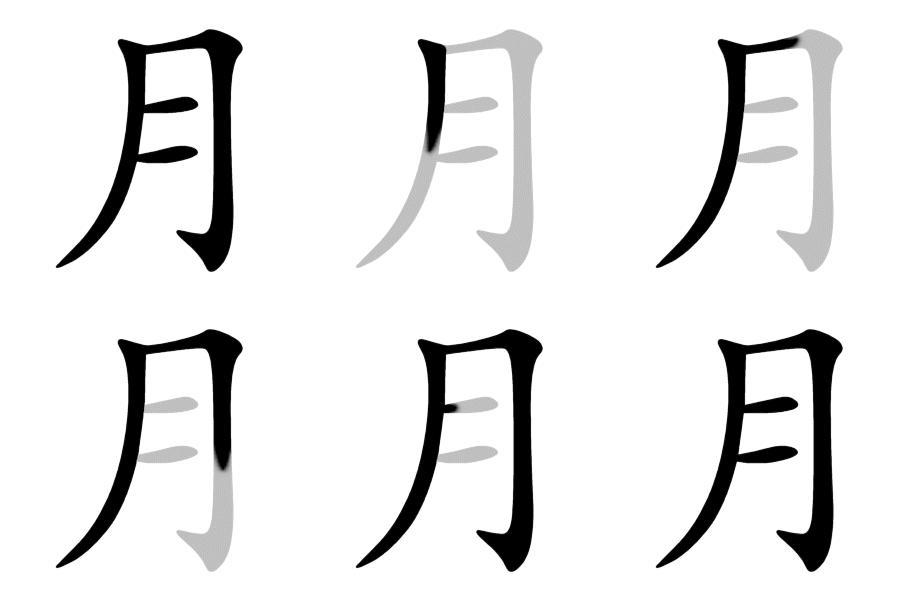
The Chinese characters for this holiday are 中 秋 節 which is pronounced Zhong Qiu Jie in Mandarin and Jung Chau Jit in Cantonese, and which translates literally into "Mid-Autumn-Day" or "Middle-Fall-Holiday" (or even more literally the "Mid-Autumn-Node").

Jung Chau Jit is celebrated on the fifteenth day of the eighth lunar month, the fifteenth day corresponding in general to the full moon in a lunar month (because a lunar month commences with a new moon, and the moon waxes for fourteen days to become full, which happens on the fifteenth day, and then wanes for fourteen more days to the point of another new moon), and so this festival always falls very close to or directly upon the day of a full moon, as it does this year.

Thus, the Mid-Autumn Holiday is also a Moon Festival, and is in fact often called the Moon Festival, and an important tradition during the days (weeks!) leading up to this holiday and on the day of the holiday itself is the giving of round "mooncakes," light gold in color and filled with a variety of different kinds of heavy, sweet fillings, and sometimes with a candied egg yolk:

image: Wikimedia commons (link).

These are traditionally served by being cut carefully into four equal quarters (a little combination cutting-and-serving implement, something like a small version of a cake trowel, is often included in commercially-sold mooncake boxes or packages), with each person present being given one section. The cakes themselves often have "blessing" words baked into the top of them. 

Being a Moon Festival, the holiday is also closely associated with the Moon Goddess, pictured at top, whose name is 嫦 娥 which is pronounced Chang Er  in Mandarin and Seung Ngo in Cantonese and translates rather directly into "Chang the Beautiful" or "Seung the Beautiful." 

There is a legend about Seung Ngo and her husband, 后 羿 being banished from the heavenly realms by the Jade Emperor (whom we met in the earlier discussion of the Lantern Festival, which takes place in the first lunar month) and having to live down upon the earth as mortals (his name is pronounced Hou Yi in Mandarin and Hau Ngai in Cantonese, and it means something like "King Archer").  

In the legend, he is distraught at the idea that his beautiful wife, having been banished from the celestial realms, is now faced with mortality, and so he seeks and eventually obtains an elixir of immortality which will restore their immortality to them. However, as so often happens in such myths, the plan goes awry, when she is forced to drink it all herself (either to keep it from a marauding robber who breaks in to steal it from her while her husband is away, or because she is overcome with curiosity while he is asleep, and drinks the whole elixir without knowing the consequences).

As soon as she does, she feels herself floating up into the heavens, without her unfortunate husband, who is left behind as a mortal. The two are thus separated forever, but Seung Ngo settles on the Moon, where she can look down upon Hau Ngai, and he can gaze up to her new home and think of her.

Having examined some of the most prominent aspects of this important ancient holy day, we are now in a position to benefit from the deep knowledge contained within its symbols and forms.

Because this poignant myth, and all the other symbols of the Mid-Autumn Festival, are powerful symbols which speak to truths about our incarnate existence, this existence in which we find ourselves crossing the "underworld" of the material realm in a physical body -- which is closely associated with the figure of the moon in the ancient system of celestial metaphor -- but doing so with the dimly-remembered awareness that we are separated from our true home (and disconnected from our higher "divine twin") during this earthly sojourn, and that we are in fact actually spiritual beings as much or more than we are physical beings.

The festival, positioned in the time of year next to fall equinox, contains the same symbols of a goddess and the fall from the celestial realm into the mortal incarnate life associated with the point of autumn equinox literally worldwide in the ancient myths.

Among them:

  • The presence of a goddess-figure (in this case, the goddess Seung Ngo, or Chang Er), goddess figures being shown in the previous post to be associated in ancient myth the world over with the point of fall equinox and the plunge into incarnation.
  • A myth in which there is a prominent theme of expulsion from the heavenly realm and banishment to the earthly realm (the plunge into this lower realm), featuring a duo in which one of the pair is mortal and one divine: just as we, in this incarnate life, find ourselves "crossed" with a physical body and an internal divine spark. 
  • The incorporation of moon-themes to go along with the incarnation theme of the fall equinox (dominated by the presence of a goddess at the point of incarnation). As Alvin Boyd Kuhn demonstrates in extended discussions found in Lost Light, published in 1940, the ancient myths  and sacred traditions very often used the moon to symbolize our incarnate form, and the sun our divine spirit, which lights up and animates our physical body in the same way that the sun gives its light to the moon (see pages 115 and following, for example, or 520 and following, or 139 and following, or 521 and following). In that exploration of ancient myth, Kuhn says quite explicitly: "The sun types soul, always, the moon, body" (479), and elsewhere: "The moon being the parent of the mortal body, lunar symbolism was prominently introduced into the portrayal "(140).
  • The connection of the moon (our incarnate side) with the idea of water, seas, oceans, and incarnation (through the tides, and also through the internal tides of our body), which also connects with the goddess-ocean connection discussed in the previous post (with examples which demonstrated the "mother-ocean" connection inherent in the names of Mary, Tiamat, and Aphrodite, as well as in the Chinese ideograms for mother and ocean).
  • The tradition of gathering together with family at the Moon Festival, representative of the idea that we align the cycle of our personal lives and our physical motions (often traveling great distances) with the cycles of the earth, sun, moon and stars: reinforcing the profound connection between "microcosm" and "macrocosm" discussed in the preceding post (and many others), a connection which the ancient myths and sacred traditions of the human race the world over all seek to convey. 
  • The tradition of gathering together with family at the Moon Festival, which also commemorates our physical, material entry into this incarnate life, which is celebrated when we honor our family and especially our parents.
  • Traditions in this holiday (especially as celebrated in Vietnam) which focus on children and proclaim it to be a holiday which honors young children, who are just embarking upon their journey through the incarnate human life.
  • The tradition that mooncakes are cut up into four quarters, which is clearly connected with the lunar symbology, but also with the concept of "crossing" or the crucifixion of this incarnate life (see numerous previous posts which demonstrate that the Great Cross of the year was associated in ancient myth with the twin components of incarnate human existence: the horizontal component representing the physical, "dead," "animal" nature of our body, and the vertical component representing the spiritual, divine, celestial component of the invisible and infinite realm which the ancient myths tell us is actually all around us and also within us and within every other being with whom we come into contact).

Clearly, then, the Mid-Autumn Festival preserves a great many symbols which carry a profound spiritual message, using the symbology of the moon (associated with incarnation), the casting down from the spiritual realms into incarnate existence (in the story of Hou Yi and Chang Er, or Hau Ngai and Seung Ngo), the myth regarding a married couple who are extremely close but who find themselves in the condition of one divine and one mortal (the "divine twin" pattern found around the world, including in the myth of Castor and Pollux but also of Jesus and Thomas and many others), the traditions of gathering with family and ordering our lives in accordance with the cycles of earth, sun, moon and stars, and the traditions of honoring our physical family and our parents, who brought us into this incarnate body in the first place.

It is also worth pointing out, in passing (although it could become a full-length examination and discussion) that a great many Chinese characters which use the symbol for "the moon" actually refer to our physical human body. The Chinese ideogram for "moon" is:

Other words whose ideograms use this as a "radical" in their Chinese character, and which relate to the physical human body, include:

The liver: 

The ribs or chest: 

The armpit, or arms:

The elbow:

Pelvis, groin or thighs:

The diaphragm:

Internal organs, guts, viscera:

A gland:

Fat, plump, or obese:

And there are many others.

Some scholars or those familiar with Chinese radicals may argue that none of the above characters are actually connected with "the moon," even though the radical looks just like the Chinese symbol for the moon, because the actual radical for "meat" -- which looks like this --

ends up looking like the symbol for "the moon" when it functions as a radical in a compound character. 

That is a valid argument, but we must ask ourselves why that "meat" symbol turns into a "moon" symbol in all of these ideograms? The answer, of course, could very well be the fact that the ancient wisdom of the human race universally acknowledged an esoteric connection between the moon and the physical, corporeal, carnal ("meat") body.

And so it becomes clear that all of the symbology of the culturally significant and anciently-established Mid-Autumn-Festival can be shown to be connected to other mythological symbols used in other myths around the world -- all of them designed to impart to us profound gnosis regarding our human condition here in this incarnate life, including the fact that we are not merely physical beings but that our human nature consists of both a physical and a spiritual component, that our physical "moon" form (associated with water) is illuminated by our spiritual "solar" and divine nature (associated with fire and with air -- or spirit).

Now, very briefly, let us also note the fact that because the Mid-Autumn-Festival always falls on or very near a full moon, it will also periodically happen that this anciently-ordained observation will coincide with a lunar eclipse. Previous posts on the actual celestial mechanics of the moon phases (see here, here, and here) have explained why lunar eclipses must always coincide with a full moon, and why solar eclipses must always correspond to a new moon (not every full moon is a lunar eclipse, of course, nor every new moon a solar -- but every lunar eclipse occurs at full moon, and every solar eclipse occurs at new moon).

This September 27 full moon also happens to take place when the moon is passing through a "lunar node" (a "crossing point" with the plane of the ecliptic of the earth) and will therefore result in a total lunar eclipse visible for most of the Americas, Africa and Europe (see resources from Sky & Telescope regarding this eclipse available here).

Not only is this a total lunar eclipse, but it is also a total lunar eclipse which corresponds to the moon's closest approach on its orbit around the earth, when it is physically closer to us and thus appears physically larger in the sky -- all of which add up to the promise of a spectacular heavenly event this weekend.

This particular moon (all month long) is in fact known universally as the Harvest Moon (in China also), which is traditionally understood to be the brightest moon of the year.

All of these factors argue that this weekend's lunar eclipse should be worth going out and watching, if at all possible in your particular global location and circumstance.

As the moon enters the shadow of the earth, it will take on a dusky red hue -- which (only recently) has begun to be designated as a "blood moon" by some in the popular media and in certain evangelical circles (largely based upon a literalistic interpretation of certain Old and New Testament scriptures which I believe can be definitively shown to be esoteric in nature and not literalistic in nature). Scriptures in the Old and New Testament which describe the moon as turning to blood or being bathed in blood include the following texts:

Joel 2:31 "The sun shall be turned into darkness, and the moon into blood, before the great and terrible day of the LORD come."
Acts 2:20 "The sun shall be turned into darkness, and the moon into blood, before that great and notable day of the Lord come:"
Revelation 6:12 "And I beheld when he had opened the sixth seal, and, lo, there was a great earthquake; and the sun became black as sackcloth of hair, and the moon became as blood;"

Alvin Boyd Kuhn actually addresses many of these Biblical passages directly, and argues (with extensive textual evidence) that the description of the "moon becoming as blood" only emphasizes even more dramatically the esoteric symbolical connection between the moon and our physical body in this human life.

Discussing the passage cited above from Revelation 6, he explains among the metaphors given: 

along with the darkness over the earth, the veiled sun, the blood-stained moon, is that "the stars from the heavens fell." In the same place we read that "when the message of the third angel was sounded forth, a great star went down from heaven and it fell upon the earth." Another star fell at the sounding of the trumpet of the fifth angel. The various legends, then, of falling stars become invested with unexpected significance as being disguised allusions to the descent of the angelic myriads to our shores , -- to become our souls. 116.

In other words, Kuhn here argues that the metaphors in Revelation 6 (and indeed throughout the Bible)  all have to do with our incarnate condition, consisting of a "crossing" between spirit (symbolized by the sun) and matter (our material bodies, symbolized by the moon). 

This interpretation (according to Alvin Boyd Kuhn) would include the metaphor of the earth being enshrouded by darkness -- because we plunge down to incarnation in the lower half of the zodiac wheel, as described in numberless previous posts. The lower half of the wheel is the half in which night triumphs over daylight (initiated by the fall equinox, when the hours of darkness begin to be longer than the hours of light, in each 24-hour period):

It would include (according to Kuhn) the moon being bathed in blood -- because the moon represents our incarnate condition, our sojourn in a body composed of water and blood and clay, our crossing of the "Red Sea" (which can be metaphorically seen to be the crossing which each and every human being undertakes, going through life in a human body through which courses the "red sea" of the blood in our veins and arteries).

It would include (according to Kuhn) the stars being cast out of heaven and forced to "fall upon the earth" -- for this is the very condition in which we find ourselves, as human souls who dimly realize that we come from a spiritual home, but who have been exiled (just like Hau Ngai and Seung Ngo) upon this material plane.

In other words, the passages in Revelation (and all the other esoteric Biblical scriptures) are describing our own human experience, our experience as divine beings who have been "crossed with" physical, material, animal bodies during this incarnate life.

And this is just what all the other Star Myths of the world are trying to convey to us as well! (Note that it can be conclusively demonstrated that the passages of the book of Revelation involving the opening of the seven seals are absolutely based upon metaphorical descriptions of the constellations in our night sky, as I demonstrate briefly in this previous post regarding Revelation Chapter 9: they are all allegorical celestial metaphors which use the awe-inspiring motions of the heavenly cycles to convey truths to us about the invisible realm).

Indeed, all of these metaphors and sacred scriptures are designed to convey to us the very same truths conveyed through the ancient metaphors connected to the Mid-Autumn-Festival celebrated in China and Vietnam and some other surrounding cultures from time immemorial.

As the day of the first full moon after fall equinox approaches, it is a time for contemplation and reflection upon our human condition in this incarnate life -- our "plunge into matter" which in ancient myth was associated with the point of the fall equinox, with the goddess at the edge of the ocean (or the goddess of the Moon), and with the "crossing" of our divine nature with a physical body.

And yet, even as we are plunged into this physical human form, we are given forms and symbols and myths and stories and scriptures to remind us that this material world that is visible and perceptible to our senses is not all that there is, and that this physical "animal" human body we inhabit is not all that we are. 

Just as the moon is illuminated by the fire of the sun's life-giving rays, so our material nature is illuminated and animated by a higher spiritual self that exists "above and beyond" our merely physical carcass. 

Just like the mooncake in the Jung Chau Jit celebration, which is divided and quartered into four equal sections, we ourselves are made up of a "cross," a "crucifix," a "quartered whole" consisting of both a horizontal line (between the equinoxes, and associated with matter) and a vertical line (between the solstices, reaching towards infinity, and associated with all that is spiritual, and with raising the spiritual aspect within ourselves and with calling it forth in those we meet and indeed in all of creation around us).

I sincerely wish you a very blessed Mid-Autumn Festival, and harmony between the microcosm and macrocosm. May all beings be freed from suffering and filled with peace and joy, love and light.