Ganesh and the Infinite Celestial Realm

Ganesh and the Infinite Celestial Realm

image: Wikimedia commons (link).

image: Wikimedia commons (link).

The Star Myths of the world can be definitively shown to be based upon a common, worldwide system of celestial metaphor, which uses the celestial realm to picture for us the Invisible Realm, the realm of the gods, the realm of spirit.

Even though we cannot see it, the Invisible Realm is very real -- in fact, as Lakota holy man Black Elk explained, that Invisible World is the real world that is behind this one, and from which this one flows. It is the spirit world which animates this material world -- and it is the spirit world which provides the life in every plant that grows, and which in fact flows through and animates every aspect of this material realm, and which is present and accessible to us at all times and in all places, even though we are not always attuned to it or conscious of its presence. In some traditions, the Invisible Realm was referred to as "the seed world," because in that realm, everything exists in infinite potentiality, in "seed form," like an enormous tree which is present in a tiny acorn or pinecone or seed-pod, but not yet manifest in the material world.

All the gods and goddesses and spiritual beings and heroes and kings and princesses in the ancient myths and sacred scriptures and traditions can be shown to be based upon the motions of celestial entities and heavenly cycles, including the stories in the Old and New Testaments of the Bible, as well as in virtually every culture around the globe. Properly understood, this fact should actually be seen as uniting us all, because it shows that all the sacred stories and myths are in some way related, although where this common system originated remains a mystery of our very ancient past.

By employing this system of metaphor, the sacred traditions of humanity use the infinite realm of the heavens to show us the infinite realm, the "seed world" of infinite potentiality, and to convey profound truths regarding our own connection to this realm of spirit, truths which we need in this incarnate life -- truths which are intended for our benefit. Because they show us that each one of us -- as well as everyone we meet -- actually has a spiritual component, an infinite component, a Higher Self, and that we should be recognizing and acknowledging that aspect in ourselves and others and seeking to become more attuned to and integrated with it, and to elevate that aspect in others as well (as opposed to denying it, or trying to suppress it, in ourselves and others, or to put people down because of their physical and outward form or condition).

The sacred traditions and Star Myths also encourage us to align our lives with the patterns in the celestial realms and with the heavenly cycles of the sun, moon, planets and stars -- probably as a means of maintaining the awareness of our constant connection with and dependence upon the Invisible Realm, the infinite realm (the heavens being, in fact, infinite and thus not just a "picture" of the infinite realm but truly an aspect of that infinite realm, which we can contemplate on any clear and starry night).

One divinity who is recognized on every fourth day following the full moon is Lord Ganesh (often spelled Ganesha as well), also known as Ganapati (and by many other names as well), the elephant-headed deity who is revered and worshiped in Hindu tradition but also in many forms of Buddhism as well as the Jain Dharma, and whose devotion can be found across Asia, including (especially) in Tibet, China, Japan, Vietnam, Thailand, and other adjoining regions, and in more recent centuries around the world.

As we just passed through the point of the full moon, if you wish to prepare to incorporate special meditation upon and adoration of Ganapati this month (on the fourth day following full moon), you may wish to start thinking about and preparing for that now. The fourth day of the waning moon of the Hindu month of Bhadra or Bhadrapaada is traditionally the day most intensely associated with the adoration and worship of Ganesh, and is known as Chaturthi, but in fact every fourth day of the waning moon can also be celebrated as Ganesha Chaturthi throughout the year. 

There are many excellent sites on the web which describe ways in you can align your actions and thoughts on the fourth day of the waning moon each month with meditation upon Ganesh, such as this one, and you can also type in the words of the Ganesh mantra or Ganesh Dhun ("tune") into a search (or simply type in the search terms "Ganesh mantra" or "Ganesh Dhun") in order to hear how that mantra sounds and learn it for yourself (see hereand here for more on the concept of mantras if interested).

As I will demonstrate below, Ganesh is undoubtedly a celestial figure -- as are all the other gods and goddesses and divine powers of the infinite realm who are shown to us in the myths and sacred scriptures around the world. Some of his most distinctive characteristics include of course his elephant head, as well as his serpent belt, and his traditional "vehicle" or mount, who is a mouse (or rat, or shrew). These characteristics, along with some of the aspects of the stories surrounding them, can in my opinion be shown to be celestial in their origin, and discussed below. 

Before proceeding, however, I wish to assert very clearly that -- as with all Star Myths -- the reader should not make the error of assuming that because a sacred story can be shown to be based upon the stars, this fact absolutely does not mean that this myth is not true. Quite to the contrary, I believe that the world's Star Myths contain absolutely vital truths, which are not only true but necessary for our understanding in this incarnate life in which we find ourselves, here in this simultaneously material-spiritual universe or cosmos. In fact, as I explain elsewhere (including in my most recent book, examining the Star Myths of ancient Greece), it is when we begin to understand their celestial language that we can really begin to communicate with the sacred myths and to listen to what they are trying to tell us.

Below is an image of Ganapati from the twelfth century Hoysaleswara temple in southern India, showing him standing upon his rodent steed, and wearing his serpent belt (with a cobra head -- to see that, look just to the left of his navel):

image: Wikimedia commons (link).

image: Wikimedia commons (link).

According to the myths (and there are an astounding array of variations to the Ganesha story, as described in the excellent collection of scholarly studies entitled Ganesh: Studies of an Asian God), Ganesh is the child of Parvati, the goddess consort of the god Shiva -- although Ganesh is usually described as being created without a father but is the son of Parvati alone. This is a result of a tension between Parvati and Shiva, because Parvati wanted a child, but Shiva as an ascetic practiced the art of having intercourse without emission, and because as an immortal Shiva did not feel the need to have children who would remember him after death.

Parvati was also exasperated because Shiva was constantly coming in to her while she was bathing and  thus interrupting her baths, and he was able to do so because her attendant who was supposed to keep Shiva out was inattentive and irresponsible and easily bypassed by the god. So, she created her own son all by herself, and set him up as the guardian of the entrance to her bathing pools.

According to many versions of the legend, Shiva was quite surprised when he saw a strange young man at the entrance to his wife's bathing chambers, and not recognizing Ganesh, Shiva immediately cut off his head. Parvati of course was horrified and instructed Shiva to restore Ganesh without delay, and in his haste to find a head to replace the one he had cut off, Shiva had to make do with the first head that was available -- which happened to be an elephant's head. After all, it was an emergency. 

From that point on, the legends tell us, Shiva accepted Ganesha as his son, and they were all a happy family.

Thus the story of how Ganapati got his elephant head. In another story, explaining why he is often depicted with a serpent belt, we learn that Ganesh was very fond of sweet cakes or pastry treats -- and in fact his statues often show him holding a bowl of such cakes or delicacies, sometimes with the tip of his trunk reaching into the bowl in order to pull one out and place it in his mouth. One day, after having consumed an inordinate amount of such treats, Ganesh was riding upon his mouse, and a serpent slithered across their path, scaring the mouse so badly that he bolted in terror, pitching Ganesh off of his back and into the road. 

Ganesh had eaten so many cakes that his stomach split open and they all tumbled out -- and ever since then, he wears the serpent as a belt or bandolier, in order to hold the split together, or at least that is one version of the legend.

There is much more to learn about Lord Ganesh, for those interested in going further, but let us now briefly examine the indisputable evidence which I would argue shows the celestial basis for the sacred stories described above. Scholars have spent a great deal of time trying to find cultural or historical reasons for the existence of a god with an elephant's head who rides on a mouse or a rat, and there may be an element of truth in some of their speculations and analyses, but ultimately I believe that these aspects of the myth are directly attributable to the outline of the very same constellations which form the basis for other myths and legends literally around the globe. 

In other words, like the stories in the Bible and in the Greek myths and the Mesopotamian myths and the myths of Africa and Australia and the Americas and the Pacific and of ancient China and Japan and other parts of Asia and Europe, the Ganesh stories are Star Myths.

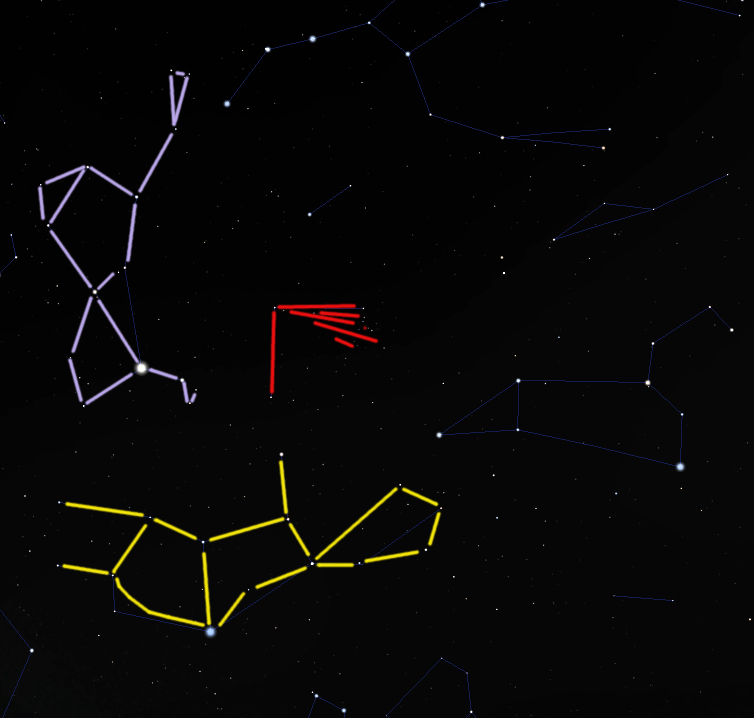
Below is a section of the sky, from the open-source planetarium app stellarium.com, showing the constellational outlines as suggested by the great teacher of practical astronomy, H. A. Rey.

After reading the brief accounts of some aspects of the Ganapati myth described above, you should be able to see immediately where those details in the stories have their origin:

Let's begin with Ganesha himself: it is my contention that the constellation Bootes, with his distinctive upraised "pipe," plays the role of the celestial Ganesh. The long pipe resembles the trunk of an elephant, and the head of this constellation is already rather large and somewhat too big for the body.

Additionally, the Northern Crown, or Corona Borealis, which is located just behind the head of Bootes, could possibly be seen as an elephant's ear, although this is not certain and it is not necessary to accept this connection in order to see that Bootes is undoubtedly Ganesh (we will see more evidence in a moment).

Notice that Ganesh is sitting directly in between the two celestial figures who I believe play the role of his parents: the constellation Virgo (outlined in yellow) who plays the role of Parvati, and the constellation Hercules (outlined in red, to the left of Bootes as we look at the above star chart) who plays the role of Shiva. Remember that in the story, Parvati installs Ganesha as her guardian at the entrance to her baths, so that she can keep the unwanted attentions of Shiva at bay while she enjoys her bath.

Notice also that the outline of Hercules features a massive upraised club, which could also be easily envisioned as a mighty sword or scimitar -- and it looks as though Shiva (since I believe Hercules plays the role of Shiva) is charging towards Ganesh with his sword poised to strike off his head in a moment.

For those who may be unsure as to whether Hercules really plays the role of Shiva in the heavens, it should be noted that the distinctive posture or outline of the constellation shown above is often interpreted in Star Myths around the world (including some of those discussed in Volume Two on the Greek myths) as dancing vigorously, and that Shiva in Hindu iconography is indeed sometimes portrayed as dancing vigorously in a manner very reminiscent of the figure of Hercules in the sky.

Below is an image of Shiva in his form as Nataraja, performing his distinctive dance (known as the Tandavam):
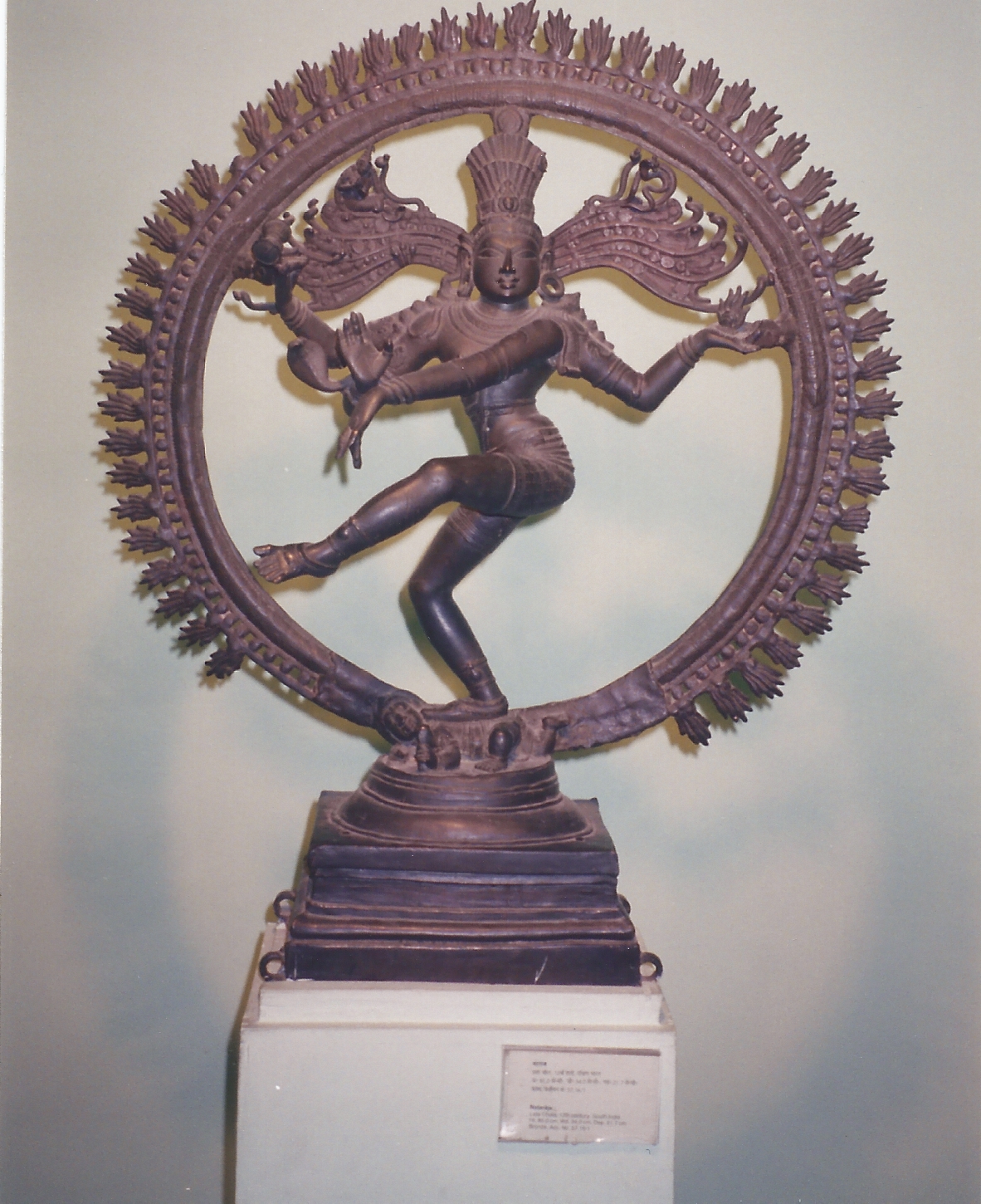
image: Wikimedia commons (link).

image: Wikimedia commons (link).

And below is the same star chart shown previously, but this time with the outline of Hercules drawn as it is "conventionally" delineated, in "non-H. A. Rey" form (I usually prefer the H. A. Rey version of the constellations, of course, but sometimes other ways of envisioning them can shed light on the world's various Star Myths, and in particular the constellation Hercules often appears in myth in this "whirling form" rather than in his more "human form"):

If you look carefully at the statue of Shiva Nataraja dancing in the image above, you will see that his one foot is planted on the back of what looks like an infant -- a rather upsetting fact, but one which I believe is in fact also celestial in nature. The constellation Corona Borealis which we were just discussing a moment earlier can be shown to play the role of an infant in a great many Star Myths literally around the globe, from the Pacific islands to the Old Testament or Hebrew Scriptures. As you can see, Corona Borealis is located very close to the whirling form of Hercules, which I believe is also the whirling form of the dancing god Shiva Nataraja. 

Here is a link to an earlier discussion of the story of the Judgment of Solomon in the Old Testament, which shows that the Northern Crown (Corona Borealis) almost certainly plays the role of a baby in that story, and here is a link to a video I made discussing the same story and some of its spiritual significance.

Continuing with our analysis of the celestial aspects of the Ganesha myth, it is very intriguing to consider the celestial counterpart for Ganesha's rat or mouse steed (sometimes known by the name Mushaka Vahana or Mushika Vahana -- "mouse vehicle" or "mouse vahana").

While it may be rather startling to hear it at first, after careful consideration of this question I have finally settled on the conclusion that the origin of the tradition that Ganesh rides upon a mouse (or rat, or shrew) comes from the shape of the outline of the constellation Virgo, who we have earlier seen playing the role of the beautiful goddess Parvati. In fact, in ancient myth, one constellation will at times be seen to play to very different characters in the same myth, and I believe that in the myth of Ganesh, when Ganesh is riding upon his Mushakavahana mount, the celestial mouse is played by the constellation Virgo.

Notice that the outline of Virgo does indeed have a very elongated head, with a rather pointed "nose." Note also that just below Virgo we find the long and sinuous form of the constellation Hydra, which extends out in front of Virgo and thus can be seen to play the role of the serpent that slithers across the path of the mouse who is carrying Ganesh, scaring the mouse and causing Ganesh to fall off. In fact, the outline of Hydra even has a kind of "cobra hood" at the front end of the constellation -- just as the serpent-belt that Ganesh is usually depicted as wearing is often a cobra in the paintings or statues of the god.

Further confirmatory evidence for this interpretation comes from the fact that Ganesh, like other Hindu deities, actually has multiple avatars or incarnations, some of whom ride on different mounts other than a rat (although rats, mice and shrews are the mounts for the majority of his avatars). Other mounts ridden by incarnations of Ganesh include a lion (and note the location of Leo in the sky) and a peacock. I believe the peacock can actually be explained by the proximity of another constellation -- Coma Berenices, or "Berenice's Hair," which is envisioned as a peacock or as a "whisk" made of the tail of a peacock in some Star Myths of the world (including others from ancient India). 

One of Ganesha's other incarnations also rides a horse -- and this may have to do with his proximity to the Big Dipper, which is definitely envisioned as a team of horses in many other Star Myths of the world, including many of the Greek myths examined in Volume Two, as well as in other myths from ancient India, including the Mahabharata (discussed in Volume One, as well as in previous posts such as this one and previous videos such as those found at the bottom of this page).

Even more astonishing support for the conclusion that Virgo plays the role of the mouse or shrew that Ganesha rides when we consider another Star Myth, from a land that anthropologists believe has been isolated for longer than perhaps any other part of the world: Australia. There, in a myth which is examined in Star Myths of the world and how to interpret them, Volume One, and which is in fact available to read in the online "preview" of some of the material from Volume One (which you can see in online pdf format here), we find some amazing confirmation of the above interpretation, as well as some insight into other aspects of the Ganesh tradition.

The myth in question, from the Aboriginal cultures of Australia, is described in the very first chapter of Volume One, under the title of "The Bandicoot Woman." It involves celestial characters including a Bandicoot Woman, a Moon Man, and a pair of "hawk ancestors" named Kirkalanji and Warra-pulla-pulla. In the analysis of that myth, I argue that the Bandicoot Woman corresponds to the constellation Virgo in the sky.

Now, a bandicoot is a rodent found in Australia, and if you are not familiar with what one looks like, I included an illustration in the book (many others could also be found on the web):
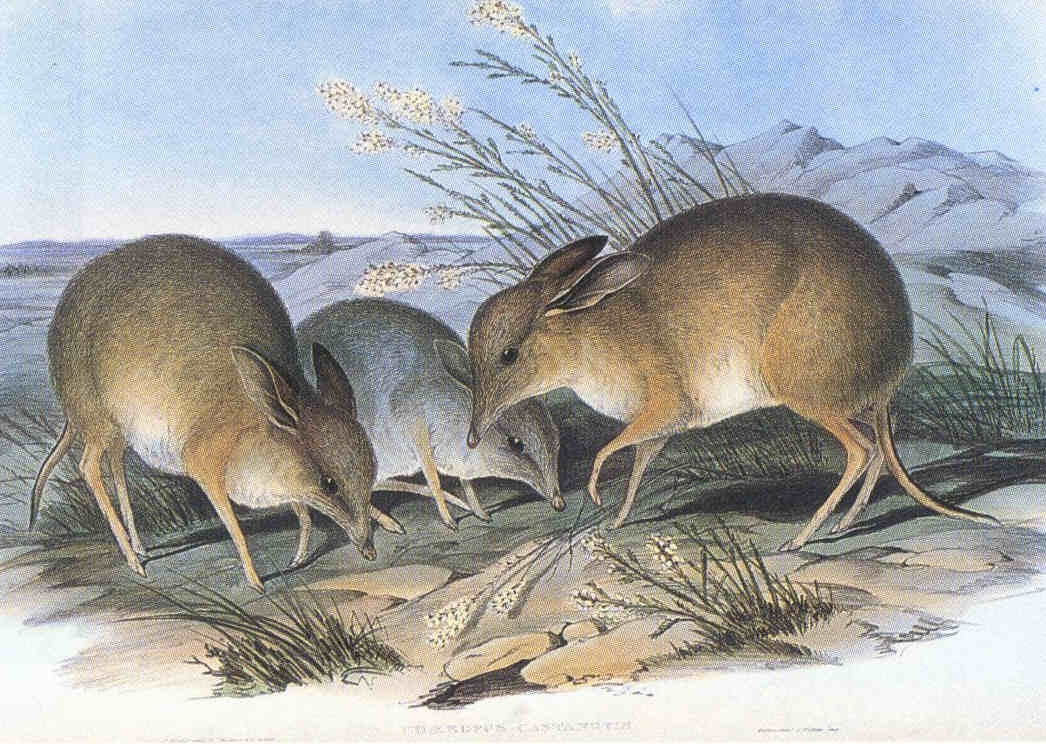
image: Wikimedia commons (link).

image: Wikimedia commons (link).

The question might well be asked, "Why is the woman in the Aboriginal myth called a bandicoot woman?"

My answer, of course, would be that the myth in question is celestial in origin -- and the woman in the story corresponds to the constellation Virgo. And we have just observed that the outline of the rather distinctively-shaped head of that constellation is somewhat elongated, and pointed at the tip.

This is a rather startling correspondence between a myth from the Warramungu or Warramunga people of Australia and a myth from ancient India. Since it is generally thought that the Aboriginal people of Australia were largely isolated and undisturbed for millennia prior to the early modern period, if these two stories or ways of envisioning the constellation Virgo somehow share a common foundation, it must be ancient indeed. 

Of course, some will argue that it is possible for two groups of people in different parts of the world to look at the stars of Virgo and envision a woman and a rodent at the same time -- but in fact Virgo is one of those constellations that does not really look much like what its constellation says it looks like, unless you really know what you are looking for. It is actually quite remarkable that Virgo appears as a woman in virtually every myth around the globe, because the stars of Virgo are not all that easy to envision as a woman, and to envision them as a rodent-and-woman in two different parts of the world is really even more astonishing.

But, even beyond that, there is more intriguing correspondence with the Warramungu myth of the Bandicoot Woman, which you may have already noticed. 

The question could be asked, "Why is the Chaturthi or adoration of Ganesha celebrated on the fourth day of the waning moon? What is the connection between Ganesh and the moon? Why is he a lunar god in the first place?"

It's a good question -- and I believe that the sacred myth from the Aborigine people indigenous to Australia helps us to see the answer. As you may have noticed, the companion to the Bandicoot Woman in the Warramungu myth is a figure called the Moon Man -- and as I demonstrate in the analysis found in Volume One (which you can read online using the links above), it is almost certain that this Moon Man corresponds to the figure of Bootes. In fact, he sits down with his back to the fire in the myth -- the fire being the rising column of the Milky Way band, which the "back" of Bootes is indeed towards in the sky as well.

In other words, not only does the Warramungu myth of Australia help us to understand why Virgo plays a rat upon which Ganesh rides in the myth of ancient India, but it also helps us to understand why Ganesh is associated with the moon! The ancient system of celestial metaphor obviously connected the rather moon-shaped head of the constellation Bootes with the lunar orb. And, as we can see from the veneration of Ganesh on the fourth day of the waning moon, the head of Bootes was apparently seen as shaped about like the moon when it is beginning to wane, four days after it is at the stage of full moon.

Thus, when we worship Ganesh on the fourth day of the waning moon, we are connecting ourselves and our lives to the celestial cycles and to the realm of the gods, and doing so in accordance with a system which may be almost unbelievably ancient -- and which also appears to have been in some way (which we do not presently understand) worldwide.

As some of the essays in the Ganesh book linked above also explain, Ganesh's role as the guardian who protected the entrance to Parvati's bath makes him what is known as a liminal figure: he is associated with boundaries, or liminal spaces (the word liminal is an adjective to describe a threshold or a boundary or a "third space" which is neither in one room or the other). See for example the discussion on page 3 of the introduction by Robert L. Brown, in which he says: 

In the Indian context, Ganesa is the liminal god of transitions: he is placed at the doorway of temples to keep out the unworthy, in a position analogous to his role as Parvati's doorkeeper, and he can set up, as he did for his father, obstacles to the successful completion of goals. His parents' ambivalent relationship, founded on the opposing concerns of asceticism and sexuality, places Ganesa in between. He is created by Parvati as a result of Siva's asceticism and refusal to have children, but is annihilated due to Siva's sexual interest in Parvati, only to be restored, transformed, as a bond between the two. He is here fulfilling his transitional role as a means to integrate opposing elements.

I believe that all of this also applies to his role in helping us to integrate opposing elements in our lives as well -- specifically the seemingly opposing elements of materiality and spirituality. Contemplation of Ganesh and his myths can help us to integrate the spiritual aspect of our nature, and to more fully understand the presence of the Invisible World, which is always "just across the liminal boundary" wherever we happen to find ourselves in this material realm.

One of Ganesha's other most important aspects is also referenced in the quotation above -- his association with obstacles: both placing them and removing them. Ganesha can help us to remove the obstacles to our connection with the Higher Self and the divine realm, to which we always have access and with which (the ancient myths tell us) we always need to be in connection in this life, because it is in fact the source of life.

It is my hope that greater understanding of the system of celestial allegory will also "remove the obstacles" to your access to the ancient wisdom that is available to us in the myths, which were provided to humanity as a precious inheritance and treasure, for our benefit and blessing.

Jai Ganesh!

Blessings, food, economics and libations to the gods

Blessings, food, economics and libations to the gods

image: Wikimedia commons (link).

image: Wikimedia commons (link).

Above is a striking image from an ancient artist depicting the god Apollo in the act of pouring a libation of wine, while a raven observes (evoking the spirit world, even as Apollo of course inhabits the realm of the gods, being a god himself). 

In addition to evoking the spirit world, I believe that the raven may be included in this ancient artwork because Apollo in this image has certain elements corresponding to the posture typically associated with the constellation Virgo, including a seated position with one arm dramatically extended. The constellation of Corvus the Crow is closely associated with Virgo, and even though it is located on the opposite side of the constellation Virgo from the side on which the raven is depicted in this image of Apollo pouring a libation, this pairing definitely evokes the celestial figures of Virgo and Corvus, and thus the Infinite Realm or Spirit Realm. 

The ancient myths use the stars and heavenly figures to convey powerful truths to us about the importance of, and our dependence upon, the Invisible Realm, the Infinite Realm, even in the most mundane aspects of our daily life.

In fact, the act of pouring a libation, which is described frequently in both the Iliad and the Odyssey, was done at the beginning of a meal, as a way of acknowledging that the food and drink which we enjoy, and upon which we depend for the very sustenance of our lives, is itself a gift from the gods, and that it flows down to us from the spirit world in a very real sense. 

The invisible spark of life which causes the grain to grow from a seed into the wheat from which we make our bread, or which causes the vines to grow which produce the grapes which will later be turned into wine, must come from the Invisible World. It is not a product of the material realm -- and we are dependent upon the continued infusion of this purely physical world with the invisible, mysterious and divine outpouring which overflows from the spiritual world for the growth of the plants and vines and trees which sustain all life on earth.

The pouring out of libations described in the texts which have survived from ancient Greece seem to express the recognition that all food and wine (or spirits) are gifts from the divine realm. 

Here are two examples from the Odyssey -- first, when Telemachus (along with the goddess Athena, disguised as his childhood guardian Mentor) arrives in the land of Nestor and his family, in sandy Pylos:

There sat Nestor among his sons as friends around them
decked the banquet, roasted meats and skewered strips for broiling.
As soon as they saw the strangers, all came crowding down,
waving them on in welcome, urging them to sit.
Nestor's son Pisistratus, first to reach them,
grasped their hands and sat them down at the feast
on fleecy throws spread out among the sandbanks,
flanking his brother Thrasymedes and his father.
He gave them a share of the innards, poured some wine
in a golden cup and, lifting it warmly towards Athena,
daughter of Zeus whose shield is storm and thunder,
greeted the goddess now with an invitation:
"Say a prayer to lord Poseidon, stranger,
his is the feast you've found on your arrival.
But once you've made your libation and your prayer --
all according to ancient custom -- hand this cup
of hearty, seasoned wine to your comrade here
so he can pour forth too. He too, I think,
should pray to the deathless ones himself.
All men need the gods . . ." 3. 36 - 55. Translation by Robert Fagles.

And again when Odysseus arrives among the Phaeacians:

As long-suffering great Odysseus ate and drank,
the hallowed king Alcinous called his herald:
"Come, Pontonous! Mix the wine in the bowl,
pour rounds to all our banqueters in the house
so we can pour out cups to Zeus who loves the lightning,
champion of suppliants -- suppliants' rights are sacred."
At that Pontonous mixed the heady, honeyed wine
and tipped first drops for the god in every cup,
then poured full rounds for all. And once they'd poured
libations out and drunk to their hearts' content,
Alcinous rose and addressed his island people . . . 7. 210 - 220.

It is also noteworthy that, when Athena first arrives at the house of Odysseus, where Telemachus and Penelope are basically held hostage by the violent, destructive suitors, there is a feast going on, but no libations to the gods are described at all.

The practice of acknowledging, prior to a meal, our dependence upon the divine for every item of food that we eat and of outwardly proclaiming our gratitude for these gifts is traditionally known in English-speaking countries as "saying grace" or "giving the blessing." These terms are appropriate, in that the word "blessing" (I believe) encompasses the idea of acknowledging the importance of the divine realm, and of elevating that which is spiritual in ourselves and in others and in the wider world around us -- while the word "grace" evokes that which is seen as a gift from the other realm, something which cannot be forced or demanded or created by our own efforts but which comes basically as a gift from the gods, or as a gift from God. 

Intriguingly enough, veteran economist Michael Hudson (who is also a scholar of ancient history, as well as having been an advisor to the United Nations Institute for Training and Development, a university professor, a manager at an early sovereign bond mutual fund, and a host of other high-level roles in academia, finance, and government) explains that "the great fight of the classical free market economists" was to oppose those who wanted to claim private ownership over "what was a gift of nature -- the sun that the Physiocrats cited as the source of agriculture's productive powers, inherent soil fertility according to Ricardo, or simply the rent of location as urbanization increased the value of residential and commercial sites" (Killing the Host, 30). 

He has much more to say about this subject in that book and in his other writings. It would seem that the behavior of the suitors in the Odyssey could be used as an example of the kind of damaging, violent, host-destroying behavior that Michael Hudson -- and the classical liberal philosophers he invokes -- opposed. It is also noteworthy that when Telemachus publicly confronts the suitors about their destructive freeloading behavior, their leaders make speeches which essentially seek to exonerate themselves and blame Telemachus and his mother, just as the "suitors" that Michael Hudson describes in his book want to portray themselves as virtuous while blaming their victims for the horrendous damage that they themselves (the "suitors," or as the classical economists called them, the "rentiers") are causing.

The powerful insights which the ancient myths and sacred stories of the human race can offer and which can be applied to the very practical, and often very pressing, problems and situations we face today, are literally endless. A greater appreciation of the importance of the seemingly simple act of acknowledging our dependence on the gifts of the Invisible World, the gifts of the divine realm, before each meal, for every item of food or drink that we taste and upon which our lives depend here in this material realm can lead to a better understanding of the damage that arises from the reckless disregard of the divine source of these gifts, damage that actually acts as the very opposite of blessing.

Welcome to new visitors from Lost Origins

Welcome to new visitors from Lost Origins

image: lost-origins.com (link) and Wikimedia commons (link).

image: lost-origins.com (link) and Wikimedia commons (link).

Special thank you to Andrew Tuzson and the team at Lost Origins for having me over to the show for an enjoyable conversation about Star Myths, ancient history, and various and sundry related and (in my opinion) extremely important subjects.

Also, welcome to new visitors (and returning friends) who heard the interview and came over to look around. You'll find that this blog is fully searchable, as is my entire website at Star Myth World (dot com), where at the very bottom of every page you'll find links to a "Resources" page as well as to pages which enable you to search for content within the site.

If you haven't heard the interview yet, or if you want to download it for your next commute or bus-ride to work (or evening of doing dishes, or morning of sweeping the porch), you can find it in the podcast section of the Lost Origins site, as well as on iTunes, and you can also download it here at the site which contains the files from the interview. It is also embedded below.

During the interview, we discussed the role of the Lord Krishna as the divine charioteer in the Mahabharata, and the evidence that the descriptions of Krishna and Arjuna and the great Battle of Kurukshetra in the ancient Sanskrit texts (in common with virtually all the other myths, scriptures, and sacred stories of humanity around the globe and across millennia) are all based upon celestial metaphors pointing to the constellations, planets, sun, moon and heavenly cycles -- which themselves are actually used as a metaphor to convey to us powerful truths about the nature of the universe and of human existence, and the existence of an "infinite realm" or "realm of the gods" which is pictured for us in the myths using the realm of the stars (the starry realm itself being infinite as well, of course).

You can read more about the celestial interpretation of the Mahabharata, the Bhagavad Gita, the interaction of Sri Krishna and Arjuna, and many other Star Myths in the "myths section" of my website, here. Clicking on any of the images in that section will take you to a discussion of the Star Myth pictured -- the very first one in the gallery is an image of Lord Krishna with his flute.

Here are a few additional links for those interested in reading more about some of the subjects which arise from the celestial interpretation of the relationship between Arjuna and Krishna, as well as other topics which came up during the course of the interview:

I hope you will enjoy our conversation -- I certainly enjoyed meeting Andrew, and commend him for starting a new podcast dedicated to exploring the evidence that the conventional timeline of human history (and especially of very ancient human history) appears to be gravely flawed. 

The control of the "narrative of history," or the stories we tell ourselves about where we came from and which form the framework for the way we interpret the world around us and the events that we see unfolding in the present moment is extraordinarily important, as George Orwell warned us many decades ago (see discussion here).

Thus, it is not just an idle pastime or quirky hobby to want to delve into the evidence surrounding the "Lost Origins" of humanity -- our unknown ancient past is something of incredibly immediate importance to every single man and woman on the planet today. It is something we should all be exploring with a curious mind, and with openness to consider various competing hypotheses which purport to explain the evidence we see around us on our planet -- and in the ancient myths of humanity.

I'm glad Andrew and his show are entering into this investigation, and hope everyone will go check it out.

Unshorn hair and the sixth sense

Unshorn hair and the sixth sense

image: Wikimedia commons (link).

image: Wikimedia commons (link).

Big thank you goes out to Darren and Graham of Grimerica, who posted a link to this articletoday on twitter concerning an absolutely amazing topic worthy of careful consideration by all.

Entitled "Hair is an extension of the nervous system," the article was actually first posted back in November of 2015 on The Mind Unleashed.

The text describes an alleged discovery which came to light during the Vietnam War that talented Native American trackers recruited by the military seemed to lose their "sixth sense" when their hair was cut off (short haircuts are routinely administered to everyone entering the US Army). 

According to the article, a series of experiments were devised to try to determine whether cutting off the hair was a factor in the loss of the ability to sense the stealthy approach of an enemy, or the "numbing" of the sense of danger when approaching a location containing a concealed armed enemy -- and the results of the studies were so conclusive that the military recommended that the highly skilled trackers should be exempt from military haircuts" and in fact were required to keep their hair long.

The article does not provide any way of actually checking the original sources of the assertions that it makes. It would be beneficial to pursue some of the records backing up the claims made in the story. However, this information would fit a pattern in which knowledge of a type which is generally discredited by the "conventional paradigm" taught in schools and universities, and reinforced in the general media and "scientific" literature and videos, is explored by the military in situations where they are more interested in certain results than in conforming to the flawed models which (for whatever reason) are force-fed to the general public.

Another example of the same sort of phenomenon (in which the military acknowledges realities which fit a paradigm of the cosmos that is very different from what is taught in school and reinforced in the general media and public discourse) would be the various "psi" (or "psy") programs which have been described by former participants, in which personnel with demonstrated psychic capabilities were used in order to perform "remote viewing" and "out-of-body travel" to conduct reconnaissance on distant locations in other countries, or to search for a downed aircraft in areas that were either too sensitive or too difficult to search using conventional technologies.

Note that the extraordinary tracking abilities are described using terms such as "sixth sense," "intuition,"   "extrasensory" and even "almost supernatural."

This would imply that, in addition to their highly-developed skills at reading the physical signs available to our five physical senses, the men in question were also connected to the Invisible Realm in some way and to some degree when they were performing their incredible feats of tracking. It is extremely significant to consider the possibility that it was this particular aspect of their ability that was impacted by the cutting off of their hair. 

And, it is interesting to note that this article mostly focuses on the question of whether or not men cut their hair short, and the possible impact of that decision. Women, of course, tend to wear their hair longer as a general rule -- and are also often observed to exhibit greater levels of intuition (to such a degree that the phrase "woman's intuition" is fairly common).

Some might argue that the article is describing the benefits of unshorn hair in a combat environment, which is a very unusual and dangerous environment not representative of normal day-to-day life, and that therefore the discoveries described in the article, even if they were verifiably proven, would not have much relevance in other situations.

But it could certainly be argued that the kind of "sixth sense" and "intuition" described in the article as being somehow connected to the hair -- which the article argues is actually "an extension of the nervous system" -- could be beneficial in a host of other aspects of daily life having nothing to do with military combat, from driving a motor vehicle, to surfing, to creating artwork or music or participating in any other creative activity which involves contact with the Higher Self.

Indeed, if the article is correct, it would appear that there is some connection between unshorn hair and the realm of spirit -- an assertion that would appear to be very much in line with ancient myths, scriptures and sacred traditions found in many cultures in different parts of the globe. Previous posts which have dealt with this subject include "Dionysus, mighty and many shaped god," "Samson and the seven locks of his head," and "Joseph Hill and the Nazarite vow."  

It is also interesting to consider that in previous centuries, it appears to have been much more common for men to wear their hair "unshorn" (even in "western" cultures, but in fact all around the globe) than it has been since about the beginning of the twentieth century. Here are a few images of individuals, some of them well known and others not as well known, demonstrating this reality:

Isaac Newton, whose Principia Mathematica was first presented to the Royal Society on April 28th, 1686 (thanks to my friend Mark S. for pointing out that significant historical anniversary). Wikimedia commons (link).


Self-portrait of artist Albrecht Durer, Wikimedia commons (link).


Chinese-American man in San Francisco's Chinatown circa 1910, with long hair braided in a queue. Wikimedia commons (link).


Samurai with long hair drawn upwards into traditional topknot, Japan. Wikimedia commons (link). 


Lysander Spooner. Wikimedia commons (link).


Walt Whitman. Wikimedia commons (link).


John Muir. Wikimedia commons (link).


Sikh men (hair is traditionally unshorn and coiled beneath turban in a Rishi knot). Wikimedia commons (link).


Bob Marley. Wikimedia commons (link).


Aborigines of Sri Lanka. Wikimedia commons (link).


Australian man circa 1923. Wikimedia commons (link).


These are just a small sample of images from previous decades and centuries. Obviously, many more could be provided. 

While we do not know, due to what may be the suppression or the rejection or the gradual loss of the knowledge of the connection between unshorn hair and the ability to sense the Invisible World, how much of a role our hair plays in this regard, it is very interesting to speculate about what additional consciousness or perception we might be depriving ourselves by ignoring wisdom that once perhaps was known more widely, and that survived among some cultures longer than among others.

Big up to Graham and Darren for pointing out this important subject.

For more on the subject of tracking, see some of the books by Paul Rezendes and by others skilled in this ancient art, as well as the many courses and workshops led by those who have spent years developing their skills in the outdoors, who can be located using searches on the web for experts in your area.

For my previous visits with Darren and Graham in the land of Grimerica (where there are no haircuts), see here and here.

And don't forget this little piece of ancient knowledge:
"Bangled, tangled, spangled and spaghetti . . . "

The Dendera Zodiac and the message of the Decans

The Dendera Zodiac and the message of the Decans

image: photo taken by the author, 04/25/2016

image: photo taken by the author, 04/25/2016

I loved going to visit the Rosicrucian Egyptian Museum in San Jose, California, as a child. Here is a post written almost five years ago discussing a few of the many fond memories I have from visits to the "mummy museum" when I was very young.

I had the opportunity to visit the museum again this weekend, and found that one of the most striking aspects of the collection, in addition to the many actual artifacts from ancient Egypt on display, is the large number of actual castings of very significant ancient treasures which the visitor can examine up close, with no glass case in between.

These casts were made from the original ancient pieces of art themselves: they are not replicas created  by later artists (although there are some replicas in the collection as well). In other words, the castings preserve the actual artwork as created by the ancient artists themselves, and not an interpretation or imitation from the hand of a modern artist, no matter how skilled.

Some of the casts of incredible ancient artifacts which you can examine in minute detail, getting as close as you wish, include castings taken from the original Rosetta Stone, from the Dream Stele of Thutmose IV, from the famous diorite statue of Khafre enthroned with Horus Falcon behind his head, and many others.

But one of the highlights of the entire collection for me this time was the breathtaking casting of the Round Zodiac of Dendera, taken from the original ceiling of the Temple of Hathor-Isis at Dendera. The ceiling itself was actually blasted out during the invasion of Egypt by Napoleon and taken back to the Louvre, in Paris, in early 1800s. The cast of that original ceiling section was made at the Louvre for the Rosicrucian Museum in 1987. 

Sadly, the actual Temple of Hathor in Egypt also has a casting in the location of the original, since the original ceiling is in France -- a continuing testament both to European imperialism and to the "privatization" of treasures which should properly be understood to belong to all of humanity (the King of France apparently paid Egypt 150,000 francs to "purchase" the priceless Round Zodiac ceiling and remove it from Egypt to the Louvre).

Regardless of whether you think the Louvre should return the original to Dendera and display a cast for visitors to the Louvre, the cast model on display at the Rosicrucian Museum in California is spectacular.  You can get as close as you wish, and examine the detail of the incredible ancient artwork of this famous piece. Above is an image that I took at the museum this weekend. Below is an image of the actual original Dendera Zodiac on display at the Louvre:

image: Wikimedia commons (link).

image: Wikimedia commons (link).

Much could be written about the significance of this beautiful piece of sacred art. Much in fact has been written about the Dendera Zodiac by insightful analysts of the esoteric and symbolic art of ancient Egypt, including R. A. Schwaller de Lubicz and later by John Anthony West in Serpent in the Sky.  Both argue that the Dendera Zodiac contains evidence of understanding of the phenomenon of the precession of the equinoxes, as well as evidence of other important celestial mastery by its designers.

For those able to read the French language, there is also a study published in 1844 by Jean-Baptiste Biot (1774 - 1882) of the Dendera Zodiac and the evidence that its designers incorporated the phenomenon of precession, available online for examination here.

The precision casting of the Round Zodiac in the Rosicrucian Museum enables you to see at close range the figures of the zodiac which are arranged around the central constellations of the north circumpolar region of the sky.

Below is a reproduction of the same image from the top of this post, with the constellations of the zodiac band labeled in red letters, as well as the constellations Orion and the Big Dipper (which is technically an "asterism" and not a full constellation) labeled in yellow letters:

And below is a slightly closer view of the same labeled zodiac figures from the Dendera Round Zodiac:

Note that the Big Dipper is depicted as the "foreleg of the bull," a depiction that was common in ancient Egypt and which is discussed at some length in my 2014 book, The Undying Stars.

Just as they are arranged in the Dendera Zodiac, the Lion of Leo and the Big Dipper of Ursa Major are placed in the sky "back-to-back," such that the lower contour of the Big Dipper is always facing the line of the upper back of the Lion. You can in fact see the Lion and the Dipper in the night sky at this present time of year (end of April, 2016), high up in the night sky during the "prime time" viewing hours prior to midnight. Here is a previous postdiscussing the "interlocking" relationship of Leo and the Dipper.

It is also notable that the zodiac sign of Cancer the Crab, clearly visible in the Dendera Round Zodiac, is not positioned in front of the muzzle of Leo on the Round Zodiac, the way it is in the night sky. Instead, for some reason, Cancer is moved "upwards" and towards the center of the entire spiral of the heavens and heavenly denizens. Of this fact, John Anthony West states in Serpent in the Sky:

Detail of the round Denderah zodiac. Schwaller de Lubicz thought the signs of the zodiac disposed about an eccentric circle with one center at the pole of the ecliptic (nipple of the female hippopotamus) and the other at the pole star (jackal or dog). This does not seem to me entirely convincing. Note the placement of Libra, for example. But whatever the scheme directing the arrangement, it is certain that the sign of Cancer has been singled out for special treatment. 114.

Even more noteworthy on the Dendera ceiling than the zodiac spiral itself (which is undeniably possessed of tremendous significance) is the beautiful procession of the "decans" around the outermost rim of the heavenly dome in the temple relief. Previous posts have discussed the fact that each of the twelve signs of the zodiac is associated with three nearby non-zodiacal constellations as well, which are known today as "decans." But this decan system is slightly different from, and probably prefigured by, the ancient Egyptian use of decans as a division of the hours of the night throughout the year, a system which was in operation in Egyptian civilization many centuries prior to the creation of the actual Dendera Zodiac itself.

The mathematician and historian of scientific and mathematical thought Otto E. Neugebauer explains the ancient Egyptian system of decans in his 1969 text, The Exact Sciences in Antiquity. His description is both fascinating and eye-opening, for those attuned to the system of esoteric knowledge encoded in the constellations and heavenly cycles in the Star Myths of the world. 

Professor Neugebauer details how the heliacal rising of selected stars located along the zodiac band would help observers in ancient Egypt (in particular, the priests) to know when the dawn would be arriving at any given time of the year. He explains:

When we watch the stars rise over the eastern horizon, we see them appear night after night at the same spot on the horizon. But when we extend our observation into the period of twilight, fewer and fewer stars will be recognizable when they cross the horizon, and near sunrise all stars will have faded out altogether. Let us suppose that a certain star S was seen just rising at the beginning of dawn but vanished from sight within a very short time because of the rapid approach of daylight. We call this phenomenon the "heliacal rising" of S, using a term of Greek astronomy. Let us assume that we use this phenomenon as the indication of the end of "night" (meaning real darkness) and consider S as the star of "the last hour of night." One day later we may again say that the brief appearance of S indicates the end of night. 83, available to read online here.

So far, so good: Neugebauer is explaining that specific stars always appear to rise up at the same location on the horizon, although as we will see and as he is about to discuss, each star will rise later each night due to earth's progress around the sun (this is discussed in many previous posts, including in this video about the "analogy of the dining room"). Just prior to sunrise, as the eastern sky begins to grow lighter and lighter (from deep velvet black to dark blue to lighter and lighter blue), stars which made it high enough above the horizon to be briefly observed will soon be swallowed up by the light of the rising day-star. 

This is the phenomenon known as the "heliacal rising" of a star. As the earth proceeds on its orbit, a star will get further and further "ahead" of the sun, so that it is above the horizon for longer and longer portions of the night (or early morning) before the day-star pops up and drowns out the stars.

Next, Professor Neugebauer will explain that the Egyptians called the star undergoing its "heliacal rise" as the decan for that particular ten-day stretch each year. But, as it rises a bit earlier and earlier, it will be higher and higher in the eastern sky when the sun finally pops up -- which means that eventually a new star below it will be the star of heliacal rise at that time, and the previous decan will retire from the role until next year:

We may continue in the same way for several days, but during this time a definite change takes place. The sun not only participates int he daily rotation of the sky from East to West, but it also has a slow motion of its own relative to the stars in a direction opposite to the daily rotation. 

This eastward motion of the sun (completed once in one year) delays the rising of the sun from day to day with respect to the rising of S. Consequently, the rising of S will be more and more clearly visible and it will take more and more time before S fades away in the light of the coming day. Obviously, after some lapse of time, it no longer makes sense to take S as the indicator of the last hour of night. But there are new stars which can take the place of S, and this procedure can be repeated all year long until the sun comes back to the region of S. Thus year after year S may serve for some days as the star of the last hour, to be replaced in regular order by other stars T, U, V, . . . 

It is this sequence of phenomena which led the Egyptians to measure the time of night by means of stars (or groups of nearby stars) which we now call decans. 83 - 84. 

Once we understand this progression, we can understand the layout of the so-called "diagonal calendars" which began to appear painted on the coffin lids of Egyptian coffins in the Middle Kingdom (11th and 12th dynasties, around 2000 BC to 1700 BC). Each month of 30 days would be divided into three "decades" of ten days apiece, in which a certain specified star was the designated decan (undergoing the phenomenon of heliacal rise in the east just prior to sunrise). In the subsequent decade, that decan would be higher in the sky (due to rising a bit earlier each night), and the decan "under" it would have taken over as the new decan, and the previous decan would be written above it, as such (read from right to left):

decade 3   decade 2   decade 1

---------------------------------------

S                                                        three hours left of night

T                    S                                 two hours left of night  

U                   T                S               last hour of the night

(Table based upon that found in Neugebauer 85).

Now, Neugebauer explains perhaps the most important aspect of this system -- the selection of the stars to be used as decans, and the criteria for their selection:

From what has been said to this point, any sequence of stars or constellations whose risings were spaced at ten-day intervals could have been used. But additional information is available. We not only know that Sirius and Orion figured among the decans but that Sirius was, so to speak, the ideal prototype of all the other decans. Its heliacal rising ideally begins the year, just as the rising of the other decans are associated with the beginning of the parts of the year, the decades. The rising of Sirius occurs after an interval of about 70 days, in which the star remains invisible because of its closeness to the sun. Similarly, it was assumed that the same holds for all decans. The Demotic commentary to the inscriptions in the cenotaph of Seti I describes at length how one decan after another "dies," how it is "purified" in the embalming house of the nether world, to be reborn after 70 days of invisibility. 87.

This discussion is of the greatest significance.

Professor Neugebauer has just explained that the 70-day disappearance of Sirius (caused by the interposition of the sun, as we on earth go around our orbit, when the direction of the star Sirius is not visible because the sun is "in the way" -- see the previously-linked video with the metaphor of the dining room) was anciently associated with the death, embalming, and purification of that star in the "nether world" (the underworld).

This corresponds to the 70-day process of embalming a mummy, which was detailed by early Egyptian scholar E. A. Wallis Budge, and which is referenced in the famous "tomb tour" at the Rosicrucian Museum. 

And now comes the most important piece of the puzzle, provided by Alvin Boyd Kuhn. In Lost Light (available online -- see the link to the 1940 text on the "resources" page of the Star Myth World website), Alvin Boyd Kuhn devotes an entire chapter to the significance of the mummy (chapter 10), and presents a convincing argument that the whole purpose of embalming the corpse was as an elaborate metaphor for our mortal life in this physical body! 

In other words, Kuhn avers that the mummification process was meant to signify the descent of a living spirit into a "dead" or "dying" mortal body, a descent we each undergo in our incarnation into this material world.

Now, please follow the argument: 

  • The mummification process took 70 days (very strictly 70 days, not more nor less).
  • The decans were selected because, like Sirius (the first decan), they disappeared for 70 days.
  • When the decan was not visible, it was said to be "in the underworld."
  • There, in the underworld, the decan star was envisioned as being "embalmed like a mummy" and purified for 70 days.
  • Then, the decan would reappear -- into new life.
  • Alvin Boyd Kuhn argues that the 70-day mummification process was meant to metaphorically represent this mortal life in the body.

In other words, the star's descent into the underworld for 70 days was metaphorically an "embalming" prior to new life, and our own descent into this life was metaphorically figured by the mummy's embalming over 70 days -- hence (by a kind of "transitive property of metaphors") we can see that the decan's disappearance (the "death" of the decan-star) figures our own descent into this world, where we are "purified" in a mortal body as part of our preparation for new life on a higher level!

The story of the decans (stars, plunged into the underworld, only to appear again in the celestial realm) is the story of our own plunge into incarnation for a time.

In fact, this is the exact understanding that brings the exhibits and artifacts of ancient Egypt to life for each of us, once we realize their meaning. Each symbolic piece of sacred art is in fact about us -- about you, and about me. Each piece of sacred art which has survived from ancient Egypt is meant in some way to teach us about our own human condition in this life, within a universe that is simultaneously spiritual and material.

When we understand this, we can appreciate the beautiful sacred artwork on the Dendera Zodiac (for example) on a whole new level.

Here is an image of an artist's rendition of a beautiful rectangular star-clock depiction showing the procession of the decans from the tomb of King Seti I, whose reign began in 1290 BC (and who was the father of Ramses II):

image: Wikimedia commons (link). 

Like other decan star-clocks or calendars, it is read from right to left (into the faces of the figures, reading as though you are "having a conversation" with them). Can you see the decan of Sirius, associated with the goddess Isis? She is just after a smaller figure who represents Orion (just left of the Orion figure), and she is the tallest of the decans depicted (and she has the star Sirius above her headdress).

And below is some detail of the Dendera Zodiac cast at the Rosicrucian Museum, with a few of the decans indicated (the decans are arranged in a circle, around the edge of the sky-disc in the Round Zodiac):

There is much more which could be said about the Dendera Round Zodiac, and much more that could be said about the many other accurate castings and original ancient artifacts which are on display at the wonderful Rosicrucian Museum.

It is difficult to fully appreciate these ancient treasures, however, until we begin to understand their profound metaphorical meanings.

Once we begin to understand the language that they are speaking, then they can again begin to whisper their intended message, across the vast gulf of time, to provide to us incredible ancient wisdom for application in our own lives.

Popocatepetl and Ixtaccihuatl

Popocatepetl and Ixtaccihuatl

image: Ixtaccihuatl (left) and Popocatepetl (right); Wikimedia commons (link).

image: Ixtaccihuatl (left) and Popocatepetl (right); Wikimedia commons (link).

I remember learning the touching legend of the lovers Popocatepetl and Ixtaccihuatl when I was in high school. It is a Mexicahtl legend from the Aztec Empire (and perhaps earlier as well) which is mentioned in the accounts from the 1500s recorded by the Franciscan Friar Bernardino de Sahagun and which predates the European invasion and destruction of the Mesoamerican civilizations. 

The story relates that the beautiful maiden Ixtaccihuatl was the daughter of the emperor, and she fell in love with the warrior Popoca. In the different versions of the myth, the emperor says he will consent to their marriage, if the young warrior returns victorious from an upcoming battle (in some accounts, the emperor disproves of the match for his precious daughter, and thus does not intend for the warrior to ever return). 

Whether or not the emperor was harboring treacherous motives against the young man, in all the accounts the message comes back from the battle that the brave warrior has met his death on the battlefield -- in most versions, this message is falsely dispatched to the capitol by a rival who hates Popoca and wishes to marry the emperor's daughter himself.

Ixtaccihuatl is devastated by the news and either takes her own life (with a dagger) or perishes of grief after a short period of intense mourning.

When the handsome young warrior returns victorious from the battlefield and is told what has happened, he too is overcome with grief, and -- gathering the body of his beloved in his arms -- ascends into the high mountains beyond the city, where he lays her down and takes up a lonely vigil, holding a flaming, smoking torch as the days and nights pass and the snow and ice slowly cover both Ixtaccihuatl and the bereaved Popoca.

Eventually, by the will of the gods, the two become snow-covered mountains themselves -- mountains sacred to the Nahua or Mexicah peoples who lived in what is now central Mexico and who built the Aztec Empire. Sahagun relates that he himself climbed these mountains to observe the ongoing veneration that took place there in the 1500s.

In the stunning image above, you can clearly see the outline of Ixtaccihuatl, who looks like a woman lying on her back, draped in snow, at the left of the photograph as we face it -- and beyond is the looming peak of Popocatepetl, who still holds his blazing, smoking torch as he keeps watch over his beloved.

Both mountains are volcanos. Ixtaccihuatl rises to a dizzying elevation of 17,160 feet above sea level, and Popocatepetl to 17,802 feet above sea level.

When I first learned the story of Popocatepetl and Ixtaccihuatl, neither had erupted for many decades. Ixtaccihuatl is usually classified as being extinct. But in 1991, after a half a century of inactivity, Popocatepetl awakened, producing a series of eruptions which continue to this day.

Clearly, the steadfast warrior still watches over his beloved Ixtaccihuatl, and he still bears his flaming brand.

This week, Popocatepetl began a powerful eruption in which fiery lava can be seen bursting violently out of the mountain, and a thick column of billowing volcanic ash has been pouring up into the sky and leaving a thin coat of volcanic dust over the surrounding countryside and the closest city, Puebla.

The latest eruption commenced in the early morning hours after midnight on April the 18th. Below are two videos showing the volcano's activity:

video above: link.


video above: link. (Note that the most spectacular activity begins after about 4:00 in the clip).


Obviously, this is a myth which appears to be completely inspired by the actual sacred mountains themselves: but it is very intriguing to note that in the sky there is also a corresponding set of constellations in which a male figure sits up as if in a vigil over the recumbent form of a female figure in the heavens -- and in between them, not far from the seated male figure, we can also perceive a constellation which does indeed resemble a flaming torch, and which can be shown to play the role of a flaming torch in some of the Star Myths found around the globe (some of which are discussed in my recent series of books, Star Myths of the World and how to interpret them -- examples are found in both Volume One and Volume Two).

Below is a diagram of the night sky taken from the open-source planetarium app, Stellarium. I have drawn in the outlines of the constellations Virgo (in yellow), Bootes (in light purple), and Coma Berenices (in red), using the system of constellation outlines suggested by H. A. Rey:

Note that the female figure (Virgo) is lying down on her back, just as Ixtaccihuatl in the legend, and beside her sits the male figure (Bootes) dutifully watching over her, with his flaming torch nearby (Coma Berenices, or "Berenice's Hair").

At this point, of course, nearly everyone will object that any suggestion of a celestial origin for this moving story of the Aztec warrior and his beloved princess cannot possibly be correct, because we can all see the mountains themselves, towering over Mexico City and the surrounding plains to this very day. Surely this legend is inspired directly from the volcanos themselves, and has nothing to do with the stars!


But note carefully that the legend chooses to "see" these mountains in terms of a recumbent maiden and a vigilant lover with a torch -- certainly not the only possible way to frame a myth regarding these two mountains. In other words, the sacred mountains are imbued with a mythical legend which reflects a reality which can also be seen in the heavens above: a pattern often referred to by the meaningful phrase "as above, so below," which can be found to operate worldwide and often at geographical locations which are specifically envisioned as reflecting the celestial realm (such as the River Ganga in India or the region of the Paha Sapa in the Lakota lands in North America).  

The sacred mountains of Popocatepetl and Ixtaccihuatl thus appear to fit into this very same worldwide pattern.

It is also noteworthy to examine the meaning of the names of the two young lovers in the story. Ixtaccihuatl (also frequently spelled Iztaccihuatl) is said to signify the "White Maiden" (from the words ixta or izta meaning "white" and cihuatl meaning a woman or maiden). She is also sometimes referred to as the "Sleeping Maiden" or "Sleeping Woman" -- La Mujer Dormida (perhaps Popo is waiting and watching over her for the day when she will finally awaken to new life and the two can have the happiness together that they were denied for so long).

Popocatepetl, we are told by those knowledgeable in the Nahuatl language, signifies "to smoke" or "to be smoking" (popoca) and "a mountain" (tepetl). The discussion of the mountains and their legend in this volume, for instance, notes some other mounds or mountains which also end with -tepetl, such as Tlachihualtepetl.

Is it just a coincidence that halfway around the world, the very similar term "tepe" is also used to signify a mound or a hill, such as in the famous and extremely important archaeological site at the mound that had the name of Gobekli Tepe in the southern part of modern Turkey, and which we are told signifies "pot-bellied mound" or "pot-bellied hill"?

Advocates of the conventional narrative of ancient human history refuse to admit the possibility that some ancient common source may have influenced cultures all around our globe (or somehow left some kind of memory which was taken in different directions by different cultures down through the subsequent millennia). They would thus dismiss any attempt to draw linguistic connections between "mounds" or "mountains" described by the word tepe in the region of Asia Minor and the use of the  very similar word tepetl to describe mountains and man-made pyramids in Central America.

And yet, there is abundant archaeological evidence that suggests that the conventional narrative of ancient human history is gravely mistaken (if not deliberately deceptive). An earlier post discussing a site with a similarly outstanding Nahuatl name, Calixtlahuaca, provides links to some examples of the evidence which is generally ignored or disputed or "wished away" by those advancing the conventional narrative.

In addition to the formidable archaeological evidence from around the world arguing for an ancient history of the human race far different from what we are generally taught in school, there is also the emerging evidence that the myths of virtually every culture on our planetshare a common system of celestial metaphor.

This worldwide system constitutes a whole additional body of evidence, very difficult to deny, which argues for some sort of very ancient common source or influence in the very distant past -- so ancient it predates ancient Sumer and ancient Babylon and ancient India and ancient Egypt (all places where the myths can be shown to be using this worldwide system), and yet so widespread that it can be found operating in the sacred traditions of cultures in the Americas and the Pacific and in Australia and in Africa which continued those traditions right up into recent centuries or to the present day.

These Star Myths from around the globe constitute a precious inheritance which was bequeathed to the human race at some point in our past.

And, as this week's activity of Popocatepetl shows, as he continues to watch over his beloved, it is a living inheritance which is still powerful and active, right up to the present moment.

The octopus of twists and turns

The octopus of twists and turns

Today in the New York Times it was reported that an octopus named Inky, who had been a resident of the National Aquarium of New Zealand since 2014, had disappeared from his tank -- apparently slipping "through a small gap" found at the top of the tank -- and then made his way across the floor to a drainpipe which led down 164 feet of pipe into Hawke's Bay . . . and freedom.

Above is a video in which aquarium manager Rob Yarrell describes the escape and notes wistfully, "Didn't even leave us a note."

The above Times article also quotes Alix Harvey of the Marine Biological Association of England, who tells of an octopus in residence there who would regularly leave his own tank and make his way to other tanks to devour the fish kept there, before heading back into his own tank before morning.

She says that "Octopuses are fantastic escape artists [. . .] They have a complex brain, have excellent eyesight, and research suggests they have an ability to learn and form mental maps." Inky's escape certainly seems to confirm the ability to "form mental maps" and to put together a rather remarkable plot to sneak out when no one was looking.

In fact, the same article reports that the staff did not even notice Inky's escape until much later -- how much later is not exactly clear but the story says that "The escape happened several months ago, but only recently came to light," which seems extremely unusual. It is especially unusual because the stories about Inky's escape also state that the staff was able to determine what happened by looking at the "octopus tracks" which "suggest he then scampered eight feet across the floor" to the drainpipe in question.

If the escape was not noticed for quite some time after Inky made his move, it would suggest that the tracks may have already gone cold by the time investigators arrived on the scene. Perhaps they called in Ace Ventura to recreate Inky's exploits (we can only imagine what that might have entailed).

In fact, the intelligence and resourcefulness of the octopus are legendary -- so much so that one of the most ancient epics of the human race pointedly compares its central figure, whose resourcefulness is also legendary, to an octopus as he himself is making good his narrow escape from captivity: the great Odysseus.

In Book 5 of the Odyssey, as the long-suffering Odysseus is making his way by raft across the open ocean from the isle of the goddess Calypso, he is spotted by the angry Poseidon, who stirs up a tremendous storm, blasts the raft to pieces, and sent winds and waves so powerful that they threaten to end the hero's homecoming right there. The vital assistance Odysseus receives from the divine Leucothea at that critical juncture is discussed in this previous post.

Even with the protection offered by Leucothea and the inspiration provided by Athena, making landfall on the rocky shores of the first coastline he encounters -- on the morning of the third day, after paddling for two days and nights through the heaving swells -- is a perilous undertaking, amidst what the poem describes as

roaring breakers crashing down on an ironbound coast,
exploding in fury --
the whole sea shrouded --
sheets of spray --
no harbors to hold ships, no roadstead where they'd ride,
nothing but jutting headlands, riptooth reefs, cliffs.
Odyssey, Book 5: 445 - 448, from the superlative translation by Robert Fagles.

It is just as he is negotiating this life-threatening landfall that the ancient poem compares Odysseus to the octopus, in an inspired metaphor:

Just as that fear went churning through his mind
a tremendous roller swept him toward the rocky coast
where he'd have been flayed alive, his bones crushed
if the bright-eyed goddess Pallas had not inspired him now.
He lunged for a reef, he seized it with both hands and clung
for dear life, groaning until the giant wave surged past
and so he escaped its force, but the breaker's backwash
charged into him full fury and hurled him out to sea.
Like pebbles stuck in the suckers of some octopus
dragged from its lair -- so strips of skin torn
from his clawing hands stuck to the rock face.
A heavy sea covered him over, then and there
unlucky Odysseus would have met his death --
against the will of Fate --
but the bright-eyed one inspired him yet again.  Odyssey, Book 5: 468 - 482.

When I was teaching the Odyssey in the department of literature at West Point (now very long ago), I was so struck by the aptness of the comparison of the wily Odysseus to the octopus that I made a point of adorning most of my lesson slides with octopus images (and not much else -- I believe in engaging in discussion with my students when exploring a work of literature, and not showing a bunch of words on slides) -- here are a few representative samples:


The insights into the character of Odysseus that can flow from the consideration of the incredible octopus to which he is briefly compared in Book 5 are many and deep.

The octopus, as we have already seen from the discussion of the accomplishments of Inky above, is a master of escape -- so too is the central figure of the Odyssey. Odysseus, in fact, is famously described in the opening lines of the epic as "the man of twists and turns" (Book 1, line 1). Such, at least, is the inspired translation which Professor Fagles gives to that opening descriptor of Odysseus: the line itself in the ancient Greek is

andra moi ennepe, Mousa, polutropos his mala polla, 

which I believe translated literally and word-for-word is something like

"the man describe-relate, O Muse, much-turned/much-turning this-one very-much"

and which previous translators have rendered

"The man, O Muse, inform -- that many a way

 Wound with his wisdom . . . " Chapman, 1616.

and

"Muse make the man thy theme, for shrewdness famed

And genius versatile . . . " Cowper, 1791.

and

"Sing in me, Muse, and through me tell the story

of that man skilled in all ways of contending,

the wanderer . . . " Fitzgerald, 1961.

and

"Tell me, Muse, of the man of many ways, who was driven far journeys

after he had sacked Troy's sacred citadel." Lattimore, 1965.

Odysseus is a man "of twists and turns," of "many ways," who is "skilled in all ways of contending" -- one whose "ways of contending" more often involve using his inspired resourcefulness rather than using brute force, one who more than once must use his wits to escape physical pens even more daunting than the aquarium from which Inky made his bold dash to freedom, and one who frequently must change his shape and his persona and put on disguises in order to negotiate the many twists and turns he encounters on his long and arduous voyage through the unforgiving seas of this life.

Below are a few videos of octopi in various situations demonstrating absolutely incredible feats of resourcefulness, deception, and disguise -- each of which makes the ancient poem's metaphorical comparison of Odysseus to an octopus appear all the more appropriate:

Octopus escapes jar


As you can probably tell by now, I love the Odyssey (and have since I was quite young in age -- just a boy, in fact, and long before the excellent Robert Fagles translation was even available).

In Star Myths of the World and how to interpret them, Volume Two, I devote quite a bit of space to an exploration of this wonderful epic poem, and to the insights that can arise when we approach the Odyssey with some understanding of the language of celestial metaphor in which it -- along with the other myths and sacred stories given to humanity -- is undoubtedly speaking.

According to my analysis, it is very clear that the Odyssey is not so much intended to describe to us the adventures of the incredibly wily and resourceful "man of twists and turns," the great-hearted hero Odysseus, as it is to demonstrate to us the journey undertaken by each and every man and woman making his or her way through the furious breakers and jutting headlands and riptooth reefs of this incarnate life -- and the importance of recognizing and listening to the guidance available from the Invisible Realm, the realm of the gods: guidance which Odysseus shows himself to be extraordinarily sensitive and attuned. 

We can all be grateful to Inky, for demonstrating his own Odyssean resourcefulness and providing such a stunning demonstration of the genius of the ancient poem's comparison of Odysseus to the wily,  deceptive, twisting-and-turning octopus.

His escape should also demonstrate that octopi just want to be free.

If we are upset about the great anguish and distress inflicted upon the mighty orcas in captivity (and we very much should be, as discussed in this previous post), then we should also give mind to the plight of the intelligent and complex octopi held in aquariums around the world, and then we should do the right thing and provide them all with access to small gaps in their tanks, and drainpipes that run out to the ocean.