Very important interviews with Chris Knowles and Gordon White on The Higherside Chats

Very important interviews with Chris Knowles and Gordon White on The Higherside Chats

Here are two outstanding recent interviews from what I consider to be an essential resource: Greg Carlwood's The Higherside Chats.

The first is a conversation with Chris Knowles, author of the Secret Sun website and blog. The most-recent interview is actually the second part of what I would consider to be a longer conversation which includes the previous interview with Chris, recorded just prior to the despicable events that took place in Las Vegas on October 1st, 2017.

The first of those interviews is entitled "Song to the Siren" and the second is entitled "Heaven or Las Vegas," and those are embedded in the two videos below. 

Note however, and this is very important, that The Higherside Chats is a subscription podcast, and that unless you subscribe for the very reasonable price of $5 per month, you're really only getting half of the content, as Greg likes to say. I consider Greg Carlwood to be one of the best interviewers in the world of independent media today, someone who really does his homework prior to each conversation and who shows up to his interviews with pages of insightful questions as well as an upbeat and positive attitude that -- at the same time -- doesn't suspend critical thinking. 

Rather than listening to the free portion only, I would highly recommend joining The Higherside Chats "Plus" membership plan available at this link. There's even a free trial period if you want to try it out before you pay any money. I personally am not affiliated with The Higherside Chats in any way and am not paid anything to promote Greg's show -- although I have appeared on The Higherside Chats show myself a couple of times. 

I have said before that I believe independent media to be extremely important, because it can be demonstrated beyond any doubt that conventional corporate media outlets are actively lying and suppressing the truth in many important aspects of what is being reported today as "news."

The second extremely important recent interview appearing on The Higherside Chats in the month of January 2018 is with returning guest Gordon White, author of multiple books and of the blog and podcast Rune Soup. That interview is entitled "The Dominant of Witchcraft" and is embedded above at the top of this post.

These two conversations -- the extended conversation with Chris Knowles which covers the two podcasts linked above and embedded below and the most-recent conversation with Gordon White -- should be absolutely paradigm-shifting for anyone who believes the materialist or naturalist paradigm which only arose relatively recently in history and which argues that there is no supernatural or Other Realm (or Realms) beyond the physical and material realm with which we are most familiar (a paradigm which is still aggressively propagated in institutions of education from the earliest grades all the way through university-level undergraduate and post-graduate levels).

While some might argue that cutting off the awareness to the Other Realm (the Invisible Realm, or the spirit realm -- the realm of the gods) was necessary to enable all the advances of modern science and engineering over the past few centuries (an argument which could certainly be debated), it should be quite evident that if there really are other realms or dimensions or realities beyond the material or naturalistic realm taught in school then it is actually quite "unscientific" to ignore that fact and to pretend that there are not.

I am convinced that the ancient myths, scriptures and sacred stories bequeathed to virtually every culture on our planet teach the reality of the existence of the Invisible Realm, or the realm of the gods. Previous posts which touch upon this subject and some of its implications include:

. . . and many others.

Obviously, pointing towards these particular interviews does not imply that Greg or his guests agree with anything that I myself write about, or that I necessarily agree with every single thing that they say -- but it should be extremely clear from the amount of evidence which is presented in these interviews that this is a vitally important subject and one which simply must not be ignored, particularly at this junction in human history.


Cross-quarter days revisited: Loughcrew

Cross-quarter days revisited: Loughcrew

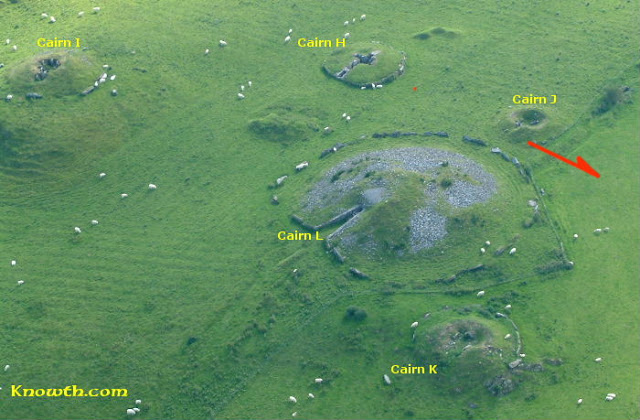
image: Cairn L at Loughcrew, Knowth.com (link to image).

image: Cairn L at LoughcrewKnowth.com (link to image).

We are rapidly approaching a significant point on the annual cycle -- one of the "cross-quarter days" which serve as "half-way markers" between the four great stations of the two solstices and the two equinoxes.

In my most-recent appearance on the Grimerica Show for "Skies over Grimerica (January 2018)" we not only discussed the lunar eclipse of January 31, 2018, but also the concept of cross-quarter days. 

The solstices and equinoxes give us definitive markers for the annual cycle created by earth's orbit around the sun. The tilt of our planet's axis of rotation, relative to the plane of our orbit around the sun (the plane of the ecliptic), and the fact that the poles retain their orientation as we orbit (see this post describing the "earth-ship metaphor" for more on this phenomenon) means that the sun's rising and setting points along the eastern (rising) and western (setting) horizon will move further north during one half of the year (before reaching the northern limit at the June solstice) and further south during the other half of the year (before reaching the southern limit at the December solstice), passing through the half-way "crossing point" of the equinoxes midway between those solstice points twice per year (once on the way north to June solstice, and then again on the way south towards December solstice).

These four points -- the June solstice, the midway crossing-point southwards at the September equinox, the December solstice, and the midway crossing-point northwards at the March equinox -- divide the annual cycle (which we call a "year") into four sections or "quarters."

In addition to these four very important "quartering points," however, which divide the annual cycle into four quarters, we could also observe a point halfway between the solstice on either end and the two "crossing points" of the equinoxes in the middle. And in fact there is extremely solid evidence to suggest that ancient cultures did indeed observe such half-way points between the solstice and quinix observances every year. Because these half-way points further divide the already-quartered year (quartered by the four stations of the two solstices and the two equinoxes), they have come to be known as the "cross-quarter days."

You can read more about cross-quarter days in previous posts from the very first year of this blog, such as this one and this one.

Below is a diagram of the annual cycle using the zodiac wheel to indicate the positions of the quartering days of the two solstices and the two equinoxes, located at the junctures of the zodiac signs from the Age of Aries.

quarter days.jpg

Note that the dates given are the most frequently noted dates for the solstices (in June and December) and the equinoxes (in March and September), but that the actual calendar date for each will "drift around" a little bit, due to the imperfect match between the period of earth's rotation on its axis and that of earth's rotation around the sun. In other words, earth returns to the exact same point (such as the exact point of winter solstice) once a year, but because earth's rotation (which creates one day each time we complete a full rotation) does not fit evenly into that period of returning to the exact same point (one year), no calendar can have a perfectly even number of days (rotations) to get back to the exact same point on the orbit (the end of one year and the beginning of the next). 

This is why our calendars use "leap years," in order to bring the calendar date back to the traditional solstice and equinox dates shown above (otherwise the calendar would "drift apart" from the yearly progress markers of the two solstices and the two equinoxes). Various calendrical systems used throughout history have made use of other mechanisms besides leap years, such as intercalary days, to accomplish the same "correction" of the mismatch between daily axial rotations and annual orbital years.

That said, we can use the most common dates of the solstices and equinoxes to determine the half-way points between these four stations of the year, and thus further sub-divide each "quarter" from the diagram above into two new "half-quarters" -- thus dividing the year into eight sections instead of four sections.These half-way points have traditionally been known as "cross-quarter days," because they draw yet another cross through the year, in addition to the cross formed by the equinoxes and the solstices. 

Instead of taking anyone's word for the dates on which these cross-quarter days should fall, we can very easily calculate those dates using any calendar. The easiest way to calculate the cross-quarter days is to simply count up the days between a solstice and an equinox, and then divide that number by two to find the number of days to count from either marker in order to each a date halfway between.

As an example, let's use the calculation between the March equinox and the June solstice. The March equinox typically falls on March 21 (although the date will "drift" slightly due to the mismatch between daily axis rotations and annual orbits described above, and will thus need to be "re-set" back to March 21st using the mechanism of a leap year). The June solstice typically falls on June 21 (with the same note about drift which applies to the March equinox applying equally to the June solstice).

From March 21 to June 21 we count 92 days (ten days from March 21 to March 31, plus thirty days from April 1 to April 30, plus thirty-one days for the month of May, bringing the count to seventy-one, plus another twenty-one days to reach June 21, for a total of ninety-two days).

Dividing 92 in half, we get the number 46. When we add 46 days to March 21 (the March equinox), we will find the "cross-quarter day" that marks the half-way point between the March equinox and the June solstice -- which is May 6th.

The same process could be done to find the halfway points between the June solstice and the September equinox (which falls on or around August 8), between the September equinox and the December solstice (which falls on or around November 8), and between the December solstice and the March equinox (which falls on or around February 4). 

Obviously, we are currently progressing between the December solstice and the March equinox -- and the cross-quarter day which we are approaching is the cross-quarter day falling on or around February 4.

The cross-quarter days were understood to have great significance in ancient cultures which understood the tremendous importance of the heavenly cycles. They were celebrated as in western Europe and the British Isles as Beltane (the early May cross-quarter day), Lughnasad (the early August cross-quarter day), Samhain or Sawain (the early November cross-quarter day), and Imbolc (the early February cross-quarter day), as well as under other names both in Europe and around the globe.

Upon the adoption of the Julian calendar (and the later Gregorian calendar, which modified the Julian calendar in order to improve the leap-year calculation used to correct the mismatch of daily rotations to annual orbits described above), many of the traditional holidays and observances associated with the cross-quarter days described above appear to have "migrated" to the first of the month in which that cross-quarter day would normally fall. For example, the cross-quarter day of Samhain or Sawain would fall on November 8, based on calculations following the pattern outlined above -- and yet we all know that the important holidays of Halloween and All-Hallow's Eve take place on November 1st rather than November 8th, with Halloween being celebrated on the Eve of November 1 itself.

Similarly, the early May cross-quarter day which by strict mathematical calculation would fall on May 6th has migrated to May 1st and survives in numerous traditions associated with that date throughout the centuries, including both the dancing around the May-pole and other sundry May-day celebrations such as the association of May 1 with labor and worker's rights.

The cross-quarter day marking the point half-way between the darkest day of winter in the northern hemisphere (the December solstice) and the day of "crossing upwards" into the upper half of the year (the March equinox) would normally fall on February 4, but it too has migrated towards the first of the month, and is most well-known for the observation of Groundhog Day

This cross-quarter day is also associated with St Brigid in Ireland, whose feast day is February 1. One tradition on the eve of St Brigid's day is to leave out a scarf or strip of cloth for Brigid to bless as she is passing by -- which is very interesting as the association of goddesses with scarves or sashes is found in mythology around the globe (see for instance the discussion in Star Myths of the World, Volume Two of the sash given to Odysseus by the goddess Leucotheia, and note that the traditional story of Sir Gawain and the Green Knight also features the gift of a sash of protection by a female figure to the knight Gawain, in a clear parallel to the Odysseus-Leucotheia story).

We can be very confident that the observation of the importance of cross-quarter days is extremely ancient, based on the fact that some of the oldest surviving monuments on our planet contain alignments to sunrises on certain cross-quarter days.

As discussed briefly in the "Skies over Grimerica" episode linked above, the passage mounds of the Boyne River Valley in Ireland are some of the most ancient aligned monuments to have survived from remote antiquity to the present day. The massive passage mound at Newgrange is very well known, and its sixty-foot long passage is known to align with the sunrise on the winter solstice, allowing a beam of light to penetrate all the way to the chamber deep within the great mound at that time of year alone.

The mound of Newgrange and its aligned passage is thought to have been constructed around the year 3200 BC, over five thousand years ago and thus older than even Stonehenge. However, the passage mounds at nearby Loughcrew in the same part of Ireland, while not nearly as large as the mound at Newgrange, are thought by some scholars to predate the construction of Newgrange by an additional eight hundred years (thus dating Loughcrew to around 4000 BC).

As discussed and diagramed by author, explorer, and archaeoastronomer Martin Brennan in his excellent book on the alignments and beautiful rock art of the Boyne River Valley passage mounds entitled The Stars and the Stones: Ancient Art and Astronomy in Ireland (1983), the passage and chamber of the mound known as "Cairn L" at Loughcrew (pictured above) is aligned to the sunrise on the cross-quarter days of February 4 and November 8 (the sun will pass through the same rising point on the eastern horizon on both February 4 and November 8, once on the way north in February between winter solstice and spring equinox, and then again on the way back south in November between fall equinox and winter solstice).

Below is the same image of Cairn L, from the website Knowth.com, this time with a "north-seeking arrow" superimposed (by me) onto the image, using the best resources I have available:

cairnl w Nseeking arrow.jpg

Those familiar with the earth's rotation will recognize that if the red arrow is pointing north, then the passage seen on the side of Cairn L is facing somewhat south of east -- and this is the direction from which a beam of light from the rising sun on the morning of February 4 will penetrate deep into the mound of Cairn L and illuminate a specially-positioned pillar within the stones of the passage mound. 

Below is the same image one more time, this time adding a line indicating the direction of the sun's rays at sunrise on the February and November cross-quarter days, rays that will penetrate to the special pillar inside the mound only on those special days:

cairnl w sunbeam.jpg

My estimate of the direction of the sunbeam from the rising sun of February 4 and November 8 is based on the diagrams and discussion found in The Stars and the Stones, pages 110 and 111. 

Below is an image of the stone itself which is illuminated by the light from those two special cross-quarter days (including the upcoming cross-quarter day of Imbolc):

image: Knowth.com (image link here).

image: Knowth.com (image link here).

In the image above, the rising sun's beams would come in from the right as we face the image. The sun's rays will strike the standing stone visible on the left of the image (the stone with the green moss on its one of its faces) on the morning of spring equinox. Note the beautiful and distinctive spiral artwork on the stone in the background -- this stone is along the northern edge of the chamber at Cairn L.

Cairn L is thought to have been constructed some 6,000 or 6,100 years ago -- which means that the observance of cross-quarter days must be extremely ancient indeed.

Just imagine the level of planning and design required to create an artificial mound containing a stone-lined passage in which a lone stone column or pillar is only illuminated on certain days, twice per year. This difficulty in planning and design (to say nothing of the effort required to actually execute that design) argues very strongly that the cross-quarter days which divide the year's four sections into a total of eight sections were held in very high esteem.

And yet today, it is my impression that the entire concept of cross-quarter days is largely ignored or forgotten among the men and women of the modern world.

I'm convinced based on abundant evidence that the many cycles of the sun, moon, planets, and stars were invested with spiritual significance as part of an ancient, world-wide system of code which informs the ancient myths, scriptures and sacred stories of virtually every culture on our planet. 

I am also convinced that these cycles (and the invisible, spiritual, or hyper-dimensional realms that they point towards) were understood to have actual impacts on the dimension we think of as the "material world" in which we normally operate.  

The more we begin to become aware of the ancient cycles and their significance, the more readily we can begin to grasp the profound wisdom which is patiently waiting to communicate to us through the precious ancient myths of humanity.


Total Lunar Eclipse, January 31, 2018

Total Lunar Eclipse, January 31, 2018

image: NASA (link).

image: NASA (link).

The moon is waxing towards full, and will reach the point of full moon on January 31. As you've probably already heard, this full moon will feature a total lunar eclipse, which will be visible as the moon is rising for viewers in eastern Europe, Asia, Australia and the western Pacific Ocean, and as the moon is setting for viewers in the eastern Pacific Ocean, and the western part of North America and Mexico (but the moon will pass through earth's shadow close to or after the moon sets for the eastern side of North America and for much of Central America, South America, Africa and western Europe).

The diagram above shows the times that the earth's shadow will envelope the moon, using the Pacific time zone in effect in western North America (including California). Viewers in the Eastern time zone of North America will have to add three hours to the times for the moon's entry into the penumbra and umbra -- which means that the moon will already have moved below the western horizon (moon set) by the time it is fully enveloped by the umbra for viewers in eastern North America, South America, the Atlantic, Africa and western Europe (see map below, also from NASA):

eclipse data jan 2018b.jpg

A total lunar eclipse can only occur when the moon passes through the point of full moon -- that is, when it is directly opposite from the sun: when the sun, the earth, and the moon are aligned such that the earth is between the sun and the moon. However, because the plane of the moon's orbit around the earth is tilted slightly from the plane of the earth's orbit around the sun, the moon will not go into earth's shadow every time that the moon reaches the point of full moon (when earth is between sun and moon). The moon will only pass into the shadow of the earth when the moon happens to reach the point of full moon at the same time that the moon on its tilted orbital plane is also passing through the plane of earth's orbit around the sun.

Further discussion of the moon's tilted orbital plane, and a few helpful videos to help you visualize what it means when the moon passes through the orbital plane of the earth around the sun, can be found at previous posts such as "The lunar nodes and the nine-world cosmology" and "An excellent website explaining the lunar nodes (with animation)." 

There is also some discussion of the January 31 lunar eclipse in this month's installment of "Skies over Grimerica," which was recorded on January 17th.

The leading edge of the moon will enter the penumbra of earth's shadow at 2:51 in the a.m. on early Wednesday morning, January 31, for observers in the Pacific time zone in western North America (this contact of the leading edge of the moon with the penumbra is also referred to as "P1"), and the leading edge of the moon will enter the umbra of earth's shadow at 3:48 in the a.m. just under one hour later (this contact of the leading edge of the moon with the umbra is also referred to as "U1"). The umbra is the full shadow of the earth, which would completely blot out the moon from our view, except for the fact that our planet has an atmosphere which bends the rays of the sun, allowing some rays to "leak through" to the face of the moon, giving it some illumination instead of plunging it into total blackness. These refracted rays are reddish in color, for the same reason that the sun and the moon appear redder when they are just rising or setting (because the rays of light are bending through our earth's atmosphere). 

There is a good discussion of this phenomenon, along with some nice diagrams, in this discussion of the January 31 eclipse over at Sky & Telescopehere.

As the moon continues on its orbit, the umbra will creep across more and more of the face of the moon, until the umbra reaches the trailing edge of the moon at 4:51 a.m. on Wednesday morning, January 31, for viewers in the Pacific time zone (the contact of the trailing edge of the moon with the umbra is also referred to as "U2"). At this point, the lunar eclipse is total. However, the centerline of the moon will pass through the very center of the umbra at 5:29 am for viewers in the Pacific time zone -- this is the point of "max eclipse" for this lunar eclipse.

The leading edge of the moon will begin to exit the umbra at 6:07 am Pacific time, which is also referred to as "U3." The moon will set below the western horizon for viewers in much of the west coast of North America before its trailing edge moves out of the umbra when the trailing edge of the moon leaves the umbra it is also known as "U4").

Viewers in other parts of the world which can see the lunar eclipse can use the Greenwich or Universal times shown in the upper-right corner of the second diagram above in order to calculate the local times for P1, U1, U2, U3, and U4.

The media is giving all sorts of sensational names to this lunar eclipse, in an attempt to make this month's event seem more unusual than other lunar eclipses -- but much of the hype involves the fact that this is the second full moon of the calendar month of January, which is simply an effect of the calendar and not of the celestial mechanics of the earth and the moon. Moreover, the use of the term "blue moon" to refer to the second full moon in a month appears to be relatively recent and -- according to this article in Sky & Telescope -- this use of the term "blue moon" may actually have resulted from a mistake by a writer in that same magazine back in 1946.

However, don't let the media's constant need to hype everything in their grasp spoil the experience of observing the eclipse for yourself, if it is at all possible for you to do so and if you live in a part of the globe where this eclipse will be visible during the time that the moon is moving through the umbra of earth's shadow. I believe that it is always beneficial to observe the motions of the heavenly cycles, and to marvel at the effects of the interplay between the moon and the earth and the sun. 

The moon is swinging along its path this very moment, heading for the point where it will intersect with the plane of the earth's speeding orbit around the sun, and in just over twenty-four hours it will begin to enter into the shadow cast by our entire planet. As always, that will be something to see.

Mahatma Gandhi and Satyagraha

Mahatma Gandhi and Satyagraha

image: Wikimedia commons (link).

image: Wikimedia commons (link).

Mahatma Gandhi was born in 1869.

As is of course very well known, he opposed colonialism, oppression, and exploitation.

Gandhi is also well known for advocating and practicing satyagraha, which in his own translation of his 1909 book on Indian Self Rule, he renders as "soul force" or "love force" in English (for instance in this chapter).

Of this concept, Gandhi wrote:

"When I refuse to do a thing that is repugnant to my conscience, I use soul-force" (chapter 17, "Passive Resistance").

In that same text, which he wrote in 1909, he provides many perspectives upon the reason that soul force is superior to brute force -- perhaps most succinctly when he says:

To use brute force, to use gunpowder, is contrary to passive resistance, for it means that we want our opponent to do by force that which we desire but he does not. And if such a use of force is justifiable, surely he is entitled to do likewise by us. 17.

But just because he subscribed to the principle of nonviolent or peaceful resistance does not mean that he believed in allowing oppression, exploitation, and colonialism to continue -- quite the contrary. In the same 1909 text, he proclaims: "You may keep the riches that you have drained away from this land, but you may not drain riches henceforth. [ . . . ] We cease to play the part of the ruled" (chapter 20, "Conclusion").

Mahatma Gandhi realized and acknowledged that those who had turned his country into a colony had superior military power. He says as much in the same concluding chapter just cited, but then notes that it is only by the cooperation of the governed that those who have been oppressing and exploiting the people are able to do so, when he declares:

You may, if you like, cut us to pieces. You may shatter us at the cannon's mouth. If you act contrary to our will, we shall not help you; and without our help, we know that you cannot move one step forward.

This insight, that "without our help, we know that you cannot move one step forward," is crucial to understanding the power of Gandhi's satyagraha. At another point in the same tract, he declares that without those who collaborate with the colonizers, the country could never have been enslaved: "It is we, the English-speaking Indians, who have enslaved India. The curse of the nation will rest not upon the English but upon us" (chapter 16, "Education").

Without such collaboration, the oppressors would be stymied. This fact is the key to the effectiveness of the nonviolent resistance which Gandhi demonstrated and advocated. 

The colonialist powers used brute force to try to coerce collaboration, or to give an excuse to those who collaborated -- enabling them to rationalize their collaboration by saying, "What else can I do? They have all the firepower." By demonstrating that the occupiers had no power without such collaboration, Gandhi removed that rationalization.

When that which belongs by right to all men and women is siphoned-away for the benefit of a small group at the expense of everyone else, the only way this can happen is if the vast majority of the people (who will intuitively realize that a wrong is being committed) allow it to happen, usually due to their fear of the threat of violence, and also due to their lack of awareness that they already possess the means to bring that misappropriation to a stop. Gandhi's teaching and his example addressed both of these obstacles.

Colonialism, by its very definition, has at its core the seizing of that which belongs to all men and women in a nation by a very few (some of them from another nation, but requiring the cooperation of collaborators from the colonized populace as well). We may delude ourselves into thinking that such imperialism came to an end around the world many decades ago, but in fact today's neoliberalism operates on the very same principles, having at its core the privatization of resources which belong to the public, on a vast scale -- including mineral resources such as oil and natural gas and ores and metals and rare earth elements, public utilities, ports, airports, railroads, forests, aquifers, pensions belonging to retirees, and even rivers.

Almost everyone knows without even having to be taught that the seizing of such gifts of the gods for the benefit of the few at the expense of everyone else is inherently wrong. Gandhi's teaching should open our eyes to the fact that without our cooperation, such unjustifiable exploitation could not take place. 

His remedy was both simple and at the same time powerfully effective: do not cooperate with it. Refuse to do a thing that is repugnant to your conscience.

That this methodology is greatly feared by those few who rely on the cooperation of the many in order to drain away the riches that belong to all men and women is evidenced by the fact that Mahatma Gandhi was brutally assassinated on January 30, 1948. Just over twenty years later, the Reverend Martin Luther King, Jr. -- who was implementing the very same conscience-driven nonviolent approach -- was also brutally assassinated. John Lennon was advocating and practicing much the same soul-force or love-force.

The actions and example of Mahatma Gandhi and Martin Luther King brought about incredible changes. They demonstrate that soul force is indeed more powerful than brute force.

They knew that violence could not stop their message: but it is up to us to continue to proclaim it and live it.

Near the very end of the conclusion of the text by Gandhi cited above, Gandhi urges us not to wait for anyone else in our application of the principle of satyagraha. To ask when everyone will be ready to join us in this refusal to cooperate with oppression and exploitation, he says, is to make a mistake.

Seventy years after the departure of Mahatma Gandhi from this incarnation, his message and example live on, as urgently needed today as ever in the past.

Ursula K. Le Guin and the purpose of "thought experiment"

Ursula K. Le Guin and the purpose of "thought experiment"

image: Wikimedia commons (link).

image: Wikimedia commons (link).

I was saddened to learn today that author Ursula Kroeber Le Guin has crossed.

She was born in 1929 and grew up in Berkeley, California. 

One of my professors in graduate school considered her a mentor and friend.

He introduced me to an important teaching from Ursula Le Guin regarding the "thought experiment" of fiction writing (as well as of theoretical physics including quantum physics):

The purpose of a thought-experiment, as the term was used by Schrodinger and other physicists, is not to predict the future -- indeed Schrodinger's most famous thought-experiment shows that the "future," on the quantum level, cannot be predicted -- but to describe reality, the present world. 

Science fiction is not predictive; it is descriptive.

From her introduction to The Left Hand of Darkness (1987).

I discussed this important quotation in a blog post from 2014, here (one which may be even more appropriate today than when it was written then).

I would recommend taking the time to read the work of Ursula Le Guin in the coming days and months, and to pause from time to time to think of the above quotation, and to contemplate what she might be describing in our present world in her thought experiments about other "imaginary" worlds -- and then to ask what realities her work might be urging us to perceive, realities to which we might have remained asleep or oblivious without the help of her prophetic writing.


Respect.

The Truth is Up There

The Truth is Up There

image: Wikimedia commons (link); modified.

image: Wikimedia commons (link); modified.

The X-Files is one of the longest-running series in television history, premiering in September 1993 and (after a lengthy pause) still airing new episodes today.

The series depicts a world in which malevolent aliens are plotting to take over the earth and destroy humanity, assisted by certain treacherous humans who have been promised that they will be spared in exchange for their collaboration. 

The episodes revolve around the exploits of special agents Mulder and Scully of the FBI, who investigate cases in the agency's "X-Files" involving the unexplained and the paranormal, and the tension between the implications of the mounting evidence and the resistance of those who want to ignore those implications and who refuse to accept the possibility that their entire paradigm may be wrong (as well as the efforts of those who actually know what's going on and who want to suppress the evidence or downplay the implications in order to preserve the false paradigm).

This tension leads to the memorable tagline which appears at the end of the credit sequence which rolls at the beginning of every episode: "The Truth is Out There" -- the implication being that no amount of effort by the forces who want to suppress the facts can ultimately prevent the truth from finally coming out. 

It's an extremely powerful message.

I do believe that the truth eventually does come out, regardless of efforts to suppress it, although I myself am not at all convinced that the truth involves space aliens (see discussions here and here, for example). In fact, I'm personally more inclined to believe that many of the space alien theories propagated rather aggressively during the decades immediately following the ostensible end of the Second World War were intended to distract from the truth that is actually out there, rather than to point people towards the truth -- although I think the overall premise of the X-Files can serve as a brilliant metaphor for things that are actually going on and which are in fact extremely dangerous, and which are important to perceive for the safety of the human race and the planet Earth. 

Whatever your beliefs on that subject, however, one paradigm-exploding body of evidence which should really be beyond dispute at this point is the overwhelming set of data-points which demonstrate that the world's ancient myths -- from virtually every culture on every inhabited continent and island -- are speaking a common language of celestial metaphor. This evidence argues strongly for the existence of some now-forgotten culture or civilization which predates (possibly by millennia) even the most ancient civilizations known or postulated by conventional academic historians. 

The evidence in myth of a shared world-wide system may in fact constitute an even more-indisputable body of evidence for the existence of such a lost civilization than the formidable body of evidence composed by the world's network of ancient monuments, which also appear to be interconnected in ways that are virtually impossible to reconcile with the conventional historical paradigm (see for example evidence discussed here and here, as well as in the work of researchers such as Graham Hancock and Joseph Farrell and Laird Scranton, among many, many others).

That's because, once the outlines of the system are understood, the connections between the stars and the myths can be readily perceived by anyone, for myths stretching from ancient Egypt to Aotearoa, and from the myths of ancient China and Japan to those of the Norse of Scandinavia, and from the stories in the scriptures of the Bible from Genesis to Revelation -- all of which can be seen to be closely related to one another and even to share numerous common elements making their connection to one another and to the stars of the night sky virtually undeniable.

This evidence can be seen in the texts of the myths themselves, as well as in ancient artwork from around the world, and it can be seen most of all in the motions of the stars and visible planets of our night sky, which are accessible on most nights to everyone who is able to go out and look at them for himself or herself.

The number of correspondences between the myths and the stars are absolutely overwhelming, and constitute a compelling -- and, in my opinion, conclusive -- set of data which argues that the world's myths are based on a common system of celestial metaphor. I have now outlined some of this evidence in five original books each with hundreds of pages and hundreds of illustrations, including The Undying Stars (423 pages), Star Myths of the World, Volume One (482 pages), Star Myths of the World, Volume Two (718 pages), Star Myths of the World, Volume Three (766 pages), and Astrotheology for Life (322 pages), as well as another book based on just a small selection from my first one thousand blog posts, entitled Ancient Myths, Ancient Wisdom (866 pages).

And the evidence that has been presented in those books thus far actually constitutes only a tiny fraction of the evidence available in ancient myth and ancient artwork from around the world which could be offered as support for the conclusion that some common system of celestial metaphor, from some presently unknown source, somehow informs the sacred stories from cultures separated from one another by vast distances -- and in some cases by vast gulfs of time as well.

Indeed, new discoveries such as the Pylos Combat Agate, which was only unearthed in the past year from a shaft-grave discovered only as recently as 2015 -- and which was not even recognized as containing its stunning artwork until it was carefully cleaned off in 2017, and first revealed to the public this past November well after I had published all of the original volumes listed above, and well after the publication of the blog post selections included in Ancient Myths, Ancient Wisdom -- provide astonishing new evidence for the operation of this ancient worldwide system, in addition to the evidence in texts and artifacts which have been known and remarked upon for centuries (or even for millennia).

Unlike other forms of evidence pointing to the existence of an ancient culture predating and influencing the other known cultures and civilizations of humanity, the celestial correspondences can be seen by going outside on a clear dark night and looking up at the sky. It is not necessary to travel to remote deserts or jungles, or to have an advanced degree in geology or archaeology or even astronomy to see the evidence for one's self.

An example which is shown in my recent video discussing the special category of "dual-horizon" myths, and discussed in a little more detail in this month's "Stars over Grimerica" episode exploring the celestial phenomena visible during this time of year, are the aspects of the goddess Durga and the demon Mahishasura, from the ancient scriptures and sacred traditions of India, which can be readily seen to correspond to the distinctive features of the constellation Virgo (and the nearby constellations of Leo, Hydra, and Coma Berenices) and of the constellation Orion (and the nearby constellation of Taurus, particularly the "head of the bull" formed by the Hyades and the two "horns" indicated by the two stars located at roughly an equal distance beyond the two tips of the "V" of the Hyades).

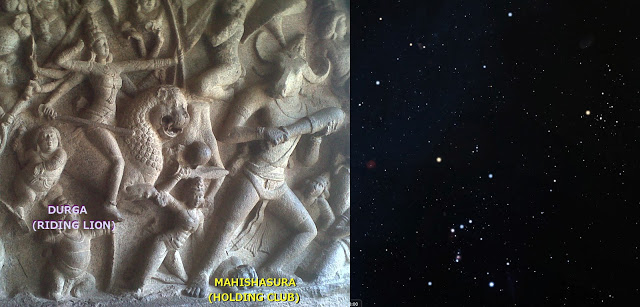
Below is an amazing stone relief found in the Mahishamardini cave temple (or mandapa) in the Mahabalipuram temple complex of southern India, thought to have been carved in the 7th and 8th centuries AD. This portion of the temple carving depicts the goddess Durga, riding on a lion towards Mahishasura, depicted as a powerful figure with the head of a bull water buffalo:

left: Mahabalipuram temple relief, Wikimedia commons (link); right: stars of Orion and Taurus, stellarium.org.

left: Mahabalipuram temple relief, Wikimedia commons (link); right: stars of Orion and Taurus, stellarium.org.

The correspondences between the depiction of the figure of Mahishasura by the artist of the late 600s or early 700s, and the outline of the constellation Orion as we can see it in the sky above our heads this very week in the year 2018, could not be more compelling.

Below, the outline of the figure of Orion (yellow lines) and the nearby "head of the bull" of Taurus as defined by the V-shaped Hyades plus the two stars indicating the tips of the two long horns (red lines) have been added to the same stars seen in the above image to the right of the temple relief:

durga mahishasura relief with orion and taurus 02.jpg

Note that the figure of Orion as seen in the sky appears to have one leg bent and the other leg straight (the leg on the right as we face the constellation, which would be the left leg of the figure, if envisioned as facing us). The artwork from Mahabalipuram depicts Mahishasura in an identical stance: the left leg is bent at the knee (the leg on the right as we face the sculpture), while the right leg (on the left as we face it) is straight.

Further, the Asura carries a short club in his right hand, which can be seen in the outline of Orion held aloft in the figure's right hand (on the left as we face the constellation).

The artist has even depicted Mahishasura as having a long sash which dangles down from his waist between his legs, somewhat closer to the leg on the left (the right leg of the Asura) than the leg on the right as we face the sculpture. This detail clearly corresponds to the "sword" or "sheath" hanging down from the famous three-star belt of the constellation Orion, containing the hazy Orion Nebula, which is visible in the star-diagram above between the legs of the constellation, slightly closer to the leg on the left as we face the image than to the leg on the right.

Above and a little to the right as we face the star-chart above we see the outline of the head of Taurus the Bull, depicted with red lines in the image. The fact that this bull's head is clearly separated from the neck and torso of the outline of Orion no doubt gives rise to the fact that in the ancient myths, Durga slays Mahishasura by severing his head from his body.

Clearly, the ancient artist seems to have been aware that the myth of the combat between Durga and Mahishasura is based on the constellations in the night sky, and that Mahishasura corresponds to the constellations Orion and Taurus, with Orion representing the body and Taurus the head. It is also possible that the artists themselves were not informed of the actual celestial origin of the artistic conventions they were taught regarding the proper ways to depict various supernatural figures -- but it is clear that however the artists inherited these artistic conventions, the conventions themselves preserved the connection to the stars in the heavens.

In the videos linked above, as well as in other writings about the identity of the goddess Durga, I have provided further discussion which shows fairly conclusively that the goddess corresponds to the constellation Virgo in the sky, and that the lion upon which she rides corresponds to Leo (a common pattern in other myths around the world, in which goddesses ride upon, stand upon, or are otherwise associated with lions). And, what is in my opinion still further confirmation of the celestial correspondences in this myth, it can be seen that the constellations Orion and Taurus (representing Mahishasura) are sinking down into the west at the same time that Virgo and Leo (representing the goddess Durga riding triumphantly upon her lion) are rising up out of the east. Right now, in fact, is a particularly good time of year to observe this phenomena in the motions of the respective constellations Taurus, Orion, Leo and Virgo.

There are in fact hundreds, or even thousands, of other examples which could be offered from ancient myth or ancient artwork, literally from around the globe.

And the silently circling stars which you can go outside and see this very night will testify to the connection of the ancient myths to the heavenly actors, a connection which becomes all but undeniable as example after example is found to correspond to the constellations and other celestial players in extremely precise and minute details.

In fact, the knowledge of these connections is not particularly new, and it certainly did not originate with me or with my work. I have found hints of this awareness in the writings of ancient philosophers, including Plato and Macrobius (and I'm pretty suspicious of Plutarch's knowledge on this subject as well). In more recent centuries, French free-thinkers such as Charles-Francois Dupuy (1742 - 1809) and Volney (1757 - 1820) wrote extensively on some aspects of this same concept.

Even more comprehensive, in my opinion, are the connections between the stars and the characters and episodes found in the Bible that were discovered by the Reverend Robert Taylor of England (1784 - 1844), who delivered sermons or lectures on these correspondences over a course of many years to packed audiences in London (and who was in fact thrown in jail on multiple occasions for doing so, in addition to losing his job as a minister). After his death, these sermons were collected and published in two volumes, which can both be accessed through links on the "Resources" page of my primary website.

Even more recently, Professors Giorgio de Santillana and Hertha von Dechend collected a massive encyclopedia of evidence for what they called a "great world-wide archaic construction" which survived "in traditional rites, in myths and fairy tales no longer understood," which became a book entitled Hamlet's Mill: An essay on myth and the frame of time, published in 1969 (nearly fifty years ago now!).

And yet, despite the fact that Robert Taylor's extremely massive body of lectures was published in the middle of the nineteenth century (and we are already well past the beginning of the twenty-first), and despite the fact that Hamlet's Mill was published forty-nine years ago this year, the overwhelming amount of evidence which demonstrates that the ancient myths, scriptures and sacred stories of the world are based on the stars -- and indeed, based upon a common world-wide system of celestial metaphor which employs the same metaphors and the same understanding of constellational details (details in many cases which we would not expect to arise independently of one another in multiple cultures without any connection) -- this paradigm-shifting information is all but unknown today.

It's almost as if some very powerful forces are actively working to suppress the awareness of this evidence, and to preserve the conventional paradigm and historical narrative among the general public (and even among academicians), akin to the forces depicted in the X-Filesseries, who work to suppress the evidence that Mulder and Scully encounter, and to keep the true picture implied by the evidence from coming to light.

And yet, despite whatever forces may or may not be working behind the scenes to discourage awareness of the full implications of this information, the evidence is out there and it is available for all to see, once they begin to look for it. As the characters of the X-Files themselves declare, "no agency has jurisdiction over the truth."

And, unlike the evidence discovered by agents Mulder and Scully in that series, the evidence of the myths and the stars cannot be buried away in some bulging filing cabinets in remote corners of vast institutional buildings -- because the evidence is turning over our heads at all times. All we have to do is learn how to look.

In this case, the truth really is out there . . . or, perhaps more precisely,

                                                       The Truth is Up There


Skies over Grimerica: Night skies and Star Myths for January, 2018

Skies over Grimerica: Night skies and Star Myths for January, 2018

It's time for another edition of "Skies over Grimerica," in which I join hosts Darren and Graham of the Grimerica Show to discuss the phenomena visible in the skies overhead during the current month, including some of the constellations in the night sky for the month along with their connection to ancient myth.

Previous installments of this fairly recent feature have included the "Skies over Grimerica" segments for the months of November and December (recorded in those months during 2017). This latest show discusses the phenomena visible right now during the remainder of the month of January (2018), including the total lunar eclipse coming up at the next full moon (January 31), as well as some phenomena coming up in early February, including that month's cross-quarter day.

The above conversation was recorded on January 17, 2018.

As with previous iterations of this feature, we follow the general outline of discussing the moon, then the planets, then any special upcoming "stations of the year" (last month looking at winter solstice, and this month looking at the concept of "cross-quarter days"), then the constellations visible during the month (or at least some of them), associated myths from around the world, and some discussion of the possible meaning and message of those myths.

We went for quite a while during this month's conversation, both because we covered a lot of ground and also because we dove at some length into a few different aspects of celestial mechanics in response to questions about subjects such as the angle of the ecliptic plane along which the sun, moon and visible planets can be seen to rise (and how that angle changes based on the observer's latitude on planet earth), the concept of the celestial north pole and how its elevation in the night sky changes based on the observer's latitude on planet earth, and the fact that the visible planets are sometimes grouped more "tightly" in the sky from the perspective of observers on our planet and sometimes are more widely dispersed, due to their location in their respective orbital tracks (among other subjects).

We also went into the concept of umbras and penumbras in relation to solar eclipses and lunar eclipses, the use of gnomons and shadows for telling time during the day and for marking the sun's progress back and forth between the solstices as we progress through our annual orbit, and a little bit on the use of passage chambers aligned with the sun's rising or setting points during special days of the year such as the solstices, the equinoxes, or the cross-quarter days (this month looking at Cairn L at Loughcrew in Ireland, which is aligned with the sunrise for the upcoming February cross-quarter day).

For those not wishing or not able to devote the two hours and fourteen minutes required to absorb this full episode in one sitting, the following are some general time-markers between the above-named subjects on the menu:

  • The moon and the lunar eclipse discussion begins soon after the "formal start" of the show, which doesn't actually start until about the 0:05:00 minute mark.
  • Discussion of the visible planet locations for the month begins at about 0:34:30. That segment also gets into some deeper dives into some of the aspects of the celestial mechanics mentioned above.
  • Discussion of the concept of cross-quarter days in between the stations of the two solstices and two equinoxes begins at approximately 1:02:00 in the video.
  • Discussion of some of the constellations visible this month, and their relation to the story of the goddess Durga and Mahishasura (in some detail), begins at about 1:28:20 and continues to the end of the video.

Links to previous blog posts that go into areas related to some of the points of discussion from this months segment include:

I hope that you are enjoying the "Skies over Grimerica" segments, and that you can go out into the night sky to observe some of the glorious heavenly phenomena for yourself each month, if at all possible.

I'm convinced that the ancient myths of the world are speaking a heavenly language which uses the heavenly cycles to convey profound truths for our benefit and blessing. The more we can observe and understand those cycles, the better we can "hear" what the world's ancient wisdom is trying to say to us.