Magnetic anomalies and the ocean ridges


In the previous post, we touched on the earth's magnetic field, and linked to a page from the University of Tennessee-Knoxville discussing some of the principles of the magnetosphere created by the interaction of earth's magnetic field with the ionized solar wind.

In the section entitled "Origin of the Magnetic Field" on that page, the authors have written:
Rocks that are formed from the molten state contain indicators of the magnetic field at the time of their solidification. The study of such "magnetic fossils" indicates that the Earth's magnetic field reverses itself every million years or so (the north and south magnetic poles switch). This is but one detail of the magnetic field that is not well understood.
As it turns out, this is another area of geology in which evidence that is difficult or impossible to explain using the tectonic theory can be better explained by the hydroplate theory. For a list of other similar evidence discussed in this blog, see this previous post or simply go to the website of Dr. Walt Brown, the originator of the hydroplate theory, where he has published his entire book detailing the evidence supporting his theory on the web for anyone to read.

Dr. Brown explains that the theory of "magnetic reversals" is a byproduct of the assumptions of the tectonic theory, and is derived from magnetic readings from the ocean floor, taken along the Mid-Oceanic Ridge. An explanation for these readings was one of the important factors leading to the acceptance of the long-ridiculed tectonic theory in the 1960s:
The plate tectonic theory gained acceptance when an important discovery of the 1960s was misinterpreted. The public was told that paralleling the Mid-Oceanic Ridge are bands of ocean floor with reversed magnetic orientation. These "magnetic reversals" alternated with bands of rock having the normal (north pointing) polarity. At a few places, the pattern of reversals on one side of the ridge is almost a mirror image of those on the other side. This suggested periodic reversals of the earth's magnetic poles, although there is no theoretical understanding of how this could have happened. Molten material supposedly rose at the ridge, solidified, took on the earth's current magnetic orientation, and then moved away from the ridge like a conveyor belt. That explantion is wrong. 7th edition page 91.
Elsewhere, Dr. Brown explains in great detail the problems with the tectonic explanation for this phenomenon, as well as an explanation from the hydroplate theory.

Among the many problems with the tectonic explanation is the question of how these undersea ridges form in the first place. The tectonic theory explains such ridges as being formed when two plates drift apart over millions of years, allowing magma to seep up and cool, hardening into a ridge as the floor spreads or expands. However, as can be seen in the above image of the Mid-Atlantic Ridge (from a US Navy map showing sound surveillance sensors emplaced to listen for patrolling submarines in the Greenland-Iceland-UK gap), these ridges not only feature a long "axial" rift or crack perpendicular to the supposed direction of seafloor spreading, but also numerous faults that cut across the axial rift all along the length of the ridge. These are difficult to explain according to tectonics, but are exactly what we would expect according to the hydroplate theory based upon its explanation for the origin of the ridge in the first place.

Other evidence posing grave difficulties for the tectonic explanation include the fact that, if ocean ridges are caused by spreading of plates and ocean trenches are caused by subducting plates, we would not expect to find places where ridges and trenches intersect, and yet we find such intersections in three places in the eastern Pacific, as Dr. Brown explains on this web page, along with many other difficulties for the tectonic explanation of ridges and trenches.

Beyond the problem of the origin of the ridges in the first place, current theory has no explanation for what could have caused the magnetic poles on earth to supposedly reverse several times in the distant past. The University of Tennessee-Knoxville page above, which states that this happened, admits that "this is but one detail of the magnetic field that is not well understood."

However, Dr. Brown's theory explains that the magnetic field did not reverse at all. That explanation is a byproduct of the erroneous tectonic explanation for the magnetic readings we find near mid-oceanic ridges. Instead, he explains, the magnetite and hematite in oceanic basalt is highly magnetic, but that it (like other magnetic materials) loses its magnetism at a certain temperature, known as the Curie point for a substance. The Curie point for basalt is near 578o C. In the diagram below, used by permission, Dr. Brown shows a typical cross-section of a mid-oceanic ridge.


He explains:
The ridge's temperature generally increases with depth. However, the walls of these cracks in the Mid-Oceanic Ridge are cooled by cold water circulating down into and up out of them by natural convection. The cracks act as chimneys; hotter rock below serves as the heat source. After several thousand years of cooling, the constant temperature line corresponding to the Curie point should be as shown by the long dashed line. As a rock particle cools from 579o C to 577o C, for example, it takes on the magnetism of the earth's magnetic field at that point. Therefore, more magnetized material would be near each fracture. Magnetic anomalies would also occur perpendicular to the ridge -- as they do [this fact contradicts the tectonic explanation and involves the perpendicular faults that cross the axial rift discussed above]. Naturally, if a device that measures magnetic intensity (a magnetometer) is towed across the ridge, it will show the magnetic anomalies of Figure 45 on page 91 [the figure referred to as Figure 45 can be seen on this web page at Dr. Brown's website]. These magnetic anomalies, however, are not magnetic reversals.

Incidentally, the hot water that rises from these sediment-filled cracks probably accounts for the jets of up to 400o C water that shoot up from the ocean floor. Such black smokers are often aligned parallel to the ridge and are intermittent as one would expect from the above explanation. 115-116.
More information on black smokers, which were discovered by the ALVIN submersible in 1977 and are always found near ocean ridges, can be found here.

Thus, the magnetic anomalies on the bottom of the ocean appear to be more evidence supporting the hydroplate theory and undermining the tectonic theory.


Magnetic polarity at Avebury Henge


In the previous post, I reported on the work of Walter Cruttenden and the theory that the phenomenon of precession is caused not by a wobble in the earth's axis but rather by the elliptical motion of the earth around another faraway stellar object.

The point of that post was not to suggest that I necessarily subscribe to that particular theory but to point it out as noteworthy -- something that people who are interested in the mystery of mankind's ancient past should be aware of and keep an eye on.

Obviously, Mr. Cruttenden's work involves some common points of interest with the subject matter covered in the Mathisen Corollary, including the phenomenon of precession as well as the thesis that and ancient civilization (or civilizations) achieved levels of advancement far beyond anything currently described in conventional timelines of history.

One other extremely interesting point which Mr. Cruttenden mentioned briefly during his interview on Red Ice Radio (which can also be accessed via podcast by searching iTunes for the phrase "Red Ice Cruttenden") is the work of the late John Burke, author of Seed of Knowledge, Stone of Plenty.

Mr. Burke and his colleagues were involved in measuring the electromagnetic fields found at henges and megalithic sites around the world, and they reportedly found that certain structures appeared to be designed to channel the earth's naturally-occurring telluric energy in some way. The earth's magnetosphere results from its interaction with the ionized solar wind, as explained in this description with diagrams from the University of Tennessee at Knoxville, and the changes in this magnetic field create very low-frequency underground electric currents which travel over long distances on the earth.

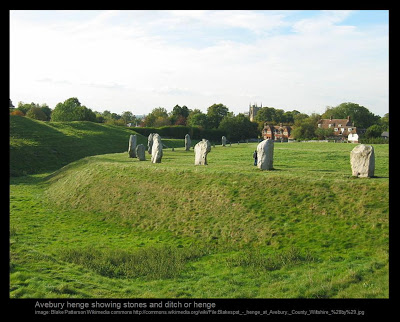
In the interview, Mr. Cruttenden brings up a startling finding reported by John Burke and co-autor Kaj Halberg in their book. They report that measurements of the stones at Avebury Henge in England detected low levels of magnetic polarity in each stone, and the surprising fact that the circle stones appear to have been arranged such that the south pole of one stone faces the north pole of the next, to create a circle of magnetic polarity as well as a physical circle of stone.

On page 130 of their work, Burke and Halberg report:
These big slabs of sandstone, dragged from nearby Marlborough Downs, contain black magnetite, which makes the stones magnetic. Retaining their original polarity from their formation deep underground, each stone acts like a weak but very large magnet. While the magnetism of the standing stones is not strong enough to noticeably deflect a compass needle, the more sensitive magnetometers show that the stones are indeed magnetic, as geological studies have confirmed. We recorded a particularly powerful jump in the magnetometers by holding the probe up to a fist-sized cluster of magnetite crystals, visible in one of the avenue sarsens.

If these stones were strictly for cermonial purposes, the magnetic orientation of the stones would not be of consequence. However, the south pole of each stone faces the next stone in line as you move toward the circle. This arrangement means that the north poles of the stones generally point south, which are opposing the geomagnetic field. Inside the main and the minor stone circles, the south poles of all stones point at the next stone in the circle, in a clockwise direction, with two exceptions. The stones at the two intact causeway entrances have their poles aligned with those of the avenue, rather than with the clockwise pattern of the circle, up to a ninety-degree difference from their companions in the ring. We measured all sixty-seven remaining stones, with an average of sixteen readings per stone. None had a detectable magnetic pole pointing in a direction that would contradict this pattern. 130-131.
Mr. Burke and Mr. Halberg note that the henges (circular ditches with accompanying circular mounds) found throughout western Europe and the British Isles would tend to disrupt the telluric current, but that these ditches almost always feature an intact causeway or bridge (or place where the ditch stops on either side before completing the circle) where the current would tend to be focused more strongly (just as water, flowing through a chokepoint or narrow place, will flow with more velocity, a principle which is incorporated in shower heads or kitchen faucets that produce many tiny jets using very small openings). You can see the very prominent ditch and embankment at Avebury, along with part of the circle of stones, in the image above.

The authors theorize that these constructions might have created beneficial stress upon seeds, inducing them to grow better and produce more food yield. In a 2008 interview between Mr. Cruttenden and Mr. Burke available at the official CPAK online website here, Mr. Burke notes that ancient construction with measurable electromagnetic effects are not confined to the Old World but exist all over North America as well, and points to an early record from a Jesuit missionary who said the Native American tribes in the area of Louisiana would still bring seeds to a certain mystical location in order to receive a sort of blessing upon the seeds prior to planting them.

Whether this is the correct explanation or not for these ancient monuments, it is certainly an interesting area for further research. It may be that there were other original purposes for the constructions, and that they also had beneficial agricultural side effects which were noted by either the original architects or by later peoples.

Whatever one concludes, the bigger point seems to be that if in fact the huge multi-ton stones of Avebury are situated such that their poles align with the circles themselves, this would constitute powerful evidence that the designers possessed far greater levels of technological advancement than conventional historians attribute to them. Images of other magnetometer and caesium gradiometer surveys at other megalithic stone circles and henges done by other researchers appear to confirm the findings of Mr. Burke and Mr. Halberg -- some of them can be found here.

Magnetic anomalies have been recorded at many ancient sites in North America as well. The numerous chambers found in New England often share similar construction techniques and solar orientations to passage mounds found in Ireland and other parts of Europe, a fact I discuss towards the end of the Mathisen Corollary book. This website by Dr. Bruce Cornet notes the location of several dozen such stone constructions in New York state, as well as diagrams of the magnetic anomalies near many of these sites.

The fact that sites in the New World appear to contain evidence of deliberate electromagnetic manipulation or orientation provides yet another clue suggesting ancient contact across the oceans, contrary to what is taught in schools from kindergarten to the university. For other posts discussing other clues that contradict "isolationist" doctrines, see here and here.

This evidence would certainly appear to be a fertile field for future research. While much of it is quite startling and open to many possible interpretations, and while some of the evidence and interpretations offered so far may require more examination, simply rejecting it out of hand is probably not the wisest course of action if we really want to learn more about the real ancient timeline of mankind. Perhaps it is best to close this brief examination by referring back to the quotation by Edgar Smith Craighill Handy, cited approvingly by Thor Heyerdahl in 1953: "There is such a variety of possibilities open in the matter of relationships and derivations that my own feeling is that there is only one sure way of being in the wrong, and that is by asserting dogmatically what is not true" (cited in American Indians in the Pacific 8).

The Binary Model of Precession


If you have visited the interview of Mathisen Corollary author David Warner Mathisen at Red Ice Radio, you may have noticed that the producers of Red Ice linked several other previous Red Ice interviews on related topics among the links below the description area on the page.

Among these is a fascinating interview with Walter Cruttenden of the Binary Research Institute, from April, 2010. While Red Ice makes hour one of all interviews available to everyone for a full year after they are posted, after that time a subscription to Red Ice is necessary in order to listen to them, and a subscription is always required in order to hear hour two. However, most Red Ice interview hour ones are available as free podcasts in the iTunes store, and the first hour of Walter Cruttenden's Red Ice interview can be found as a free download in the iTunes store -- simply go to the iTunes store and conduct a search for the phrase "Red Ice Cruttenden."

The interview is fascinating and thought-provoking on several levels, and is well worth a listen, even if you do not agree with every conclusion or assertion proposed. Among the striking concepts that are discussed is the theory that the precession of the equinoxes is caused by an elliptical orbit of the sun through space around another star or stellar object -- the "binary model" of precession. This motion is described in the above video segment, along with animation.

Note the discussion of the changing rate of orbit that the sun would take if such a theory were true (due to Kepler's laws of motion). We discussed this very concept of faster and slower orbit with reference to the earth's orbit around the sun in this previous post, in which we compared it to the motion of a surfer speeding up and slowing down as he goes down and then back up the face of a wave (and not just any surfer and any wave, but the great Shaun Tomson surfing a long right at J-Bay). According to proponents of the binary theory, astronomers have measured just such a speeding up of the rate of precessional motion that would be consistent with the sun's orbit around a distant stellar object.

In his interview, Mr. Cruttenden points out that electromagnetic waves, including light waves as well as other forms of electromagnetism emitted by stars such as our sun, have powerful effects on virtually every lifeform on earth. When our portion of the globe faces away from the sun, we generally drop into an unconscious state until we are facing the light again, and the same is true of the seasons that are caused by earth's orbit and obliquity, which have a tremendous impact on the life cycles of countless plants and animals. If this is true for earth's daily spin and annual orbit, he argues, it might also be true of the electromagnetic radiation emitted by this proposed companion object, causing civilizational advance when we grow closer and civilizational decline and a rise of barbarism and violence when we draw further away from our companion star.

While one may or may not accept the binary theory, Mr. Cruttenden in his interview and the narrator in the video segment above (Darth Vader) point out that many theories that were once ridiculed later gain widespread acceptance: popularity is no measure of the truth of a theory. This is another theme we have discussed previously on this blog several times as well with regard to the theory of plate tectonics and the hydroplate theory, for example. It is also discussed in the new introduction to the Mathisen Corollary posted here (and in the older introduction as well).

For all these reasons, the interview with Walter Cruttenden is well worth careful attention, as are the arguments put forth by the Binary Research Institute. Check it out for yourself!

Hawaiki and Hawaii


In the previous post, "Vindication for Thor Heyerdahl," we examined new evidence that appears to support some of Heyerdahl's theories about contact between Easter Island / Rapa Nui and the Americas.

In that post, we noted Heyerdahl's assertion that ancient voyagers who set out into the Pacific from the Americas would likely first encounter either Easter Island or Hawaii, depending on their point of departure and direction of travel. We also noted the fact that the Polynesian historical traditions themselves clearly relate -- "and quite independently on widely separated Polynesian islands -- that the first land discovered and settled by their ancestors in the ocean was an island, or rather a group of islands, referred to in most Polynesian dialects as Hawaiki, in others as Hawai'i" (Heyerdahl, American Indians in the Pacific, 40-41).

Today, despite the extensive evidence Heyerdahl mustered in support of his theory, the idea that Polynesia was originally occupied by a people coming from the east (the Americas) is almost universally rejected, and along with it the idea that Hawaiki could refer to Hawaii itself as the first ancestral homeland in the Pacific, where some remained to settle and from which others spread out across the Pacific to discover and settle new islands.

As mentioned in the post linked above, some modern historians have held that Hawaiki must refer to Java in Indonesia, and that the oral traditions which describe Hawaiki as being located east of other Polynesian lands (such as New Zealand) must be incorrect -- in other words, maintaining that the keepers of these traditions didn't know what they were talking about and that some of the most superb mariners the world has ever known didn't know their east from their west.

Others today argue that Hawaiki may have been Taiwan (a theory we shall look at shortly).

Thor Heyerdahl provides characteristically thorough evidence and analysis in support of his assertion that Hawaiki actually refers to Hawaii. First, he notes that while the oral traditions found on almost every other Polynesian island refer to a migration from Hawaiki, no such oral tradition exists on Hawaii itself. If Hawaiki were actually in Java or Taiwan, such an omission would be unusual, but if Hawaii is the Hawaiki referred to by other islanders, then we would not expect there to be such a legend on Hawaii itself.

Further, Heyerdahl points to texts which historians made in the early 1800s of Maori oral tradition regarding the route of their ancestors from Hawaiki to Aotearoa / New Zealand. He notes that according to Maori tradition, Kupe was the first to reach Aotearoa from Hawaiki, and he later returned to the islands of Hawaiki. Later, according to Maori history, we learn that a progenitor named Whatonga and a number of his firends went on a visit from an island called Ahu to the main island called Hawaiki, to take part in a canoe race (170).

During the race a strong offshore gale carried Whatonga and others out to sea, where they became lost in the fog and eventually ended up in Rangiatea (the Maori pronunciation of Raiatea, in the Society Islands near Tahiti), where they made preparations for their return to Hawaiki and eventually left to successfully return to Hawaiki. However, in the interim, Whatonga's grandfather had set out to search for him, first landing in the Samoan group of islands, then proceeding to Rarotonga, and then to the Chatham Islands and finally to New Zealand in his search.

When Whatonga arrived in New Zealand and heard that Toi had gone to find him and not returned, he set out himself in a new deep-sea canoe named Te Hawai, and after reaching Rarotonga and hearing of his grandfather's earlier visit there, continued to Aotearoa and finally caught up with Toi there. These accounts were "painfully memorized by every generation among the subsequent occupants" of Aotearoa (170). Analysis of the genealogies that were also carefully memorized and passed down indicates that Kupe's visit was probably around AD 950, and that of Toi and Whatonga around AD 1150.

Heyerdahl notes the very clear parallel between the names of the islands Ahu and Hawaiki and the islands of O'ahu and Hawai'i, as well as the fact that historians have recorded that the island of O'ahu was originally called Ahu (170).

Another remarkable tradition preserved by the Maori is the sailing directions from Hawaiki, and particularly the starting point. Tradition states that "the bows of the canoes must be directed straight south from Maui-taha and Maui-pae" (172). These two names denote twin islands within the Hawaiki group, and in fact there are two small islands to the west of Maui (seen in the image above -- Maui is the island just north and west of the Big Island or Hawaii itself, and to the west of it can be seen the islands of Lanai and Kahoolawe, which may correspond to Maui-taha and Maui-pae). Hawaiian tradition also tells us that voyages were to start from this location (172). Is it not remarkable that Maori tradition mentions the names of the islands Maui, Oahu, and Hawaii?

From there, the sailing directions of the Maori oral tradition tell us, the canoes must proceed due south, in order to reach Rarotonga (which was known as the "Road to Hawaiki" among the Maori), after which they were to bear southwest, placing the prow to the left of the setting sun (172). These directions are perfect for reaching New Zealand from Hawaii, but atrocious if one wishes to reach New Zealand from Java or Taiwan.

Heyerdahl also provides quite convincing evidence from the preserved genealogy lists of both the Maori and the Hawaiians, in which some names and generations match (the names of both the husband and the wife, and on more than one occasion) (172-172).

Recently, some historians have argued that Hawaiki must refer to Taiwan, and point to mitochondrial DNA evidence as conclusive proof. This article from the Economist in 2005 makes that case, noting that "In a study involving 640 people from nine Taiwanese tribes, Dr Trejaut and Dr Lin found three mutations shared by Taiwanese, Polynesians and Melanesians (who also speak Austronesian) which are not found in other Asians."

Of course, the presence of unique mitochondrial DNA shared by Taiwanese and Polynesians could indicate the origins of the Polynesians from the islands of Taiwan, but it could just as easily indicate a visit from the opposite direction. This is especially true since the people whose DNA was tested are from an ancestry of a different origin than the majority of Taiwan's inhabitants. The mitochondrial DNA studies are an important clue, but they should be included along with all the other evidence in the search for the truth, rather than being used to force the acceptance of a single theory.

Since the publication of Heyerdahl's book in 1953, successful voyages have been made from Hawaii to Tahiti and other destinations in the Pacific by the Polynesian Voyaging Society, using double-hulled canoes and other technology available during the era before European contact. This map of the first voyage of the Hokule'a in 1976 clearly shows Raiatea, where Maori oral history tells us that Whatonga first landed after he was blown off course and then lost in the fog during his race.

This issue illustrates the fact that even today, the analysis of evidence regarding even the fairly recent past can be disputed by reasonable observers. The issue is also important from many other perspectives. First, it is important to the Polynesians themselves. It is also important because, as we have seen in several previous posts, the mysterious origins of the people of Polynesia appear to hold numerous clues concerning mankind's very ancient past.

Caution: staring too long at the above image of Hawaii may induce an irresistible urge to go surfing.

DMT, Egypt, evolution, and other subjects


Here is an amazing episode of Magical Egypt featuring the work of John Anthony West and other researchers -- his pioneering and penetrating work can be found at his website here. The segments of the video can be found by following the links below, and it is well worth consideration as an introduction to a whole new layer of insight into the civilization of ancient Egypt.

one of six

two of six

three of six

four of six

five of six

six of six

The incisive analysis of Mr. West illustrates a truth that I have stressed before in previous posts: namely, that just because there are clear astronomical and mathematical truths encoded in ancient myths and texts, this does not take away the many other rich layers of meaning which are also present. In other words, seeing celestial codes in literature does not take away from the deep and powerful illumination of other aspects of the human condition in that literature. It only adds; it does not take away (see for example the discussion in this previous post and this previous post).

The documentary segment above neatly illustrates the way numerous other layers may be going on at the same time that celestial truths are being preserved. For example, the videos begin with an extensive and erudite explanation of the text of "The Book of What is in the Duat" found in the tomb of Tuthmoses III (reigned 1479 BC - 1425 BC) by John Anthony West. This is an extremely important text (also known as the Amduat) and it is well worthwhile to listen to Mr. West's explication of it. Its first complete known appearance is in the very tomb of Tuthmoses III shown in the video. Tuthmoses III was the great-great-great grandfather of Tutankhamun, or the grandfather of the grandfather of Tutankhamun's father Akhenaten.

At approximately 8:40 in the second of the above six videos, Mr. West describes "a familiar figure" which confronts the progress of the solar bark through the twelve hours of the Amduat. This figure, we are told, is the "great serpent, which is being chopped up by knives. This is the serpent Apep, or Apophis, which is a form of Set, the opposition." The point of bringing this up is to show that, while Set plays an incredibly important role in the astronomical knowledge hidden in the Egyptian myths (which surface again and again in mythology around the world), a role which is described in Hamlet's Mill and elaborated upon in greater detail in Jane Sellers' Death of Gods in Ancient Egypt and in the Mathisen Corollary, this celestial role does not mean that Set cannot also stand for several other principles which have less to do with astronomy and more to do with life, death, and the human condition. This is an important point to consider.

Along these lines, the transition of the discussion in the above videos to the work of dimethyltriptamine (DMT) researcher Dr. Rick Strassman follows an extremely interesting analysis of the Amduat text which begins at approximately 3:00 minutes into segment three of six above. There, the assertion is made that the geometry and negative spacing of one drawing of two human figures flanking two intertwined serpents topped by a solar disc suggests a human skull, with the sun disc approximating the location of the pineal gland (and the Uraeus headdress).

From there, the videos explore the rather controversial theory of Dr. Strassman, who believes that the powerful hallucinogenic compound DMT may be naturally produced in certain conditions in the human body, perhaps by the pineal gland, and that this substance is tied to the perception of mystical experiences as well as to visions of the afterlife and the well-known reports of near-death experiences by numerous individuals. Small amounts of naturally-occurring DMT have been found in human tissues, and the theory of some researchers is that certain types of meditation or certain levels of stress could trigger increased production of DMT and possibly the onset of powerful visions and otherworldly experiences.

A brand-new documentary discussing Dr. Strassman's theories, and the implications of DMT in general, based upon and named after Dr. Strassman's book The Spirit Molecule, is currently being released.

The implications of this theory, as well as the very interesting ties to ancient Egypt discussed in the remaining segments of the video above, are fascinating to consider, whether one accepts them or not. Another important theme of this blog and my book is the importance of considering alternative theories and examining all the available evidence for and against them, rather than rejecting them out of hand as is too often the case today. Thor Heyerdahl's approving reference to a quotation by Edgar Smith Craighill Handy is worth repeating in this context: "There is such a variety of possibilities open in the matter of relationships and derivations that my own feeling is that there is only one sure way of being in the wrong, and that is by asserting dogmatically what is not true" (cited in American Indians in the Pacific 8).

If a naturally-occurring chemical compound is in fact responsible for mystic visions and concepts of otherworldly beings and an afterlife, does this mean that critics can dismiss the reality of a soul and a spirit world, mystical revelation, and other related concepts as mere figments of a chemically-induced altered state of consciousness?

One strong argument against Darwinian evolution is the extensive evidence for a spiritual aspect to human existence. Spirits or souls cannot really be explained by Darwinian evolution at all, which is why the existence of such concepts is vehemently rejected by most Darwinian apologists. If any supernatural experiences can be attributed to naturally-occurring hallucinogenic compounds, perhaps produced by the pineal gland, then this would appear to be a powerful new argument in the evolutionists' arsenal.

However, there are several counters to this line of argument as well. First and most obvious among them is the possibility that naturally-occurring DMT is not responsible for visions at all (this hypothesis is still speculative and has not been proven). Another counter is the fact that some DMT users (and near-death experience survivors) appear to have experienced things that they would not be expected to know or that their brains could not be expected to have "dreamed up," whether under the influence of a chemical or not. There are also other evidences of spiritual aspects to the human experience which do not seem to rely upon altered states of reality among those who experience them (for instance, some of the physical feats performed by yogis, fakirs, or advanced martial artists). Finally, there is the entire discussion in the final videos of the series above in which doors and passwords for use in the afterlife are discussed, and the insightful comment of the narrator at the beginning of the discussion that such knowledge, in order to be useful, implies the transmission of data and knowledge from someone or something from the "other side."

Again, to discuss these things is not to imply agreement with or acceptance of everything that is discussed. However, it is a fascinating layer of analysis of a very ancient civilization, and an important line of clues into their "technologies" (technologies not only in the sense in which we commonly use the word, but also in the sense that martial arts and other forms of human achievement and science can be thought of as technology). It is important that researchers and analysts such as John Anthony West, Rick Strassman, and the others involved in the video and in ongoing investigations continue to probe in new and unconventional directions, because one never knows what will be discovered and when a new breakthrough might occur.

We should all be stimulated to apply our own gifts and areas of expertise in the same way to areas of research or analysis to which we are drawn, as the mystery of human existence and mankind's ancient past is too big for any one individual to decode in its entirety.

The hydroplate theory and the lunar surface


In previous posts, we have presented extensive evidence which supports Walt Brown's hydroplate theory, which argues that most of the geological features found on earth are best explained by the events surrounding a catastrophic global flood rather than by tectonics and other "uniformitarian" theories which argue that most geological features were formed by the same processes which are going on today, working over tremendous lengths of time.

Previous evidence which we examined included the shape of deep ocean trenches, the gravity readings found above those ocean trenches, many aspects of earthquakes, many aspects of the Grand Canyon, the existence of fossils and geological strata, submarine canyons, the locations of volcanic activity, the case of the frozen mammoths, the fossil evidence found in Antarctica and the Canadian Arctic Archipelago, the origin of petrified wood, and the apparent lack of impact from continental drift on megalithic monuments of great antiquity.

Going beyond evidence found on earth alone, Dr. Brown points out aspects of other bodies in the solar system which would also have been affected if the hydroplate theory is correct. He argues that the violence of the escaping water that caused the flood during the initial rupture event would have flung some water and rocks out of earth's orbit and into space. As the water burst out, not only would it have flung spray high into the atmosphere and even into space, but it would also have eroded the sides of the continental plates as it jetted out, filling the waters that covered the earth with tons of sediments and flinging a lot of it high into the atmosphere as well.

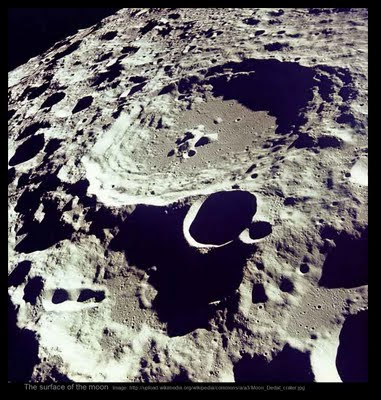
Additionally, the mass of the miles-high cliff faces created by this rupture would have caused huge blocks of earth and rock to collapse -- some of these giant chunks would have been forcefully jetted out into space. Most of those that were caught by earth's gravity would have burned up in the atmosphere, but the moon is not protected by an atmosphere and some of these huge pieces of earth would have struck it full force. You can see the scar left by this violent rupture and read more about the hydroplate theory in this previous post.

Dr. Brown argues that this theory provides a better explanation for the features on the surface of earth's moon than do other theories. For one thing, scientists know that the side of the moon that is always turned towards the earth has far more of the largest craters, which is very difficult to explain unless the source of the impacts was from the earth. Large space objects would be unlikely to circle around to the earth side of the moon and then turn around and dive onto the moon's surface instead of continuing on towards earth.

Even more mysterious, the dark patches on the moon's surface, which are visible from earth and are called the maria (or "seas") -- such as the Sea of Tranquility, or Mare Tranquillitatis -- are acknowledged by conventional scientists to have been formed by lava flows which have now cooled and hardened, and the vast majority of these are also on the earth-facing side of the moon as well. Why would almost all of them be on the earth-facing side? The few that are located on the far side are very small and are close to the few large craters on that side.

Dr. Brown explains on his site:
Some have proposed that the Moon’s crust must be thinner on the near side, so lava can squirt out more easily on the near side than on the far side. However, no seismic, gravity, or heat flow measurements support that hypothesis. The Moon’s density throughout is almost as uniform as that of a billiard ball, showing that little distinctive crust exists. Not only did large impacts form the giant basins, but much of their impact energy melted rock and generated lava flows. This is why the lava flows came after the craters formed. These impacts appear to have happened recently.
[. . .]
If the impacts that produced these volcanic features occurred slowly from any or all directions, all sides would be equally hit. Only if the impacts occurred rapidly from a specific direction would large impact features be concentrated on one side of the Moon. Of course, large impacts would kick up millions of smaller rocks that would themselves create impacts or go into orbit around the Moon and later create other impacts—even on Earth. Today, both sides of the Moon are saturated with smaller craters. Were the large lunar impactors launched from Earth?
Even conventional theorists admit that whatever caused the craters and the lava appears to have taken place in a relatively concentrated window of time in the past. In other words, uniformitarian processes (processes that are going on now, acting over very long periods of time) do not satisfactorily explain the features of the lunar surface. Some unusual event must have caused them.

We might point out as an aside that if this is true of the features on the moon, it appears to be even more true for the features of the earth. The events described in Dr. Brown's theory would provide a very good explanation for these puzzling aspects of the lunar surface.