The waxing crescent moon


Almost a week ago, on June 30, we discussed Taurus and the Hyades, and the fact that the sun was rising in the constellation of Taurus, just as in the Polynesian legend of Maui catching the Sunbird in a net and beating it with a jawbone.

At that time, we linked to this diagram of the morning sky, which clearly shows the Hyades looking like a boomerang or a jawbone, but which also shows the crescent moon just ahead of the rising sun, but becoming thinner and thinner as it rises later and later, losing ground to the sun and appearing lower and lower above the horizon prior to sunrise. On July 1, the moon would "lose the race" and be overtaken by the sun. On that day, it would rise at the same time as the sun, in what is known as a "new moon" (which cannot generally be seen, because it rises with the sun and moves through the sky very close to the sun, and the dark side of it is turned towards the earth as an observer from earth looks towards it and the sun).

Now, nearly a week later, the moon has continued to rise later and later and it has now been overtaken by the sun, and so the moon is following the sun throughout the day (look at the diagram and see that the sun will be "revealed" to an observer on earth first, then the moon, as the earth turns in the direction indicated). The moon is now a thin crescent in the sky trailing behind the sun, and at sunset can be seen in the sky above where the sun has set, a thin crescent but getting thicker and thicker as it trails the sun more and more, and as it appears higher and higher in the sky at sunset (because it is trailing the sun by a greater and greater angle each day).

The reason for the above activity is depicted in the rough sketch above, which shows the moon's orbit around the earth from the vantage point of an observer looking down on earth from high above the north pole. The plane of earth's orbit is the same as the plane of the page on which the sketch is drawn, and the plane of the moon's orbit (which is slightly different from the plane of earth's orbit around the sun) can be considered to be the same as the plane of the page as well, for simplicity. The position of the sun is towards the top of the diagram, and the direction of earth's rotation is indicated by arrows.

The direction of the moon's orbit around the earth is indicated by arrows as well, and it happens to orbit in the same direction that earth rotates. The point on the earth where sunrise is taking place is indicated by a label which reads "sunrise" -- it is the place where the rotation of the earth first begins to bring the observer to the point where he can see the sun begin to appear around the edge of the earth (of course, he would see the sky lighten considerably before the first edge of the sun began to come into view).

Similarly, the point on the earth where sunset is taking place is also indicated by a similar label, and the rotation of the earth is causing a similar phenomenon there, as it takes the observer to a point where the sun drops behind the edge of the earth "behind" the observer.

In each case, we can observe the moon in its orbit. Last week, in the days leading up to the new moon on July 1, the moon was at roughly the point on its orbit indicated by the first moon circle in the diagram above (the first circle meaning the first one on the right, since it is orbiting in a counter-clockwise direction, from right to left in the diagram above; the first circle we are discussing is the one labeled with the word "moon"). An observer on earth would see the moon before sunrise, and would only see a very thin sliver of the illuminated side of the moon -- the thin sliver on the sunward edge of the moon (the left edge). This was the "waning crescent" depicted in the diagram of the sunrise linked in the post on Taurus and the Hyades -- "waning" meaning that it was becoming thinner and thinner and growing less and less visible, on its way to disappearing completely in a new moon.

The new moon took place as the sun "passed up" the moon, and after the new moon the sun is ahead of the moon instead of being behind it (as it was in the diagram connected with Taurus and the Hyades). Now the sun leads the moon through the sky, and the moon is still in the sky after the sun goes down, as a thin crescent but one that is now lit on the right edge. The diagram above should make clear why it is the right edge of the moon that is now visible as a crescent, while in the waning moon it was the left edge. As the moon continues around earth, the side being lit by the sun shows more and more towards earth, so the crescent gets thicker and thicker -- it is a "waxing" crescent, which means it is growing larger and larger.

Eventually, the moon will get to the point of being opposite the earth from the sun -- at the bottom of the above diagram -- when it will be full because its illuminated side which is facing the sun will also be facing fully towards an observer upon the earth. It will of course be high in the sky at midnight then, and no longer close to either the sunrise or the sunset. Thus, we can conceptualize that the waxing crescent we see now will continue to wax thicker and thicker until it becomes a full moon, on July 15.

The great H.A. Rey, creator of the Curious George books and also the author of an outstanding book on the stars (discussed, among other places, in this previous post and this previous post), explained the moon's motion this way in The Stars: A New Way to See Them:
Like sun and stars, the moon rises east and sets west, as an effect of the earth's rotation from west to east. But the moon also revolves around the earth from west to east and this reduces the apparent effect of the earth's own rotation. The result is that the moon appears to wander across the sky perceptibly more slowly than sun and stars, and this makes its schedule rather erratic, at first glance. Every day, it rises about 50 minutes later, on the average, than the day before and sets accordingly later too. This daily retardation, as it is called, brings the moon out of step with the sun and then into step again over a period of a month or, more exactly, of 29 ½ days. 136.
To understand how the moon in the above diagram went from a waning crescent lit up on the left edge to a waxing crescent lit up on the right edge (all descriptions are assuming an observer in the northern hemisphere), imagine taking the diagram above in which the observer is above the north pole, and moving the observer downwards towards the plane of the ecliptic and on the other side of earth from the sun, so that he is now hovering a little above the plane of earth's orbit around the sun and looking at the earth towards the sun, as in the sketch below:


Again, we see the direction of earth's rotation is indicated by arrows, and the direction of the moon's orbit around earth is likewise indicated. The point of sunrise is indicated, at the edge towards which a stationary observer on earth will rotate until the sun begins to peek over the horizon, and the point of sunset is likewise indicated where the turning earth will leave the sun behind the observer as he rotates into night.

We can now see even more clearly why the moon was a thin crescent ahead of the sun in the days leading up to July 1 (when the moon was in the position indicated by the rightmost circle in the diagram above). It should be clear that the very right edge of the disc of the moon would be illuminated to an observer on earth.

After the moon passed through the position of new moon (the center moon in the above diagram, in which its illuminated face is pointed away from an observer on earth), the moon would now be seen following the sun during the day, with its right edge illuminated. At sunset, after the sun disappeared below the horizon, the moon would still be visible in the sky, a little above the disappearing sun, as a thin waxing crescent.

Each day, as the moon proceeds along its circle around the earth, it will be further behind the sun (and higher in the sky at sunset), and more of it will be illuminated, until it reaches the point of full moon (a previous post at a time close to full moon provides some other illustrations of the same principle we are examining here).

This discussion should help clarify the reason that the moon fills up from right to left (beginning with a thin crescent along the right edge and then filling up the right half until full). It then begins to darken from the right edge until only a crescent is left upon the left. You can perhaps remember this by thinking that the moon works opposite to modern writing -- it goes right to left instead of left to right (ancient writing, such as that of the Phoenicians and Hebrews, went right to left as well, as we have pointed out in this previous post).

Another mnemonic device, this one offered by H.A. Rey later in the same discussion cited above, is to think of the moon as going from having a lit edge like the curve on a capital "D" (which has its curve on the right side) to having a lit edge like the curve on a capital "C" (which has its curve on the left side). Here again, you can think of the moon as operating "backwards," in that it goes counter to alphabetical order, from D to C instead of going from C to D.

In any event, be sure to enjoy the crescent moon just after sunset. Now you should be able to conceptualize exactly what is taking place in the celestial mechanics that is causing the beautiful sight.

Malta: where's the drift? Part II


In his book Underworld: The Mysterious Origins of Mankind, Graham Hancock examines the evidence of underwater ruins that show strong signs of being man-made despite being submerged in the ocean.

In the book, he pays particular attention to the islands of Malta, which are home not only to megalithic temples but also to submerged ruins. He also discusses the theories of Dr. Anton Mifsud, an Italian researcher who lives in Malta and has spent a considerable amount of time studying its archaeology and history. Dr. Mifsud has published works suggesting that Malta may have been the site of the famous island kingdom of Atlantis related by Plato from a story allegedly preserved by the priests of Egypt.

Malta itself is composed of four islands, as shown in the NASA image above: the largest island, which is the island of Malta, another large island to the northwest called Gozo, which also contains megalithic ruins, the island of Comino in between Malta and Gozo, and a very small rocky islet called Filfla, which some have hypothesized to be the remaining tip of Atlantis.

In Underworld, Mr. Hancock relates:
Mifsud's proposal, as we've seen, is that the world-famous story of the destruction of Atlantis in a 'single dreadful day and night' that Plato recounted at the beginning of the fourth century BC is an echo, or folk memory, of massive destruction wrought on Malta in 2200 BC by a fault collapse along the submarine Pantalleria Rift. [. . .] He proposes the cataclysmic collapse of this hypothetical south-western extension 4200 years ago as the explanation for the mystery of the sudden and apparently overnight extinction of Malta's age-old temple-building culture at the same date. 443 - 444.
Elsewhere, Dr. Mifsud has pointed out that when the Knights Hospitaller came to Malta in the 1500s, they removed many of the megalithic stones for use in their own fortifications. According to the reports of some of the knights, one of the temples they found on their arrival was half submerged by the waters of the sea when they found it (this temple is no longer evident).

The idea that relatively recent tectonic activity caused a major uplift or "tilt" in Malta (as described by Mifsud and Hancock) and led to the extinction of the temple-building culture and the submergence of many ruins has some problems, however.

First, as readers of this blog will know, the tectonic theory itself has major problems. There is a host of evidence from around the world which cannot be satisfactorily explained by the tectonic theory -- for a list of some of this evidence, with links to previous posts discussing each of them, see this previous post.

A bigger problem with the use of tectonic activity to explain Malta's submerged ruins (tectonic activity which is ongoing and which continues to further tilt Malta right up to the present day, according to its proponents) is the fact that the ruins of Malta retain their celestial alignments, which visitors to the islands can still observe. We have written about this fact in a previous post, which illustrates the solar alignments in the temple of Mnajdra.

The megalithic temples on Malta are often called the oldest megalithic structures in the world. They certainly predate the 2200 BC suggested by Dr. Mifsud as the date of the cataclysmic upheaval and subsidence that supposedly ended the temple-building culture. If such a tectonic cataclysm took place after the temples were built, would we still expect their solar and astronomical alignments to survive?

This same dilemma pertains for most of the other ancient monuments which have celestial or geodetic alignments. It is powerful evidence against the tectonic theory itself, along with all the other geological evidence which undermines the tectonic theory.

However, the hydroplate theory of Dr. Walt Brown has no such difficulty with the megalithic evidence from Malta and elsewhere around the world. According to his theory, there was a cataclysmic global flood, during which the sliding of plates did occur -- fairly rapidly and with violent consequences when they ground to a halt, causing uplifts, tilting, and volcanic activity primarily along their forward edges. When they buckled and thickened, the floodwaters flowed off of the thickened continents into the newly-opened ocean basins, but the sea levels were lower for many centuries than they are today. However, these heavier continents slowly sank down into the mantle, raising the ocean floors at the same time and with them the ocean levels.

This theory would explain the submergence of ruins around the world, as well as the fact that tectonic activity has not altered the alignments of ancient monuments, which were all built after the violent collisions and buckling that took place at the end of the flood event. It would also explain the evidence of very ancient maps, alluded to by both Mr. Hancock and Dr. Mifsud, showing Malta as a single large island (in which Gozo, Comino and Malta itself are connected). These ancient maps could have been made before the slow rise of the oceans had been completed, by a very ancient lost civilization, as Mr. Hancock observes (445).

It appears that the hydroplate theory provides a new perspective on the mysteries of Malta, and one which deserves more examination. The Mathisen Corollary is the first book to apply this geological theory to the mysteries of mankind's ancient past.

Shaun Tomson: The Light Shines Ahead


Here is a link to a video of a very moving talk by Shaun Tomson, a superlative surfer and a very encouraging and giving human being, in which he shares a deeply personal part of his family's story with the world.

If you haven't listened to it yet, you should stop reading now and do so.

Yesterday's post discussed Mr. Tomson's film Bustin' Down the Door, and a few of the many layers of issues regarding the shared human experience which that film engages and enables its viewers to consider. The talk above, which Mr. Tomson gave on December 22, 2010, provides a much more intimate perspective on the words shown on the screen at the end of the movie, which were written by Mr. Tomson's son, Mathew.

It is an unforgettable talk.

At the end, he encourages each of his listeners to imagine what would happen if they would take just thirty minutes each week to sit inside a "sacred story circle" to share their story and their light with someone else. The reference is to a poignant memory he shares with us about a time he shared with his son inside just such a circle.

It is worth noting that there is very ancient precedent for the circle that his son created and shared with his dad, and which his dad then shared with the world.

We noted in this previous post the resemblance that many historians have pointed out between the activities of the ancient Celts and Druids (prolific builders of stone circles) and those of the ancient Hebrews.

The poet, historian and playwright Thomas Moore (1779 - 1852), considered the National Bard of Ireland, wrote a four-volume History of Ireland (published between 1835 and 1846), in which he discussed the ancient precedent of the sacred stone circle, as well as the connection between those of the ancient Hebrews and those of the ancient Druids, saying:
No less ancient and general, among the Celtic nations, was the circle of upright stones, with either an altar or tall pillar in the centre, and, like its prototype at Gilgal, serving sometimes as a temple of worship, sometimes as a place of national council or inauguration. That the custom of holding judicial meetings in this manner was very ancient appears from a group which we find represented upon the shield of Achilles, of a Council of Elders, seated round on a circle of polished stones. The rough, unhewn stone, however, used in their circular temples by the Druids, was the true, orthodox observance of the divine command delivered to Noah, "If thou wilt make me an altar of stone, thou shalt not make it of hewn stone" [. . .]. Volume 1, pages 37-38.
Thus the sacredness of such stone circles is very ancient indeed.

The "prototype at Gilgal" to which Thomas Moore refers above can be found in Joshua 4:20-22 (and note that the verses contain a strict command for the sharing of sacred stories between fathers and children).

Mr. Tomson is one of my personal heroes, not only for his surfing but also for his stature as a human being, in much the same way that he describes the great Duke Kahanamoku as his personal hero growing up. Mr. Tomson's surfing can be used to understand an important principle about the earth's orbit around the sun, through the video attached to this previous blog post. We should all be grateful for his willingness to share his story.

Summer movie watching: Bustin' Down the Door


Bustin' Down the Door ranks among the best surf movies ever made. It chronicles the journey of the surfers who changed the sport in the 1970s and created professional surfing.

The movie also details the backlash that took place from the local Hawaiians at the regrettable suggestion, published in an article in Surfer magazine, from one of the new generation, that "we seem to be able to push ourselves harder than the Hawaiians do. Our surfing, as a group, has improved outrageously; whereas theirs, as a group, has stagnated." This, and other episodes, led to an explosive situation which included escalating violence, which was finally defused by a traditional Hawaiian tribunal or ho'oponopono led by Hawaii's Aikau family.

The situation brings out some very important aspects of the "zero sum" fallacy, a mentality which extends far beyond surfing. Zero-sum thinking is often explained using the metaphor of a "fixed pie" view of the world: there is only so much wealth out there, and the more people there are competing for any given portion of it, the less there is for everyone else to squabble over.

Those who have a fixed-pie or zero-sum view of the world naturally see others as potential competitors for resources, and even support measures to reduce the addition of other people whom they view as making everyone's pie even smaller. There are plenty of examples of this erroneous view even at the highest levels of human government, including at the United Nations, which has a branch called the United Nations Population Fund (UNFPA) which promotes the idea of a "link between population and poverty" and supports goals of "lower fertility, smaller families, and slower population growth, thus reducing the burden on the environment."

This view is erroneous, because every single individual actually represents not only a potential consumer but also a potential producer -- every single human being can actually add to the size of the pie, and make the world better for others.

It is easy to see how a zero-sum mentality leads to resentment or active enmity between different peoples, tribes, nations, or groups, because the zero-sum view encourages people to see any wealth or achievement gained by someone else as taking away from the "fixed pie" available to everyone else. On the other hand, the opposite view that every individual and every culture is a contributor who can actually make the world a "bigger" place can lead to cooperation and progress.

In the surfing microcosm explored in the movie Bustin' Down the Door, it is clear that the achievements of the Hawaiians were essential to the achievements reached by newer surfers from other parts of the world, and that the contributions of surfers from other parts of the world in turn advanced the sport in new directions that could then benefit everyone else as well. This idea was actually present in Rabbit Bartholomew's notorious article of the same title, also published in Surfer magazine in 1977, in which he was generally respectful of the great Hawaiian surfers of his and the previous generation, but which was interpreted as being belligerent and disrespectful due to the photographs accompanying the article and those in other surf magazines, one of which featured him wearing an Everlast boxing robe. The text of the original article is reproduced here.

The reconciliation of the situation by the members of the Aikau family, who had the stature to bring about a peaceable solution to the conflict, can be seen as a triumph of the right of human beings to demand that their human dignity, worth and contribution to the human family receive their due respect, and a reversal of the escalating negative effects of zero-sum conflict between peoples or groups or tribes.

The movie even brings out some of the history of the annexation of Hawaii by the United States. In short, it touches on many levels of very deep issues, and thus intersects with the mysteries of mankind's ancient past, in that the Hawaiians may well be the proud descendents of the first Polynesians to venture into the mighty Pacific, and the residents of the traditional Polynesian homeland referred to as Hawaiki by legends found throughout the rest of Oceania.

It is also connected to the questions of mankind's ancient past because there is some evidence that the incredible achievements of ancient civilizations actually featured cooperation between very different families of man, and that those ancient civilizations collapsed into barbarism by the devolution of that cooperation into resentment and violence, as we have discussed here.

Bustin' Down the Door should definitely be featured on your list of movies to watch this summer (even if you've seen it a hundred times already)!

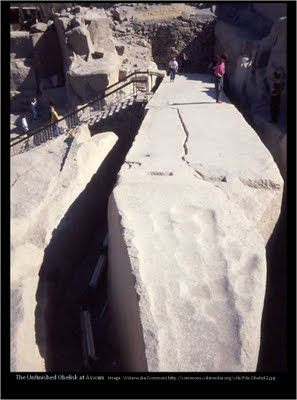
The Unfinished Obelisk at Aswan


Here is an image of the famous Unfinished Obelisk, lying in the Aswan Quarry in Egypt.

It is the largest ancient obelisk we known of in the world, and would have been about 137 feet when finished (by way of comparison, the Statue of Liberty from base to the top of the torch is 151 feet, not counting the brick pedestal).

The entire obelisk would have been a single piece, and would have weighed nearly 1,200 tons. This is almost unbelievably massive for a single block of stone intended to be moved around and stood upright.

The three enormous stones known as the "trilithon" in the base of the Temple of Jupiter at Baalbek are three of the largest stones ever incorporated into a building, and each of them weighs about 800 tons. Two stones near that temple but not incorporated into it for some reason (the so-called "Stone of the Pregnant Woman" and one other) weigh over 1,000 tons each, with the "other" stone being judged to be just over 1,200 tons as well. These are among the largest known single blocks ever quarried.

How anyone would move stones of such tremendous mass remains a mystery. Even moving such stones today with modern equipment would pose a complex engineering challenge. In their book, Keeper of Genesis: A Quest for the Hidden Legacy of Mankind, Robert Bauval and Graham Hancock provide some perspective on the difficulty of moving such stones. Speaking of the massive stones in the megalithic Valley Temple and Sphinx Temple at Giza*, which weigh around 200 tons each the authors write:
Such loads simply cannot be hoisted by the typical tower and hydraulic cranes that we are familiar with from building sites in our cities. These cranes, which are pieces of advanced technology, can generally 'pick' a maximum load of 20 tons at what is called 'minimum span' -- i.e. at the closest distance to the tower along the 'boom' or 'arm' of the crane. The longer the span the smaller the load and at 'maximum span' the limit is around 5 tons.

Loads exceeding 50 tons require special cranes. Furthermore, there are few cranes in the world today that would be capable of picking 200-ton blocks of quarried limestone. Such cranes would normally have to be of the 'bridge' or 'gantry' type, often seen in factories and at major industrial ports where they are used to move large pieces of equipment and machinery such as bulldozers, military tanks, or steel shipping containers. Built with structural steel members and powered with massive electric motors, the majority of these cranes have a load limit of under 100 tons. In short, a commission to put together a temple out of 200-ton blocks would be a most unusual and very taxing job, even for modern heavy-load and crane specialists. 28.
Modern academia is generally united around the consensus that the Unfinished Obelisk was discarded when a crack was found (or developed) in the obelisk. In a recent interview on Red Ice Radio from June 12 of this year, Christopher Dunn, author of the Giza Power Plant and Lost Technologies of Ancient Egypt, observes that this explanation poses some logical problems. Beginning at about the 47:50 minute mark in the second hour of the interview, he notes that at least some of the worked stone could certainly have been salvaged, either for a smaller obelisk or for other construction purposes.

He notes that the builders had already dug channels eleven feet deep all the way around the stone, and created edges and faces, all of which represented an enormous cost of labor that could have been at least partly recuperated. Dropping all of that on account of a single crack seems a laughable theory. He suggests that the abandonment of the entire obelisk suggests something more ominous, although exactly what happened to cause its abandonment is still open to investigation.
Christopher Dunn: Along with the Unfinished Obelisk, and then at Abu Rawash near Giza where you have an unfinished pyramid, and you have unfinished blocks of granite that are stored near this unfinished pyramid at Abu Rawash, it seems to me that work was proceeding, but then it came to a sudden halt, and the work was abandoned, but not because --
Interviewer Henrik Palmgren: the shift was over?
Christopher Dunn: Yes. Something else happened. Exactly. But as far as that obelisk goes, the conventional theory of the obelisk being crafted by workers in the trenches beating the rock with dolorite pounders -- everybody I know, engineers particularly, who travel to Egypt and go to the Unfinished Obelisk, they don't consider that theory for very long.
The Unfinished Obelisk strongly resembles another famous unfinished work, the massive unfinished moai in the Raro Ranaku quarry on Easter Island (Rapa Nui). An image of that moai taken around 1921 can be seen on the web here.

Like the Unfinished Obelisk at Aswan, this moai would have been the largest we know of on the island. Also like the Unfinished Obelisk, its abandonment suggests an interruption, possibly of a violent nature. In the case of the moai of Easter Island, hand tools were found near the site (as they were at Aswan in fact), and there are many other moai that were apparently abandoned prior to their final intended destination.

We have previously discussed the evidence that the moai-builders were slaughtered in a violent massacre by invaders from another island, possibly in conjunction with a different tribe or class of people who were already on the island with them. Is it possible that such a violent struggle between different groups took place in Egypt's ancient past as well?

If so, it is yet another clue that one of the most dangerous threats to civilization and human achievement is the instigation of grievances between groups, tribes, or classes -- the attitude that people of another tribe or type have fewer rights, or even that they do not have the right to live at all. There are those who can be seen stoking such attitudes even today, promoting the grievances suffered by one group at the hands of another group, and fostering resentment and hatred over these grievances.

As we approach the celebration of the Declaration of Independence in the United States, when in 1776 the signers pledged their sacred honor and their lives to defend the idea the all men are created equal -- as individuals -- and that they are endowed by their Creator with certain inalienable rights -- not rights that are bestowed by a government, or by virtue of membership in one privileged class or tribe or group versus another group or tribe -- we should consider these things, and consider the possibility that the opposite view, which can still be seen gnawing at the foundation of civilization today, may have been responsible for the overthrow of advanced civilizations in the past.


* In this post on his Message Board portion of his website, Graham Hancock notes that the blocks in the Valley Temple approach 100 tons but do not exceed 100 tons. He notes, however, that blocks in the Mortuary Temple attributed to Menkaure at Giza do reach 200 tons (and perhaps 220 tons).

Taurus and the Hyades


The Hyades and the Pleiades are visible in the eastern sky before dawn as the sun is rising in Taurus.

To see them, you will need to get to a place with a good view of the eastern horizon (no hills in the way) by about 4:30 am, but if you are able to do so, the view is well worth it. The sun is currently rising at 5:22 am for an observer near 35o north latitude, and the sky brightens enough to really begin to drown out the stars by about 4:55 to 5:00 am.

The chart above shows the constellation Taurus, first with the decorative or allegorical drawing common in previous centuries (this one is from a set of cards called Urania's Mirror from 1825, engraved by Sidney Hall), and then with the new graphic lines devised by H.A. Rey (shown here in red).

In the pre-dawn sky above the horizon, the easiest parts of the constellation to make out are the bright red star Aldebaran and the beautiful Pleiades above it. The Hyades are more difficult to make out, but you can see how they make the shape of a boomerang in this diagram from Sky & Telescope which depicts the celestial objects you can see looking east before the sunrise right now. The full "play-by-play" description from Sky & Telescope of the moon and planets in the east before sunrise and again in the west after sunset can be found here.

We have already discussed some of the mythology surrounding the Pleiades, which often take the form of a net in Greek mythology and other mythology around the world. The authors of Hamlet's Mill point out that the Hyades also feature prominently in many important myths, which they believed encoded ancient astronomical knowledge, some of it very sophisticated.

The boomerang-shape of the Hyades, so apparent in the Sky & Telescope diagram referenced above, gave rise to legends in which the Hyades became a weapon. In some cultures they were actually a boomerang, but more commonly they were encoded in myth as a jawbone, which of course also resembles their shape. In the Mathisen Corollary book, there is discussion about the important resemblance of these stars to the implement known as an adze as well.

Hamlet's Mill authors Giorgio de Santillana and Hertha von Dechend write about this jawbone:
For that jaw is in heaven. It was the name given by the Babylonians to the Hyades, which were placed in Taurus as the "Jaw of the Bull." If we remember the classic tag "the rainy Hyades" it is because Hyades meant "watery." In the Babylonian creation epic, which antedates Samson, Marduk uses the Hyades as a boomeranglike weapon to destroy the brood of heavenly monsters. The whole story takes place among the gods. It is known, too, that Indra's powerful weapon, Vajra, the Thunderbolt made of the bones of horse-headed Dadhyank, was not of this earth (see appendix #19).

The story is so universal that it must be seen as spanning the globe. In South America, where bulls were still unknown, the Arawaks, the Tupi, the Quechua of Ecuador spoke of the "jaw of the tapir," which was connected with the great god, Hunrakan, the hurricane, who certainly knows how to slay his thousands. In our sky, the name of the celestial Samson is Orion, the mighty hunter, alias Nimrod. He remains such even in China as "War Lord Tsan," the huntmaster of the autumn hunt, but the Hyades are changed there into a net for catching birds. In Cambodia, Orion himself became a trap for tigers; in Borneo, tigers not being available, pigs have to substitute; and in Polynesia, deprived of every kind of big game, Orion is found in the shape of a huge snare for birds. It is this snare that Maui, creator-hero and trickster, used to catch the Sunbird; but having captured it, he proceeded to beat it up, and with what? -- the jawbone of Muri Ranga Whenua, his own respected grandmother. 166.
If Maui caught the Sunbird in the net of the Hyades, and then beat it up with a jawbone, this almost certainly refers to the rising of the sun in the constellation Taurus, which is currently taking place. Be sure to get up early and check it out.


How do you explain coral atolls?


Coral atolls consist of submerged volcanic mountains, often at great depths below the surface, upon which huge formations of coral have grown.

Scientists and engineers have drilled deep into several atolls and have been able to determine the size of the coral cap and the depth of the top of the volcanic seamount underneath the coral of the atoll. On Funafuti Atoll in Tuvalu, drilling determined that the depth of the volcanic rock was nearly a thousand feet below the surface (see for instance Geology and Hydrogeology of Carbonate Islands, page 582). On Bikini Atoll, the coral cap goes down over 3,200 feet. Drilling has found that the mountain beneath Eniwetok Atoll is over 4,600 feet below the surface in some places.

Reef-building corals cannot survive and build reefs at depths below about 160 feet at the most, because they require sunlight for photosynthesis. Therefore, the great depths of some of the volcanic mountains supporting huge coral atolls poses something of a geological mystery. How could a mountain whose top is over 3,200 feet below the surface support the Bikini Atoll? How could a mountain whose top is over 4,600 feet below the surface support the Eniwetok Atoll? Even the atolls in Tuvalu, whose tops are just under a thousand feet below the surface pose a problem, since corals cannot begin their construction at anything near those depths. A related question concerns the existence of guyots or tablemounts, which are huge undersea volcanoes with flat, truncated tops, possibly sheared off by violent wave action, but often located many thousands of feet below the surface.

As it happens, Charles Darwin was aware of this mystery and proposed an explanation, which (according to this educational webpage from the University of Arizona) is still largely accepted today. He put the problem like this in the Structure and Distribution of Coral Reefs (1842), which can be read online in its entirety here:
What cause, then, has given to atolls and barrier-reefs their characteristic forms? Let us see whether an important deduction will not follow from the consideration of these two circumstances,—first, the reef-building corals flourishing only at limited depths,—and secondly, the vastness of the areas interspersed with coral-reefs and coral-islets, none of which rise to a greater height above the level of the sea, than that attained by matter thrown up by the waves and winds. I do not make this latter statement vaguely; I have carefully sought for descriptions of every island in the intertropical seas; and my task has been in some degree abridged by a map of the Pacific, corrected in 1834 by M.M. D'Urville and Lottin, in which the low islands are distinguished from the high ones (even from those much less than a hundred feet in height) by being written without a capital letter: I have detected a few errors in this map, respecting the heights of some of the islands, which will be noticed in the Appendix, where I treat of coral-formations in geographical order. 90.
Darwin's proposed explanation was simple: the existence of coral atolls is "quite inexplicable, excepting on the theory, that the bases on which the reefs first became attached, slowly and successively sank beneath the level of the sea, whilst the corals continued to grow upwards" (98).

Of course, Darwin was writing before the tectonic theory had even been suggested, and his explanation as to what could cause the mountains that formed the bases for these reefs to sink or subside into the depths below is pretty vague. He basically summed up the proposed cause of the subsidence as "subterranean disturbances beneath them" (98).

Unfortunately, in the ensuing period of over a century and a half, the explanation has not gotten much better. This article from the California Academy of Sciences declares that lower sea levels due to ice ages, followed by sea level rise after the end of an ice age, contributed to the ability of coral to grow to such heights (see the section entitled "Formation of Coral Reefs"). However, as we have discussed in previous posts, no ice age theory can account for 4,600 feet of sea level rise from ice melt alone. Further, if the ice had melted too rapidly and the ocean level had risen faster than the coral could grow upward, Eniwetok and other atolls could never have formed, because the sea-level rise would have "outrun them."

Other explanations are equally vague. The formation of Midway Island, a coral atoll located northwest of the Hawaiian Islands, is often attributed to subsidence due to the weight of the island and the coral, but clearly the Hawaiian Islands would have even more size and weight and should have sunk as well (some theories argue that they will, if we just give them enough millions of years, which function as a kind of magic wand for many theories that are short on details).

This webpage from the US National Oceanographic and Atmospheric Administration (NOAA) shows a helpful graphic of a coral reef growing upwards and a volcanic island sinking downwards, but the explanation of how this takes place is fairly unhelpful: "As the reef expands, the interior island usually begins to subside and the fringing reef turns into a barrier reef." Why does it "usually begin to subside"? This sentence makes it sound as though the reef expanding has something to do with it.

In their description of the significance of Midway Island, the US Fish and Wildlife Service was forced to concede: "Midway is an example of atoll formation, a poorly understood geological process that can contribute to our understanding of the relationship between climate, reef development, and carbon sequestration" (3-4).

However, it is possible that in this case, Darwin was correct about the idea that coral reefs of such great heights grew atop volcanic mountains that once were near or above the surface, and then slowly subsided. While the tectonic theory has trouble explaining why they would subside, the hydroplate theory actually provides a very robust explanation.

Central to the hydroplate theory is the formation of the Mid-Oceanic Ridge, where the basement floor sprang upwards in response to the removal of tons of material by the jetting eruption of the waters that initiated the global flood. This upward movement would not have created a huge air pocket in the middle of the earth, but rather would have pulled or sucked the earth upwards on the opposite side from the bulge -- which is exactly what happened to create the deep basins of the Pacific and Indian Oceans.

This downward motion would explain the characteristic "arc-and-cusp" patterns of many deep ocean trenches in the Pacific, as well as the gravity anomalies beneath these deep trenches, which have far less gravity than the tectonic theory would predict. The violent downward buckling of the Pacific and Indian oceans would have also created massive friction and melting of rock deep under the surface, creating vast reservoirs of magma, much of which either seeped upwards and formed volcanoes and volcanic mountains and islands (note that the "Ring of Fire" marks the edges of the part of the earth that was sucked inwards according to this explanation), or else it would have sunk deeper into the earth to contribute to the liquid outer core beneath the mantle, according to Dr. Brown's hydroplate theory.

As we have explained in previous posts, the sea levels would have been much lower after the events surrounding the flood, but would have slowly risen in the centuries thereafter, as the continents sank downwards. At the same time, the Pacific floor and many of the volcanic formations on it would have also experienced sinking, due to the entire mantle sinking into the liquid of the magma that was created by the intense friction of the event just described.

Dr. Brown explains this process in relation to the formation of seamounts and atolls (which are found almost entirely in the Pacific directly on the other side of the globe from the Mid-Atlantic Ridge, right where his theory says they should be, as well as to a lesser extent in the Indian Ocean):
All the fracturing and shifting deep within the earth produced frictional heating, gravitational settling, and huge amounts of heat and magma. Most of that magma now constitutes the earth’s outer core. [. . .] For years after the flood, much magma escaped upward along faults, especially in the Pacific, which had the fastest-sinking and most fractured portion of the crust. Volcanic cones rapidly rose, many reaching the ocean’s surface, where large waves leveled the volcanic peaks. Over the next few years, the mantle below the Pacific plate sank even further into the growing liquid outer core, because the Pacific plate was loaded with thick, dense magma. That sinking pulled tablemounts down 3,000–6,000 feet below sea level. The tablemount and trench region is several thousand feet lower than the average depth of the Pacific. [. . .] Clustered tablemounts sometimes differ in elevation and depth by 1,000–2,000 feet, so they apparently formed at different times while local ocean depths were changing rapidly. This probably happened during the years after the compression event as the mantle below the Pacific plate sank into the growing liquid outer core. When new cracks permitted magma to escaped upward, seamounts grew from different depths. Therefore, the first tablemounts that formed were usually shorter than tablemounts that formed after the plate had been pulled deeper. Earlier tablemounts were then pulled down farther than those that formed later. Consequently, short tablemounts can be far below sea level, while nearby, taller tablemounts can have their tops at shallower depths. From the online edition; see the full explanation from which the quoted section above was cited here.
Dr. Brown provides much more discussion which supports this explanation of the formation of tablemounts. While Darwin appears to have deduced the correct explanation as well, he could not provide a solid geological explanation for the mechanism that would have caused the subsidence of the areas of the Pacific containing tablemounts and atolls. The hydroplate theory does.

This is yet more evidence that the hydroplate theory should be carefully considered as a possible explanation for the many features we see in the world around us, features that are difficult or impossible to explain with the reigning tectonic theory (numerous others are listed here). The ability of the hydroplate theory to explain such widely varied geological mysteries is truly impressive. As one might expect, if the hydroplate theory is indeed correct, it would also help shed light on numerous mysteries of mankind's ancient past as well, which is the subject of the Mathisen Corollary. The case of the coral atolls should be seen as a very strong argument in its favor.