Dangerous liaisons: Jupiter, Venus, and Mercury


Above is this week's edition of an excellent feature from Sky & Telescope and PBS called SkyWeek, featuring Sky & Telescope Associate Editor Tony Flanders and excellent graphics and diagrams pointing the way to notable celestial events currently occurring in the sky.

This week's video focuses on the dramatic line of planets clearly visible in the evening sky just after sunset. The brightest of these is Venus, and not far behind Venus as it descends towards the west is Jupiter, also extremely bright but not so bright nor so large as Venus.

Jupiter and Venus are currently closing in on a spectacular conjunction, which will take place halfway through March of this year. This article from EarthSky explains why this particular conjunction of Jupiter and Venus will be particularly viewer-friendly: both planets remain visible after sunset much longer than they will during upcoming conjunctions in future years, when they will be close again but will be very low to the horizon in the west and set soon after the sun does.

The conditions which make the current dance of Venus and Jupiter so special are caused by the fact that Venus is approaching greatest evening elongation (or apparent distance from the sun as the evening star -- see this previous post for a diagram which explains the behavior of Venus as evening and morning star). Also, the ecliptic angle is currently very steep, as explained in the video above as well as in the EarthSky article.

The video also shows that Mercury will be visible just above the western horizon along the ecliptic path as the pencil-thin sliver of the new waxing crescent becomes visible after sunset on Wednesday. New moon occurs on Tuesday, February 21 as the sun "catches" the moon and then "passes" it up -- the young waxing crescent will then trail the sun by a greater and greater distance each day. It is most visible just after the sun goes down in the west, trailing by a short distance when it is barely a sliver, and by a larger and larger gap as its crescent grows. To see a discussion of the cause of the new moon and the waxing crescents visit this previous post.

Far behind the trio of Jupiter, Venus, and Mercury, you can find Mars rising in the east in the majestic constellation of Leo the Lion. Mars is currently in retrograde -- you can read some discussion of this phenomenon here and here, and see some diagrams that should help you locate it if you are unfamiliar with the location of this constellation here.

Numerous previous posts have discussed the very important work of Giorgio de Santillana and Hertha von Dechend in Hamlet's Mill, particularly their argument that the ancient myths (in addition to powerfully illuminating the human condition in their portrayal of the various personalities, weaknesses, and intrigues of the gods) also function as vessels for the preservation and transmission of detailed astronomical knowledge. See for example previous posts such as "Aristotle's 'ancient treasure'" as well as "Don't miss Saturn this month" (from May of 2011).

Based on this theory, we might expect conjunctions of Jupiter and Venus as well as approaches of Venus and Mercury to be enshrined in myth in some way (probably as a story about a sexual liaison), and that is indeed exactly what we do find (to see a previous post explaining how the famous myths regarding Ares and Aphrodite are almost certainly transmitters of astronomical events concerning Mars and Venus, see "Mars, Venus and the Pleiades").

Zeus is said to have pursued Aphrodite, who resisted his advances (Jupiter can be said to be pursuing Venus right now). He apparently is recorded as giving up the chase and not actually consummating the union, but spilling his seed in a furrow in lust over the voluptuous goddess. One look at the excellent EarthSky image of the upcoming March 2012 conjunction of Jupiter and Venus can give a hint as to what this myth is trying to convey:


Similarly, there are stories in which Hermes seduces Aphrodite. Note that he does not pursue her the way Zeus is described as doing: this is descriptive of the motion of the planets as well. Mercury is closer to the sun in our solar system, and hence is more closely tethered to the sun in our sky, remaining closer to the horizon after sunset than Venus can. Thus, Venus will actually be more accurately described as moving closer to Mercury (in other words, being "seduced by Hermes") than as being chased by him (the way Venus is currently being chased by Jupiter, which is outside of earth's orbit and thus can arc across the entire sky rather than staying near the rising or the setting sun the way that the interior planets Venus and Mercury must do).

The product of the union of Hermes and Aphrodite was a son named Hermaphroditos, according to some legends. His name is a combination of the names of his parents. As is evident by the continuing use of his name to this day to describe a person of dual sexual characteristics, ancient myths describe Hermaphroditos as possessing the characteristics of both male and female, either from birth or -- more commonly -- as the result of union with a nymph at a pool. After that incident, any man who bathed in the pool would also emerge half-woman.

The fact that we find stories about liaisons between Jupiter and Venus and between Mercury and Venus in the ancient myths, described in a manner which appears to be consistent with the actual behavior of the planets, lends powerful support to the argument that the myths were more than amazing literary achievements -- they preserved sophisticated scientific achievements as well.

For more on this subject (particularly if you still don't accept this theory), visit "If the ancients really knew so much, why didn't they just come right out and say it?"

Birthday of J.C. Willis (1868 - 1958)


Earlier this month, in a post entitled "Across the (Electric) Universe," we encountered the work of one of the modern era's foremost botanists, John Christopher Willis, who was born this day (February 20) in 1868.

The Biographical Memoirs of the Fellows of the Royal Society for Dr. Willis tell us that:
John Christopher Willis was born at Birkenhead on 20 February 1868. He studied at University College, Liverpool, and at Cambridge and for a time was an assistant in the Botany Department at Glasgow. In 1896, he was appointed director of the Royal Botanic Garden, Peradeniya, Ceylon, and held the post for 15 years. From 1912 to 1915 he was director of the Botanic Garden at Rio de Janeiro and after his retirement he worked at Cambridge and later went to live at Les Terrages, Avenue des Alpes, Montreux, Switzerland, where he died on 21 March 1958. He married Minnie, daughter of T. Baldwin, in 1897, and she died in 1931. There were three daughters of the marriage. He was an M.A. and Sc. D. (Cantab.), and was given an honorary S.D. by Harvard. He was elected a Fellow of the Linnean Society in 1897 and a Fellow of the Royal Society in 1919. The Annals of the Royal Botanic Gardens, Peradiya, was a periodical founded by him, volume 1 part 1 appearing on 27 June 1901.
Based on his extensive study of plant speciation and distribution (beginning with a deep study of the varieties of of the Podostemaceae family), J.C. Willis reached the firm conclusion that the accepted mechanism of Darwinian natural selection could not possibly account for the evidence found throughout the plant world. He allowed that natural selection could and did play a subsidiary role at times, but that it could not explain the origin of species.


Dr. Willis argued that the Darwinian explanation of a series of small and gradual changes was fatally flawed, and proposed in its place a process of major mutations bringing forth entirely different (widely divergent) genera that then branched out into different species.

The addition of evidence from botany highlights the weaknesses in the Darwinian theory. Even today, most defenses of Darwinian evolution tend to focus on arguments supported by the natural selection of animals rather than plants. Plants pose some difficult problems for the natural selection theory, and Dr. Willis argues that one of these was considered the strongest argument against his theory by Darwin himself:
On the face of it, this suggested mechanism for the carrying on of evolution, to which Darwin gave the name of Natural Selection ("or the preservation of favoured races in the struggle for life") seemed eminently reasonable, and one that could do the work required. But the struggle was necessarily of each individual of a species for itself alone, and if one individual showed a favourable variation while its neighbours did not, the variation would soon tend to be lost by crossing. This was shown by Fleeming Jenkin in a criticism which Darwin considered as the best that was ever made of his work. [. . .] When Darwin gave way, as he was forced to do, to this criticism from Fleeming Jenkin, the freedom of the natural selection theory was really lost. Course of Evolution, page 5 -- all pagination references are to the original pagination in the 1940 text, seen in the online version by the page-numbers at the top of each page.
In that text, Dr. Willis systematically illustrates examples from the world of botany that cast serious doubt upon the proposed Darwinian mechanism for the origin of the species.

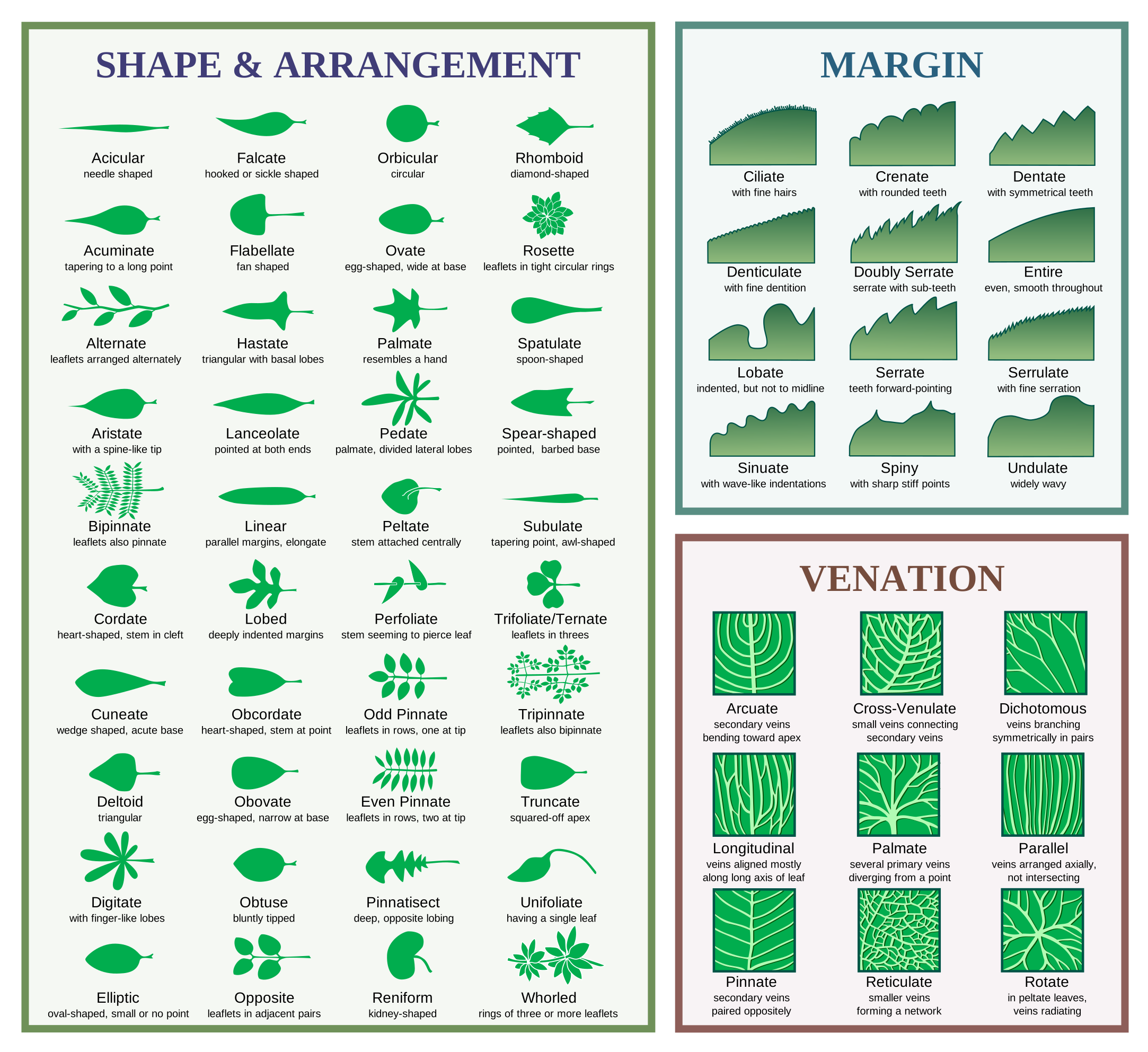
For example, he points out that plants and trees typically display leaf patterns which are either alternate or opposite, and that they are always either perfectly opposite or perfectly alternate, with no intermediaries. (Below see detail from a diagram in Wikimedia commons which illustrates the distinction between leaves that are alternate and leaves that are opposite -- opposite leaves are here described as "pinnate," from a Latin word meaning "feathers").


Dr. Willis writes:
Gradual change, picking out advantageous variation, would be very unlikely indeed always to produce the same structural character, such, for example, as is shown by a berry or a drupe, or by opposite leaves. Why should berries be most often found in the near (systematic) neighbourhood of capsules, drupes in that of achenes or nuts? Why should selection pick out leaves that were exactly opposite, ovules with the raphe exactly dorsal or ventral, or why such clearly marked and exactly formed fruits as capsules, berries, etc.? Selection would obviously act with decreasing force as the leaves came nearer and nearer to being opposite (or alternate for then they show a definite phyllotaxy or arrangement), or the raphe to being dorsal or ventral, etc. In actual fact, between many of these characters, intermediary stages are not possible. One could only take the one or the other side of a very divergent variation, such as alternate or opposite leaves, dorsal or ventral raphe, etc. 45.
This is a devastating critique, and one that is uniquely evident in botany (not as easily made using the arguments from the animal kingdom that are popularly put forward to support the Darwinian or neo-Darwinian evolutionary theory based on gradual mutation plus natural selection).

Related to this argument is the lack of "intermediates" found either in existing species today or in the fossil record. In describing his rejection of the theory of "progress by small, gradual and progressive adaptation," Dr. Willis points out: "But fossil evidence gives but little support to this conception. Real intermediates are rare; [. . .]" (43). Later in the same work, he reiterates: "Lastly, there should be mentioned the all but complete absence of transition stages in the fossils, a fact which violently disagrees with the supposition that evolution was gradual and continuous" (73). He goes into even more detail on this point on page 12:
One does not find to any serious extent in the fossil record, species which represent real intermediates between existing or fossil species. One finds rather examples of species that have some of the characters of the one, some of another. But one does not find species (as from the constant occurrence of the few characters side by side in existing species one might expect to do) that show intermediate characters between alternate and opposite leaves, between palmate and pinnate leaves, between erect and climbing stems, between racemose and cymose infloresences, between flowers with and without a cyclic perianth, between isomerous and heteromerous flowers, between imbricate, valvalte, and convolute aestivation, between flowers with the odd sepal posterior and with it anterior, between stamens in one and in more whorls, between anthers opened by splitting or by teeth, valves, or pores, between 3-locular and 4-locular ovary, between ventral and dorsal raphe, between loculicidal and septicidal fruits, and so on through all the important structural characters. 12.
Later, on pages 79 through 80, he gives another long list of variations within different plant families (such as "seed without wings; seed with wings" or "leaves usually 5-nerved; leaves usually 3-nerved") and then concludes:
Both in the monotype and the ditype families it will be seen at once that the characters that distinguish the species in the one and the genera in the other, are of the "family" type rather than of the specific or generic type found in large families. And most often they allow of no intermediaries. 80.
Along this same line of argument, Dr. Willis notes that, while the natural selection theory generally maintains that mutations that provide some kind of survival advantage tend to survive, the numerous attempts to explain how plant differences (such as three petals on a flower versus four petals on a flower) could provide a survival advantage often fall flat or are completely strained. He says, "Morphologists have long maintained that structural characters have nothing to do, directly, with the life or functions of the plant, and it would appear that they are right in this contention, which violently contradicts the supposition of selection as a chief cause in evolution. The evolution that has produced more than 12,000 genera and 180,000 species has not been, primarily, an adaptational evolution, as the writer tried to show twenty-five years ago in the case of the Podostemaceae" (54).

In addition to these major difficulties, Dr. Willis offers other examples from the plant world which are very difficult to explain using the mechanism of natural selection. One of these is the fact that, while climate may change gradually, there will usually be periods of unusual weather within those longer gradual changes, and these would often kill off any gradual changes that had begun to take place within plant species:
For example, the climate (not the weather) must change gradually in the direction of warmer or cooler, wetter or drier. But these changes are well known to be so slow that they can only be detected in averages of a century or more -- a period longer than the life of most plants, except many trees -- whilst weather is continually changeable. Suppose a plant to have begun to vary in the direction of suitability to increased drought, and then there comes, as so commonly happens, a cycle of wetter years; what is going to happen then? 55.
Similarly, he argues that major new "adaptations" such as climbing plant species can hardly be explained by a series of gradual mutations:
A very great difficulty in the path of acceptance of natural selection as a cause for gradual adaptation is the fact that so many of what look like real morphological adaptations require so much correlation. Climbing plants come into this group, though they are obviously well suited to climbing. The habit cannot be difficult to acquire, for there are so many cases of the closest relatives, one climbing, one erect. A climber also needs a support, which is usually an erect plant, so that erect plants must have been the earlier. But one cannot imagine natural selection picking out the beginnings of weak and flexible stems, whether by gradual change or by small mutations. And when at last they were formed, as obviously there would be no value in developing tendrils or other means of climbing until the stems were weak, they would collapse into the darker lower levels of vegetation and would have to undergo physiological adaptation to living in greater darkness. Then they would have to learn to form climbing organs, and finally, learning to climb, they would once more have to adapt themselves to life in greater light. And what use would the beginnings of tendrils or other climbing organs be? And why, after having learnt to live in greater darkness, should the plant want to grow up into the light once more? Yet it would be dragged up by the tendrils, and would probably suffer from the excess of light. 56.
It must be pointed out, as noted in the previous post that mentioned Dr. Willis, that the author of these powerful criticisms of Darwinism was not himself a creationist, and that Dr. Willis did in fact accept the theory of evolution. He simply did not believe that the evolutionary mechanism offered by Darwin was correct. In its place, he offered a much different and more radical mechanism, and one that has never gained widespread acceptance.

Dr. Willis was a proponent of a theory called "Differentiation," in which some unknown force caused major mutations that diverged tremendously from previous forms, rather than the endless gradual changes which characterize the Darwinian theory. He explains this theory in pages 65 to 73 of the text linked above (it is almost worthwhile to read this chapter first when tackling that 1940 text, and then going back to the beginning to follow the rest of his arguments). One can also find a summary (with some points of disagreement) of the theory of Differentiation as proposed by Dr. Willis in this review of one of his later books, found in Volume 50, issue 1, pages 135-139 of New Phytologist, May 1951.

In general, this theory proposes that very large mutations found new families, which then branch off into different genera and species and sub-species, without the extinction of the parent family. This progress is very different from the general thrust of Darwinism, which argues that species arise through gradual changes, and that only the fittest are selected over time to propagate, such that existing species (including man) must be the product of other species that are no longer on earth.

In describing this theory, Dr. Willis explains:
There is nothing inherently absurd in the idea that a family might be founded by a single mutation. About 1902 the writer became a convert to theory of mutation, but it seemed to him completely illogical to insist that mutation could only be very small, when before us, in every family, there lay so much evidence that species, genera, tribes, sub-families and families were so continually separated by such well-marked divergent characters as leaves opposite or alternate, anthers opening by slits or by pores, [. . .]. They could only, it would appear, be the result of definite single mutations, and therefore mutations must at times be large. And if large in regard to these characters, which are very often of "family" rank, why not in all cases? 67-68.
Dr. Willis saw this theory as occupying a middle ground between two extremes that he rejected: special creation of the species, and natural selection as proposed by Darwin (which he described as a religion of its own on page 6, saying "the name Darwinism became attached rather to the theory of natural selection, which became a cult, and which now exercises enormous influence in the world at large, even national policies being in some instances largely tinged with it").

Between these two extremes, he says, lies his proposal, saying: "Special creation went too far in one direction, natural selection in the other, and differentiation may be called a kind of compromise" (7).

Even while he rejected a divine origin for the families and species that he describes in his book, he admits that at present we do not know the cause for the large and seemingly purposeful leaps that plant and animal families appear to have taken in their evolutionary path. As mentioned in the previous post on the theories of Dr. Willis, he believes that there may be some force in the universe which propels evolution forward, and that this force might be somehow electrical.

In addition to the quotation cited there, from page 188, he also proposes some electric force on page 46, in the text and in a footnote there, saying:
There might for example be (probably is) some physical or chemical law that at present we do not know, compelling genes or chromosomes to behave in a certain way. [Here there is a footnote, which reads: "My friend Dr C. Balfour Stewart suggests that it is probably electrical, as is probably the splitting of the chromosomes in reproduction."]
As noted previously, recent science has suggested that electricity may play a much greater role in the universe than was ever previously admitted, and so Doctors Willis and Stewart may have been onto something bigger than anyone at the time realized.

The important thing to note about the work of Dr. Willis, and the reason I have dwelt at length on the details of his work, is his willingness to challenge conventional entrenched theories, theories that even in his day could accurately be described as forming a sort of Darwinian "cult."

He was willing to examine huge amounts of evidence that seemed to point to a conclusion other than the accepted explanation, and to go on record as saying that this evidence cast grave doubt upon the conventional academic orthodoxy. He was also willing to propose an alternate theory, no matter how strongly such a theory was opposed, based upon the evidence that he found -- even if he had to admit that all the details of how this theory could work were not yet known.

In doing so, Dr. Willis exhibited what I believe to be tremendous integrity. Even those who believe that the evidence supports a conclusion in the other camps that he identifies (the camp of special creation and the camp of natural selection) should agree that all possible explanations should be identified, and the evidence that supports or does not support each theory should be honestly and thoroughly examined.

Unfortunately, this attitude is rare today.

Previous posts which deal with this important subject include:
and, on a slightly different tack,
For all these reasons, J. C. Willis and his work should be more well-known today. And the theory of Darwin should be more carefully considered, rather than accepted as an article of blind faith.

Hogbacks of the California coast


I recently wrote a blog post examining "The unbelievable bathymetry of Mavericks."

In that post, I noted the amazing underwater features (which others have also discussed, and which in this particular stretch of the Pacific Ocean help to focus the wave energy that makes Mavericks one of the biggest and most powerful waves in the world) and suggested that conventional explanations for these features have some problems.

In particular, I noted that conventional explanations such as the suggestion that ancient uplift may have curved layers of strata, which were then tilted and sheared off (the "plunging folds" explanation), did not seem to fit the evidence (for one thing, I pointed out that "the curves are clearly further apart at the point of greatest 'hairpin turns' rather than closer together as we might expect if they were actually caused by tectonic uplifting"). I then suggested that the graceful curving patterns found not just at Mavericks (off of Pillar Point at the north end of Half Moon Bay) but also for hundreds of miles along the Northern California coast could more likely be the product of volcanic lava flow, or even of glacial carving.

In fact, although I did not make this point in the previous post, the fact that these graceful parallel patterns appear intermittently along a stretch of coast for hundreds of miles is yet another argument against the "plunging folds" explanation.

However, towards the end of the post I did admit that I was not certain of "the exact mechanism that carved the graceful channels in the original deeply-scored washboard," although I did believe that either lava or glacial ice were the two most-likely candidates. I noted that these two mechanisms could easily fit within the framework of the hydroplate theory of Dr. Walt Brown, while the conventional explanations seemed to be somewhat vague and inadequate in light of the evidence on the ground.

Since then, however, I have been in contact with Dr. Brown and he suggested that based on several pieces of evidence, he does not believe that either lava or glacial flows are a likely explanation for the curving ribs that are so evident in the seafloor near Mavericks and along the coast to the north and south. In fact, he wrote that "for a variety of reasons I don't believe those features were produced by glaciers, icebergs, reefs, faults, or volcanic eruptions" (the reason he mentions reefs, icebergs, and faults in that list is that other conventional explanations try to explain these distinctive features by referring to the proximity of the San Andreas Fault, although how the fault could produce such swirling parallel curves is not explained; the other candidates in the list have also been mentioned, including the possibility that the bottoms of passing icebergs floating above might have carved out these patterns, which is so unlikely I did not even take the time to refute it as a possibility in my previous post).

Dr. Brown offered a very different explanation -- he believes that these features found at Mavericks and up and down the California coast look like classic "hog backs." He cautions that "several tests would need to be done before definitely saying those features at Half Moon Bay are hog backs." One such test would be to find similar hogbacks east of the beach (we will return to that line of testing in a moment).

Hogbacks are geological features formed by steeply tilted strata which become exposed, revealing long parallel ridges that resemble the sharp spine of a wild boar (in the US, wild pigs are often called "razorbacks"). The mechanics behind the hogback feature are somewhat different from those being argued for the tilted uplift process that supposedly produces "plunging folds" and which some believe may be responsible for the curves beneath the waves at Mavericks. A hogback is created when forces lift and then shear an entire stack of sediments, generally for many miles: see the diagram below.


I adapted the above diagram (my own rough sketch) from a diagram found in this excellent photo-essay examining a famous hogback feature, the San Rafael Swell (in Utah). The San Rafael Swell in one of many dramatic hogback features in that part of the country which are associated with the uplift of the Colorado Plateau (which Walt Brown explains in his book in the extended discussion of the formation of the Grand Canyon).

The drawing above shows that hogback geology is associated with a formation called a "monocline," which is a place in which the strata have been bent by the uplift of a portion of the earth below them, such that they resemble (in Walt Brown's analogy, see note 47 on this page of his book) a handkerchief draped over a large book sitting on a table (the handkerchief represents the strata, and the large book represents the uplifted geology).

The fact that there are many places in the world today in which the strata gracefully bend up over an uplift in this manner is a piece of supporting evidence for the hydroplate theory, which holds that the strata were all laid down rapidly during the flood event (in which they were sorted into their characteristic layers by liquefaction on a massive scale). If the strata were laid down over millions of years successively, with each becoming dry and brittle in the ages before another layer was laid down, then we would expect the strata to all bend and break at every monocline.

However, in some places, where intense shearing took place or where the uplift may have taken place after the strata had some centuries to harden following the flood, the monocline will produce a sheared-off layer of upward-tilted strata, such as can be seen at the left side of the drawing above. These layers will be exposed in great parallel lines running for many miles -- in some cases for hundreds of miles.

Note that this mechanism takes care of one of my objections to the "plunging fold" explanation -- I noted that at the hairpin curves, the parallel ribs at the bottom of the sea near Pillar Point and the Mavericks break are often further apart, rather than closer together (we would expect them to be closer together if they were caused by tectonic uplift at one point, tilted over and then sheared off). Because hogbacks are caused by an entire "layer cake" of strata being stretched upwards by an uplifting monocline and then shearing, rather than by tectonic folding which would compress the layers together at the point of greatest bending, the layers may well be further apart at the curving places, unlike what we would expect with the "plunging fold" explanation.

Hogbacks can also be found in conjunction with rings around domes that resemble a volcanic crater, such as in Sonoma, California and in Sundance, Wyoming and in the Dakota Sandstone Hogback.

In the drawing above, I have modified the diagram found at the website discussing the San Rafael Swell, because at the San Rafael Swell the Colorado Plateau which caused the uplift is to the west (left side of the diagram). In the above diagram, which is also looking to the north, the Pacific Ocean is meant to be to the left, and the shoreline and geology of the Peninsula and points further east are to the right.

Note that (as the caption below the drawing explains), some of the layers will be lost along the uplifted terrain, although small sections of them might remain. This fact may well explain the geology of Pillar Point that is shown on Slide 7 in this excellent Surfline special feature depicting the bathymetry which create the waves at Mavericks, which was written in November of 2011 by Surfline founder Sean Collins, shortly before his death in December of 2011. The text in Slide 7 states that Pillar Point looks the way it does because it is a "pull-apart basin" created by the San Gregorio Fault (a small fault intersecting with the larger and more notorious San Andreas Fault), but it may well be that Pillar Point is a remnant of what I label as "layer C" in my diagram of a hogback formation in the drawing above.

The diagram above horribly oversimplifies the terrain between the Pacific Coast and California's Great Central Valley (depicting all of it as a single massif, while in reality it consists of a series of complicated ranges and valleys and higher ranges and wider valleys before you reach the highest range that separates you from the Central Valley). However, the main point of this oversimplification is to show that, if the swirling patterns off the coast at Mavericks (which seem to be part of a much more extensive complex of such parallel ridges stretching for hundreds of miles up and down the NorCal coast from Half Moon Bay, emerging only intermittently from the silt that blankets them and hides them) are actually a system of hogbacks, then there should be a corresponding and corroborating series of hogbacks on the other side of the uplifted area (just as there is on the right side of the drawing above).

As Walt Brown told me, if we find such hogbacks to the east, then we can be fairly certain that these mysterious features off the California coast are also hogbacks (although diving down and inspecting them would still be the ultimate test).

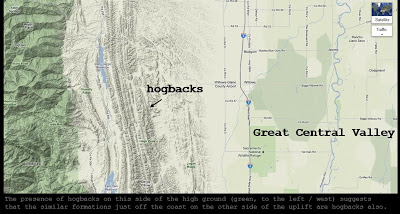
When we take a look along the western rim of the Great Central Valley, what do we find? Not only do we find hogbacks, but we find an enormous length of hogback formations, stretching just about as far as the deeply-scored and swirled terrain features that we located off the coast along the same latitudes. (There are also hogbacks along some of the highest mountains in the Bay Area east of Half Moon Bay, such as on Mission Peak and Monument Peak, as shown in photographs on this web page from a Bay Area resident).

Below is a diagram showing one small segment of the hogback series along the western edge of the Central Valley -- this is from an area just east and north of Clear Lake, one segment of which is called Devil's Elbow.


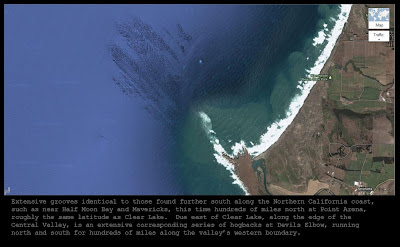
Note that this series of hogbacks is roughly parallel to the similar ridges at Point Arena pictured in the image at the top of this post. Point Arena is about as far north as I have been able to see these underwater hogbacks (if they are in fact hogbacks, which is looking more and more likely), and it is notable that the hogback lines also come to an end at roughly the same latitude in the northern area of the Central Valley (and that they do so with some swirling flourishes on the Valley side, reminiscent of some of the curves found in their undersea counterparts off the coast).

The reader is invited to spend some time looking at Google Maps to check out the distinctive terrain along the western edge of the Great Central Valley of California for himself or herself. The best way to see these hogbacks is to click on the "maps" square in the upper-right corner of the Google Map, and then select "Terrain." The best way to see the hogbacks under the water off the coast, however, is to select "Satellite" and then zoom down to the water's edge (the parallel ridge spines seem to emerge near promontories such as Pillar Point, Point Reyes, Point Arena, Morro Rock, Bolinas, and other similar points).

The hogback features can be traced all the way from the dramatic hogbacks at Devil's Elbow near Clear Lake down to the town of Coalinga and even a bit further south of that, roughly parallel to Morro Rock. The fact that the terrain features off the coast extend about the same distance north and south as the hogback lines along the western side of the Central Valley is another clue that Dr. Brown is correct in suggesting that the curved reefs that produce the surf at Mavericks are really submerged hogbacks.


As mentioned in passing above, the hydroplate theory has a much better explanation for hogbacks (and especially for the dramatically curved hogbacks in the seafloor near Mavericks) than the conventional theories of geology. The hydroplate theory maintains that the strata were all laid down rapidly as a result of a global flood, and that they were soft and pliant for some time after the floodwaters drained into the ocean basins.

They hydroplate theory also maintains that the ocean levels were much lower for centuries after the flood. This would allow the layers to harden, including those that are now submerged in twenty to a couple hundred feet just off the California coast. The sinking of the continents and the rising of the ocean floors took place over the next few centuries, due to the increased weight of the continents that thickened during the flood event (as a result of the buckling that pushed up mountain ranges such as those along the California coast and further east such as the Sierras and the Rockies -- these mountain ranges also sank down and pushed up plateaus such as the Colorado Plateau in the process of sinking down into the mantle). It is quite possible that the severe forces surrounding this "settling in" process in the centuries after the flood were the forces responsible for shearing the layers that now form the hogbacks under the ocean. It is also possible that these hogbacks (and the corresponding hogbacks on the Central Valley side) were bent and sheared during the compression event itself.

Note that there are also dramatic hogback lines on the eastern edge of the Central Valley, where it meets the uplifted hills that eventually lead up to the Sierra Nevada.

It is also possible that the rapid draining of the Central Valley some centuries after the flood created conditions that led to further uplift and the shearing that created some or all of the hogbacks of California. In his discussion of the evidence surrounding the formation of the Grand Canyon, Dr. Brown explains how the escaping water from trapped inland lakes on the Colorado Plateau stripped off layers of limestone, allowing upwarping of the basement rock which sprang upwards when the extra weight above it was removed.

Take a good look at diagram 113 on this web page of Walt Brown's book (about 7/8ths of the way down the page) -- it shows a cross-sectional drawing of the Kaibab Plateau (which he explains should really be called the Kaibab Upwarp or the Kaibab Uplift, as it is not technically a plateau). Note the layers on the right side of the diagram -- the East Kaibab Monocline. This terrain feature and the mechanism which produced it are both very similar to hogbacks and the forces that produced them.

As we noted in the previous blog post about the bathymetry of Mavericks, there are "grand canyons" stretching down into the Pacific just west of Mavericks and Half Moon Bay, and there are others up and down the coast. These canyons were clearly not carved after the oceans rose to their current levels, but before. It is possible that the forces which created the hogbacks of the Northern California coast were unleashed in conjunction with the draining of the Central Valley basin some centuries after the flood.

Thus, upon careful further consideration, it appears quite likely that the dramatic ridges below the surface at Mavericks (and further north and south along the California coast), which have only become clearly visible recently thanks to new underwater imagery released in 2007, are submerged hogbacks. This explanation is certainly consistent with the details of the hydroplate theory.

It is a possibility that deserves much more study from geologists.

Have you been watching retrograde Mars?


If you've been observing the brilliant Red Planet each night, you will have noticed that its location has moved distinguishably higher relative to the stars of the rising constellation Leo in the evening sky prior to midnight (all descriptions and illustrations northern-hemisphere-centric).

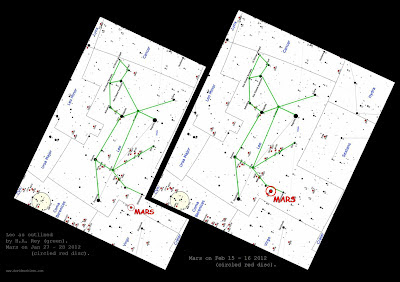
As discussed in a blog post near the end of January, Mars began its period of retrograde motion about three weeks ago, and will continue in a retrograde direction until April 15, when it will stop and resume its usual direction through the zodiac constellations.

In the diagram illustrating the position of Mars near the beginning of the retrograde motion (shown at left above), Mars was clearly below the bright tail-star of Leo, Denebola. The situation is quite different now, and noticeable if you have been taking a look at Leo periodically between then and now. Now, Mars is clearly above Denebola and heading higher in Leo (right diagram above).

This motion will continue as Mars moves "headward" through the constellation of Leo the Lion, prior to turning around and proceeding down the constellation towards Virgo (the constellation which follows the Lion, as discussed in this previous post about ancient goddesses who rode in chariots pulled by a lion).

Astrologers from very ancient times up to the present have believed that the planet Mars is associated with aggressive and assertive energy, most notably with martial prowess and with athletic prowess. Hence, periods in which Mars is retrograde are often described as being an inversion of this type of energy, and inauspicious for the start of any sort of combative or aggressive activity (including war but also lawsuits, arguments, or even new love affairs -- see for instance the discussions on these contemporary astrological websites here and here).

Before completely dismissing such assertions as "ancient superstition," consider the fact that the post previous to this one referenced an article from the fairly staid and respectable Wall Street Journal which analyzed the way in which certain musical patterns (which could be analyzed, isolated, and predicted by researchers) could create reactions in listeners which cause reactions in which "our sympathetic nervous system goes on high alert; our hearts race and we start to sweat."

One of the patterns mentioned by researchers as common in songs that cause these reactions are jumps of a full octave: musicians and mathematicians can confirm that a jump of a full octave is equivalent to a halving of the wavelength or a doubling of the frequency of a vibration. It is also possible to confirm that changes in wavelengths that produce a fifth of an octave are usually perceived as being quite pleasant and positive, while other fractional changes are generally perceived as quite disharmonious and jarring. Thus, music contains proportional relationships that actually relate to distances, and these have real and measurable effects on our emotions and even our physical nervous system (including reactions such as starting to sweat and increasing the heart rate).

The proportions in a building or a garden can have similar effects on us -- it can be demonstrated, for instance, that some of the most revered and historic Zen gardens incorporate very harmonious distances and proportions. In a sense, we might say that the measurements of a building or a garden can act on us in much the same way that music can act on us: architecture is "physical music."

Is it not possible, then, that our "surroundings" in the space far beyond the garden or building where we are standing -- our surroundings out to the proportional arrangements in the solar system, which change as the planets move about in relation to the earth and the sun -- could act as a much larger piece of architecture, or a much larger Zen garden?

Such a suggestion may seem to be a stretch, perhaps a stretch too far, but as John Anthony West (also mentioned in the previous blog post, along with a link to his excellent study Serpent in the Sky: The High Wisdom of Ancient Egypt) points out, "There is some direct, and much more indirect, evidence accumulating showing the existence of these correspondences, often corroborating old 'superstitions'" (114).

Among the studies that he mentions as evidence suggesting possible correspondence between planetary positions and measurable effects on our personality is the (admittedly controversial) work of Michel Gauquelin, who conducted statistical analyses which seemed to indicate some connection between athletic achievement and the position of Mars at time of birth -- the so-called "Mars effect."

Mr. West cautions that even if such "correspondences" can be demonstrated, "extrapolating from what is soundly established is fraught with dangers" (115). Nevertheless, it is interesting to note how widespread the belief appears to have been among the ancient civilizations, that the positions of the planets have a real effect on human affairs.

As Mars continues to retrograde towards the level of the stars of the Lion's hips (now approaching the level of Theta Leonis, also known as Coxa, Latin for "hip"), you may want to familiarize yourself with the stars of Leo using this chart from an 1889 study. It records ancient beliefs about influences caused by heavenly bodies (mainly the moon) when arranged relative to earth such that they are passing near these particular stars in Leo (sometimes good for voyages or redeeming captives, but other times only good for planting or marrying, but not for navigating!)

These subjects are interesting to consider. Whatever your opinion of them, it is a great opportunity to set a time each night (or every few nights) to go out and observe Mars and Leo during this period of retrograde motion by the Red Planet.

What kind of music gives you chills?


One of the most-read stories on the US version of the Wall Street Journal in recent days has been "Anatomy of a Tear-Jerker," by Michaeleen Doucleff, which analyzes the elements in Adele's song "Someone Like You" which appear to be tailor-made to produce strong emotional reactions in listeners.

The story concludes that "researchers have found that certain features of music are consistently associated with producing strong emotions in listeners. Combined with heartfelt lyrics and a powerhouse voice, these structures can send reward signals to our brains that rival any other pleasure." The article tells us that such songs include
at least four features. They began softly and then suddenly became loud. They included an abrupt entrance of a new "voice," either a new instrument or harmony. And they often involved an expansion of the frequencies played. In one passage from Mozart's Piano Concerto No. 23 (K. 488), for instance, the violins jump up one octave to echo the melody. Finally, all the passages contained unexpected deviations in the melody or the harmony. Music is most likely to tingle the spine, in short, when it includes surprises in volume, timbre and harmonic pattern.
What other songs share these same elements? Many of the songs of crooner Chris Isaak seem to fit this description. So does the 1992 Guns n' Roses song "November Rain," which also features two screaming guitar solos by Slash and a music video containing imagery surrounding emotion-laden environments such as weddings, funerals, and windswept deserts with stark lonely churches. If you know of songs that consistently give you chills or other similar reactions, head over to the Mathisen Corollary on Facebook or Twitter and share them!

Researchers have found that "When the music suddenly breaks from its expected pattern, our sympathetic nervous system goes on high alert; our hearts race and we start to sweat. Depending on the context, we interpret this state of arousal as positive or negative, happy or sad." Knowing how to manipulate the sympathetic nervous system with the vibrations of music and proportions such as octaves is exactly the kind of knowledge that John Anthony West says the ancient Egyptians consciously sought out, in his book in Serpent in the Sky: The High Wisdom of Ancient Egypt.

The Wall Street Journal article asks, "If 'Someone Like You' produces such intense sadness in listeners, why is it so popular?" We explored this same question previously in "Why do we listen to beautiful music about heartbreak and misery?"

Happy Valentine's Day!

Valentine's Day, Pan, and Precession


There is some indication that the modern holiday of Valentine's Day occupies the place in the calendar which once belonged to the Lupercalia, an ancient festival that took place from February 13th through February 15th. In fact, the name of the month of February descends from a festival called "Februa" that took place on the same dates, a spring festival associated with purging.

Lupercalia clearly contains the Roman word for "wolf," lupus. It appears to be associated with a still more-ancient festival known as the Lykaia, an Arcadian festival held on Mount Lykaios and associated with "Wolf Games." In Hamlet's Mill, authors Giorgio de Santillana and Hertha von Dechend explain that this ancient festival was associated with the god Pan (as was Lupercalia) because Pan was said to have been born at this Mount Lykaios. The connection between Pan and a mountain associated with wolves stems from a tale in which Zeus turned a disobedient human into a werewolf in that location.

In a chapter entirely devoted to the discussion of this important ancient mythological figure, entitled "The Great Pan is Dead," de Santillana and von Dechend explain:
Pan is said to have been born here, and here he had a sanctuary. Here also Zeus tilted a "table" -- whence the place had the name Trapezous -- because Lykaon had served him a dish of human meat consisting of his own son. Zeus turned Lykaon into a werewolf, and in tilting the "table" caused the Flood of Deukalion, the "table," of course, being the earth-plane through the ecliptic. This is the significant event of the tale, and the whole is so long no sensible person would try to summarize it. 278 - 279.
This association of the tilting of the axis (the tilting of the table by Zeus, which de Santillana and von Dechend argue with some justification is a mythical metaphor for the division of the ecliptic and the celestial equator, which is caused by the obliquity of earth's axial tilt from the orbital plane of the ecliptic) with the Flood of Deukalion is significant. The hydroplate theory of Walt Brown argues that the events of the global flood would have caused a major roll of the earth, resulting in a major disruption of the celestial axis to observers on earth. The Mathisen Corollary book explores evidence in ancient myth that the "chopping down" of the celestial axis was associated with a worldwide flood.

Interestingly enough, de Santillana and von Dechend present evidence in their chapter on Pan for the identification of Pan (at least, the Pan whose death was announced in many ancient tales as signifying the end of an age) with Tammuz, and with Janbushad or Jamshyd. They then go on to explain:
It has been seen already (p. 146) that Jamshyd is in Avestic Yima xsaeta, the name from which came Latin Saturnus. There is no question then, this is about Saturn/Kronos, the God of the beginning, Yima (Indian Yama), the lord of the Golden Age. 283.
We have discussed the importance of Yima (or Yama) and the Golden Age in previous posts, such as this one and this one.

Thus the festival of Lupercalia (connected by a very roundabout path to modern Valentine's Day) points again to the importance of precession (which itself is caused by the fact that earth's axis is "unhinged") in ancient mythology.

For readers who are disconcerted by the fact that Pan seems to be a very different god from Saturn, it might be helpful to read this previous post entitled "The real actors on the stage of the universe are very few," which explains that one celestial actor (such as the planet Saturn) can take on many different roles -- in fact, Saturn appears to be associated not only with Kronos but also with Prometheus, Hephaestus, and Phaethon, and now we see that he is associated with Pan as well (in fact, de Santillana and von Dechend tell us that, while Pan is considered a very "young" god in Greek mythology, he was considered one of the most ancient by the Egyptians -- just as Saturn / Kronos was considered an "ancient" god by the Greeks).

He is also associated with the figure of Orion or Osiris, who in some accounts was a civilizing figure who came to dwell among mankind and taught them to grow grains and to cease from cannibalism -- an interesting connection to the story of Lykaon and the birthplace of Pan in the Greek myth described above.

To finish up on a slightly different aspect of Pan, we can see that in the mosaic above, Pan is chasing the nymph or dryad Pitys, who is turning into a tree to escape his clutches (much to Pan's dismay). The ancients believed that dryads protected trees, and that causing damage to a tree would cause damage or harm to the dryad who was associated with that particular tree. Unfortunately, as we have seen in this recent post on the Methuselah tree, some moderns appear to be all to willing to deface and destroy the trees of the forest.

The unbelievable bathymetry of Mavericks


The window for the Mavericks surf contest is open through the end of March, and at any time the selected contestants can be given 24 hours to head to California for the big-wave competition.

The contest has only been held seven times since 1999. The surf spot has only been known to the general public since 1990, after a photograph taken by a friend of Mavericks pioneer Jeff Clark (who first surfed it alone as a teenager in 1975) was published in Surfer magazine.

It is one of the largest and heaviest waves in the world (which makes the fact that Jeff Clark paddled a half-mile out to sea to surf it alone for years all the more impressive).

Surfline, itself a pioneer in the world of predicting surf, has an outstanding special feature presentation on the mechanics of Mavericks and the interaction of water and geology that produces its monster waves. It was produced and written by the late Sean Collins, the founder of Surfline, who was single-handedly responsible for changing the way surfers around the world check conditions before heading to the ocean, and published on November 16, 2011 -- only a month before he left this life at the age of 59.

The thirty-page analysis features beautiful aerial photographs and especially underwater bathymetry images showing the unique underwater terrain that channels wave energy from the largest northwest Pacific storms into the lineup at Mavericks. The word "bathymetry" (Greek for "the measurement of the deep") refers to the same science as topography, but underwater. Slide 8 of the Surfline analysis of Mavericks explains that:
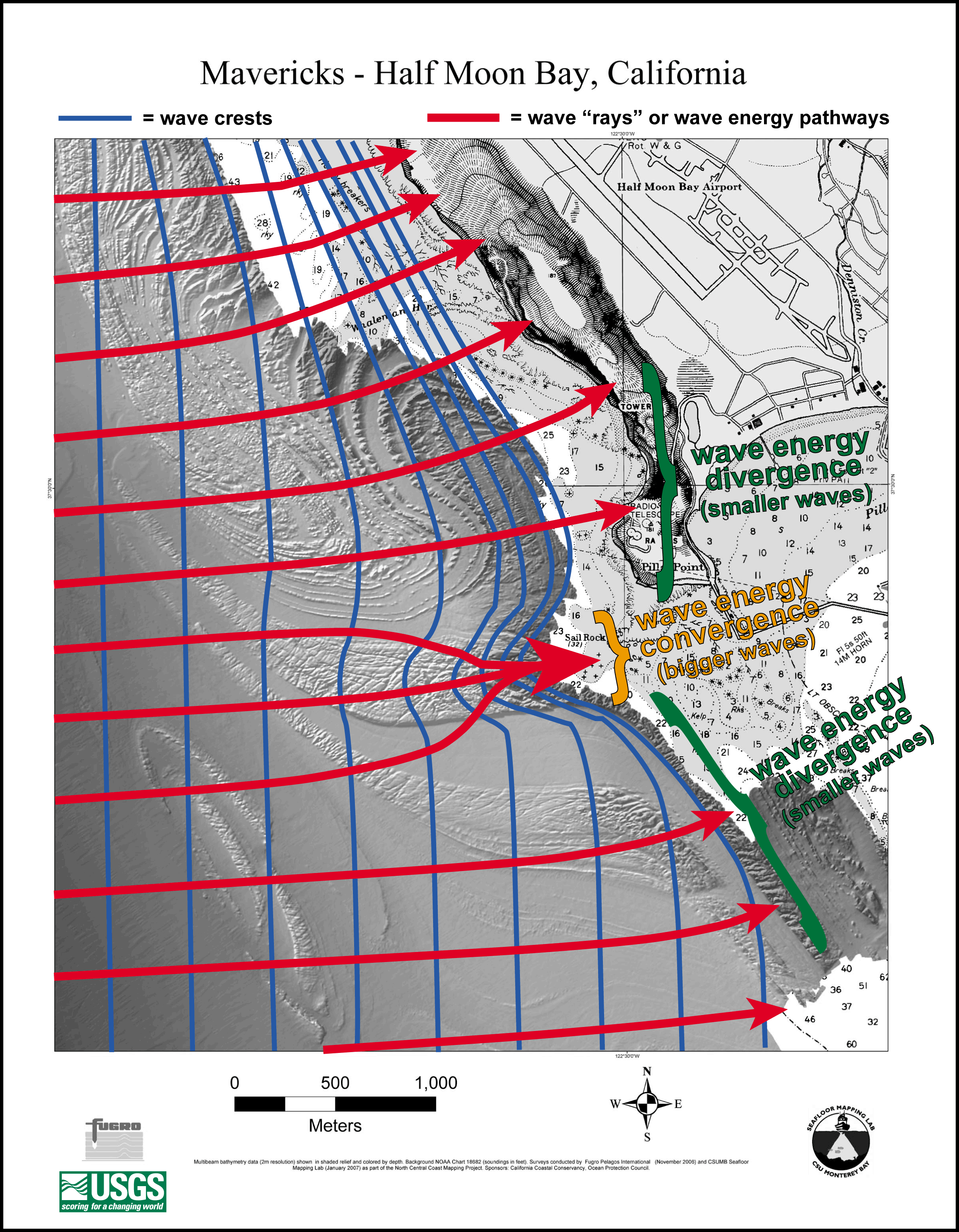
Swells approaching Maverick's from the North Pacific will first pass over the continental shelf, and the distribution of swell energy along the coast will be determined by swell interaction with the topograph of the ocean floor (bathymetry). Swell energy will always turn towards shallower water (refraction), and swell direction and swell period will be contributing factors of how much the swell will refract.
Willard Bascom (1916 - 2000), a pioneering oceanographer and scientist and author of the excellent Waves and Beaches: the dynamics of the ocean surface (1964), whom we have met before in this previous post, explains refraction in that book by saying:
Refraction simply means bending. As waves move into shoaling water the friction of the bottom causes them to slow down, and those in shallowest water move the slowest. Since different segments of the wave front are traveling in different depths of water, the crests bend and wave direction constantly changes. Thus the wave fronts tend to become roughly parallel to the underwater contours. 70-71.
Underwater bathymetry imagery released in 2007 from the USGS and Cal State Monterey Bay revealed an amazing complex of dramatically curving reefs that channel the wave energy into the patch of ocean located off of Pillar Point (at the northern boundary of Half Moon Bay) where Mavericks breaks when the swell energy is powerful enough and the swell direction is right.

Slide 14 of Sean Collins' Surfline presentation of the Mechanics of Mavericks shows the critical portion of this underwater reef complex. The text on that slide reads:
The unique bathymetry extending about a mile offshore is the secret to the big surf at Maverick's. Recent side-scan sonar surveys by the USGS and the Seafloor Mapping Lab at California State University at Monterey Bay have revealed a very interesting swirling pattern of shallow reef that extends westward off Pillar Point. These swirling grooves in the reef off Pillar Point act like a huge magnifying glass to merge and focus extra wave energy from adjacent deeper water toward the shallower reef. The unique patterns in the ocean floor were created by long-term erosion and historic seismic activity of the local San Gregorio Fault system. Another possible cause is huge icebergs during the last Ice Age that may have helped to grind out these grooves -- a similar phenomenon that also occurred on the Hudson Shelf near New York.
The fantastic curving patterns can be seen in the NOAA/USGS imagery from this website shown in the diagram below. You can see how the deep channels on either side of the Mavericks lineup create refraction that cause waves to bend towards the shallower ridge in between the channels, focusing the wave energy.


The origin of these graceful curving reefs, like other geological features on earth, invites various explanations. Like a popular mystery story (such as the stories of Sherlock Holmes, or Scooby Doo and the gang), there are explanations which generally fit into the popular assumptions and preconceptions of the powers that be, but these explanations may or may not stand up to scrutiny. The conventional explanations will generally involve tectonic forces, such as the idea that they were caused by "long-term erosion or historic seismic activity of the San Gregorio Fault system" cited above.

A more detailed example of a conventional explanation for such extreme curving geological features can be found in the Highly Allocthonous website of geologist Chris Rowan, where such plunging folds are explained as a "tale of orogenies past," in which tectonic forces lift parallel layers upwards (causing them to bend), and then other forces cause the fold axis to become tilted to some degree. When the tilted bent layers are sheared off, the folded layers present dramatic hairpin bends that represent the top of the uplifted layers. Mr. Rowan entitles his post "12 folds a-plunging" and provides numerous photographs of examples from around the world (all of them above the current ocean surface).

This blog post from professional geologist Michael Welland (author of Sand: the Never-ending Story, 2010) discusses the extreme curved reefs off the California cost near Half Moon Bay and links to the Highly Allocthonous post about "plunging folds" as a likely explanation for the bathymetry that gives rise to the waves of Mavericks. While the Highly Allocthonous post does not directly mention the reefs off of Pillar Point, the other examples it offers of "plunging folds" certainly makes it appropriate for Mr. Welland to argue that the mechanism described for the curving patterns in "12 folds a-plunging" are the same forces that created the bathymetry at Mavericks, and Mr. Welland concludes that the Pillar Point reefs are "clearly 'folds a-plunging' in the sea-floor off San Mateo County."

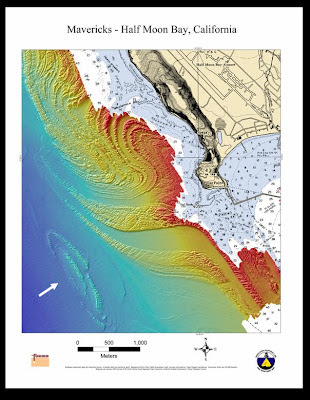
There are some significant details, however, which call into question this explanation for the origin of the severe curving reefs near Half Moon Bay. First, there is the question of the distinctive reef composed of concentric circles indicated by the white arrow in the imagery from CSU Monterey Bay below (this is the same imagery as that in the image above, but colored to indicate depth, with red being shallower and blue deeper water depths, and yellow indicating depths in between blue and red):


It is difficult to imagine a scenario in which the concentric circles of the reef indicated by the arrow could have been created by uplifting of layers which were later tilted and sheared off.

In fact, the more one considers that explanation, the less satisfactory it appears in light of the reef patterns depicted in the sea-floor imagery. Note, for example, that the curves are clearly further apart at the point of greatest "hairpin turns" rather than closer together as we might expect if they were actually caused by tectonic uplifting.

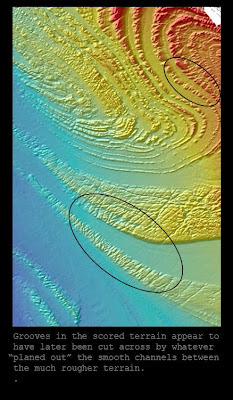
Further, a close examination of the topography will reveal that the terrain in question is deeply scored and jumbled, and that it appears that wide bands have been "planed out" in this deeply scored terrain to create the graceful curves, but that some of the scoring lines clearly continue on the "other side" of the "planed out" bands.


For instance, in the image above, the reader can examine grooves and scoring inside each of the circled areas which appear to have once belonged to a continuous piece of land which was later divided by some force that carved out a deep and smooth channel right down the middle. Not only are these channels significant to surfers at Mavericks (since they act to bend the wave energy towards the central ridge), but they are also important clues to the mysterious underwater terrain off the California coast.

The fact that something appears to have cut across the existing terrain and left deep grooves like this indicates flow of something -- the most likely suspects being liquid or viscid flows, either lava, glacial ice, or water. In each case, it seems clear that the terrain was not under the surface of the ocean when the lava, ice, or water carved these channels. The curving patterns are certainly indicative of flowing liquid or viscid forces as well*.

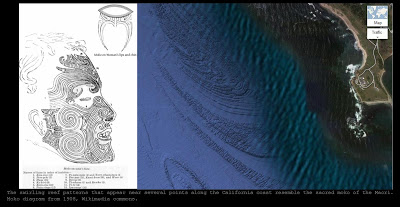
The image below from Google maps shows that the graceful curving reefs that create the Mavericks break are part of a larger patch of underwater ridges that stretch north of Pillar Point towards Montara and south into Half Moon Bay itself, but which are most extreme in the area of the Mavericks break.


The darker area contains swirling patterns as well as "feathered" ridges that seem to end in a series of parallel points, resembling quite remarkably the patterns of the sacred moko of the Maori of Aotearoa (New Zealand).


The reader can click on the image to zoom in and see the details, or even better to visit Google and conduct a search on their maps for "Half Moon Bay, California" -- selecting the "satellite" imagery view rather than the "map" imagery view in the upper-right corner of the map will bring up the sea-floor images seen above.

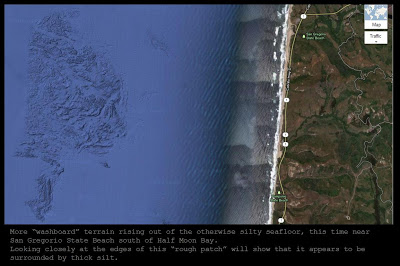
Cruising along the Google Maps imagery up and down the California coast will show that the extended dark rough patch near Mavericks that resembles a moko in its swirling pattern may be more extreme than those found elsewhere, but that it is by no means alone. Other such patterns rise up out of the otherwise much smoother continental shelf at various points, including further north near Bolinas (also near a significant headland like Pillar Point accompanied by a wide bay) and further south near Morro Rock (again, a prominent headland and one which in this case features an obvious volcanic extrusion). See the images below.


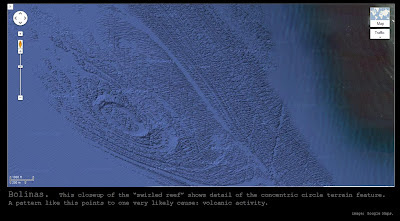
In the image above of the long dark scored reefs off the coastline near Bolinas, California, note the same hairpin curves and feathering found at Mavericks, and also note the very distinctive concentric circle pattern which is even more pronounced than the concentric ring pattern pointed out at Mavericks in the images above.


The detail of the Bolinas pattern reveals very clear evidence that these "moko" patterns that seem to rise up at certain points along the California coast may be indications of volcanic activity in the ancient past. The concentric circles of the Bolinas "rough patch" form a complete ring (unlike those off of Pillar Point / Mavericks), and the USGS / CSU Monterey Bay imagery appears to indicate steeply beveled sides to the ring, giving it a very clear crater-like appearance.

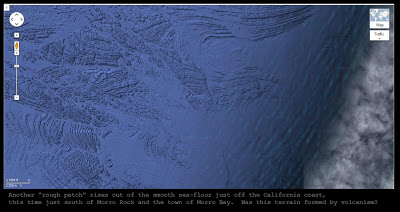
Moreover, the deeply scored and darker sea-floor both here and at Half Moon Bay / Mavericks seems to indicate volcanic flow. The image below of another such "rough patch" off the coastline just south of Morro Rock (further south along the California Coast from Half Moon Bay, south of Monterey and Carmel and Big Sur) reinforces this conclusion:


This kind of "washboard" terrain is very characteristic of ancient volcanic action, and is reminiscent of the terrain around Fort Irwin and the Mojave Desert that was discussed in this previous blog post. Note that again we find a volcanic-looking rough patch protruding from the otherwise smoother seafloor in the vicinity of a prominent headland -- Morro Rock sticks out into the Pacific in much the same way that Pillar Point does. It would be redundant to include an image of it here, but another such patch can be observed at Point Año Nuevo not far south of Half Moon Bay.

The interesting thing about these mysterious patches of heavily scored volcanic-looking ground is that they are surrounded by much smoother seafloor. In fact, looking at them for a long time will give the distinct impression that these rough patches themselves are partially filled up with the same thick silt and sand that blankets most of the adjacent seafloor. Let's return to the imagery around the Mavericks surf break and see.


Just south of Half Moon Bay, at San Gregorio State Beach (where highway 84 intersects the Pacific Coast Highway or Highway 1) there is another small "rough patch" that clearly appears to be surrounded by silt. These patches are starting to give the impression that the entire ocean floor off the Northern California coast is really rough and washboard-like, but most of it is drowned in silt.


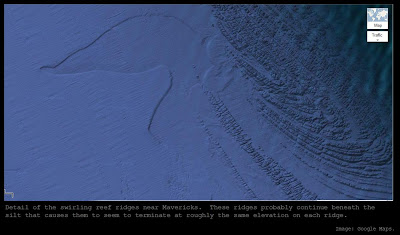
A close-up look at the swirling ridges that lead in towards Mavericks gives the same impression: it appears that the long "feathered" ridges disappear into a deep layer of silt. In other words, these ridges probably continue on below the surface that we can see: they were formed first and then buried later in silt.

A closer examination of the concentric terrain feature near Mavericks will reveal the same thing: it is probably a crater very much like the one shown above at Bolinas, but since it is deeper and more deeply buried in silt, only the upper edges of the lip of the crater can be seen, and these do not form a complete circle above the silt as the crater at Bolinas does (the Pillar Point crater is probably a complete circle, but some of its lip is below the level of the silt that flowed in later).

What could explain these amazing terrain features? The conventional explanations are quite inadequate. The hydroplate theory of Dr. Walt Brown, however, provides a scenario which appears to fit the evidence quite satisfactorily.

We have already seen in previous posts that Dr. Brown's theory envisions the continents sliding away from the initial rupture (and the rapidly rising Atlantic floor, which sprang upwards after the escaping floodwaters removed enough sediment) and towards the newly formed Pacific Basin (which buckled downwards in compensation for the upward-springing Atlantic floor, "sucked" towards the Atlantic on the other side of the globe as if the underside of the Pacific floor were connected through the earth by long cables to the underside of the Atlantic).

The forward edge of the Americas would have experienced tremendous friction, enough to create heat sufficient to melt granite and produce massive amounts of magma, which later spilled out as immense lava flows (the Columbian basalts of Washington and the volcanoes of the Mojave area are two examples of evidence of this activity). Such friction and melting could explain the volcanic-looking deeply scored "washboard" terrain that we see in places along the front-edge of the drifting continent (the California coast and the continental shelf).

As the continents slid, they buckled and thickened. Later, when the continents finally ground to a halt, the floodwaters poured off of them towards the ocean basins, dumping massive amounts of sediments into the ocean basins. The waters pouring off the continents carved immense canyons as they cascaded over the edges of the continental shelves: the Monterey Canyon that was discussed in this previous blog post is one such canyon, as are the canyons of the Ganges Fan and the Indus Fan and the canyons found under the sea at the mouths of some of the largest rivers in the world such as the Amazon and the Hudson.

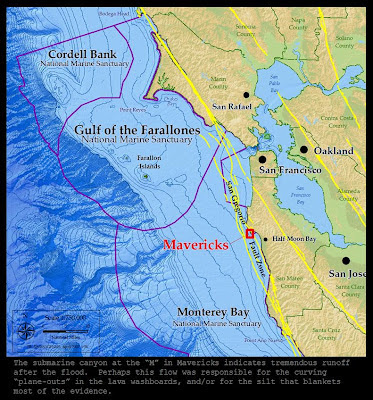
At that time, when those canyons were formed, the sea level was much lower than it is today (that's why those canyons could be carved by rushing water -- today they could not be carved because they are under the ocean). Note that another mighty submarine canyon yawns below the lip of the continental shelf just west of Mavericks and Half Moon Bay as well. Look just left of the large red letter "M" in the word "Mavericks" in the image below from this NOAA website about National Marine Sanctuaries in the United States.


The sediment-rich waters flowing off of the continent may well have blanketed the washboard features so deeply that they only protrude in certain places along the California coast. It seems that at places where a large promontory (such as Morro Rock, or Pillar Point) shielded some of the silt flow, less sediments were deposited and some of the fingers of volcanic reef could poke through the silt. This silt likely hardened into sedimentary rock over the centuries before the sea levels rose to cover the continental shelves (the hydroplate theory explains that the continents were much higher relative to the seas immediately after the flood for some hundreds of years, before their great weight caused them to sink down and the ocean floors to rise).

The graceful curving patterns could have been caused by lava flow from the original lava activity that created the rough volcanic terrain, but it is much more likely that they were planed-out later while the continental shelves were still above sea level (based on the fact that some of the original grooves and scoring are interrupted by the broad channels that must have been scooped-out later).

These channels may have been carved out by glaciers which covered North America during the Ice Age that was caused by the temporarily higher continents and lower warmer seas (the warm oceans producing much more precipitation, which fell as snow and ice over the colder higher land masses). We know that glaciers reached these latitudes in California, as Yosemite Valley further inland is an obvious product of glacial carving.

An astute reader might wonder how the silt filled these glacial channels, if the silt was deposited by waters flowing off the continents right after the flood and before the Ice Age. It is possible that waters were trapped in the Great Central Valley of California long after the initial flood, later breaching and rushing out to the Pacific (just as other trapped waters later breached and carved the Grand Canyon, depositing tons of sediments in the Gulf of Mexico in the process, as Walt Brown explains in his book, which contains an entire chapter on the Grand Canyon).

The exact mechanism that carved the graceful channels in the original deeply-scored washboard is not certain at this time, but it appears likely to have been either glacial ice or sediment-rich water, and possibly later lava flows although this mechanism appears less likely*. The bottom line is that the mechanisms proposed by conventional geology appear quite inadequate, while there are several options which fit the general outline of the hydroplate theory. Note that the hydroplate theory was around long before the undersea images became available in 2007.

Thus, the incredible undersea terrain that produces the mighty waves of Mavericks appears to be yet another piece of geologic evidence that is very difficult to explain using conventional geologic theory, but which fits rather nicely within the predictions of the hydroplate theory.

The only question is, did the Polynesians (who gave the world surfing in the first place) somehow know about the distinctive undersea swirls that produce the gigantic waves at Mavericks, and incorporate these patterns into their tattooing? If so, perhaps they knew about this "undiscovered" surf break centuries before it became known again in the 1990s! But that is a mystery for another day.


* Note: since publishing this post, I have come to believe that hogbacks are the most likely explanation for these dramatic underwater features -- see this post, published 02/16/2012.