Chief Joseph, 1840 - 1904


March 3 is the birthday of Chief Joseph, born this day in 1840. His name in his own language, Hin-mah-too-yah-lat-kekt (it is rendered and spelled slightly differently in different places), means "Thunder Rolling Down the Mountain." He was elected leader of the Wallowa (or Wal-lam-wat-kain) band of the Nez Perce in 1871, after the death of his father. In their own language, the Nez Perce are called the Nimíipuu, which means "The People."

The US government originally signed a treaty in 1855 acknowledging the right of the Nez Perce to an area of about 7.7 million acres, including the Wallowa Valley in northeast Oregon where Joseph was born. However, in 1863 the government proposed a new treaty which would reduce the Nez Perce territory to well under a million acres and exclude much of their traditional homeland, including the Wallowa Valley, which Joseph's father and many other Nez Perce leaders refused to sign.

In 1877, facing the forcible removal of his people from the Wallowa, Chief Joseph (along with other primary leaders including Toohoolhoolzote, Looking Glass, White Bird, and Joseph's younger brother Ollokot) led a group including between 200 and 250 warriors and numbering over 800 including women and children in search of a place where they could live in peace and freedom -- ultimately trying to reach Sitting Bull's people, who had fled across the Canadian border to Saskatchewan earlier that same year.

Pursued by much larger forces (numbering as many as 2,000 soldiers) under the overall command of General Howard of the US Army, Chief Joseph and his people traversed almost 1,200 miles, across the Rocky Mountains and several other ranges, from Oregon to northern Montana, fighting eighteen battles against superior numbers, until they were finally forced to surrender only forty miles from the Canadian border.

The dignity and eloquence of Chief Joseph's speech at the occasion of that surrender, as well as later trips to Washington DC to petition the federal government on behalf of his people, are justly famous.

Some selected passages of his words can be found at this web site. Passage IV, from a visit to the US capitol in 1879, reads in part:

There need be no trouble. Treat all men alike. Give them the same laws. Give them all an even chance to live and grow. All men were made by the same Great Spirit Chief. They are all brothers. The earth is the mother of all people, and all people should have equal rights upon it. You might as well expect all rivers to run backward as that any man who was born a free man should be contented penned up and denied liberty to go where he pleases. If you tie a horse to a stake, do you expect he will grow fat? If you pen an Indian up on a small spot of earth and compel him to stay there, he will not be contented nor will he grow and prosper. I have asked some of the Great White Chiefs where they get their authority to say to the Indian that he shall stay in one place, while he sees white men going where they please. They cannot tell me.

[. . .]

We only ask an even chance to live as other men live. We ask to be recognized as men. We ask that the same law shall work alike on all men. If an Indian breaks the law, punish him by the law. If a white man breaks the law, punish him also.

Let me be a free man, free to travel, free to stop, free to work, free to trade where I choose, free to choose my own teachers, free to follow the religion of my fathers, free to talk, think and act for myself -- and I will obey every law or submit to the penalty.

Whenever the white man treats the Indian as they treat each other then we shall have no more wars. We shall be all alike -- brothers of one father and mother, with one sky above us and one country around us and one government for all. Then the Great Spirit Chief who rules above will smile upon this land and send rain to wash out the bloody spots made by brothers' hands upon the face of the earth. For this time the Indian race is waiting and praying. I hope no more groans of wounded men and women will ever go to the ear of the Great Spirit Chief above, and that all people may be one people.

When Chief Joseph surrendered in 1877, it was found that he carried a small tablet in a pouch bearing an inscription in the cuneiform writing system of ancient Sumer, Babylon, and Assyria. The tablet measured just over an inch square, and he said that it had been handed down in his family for many generations and that it had been given to his ancestors. Modern scholars have translated it and it appears to bear a record of an ancient transaction involving the sale of a lamb. This writeup appeared in the Smithsonian Magazine in February, 1979 (Smithsonian 9:36) describing the inscription. Scholars attest that the date in the inscription places it prior to 2000 BC.

Since being discovered to bear cuneiform writing, the tablet has been the subject of speculative attempts to explain away the obvious problems that it poses for the conventional historical narrative (when it is discussed at all -- in general, scholars appear to have ignored this stunning and important piece of historical evidence). Although there is not a shred of evidence to support these assertions, writers declare that it must have been given to Chief Joseph or his father by missionaries. This is disgraceful, as to make this assertion is to call him a liar. It is also ridiculous, as there is no explanation as to how a nineteenth-century missionary would be carrying around an ancient cuneiform tablet or why this imaginary missionary would decide to give it to Chief Joseph of his parents, let alone why Chief Joseph would choose to lie about it.

Other speculations, such as the idea that the son of the US Army officer who had served under General Howard in the Nez Perce War and who donated the item to the West Point museum got his story mixed up or lied about it as well, are equally baseless. These are the sorts of disgraceful speculations that replace serious analysis of evidence about human history when other vested interests are threatened by the facts.

Ultimately, as I have repeated many times in this blog as well as in my book, any one piece of evidence on its own is not as important as the larger body of evidence of which that single item is but one representative member. The cuneiform tablet of Chief Joseph, were it the only item suggesting that ancient history is quite different from what we are taught, would not prove that we should re-evaluate the orthodox view. However, it is one of thousands of other pieces of very solid evidence (some of which are discussed in other posts listed here).

Setting aside the question of his treasured cuneiform tablet, it is appropriate to honor the spirit of Thunder Rolling Down the Mountain on this 172nd anniversary of his birth.

Even suffering first-hand the outrages that were inflicted upon himself and his people, he did not sink to categorizing other individuals by their membership in an ethnic group (he did not become a racist against "whites," even after his people were disgracefully and shamefully treated by them), saying: "We were troubled with white men crowding over the line. Some of them were good men, and we lived on peaceful terms with them, but they were not all good."

Even after all the indignities he and his people suffered, he was able to say, "All men were made by the same Great Spirit Chief. They are all brothers. The earth is the mother of all people, and all people should have equal rights upon it."


Leap Year


The year 2012 is a "Leap Year," containing 366 days instead of the usual 365 of a common year, achieved by the insertion of an additional day in the month of February (February 29), a convention which has given rise to all kinds of quirky traditions since it was instituted, such as the idea (not as common any more) that the roles of the sexes in proposing marriage should be reversed on this odd day, and the fact that babies born on this day have a sort of dual-status for their birthday and age.

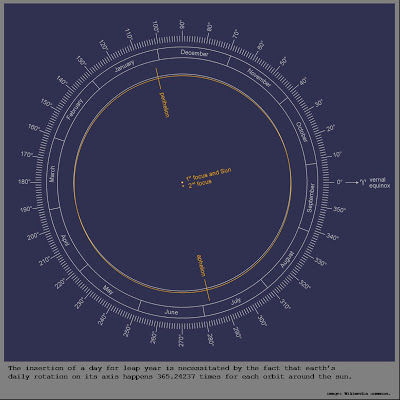
The insertion of a Leap Year day is necessitated by the fact that earth's daily rotation (which creates the measure of time known as a day) does not match up exactly with earth's annual orbit (which creates the measure of time known as a year). In other words, earth's spinning on its axis as it goes around the sun happens more than exactly 365 times before returning to the exact same spot on its orbital path.

If the earth rotated exactly 365 times and came back to an identical spot, then a calendar of 365 days would mean that any successive January 1 would bring it back to an identical point on its orbit, as would any successive March 21, June 21, September 22, or December 21 (the days on the calendar that generally fall near the time earth passes through its solstice points and equinox points). Because earth rotates faster than 365 times per year, if the calendar of days were left at a simple 365 per year, the equinoxes would begin to gradually drift through the year, until spring equinox was taking place on a calendar day associated with winter (for example).

If earth's rotation were exactly 365 and a quarter turns per orbit, then the insertion of an extra day in the calendar every four years would "pull" the calendar back into alignment with the orbit quite nicely. However, earth's spinning is not quite 365 and a quarter days (or 365.25 days) in one orbit -- the actual number is just below 365.25 at about 365.24237 days per year. Therefore, the convention is that leap year days are not inserted every hundred years, on years ending in two zeros. However, years ending in two zeros which are able to be evenly divided by 400 (such as the year 2000 and the year 2400, but not the year 1900 or the year 2100) do get a leap year.

There is some analysis which suggests that in ancient times the earth rotated an even 360 times per year. Dr. Walt Brown, the creator of the hydroplate theory, points out that Immanuel Velikovsky demonstrated references to a 360-day year among the writings of the ancient "Persians, Egyptians, Chinese, Chaldeans, Assyrians, Babylonians, Incas, Hebrews, Greeks, Hindus, Romans, Aztecs, Mayas, and Peruvians" (see footnote 32 on this page of the online version of Dr. Brown's book).

He also notes that in the Hebrew Scriptures describing the flood of Genesis, the duration of the flood appears to be referred to as an even "five months" which is also described as "150 days" (see Genesis 7:11, 7:24, and 8:3-8:4). Dr. Brown believes that the events surrounding the cataclysmic flood could have increased the spin rate of the earth (just as major earthquakes continue to do to this day -- see this previous post and the figure-skater analogy).

In the description of the Isis and Osiris series, the historian and initiate into certain ancient mystery schools Plutarch (46 AD - 120 AD) relates the Egyptian myth that the god Thoth (Plutarch calls him Hermes) won an additional five days to add to the 360-day year by playing draughts against the moon deity. He writes:
They say that the Sun, when he became aware of Rhea's intercourse with Cronus, invoked a curse upon her that she should not give birth to a child in any month or year; but Hermes, being enamoured of the goddess, consorted with her. Later, playing at draughts with the moon, he won from her the seventieth part of each of her periods of illumination, and from all the winnings he composed five days, and intercalated them as an addition to the three hundred and sixty days. The Egyptians even now call these five days intercalated and celebrate them as the birthdays of the gods. They relate that on the first of these days Osiris was born, and at the hour of his birth a voice issued forth saying, "The Lord of All advances to the light." But some relate that a certain Pamyles, while he was drawing water in Thebes, heard a voice issuing from the shrine of Zeus, which bade him proclaim with a loud voice that a mighty and beneficent king, Osiris, had been born; and for this Cronus entrusted to him the child Osiris, which he brought up. It is in his honour that the festival of Pamylia is celebrated, a festival which resembles the phallic processions. On the second of these days Arueris was born whom they call Apollo, and some call him also the elder Horus. On the third day Typhon was born, but not in due season or manner, but with a blow he broke through his mother's side and leapt forth. On the fourth day Isis was born in the regions that are ever moist; and on the fifth Nephthys, to whom they give the name of Finality and the name of Aphroditê, and some also the name of Victory. There is also a tradition that Osiris and Arueris were sprung from the Sun, Isis from Hermes, and Typhon and Nephthys from Cronus. For this reason the kings considered the third of the intercalated days as inauspicious, and transacted no business on that day, nor did they give any attention to their bodies until nightfall. They relate, moreover, that Nephthys became the wife of Typhon; but Isis and Osiris were enamoured of each other and consorted together in the darkness of the womb before their birth. Some say that Arueris came from this union and was called the elder Horus by the Egyptians, but Apollo by the Greeks.
Here is another website which presents some different analysis arguing that earth's year was once 360 days.

The hydroplate theory certainly does not stand or fall on the possibility of the earth once moving around the sun concurrent with exactly 360 revolutions rather than today's 365.24237. However, it is an interesting concept to consider, especially during a Leap Year.

Mushrooms


Many readers have no doubt already seen the video above of the presentation by Paul Stamets filmed in March 2008 discussing "Six Ways Mushrooms can Save the World" (many thanks to my good friend Mr. DY for alerting me to this video some years ago).

Now, there is a new video just recently uploaded to the web, also featuring Paul Stamets in a TEDMed talk from October of 2011, which goes into more detail on some of the amazing subjects discussed in the video above, as well as discussing some recent advances he and his colleagues have made since then. It includes a very moving story at the end that you won't want to miss.


As Mr. Stamets himself mentions in both talks and discusses at greater length in his writings both on the internet and in his published books (such as Mycelium Running, Growing Gourmet and Medicinal Mushrooms, The Mushroom Cultivator, and Psilocybin Mushrooms of the World), there is extensive evidence that ancient civilizations were keenly aware of the incredible powers of mushrooms -- perhaps more aware than we are today.

In this selection from Growing Gourmet and Medicinal Mushrooms, Mr. Stamets provides some descriptions of the evidence of ancient mushroom use, including cave art in the Tassili region of Algeria in which "mushrooms with electrified auras are depicted outlining a dancing shaman." The "electrified auras" -- as well as the descriptions and images Mr. Stamets gives in his talks of mycelium as "the Earth's natural internet" -- brings to mind the topics touched on in previous posts such as this one and this one. Mr. Stamets also notes that the man known as "The Ice Man" (whose mummified remains were found in the Ötzal Alps) apparently had three different species of mushroom among his possessions.

There is strong evidence that the ancient Egyptians, Hindus, and Maya all revered mushrooms. This website outlines some of the arguments that have been made concerning the possibility that the manna described in the sacred Hebrew Scriptures was actually a form of mushroom (it was small and round, it was gathered in the morning "in the morning dew," and it would breed larva and melt to mush if kept and not dried).

Books by Dr. Dan Merkur (Mystery of Manna: the Psychadelic Sacrament of the Bible) and Dr. Carl A. P. Ruck (Sacred Mushrooms: Secrets of Eleusis and Mushrooms, Myth, and Mithras: The Drug Cult that Civilized Europe) provide extensive evidence that the ancients incorporated psychoactive mushrooms in some of their most important attempts to interact with the divine and the supernatural. The writings of the first Europeans to encounter the civilizations of Central America indicate the same thing, as do the hundreds of "mushroom stones" which have been found in the Americas.

Mr. Stamets has another article available on the internet which explores some fascinating history of mushrooms in Asia, demonstrating connections to the warrior "Flowering Knights" of Korea and to shamanic practice, as well as pointing out that "Prominent within many Buddhist temples are representations of medicinal mushrooms, particularly Ganoderma lucidum, also known as Ling Chi, the Mushroom of Immortality, and the Tree of Life Mushroom."

Whatever your assessment of these various arguments, it is apparent from the work of Mr. Stamets that modern science is only just beginning to take note of the amazing secrets surrounding mushrooms. It is also quite clear that ancient advanced civilizations perceived the importance of these amazing organisms.

While more examination on the topic is warranted, the prominent place of mushrooms in ancient times in Asia, Central America, and the Mediterranean, as well as the fact that they were apparently referred to as "The Bread of God" by civilizations in both the Old World and the New World, seems to point to the possibility of contact beyond what is countenanced in conventional history.

Much more can be said on this subject, beyond the scope of this short post, but in conclusion it is also important to point out a subject brought up in both of Mr. Stamets' videos above. That is the fact that there are very rare and very beneficial fungi species which can only be found in old growth forests. These species (such as the Agarikon fungi, or fomitopsis officinalis) were apparently known to the ancients, but have disappeared from Europe with the disappearance of the old growth forests, and now can be only rarely encountered in the few remaining patches of old growth forest in the Pacific northwest.

It seems that in the process of stamping out ancient knowledge in much of the world, the agents of anti-knowledge also nearly stamped out a species that the ancients recognized as incredibly beneficial to mankind. No doubt there are many other species that were in fact lost forever, whose potency mankind will now never have the opportunity to rediscover.

Note: the fact that mushroom expert Paul Stamets feels the need to place the warning in bold type and red ink on his website which reads, "WARNING: Never eat a mushroom unless it has been positively identified" should be taken with the utmost of seriousness. There are mushrooms which can destroy the human liver before any ill effects are noticed -- by the time the symptoms show up, it is usually too late. Fungi on one continent that look just like the fungi of another can be edible in one continent but can be a deadly look-alike species on another. Every year there are tragic stories of families from Asia living in California who pick wild fungi for a New Year's dish and all are poisoned by the same meal. Please use extreme caution and respect the power of mushrooms -- they are an organism which is not to be taken lightly.

Jellyfish


From Esoterism and Symbol, by R.A. Schwaller de Lubicz, translated by André and Goldian VandenBroeck, 1977 (translation of Propos sur Esotérisme et Symbole, 1960):
The heart beats its rhythm, not because it is driven by a motor, but because it is itself the motor of blood circulation. Each cell of the heart beats this rhythm, and Dr. Carrel's experiment demonstrated what was well known to ancient wisdom concerning innate intelligence and consciousness. Each organic being (and even each cell of the organs of an organized being) has its part in the general life which is its personal specification. Man's heart is not alone in beating rhythmically like a motor: there are aquatic beings that are entirely a heart of this kind and represent the awakening of the consciousness which will become "heart." Another consciousness will become liver, another will become lung, and thus each function has its organ. Compared with an apparently inert mineral, for example, such an organ is the incarnation of a consciousness, of a cosmic function which has received corporeal life. A museum accordingly classifying "The Evolution of Consciousness" or "The Becoming of Life" as natural history would be much more authentic than our displays of dead specimens. 13
See the previous discussion in this post which says:
"Certain cultures preserve the knowledge of the fact that different organs of our human bodies have different times during the day at which they are at higher and lower energy levels (traditional Chinese medicine, for example, places great importance on these cycles)."

This topic is also related to the subjects discussed previously in this post.

At the end of this particular discussion, Schwaller de Lubicz says in a footnote: "The 'microcosm' is an image that makes it possible to perceive the idea being developed here. In reality, man is the universe, and not a miniature universe in the image of a large one" (14).


Note: the inclusion of the above quotation from 1960, which contains a reference to Alexis Carrel, does not constitute an endorsement by the author of this blog of either Dr. Carrel's actual experiment or his other views -- the quotation from Schwaller de Lubicz does not stand or fall upon his reference to the celebrated experiment of Dr. Carrel.

Daniel Reid's Handbook of Chinese Healing Herbs


In his excellent introduction to traditional Chinese herbal lore, A Handbook of Chinese Healing Herbs, Daniel P. Reid writes:
Modern Western medicine subscribes to the "single agent" theory of disease, whereby every disease is blamed on a specific external pathogen that invades the body from outside. Disease is thus attacked with knives, radiation, and powerful chemical agents designed to "kill" the alleged invader, and in the process these weapons often lay waste to the internal organs, impair immune response, and deplete vital energies, thereby sowing the seeds of even more severe ailments later.

Traditional Chinese medicine takes a different approach. It traces the root cause of all disease to critical imbalances and deficiencies among the various internal energies that govern and regulate the whole body. Whenever such states of imbalance or deficiencies are left unchecked for too long, they eventually give rise to serious malfunctions in the body's biochemistry and internal organ systems, and that in turn impairs immunity, lowers resistance, and creates the conditions of vulnerability which permit germs, toxins, parasites, and other pathogens to gain a foothold in the body. [. . .]

Rather than treating the disease, as modern medicine does, the traditional Chinese physician treats the patient by correcting the critical imbalances in his or her energy system that opened the door to disease in the first place. 4-5.
This passage provides an excellent description of two very different paradigms or frameworks for viewing the human body and its ailments. The rest of the book delves into a selection of plants and remedies that herbalists in China have used for thousands of years to preserve or restore the balance of energy that is conducive to health.

Interestingly, as author Daniel Reid points out, tradition credits the legendary benefactor Shen Nung with discovering herbal medicine over 5,000 years ago (3). Also known as Shennong ("The Divine Farmer") and the "Emperor of the Five Grains," Shen Nung is described as having tasted 365 different plants and describing their properties -- a number which already indicates some connection to matters celestial as well (not surprising, since Chinese medicine asserts as a fundamental tenet that the harmonies which govern the universe are the same as those which govern the human body).

He is also credited with being the first to teach mankind the use of the plow and the basics of agriculture, an Osirian function which he shares with other Osirian figures around the world, including Viracocha / Quetzlcoatl in Central and South America, and the Oannes / Nommo figures in Sumer, Babylon, and the traditions of the Dogon of Africa (sometimes the Osirian figure is described as teaching the arts of agriculture to mankind, and sometimes as teaching people not to eat one another). The fact that Shen Nung apparently met an untimely death (in some accounts, by eating poisonous herbs) and that he is somehow associated with the Yellow Emperor (Huangdi or Huang-ti) are also Osirian or Saturnian connections (see brief discussion in this previous post, which points to the extensive evidence examined by Giorgio de Santillana and Hertha von Dechend in Hamlet's Mill).

Another fascinating aspect of Mr. Reid's book on Chinese herbal medicine is his decision to limit the discussion to 108 herbs. He writes:
There are over 2,000 items listed in Chinese herbal pharmacopeias, but only about 300 are used in general practice, of which less than one hundred are regarded as indispensable in formulating the most popular prescriptions. In order to provide more detailed information on the most important and therapeutically useful herbs, we have limited our selection for this book to 108 plants. The number 108 is highly auspicious in Taoism as well as Buddhism, and the mala (rosary) used in mantra and meditation practice in both traditions consists of 108 beads. So we present the 108 herbs described in this book as a sort of "rosary of remedies" for the reader's own health practices. 9 - 10.
As many readers will immediately recognize, the number 108 is a critical precessional number, found in the most ancient myths and monuments around the world, as well as in other Chinese arts including many martial arts.

The resonances between the legends of Osiris and the Yellow Emperor and Shen Nung, as well as the prominent use of precessional numbers such as 72 and 108 in both ancient Egypt and ancient China suggests either very ancient contact between the two cultures, or contact with some common civilizational ancestor (see here and here for more detail on the connections between Osiris and precession). These connections are fascinating and bear further investigation, although this direction of investigation runs counter to conventional orthodox history as taught in most centers of academia today.

For a previous post discussing the important work of author Daniel Reid, as well as an amazing and touching account of his friendship with the great John Blofeld, see this previous post on "A heartfelt portrait of John Blofeld from Daniel P. Reid."

The very thin crescent moon


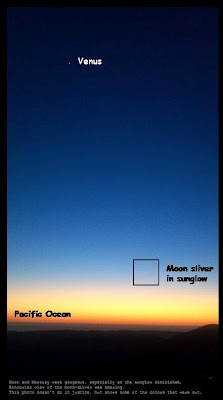
Conditions turned out to be just right for viewing the very young crescent moon in my neighborhood of the globe last evening.

As the sun sank below the horizon, the brilliant planets Venus and Jupiter looked like jewels in the deepening blue high above, forming a line which pointed down towards the red glow where the sun had disappeared over the rim of the earth's horizon.

At first, the very fine sliver of the moon's arc was impossible to spot, but suddenly it was unmistakeable. The photograph above does not do it justice at all. Through binoculars it was breathtaking -- a thin silvery line, so thin that it was not even completely continuous. There is a gorgeous photograph on the web taken by photographer Stephano de Rosa which shows the same crescent over the Alps: this is very much what it looked like here, except that the color of the sky was different over the Pacific Ocean. Clicking on that photograph enlarges it for even better detail.

Just below and to the left, Mercury could be easily spotted through binoculars, a very small jewel sitting in a golden sea of the sun's glow (at first). As the rim of the earth continued to "rise up" (or the sun continued to retreat further below the horizon), this glow diminished and the moon and the planet Mercury became very distinct in the darker blue background. Mercury took on a very slight orange hue (almost yellow-orange).

This previous post outlined some of the mythological connections associated with the category of planetary events we are enjoying this month. The excellent video from Sky & Telescope's Tony Flanders shows where the crescent moon will be located tonight. As the sun continues to outpace the moon like a runner in a race that has passed another runner and continues to widen the gap, the moon trails the sun by a greater distance each day, and thus sits higher in the sky after sunset each evening. The crescent also thickens as the moon gets further from the sun (on its way to becoming full when the moon has gotten so far from the sun that it is now opposite to the sun from the observer on earth -- see previous discussions here and here).

Mr. Flanders also has an accompanying article which explains that last night's very thin crescent moon was about twenty-eight hours old when the sun was going down on the west coast of North America on the evening of February 22 (about twenty-four hours old for viewers along the east coast of the same continent). A link in that article takes you to another excellent Sky & Telescope discussion of very new crescent moons.

It explains that the window of sixteen to twenty-four hours after the precise moment of new moon is about the soonest one can observe the very thin crescent with the naked eye. The record for naked-eye observation of a new crescent is currently a moon that was only fifteen hours and thirty-two minutes old. A crescent only eleven hours and forty-two minutes old was observed with optical aid in 2002.

The second page of that article on observing very new crescents explains that astronomers have determined that the moon must be at least seven and a half degrees behind the sun for a crescent to begin to appear at all. Some of the work in this area was done by professor of astronomy Dr. Bradley Schaefer, who is mentioned in that article and also in this previous post discussing his important new analysis of the star catalogs of Ptolemy and Hipparchus (and his analysis of the Farnese Globe).

All five visible planets are now observable in the same evening. The planet Saturn rises later in the constellation Virgo, which follows Leo and retrograde Mars in the east.


Leo, the Lion King, Hamlet, and Osiris


Spoiler alert: if you are the one person who never saw the 1994 Disney movie The Lion King, you may not want to read on, in order to avoid compromising the storyline -- except for the fact that, because the storyline is so ancient, all humans probably know it even without seeing the Disney adaptation.
Currently, the majestic constellation of Leo the Lion dominates the eastern sky after sunset, rising vertically out of the eastern horizon just as the sun is going down, and reaching culmination almost precisely at midnight in the mid-thirty degree latitudes of the northern hemisphere.

Right now, as the night sky is clear of interference from the moon (which is currently being overtaken by the sun to form a new moon, and will closely trail the sun for a few days), there is a dazzling panoply of stars and constellations filling the night sky.

Orion continues to rise earlier and earlier (for a discussion of this principle, see this previous post). Whereas he was only just breaking above the horizon at 10 pm back in late October and early November, he now rises shortly after 1 p.m. (during daylight hours) and is well advanced in his arc across the sky by the time the sun goes down, reaching his culmination or highest point at around 7:30 in the evening (depending on your location on the globe) and sinking below the western horizon around 2 a.m.

During much of the same time, the constellations of Taurus (with the beautiful Pleiades), Perseus, Auriga, and Gemini are also clearly visible in the turning sky, all of whom we have examined previously.

If you can get to a dark enough point for observation, you should be able to see not only the "sickle" shape formed by the brightest stars in Leo the Lion as he rises, but also the much smaller and dimmer stars that make up his actual face. When you do make these out (see this diagram for help, and then go out and see the actual constellation in the sky, which is much more impressive than any illustration can convey), you may well be reminded of the lantern-jawed lions of Disney's Lion King, and this is actually an interesting connection, because the plot of that movie comes directly from some very ancient sources.

Many have already pointed out the direct parallels between the plot of The Lion King and Shakespeare's Hamlet. These include the murder of the rightful king (Mustafa in The Lion King and old King Hamlet in Shakespeare's play) by a usurping brother (Scar in The Lion King and Claudius in Hamlet), as well as a confused son (Simba in The Lion King and young Prince Hamlet in Shakespeare's play) who must rise to the task of righting the wrong, deposing the usurper, and restoring the kingdom.

Some have also pointed out that this plot in The Lion King also directly parallels the ancient Egyptian mythology surrounding Osiris, who is killed by his brother Set (or Seth) and must be avenged by his son Horus. Set temporarily reigns in his brother's stead in a position of primacy, but the Nine Gods of the Egyptian Ennead declare that this situation is not right. Set and Horus contend for the kingdom and Set is eventually deposed and Horus ascends to supreme authority.

In fact, this connection between the plot of Hamlet and the events depicted in the Osiris-Set-Horus series is found in multitudinous other myths from around the world and throughout human history, as described by Giorgio de Santillana and Hertha von Dechend in their essential 1969 text, Hamlet's Mill (which takes its title from this crucial observation).

Those authors (as well as others who have followed them) provide convincing evidence that this myth is bound up with the celestial phenomenon of precession, which eventually "deposed" the constellation Orion (identified with Osiris) from his accustomed date of heliacal rising -- encoded in myth as the slaying of Osiris by Set.

The full details of this astronomical origin of the Osiris-Set mythology (which persists to this day in various manifestations, including the plot of The Lion King) are more fully explained in the Mathisen Corollary book (available in paperback form on Amazon here, although shipping with a slight delay, or for immediate shipping directly from the publisher here, and also available for immediate reading in Kindle format here).

So, although Leo is not really directly related to the Osiris story in the same way that Orion is, the fact that the familiar plot-line of The Lion King directly relates to this ancient and precessional myth gives it a sort of modern connection to the vitally-important Osiris series, a myth-pattern which simply must be clearly understood in order to understand many of the symbols hidden in ancient monuments and legends from around the globe. The movie also incorporates the stars of the night sky as an important motif, tying its plot even more directly to this ancient theme.

For this reason, enjoying the timeless plot of The Lion King can open a window onto mankind's ancient past.