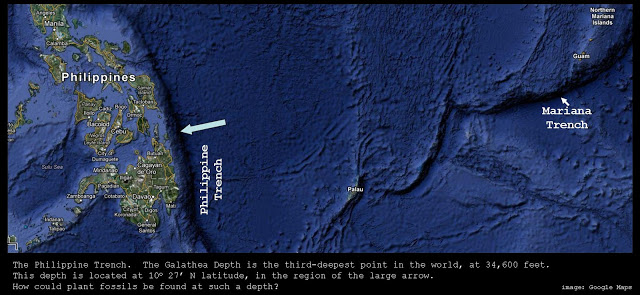
The Mariana Trench is famous for having the deepest known point in the ocean, Challenger Deep (36,000 feet), which was discussed in this previous blog post. However, prior to the Challenger Expedition of 1951, the deepest known point was the Galathea Depth (34,600 feet), at the bottom of the Philippine Trench, at the area indicated by the large arrow in the image above. This point, named for the Galathea Deep Sea Expedition of 1950-1952, remains the third-deepest known location in the world to this day.
The Galathea Expedition was a Danish oceanography expedition whose purpose is described in this report from the expedition itself, beginning on page 26. That purpose was "to explore the ocean trenches in order to find out whether life occurred under the extreme conditions prevailing there -- and if so, to what extent" (26). In addition to making extensive notes on deep-sea life that it discovered, the Galathea Expedition also reported plant remnants and fossil plant remnants from the lowest depths of the Philippine Trench -- a truly remarkable discovery.
How did plant material find its way to the bottom of the Philippine Trench, and how did plant fossils occur there? It is quite clear that no plants can grow at such depths, isolated from the light of the sun by six miles of water above them. The discovery of fossils of organisms that could only grow on land or perhaps in very shallow waters at some of the deepest points in the ocean parallels the discovery of marine fossils atop Mt. Everest, earth's the highest point (those fossils are discussed here).
Dr. Walt Brown, the originator of the hydroplate theory, discusses both sets of evidence, and argues that his theory provides a more reasonable explanation for these remarkable discoveries than the conventional theory. The discussion of the deep ocean trenches, and the mechanism that caused them according to the hydroplate theory, can be found here.
The reports from the Galathea Expedition, such as this one which discusses this material on pages 15 - 17, propose that turbidity currents may have carried the plant material to these depths, and that is certainly a possible explanation. However, even if we allow that such currents could have moved plant matter down that far, we still must account for the fact that they turned into fossils. As we have discussed in many previous posts (such as this one), unusual conditions are necessary to create any fossils, whether on land or in the ocean. Organic matter must generally be buried rapidly in something like thick wet mud, to keep bacteria from breaking it down -- given enough time, these bacteria would even break down bone, preventing the formation of a fossil.
Again, the turbidity currents could have been accompanied by mud flows which then buried the matter and allowed it to fossilize. Another possibility is that fossils formed in shallower water and then the "conveyor belt" action proposed by plate tectonics drew the plates along over the millennia until the land fossils (or shallow-water fossils) ended up in the deep-sea trenches.
Arguing against this explanation, however, Dr. Brown points out that "Because plants float and quickly disintegrate, they should not be buried
and preserved in one of the deepest parts of the Pacific Ocean" (see point 24 on this page of his online version of his book). He also points out that the sedimentary layers in the deep ocean trenches are undisturbed -- if plates were truly subducting the way tectonics advocates say that they are, these sedimentary layers should be violently disturbed by this ongoing activity. This argument is given as one of the sixteen reasons he shows that plates are not subducting in the ocean floor, found in Table 4 on this page of his book.
On the other hand, Dr. Brown's theory has no trouble explaining the presence of fossils at the bottom of the deepest ocean trenches. He argues that these deep ocean trenches were caused by downward pulling pressure from beneath the Pacific basin itself -- that they were basically sucked down, not pushed down by subduction. The force that pulled the floor of the Pacific toward the other side of the globe was the result of the powerful mechanism that unleashed the global flood itself: a powerful rupture releasing water that had been trapped under the earth's surface, which jetted upward and eroded the crust above the rupture, allowing the basement to spring upward as the weight above was released. When the earth bulged upward on the Atlantic side, creating the Mid-Atlantic Ridge and initiating the slide of the continents away from the rupture, the floor of what would become the Pacific, on the opposite side of the globe, was sucked downward towards the center of the earth, creating the deep ocean trenches which form distinctive "arc-and-cusp" patterns that are much more consistent with this explanation than with the theory of subducting plates.
This explanation is consistent with fossils from land or shallow-water plant species now located at the bottom of the deepest trenches. As Dr. Brown explains, "It should be no surprise that the global flood, which fossilized
trillions of animals worldwide, also formed fossils in places that later
became ocean trenches. Rapid burial, necessary to form and preserve
fossils, was quickly followed by the subsidence of the Pacific plate and
the downward buckling of trenches" (this page, point 23).
The evidence from the bottom of the deepest parts of the ocean should be considered along with all the other extensive evidence from around the globe, and then the theories that attempt to tie all this evidence together should be compared to see whether they can adequately explain all of the evidence, and to see which theories have difficulty with various pieces of evidence. In my opinion, there is really no comparison. There are literally hundreds of pieces of evidence which appear to be better explained by the hydroplate theory than by the tectonic theory. The tectonic theory certainly explains evidence better than the theories that it replaced, but it has major problems with many pieces of geological evidence that the hydroplate theory explains quite well.
The fossils at the deepest ocean trenches appear to join with the fossils at the highest mountain tops in declaring the truth about the earth's violent past.