Matariki


Special thanks to Main Man who contacted me all the way from 37 degrees South latitude with this outstanding infographic on Matariki, the Maori new year, published in the New Zealand Herald.

As you can see from the article, Matariki is the Maori name for the beautiful Pleiades, discussed in these previous blog posts, which all contain some discussion of how to find them in the sky (see here, here, and here).

The Herald infographic explains, "The reappearance of Matariki in the eastern sky before sunrise marks the beginning of the new year."  The phenomena of a star or group of stars reappearing in the sky in the east before the sunrise is called the heliacal rise of the star or group, and it is caused by the fact that as the earth goes around the sun through the year, stars rise a little earlier each day due to the progress of the earth around its orbit.  This means that they will be further and further along each night when you see them in their journey from east to west across the sky, and eventually a star will have set before the sun goes down and the stars become visible (unless the star is one of the undying stars, near enough to the pole to be visible all year around).

After that happens, the star or group of stars will be up during the day for a period, but it will still keep rising earlier and earlier and after some time of this, it will rise before the sun again, and there will be a special morning on which it will rise far enough ahead of the sun to be just visible in the east above the eastern horizon in the early morning sky, which will be lightening as the sun's rising approaches but still dark enough to perceive the returning star or stars.  When this happens for Matariki (the Pleiades), it marks the new year for the Maori.

Currently at my latitude, Matariki rises around 5 am (and getting a little earlier each day).  The sun rises about forty-five minutes later.  Therefore, if you look to the east before the sun rises, you can find the beautiful cluster of stars above the horizon, before the rising sun fills the sky with his rays.  So, no matter where you are on the globe (unless you are so far north that the sun is not currently dipping below the horizon at all), you should be able to rise early and take in the glorious spectacle of the glistening stars of Matariki, hanging in the deep blue predawn sky, signalling the start of a new year and the connection of heaven and earth.


Comet Tempel 1 and the Deep Impact mission of 2005


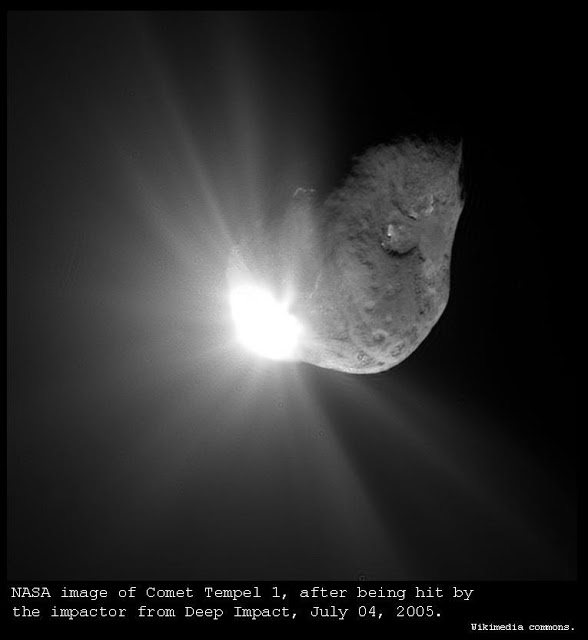
(image above: Wikimedia commons).

Comet Tempel 1 is a short-period comet with an orbital period of approximately 5.5 years and a perihelion of about 1.5 AUs (an AU or "astronomical unit" is a unit that is roughly the mean earth-sun distance, and the perihelion of 1.5 AUs means that Comet Tempel 1's orbit takes it further from the sun than the orbit of Mars but not as far as Jupiter).  

The comet was discovered in April of 1867 by Ernst Wilhelm Leberecht Tempel, of France, who was looking for comets at the time (see this discussion of the comet's history from the NASA webpage). As that page explains, the comet was observed that year using telescopes until it was lost from sight in August of 1867, but it was reacquired at its next visit in 1873, then again in 1879 (when Tempel himself recovered visual observation of his discovery), after which it was lost to observers on earth until 1967.

In 1967, Professor Elizabeth Roemer, an American astronomer, took several photographic images of the area in space where the comet was predicted to reappear.  Her initial inspection of the plates turned up nothing, but upon re-checking them the following year she noticed a very faint (18th magnitude) object near the location that the comet's return had been calculated to be, in the plate from June 8th of 1967.  Later analysis of the comet confirmed that this image was indeed Comet Tempel 1, reacquired after all those years.

On its next visit in 1972, Professor Roemer and another astronomer successfully recovered observation of Comet Tempel 1, and it has since been observed on every subsequent visit, according to the NASA site linked above.  

The most remarkable history of the comet, however, was yet to take place.  In 1999, planning began for a mission to study the composition of comets by firing a "smart impactor" into a comet, releasing material from the comet into space from the impact.  This material could then be observed up close by the spacecraft that had fired the impactor, and the spectrometry and other data studied to reveal information about the makeup of the comet itself.

The mission was dubbed "Deep Impact," and the Deep Impact spacecraft was launched from Cape Canaveral Air Force Station (Cape Kennedy) in January of 2005, on its way to a rendezvous with Comet Tempel 1 in July of the same year (see this NASA page for details of the launch).  The Deep Impact spacecraft was a two-part system consisting of the flyby spacecraft (described as being about 11 feet by 8 feet by 7 feet) and the smart, instrumented, self-guiding impactor (which weighed about 816 pounds counting fuel at the time it was launched).  The impactor was made largely of copper (it was 49% copper) to minimize interference with the comet's material.

At this time eight years ago, Deep Impact was speeding towards Tempel 1, taking images as it approached.  From the images, scientists have calculated that the comet's nucleus is roughly 7.6 kilometers (4.7 miles) by 4.9 kilometers (3.0 miles), and venting or outgassing sporadically as it orbits the sun.  At twenty-four hours before intended impact, the impactor separated from the flyby vehicle and shot towards the comet's nucleus.

What happened next is astonishing.  The impactor successfully struck the comet and created an enormous cloud of debris (often referred to as the "ejecta" by scientists writing about the event).  The spectral analysis revealed a host of amazing material from the comet, including organic material!  How did that get there!?

In addition to this perplexing discovery, scientists found numerous materials in the debris cloud that also create some explanatory difficulties.  This discussion of the analysis of the ejecta pubished in 2006 indicates that the spectral analysis of the debris thrown up by the tremendous impact included: "both crystalline and amorphous (glassy) silicates, amorphous carbon, carbonates, clay minerals (phyllosilicates), water in both the gaseous and solid states and sulfides."  This page on the NASA website also discusses the material ejected when the impactor struck the comet.

Dr. Walt Brown, the originator of the hydroplate theory, provides extensive discussion of comets in his book (which can be read in its entirety online or purchased for reading in hardcopy), because comets have so many features which confound conventional theories, but which can be satisfactorily explained by the hydroplate theory (previous blog posts on this topic can be found here and here, for example, or found by using the blog-specific search window at the upper left of this page). 

Dr. Brown points out that the ejecta from the impact of the 2005 mission pose numerous problems for conventional comet theorists.  For example, the fact that the comet contains crystalline dust is difficult to explain if comets form in deep space.  Dust formed in outer space should be noncrystalline, posing a serious problem to the theory that comets form in a hypothetical "Oort cloud" beyond the solar system, as well as to other theories that posit a deep-space origin for comet dust, as Dr. Brown explains in the section of his book comparing various comet-origin theories in detail (that section begins here).  

Dr. Brown also notes that the organic material found in the comets poses serious problems for most conventional comet theories.  Vegetation or bacteria capable of producing the organic readings found in the spectra of Comet Tempel 1 would not be expected to originate in the cold, dark reaches of space where most conventional theorists believe comets come from.

Additionally, note that the 2006 list of debris ingredients includes silicates (which Dr. Brown points out contain considerable oxygen, "a rare commodity in space"), carbonates (they found calcium carbonates, or limestone, a mineral that forms in liquid water -- something difficult to explain in the frigid vacuum of space where the Oort cloud is supposed to reside), and clay (another mineral substance that requires liquid water).

All of these findings, however, including the presence of organic methane in the comet's ejecta, are completely predictable if the origin of comets was the planet earth!  According to the hydroplate theory, comets originated when subterranean supercritical water was ejected at tremendous velocities during the events surrounding a catastrophic flood in earth's past.  

Dr. Brown's explanation of this comet-origin theory can be found in the paragraph that begins below the long table (Table 13) on this webpage (a little over halfway down the webpage).  He explains that: "Carried up with the water were eroded dirt particles, minerals that form only in scalding-hot, high-pressure, liquid water, pulverized organic matter (especially cellulose from preflood forests), and even bacteria."  This explanation accounts for all of the surprising features of the composition of Comet Tempel 1.

For example, silicates are one of the most common components of earth's crust, and the fact that they contain oxygen is no problem if they originated on earth.   According to Dr. Brown's theory, the material that escaped earth's atmosphere and formed comets originated in the hot, mineral-rich water that had been trapped beneath the earth's surface under great pressure.  This theory would explain the presence of minerals and clays that form only in the presence of hot, liquid water (see this portion of Dr. Brown's book, point 7 near the bottom of the webpage).  Dr. Brown's theory also explains the organic materials: "Organic compounds—including methane, ethane, and the amino acid glycine—are found in comets,1 because that water contained pulverized vegetation from preflood forests (as well as bacteria and other traces of life) from within hundreds of miles of the globe-encircling rupture."

Further, comets contain significant amounts of heavy hydrogen -- about twice the amount that is found in the oceans on earth today.  This actually accords quite well with the hydroplate theory:
Comets are rich in heavy hydrogen, because the water in the subterranean chambers was isolated from other water in the solar system. Our oceans have half the concentration of heavy hydrogen that comets have. So, if half the water in today’s oceans came from the subterranean chambers (as assumed on page 118), then almost all heavy hydrogen came from the subterranean chambers. (This will become even more clear after reading the radioactivity chapter on pages 350395.)  
Other theories have difficulty explaining the presence of this heavy hydrogen because, as Dr. Brown explains, "The concentration of heavy hydrogen in comets is 20-100 times that of interstellar space and the solar system as a whole.  Evidently, comets came from an isolated reservoir."

This information is probably not common knowledge to many members of the general public.  This NASA page discussing the ejection plume mentions the "substantial amount" of organic material measured and speculates that other similar comets "could have brought this material to Earth early in our planet's history."  Such speculation, however, does not provide much detail as to how that organic material could have gotten into the comets in the first place.  A far more likely conclusion at this point, given all the evidence discussed above, seems to be that earth sent the organic material out into space, rather than the other way around.

The evidence in support of the hydroplate theory is extremely wide-ranging and not limited to our planet (although there is plenty of evidence here on earth as well, from the tops of the tallest mountains to the bottom of the deepest trenches of the Pacific).  The mysterious properties of comets rank high among the list of evidence that is very difficult for conventional theories to handle, but which strongly support the hydroplate theory's explanation of the events of the ancient past.


Two very disturbing developments


Recently, disturbing news involving genetics has been making headlines in the US.

On May 29, the US Department of Agriculture announced that test results of wheat plants growing on an Oregon farm confirmed the presence of genetically-engineered wheat, despite the fact that genetically-engineered wheat is not approved for human consumption.

Here is a link to the USDA's press release on the discovery.

This discovery is disturbing in that it reveals the clear possibility that genetically-modified wheat has already entered the food supply, unbeknownst to farmers, regulators, or consumers.  Most commentators are assuming that this GMO wheat is somehow descended from genetically-engineered plants that the USDA allowed to be "field tested" in sixteen states from 1998 through 2005.  

How this wheat spread to fields under cultivation that were not part of the test, and how many such fields are now contaminated, is unknown.  What is known, however, is that it not only did spread but that wheat being grown today is descended from this genetically-engineered variety.

Here is a recent article from the New York Times downplaying the safety concerns of this discovery, saying "Absent any proven health threat, the most common fear is economic — that organic farmers will lose crops, or that food exports to countries that ban imports of gene-altered products will suffer."  In other words, farmers and exporters and other business entities participating in the sale of wheat are the only ones with anything at stake here: no one who consumes such wheat has anything to worry about. 

However, that statement is debatable.  Numerous previous posts have looked at the subject of genetically-modified food, such as this one and this one, and noted that this issue is related to the overarching theme of this blog, which is that individuals should consider the evidence for themselves about important subjects.  

The safety of genetically-modified foods is far from a settled issue.  In fact, there are serious reasons to investigate this question further.  Even if the safety of such foods were settled beyond any doubt (which it is not), there may be reasons of conscience, religion, etc. why some individuals may wish to refrain from consuming genetically-modified foods, and the fact that genetically-engineered wheat may be entering the food chain without their knowledge means that consumers have a stake in this issue, and not just the growers and the exporters as the New York Times story alleges.

Further, the "safety" of this genetically-modified wheat appears to be based on the assertions of its developer, according to the USDA press release.  The USDA release states that:
The Food and Drug Administration (FDA) completed a voluntary consultation on the safety of food and feed derived from this GE glyphosate-resistant wheat variety in 2004.  For the consultation, the developer provided information to FDA to support the safety of this wheat variety.  FDA completed the voluntary consultation with no further questions concerning the safety of grain and forage derived from this wheat, meaning that this variety is as safe as non-GE wheat currently on the market.
This is a very illogical paragraph.  It asserts as a conclusion that "FDA completed the voluntary consultation with no further questions concerning the safety of grain and forage derived from this wheat, meaning that this variety is as safe as non-GE wheat currently on the market."  The conclusion that "this variety is as safe as non-GE wheat currently on the market" does not follow at all from the fact that the "FDA completed the voluntary consultation with no further questions."  

All we can conclude from that is that the FDA decided not to question the developer any further.  They could have decided that for a number of reasons, but it does not follow automatically that we must conclude from this that the GMO wheat is "as safe as non-GE wheat currently on the market."

The fact that wheat is used in a tremendous variety of foods, and that the US exports a huge amount of wheat to nations around the world, makes this a very important and disturbing development.  In fact, wheat has been referred to as "the staff of life."  This particular phrase may well descend from the venerable English translation of the 105th Psalm, verse 16, in which we read that, "he called for famine upon the land: he brake the whole staff of bread."

Elsewhere in the news, the US Supreme Court this week decided in a case entitled Maryland v. King that individuals who are arrested may be compelled to yield a DNA sample, which can then be entered into federal crime records.  The case was decided by a vote of 5-4, with an eloquent dissent written by Antonin Scalia, in which he asked why an arrest entitled such an invasion, when an arrest does not entitle a warrantless search of someone's house, for example.  "But why are the 'privacy-related concerns' not also 'weighty' when an intrusion into the body is at stake?  (The Fourth Amendment lists 'persons' first among the entities protected against unreasonable searches and seizures)" (page 35 of the pdf file of the decision).

Remember that an arrest is not a conviction -- a person who is arrested is presumed innocent until proven otherwise.  The Fourth Amendment codifies the inherent right of all men and women to the security of their persons, houses, papers and effects, and declares that this inherent right shall not be violated except by a legally-issued warrant, and that such warrant must specifically -- in fact, "particularly" -- describe exactly what is being searched and what particular person or thing the searching agent is looking for.

This new decision completely overturns that requirement, allowing the state to compel an arrested person (who is innocent until proven otherwise) to give up his or her DNA, which will then be searched not for anything in particular.  It is almost as if the court had ruled that agents could come snooping through someone's home, not looking for anything in particular but just for anything that might tie the resident to any crime, except that snooping through someone's DNA is even more intrusive, at least according to the dissent authored by Scalia and signed by three other justices.

The entire decision can be read online here, with Scalia's dissent beginning on page 33 of the pdf file.

The majority opinion asserts, "By comparison to this substantial government interest and the unique effectiveness of DNA identification, the intrusion of a cheek swab to obtain a DNA sample is a minimal one" (page 27 of the pdf file). 

So, instead of saying, "Papers, please," arresting agents can now say, "open wide" and gather a DNA sample from a citizen, which is a far more comprehensive form of identification than anything seen in the past.

Thus we now have a situation in which citizens apparently do not have a right to know the genetically-modified status of the wheat in their pizza, but the government has the right to demand to know the entire genetic content of an individual who is arrested by authorities.

These developments highlight the importance of thinking for yourself, and not simply accepting at face value every assertion made by the "experts."


Asteroid 1998 QE2 and its newly-discovered asteroid moon


Earth was recently visited by a large asteroid, first discovered in 1998 and ironically given the name Asteroid QE2.  

As this page from the NASA website explains, the asteroid made its closest approach to earth (until it returns in another 200 years) on May 31 at 1:59 in the afternoon, Pacific time (4:59 pm Eastern / 2059 UTC).  Its approach only brought it to a distance of 3.6 million miles away -- about 15 times the distance of the earth and the moon, according to NASA.

One of the most remarkable aspects of this flyby was the discovery based on radar imagery, captured on the evening of May 29 this week, that Asteroid 1998 QE2 has its own small "moon" traveling in tandem with the asteroid on its lonely journey through space.  Scientists estimate that Asteroid QE2 itself is 1.7 miles in diameter, while its partner is only 2,000 feet wide.  Asteroids that travel in tandem with another asteroid are sometimes called binaries, and as the NASA site says, scientists estimate that about 16% of the near-earth asteroids 200 meters in size or larger (655 feet or larger) have moons.

While the asteroid and its companion received a lot of press, very few of the articles tackle the question of how an asteroid could capture another asteroid as its moon (including the NASA discussion of Asteroid QE2 and its moon).  No mention is made of just how difficult of a physics problem that is, and the general public is basically left with the impression that binary asteroids are not difficult to explain.

In fact, asteroids like QE2 that possess moons are very difficult to explain under conventional theories, as Dr. Walt Brown, originator of the hydroplate theory, discusses in the chapter of his book devoted to "The Origin of Asteroids and Meteorites." 

Conventional attempts to explain the origin of the asteroids that orbit the sun in our solar system often posit that they are space rocks that were on their way to becoming a planet, but never quite managed to do so -- the so-called "failed-planet theory."  Another theory, a bit more out on a limb, is the hypothesis that the asteroids are the remnants of an exploded planet.  Some analysts even believe that this exploded planet was destroyed in a cosmic war, rather than exploding due to some kind of natural event.

Dr. Brown explains that neither of these theories can easily explain the presence of asteroids with moons.  Part 6 of "Question 7" located just over halfway down this page in Dr. Brown's discussion of asteroids and meteorites outlines some of the problems in explaining binary asteroids:
Some asteroids have captured one or more moons. [See Figure 168.] Sometimes the “moon” and asteroid are similar in size. Impacts would not create equal-size fragments that could capture each other.48 The only conceivable way for this to happen is if a potential moon enters an asteroid’s expanding sphere of influence while traveling about the same speed and direction as the asteroid. If even a thin gas surrounds the asteroid, the moon will be drawn closer to the asteroid, preventing the moon from being stripped away later. An “exploded planet” would disperse relatively little gas. The “failed planet explanation” meets none of the requirements. The hydroplate theory satisfies all the requirements.
In addition to their problems explaining asteroid moons, the failed-planet theory and the exploded-planet theory have problems in and of themselves.

This previous post, entitled "Comet origins and the mysteries of mankind's ancient past" discusses some of the work of the late Dr. Tom Van Flandern, who was a proponent of the exploded-planet theory, as well as an astronomer who pointed out the numerous problems with the conventional explanations for the origin of comets (a subject discussed in that and several other previous blog posts).  In spite of the fact that the exploded-planet theory has some problems, those who are exploring that theory should be commended for realizing the many problems with the conventional paradigm that is usually offered as the only explanation (whether the paradigm of mankind's ancient past or of the origin of the various bodies in our solar system).

This previous blog post, provides a list of evidence that appear to cause serious difficulties for either the exploded-planet theory, the failed-planet theory, or both.  It also discusses the asteroid-origin theory put forward by Dr. Brown, who believes that most of the asteroids are actually fragments violently ejected from earth during the rupture that led to a cataclysmic global flood.  While such a proposal for the origin of asteroids may initially sound preposterous, it turns out that this theory explains many of the puzzling aspects of asteroids (as well as meteoroids and comets), including the presence of binary asteroid pairs.  The interested reader should take the time to read Dr. Brown's entire chapter on the subject for the complete discussion (and then to peruse the other chapters of his book, which detail thousands of other geological pieces of evidence on our planet which support this theory of a catastrophic flood).

On the very first page of his chapter on asteroid origins, Dr. Brown has posted a photograph of asteroid Ida, taken in 1993 by the Galileo spacecraft.  That image shows Ida to have a mile-wide moon, orbiting about 60 miles away from Ida (the moon was then named Dactyl).  In his discussion of Ida and Dactyl, and asteroid binaries in general, Dr. Brown writes:
Asteroid Ida and Its Moon, Dactyl. In 1993, the Galileo spacecraft, heading toward Jupiter, took this picture 2,000 miles from asteroid Ida. To the surprise of most, Ida had a moon (about 1 mile in diameter) orbiting 60 miles away! Both Ida and Dactyl are composed of earthlike rock. We now know at least 200 other asteroids have moons; nine asteroids have two moons.1 According to the laws of orbital mechanics (described in the preceding chapter), capturing a moon in space is unbelievably difficult—unless both the asteroid and a nearby potential moon had very similar speeds and directions and unless gases surrounded the asteroid during capture. If so, the asteroid, its moon, and each gas molecule were probably coming from the same place and were launched about the same time. Within a million years, passing bodies would have stripped the moons away, so these asteroid-moon captures must have been recent. 
 
From a distance, large asteroids look like big rocks. However, many show, by their low density, that they contain either much empty space or something light, such as water ice.2 Also, the best close-up pictures of an asteroid show millions of smaller rocks on its surface. Therefore, asteroids are flying rock piles held together by gravity. Ida, about 35 miles long, does not have enough gravity to squeeze itself into a spherical shape.
These are important issues surrounding the question of asteroids with moons.  The point about the moons being stripped away after a million years (or less) is very important, especially since most proponents of the conventional "failed-planet theory" believe that the asteroids are leftovers from a very early period in our solar system's history.  Elsewhere in the chapter, Dr. Brown also points out that tidal effects (which he describes in the "Technical Notes" section of his book) would "limit the lifetime of the moons of asteroids to about 100,000 years."  

For some reason, the recent articles proclaiming the discovery of the moon orbiting Asteroid 1998 QE2 do not seem to mention these problems.

The discovery this week of the moon orbiting QE2 is just another example of the wide array of evidence that the hydroplate theory can explain but which conventional theories have serious problems explaining.  It is interesting to consider that, since the moon around QE2 was only discovered on May 29 of this year, Dr. Brown could not have known about its existence when he wrote his book.  

The existence of another binary asteroid, however, is not as surprising to those who know about the hydroplate theory as it should be to those who do not.


Virgo


Right now is an outstanding time of year to view the constellation Virgo the Virgin, high in the southern sky (for northern-hemisphere viewers) right around 10 pm.  And, as the moon is not rising until after midnight right now, the hours after sunset and before midnight provide a wonderful opportunity to gaze at the breathtaking array of stars along the ecliptic path.

Due to the turning of our earth on its axis, all stars appear to make an arcing path from the eastern horizon to the western horizon, reaching their highest point in between as they pass through (or transit) the "local meridian" -- that meridian of the celestial globe that runs through the celestial north pole and continues to the "due south" point on the southern horizon to the celestial south pole (which is out of sight below the horizon for many northern hemisphere viewers).  The crossing of this line marks the highest point of the sky for any star in its circular path, and is known as the star's "transit." 

Currently, the brightest star of Virgo -- the star Spica -- is transiting or reaching the highest point on its arc at about 10pm (and a few minutes earlier each night). 

One of the easiest ways to find Spica is to look for the small, bright, distinctive constellation of Corvus the Crow, who is always perched near Virgo, staring intently at the jewel of Spica.  In the diagram above, you can easily make out Corvus below Virgo.  

In the diagram above, I have added some lines to the outline of Virgo in order to correspond to the system of H.A. Rey, which I believe is much more user-friendly than any other constellation-outlining system I've ever seen (and which is the one I've used from the time I was a child, and which is described in the first two books discussed in this previous post, the top one for young children and the second one for older children and adults).

The planet Saturn is still passing through the constellation Virgo, just as he was two years ago when discussed in this post from 2011.   Then, Saturn was close to Porrima (the star marked by a green arrow in that previous post), but is now east of Spica, below the star that is connected to Spica (which is marked by a red arrow) by a line going straight to the left from Spica in the diagram in that previous post.  That previous post diagram is included below for ease of reference.

Saturn should be very bright and fairly golden in color.  You will have no trouble finding it, once you have followed Corvus to Spica.  Take some time to trace out the entire outline of Virgo, which is easy to do right now (but which is not always so easy).  It is a large and incredibly important constellation.  Further wast from Virgo, you should also have no problem spotting the majestic constellation of Leo the Lion.  If you haven't already done so, you might want to check out this previous post on some of the fascinating connections of these two constellations.

Further east from Virgo, you will also have no trouble finding the sinuous shape of Scorpio rising up from the horizon.

This is truly an excellent time to enjoy the dazzling panoply of the heavens.  I hope you can do so if at all possible.


Deep earthquakes


(Mobile readers please scroll down to read the post).


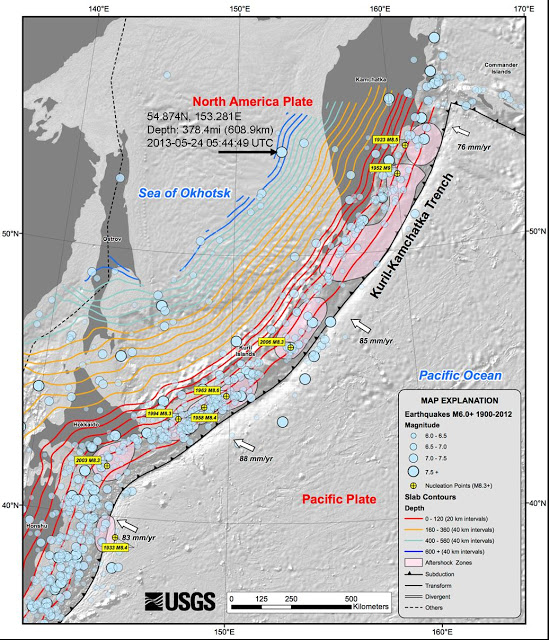
This past week, a very powerful deep earthquake of magnitude 8.3 originating 378 miles beneath the Sea of Okhotsk (west of the Kamchatka Peninsula) has scientists wondering whether this is the most powerful deep earthquake ever recorded.

At 3.8 miles deep or 609 kilometers below the surface, it is not quite as deep as the 395-mile deep (631 kilometer) earthquake that occurred below Bolivia in 1994, but at 8.3 it was more powerful than the Bolivia deep earthquake, which was judged to be 8.2.  

Here are two articles describing the recent deep earthquake below the Sea of Okhotsk, one from the "newsblog" of the journal Nature, and one from the website LiveScience.

Deep earthquakes present some challenges to geologists.  In fact, until the Bolivia earthquake, conventional geologists did not believe that deep earthquakes could approach the power of shallow earthquakes.  That's because conventional geologists believe that earthquakes are primarily driven by the engine of heat, primarily by the heat created by the friction and pressure at plate boundaries, which causes rock to suddenly squeeze into a denser form, leading to rapid realignment of material below the surface that creates a chain reaction from the epicenter which is felt as an earthquake.  

Deep earthquakes pose a problem for that theory, in that the heat and pressure so far below the surface are so great that the mechanism used to explain earthquakes at shallower depths would not seem to be a plausible explanation for deep earthquakes.  Whatever caused deep earthquakes, scientists did not believe that deep earthquakes would be as powerful as shallow earthquakes, but the Bolivia quake challenged that view.

As this New York Times Science Page article published in 1995, in the wake of the powerful Bolivia deep quake,  explains:
These upheavals [deep earthquakes], which occur 200 to 400 miles below the earth's surface, are puzzling in that they ought to be impossible. The pressures and temperatures at that depth are so great that rock should undergo no frictional sliding, the mechanism of garden-variety earthquakes near the surface. So most geologists came to believe that the crushing pressures and increasing heat below a certain depth squeezed the rock into forms that were suddenly denser, creating huge cracks that developed into big temblors.

No more. An extraordinarily big earthquake 395 miles beneath Bolivia last June not only shattered records by jolting cities as far away as Toronto but also left the squeeze theory shaken.

A new analysis of shock waves from that earthquake show its fault zone was 30 miles long and 20 miles wide, too big to be explained by the leading theory. In fact, experts say, the quake bears a disturbing resemblance to big ones that occur near the earth's surface.

"It's embarrassing," said Dr. Paul G. Silver, a geologist at the Carnegie Institution of Washington who questions the old theory. "It looks and acts and talks like these shallow earthquakes. But it shouldn't exist."

As the article goes on to explain, "The mystery is how earthquakes happen at all at remote depths where temperatures may exceed 2,900 degrees Fahrenheit and pressures are 240,000 times greater than those at the surface of the earth. In theory, any rock there should have the consistency of putty, ruling out the brittle fracture and frictional sliding found in faults near the surface."

In spite of the embarrassment of the "experts," that article reassures the reader that: "No matter who wins the intellectual battle, experts agree that deep earthquakes are a general expression of plate tectonics."

Well, that's comforting.

Except that proponents of plate tectonics still have a king-sized problem providing valid explanations for the characteristics of deep earthquakes, as Dr. Walt Brown -- the originator of the hydroplate theory -- explains in great detail in his discussion of the phenomenon.  Here is the beginning of an extended section of his book (the entirety of which can be read online here, or purchased to read in hardcover from his site or from Amazon) dealing with the phenomenon of earthquakes, and discussing the importance of deep earthquakes.

According to the hydroplate theory's model, the reason conventional geologists have a hard time explaining deep earthquakes is that their explanation of all earthquakes is incorrect.  On this page of his book (and the one that follows it), Dr. Brown presents an extended chart that lists features of earthquakes and then compares the hydroplate theory explanation to the tectonic theory explanation for each.  

At the heading of the two columns (hydroplate and tectonic), he explains the two different explanations that the two theories provide for the phenomenon of earthquakes (and the related phenomena of the Pacific basin, including the "Ring of Fire" and the deep Pacific trenches).  

The tectonic model explains earthquakes, deep Pacific trenches, and the "Ring of Fire" (surrounding the Pacific basin) as the product of "subducting plates that have been diving into the mantle for hundreds of millions of years."  As noted above, this explanation sees earthquakes and the related phenomena as primarily driven by heat.

In contrast, the hydroplate theory has a very different explanation.  According to Dr. Brown, "Trenches, earthquakes, and the Ring of Fire are a result of shifts inside the earth during the flood, including the rising of the Atlantic floor and the subsidence of the Pacific floor."  Rather than being driven by heat, these phenomena are primarily driven by gravity, according to the hydroplate theory.

You can explore the list of geological evidence in the two columns and decide for yourself which of the two explanations explains the evidence more satisfactorily.

According to the hydroplate theory, earthquakes today are the result of a cataclysmic event that took place at the time of a global flood.  The initial eruption of floodwaters from under the crust removed the weight of the continents above and led to an upward bulge of the basement rock beneath.  This series of events caused the mid-Atlantic ridge, and led to tremendous friction and melting inside the earth, in a widening cone whose base on the other side of the earth corresponds today (roughly) to the edge of the Pacific basin and the Ring of Fire.

In figure 95, found in note 37 on this page of Dr. Brown's online book, he presents a simplified diagram showing the effect on the inner earth of the proposed upward springing of the floor of the Atlantic after the release of the floodwaters and the erosion of the sides of the continents, which removed weight above the basement rock that forms today's Atlantic floor (this event was discussed in some detail in this previous post). The caption accompanying the image at figure 95 explains:
The mass rising to fill in the blue region of the top cone (the new Atlantic floor) would, as a first approximation, equal the mass passing through the center of the earth. The rock in the yellow cone would experience extreme shearing stresses and deformations, so rock first melted as it approached (and was extruded through) the constriction at the center of the earth. (This is how the earth’s core, shown in red, began.) As the extruded rock melted, it also shrank, by about half, because it was far below the crossover depth. That, in turn, collapsed the deepest foundations on the Pacific side of the earth and produced more shearing deformations and melting immediately above. A runaway situation quickly developed which formed the ring of fire (shown in green), and produced a myriad of fractures in and below the Pacific plate [to see the different colored areas he is describing, visit figure 95 in his book].
(This same sequence of events was also responsible for the creation of our planet's very strong magnetic field, as discussed in this previous blog post). 

Figure 86 (located almost halfway down this page discussing earthquakes, trenches, and the Ring of Fire) shows that earthquakes with magnitudes of 5.0 or greater have a distribution with two peak depths -- one at 22 miles and one at 370 miles beneath the surface.  The distribution chart shows that very few earthquakes originate at 222 miles -- the distribution curve has two distinct groupings of shallow earthquakes and deep earthquakes, with very few at the "crossover point" in between the two groups.  It also shows that earthquakes do not originate at depths greater than 410 miles.  

Dr. Brown's theory has an explanation for this surprising evidence.  His theory argues that earthquakes are caused when rock converges upon a point beneath the surface.  But how could rock converge on a point, unless rock that had been at that point were to somehow disappear to allow the surrounding rock to rush in?  Dr. Brown explains that due to the principles of physics, magma (molten rock) will expand and move upwards (towards the earth's surface) if it is above the crossover depth (of 222 miles), and that it will contract and move downwards (towards the earth's core) if it is below the crossover depth.

Shallow earthquakes are often caused when molten rock expands and moves upwards -- like a beach ball being held under the surface of the water, it wants to get up and eventually paths will open up for it to do so, often quite suddenly and with a chain reaction of further melting of the rock around them.  As this takes place, rock in the area will rapidly rearrange and cause an earthquake.

Deep earthquakes are caused by the same process, except that below the crossover depth the magma contracts and seeks to sink down to the core.  When it manages to do so, the rearrangement of rock that takes place creates a deep earthquake.

These are very broad outlines of the forces involved; for a more complete explanation, the reader is invited to examine the several pages of detailed discussion and diagrams in Dr. Brown's book on this topic.  However, it is important to point out that Dr. Brown's theory links deep earthquakes, the Ring of Fire, and the deep ocean trenches to a single originating event that connects all of them.  As you can see from the maps of this recent powerful deep earthquake, it originated in the vicinity of the Kuril-Kamchatka Trench (see map above from the USGS, with last week's earthquake location pointed out by a black arrow that I added based on the USGS report here).

The conventional explanation for the origin of these trenches, as well as the deep earthquake that took place last week, is that the Pacific plate is subducting or diving underneath another plate along these trenches, and that this subduction creates the trenches and the earthquakes.  As the article linked above from the journal Nature explains, the conventional view is that, "The crust is descending fast enough — about 8 centimetres per year — to remain cool enough to rupture even at great depths. The diving plate is thus seismically active down to 650 kilometres or greater."

Never mind the fact that a thirty-to-sixty mile thick plate diving beneath another plate would create intense pressure and intense heat, which would increase dramatically the deeper the plate went (making the above explanation somewhat problematic), the very idea that subduction is responsible for the deep ocean trenches is fraught with problems.  

One of the biggest of these, as Dr. Brown points out, is the shape of the ocean trenches -- they are frequently arcs, and sometimes they have dramatic cusps.  How could a diving plate create an arc?  As Dr. Brown points out, if you bend a thick paperback book in half (to simulate a plate that is subducting), you will have a very difficult time making that bend resemble an arc (in fact, you won't be able to do it).  

The cusps create an even bigger problem.  In the map above, you can see that the recent deep earthquake near the Kuril-Kamchatka Trench was located almost due west of a point where the trench takes a dramatic 90-degree turn.  What kind of subducting plate could create a trench shaped like that?

There are numerous other problems with the tectonic explanation for the deep ocean trenches (including the fact that almost all of them are located along the western portions of the Pacific basin).  Some of those are discussed in previous blog posts, such as this one and this oneMany more are discussed in detail in Dr. Brown's book.

On the other hand, the mechanism proposed by the hydroplate theory explains the shape and distribution of the deep Pacific ocean trenches very comprehensively, as part of the events of the catastrophic global flood, when the inner earth rose towards the Atlantic and "sucked" the Pacific basin towards the center of the earth.  The evidence supporting this explanation is detailed in Dr. Brown's discussion in points 43 through 56 towards the end of this page in his book.

All of this discussion is not a mere academic argument with no real consequence to our day-to-day lives.  According to Dr. Brown's theory, there could be reasons that powerful and deep earthquakes are becoming more common, and if his theory is correct we could see a tremendous increase in earthquakes at some point in the future.  At the end of the discussion accompanying Figure 87 on this page of his book, Dr. Brown writes:

Drainage into the outer core continues today, releases gigantic amounts of heat throughout the mantle and core,31 and will eventually produce many powerful earthquakes.  When this will happen is uncertain.32
In the footnote at the end of that statement (footnote 32), he restates the same disturbing conclusion:
Nevertheless, earthquakes will someday increase substantially, because heat is building up inside the earth and the shrinkage of rock that melts below the crossover depth increases stresses in the crust and upper mantle. Also, these microscopic movements inside the earth generate heat thousands of times faster than heat escapes at the earth’s surface. This increasing heat melts rock, especially along the relatively hot walls of faults extending from trenches down to the liquid outer core. That melt then lubricates and facilitates further internal movements. [See Endnote 31.]
This prospect for earthquakes increasing "substantially" someday is not exactly comforting.  However, it points to the importance of maintaining the ability to critically examine and question the dominant geological paradigms that inform our understanding of the world around us.  Powerful deep earthquakes such as the one that originated below the Sea of Okhotsk last week expose the weaknesses of the conventional models.  

Events such as this one should cause scientists to consider alternative explanations, such as the theory offered by Dr. Walt Brown, which has a lot of evidence to support it.

The Golden Gate


Above is a beautiful image from Wikimedia Commons of the Golden Gate, the narrow strait opening from the San Francisco Bay (on the left in the image above) into the vast Pacific Ocean (to the right in the image above, which was taken from the North Bay looking south towards San Francisco).  

The Golden Gate is of course spanned by the world famous Golden Gate Bridge, designed and supervised by Joseph Strauss (1870 - 1968) and completed in 1937, which is widely regarded as one of the most beautiful bridges in the world (who are they kidding -- it is undoubtedly the most beautiful bridge in the world).

The Golden Gate is about 1.7 miles wide at the point where the bridge is built across it, and its relative narrowness in comparison to the much larger bodies of water on either side of the strait means that the tides create very swift and powerful currents as the waters flood in from the ocean and then ebb back out in accordance with the tidal cycles each day (for a more detailed look at the tides and the celestial forces which influence them, see this previous post: "Moon, turn the tides . . . gently, gently away").

To understand why the tidal currents through the Golden Gate are so powerful, it may be helpful to imagine the "jet sprayer" faucet feature found on many modern kitchen sinks.  When you turn on your regular kitchen faucet, the water will come out at a certain moderate rate, but when you pull out the "jet sprayer" and depress the trigger, the water will suddenly come out with greatly increased force and pressure, even though you did not increase the water flow at the tap in any way.  Why does the water increase in power so much?  Because it is being forced through a much smaller opening (typically, through many pinhole openings, rather than through one larger faucet opening).  This is similar to the effect you get with a garden hose, when you suddenly constrict the opening with your thumb (again, the smaller gap creates an immediate increase in stream pressure, even though you did not increase the water flow at the tap in any way).

This same principle acts to greatly increase the power of the flood tide and ebb tide through the Golden Gate.  The strength of these tidal currents, and the generally cold water temperatures, helped make the notorious Alcatraz one of the most difficult prisons in the world from which to escape.  Alcatraz is pictured below, to the left of the left-hand tower in the photo as the viewer is looking at the image:


What mighty forces created this narrow gap between the San Francisco Bay and the great Pacific?  Wikipedia vaguely tells us that "San Francisco Bay is thought to represent a down-warping of the Earth's crust between the San Andreas Fault to the west and the Hayward Fault to the east, though the precise nature of this remains under study."  The entry goes on to speculate that a confluence of rivers flowing into this unexplained "down-warping" from the Great Central Valley then created the Golden Gate.

Such an explanation is typical of the kind of "hand wave" often given in place of a rigorous explanation when the conventional models have a hard time dealing with the details of the case.

In contrast, the hydroplate theory of Dr. Walt Brown offers a different hypothesis, based upon the overarching framework of Dr. Brown's comprehensive theory -- a hypothesis which finds evidence to back it up at other narrow straits around the world, and one which makes predictions about what someday will be found beneath the silt that currently blankets the bottom of the Golden Gate.

In the section entitled "Canyons" found near the end of this long webpage in his online book detailing his theory, Dr. Brown explains:
Drainage of the waters that covered the earth left every continental basin filled to the brim with water. Some of these postflood lakes lost more water by evaporation and seepage than they gained by rainfall and drainage from higher elevations. Consequently, they shrank over the centuries. A well-known example was former Lake Bonneville, part of which is now the Great Salt Lake.    
 
Through rainfall and drainage from higher terrain, other lakes gained more water than they lost. Thus, water overflowed each lake’s rim at the lowest point on the rim. The resulting erosion at that point on the rim allowed more water to flow over it. This eroded the cut in the rim even deeper and caused much more water to cut it faster. Therefore, the downcutting accelerated catastrophically. The entire lake quickly dumped through a deep slit, which we today call a canyon. These waters spilled into the next lower basin, causing it to breach its rim and create another canyon. It was like falling dominoes. The most famous canyon of all, the Grand Canyon, formed primarily by the breaching of what we will call Grand Lake. It occupied much of southeast Utah, parts of northeastern Arizona, and small areas of Colorado and New Mexico. [See the map on page 201 and pages 202235.] Grand Lake, standing at an elevation of 5,700 feet above today’s sea level, quickly eroded its natural dam 22 miles southwest of what is now Page, Arizona. As a result, the northwestern boundary of former Hopi Lake (elevation 5,950 feet) was eroded, releasing waters that occupied the present valley of the Little Colorado River.

With thousands of large, high lakes after the flood, many other canyons were carved. “Lake California” filling the Great Central Valley of California carved a canyon (now filled with sediments) under what is now the Golden Gate Bridge in San Francisco. The Strait of Gibraltar was a breach point as the rising Atlantic Ocean eventually spilled eastward into the Mediterranean Basin. The Mediterranean Sea, in turn, spilled eastward over what is now the Bosporus and Dardanelles, forming the Black Sea.
Note that this explanation is rigorous and detailed, it is built upon the fundamental principles of Dr. Brown's overarching theory, and that overarching theory is supported by extensive geological evidence from around the globe (see for instance"The Grand Canyon and the Great Flood," "The Ganges Fan, the Indus Fan, and the Great Flood," "The submarine canyons of California's Central Coast," "Geoids, relative gravity differences, and the deep Pacific trenches," "The bizarre 'barbed tributaries' of Marble Canyon," "Extraordinary sediment deposit from Pakistan to Bhutan supports hydroplate theory," and many others on this blog and in Dr. Brown's book).

It is also important to note that Dr. Brown's theory provides a comprehensive model from which it is possible to make predictions, and that Dr. Brown has published many such predictions in the past.  The ability to make predictions is one of the hallmarks of a true scientific hypothesis. Many of Dr. Brown's predictions have already been proven correct; others have yet to be proven.

In the case of the "downcutting" action described in the passage quoted above, in which large bodies of trapped water, left over from a global flood event, catastrophically breached, leading to the carving-out of V-shaped canyons, Dr. Brown has predicted that:
The crystalline rock under Gibraltar, the Bosporus and Dardanelles, and the Golden Gate Bridge will be found to be eroded into V-shaped notches. (This prediction, first published in 1995, was confirmed for the Bosporus and Dardanelles in 199890 and for Gibraltar in 2009.91)
In other words, Dr. Brown has applied this theory to the straits at the Dardanelles, the Bosporus, and the Straits of Gibraltar (all in the region of the Mediterranean), as well as to the Golden Gate.  He predicted in 1995 that V-shaped canyons could be found under the silt of each of these straits, because he believed that all were carved by the same type of event (the violent breaching of a narrow barrier by a large, trapped body of water). His predictions were later found to be correct in the Bosporus, the Dardanelles, and the Straits of Gibraltar.  

You can see images with cross-sections of the Dardanelles Strait in this scientific publication from September, 2012, showing the type of V-shaped notch predicted by the hydroplate theory.   Dr. Brown's prediction has yet to be proven at the Golden Gate, but perhaps it will be in the future.

The evidence would appear to suggest that the beautiful Golden Gate represents yet another strong supporting argument in favor of the hydroplate theory of Dr. Walt Brown.