John Anthony West on creativity, discipline, and consciousness


In his groundbreaking book, Serpent in the Sky: the High Wisdom of Ancient Egypt (1979), John Anthony West explores a host of vital topics, but one extremely important subject he discusses is the relationship between creativity, discipline, and consciousness.  

In his examination of the incredible art of ancient Egypt, he explains that creativity and discipline are intimately connected.  We might at first think that discipline, implying rules and even restrictions, would be the antithesis of creativity, but John Anthony West explains that this is not so: it is in fact the discipline which enables the expression of the individual's creativity.  

He writes:
In Egypt, the anonymous sages were the artists, in our modern inspirational sense.  They designed the temples and the statues and the wall friezes.  The sculptors, painters and masons were but interpretive artists, this is true.  But there is no ignominy in this position.  We do not think the violin virtuoso 'repressed' because he must play Beethoven's or Bartok's notes.  Moreover, within the restriction of the imposed piece, there is ample opportunity for the exercise of creativity -- otherwise all virtuosos at a given level of professionalism would sound the same.  And if the virtuoso is a real virtuoso, then he will share in Beethoven's revelation.  90.
It was this combination of discipline and creativity that enabled the development of the individual artist, who by the long path of his particular discipline was enabled to express creativity at a very high level.  In John West's analysis, Egyptian art and architecture was "a continuous exercise in the development of individual consciousness" (90).  

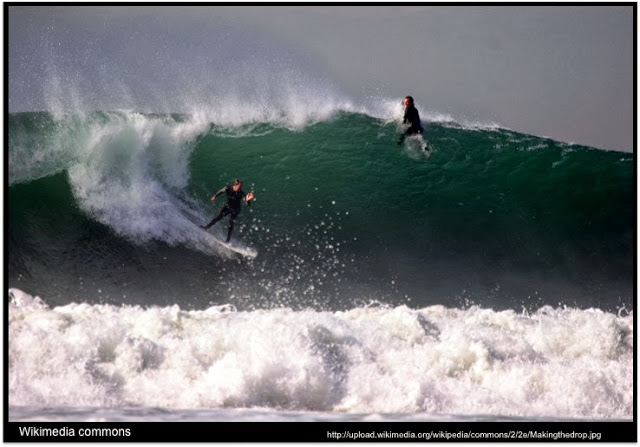
This discussion of the interplay between discipline, creativity, and consciousness is extremely interesting.  It is only through years of discipline, for example, that basketball players can reach a level at which their playing can actually become an expression of individual creativity -- a level of artistry and self-expression (within the highly-defined boundaries of the sport) that can be described as the level of a virtuoso.  The same can be said of many other pathways for expressing creativity -- whether music, or painting, or sculpture, or the martial arts, or surfing, or yoga, or rock-climbing, or the craft of pottery, or of woodworking, or of glassblowing, or endless other examples which we can call to mind.

We could even venture to say that the simple act of making tea (which is -- at least in theory --  easier to prepare than coffee) can become a discipline which can eventually enable an extremely high level of artistic expression (and, of course, in some cultures it has).  

Interestingly, John Anthony West suggests that together, the interplay of discipline and creativity can lead to "the development of individual consciousness."  In an important 2008 interview on Red Ice Radio (discussed in this previous blog post, with a link to an online video containing the entire interview), John Anthony West elaborates on the importance of creativity and discipline to life.  

While the entire interview is worth listening to, the really focused discussion of "consciousness" and the role of creativity and discipline begins around the 1:15:00 mark in that video.  During that discussion, he again expresses the view that creativity -- which can be expressed in an enormous variety of disciplines, including hard work as "a carpenter, or a cooper" (1:17:22) -- is fundamental to consciousness.

In the same discussion, he expresses the view (also found on pages 90 and 91 in Serpent in the Sky) that modern civilization makes it much more difficult to pursue this path, particularly in our daily work lives.    But, in the same discussion, he notes that this should not be cause for complete despair -- it is still possible to pursue this path, although perhaps one will have to make a living doing something else at the same time.  Beginning at about 1:32:15, Mr. West explains:
It's very difficult to find that life path that will actually prove nurturing in and of itself -- but it doesn't mean that you can't do it: everyone has to make a living, so, not everybody can be a writer or a painter or an artist or a creator in that sense, especially nowadays -- but as long as the message is driven home, and there are -- as I said, there are -- my own focus is the Gurdjieff work but, that's, you know, that's a small thing -- it's not a small thing, it's a big thing, but it's not that well known -- but there are disciplines, legitimate disciplines, out there, that can be followed -- it's hard to do by yourself, you almost need a class to do it -- it's like learning the violin by yourself -- you can learn it, but you're much better off with a teacher -- you can learn it by yourself and then when you get to a certain point you have to get a teacher to teach you what you're doing wrong so that you can do it right.  So there are schools in which you can pursue that path -- but without the discipline it's just in your head -- it's a lot of New Age malarkey -- but without that there's no possibility of a civilization.  [. . .] First you have to recognize that the path is there -- then it has to become visceral and practical, and not just in your head, and that's the difficult part, unfortunately -- but without that there is no civilization nor can there be.  Simple as that.  Without the understanding that we as human beings individually and collectively have a destiny to fulfill -- nothing can happen.
Once again, we see the theme that "creativity" without any discipline at all, may not really be creativity but actually "malarkey."  But there are paths, legitimate paths, which are open to us to pursue, and which can connect us to something that, in John Anthony West's analysis, the ancient Egyptians were also pursuing -- pursuing with a single-minded purpose, in fact.

This seems to be an extremely important subject, and one upon which John Anthony West's insights are supremely valuable and worthy of careful consideration.

California's Old Stone Face, pareidolia, and Carl Sagan's demon-haunted world


Located along the California coastline, roughly halfway between San Francisco and Los Angeles, near the town of Los Osos, is a rugged boulder known as the "Old Stone Face."  As you can see from the image above, it clearly resembles a human profile, staring silently off in the direction of the Pacific Ocean, towering above the other boulders nearby.

If we ask ourselves how this boulder came to resemble so closely the profile of a human face, the first and most likely explanation is that we are simply "reading into" the natural shape of a rocky outcropping and finding a human face.  The ability to see forms in the random patterns of nature, such as in clouds, is called "pareidolia," and some have suggested that the ability to find faces among random shapes and figures is an evolutionary trait which has become "hardwired" into the human brain.  

For example, in his book the Demon-Haunted World (1997), Carl Sagan wrote:
Humans, like other primates, are a gregarious lot.  We enjoy one another's company.  We're mammals, and parental care of the young is essential for the continuance of the hereditary lines.  The parent smiles at the child, the child smiles back, and a bond is forged or strengthened.  As soon as the infant can see, it recognizes faces, and we now know that this skill is hardwired in our brains.  Those infants who a million years ago were unable to recognize a face smiled back less, were less likely to win the hearts of their parents, and less likely to prosper.  These days, nearly every infant is quick to recognize a human face, and to respond with a goony grin.  
As an inadvertent side effect, the pattern-recognition machinery in our faces is so efficient in extracting a face from a clutter of other detail that we sometimes see faces where there are none. 45.
Note that Sagan here is pawning off his explanation for the origin of our "pattern-recognition machinery" as the only possible explanation -- he is declaring authoritatively that this skill is a byproduct of the need for parental attention in mammals in order to survive.  One wonders whether whales and dolphins (who are also mammals and nurse their young) evolved their own "inadvertent side effect" similar to ours, and now see the faces of their own species in random groupings of waves or drifting seaweed.  

Sagan's fable about babies who respond with "a goony grin" having better odds of survival is just that: a fable.  One might still believe in evolution but argue that the ability to recognize a face in the jungle could help save you from an ambush, and that therefore early humans who could spot a face hiding among the rocks or the leaves (even if camouflaged) would be more likely to survive and reproduce.   But no -- Sagan authoritatively declares that his smiling infant explanation is the reason for our ability to  see faces, and that is the end of the matter.  It is, of course, also possible that our amazing "pattern-recognition machinery" is something that did not come about by evolutionary pressures at all (here is a link to a series of posts on the topic of evolution and alternative possibilities).

In any case, whether you agree with Sagan's explanation above or not, one possible explanation for the Old Stone Face shown in the (un-retouched, un-altered) photograph above is that it is simply another example of our incredible ability in "extracting a face from a clutter of other detail."  This is certainly the simplest explanation, and therefore has much to commend it.  In fact, using the principle of "Occam's razor," it must be considered the reigning hypothesis unless and until enough other pieces of evidence can be found which indicate that a different explanation should be entertained.

However, just because humans do have a remarkable ability to "extract a face" from random clutter does not necessarily mean that the boulder above was not subtly altered to more closely suggest a human head.  In fact, there are several examples from around the world of stone profiles which were altered by ancient humans -- indicating that the practice of shaping stony prominences into human faces was a deliberate activity that marked many different cultures, or perhaps one culture that traveled to many different locations on our globe.

For example, in the post entitled "Aligned stones, V-shaped notches, and massive but subtle sculptures found in India, New Zealand, and Peru," we examined evidence from three widely separated places where ancient sky-watchers created stone circles with astronomical alignments, as well as sight-lines to surrounding terrain features (some of which have conspicuous V-shaped notches aligned to important solar and lunar rising and setting points), and -- in each case -- the ancient stone builders of these complexes seem to have done some additional manipulation of large stones nearby in order to create monumental sculptures, often of craggy bearded faces.

At the important site of Ollantaytambo, in modern-day Peru, for example, there is a massive stone face measuring over 300 feet in height (see below).  Its profile features frowning brows, an angular jawline, and a nose very similar in shape to the Old Stone Face on the California coastline shown above.


Due to the other obvious signs of advanced stoneworking present in the area, as well as the very obvious shape of the eye and the nose, I would venture to state that even Carl Sagan would not argue that the face at Ollantaytambo is the product of our "hardwired" human ability to "see faces where there are none."  It was certainly sculpted by ancient artisans, perhaps because the cliff already had some natural resemblance to a human face, for reasons of which today we can only speculate: possibly for fun, and possibly for much more serious purposes.

The previous post linked above also made reference to a massive craggy bearded face found in a rock cliff at Whangape, on the north end of the North Island of New Zealand (Aotearoa).  This enormous face is discussed by Martin Doutre in his excellent Ancient Celtic New Zealand website, where it can be seen in two photographs at the very bottom of this page in his "articles" section.

Of that stone face, Mr. Doutre writes:
The clearly carved face is huge, and gazes towards the general positions of the Summer Solstice and Equinox rise points of the sun.  The face itself was carved to be very deliberately fluted or channeled, causing a high degree of shadow play across the face between the time of the Summer Solstice to the Winter Solstice and throughout each day of the year.  The Winter Sun would leave very long shadows on the face and an adept reader of the interplay between light and shadow would be able to fairly accurately determine both the time of year and the time of day.  The pyramidal marker stone atop the head would have served the function as an observatory position for solar rises and sets.  Accurate fixes on the Solstices (Summer & Winter) and Equinoxes (Vernal & Autumn) would have been calculated from that position and the calendar kept accurate accordingly.

Like the face of the old bearded man of Tokatoka, Ruawai, mentioned in Waitaha oral traditions, the face at Whangape sits adjacent to a deep navigable channel to the sea. These huge carvings obviously represented Tangaroa, god of the sea and ocean migrations.  It seems reasonable to assume that mariners heading to the open sea would say prayers to Tangaroa and, upon a safe return, express their thanks.
Interestingly enough, the Old Stone Face on the California coast is also found very close to a deep harbor with a channel leading to the Pacific Ocean.  Is it at least possible that, given its apparent similarities to the faces at Whangape and Ollantaytambo, it is the product of an ancient practice of subtly altering large stone outcroppings?

It is important to note that it is very possible that people in all parts of the world altered stone outcroppings independent of one another to create sculptures.  However, there are certain strong similarities in these faces which suggests the possibility that the people who created them were in some way connected (we can entertain this possibility for the cultures that produced the faces at Ollantaytambo and Whangape, whether or not we believe the Old Stone Face in California was manipulated by humans in the past).

As mentioned in the previous blog post linked above, the practice of subtly altering stone formations to resemble profiles is found in many other parts of the world as well.   This page from the website of Subhashis Das contains outstanding photographs of some of the wealth of ancient megalithic sites still surviving today in India.  If you scroll far down through the page, you will see boulders which have been subtly altered to resemble a huge iguana and the flukes of a diving whale.  On a different page, entitled "Did India and Britain have a contact in the deep past?" Mr. Das presents numerous photographs of dolmens, holed-stones, and labyrinth-patterned carvings in both India and the British Isles which strongly suggests that they are all the products of a single ancient culture, or at least of cultures which had fairly close contact with one another.

The evidence from around the world clearly seems to suggest that there was in fact an ancient culture which left its imprint at points far removed across our entire planet, from the British Isles, to the Americas, to the South Pacific, and that this ancient culture for whatever reason enjoyed creating massive stone sculptures in such a way that their art looked almost as if it was the product of nature and not of a human artist.  Based on this evidence, the many stone faces which can be seen around the world (often near a waterway or a navigable coastline) should be carefully examined to see if there is any evidence to suggest that there are also deliberate astronomical alignments marked into the terrain nearby, or other evidence to connect them to sites such as Ollantaytambo and Whangape and some of the megalithic ruins in India.

Because of the evidence from other parts of the world, these stone faces should not be immediately dismissed as products of "pareidolia," or Carl Sagan's "hardwired pattern-recognition machinery."


Fresh kale and Thomas Jefferson


One of the best things about growing your own vegetable garden is being able to make a green smoothie using leaves which you harvested only a few minutes before.

I like to walk out in the early morning and cut a few leaves from one of the kale plants, a few leaves of Swiss chard, and throw them right into the blender after a quick rinse-off.

Above is one of our garden's kale plants which, like the mythical hydra, seems to grow two more leaves whenever one of them is cut off.  You may be able to notice from the photo that I like the "square foot gardening" method of Mel Bartholomew.

It is a matter of only a few seconds to throw the fresh leaves of kale and chard into the blender along with a banana, some coconut milk, and some pineapple and blueberries, and mix up a delicious smoothie.  


Here's what it looks like before the pineapple and blueberries go in.  You can see the big leaf of chard behind the kale leaf, both of which were picked just a few minutes before and never had to sit around in a refrigerator.


Thomas Jefferson, who knew a thing or two about this subject of freedom, liberty, and revolutionary acts, seems to agree.  In his landmark Notes on the State of Virginia (1785), Thomas Jefferson wrote: "Was the government to prescribe to us our medicine and diet, our bodies would be in such keeping as our souls are now" (266).  

Kale and Swiss chard are excellent fall and winter crops for your garden (for readers in the northern hemisphere, that means now!).  

In fact, we are now approaching a full moon (in less than 24 hours).  According to those who know about such things, the time to plant vegetables which produce their harvest above the ground is during the waxing moon (so you've got less than twenty-four hours if you need to plant something in that category for this cycle!), and the time to plant vegetables and tubers which produce their harvest below the ground is during the waning moon.  

Here is a previous blog post which gives a quotation from R.A. Schwaller de Lubicz on that subject, and here is a link to a video with Santos Bonacci in which he briefly discusses the same subject beginning at the 28:00 minute mark.  

You too can rush your own leaves of kale, chard, and whatever else right from the garden to your table, with only a few seconds in between.  All you need is a place to garden -- which can be in the most unlikely of places, as "guerrilla gardening" guru Richard Reynolds has repeatedly demonstrated.  Notably, Richard seems to do much of his gardening at night (perhaps he has also read his Schwaller de Lubicz -- who knows?)  

You may even decide to read aloud from Jefferson as you do so.


Another dazzling display in the pre-dawn sky: Mars passing Regulus in Leo


Star-watchers who have been rising early to enjoy the spectacle of Jupiter in Gemini high in the sky during the hours before dawn (described in this previous blog post) have no doubt already been watching another planetary show not far away, where the Red Planet Mars has been moving into the constellation Leo the Lion and which is now passing very close to Leo's brightest star Regulus (alpha Leonis).

The Sky & Telescope feature entitled "This week's sky at a glance" tells readers: 
Before dawn Tuesday morning, look for orange-yellow Mars just 1degree from blue-white Regulus in the eastern sky.  They're far lower left of bright, high Jupiter.
In the procession of zodiac constellations, faint Cancer the Crab follows immediately behind the Twins of Gemini in the night sky (meaning Cancer is to the east -- closer to the eastern horizon -- from Gemini), and Leo follows immediately after Cancer.  You can see a diagram which shows the relative positions of Gemini, Cancer and Leo in an earlier blog post from 2011, entitled "The Gate of Cancer."

Leo will be very easy to spot, rising from the east towards the Twins in the early morning pre-dawn sky.  The Twins, above Orion, will be closing in on their zenith in the hours before sunrise (Orion's upraised shoulder, marked by reddish Betelgeuse, reaches zenith or transit point at about 5:26 am today, reaching that point about four minutes earlier each day -- Betelgeuse is ahead of most of the stars of the Twins, but not by very much).

Further to the West, the stars of Leo are still on their ascending arc during the hours before dawn. Regulus rises at about 3:00 am today, and doesn't reach its transit point until about 9:38 am, well after the sun's rise will have drowned all the stars from view.  Just like Betelgeuse, Regulus is rising four minutes earlier each night (a phenomenon which is caused by the progress that earth makes in its orbit around the sun).

Mars is also rising around 3:00 am today, but it is only rising a minute earlier each morning, which is why Leo is progressing "faster" and basically overtaking Mars.  The stars of Leo will continue "passing" Mars until Leo eventually leaves Mars behind and Mars enters Virgo, which is the zodiac constellation which follows the Lion.

Mars has been proceeding closer and closer to Regulus each morning, creating a beautiful sight as the Red Planet approaches and enters the lower part of the arc of the gleaming sickle of stars at the front of the Lion.  The diagram above shows the full outline of Leo, as diagrammed by the outstanding method proposed by H.A. Rey.  The path of Mars is marked by a black arrow, and the current location of the Red Planet is indicated by a red disc with a thick black outline, passing very close to Regulus this morning.

For a more detailed diagram of the track of Mars through the zodiac constellations, including its upcoming retrograde motion beginning at the end of February 2014, see this outstanding star chart from Naked Eye Planets, by Martin J. Powell.

Below is a fascinating discussion from Tony Flanders of Sky & Telescope of the close conjunction of Mars and Regulus, as well as the close conjunction of Venus and Antares taking place this week each evening shortly after sunset.


Surfing and Herman Melville's Moby Dick


In surfing, as in almost every other human endeavor, situations often arise in which there are a limited number of resources (in this case, ridable waves) which are seen as desirable by a large number of people (in this case, surfers who wish to ride those waves).

Even though there are no official government policemen sitting in the lineup to keep "law and order," surfers do not erupt into violence every time they are faced with crowded conditions, fighting over every wave that arrives.  Instead, a simple and effective informal "code" arose among surfers many decades ago, which enables surfers to peaceably cooperate so that everyone has an opportunity to catch waves.  

The etiquette basically dictates that when two or more surfers want to catch the same wave, it belongs to the surfer who takes off on the wave first and "deepest" -- that is to say, closest to the point at which the wave begins to break (the "curl" of the wave, where the blue or green water breaks and turns white and foamy).

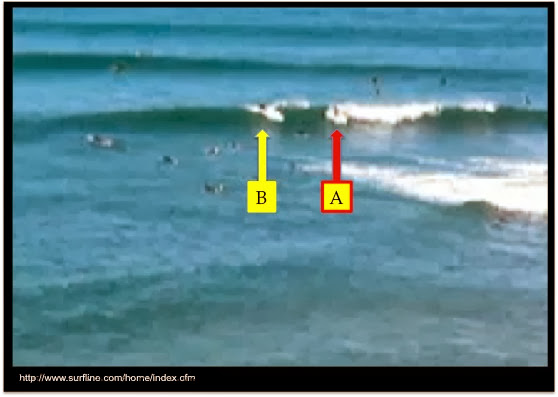
In the image below, for example, two surfers have caught the same wave.  Surfer A, to the right as we look at the picture from our perspective, has caught the wave slightly before another surfer, Surfer B, seen to our left as we look at the picture.  Surfer A has caught the wave first, but even more importantly, he is closer to the curl of the wave, which can be seen fanning out to the right (as we look at the image -- the curl is really to the left of Surfer A as he rides the wave, because the wave is "a right" from his perspective: he is riding to his right, and Surfer B is to his right down the line of the unbroken wave).


In this case, the wave rightfully belongs to Surfer A and Surfer B is "dropping in" on Surfer A by taking off along the line that Surfer A wishes to follow, a line which proceeds down the still-unbroken  (green) barrel of the wave, away from the breaking curl of the wave.

This code is so well-known and so widely-used that it has been written about many times.  It is explained quite clearly on the world-renowned Surfline website, in a web page entitled "Don't drop in on or snake your fellow surfer." However, it is important to note that this widely-followed piece of surfing etiquette did not arise because it was first written down as a rule or passed as a "law" somewhere: it arose naturally among surfers as an effective way to govern the allocation of relatively scarce resources (waves) among relatively crowded conditions (in the image above, you can see that there are quite a few surfers at this particular break -- you can see several in the water to the left of the letter "B" as you look at the picture).

In fact, the situation in the image above had a happy ending: Surfer B realized he was about to drop-in on Surfer A, and he rapidly turned back over the wave to get out of Surfer A's way.  You can see this taking place in the images below.  In image 1, on the left, Surfer B is dropping in, and then in image 2, a split-second later, Surfer B turns and disappears back over the lip, leaving the wave to Surfer A:


This example of a natural code of etiquette arising among individuals who operate in an environment where there are no actual policemen or lawyers or other representatives of government, and yet who are able to peaceably allocate scarce resources amongst themselves, brings to mind the chapter in Herman Melville's Moby Dick (1851) entitled "Fast-Fish and Loose-Fish."  There, Melville writes:
Perhaps the only formal whaling code authorized by legislative enactment, was that of Holland.  It was decreed by the States-General in A.D. 1695.  But though no other nation has ever had any written whaling law, yet the American fishermen have been their own legislators and lawyers in this matter.  They have provided a system which for terse comprehensiveness surpasses Justinian's Pandects and the Bylaws of the Chinese Society for the Suppression of Meddling with other People's Business.  Yes; these laws might be engraven on a Queen Anne's farthing, or the barb of a harpoon, and worn round the neck, so small are they.
I.  A Fast-Fish belongs to the party fast to it.
II.  A Loose-Fish is fair game for anybody who can soonest catch it.
In fact, it is remarkable that the code here articulated by Melville is precisely the same code which arose among surfers, it requiring only the substitution of the word "wave" for "fish" to admirably summarize the code of wave-catching etiquette just described.

Many philosophers have advocated the need for a political state -- often defined as an entity which maintains a monopoly on the legitimate use of force -- by arguing that in the absence of a state, mankind would fall into a state of complete violent chaos.  This view was most famously and influentially argued by Thomas Hobbes in his Leviathan, published in 1651.  There, Hobbes argued that in the state of nature life would be "solitary, poor, nasty, brutish, and short."  The last three words of this phrase have become almost universally known and cited.

However, the examples of the surfer's code and the whale fishery tend to refute this view of mankind's inherent brutishness.  Both activities (surfing and whaling) are conducted outside the reach of normal laws and legislators, and in both cases the participants "have been their own legislators and lawyers."

Proponents of voluntaryism and some forms of libertarianism (among others) argue that the institution of states actually leads to greater levels of violence and more "brutishness" than would occur in their absence.  While they don't generally cite either surfing or Moby Dick as evidence in favor of their arguments, it seems possible that they could.

The use of an example from the immortal Moby Dick is not meant to imply that the author of this blog in any way condones the killing of whales.  To the contrary, several previous posts have discussed arguments against the regular slaughter of animals for food or any other purpose -- see for instance:


Birthday of Master Yip Man (October 10)


October 10 is the birthday of Master Yip Man (1893 - 1972).  His mastery of Wing Chun Kung Fu is unquestionable.  

This passage from Wing Chun Warrior by Ken Ing describes some of the details of Yip Man's life:
Yip Man was born in Foshan in 1893, during the reign of Emperor Guang Xu (1875  - 1908).  His family was well off, and he was raised and educated in the traditional manner.
By the time he was 13, he was accepted as the last disciple of Chen Hua-shun [Guangdongwa: Chan Wah Soon], who was the most outstanding disciple of Liang Zan [Guangdongwa: Leung Jan].  His Sifu was in his seventies when he was accepted, and it was Wu Zhong-su, his second elder Kung Fu brother, who undertook the responsibility of teaching him.
In 1908, when he was 15, Yip Man became a boarder at St. Stephen's College in Stanley in Hong Kong.  It was his good fortune that, while in Hong Kong, he met Liang Bi [Guangdongwa: Leung Bik], the son of Liang Zan [Leung Jan].  By the time he returned to Foshan, he had plumbed the depths of Liang Bi's knowledge of Wing Chun. The superiority of Yip Man's Wing Chun led to speculation that secret Kung Fu knowledge had been passed from Liang Zan to Liang Bi to him.
Yip Man witnessed the fall of the Qing Dynasty in 1911, the birth of the Republic of China under the presidency of Sun Yat-sen, and the Kuomintang regime under the leadership of Chiang Kai-shek.  He survived the Second World War and the occupation by the Japanese Imperial Army betwee 1937 and 1945.
After Japan was defeated in 1945, Yip Man served as a police chief in Foshan, from which vantage point he witnessed the failure of the Kuomintang regime and its retreat to Taiwan.  Before the birth of the People's Republic of China on 1 October 1949, he escaped to Hong Kong without his family to avoid an expected purge by the victorious Communists led by Mao Zedong.
To earn his livelihood in Hong Kong, Yip Man began teaching Wing Chun Kung Fu.  Considering the state of Hong Kong's economy at the time and the huge number of refugees flooding across the border, establishing a school was a formidable undertaking.  However, as a result of Yip Man's efforts, Wing Chun rapidly became recognized in Hong Kong Kung Fu circles as a legitimate system of martial arts.
At different times and at different places throughout his career, Yip Man had accepted students.  However, it was the students he taught in the 1950s in Hong Kong who built the reputation of Wing Chun.  Collectively they were known simply as the Wing Chun fighters.  103-104.

It is no exaggeration to say that the Sifu Yip Man's teaching changed the world.  Through his students, and in particular through the exceptional career of his student Bruce Lee (pictured above with his Sifu, Yip Man, during the 1950s in Hong Kong), the West came to know about kung fu in a completely different way than ever before.

In fact, it is not an exaggeration to suggest that those who came to study Chinese kung fu outside of China since the 1960s and 1970s owe a debt of gratitude to the teaching of Master Yip Man.  His decision to teach kung fu in Hong Kong beginning in the 1950s led directly to the incredible explosion of popularity of the martial arts around the world beginning in the 1960s.

It is also no exaggeration to say that, through the study of the martial arts, many people of other cultures and backgrounds have been introduced to the profound culture of China and its neighboring cultures and countries, and their lives have been made richer by this contact.

You can learn more about the life and teaching of Sifu Yip Man at the website of the Yip Man Museum in Foshan.  The website contains a virtual tour feature in which you can click on almost all of the photographs and artifacts at the museum itself, and see them on your computer screen.

Respect.