Lysander Spooner, natural law, and human consciousness


January 19 is the birthday of philosopher and abolitionist Lysander Spooner, born this day in 1808.  He was a tireless defender of human freedom and the inherent rights of every individual.  Spooner was a proponent of natural law, which he discussed in most of his writings and to which he devoted a treatise entitled Natural Law: or the Science of Justice, published in 1882.

Spooner defined natural law in that treatise as "the right of anybody and everybody [. . .] to repel injustice and compel justice, for themselves and all who may be wronged" (7).  He argued that this right was equal among all individuals, without distinction, and inherent to them -- that is that it was a right they were born with and that was not granted by anyone else or subject to approval or disapproval.

In quoting this portion of Spooner's tract, it is important to note that he believed that "justice" largely equated to what he called "peace" -- the freedom from physical coercion or the threat of violence against one's person, ideas, and property.  In his eyes, people have the right (and in fact the obligation) to use force to protect both their own physical person and that of others when they see it being threatened.  However, Spooner expressly states that force may never be used to compel any of the many other moral duties which people owe to one another such as "to feed the hungry, clothe the naked, shelter the homeless, care for the sick, protect the defenceless, assist the weak, and enlighten the ignorant" (6).  These are things that one has a moral duty to do, but can never have a legal duty to be forced to do, in Spooner's argument (which readers should examine in its entirety using the link above).

While other philosophers -- notably Locke -- had put forth the idea of natural law before Spooner, Spooner went further in asserting that natural law was the only legitimate law, that it was as universal as the laws of gravity or chemistry, and that human attempts to add to it or subtract from it through legislatures or any other human declarations are "just as false, absurd, and ridiculous as it would be to talk of adding to or subtracting from mathematics, chemistry, or any other science, by legislation" (12).

These important concepts were not empty philosophizing to Spooner -- he put them into practice in his own life, most notably through his strenuous opposition to slavery in the United States during his lifetime.  In 1850, he published a treatise arguing that moral men and women had a duty to aid fugitive slaves under natural law, and that the legislated human laws of the United States which made such aid "illegal" had no merit, and were themselves illegal.

In it he writes, "That the act of delivering a man into slavery is a crime of a high grade no one can deny" (52) and that no slave is held by natural law but rather by brute force (56).  He further argues that the rescue of those restrained of their liberty without authority of law is both morally and legally meritorious, that every body is under obligation to assist such a person, and that that "an officer of the government is an officer of the law only when proceeding according to the law" -- the moment he steps beyond it "he, like other men, forfeits its protection and may be resisted like any other trespasser" (36).

In 1852, he published an important Essay on the Trial by Jury as constituting the most important bastion against tyranny, and argued that juries have a natural law right to judge the legality of any law on which they are being asked to decide a case (this concept is known as "jury nullification," the right of the jury to nullify a law -- a form of "veto" by the randomly-selected citizens of the country).  In that treatise, Spooner complains that the practice of excluding from the jury citizens who answered that they had personal issues with enforcing laws such as the Fugitive Slave Law or with penalties such as the death penalty was a form of tyranny and of "packing the jury" (footnote on 8 and ff).

In his treatise on Intellectual Property (in which he argues that all property, in fact, is "intellectual," in that nothing that is made through human effort, whether physical or not, does not first originate in the mind), he argues at length that no human being has a right to own another:
A man's body is his own.  It is the property of his mind.  (It is the mind that owns every thing, that is property.  Bodies own nothing but are themselves subjects of property -- that is, of dominion.  Each body is the property -- that is, is under the dominion -- of the mind that inhabits it.)  And no man has the right, as being the proprietor, to take another man's body out of the control of his mind.  In other words, no man can own another man's body.  16.
He goes on to say that an individual's ideas are also his or her own, and that he or she has the right to keep them or sell them as he or she sees fit.  Again, because Spooner expressly argues in the first several pages of this treatise that all labor is a form of the expression of ideas (saying for example that "the thought, that guides the hand in labor, is ever as clearly wealth, as is the hand itself" on page 11), this means that he is arguing that nobody is entitled to take anyone else's labor (or the products of that labor).  He writes:
A man's ideas are his property.  They are his for enjoyment, and his for use.  Other men do not own his ideas.  He has a right, as against all other men, to absolute dominion over his ideas.  He has a right to act his own judgment, and his own pleasure, as to giving them, or selling them to other men.  Other men cannot claim them of him, as if they were their property, and not his; any more than they can claim any other things whatever, that are his.  If they desire them, and he does not choose to give them to them gratuitously, they must buy them of him, as they would buy any other articles of property whatever.  They must pay him his price for them, or not have them.  They have no more right to force him to give his ideas to them than they have to force him to give them his purse.  16-17
Spooner argued that natural law was not only everyone's inherent right, but that it was deeply ingrained in everyone at a very early age, by a sort of innate intuition (see for example the discussion on page 9 of the above-referenced treatise on natural law).  This assertion connects directly to assertion made in the previous post's discussion of the life of Martin Luther King Jr. and the evidence which shows that the agents of the US government who (in complete violation of natural law) placed electronic bugs and wiretaps to surveil him, attempted to blackmail and coerce him, and plotted to "depose" him as a leader and replace him with someone else more to their liking, even though by the government's own admission he had committed no crime.

That post argued that "Oppression and the denial of natural rights always involves mind control, because human beings innately know what is wrong, even if they are often put into a trance state in which they stop seeing gross injustices being enacted right in front of them, gross injustices that they themselves might even be perpetrating."

This reveals the connection between the concept of natural law and the concept of "consciousness vs. mind control."  Getting people to agree to human laws which go against natural law must necessarily involve mind control, because people have a powerful, innate intuitive sense of natural law.  Overcoming this powerful human sense requires various forms of coercion, deception, ritual, symbology, and the repetition of propaganda (discussed in this and this previous post).  That is why those trying to enact and enforce human laws that violated natural law were so threatened by Dr. King: his exposure of the injustice taking place was waking people from the trance that they had been in and appealing to their innate sense of justice, which was overcoming the programming that had kept it beneath their radar.

By his strategy of civil disobedience, he exposed the fact that it was brute force -- violence -- that was upholding the racist laws and cultural norms, and not any sort of legal rectitude.  When that fact was forced out into the open, people began to wake up from their trance.  When people see force being used to stop someone from murdering someone else, they do not generally react with revulsion (because that is in accord with natural law).  When people see force being used to stop someone from exercising his or her natural right to walk down the street, or sit on a bus, or drink from a water fountain, then they suddenly realize that natural law is being violated and that they have been asleep to the true situation.

Mark Passio, who has written and spoken extensively on this subject and who has already made the assertion that institutions built upon the violation of natural law must always use mind control or "mass hypnosis," has said:
People ask me sometimes, "What is enlightenment?"  And I say: enlightenment is the full and complete understanding of every being's sovereignty and the total willingness to accept the responsibility to honor that complete sovereignty in all others.  That's enlightenment.  That is what enlightenment is.  [quoted in this previous post]. 
Thus, Lysander Spooner's life and his work on natural law has incredible importance to every individual, as well as to society.  By articulating his vision of natural law and the inherent rights of every individual, he was trying to wake up those around him, and to move them closer in the direction of the definition of enlightenment offered above.  In the ongoing battle between the forces of consciousness and anti-consciousness, his was a voice for freedom, human dignity, and truth.


The works cited above, and others by Lysander Spooner, can be found online here.


Martin Luther King and the war against consciousness


http://commons.wikimedia.org/wiki/File:Martin_Luther_King_-_March_on_Washington.jpg

January 15, 2014 marks the 85th anniversary of the birth of civil rights leader Martin Luther King, Jr.  He would be turning 85 today if he had not been viciously murdered in 1968.

Dr. King's efforts to awaken the world to the injustices of institutionalized racism in the United States are, of course, well-known, as is his express commitment to non-violence in the pursuit of that goal and the goal of ending that injustice.

In recent posts about the sudden sharp rise in awareness about the inhumane treatment of captive orcas due to a 2013 documentary film, we have seen that one of the film's effects on viewers is to suddenly cause them to become aware of the extent to which a "status quo" which they basically took for granted their entire lives and never really thought to question has all along been built upon what this post called "a foundation of captivity and exploitation that propped it all up."  We have seen quotations from people who have woken up to the truth ask in disbelief, "How can anyone look at that and think that that is morally acceptable?"

The discussion argued that the film was basically shaking people out of a sort of "trance" state -- a state akin to that of someone under hypnosis, who is unaware of what is really going on right in front of them -- and that being in such a state is essentially the opposite of any definition of the term "consciousness."  To that extent, the effect of the film was to raise consciousness and dispel this harmful "trance" state.

Clearly, Dr. King's efforts during his life were efforts to raise consciousness in the very same way -- to wake people out of their stupor and into awareness of the horrible inhumanity and injustice that they were tolerating, even participating in and supporting by their actions (even if they weren't giving their support of this injustice very much conscious thought at all).

However, there were forces which we can only describe as forces aligned against consciousness that were violently opposed to Dr. King's efforts to awaken consciousness in the United States and the wider world.  While most people today are aware of Dr. King's legacy, many remain completely unaware of the nefarious campaign to discredit and destroy him in the eyes of the public, despite the fact that this nefarious campaign has been well documented and that it indisputably did take place.

Readers unfamiliar with this specific aspect of the war against consciousness, carried out by agents of the US government against black leaders and specifically against Dr. King, may want to start with this Wikipedia overview of the COINTELPRO activities of the federal government during that period.  They then might want to read the transcripts of the Church Committee Hearings that took place during the 1970s, after documents stolen from an FBI office revealed the existence of this program of institutionalized surveillance of citizens considered threats.

In this document, for example, the reader can see evidence being presented to congress that government agents staged a deliberate campaign to depose Dr. King, with one attorney saying of the FBI that "the Bureau at one point had a plan to select a leader who they thought ought to lead the blacks in this country, and at the same time to depose Martin Luther King, against whom they ran their most sustained and toughest program of any we have seen" (page 7 in the pagination of the original document, or page 16 of the pdf file linked). 

That campaign included planting bugs and wiretaps to record Dr. King's activities, in the hope of discrediting him.  Although the original congressional document linked above specifically states that the details of the surveillance data which was collected was being withheld from the record "out of consideration for the privacy of Dr. King's family" (see footnote on page 21 of the document as originally paginated, or page 30 of the pdf file), the section of this Wikipedia article on Dr. King entitled "allegations of adultery" cites evidence that the government surveillance included tape recordings of alleged extramarital affairs, which were then released to third parties and also mailed to Dr. King along with threatening notes.

This evidence of nefarious surveillance is extremely shocking and troubling, especially the evidence that suggests that there were specific government plans to remove Dr. King and replace him with a leader that the agents of the government felt would steer things in a direction that they liked better.  This despite the fact that Dr. King was specifically committed to non-violence and civil disobedience in the face of clear and aggressive injustice.

During the hearings, Senator Mondale asked an attorney (on page 42 of the original pagination, or page 51 of the pdf file), "What was the threat that the FBI believed that Martin Luther King posed to this country?"  The answer is telling:
You get different feelings on that, Senator, from the documents, but it is a threat of change.  There is a flavor running in there of an assertion that he was influenced by Communists, but that does never seem to be followed through on or proven what his actions were.  It was the threat of change, I would say.  [. . .] I think it is easy to underestimate the impact the concept of civil disobedience had on the Bureau in general and Mr. Hoover in particular.
This little exchange goes a long way towards demonstrating the fact that the true situation involved a battle between consciousness and mind control.  Dr. King had specifically disavowed violence, but his actions of civil disobedience posed a tremendous threat to people who did not want the consciousness of the public at large to be raised.  Because his actions were designed to increase consciousness, the enemies of consciousness saw him as a threat.

Dr. King proved that the most effective actions for consciousness and against oppression do not involve the use of force.  Oppression and the denial of natural rights always involves mind control, because human beings innately know what is wrong, even if they are often put into a trance state in which they stop seeing gross injustices being enacted right in front of them, gross injustices that they themselves might even be perpetuating.  The most dangerous thing for the forces of oppression is a situation in which those masses of people who are in a trance begin to wake up to the injustices that they themselves are supporting.

The war between consciousness and the forces of anti-consciousness goes on today.  Those who celebrate the life of Martin Luther King, Jr. know which side they are on in this conflict.


Light-harvesting plants, quantum physics, and consciousness


How do plants turn sunlight into energy?  The question is incredibly important: just about every form of life on earth, and certainly the life of every human being, depends upon their ability to do it. Even if you do not choose to eat a strictly plant-based diet (and here are a number of reasons from the ancient philosopher Plutarch to choose a plant-based diet, and here are some more from the ancient poet Ovid), every animal (or fish) that you choose to consume for food depends (at some point in its food chain) on the ability of plants to turn sunlight into energy.

Recently, Edward J. O'Reilly and Alexandra Olaya-Castro of the Department of Physics and Astronomy at University College London published a scientific paper discussing their research into the transformation of light into energy by plants.  Why might professors from a department of physics and astronomy be interested in such a subject?  Because these professors are interested in the intersection of quantum physics and biomolecular processes, and because evidence suggests that plants' ability to transform light into energy involves quantum phenomena!

Entitled "Non-classicality of the molecular vibrations assisting exciton energy transfer at room temperature," the article published in Nature Communications on January 09, 2014, concludes that studies conducted on cyanobacteria, cryptophyte algae, and higher plants reveal that "light harvesting" complexes inside plants, algae and cyanobacteria utilize a form of vibrational energy transfer that involve quantum behavior (Nat. Commun. 5:3012.  doi: 10.1038/ncomms 4012 (2014)).  While it sounds as though scientists are still investigating the exact role these "non-trivial" quantum phenomena play in the process, the research presented by Drs. O'Reilly and Olaya-Castro suggests that these non-classical vibrations enhance the efficiency of the light collection and energy transfer that takes place during this critical photosynthetic transformation upon which just about all life on earth depends.

The term "non-classical" refers to the fact that evidence from experiments conducted as early as 1800 had started to reveal fundamental flaws in "classical physics" (also known as "classical mechanics" or "Newtonian physics").  By the early decades of the twentieth century, enough evidence had accumulated to cause some physicists to realize that an entirely new form of physics was necessary to explain the evidence: the theory that began to take shape to explain these often-bizarre experimental results is now called "quantum theory" or "quantum physics" or "quantum mechanics."

In their outstanding book Quantum Enigma: Physics Encounters Consciousness (Second Edition), Professors Bruce Rosenblum and Fred Kuttner of the University of California at Santa Cruz provide what they call a "rough summary" of quantum theory:
Quantum theory tells that the observation of an object can instantaneously influence the behavior of another greatly distant object -- even if no physical force connects the two.  These are the influences Einstein rejected as "spooky actions," but they have now been demonstrated to exist.  Quantum theory also tells us that an object can be in two places at the same time.  Its existence at the particular place where it happens to be found becomes an actuality only upon its observation.  Quantum theory thus denies the existence of a physically real world independent of its observation.  7.
These assertions are more than startling -- they are actually staggering in their implications. Interested readers are urged to obtain Quantum Enigma to explore the subject in greater depth.

In terms of the light-harvesting complexes in plants (and algae and bacteria), the recent paper first provides evidence to rule out classical explanations for the vibrational behavior observed, and then discusses evidence that the non-classical vibrations assist in efficient energy transfer.  They demonstrate that the vibrations of the excitons involved in the light-harvesting process demonstrate superposition: that is to say, the vibration of the excitons demonstrates non-classicality in that particles enter a state in which they exist on different levels of vibration simultaneously.  Or, as the authors of the new report put it: 
[. . .] at times when Q(t) is negative -- that is, t=0.2ps -- the regularized quasi-probability solution Pw(α) at this time exhibits negatives, which rules out any classical description of the same phenomena.  [. . .]  In short, non-classicality of the collective mode quasi-resonant with the excitonic transition arises through the transient formation of exciton-vibration states.
(That certainly sheds some light on the subject!)

More discussion of the quantum aspects of this vital biological process can be found on this page of University College London's Department of Physics and Astronomy website.

As stated previously, the implications of quantum physics upon our entire understanding of the universe are profound and staggering.  At a very fundamental level, quantum theory appears to undermine the "ideology of materialism" that informs almost everything students are taught in most school classrooms, from kindergarten through graduate school.  One way of interpreting the final sentence in the Rosenblum and Kuttner quotation above (in which they declare that "Quantum theory thus denies the existence of a physically real world independent of its observation") is by concluding that the universe (in some way) arises from consciousness, rather than the conventionally-taught materialist position which basically declares that consciousness arises from the universe (that our consciousness is dependent upon the physical structures of our brains, for example).

The fact that plants appear to be exhibiting quantum behavior on a very fundamental level -- that in fact their very survival is dependent upon quantum behavior, and thus that our very survival is dependent upon quantum behavior -- adds a whole new layer of profundity to the staggering implications of quantum theory.  

We have already seen (from the Rosenblum and Kuttner quotation above, and more evidence is presented in their book) that quantum physics relates very intimately to the question of consciousness -- that quantum phenomena in some sense depend upon consciousness.  The fact that plants appear to depend upon quantum phenomena is thus especially intriguing, given the fact that plants are directly involved in most of the methods of altering human consciousness (from the fruit of the vine, to the fermentation of beer, to coffee, tea, and more powerful plants such as ganja, opium, peyote or ayahuasca).

The new research presented by Drs. O'Reilly and Olaya-Castro clearly has enormous implications. They should be commended for their work, and encouraged to continue to explore the ways in which plants and other life forms use and depend upon quantum phenomena.


The Warriors and the Ten Thousand

The Warriors and the Ten Thousand

Many people are aware that the classic 1979 film

The Warriors

(based on the 1965 book by Sol Yurick) has deliberate and overt parallels to the famous "march of The Ten Thousand," the account of an army of Greek mercenaries who were isolated in the middle of the Persian empire and had to "bop their way back" to friendly territory.  I myself still vividly remember having this fact and all the parallels explained to my seventh grade Latin class by our outstanding Latin language and classical history teacher, only a couple of years after the movie hit the box office.

In the movie, every gang in the city sends a delegation of nine representatives, none of them (in theory) armed, to a big "conclave" in Van Cortlandt Park in the Bronx.  There, Cyrus -- the leader of the biggest gang in the city (the Gramercy Riffs) -- delivers his famous speech (

part 1

--

part 2

--

part 3

)

, in which he dramatically points out to the assembled "soldiers" that the various gangs, if they would only stop fighting against each other, far outnumber the police and anyone else who might stand in their way.

However, when Cyrus is treacherously shot by the leader of a gang calling themselves "The Rogues," who promptly frames the Warriors for the murder, the Warriors find themselves isolated in the middle of unfriendly territory, with every gang in the city (especially the Riffs) out to get them.

This plotline very closely parallels the situation faced by the Greek band of ten thousand hoplites who had ventured into the heart of Persia behind the popular Persian prince Cyrus, the son of Darius II, to face his older brother (the new King of Persia) in battle in an attempt to seize the throne. Cyrus was killed in the Battle of Cunaxa in 401 BC, and the Greeks were isolated, deep in enemy territory, outnumbered by enormous armies and with hundreds of miles of hostile territory between them and their homeland, all of it occupied by various tribes who would oppose their passage through, in addition to the armies of the King who had killed Cyrus and scattered his other troops.

In addition, one of the generals of the King treacherously captured and killed the leading Greek generals immediately after the battle, and so one of the Greek warriors -- the Athenian Xenophon, who was probably about 26 or 27 years old -- was elected to be the new leader (by his own account) and successfully brought them to safety (see the map below showing their route).

Xenophon's account of the expedition and its desperate aftermath, which was called the

Anabasis

in Greek and which is sometimes called

The Persian Expedition

in English (the Greek word itself means "A Journey up from the Sea"), makes clear that the Greek warriors were extremely able fighters, possessed of deep traditions and admirable discipline, and with solid tactics that made them more than the match of whomever they faced, as long as they kept their wits about them and did not give in to fear or panic.

They also display throughout the entire ordeal a deep faith in the gods and in the propriety of their own behavior, and a belief that if they acted uprightly rather than treacherously, the gods would be on their side rather than on the side of their enemies, who did act treacherously and murderously.

And, while the movie version contains the memorable speech given by Cyrus, complete with rhetorical flourishes, the speeches recorded in Xenophon's ancient account of the march of the Ten Thousand take second place to no one for their stirring articulation of the ideals of the proud and free Greek soldiers, who may be cut off, isolated, and outnumbered, but who would rather fight like free men than throw themselves on the mercy of the Persians.

When, after the Battle of Cunaxa is over and Cyrus has been killed, the King sends his heralds (led by a Greek named Phalinus who is working for the King) to the Greek army and demands that they surrender their arms and appear at the court, to obtain whatever favor they could get from the King,  the reply recorded by Xenophon given by Theopompus the Athenian is timeless:

As you see, Phalinus, the only things of value which we have at present are our arms and our courage.  So long as we keep our arms we fancy that we can make good use of our courage; but if we surrender our arms we shall lose our lives as well.  So do not imagine that we are going to surrender to you our only valuables.  On the contrary, with their aid we shall fight for what you value, too.  [page 105 of the Penguin edition (translation by Rex Warner, first published in 1949)].

Phalinus, trying to persuade the Greeks to lay down their arms, gives them various reasons to do so. The leader of the Greeks, Clearchus, gives Phalinus their final answer:

Well, then, so much for your advice.  Now you can take back our answer, which is that we consider that, if it is a case of becoming friends with the King, we shall be more valuable friends if we retain our arms than if we surrender them to someone else; and if it is a case of fighting, we shall fight better if we retain our arms than if they are in someone else's possession.  106.

Thus should free people always reply to tyrants and their persuasive counselors -- not with malice or ill intent, but with dignity and the willingness to stand on the natural-law right of men and women to defend their persons and freedom against violence from any quarter, howsoever cloaked in the garb of supposed worldly authority.  The ancient Greeks knew their rights and the difference between freedom and slavery, and thus were able to make such a reply.  In the intervening centuries some people have forgotten those rights and differences, while others have malevolently done whatever they could to obfuscate these simple and anciently-established principles.

The names in the ancient account closely parallel those in the movie.  Cyrus, of course, has the same name in both epics.  Xenophon's account paints Cyrus as an admirable, brave, and generous leader, and one who admires the Greeks for their ferocious dedication to their freedom.  At one point before the fateful Battle of Cunaxa, he addresses the Greeks:

Soldiers of the Greeks, I am not leading you into battle with me because I am short of native troops.  No, the reason why I sought your help was that I considered you to be more efficient and formidable than great numbers of natives.  I want you, then, to show yourselves worthy of the freedom which you have won and which I think you happy in possessing.  You can be sure that I would rather have that freedom than all I possess, and much more. [. . .] 82.

Clearchus, who is treacherously murdered by the King's general Tissaphernes after the battle is over, is no doubt Cleon in the movie, the leader of the delegation of nine Warriors to the conclave in the Bronx, who is fingered by the leader of the Rogues and is surrounded and beaten down by a mass of hostile Gramercy Riffs.

Xenophon himself is no doubt Swan (note the linguistic similarity of the two names), who is elected "war chief" by the rest of the Warriors after a tense standoff with the powerful fighter Ajax, in a scene that has some parallels with the episode in the Persian Expedition in which Xenophon offers himself as the new leader after the murder of the Greek generals.  In that scene, Xenophon says that all the captains of the Greek army wanted Xenophon to be their leader, except for one Apollonides, who opposed Xenophon and started complaining about all their difficulties.

Apollonides does not play any significant role in the rest of the

Anabasis

, but Ajax is actually one of the most memorable characters in the film, because although he is sullen about not being elected to be the new war chief, he is actually happy as long as he is given opportunities to fight, and approaches every one of the film's "battle scenes" with a grim sort of joy, and he is unstoppable until he falls into a trap set by the police and is hauled away in cuffs.

In the film, the Warriors have to get back to Coney Island, and Swan articulates the sentiment that once they see the ocean, they figure they're home.  In the

Anabasis

, there is an unforgettable moment when the embattled Greeks, who have fought their way through tribe after tribe, across range after range, crest the summit of Mount Thekes and catch a glimpse of the sea for the first time:

They came to the mountain on the fifth day, the name of the mountain being Thekes.  When the men in front reached the summit and caught sight of the sea there was great shouting.  Xenophon and the rearguard heard it and thought that there were some more enemies attacking in the front, since there were natives of the country they had ravaged following them up behind, and the rearguard had killed some of them and made prisoners of others in an ambush, and captured about twenty raw ox-hide shields, with the hair on.  However, when the shouting got louder and drew nearer, and those who were constantly going forward started running towards the men in front who kept on shouting, and the more there were of them the more shouting there was, it looked then as though this was something of considerable importance.  So Xenophon mounted his horse and, taking Lycus and the cavalry with him, rode forward to give support, and, quite soon, they heard the soldiers shouting out 'The sea! The sea!' and passing word down the column.  Then certainly they all began to run, the rearguard and all, and drove on the baggage animals and the horses at full speed; and when they had all got to the top, the soldiers, with tears in their eyes, embraced each other and their generals and captains.  In a moment, at somebody or other's suggestion, they collected stones and made a great pile of them. 211.

In George Cawkwell's introduction to Rex Warner's translation of the Persian Expedition, that Oxford professor (and native of New Zealand) begins by saying:

Every schoolboy used to know how ten thousand Greeks found themselves in the heart of the Persian empire a thousand miles from Greece, with half their leaders arrested by the Persians, and with a Persian army at hand, and how Xenophon the Athenian took charge and brought them safely home over rivers and mountains, through terrible winter and equally terrible barbarian foes, and it was a dull schoolboy indeed who did not thrill at the sound heard one day by Xenophon from the rear of the column as he laboured up yet another mountain against, as he thought, yet another hostile tribe -- 'The sea, the sea.'  9.

Sadly, it is safe to say that most schoolchildren can now go from kindergarten through graduate school without learning the story of the ten thousand Greeks, and the thrilling sound heard one day by Xenophon, "The sea, the sea."  Even George Cawkwell's phrasing makes it clear that when he himself wrote those words, in 1972, it was no longer the case that every student would as a matter of course learn the story.

That cultural amnesia is most unfortunate -- and characteristic of much else that we have forgotten about the ancients.  The march of the Ten Thousand has plenty to teach us today about courage against seemingly impossible odds, and about devotion to freedom, of faith in the wisdom of standing for the natural rights of mankind against tyranny, of faith in that which is divine, and revulsion for those who are willing to treat other men as gods instead.

Cyrus himself said he was envious of the freedom which the Greeks had won for themselves -- a freedom which we in fact are still heirs to.  Let's not forget that, no matter how far away from the sea we may seem to be at the moment.

"The recognition of our high cosmic mission . . ." -- Alvin Boyd Kuhn on evolution


In the past, this blog has tackled aspects of the creation vs evolution debate, and explored some of the major problems with the Darwinian mechanism of evolution which (in its various permutations) is by far the predominant evolutionary mechanism accepted by conventional academia, and which is taught as if it is proven fact by its defenders.

Among the previous posts which have ventured into this hotly contested and battled-scarred landscape are:
and
Some of those posts discuss the fact that there have been very serious proponents of evolution who have rejected the Darwinian mechanism as simply the wrong mechanism.  Among these were eminent botanist J. C. Willis who noted that the abundant evidence in botany poses irreconcilable problems for the Darwinian hypothesis, and who proposed a completely different mechanism of evolution which he called "Differentiation," and which proposed that some force caused very large new mutations or differentiations which diverged tremendously from previous forms, and which then went on to branch out into various sub-species and sub-genera, without the extinction of the parent that began the "family" (almost a complete inversion of the Darwinian mechanism).  

Others of those posts, such as those discussing the work and research of Dr. Rupert Sheldrake, who also believes in evolution but by a mechanism different from the conventional Darwinian mechanism, have noted that evidence of "psi" phenomena and other "paranormal" activity pose some serious difficulties for the Darwinian model as well.  Posts which discuss this aspect of human existence, and the evidence for consciousness that can survive the death of the body (something Darwinian evolution would not predict and which most conventional defenders of Darwinian orthodoxy would vehemently deny) include:
and
All of this "review" is pertinent, because today we will very briefly examine another theory put forward by someone who believed in evolution, but again by a very different mechanism than that propounded by almost any of the modern Darwinists.  Moreover, it is a theory which seems to be able to incorporate the evidence for psychic, paranormal, and afterlife experiences discussed in the posts found in the second group of links, as well as having some points of harmony with the evidence discussed by J. C. Willis and his "Differentiation" theory, as well as some of the other evidence discussed in the posts from the first group of links.

In his 1940 text Lost Light: An Interpretation of Ancient Scriptures, Alvin Boyd Kuhn makes this assertion, speaking of the ancient religion of the Egyptians and of many other ancient cultures:
It was designed to prevent the utter loss of purpose and failure of effort in the cosmical task to which man, as a celestial intelligent spirit, had pledged himself under the Old Testament covenant and "the broad oaths fast sealed" of Greek theology.  In coming to earth to help turn the tide of evolution past one of its most critical passages, he bound himself to do the work and return without sinking into the mire of animal sensuality.  We must henceforth approach religion with the realization that it is the psychic instrumentality designed for the use of humanity in charting its way through the shoals of the particular [. . .] evolutionary crisis in which it was involved.  91.
In these few sentences is contained a radical and revolutionary proposition: that evolution in the physical species is guided along by the incarnation of "celestial intelligent spirit" -- that we are spirits inhabiting human bodies as part of the task of helping evolution.  

In other words, Kuhn is here articulating his theory that the ancient sacred texts all dealt with the incarnation of spirit in matter (something discussed in this previous post), and that in fact they taught the doctrine of multiple reincarnations (evidence for reincarnation is discussed extensively in Chris Carter's Science and the Afterlife Experience, among other books).  One very interesting aspect of Kuhn's discussion of the idea of incarnation and reincarnation is his view of its purpose: he asserts in the passage above that the purpose of incarnation is to move evolution forward.*

In the passage above, he hints at the difficulty of this task.  One of the dangers of the business of incarnating, is that the spirit would become entangled in the snares inherent in the physical world, "sinking into the mire of animal sensuality."  For this reason (among others), Kuhn argues that the ancient wisdom was designed to remind us of our origin "as a celestial intelligent spirit," so we would not forget where we came from and why we are here. 

However, because of what Kuhn saw as a horrendous loss of the true light of the ancient scriptures, he believed that this vitally important mission is in grave jeopardy.  He writes:
All the stupendous knowledge relating to the entire cosmic chapter was once available, given by the gods to the sages.  We have nearly lost it beyond all recovery because the ignorance of an early age closed the Academies and crushed every attempt to revive the teaching.  [. . .]  We must work again to the recognition of our high cosmic mission, and revivify the decadent forms of a once potent religious practique, based knowledge.  For spiritual cultism was once vitally related to our evolutionary security, which stands jeopardized by present religious desuetude.  91.
Every reader must of course decide for himself or herself where to come down on this important subject.  The question, however, is far from settled, despite what some would have you believe.  There are many strident voices which would attempt to drown out any further examination of the subject of creation vs evolution, and would use all kinds of ridicule, ostracism, marginalization, and other forms of pressure to cause people to simply accept that evolution is the only possible answer, and that within the camp of evolution only certain strictly-materialistic forms of Darwinism may ever be discussed.  

If Alvin Boyd Kuhn is even partially right, the dangers of this kind of close-minded thinking may be enormous, and the damage that it is doing may be most grievous.  

We should encourage those around us to be unafraid in diving into this field, and not simply abandon it to those who would try to silence all opposition (and who, by their rigid intolerance, may be doing "evolution" in the sense that Kuhn is talking about a tremendous disservice).  Most importantly, each of us individually should be unafraid to examine openly all the possibilities.

---

* And, for the record, I personally do not believe that by "moving evolution forward" Kuhn was talking about the "transhumanist" idea of physically modifying the human body (or even human mind-body) using implantable or bio-electronic biometric silicon-based microchips which appear to be well suited for surveillance, enslavement, and the massive restriction of higher consciousness whatever else they may be good for.  Kuhn talks extensively about the "fourfold soul," the "sevenfold soul," and other subjects which lead one to conclude that the advancement he was talking about was not based upon some form of biological enhancement.


The profound importance of tea


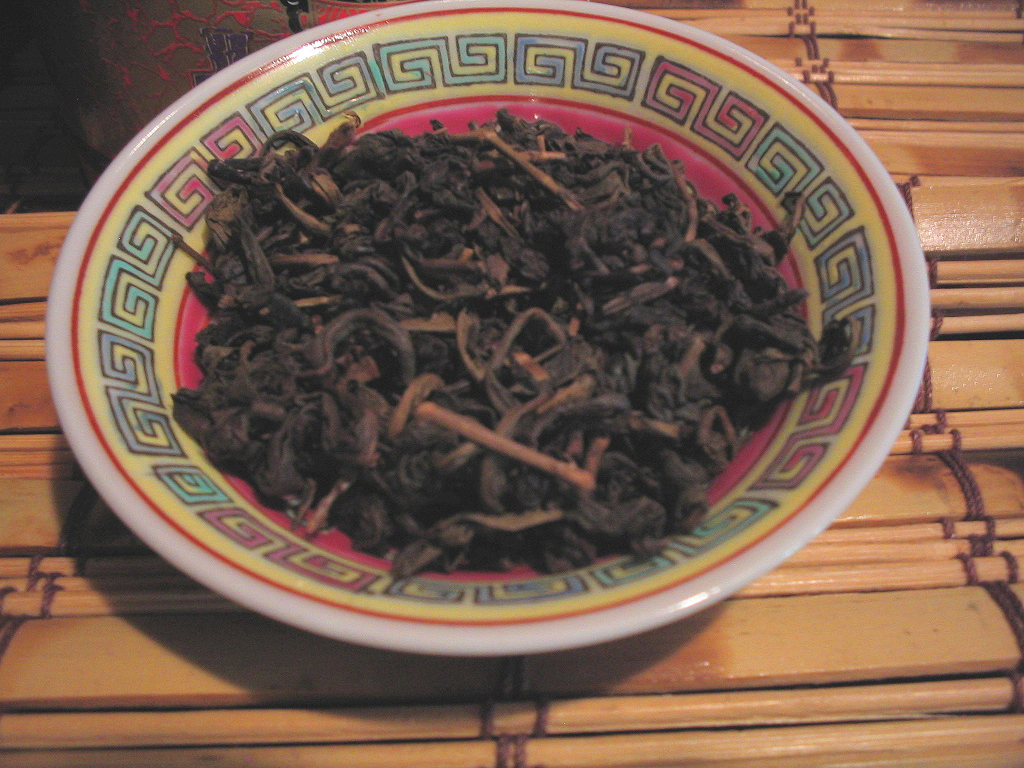
There are many very ancient Chinese legends purporting to describe the origin of tea, but many of them attribute the discovery of tea to the legendary Shen Nung, who was said to have lived around 2800 BC.  In Shen Nung's Canon of Herbs, thought to have been compiled from texts written during a period beginning in 206 BC, it is specifically said that Shen Nung tested hundreds of herbs on himself, encountering seventy-two poisons each day, and used tea as his antidote.

It is said that in the course of his intensive field work, Shen Nung once ingested 72 poisonous plants in an single day, after which he collapsed on the ground, teetering on the brink of death from poison.  As he lay there in agony, a breeze blew a few leaves from a nearby tree onto the ground beside him.  Noticing their distinctive aroma and vibrant green color, curiosity and force of habit prompted him to put a few leaves in his mouth and chew them.  He liked the taste, soon felt better, and quickly recovered his strength, so he chewed some more leaves and found that they completely cleansed his system of all toxins.  This is what he wrote about tea in his pharmacopeia:
Tea's essential flavor is bitter.  After drinking tea, the mind thinks more clearly and quickly, the whole body becomes light and agile, and vision improves.  34.
In her book, Tea: Aromas and Flavors Around the World, Lydia Gautier notes that Shen Nung's Canon of Herbs also states: "if one consumes tea for long enough, the body gains in strength and the mind in keenness" (106).  She goes on to say:
When one reads ancient Chinese texts, the benefits attributed to tea are extremely varied.
  • It stimulates circulation of the blood in all parts of the body.
  • It stimulates clear thinking and a lively mind.
  • It speeds up the elimination of alcohol in the organs of the body.
  • It increases the body's power to resist many illnesses.
  • It accelerates the metabolism and oxygenation of the organs of the body.
  • It prevents tooth decay.
  • It has a purifying and fortifying effect on the skin, helping it to remain younger-looking.
  • It prevents or reduces anemia.
  • It purifies urine and aids diuresis.
  • It improves the eyes and makes them shine.
  • It combats the effects of heat in summer (tea is by nature cold, that is, yin).
  • It aids digestion.
  • It eases pain in the libs and joints.
  • It reduces harmful mucus secretions.
  • It eases thirst.
  • It drives away fatigue and depression, bringing a general sense of well-being.
  • Finally, it prolongs life.  106.


Modern studies do indeed show that tea has measurable health benefits.  Tea is rich in flavonoids which medical studies have linked to improvements in cardiovascular health as well as to other beneficial effects for maintaining mental and physical health.

Interestingly, the ancient Chinese sources cited above appear to link tea to the rhythm of the cosmos as well.  Readers of this blog will no doubt have noted that the number of potentially deadly herbs that the legendary Shen Nung ingested, seventy-two, is one of the most notable precessional numbers.  Seventy-two is the approximate number of years it takes for the subtle motion of precession to delay the position of the background of the heavens by a single degree (for a video that explains this phenomenon and some of its tremendous significance in ancient sacred scripture and tradition, see here).  The mention of this significant precessional number in the legend regarding the discovery of tea is almost certainly not accidental.

The evidence of an ancient association of the beneficial properties of tea to the celestial motion of precession becomes even more pronounced when we read, in one of the tea-related articles on Daniel Reid's website, that the Chinese calligraphic symbol for tea contains strokes which add up to the number 108, according to Frederick R. Dannaway in the article entitled "Tea as Soma, pt. 1" (towards the bottom of that webpage).

Of course, along with the number 72, the number 108 is also one of the most-commonly recurring precessional numbers in ancient mythology and sacred tradition.  In the Agnicayana fire ritual of Vedic and Hindu tradition (believed to be the oldest surviving ritual in the world), the traditional altar is supposed to be constructed of 10,800 bricks (a version of the number 108).  Many aspects of the Chinese martial arts incorporate the number 108 as well, including the legendary number of obstacles one had to overcome in the final test for a Shaolin monk, and the number of moves or techniques incorporated into the famous wooden man or wooden dummy.  

The fact that tea is associated by the very design of its Chinese calligraphic character with the number 108 is undoubtedly significant, and links this beverage with the subtle motion of the universe -- a phenomenon that was obviously considered to be of profound importance to ancient civilizations.  Researchers such as Graham Hancock and Jim Alison have also conclusively demonstrated that the ancient designers of the worldwide grid of megalithic monuments (some of them dating to extremely remote antiquity) incorporated the numbers 72 and 108 into the distances between these sites (measured in degrees of longitude).

It is a clear sign of the importance ascribed to tea that the ancients would take pains to incorporate these two numbers into the legend concerning the origin of tea, and into its written symbol.  As Daniel Reid explains in his book on the Art and Alchemy of Chinese Tea, tea was seen as having alchemical or transformative powers upon the men and women who drink it.  On page 87, he writes:
In Chinese, the term for "alchemy" is lien jin shu, literally "the art of forging gold."  But the "gold" they're talking about here is not the gold ore mined from the earth and forged by fire into ingots and coins.  They're talking about jin dan, the "golden elixir of life," an elusive energetic essence that resides dormant within particular plants and minerals, and which may be extracted and activated by various means and transferred into the human system, where it acts as a potent tonic to protect health, prolong life, and enhance mental performance.  This precious essence is the "green gold" in the alchemy of Chinese tea.
And, in the "Art of Chinese Tea" article near the top of the page from his website linked previously (here's the link again), he quotes Master Xhongxian Wu as saying that, "one may become enlightened by drinking tea," and notes that "here are many stories of Buddhist monks or Taoist hermits who suddenly "awakened to the Dao" (wu Dao) while savoring a cup of tea."

Given the health benefits, as well as the ancient connection to the profoundly important precessional numbers, and the serious assertion that "one may become enlightened by drinking tea," who would not want to begin each day or finish each meal with a cup of Chinese tea?  

While doing so, perhaps it would not be inappropriate to contemplate the turning of the earth through the lines still marked by the ancient megalithic monuments located along carefully-selected meridians, and the slow and subtle but inexorable motion of precession which delays the march of the constellations through the heavens, all of which are somehow linked to the cup of tea in your hands.


New Year's and the Egyptian Book of the Dead


In Lost Light: An Interpretation of Ancient Scriptures (published in 1940, and available here for reading online in its entirety using the top link in the left-hand column which says "read online" or for download as a pdf using the link just below that one), Alvin Boyd Kuhn spends an entire chapter (entitled "Weighed in the Balance," beginning on page 480) discussing the concept of "judgment day" or the "judgment of the soul" found in ancient sacred texts and traditions.

On page 490, he specifically addresses a tradition that "the dead are summoned before the divine tribunal to be judged upon the day of doom, which occurs each New Years Day!"  But he cautions, as he does throughout the book, that these kinds of ancient traditions are misinterpreted if we try to understand them literally.  

What this ancient tradition really means, according to Kuhn, is that those of us in a current incarnation in the physical world (whom the ancient texts refer to as "the dead," in that the soul's descent into a physical body is a kind of "death" or "entombment in flesh," but which is only a temporary condition) are undergoing a kind of judgment day year in and year out (that is to say, "constantly" during this incarnation).  Further down on the same page, he explains: "If the Day of Doom came once each year on New Year's Day, it was set only as an annual commemoration of a fact which was perpetual, constant, persistent throughout life."

He then goes on to explain that the famous depictions of the "weighing of the heart" in the "Hall of Judgment" or the "Hall of Two Truths" in the scrolls that have collectively come to be known (somewhat incorrectly) as the Egyptian Book of the Dead do not actually refer to an event that takes place in some other realm in the afterlife: just like everything else in the Book of the Dead (in Kuhn's interpretation) it has to do with things that we need to know about here and now, in this incarnation (this life)!

He writes:
As argued in an earlier chapter, the Spiritual Guides of humanity gave the race a code of religious instruction that was meant to apply to the world in which it was given, not to a succeeding one.  The seers were not concerned with teaching mankind about the supervening consciousness of the discarnate life.  They taught humanity how to live in the world in which the teaching was imparted, well assured that philosophic behavior of life here would put them in favorable condition to meet the exigencies of the life of rest following the day on earth.  They were vastly concerned to instruct mortals in what it behooved them to learn here, as this was the only realm in which progress could be made, -- unless it be contended that one makes greater progress in sleep at night than in one's waking life by day.  481.
And again, on page 484 Kuhn avers that the sojourn of the soul on earth during each incarnation is in fact the Hall of Judgment: "The horizon line between the two cherubim is the place of the Great Balance.  The two Horus forms or lion gods are the two pillars of justice, and the judgment is the long series of decisions which the man himself renders as he journeys across." (Italics in original).

Even more graphically, Kuhn unpacks his thesis near the end of the chapter:
Man has entered the Gotterdammerung; he stands within the twilight.  He stands on the mounts both of crucifixion and transfiguration, with the shadow of the two beams of the cross or the scales falling athwart his body.  Every act, word and thought of his causes those arms of the scales to move up or down, according as he gives an impulse to spiritual or to sensuous expression.  In their motion they write the scroll of his book of life, alternately upon outward feature and inner character.  Every movement of the bars is a decree of judgment for him.  Taht-Aan, the scribe and recorder, is filling the pages of his book.  496.
This passage certainly makes the whole process sound dreadfully ominous, as if the Book of the Dead taught the impossible doctrine that every sin would have to be avoided in order to avoid having one's heart tossed to the dreadful demon, Ammit, to be devoured.  But Kuhn elsewhere explains that the process of passing through the scales in each incarnation was seen as the essential part of the progress towards overcoming incarnation:
To come forth guiltless from the scales may now be seen to convey the deep significance of the soul's emergence from earth life between the two horizons, washed clean and gloriously spiritualized.  If the judgment had been adverse, the soul would have been cast to the monster Am-mit, which only means, however, return to animal incarnation until final purification.  491.  
It is clear from explicit statements and analysis elsewhere in the book that by "animal incarnation" Alvin Boyd Kuhn here does not mean incarnation in the form of what we call "an animal," but rather he means that the soul would incarnate again as a man or a woman -- taking on a physical body again -- as part of the process.  

As he says all the way back on page 41, "As the Egyptian most majestically phrases it, the soul, projecting itself into one physical embodiment after the other, 'steppeth onward through eternity.'"  And again on page 251 he writes that the Egyptians believed that, "The soul is as the bee gathering sweet honey of immortality from the flowers of life experience on earth." 

And yet again on the same topic, Kuhn writes on page 273 that "In this light it may be seen that the whole of the negative and lugubrious posture of theology as to 'sin' and 'death' as its penalty, might be metamorphosed into an understanding of the natural and beneficent character of all such things in the drama." That is to say, in Kuhn's analysis, because "sin" describes lessons that can only be learned as an incarnation of the divine spark of a soul united to the animal body of the flesh (a pure spirit cannot sin, and neither can a non-human animal -- only a man or woman, who is a combination of the spirit and the animal together can do so), and because by "death" the ancients meant "incarnation of the spirit again," the whole process is transformed from being a fearful one into a positive or beneficent one.

In light of all the forgoing discussion, and the point made way at the top that all this was metaphorically said to have taken place among "the dead" (that is to say, those incarnated right now) on New Year's Day, it is interesting to speculate as to whether the famous "negative confessions" which are found accompanying the scene of the weighing of the heart in the Hall of Judgment (the Hall of Two Truths) in the scrolls of many ancient copies of the Book of the Dead might have some relationship to our ongoing tradition of the "New Year's Resolution."

The so-called "negative confessions" were often forty-two in number, and are associated with Spell 125 of the Egyptian Book of the Dead.  Professor Raymond O. Faulkner (1894 - 1982) said that the name "negative confession" was self-contradictory, and that a better name for it would be "the declaration of innocence."  Here is a portion of the forty-two declarations, as translated by Professor Faulkner (on pages 31 and 32 in this edition of his translation, published posthumously in 1990):
O Far-strider who came forth from Heliopolis, I have done no falsehood.
O Fire-embracer who came forth from Kheraha, I have not robbed.
O Nosey who came forth from Hermopolis, I have not been rapacious.
O swallower of shades who came forth from the cavern, I have not stolen.
O Dangerous One who came forth from Rosetjau, I have not killed men.
O Double Lion who came forth from the sky, I have done no crookedness.
O Flame which came forth backwards, I have not stolen the god's-offerings.
O Bone-breaker which came forth from Heracleopolis, I have not told lies.
Those of us who try to make New Year's resolutions each year might do worse than to select from among the "declarations of innocence" in Spell 125 of the Book of the Dead any that personally resonate.  Some of the confessions that are most compelling to me personally include:
O Disturber who came forth from Weryt, I have not been hot-tempered [see discussion in this previous New Year's post].
and
O Owner of horns who came forth from Asyut, I have not been voluble in speech.
Alvin Boyd Kuhn's insight that subject matter of the Book of the Dead applies to our sojourn in this life is indeed revolutionary, and worthy of careful consideration.