"Thou journeyest on the road whereon the gods journeyed"


image: Wikimedia commons (link).

The earth has now passed the point of the June solstice, and the sun is now beginning its long decline towards the bottom of the year (for those in the northern hemisphere: for the southern hemisphere, the sun's path will now be climbing in the sky).

This long descent of the sun each year furnishes the ancient mythology of the world with a powerful metaphor for the descent of the god out of the fiery realm of the heavens and into the miry realm of earth and water: the incarnation.

In Lost Light, Alvin Boyd Kuhn argues that all the ancient myths of the god or goddess descending to earth -- there to be cut up and scattered abroad, or to search for the cut up body of the god, or to dwell among mankind, or to be hidden in a secret place -- were intended to teach that individual men and women (and babies and children too) each contain a divine and immortal spark, temporarily buried inside material flesh.  

In other words, the gods and goddesses of the myths are in humanity.

Examples cited by Kuhn in chapter VII of Lost Light include the tearing to pieces of Dionysus or Bacchus, the cutting in pieces of Osiris, the descent to earth to search for the pieces of Osiris by Isis, the descent of Persephone into the underworld for six months of each year, the bringing of fire to mankind by Prometheus (here Kuhn quotes Thomas Taylor who says that Prometheus concealing the fire in the Thyrsus reed was representative of "leading the soul into the body"), the descent of Eros the god to wed the human bride Psyche, the descent of Orpheus into the underworld to pursue Eurydice, the descent of Hercules into Hades to bring up the three-headed dog Cerberus, and many more. 

In support of his argument, Kuhn cites a remarkable passage from the Pyramid Texts of the Egyptian king Pepi I (reigned circa 2289 BC to 2255 BC). On page 121 of Lost Light, Kuhn writes:
In Egyptian scriptures we encounter the promise that "if Pepi falleth on to the earth, Keb [Seb] will lift him up." Pepi here stands for the divinity in man, the god come to earth. To him in another place it is said: "Thou plowest the earth . . . Thou journeyest on the road whereon the gods journeyed." Here is identification of the earth as the place to which the gods were sent to travel the road of evolution.
Note what Kuhn is asserting in the above lines: that the scriptures in the Pyramid Texts are identifying the "road whereon the gods journeyed" as this human world of the incarnation. 

In other words, the gods and goddesses of the myths are in humanity.

Here is a more modern translation of the same passage from the Pyramid Texts of Pepi I, this time from the 2005 publication Ancient Egyptian Pyramid Texts, translated by James P. Allen and edited by Peter der Manuelian, available to read in its entirety online here (but worth owning in hard copy as well, of course). On page 107, we find the passage that Kuhn quotes in his argument: it is from Recitation 37, Address to the Spirit as Osiris in the Duat:
The earth has been hacked for you and a presented offering laid down for you before you, and you will go on yonder path on which the gods go.
The implications of this passage are profound. The ancient text is here confirming the interpretation presented by Kuhn, and elaborated in The Undying Stars, that the celestial motions of the sun, moon, stars, and planets which are allegorized in all the ancient myth-systems of the world (including those in the Old and New Testaments of the Bible) were intended to convey an esoteric teaching: that the gods descend and walk the path of the underworld, and that this path is the path we ourselves are walking ("thou journeyest on the road whereon the gods journeyed").

The gods, of course, are the sun, moon, planets, and stars -- after all, are the planets not named Mars, Mercury, Jupiter, Venus and Saturn? And yet, as they journey along their "road" through the heavens, each of these eventually plunges down into the western horizon, there to toil through the underworld until they rise again on the eastern horizon. This allegorizes the human condition in incarnation, divine sparks plunged into bodies made of clay (water and earth).

And the assertion that the gods and goddesses of the myths are to be found inside each one of us is reinforced in this passage by the text's calling attention to the "road" or "path" on which the gods go. The sun, moon, and visible planets travel through the sky along the ecliptic band: this is the road whereon they journey, and they cannot deviate from it. That ecliptic band contains the stars which make up the zodiac constellations -- and we have already seen that the ancients taught that there is a direct zodiac correspondence in the human body ("as above, so below"). In other words, the zodiac not only stretches across the infinite heavens in the macrocosm, but is also contained in the microcosm of the individual body of each man or woman -- from head to toe (Santos Bonacci has many outstanding videos in which he expounds upon this concept).

So, if the planets (that is to say, "the gods") travel along the zodiac path through the heavens, but that zodiac path is also reflected within the human body, we can see once again the clear teaching that . . . the gods and goddesses of the myths are in humanity. And, as discussed in this previous post, there are ancient wisdom traditions which teach a direct connection between each major organ in our bodies and a specific planet in the heavens.

While literalist theology as it has been taught for the past seventeen centuries would generally tend to reject the assertion that "the incarnation" refers to the spark of divinity coming down and incarnating in every single human being, there is some clear support in the scriptures of both the Old and New Testaments for the position that this is exactly what they always intended to convey.  In the Old Testament, for example, Kuhn argues in that same chapter VII of Lost Light that myths such as Abram being sent out of Ur of the Chaldees into a land to the west is yet another clear celestial allegory of the descending heavenly spark, representative of incarnation (he argues on page 113 that the word Ur itself means "fire," as in the realm of the fiery stars, and notes that the Duat of the Egyptians was located in the west, where the stars set due to the turning of our planet on its axis).  He also points to the "descent" of Abram into Egypt (allegorical for the lower half of the zodiac wheel, the underworld) for a time as telling the same incarnational story, and again that the descent of the twelve sons of Jacob later in Genesis tells the same (113).

Another well-known Old Testament verse which Kuhn does not directly point to in Lost Light, but which seems to have a clear parallel to the metaphor of Prometheus bringing down divine fire concealed in a smoking reed or handful of reeds is found in Isaiah 42 (quoted again in the New Testament book of Matthew): "A bruised reed shall he not break, and the smoking flax shall he not quench: he shall bring forth judgement unto truth" (Isaiah 42:3; Matthew 12:20 modifies the last part somewhat by saying "till he send forth judgment unto victory," which could be esoterically understood as saying that our incarnations here will continue until the cycle ends in judgement unto victory).

In the New Testament, Paul teaches in many places "the mystery of Christ in you," for example in 2 Corinthians 13:5, as well as in his own description of his first receiving the revelation of this mystery, in Galatians 1:16. 

And, Kuhn argues that this understanding of the New Testament metaphors (that they teach the exact same esoteric truth as that which was conveyed by the descent of the gods to earth in the myths of Dionysus or Osiris) helps shed light on the otherwise difficult-to-explain passage in Luke 14:26, in which Jesus orders his followers to hate their father, mother, brother, sister. In Kuhn's interpretation, this discussion of "leaving one's family" is metaphorically describing the leaving of the heavenly realms to plunge into exile in matter (the incarnation). Seen in this light, Kuhn argues, it is not talking about our human parents and siblings at all, and it certainly is not teaching "hatred" of those human relations (Lost Light, 126). 

On the contrary, all these ancient teachings should impart to us a new appreciation of everyone we meet, as well as ourselves. In this view, each person contains an infinite universe, because each is a "microcosm" of the infinite cosmos. Each, too, embodies within himself or herself "the gods." That includes the baby screaming in the seat behind us on an airplane (or the 4-year old kicking the back of our seat)! This should engender in us a profound sense of wonder for everyone we meet, and a new appreciation of who we are as well. It should also point us towards the natural-law principles of nonviolence and respect for the lives and bodily safety of those with whom we come in contact (and our own as well).

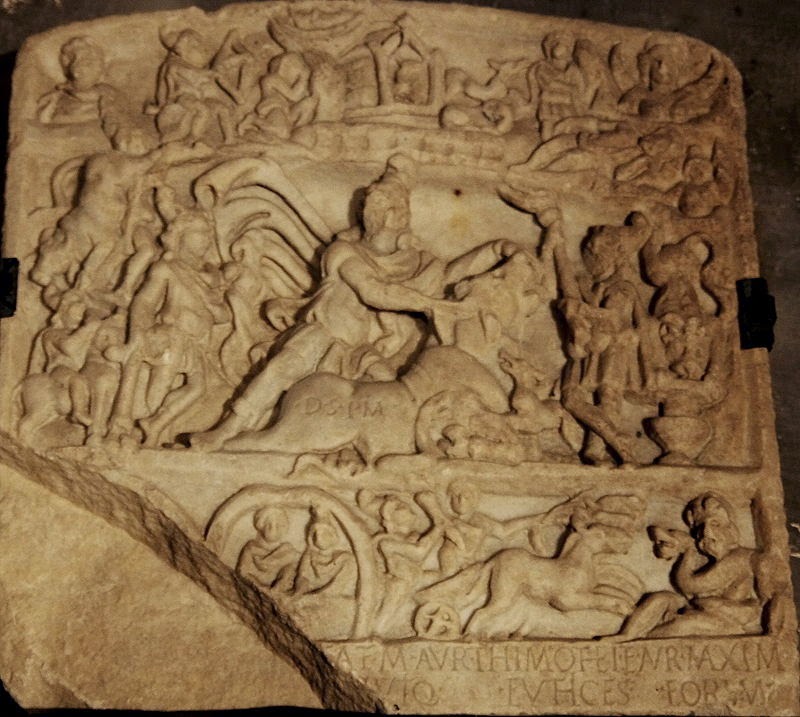
Ten reasons to suspect a close connection between ancient Roman Mithraism and ancient Roman Christianity


image: Mithraeum located under the Basilica of San Clemente, Rome. Wikimedia commons (link).

Conventional scholars continue to debate the origin of the Roman cult of Sol Invictus Mithras, which (based upon the archaeological evidence of the mithraea) arose circa AD 100 and ends in AD 396.  Although scholars today are more circumspect in their pronouncements regarding the origins of this institution than they have been in previous decades (prior to the 1970s), it is still common for well-regarded Mithraic scholars to assert that Mithraism and Christianity were bitter rivals.

For instance, this essay published in a collection in 1994 tells us that: "Between the second and fourth centuries C.E. Mithraism may have vied with Christianity for domination of the Roman world." The author continues:
The Christians' view of this rival religion is extremely negative, because they regarded it as a demonic mockery of their own faith.  One also learns of Mithraism from brief statements in classical Greek and Roman authors.
While it is certainly true that Christian polemicists, including Tertullian, attacked Mithraism on these grounds, this does not necessarily indicate that the two systems were indeed at cross-purposes. Author Flavio Barbiero, whose work is discussed in The Undying Stars and in this previous post, has put forward a theory which argues that the cult of Sol Invictus Mithras was actually the secret society through which decisions were made and strategy enacted to gain control of the "command-and-control" centers of the Roman Empire, and that this exclusive institution, whose proceedings were kept entirely secret, operated in the background, using literalist Christianity as a public and nonexclusive shield -- one that it controlled, and one that would take the brunt of those who wanted to stand against the underground campaign.

Flavio Barbiero offers a host of evidence to support this view of events, and the conclusion that this campaign was ultimately tremendously successful -- successful to the point that it shaped European history and then world history for the following seventeen centuries, and continues to do so to this day. The following points are taken from his 2010 publication The Secret Society of Moses: The Mosaic Bloodline and a Conspiracy Spanning Three Millennia. Many of these pieces of evidence are also discussed in his 2010 article entitled "Mithras and Jesus: Two sides of the same coin" on the website of Graham Hancock. 

Note that the following points are not intended to be aimed at any particular branch of Christianity as it has existed since the fourth century, but rather to shed light upon the possible origins of all of literalist Christianity, which deliberately chose to take a very different approach to the interpretation of the Biblical scriptures, and one which intentionally cut itself off from all the "pagan" traditions of the world as well as from the esoteric, gnostic, Sethian, Valentinian and Hermetic forms of Christianity which existed prior to this juncture in history.
  • Mithraism was neither a "religion" nor a "mystery cult" -- unlike other ancient religions, it was extremely exclusive and met in special mithraea which were so small that, "At most, forty people could be seated in each of them" (158). The majority of mithraea could not hold more than twenty.
  • Numerous mithraea have been found underneath ancient Christian basilica or churches, indicating that there may have been some kind of symbiotic connection between the leadership of the cult of Sol Invictus Mithras and that of the Christian church. While it is possible to explain this fact away by saying that the Christian church triumphantly took over the sites of its old rival and built churches on top of their sacred sites (as it later did around the world), there is evidence that this explanation was not the case for Mithraism and Christianity. Specifically, Barbiero notes that the Basilica of St. Peter on Vatican Hill was built above the Phrygianum, the most central mithraeum in Roman Mithraism, where the "Father of Fathers" (head of the entire order of Sol Invictus Mithras) held sway. Most significantly, the Christian Basilica of St. Peter was built by the emperor Constantine in AD 322, but the last "Father of Fathers" of Mithraism did not die until AD 384, and he continued to use the mithraeum in the Phrygianum for all those years! It would be remarkable if these two supposedly "rival religions" coexisted for even two years with their "headquarters" co-located, but the dates indicate that this coexistance lasted for sixty-two years. Barbiero writes: 
In this light, we are forced to conclude that Sol Invictus Mithras and Christianity were not two religions in competition, as we often read, but were two institutions of a different nature that were closely connected. Rather than being a simple hypothesis, this is practically a certainty. It is unthinkable that the Roman church continued to extend hospitality to the head of a rival pagan religion for more than half a century and at the heart of its most exclusive property, the basilica dedicated to the prince of apostles. The Mithraic pater patrum and the bishop of Rome must necessarily have been closely linked. 163-164.
  • As the passage just cited indicates, the title of the supreme head of the Mithraic organization was pater patrum, or "Father of Fathers." The Mithraic system had a hierarchy of seven Mithraic grades, with the highest being the Pater or "Father" (the head of any particular mithraeum). The head of the entire system, of all the Mithraic "lodges," was the "Father of Fathers," or pater patrum (pa-pa, for short). It is most significant that, after the death of the last Mithraic pater patrum, in AD 384, the bishop of Rome adopted this same title, which is still used to this day (and which is rendered in English "the Pope," but in Italian and Spanish is still papa). This evidence is discussed in Barbiero, 163 and elsewhere.
  • As part of the same discussion, Flavio Barbiero notes that specific aspects of Mithraic ritual and attire were adopted into the rituals of Christianity, including the distinctive headgear of Christian bishops, which is still called a mitre, a word with linguistic connections to Mithras or Mitra.   
  • There is powerful evidence of early prominent Christian leaders who were also members of the Sol Invictus Mithras organization, right up to the point that they declared themselves Christians, or took holy orders to become high-ranking leaders of Christianity. The most prominent of these whom Barbiero notes is the emperor Constantine himself (Barbiero, 166-167). Others include St. Ambrose, whom Barbiero notes "passes directly from being a pagan to being bishop of one of the most important sees of the period" (166). St. Ambrose was the son of a father who was a member of Sol Invictus Mithras, as was the Christian apologist and polemicist Tertullian (AD 160 - AD 225), as well as church fathers St. Jerome and St. Augustine (Barbiero 167-168). This fact is highly significant and indicates that these early Christian "Fathers" were descended from the same family lines that Barbiero discusses in his thesis.
  • Constantine continued minting coins with clear Sol Invictus symbology and imagery, even after his vision of the heavenly "Chi-Rho" sign in some cases minted coins containing both sets of symbology, Christian and Mithraic. This is a clear indication that the two systems were not actually seen as antagonistic, at least during the early stages of establishing Christianity as official to the empire (later, Mithraism would be dismantled and the family lines would use Christianity as their open system of control, the "underground" mechanism of Sol Invictus Mithras having served its purpose). This use of Sol Invictus symbology on his coins is discussed in Barbiero page 165, and is also attested to in the notes to a translation of the works of the Christian polemicist and apologist Eusebius (c. AD 260 - c. AD 340). On page 207 of this edition of the works of Eusebius, we read a note from the editor to Eusebius' mention of a chi-rho coin which informs us that Constantine claimed to have seen the Christian chi-rho sign in the sky "resting over the sun," and that thereafter Constantine "continued to commemorate [the sun] on his coins as Sol Invictus (see Bruun, 'Sol'), whether out of numismatic conservatism (Barnes) or as a sign of solar monotheism."
  • There is evidence that early Christian leaders saw reverence to the sun as not at all incompatible with Christianity, with Pope Leo in a famous passage in his Christmas sermon of AD 460 declaring that: "This religion of the Sun is so highly respected that some Christians, before entering the basilica of St. Peter the apostle, dedicated to the one true living God, after climbing the steps that lead to the upper entrance hall, turn towards the Sun and bow their heads in honor of the bright star" (cited in Barbiero, 161). Tertullian also writes that "it is a well-known fact that we pray turning towards the rising sun" (Ad Nationes 1.13, cited in Barbiero "Two sides of the same coin," page 3). This connection between the sun and the "one true living God" described in the sermon by Pope Leo is in keeping with Constantine's use of both Sol Invictus imagery and Christian "chi-rho" symbology on his coins (Constantine evidently did not see anything contradictory or conflicted about the use of both).
  • In AD 386, a decree by the emperor Aurelian changed the name of the Christian day of worship from "the day of the sun" (Sunday being the first day of the week, in a significant change from the seventh-day Sabbath of antiquity) to "the day of the Lord" (Barbiero, 237).
  • The spread of the mithraea throughout the western empire (particularly in the vicinity of army barracks and organs of the government bureaucracy) parallels the spread of Christianity. Barbiero writes, "Wherever the representatives of Mithras arrived, there a Christian community immediately sprang up" ("Two sides of the same coin," page 9). Early bishop's sees were located in Britannia, Gaul, Spain, and North Africa -- the same places that legions were located and which are the sites of mithraea (Ibid).
  • Barbiero traces the progress through which the new Roman class of equites or "equestrians," to which the descendents of the family lines who had come to Rome with Titus and Vespasian after the fall of Judea belonged, gained access to the Senate and then progressively grew more and more powerful in the Senate. Dedicatory inscriptions reveal that as this process took place, more and more senators were members of Sol Invictus Mithras. However, upon the death of the last pater patrum of Sol Invictus Mithras, Flavio Barbiero notes that the entire Senate, that "stronghold of the cult of Mithras, discovered that it was totally Christian" (163, see also 241). In other words, the transition was remarkably smooth and bloodless -- indicating that Mithraism and Christianity were not at all the bitter rivals that the conventional narrative often paints them as being. They were, as Barbiero says, "two sides of the same coin."
These are by no means all the pieces of historical evidence which Flavio Barbiero musters to support his assertion that the institutions of Sol Invictus Mithras and literalist Christianity actually worked "hand in glove." Further, while this is a central part of his overall theory, there is much more to the theory, and that "much more" is itself supported by still further extensive evidence from other aspects of history.

In short, there is so much evidence to support this thesis that it simply cannot be ignored, and deserves careful consideration by everyone who wishes to explore the possible reasons for the suppression of the ancient celestial system of allegory which (I believe) was meant to preserve and to convey a sophisticated shamanic-holographic cosmology that was once widespread around the globe and which flourished in "the west" right up until the fourth century AD. The loss of this ancient wisdom, an inheritance belonging to all of humanity, is an absolutely watershed event in human history, and one which continues to impact our lives right up to the present day.


----------------
Special note: if you have not yet seen it, you might be interested in this previous post discussing possible connections between Mithraism and the later Knights Templar.

Common symbology between Mithraic temples and the Knights Templar, and what it might mean


image: Wikimedia commons (link).

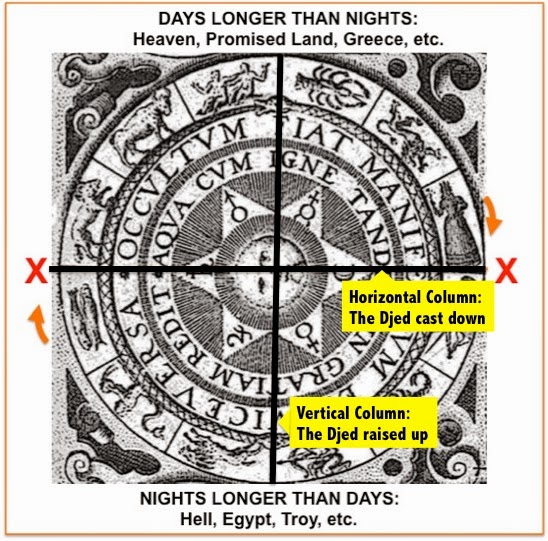
Previous posts have explained that in the ancient system of metaphor found in the world's ancient mythologies, the "summer half" of the year (in which days are longer than nights) was variously allegorized as a heavenly mountain, a high hill, a gleaming city, or the land of Paradise or Heaven.  

The "winter half" of the year (in which nights are longer than days) was variously allegorized as a deep pit, a land of bondage or toil or slavery, Tartaros, Hades, Sheol, the Underworld, Amenta, or Hell.

In between these two halves of the year were two "crossing points," where the fiery path of the sun (the ecliptic path) crosses the celestial equator each year -- the two equinoxes (one in the spring and one in the fall).  

Previous posts have demonstrated that the ancient systems of metaphor often depicted sacrifices at these "crossing" points (including, appropriately enough, the crucifixion of Christ, which is replete with both autumnal and vernal imagery). For more detailed examination of some of the equinox sacrifice metaphors, and the celestial clues which indicate that these sacrifices align with the equinox in the ancient esoteric system of astronomical allegory, please see the first three chapters of The Undying Stars, chapters which are available to read online here (in particular, you'll want to read the third chapter, which begins on page 26 of the book, using the page numbers as they appear on the book pages themselves).

However, the ancient system did not always depict these equinox crossing points with sacrifice myths: sometimes they involved passage through a narrow and dangerous doorway, gateway, or channel between two rocks (such as the Symplegades encountered by Jason and the Argonauts of Greek myth), and sometimes they involved other metaphors (see for instance the series of three examinations of Virgo myths through various ancient cultures, including those of Scandinavia, the Americas, and Japan).

Another way that the equinox "crossings" have been allegorized in ancient symbology is the use of figures with their legs distinctively crossed, in the symbolism employed in the cult of Sol Invictus Mithras. The cult of Mithras was an exclusive secret society, which met in underground grottos called mithraea, or in buildings designed to feel as if they were underground. As David Ulansey explains in his important 1989 publication, Origins of the Mithraic Mysteries: Cosmology and Salvation in the Ancient World, the Mithraic mysteries were so secret that virtually nothing of their inner workings was ever written down -- or if it was, none of it has been known to survive into the present. He writes that they:
centered around a secret which was revealed only to those who were initiated into the cult.  As a result of this secrecy, the teachings of the cult were, as far as we know, never written down.  Modern scholars attempting to understand the nature of Mithraism, therefore, have been left with practically no literary evidence relating to the cult which could help them reconstruct its esoteric doctrines. 3.
However, he explains, the remains of the mithraea which have been discovered scattered throughout the lands of the former Roman Empire do provide important material for modern analysts to examine, in particular, the symbols found in the scenes which are found upon the walls of these ancient meeting-places.  Ulansey writes:
But the Mithraists did leave to posterity a key for unlocking the  inner mysteries of their religion.  For although the iconography of the cult varies a great deal from temple to temple, there is one element of the cult's iconography which was present in essentially the same form in every mithraeum and which, moreover, was clearly of the utmost importance to the cult's ideology: namely, the so-called tauroctony, or bull-slaying scene, in which the god Mithras, accomplanied by a series of other figures, is depicted in the act of killing a bull.  This scene was always located in the central cult-niche of the mithraeum. 6.
Professor Ulansey's 1989 book is important in that in it, Ulansey challenges the conventional theories that had been accepted up until that time regarding the origin of the symbols (which held that they must have come from Persia and ancient Persian myth, since most scholars accepted the idea that Mithraism somehow came into the Roman Empire from Persia, an idea which Ulansey shows to have been almost entirely championed in modern times by a single nineteenth-century and early twentieth-century scholar, Franz Cumont). 

Ulansey's text labors to advance an alternative thesis, that the symbolism of the tauroctony is almost entirely celestial and primarily zodiacal, and that its central scene of slaying the bull has clear ties to the precession of the equinoxes. Towards this end Ulansey musters overwhelming evidence, and it is safe to say that on this point his arguments are decisive in favor of the fact that the imagery present relates to the zodiac signs and neighboring constellations, and the ages-long motion of precession.

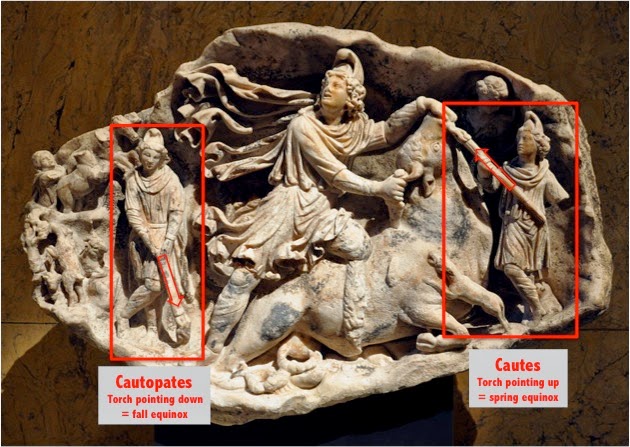
One of the extremely interesting parts of Ulansey's argument concerns his interpretation of two mysterious figures who appear in many (but not all) of the tauroctonies, two torchbearers known as Cautes and Cautopates (we know their names from dedicatory inscriptions, as Ulansey explains on page 62).  These figures often (but not always) have crossed legs, and in most (but not all) of the tauroctony scenes in which they appear, one of them (Cautes) has his torch pointing upwards, and the other (Cautopates) has his torch pointing downwards.  

Ulansey presents cogent arguments for identifying these figures, with their crossed legs and torches, as indicative of the crossing of the fiery arc of the sun's path down into the lower or wintery half of the year (at the fall equinox, indicated by Cautopates with his lowered torch) and up into the upper or summery half (at the spring equinox, indicated by Cautes).  I discussed Ulansey's arguments, along with supporting arguments from Hamlet's Mill (which show that fire-imagery is very common at the points of the equinoxes in many of the world's ancient sacred mythologies) in my first book, The Mathisen Corollary (in chapter 10).  Some scholars have challenged Ulansey's identification of Cautes and Cautopates with the vernal and autumnal equinoxes, but he presents counters to their attacks in his book.

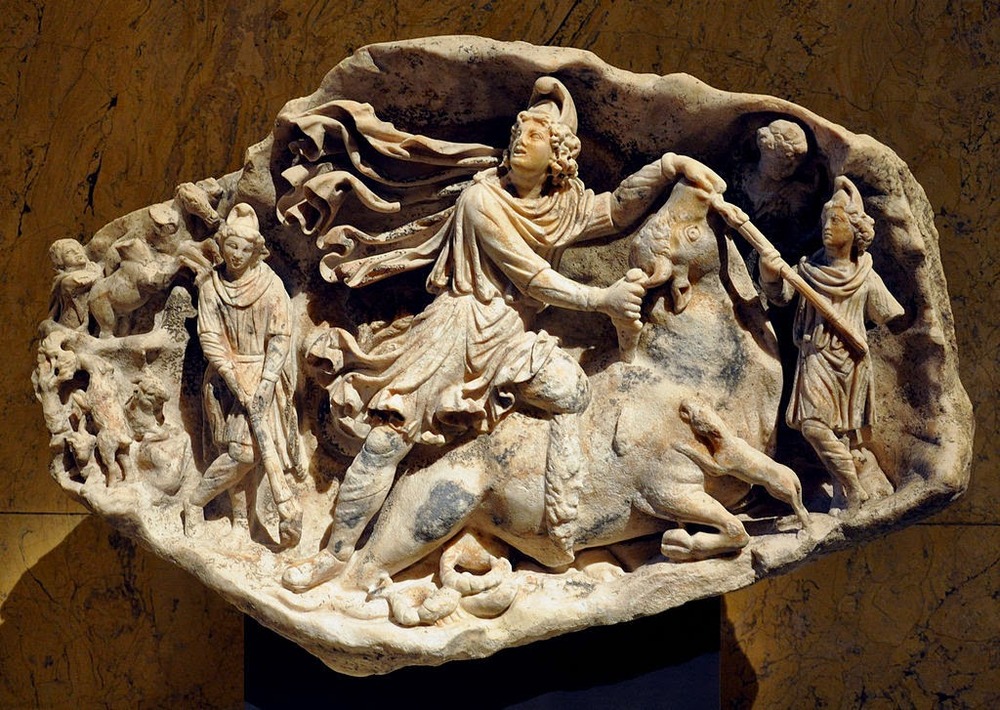
You may be able to spot Cautes and Cautopates in the tauroctony scene above, which is from an ancient mithraeum and which is currently on display in the Kunsthistorisches museum in Vienna.

In that particular tauroctony, Cautes appears on the right side of the bull-slaying scene as we look at it, with his torch's flame pointing upwards, and Cautopates appears on the left as we look at it, with his torch's flame distinctly pointed downwards.  Below is another image of the same scene, this time with Cautes and Cautopates outlined with red rectangles, and the direction of their torches indicated by red arrows (the point of the arrow going towards the respective flames of the torches):


Below is another tauroctony scene from a different ancient mithraeum, which also features Cautes and Cautopates.  Can you spot them and their crossed legs and torches (one pointing down for Cautopates and one pointing up for Cautes)?


image: Wikimedia commons (link)

Once again, they should be relatively easy to spot.  Their crossed legs are very clear in the above image, due to the way they happen to stand out in the photograph.  Below is the same image, with boxes drawn around Cautes and Cautopates to indicate their location, and arrows on each torch pointing in the direction of the flame, which is pointing down in the case of Cautopates on the left, and up in the case of Cautes on the right:


Based on what we have discussed in many previous posts at this point, Ulansey's argument that these two figures represent the two equinoxes is almost certainly correct.  Below is the now-familiar image of the zodiac wheel of the year, which has a large "X" at each equinox to indicate a "crossing."


As I discussed with Henrik Palmgren in my most-recent interview on Red Ice Radio, Mithraism (the cult of Sol Invictus Mithras) may play a far more important role in world history than most people (or even most conventional scholars of Mithraism or of ancient history in general) realize at this time. Historian and author Flavio Barbiero has published a book entitled The Secret Society of Moses: The Mosaic Bloodline and a Conspiracy Spanning Three Millennia (2010) in which he presents evidence that the cult of Sol Invictus Mithras was used as an underground "nerve center" for certain former priestly families of Judea whom Barbiero argues were brought to Rome after the conquest of Judea and the fall of the Temple in Jerusalem in AD 70, at the hands of the general (and future emperor) Titus, who was prosecuting the military campaign in conjunction with his father, Vespasian.

Admiral Barbiero argues that Mithraism basically functioned as an extremely effective secret society, and one which spread through certain strategically-chosen institutions in the Roman Empire, including the Praetorian Guard, the Roman army at large, the centers of trade and commerce (in particular the ports and customs-facilities) and the organs of the political bureaucracy.  It took some time (almost two hundred years), but this "nerve center" eventually gained so much power that it was able to install and remove emperors at will.  The extensive evidence to support this amazing claim is discussed at length in Barbiero's book, and it is also discussed in The Undying Stars in conjunction with that book's examination of the question of "what happened to the ancient wisdom?" Interested readers can also get an overview of the theory in this article which Flavio Barbiero published in 2010 on the Graham Hancock website.

According to this theory, the nobility which controlled Europe during the Middle Ages (as well as the leaders of the western church) almost certainly descended directly from the same lines of priestly families who came to Rome with Vespasian and Titus after the fall of Jerusalem.  Interestingly enough, Barbiero finds evidence for this theory (in addition to the bigger pieces of evidence which are discussed in that linked article and which make up the bigger part of his argument) in the fraternal orders which formed among the European nobility during the Crusades -- including the most famous of these, the Knights Templar.

Those familiar with the history of the Knights Templar may have already been struck by the distinctive "legs crossed" symbology in the foregoing discussion, from the temples of Sol Invictus Mithras.  Barbiero argues that it was probably within "some associations of nobles in which the most authentic spirit of the original institution of Sol Invictus could have survived" (333).  He makes note of the connection between the fact that the funeral monuments of Templar knights represent their effigies with their legs crossed, and says "we cannot imagine that it is a simple coincidence that in all the mithraea there are always two characters with their legs crossed in the same way" (337).

That the members of the noble families who were descended from those original priestly lines who defended the land of Judea and the Temple of Jerusalem against the invading Roman armies under Vespasian and Titus would form dedicated military orders which had secret rituals and shared symbology with the ancient cult of Sol Invictus perfectly accords with Barbiero's thesis. In fact, he writes of knights who made up the top rank of these military orders (such as the Templars):
To all effects, they were professional warriors dedicated to war, which always appeared to be a striking anomaly in the Catholic religion, in flagrant contrast to the pacifism preached by Christ.  In reality, this was no anomaly, but was instead a perfect continuation of the traditions of the priestly family.  Josephus Flavius was a priest but also a warrior and a military leader.  The followers of Sol Invictus had taken control of the Roman army and were, first of all, military men. 335.
Below are some images of the tombs of various Templar knights. In the first one, for example, you can see that the two knights on the right-hand side of the photograph (as we look at it) have their legs crossed:


image: Wikimedia commons (link)

Below is a drawing of another effigy of a knight from his tomb.  You can clearly see that his legs are crossed:


image: Wikimedia commons (link)

And finally, one more drawing of effigies of knights from medieval tombs.  The tomb closer to the viewer clearly depicts an effigy with the legs crossed in the same distinctive manner:


image: Wikimedia commons (link)

There is much more to this subject, but this connection alone constitutes yet another piece of evidence supporting Flavio Barbiero's theory as presented in his book, a theory which is very important for the question of "what happened" to the common system of celestial allegory which underlies virtually all of the world's ancient sacred texts (including those which found their way into what today we refer to as the Bible), and to the knowledge that this ancient wisdom should actually unite mankind, instead of dividing us.

Welcome to new visitors from Red Ice (and to returning friends)!


Welcome to everyone who perhaps is visiting for the first time after hearing about this site through Red Ice Creations! And, a warm welcome back to those who perhaps have visited before and for whatever reason decided to come check in again. 

Above is hour one of my recent interview with Henrik Palmgren of Red Ice Radio, discussing some of the subjects covered in my latest book, The Undying Stars. I am very grateful to Henrik and the team at Red Ice for the opportunity to discuss these subjects with all the fans of Red Ice worldwide, subjects which I believe to be of profound importance to humanity, not just in terms of our ancient history on this planet (as important as that is), but also in terms of where we are today and the acute challenges that we are all facing at this critical juncture in history.

I believe that Red Ice is a very important "space" and that we should all be grateful for the work that Henrik, Lana, and the rest of the team have done in creating a welcoming forum where evidence can be openly examined and views from all different angles can be expressed, as we try out different theories which can explain all the evidence.

As we collectively wrestle with questions such as "Where did the literalist interpretation of Christianity come from and how did it become so powerful?" or "Is there anything to all this talk of 'blood-lines'?" or "If people were crossing the oceans in ancient times, and if cultures had ancient ongoing contact between the continents, and if there is so much evidence for such contact, why is conventional academia so quick to declare all that evidence to be the product of hoaxers, or to ridicule the possibility of ancient cultural diffusion?" or even "Is there really a 'war on consciousness' that has been fought for centuries -- maybe even for millennia?" we find ourselves in a situation that is very much like a classic detective story (think Sherlock Holmes or Agatha Christie or even Scooby Doo) in which we have to be free to propose different possible explanations that fit the evidence and compare the theories to see which one fits the evidence most perfectly, if we ever want to have a hope of "solving the crime."

Henrik and the team at Red Ice, along with others in the "alternative media," are providing a way for those different explanations to be exposed and examined, and presented to the widest possible number of people on the planet, so that others can contribute to the examination of the various possibilities. I can quite frankly say that listening to the various guests on Red Ice over the years has contributed tremendously to my own synthesis of a possible explanation of what might have happened, and that the ability to listen to the proposals of many different theorists is absolutely invaluable to that process, allowing us to "trim off" parts that do not seem to fit the evidence very well while keeping important discoveries from many different sources, getting closer and closer to a possible solution all the while (in this way, the process might also be compared to the classic game of "Clue").

It is no exaggeration to say that Henrik has demonstrated time and again that he has acquired an amazing level of insight into material from all across the truly vast landscape of "alternative" subject matter, and has a familiarity with so many topics that he can follow the references and come up with insightful comments and questions for just about anything that guests to the show bring up. It truly is a pleasure to have a conversation with him and to listen to the conversations and discussions that he has with all the other guests on the program.

My own book admittedly covers quite a lot of material and there were a lot of times that I found myself taking some big "cross-country" flanking movements to try to embrace the full scope of some of the topics that we discussed (or at least to show the size of the particular topic, even if there wasn't time to explore all the details of the terrain). For those who want to get further into the details, I would suggest visiting this previous post, which contains a long list of "subject headings" and some links in each heading to a "search result" that shows a series of previous blog posts dealing with that subject (such as the topic of shamanism, for instance).

There is also a little "search window" to search just within this blog, located at the upper left of your screen (on most viewing devices): you can conduct searches for any of the subjects mentioned in the interview to see if I've covered them in previous postings. And, of course, there is a whole lot more evidence to back up some of the assertions that I made in this most-recent interview to be found in The Undying Stars book itself, which has 444 pages in both its hardcover and softbound editions, and which includes over 700 footnotes along with an index and bibliography, and over seventy illustrations to give a better understanding of the arguments which I present.

I hope you enjoyed the interview, and that you will come back to visit these pages again -- there is much more to discuss! Also, I am happy to hear from you and have a conversation about these matters: the best way to do that at present is via either Facebook or Twitter, although I may find better methods in the future (each of those has its own set of potential drawbacks).

And finally, for those of you who will be attending the upcoming Secret Space Program and Breakaway Civilizations Conference in San Mateo, California next week, I hope to see you there in person and would be happy to talk with you there -- please come up and say hello if you see me!


Enlightening interview with Dorian Yates on London Real


Above is an interview with Dorian Yates, an athlete who remained at the very pinnacle of his sport for six straight years, winning the Mr. Olympia bodybuilding championship from 1992 through 1997 -- and winning the 1997 contest despite having a torn triceps and biceps.

The interview is especially noteworthy in light of the subject we have been discussing this Summer Solstice 2014, which is the "crossing" in every man and every woman of the material component (symbolized in the ancient esoteric system by the horizontal line running between the two equinoxes) and the spiritual component (symbolized in the ancient esoteric system by the vertical "pillar" or "column" running between the two solstices).

Bodybuilding contests, whether for men or for women, clearly involve extreme focus upon the material, physical aspects of the human body -- the material aspect of who we are. And yet, we all instinctively know and feel that this human body is not all of who we are -- not even the most important part of who we are. In the above interview, conducted by the team at London Real, Dorian Yates demonstrates that there is a lot more to him than just his superlative muscular development and the discipline that enabled him to reach the pinnacle of the bodybuilding world for so many years -- as impressive as that achievement is.

In fact, not to throw any "spoilers" at those who haven't yet seen the interview, he even discusses techniques of transcending the body -- traveling outside the body -- and entering into the other realms: what I would argue is indeed the world of the shamanic.

He also discusses ways in which, while he wasn't paying particular attention to these areas of investigation while he was immersed in the intensely competitive world of professional bodybuilding, he has since come to realize that many of the conventional narratives which are fed to us constantly through schooling and "the news" and the media are absolutely false, and he discusses what I would call "walking out of the Truman Show" that the designers of these false narratives want to keep us in.

It is also interesting to note that some of the contests at the summit of the sport of bodybuilding have titles such as "Mr. Universe" or "Mr. / Ms Olympia." While it is probably a stretch to make too much out of the title chosen for these contests, it can be argued with substantial evidence that one of the central esoteric teachings of all the world's ancient sacred traditions is the concept of the "macrocosm / microcosm," or "as above, so below" -- which includes the teaching that each individual man or woman is a microcosmic embodiment and reflection of the entire cosmos.

In other words, a contest which is absolutely all about the human body (and, incidentally, the proportions of the human body) is also about the universe.

The interview above with Dorian Yates is absolutely fascinating, and it is also enlightening. Special thanks to my good friend David Y. for alerting me to its existence. And, thanks to Dorian Yates for sharing his profound thoughts and personal views. Kudos must also go out to the team at London Real, for the way they allow the many amazing people on our planet (and in their particular corner of the planet) to tell their story.


Now man is distinctly a creature compounded of two natures, a higher and a lower, a spiritual and a sensual, a divine and a human, a mortal and an immortal, and finally a fiery and a watery, conjoined in a mutual relationship in the organic body of flesh. Says Heraclitus: "Man is a portion of cosmic fire, imprisoned in a body of earth and water." Speaking of man Plato affirms: "Through body it is an animal; through intellect it is a god." To create man God incarnated the fiery spiritual principle of his life in the watery confines of material bodies.  This is the truest basic description of man that anthropology can present.  All problems spring from that foundation and are referable for solution back to it.
Man is, then, a natural man and a god, in combination. Our natural body gives the soul of man its baptism by water; our nascent spiritual body is to give us the later baptism by fire! We are born first as the natural man; then as the spiritual. Or we are born first by water and then by fire. Of vital significance at this point are two statements by St. Paul: "That was not first which is spiritual, but that which is natural"; and, "First that which is natural, then that which is spiritual."
-- Alvin Boyd Kuhn, Lost Light. 6.


Summer solstice, 2014


image: Summer solstice sunrise behind heel stone, Stonehenge (2005).  Andrew Dunn.  Wikimedia commons (link).

The sun has been toiling "up the mountain" ever since making the turn at the very bottom of the year (at the winter solstice) and it reaches the veritable summit of the year today: the day of summer solstice (for the northern hemisphere).  

The north pole will be tilted most directly towards our sun at the moment of this year's solstice, which occurs on June 21st at 10:51am Greenwich time, which is 6:51am Eastern time for those in North America, and 3:51am for those in the happy condition of being located along the Pacific coast in the Pacific time zone. Of course, this means that the south pole will be tilted most directly away from our sun at the same moment, and thus the June solstice marks the winter solstice for observers in the southern hemisphere.

For those in the northern hemisphere, this tilting of the north pole most directly towards the sun means that the sun's arc across the sky (caused by the daily rotation of our planet on its axis) will be the furthest "up" towards the north pole out of all of the arcs that it makes across the sky throughout the year.  The mechanics of this phenomenon are described in many previous posts: those interested may find that the most helpful of these include "How the earth-ship metaphor helps explain the sun 'standing still' at the solstices" and "Winter solstice 2011" (which contains some helpful sketches).

In the system of celestial allegory we have been exploring together in some of the most recent posts, we have seen that the myths and sacred traditions of the world almost universally depict the "upper half" of the year -- that part rising up from the spring equinox all the way to the summer solstice before descending again all the way to the autumn equinox, during which days are longer than nights (and yes, it is true that days remain longer than nights just a bit prior to and after the spring and fall equinoxes, due to the properties of physics and the size of the solar disc) -- as a heavenly mountain (including Olympus, Sinai, Mount Meru, and many more), as a shining city, or as Paradise. In contrast, the lower half of the year is depicted as a pit, an underworld, a place of toil and imprisonment, and as Hell (or Sheol, Tartaros, Niflheim, or Amenta).

Previous posts which deal most directly with the esoteric and allegorical aspect of these two halves of the year, with their summit at the point of summer solstice and their lowest pit at the point of winter solstice, were entitled "A land flowing with milk and honey . . ." and "No hell below us . . .". The critical crossing points between these two halves of the year (the two equinoxes) were allegorized as places of sacrifice, as well as of passing through a narrow and dangerous door or gateway (or channel between two clashing rocks). These allegories for the equinoxes are discussed more fully in the first three chapters of The Undying Stars available to preview online here, as well as in previous posts such as "Why St. Peter was crucified upside-down," "The old man and his daughter," and "The horizon and the scales of judgment."

Esoterically, these beautiful allegorizations of the annual circle with its four most important yearly points of the two solstices and two equinoxes were used by the ancient sages who gave us the scriptures and sacred traditions of the world to represent their view of the human condition: plunging into incarnation at the autumn equinox, to toil through the underworld of this life until reaching the point of spring equinox and release from the present incarnation, there to rise up and soar into the heavenly realms of spirit until impelled again to descend into the material world. 

Alvin Boyd Kuhn, who is perhaps the most thorough expositor of this interpretation of the esoteric meaning in the world's ancient myth-systems, explains in Lost Light (published in 1940) that the horizontal line between the two equinoxes was seen by the ancient sages as representative of the soul of the man or woman "cast down" into incarnation, as if the spirit had "fallen upon its face" or was going about horizontally like an animal (because the spirit was now incarnated in an "animal" body), but that the vertical line which ascends from the winter solstice up to the pinnacle of the summer solstice represents the spirit ascending again, overcoming its "death" in the body, reclaiming its divine nature even though for a time it was imprisoned in the flesh of the material world.

The two lines together, of course, form a cross (as can be seen on the zodiac wheel).  Of this concept, Kuhn writes:
This most ancient, perhaps, of all religious symbols (by no means an exclusive instrument of Christian typology) was the most simple and natural ideograph that could be devised to stand as an index of the main basic datum of human life -- the fact that in man the two opposite poles of spirit and matter had crossed in union. The cross is but the badge of our incarnation, the axial crossing of soul and body, consciousness and substance, in one organic unity. An animal nature that walked horizontally to the earth, and a divine nature that walked upright crossed their lines of force and consciousness in the same organism. 414 - 415.
Kuhn goes on to explain that in Egypt, the Djed column (which he calls "the Tat cross") and which was representative of this concept, would be cast down upon its face at the time of the autumn equinox, but then raised again in a mighty ceremony at either the spring equinox or the summer solstice.  He writes: 
The Egyptians in the autumn threw down the Tat cross, and at the solstice or the equinox of spring, erected it again. The two positions made the cross. The Tat is the backbone of Osiris, the sign of eternal stability.  And Tattu was the "place of establishing forever." 416.
This "raising of the Tat cross" or elevation of the divine spark inside each man or woman was the purpose of our material incarnation, according to the ancient sacred traditions: "This transformation," Kuhn writes, "is made by man here on the cross of material life" (359).  Thus, the "pillar of the year" (which is embodied in the Djed column or "backbone of Osiris") is represented in the zodiac metaphor by the vertical "pillar" which runs from the pit of the winter solstice to the summit of the summer (see diagram):


Kuhn also connects this raising of the Djed column, in the Old Testament, with the raising up of various staffs by Moses, including the staff with the fiery brazen serpent in Numbers 21, but also with the raising of the staff of Moses and his two arms in the famous battle-scene described in Exodus 17.  In that story, the Old Testament scriptures tell us:
Then came Amalek, and fought with Israel in Rephidim.
And Moses said unto Joshua, Choose us out men, and go out, fight with Amalek: tomorrow I will stand on the top of the hill with the rod of God in mine hand.
So Joshua did as Moses had said to him, and fought with Amalek: and Moses, Aaron, and Hur went up to the top of the hill.
And it came to pass, when Moses held up his hand, that Israel prevailed: and when he let down his hand, Amalek prevailed. 
But Moses' hands were heavy: and they took a stone, and put it under him, and he sat thereon; and Aaron and Hur stayed up his hands, the one on the one side, and the other on the other side; and his hands were steady until the going down of the sun.  
Exodus 17:8-12. 


image: Bible Pictures and What They Teach Us, Charles Foster (1897).  Wikimedia commons (link). 

The battle with the Amalekites here may be representative of the "battle" between the upper and lower halves of the year, and the raising and lowering of the staff almost certainly represents the column of the solstices, going up to the summer solstice and down to the winter solstice. When the staff goes down towards winter solstice, of course the Amalekites (representing the forces of the lower half of the wheel) would prevail, and when the staff goes up towards summer solstice, then the Israelites (representing the forces of the upper half of the wheel) would prevail.

Note that Moses is here depicted as located at the "top of the hill," which would generally correspond to the summer solstice in the system of celestial metaphor found throughout ancient mythology.  In Lost Light, Alvin Boyd Kuhn explains that the symbology of the upraised arms of Moses also relate to the upraised arms of Shu in Egyptian mythology, saying that "Shu, who upholds the heaven with his two arms," resembles "his Hebrew antitype, Moses on the Mount" (483).  

Shu was an Egyptian deity associated with the air, one of the four elements of fire, air, earth, and water, and he was almost always depicted with both arms upraised, often holding up the body of Nut, the goddess of the sky or heavens.  In the image below, from the version of the Book of the Dead inscribed upon the Papyrus of the priestess Nesitanebtashru of Egypt (circa 1025 BC), we can see that the upraised arms of Shu are held up by two assistants, just as in the Exodus passage the upraised arms of Moses are held up by Aaron and Hur:


image: Shu god of air holding up the body of Nut, goddess of the heavens; Geb god of earth reclines beneath.  Papyrus of Nesitanebtashru, 21st Dynasty (aka Greenfield Papyrus).  Wikimedia commons (link).

Now, according to the process described in the previous post in which we demonstrated that if the "land flowing with milk and honey" truly relates to the summit of the zodiac, we should be able to find connections to the zodiac signs located next to the juncture of the June solstice (that is, to either Gemini or Cancer, or to both of them), let us examine this symbolism of Shu (or Moses) with his upraised arms, assisted by two companions.

Sure enough, there at the summit of the year, with his section of the year beginning right at the point of the solstice, we find the sign of Cancer the Crab, an animal with two prominent arms which are typically extended in an attitude very similar to the depiction of the arms of Shu in the ancient papyrus reproduced above. Below is an illustration of the sign of Cancer the Crab from a book printed in 1511 or 1512:


image: Wikimedia commons (link).

As can be seen from the zodiac wheel diagramed earlier (with the cross composed of the horizontal line of the equinoxes and the vertical line of the solstices), the sign of Cancer was sometimes previously depicted as a creature we would today call a lobster (rather than a crab). Nevertheless, these creatures also feature the same outstretched or "upraised" arms, very suggestive of the upraised arms of Shu. 

The Reverend Robert Taylor (1784 - 1844), whose analysis of the celestial metaphors present throughout the Old and New Testaments of the Bible is described at greater length in The Undying Stars, also makes this identification of the "arms" with the sign of Cancer the Crab.  In his text Astronomico-Theological Lectures, published in 1857 (after his death, and containing sermons he delivered on the celestial metaphors in various parts of the Bible, sermons which were sufficient to get him thrown in jail in England for a total of three years), Robert Taylor asserts that the "everlasting arms" described in Deuteronomy 33:27 are the arms of Cancer the Crab:
From the domicile of the Sun in the Lion of July adjoining on that of the Crab [. . .] when the Sun begins to descend, the claws or arms of the Crab in the Egyptian diagrams of the Zodiac were represented as spread out or extended below the path of the Lion; and hence affording the idea of support and security from falling, which is the solution of those beautiful figures of the allegory, 'the eternal God is thy refuge, and underneath are the everlasting arms.' It is none other than the claws of the Crab, which, had they been duly depicted according to their position in the heavens, would have presented to your eye the exact position of the everlasting arms [. . .]. 263.
Note that despite the charges of heresy leveled against him (which landed him in jail), Taylor always treats the scriptures themselves with the utmost reverence (it is the literalist misinterpretations against which he levels his sometimes razor-sharp sarcasm), and asserts that interpreting them in the way they were intended to be interpreted is the only way to truly render them their due honor.

As discussed in the previous post on the land flowing with milk and honey, the summer solstice point is located at the beginning of the sign of Cancer, but at the end of the sign of Gemini, and so the two signs together really flank the solstice and "share the duty" of upholding the summit of the year. And so, just as with the appellation of the Promised Land as a land flowing with milk and honey, in the imagery from the ancient Egyptian papyrus from around 1025 BC, elements of both Cancer and Gemini are present. In the papyrus, we see two helpers assisting Shu, who are certainly nearly identical in their appearance -- perhaps suggestive or representative of the Twins of Gemini.  

These two figures become Aaron and Hur assisting in the holding up of the arms of Moses in the Exodus version of the same symbol. 

Just as with Robert Taylor, the aim in illuminating the solstice connection of these ancient depictions is in no way meant to detract from our appreciation of what he calls "those beautiful figures of the allegory." Far from it! In fact, the profound truths that they depict can only be fully realized if the esoteric and allegorical nature of the passages is unlocked (see discussions in this previous post entitled "Montessori and 'thinging'" and in this one entitled "The ancient torch that was lighted for our guidance").  

In this case, as previously alluded, the esoteric message conveyed by the summer solstice imagery concerns the "raising up of the Tat cross" or the "Djed column," which has to do with the realization of our spiritual and divine nature, a major part of our labor here in the material realm (where our spirit has been cast down "between the two horizons" and imprisoned in the material or the "animal" flesh and blood of the body).

One more image is appropriate here as we reach the summer solstice, one which has been shown and discussed in previous blog posts and which is discussed at greater length in The Undying Stars, and that is the image of the Djed column shown below from the beautifully-illustrated version of the Book of the Dead from the Papyrus of Ani (Ani was a priest thought to have lived during  the reign of Seti I, between 1290 and 1279 BC).  

Here, the upright column can be clearly seen to possess the horizontal bars reminiscent of the vertebrae, and it also is surmounted with the Ankh, or cross of life (incorporating the two parts of the zodiac wheel and the two parts of our human nature, animal and divine). The Ankh also incorporates the circle symbol on top of the cross, which is representative of eternity since a circle has no beginning and no end. It is also representative of the feminine force, joined together with the masculine symbol of the column. And, surmounting it all (of course) we see again the "everlasting arms," uplifted in an expression of blessing, victory, and support.

All these things are worthy of deep consideration this Summer Solstice, 2014.  Peace.


image: Wikimedia commons (link).

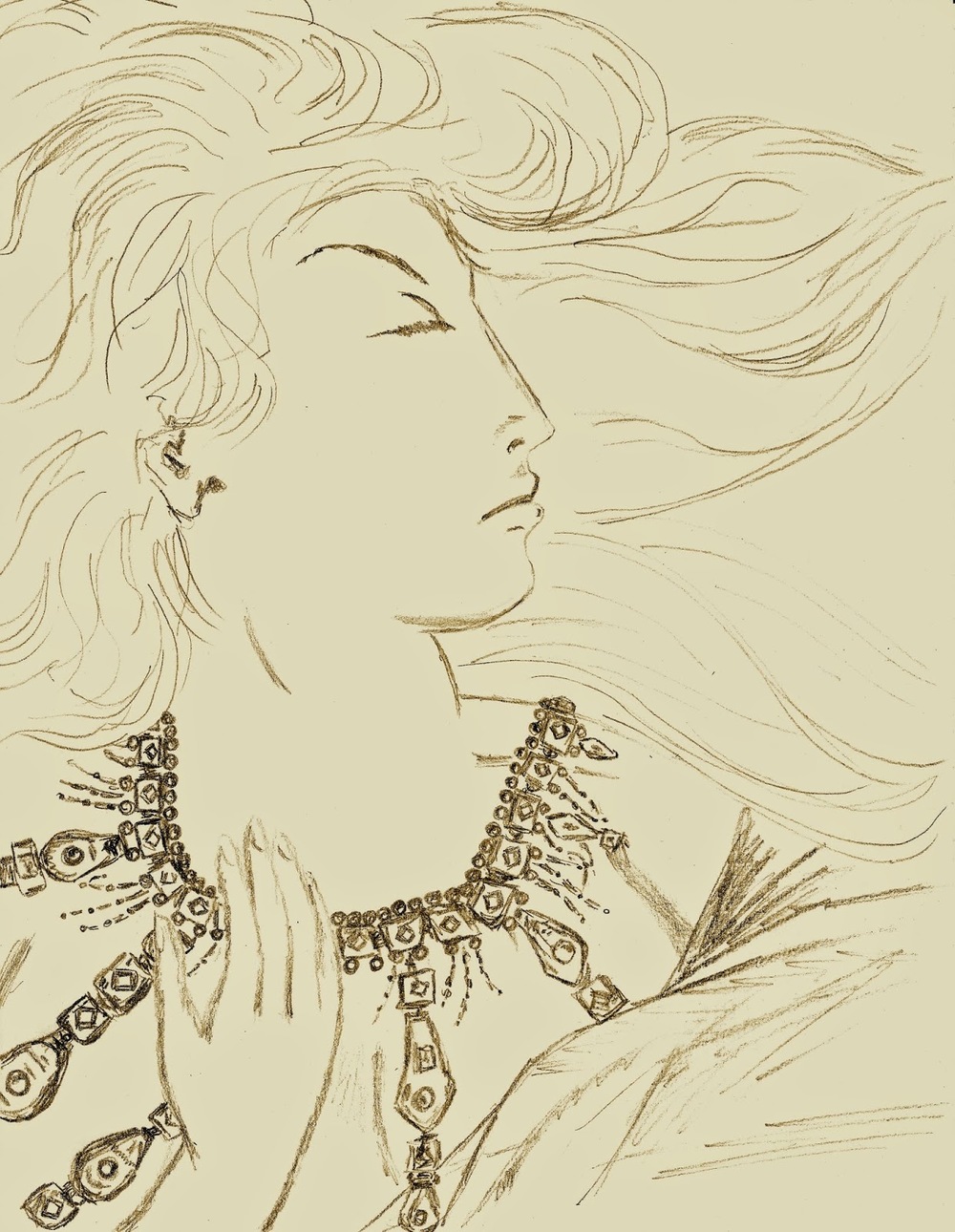
Brisingamen, the necklace of Freya


Freya and Brisingamen sketch based on image in Ingri and Edgar D'Aulaire's Norse Gods and Giants

Now is a particularly good time of year to go out after dark and enjoy the spectacular constellations visible along the zodiac band in the hours after nightfall and leading up to midnight (and the next week and a half will be particularly excellent, as the moon is waning and rising later and later in the night -- that is, closer and closer to sunrise -- as the sun prepares to "overtake" the moon and give us another new moon on June 28th, after which there will still be a few nights of good star-gazing while the moon sets relatively soon behind the sun).

High in the center of the sky you can locate the constellation Virgo, one of the most important constellations in the sky, and one who plays numerous roles in the ancient mythologies of the world, as demonstrated in the previous series of posts which presented some of the connections between the mythical stories of cultures as widely diffuse as those of ancient Japan, of the Indians of North America, and of the Norsemen of Scandinavia.

Virgo is easy to spot if you can locate her brightest star Spica, which Corvus the Crow is constantly staring at as described in this previous post, and her directly outstretched arm which is very prominent and which is described in this previous post.

Above her (all relative positions described from the perspective of a viewer in the northern hemisphere; please adjust for your own latitude on our planet) you can now easily make out the stars of Bootes the Herdsman, featuring the brilliant red-orange star Arcturus. A commonly-cited memory aid for locating both Arcturus and Spica tells us to follow the sweep of the handle of the Big Dipper and draw an "arc" to Arcturus, and then to continue along the same general direction and draw a "spike" to Spica. This method works quite well, especially as the well-known constellation of the Big Dipper is now high in the sky for observers in the northern hemisphere.

Another aid to locating Bootes which always helps me to find him is the fact that his long pipe reaches very nearly to the tip of the handle of the Dipper. Once you locate the Dipper's handle, you can trace the Herdsman's pipe back to his large (but faint) head, and then continue to trace out the rest of the constellation.  Both Virgo and Bootes are depicted in the star chart below, which is now familiar to readers of the three articles linked above which make the case that all the myths discussed utilize a common system of celestial metaphor, one that connects virtually all the world's ancient sacred traditions no matter how widely dispersed across the globe (including those in the Old and New Testaments).


If the night is dark and Bootes is high in the sky, you can clearly make out the beautiful semicircle of stars known as the Corona Borealis, or Northern Crown, which can be seen in the diagram above just to the left of the Herdsman's head, and which is labeled "Crown." It really is very close to the outline of the head of Bootes, and the best way to locate it is to look right at his head and it will be seen to be almost touching him. The diagram in the previously-linked post on Arcturus shows both Bootes and the Crown, and labels the brightest star in the Crown, which is known as Gemma or Alphekka or Gnosia.

We have seen from the examination of the mythology of ancient Japan that the Northern Crown was described in the Kojiki as an "augustly complete string of jewels eight feet long," which should give us a clue that another marvelous string of jewels belonging to a beautiful goddess may also be connected to this semicircle of stars next to Bootes and above Virgo: the dazzling fire-gold necklace of Freya, the Norse love-goddess.

Freya's necklace is called the Brisingamen, and it is featured in the Norse poetic Edda in the section known as the Thrymskvitha (or "Lay of Thrym"), which can be found beginning on page 173 of this online version of the poetic Edda. The Brisingamen is also featured in the prose Edda of Snorri Sturluson, particularly in the section known as the Skaldskaparmal, in which the theft of the necklace by Loki is alluded to although not described at length.

Other early Norse poetic compositions outside of the Eddas describe the theft of the Brisingamen by Loki with more detail, saying that Loki (who is a master of shape-shifting) turned himself into a fly in order to steal into Freya's bedchamber while she slept, buzzing around her face until she batted at him with the hand which even in sleep rested upon the clasp of her precious necklace. The moment she did this, Loki transformed in a flash into his normal self and stole the necklace. Snorri also refers to the theft of the necklace, citing passages from other poets which refer to the theft as well, showing that the episode was well-known by his day and probably much earlier.

If any doubt remained about the identification of Loki with Bootes in the episode of Skadi's laughter described in that post on the mythology of ancient Japan, the fact that Loki is described as the thief of the Brisingamen from the sleeping goddess and the fact that the starry necklace in the celestial realm is located not on Virgo where it belongs but next to Bootes who hovers over Virgo's recumbent form should "put those doubts to bed" once and for all (so to speak).  

Additional evidence comes from the fact that Snorri mentions that it was Heimdal who challenged Loki over the suspected theft, and who fought Loki for the necklace and eventually beat Loki and returned the necklace to Freya.  The authors of Hamlet's Mill present extensive evidence that Heimdal, the "son of nine mothers" and the one who, Snorri tells us, is also referred to by the name Vindler (which the authors of Hamlet's Mill tell us is associated with turning, or a turning handle).  The authors of Hamlet's Mill argue that these clues tell us that Heimdal is associated with the "handle" that turns the entire night sky around the central pole -- and that he is in fact associated with the entire "equinoctial colure," which stretches from Ares to Virgo through the north celestial pole (and around from Virgo to Ares through the south celestial pole as well, although this half of the colure is less appropriate to this discussion about the northern constellation Bootes and the northern myth of Loki).

Based upon their arguments, if Heimdal is associated with the handle of the Dipper and the north celestial pole, we can surmise that it is only natural that Norse myth might describe him as the arch-rival of Loki, if Loki is associated with the nearby constellation of Bootes the Herdsman, who appears to be tied to the handle of the Big Dipper. For discussion of those characteristics of Heimdal, see this previous post.

The fact that Virgo's arm is raised as if in the act of "swatting away" the thief of her necklace should be even further proof that this set of constellations furnished the material for this particular episode from Norse myth.

Any doubts which still remain regarding the identification of Loki the thief who steals from the goddess her most precious possession with the constellation Bootes above Virgo can be laid to rest by noting another nearby asterism seen in the star chart above, located just above the head of Virgo and to the right of the figure of Bootes the Herdsman, the constellation known as Coma Berenices or Berenice's Hair (and marked as such on the diagram). In his outstanding book The Stars: A New Way to See Them, author H.A. Rey says of Berenice's Hair:
Small and very faint. Contains a group of dim stars, visible only on clear, moonless nights when the constellation is high up [like, right now].  36.
He goes on to explain that:
The constellation owes its name to a theft: Berenice was an Egyptian queen (3rd century BC) who sacrificed her hair to thank Venus for a victory her husband had won in a war.  The hair was stolen from the temple but the priests in charge convinced the disconsolate queen that Zeus himself had taken the locks and put them in the sky as a constellation.
This story as related by H.A. Rey almost certainly has it backwards: the story of the queen who sacrificed her hair to the goddess Venus is most likely a legend inspired by the constellations Virgo and Coma Berenices (and not an original event that happened on earth and which later inspired the naming of constellations in the sky).

Those familiar with the Norse myths will immediately be reminded of yet another theft by Loki of the treasured possession of a beautiful goddess: this time, the theft of the golden-red hair of Sif, the wife of the thunder-god Thor. The myth of the theft of Sif's hair by Loki is clearly a dramatization of these three constellations: the disembodied hair of Coma Berenices, floating above Virgo and just next to Bootes.  In all of this, it can be seen that our identification of Loki with Bootes has ample reinforcement.

This analysis provides further support for my assertion regarding the identity of Loki and Skadi in the episode of the laughter of Skadi (Loki is again Bootes, and the beautiful Skadi is Virgo, who takes on the female role in a great many of the world's myths). It also further supports  the connections we saw, discussed in the post entitled "The celestial shamanic connection: Ancient Japan," between the Norse myth related in the Eddas in which the gods must make the beautiful jotun maiden Skadi laugh, and the Japanese myth related in the Kojiki that brings laughter to the assembled gods when the goddess Amaterasu hides herself in a cave. In the Japanese myth, it is the sexually explicit dance of the goddess Uzume which brings the laughter, and in the Norse myth it is the equally graphic antics of Loki which finally bring laughter to Skadi.

In the discussion, I make the argument that both of these myths clearly involve the constellation Virgo the Virgin and and the surrounding constellations in that region of the sky, and that in the Norse myth Skadi plays the role of Virgo and that Loki is Bootes the Herdsman -- a correlation I have not seen explicitly put forward anywhere else before (although the authors of Hamlet's Mill were clearly aware of some relation between the myth of Skadi and the myth of Uzume and Amaterasu, they never tell us directly that the connection specifically involves Virgo and Bootes, or trace out the connections between these myths and those stars).

The details which indicate that Loki's role in the tale come from the location of Bootes are conclusive, in my opinion, particularly the fact that Loki eventually precipitates himself into Skadi's lap in order to finally bring a smile to her lips -- a detail which can be readily understood from the relative location of Bootes and Virgo shown in the star chart. But the further evidence we have seen for Loki as Bootes in the myth of the theft of the necklace of Freya and in the myth of the theft of Sif's hair should put the matter beyond any doubt.

And so, if we have established that Loki is Bootes in numerous episodes from Norse myths, this serves to reinforce the assertion that the episode in which Loki makes Skadi laugh and the episode in which Uzume makes the assembled gods laugh and the goddess Amaterasu come out of her cave share a clear celestial connection, in that both the Norse and the Japanese myth use many of the exact same celestial components.

Further, the fact that we have now established the Northern Crown as the celestial counterpart of the mythical Brisingamen, the gorgeous necklace of Freya, reinforces yet another connection between the Norse and the Japanese myth-systems, in that the oldest surviving Japanese text containing these myths, the Kojiki, describes a jeweled necklace in conjunction with the episode in which Uzume dances for the assembled kami. Both systems are clearly employing many common elements in their myths involving the constellations surrounding Virgo in this particular part of the night sky.

Be sure to note also the fact that both myth systems, from Japan and from Scandinavia, are doing so in texts which can be shown to date from long before the conventional paradigm would allow for contact between cultures situated so far from one another on the globe. The Kojiki was composed no later than AD 711 or AD 712 (and probably contains myths that are centuries older than that). The age of the Poetic Edda is debated among scholars, but its original composition probably predates Snorri's Prose Edda of about AD 1220, and it may contain material that had been passed down for centuries before it was ever written down. In any case, contact between the cultures of Japan and Scandinavia prior to AD 711 is not consistent with the dominant conventional narrative of history, so what can explain the existence of a common system of celestial metaphor in the mythologies of such widely-separated peoples?

There are many possibilities, but almost all of them set the conventional historical paradigm on its ear.  One possibility is that there was ongoing transoceanic contact between these cultures during the centuries that these works were composed, or at some time prior. Another possibility is that both cultures (and the many others around the world whose mythologies share the same universal allegorical system) are descended from some even earlier common predecessor civilization, perhaps one which left this ancient esoteric system as a precious inheritance for all humanity.

In any case, if it is at all possible for you to do so, now is an excellent time to head outside in the hours after nightfall, and to identify the constellations discussed, such as Virgo, Bootes, the Northern Crown, and even (if the night is dark enough and the sky clear enough) Berenice's Hair. As you do so, you can think of the legends of the beauty of Freya, and of her dazzling necklace, the Brisingamen. And as you contemplate the theft of the heavenly necklace by Loki (and his theft of another heavenly treasure, that of Sif's hair), you can reflect on the possibility that this once-universal system of celestial metaphor, which Aritsotle himself referred to as the "ancient treasure" and which may represent the legacy of some far older and possibly far more advanced predecessor civilization, has effectively been stolen from humanity, and knowledge of it suppressed, for at least the past seventeen centuries.