Amen and Amenta: the hidden god and the hidden realm

Amen and Amenta: the hidden god and the hidden realm

image: seedlings, Wikimedia commons (link).

In the previous post, we saw evidence which bolsters the theory proposed by Jeremy Narby that shamanic cultures use communication with the spirit world in order to gain access to knowledge not explainable by conventional methodologies (conventional methodologies such as the process of trial-and-error). Previous posts have explored this concept, such as this one, this one, and this one.

The Undying Stars examines the body of the world's sacred mythologies and finds evidence that all of it can be conclusively shown to be based upon a common system of celestial metaphor -- no matter where in the world those myths are found.

From there, one can build a solid case that the message conveyed by these star-myths was a shamanic message: they teach a view of the universe that includes a vitally important unseen realm, and they teach the possibility of communicating with and even traveling back and forth to that unseen realm, in order to gain knowledge not otherwise obtainable, and in order to effect change (change in one realm impacts the other).

Importantly, as The Undying Stars demonstrates, the assertion that the world's sacred mythology is based upon a system of celestial metaphor and teaches a shamanic worldview can be shown to apply to the sacred myths in the Bible, as well as those of the so-called "pagan" cultures of the Egytpians, the Sumerians, the Greeks, the Norse, the Celts, the Inca, the Maya, the Aztec, the tribes of North America, the cultures of the Pacific islands, the cultures of Australia, the cultures of Japan and ancient China, India, and Tibet, and the cultures of Africa.

All of them teach a view of the universe that includes a vitally important unseen realm, and the possibility (and necessity of) communicating with and even traveling back and forth to that unseen realm -- including the sacred stories in the Old and New Testaments of the Bible. This interpretation of the Biblical stories, however, has been suppressed for at least seventeen hundred years.

The unseen realm called by many names. The Aborigines of Australia call it Dreamtime. The various cultures of the Americas refer to it as the Spirit World. The concept of the apeiron articulated by the pre-Socratic philosopher Anaximander appears to share almost all of the important aspects of the spirit world or hidden realm, including the fact that it was conceived as being boundless, timeless and infinite, and that it is an unfailing "reservoir" from which new life and new worlds unfold and into which they eventually disappear, only to unfold again in new forms.

This description of the apeiron, as well as of the spirit worlds of the other cultures from around the world, matches very well the ancient Egyptian concept of the hidden realm, which they called Amenta or Amentet, and which was accessed through the gateway of the Duat (sometimes rendered into Latin script as Dwat).

Jeremy Naydler is the author of Shamanic Wisdom in the Pyramid Texts, an extremely important study which offers evidence that the ancient Egyptian Sed Festival performed periodically by the kings of Egypt (assisted by the priests) actually involved a hidden rite taking place inside purpose-built pyramids, during which the king would enter a trance-condition and communicate with the hidden realm, for the purpose of bringing harmony and blessing to the entire kingdom.


His description of the hidden realm, to which the king traveled via what we would today refer to as an "out-of-body experience" or OBE, is very instructive. Dr. Naydler argues that, through their single-minded insistence upon identifying this hidden realm with the realm of the dead, conventional Egyptology portrays ancient Egypt as completely obsessed with death. But, although this hidden realm is in fact the realm of the dead, it is actually much more -- and those who think of it as only the realm of the dead risk missing the entire point. He writes:

Death was a realm -- not a physical realm but a subtle realm that they referred to as the Dwat. Furthermore, the realm of the dead was for them an ever present factor of life, interpenetrating the world of the living. In the realm of the dead, invisible forces, powers, and energies -- gods and demons as well as the spirits of the dead -- are active, and their energy impinges directly on the world of the living. The Egyptians were intensely aware that the world they lived in was more than just the world perceptible to the senses. It included a vast and complex supersensible component as well.

It would be a mistake, then, to regard the Dwat as simply the realm of the dead. It is the habitation of spirits, of beings that are capable of existing nonphysically. These include the essential spiritual energy or life energy of those beings and creatures that we see around us in the physical world. In the Dwat, everything is reduced to its spiritual kernel. Just as the forms of living plants, when they die, disappear from the visible world as they are received into the Dwat, so when the young plants unfold their forms again in the new year, they unfold them from out of the Dwat. This "hidden realm" (literally amentet, another term for the realm of the dead) is the originating source of all that comes into being in the visible world.

[. . .]

Therefore the Dwat, as much as it is the realm of death, is the source of all that comes to exist in the material world. The lord of this realm of death, which is also the realm of rebirth and rejuvenation, is Osiris. Thus the realm of Osiris, where the dead dwell, was by no means only a place where exhausted and tired-out life languished in a state of passive inertia. It was where things also existed in a state of energized inwardness, poised to burst forth again into manifestation. The Egyptian understanding of the realm of the dead, then, was that it was the source of the fertility of the land, the growth of crops, and the increase of herds. And the dead were not just passive in this realm, but were felt to have a special role as the guardians of the forces of life, and hence the well-being of the whole land of Egypt. This is the meaning behind the ancient Egyptian cult of the dead: It was not simply about remembrance; it was about ensuring that a connection between the manifest world and its vital spiritual kernel was maintained, for the dead were the conduits of this inner spiritual vitality to the outwardly manifest world. 83-84.

Note that in the passage above, Dr. Naydler points out that the Egyptian word for the "hidden realm" was amentet (sometimes rendered Amenta), and that the word literally means "hidden realm" or "unseen land." The Egyptian word amen meant "hidden" and the Egyptian god Amen or Amun was in fact "the hidden god" or the "unseen god."

While some may protest the identification, there is no denying that this word in its form and pronunciation is identical to the amen used in the New Testament scriptures. Is it possible that the use of this word in prayer (which, by its very definition, is communication with the unseen realm) indicates an acknowledgement of this fact and a hope that the prayer will successfully reach the other world?

But this concept of the hidden god and the hidden world goes deeper still, with esoteric connections expounded in Lost Light by Alvin Boyd Kuhn (1940). There, he explains that the ancient myths contain the teaching that every man and woman contains a spark of divinity, hidden within the material incarnation, which returns to the hidden realm after the death of the body but, like the invisible life of the plant buried within the seed, will return to bloom forth again. Kuhn finds evidence of this myth in the Old Testament stories of both the ark of the covenant and the ark of Noah. He writes:

Spirit goes into the cabin of the boat of the physical body to be gestated to new birth there. In turn, the body, going to dissolution outwardly, sends its principles into the inner shrine, or ark of the covenant, to be incubated there for its new birth in the next generation. Matter and soul eternally reciprocate dominance and leadership in living nature. And flesh is no more the ark of the soul than the soul is the ark of the flesh. Spirit conserves the gains of matter, to reproduce them in later form, as matter does those of spirit.

As soon as Life bifurcates into its two opposite but complementary nodes, there is set in motion the operation of mutuality and reciprocity, rhythm and balance, between the two. Deep inside the ark was the shrine for Deity; buried in the secret depths of every physical man is Amen-Ra, the hidden Lord.

[. . .]

Inside the physical matrix there hides the form of the god. Inside the god (when not embodied) hides the form of the (next) body. Each will give birth to the other in the cycle. To carry the image of birth in and from water, the boat or ark symbol was introduced. And the vastly important identity between the ark of the Biblical flood and the ark of the covenant in the Old testament -- the boat on the water and the chest in the temple -- has been entirely lost sight of. Egypt kept the intimate relation in view when the chest from the sanctuary was carried on the shoulders of priests in procession in the shape of a boat or inside a boat. The tabernacle was a combined boat and shrine, or ark sanctuary. The fire on the altar or the shrine in the holy of holies was the symbol of divine mind nestling imperturbably in the heart of every material form. 425-426.


It is clear from the above that, at least according to an esoteric interpretation, the scriptures of the Old Testament are teaching a concept very similar, if not identical, to that held by the rest of the world's cultures which taught that this world is interpenetrated by a "hidden world," a "seed world" -- a world in the words of Jeremy Naydler quoted above which is "the originating source of all that comes into being in the visible world."

From the passage just cited, Alvin Boyd Kuhn continues with words which harmonize very closely with Dr. Naydler's description of the Egyptian concept of the Duat or Dwat, Amentet or Amenta:

Life, as said, ceaselessly alternates shuttle-like between the two nodes of manifestation and withdrawal, activity in matter and rest in spirit. From the heart of invisible being it issues forth to express its creative pleasure in building the universe. But it operates rhythmically in cyclic rounds, for it is never static; and its periodic activity is focalized in time, and runs its course to an end, at which the forms built up to express its nature are dismantled and vanish away. 426-427.

But this esoteric interpretation of the Old and New Testament texts has been suppressed for centuries. Thus, the teaching that the word "amen" uttered at the end of a prayer may have reference to the same hidden world which is accessed by the American Indians as the Spirit World and the Australian Aborigines as Dreamtime and the ancient Greeks as apeiron and the ancient Egyptians as Amenta will be reflexively opposed by most "orthodox" interpreters of the scriptures. Likewise the interpretation that buried within the scriptural metaphors is the teaching of the "hidden god," the divine spark which resides within each man or woman, practically unknown and even forgotten.

Alvin Boyd Kuhn avers that the purpose of the ancient myths was to remind us of this reality and to reawaken us from the stupor into which we fall when we incarnate in this material realm. But, with the very existence of the hidden realm denied or obscured or ridiculed, and the very mention of the spark of internal divinity declared heretical by both the religious and the anti-religious alike, humanity in the modern age stands uniquely cut off from the teaching that was once the universal inheritance of all the peoples of the globe, and which still informs those cultures retaining a memory of the shamanic cosmology -- although they are becoming fewer and fewer.

The sacred formulas of the Cherokee

The sacred formulas of the Cherokee

image: Wikimedia commons (link). A'yûn'inĭ or "Swimmer."

Either one or two days after the incident with the ground squirrel recounted here, I sat down to a pleasant cup of oolong tea to read Sacred Formulas of the Cherokees (published by James Mooney in 1891).

The book itself contains extremely important records of primary-source formulas written by Cherokee shamans in their own words. Mooney explains that these records are unique among the Native American tribes of the continent, in that the Cherokee possessed their own alphabet (actually, a syllabary, with each symbol standing for a spoken syllable) and writing system, and could thus record their own thoughts and traditions directly, in their own words and language, without having to relate them to an interpreter. The famous Cherokee syllabary was developed by Sequoyah (c. 1770 - 1840) in the early 1800s, and rapidly adopted among the Cherokee Nation.

Mooney explains the significance of this development for the preservation of formulas used by Cherokee shamans in his text (remember, it was published in 1891, so when he says "the early part of the present century," Mooney is referring to the early part of the nineteenth century):

These formulas had been handed down orally from a remote antiquity until the early part of the present century, when the invention of the Cherokee syllabary enabled the priests of the tribe to put them into writing. The same invention made it possible for their rivals, the missionaries, to give to the Indians the Bible in their own language, so that the opposing forces of Christianity and shamanism alike profited by the genius of Sikwâya. The pressure of the new civilization was too strong to be withstood, however, and though the prophets of the old religion still have much influence with the people, they are daily losing ground and will soon be without honor in their own country.

Such an exposition of the aboriginal religion could be obtained from no other tribe in North America, for the simple reason that no other tribe has an alphabet of its own in which to record its sacred lore. [. . .]

This alphabet was at once adopted by the tribe for all purposes for which writing can be used, including the recording of their shamanistic prayers and ritualistic ceremonies. The formulas here given, as well as those of the entire collection, were written out by the shamans themselves -- men who adhere to the ancient religion and speak only their native language -- in order that their sacred knowledge might be preserved in a systematic manner for their mutual benefit. [. . .] The formulas contained in these manuscripts are not disjointed fragments of a system long since extinct, but are the revelation of a living faith which still has its priests and devoted adherents, and it is only necessary to witness a ceremonial ball play, with its fasting, its going to water, and its mystic bead manipulation, to understand how strong is the hold which the old faith yet has upon the minds of even the younger generation. The numerous archaic and figurative expressions used require the interpretation of the priests, but, as before stated, the alphabet in which they are written is that in daily use among the common people. [pages 308-309 in the original pagination as annotated in the left-hand margin of this online edition].

There is much in the above passage upon which to comment and reflect, but chief among them is the lamentable situation in which the proponents of literalist Christianity failed to understand that their scriptures are unmistakably based upon the exact same universal esoteric system that underlies the sacred traditions of the rest of the world's traditional cultures (see the extended discussions found in this and this previous post), and that in fact the founding scriptures of the Old and New Testament teach a worldview which can be accurately described as shamanic (Paul himself admits to traveling "out of the body" in 2 Cor 12).

The two should have never been "opposing forces" and "rivals" as they are described in the passage above. Yet this is a tragedy of history which was repeated over and over during the centuries which saw the spread of literalist Christianity, first within the borders of the Roman Empire, then out into the former "frontier" regions of Europe, and then into other continents including the Americas, Africa, Asia, and the Pacific islands.

The photograph above shows one of the Cherokee shamans who shared the ancient knowledge with Mooney when Mooney arrived at the Cherokee reservation in 1887, of whom Mooney says:

Some time afterward an acquaintance was formed with a man named A'yûn'inĭ or "Swimmer," who proved to be so intelligent that I spent several days with him, procuring information in regard to myths and old customs. [page 310 of the original pagination as indicated in the left-hand margin of the same online edition linked above].

Swimmer eventually furnished Mooney with "a day-book of about 240 pages" which was "about half filled with writing in the Cherokee characters," and which Mooney bought from Swimmer after giving him "another blank book into which to copy the formulas, after which the original was bought." This became known as the Swimmer Manuscript. It is available to read online in various places, including here.

As I studied this fascinating account, one passage which struck me most forcefully was the Cherokee account of "The Origin of Disease and Medicine," found beginning on page 319 of the original pagination as found in the same online edition linked above. There, the sacred history gives some very significant information regarding the origin of the knowledge of the plant-based medicines. The story begins:

In the old days quadrupeds, birds, fishes and insects could all talk, and they and the human race lived together in peace and friendship. But as time went on the people increased so rapidly that their settlements spread over the whole earth and the poor animals found themselves beginning to be cramped for room. This was bad enough, but to add to their misfortunes man invented bows, knives, blowguns, spears, and hooks, and began to slaughter the larger animals, birds and fishes for the sake of their flesh or their skins, while the smaller creatures, such as the frogs and worms, were crushed and trodden upon without mercy, out of pure carelessness or contempt. In this state of affairs the animals resolved to consult upon measures for their common safety. 319.

The bears go first, but after experimenting with bows and arrows decide for the time being to use their teeth and claws instead (a fortunate development for humanity, the Cherokee account seems to imply). Next the deer held a council under their chief, and they decide to inflict rheumatism upon any hunter who fails to ask pardon for the offense of slaying a deer any time he should kill one of their number: there is a sacred formula, preserved by the tradition of the tribe, that must be spoken by the hunter to ask pardon of the deer for killing it.

The account continues, and becomes even more noteworthy:

Next came the fishes and reptiles, who had their own grievances against humanity. They held a joint council and determined to make their victims dream of snakes twining about them in slimy folds and blowing their fetid breath in their faces, or to make them dream of eating raw or decaying fish, so that they would lose appetite, sicken, and die. Thus it is that snake and fish dreams are accounted for.

Finally the birds, insects, and smaller animals came together for a like purpose, and the Grubworm presided over the deliberations. It was decided that each in turn should express an opinion and then vote on the question as to whether or not man should be deemed guilty. Seven votes were to be sufficient to condemn him. One after another denounced man's cruelty and injustice toward the other animals and voted in favor of his death. The Frog (walâ'sĭ) spoke first and said: "We must do something to check the increase of the race or people will become so numerous that we shall be crowded from off the earth. See how man has kicked me about because I'm ugly, as he says, until my back is covered with sore;" and here he showed the spots on his skin. Next came the Bird (tsi'skwa; no particular species is indicated), who condemned man because "he burns my feet off," alluding to the way in which the hunter barbecues birds by impaling them on a stick set over the fire, so that their feathers and tender feet are singed and burned. Others followed in the same strain. The Ground Squirrel alone ventured to say a word in behalf of man, who seldom hurt him because he was so small; but this so enraged the others that they fell upon the Ground Squirrel and tore him with their teeth and claws, and the stripes remain on his back to this day.

The assembly then began to devise and name various diseases, one after another, and had not their invention failed them not one of the human race would have been able to survive. [. . .]

When the plants, who were friendly to man, heard what had been done by the animals, they determined to defeat their evil designs. Each tree, shrub, and herb, down even to the grasses and mosses, agreed to furnish a remedy for some one of the diseases named, and each said: "I shall appear to help man when he calls upon me in his need." Thus did medicine originate, and the plants, every one of which has its use if we only knew it, furnish the antidote to counteract the evil wrought by the revengeful animals. When the doctor is in doubt what treatment to apply for the relief of a patient, the spirit of the plant suggests to him the proper remedy. 321 - 322.

This passage is full of resonances with topics discussed in The Undying Stars, particularly the subject of the shamanic and accounts from shamanic cultures that their vast awareness of medicinal plants and plant-based remedies are not based on trial and error (nor could they be), but rather are derived from teachings received from the plants themselves (or, in the words of the above translation, from "the spirit of the plant").

This shamanic tradition from shamans in North America who were still in contact with their living ancient tradition accords well with the observations of anthropologist Dr. Jeremy Narby during his years of living and conversing with the people of the Peruvian Amazon. In The Cosmic Serpent, he records that he was originally astonished when he was told by the Ashaninca that they learned of the medicinal properties of plants by undertaking shamanic journeys during which they communicated directly with the plants themselves (in the spirit world).

The sacred teachings of the Cherokee appear to confirm that the things Dr. Narby was told and that he experienced himself are part of a pattern that stretches well beyond the specific peoples and areas he was studying, and may indeed be characteristic of surviving shamanic cultures. The mention of "snake dreams" in the above account may also have some harmonies with the experiences Dr. Nary describes, although it should be noted that in the Cherokee account, these "snake and fish dreams" seem to have a heavily negative and even sinister and potentially deadly connotation.

It is notable that the message of the story does not seem to be one of limiting the growth of the human population: the animals (especially Grubworm) who desire to cause harm to men and women through disease are portrayed in a negative light, and animals such as the deer and the bear seem to take a merciful attitude towards men and women. Further, the plants upon hearing of the harm intended by some of the animals are described as being "determined to defeat their evil designs." The plants furnish remedies so that the harmful plans of some of the animals will be thwarted.

Finally, of personal interest to me was the prominent mention of the Ground Squirrel, who "alone ventured to say a word in behalf of man," because people apparently "seldom hurt him [Ground Squirrel] because he was so small." Coming literally just a couple days after the rescue of the ground squirrel (see link at the top of this post) which made a deep impression on me, this unexpected passage in a book I had never read before was quite astonishing.

In fact, I had not sat down to read this particular Mooney manuscript, but had at that moment been looking for any online editions of Mooney's text describing his time observing the Ghost Dance movement of the Great Plains. When that was unavailable online, I moved on to the Cherokee text linked above instead. You can imagine my surprise when Ground Squirrel was singled out for discussion in this important account of the origin of plant-medicine remedies, and when he was described as being the only one who stood up for mankind, since they seldom hurt Ground Squirrel because he as so small.

These sacred teachings clearly have significance for us today -- they seem to be trying to tell us something important. Among those messages, perhaps: "Listen to the plants," and "Be kind to Ground Squirrel."

Know the stars: change the world

Know the stars: change the world

image: Wikimedia commons (link).

How can knowing the stars change your life? And even . . . change the world?

The endless, silent motion of the circling stars (along with the planets, and the motions of the sun and the moon) form the foundation of all the world's ancient sacred traditions -- from ancient Egypt, to ancient Greece, to the land of the Norsemen, to North America, and Central America, and Japan, and China -- even the islands of the broad Pacific (and in many other cultures and places not named here but which can also be demonstrated to have myths and sacred stories based upon the heavenly motions).

These heavenly cycles even form the basis for the stories found in the Old and New Testaments of the Bible (see for example here, here, and here).

If virtually every ancient sacred tradition and set of ancient scriptures is based upon the motion of the stars and other heavenly bodies, the formulators of those priceless vessels of ancient wisdom must have felt that this subject was vitally important.

What were they trying to tell us?

Plato, using the character of Socrates, seems to hint that the message of these celestial myths is the message of the temple at Delphi: Know thyself.

Part of that knowing involves who we are as human beings, and (according to Socrates) the knowledge that we consist of a soul which "is not born and does not die," a soul which descends into and "besouls" a body during multiple successive incarnations, in order to learn certain lessons -- all of which are related (according to Plato and Socrates) to love. This motion of incarnation and reincarnation is demonstrated to us in the motions of the stars and the heavenly spheres. See for example the discussion here.

But there is more. Because knowing that we are actually denizens of a spiritual realm and that our immaterial souls transcend the material realm (and are not dependent for their ultimate survival upon the material body), in the eyes of the ancients, implies something else. It implies that just as we are not bound by the material realm, and will one day transcend its bounds, we are also capable of transcending the material realm even during this life. It can be demonstrated that all of the ancient sacred traditions taught a vision that can be described as shamanic -- a vision that taught that we can transcend the artificial boundaries and limits that others try to impose upon us, or that we impose upon ourselves.

This is the vision that I describe as shamanic-holographic: the perception that what we take for "realities" are often simply illusions, created by our mind -- that we can actually replace these realities with new ones. Writer, investigative reporter and philosopher Jon Rappoport is one of the most eloquent champions of the individual's ability to transcend the realities that others try to force upon us (or that we force upon ourselves), and to create new realities. His concept of art and the artist is very much in harmony with the teaching that I believe is found in all the world's sacred mythologies, and which I have described in my book as "shamanic." He clearly perceives this purpose in the ancient stories of the gods and goddesses -- and in particular the presence of a "trickster" in every myth system, something he spoke of in his performance this past weekend at the Secret Space Program conference (I hope to explore in future posts some of the profound concepts he raised this past Sunday).

Take a look, for example, at this recent essay from Jon Rappoport's website, paying particular attention towards the end to his examination of the message of the god Hermes.

As he demonstrates in that essay, it is possible to transcend boundaries and to change the world for the better through art. The ancient scriptures (including those found in the Old and New Testaments) also teach that it is possible to actually tune our consciousness to the hidden world, the immaterial world -- the world to which shamans travel, and through which people may be moving when they have out-of-body experiences. This hidden realm may also be the world which we encounter when we dream, and which people tap into when they experience a "placebo effect" (essentially healing themselves in some way, based on a belief that they gave themselves by taking a placebo or "sugar pill").

This ability to transcend artificial boundaries -- an ability that the star-myths all urge us to grasp and to wield -- has very real potential to change our world for the better even beyond the individually life-changing possibilities hinted at above. Because most if not all of the world's injustices and violations of human rights are based upon the ability of perpetrators to impose "artificial laws" upon other men and women, and to get men and women to accept these artificial laws.

The great nineteenth-century philosopher and abolitionist Lysander Spooner contrasted artificial laws with what he called natural law. Examples he offered of artificial laws: laws passed in the United States which allowed men and women to be treated as property -- that is, as slaves -- which he argued loudly and powerfully to abolish, as well as laws which said that if citizens living in free states did not turn in fugitive slaves, they could be held to be in violation of the law and subject to both fines and imprisonment themselves. Spooner argued that men and women have the ability -- and even the right and the duty -- to ignore such artificial (and actually criminal) so-called laws. In other words, he argued that we must transcend the phony boundaries and statutes that others try to impose upon us, and that so-called "laws" which violate natural law (what I prefer to call "natural universal law") are no laws at all.

When we know the stars -- and the timeless message which the ancient scriptures of humanity meant to convey using the majestic motions of those stars -- then we can know ourselves, and know that we each individually contain and reflect the infinite cosmos. This endows each of us with infinite worth, and it also endows everyone we meet with the same. It teaches that we cannot violate the rights of our neighbor, and also that no one has the right to violate ours -- no matter what artificial systems others try to erect in order to attempt to excuse such violations or to hypnotize the people into permitting and even enabling such violations. It teaches that we can and must ignore and transcend so-called laws which are actually no laws at all (even as we obey the natural universal law which forbids doing violence to another person, who is equally an immortal soul and who individually also contains and reflects the entire cosmos).

And, on a personal level, it teaches that we can explode and scatter the artificial boundaries and limits that we or others try to impose upon ourselves and our potential, and boxes that we put ourselves into.

These are all potentially world-changing truths.

Know the stars: change the world (for the better).

The universe conspires to rescue a squirrel

The universe conspires to rescue a squirrel

The other day my older son had two basketball games with his high school team, which were held at a nearby community college. The games were an hour apart, and so in between the two games, my wife decided to run some laps on the track at the college, which was completely empty. My younger son and I went along as well to get outside and enjoy the sunshine in between games.

There were some young palm trees planted around the outside rim of the field, and he found a very solid palm tree husk and was playing with it to keep busy, in between pushing around some tires that were also lying around and taking some laps with my wife. Towards the end of the hour, when it was almost time to go, he noticed some deep holes next to the long-jump pit, which are used to allow the trainers to move a low hurdle into two different positions (athletes practicing the long jump sometimes train by taking off over a low hurdle, positioned at the end of their approach run and in front of the sand-filled pit where they will land).  

The low hurdle wall was already in place in one set of the holes in front of the pit (which was covered, since the track was not in use) but the other set of the holes were exposed (see image below):

Looking into the hole, he saw that it was so deep he could not even see the bottom. Hoping to see just how deep it went, he inserted the narrow end of the palm husk (shaped just like those seen in the second photo on this page). He heard a squeak. He wasn't sure why the husk would make that noise -- and then he heard the squeak again and realized to his horror that a squirrel had fallen into the hole at some point and was trapped at the bottom!

He quickly called us over and we tried to figure out how we could get the squirrel out. The palm husk was not actually long enough to reach him (or her), and besides it was so narrow that the squirrel couldn't really move his body around to maneuver into position to climb out (it was so deep that he could not be seen until we shined a light down). We tried lowering the empty sleeve of my wife's thin hooded sweatshirt also without success. I even ran over to the pole-vault pit and borrowed a vaulting pole, but the squirrel would not or could not climb up anything that was offered.

It seemed there was nothing else for it but to reach in and try to pull the squirrel out, which wasn't really my first choice of rescue methods. Reaching into a hole with an unknown squirrel at the bottom felt a little like the scene from the 1980 movie version of Flash Gordon, when Flash Gordon and Prince Barin have a little test of nerves by reaching their hands into the big hollow tree stump containing the poisonous "wood-beast."

Here's an image looking down into the hole (it's the closer of the two open squares in the image above):

What a lonely and terrifying place for that poor squirrel to be trapped!

With some trepidation, I reached down into the hole, and although I have pretty long arms I was unable to reach all the way to the squirrel before hitting my deltoid against the edges of the opening. 

Withdrawing my arm, I began to feel that we had exhausted all our options. I had the sickening feeling that we might have to leave the squirrel in there to die, and imagined how miserable it would be. I tried not to think of it turning into a little skeleton down there at the bottom of the long-jump training-wall post-hole.

Shining the light down into the hole, we could see the squirrel's fur and it seemed as though it was barely breathing. After racking my brains for any other solution, I decided to see if perhaps I could get my deltoid past the edge of the hole and somehow reach the squirrel's back. I pulled my sleeve all the way up over my shoulder and reached down again, and slid my arm all the way down up to the very top of my arm, and found that I could just barely touch the squirrel's back with the outstretched tips of my middle and index fingers. The squirrel made a little chattering noise when I made contact with his  (or her) back.

But it was too deep to get my thumb into the action, which would have made it much easier to pull the squirrel out. I tried to pinch its fur between the fingertips of my index and middle fingers, the only parts of my hand that could even reach down far enough. The fur was so short and so soft that it slipped right out each time I tried to lift him up. On about the third or fourth try, however, I managed to pinch a fold of the animal's skin and rapidly drew him out to safety (my wife jumped back quickly!).

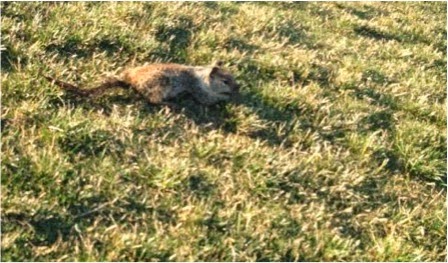
The squirrel sat there blinking its eyes for a second, and then tried to run off, but it kind of staggered around and fell over onto its side a couple of times. Each time it did so, however, it took a little breather and then started off again, and quickly recovered its equilibrium and became more sure of its little hops across the grass of the field. Soon it was hopping along at a good pace and it ran down a little dug-out squirrel hole at the base of the pole-vault pit (see images above and below -- this is obviously a ground squirrel).

We ran to the water fountain and filled an empty plastic water bottle we found in the trash can, and took it over to the little hole at the pole-vault pit, where we filled the shallow palm husk with the water and left it for him. We also attempted to cover the hole as best as possible with a square piece of the same palm husk. 

As we hurried back to see the second basketball game (which had already started), we thought about all the things that had to have taken place for us to have even discovered the poor trapped ground squirrel. First, of course, there had to be a basketball schedule with games that were an hour apart. But second we had to all go to the game, rather than just one of us (something we didn't decide until that afternoon). Then, my wife had to actually go through with her plan to take a run on the track in between games, which she almost talked herself out of. Then, my younger son and I had to decide to go with her, rather than hanging out in the gym with the other parents and players. 

Then, there had to be a palm husk available for my younger son to encounter. Then, he had to encounter the palm husk and decide to play with it,  rather than just sitting on the bleachers and reading a book or running around the track. Then, something had to draw him to the particular hole where the squirrel was trapped, and he had to have the idea to see if he could reach the bottom of that particular hole with it (he could not).

Additionally, the squirrel had to squeak at him, even though the palm husk was not long enough to actually get anywhere close to touching the squirrel). And then, he had to actually realize that the faint squeak was a trapped animal (it was pretty deep, and at first he thought the sound was just the scraping of the palm husk against the aluminum sides of the hole). Finally, someone had to be present with an arm just long enough and thin enough to (barely) reach the back of the little animal. 

If any one of the long series of seemingly "chance" decisions had not been made, the squirrel might not have been discovered (he [or she] certainly would not have been discovered by us, and it does not seem too likely that anyone else was coming through that way anytime soon).

While this episode brought that realization out into the open, in fact there are so many areas of our lives in which an equally improbable series of decisions and events and "coincidences" have to take place that it is a wonder that any of us were born at all! Think, for instance, of the chain of circumstances that lead up to anyone meeting their husband or wife.

There are many ways to explain long chains of such improbable events, and "blind chance" is one of them, but that is not the explanation that the ancients seemed to favor. In reviewing the various scriptures of ancient wisdom which deal with this topic, Alvin Boyd Kuhn says in Lost Light:  

Buried within the heart of each fragment, then, is the hidden lord of divine life, and from no one is he absent. He dwells there to be the guide, the guardian, the comforter and informing intelligence of the organism. He is the holy spirit, the flame, the ray, the lamp unto our feet. Says St. Paul (I Cor 4:7): "For God, who commanded the light to shine out of darkness, hath shined in our hearts . . . but we have this treasure in earthen vessels." The ancients oft termed this presence the daemon or guardian angel, as in the famous case of Socrates. He is that attendant monitor who stands behind the scenes of the outer life, instant to bless, ready to save, a never-failing help in trouble. His counsel is never lacking, if one seeks it or has not previously stilled its small voice. It reasons with us until many times seven. It abides within our inner shrine, patiently awaiting the hour of our discovery and recognition of its presence. 216-217.

This, or something like it, seems to almost certainly be responsible for the rescue of one small ground squirrel, trapped in a deep hole, all alone.

The squirrel hops away to the pole-vault pit, where he (or she) had a little burrow.

Back from the Secret Space Program conference 2014

Back from the Secret Space Program conference 2014

The 2014 Secret Space Program and Breakaway Civilizations conference has come to a close, but the ideas and conversations that it has sparked are just getting started.

In the near future, I hope to post some thoughts concerning specific aspects of the many excellent presentations.

It was an unforgettable weekend and I met some wonderful people. Special thanks to everyone who came up and introduced themselves to me at the Redwood Hall during the "intermissions" throughout the weekend -- I very much enjoyed our conversations and hope to continue them in the future!

Also, thanks to those who purchased copies of The Undying Stars (and copies of the Mathisen Corollary!) -- I truly hope that you enjoy reading them.

There really is something extremely important about interacting face-to-face and in-person with other men and women which simply cannot be replicated by any technology. I often use the analogy of playing basketball or other team sports -- practicing individually on skills can only take someone so far: there are certain things that can only improve through interaction with others. Events such as this year's Secret Space Program conference are tremendous opportunities to "play" with people who can really help elevate your game, because so many of the attendees have been thinking about and wrestling with these topics at a very high level for so many years, and interacting with others during that time as well.

We all have different backgrounds, life experiences, areas of interest and areas of specialization, talents and gifts to bring to bear on these questions, and when we share conversations with each other we can all benefit.

Catherine Austin Fitts (one of the speakers at the conference, of course -- you won't want to miss her presentation if it is posted to the web in the coming days or weeks) discussed during her most-recent Red Ice interview the importance of gathering in person with other individuals in events such as this year's conference. Towards the end of the second hour, she and Henrik had the following interchange:

Catherine Austin Fitts: Each time you let the market work, something amazing would happen -- because there is nothing more powerful than group intelligence, and I don't know if you've ever studied Rupert Sheldrake . . .

Henrik Palmgren: Oh, sure! We've had him on, yeah.

Catherine Austin Fitts: Yeah -- fabulous stuff, and it's really true. There is a, you know, extraordinary things that happen when the group intelligence goes to work. And, if I look at our current situation [i.e. in which "the big picture" is purposely hidden from the majority of the population, and deliberate lies and cover-ups are offered instead of the actual available evidence -- DM], one of the things that I find so painful, is . . . the group intelligence is not being allowed to go to work.

Henrik Palmgren: Exactly.

Catherine Austin Fitts: If you look at the amount of money spent on entrainment, and spent on manipulation, and spent on encouraging people -- you know, we've "puppy trained" the whole western world to believe that they can only unleash their creativity on consumer goods and social media, as opposed to the real problems of the world. And that's such a painful thing to watch -- because it's such a dumbing-down and a marginalization of a very amazing group of people. And if we could let the group intelligence go to work in a way that was aligning with the leadership, I think something remarkable could happen. And so the question is, can our group intelligence be powerful enough to sort of overcome all the disinformation and all the, you know, the entrainment, and instead go to work on really coming up with something that could work for all concerned? I don't know -- but I think I agree with you, I think you have to start with the truth. And I think the group intelligence can handle the truth.

[. . .]

But I for one find there's something magical that happens when you get a lot of -- you know, if you look at the people who are coming to this conference and speaking, these are people who've spent a lifetime trying to find the truth. And they all have very rich knowledge in different areas. And I find that when you come together in person, you know and there's sort of an intimacy of communication that happens: you get a sharing, and you get . . . you almost create a new field. So I for one am sort of hoping that we get breakthrough insights about what's going on and what we can do about it that are really, that enrich all of our work.


I could not agree more with the assertions about the finding that "there's something magical that happens" when people come together in person, and the intimacy of communication that is not available through any other medium (as amazing as our technology has become for sharing ideas and having conversations over great distances -- capabilities which are vitally important in their own way and enable platforms such as Red Ice and others which have done so much to create forums to share ideas worldwide).

Catherine asserts in these statements that the product of such in-person interaction can lead to entirely new "breakthrough insights," insights which can enrich all of our work. This was certainly true for me during the past weekend at the conference. Thanks are due to all the speakers who came and shared, and to all the participants in the conference on every level for creating together that magical environment.

image: Wikimedia commons (link)

A new theory on chemtrails proposed by Mark McCandlish

A new theory on chemtrails proposed by Mark McCandlish

At the Secret Space Program and Breakaway Civilizations conference all day today -- terrific talks and discussion from all the speakers.

My brain pan is spinning at such a velocity after listening to so many thought-provoking conversations in one day that I can barely write a coherent post! It will definitely take time to slowly chew over and digest some of the concepts that were introduced today, but many of them resonate with the subjects examined in The Undying Stars, and there should be some posts appearing here in the near future exploring some of those connections.

However, one of the comments Mark McCandlish made towards the very end of the day (if you didn't stay until 9 pm, you probably missed this one) was something I had not considered before and wanted to "re-broadcast" right away, as something worthy of wider discussion and consideration.

Mr. McCandlish discussed a great many extremely important subjects today, most of which involved what might be called "exotic technologies" and propulsion systems, how those might work and how it is possible that they have been in existence for many years -- with capabilities that are absolutely mind-blowing. This subject is of course absolutely central to all of the topics being examined at this conference, and the work Mr. McCandlish has done in gathering the evidence, thinking about it and researching it and discussing it with others for many years, as well as using his considerable artistic and technical illustration talents to communicate the principles that may be at work, entitle him to all of our respect and deep gratitude.

But, it is obvious that Mr. McCandlish (along with some of the other speakers) also cares deeply about the question of chemtrails, and towards the end of the evening he took the opportunity to respond to a question or comment from the audience about this subject, and to provide a possible explanation for their purpose which I had not heard nor considered previously, and one which is very intriguing to consider.

He said (and I am paraphrasing here) that he has been considering the possibility -- and has arrived at the conclusion -- that the spraying of highly reflective particles into the atmosphere may well be serving as the equivalent of chaff, a countermeasure employed by aircraft during military missions in order to throw up reflective signals which create big "clouds" on enemy radar screens, helping to prevent enemy radar operators from identifying the precise location of the aircraft throwing out the chaff.

But, while conventional chaff is used to mask an airplane from radar, my understanding of the theory Mark McCandlish articulated at the end of the evening in day one of the Secret Space Program conference is that he believes that the blankets of reflective material spread across the sky as chemtrails may be used to "disguise exotic propulsion" by craft which are already using technologies which may mask them from radar and which may also be using technologies which mask them to some degree from our ordinary vision.

In fact, he described seeing one such craft himself, which was almost invisible to the naked eye, but whose outlines could be barely discerned due to the fact that it was sunset at the time of the sighting and some of the edges of the cylindrical craft were outlined by a thin line of reflection (if the video of the Q&A discussion from the end of the day is posted online at some point, I will try to come back later and link to that video here so that others can hear the exact description of this incident in Mr. McCandlish's own words).

Previous posts on this blog have examined the chemtrail phenomenon, including possible explanations, but none of the explanations I have ever encountered have included the possibility that chemtrails may be being laid down in areas where secret craft using exotic propulsion systems or other exotic technologies are known to operate (including in Southern California, where I frequently see heavy chemtrail activity).

Some of those previous posts have included photographs I took myself showing trails which are very difficult to explain away as "normal condensation trails left by jetliners." This ludicrous explanation continues to be propagated as the rational explanation behind the "chemtrail conspiracy theory" on conventional-paradigm-defending sites such as Wikipedia (search for the word "chemtrail" on Wikipedia and you will be redirected to a page entitled "chemtrail conspiracy theory" which condescendingly declares that, "Although proponents have attempted to prove that the claimed chemical spraying does take place, their analyses have been flawed or based on misconception" and "Scientists and government officials around the world have repeatedly needed to confirm that supposed chemtrails are in fact normal contrails" -- Wikipedia, 06/29/2014, 01:05am Pacific).

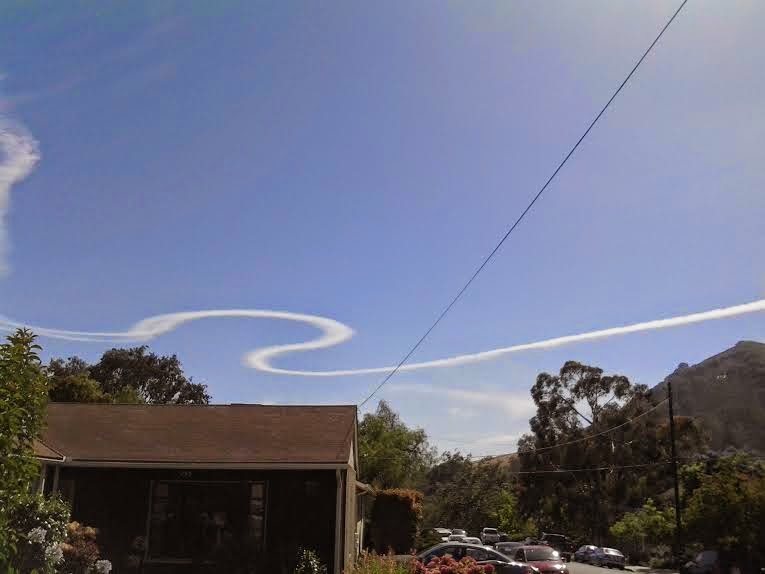
The image above is one that I photographed myself just this past week, over the distinctive "morro" mountain features of San Luis Obispo, California (photo taken on Monday, June 23, at 1609 hours, from my bicycle). If someone can explain how, in the words of the patronizing Wikipedia entry, the above photograph can possibly be explained by someone who maintains that "supposed chemtrails are in fact normal contrails," I'd be interested in their written analysis (the author of such an explanation is invited to post it on the web and link to it on my Twitter or Facebook account so that readers can evaluate the argument for themselves).

Is the jet plane producing the supposedly "normal contrail" in the above image just giving its San Francisco-bound passengers coming up the coast from LA a few little "extra scenic S-turns over San Luis Obispo"? Have you ever been on a jetliner that decided to take a few S-curves like this for some reason? Perhaps the captain came over the address system and said something like, "Well, folks, we've reached our cruising altitude here, and those of you on the left side of the aircraft should be able to see the beautiful waters of the Pacific and the famous Morro Rock -- and let me just do a few big meandering curves all over the sky to let you really take that in, and to give our passengers on the right side of the aircraft a chance to get out their iPads and take some photos of it too."

It might be argued that some kind of strange wind effect operating on one particular part of the sky created one of the big loops in the trail above, but which direction would that wind effect be coming from? The problem with the above photo is that it has not one but two big "bights" in the trail, and so if one wishes to explain it as a product of some kind of wind phenomenon, it would seem that two unusual wind streams would be required, one essentially blowing away from the camera (on the right side of the photo as we look at it), and one more blowing towards the camera to create the bight on the left side of the photo as we look at it.

I can attest to the fact that this photograph has not been "shopped" or retouched in any way -- it was taken from my inexpensive phone and then posted directly here -- it has been sitting on my phone untouched since this past Monday. If you still believe that "supposed chemtrails are in fact normal contrails" after examining the photograph above (as well as some of the others in the previous posts linked below), then I'd be interested in reading your arguments as to why my assertion that the photo above clearly proves that these are not just "normal contrails" produced by normal aircraft is incorrect.

Previous posts from this blog on the subject of chemtrails include:

Mark McCandlish's suggestion, which provides a clear connection between the as-yet-unexplained (but undeniable) phenomenon of chemtrails and the test-flights (or operational flights) of secret craft with exotic propulsion systems and equally exotic cloaking technologies is compelling, and worthy of greater consideration and wider discussion. Again, this was by no means his central point of discussion today, and his other points are extremely important and presented with a clarity that was most impressive, but this assertion made at the very end of the day also deserves to be noted.

On the other hand, the unsupported arguments on Wikipedia and other conventional-paradigm outlets that chemtrails simply represent "normal contrails" and that all the "conspiracy theories" suggesting otherwise can be waved away with the unsupported assertion that "their analyses have been flawed or based on misconception" are barely worthy of rebuttal.

The Battle of the Little Bighorn, June 25 - 26, 1876

The Battle of the Little Bighorn, June 25 - 26, 1876

image: Sioux Sun Dance, 1874. Wikimedia commons (link).

June 25 is the anniversary of the Battle of the Little Bighorn, which took place from June 25-26 in 1876.

The causes leading up to the battle were complex, but can be boiled down to the fact that the US Army was seeking to attack the Sioux and other Native Americans who refused to be confined to the reservations, and the larger issue that the US Government wanted to purchase the Black Hills (Paha Sapa) from the Sioux due to the discovery of gold there, and that the Sioux did not want to sell them.

In Crazy Horse and Custer: The Parallel Lives of Two American Warriors (1975), historian Stephen E. Ambrose writes:

The United States Government was embarrassed, not at the way its citizens were violating the treaty but by its failure to obtain some legal excuse to take the Hills. It seemed to have little sense of the nation's honor and little morality of its own. On November 3, 1875, President Grant held a high-level Cabinet meeting, with General Sheridan in attendance. It was decided that the hostiles were the ones standing in the way of a Black Hills take-over, so the solution was to drive the hostiles out of the unceded Indian territory in Wyoming and Montana and force them onto the reservations. On December 6 Grant ordered all Indians in the unceded country to move onto the agencies by January 31, 1876. Otherwise, they would be certified as hostile and the Army would come after them. The unceded country would become a free-fire zone. It was a declaration of war, although it should be added that neither Grant nor his advisors thought that the hostiles would put up a fight; in their view, the Army would have an easy time of bullying Crazy Horse, Sitting Bull, and the others onto a reservation. 396.

Sitting Bull was one of the leaders of the Hunkpapa Lakota warriors who refused to come in to the reservations and and who wanted to preserve their way of life; Crazy Horse was a leader of the Oglala Sioux who likewise disdained the idea of coming in. While the number of Indians who remained with Sitting Bull and the other leaders who wanted to live free had been dwindling, during the summer of 1876 their numbers began to swell dramatically, in large part because of the terrible conditions including food shortages found on the reservations, where corruption among the government agents commissioned to provide food to the reservation Indians was rampant.

Regarding the abominable conditions in the Indian agency camps, Ambrose writes:

The truth was that the agents were corrupt. They accepted diseased cattle, rotten flour, wormy corn, and so on from the white contractors, then took kickbacks when the United States Government paid the bill. There was nothing for the Indians to do at the agencies; the people were undernourished at best, starving at worst. Red Cloud and Spotted Tail argued incessantly with their agents, demanding more and better food, to no avail. 389.

According to Ambrose, an opinion he backs up with evidence from newspaper accounts and the actions Custer took, Custer himself was disgusted at the corruption in the setup, which he suspected (and went on public saying) could be traced all the way up to the brother of US president Ulysses S. Grant (399). There is also some evidence that Custer thought he could become the Democrat candidate for the presidency and win an election against Grant (a Republican), particularly if he gained a big victory in time for the news to make it back east before the Democrat National Convention, scheduled to open on June 27(407).

In an interview in 1881 in which he spoke of the battle for the first time since it took place, Sitting Bull said to a reporter:

During the Summer previous to the one in which Custer attacked us, he sent a letter to me telling me that if I did not go to an agency he would fight me, and I sent word back to him by his messenger that I did not want to fight, but only to be left alone. I told him at the same time that if he wanted to fight that he should go and fight those Indians who wanted to fight him. Custer then sent me word again, (this was in the Winter.) * * * 'You would not take my former offer, now I am going to fight you this Winter.' I sent word back and said just what I had said before, that I did not want to fight, and only wanted to be left alone, and that my camp was the only one that had not fought against him. Custer again sent a message: 'I am fitting up my wagons and soldiers, and am determined to fight against you in the Spring.' I thought that I would try him again, and sent him a message saying I did not want to fight; that I wanted, first of all, to go to British Territory, and after I had been there and came back, if he still wanted to fight me, that I would fight then. Custer sent back word and said: 'I will fight you in eight days.' I then saw that it was no use, that I would have to fight, so I sent him word back, 'All right; get all your men mounted and I will get all my men mounted: we will have a fight; the Great Spirit will look on, and the side that is in the wrong will be defeated.'

Ambrose confirms the general outline of the above account, with the US Government making a deadline (as noted in the earlier block quotation) for all Sioux to be in to the agencies by January 31. They sent out runners to inform all the "wild Sioux" of the impending deadline. Ambrose writes: "The runners found Sitting Bull camped at the mouth of the Powder River. He sent back a friendly message -- he couldn't come in just now, but he would consider the order and might come in later on, perhaps next summer, maybe later" (396). Ambrose says that Sitting Bull and Crazy Horse both regarded the order as "a good joke" (396-397).

The Secretary of the Interior wrote to the Secretary of War: "Said Indians are hereby turned over to the War Department for such action on the part of the Army as you may deem proper under the circumstances" (397). In between the end of the deadline and the actual departure of the 7th Cavalry into Sioux territory in May, Custer was involved in political bickering with President Grant, and was almost relieved of command of the expedition.

As word of the impending army campaign spread amongst the Sioux in the Indian agencies, more and more began to join Sitting Bull and Crazy Horse, Hunkpapas, Oglalas, Brulés, and Blackfeet Sioux, Cheyennes, Sans Arcs, Assiniboines and Arapahoes. Some estimates put the number of lodges that had gathered around the great camp in the Powder River country at over a thousand -- in some estimates two thousand. Ambrose estimates that the number of warriors was probably between two thousand and four thousand. The camp had to move frequently because the enormous numbers of ponies would exhaust the grass for forage, and new grazing areas would need to be found. The mighty camp moved into the Rosebud Valley in early June of 1876, and prepared for a Sun Dance.

Ambrose explains:

All the people, Sioux and Cheyenne, went into one enormous circle. Everything was done in the old way, according to strict and elaborate ritual. Virgins cut the sacred tree; chiefs carried it into the camp circle; braves counted coup upon it. The buffalo skulls were set up, along with the sacred pipes and other paraphernalia. Many men pierced at that dance, undergoing the self-torture so that Wakan Tanka, the All, would smile upon his people. Sitting Bull, his breast already covered with scars from previous Sun Dances, was the sponsor and leader. He sat on the ground with his back to the sacred Sun Dance pole while his adopted brother, Jumping Bull, lifted a small piece of his, Sitting Bull's, skin with an awl and cut it with a sharp knife. Jumping Bull cut fifty pieces of flesh from Sitting Bull's right arm, then fifty more from the left arm.

With blood streaming down both his arms, Sitting Bull then danced around and around the pole, staring constantly at the sun. He danced after the sun had set, through the night and into the next day; for eighteen hours he danced. Then he fainted. When Black Moon revived him by throwing cold water on his face, Sitting Bull's eyes cleared and he spoke to Black Moon in a low voice. His offering had been accepted, his prayers had been heard. He had had a vision.

Black Moon walked into the middle of the circle and called out, "Sitting Bull wishes to announce that he just heard a voice from above saying, 'I give you these because they have no ears.' He looked up and saw soldiers and some Indians on horseback coming down like grasshoppers, with their heads down and their hats falling off. They were falling right into our camp." 417.

This vision, which has become famous, had an effect on the gathered warriors that was electric. Later, during their reconnaissance on the two days prior to the battle itself, some of Custer's many Native American scouts (probably the "Indians on horseback" seen in the vision with the white soldiers) came across drawings in the sand along the Rosebud of Sitting Bull's vision and told the officers about it, warning them to turn back, but Custer only shrugged (428).

Crazy Horse was also known to possess very strong medicine through which it was believed that he could never be killed in battle by a bullet or by an enemy, something he had been told in his vision as a young adolescent boy of twelve or thirteen, 22 years before the Battle of the Little Bighorn (described by Ambrose on pages 68-69). After the Little Bighorn, an Arapaho who had ridden with Crazy Horse reported that, "Crazy Horse, the Sioux Chief, was the bravest man I ever saw. He rode closest to the soldiers, yelling to his warriors. All the soldiers were shooting at him, but he was never hit" (442).

Ambrose describes the decision undertaken by Crazy Horse during the actual attack, when Custer had split his twelve troops of cavalry into three maneuver elements, with three troops going with Captain Benteen, three troops with Major Reno, and five with Custer himself (one troop was left back to safeguard the supporting troops with the supplies and ammunition in the rear). It was a breathtaking maneuver on the part of Crazy Horse. Custer himself apparently planned to ride around in a large flanking maneuver to attack the rear of the Indian village (the north end as it was arrayed along the generally north-south direction of the Little Bighorn), planning to have Reno and Benteen coming up from the south. But, as Ambrose explains, Crazy Horse had ridden through the village, gathering a stream of warriors behind him, and set off to outflank Custer's maneuver:

Crazy Horse called to his men, "Ho-ka hey! It is a good day to fight! It is a good day to die! Strong hearts, brave hearts, to the front! Weak hearts and cowards to the rear!" He then led them, at a gallop, through the camp, planning to get beyond Custer, ford the Little Bighorn, and hit the 7th Cavalry in the right flank and rear. The Indian force picked up reinforcements as it tore through the camp, until there were as many as one thousand men following Crazy Horse, mainly Oglalas and Cheyennes. 440.

Meanwhile, the Hunkpapa war chief Gall had engaged Custer with as many as a thousand warriors of his own, crucially tying up Custer's maneuver force and setting them up for the flanking movement being led by Crazy Horse. Gall's two wives and children had been killed when Major Reno's troopers had launched the attack on the southern end of the village that morning. Ambrose speculates that when Gall's force lit into Custer's troops, Custer must have realized that he himself "was no longer on the offensive. Suddenly he was in a fight for survival" (440).

Custer may have tried to make his way towards the hilltop which is famous today for being the site of his "last stand." But at that moment, Ambrose believes, Crazy Horse with his thousand or so mounted warriors crested the intervisibility line created by the top of the hill Custer and his men were making for:

What a sight it must have been, especially for George Armstrong Custer, who was -- probably -- at that instant leading his men toward the spot on which Crazy Horse stood. Behind Crazy Horse, Custer would have seen the thousand warriors, all painted, many with war bonnets, some holding spears high in the air, their glistening points aimed right at Custer. Many braves, as many as one out of five, were brandishing Winchesters or other rifles. Half or more of the Indians held bows and fistfuls of arrows, often with shields in the other hand -- they guided their ponies with their knees. The ponies were painted too, with streaks and zigzags and other designs, and with their new coats, sleek sides, and plenty of fat from the spring grass, the animals looked magnificent. [. . .]

Crazy Horse would have been in front, alone, standing out in that kaleidoscope of shifting color by his apparent plainness. He would have worn only his breechcloth and a single hawk's feather in his hair. Almost surely he had his pebble behind his ear, another under his arm, and had thrown some dust over himself and his pony after painting zigzag marks on his body and some lightning streaks on his pony. He carried his Winchester lightly. His eyes must have sparkled; certainly he must have been proud -- of himself, of his warriors, of all the Oglalas, all the Sioux and Cheyennes. Together they had achieved something never before accomplished -- an armed mass of Indians, a thousand or more strong, was about to descend from an unexpected direction upon less than 225 regular Army troopers. 441.

There are many deep lessons here to reflect upon, a hundred and thirty-eight years after that fateful day. First, in spite of the massive victory by the Native American tribes acting in concert against the invaders, a victory that sent shock waves throughout the world, the aftermath was ultimately not favorable for the Sioux and the Cheyenne and their allies. Their way of life would soon be destroyed, their people forced onto the reservations, the Black Hills appropriated by the US Government that same year -- and the faces of four US presidents carved into them during the 1920s and 1930s.

Sitting Bull would try to continue to live the old life with a band of followers, moving up into Canada, but the cold winters eventually caused his followers to abandon the dream, and eventually he turned himself in, as Crazy Horse did years earlier, his own followers facing starvation from lack of buffalo and several children having frozen to death from the cold. Both Crazy Horse and Sitting Bull were killed by being stabbed in the back (Crazy Horse) and shot (Sitting Bull) under suspicious circumstances while in police custody in the agencies.

Clearly, the events described above show that the actions taken by the US Government were in egregious violation of natural universal law. To declare that men and women must place themselves on a reservation or be "certified as hostile" and subject to attack at any time by the army violates natural law. On the other hand, Sitting Bull not once but several times stated that he and his people did not want to fight, but would fight back if attacked. His testimony is that he and his people wanted to be left alone to live as they chose to live.

But, although they were perfectly within their rights to fight back when confronted with deadly force from the invading armies, their victory did not cause the people who were supporting the murderous policies in the first place -- that is to say, the people who elected and supported the US Government and gave their approval to the policies being enacted ostensibly in their name -- to change their minds and reconsider the fact that they were in the wrong and were guilty of violating natural universal law against their fellow human beings. In fact, the stunning defeat of Custer and the 7th Cavalry only hardened their resolve to continue their illegal seizure of the homelands of the Native Americans and to insist on the destruction of their way of life.

It is a certainty that, had enough people become outraged at the illegal and murderous actions that were taking place, those actions could have been ended. But in order to make that happen, the ideologies and mind control that enabled all those people to excuse and overlook the illegal policies had to be overcome. The use of force -- even when rightly employed to try to stop violence -- is rarely enough to overcome the ideologies and mind control that are blinding those who are excusing and enabling murder. However, as discussed in this previous post on Martin Luther King, Jr., nonviolent demonstrations which cause the perpetrators of these crimes to reveal the true nature of their heinous beliefs and activities can sometimes do so, by appealing to and awakening that innate knowledge of natural law which nearly all men and women possess, and which the enablers of violence and violation must "hypnotize" and "put to sleep" using ideology and mind control.

Had the Native Americans employed techniques designed to appeal to this aspect of the populace back east that was enabling the murderous policies in the west, and had they combined that with continued brilliant military actions such as that which delivered the crushing defeat to the 7th Cavalry in 1876, the results might well have been different. Military victories alone could not accomplish this.

Another important lesson from the events just described is the way they fit into a much larger pattern, a pattern that has been absolutely dominant throughout the history of the past seventeen centuries, but which has been camouflaged so well that most of us do not even realize it is going on. That pattern consists of the tactics of the enemies of what we might call "the shamanic." The goal of the US Government, stated in black and white ink in their treaties with the Sioux (treaties the US Government later shamelessly broke), was not simply control of the Black Hills and their gold, but also the requirement that the Native Americans turn over their children to be educated by the agents of the government from the ages of six through sixteen. These stipulations can be seen in the Treaty of 1868 in Article VII in this transcript, or in the images of the original handwritten treaty documents here.

The overt goal of the US Government was the eradication of the old ways. We can see from the historical events cited at the beginning of this post that the pattern included the registration of the formerly free Indians in an "agency," where they would be dependent upon government agents for their food. This situation naturally invited corruption, in which certain people who had "connections" (including, in this case, possibly the brother of the president of the US himself, along with others administrating the system) could make money for themselves through those connections.

In this particular example, the corruption involved the purchase of rotten or substandard food from suppliers, probably at a discount (the suppliers being happy to get any money for goods which would otherwise have to be thrown away) and then overstating the prices paid in order to skim the difference for themselves. But this is just one form such corruption can take. Note that the entire Middle Ages basically followed a similar pattern -- the Middle Ages that were set up in Europe, according to the theory I explore in The Undying Stars, by the experts in mind control who took over the Roman Empire using the twin mechanisms of Mithraism and literalist Christianity, and who then established for themselves fiefdoms across Europe.

During the Middle Ages, in other words, the bulk of the populace was reduced to a status similar to that of the Native Americans who were forced into the agencies: their freedoms were curtailed, they were dependent upon those who had declared themselves to be the owners of the lands, and they were reduced to conditions at or near poverty, while those well connected to the governing bodies could create lucrative schemes to enrich themselves in much the same way as did the corrupt agents who were procuring rotten food for the Indian agencies described above.

Put another way, we can see the pattern that was imposed on Europe during the time of feudalism being imposed upon the Native Americans during the nineteenth century.

Additionally and related to the foregoing, the incidents just described indicate the fact that the Native American cultures were clearly shamanic, and had access to knowledge and powers which cannot be explained within the general paradigm favored by those in charge of the conventional historical narrative today. Both Sitting Bull and Crazy Horse genuinely appear to have been able to cross over the boundaries between this world and the "other realm," with positive impact on their own lives and on the lives of those they led. Crazy Horse had at least one such boundary-crossing vision, at the age of twelve or thirteen, which guided him for the rest of his life. He may have had others, but we can be sure he had one. Sitting Bull by all accounts had many others, and appears to have had a very clear vision prior to the Battle of the Little Bighorn, during which he was able to access information from another aspect of reality or another realm of experience.

I have suggested in The Undying Stars that part of the pattern of those people who created the conditions of the Middle Ages included the deliberate destruction of such shamanic knowledge, wherever it might be (beginning first within the Roman Empire itself, then expanding to other parts of Europe and Africa, and then across the oceans).

Finally, and this may be most crucial of all, we might want to ask ourselves to what degree we today are enabling and supporting the placing of other human beings "onto the reservation" -- to what degree we "look the other way" to violations of natural universal law, or by our ideologies excuse those violations and try to convince ourselves that they are not really violations at all. And, related to that question, we might also ask in what ways we ourselves are being told that we must give up on the idea of freedom and submit to life "on the agencies" (by accepting universal, ubiquitous surveillance, for example).

Custer himself, who was a very complex character, certainly with many flaws but in many ways not entirely unsympathetic, went on record as saying: "If I were an Indian, I would greatly prefer to cast my lot among those of my people who adhered to the free open plains rather than submit to the confined limits of a reservation" (cited in Ambrose, 387).

We may tell ourselves, in the comfort of our living room, reading about the events of 1876, that if given the choice, we too would have followed the path of Crazy Horse, or of Sitting Bull, and opted for freedom, politely declining the invitation to come in to the agencies, not seeking the way of war but unafraid of it if it came. But, given the fact that we may well be staring at impending changes which will be every bit as radical as those faced by the Sioux, we must ask ourselves whether we are casting our lot with those who "adhered to the free open plains" or those who have decided to "submit to the confined limits of a reservation," in Custer's words. It is very interesting that the US company Google chose to host their annual I/O conference on the anniversary of this particular battle, with demonstrations related to new ways to add "input-output" devices and software to your television, your automobile, and just about everywhere else you go during the day, including devices to monitor you while you sleep, although of course it is probably only coincidence.

These issues show us that the Battle of the Little Bighorn and the examples set by Sitting Bull, Crazy Horse, Gall, and the others are not merely the "stuff of history," but that they continue to have tremendous relevance to the lives of every man and woman alive today.