Truth Warrior interview now available as a podcast

Truth Warrior interview now available as a podcast

For those not able to watch the entire interview as a video, the Truth Warrior interview linked in this previous post is now available as a podcast, which can be downloaded to a music player such as iTunes, where it can then be loaded to a mobile device or a compact disc for listening while not stuck in front of a screen.

To download, you can "right-click" or "control-click" (for Macs) on the yellow title in the above Spreaker bar, and then "download linked file as" in order to save it. You can also find additional downloading, listening and sharing options here at Spreaker.com.

More on the spiritual significance of firesticks

More on the spiritual significance of firesticks

In light of the foregoing post examining the profound importance anciently attached to the bringing of fire to humanity, its association with the constellations of Orion (who may well represent Prometheus-Kronos-Saturn-Osiris) and Gemini (who may represent the "celestial fire sticks" and the hollow reed in which Prometheus hid the fire when he stole it away from the realm of the gods and brought it down to earth) and the lost Golden Age, and its esoteric and spiritual significance, it is more than noteworthy that numerous Native American prophets or medicine men in past centuries reported visions in which they received a message from the spirit world to stop using the white man's steel and flint to kindle fires, and to return to the traditional fire sticks.

In his first-hand account of the Ghost Dance Religion and the massacre of Native Americans by the US Army at Wounded Knee, James Mooney (whose work of trying to record and preserve details of Native American culture and spirituality was also mentioned in this previous post) goes back to the mid-1700s in his examination of the roots of the Ghost Dance.

Mooney begins his examination of prophets who were given visions which advocated a union of all the various tribes and "a return to the old Indian life" with an individual known to Mooney only as the Delaware Prophet but identified today as Neolin or "the Enlightened One," who in 1761 sought a spirit vision and fell into a deep sleep in which he went on a long journey to the other realm, where he received specific instructions that he brought back and began to relate, and which subsequently spread from tribe to tribe, eventually playing a central role in the conflict known as Pontiac's War.

According to the account of John McCullough, who had been captured at the age of eight and adopted into a family of the Delaware people in northeastern Ohio, and whom Mooney cites at length regarding the details of the message of the Delaware Prophet:

It was said by those who went to see him that he had certain hieroglyphics marked on a piece of parchment, denoting the probation that human beings were subjected to whilst they were living on earth, and also denoting something of a future state. They informed me that he was almost constantly crying whilst he was exhorting them. I saw a copy of his hieroglyphics, as numbers of them had got them copied and undertook to preach or instruct others. The first or principal doctrine they taught them was to purify themselves from sin, which they taught they could do by the use of emetics and abstinence from carnal knowledge of the different sexes; to quit the use of firearms, and to live entirely in the original state that they were in before the white people found out their country. Nay, they taught that that fire was not pure that was made by steel and flint, but that they should make it by rubbing two sticks together.  . . . It was said that their prophet taught them, or made them believe, that he had his instructions immediately from Keesh-she-la-mil-lang-up, or a being that thought us into being, and that by following his instructions they would, in a few years, be able to drive the white people out of their country.
I knew a company of them who had secluded themselves for the purpose of purifying from sin, as they thought they could do. I believe they made no use of firearms. They had been out more than two years before I left them. . . . It was said that they made use of no other weapons than their bow and arrows. They also taught, in shaking hands, to give the left hand in token of friendship, as it denoted that they gave the heart along with the hand. [Mooney, 668; ellipses in the original].

Superficial accounts of the message of the Delaware Prophet will typically include the restrictions against drinking the white man's alcohol (mentioned in numerous other accounts of Neolin's message) and the admonishment to return to the bow and arrow and to traditional garments of skin rather than using European clothes, but the specific requirement to abstain from making fire with steel and tinder, and to use none other than the rubbing of two sticks, is often omitted. 

And yet it is no doubt of great importance, for the exact same admonishment was received in a vision reported in 1805 (forty-four years after the vision reported by the Delaware Prophet) by the Shawnee prophet Tenskwatawa, the brother of Tecumseh. Based upon contemporary reports, Mooney relates the vision of Tenskwatawa as follows:

[. . .] one day, while lighting his pipe in his cabin, he suddenly fell back apparently lifeless and remained in that condition until his friends had assembled for the funeral, when he revived from his trance, and after quieting their alarm, announced that he had been to the spirit world and commanded them to call the people together that he might tell them what he had seen. When they had assembled, he declared that he had been conducted to the border of the spirit world by two young men, who had permitted him to look in upon its pleasures, but not enter, and who, after charging him with the message to his people already noted, had left him, promising to visit him again at a future time. [Mooney, 673; my ellipses].

The details of the message with which Tenskwatawa said he had been charged were related by various witnesses of the era as follows:

The firewater of the whites was poison and accursed [. . .]. The young must cherish and respect the aged and infirm. All property must be in common, according to the ancient law of their ancestors. [. . .] The white man's dress, with his flint-and-steel, must be discarded for the old time buckskin and the firestick. More than this, every tool and every custom derived from the whites must be put away, and they must return to the methods which the Master of Life had taught them. 672.

Whether or not this message was derived from the message of the Delaware Prophet, which it resembles very closely in almost all of its details, the fact remains that the admonition to use only fire generated by the old method of using firesticks was a central part of the teaching. In fact, in the portrait of Tenskwatawa painted by the American artist George Catlin in 1830 or 1831, the prophet is shown holding his fire-sticks in his right hand, and his sacred string of beans in his all-important left hand, the hand which was connected to the heart, the beans with which those who accepted the vision would pass through their own left hands in a solemn ritual known as "shaking hands with the prophet" (described in Mooney 677-679).

image: Wikimedia commons (link).

It is certainly interesting as well to note the similarities of this account with contemporary accounts given by many survivors of near-death experiences, in which many have reported that they met personages at the entrance to the other world who allowed them to see some things but then explained that they had to go back now and could not go further, as it was not their time to leave this world. For further examination of the NDE phenomenon, see previous posts such as this one and this one, as well as Chris Carter's outstanding examination of the topic in Science and the Near-Death Experience.

In light of the discussion in the previously-linked post about Prometheus and the gift of fire, and the identification of the fire-sticks found in mythologies the world over with the stick-like constellation of Gemini the Twins (almost certainly the constellation being depicted in the Panel of the Wounded Man in the Cave of Lascaux as a figure composed of two parallel lines, an identification brilliantly argued by William Glyn-Jones and discussed here and here), is it not also most remarkable that in the vision reported by Tenskwatawa in 1805 his guides in the spirt world are "two young men"?  

In light of the undeniable importance attached to using two sticks to kindle fire in the historical accounts of the visions reported by both Neolin and Tenskwatawa, it is not unreasonable to conclude that there may have existed an ancient sacred tradition, passed down through the generations, of the spiritual significance of the kindling of fire using the two sticks -- and perhaps also the connection of this tradition to the heavenly Twins of Gemini.

For those who wish to follow the visions received by the Delaware Prophet and Neolin, and use no fire but those derived from a fire that was started with firesticks, the method is demonstrated in the video above (as well as many others available on the web today).  If you were to kindle a fire using this method every day, you would no doubt become an expert at it in short order.

Two different methods of fire making without matches using a vertical fire-stick along a horizontal fire-stick (pramantha and arani in the Vedas of ancient India, whose importance as a spiritual symbol of human existence simply cannot be overstated, and which are also discussed in the aforementioned post about Prometheus) are shown in this page from the Air Force survival manual that I used to read frequently while I was growing up (and mentioned in this and this previous post):

Of course, the methods shown in the top panel (flint and steel) and in the left-hand lower panel (burning glass and electric spark from a live storage battery) would not be approved methods according to the visions of Neolin and Tenskwatawa; those in the square panel at the lower right of the page all involve two sticks and thus would be -- that panel is enlarged below:

Of course, the 1960s Air Force clothing depicted would probably not be looked upon with favor by those eighteenth-century and nineteenth-century visionaries.

Below is a recent music video from the fantastic musician, poet, songwriter, teacher, and advocate for human freedom and justice Michael Franti (and SOJA) in which he is seen making fire using a version of the two-sticks method. He holds the lower stick between his feet -- Michael Franti has chosen to walk this world barefoot for at least the past fifteen years:

The concept of the fire-sticks has deep connections to the concept of human consciousness, of raising greater awareness of our purpose here in this incarnation (in which we can be seen as sparks which have come down to inhabit the matter of our bodies within this material realm), and -- as can be seen from its importance in visions which centered around resistance to the injustice which was being inflicted upon the Native American inhabitants of this continent and the destruction which was being wrought upon their way of life -- of the mindfulness we should take in our lives to align ourselves with the right path.

Prometheus, Bringer of Fire

Prometheus, Bringer of Fire

Previous posts have explored myths from around the world regarding the origins of fire which center on the stars of the fall equinox, particularly the constellations Virgo, Boötes, and Centaurus (see for example "The Old Man and his Daughter").

However, there is another well-known ancient myth regarding the obtaining of fire by mankind: the myth of Prometheus.

As related by Apollodorus in the seventh section of Book I of his Bibliotheca (translated by James George Frazier, 1921):

Prometheus moulded men out of water and earth and gave them also fire, which unknown to Zeus, he had hidden in a stalk of fennel. But when Zeus learned of it, he ordered Hephaestus to nail his body to Mount Caucasus, which is a Scythian mountain. On it Prometheus was nailed and kept bound for many years. Every day an eagle swooped on him and devoured the lobes of his liver, which grew by night. That was the penalty that Prometheus paid for the theft of fire until Hercules afterwards released him, as we shall show in dealing with Hercules. 1.7.1.

Note that as in the case of the Old Man and his Daughter, the bringing of fire to humanity involves a theft -- one for which Prometheus in this case is severely punished. This aspect of the myth recalls the theft of the mead of poetry by Odin from the maiden Gunnlod -- another myth which, like that of the Old Man and his Daughter and the theft of fire -- is based around the constellation Virgo, and one which also features an eagle (in this case, two eagles, as well as the additional twist that Odin and his adversary each transform into eagles, which adds a shamanic element to the story as well).

In Hamlet's Mill, authors Giorgio de Santillana and Hertha von Dechend explore the evidence which suggests that poetry -- which Odin had to go to so much trouble to steal -- was anciently regarded with the most profound respect, and treated as a high technology connected to the order of the cosmos. Poetic versification was not something to be trifled with, and they cite evidence that poets took great care to align their use of the technology of metaphor and meter with the deep patterns of the universe:

Every era, of course, has freely invented its own ballads, romances, songs and fables to entertain it. That is another matter. This concerns the poet, poiētēs, as he was understood in early times. There was an original complex of meaning which comprised the words poet, vates, prophet, seer. Every knowledge and law, Vico wrote with a flash of genius two centuries ago, must once upon a time have been "serious poetry," poesia seriosa. It is in this sense that Aristotle in a sophisticated age still refers respectfully to "the grave testimony of [early] poets." 119.

Note that Hamlet's Mill is available to read online here (although every home library should probably have a physical paper copy!); the passage cited above can be found in chapter 8, here.

In light of this role, we can understand why the ancient myths described poetry as something which came down to earth from the heavens, and which "properly belonged" to the celestial regions (hence its portrayal in Norse myth as something which must be stolen, or which drops to earth from the gods). If poetry somehow relates to the motions of the cosmos, then we begin to sense the thought process behind the ancient requirement that the poetry must conform to certain patterns ("as above, so below"). The Edda of Snorri Sturluson, one of the most important sources for Norse myth, spends most of its time explaining the technology of poetry, kenning, and naming.

We can further surmise that the "stealing of fire" may somehow be describing the same concept as the stealing of poetry, in that it is bringing down to humanity something which properly belongs to the heavenly spheres -- and that these myths are about much more than supposedly-primitive humans trying to explain the discovery of the method of kindling fire in their supposedly-primitive past.

This suspicion that the stealing of fire and the stealing of poetry might be pointing us to the same esoteric truths is further bolstered by the fact that Hamlet's Mill  spends a good bit of time examining the importance of the rebel Titan Prometheus, and finds evidence that he is also somehow closely associated with the ancient figure of Kronos-Saturn, "the giver of measures."  In support of this assertion, they cite the thirteenth Orphic Hymn:

So the (13th) Orphic Hymn to Kronos addresses the god as "Father of the blessed gods as well as of man, you of changeful counsel, . . .  strong Titan who devours all and begets it anew [lit. "you who consume all and increase it contrariwise yourself"], you who hold the indestructible bond according to the apeirona (unlimited) order of Aiōn, Kronos father of all, wily-minded Kronos, offspring of Gaia and starry Ouranos . . . venerable Prometheus." 132-133. Bracketed material appears as such in the original text by de Santillana and von Dechend.

Here Prometheus is specifically identified as an aspect of Kronos, giver of measures. The ominous figure of Kronos-Saturn appears in the myths of the world with specific characteristics shared across the globe: he is in one sense a benevolent figure, who came and dwelt among men in a distant Golden Age, teaching them the civilizing arts, but he is also a doomed figure, destined to be imprisoned beneath the earth or beneath the sea (or, in the case of King Arthur, beneath the surface of the Lake), a figure bound in chains, a figure who simultaneously gives the measures of time and space, and is at the same time bound by them. Saturnian figures discussed in Hamlet's Mill include Yama, Varuna, Phaethon, Ea, Enmesharra, Osiris, Hephaestus, Pan, Jamshyd, Yima xsaēta, Balder, Attis, and the Yellow Emperor of ancient China (268-286).

Saturn "gives the measures" because he is the furthest visible planet, with the longest orbit -- a fact which can be observed from earth by seeing that it takes him the longest to return to the same zodiac constellation in the night sky (presently he is in Libra).

We can immediately see that the one who "gives the measures" is related to the gift of poetry -- which is almost by definition a metrical form of language. There is also, as de Santillana and von Dechend discuss, a clear connection to the shaman, whose drum is an important part of the shaman's paraphernalia the world over and which helps connect the shaman to the celestial motions of the universe, and to traverse the ladder to the "other realm" or "spirit realm" -- the realm of the gods.

As noted above, many myths from around the world describe Saturn (or their Saturnian figure in their system) as ruling over a vanished Golden Age, in which he walked among men and women and taught them the civilizing arts, including the growing of crops (in some accounts, in the Golden Age men and women abstained from eating the flesh of animals -- and in some accounts, the Saturn-figure is the one who taught them to not eat one another!). We can immediately see why Prometheus the Giver of Fire fits into this pattern of the god who came down to give higher technology to mankind.

In Hamlet's Mill, the authors provide evidence (without stating it explicitly or at least systematically) that this lost Golden Age corresponds to the Age of Gemini. The key piece of evidence they cite to support this identification is their discussion of the Galaxy and the fact that in the Age of Gemini, the band of the Milky Way would have aligned with the two points of equinox (the spring equinox then being located in Gemini -- hence the name of the Age of Gemini -- and the fall equinox then being located in Sagittarius, who is located next to the other end of the Milky Way band). They note that with such an alignment the "gates" of the equinox would align with the "gates" of that shimmering path of souls (the Milky Way in the night sky). Also, there would have been a satisfactory poetic harmony in the fact that the fiery path of the sun (the ecliptic path, which crosses the celestial equator at equinox) was then aligned with the smoky path of the Galactic band.

As you can see for yourself in the predawn sky at this early-August time of the year, and has been discussed previously (see this post for example), the prominent constellations above the horizon in the Age of Gemini are Gemini (of course) and Orion, who is so close to the Twins that the end of his upraised club (or mace) nearly touches the bottoms of their feet. Below is an image of those constellations arranged on the horizon, first without lines drawn in and then with the outlines as suggested by H.A. Rey:

Above is the view of the eastern horizon: you can see the stunning figure of Orion (look for the three stars of his nearly-vertical belt, directly up from the number "19" in the date-time window of the Neave Planetarium controls). Above him you can see the dazzling "V" of the Hyades, and above them the shimmering cluster of the Pleiades. To the "left" of the "V" of the Hyades are the two stars that make up the long "horns" of the Bull, and above them is the lantern-jawed charioteer of Auriga. 

To the "left" of Orion (towards the north, along the horizon) are the Twins of Gemini, their two brightest stars being their two heads: Castor and Pollux. Below is the same sky-shot, with the lines drawn in as I like to imagine them (following primarily along the recommendations of H.A. Rey, with some slight deviations mainly in Taurus):

If you are able to go have a look for yourself tomorrow morning before the sun begins to lighten the eastern horizon, you will see that as the massive Orion looms above the eastern horizon, he really steals the show, in spite of the fact that this is the lineup of the Age of Gemini and it is the Twins who give their name to that Age. These stars are on the predawn horizon now, in early August, due to the "delaying" motion of precession but they were in their current predawn lineup at the time of the March equinox four long Ages ago (prior to the Age of Pisces, which followed the Age of Aries, which followed the Age of Taurus, which followed the Age of Gemini).

Thus Orion is also associated with that lost Golden Age, and hence with Saturn and Saturnian figures in the myths of the world (most notably perhaps with Osiris). But the constellation of the Twins is extremely important too: Prometheus is described as bringing fire to mankind hidden inside a smoldering reed. There is reason to believe that the stick-like figures of Gemini represent this "fire-reed" -- and that they are also associated with the "fire sticks" mentioned in so many ancient myths in conjunction with the bringing of fire to humanity, including the Vedas of India -- fire sticks which belong to the gods.

In the Vedas, these fire-sticks are described with specific names -- Pramantha for the "upper fire stick," the active drill, and Arani for the passive stick in which the fire is kindled. It has been noted by many previous authors that the name pramantha may well be linguistically connected to the name of Prometheus (Hamlet's Mill discusses this connection on pages 139-140).

Having examined all of these connections, we can begin to understand that the star myths surrounding Prometheus and the bringing of fire to mankind -- like all star myths -- are not "simply" about hiding a message about the stars inside of a mythological story. On the contrary, these stories and their celestial connections were designed to impart life-changing truths about who we are as human beings and what we are doing here in these bodies, on this earth.

The fact that the Twins can be seen as fire-sticks, through which fire is kindled by the action of one vertical stick turning in one horizontal stick, can clearly be seen to relate back to the concept of the "raising of the Tat-cross (or Djed column)," discussed at some length in this post on the most-recent summer solstice. In that post, we saw that:

the horizontal line between the two equinoxes was seen by the ancient sages as representative of the soul of the man or woman "cast down" into incarnation, as if the spirit had "fallen upon its face" or was going about horizontally like an animal (because the spirit was now incarnated in an "animal" body), but that the vertical line which ascends from the winter solstice up to the pinnacle of the summer solstice represents the spirit ascending again, overcoming its "death" in the body, reclaiming its divine nature even though for a time it was imprisoned in the flesh of the material world.
The two lines together, of course, form a cross (as can be seen on the zodiac wheel).

The two sticks of the fire-drill, one vertical and one horizontal, can also be seen as forming a cross, and one which poetically embodies the kindling of the divine spark of the spirit within the inert or passive animal (or horizontal) body. It has been noted by many commentators that in ancient India those fire-sticks have long been understood in just such an esoteric manner, kindling the divine fire within the individual, and then raising the inert or animal nature (figured by the horizontal) to the vertical. The raising of the kundalini along the spinal column, through the seven chakras, can be understood as the raising of this divine spark within the body of our incarnate material form.   

Hence, we can understand that the myth of Prometheus bringing the fire imparts the esoteric understanding that each man and woman consists of a divine spark or fire from heaven, plunged into a body of water and earth (a body of clay -- look again at the passage quoted earlier from Apollodorus describing the Prometheus legend). The important constellations of the Twins of Gemini convey this message in their role as the hollow reed or narthêx stalk (Frazer in his 1921 translation has an extensive footnote in which he discusses the possible genus and species of the plant in question, when of course the reed with which Prometheus brings the fire in the myth is actually a constellation in the sky). 

But the personage of Prometheus himself also embodies the same esoteric message! The bringer of the spark of fire down from heaven, Prometheus ends up chained to a rock, or nailed to a mountain: crucified, that is, upon the cross of matter. Note that in the version cited by Apollodorus, he is nailed there by Hephaestus himself -- another Saturnian figure! All those within the wide orbit of Saturn, of course, are metaphorically Saturn's children, bound during this incarnation within the coils of time and space. He is the one who gives the measures, and he is the one who himself figures our imprisonment, by being bound himself and cast down to the depths, where he sleeps in the cave of Ogygia (in Greek myth) or beneath the waves of the Lake (in the Arthurian legend), or lies bound as a mummy within the underworld (in the form of Osiris).

Returning to the myth as we see it in the book of the heavens, we see that if Gemini can be seen to play the role of the fire sticks or smoldering reed in the story, the imposing figure of Orion must play the role of the fire-giving Titan himself. And we know from Egyptian mythology that Orion corresponds to Osiris: this fact, and the evidence we have already seen which establishes the connection between Prometheus and Saturn-Kronos, supports the conclusion that in this myth, Prometheus is also Orion.

Note that, just as we saw with the horizontal and vertical fire-sticks, Orion begins his journey across the sky in a horizontal posture -- suggestive of Osiris lying inert in the underworld, or Saturn-Kronos chained and asleep in the cave of Ogygia beneath the waves. However, as the video above entitled "Orion rising and crossing the sky" (which I made using the Neave Planetarium online) demonstrates, his very motion figures the esoteric teaching of the "raising up of the Djed column" or the "Tat cross" -- the backbone of Osiris. You can see in the video (or in the procession of the actual stars shining against the backdrop of infinity in the actual sky above our heads) that Orion begins his journey in the east and horizontal, but by the time he reaches his zenith above the due-south-point on the southern horizon (for viewers in the northern hemisphere), he has been raised-up like the Djed column of ancient Egypt to a vertical posture.

This silent message, which the stars give forth "night unto night" (in the words of the 19th Psalm), proclaims to us that we -- who are ourselves like stars that have been cast down from the fiery heavens into this world of earth and water (this world of miry clay) -- will and must raise up this divine spark which is hidden inside of us, and that this process is an essential part of our sojourn here in this incarnate existence.

That the stars of Orion and the constellations around him are being allegorized in the ancient Saturnian myths is quite evident from the artwork of the ancient Egyptians, which often depicted Osiris lying horizontal in the underworld and yet retaining distinctive features of the constellation Orion, as in the artwork below from Dendera which was reproduced in the 1911 text by E.A. Wallis Budge entitled Osiris and the Egyptian Resurrection:

Note the "striding" position of the legs, very characteristic of Orion (whom the Egyptians named Sahu -- a name which may in fact have etymological connections in the syllable Sa with the name of Saturn).

Below is another image of the supine Osiris. Note the attendance in the image below of the jackal-headed god Anubis (at the feet of Osiris):

Note that the constellation we know as Canis Major (the Big Dog) closely accompanies Orion on his journey across the sky. The outlines of Canis Major in the video above and in the various free planetarium apps (such as the Neave Planetarium and the downloadable stellarium.org) do not really do justice to the constellation of Canis Major. As with many other constellations, the outlines suggested by author H.A. Rey are in my opinion far superior (and far more helpful for actually identifying the constellations in the night sky).

Below I have added the outline to the stars of Canis Major as suggested by H.A. Rey in The Stars: A New Way to See Them. Once you know the outline, you should be able to identify this majestic celestial hound in the video above showing Orion rising from the horizon towards zenith before sinking back down towards the west. Better yet, you should be able to identify the outline of the Big Dog in the sky, with the Dog Star Sirius in the upper forward shoulder of the constellation.

Sirius is the brightest star in the sky, and was associated with the goddess Isis in ancient Egypt (Isis can be seen in the above image, hovering over the dead Osiris in the form of a falcon). Even though Sirius is associated with Isis, it does seem from the image above that the position of Anubis in relation to the supine Osiris suggests that in this image at least Anubis might be associated with the outline of Canis Major. I have left the stars of Orion as they appear without the lines -- he looks best that way, the way he actually appears in the night sky:

From the foregoing discussion, it is evident that the ancient star myths describing the bringing of fire from the heavens (its proper dwelling-place) down to earth concern far more than simply "legends to explain how humans first obtained fire." The fire in question is divine fire -- the spark of divinity -- and the legends are there in part to remind us of a truth which we have forgotten, in our dizzying plunge from the world of spirit into this deadening world of animal nature, this world of muddy clay. 

As we have seen, the myths are telling us that we must ascend and transcend the earthly nature, and in doing so raise the material nature and transform it (as the horizontal or passive fire-stick is imbued with the spark from above, and blazes into something completely new, possessed of something it did not appear to have before).

We have also seen that the descent of the fire -- a gift from the gods -- parallels the descent of the mead of poetry from heaven down to earth, and that poetry too is in some way meant to convey a transformative message. Poetry, properly understood, has to do with creating new realities, creating new worlds, transcending limits (poetry by its very nature makes metaphors which connect two disparate things or disparate ideas -- thereby busting through boundaries, smashing down literal thinking). See the explication of the inspiring speech given by Jon Rappoport on this subject, here

As such, we can finally see that the subjects we have been discussing lie at the heart of the message of the myths: consciousness, the realization that we can transcend the chains which bind Osiris, the nails which pin Prometheus to the rock.

"Just following orders"

"Just following orders"

Spoiler alert: do not watch the above clip if you have not seen the film Breaker Morant yet. Instead, go watch it as soon as you can possibly find a way to do so.

Foreword note: Let me state at the outset that, while the essay below primarily deals with the responsibilities of the individual, on the larger scale I believe that war in itself is a criminal act under the concept of natural universal law except in the very limited cases in which it is undertaken in self-defense to stop an ongoing act of invasion or killing, just as individually using force against someone else is only justified to when one's own person or home is actually attacked, and only until the aggressor stops (you cannot keep going after that, or you become the aggressor). Further, it is not self-defense if you are actually invading or taking the land of another people and they offer resistance: it is proper to use force against someone who breaks into your home at night, and the person breaking in cannot claim to be acting in accordance with natural law if that person points to your legitimate use of force and calls it aggression and calls their subsequent actions "self-defense." The idea that individuals can violate natural law when acting in groups or on behalf of a "country" or other entity is a form of mind control.

When I was a young cadet at West Point, we received countless classes in a variety of subjects related to the standards of morality and honor expected of an officer, including numerous classes devoted to one particular subject: the absolute duty of an officer to refuse to carry out an unlawful order.

Ask any of my classmates and they will attest to the fact that this particular subject was stressed over and over, and to the fact that the film which we would watch almost every time this subject was going to be discussed was Breaker Morant (released in March of 1980). I believe I can safely say without exaggeration that my classmates and I were shown Breaker Morant at least five times in its entirety in conjunction with classes on and discussions about the topic of unlawful orders, and probably closer to ten or even twelve times during our four years at the Academy.

Fortunately, Breaker Morant is an outstanding film, and anyone who has not seen it should do himself or herself a favor and go watch it immediately. I think the first time I saw it I did not understand a word that anyone said in the movie (Australian being a very difficult language when first encountered by non-native speakers) but after seeing it so many times I can probably recite the entire movie from memory.

The point of showing Breaker Morant to young future officers was that in the film (which is based on true events which took place during the horrendous Boer War, 1899 - 1902) young lieutenants and captains are given orders that Boer prisoners caught wearing British uniforms are to be shot, an order which Lieutenant Morant carries out. Although one of the most powerful issues explored in the film is the fact that the junior officers who carried out the orders were court martialled while the high-ranking British officers who actually issued those orders are never tried and were not even made available to provide testimony despite the requests of the defense lawyer, the consuming focus of all our "honor classes" on this subject was

the clear and unequivocal teaching that an officer must never obey an unlawful order, and that if an officer commits an unlawful act, saying "I was just following orders" is no excuse.

In one sense, it might be said that Breaker Morant was not the best choice of films to use to try to hammer this point home: after all, Lieutenant Morant (played brilliantly by the inimitable Edward Woodward, leading an outstanding cast), Lieutenant Handcock, and Lieutenant Witton are extremely sympathetic characters who are clearly being railroaded in a gross miscarriage of justice, and as noted above the film is really about the treachery of the British high command in leaving young officers to swing in the wind for political reasons. While the shooting of prisoners who are no longer enemy combatants is clearly a crime, deliberately withholding material evidence from the defense in a capital murder trial is of course also a crime which could also have been profitably discussed in those classes (it never was), and in fact the entire Boer War can be argued to have been a criminal undertaking by the British Empire, in which a populace which wanted to remain independent and had every right to remain independent was forcibly brought to its knees in order to annex their country (using brutal tactics including concentration camps). 

On the other hand, the use of that particular film can be seen to have been an outstanding choice, in that it explores the subject of "unlawful orders" in great depth and with considerable dexterity, and powerfully dramatizes the tremendous pressures which threaten to sweep the individual off of his or her moral foundations, especially when he or she is caught up in a society which is actually being run by leaders who themselves are in gross violation of natural universal law. The irony of the events dramatized in the movie, and an irony of which the participants themselves are fully aware, is that they are being tried for murder by a system which continually demonstrates that it does not uphold the very laws that it is trying them for breaking.

While it may seem that the subject of Breaker Morant is rather far removed from the "ordinary experience" of those of us who are not exposed to the rather extreme situations Lieutenants Morant, Handcock, and Witton had to face, the subject of unlawful orders is actually incredibly relevant to all of our daily lives, and to the subjects discussed in this blog.

First, the subject has direct application to the discussion in the previous post regarding the use of the atom bomb to kill noncombatants at Hiroshima and then Nagasaki, exactly sixty-nine years ago. As that post revealed, the majority of high-ranking officers in the armed forces of the United States, all of whom had endured years of bitter fighting, believed that the use of those weapons was wrong, including the seniormost officer on active duty during the war, Admiral William D. Leahy, the Chief of Staff to the Commander-in-Chief, who stated unequivocally that dropping the bomb was barbaric and unethical.

Many of them expressed the belief that the use of the atom bombs was not necessary to convince Japan to surrender, and several of them stated that even if it was determined that their use was necessary, they could have been dropped on an uninhabited area as a demonstration of their power, with one stating that if they were to be dropped on a built-up area, civilians could have been warned some weeks in advance in order to allow them to leave before the bombs were dropped.

However, the question remains: if so many of these high-ranking officers opposed the use of the atomic bomb, and if the seniormost officer in the armed forces felt that it was actually ethically wrong and barbaric to use it, then how is it that they allowed it to be dropped? The answer is that there is a very strong tradition of civilian control of the military, and that these high-ranking officers were obeying the orders of the civilian commander-in-chief. They caused these orders to be carried out not just once, on August the sixth against Hiroshima, but again a second time on August the ninth, against Nagasaki.

That these officers believed it was their duty to carry out orders with which they strongly disagreed is quite clear from several of the quotations cited in the previous post.

General Henry H. "Hap" Arnold (West Point Class of 1907), the commander of the US Army Air Corps, stated publicly within days of the bombing that he felt the use of the atom bomb had been unnecessary. His deputy, General Ira C. Eaker, stated that:

Arnold's view was that it was unnecessary. He said that he knew the Japanese wanted peace. There were political implications in the decision and Arnold did not feel it was the military's job to question it.

There are several important points in that quotation: Arnold knew that Japan was already looking to surrender. He therefore concluded that militarily, further attacks were no longer necessary. He realized that there were apparently political reasons, but believed that there were no longer military reasons to do so. If one knows that one's opponent wants to stop the fighting, then continuing to attack (for instance, in order to push for "unconditional surrender") is no longer self-defense, but actual aggression (this situation can be argued to be directly analogous to the shooting of prisoners after they have surrendered). Further, the quotation, from someone who knew General Arnold well, indicates that Arnold believed it was not his place to question orders from the civilian politicians, although he clearly had strong misgivings about this fact.

Another indication of the same sentiment is the account in the previously-linked series of quotations from high-ranking military leaders who opposed the bombing of General Carl "Tooey" Spaatz (West Point Class of 1914), the commander of US Strategic Air Forces in the Pacific at the time of Hiroshima. He suggested dropping the bomb over the water to demonstrate its power without dropping it on civilians, and was so upset when he was told he was (in his words) "supposed to go out there and blow off the whole south end of the Japanese Islands" that he insisted on having the order in writing, saying: "I would not drop an atomic bomb on verbal orders -- they had to be written."

He later wrote: "The dropping of the atomic bomb was done by a military man under military orders. We're supposed to carry out orders and not question them." Obviously, General Spaatz was still very upset about this decision, and was explaining his reasoning for carrying out an order with which he deeply disagreed.

By the time my class went through West Point, new classes had been implemented (at some point in time) which emphasized the exact opposite: that an officer is never supposed to carry out unlawful orders and in fact has a duty to refuse to do so.

This subject relates directly to the arguments put forward by nineteenth century abolitionist, lawyer, and philosopher Lysander Spooner (1808 - 1887). He argued that an artificial law (that is to say, a "man-made law") which violates natural law is in fact an illegal law and hence no law at all, and that all men and women have a duty to refuse to honor an illegal law. He made this argument quite forcibly prior to the American Civil War (so-called, although it was not actually a "civil war" in that one side was not trying to take over the government of the nation, but rather to leave the nation), in which he argued that the Fugitive Slave Act was an illegal law in that it demanded upon penalty of imprisonment that people turn in runaway slaves, and Spooner argued that the holding of men and women as property (as slaves) was a gross violation of natural law.

Notice that he did not argue that men and women had to obey the Fugitive Slave Act, since it had been signed into law, until they were able to overturn the law through the due process of legislative action: he argued that the so-called "law" was illegal and hence no law at all. He further argued that those who argue that people are required to uphold an illegal law until it was overturned through legislative action are actually arguing for tyranny, because under that view a law is binding just because someone says it is, even if that law is illegal (such as laws enforcing slavery). In A Defence for Fugitive Slaves against the Acts of Congress of February 12, 1793, and September 18, 1850, Spooner argues that the Fugitive Slave Acts are unconstitutional (it can be demonstrated that Spooner sees the boundaries of the constitutional protections of individual liberty as co-located with the boundaries of natural law 'sprotections of individual liberty), and then goes on to say:

An unconstitutional statute is no law, in the view of the constitution. It is void [. . .]. If this doctrine were not true, [. . .] congress may authorize whomsoever they please, to ravish women, and butcher children, at pleasure, and the people have no right to resist them. 27.

By the word "ravish," it should be obvious, Spooner is describing what we would today term "rape." By offering such extreme examples as laws which would permit the raping of women and the butchering of children, Spooner was demonstrating the untenability of the position of those who argue that men and women must obey "laws" the moment they are placed on the books by a legislative body, regardless of whether or not those so-called laws violate natural universal law.

Clearly, in Spooner's eyes, even a military officer would not be required to obey the orders of the president, if that president ordered something that was clearly a violation of natural universal law (such as the employment of atomic weapons against noncombatant women and children). We could rephrase this argument as follows: "An order from a president which violates natural law carries no force of law -- it is void. If this doctrine were not true, the president could order whatever arbitrary injustice he wanted, and military officers would have no right to oppose him."

While the discussion above clearly applies to the duty of those in militaries to refuse to obey unlawful orders, Spooner argued with great moral clarity that this duty applies equally to citizens during peacetime, and particularly with regard to participation on juries. Spooner advocated a position known as "jury nullification," in which he argued that a member of a jury has an obligation to oppose a law which violates natural law or which is unconstitutional (in his eyes, they were very nearly the same thing, since he saw the US Constitution as being largely premised upon natural law, and rejected its authority in any places where it was used to support violations of natural law, such as in its toleration of the institution of slavery).

In a sense, one could argue that Spooner's position on jury nullification is very analogous to the teaching of the Breaker Morant classes I received at West Point, in that Spooner argues that a jury member had a right and even a duty to refuse to obey the instructions of a judge regarding the enforcement of an unlawful statute.

In a trial by jury, after all the arguments have been presented, the judge typically issues instructions to the jury which state that the jury has an obligation to determine whether or not the defendant has violated the law as it is written and as it has been explained by the presiding judge: they must not try to rule on whether or not the law itself is right or wrong. See for example the discussion of "instructions to the jury" on this web page of the American Bar Association, which declares that:

The judge will point out that his or her instructions contain the interpretation of the relevant laws that govern the case, and that jurors are required to adhere to these laws in making their decision, regardless of what the jurors believe the law is or ought to be. In short, the jurors determine the facts and reach a verdict, within the guidelines of the law as determined by the judge.

In other words, it is up to the judge to tell them the law, and for them to accept it and not question it, but only to determine whether or not the law was broken. But Spooner strenuously objects to this interpretation of the role of the juror: he argues that the juror is the last and most important obstacle to the imposition of arbitrary and tyrannical law. By the exact same arguments cited above, the position articulated by the American Bar Association, that the juror has no right to decide if a law is valid, could and would be interpreted to mean that a juror must vote to lock a defendant away if the law said that walking about in one's house without a shirt on was punishable by imprisonment, if the evidence presented proved that the defendant did so, regardless of the fact that such a law would be quite against natural universal law, not to mention the Fourth Amendment and various other parts of the Bill of Rights.

The arguments of the American Bar Association and the instructions they outline for the judge to give to the jury are equivalent to telling officers in the military that they must not judge whether or not an order is illegal: their duty is simply to carry it out.

In An Essay on the Trial by Jury (1852), Spooner says that such a teaching would be tantamount to tyranny, in that it would obligate men and women to uphold criminal laws. He writes of juries:

It is also their right, and their primary and paramount duty, to judge of the justice of the law, and to hold all laws invalid, that are, in their opinion, unjust or oppressive, and all persons guiltless in violating, or resisting the execution of, such laws.
Unless such be the right and duty of jurors, it is plain that, instead of juries being a "palladium of liberty" -- a barrier against the tyranny and oppression of the government -- they are really mere tools in its hands, for carrying into execution any injustice and oppression it may desire to have executed. [page 1, italics in the original].

Under the doctrine of jury nullification, juries could decide not to send someone to prison for life under the "three strikes" law for the crime of stealing a piece of pizza, or they could decide not to take away someone's liberty for possessing a plant which is "legal" to possess in one state and "illegal" in another. This position does not mean that Spooner is arguing that juries can simply decide what laws they "like" or don't like: note carefully that he argues that jurors have a duty to hold invalid those laws which are unjust or oppressive, which is to say those which violate natural universal law. The doctrine of jury nullification no more means that jurors don't have to uphold valid laws than the classes we received at West Point taught us that we didn't have to obey lawful orders (they absolutely taught that we did have to obey lawful orders). The classes taught us that we had a duty to resist unlawful orders, and Spooner is arguing that jurors have a duty to nullify unjust laws (those which can be demonstrated to violate the higher law of natural universal law).

We now see that we do not need to find ourselves in the rather extreme circumstances of risking arrest for refusing to tell the whereabouts of a fugitive slave, or fighting a guerrilla war on the high veldt at the turn of the century (the last century), or facing orders to drop an atomic bomb, in order to think about the importance of refusing to enforce an unlawful order, and to apply the teaching that we each have a duty to refuse to carry out illegal orders.

We should hope that, had we faced those extreme situations, we would not have turned in a runaway slave (even though the law said we could go to jail if we did not), and we would not have shot prisoners after they surrendered (even though our superior officers had told us that this was now the official policy), and we would not have acquiesced to the decision to use the atom bomb (even though we received unequivocal orders to do so). But, even if we never are put to such a drastic test, there will be times in each of our lives (perhaps on jury duty, perhaps in some other capacity) when, in Spooner's words, we must be "a barrier against the tyranny and oppression of the government" rather than "a mere tool in its hands for carrying into execution any injustice and oppression it may desire to have executed."

Afterword:  If you read the evidence in my latest book, The Undying Stars, regarding aspects of world history which are not well known (and which in fact have been carefully covered up) and the mechanisms of mind control (including literalist religious dogmas but also political structures and hierarchies) which have been used by a relatively small number of people in positions of power to influence the majority of people (who generally know natural law more or less innately) to permit atrocious violations of natural law, you will understand that the above discussion is not a departure from the normal subject matter discussed on this blog, but is instead actually quite central to it. Some discussion of the connections can also be found in this interview.

August 06, 2014

August 06, 2014

August 06, 2014 marks the 69th year since the bombing of Hiroshima.

It may not be widely known that many high-ranking military officers serving in the US armed forces at the time were opposed to the bombings, and went on record to say that they believed the use of two atomic bombs against Japan (the first against the city of Hiroshima on August 06, 1945 and the second against the city of Nagasaki on August 09, 1945) was unnecessary and morally wrong.

This site published by a professor at the University of Colorado gives a partial list of high-ranking US officers who opposed the bombing, along with quotations in which they stated their reasons.

One of the first quotations given is from the Chief of Staff to the Commander-in-Chief during the war, Admiral William D. Leahy (1875 - 1959), who declared that in using the atomic bomb against cities full of noncombatants, the United States

adopted an ethical standard common to the barbarians of the Dark Ages. I was not taught to make war in that fashion, and wars cannot be won by destroying women and children. 

General Douglas MacArthur's pilot, Weldon E. Rhoades, wrote an entry in his diary the day after the Hiroshima bombing, in which he stated:

General MacArthur is appalled and depressed by this Frankenstein monster. I had a long talk with him today, necessitated by the impending trip to Okinawa.

A common theme among the quotations cited is the opinion, given by high-ranking military officers who had been commanding at various levels throughout the war and whose professional judgment on the subject should be respected, that the bombings were not necessary in order to end the war and that they were employed for political reasons rather than military reasons. This opinion, which is repeated several times among those officers quoted, is in direct opposition to what children in the United States are taught in school about the necessity of using the atomic bombs against Japan.

Also present in many of the quotations are opinions that it was wrong to target noncombatants and that if a demonstration of the atomic bombs was considered necessary it could have been done over an uninhabited area in order to show their destructive power. 

Nevertheless, questioning the decision to use the atomic bombs in the way that they were used often elicits powerful emotional responses, including at times hostility, name-calling (such as "revisionist history" or "revisionism," as well as "anti-American" and "unpatriotic," and even "disrespectful to those who served in World War II"), and the general opinion that questioning the decision is off-limits.

This fact in and of itself should set off an alarm, in that the declaration that some subjects cannot be discussed or that only one conclusion is allowed to be considered is often a sign that natural universal law is being violated and the violation is being covered over with arguments to try to excuse it and to deflect the natural human reaction to such violation, which is revulsion. Note that the military officers cited above almost universally rejected the arguments and excuses offered in support of the use of the atomic bombs against Hiroshima and Nagasaki. 

Because most people recognize violations of natural law, and reject it, it generally takes a concerted and coordinated effort to convince large numbers of people that a violation of natural law is actually something to applaud rather than something to reject. Two previous posts in particular have discussed this subject: "Lysander Spooner, natural law, and human consciousness," and "A Memorial Day meditation on natural universal law." 

In those two previous essays, quotations from nineteenth-century natural law advocate, anti-slavery abolitionist, and philosopher Lysander Spooner are cited in which Spooner declares: 

  • that acting as an officer of government in any capacity does not give anyone the right to violate natural universal law, 
  • that artificially-enacted laws which violate natural universal law may and must be resisted at all times (and must not be "obeyed until they are overturned," as some incorrectly argue), 
  • that officers of government who violate natural universal law may and must also be declared to be criminals and treated as such, 
  • and that those who try to argue that artificial law can ever trump natural law will always resort to "pretences and disguises" to try to overcome the innate human revulsion towards violations of natural universal law.

The twin facts of the high numbers of American military officers who were appalled and revolted by the decision to use the atomic bomb against Japan, and the situation in which questioning this decision has been declared to be "unpatriotic," "anti-American," and "off limits" in the decades since, indicate that the use of the two atomic bombs was in fact completely in violation of natural law, and that "pretences and disguises" have been heavily employed in the decades since in order to try to cover-over this violation. 

Another name for these "pretences and disguises" is mind control.

The horrific destruction of Hiroshima and Nagasaki and the hideous incineration of the citizens of those cities -- including huge numbers of noncombatant men, women and children -- was quite simply an illegal and immoral violation of natural law.

The fact that this destruction was inflicted using atomic weapons had the additional effect of exposing thousands of those who survived the initial day of the bombing to lingering death from radiation and the diseases such as leukemia which that radiation caused in their human bodies.

Emblematic of the horrible effects of the bombing, its illegality under natural law and its lack of justification was the death of Sadako Sasaki, a young girl who was two years old when the bomb was dropped near her home next to the Misasa Bridge in Hiroshima. Nine years later, at the age of eleven, she began to develop swelling and purple spots in the tissues of her body. She died of leukemia less than a year later, at the age of twelve. In addition to symbolizing the wider tragedy, her death at such a young age was of course also a personal tragedy for Sadako herself and for her family.

There is simply no way to argue that the deliberate targeting of women and children, the rubbling of their homes, and the inflicting of such diseases upon noncombatants, is in accordance with natural law.

Although next year will mark seventy years since this tragic event and the tragic bombing three days later of Nagasaki, these issues remain absolutely relevant today -- perhaps more relevant than ever.

image: Origami crane (orizuru), Wikimedia commons (link).

Star Myths in the Bible: The Prophet Elisha

Star Myths in the Bible: The Prophet Elisha

Special thanks to reader Pat B, who sent me a comment via the Undying Stars page on Facebook and asked if I could discuss my take on the verse from sacred scripture found in 2 Kings 2:24, which reads as follows in the so-called "King James" version (which follows closely on the wording found in the earlier Geneva translation):

And he turned back, and looked on them, and cursed them in the name of the LORD. And there came forth two she bears out of the wood, and tare forty and two children of them.

Above is a video I made in which I discuss some of the episodes described in the book of Second Kings, including the notorious incident of the two bears.

For those who might be upset to find a prophet of God sending two bears to tear apart children just because they appear to have been mocking him (and specifically mocking his bald head), fear not: I believe there are good and cogent reasons to believe that this specific incident, like so many others in ancient myth (including the ancient myth in the Hebrew scriptures of the Old Testament) was never intended to be understood literally. This episode can be demonstrated to be a "star myth," following the common pattern of celestial metaphor which underlies virtually all of the world's sacred traditions.

The two she-bears described in the text are undoubtedly the groupings Ursa Major and Ursa Minor, which we commonly know as the Big Dipper and the Little Dipper (technically speaking, the Big Dipper is only a sub-set of the complete constellation of Ursa Major).

I initially thought that Elisha in this passage would likely correspond to the constellation of Bootes the Herdsman, who is located quite close to the Big Dipper (his "pipe" that he appears to be smoking nearly touches the handle of the Big Dipper). The constellation Bootes has a very bulbous, round-looking head, which would certainly seem to correspond to the taunts of the children found in 2 Kings 2:23, in which they mock Elisha by saying, "Go up, thou bald head; go up, thou bald head." You can see how round the head of Bootes is by going back to the earlier discussion of the Greek myth of Atlas and Heracles (or Hercules), in which Atlas probably corresponds to Bootes.

However, upon closer examination of the passages leading up to the incident of the two bears, as well as some of the other episodes in the life of Elisha, I believe that Elisha actually corresponds to an even more important figure in the sky: the zodiac sign of Aquarius. The video above provides the argument and illustrates the correspondence using images from both Stellarium.org and the browser-based Neave Planetarium. The illustration of Elisha looking on as the two bears tear apart some of the hapless children is from a 1463 manuscript which can be seen on Wikimedia commons here.

There are discussions in previous posts demonstrating similar celestial correspondences in more than twenty other myths and sacred stories from around the world -- for a list containing many of those, see this previous post. In particular, viewers of the above video who are new to this subject may be interested in reviewing previous discussions which show the importance of the Virgo-Bootes pairing in mythology, including the discussion of Suttung and Gunnlod from Norse myth, Loki and Freya from Norse myth, Loki and Sif from Norse myth (same post previously linked for Loki and Freya), the Old Man and his Daughter in North American sacred tradition, and the evidence suggesting that Abram and Sarai (Abraham and Sarah) represent the same two constellations discussed towards the end of this post.

This examination of the episodes in the life of the prophet Elisha is just another example of the assertion made by the Reverend Robert Taylor (1784 - 1844), who argued that it is not necessarily the literal interpretation of the text which gives true reverence to the ancient sacred scriptures of humanity (see, for instance, his Astronomico-Theological Lectures, and the discussions on page 343, page 353, or page 209). 

In fact, in this case, reading the passage literally leads to a rather abhorrent conclusion: that a prophet of the Highest sent ferocious bears to rend forty-two children who mocked him. And, since most orthodox theology would hold that even a prophet could not accomplish such a feat without the actual active intervention of the one whom he serves, a literal reading of this text would indicate that it was not really the prophet who sent those two bears to attack the children who mocked Elisha.

Thus, we come to understand more deeply the assertion of Alvin Boyd Kuhn, when he said: "the sacred scriptures of the world are a thousand times more precious as myths than as alleged history" (Lost Light, 24; italics in the original).

image: Aquarius, as outlined by H.A. Rey, from a screen-shot of Stellarium (I added the yellow outline using the H.A. Rey system, which is different from the outline found on Stellarium and Neave). Note that Aquarius is rising in the east head-downwards -- this is important for understanding the clues found in the ancient star-myths.

Reality Creation and The Tonkin Gulf incident, August 2nd and 4th, 1964

Reality Creation and The Tonkin Gulf incident, August 2nd and 4th, 1964

image: USS Maddox in 1964, Wikimedia commons (link).

This day in history, the second of August, marks the fiftieth anniversary of the Tonkin Gulf incident, which took place on August 02, 1964, and which was used as justification for a major escalation of US military activity in Vietnam.

The incident was described to the world by politicians and the media as an unprovoked attack on US Navy vessels conducting routine operations in international waters during the night of August second, followed by a second unprovoked attack on August 04. 

Based on allegations that US naval vessels which had simply been "lawfully present in international waters" had been "deliberately and repeatedly attacked," the president went to Congress, asked for and received authorization for the use of "all necessary steps, including the use of armed force." The Tonkin Gulf Resolution was signed into law by joint resolution of Congress and approval of the president on August 10, 1964. 

This grant of authority was used to initiate US air strikes in 1964 and major deployment of US conventional ground forces (in addition to the limited numbers of special operations forces that had been in the country since at least 1961) throughout 1965 into Vietnam, with over 184,000 conventional military personnel on the ground by the end of 1965.

Whether or not the deployment of military force into Vietnam was justified in order to stop the violence that was in fact taking place there, the evidence which has been uncovered in the decades since strongly suggests that any attack which took place on US naval vessels on August 02 was not exactly "unprovoked," that those naval vessels were in fact supporting covert military raids into Vietnam (a fact which Secretary of Defense Robert McNamara denied in testimony before Congress during the deliberation over the Gulf of Tonkin Resolution itself in 1964 and again in 1968), and that there was probably no second attack at all on August 04, 1964. 

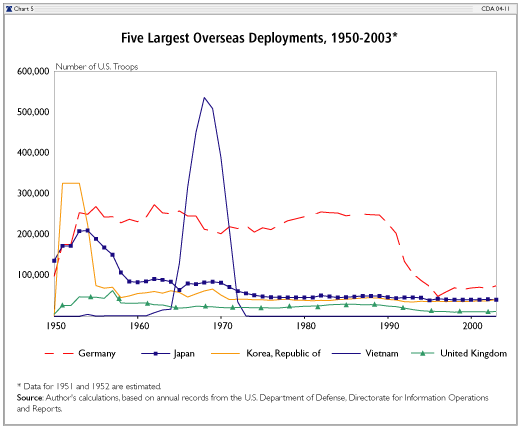
In other words, setting aside the larger question of whether or not military intervention in Vietnam was justified, the evidence strongly suggests that the Gulf of Tonkin Resolution itself was based upon a false version of reality which was presented to the American people and their elected members of Congress. This false version of reality led directly to the combat deployment of over 184,000 people to Vietnam by the end of the following year, a number which increased to over 500,000 at the war's peak in 1968 (see chart below, which can be found here).

This article from the 30-year anniversary of the Gulf of Tonkin incident (in 1994) lays out some of the arguments and evidence supporting the conclusion that the facts surrounding the August 02 confrontation were completely misrepresented, and that it is likely that no actual second confrontation took place two days later on August 04, 1964.

This more-carefully footnoted essay by Professor Peter Dale Scott of the University of California, published in 2008, explains that of the one hundred twenty-two pieces of signal-data collected on the night of August 04 (from radar, sonar, and other signal-gathering devices available to government intelligence personnel), only the fifteen pieces of data which would support the picture of a second attack were passed on to the White House. 

Meanwhile, in a completely separate agency from the one which passed on that incredibly selective array of data, a paragraph stating that suggested that the data supported the conclusion that a second attack had not taken place on August 04 was removed from the Current Intelligence Bulletin "which would be wired to the White House and other key intelligence agencies and appear in print the next morning."  

Professor Scott writes that it is possible to conclude that these two actions in two separate agencies could conceivably have taken place spontaneously, based upon a certain "shared bureaucratic mindset, or propensity for military escalation."

Of course, it is also possible that these two actions, each designed to paint the picture of a second confrontation which in all likelihood never even took place, and each removing critical information in order to support that false picture, were in fact coordinated.

This possibility is further supported by the published testimony of the Secretary of Defense himself, who went on record before Congress not just in 1964 when they were deliberating over the initial Gulf of Tonkin Resolution but also nearly four years later in 1968, stating "that attacks occurred against our ships both on August 2nd and August 4th, that we had available to us incontrovertible evidence of these attacks when the decision was made to make our limited and measured response, and that these attacks were in no sense provoked or justified by any participation or association of our ships with South Vietnamese naval operations" (see remarks by the Secretary of Defense to the Senate Foreign Relations Committee from 20 February 1968, about half-way down this web page).

Either he was deceived as well, or he was aware of the selectivity of the data and conclusions that had been presented to the American people and their elected politicians in August of 1964 and was participating in the fabrication of a false reality designed to create a "movie" in the minds of the vast majority of the citizenry which had in its opening scenes events they could look back on and say to themselves, "well, we were illegally attacked first."

The conclusion that the Gulf of Tonkin represents an example of the deliberate creation of a false reality in the minds of a massive number of people is difficult to avoid. 

This conclusion becomes even more likely when we realize that the two ships involved in the incident, the destroyers USS Maddox and USS Turner Joy, each had a Navy captain in command, but that they themselves were commanded by a Naval officer on the flagship of their fleet, the aircraft carrier USS Bonhomme Richard -- and that the officer in command of that fleet during that critical time was none other than George S. "Steve" Morrison, the father of the future lead singer of the band The Doors. This fact is stated in the obituary of Admiral Morrison published in the New York Times from December of 2008.

In and of itself, the connection between the rock frontman and the Naval officer does not necessarily add anything the already substantial evidence that the Tonkin incident represented the deliberate creation of an illusory mental construct designed to influence the thought patterns of massive numbers of people. However, some researchers and in particular researcher David McGowan have recently presented additional evidence that many of the influential rock bands to have formed around Laurel Canyon just north of Los Angeles may also have been part of a coordinated effort to "create a new reality" and change the thought patterns of massive numbers of people.

In his recently-released book, Weird Scenes Inside the Canyon, Mr. McGowan argues that there was something contrived about the sudden influx of prospective band members into Laurel Canyon, many of whom (but not all) had little or no musical experience, many of whom came from military families and/or families with powerful political connections, and many of whom shot to rapid success without going through the usual path of struggling to gain recognition, play at better gigs, and eventually sign deals (he notes on page 151 that the members of Buffalo Springfield had supposedly only first met one another five days before they were playing at the prestigious Hollywood club the Troubadour, and a mere six days after that they were already on tour opening for the Byrds, "the hottest band on the Strip"). He also notes that this sudden confluence of suddenly-successful musical acts all happened to center in a self-contained canyon that also housed a secret military facility. 

Mr. McGowan points out that the initial output of all these bands coincided very closely with the buildup of combat troops in Vietnam following the Gulf of Tonkin Resolution, beginning  with the release of the Byrds' Mr. Tambourine Man  (on June 21st, 1965 -- summer solstice in the northern hemisphere) and rapidly followed by "releases from the John Phillips-led Mamas and the Papas (If You Can Believe Your Eyes and Ears, January 1966), Love with Arthur Lee (Love, May 1966), Frank Zappa and the Mothers of Invention (Freak Out, June 1966), Buffalo Springfield, featuring Stephen Stills and Neil Young (Buffalo Springfield, October 1966), and the Doors (The Doors, January 1967)" (13). 

Regarding the Doors in particular, Mr. McGowan presents evidence from previously-published interviews conducted by other interviewers with Jim Morrison himself that the future lead singer never went to concerts before forming the band, and in fact in his own words "never did any singing. I never even conceived of it," nor had he ever felt any desire to learn to play any musical instrument (129). Then, he suddenly formed a band with three other acquaintances who also had no previous musical background, and immediately began putting out albums filled with songs which Morrison had written himself, before even forming the band.

McGowan writes:

Morrison did not, you see, do as other singer/songwriters do and pen the songs over the course of the band's career; instead he allegedly wrote them all at once, before the band was even formed. As Jim once acknowledged in an interview, he was "not a very prolific songwriter. Most of the songs I've written I wrote in the very beginning, about three years ago. I just had a period when I wrote a lot of songs." 
[. . .]
In any event, the question that naturally arises (though it does not appear to have ever been asked of him) is: How exactly did Jim "The Lizard King" Morrison write that impressive batch of songs? I'm certainly no musician myself, but it is my understanding that just about every singer/songwriter across the land composes his or her songs in essentially the same manner: on an instrument -- usually either a piano or a guitar. Some songwriters, I hear, can compose on paper, but that requires a skill set that Jim did not possess. The problem, of course, is that he also could not play a musical instrument of any kind. How did he write the songs?
[. . .]
And these are, it should be clarified, songs that we are talking about here, as opposed to just lyrics, which would more accurately be categorized as poems. Because Jim, as is fairly well known, was quite a prolific poet, whereas he was a songwriter for only one brief period of his life. But why was that? Why did Morrison, with no previous interest in music, suddenly and inexplicably become a prolific songwriter, only to just as suddenly lose interest after mentally penning an impressive catalog of what would be regarded as rock staples? 129-130.

David McGowan's work raises the strong possibility that a concerted campaign of what we might call reality creation was somehow behind the sudden rise of numerous successful bands in the Laurel Creek scene from mid-1965 through the early 1970s. In fact, he presents evidence that some of these 

band members (notably the members of the Byrds) began arriving in Laurel Canyon specifically in "autumn of 1964" (see page 135) -- in other words, immediately on the heels of the Gulf of Tonkin incident, and before the actual troop buildup of 1965 (this would only be expected, if the Byrds were to release an album by summer solstice of 1965).

This fact tends to defuse the possible counter-argument that the phenomenon Mr. McGowan is chronicling was somehow an organic response to the sudden deployment of young men to Vietnam (even without the information that these band members were arriving in Laurel Canyon well before the first conventional troops arrived in Vietnam in March of 1965, there would not seem to be enough time between those first troop deployments and the sudden outpouring of albums listed above to be explained by the "organic response" hypothesis).

The thesis that the Laurel Canyon outpouring was some kind of "reality creation" is reinforced by the fact that the first album cited above, the Byrds' Mr. Tambourine Man, came out on the date of summer solstice, indicating the possible involvement of parties who understood the ancient significance of such dates. The possibility is further strengthened by the fact that both the Vietnam War and the counterculture movement at home which was closely associated with the music from the bands described in Mr. McGowan's book were profoundly transformative of society as a whole. It is also notable that music itself is uniquely suited to "creating realities." 

The evidence which fifty years later appears to confirm that the Tonkin Gulf incident involved the deliberate imposition of a false narrative or false mental reality upon a large number of people, for purposes of escalating military operations in Vietnam immediately thereafter. The evidence also appears to strongly suggest that at least some aspects of the sudden formation of numerous very influential bands in Laurel Canyon, California almost immediately following that incident may have also been an exercise in reality creation, orchestrated by parties who possessed the knowledge and the ability to do so, and who left clues such as the release of the first Byrds album on one of the most significant dates of the annual cycle.

The possibility that the two aspects of reality creation might be related, and even perpetrated by some of the same players, is astonishing. While it is by no means proven, there appears to be enough evidence to warrant further investigation of this subject by those whose areas of interest or expertise dispose them to doing so.

It should be noted that there is substantial evidence that the concept of "reality creation" -- which should be a positive subject, involving creativity, innovation, and the empowerment and greater freedom of individual men and women, as discussed in this previous post -- was actually at the heart of the ancient mythologies of mankind, which themselves may be a precious legacy to all human beings from an even more ancient "predecessor civilization." However, at a very specific point in history, this ancient knowledge was deliberately subverted and suppressed in a certain very important portion of the world (the western Roman Empire), and those who did so may well have sought to use that knowledge for their own purposes of control and self-enrichment, while suppressing the same knowledge for virtually everyone else (and launching campaigns to stamp it out both within the western empire and then over other parts of Europe and then the world).

The evidence which suggests that there was a historical monopolization of the secrets of "reality creation" by powers who wanted to use them for themselves alone may indeed be pertinent when examining the possibility that there was much more to the Gulf of Tonkin incident, and to the Laurel Canyon scene, than people were initially led to believe.

However, even if we set all of that aside and focus solely on the evidence that the Gulf of Tonkin incident involved the deliberate creation of an illusion which was then presented to the White House, to Congress, and to the people of the world, has extremely important ramifications. 

First, when we realize that previous incidents which were used to inflame public opinion in favor of war (when the public might have been indifferent or even hostile to the idea before the incident) may have also involved elements of deception or fabrication (including the USS Maine incident at the start of the Spanish-American War, or the sinking of the Lusitania to inflame American public opinion towards participation in the First World War), we should naturally wonder to what extent incidents since the Gulf of Tonkin might fit into the same pattern. 

Second, while it is obvious that most of the individuals who actually participated in the Tonkin Gulf episode are no longer in the positions of power that they held back in 1964 (and in fact, most of them have now left the body, or at least the body they had during that incarnation), it is worth asking to what extent the institutions which participated in the Tonkin Gulf deception in some capacity (that is to say, the branches of the US military, the executive and legislative branches of the US federal government, and the more powerful participants in the national and international media) are still controlled by powers or persons who would condone or even initiate such deception and the perpetration of the creation of illusions or false realities.

Further, a sober consideration of the Tonkin Gulf incident should cause us to reflect upon the frequency with which large numbers of people can be influenced to condone or tolerate the application of horrendous levels of violence against persons who are not actually combatants (whether through the use of munitions and chemicals that caused death and suffering among the noncombatant women and children in Vietnam, or in the massacres of women and children in Native American villages during the "Indian Wars" of the second half of the nineteenth century in what is today the western US). How often is such widespread indifference or toleration accompanied by the creation and propagation of a sort of collectively-accepted "false reality" or narrative, such as "Manifest Destiny" or the false storyline created around the attacks on the Maine, the Lusitania, or the Maddox?

The degree to which the media plays along with the creation of such illusions and does not challenge them (certainly evident in the Tonkin Gulf episode) is also worthy of careful consideration. 

Finally, the possibility that certain players on the world stage understand the creation of realities on a level that goes far beyond the simple telling of lies or withholding of available radar evidence, and that they may be using techniques which were once widely seen as beneficial for human consciousness but which have now been suppressed among the wider community and monopolized by a few, would seem to be extremely important to carefully consider and not dismiss out of hand. If some version of this scenario is indeed operating in history, than beginning to understand that fact can help us to realize the extent to which our acceptance of false realities creates false limits and false chains which we let bind and restrict and limit ourselves and others.

But, as Jon Rappoport so eloquently stated in the June 2014 talk discussed in the previously-linked post above, the message of the "trickster-god" in so many ancient mythologies is that we do not actually have to limit ourselves to someone else's imposed realities, and that we can at any time choose to stop giving those realities and their artificial limits that power which they ultimately derive from our own acceptance of them.

An event that happened fifty years ago -- an entire half of a century -- may seem to be ancient history. But, as the above discussion should cause us all to realize, its lessons are profoundly important to our lives at this very moment, and to our understanding of events we see taking place around us today and this week and this year.