Improved quality on part one of The Universe Inside

Improved quality on part one of The Universe Inside

I've made a few changes to improve the video quality somewhat on "The Universe Inside, part 1 (updated)."

[Later note: I'm changing the title of this video series to "Star Myths and the Shamanic Worldview," both because that is more descriptive and a clearer indication of what the videos are about, and because I am finding that "Universe Inside" has been used quite often in the past and is still being used for works which explore a wide variety of different subjects, and so to avoid confusion I'm just changing my title before going much further in the series. The new version with that new title is now embedded above and linked here. You can still see the old version if you want to (not sure why someone might want to, but there it is) if you use the "lined-out" link above ].

The starry-sky portion should now be slightly higher resolution than the first version. Still working on methods to improve that for future installments of this series. Part 2 of the series is linked and discussed here.

The Universe Inside, part 1

The Universe Inside, part 1

Here's a new video I made to try to illustrate some of the concepts which should be familiar by now to readers of this blog or of The Undying Stars.

In it, I discuss the shared shamanic heritage of humanity, and begin to illustrate the argument that all of the world's ancient scriptures and myths -- including those which found their way into the Old and New Testaments of the Bible -- are built upon a shared system of celestial metaphor, which unites the world's ancient wisdom and which conveys a shamanic worldview.

I will have to work on some ways to ensure that the resolution of the "starry sky" portions looks better -- that should be something I can fix fairly easily in the next few days.

Stay tuned for more episodes of this series, which I've titled "The Universe Inside" -- and please share with anyone who might be looking for information on this subject! 

The Michigan relics (aka the Michigan tablets)

The Michigan relics (aka the Michigan tablets)

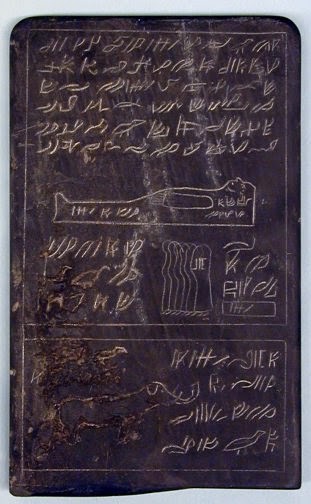
image: Michigan Department of Natural Resources (link). Djed-column "cast down"?

Beginning in the 1850s, and continuing for over fifty years, a series of artifacts including inscribed tablets of clay, slate, copper, and stone, was allegedly discovered in Michigan -- numbering into the thousands (some estimates as high as ten thousand).  These are the so-called "Michigan relics," and they have been roundly denounced as obvious frauds beginning in the late 1800s, and it is of course possible that some or all of them are fraudulent -- but there are many reasons to be careful before rushing to that conclusion.

The tablets depict a variety of scenes, many of them recognizably Biblical -- but with important and quite prominent departures from recognized "orthodox" Christian doctrine which may be a significant clue to the mystery. They also contain what one scornful professor writing in the 1890s described as "largely a horrible mixture of Phoenician, Egyptian and ancient Greek characters taken at random from a comparative table of alphabets such as is found at the back of Webster's Dictionary" -- although this is not entirely accurate as some of the tablets actually contain evidence of not one but two writing systems not know to be found anywhere else, one of which has been argued by some analysts to be based upon ancient Hebrew but altered as if to create a code, and the other of which is sometimes described as "toothbrush" writing and has yet to be deciphered (see below for an example of "toothbrush" script):

image: Michigan Department of Natural Resources (link).

The artwork on many of them can be described as fairly crude, although the quality of the art varies greatly, and at least one piece clearly uses techniques of perspective which were not thought to have been "discovered" or "invented" until the 1400s. Other criticisms include arguments that they contain copper that has been smelted using methods that the ancients allegedly did not possess, and that the daughter of one of the main "discoverers" of numerous relics later attested that her father forged them (a confession she notably did not make until after both her mother and her father had died).

All of these objections should of course be considered, and it is certainly possible that these relics are all forgeries. Yet several reasons to consider the possibility that at least some of them might be authentic remain.

First, there is the sheer number of the supposed forgeries. One collection alone catalogued 2,700 artifacts. Another collector catalogued between 9,000 and 10,000. The production of such quantities would seem to require a large number of co-conspirators, but most of those who denounce the relics as a hoax pin the scheme on a single individual, working perhaps with one other helper. 

Further, as Henriette Mertz (1898 - 1985) explains in her examination of the relics and the controversy entitled The Mystic Symbol and published posthumously in 1986, the scripts on the different artifacts reveal evidence that they were almost all done by different persons. Henriette Mertz was a code-breaker during World War II, and later was trained in detection of forgery, which is why she was asked to look at the tablets in the 1950s. She explains in her book some of the tell-tale signs of forgery, and why she does not believe that the script in the tablets betrays the work of a forger whatsoever: to the contrary, she cites evidence in the markings that they were done by different individuals, using a wide variety of different instruments and methods, and betray different "schools" and styles of writing even while depicting the same pictogram or letter.

One of the most important aspects of these tablets which must be considered in the question of whether or not they are fraudulent is the fact that they display a "theology" which is notably at odds with -- and even strongly repugnant to -- that which is considered "orthodox" by almost all the traditional literalist Christian teachers of western civilization for the past seventeen centuries. Researcher David Allen Deal, in a series of essays and analyses which are included at the end of

The Mystic Symbol and which can be read in part here on "Google books," demonstrates quite convincingly that many of the Biblical scenes portray two figures described as the "son of the right hand" and the "son of the left hand," and that the "son of the right hand" is the "younger brother" who becomes the Savior after the previous reign of the "son of the left hand," who is the elder brother of the two and who reigns for a thousand years prior to the advent of the "son of the right hand."

The assertion that Jesus had an older brother, of course, would be considered heretical among literalist interpreters, primarily because he is the son of a virgin mother (which would imply that he could not have any older siblings, although younger siblings might be possible -- a question, it should be noted, that itself has been hotly debated over the centuries even though it would seem to be much less contentious than the assertion that he could have had an older sibling). 

The further implication depicted in the labeled illustrations on some of the relics that this older brother is the Adversary, the Accuser, or the Enemy (that is to say, the Devil) is even more heretical and would be strongly rejected by most literalists (especially, it should be added, in nineteenth-century America). There are ancient sects which held that Jesus and the Devil are brothers, but the very idea is objectionable to most literalist Christian confessions in the west since late antiquity. 

What hoaxer in the 1850s, trying to create a series of fake tablets to imply a Christian presence (or a "lost tribes" presence) in the Americas would decide to impart such incendiary doctrines into the forged artwork?

Additionally, as both Henriette Mertz and David Allen Deal discuss in their analysis, some tablets appear to show priests giving reverence to Isis and other "pagan" deities right along with Biblical scenes. This is yet another piece of evidence which is difficult to explain under the conventional theory that all these relics are the product of a simple, uneducated hoaxer in the religiously conservative midwestern United States of the nineteenth century who took his cues from Webster's dictionary (and, as Henriette Mertz and David Allen Deal also point out, even if one finds alphabets in the back of a dictionary, that does not explain how that hoaxer then forms those letters into words and sentences -- some of which are written right-to-left and others left-to-right, and still others "as the ox plows" or "boustrephedon," one going right-to-left and the next left-to-right, which was anciently done but would be very difficult to forge, as Henriette Mertz points out [she suggests an experiment in which the reader try "forging" some lines while writing from right-to-left, to see how "natural" that might look or feel]).

There are still further reasons to entertain the possibility that these relics are not forgeries, such as the evidence David Allen Deal presents that they contain calendar wheels which indicate a Saturday sabbath (as was observed prior to the official change to the Sunday sabbath instituted by the emperor Constantine in AD 313), as well as astronomical details in one calendar-tablet indicating a solar eclipse which can be demonstrated to have been visible in AD 342 from the location where the tablet was found -- both astonishing pieces of evidence which might give "debunkers" some pause (would they care to explain how the nineteenth-century hoaxers managed to get those details right in their forgeries?) (seeThe Mystic Symbol, pages 191-192 for the sabbath analysis and 193-205 for the solar eclipse analysis).

Just as suspicious, in light of all of the above counter-evidence, is the haste and the vehemence with which the professors in the late 1800s dismissed the Michigan relics as obvious forgeries. One professor wrote, "Photographs of the objects have been sent to me and a glance is sufficient to reveal the true character of the find" (108). So, "a glance" is all that is required and they can be pronounced to be fraudulent. This haste in itself is suspicious -- in light of the evidence discussed above, it is even more so. 

Henriette Mertz notes that, although all these items were proclaimed fraudulent, and pinned upon the actions of one individual, that man was never actually charged with fraud:

Did one man alone forge each and every artifact comprising this vast collection of some 3,000 pieces? During the long heated controversy, the academic world would have us so believe and isolated one man charging him with the perpetration of forgery and manufacture and sale of fraudulent material. No proofs were ever offered nor was the man brought to trial. Most of this inscribed matter has now been destroyed as a result. 122.

Many artifacts do remain, both in private collections, and in some museum archives, but many have been lost -- as a direct result of the withering scorn and ridicule to which they were subjected almost immediately by the representatives of the academic community. One extensive collection also was lost when the building which housed it burnt to the ground (9).

These tablets are dealt with in some detail in The Undying Stars, because they might constitute unique evidence that some early Christians who held to doctrines which could be characterized as Gnostic and/or Coptic -- and hence heretical to the literalist hierarchical church that slowly came to power during the period between AD 70 and AD 390 (discussed briefly here and here, and at greater length in the book) -- may have fled for their lives to the Americas during the centuries in question.

If so, this might explain the haste with which evidence of ancient contact across the oceans is immediately denied today, and the vehemence with which the very possibility is ridiculed (see for example the tone of the Wikipedia entry on the Michigan Relics linked above, as well as the many quotations from professors beginning in the late 1800s all the way up to the present cited in The Mystic Symbol).

We know for a fact that Gnostic doctrines were persecuted by the rising literalist church in the period in question -- and other archaeological discoveries from the other side of the Atlantic have provided powerful supporting evidence to that effect, most notably the discovery of the Nag Hammadi texts in the 1940s.

We have also shown that there is plenty of evidence in addition to and quite separate from these Michigan relics which argues strongly for ancient contact across the oceans during or even prior to the rise of literalist Christianity. Among the information most pertinent to the discussion of the Michigan relics is the fact that the very state of Iowa (and the Native American people for whom that US state was named) bears a name which is linguistically related to the divine name found in the Hebrew scriptures.

Further evidence is found in the extensive evidence of ancient copper extraction from the Michigan peninsula, discussed here (and also ridiculed by Wikipedia and largely ignored by conventional scholars). There is also the evidence of ancient Hebrew writing found in New Mexico, which David Allen Deal has also examined and discussed, and which is featured in this previous blog post.

It is important to note that the thesis of The Undying Stars by no means depends upon the authenticity of the Michigan relics. The "Michigan relic evidence" or the idea that some persecuted Gnostic or other Christians fled to the Americas is not essential to the "Roman Empire takeover theory" originated by Flavio Barbiero -- and in fact he does not even mention this idea in his book about that theory (The Secret Society of Moses). 

Nor is this evidence essential to the argument that the scriptures of Christianity -- along with the rest of the world's sacred myths -- are constructed upon a unified system of celestial allegory (for discussions of the evidence for this argument found in over sixty different myths from around the world, including some in the Old and New Testaments, see the index found in this previous post, and there are many others discussed in my book The Undying Stars).

However, there is extensive evidence -- piles and piles of it, in all different forms -- to support the conclusion of ancient contact across the oceans, in addition to the Michigan relics (if they are indeed authentic, which I believe they may be). Many of these different forms of evidence are discussed in previous posts, some of which are linked in this post, and they include artifacts that are almost impossible to dismiss as forgeries, including the hundreds of amphorae found lying at the bottom of Guanabara Bay outside of modern-day Rio de Janeiro, the staggering array of botanical and bacterial evidence arguing for ancient trans-oceanic contact compiled by two Brigham Young researchers, and the hundreds of red-haired mummies found in Peru and other South American locations discussed in this previous post (would any professors or Wikipedia authors like to explain how a hoaxer could have "forged" all those mummies?).

The fact that the Michigan relics are collectively just "one data point" among numerous other forms of evidence arguing for ancient contact across the oceans makes their hasty and vehement dismissal even more inappropriate. For those who would like to explore them further, here are links to a couple other web sites with discussions and images (for obvious reasons, some proponents of the authenticity of the relics may be coming from a literalist Christian perspective -- although I would argue that they may be strong evidence of the literalist takeover and the driving "underground" of the original and non-literalist communities).

The Michigan relics are an important piece of evidence that may (or may not) shed more light on important aspects of human history -- and point to events whose implications have had a huge impact on nearly every family or nation on our globe: events whose implications continue to this day.

September equinox, 2014

September equinox, 2014

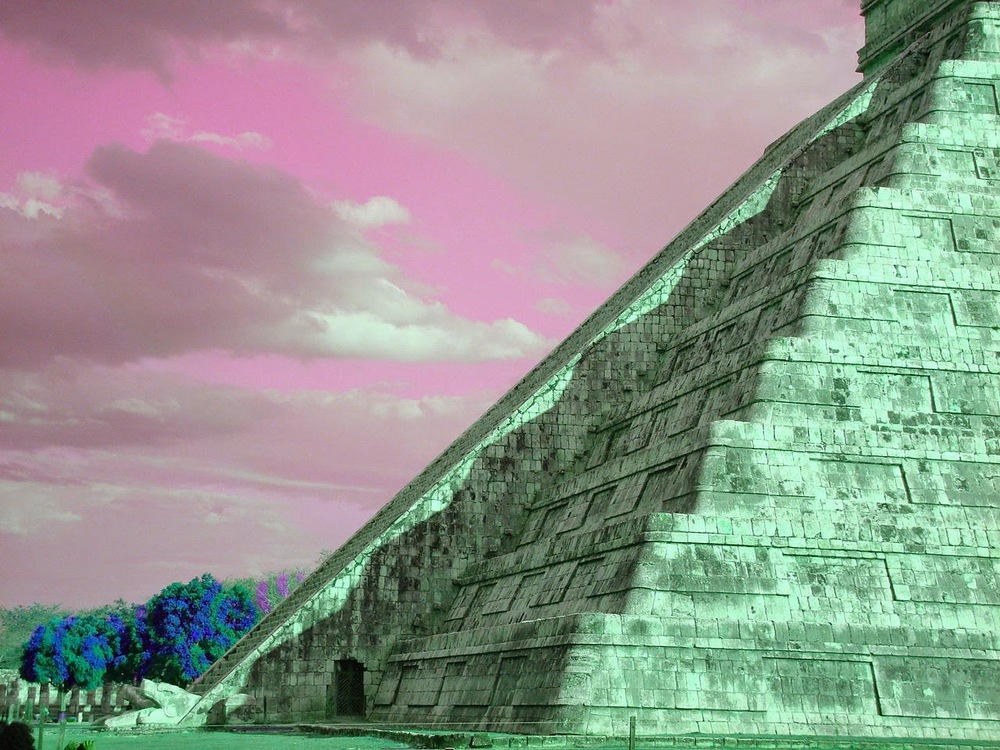
image: Wikimedia commons (link); image has been altered in its colorization.

Earth will speed past the point of equinox at 0229 GMT on 23 September, which will be 10:29 pm Eastern time on 22 September for those along the eastern edge of North America, or 7:29 pm Pacific time on 22 September for those on its western edge.

As it does so, the northern hemisphere will pass from the "upper half" of the zodiac wheel into the "lower half," as nights begin to be longer than days (a phenomenon which takes place a few days after the fall equinox, owing to the fact that the size of the sun disc plus the bend of light from the earth's atmosphere act to lengthen the days ever so slightly at each sunrise and sunset, delaying the actual day upon which night takes over as being longer than daytime: see the previous post on "Equinox versus Equalday/night"). 

For those in the southern hemisphere, of course, this equinox marks the complete opposite phenomenon, being the gateway to the return to the "upper half" of the year and the climb towards the point of southern-hemisphere summer solstice.

But for the northern hemisphere, this equinox marks the point of descent, an annual crossing point of very great metaphorical import in nearly all the sacred scriptures and traditions the world over. The passage down to the lower half of the year, enroute to the very Pit of the year at the low-point of winter solstice, symbolized the incarnation: the plunge of the soul from the fiery realms of spirit into the miry realms of matter.

It is perhaps for this reason that the Chichen Itza pyramid was designed to manifest the "serpent of light" going down from heaven to earth upon the day of the equinox (above).

This descent into the body was figured in ancient myth and legend in countless metaphors: as the death of Osiris and the corresponding "casting down" of the Djed-column or backbone of Osiris, as the plunging of Narcissus into the pool of water, to the myths of the god or goddess who was held captive in the underworld for half the year, such as Balder in northern Europe and Persephone in the Mediterranean -- the latter being central to the rites and rituals of the Eleusinian Mysteries, which included symbolically rich metaphors such as the taking of piglets down to the waters of the ocean by the initiates, and of their being mocked and humiliated as they crossed over a bridge on the way to Eleusis, and finally of searching all through the night for the missing or hidden goddess Kore (Persephone), symbolizing the hidden and nearly lost state of our spiritual or immortal part within our animal nature during the incarnation.

The annual Eleusinian Mysteries, by the way, commenced at the end of September each year and ran through early October -- until they were finally shut down by the Roman emperor Theodosius in AD 392.

The ancient writings of the philosophers were filled with references to the fact that this material world through which we pass in our incarnate state is not the real world, but is rather the shadowy projection of that real but invisible world of spirit -- a worldview we have seen to be common to shamanic cultures worldwide, and which thus supports the argument that this worldview is part of the shared heritage of humanity (which the forces of which Theodosius was a part have been trying to stamp out and deny to the people of the world for at least seventeen centuries). 

In his masterful 1940 text, Lost Light, which traces this theory regarding the ancient teaching of the soul's plunge into the body and its manifestation in metaphorical myth and in the discourse of ancient philosophers, Alvin Boyd Kuhn writes on this subject: 

In the Phaedrus Plato, in the beautiful allegory of the Chariot and the Winged Steeds, portrays the soul as being dragged down by the lower elements in man's nature and subjected to a slavery incident to corporeal embodiment. Out of these conditions he traces the rise of numerous evils that disorder the mind and becloud the reason. [. . .] The rational element, formerly in full function, now falls asleep. Life is thereupon more generally swayed by the inclinations of the sensual part. Man becomes the slave of sense, the sport of phantoms and illusions. This is the realm in which Plato's noesis, or godlike intellect, ceases to operate for our guidance and we are dominated by doxa, or "opinion." This state of mental dimness is the true "subterranean cave" of the Platonic myth, in which we see only shadows, mistaking them for reality. 145.

All this, Alvin Boyd Kuhn argues, was associated with the fall into the "lower half" of the year, when darkness begins to dominate again -- the half of the year which represents our earthly sojourn in this body which commences metaphorically at the fall equinox and ends with the triumphant return of the spirit to the heavenly realms at the "opposite horizon" of the spring equinox.

Discussing this realm of darkness further, he writes:

"The dark night of the soul," no less than the Gotterdammerung, was, in the ancient mind, just the condition of the soul's embodiment in physical forms. [. . .] All this is the dialectic statement of the main theme of ancient theology -- the incarnation of the godlike intellect and divine soul in the darksome conditions of animal bodies.
The modern student must adjust his mind to the olden conception -- renewed again by Spinoza -- of all life as subsisting in one or another modification of one primordial essence, called by the Hindus Malaprakriti. This basic substance was held to make a transit from its most rarefied form to the grossest state of material objectivity and back again, in ceaseless round. Darkness was the only fit symbol to give to the mind any suggestive realization of the condition of living intellectual energy when reduced in potential under the inertia of matter. 146-147.

From all of the foregoing, we can readily see why the points of equinox were metaphorically portrayed in myth-systems across the planet as points of sacrifice. For the September equinox which falls between Virgo and Libra in the astrological system that informs much of ancient myth, this often involves myths about the sacrifice of a virgin, as with the sacrifice of Iphigenia (discussed in the first three chapters of The Undying Stars, which can be viewed online here; the Iphigenia discussion begins on page 34 of the book pagination) or the sacrifice of Jephthah's daughter.

These myths, and some of the philosophical passages cited above, depict the point of incarnation in negative and even horrifying tones, but the counter-balancing component present in all of these same myth-systems is the restoration of the spiritual component, the raising up of the Djed-column that has been cast down, the remembering and recognition and then elevation of the divine spark within the individual, which the ancient myths portray as one of our central tasks here in this "lower realm of darkness."

If the point of incarnation depicts the temporary burying of spirit within matter, and the temporary increase of darkness over light, the act of calling forth the spirit again and letting it shine through and ultimately elevate the material world which is "covering it" is an act of great importance, and one which was discussed in the previous post about "blessing" as a daily requirement, and one with an individual component that "faces inwards" (so to speak) but also one that "faces outwards" towards others and towards the natural world. Such is the opposite of the burying and hiding of the spiritual, in that this concept of blessing is one of evoking the spiritual and enlivening the material world which after all contains and is infused with the hidden realm of spirit, and which in fact ultimately springs from the world of spirit, as even the passage from Plato discussed above asserts.

These are uplifting thoughts to consider at the significant point in the year at which the sun's path again crosses the celestial equator. The human condition may be deeply confusing, and our "mixed" state of "spiritual-animal" may cause us to feel like the participants in the Eleusinian mysteries, stumbling about in the darkness and tripping over everything, but the human condition is after all a wonderful mystery as well, and one in which we can experience the increase and eventual triumph of the light again, the restoration of the Djed, and the shining through of the world of spirit which permeates and sleeps within all of the natural universe around us, as well as in ourselves.

Imagination is the forgotten power

Imagination is the forgotten power

image: Wikimedia commons (link).

Here is a link to an important interview between Jon Rappoport of nomorefakenews.com and John Gibbons of Alchemy Radio, recorded in December of 2013.

Their conversation covers many important subjects, but one of the central themes is the power of imagination to reach beyond the world we perceive with the five senses and to create new realities. 

Beginning at approximately 22:00 into the interview, as part of a discussion in which he makes the critically important observation that the "artificial realities" that operate in the world around us are a product both of the groups who are propagating them and also of the people who accept them, Jon says:

This is something that has been going on ever since societies began to form, you know, groups, societies, nations, tribes, clans, on this planet. It is a pattern that has been repeated over and over again, and it extends to what most people would call extremely far-out, paranormal factors. And I will kind of try to put that in a nutshell by saying that the space-time continuum itself is a manufactured reality, ultimately -- that what we live in is itself a kind of a simulation, and people can become to one degree or another aware of this and do something about it. [. . .]

A short time later, building on this concept, he continues (at about 26:58):

What I came upon, and this was confirmed in my collaborative research with Jack True: imagination is the key. Imagination is the forgotten power. Imagination is that thing which we are told is a toy merely for children and when we become adults we set it aside so that we can fit into the world. Imagination is forever. Imagination is limitless power to create reality. Imagination is non-material. It has nothing to do with the brain. Its source is not in energy or matter or this continuum. Imagination for every individual is an infinite potential, an infinite capacity, to create reality as fact in the world, not merely as some sort of rumination inside one's own head. Knowing that, from my own experience and from my research with Jack True, I then -- to add to your comment, in a sense -- found the missing key: that when one begins to live a life of intense creativity, by and through imagination, eventually one comes to the point where he or she is manifesting this power to such a degree that so-called paranormal experiences begin to become the order of the day, and manufactured reality takes a back seat. And then we see what is really our legacy, our heritage, our natural state, our power. Nothing woo-woo or weird about it. It's only weird from a conventional android point of view. And face it: we live in an android civilization.

Note how Jon Rappoport here describes imagination: it puts us in touch with a reality which is beyond the reality which we perceive and decode with our five senses. It enables us to see through and ultimately to transcend artificial realities (and, previous posts have explored the fact that spinning forth artificial realities is an essential process in the creation and sustaining of tyrannies and injustices and conquests and oppressive systems). It enables us to create new realities. And it is the common heritage of all humanity.

This is clearly related to the subject being discussed in recent posts, including:

It can also be seen to be related to the definition of "blessing" discussed in this previous post, in that both have to do with reaching into a sphere beyond the material world, beyond what can be perceived with our five senses, and bringing back and infusing this world with the beneficial realities that are found beyond the ordinary world whose boundaries often seem to define all that is.

It is well worth listening to the entire interview. It is also worthwhile to go back and examine some of the related and equally world-changing points Jon Rappoport made during a talk he delivered at the Secret Space Program conference in San Mateo, California this past June, some of which are discussed here. He also has a coaching practice which he describes, appropriately enough, as "imagination work."

Exercise imagination -- and manufactured reality takes a back seat!

Why violence is wrong, even in a holographic universe

Why violence is wrong, even in a holographic universe

image: Wikimedia commons (link).

The previous post discussed the concept of "blessing," and cited evidence which suggests that a central part of our mission in this life -- perhaps the central part of our mission in this life -- is related to this concept of blessing, involving the elevation of the spiritual nature buried deep within our physical or "animal" nature, slumbering and almost forgotten, and by extension participating in the same process in the world around us, calling forth the slumbering, hidden and almost forgotten world of spirit which is present in the natural world around us, waiting to be recognized and awakened.

This understanding of the centrality of the activity of blessing, and by extension the importance of "not cursing," has profound ramifications. Among the many, many implications that we can derive from the definition of blessing offered in the previous post is a new light on an important question which might arise from someone who encounters the "shamanic worldview" which informs this definition of blessing, and that is the question of whether it really matters if we do violence to others, if we accept the possibility that this universe in some ways resembles a hologram or a simulation, or that the material world we inhabit is actually not the "real world" but is derived from or "projected by" the spirit world, or the other world.

For example, in the previous post entitled "The real world that is behind this one," the shamanic worldview was examined using the illustration of the realistic simulation scenes from the movie Divergent, in which this ordinary visible world with which we are most familiar was compared to the "simulation," and in that analogy the invisible world would then correspond to the "real world" in the movie where the simulation is generated. That post argued that the ability of the people known as "divergents" to see through the illusory nature of the simulation, and even to transcend the boundaries of the simulation, could help illustrate the shamanic ability to transcend the boundaries of our visible material world, and to journey to the other world. 

That movie analogy was used as a way of helping to illustrate what Lakota holy man Black Elk might have been trying to convey when he said that when his father's cousin, Crazy Horse, had his defining vision, he "went into the world where there is nothing but the spirits of all things. That is the real world that is behind this one, and everything we see here is something like a shadow from that world." Similarly, in The Matrix  (1999), the same kind of illustration could be made by observing the protagonist Neo's increasing ability to see beyond the computer-simulation projection of the world he had been inhabiting, and ultimately to see all the way through to the "other world" which is projecting that simulation, and which is depicted as glowing waterfalls of green computer-code: the "source code" behind the projected world. The shaman's ability to travel to the unseen world to heal imbalances in this world can be illustrated by Neo's increasing ability to actually "reach into" the code world and change the simulation-world.

But these illustrations might raise the question of why, if everything we see is "just an illusion" or a "shadow from that other world where there is nothing but the spirits of things," killing others would be considered so wrong. Most people, of course, would not normally even think of such a horrible question, since killing people (as well as lesser forms of violation of other people's natural inherent rights) is so self-evidently wrong that most people don't ask why. But, if this world is really something like a "simulation" (or even a "video game," as it is sometimes metaphorically described, in which the avatar or "player in the game" might "die" many times and then just come right back to try again), then some people might ask how it can then be argued that violence is wrong.

The first and best answer is probably: it is self-evident that violating someone else's rights is wrong.

But, because analogies which use the terms "simulation," or "hologram" or even "video game" to describe the worldview containing both a visible world and an invisible world could lead some to question this point further, the definition and centrality of "blessing" described above opens up a line of argument which may be very helpful. If our mission in this life, according to the metaphors found in ancient scriptures and sacred traditions from Egypt to the Americas to India involves finding and elevating the "god within" or the inner spiritual nature, and in participating in the same action in the rest of the world around us ("blessing"), then doing violence to another being can be seen as the direct opposite: reducing "the other" to the physical and attempting to deny or even destroy the spiritual aspect in the other. 

Even more heinous, killing another separates the spirit from the body, reducing the other to physical matter, to the status of an object. It is obviously the exact opposite of what we are supposed to be doing, both in our own lives (where we are supposed to be recognizing and elevating our spiritual component) and in the world around us (where we are supposed to be doing the same thing, reawakening the connection of the material and physical world to the "real world behind it," which is the world of spirit), and while we are at it, encouraging others to do the same.

This approach to the subject of violence recalls the arguments presented by Simone Weil (1909 - 1943) in her famous 1940 essay "The Iliad, or the Poem of Force," in which she decries the use of force, which she defines as:

that x that turns anybody who is subjected to it into a thing. Exercised to its limit, it turns man into a thing in the most literal sense: it makes a corpse out of him. Somebody was here, and in the next moment there is nobody here at all; this is a spectacle the Iliad never wearies of showing us. 6.

This reduction of a human being to a thing (at one point she says to "a stone") is criminal, and precisely because a human being is not a thing, but rather a living man or woman who has a soul. It is precisely this aspect of the possession of a spiritual component which makes the reduction to a thing, the denial of that spiritual component, so heinous according to Weil.

Later in the same essay, she notes that the act of denying the soul in another has a second terrible consequence, which is that it has the tendency to turn the perpetrator of violence into "a thing" as well:

Such is the nature of force. Its power of converting a man into a thing is a double one, and in its application double-edged. To the same degree, though in different fashions, those who use it and those who endure it are turned to stone. 22.

You can see more thoughts on Simone Weil's powerful essay in a blog post from two years ago entitled  "Reflections on Simone Weil's 'The Iliad, or the Poem of Force' and the Question of Consciousness."

Many additional valid reasons could be set forth to demonstrate why violence against another is always wrong, including the fact that each individual is a microcosm of the entire universe and reflects and embodies the whole, but this argument from the "definition of blessing" and the central importance of recognizing and "raising" the spiritual is a very powerful argument, and one which is very consistent with the "shamanic worldview" that sees this material world as a "shadow" of the spiritual world that is "behind this one." It answers an objection which might be raised from a critic of such a worldview by noting that if the spiritual world that is behind this one is in some ways the "real world that is behind this one" (in the words of Black Elk), then the recognition and elevation of the spiritual in this material world are actions of profound importance, and the contrary actions of denying, diminishing, or destroying the spiritual side of another (which perpetrators of violence seek to do) is deeply dishonest and morally repugnant.

Additionally, denying or attempting to destroy the spiritual in others will tend to do the same to the perpetrator of those actions. Dehumanizing other men and women will inescapably dehumanize ourselves if we participate in it.

It should be noted that the prohibition against doing violence to another person forms the primary central touchstone of what Lysander Spooner argued is a universal law, ingrained into the fabric of the universe we inhabit to such an extent that it can be described as a "natural law" (that is, one not arising from human artifice or culture, but rather one that is as much a part of nature as the law of gravity or the laws which govern moving objects). He argued that abstaining from committing murder, and abstaining from injuring another, is a universal duty which must always be observed -- and that we actually have a duty to enforce this duty on others when necessary.

From this it can be argued that there are times when force can be rightly used to stop violence against oneself or another person, and that there is a distinction between violence (a word which indicates a violation of another's rights) and force: it is not violence to use force if someone is about to hit you in the head, but rather it is your right and even your duty to use force to stop that person from hitting you in the head, as hitting you in the head would be a serious violation of your individual rights. The helpful distinction between the use of the words force and violence is one that I originally heard from lectures published on the web by Mark Passio.

It should go without saying that violating the rights of others cannot possibly be argued to be acceptable, even by those who might see the existence of a spiritual world "behind this one" as an excuse to argue that way. The existence of a spiritual world which interpenetrates this one -- and from which this one can in a very real sense be said to arise -- by no means authorizes anyone to brutalize, dehumanize, or objectify another human being (nor does it authorize the denial of the spiritual component within the rest of nature, which is a topic for another post on another day). On the contrary, because that spiritual world behind this one is in one sense "the real world" from which this one springs, cutting off and suppressing the spiritual in oneself or in others is like cutting off one's own source of oxygen.

The understanding of "blessing" that involves the seeing of the higher spiritual side in ourselves, in others, and in the world around us -- and that involves awakening that spirit to a greater and greater degree -- helps us to see why doing the opposite is so very wrong and so antithetical to our purpose on this material plane.

Blessing

Blessing

image: Wikimedia commons (link).

In a wonderful book which I have been reading called Awakening to the Spirit World: The Shamanic Path of Direct Revelation, by Sandra Ingerman and Hank Wesselman, there is a discussion of the concept of "blessing" which is worth careful study.

The authors write:

Blessing is the act of recognizing that Spirit is coming through what we are witnessing or experiencing. [. . .] Yet the physical plane appears to most as a camouflage universe where Spirit does not appear to exist.
Shamanically speaking, many of us respond to the physical world by assuming a deep hypnosis, a deep sleep where we no longer recognize that Spirit is present. Not only do we go to sleep, but large parts of the world may temporarily go to sleep as well. So it is our job to wake up and to awaken all that is around us. This act of waking up could be called "blessing the world." 25-26.

This is a fascinating and compelling definition of the concept of blessing. As discussed in this previous post, Lakota holy man Black Elk articulated the view of the material world in which we find ourselves as "something like a shadow" which is projected from the unseen world, the world of spirit, the world to which Crazy Horse journeyed in his powerful vision, the world which is actually "the real world which is behind this one" (behind the material world to which we are normally attuned).

The definition of blessing cited above articulates the same vision, saying that this physical world which normally occupies our attention acts as a kind of "camouflage" that hides that "real world behind this one" which Black Elk described. Blessing, from this perspective, then becomes a kind of peeling away that camouflage, an awakening to the world of Spirit that actually does infuse this one (and is in fact the source of this one, according to Black Elk), and ultimately a kind of recognizing and then releasing or enabling or allowing the power of that other realm to shine through the camouflage of this one. 

According to the authors of Awakening to the Spirit World, this act of awakening is a central part of our mission -- "our job" as they put it -- during our sojourn in this incarnate existence. "Each human," they explain, "comes with that capacity, with that ability, and with the responsibility to bless" (26). It is not something that may only be done by certain designated intermediaries: it is everyone's responsibility and privilege to awaken to that hidden reality and then to participate in the act of helping to awaken "all that is around us."

Note that this assertion appears to directly parallel the concept of the "raising of the Djed-column" that we have seen in numerous previous posts to be an essential purpose -- perhaps even the essential purpose -- of our incarnation in this earthly existence of "spirit crossed with matter," according to the world's ancient sacred traditions. Posts such as "The shamanic foundation of the world's ancient wisdom," "Scarab, Ankh, and Djed," and "The name of the Ankh, continued: Kundalini around the world" all examine evidence that a central feature of the ancient mythologies and metaphor-systems was the concept of the divine spark being "cast down" into the animal matter during incarnation (symbolized by the horizontal cross-bar on the symbol of the Cross and the Ankh, as well as by the Djed-column of Osiris laid low in death and stretched out horizontally in his sarcophagus or upon his death-bed), and the necessity of our remembering and recognizing that slumbering, forgotten spark of divine spirit which resides in each man and woman, and having remembered it to participate in the "raising of the Djed-column" and the elevation of this inner spiritual nature again.

The implication of the definition of blessing cited above is that we have this responsibility not just individually and within ourselves and our own lives, but we have a responsibility to also help those around us and even our surrounding natural world to also remember the hidden, fiery spirit that is slumbering within, and to help that to stream forth. As Black Elk informs us, the spirit world is no less real just because we cannot see it with our ordinary senses: in fact, the spirit world is the real world, and the source of the one that we can see. And so, this act of calling it forth, or awakening it in the world around us described as the act of blessing by Sandra Ingerman and Hank Wesselman is not just an imaginary or "feel-good" exercise: it is very real. 

The element of Spirit is already there, waiting to be acknowledged and called forth -- and in doing so to bless the material world that depends upon the spiritual.

Adding further confirmation to the importance of this concept is the evidence that Dr. Jeremy Naydler has found which suggests that the pharaohs of ancient Egypt deliberately made contact with the spirit world during their Sed festival rites, and that they did so in order to bless the kingdom

In his examination of this phenomenon in Shamanic Wisdom in the Pyramid Texts: The Mystical Tradition of Ancient Egypt, Dr. Naydler writes:

In the ancient Egyptian social order, there was one person who had a particularly important role in relation to the dead, and that was the king. His primary function was to keep the visible and invisible worlds linked together. The king had to live as much in relation to the spirit world as he did in relation to the visible world. He was, as god-man, the mediator between the worlds. For the king to properly fulfill his function, it was essential that the veil or barrier between the worlds did not exist for him, for his responsibilities included precisely those aspects of the well-being of the country that were dependent on the beneficent flow of vitalizing energies from the spirit realm into the realm of the living. 84.

And again:

The king was thus engaged in a ritual communion with the spirits of the land of Egypt. The underlying purpose of this was to reach across to the more subtle spirit world that upholds and vitalizes the physical world, in order to ensure a beneficent connection with it and an unhampered flow of energies from it into the physical. 85.

The clear connection to the concept being articulated by the authors of Awakening to the Spirit World should be evident from the above passages. And, while Dr. Naydler finds evidence that this activity of recognizing the hidden spirit world and inviting its energies to flow into the visible world was the privilege and prerogative of the king in ancient Egypt, the evidence in the posts linked above clearly suggest that the ancient wisdom from cultures around the world contain the message that each and every one of us can and should be engaged in the act of recognizing the spiritual "spark" within and in the act of raising it, raising the Djed-column that has been "cast down." By implication, it follows that each of us may have the responsibility to call forth the same response in the world around us (blessing).

In fact, the frequent repetition of the utterance "Amen" in the scriptures of the New Testament, a phrase which this previous post asserts has directly to do with the recognition of the "hidden divine," seems to support this conclusion as well. That post asserts, based on some strong clues (including the association of the identical hand-gesture with both phrases) that the "Amen" and the greeting "Namaste" have to do with the exact same concept: the recognition of the hidden spark of divinity. The fact that when "Namaste" is said to another, it means recognizing the life force, the divine force of creation, in the other person and also within oneself and within all of nature, indicates that saying "Namaste" to another is a form of blessing, as defined above!

Thus, we find ancient traditions encouraging the frequent blessing of others (that is, verbally recognizing the invisible Spirit within them, and "calling it out" to shine forth). So, saying "Namaste" (or the related "Amen") is an acknowledgement and an invocation of the hidden Spirit -- and this acknowledgement and invocation -- this blessing -- is by no means restricted to the king or the pharaoh. By this, we can see that we all have the privilege and the responsibility to participate in the same work that Dr. Naydler describes the pharaoh as doing during the Sed festival rites: ensuring a beneficent connection with the invisible world, and encouraging an unhampered flow of energies from the invisible world into the physical world.

This responsibility is one we should take very seriously. It should also cause us to be careful with what we say, and to avoid cursing instead of blessing. How many times during the day does something in the physical world elicit some version of the word "Damn" from our lips or in our thoughts? It is a terrible habit that is so easy to fall into (and which seems to be encouraged in so many songs, movies, and shows). It is if anything the opposite of blessing.

This is a concept that is so important to think about carefully, and the practice of our responsibility (and privilege!) to bless others and the world around us one that we should take seriously. Thanks to Sandra Ingerman, Hank Wesselman, and the other contributors to Awakening to the Spirit World for articulating this concept of daily blessing!

Below is a "tweet" from Sandra Ingerman which she wrote on the very same subject within the past twenty-four hours:

The practice of shamanism teaches how to bless all of life. Using the power of words bless yourself, the earth, and all in the web of life.
— Sandra Ingerman (@sandraingerman) September 17, 2014

image: Wikimedia commons (link).