Winter solstice 2015

Winter solstice 2015

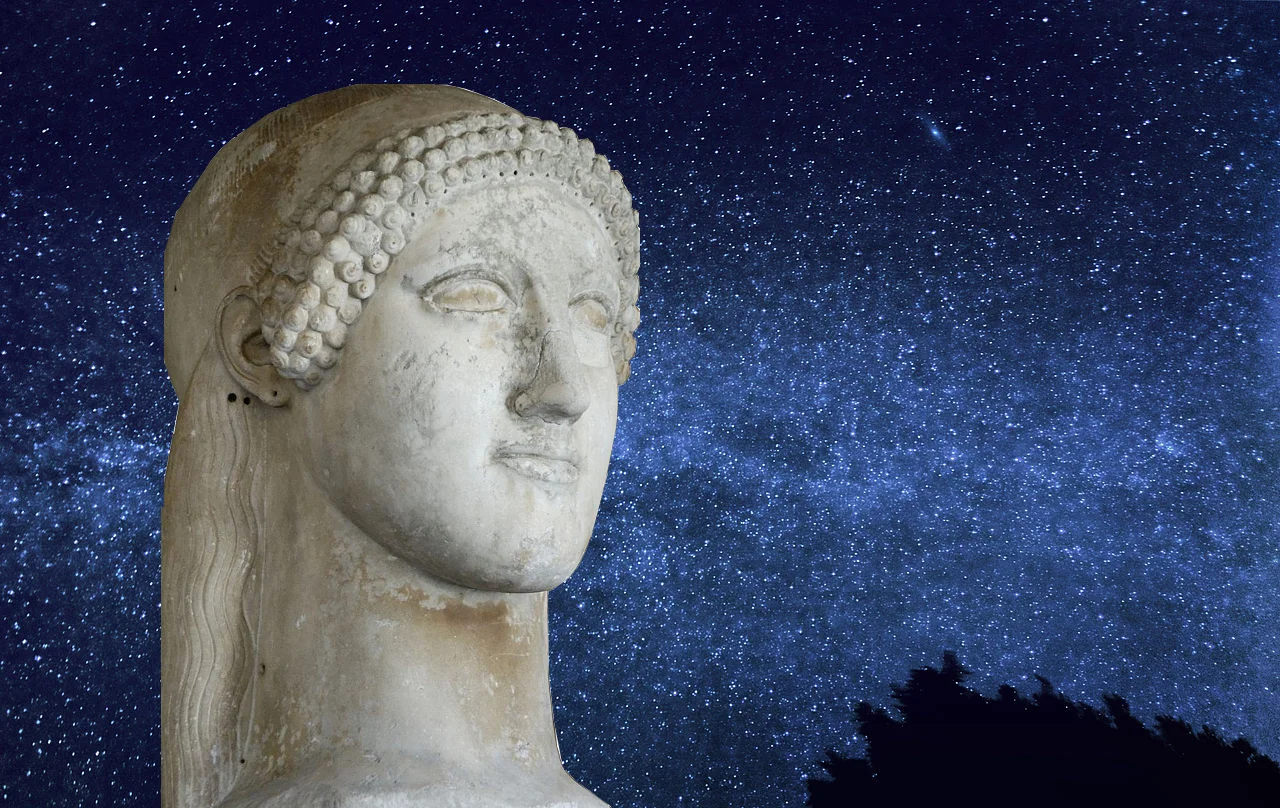
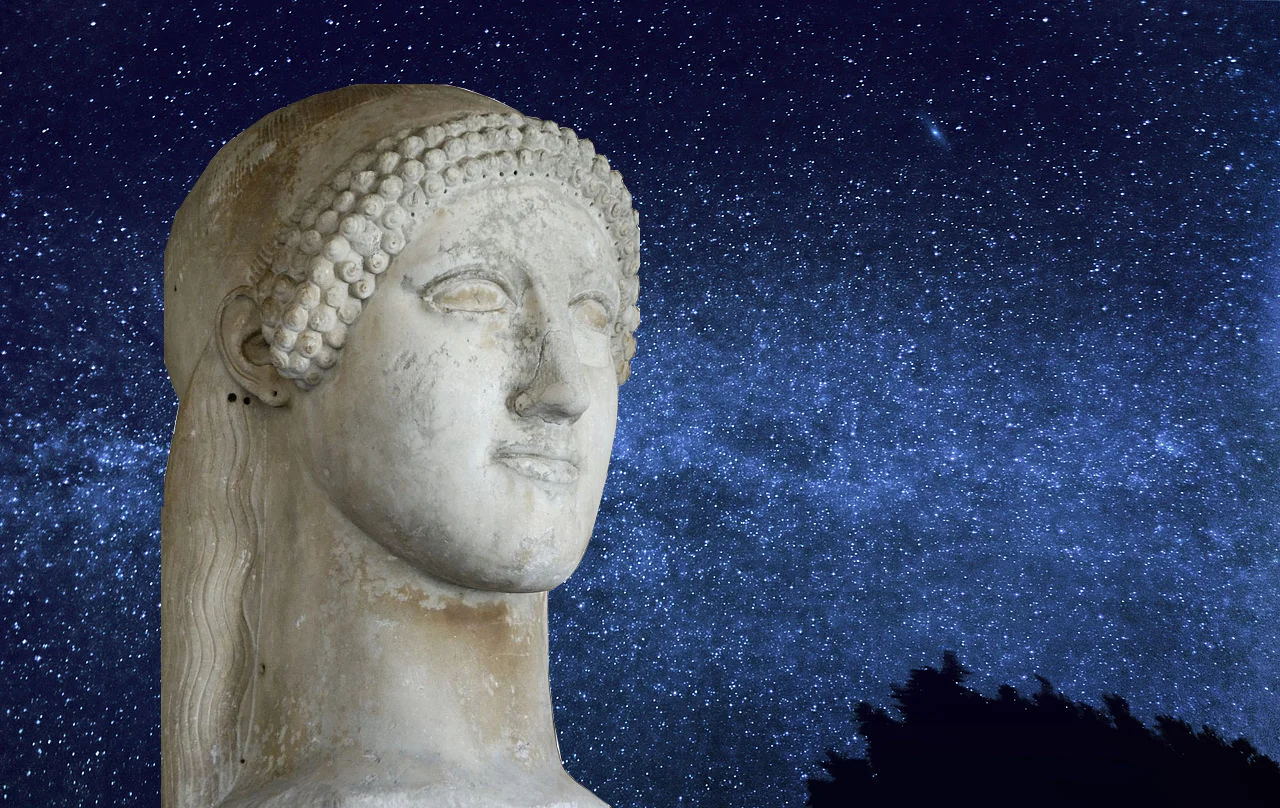
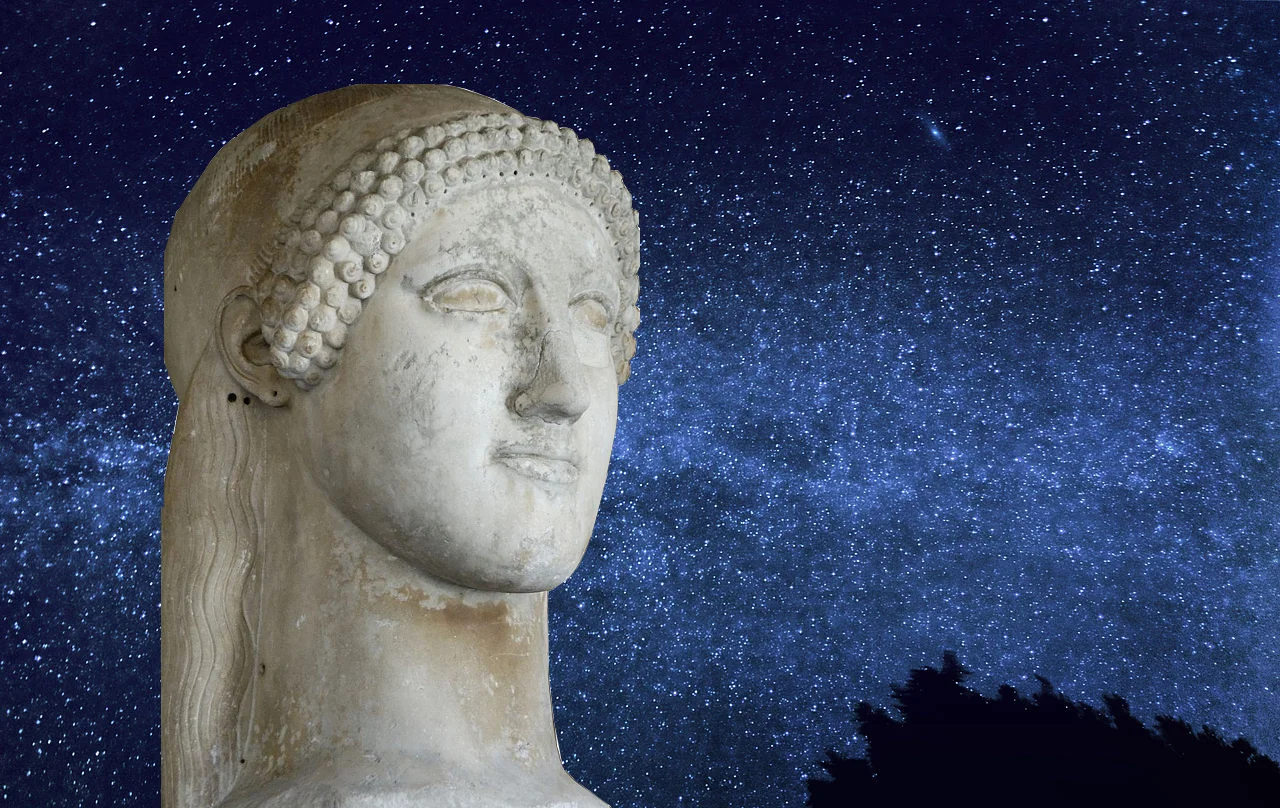
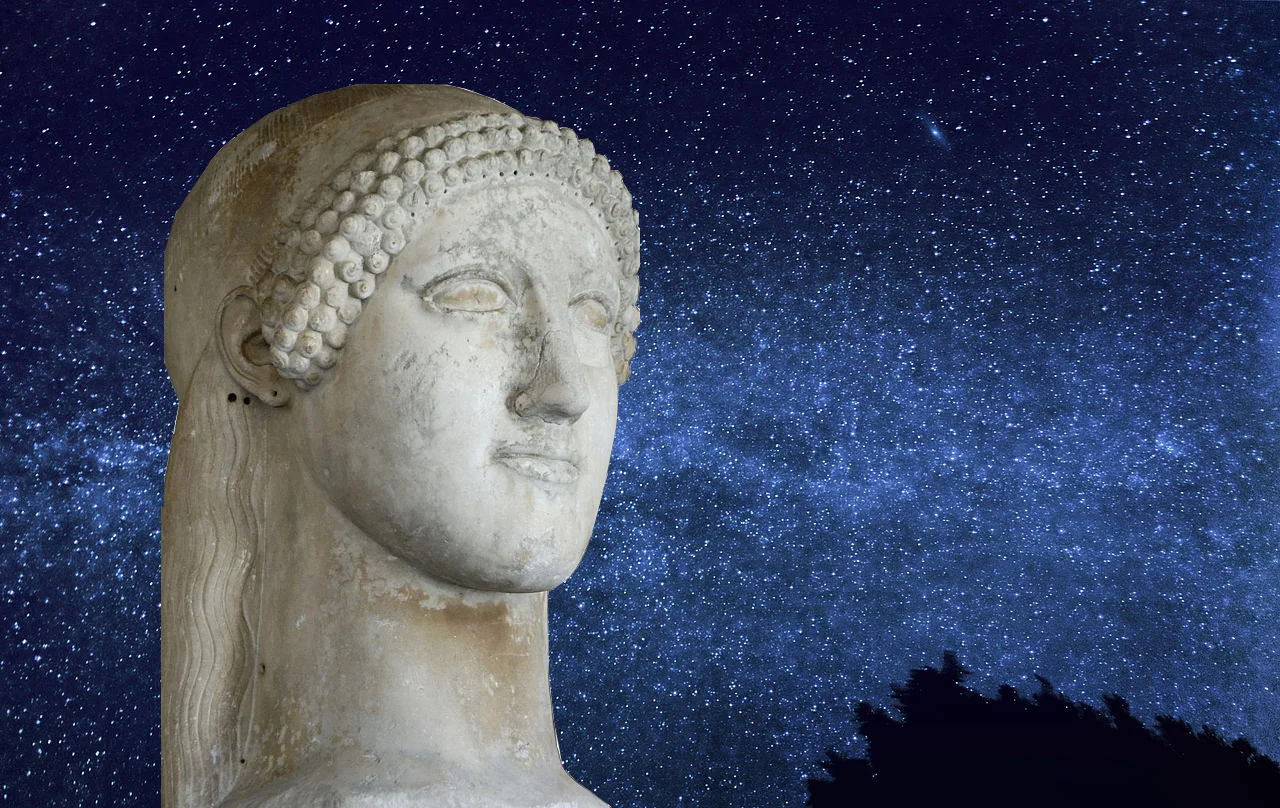
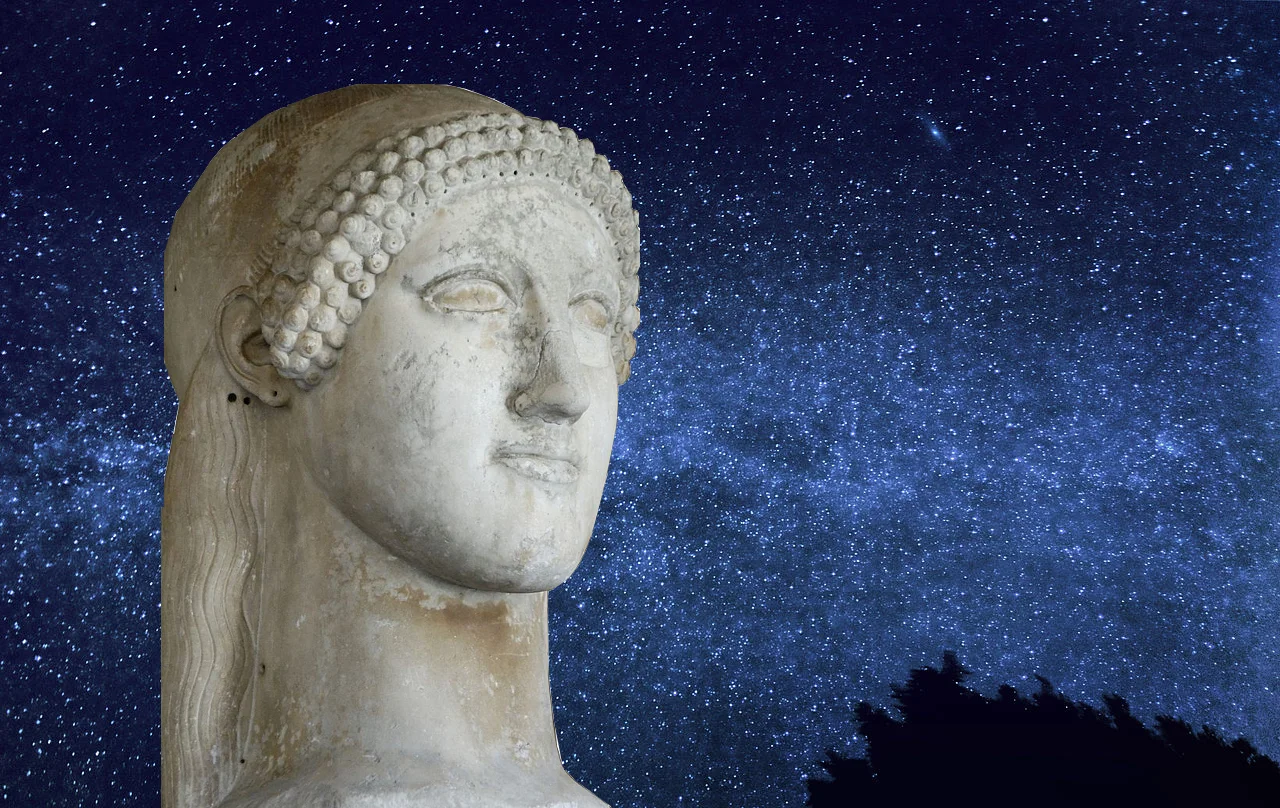
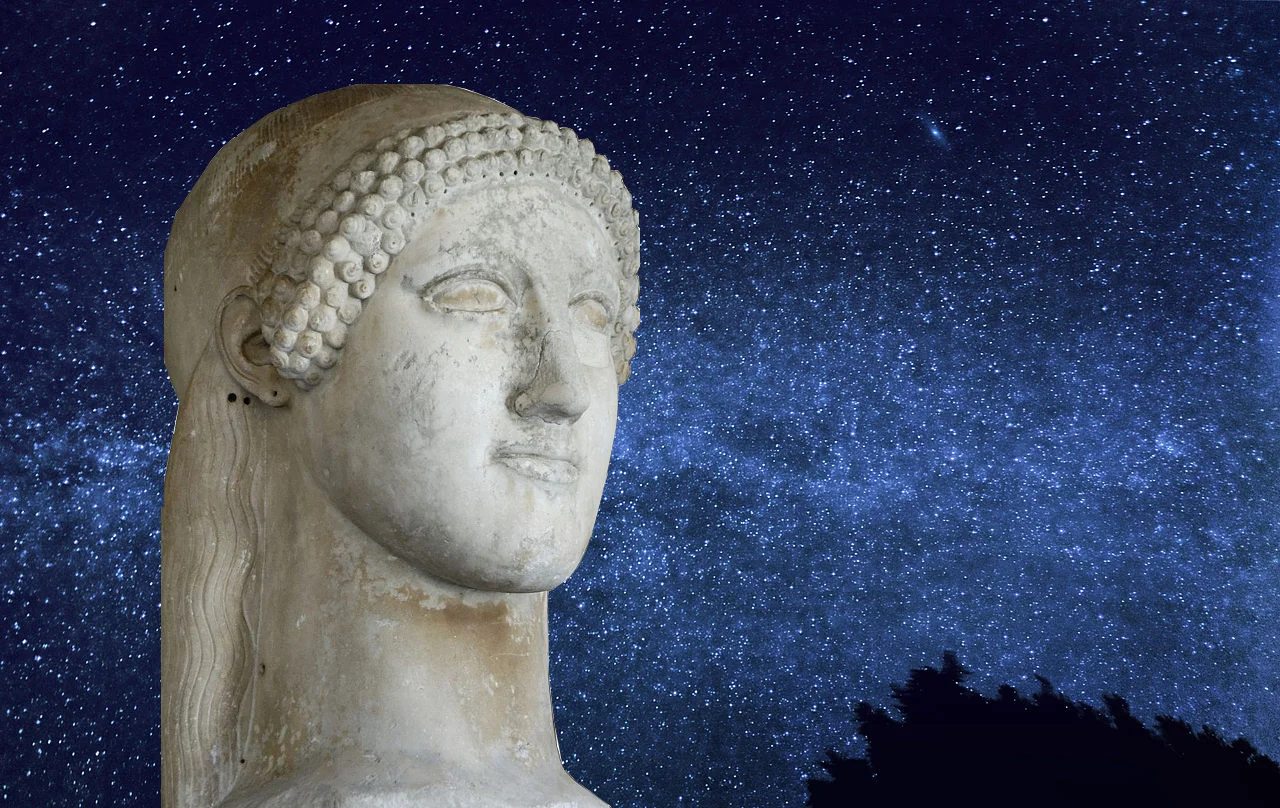
Image: Goddess Isis (link); Background Milky Way Galaxy (link).

The earth has just hurtled past the point of December solstice, where the axis of the north pole is pointed most directly away from the sun, bringing us to the point (in the northern hemisphere) at which nights are longest, darkness triumphs most completely over daylight, and the sun rises furthest to the south and travels across the sky along the lowest arcs above the southern horizon that it will make all year long.

It is the point around which the entire wheel turns: the progress of ever-increasing darkness is replaced by ever-increasing light, as days grow steadily longer and longer, and the sun's rising point marches steadily further towards the north, and the sun's arc gets higher and higher above the southern horizon, causing the sun's rays to strike the earth more and more "from above" rather than "from the side" as the sun's path rises higher and higher on its way towards the June solstice and the top of the year.

In the great cyclical metaphor which informs all the world's ancient mythologies, and which was discussed using an important extended quotation from an essay by Alvin Boyd Kuhn from 1936 in this recent post, we saw that this lowest point in the year was equated in the spiritual metaphor with the "lowest point" of our incarnation: having been thrown down into a physical human body, and having temporarily forgotten all about the spiritual side of our nature and lost contact with the invisible realm which extends through and behind every single aspect of our apparently physical universe, we at some point begin to experience an awakening to the spirit, and to reconnect with our Higher Self or our True Self, even while we are here in this incarnate life.

The map of the year discussed in that post can be seen in the zodiac wheel diagrams shown in many previous discussions:

In this diagram, the point of winter solstice is located at the very bottom of the wheel, between the symbols of Sagittarius (partly covered by the yellow rectangle labeling the "Vertical Column" of the great "cross of the year") and Capricorn (just to the left of the lowest point on that vertical bar of the cross).  It is at this point that days cease growing shorter and begin to grow longer again. The hours of daylight are still shorter than the hours of night, but the hours of daylight at least are getting longer again (prior to that point of winter solstice, the hours of day were shorter than the hours of night, and what's more, they kept getting shorter and shorter as we approached the bottom of the wheel).

Continuing around the circle in a clockwise direction brings us to the point of spring equinox (when days again begin to be longer than nights). This "crossing point" is marked with a red letter "X" and a horizontal line. The horizontal line separates the "lower" half of the year (in which nights rule over days) from the "upper" half (when the hours of daylight finally become longer than darkness again, for half the year). This horizontal bar on the great cross falls between Pisces and Aries on the wheel (at the nine o'clock position, if the circle were a clock), which indicates that this particular diagram is showing the zodiac signs as set in the Age of Aries (the reason for this can be a discussion for another day).

Continuing further, the wheel reaches its highest point, the top of the vertical bar of the cross, at the summer solstice. At that point the days begin to shorten again. The hours of light will still be longer than those of night, but they will be growing shorter each day, until the next "crossing point" is reached: the autumnal or fall equinox, at the right side of the wheel (the three o'clock position, if it were a clock face).

This great circle, with its cross formed by the horizontal bar of the equinoxes and the vertical bar running from the low-point of winter solstice up to the high-point of summer solstice, can be seen in many crosses to this day:

Original image: Wikimedia commons (link); modified in this picture and the one below.

The horizontal bar of the cross represents the fact (and the act) of our being "cast down" into an incarnate body: into an animal form (like the animals that go around in a horizontal position). But the vertical bar represents the raising of everything that is not physical, the beginning of the connection with the Higher Self and the spiritual realm, and the increasing integration of this connection into our lives.

We have just passed that lowest point, the point of winter solstice -- and the message that this special day conveys to us each year is to remember that we are spiritual beings, to remember that those around us are also, and to work to see and treat them as such, rather than "objectifying" them, which means to see them and treat them as "objects," physical lumps only, tools to be manipulated or commodities to be exploited.

Raising up and calling forth the invisible and the spiritual is the very definition of blessing. Beating down and denying the spiritual, brutalizing others and making them feel as if they are only physical objects, is the definition of cursing. The greeting Namasteand the hands-together gesture that goes with the word "Amen" (a version of the name of Amun, the hidden god) expresses the idea of blessing: acknowledging and recognizing the divine spark in oneself and others, and reminding ourselves and others that this is a true fact of who we really are.

We have just passed the point of winter solstice: the point which symbolizes the end of the downward plunge into forgetfulness of who we are, and the turn back upwards. Thus, it is very appropriate at this point in the year to think about becoming someone who blesses instead of curses, in everything that we do (whether our blessing or cursing is done through words or through other methods).

This point on the great annual cross (see the "You are here" image added to the diagram above) is the point at which we should concentrate most on the idea of "raising the Djed column," in the symbology used in the ancient wisdom of Egypt (the Djed symbology is discussed in numerous previous posts such as here and here, and in several videos as well such as here and here).  

In the symbology described in the vision of the Lakota holy man Black Elk, the same concept was described as following the "good red road" (corresponding to the vertical bar on the great wheel, and to the Djed column raised up to connect with the spirit world and integrate the invisible and visible realms) rather than the "black road" on which everyone is biting and devouring one another and living for themselves.

At the point of winter solstice, we can contemplate which road we are following in our words and actions, and we can have hope that -- at this turning point in the great wheel of the year -- we too can change course to the good road.

It is something we would probably do well to contemplate not only on an individual level but also on a societal level -- asking ourselves to what extent the present economic and political structures are built upon a vision of cursing instead of blessing: of seeing the world, and other human beings and living creatures in it, as an object or objects to be conquered, devoured, consumed, turned into a commodity. 

In ancient Egypt, the recovery of the lost god Osiris -- the god who was slain: cast down, sealed in a casket, laid out horizontally -- is effected by the goddess Isis, who tirelessly pursues her beloved Osiris and finally finds him, recovers the casket containing his body, and brings him back to life. She raises the Djed column again.

Below, the goddess is shown receiving the Djed column representing Osiris in the casket, around which a tree has grown and which has been used as a pillar in the palace of the King of Byblos:

image: Wikimedia commons (link).

Interestingly enough, in the vision of Black Elk, a divine female figure also plays a prominent role: White Buffalo Woman, who is described in his vision at the very beginning, and who in many ways is the one who begins his vision and sends him on his path.

This is another point to contemplate deeply at the point of winter solstice, because in our current culture, which is badly disconnected from the ancient wisdom and as such seeks to turn everything and everyone into a commodity or an object (a form of spirit-denial and thus of cursing), women are very frequently and regularly "objectified," economically, socially, and in many other ways. 

And yet it should be intuitively obvious that the very concept of "birth" and "re-birth" are absolutely dependent upon women and belong most properly to women (physically of course but also spiritually), and that ultimately any real aspect of healthy "growth" and "blessing" must begin with the recognition of their spiritual value and worth, and seek to bless and not to curse and objectify and debase them (as literalist misinterpretations of the ancient wisdom have done for centuries and continue to do in many cases, and as many aspects of modern society can also be shown to do, worldwide).

The point of winter solstice, then, is one of the most significant points of the entire year. It gives us much to meditate on and to contemplate. Ultimately, its message should be tremendously encouraging and uplifting: it is the point of turning from the downward path to the "good road," the point where the "cast down Djed" begins to be raised back up, the point when we begin to see that we are more than a human animal in a dog-eat-dog world and that we actually have an inner connection to the infinite realm, that we and everyone around us and in fact every aspect of our physical universe has an inner divine nature as well as a material nature.

Namaste.
"Last-minute" gift ideas?

"Last-minute" gift ideas?

With the December solstice only a few days away, all readers have undoubtedly finished all their Christmas (or other appropriate holiday) shopping, but for those who may still be trying to come up with that last gift idea, I would suggest that anyone could hardly ask for more this holiday season than to receive his or her own copy of one of the ancient sacred texts of humanity.

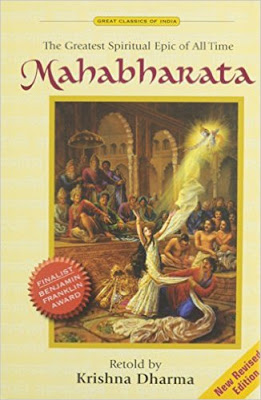
You may agree with me that a copy of the Mahabharata belongs on every bookshelf -- perhaps several copies of the Mahabharata, since there are many different translations, and there is also the original Sanskrit for those who enjoy learning new writing systems and languages and reading texts in their original format.

Above is a link to an abridged retelling of the Mahabharata by Krishna Dharma, which I believe has much to recommend it.

A complete English translation of the massive original epic (which is over seven times longer than the Iliad and Odyssey, combined) is also available online, by Kisari Mohan Ganguli, published towards the end of the nineteenth century. While it does contain some anachronistic language (most notably the use of the older forms of the second-person personal pronoun, such as thouthee, and thine, and of the verb forms which go along with them, such as wilt and hast and so on), it also has a great many virtues, including a lively style and a true appreciation for the spirit of the text, and most importantly its completeness.

However, if you want to actually put the entire Ganguli translationon your bookshelf (twelve volumes), it is fairly expensive to do so. It is also probably a rather daunting read for those who are not already dedicated Mahabharata fans. Therefore, one of the abridged retellings is probably a better place to start, and I believe that the Krisha Dharma version linked above is a good start (there are several others as well, each with its own strengths and weaknesses). Those who fall in love with this epic can then explore other retellings and translations, perhaps acquiring the entire Ganguli translation, and perhaps even venturing into the Sanskrit as well.

The other great Sanskrit epic is the Ramayana, and here again Krishna Dharma has an outstanding retelling, which moves along briskly, conveys the majesty of the legendary setting and ancient culture, brings out the depth of the characters, confronts the deep questions of duty and consciousness present in the text, and provides much to meditate upon and consider for what it has to tell us about our own journey through this incarnate life.

If anyone you know does not have a physical copy of the Ramayana in his or her home library, this retelling would certainly be a welcome addition, in my personal opinion.

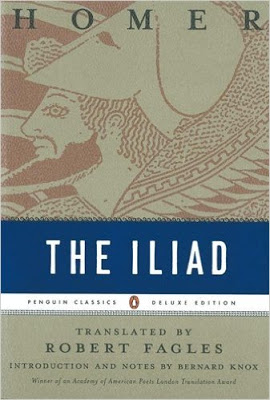
Continuing with the theme of ancient epics that belong on every bookshelf (if practicable), and can by themselves provide years and years worth of profitable reading and re-reading, contemplation and meditation, the great Homeric epics of the Iliad and the Odyssey have never been translated into the English language so magnificently, perhaps, as they have been by the late scholar of ancient Greece, Professor Robert Fagles.

I personally had the opportunity to meet Professor Fagles and hear his thoughts on the power and personal relevance for each and every one of our lives of these great epics attributed to Homer, as well as to teach his translation of the Odyssey at the college level to young cadets at the US Military Academy back in the early part of the last decade.

Some of my colleagues who had been there in the English Department at West Point before I arrived also had the opportunity to teach the Iliad, and although I did not actually teach the Iliad to students, I can attest that the translation of the Iliad by Robert Fagles is moving, powerful, and worthy of reading in front of the fireplace late into the night, with frequent pauses to ponder the impact of the ancient wisdom which can be found on every single page.

Reading the Iliad, one is presented with the undeniable evidence of Peter Kingsley's assertion that the "original instructions" have been tragically lost somewhere in the ancient history of "western civilization." Here, you will find a worldview in which the realm of the gods is understood to be both an extension of and intimately intertwined with the ordinary reality upon which our consciousness is usually focused. 

And you will have occasion to wonder at those Seers described as skilled in interpreting the flight of birds, and where along the timeline of human history that knowledge may have been lost (and if it somehow survived). Perhaps you (or the one to whom you give this ancient text as a gift) will never look at a passing dove or hawk or sparrow or vulture quite the same way again!

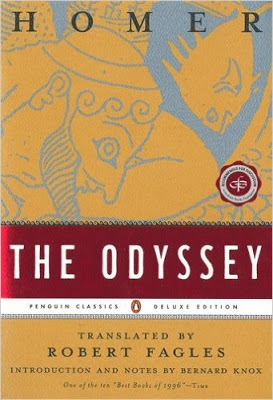
But as much as I do love the Iliad, and as much as I believe it has to teach us right now even in this most modern moment of the present day, I have always loved the Odyssey even more, even from my pre-teen days.

I have had several "favorite versions" of the Odyssey through the years. Before Professor Fagles published his translation, I think the W. H. D. Rouse translation was the first one that I read, followed by the Robert Fitzgerald translation, but the Fagles translation of the Odyssey has to be the superlative English translation (in my opinion), and it also has the great advantage of being a verse translation of what is, after all, epic poetry.

Having access to multiple translations can never be a bad thing, of course, and this recommendation should not be interpreted as a criticism of other translations: but if it is at all possible, I personally believe that every home should have a copy of the Fagles translation of the Odyssey (unless that home's occupants are fluent in another language, of course, in which case there may be better translations in other languages upon which I am not qualified to comment). It has to be the next best thing to being able to read the original ancient Greek (which of course would be the best option, but certainly not a trivial undertaking).

So, those are a few "ancient wisdom" ideas for last-minute gift-giving assistance, if anyone is still wondering. You should be able to obtain any of those from a variety of different bookseller options, including your local neighborhood bookstore.

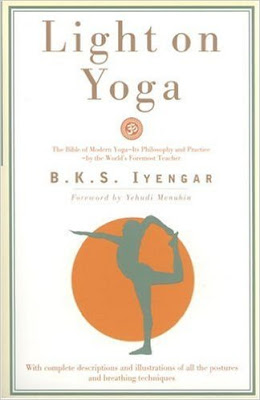
Another option, not exactly an ancient text although it does offer some commentary upon the ancient Yoga Sutras of Patanjali, as well as offering examples and instructions from the Vedas and especially the Upanishads, is the classic Light on Yoga (Yoga Dipika), by B. K. S. Iyengar.

This text is probably very familiar to anyone who is already a practitioner of Yoga, but even those who are not (or who are "not yet") may be very grateful to have access to its clear and compelling explanation of the practice and purpose of Yoga, which goes far beyond the practice of the asanas (as important and as beneficial as those can be). 

From its outset, the book explains that Yoga is a system given to humanity which teaches "the means by which the jivatma can be united to, or be in communion with the Paramatma, and so secure liberation (moksa)" (19). In other words, its aim is to facilitate the connection between the "individual human spirit (jivatma)" and the "Supreme Universal Spirit (Paramatma or God)" (19).

Reading the lucid explanations of Yoga's role in this pursuit, one who does not already follow the path of Yoga may experience a strong inclination to start!

In one passage in Light on Yoga, while discussing the concept of

Aparigraha ("not hoarding or collecting" -- one of the five principles of Yama), we read:

Just as one should not take things one does not really need, so one should not hoard or collect things one does not require immediately. 35.

This passage, perhaps, suggests another "last-minute gift idea" we might consider at this winter-time of giving and receiving gifts: the idea of giving away things we no longer need, or do not require immediately, or generally helping those in need even if we do not know them personally.  

This particular virtue (of "not collecting") is not one that I myself am especially good at, but the spirit and teaching of Light on Yoga has certainly spoken to me on this subject, and caused me to think about doing more to give away those things that I "do not require immediately." 

In any case, the above "gift-giving" ideas are offered as possibilities in the category of gifts that contain a breath of that ancient wisdom given to humanity in the distant past -- which remains as relevant today as ever (perhaps even more so).

"Here it has reached the turning-point" -- the celestial map of the soul's spiritual trek

"Here it has reached the turning-point" -- the celestial map of the soul's spiritual trek

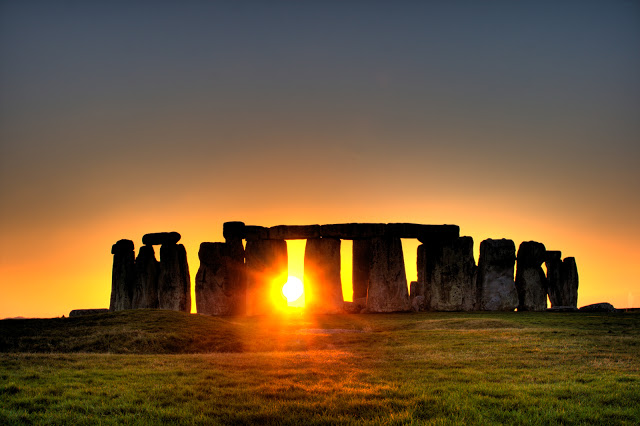
image: Wikimedia commons (link).

We are now drawing so near the point of solstice that some of the great monuments of deep antiquity are already beginning to hint at their stunning alignments to the sunrise of that significant day.

For instance, if you have the opportunity to visit Stonehenge this week, and if the weather conditions permit a view, you can station yourself near Aubrey Hole 40 and look back across the stone circle between Sarsens 22 (on the north or left as you look east) and 21 (to the south or right as you look east), on through the gap between West Trilithon Sarsens 58 and 57 (likewise left and right, respectively) and past Bluestone 69 just beyond them (framing the right edge of the gap, along with the edge of Sarsen 57), you will be able to see the sunrise sight line for the winter solstice as it would have appeared 4,000 years ago, according to the analysis of Professor Gordon Freeman in his landmark text Hidden Stonehenge (you can see all this in the sample chapter he provides

online here, beginning at page 93 and illustrated with full-color photos in image 4-13, 4-14, and 4-15, captured in 1997).

Even if you do not have the opportunity to visit Stonehenge in person, you can still contemplate the silent, massive stones, patiently marking out the great pivots of the year, as they have been doing year after year, as centuries draw on into millennia, and the earth wings its course around the fiery ball of the sun.

You can consider the vision and the skill of those incredible and now-unknowable minds who conceived of this incredible monument, who placed the stones and engineered those alignments which still remain in effect to this day, through all that has come and gone in between -- alignments (some of them) which remained hidden and all but forgotten, until new souls such as Gordon Freeman came and unlocked them to share with humanity once again.

And, considering this almost inconceivable concept, you can also cast your mind around the planet to other ancient places, where temples face the sunrise on winter solstice or mark our sun's rising point with similarly precise alignments: the great Temple of Karnak in Egypt, the mysterious observatory known as the Caracol in what is today called Belize, the incredible passage mound of Newgrange in Ireland, the more recently-discovered Goseck Circle in northern Europe which is thought to date to as early as 4,900 BC (an amazing 6,900 years ago), and many more.

All testify to the ancient and enduring importance of the great turning points of the annual cycle -- turning points which, according to the inspired analysis of Alvin Boyd Kuhn, were marked primarily for their spiritual significance as a metaphorical "map" of the circling path of the soul itself.

When we understand the ancient allegorical outline of the year as a representation of our own soul's journey down into the physical body (the first birth) and a state of spiritual amnesia (a form of spiritual sleep or even, metaphorically speaking, spiritual "death"), followed by the awakening of the realization of our true spiritual nature and the spiritual nature of the seemingly-material universe around in which we find ourselves, followed by our increased communication and communion with our inner divine nature and eventual return to the invisible realm -- then the importance of the great cycle of the year as a beautiful, visible, ever-present reminder to us becomes clear.

Alvin Boyd Kuhn sketches the outline of this ancient spiritual map most clearly and succinctly, perhaps, in his essay entitled Easter: The Birthday of the Gods, discussed in

this previous post and available to read online in various places such as here and here.

The description is so important that it is worth citing at some length:

Using solar symbolism and analogues in depicting the divine soul's peregrinations round the cycles of existence, the little sun of radiant spirit in man being the perfect parallel of the sun in the heavens, and exactly copying its movements, the ancient Sages marked the four cardinal "turns" of its progress round the zodiacal year as epochal stages in soul evolution. As all life starts with conception in mind, later to be extruded into physical manifestation, so the soul that is to be the god of a human being is conceived in the divine mind at the station in the zodiac marking the date of June 21. This is at the "top" of the celestial arc, where mind is most completely detached from matter, meditating in all its "purity."
Then the swing of the movement begins to draw it "downward" to give it the satisfaction of its inherent yearning for the Maya of experience which alone can bring its latent capabilities for the evolution of consciousness to manifestation. Descending then from June it reaches on September 21 the point where its direction becomes straight downward and it there crosses the line of separation between spirit and matter, the great Egyptian symbolic line of the "horizon," and becomes incarnated in material body. Conceived in the aura of Infinite Mind in June, it enters the realm of mortal flesh in September. It is born then as the soul of a human; but at first and for a long period it lies like a seed in the ground before germination, inert, unawakened, dormant, in the relative sense of the word, "dead." This is the young god lying in the manger, asleep in his cradle of the body, or as in the Jonah-fish allegory and the story of Jesus in the boat in the storm on the lake, asleep in the "hold" of the "ship" of life, with the tempest of the body's elemental passions raging all about him. He must be awakened, arise, exert himself and use his divine powers to still the storm, for the elements in the end will obey his mighty will.
Once in the body, the soul power is weighed in the scales of the balance, for the line of the border of the sign of Libra, the Scales, runs across the September equinoctial station. For soul is now equilibrated with body and out of this balance come all the manifestations of the powers and faculties of consciousness. It is soul's immersion in body and its equilibration with it that brings consciousness to function.
Then on past September, like any seed sown in the soil, the soul entity sinks its roots deeper and deeper into matter, for at its later stages of growth it must be able to utilize the energy of matter's atomic force to effectuate its ends for its own spiritual aggrandizement. It is itself to be lifted up to heights of cosmic consciousness, but no more than an oak can exalt its majestic form to highest reaches without the dynamic energization received from the earth at its feet can soul rise up above body without drawing forth the strength of body's dynamo of power. Down, down it descends then through the October, November and December path of the sun, until it stands at the nadir of its descent on December 21.
Here it has reached the turning-point, at which the energies that were stored potentially in it in seed form will feel the first touch of quickening power and will begin to stir into activity. At the winter solstice of the cycle the process of involution of spirit into matter comes to a stand-still -- just what the solstice means in relation to the sun -- and while apparently stationary in its deep lodgment in matter, like moving water locked up in winter's ice, it is slowly making the turn as on a pivot from outward and downward direction to movement first tangential, then more directly upward to its high point in spirit home. 
So the winter solstice signalizes the end of "death" and the rebirth of life in a new generation. It therefore was inevitably named as the time of the "birth of the Divine Sun" in man; the Christ-mas, the birthday of the Messianic child of spirit. The incipient resurgence of the new growth, now based on and fructified by roots struck deep in matter, begins at this "turn of the year," as the Old Testament phrases it, and goes on with increasing vigor as, like the lengthening days of late winter, the sun-power of the spiritual light bestirs into activity the latent capabilities of life and consciousness, and the hidden beauty of the spirit breaks through the confining soil of body and stands out in the fulness of its divine expression on the morn of March 21. [. . .]. (pages 8 - 11 as paginated in this version).

A couple quick things to point out might include, first, the fact that Kuhn does not intend to exclude women when he uses the masculine pronoun (as was the custom in grammatical usage when he was writing) -- he specifically makes this clear at numerous different points in his voluminous writings.

Second, the ancient sacred myths, scriptures, and traditions of humanity from all over the globe can now be conclusively demonstrated to use the above heavenly cycle (and many other heavenly cycles, including those of the moon and planets but most especially the motions of the stars and constellations) as part of their inspired method for conveying to us the most profound and necessary spiritual knowledge to aid us in this incarnate life.

Alvin Boyd Kuhn wrote the above incredible explication of the annual solstice and equinox points as spiritual analog for the "soul's peregrinations round the cycles of existence," but while he correctly tied the esoteric stories of the Bible to these stations on our spiritual pilgrimage, the level of celestial correspondence to the specific constellations that can be demonstrated in the stories of the Old and New Testament, and in the other myths of the different cultures all around the globe (probed more thoroughly later by Professors Hertha von Dechend and Giorgio de Santillana in Hamlet's Mill, published in 1969, but without perceiving their spiritual depth in the same way that Kuhn had decades earlier) had not yet been fully appreciated.

The more we begin to understand the specific celestial correspondences of the various gods and goddesses and spiritual beings who are found in the different myths of the world, the more we can begin to see where they might fit and what roles they might play in the great spiritual cycle elucidated by Alvin Boyd Kuhn in the passage above, and better understand their significance and meaning for our own spiritual  growth.

This is actually a matter of absolutely the utmost importance, I am convinced, and opens tremendous new avenues of communication with the incredible ancient wisdom given to humanity in the "high and far off times" (as Giorgio de Santillana called it) -- perhaps in the same millennia that the great stone henges and circles and towers and temples were being erected, or even millennia before that.

I hope that as we approach the powerful and significant turning point of December solstice this year, you will have the opportunity to contemplate these matters at some length and that meditating upon this ancient wisdom will be a blessing to you in your life and in the years to come.

A conversation with David Whitehead of Truth Warrior!

A conversation with David Whitehead of Truth Warrior!

Above is a video of a recent conversation with David Whitehead of Truth Warrior.

In it, we discuss a wide range of topics, including Star Myths in general and my most recent book, Star Myths of the World, and how to interpret them: Volume One.

We also explore the subject of paradigms in general, the difficulty of changing one's paradigm, and the difficulty of convincing someone else to consider a new paradigm. 

Some of these issues are discussed as well in my recent post entitled "The nine-dot puzzle and connecting 'outlying dots'." We discussed the metaphor of the "nine-dot puzzle" a little bit during this interview as well, as it relates the filters we use to view the "big picture" of this material-spiritual universe in which we find ourselves, and our place and purpose in it -- and also to more specific questions and models, such as our understanding of the shape of our planet and the reason that we see the sun, moon, planets and stars do the things that we see them do.

Having been somewhat taken aback by some particularly aggressive and acrimonious advocates of the "flat earth theory" (whether genuine advocates or not is difficult to know), David was very positive about my recent article entitled "The invisible kraken: Evidence that the earth is not flat," and wanted to spend part of our conversation discussing the fairly recent proliferation of commentary online trying to steer nearly every discussion towards this particular subject of the shape of our planet.

While I don't want to spend much time debating this particular subject any further (that article linkedin the previous paragraph presents what I believe are fifteen or so very solid reasons to conclude that we live on a spherical earth which is rotating on its axis once per day and which is orbiting the sun in a solar system which also includes other planets orbiting the same sun), I did agree that it might be worth spending just a few minutes discussing the recent sudden desire on the part of some aggressive web comment-posters to drag every conversation over to this subject (deliberately derailing productive discourse, in many cases).

We discuss the very important distinction between honest critical examination of alternative possibilities, and sheer sophistry which merely delights in advancing arguments that the sophist does not believe, as a form of showmanship or even deceit, not in the pursuit of truth.

Interestingly enough, the day after David Whitehead and I recorded that conversation, an articlecame to my attention (published on December 09, 2015) which contained a screenshot of the website of a certain US government agency,  a website which was discussing a manual written back in the 1940s, and which contained advice for deliberately derailing and disrupting productive activity and turning the situation into "a dysfunctional mess" -- all while appearing to be trying to be helpful and even "reasonable." 

Some of the advice from that 1940s manual describing how to undermine productive activity while still appearing to be helpful and reasonable and friendly to the very people one is trying to undermine includes suggestions such as:

  • "Bring up irrelevant issues as frequently as possible."
  • "Talk as frequently as possible and at great length."
  • "Haggle over precise wordings."
  • "Be 'reasonable' and urge your fellow conferees to be 'reasonable' [. . .]."

The website in question noted that, although these tactics were described in a 1940s-era manual on disrupting while appearing to be helpful, they remain "surprisingly relevant" to this day -- and demonstrate just "how easily productivity and order can be undermined."

The entire debate over the shape of our planet has somehow turned into a contentious subject, and one I would rather avoid. I personally do not believe there is enough evidence to warrant any real debate on the subject: there is abundant evidence (some of it discussed in my above-linked article) which supports the paradigm of a spherical earth, rotating on its axis, and orbiting the sun. Some of this evidence also appears to be very difficult to satisfactorily explain using the hypothetical mental exercise of a non-spherical earth.

There is also some reason to suspect that at least some of those aggressively trying to steer virtually every conversation in this direction are doing so in order to turn things into a "dysfunctional mess" among those engaged in offering alternative sources of analysis to those presented in conventional media.

There is a difference between honest critical examination of the evidence and of alternative theories that can explain the evidence, and sheer sophistry which does not actually propose arguments in order to try to explain evidence but rather in order to either show off, play games, or even deliberately derail, deceive, or disrupt.

It is too bad that this subject even needs to be addressed. However, for those who have gotten caught up in this disruptive topic, I hope that the above conversation will be helpful. 

My advice for anyone still honestly struggling with this issue would be to read through the evidence I offer in the above-linked article, realize that there is a lot more evidence out there which also points to a spherical earth rotating on its axis and orbiting the sun, and realize that there are some reasons to believe that at least some of the most aggressive participants in this debate might be participating simply for the purpose of creating "a dysfunctional mess."

After that, I would recommend ignoring further debate on this subject of "flat earth theories" altogether, which is what I intend to do myself.

The nine-dot puzzle and connecting "outlying dots"

The nine-dot puzzle and connecting "outlying dots"

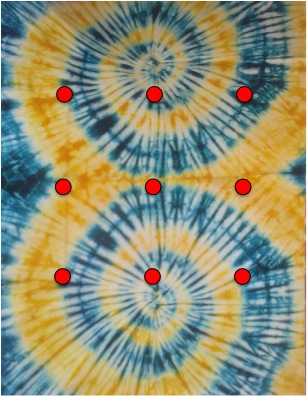
image: Wikimedia commons, with dots added (link to original).

The "nine-dots puzzle" is often presented as an exercise in "thinking outside the box," and it most certainly is that.

But it is also an excellent metaphor for the process we undergo as we deal with the data life presents to us and as we attempt to find paradigms which help us to understand that data. 

The puzzle is a thought-exercise in which nine dots are arranged in three rows of three (or three columns of three, whichever way you choose to look at it), similar to the arrangement of a "tic-tac-toe" pattern. The illustration above shows the arrangement for the puzzle.

The goal of the game is to try to connect all nine of the dots, using only four straight lines, without picking your pencil (or pen) up off of the paper (or writing surface):

If you have never had the opportunity to wrestle with this particular puzzle, and would like to try it for yourself without reading any discussion that might give away the solution and thus spoil the fun of the game, please stop reading now and come back later!

*  *  *  *  *  *  *  *  *

Readers who are familiar with the possible solutions will know that in order to connect all nine of the dots with only four straight and connected lines, you have to be able to "think outside the box" and draw the lines beyond the boundary of the implied square that the dots make by their arrangement. 

Obviously, there is nothing in the rules of the puzzle as stated which forces you to draw the lines within the borders of the square created by the outer dots. That invisible boundary is only "self-imposed" -- and yet it will prevent you from finding the solution until you can see that you don't need to stay within the "mental cage" that we unthinkingly impose on ourselves when presented with this puzzle for the first time.

So, the nine-dots puzzle is an excellent illustration of that tendency, and of the need for examining our own "self-imposed barriers" in other situations in our lives -- situations that may involve more data-points than just nine dots arranged on a page.

But I believe the nine-dots puzzle can also provide an additional, related illustration of the way we tend to impose "paradigms" or "frameworks" or "filters" through which we view the myriad data-points or "dots" which we find in the world around us during our journey through this incarnate life. In many ways, we do this out of necessity, in order to be able to make sense of things, beginning when we are very small and progressively altering our paradigm or framework as we grow up and encounter new data-points or see new ways of connecting ideas or explaining events.

The question that this puzzle illustrates very well, in my opinion, is the question of "What do you do, when you find that the paradigm you are using leaves out important dots?"

This is the question that is worked out in most of the mystery stories and "CSI television shows" that we enjoy, going back to the formula used by Arthur Conan Doyle in the Sherlock Holmes stories (or in the Scooby Doo television series from the late 1960s and early 1970s, or in the pioneering mystery stories written by Edgar Allan Poe in the first half of the nineteenth century).

In those stories, "the authorities" usually have a theory or thesis that they are using to explain the evidence or clues that they have found -- a paradigm or framework with which they are "connecting all the dots," so to speak. Then, the outsider in the story (such as Sherlock Holmes, or Scooby and the gang) comes into the picture and discovers a few more "dots" which the solution offered by the authorities leaves out. 

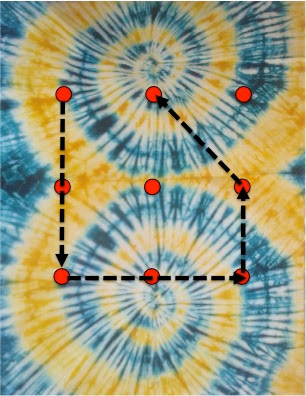
Above: Four lines which attempt to connect all the dots -- but Sherlock Holmes (or Shaggy and Scooby) might ask, "What about these two dots over here?"

Through the course of the investigation, a new outline or framework to connect all the dots emerges, leading to a new way of understanding the situation (and often revealing that the culprit was someone quite different from the person implicated in the original storyline accepted or promoted by the authorities). 

I think this is a very helpful metaphor which is applicable in many different situations -- from the way we choose to understand important events in history, to the way we interpret the "big questions" regarding the meaning of life and our purpose here in this material world.

By virtue of the fact that this material-spiritual universe in which we find ourselves contains far more than "nine dots" for us to try to understand, there are an almost-infinite variety of paradigms or frameworks or "shapes of the lines" which people adopt in order to try to make sense of the world around them.

When we find one that seems to work as an explanation, we can be very resistant to letting go of it, even if we start noticing some suspicious dots that our framework doesn't seem to include or connect very well. 

There is actually good reason for being somewhat resistant to casting aside a paradigm which we have adopted over the course of time and which seems to do a reasonably good job of explaining and connecting the dots we have encountered over the course of our life. Data-points which originally looked like "outliers" may turn out to have been illusory, or deceptive, or irrelevant for some other reason. New paradigms which someone offers and which seem to connect these new dots may in fact ignore other dots which our old framework did explain, but which the new framework asks us to forget about.

We don't want to be too careless about jettisoning one paradigm which seemed to explain the universe (or some historical event) and adopting one that radically re-draws the lines in a shape that was totally different from what we were using before. Because of this, people are usually very resistant to doing so, and with good reason.

But, as the stories of Sherlock Holmes or Scooby Doo or Edgar Allan Poe (and countless others, including many from real life) all illustrate, there are in fact times when the outlying dots are important enough to cause us to re-evaluate even our most cherished and tightly-held explanation or belief system. 

There are times when our paradigm-driven interpretation or understanding of the events that are going on in the world around us is actually deeply mistaken, and when continuing to use a mistaken paradigm or framework will actually lead to very serious negative consequences.

Although it takes a lot to let go of a framework or paradigm that we have held for a long time and which seemed to "connect all the dots" for us for many years, sometimes it is necessary. Most of us have probably had the experience of doing so at least once or twice already.

I have already explained in the past (in many interviews and in the introduction to my most-recent book) that the world-view or paradigm provided by a literal interpretation of the scriptures collected into what we today call the Bible seemed to "connect all the dots" very well for me for many years of my adult life.

However, the more evidence that I found which indicated that the stories in the Bible -- virtually from first to last -- can be shown to allegorize the features and motions of very specific constellations, the more I had to question whether the shape of the line I was using as a framework or paradigm was accurate. Eventually, I saw "enough outlying dots" that I was forced to alter my understanding of the way they all fit together.

The same sort of process can also be applied to the framework of history, or to specific historical events which have had a great impact on the direction of geopolitical events. I believe that the analogy of the "nine-dots puzzle" is very helpful in this regard, and that it can remind us to always be sensitive to the possibility that the way we are interpreting events or the relationship between data-points might be completely mistaken and in need of serious revision.

Of course, I also think that spending as much time as possible looking at the stars and identifying constellations will help anyone to become better and better at "connecting the dots"!

Star Myths of the World on Alchemy with John Gibbons!

Star Myths of the World on Alchemy with John Gibbons!

Much gratitude and appreciation to DJ John Gibbons and the team at Alchemy for having me over for a most enjoyable conversation.

Here is the link you can follow in order to listen online, download the file for listening on a mobile device, share the podcast with others directly or through various social media platforms, subscribe to the Alchemy podcasts, and post any feedback from the show.

You may also wish to consider supporting the show using links available on the main Alchemy page -- I definitely believe that supporting independent media such as your favorite podcasters is a very valuable endeavor, enabling independent voices to bring conversations such as this one to you and to others.

I think you'll agree that John's insightful questions and familiarity with the subject led to some valuable directions and brought out some new perspectives and exchanges during our talk. 

Of course, the fact that he is an accomplished and well-known musician means that we perhaps should not be surprised at his ability to "resonate" with these profound concepts!

I hope you enjoy the show! 

----  ----  ----

Here's a link to an "interview archive" where you can also find a recording of my previous visit to Alchemy, back in September of 2014.

Below are some handy links to a few of the many subjects we touched upon during the course of our conversation:

12/08/2015

12/08/2015

Prophecy is not about the future. Prophets don't talk about the future. What they do is: they talk about the past -- which has been hidden. Things which have happened -- that have been covered over, and no longer clear. That is what the real prophets do: they speak about the past, but the past that has been forgotten. 
-- Peter Kingsley, from a talk in The Elders.

Cited here.