Popocatepetl and Ixtaccihuatl

Popocatepetl and Ixtaccihuatl

image: Ixtaccihuatl (left) and Popocatepetl (right); Wikimedia commons (link).

image: Ixtaccihuatl (left) and Popocatepetl (right); Wikimedia commons (link).

I remember learning the touching legend of the lovers Popocatepetl and Ixtaccihuatl when I was in high school. It is a Mexicahtl legend from the Aztec Empire (and perhaps earlier as well) which is mentioned in the accounts from the 1500s recorded by the Franciscan Friar Bernardino de Sahagun and which predates the European invasion and destruction of the Mesoamerican civilizations. 

The story relates that the beautiful maiden Ixtaccihuatl was the daughter of the emperor, and she fell in love with the warrior Popoca. In the different versions of the myth, the emperor says he will consent to their marriage, if the young warrior returns victorious from an upcoming battle (in some accounts, the emperor disproves of the match for his precious daughter, and thus does not intend for the warrior to ever return). 

Whether or not the emperor was harboring treacherous motives against the young man, in all the accounts the message comes back from the battle that the brave warrior has met his death on the battlefield -- in most versions, this message is falsely dispatched to the capitol by a rival who hates Popoca and wishes to marry the emperor's daughter himself.

Ixtaccihuatl is devastated by the news and either takes her own life (with a dagger) or perishes of grief after a short period of intense mourning.

When the handsome young warrior returns victorious from the battlefield and is told what has happened, he too is overcome with grief, and -- gathering the body of his beloved in his arms -- ascends into the high mountains beyond the city, where he lays her down and takes up a lonely vigil, holding a flaming, smoking torch as the days and nights pass and the snow and ice slowly cover both Ixtaccihuatl and the bereaved Popoca.

Eventually, by the will of the gods, the two become snow-covered mountains themselves -- mountains sacred to the Nahua or Mexicah peoples who lived in what is now central Mexico and who built the Aztec Empire. Sahagun relates that he himself climbed these mountains to observe the ongoing veneration that took place there in the 1500s.

In the stunning image above, you can clearly see the outline of Ixtaccihuatl, who looks like a woman lying on her back, draped in snow, at the left of the photograph as we face it -- and beyond is the looming peak of Popocatepetl, who still holds his blazing, smoking torch as he keeps watch over his beloved.

Both mountains are volcanos. Ixtaccihuatl rises to a dizzying elevation of 17,160 feet above sea level, and Popocatepetl to 17,802 feet above sea level.

When I first learned the story of Popocatepetl and Ixtaccihuatl, neither had erupted for many decades. Ixtaccihuatl is usually classified as being extinct. But in 1991, after a half a century of inactivity, Popocatepetl awakened, producing a series of eruptions which continue to this day.

Clearly, the steadfast warrior still watches over his beloved Ixtaccihuatl, and he still bears his flaming brand.

This week, Popocatepetl began a powerful eruption in which fiery lava can be seen bursting violently out of the mountain, and a thick column of billowing volcanic ash has been pouring up into the sky and leaving a thin coat of volcanic dust over the surrounding countryside and the closest city, Puebla.

The latest eruption commenced in the early morning hours after midnight on April the 18th. Below are two videos showing the volcano's activity:

video above: link.


video above: link. (Note that the most spectacular activity begins after about 4:00 in the clip).


Obviously, this is a myth which appears to be completely inspired by the actual sacred mountains themselves: but it is very intriguing to note that in the sky there is also a corresponding set of constellations in which a male figure sits up as if in a vigil over the recumbent form of a female figure in the heavens -- and in between them, not far from the seated male figure, we can also perceive a constellation which does indeed resemble a flaming torch, and which can be shown to play the role of a flaming torch in some of the Star Myths found around the globe (some of which are discussed in my recent series of books, Star Myths of the World and how to interpret them -- examples are found in both Volume One and Volume Two).

Below is a diagram of the night sky taken from the open-source planetarium app, Stellarium. I have drawn in the outlines of the constellations Virgo (in yellow), Bootes (in light purple), and Coma Berenices (in red), using the system of constellation outlines suggested by H. A. Rey:
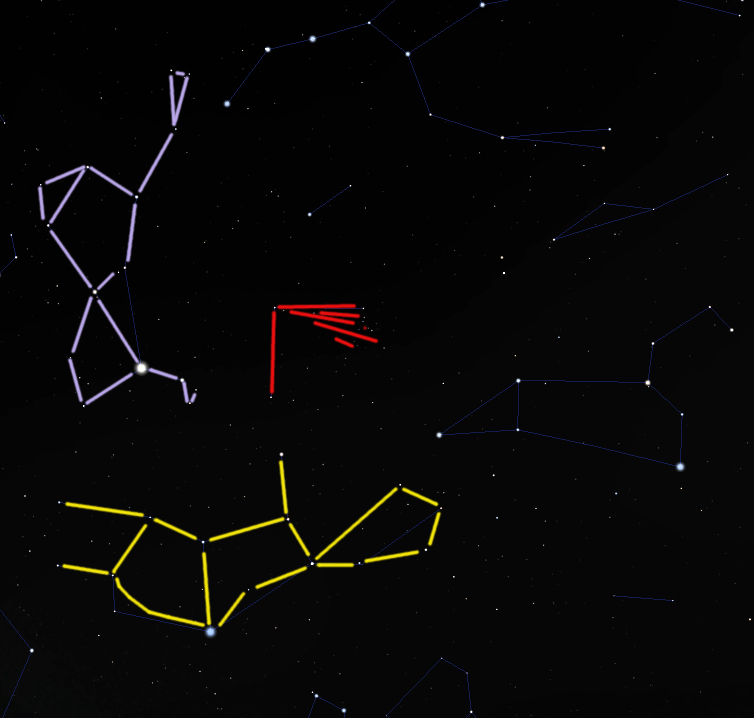
Note that the female figure (Virgo) is lying down on her back, just as Ixtaccihuatl in the legend, and beside her sits the male figure (Bootes) dutifully watching over her, with his flaming torch nearby (Coma Berenices, or "Berenice's Hair").

At this point, of course, nearly everyone will object that any suggestion of a celestial origin for this moving story of the Aztec warrior and his beloved princess cannot possibly be correct, because we can all see the mountains themselves, towering over Mexico City and the surrounding plains to this very day. Surely this legend is inspired directly from the volcanos themselves, and has nothing to do with the stars!


But note carefully that the legend chooses to "see" these mountains in terms of a recumbent maiden and a vigilant lover with a torch -- certainly not the only possible way to frame a myth regarding these two mountains. In other words, the sacred mountains are imbued with a mythical legend which reflects a reality which can also be seen in the heavens above: a pattern often referred to by the meaningful phrase "as above, so below," which can be found to operate worldwide and often at geographical locations which are specifically envisioned as reflecting the celestial realm (such as the River Ganga in India or the region of the Paha Sapa in the Lakota lands in North America).  

The sacred mountains of Popocatepetl and Ixtaccihuatl thus appear to fit into this very same worldwide pattern.

It is also noteworthy to examine the meaning of the names of the two young lovers in the story. Ixtaccihuatl (also frequently spelled Iztaccihuatl) is said to signify the "White Maiden" (from the words ixta or izta meaning "white" and cihuatl meaning a woman or maiden). She is also sometimes referred to as the "Sleeping Maiden" or "Sleeping Woman" -- La Mujer Dormida (perhaps Popo is waiting and watching over her for the day when she will finally awaken to new life and the two can have the happiness together that they were denied for so long).

Popocatepetl, we are told by those knowledgeable in the Nahuatl language, signifies "to smoke" or "to be smoking" (popoca) and "a mountain" (tepetl). The discussion of the mountains and their legend in this volume, for instance, notes some other mounds or mountains which also end with -tepetl, such as Tlachihualtepetl.

Is it just a coincidence that halfway around the world, the very similar term "tepe" is also used to signify a mound or a hill, such as in the famous and extremely important archaeological site at the mound that had the name of Gobekli Tepe in the southern part of modern Turkey, and which we are told signifies "pot-bellied mound" or "pot-bellied hill"?

Advocates of the conventional narrative of ancient human history refuse to admit the possibility that some ancient common source may have influenced cultures all around our globe (or somehow left some kind of memory which was taken in different directions by different cultures down through the subsequent millennia). They would thus dismiss any attempt to draw linguistic connections between "mounds" or "mountains" described by the word tepe in the region of Asia Minor and the use of the  very similar word tepetl to describe mountains and man-made pyramids in Central America.

And yet, there is abundant archaeological evidence that suggests that the conventional narrative of ancient human history is gravely mistaken (if not deliberately deceptive). An earlier post discussing a site with a similarly outstanding Nahuatl name, Calixtlahuaca, provides links to some examples of the evidence which is generally ignored or disputed or "wished away" by those advancing the conventional narrative.

In addition to the formidable archaeological evidence from around the world arguing for an ancient history of the human race far different from what we are generally taught in school, there is also the emerging evidence that the myths of virtually every culture on our planetshare a common system of celestial metaphor.

This worldwide system constitutes a whole additional body of evidence, very difficult to deny, which argues for some sort of very ancient common source or influence in the very distant past -- so ancient it predates ancient Sumer and ancient Babylon and ancient India and ancient Egypt (all places where the myths can be shown to be using this worldwide system), and yet so widespread that it can be found operating in the sacred traditions of cultures in the Americas and the Pacific and in Australia and in Africa which continued those traditions right up into recent centuries or to the present day.

These Star Myths from around the globe constitute a precious inheritance which was bequeathed to the human race at some point in our past.

And, as this week's activity of Popocatepetl shows, as he continues to watch over his beloved, it is a living inheritance which is still powerful and active, right up to the present moment.

The octopus of twists and turns

The octopus of twists and turns

Today in the New York Times it was reported that an octopus named Inky, who had been a resident of the National Aquarium of New Zealand since 2014, had disappeared from his tank -- apparently slipping "through a small gap" found at the top of the tank -- and then made his way across the floor to a drainpipe which led down 164 feet of pipe into Hawke's Bay . . . and freedom.

Above is a video in which aquarium manager Rob Yarrell describes the escape and notes wistfully, "Didn't even leave us a note."

The above Times article also quotes Alix Harvey of the Marine Biological Association of England, who tells of an octopus in residence there who would regularly leave his own tank and make his way to other tanks to devour the fish kept there, before heading back into his own tank before morning.

She says that "Octopuses are fantastic escape artists [. . .] They have a complex brain, have excellent eyesight, and research suggests they have an ability to learn and form mental maps." Inky's escape certainly seems to confirm the ability to "form mental maps" and to put together a rather remarkable plot to sneak out when no one was looking.

In fact, the same article reports that the staff did not even notice Inky's escape until much later -- how much later is not exactly clear but the story says that "The escape happened several months ago, but only recently came to light," which seems extremely unusual. It is especially unusual because the stories about Inky's escape also state that the staff was able to determine what happened by looking at the "octopus tracks" which "suggest he then scampered eight feet across the floor" to the drainpipe in question.

If the escape was not noticed for quite some time after Inky made his move, it would suggest that the tracks may have already gone cold by the time investigators arrived on the scene. Perhaps they called in Ace Ventura to recreate Inky's exploits (we can only imagine what that might have entailed).

In fact, the intelligence and resourcefulness of the octopus are legendary -- so much so that one of the most ancient epics of the human race pointedly compares its central figure, whose resourcefulness is also legendary, to an octopus as he himself is making good his narrow escape from captivity: the great Odysseus.

In Book 5 of the Odyssey, as the long-suffering Odysseus is making his way by raft across the open ocean from the isle of the goddess Calypso, he is spotted by the angry Poseidon, who stirs up a tremendous storm, blasts the raft to pieces, and sent winds and waves so powerful that they threaten to end the hero's homecoming right there. The vital assistance Odysseus receives from the divine Leucothea at that critical juncture is discussed in this previous post.

Even with the protection offered by Leucothea and the inspiration provided by Athena, making landfall on the rocky shores of the first coastline he encounters -- on the morning of the third day, after paddling for two days and nights through the heaving swells -- is a perilous undertaking, amidst what the poem describes as

roaring breakers crashing down on an ironbound coast,
exploding in fury --
the whole sea shrouded --
sheets of spray --
no harbors to hold ships, no roadstead where they'd ride,
nothing but jutting headlands, riptooth reefs, cliffs.
Odyssey, Book 5: 445 - 448, from the superlative translation by Robert Fagles.

It is just as he is negotiating this life-threatening landfall that the ancient poem compares Odysseus to the octopus, in an inspired metaphor:

Just as that fear went churning through his mind
a tremendous roller swept him toward the rocky coast
where he'd have been flayed alive, his bones crushed
if the bright-eyed goddess Pallas had not inspired him now.
He lunged for a reef, he seized it with both hands and clung
for dear life, groaning until the giant wave surged past
and so he escaped its force, but the breaker's backwash
charged into him full fury and hurled him out to sea.
Like pebbles stuck in the suckers of some octopus
dragged from its lair -- so strips of skin torn
from his clawing hands stuck to the rock face.
A heavy sea covered him over, then and there
unlucky Odysseus would have met his death --
against the will of Fate --
but the bright-eyed one inspired him yet again.  Odyssey, Book 5: 468 - 482.

When I was teaching the Odyssey in the department of literature at West Point (now very long ago), I was so struck by the aptness of the comparison of the wily Odysseus to the octopus that I made a point of adorning most of my lesson slides with octopus images (and not much else -- I believe in engaging in discussion with my students when exploring a work of literature, and not showing a bunch of words on slides) -- here are a few representative samples:


The insights into the character of Odysseus that can flow from the consideration of the incredible octopus to which he is briefly compared in Book 5 are many and deep.

The octopus, as we have already seen from the discussion of the accomplishments of Inky above, is a master of escape -- so too is the central figure of the Odyssey. Odysseus, in fact, is famously described in the opening lines of the epic as "the man of twists and turns" (Book 1, line 1). Such, at least, is the inspired translation which Professor Fagles gives to that opening descriptor of Odysseus: the line itself in the ancient Greek is

andra moi ennepe, Mousa, polutropos his mala polla, 

which I believe translated literally and word-for-word is something like

"the man describe-relate, O Muse, much-turned/much-turning this-one very-much"

and which previous translators have rendered

"The man, O Muse, inform -- that many a way

 Wound with his wisdom . . . " Chapman, 1616.

and

"Muse make the man thy theme, for shrewdness famed

And genius versatile . . . " Cowper, 1791.

and

"Sing in me, Muse, and through me tell the story

of that man skilled in all ways of contending,

the wanderer . . . " Fitzgerald, 1961.

and

"Tell me, Muse, of the man of many ways, who was driven far journeys

after he had sacked Troy's sacred citadel." Lattimore, 1965.

Odysseus is a man "of twists and turns," of "many ways," who is "skilled in all ways of contending" -- one whose "ways of contending" more often involve using his inspired resourcefulness rather than using brute force, one who more than once must use his wits to escape physical pens even more daunting than the aquarium from which Inky made his bold dash to freedom, and one who frequently must change his shape and his persona and put on disguises in order to negotiate the many twists and turns he encounters on his long and arduous voyage through the unforgiving seas of this life.

Below are a few videos of octopi in various situations demonstrating absolutely incredible feats of resourcefulness, deception, and disguise -- each of which makes the ancient poem's metaphorical comparison of Odysseus to an octopus appear all the more appropriate:

Octopus escapes jar


As you can probably tell by now, I love the Odyssey (and have since I was quite young in age -- just a boy, in fact, and long before the excellent Robert Fagles translation was even available).

In Star Myths of the World and how to interpret them, Volume Two, I devote quite a bit of space to an exploration of this wonderful epic poem, and to the insights that can arise when we approach the Odyssey with some understanding of the language of celestial metaphor in which it -- along with the other myths and sacred stories given to humanity -- is undoubtedly speaking.

According to my analysis, it is very clear that the Odyssey is not so much intended to describe to us the adventures of the incredibly wily and resourceful "man of twists and turns," the great-hearted hero Odysseus, as it is to demonstrate to us the journey undertaken by each and every man and woman making his or her way through the furious breakers and jutting headlands and riptooth reefs of this incarnate life -- and the importance of recognizing and listening to the guidance available from the Invisible Realm, the realm of the gods: guidance which Odysseus shows himself to be extraordinarily sensitive and attuned. 

We can all be grateful to Inky, for demonstrating his own Odyssean resourcefulness and providing such a stunning demonstration of the genius of the ancient poem's comparison of Odysseus to the wily,  deceptive, twisting-and-turning octopus.

His escape should also demonstrate that octopi just want to be free.

If we are upset about the great anguish and distress inflicted upon the mighty orcas in captivity (and we very much should be, as discussed in this previous post), then we should also give mind to the plight of the intelligent and complex octopi held in aquariums around the world, and then we should do the right thing and provide them all with access to small gaps in their tanks, and drainpipes that run out to the ocean.


The "Thirteen Postures Song" and the Cultivation of the Way

The "Thirteen Postures Song" and the Cultivation of the Way

image: Wikimedia commons (link).

image: Wikimedia commons (link).

A previous post from last August explored some of the many lessons contained in the "Thirteen Postures Song," one of the mysterious Tai Chi Classics.  

Last month, while participating as the "Author of the Month" on Graham Hancock's site, I revisited the "Thirteen Postures Song" to comment on a different aspect of that amazing poem, one which I find very pertinent in the discussion of the ancient myths of humanity. It is so important, in fact, that I believe it deserves comment again here, for the benefit of those who may have missed it previously.

The "Thirteen Postures Song" initially appears to be concerned with cultivating skill in martial arts for the purpose of defeating opponents in physical combat when necessary. It describes the attainment of such a level of kung fu that one achieves "action like stillness," and a "mysterious and uncanny" ability to adapt to the opponent's every move.

However, as the previous discussion linked above demonstrates, this achievement of "action like stillness" clearly has a spiritual dimension, as well as important parallels to the central message of other sacred texts from around the globe, including the central message of the Bhagavad Gita.

And indeed, as we continue reading the rest of the "Thirteen Postures Song," we see that it does not really seem to spend much additional thought on defeating opponents, but instead begins to discuss the cultivation of the invisible force of qi or chi, and the achievement of a state which it describes with the metaphor of a "never-ending springtime" or (literally) a "never-aging springtime."

The entire poem, along with my best effort at a fairly literal translation of the characters is reproduced again below for convenient reference: 

十三勢行工歌訣 

十三總勢莫輕識。命意源頭在腰隙。 
變轉虚實須留意。氣遍身軀不稍癡。 
静中觸動動猶静。因敵變化是神奇。 
勢勢存心揆用意。得來不覺費工夫。 
刻刻留心在腰間。腹内鬆静氣騰然。 
尾閭正中神貫頂。滿身輕利頂頭懸。 
仔細留心向推求。屈伸開合聼自由。 
入門引路須口授。工用無息法自休。 
若言體用何為凖。意氣君來骨肉臣。 
詳推用意終何在。益夀延年不老春。 
歌兮歌兮百四十。字字真切義無疑。 
若不向此推求去。枉費工夫遺歎惜。 

(those characters found online in various places -- the above are found in this online version here). 

And my translation (with apologies in advance for any errors, although I believe this translation to be fairly accurate, if very literal): 


Thirteen Collected Dynamics: Do Not Lightly Esteem ["do not take them lightly"]. 

[Their] Life-Heart and Head: [It] Issues from the Waist / Kidney Region. 

The Transformations and Turnings of Empty and Solid: [You] Must Keep in Heart-Soul-Mind. 

Chi Everywhere in the Body, the Human Body: Not Steered into an Obstacle [usually translated to mean "not hindered or obstructed"]. 

Stillness [in the] Center of Initiating-Action: Action Like Stillness. 

Because of it, the way that you Adapt to the Opponent's Moves: Indeed Mysterious and Uncanny. 

Each Posture [each "dynamic" or "force"] Learn by Heart: Come to Know its Usefulness and its Deepest Essence. 

Acquire / Will Come all-Unconscious: Effortless Mastery or Advanced Skill [literally "kung fu"]. 

Deeply Engrave and Hold the Heart-Mind in the Place of the Waist / Kidney Region. 

In the Abdomen area [be] Relaxed and Still: Chi Gallops, Flying-up -- Yes! 

Tailbone Centered and Straight: Divine Energy [from there up through] The Top of the Head (like a string through a thousand coins). 

The Benefit of a Body Filled with Lightness and Agility: [it is achieved by] Hoisting or Suspending the Top of the Head (as if hanging from above). 

Follow the Slender Thread [perhaps meaning "to the deepest, thinnest ends of the roots"]: Push Towards what you Seek. 

Flexing and Opening and Closing: You will Hear it or Know it from Within Yourself. 

The One who Begins this Path: Must necessarily have this teaching Transmitted from the Mouth [of a teacher]. 

Practice your Skill [literally "kung fu"] Without Stopping, Without Resting: the Way is by Your Own Study -- your own Cultivation. 

Regarding the Usefulness of this System: What Guideline or Standard shall we Make or Observe? 

The Heart-soul and the Chi Arrive as the Sovereign: the Bones and the Flesh are the Monarch's Ministers and Officials. 

Towards What Goal does all of this Push or Impel us? 

The Benefit of Desired Long Life and Delay of Aging: a Never-Aging Springtime. 

A Song -- Ah! A Song -- Oh! A Hundred and Forty. 

These Written Characters -- Genuine, Clear-cut: Right in Conduct, Without any Suspicion. 

If one does Not Toward this Direction Push, Seek, and Go . . . 

In Vain all that is Spent on Achieving Skill [literally "kung fu"]: Sighing, Loss, and Regret. 

The metaphor of a "never-aging springtime" is extremely important, because (along with the focus on the cultivation of the "divine energy" of chi) it appears to point towards the connection with that realm which the ancient texts and myths of humanity point towards as the source for all life in this world -- the Invisible Realm, which is even sometimes explicitly referred to as the "seed realm."

If indeed the "Thirteen Postures Song" is about the cultivation of connection with the invisible world, the way in which it tells us that we cultivate that connection is worth examining more closely.

I believe that there are two lines in the poem, found "back-to-back," which provide us with a very important insight into the path we take towards the goal that the poem says we should be pursuing.

Here are those two lines: 

The One who Begins this Path: Must necessarily have this teaching Transmitted from the Mouth [of a teacher]. 
Practice your Skill [literally "kung fu"] Without Stopping, Without Resting: the Way is by Your Own Study -- your own Cultivation. 

These lines are extremely interesting and worthy of examination. They almost seem to be contradictory. The first line tells us that we must necessarily be shown the way by the mouth of a teacher, and the second tells us that the pursuit is somehow on our own.


What does it mean?

The first line selected above says that "the one who begins this path must necessarily have this teaching transmitted from the mouth." In other words, it is generally necessary for the meaning to be shown in some way. After Daniel-san waxed the cars and painted the fence, he "knew the moves" but he did not know what he knew. He needed Mr. Miyagi to actually enable him to see it. 

It is very common to find ancient wisdom passed down through a master-to-disciple relationship. This is found in Yoga, in the martial arts, and in some of the texts describing ancient Greek philosophy, for instance (and see also the important text by Peter Kingsley, entitled In the Dark Places of Wisdom). 

But then follows the next line, which adds an additional angle (and note that these lines are found right together in the poem itself, one following the other, just as presented above). 

There we see the poem telling us: "Practice your Skill [literally "kung fu"] Without Stopping, Without Resting: the Way is by Your Own Study -- your own Cultivation." 

So, there is the necessity of one to show us, but then the poem tells us that "the Way is by Your Own Study -- your own Cultivation." We must both "be shown" and then "Practice without stopping" in order to actually cultivate this "Way" that the "Thirteen Postures Song" is describing. 

I believe that this pair of lines is very appropriate to the study of they sacred myths given to humanity as well. I cannot tell you what they mean -- and neither can anyone else. The act of receiving what they have to say and the knowledge they wish to impart to you "is by your own study -- your own cultivation." 

However, as mentioned above, if Daniel-san is never shown the layers of meaning that are beyond the act of waxing the car or painting the fence, then he would never be able to then "practice and cultivate by his own study." This situation, I believe, describes much of what has happened in places where the esoteric understanding of the myths and scriptures has been suppressed or cut off (particularly in "the west" -- which is what led to the realization over the years, accelerating in the twentieth century, of men and women from western cultures looking for and searching out answers which could be found in places where this tradition had not been so thoroughly suppressed or cut off). 

So both lines are very important to our understanding of the myths and what they have to tell us. 

The "Thirteen Postures Song" itself is actually talking about the cultivation not only of prowess at martial arts or kung fu but also about the cultivation of chi, and of the connection with the Invisible Realm -- as (I argue) are the ancient myths of the human race. 

One additional aspect in the poem which points towards that Infinite Realm, which I had not noticed back in August 2015, is the fact that the number of the "Thirteen Dynamics" themselves comes from the "five directions" and the Eight Angles (of the Bagua, which contains the Eight Divinatory Trigrams -- divination being rather indisputably involved with connecting to something beyond the purely material realm). 

That much I did mention in the blog post linked above -- but note that five and eight (adding to thirteen) also create what we call a Fibonacci progression (5, 8, 13 . . . the next in the series would be 21, etc). This connects to the concept of the Golden Ratio and to Phi -- and as I argue here, to the Infinte Realm as well (Phi being a numerical concept which, like Pi as well, "touches infinity" in that it goes on forever without any known repetition). 

Much more could be said here, but the main point is this: the cultivation of the wisdom and the Way involves the Infinite Realm, it is usually conveyed to us through esoteric means, which requires some initial guidance "from the mouth" (traditionally, this has been in the form of a "master-to-disciple" relationship), but that ultimately each man or woman must "go in" themselves, gain the gnosis themselves -- no one else can do it for them. 

I believe there is much to meditate upon in these words from the Tai Chi Classic text (and indeed, to meditate upon daily, as the "Thirteen Postures Song" in fact instructs us to do). 


Happy Birthday to Bunny Wailer (April 10)

Happy Birthday to Bunny Wailer (April 10)

image: Wikimedia commons (link).

image: Wikimedia commons (link).

April 10 is the birthday of Bunny Wailer, born this day in 1947.

In 1963, at the age of 16, he formed the Wailers with his friends Bob Marley and Peter Tosh.

The music that has flowed out of that confluence has been and continues to be a powerful force for consciousness, freedom, human dignity, and the elevation of the spirit present in every man and woman -- and against oppression, degradation, enslavement, and the denial of that same spirit.

Happy birthday to Bunny Wailer: respect.


"This Train"
Available on the Blackheart Man album by Bunny Wailer (1976).


"Hallelujah Time"
Available on the Burnin' album by the Wailers (1973).


"Dreamland"
Available on the Bunny Wailer sings the Wailers album (1980).

Dionysus, "mighty and many-shaped god"

Dionysus, "mighty and many-shaped god"

image: Wikimedia commons (link).

image: Wikimedia commons (link).

The mysterious god Dionysus, whose name means Zeus (or Diosof Nysa, is a god of tremendous importance.

He is celebrated and praised in numerous Orphic Hymns, where he is described as "blessed, many-named, frenzied Bacchos" (52), "joyous and all-abounding" (52), "loud-roaring, reveling Dionysos" (30), "blessed and fruit-giving Bacchos" (53), "mighty and many-shaped" (50), described not only as "wrathful in the extreme" (45) but also as coming to his suppliants "kindheartedly" (48) and "with joyful heart" (47) [all quotations above are from the outstanding translation by Apostolos N. Athanassakis and Benjamin M. Wolkow].

Dionysus is also described as being born of two mothers (stated explicitly in Orphic Hymn 52, for example), a mythological pattern of deep spiritual significance which is found in other myths around the world as well and which is discussed in this previous post.

The characteristics of Dionysus, the story of his two births (actually three births), and some of the celestial aspects of the Dionysus-cycle are discussed in Star Myths of the World and how to interpret them, Volume Two.

One fascinating aspect of the Dionysus-cycle of myths is the connection of the god to the land of India. In some accounts, Dionysus is described as going to India to establish his worship there, and in others he is described as coming from India. In a play by the philosopher and playwright Seneca (born 4 BC), Phaedra, Dionysus is described in line 753 as "thou, Bacchus, from thyrsus-bearing India, of unshorn locks." 

The thyrsus-rod is a scepter or long wand made from the stem or stalk of the giant fennel, often surmounted by a pine cone and also often adorned with long trailing vines of ivy. Thyrsi can be seen in the image above of Dionysus, in which the god is also holding another of object closely associated with Dionysus, a drinking-vessel.

Additionally, Dionysus and his followers are often frequently depicted wearing the skin of a leopard or cheetah or panther, as the god is seen to be wearing in the ancient artwork above.

The connection of the god Dionysus to the land of India is especially fascinating in that the mystic  and ascetic sadhus of India also frequently carry a staff, a drinking-vessel, and a leopard-skin. Below are some images of sadhus showing one or more of these Dionysian symbols:

Wikimedia: image links, from top to bottom -- firstsecondthird, and fourth.

Very notable also, and evident in the images above, are the long locks of hair worn by many sadhus -- also a distinguishing characteristic of Dionysus.

Note again in the passage from the play by Seneca cited above that Dionysus is described as the god "of unshorn locks." Ovid also calls Dionysus the god "whose locks are never shorn" (in Metamorphoses, Book 4), and Seneca elsewhere describes the unshorn hair of the god as "thy lawless -streaming locks" (in Oedipus, in the section beginning at line 405).

Others have noted that the sadhu tradition probably also influenced the dreadlocks of the Rastafari (as did the ayurvedic diet practiced by the sadhus) -- see for instance this film, Dreadlocks Story.

The practice of leaving the locks unshorn is also notable in the Nazarite vow described in the Hebrew Scriptures and in the myth-cycle of Samson, discussed in this previous post and this previous video.

I believe that all of these myths point us towards the existence of the Higher Self (as described in texts from India) -- or, as Rastafari tradition expresses it, the Higher I -- and of the importance of recognizing and awakening to and integrating the spiritual side of our nature into every aspect of our being and our daily life, in addition to our temporary material or physical nature.

The locks of Samson, described as seven in number, specifically connect to the rays of the sun (as discussed in the essay and video linked above), and thus to the fire -- or spirit -- aspect of our being (beyond the earth and water, or clay, of our physical body). 

Dionysus is a god who is specifically described as born of fire, and note that the symbol of the thyrsus (made from the stalk of the giant fennel) is closely associated in another myth with the bringing down of the divine fire to mankind by the Titan Prometheus (who conceals the stolen spark in the stalk of the same giant fennel). This important myth, and the celestial and spiritual aspects of the story, are also discussed in Star Myths, Volume Two.

Clearly, Dionysus has profound ongoing significance for our lives, and important spiritual messages to convey to us -- as do all the other sacred traditions given to humanity and preserved in the myths and scriptures the world over. 

Armed with the thyrsos, wrathful in the extreme, 
you are honored
by all gods and all men
who dwell upon the earth.
Come, blessed and leaping god, 
bring abundant joy to all. 45.

Stargazing with David Mathisen

Stargazing with David Mathisen

I hope you can join me if you are at all able to do so at the Conference on Precession and Ancient Knowledge for 2016, held in Rancho Mirage in the Coachella Valley / Palm Desert area of California, from September 30 (Friday) through October 02 (Sunday).

In addition to regularly-scheduled lectures, socializing, book-signing, and multi-speaker panels, we will also be going out into the desert Friday, September 30, in order to observe the stars and point out specific constellations -- with some discussion of the ways those particular constellations make their appearances in specific Star Myths of the world.

As it happens, the conference this year will take place at the first new moon following the autumnal equinox -- a confluence of celestially, mythically and metaphorically significant cycles, and an outstanding part of the month (weather permitting) for looking at the stars. We'll be carpooling a short ways into the desert in order to minimize light pollution.

Other speakers at the conference will include Robert Schoch, Christopher Dunn, Jason Martell, Gary Evans, Walter Cruttenden, and John Knight Lundwall.

Also, the conference organizers have just recently announced that Scott Onstott of Secrets in Plain Sight will be attending and speaking at this year's conference. You can a fairly recent blog post I've written in the past about Scott's work here.

I hope you can join us -- I am looking forward to stargazing in the California desert on the night of September 30!


Conference sign-up is available at the main CPAK 2016 website.

Every fountain has its nymph

Every fountain has its nymph

image: Wikimedia commons (link).

image: Wikimedia commons (link).

Understanding the language of the stars in which the myths, scriptures and sacred stories of virtually every culture on earth are speaking is not simply an "intellectual exercise" or a fascinating hobby like solving jigsaw puzzles or Rubik's cubes.

Understanding the language of the myths opens our eyes to the view of the cosmos contained in and conveyed by those ancient stories, stories given to humanity as a precious inheritance for our benefit, depicting for our hearts the reality of the Infinite Realm.

The myths embody the stars and constellations in the heavens in the stories of gods and mortals -- portraying throughout the endless and intimate interaction of the material and the invisible realm, and describing a cosmology in which this world is indwelt and entangled at every single point by the Other World: the realm of spirit, the realm of infinite potentiality, the realm of the gods.

In the myths of ancient Greece (upon which my most recent study of sacred celestial metaphor, Star Myths of the World -- Volume Two, focuses almost exclusively), we are shown a vision of this material realm which is connected to and in fact flows from the divine realm, a world in which the realm of the gods was present at all times and in all places.

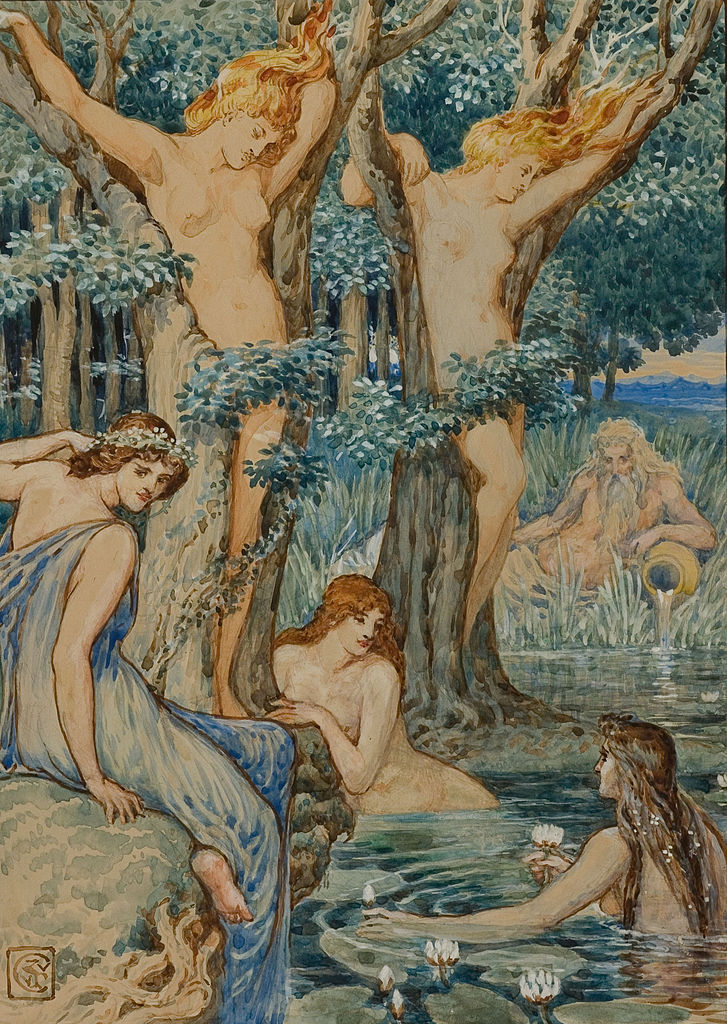
The vision of this material realm infused and intertwined at every point by the infinite realm has been expressed by various modern authors in recent centuries through the observation that in the world-view of the ancients, "each fountain had its presiding nymph" -- a phrase so common that it can be seen to echo down through the works of different writers from one decade to the next, probably quoting a much earlier source (but one that is perhaps forgotten, since never explicitly cited), and usually expressed in tones indicating that with the dimming of this vision, something good was lost to humanity (although often this tone is tempered by words dismissing that vision as "primitive," "superstitious," "overly imaginative," "ridiculous," "misplaced," and of course, "idolatrous" -- if you follow the links provided below you will see each of these ideas expressed in the sentences before or after the description of the world-view of the ancient Greeks).

Here are a few selections -- by no means exhaustive -- of this common description of the ancient understanding of our world's interdependence at every point upon the Other World:

1830: "Each cave had its Faun or Dryad,-- each fountain its Nymph."

1836: "Not a spot but had its altar; every grove was consecrated to its peculiar nymphs, its Dryads and its Fauns; every stream and fountain had the votive marble for its own bright Nereid; -- along the plain rose the splendid colonnades of the yet mighty temples of Jupiter, and all the Olympian gods; and above all, on the high Acropolis, the noble Parthenon rose over the glorious city, proclaiming to the eye of the distant traveler, the honors of the virgin goddess of wisdom, of taste and philosophic virtue, whose name crowned the city, of which she was throughout al the reign of Polytheism, the guardian deity."

1838: "The shady groves and flowery vales were peopled by Dryads or wood-nymphs, and Satyrs, a species of rural deities, who, like Pan, had the horns, legs, and feet of a goat. Mountains and streams possessed their guardian gods and goddesses, and every fountain had its Naiad or water-nymph. The lively imagination of the Greeks made them consider the thunder as the voice of Jupiter; the soft breezes of summer were to them the movement of the wing of Aeolus; the echo of the forest was the voice of a goddess, and the gentle murmur of the streamlet sounded as the tones of its presiding deity. In short, whatever sound or sight in nature charmed their fancy, the Greeks ascribed the pleasure to the agency of unseen, but beautiful and immortal, beings."

1848: "The poorest wayfarer kept august company, in whose very silence there was a soul-stirring eloquence; he celestialised his thoughts, withersoever he might wander, not only by the marble divinities that graced his path, but by the spiritual ones brooding over it in unseen beauty; for every locality had its tutelary genius, every tree its hamadryad, every fountain its nymph, every sea its nereids, and by the tongues of winds, and waves, and woods, their voices were heard, whispering the secrets of the invisible world, or thrilling the imaginative hearer with melodious hymns and canticles."

1859: "What a land for the poet to die in! A land where each star in the lofty vault was a Deity, where each mount had its Oread, each river its Naiad, each fountain its Nymph, each woody copse its Dryad, and every scene its guardian angel!"

1866: "The very religion of the Greeks originated in a deep love of Nature, and their gods and goddesses were but the types of human attributes; whilst the same spirit permeated their mythology, and the ideal beings who inhabited its shadowy domains. The powers of earth, air, and water, were embodied in human forms; the woods resounded to the voice of the unseen Pan and his joyous crew; each spring, each grotto, and each fountain had its presiding nymph; and all these were but the embodiment of those feelings awakened in the mind by the particular character of the place."

1877: "The Epic of Homer, which was the Greeks' Bible, portrays gods and men, not quite in equal numbers, as mingling in the fray, and sweeping in bloody swirls about the walls of fated Ilium. Each fountain had its nymph; each brook its naiad; each wood its dryad; each wind had its presiding god, and a deity was at the beginning and end of diversified human experiences. The sea was heaved by them, the earth teemed with them, and the air swarmed with them. The universe, as they knew it, was believed to be filled with deities, inferior and superior; and every natural occurrence which they could not explain was supposed to be a direct interference of the gods."

All of the writers above express this vision of the world in the past tense: "each fountain hadits nymph" -- as though the streams and forests and fountains and oceans are no longer infused by the Invisible World, or presided over and protected by the gods and nymphs and dryads and naiads.

And, while some of them offer a tone of nostalgic regret for the loss of this vision of the world, nearly all of them simultaneously offer their reasons to believe that this ancient vision, present with little variation in virtually every ancient tradition of every culture on our planet, was simplistic, naive, mistaken, or even (for those writers advancing the literalist Christian view) blameworthy.

In all likelihood, all of these writers (including those advancing the literalist view) were unaware of the fact that the same celestial metaphors which form the foundation for the world's myths also undergird the stories in the Old and New Testaments of the Bible, and that the myths of the world use the realm of the stars to represent the Infinite Realm (the heavens above, in fact, being infinite themselves: when we gaze into the night sky, we truly gaze into infinity) -- indicating that the myths are actually expressing truths about the Other World, and not (as is often assumed) trying to explain natural phenomena which today we explain "more accurately" and "less imaginatively" using science.

By honoring the presence of the nymphs and dryads and naiads and oreads in each and every tree, forest, stream, fountain, river, mountain, and ocean wave, the ancients were acknowledging that not only is this material realm inseparably connected to the Invisible Realm, the realm of the gods, but that this material and natural world which we perceive with our ordinary senses proceeds from and is vitally dependent upon the divine realm, the "seed realm," the realm that is in fact "the real world that is behind this one, and everything we see here is something like a shadow from that world" in the words of the Lakota seer Black Elk.

The same post linked in the preceding paragraph also contains a quotation from a scholar of ancient Egypt attesting to the fact that the sacred traditions of the Egyptians basically express the identical vision, in which everything in this physical realm proceeds from and has its source in the "hidden realm," associated with the Duat and the hidden Amenta.

The same could be said of other ancient cultures, including China, where the construction of roads and railroads in previous centuries was strongly influenced by beliefs about invisible forces and powers including "dragon lines" (which also strongly impact decisions about the locations of tombs and burials, even to this day).  And the presence of such a vision of the world in traditionally shamanic cultures is difficult to dispute.

Other posts have explored evidence that the Bible actually expresses many of the same concepts -- a worldview which is essentially shamanic in nature, as is the worldview expressed in virtually every other myth-system on earth.

Of course, because they were writing in the 1800s, the writers who gave us the quotations above were also unaware that beginning in the early years of the twentieth century, the results from new experiments designed to learn more and more about the nature of the physics of this material universe would cause physicists to arrive at a very similar vision of our universe, which would later come to be known as "quantum physics" -- a vision in which the realm of "pure potentiality" is present at the level of each and every molecule and atom and subatomic particle, and in which certain things seem to "manifest" or "unfold" from that "implicate" realm of potential in conjunction with consciousness (through a mechanism that is still, apparently, not at all completely understood, even by theoretical physicists, even though it is fairly easy to demonstrate that this is indeed what is going on).

And, again perhaps because all of the above quotations are from the 1800s, any sadness about the passing of that vision of the natural world connected at every point with, and protected in every place by, gods and goddesses and nymphs and hamadryads, is expressed in terms of benign nostalgia or wistfulness -- and not as a loss that could in fact threaten the extinction of the entire human species and perhaps many other species of plant and animal on earth as well.

Because the writers in the 1830s or 1840s probably had little capacity to imagine that in the course of the next one hundred to one hundred and eighty years, representatives of cultures which had decided that the idea that every tree has its dryad and every stream and fountain its nymph was a bunch of "ridiculous," or "imaginary," or "mistaken," or "superstitious," or "idolatrous" nonsense from a long-gone, more "primitive" era would be dumping chemicals into rivers and streams in such quantities that some of them could catch on fire, and fish and frogs would begin exhibiting mutations, or dumping radiation into the oceans and using islands and atolls for "experimental" detonations of thermonuclear devices, or ripping down swathes of the Amazon rainforest and burning all the remaining undergrowth in order to graze relatively small numbers of cattle, or deliberately inserting the genes of worms and bacteria into corn and soy and rice and wheat intended for human consumption, alterations that would (in conjunction with massive increases in the spraying of new types of pesticides and herbicides) cause massive die-offs of bees and other crucial pollinators, as well as cause the seeds of those plants to be unusable to plant the next generation of food crops (necessitating the purchase of new seeds each year), and many other widespread practices taking place on a massive scale whose details those writers from the 1800s could not imagine in their wildest dreams.

It should be fairly clear that a culture that believed that every tree has its hamadryad, every fountain its nymph, and every sea its nereids would be aghast to learn of such wanton desecration and destruction -- and indeed would argue that, since all of us are also simultaneously connected to and sustained by the very same Invisible Realm which interpenetrates every tree and indwells every stream and river, such behavior is not only destructive but self-destructive.

Nor is this question of what we might call (and have called in previous discussions) opposing "visions" of the way the world actually works simply a question of technology (one vision, it might be argued, being "pro-technology" and the other being "anti-technology").

In the ancient text of the Odyssey (discussed at length in my most recent book), when Odysseus describes his catastrophic visit to the island of the Cyclops, he says that the Cyclopian giants have no laws, plant no plants, and do not plow. Further, he explains, they have no ships, for among them are none who know how to make such vessels, and thus they have no trade. 

Odysseus and his crew, of course, come from a culture which does make ships, and plow the fields, and plant crops, and make wine, and conduct trade -- but in doing these things (some of which involve chopping down trees, presumably, since their "well-benched ships," their "vermillion-prowed ships," were made of wood), they nevertheless maintained the awareness that this world is presided over by gods and goddesses and nymphs and dryads, and that this material world proceeds from and is sustained by the Invisible World, the realm of the gods.

In the very opening lines of the Odyssey, when the gods are meeting on Olympus and Athena reproaches Zeus for leaving Odysseus captive on Ogygia, Zeus admits that one of Odysseus' most salient characteristics is his respect for the gods, and his carefulness to honor them with offerings and to pay attention to them beyond all other mortals.

And, when Odysseus and his companions watch in horror as the Cyclops murders two of their ship-mates at a time in order to make his monstrous meal, Odysseus addresses the monster and urges him to "Revere the gods!" (in Odyssey Book 9). But the Cyclops replies that he cares nothing for Aegis-bearing Zeus or any of the other blessed gods -- "since we are much superior to them" (9. 308 - 310).

This encounter (among many other things it teaches) should make abundantly clear that the subject we are discussing is not actually about "using technology" or "being primitive," but rather about the informing vision or heart-attitude: the recognition and reverence for the gods and the divine realm, which gives life to and sustains everything and everyone in the material realm, or the disregard for or denial of the gods and their primacy, the refusal to recognize our dependence upon them, and the declaration (which the Cyclops utters in just so many words) that he and the other Cyclopes are in fact "much superior to them."

It is not that we as human beings can never make use of the woods or the rivers, but that we must do so in accordance to the actual order of the universe, and with reverence and respect for the representatives of the Invisible Realm which preside over and dwell in every aspect of this one -- an attitude, in other words, of elevating the spiritual (which is blessing and life-affirming) rather than denying, debasing, or ignoring the spiritual realm that is present in each person, animal, plant, rock and stream (a denial which is in error, and which is a form of cursing, and which is ultimately self-destructive and suicidal).

The culture that is informed by the first vision -- the vision described in all the quotations above, which acknowledges and reverences the presence of the divine in every single stream and fountain, not to mention in every person and plant and animal -- will naturally look very different from the culture that will grow out from a denial and rejection of that understanding of the natural order of the universe.

Every ancient myth and sacred tradition from virtually every culture around the globe can in fact be shown to be expressing a vision of the cosmos as infused by, and connected to, and dependent upon the Invisible Realm, the Infinite Realm, the realm of the gods.

The disastrous consequences -- and the erroneous nature -- of the rejection of that vision should, by now, be self-evident to all.

But the good news is that the actual situation in the universe never really changed, even when that vision was suppressed, denied, or largely forgotten. The mistaken conclusion that the ancient myths were "mere superstition" did not actually change the fact that the Invisible Realm does indeed touch and interpenetrate every single aspect of this material, visible, and natural realm -- did not change the fact that every tree and stream does in fact have its protecting and sustaining power in the "real world that is behind this one."

The writers from the 1800s cited above chose to frame their assertions in the past tense, but their doing so did not actually change the reality that the world's myths and sacred traditions are trying to show us. It requires only to go to the world's sacred scriptures and traditions, and listen to them in the language that they are actually speaking to us, to change all of those "past tense" verb-forms to the continuing present -- an operation which is very much necessary if we are to begin to remedy some of the destruction which has already been wrought, before it is too late.

And, as we face what might accurately be described as the "Herculean task" of trying to repair some of the "cyclopean" damage that has already been done, we can then be buoyed and encouraged by the fact that, as the myths show so vividly:

"every locality still has its tutelary genius, every tree its hamadryad, every fountain its nymph, every sea its nereids -- and by the tongues of winds, and waves, and woods, their voices can still be heard, whispering the secrets of the invisible world, or thrilling the hearer with melodious hymns and canticles."