Join me on "Where Did the Road Go?" tonight

Join me on "Where Did the Road Go?" tonight

image: Wikimedia commons (link).

image: Wikimedia commons (link).

Please join me tonight (July 16, 2016) as I visit with Seriah Azkath on his live radio show, "Where Did the Road Go?" to discuss Star Myths, lost history, and other important subjects. 

The show will air at 11pm eastern time in North America (8pm Pacific), and can be heard over the radio waves at WVBR (Ithaca, NY) at 93.5 FM on your dial, or through their "live-stream" link here

If you are not able to listen live, the podcast of the show will be available afterwards for free replay at various places on the web. 

However, if you are able to listen live, you can submit suggested questions or comments to Seriah during the show, using the "Chat Room" feature on his website, or by sending him an email using the instructions found here.

Hope you can join us and looking forward to an intriguing conversation with Seriah and the "Where Did the Road Go?" audience!

image: Wikimedia commons (link).

image: Wikimedia commons (link).

Sacred stone sites and points of connection with the Infinite Realm

Sacred stone sites and points of connection with the Infinite Realm

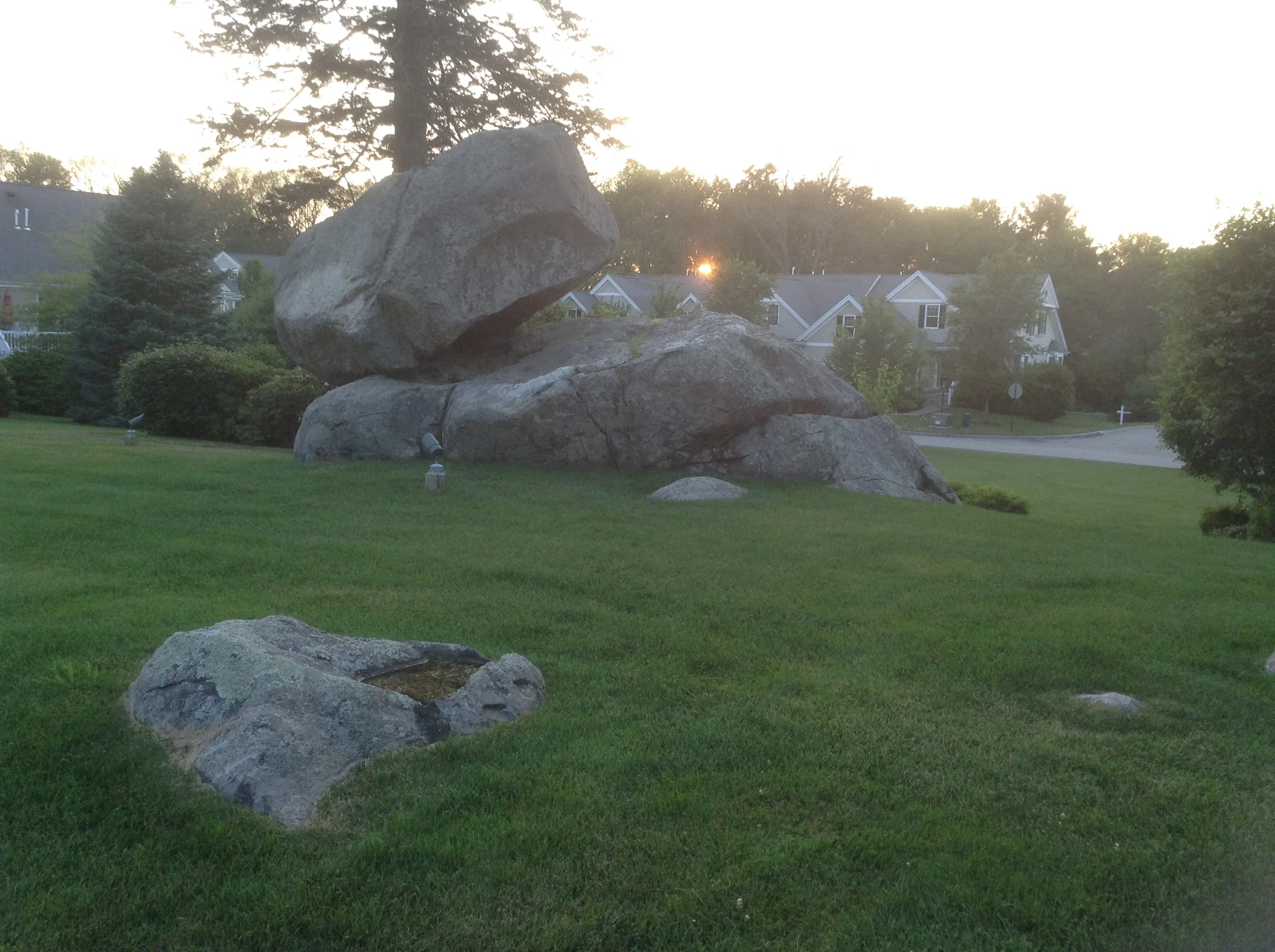
Sunset at the Holliston Balancing Rock: July 05, 2016. Photograph by David Mathisen.

Sunset at the Holliston Balancing Rock: July 05, 2016. Photograph by David Mathisen.

Just returned from a trip to Massachusetts and Connecticut, where I had the opportunity to visit some amazing historical treasures that should not be missed by those who are interested in ancient matters or spiritual matters, and who have the ability to travel to that part of our living planet.

One source of inspiration for sacred sites in what the colonialist powers centuries ago named "New England" is the outstanding 1989 text Manitou: The Sacred Landscape of New England's Native Civilization, by James W. Mavor, Jr. and Byron E. Dix.

I was actually informed of this important book by a man I met the first time I visited the Upton Chamber, back in September of 2011. I wrote two posts about the Upton Chamber in 2012, the first one based on my initial visit and the second discussing some of the additional information I learned about the Upton Chamber after purchasing a copy of Manitou by Mavor and Dix:

and

At the time of my first visit to the Upton Chamber, I had published only my first book, The Mathisen Corollary, and the man I met at the chamber, who was involved in its preservation, was dismayed to learn that I believed that the chamber's construction of corbelled architecture (very reminiscent of the corbelled chambers found in Ireland and other parts of Europe) might be evidence of pre-columbian trans-Atlantic contact. Being of Native American heritage himself, he recommended Manitou as a book written from a viewpoint which generally argues that the numerous ancient stone sites in the Northeastern parts of our continent, and indeed throughout the Americas, need not be automatically assumed to be evidence of trans-oceanic influence, but rather that it is more likely that they are sacred Native American sites situated to connect with the Infinite Realm, positioned to align with the infinite heavens and also to tap into natural earth energy points, based on very sophisticated understanding of the flow of the earth's invisible currents and forces.

The authors of Manitou write: "We have often wondered why New England history and folklore repeatedly attribute stonework to European colonists when its origins are either unknown or probably Indian" (304). Earlier on the same page they write: 

However, their native origin is indicated by traditional features such as astronomical orientation, embrasures, gaps between boulders, and inclusion of manitou stones. And Indian stone rows are frequently of sizes and shapes that fit the landscape as ritual architecture but serve no European practical purpose.

However, while arguing that the astronomically-aligned stones and chambers of New England almost certainly predate Columbus and should be assumed unless proven otherwise to be of Native American design and construction, Mavor and Dix do entertain the possibility of pre-columbian European contact, particularly in the form of "seagoing monks from Ireland with both a tradition of shamanistic astronomy and seafaring" (238 - 239). They note in particular the extremely high number of architectural parallels between the construction of the Upton Chamber and the great passage mounds of Ireland such as those at Knowth and Newgrange, and speculate that such contact may have occurred prior to AD 710 (based on their analysis of the timeline of Irish history and the conflicts and struggles which eventually led to the displacement of the more traditional spiritual leaders in Ireland by the Christian monks, as well as their analysis of the solar and astronomical alignments of the Upton Chamber -- see pages 234 and following).

Of the Upton Chamber, Mavor and Dix write:

It has a long entrance passage roofed with slabs and a circular corbelled domed roof. As the passage approaches the chamber, each roof slab successively overlaps the previous one until a sufficient height is achieved for the passage roof slabs to fit smoothly into the roof corralling of the chamber proper. Also, the passage widens out gradually as it approaches the chamber, a technique that not only provides visual continuity but also avoids the necessity of a huge lintel stone at the transition between passage and chamber in order to transfer the chamber roof load to the passage. Except for a few stone chambers in southern New England, this technique is known only in the great chamber tombs of Newgrange and Knowth in the Boyne valley of Ireland, and possibly in some ruined examples in Portugal. 237.

The authors describe the alignments of the Upton Chamber in a table found on page 51, in an extended discussion of the Upton site that takes up an entire chapter and includes alignments to the summer solstice sunset and the stars Denebola, Alpheratz (alpha Andromedae, the head of Andromeda and one of the four corners of the Great Square), El Nath (beta Tauri, one of the "horns of the Bull"), Arcturus, Al Geiba (gamma Leonis, at the base of the Lion's mane or curving neck), Murphrid (eta Bootis, at the "knee" of the Herdsman), Scheat (beta Pegasi, one of the other corners of the Great Square), Alcyone (the brightest of the Pleiades), and the Pleiades in general. 

Thus, the authors can truly declare that at the Upton Chamber, "an elaborate array of events is recorded by markers on the horizon" and that both Newgrange and Upton "have sophistication of different kinds" (239).

Below are a few photographs from my most-recent visit to the Upton Chamber, on July 03 of this year (about a week ago):

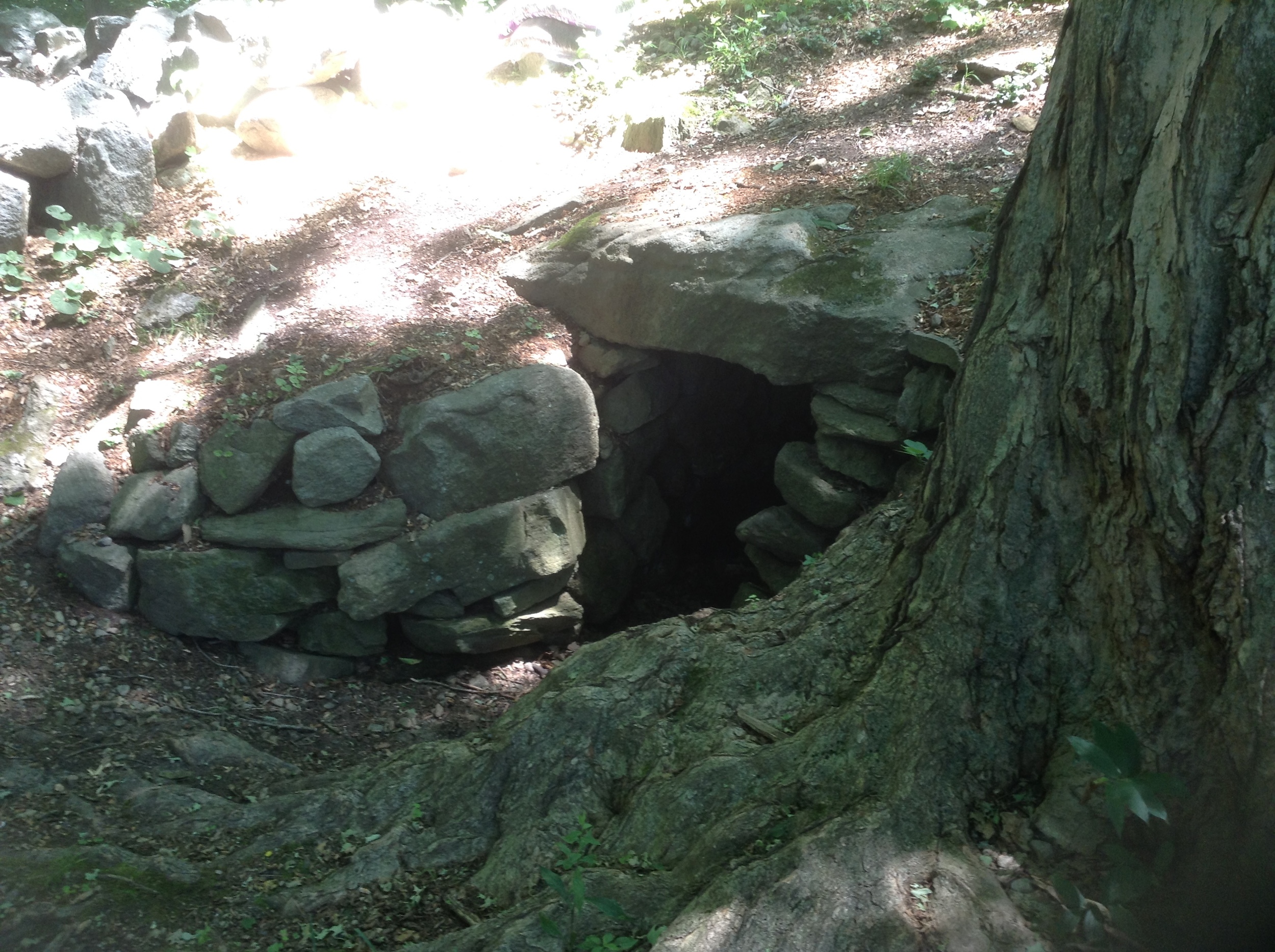
Above: the entrance to the passage. The chamber itself is underground and is approached from the left side of the entrance as one faces the opening. Compare to the images of the chamber from five years ago, in the first blog post linked above. 

Above: the entrance to the passage. The chamber itself is underground and is approached from the left side of the entrance as one faces the opening. Compare to the images of the chamber from five years ago, in the first blog post linked above. 

Above: looking directly into the entrance to the Upton Chamber's passage.

Above: looking directly into the entrance to the Upton Chamber's passage.

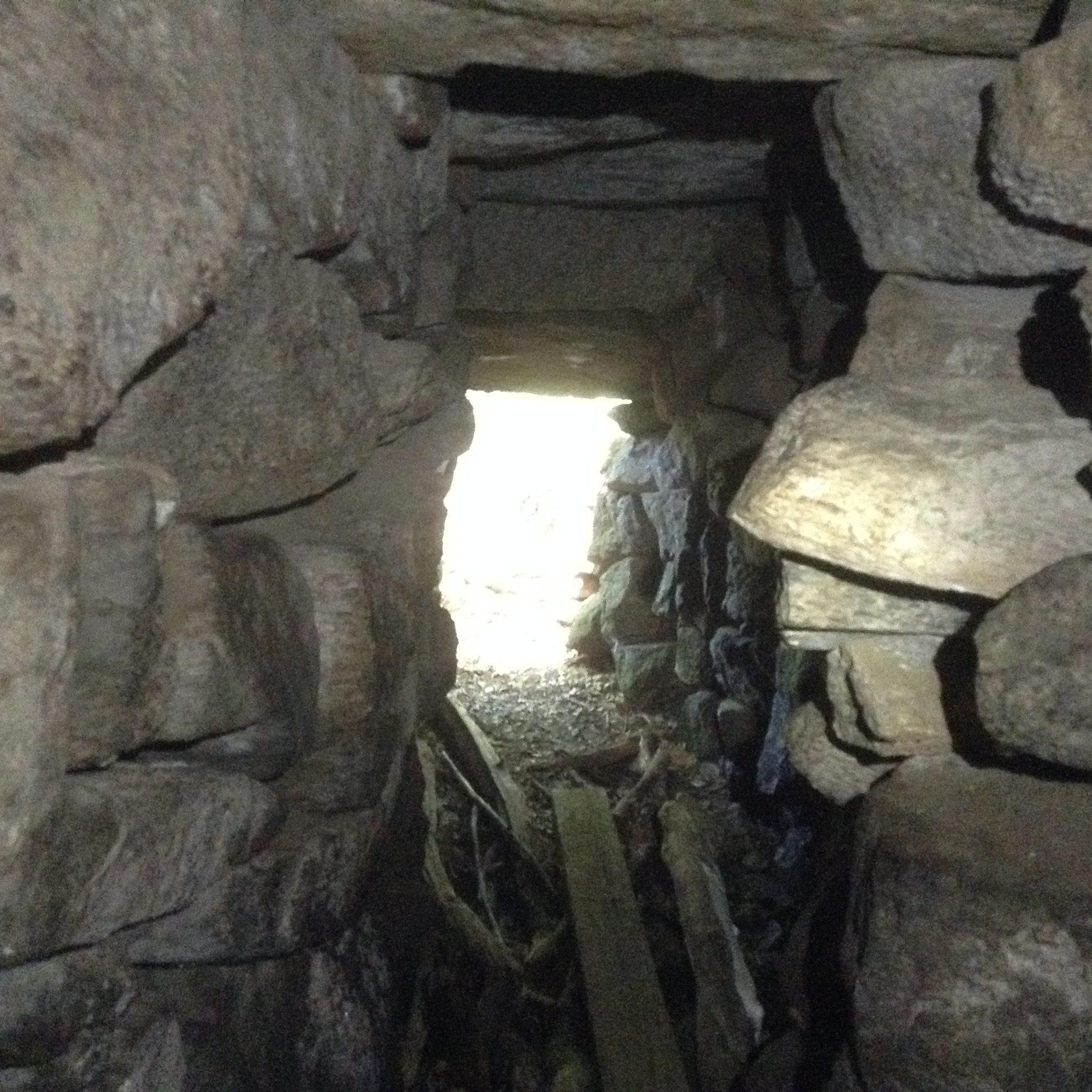
Above: looking out from the point of transition between the passage and the corbelled chamber (which is behind the viewer). Note the size of the horizontal "roof slabs," all of which are "underground." When the visitor approaches the chamber for the…

Above: looking out from the point of transition between the passage and the corbelled chamber (which is behind the viewer). Note the size of the horizontal "roof slabs," all of which are "underground." When the visitor approaches the chamber for the first time, the approaching trail leads them to a point at which they are standing on the earth that is above this underground passage and the domed chamber behind.

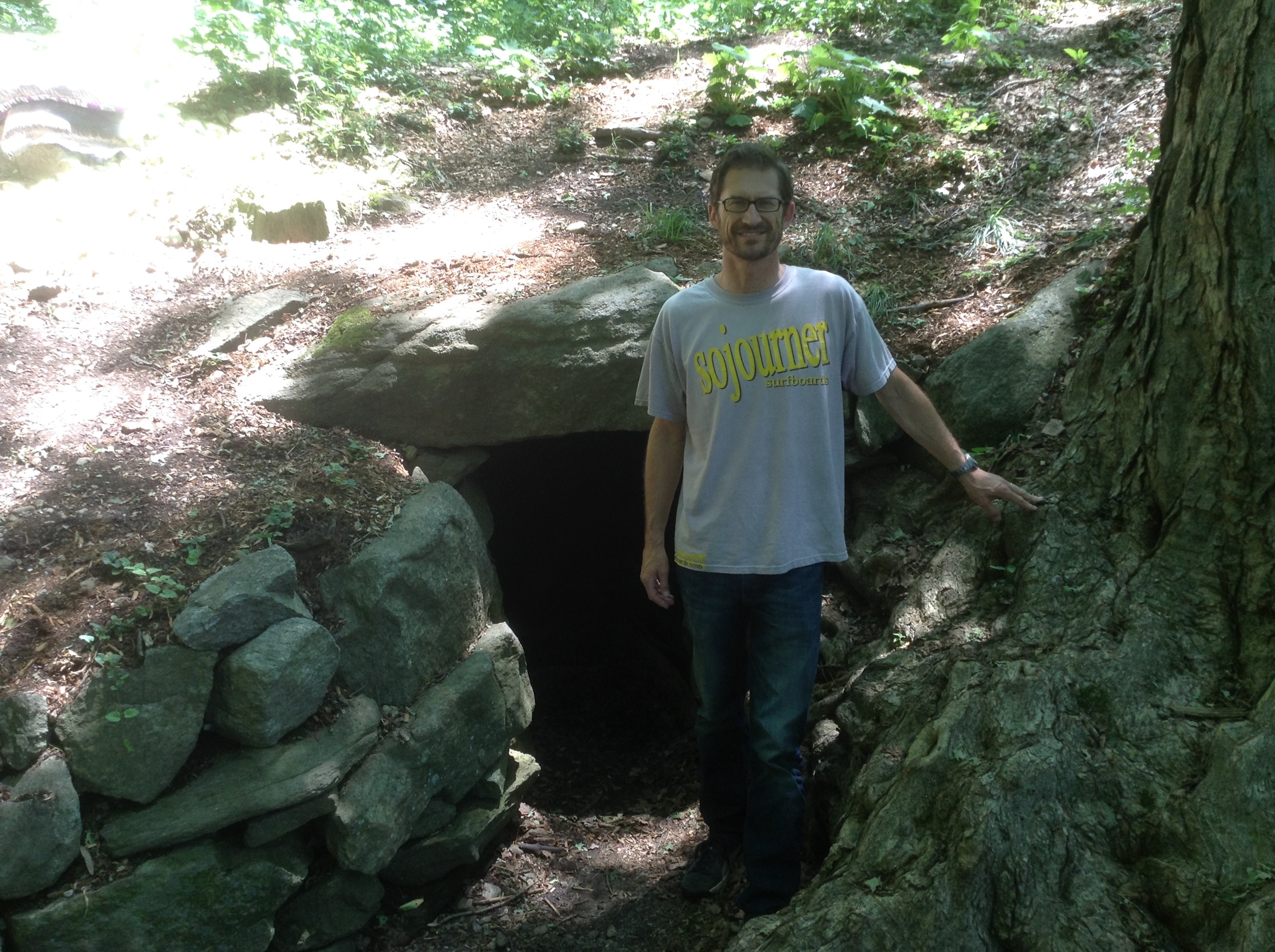
Above: your humble author at the entrance to the passage and the Upton Chamber, for purpose of scale. This photograph was taken on July 03, 2016. Again, the interested reader may wish to compare to images showing the opening from about five years ea…

Above: your humble author at the entrance to the passage and the Upton Chamber, for purpose of scale. This photograph was taken on July 03, 2016. Again, the interested reader may wish to compare to images showing the opening from about five years earlier, in September of 2011, which can be seen in the first of the blog posts linked above. 

At this time, I am quite happy to remain open to the possibility that the incredible sacred landscapes found in the Americas may have been built entirely by Native American cultures, that some of them might have been influenced or in some cases built by visitors from across the oceans long before the era of Columbus and the subsequent European invasion, or that the sacred traditions that influenced the creation of the sacred landscapes of the Americas and the creation of sacred structures in other parts of the world might all be descended from some common ancient source that is now forgotten (or some combination of all three of these possible explanations).

Now that I have spent some years investigating the very clear evidence showing that a common system of celestial metaphor appears to be operating in the myths, scriptures, and sacred stories of cultures literally around the globe, from the Vedas and Sanskrit epics of ancient India to the sacred traditions of the Aborigine cultures of Australia to the recorded traditions of the peoples and nations of the Pacific Islands and of North America, Central America and South America, as well as the sacred myths of ancient Mesopotamia, ancient Egypt, pre-Christian Europe, and the Old and New Testaments of what we call the Bible, I believe that the possibility that all these seemingly different cultures are somehow descended from an extremely ancient and now-forgotten common ancestor civilization or culture becomes a much more likely possible hypothesis that could explain some of the similarities we find in sacred archaeology around the globe as well. 

Whatever the explanation, I think it is very clear that the sacred, astronomically-aligned stone landscapes and structures from other parts of the world and those in the Americas appear to point towards spiritual understandings and practices that are more similar to one another than they are to the literalist Christian understanding which replaced the traditional ways, first in Europe and then in the Americas.  

The very title of the book by Mavor and Dix, Manitou, suggests that these sites were designed to  function as points of contact between the ordinary, visible, material realm and the infinite, invisible, spirit realm. As the authors explain, the word manitou is a word from the Algonquin language family which describes "inhabiting spirits" which are found to "inhabit every space and every object in nature" (329 - 330). The authors also explain that this concept can perhaps be understood in relationship to the principles of Chinese geomancy or feng shui, saying:

Manitou appears to be inseparable from geomancy, the concept of the world as a place where all activities and objects, both in the natural and supernatural domains, are connected in some subtle manner. Geomancers believe that the natural order can be sensed and tuned into by traditional practices, much as shamans do. While usually confined to eastern Asia and intimately involved with traditional Chinese Taoist philosophy, feng-shui, literally wind-water but, more generally, living with the rhythms of the land and seasons, would be expected to have or have had counterparts in other parts of the world, including America.
The elaborate practices of feng-shui used in selecting propitious natural sites for towns, homes and tombs and in modifying the landscape to improve them are based largely on common sense and knowledge of natural science. To this art are owed the disciplines involving the systematic use of magnetism, navigation and geography. The crux of feng-shui is the life force of the earth, ch'i, which flows through the earth like an underground stream in veins called dragon lines. The most favorable places are those with the greatest amount of ch'i flowing. This in turn, is related to its rate of accumulation and dispersal. The practitioner learns to recognize natural and man-made influences which are favorable or detrimental to the flow of ch'i. He does this through observations of landforms, water flows, horizon profiles, directions, the locations of constellations, and through intuition. 330.

Clearly, what is being discussed above is one aspect of visualizing and enhancing connections between the visible and invisible realms. Elsewhere in the book, Mavor and Dix make the important observation that the incorporation of astronomical alignments in these sites explicitly connects the seemingly ordinary realm of our daily experience with the Infinite and Invisible World, saying:

Astronomy takes the structure of familiar things and opens them to the infinite scale of the universe.
When the land and sky are considered together, our experience of the world is changed and perhaps given profound new meaning. Horizon phenomena such as the rising and setting of the sun and moon and the resulting patterns of light and shadow on the land become humbling and awesome manifestations of our connection with the cosmos. 121. 

In the same paragraph, the authors note that "The invasion of America which started during the sixteenth century and continues to the present day is one of the most overwhelming cultural discontinuities on record" and that much of the traditional practice and wisdom of the cultures who occupied the New England region and who were violently supplanted after this invasion have been lost -- but that "much possible evidence of native culture prior to this great discontinuity still lies abundantly  about us unrecognized today" (121).

One very important surviving example of this "unrecognized evidence" discussed in Manitouare the numerous perched, balanced, stacked, and pedestal boulders -- many of tremendous size -- which still dot the landscape of the northeastern woods of New England. Many of these are also "rocking stones," which could at one time be easily rocked with one hand, even with the pressure of one finger, or the pressure of a slight breeze, even if the balanced rock itself weighs several tons. Mavor and Dix note that:

Rocking stones have a well-documented history world-wide, from as early as the days of Pliny the Elder, AD 23 - 79, who wrote about them in his Natural History. In Great Britain, there is a wealth of antiquarian literature about rocking or balanced stones. Many have rock basins carved into their surfaces or have rock chairs associated with them. The European settlers of America were familiar with balanced rocks, having seen them in their native countries. Many of the perched and rocking boulders sites of New England were given names that usually incorporated Satan or the devil, a holdover from English ecclesiastical authority which labeled these monuments as diabolic devices and the idols of blasphemers. There was much speculation in the seventeenth and eighteenth centuries about the origins and use of these stones by Druids and others for religious ritual. With the rise of Cromwell and the Puritans, many rocking stones in Europe were toppled because of the belief that they were pagan idols. In New England, many have survived destruction by nature and man. 109.

The ancient description of a rocking stone by Pliny the Elder which Mavor and Dix are probably referencing in the above passage is almost certainly that found in Natural History, Book Two and Chapter 98: "Wonders of Various Countries Collected Together," where Pliny describes a "terrific rock" in the region of ancient Harpasa, which was located in the Roman province of Caria in Anatolia (modern Turkey), and which "could be moved by the force of a single finger."

One of the balancing-stone sites mentioned in Manitou which I visited on this trip is the Balancing Rock of Holliston, Massachusetts. The balancing rock is shown in the image at the top of this post at sunset on July 05, 2016 (about two weeks after summer solstice). As can be seen in that image, the stacked stone itself is surrounded by other rocks buried in the earth, one of which appears to align with a prominent crack on the back of the base-rock in the stacked pair to point towards the sinking sun:

Above: The stone in the ground has a distinctive depression in the top as well as a smaller round hole similar to a flagpole-hole (such holes are seen in images of many other stones in photographs found in the Manitou book, sometimes accompanie…

Above: The stone in the ground has a distinctive depression in the top as well as a smaller round hole similar to a flagpole-hole (such holes are seen in images of many other stones in photographs found in the Manitou book, sometimes accompanied by grooves pointing to sunrise or sunset points on important days of the year -- see for instance the images on page 229).

The "outer stone" shown at the beginning of the arrow in the above image is shown here in close-up top-view (the water is either from sprinkler irrigation or a rainstorm that came through on July 04):

The large crack on the back of the base-stone is seen in the image below from a slightly closer view:

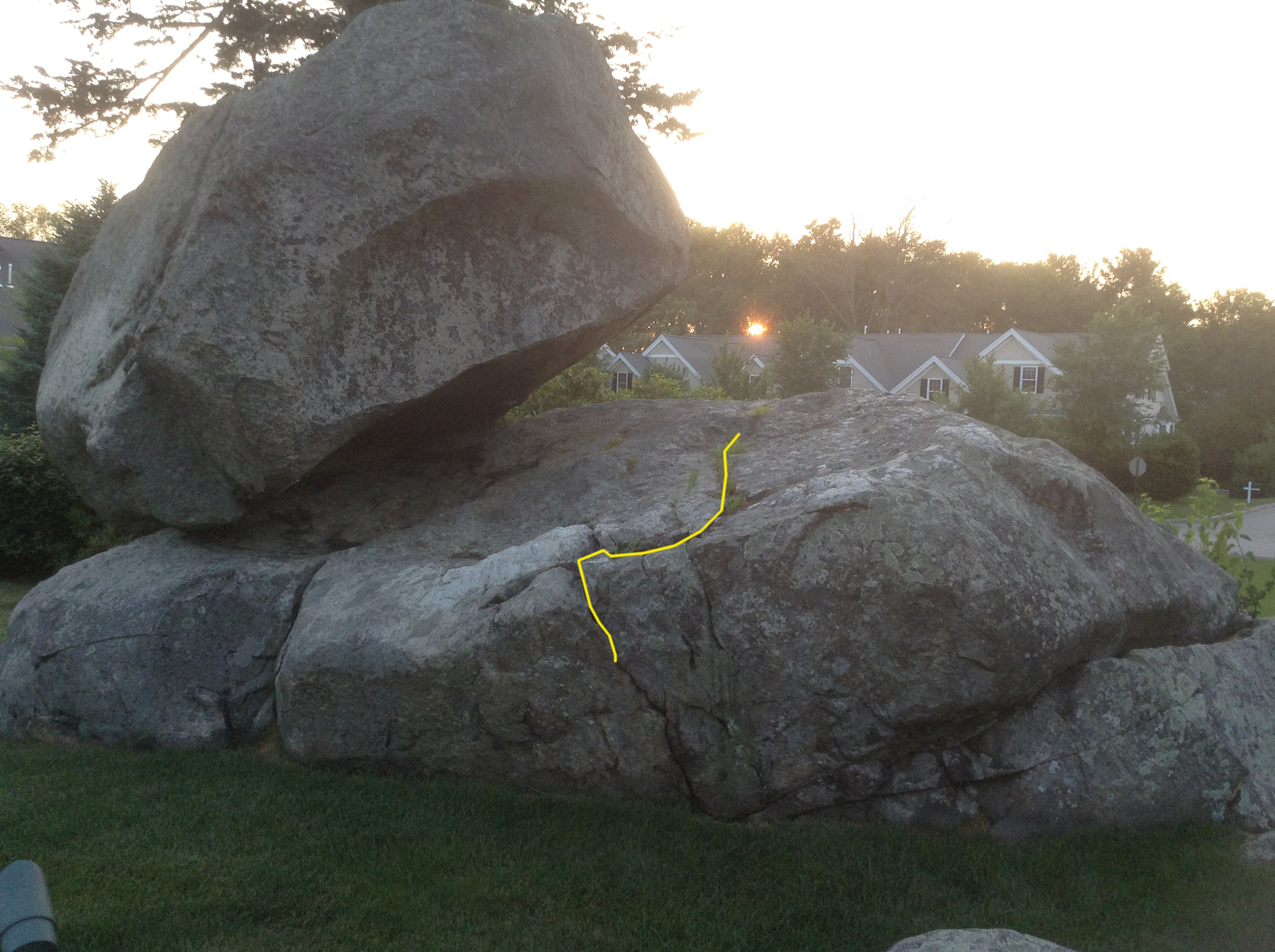
The crack in question is very pronounced when seeing the rock in person. It is seen in the above image directly below the setting sun, and has green grass growing in it. I don't know if this prominent crack is part of an alignment with the setting sun around the time of summer solstice, but it does appear to align rather directly with the setting sun when seen from the "outer ring" alignment stone that contains the depression and the circular hole. The same crack is shown in the image below, marked by a yellow line:

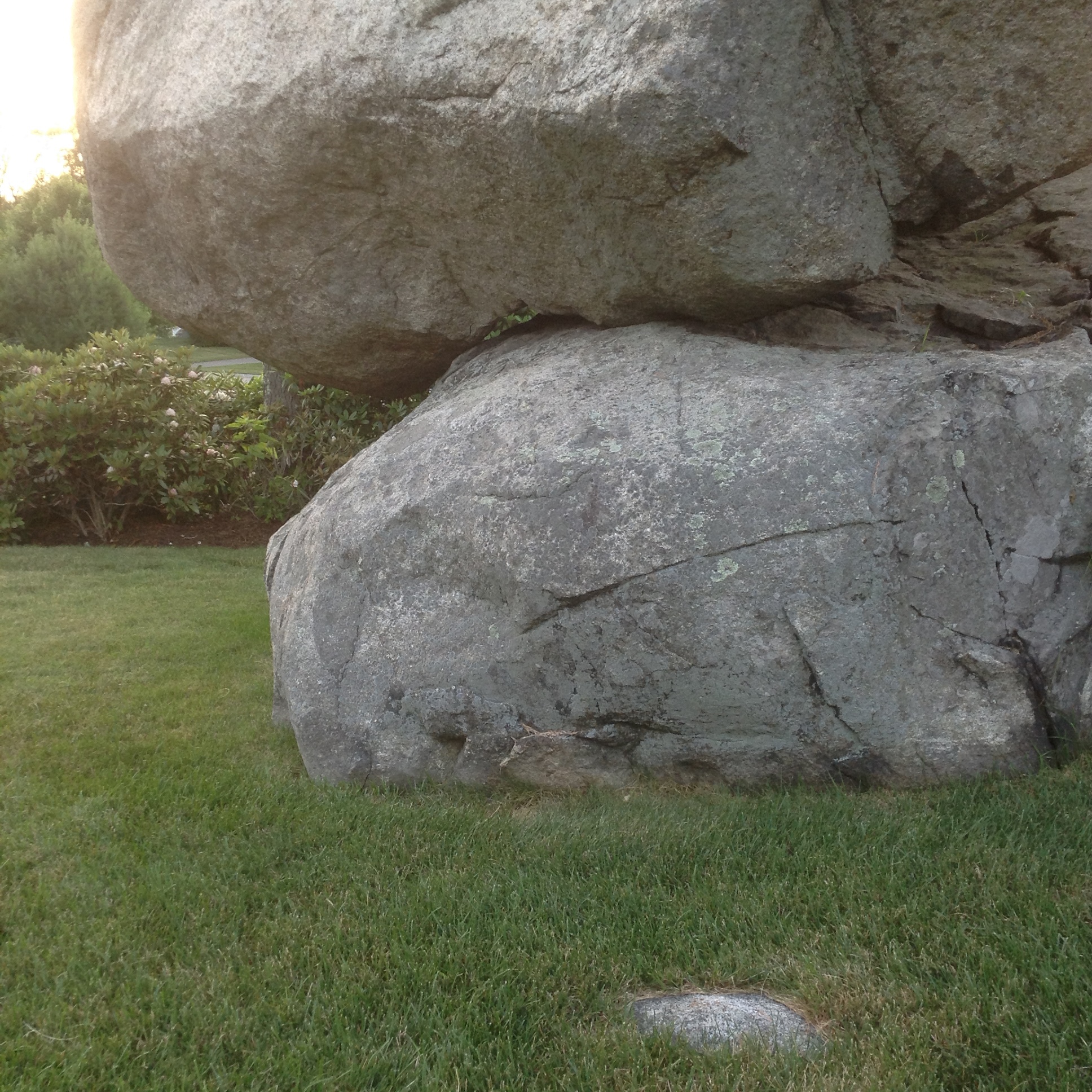
The upper stone in this Balancing Rock actually rests on the base stone in such a way that it only appears to touch on two points, with plenty of "daylight" showing between the upper and lower stones:

As you can perhaps ascertain by the shadows in the above image, this photo is taken from the other side of the Balancing Rock, with the setting sun to the back of the camera, and the shadow of the tall conifer tree seen in the image at the very top of this post going right up the middle of the upper rock in the stack.

There is actually another much smaller "window of daylight" visible from the other side of the stack, looking back through the portion of the upper rock seen on the right "contacting surface" in the above image. This small window is shown in the image below, which is taken from a vantage point looking back towards the setting sun and towards the tree-trunk that is casting the shadow in the above image. Here is that small window:

This small "window" in between the two stacked stones may point to another alignment on the western horizon, perhaps the setting-point of an important star or other celestial body. There is, in fact, another "outer alignment" stone located in the ground not far from this small window -- which may indicate the position an observer should be located in order to look through the small window and see the celestial body's setting place:

The present landscaping completely obscures the view to the horizon through the window, as does further forest growth and new housing developments. However, interested researchers could probably spend some time and discover possible candidates for western-horizon alignments through the small window, if present. Judging by the number and sophistication of the alignments present in the Upton site, the likelihood that there are multiple alignments incorporated into the Balancing Rock at Holliston should be seriously investigated.

The Holliston Balancing Rock is quite massive -- and the upper stone projects over the lower stone not only towards the south (over the "back" of the lower or base stone) but also towards the northeast to an impressive distance, not clearly visible from the above photos. Below is an image taken from the north showing the degree to which the upper boulder protrudes eastwards:

In order to convey a sense of the size of this stacked boulder, a photo is included below which shows your friendly author seated next to the boulder. In order to remove some of the other signs of modern buildup from the background (such as about eleven different sets of telephone and power lines), I have cropped-out the blue sky and replaced it with a starry background featuring the Lagoon Nebula (in the constellation Sagittarius, which is now prominent in the sky at this time of year):

image: Holliston Balancing Rock, with background of stars from the Lagoon Nebula (background image: Wikimedia commons, link).

image: Holliston Balancing Rock, with background of stars from the Lagoon Nebula (background image: Wikimedia commons, link).

The fact that there are other massive balanced rocks in many other locations adjacent to the Holliston Balancing Rock argues that these stones are not accidental depositions of unguided glaciers but rather that they were deliberately designed and constructed in order to create a sacred landscape. This hypothesis is strengthened tremendously if astronomical alignments are also shown to be present in some of these stacked boulders, revealing a deliberate linking of the visible terrestrial landscape and the infinite heavens.

Further, these massive balanced stones are very frequently located in places which Mavor and Dix describe as having "particularly rugged beauty and probably great manitou" (115). The locations very often fit the descriptions of "dragon's lair" locations in feng shui, thought to possess features that indicate particularly abundant earth energy or natural ch'i, discussed in Manitou page 331.  In more than one occasion, these significant sites are situated near a swampy pond or a slowly meandering stream, according to the authors -- and this is certainly true of the Upton Chamber site described above (see the first-linked blog post) as well as of the Holliston Balanced Rock. The tranquil pond near the Balanced Rock in Holliston is shown below (camera is looking across the pond in the general direction of the rock stack):

The site of the Gungywamp stone complex in Connecticut, which I visited in 2011 but not on this recent trip, is also located near a large swamp; you can read more about Gungywamp and see some photographs I took when I visited there in this previous post.

Finally, the fact that many of these massive balanced stones once had a "rocking" feature as part of their construction appears to be yet another argument against their being simple "accidents of nature" created without human agency. 

The possibility that glacial activity would accidentally deposit one massive boulder balanced delicately above another seems to be rather remote. However, the possibility that glaciers would "choose" to do so with great frequency in one particular part of North America, and that they would "select" sites with characteristics prized as being "abundant in earth energy" (or ch'i or manitou or mana) would seem to be even more remote. If we allow those possibilities, then we must ask ourselves, "How many of these 'accidental' balanced rocks would we expect to be so finely balanced that they can be set a-rocking, without tumbling over?" The answer would probably be, "Maybe one in a million? Maybe less than that?" The fact that a great many of those described by Mavor and Dix in their book (and the many others which are no longer in existence, having been destroyed by real estate developers or religious zealots over the centuries) feature a finely-tuned rocking mechanism appears to argue strongly for their human origin, rather than their accidental creation by glaciers.

Below is an image of another balanced boulder, less than an hour's drive away from the Holliston Balanced Rock, located in the city of Fall River, Massachusetts (you can find it on the map at the intersection of Eastern Ave and County Street in Fall River, and can in fact see it using Google's "Street View" by dragging the little "person icon" to that intersection). Known as "The Rolling Rock," Mavor and Dix describe it at length in Manitou, and note that there are almost identical specimens in two other nearby towns (an extremely strong argument against accidental glacial origin for these marvels). Here is what they say about the Rolling Rock of Fall River:

A particularly impressive example is Rolling Rock in Fall River, Massachusetts, preserved by the city as an historic and scientific curiosity; there are nearly identical rocks in Taunton and Swansea. Rolling Rock was called the Goose Nesting Rock in old boundary descriptions and is a 140-ton, egg-shaped, conglomerate boulder, containing many smoothly fractured quartzite pebbles. It is supported by two small bearing surfaces on a natural granite outcrop. Now nearly surrounded by houses in a dense residential area of the city, it was shown in its present location on an 1812 map of Fall River, just nine years after the town was formed, and was still described as free to rock in 1841. Until about 1900, it could be moved easily with one hand and could be made to oscillate two or three inches at the top. It is strategically located for visibility on the horizon from some distance to the east and west because it crowns the brow of the southerly spur of the highest hill in Fall River, overlooking North Watuppa Pond. It is also on the old Indian trail from the falls of the Fall or Quechechan River to the narrows between North and South Watuppa Ponds. In the nineteenth century, the stone could have been seen from the falls, an important Indian fishing spot. The site of the North Watuppa praying village described in Chapter 3 lies just across the pond to the east.

Most large rocking boulders have been stabilized by either natural weathering or human activity depositing sediment and small stones under them to prevent the rocking motion. The Fall River stone, stabilized in the 1930s, has only a few small pebbles under it, but they have put a stop to its rocking ability. We imagine that the boulder could have been used as a signaling device as rocking it in sunlight about its axis, which is oriented ten degrees true, would cause changes in reflective patterns when seen from the east and west.

[. . .]

Rocking stones range in weight from tens of pounds to hundreds of tons and are found in a variety of forms from egg shapes to long planks, as shown in Figure 4 - 18 [which has photographs of six rocking stones, not counting Fall River's Rolling Rock which is pictured in 4 - 17 on the preceding page]. Some, when rocked, strike their platforms creating deep booming sounds that can be heard or felt in the earth some distance away. 105 - 107.

Below is an image of Fall River's Rolling Rock, photographed on July 06, 2016:

This is the south side of the boulder, with the photographer looking almost due north; the plaque describing the Rolling Rock is located on the right side of the base stone platform in this image (east side -- towards the right in this image which looks north).

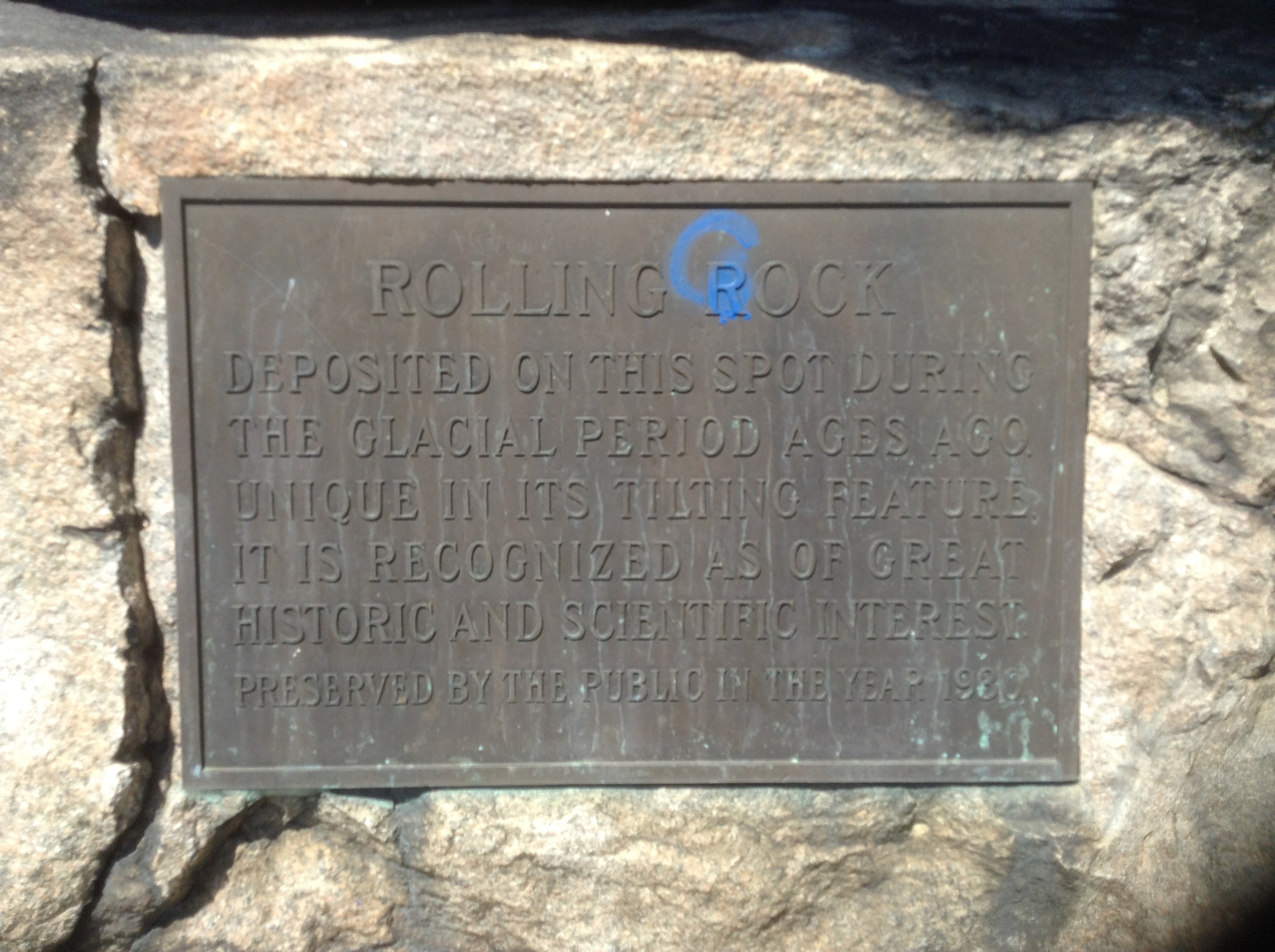
Below is the plaque affixed to the base rock of the stack:

The plaque reads:

ROLLING ROCK
Deposited on this spot during
the glacial period ages ago.
Unique in its tilting feature.
It is recognized as of great
historic and scientific interest.
Preserved by the public in the year 1930.

Needless to say, I disagree with the plaque's confident pronouncement that this massive balanced stone was "deposited on this spot during the glacial period ages ago." As Mavor and Dix point out, the  supposed glacier seems to have selected a particularly prominent spot at which to "deposit" the Rolling Rock.  

Even more importantly, note the reference to the "praying village" in the extended quotation from Manitou regarding this Rolling Rock cited above. Mavor and Dix spend a great deal of time discussing praying villages in their book -- beginning on page 41 where they discuss the fact that the Upton Chamber was also located near an important "praying village." Although the term "praying village" may have come from two young Puritans in the 1630s, John Eliot and Daniel Gookin, who set out to convert the local Native Americans to their literalist Puritan interpretation of Christianity, Mavor and Dix note that the praying villages these two established were actually selected because they were already revered by the native nations and used for spiritual purposes and shamanic activity:

Eliot's praying villages are important to our story because, as Gookin reported, they were located not by Eliot and Gookin, but by the Indian powwows or shamans, at or near their sacred places of ritual. These sites became magnets for our research because there stone structures still exist in a ritualized landscape that is intact enough to be studied and interpreted. We also began to suspect that the religion of the Indians and their interaction with colonial missionaries could provide clues to the origins and functions of the landscape architecture. 41.

Not only was the Upton Chamber located near a praying village, but Holliston (the site of the Balancing Rock described extensively above) also appears to have been an early praying village for the Nipmuc people, organized into a praying village site by Eliot and Gookin. And, as just noted in the above quotation from Manitou, we now see that the Rolling Rock of Fall River was also near a praying village, the North Watuppa praying village, located across the pond to the north of the Rolling Rock. That would be the third site in a row with an adjacent pond, and the third in a row situated at a praying village, which Gookin himself appears to have admitted were situated at sites already central to the traditional shamanic spiritual gatherings of the indigenous tribes.

This fact suggests that perhaps these "balancing rocks," no less than the astronomically aligned chambers such as that in Upton, were seen as connecting-points to the Infinite Realm, or the Invisible Realm -- places where the visible and terrestrial world touched the unbounded and divine realm of infinite potentiality, and where that divine realm became in some way visible. It certainly seems to be within the realm of possibility that rocking or rolling stones which could produce "deep booming sounds" or vibrations capable of being heard or felt some miles away could have been used in some way to promote shamanic trance or journeying to the Spirit World. We have already seen overwhelmingly abundant evidence that sustained rhythmic drumming is one of the most widely-used techniques for inducing shamanic journeying in cultures literally around the world, and on every continent (including Europe, before literalist Christians initiated aggressive campaigns to ban shamanic drumming).

Mavor and Dix devote a number of pages throughout the book to discussions of the Native American entity known as Hobomock, with whom shamans of the northeastern indigenous tribes would often seek to gain contact in order "to heal wounds or diseases and to remove evils" (76). The authors note that Hobomock was closely associated with swamps and marshlands, as well (apparently) with areas displaying above-average seismic activity. These are found throughout the Northeast, including many swamps not located near the sites described above.

They write:

A cedar swamp in East Freetown, Massachusetts, an extension of Bolton Cedar Swamp, is named Hobomock. Salisbury, citing Edward Winslow, writes that the major spirit, Hobomock, "protected and empowered those who obtained visions of him." Several groups of stone mounds, several hundred mounds altogether, are located on the rising land just west of Hobomock Swamp, and the group extends into the swamp itself. It may be that the swamp was named by the colonists after Hobomock, whom they equated to the devil, because of extensive Indian religious activity in the area, of which the stone mounds are the relics. If the mounds were associated with seeking visions of Hobomock, this would be reflected in tradition.

[. . .]

Algonquin groups are known to have used stone mounds and rows in their vision quest ritual. Several swamps in New England retain the name Hobomock, the spirit to which most vision quests by Algonquin powwows were directed. 132.

Rocking stones in Europe were also frequently associated with the voice of spirits, the power of healing, and (in many cases) witchcraft or forbidden contact with the spirit realm. The famous Logan Rock of Treen in Cornwall is described in numerous books and websites, including this 1903 text (a third edition of an earlier publication) entitled Popular Romances of the West of England, collected and edited by Robert Hunt. 

The Logan Rock was said to have been capable of healing children, as well as giving people the power to become witches, and also to have had the ability to judge character, but it was deliberately dislodged by an officer and group of sailors from the Royal Navy in 1824, and although it was restored to its previous location again later, it was said that afterwards it never rocked as well as it had previously, and it no longer retained its mysterious otherworldly powers.

The similarity of the traditional beliefs surrounding these sites on either side of the Atlantic is noteworthy. The Logan Rock described above (the name "logan" is sometimes used in Europe to describe any rolling or rocking stone) is located next to the sea -- others in Europe are associated with sacred wells or ponds. It is associated with contact with the spirit world and with the obtaining of otherworldly powers. It is clearly part of a tradition that stands outside what is considered Christian orthodoxy. And it was deliberately destroyed or damaged, such that its rocking ability was never again the same.

The authors of Manitou note that almost all of the rolling rocks or rocking stones of the sacred landscape of the Northeast no longer rock, having been deliberately stabilized. While it is possible to explain the motive as being to prevent safety problems, Mavor and Dix mention another, more sinister possibility, when describing a massive boulder in Fitchburg, Massachusetts known as the Rollstone, which was first broken apart and moved from its original location on the summit of Rollstone Hill, and then stabilized so that it could no longer rock. They write:

We suspect that the Rollstone and many others of this type were formerly rocking stones which have been stabilized by additional supporting rocks. People could have done this for safety, to make a signaling stone inoperative or as a ritual killing of a sacred artifact. 110.

We have already cited quotations which explain that a great many of the pedestal boulders and balanced rocks of Europe were toppled or otherwise deliberately destroyed during previous centuries by literalist Christian authorities, and that the plethora of sites in New England should thus be appreciated as a priceless (although often overlooked) treasure for gaining greater insight into the spiritual wisdom imparted to people all around the world, which can be seen to have been very similar across oceans, across cultures, and even across millennia -- but which is almost always opposed by literalists, often violently. 

The possibility that some or all of the surviving sacred sites in the Americas might have been targeted for the "ritual killing" of their sacred function should be considered very carefully, because it seems to be very likely, in light of the fate of so many similar sites in Europe (including the Logan Rock, supposedly tumbled over as a sort of "bet" or on a kind of a "lark," although that could also have been a cover story), and in light of the deliberate and very aggressive attempts to eradicate the culture and spiritual traditions of the Native Americans for centuries by religious and governmental authorities of the colonizing European powers (and later, by the religious and governmental authorities of the newer nations of Canada and the United States and others further south). 

Such a possibility also echoes the well-documented and historically-undeniable campaigns -- stretching right into the twentieth century -- to outlaw the drums used by shamans in cultures in Europe and Asia that somehow managed to retain their shamanic heritage longer than regions that had been controlled by literalist Christian authorities since earlier centuries.

It is also disturbing to note that the stabilizing of the Rolling Rock appears to have taken place during the same decade -- the 1930s -- that the unique rock art at the sacred Native American site of Painted Rock in present-day California was deliberately blasted with shotguns and permanently defaced. 

This subject clearly relates to the theme of "two visions" discussed by the Lakota holy man, Black Elk, who personally witnessed and later described the destruction of his people's way of life, and who described two roads that people can walk: one of them acknowledging the connectedness of all things, and the other characterized by division, hostility, and people living on "little islands" unto themselves, endlessly trying to grasp what they need before someone else gets it.

The entire concept of manitou which runs through and connects everything Mavor and Dix talk about in their book is a concept of connectedness, and the deep unity that flows through the planet and all of nature -- a vision that can also be seen operating in the worldview of ancient Greece and of many other cultures around the world, and which I believe informs the message that underlies all the Star Myths which utilize celestial metaphor in order to show us the reality of the invisible world that connects everyone and permeates every aspect of our world.

In a passage which succinctly summarizes this vision of connectedness, Mavor and Dix say:

We perceive manitou as the spiritual quality possessed by every part or aspect of nature, animate or inanimate. (343).

In other words, the sacred landscapes still very much in evidence in many parts of the Americas provide powerful testimony that humanity shares a precious inheritance which seems to retain remarkably similar fundamental features all around the globe, and even across millennia (although the outer details may vary significantly). This worldwide ancient inheritance is manifested in the myths and sacred stories found on every continent and in virtually every culture and society (myths which can all be shown to be based upon a common, worldwide system of celestial metaphor), and it is also manifested in certain received traditions regarding earth energies, sacred sites, and connections between the finite terrestrial landscape and the infinite celestial realm of the heavens (symbolizing connection between the material world and the Spirit Realm or the Divine Realm).

I would once again encourage interested readers to obtain a copy of Manitou by Mavor and Dix, as well as to consult other print and online resources which discuss the sacred landscape of the Americas, and to respectfully visit these incredible locations, if at all possible, and to marvel at their power. 

At the same time, we should all ponder the terrible crime of violently attempting to destroy the culture and sacred traditions of peoples around the world, including the native indigenous peoples of the Americas, and consider what steps towards reconciliation are appropriate, while also becoming aware of places and ways that the suppression or elimination of cultures and sacred traditions is continuing to this very day, all around the world (and close to home).


Below: another view of the Fall River Rolling Rock, with the plaque visible on the right (east-facing) edge of the base rock.

Below: one more image of the Rolling Rock, this time showing a certain visitor in order to provide a sense of scale.

Lord Krishna urges: "Make peace"

Lord Krishna urges: "Make peace"

image: Wikimedia commons (link).

image: Wikimedia commons (link).

In the Bhagavad Gita, one of the most consistent messages expressed by Lord Krishna throughout the Gita is that in this incarnate life, we should always strive to do what is right, without attachment to the outcome.

This previous post contains some discussion of the Bhagavad Gita, and some examples of this message, which Krishna presents in various ways throughout the holy text, saying for example:

Do your duty to the best of your ability, O Arjuna, with your mind attached to the Lord, abandoning worry and attachment to the results, and remaining calm in both success and failure. The equanimity of mind is called Karma-yoga. Work done with selfish motives is inferior by far to the selfless service or Karma-yoga. Therefore be a Karma-yogi, O Arjuna (6. 26).

Prior to the Battle of Kurukshetra, in an earlier episode in the Mahabharata (one of the great epics of ancient India, of which the Bhagavad Gita is a sub-section), Krishna himself models this behavior, by making every effort to avert the war, and to convince the Kauravas to cease their wicked desire to try to destroy their cousins the Pandavas. The eldest brother of the five Pandavas, Yudhistira, asks Krishna to approach the Kauravas and explain his desire for peace, even though Duryodhana (the eldest of the sons of Dhritarastra and the absolutely bloodthirsty and insatiable leader of the Kauravas) has demonstrated over and over that he desires war and will stop at nothing to get it, so convinced is he of his army's ability to destroy his virtuous cousins, whom he has always hated.

In making this request of Lord Krishna, the temperate Yudhistira declares:

Under all circumstances, however, war is a sin. Who in striking another is not himself struck? As regard the person, however, who is struck, victory and defeat, O Hrishikesa, are the same. It is true that defeat is not much removed from death, but his loss also, O Krishna, is not less who winneth victory (5. 72).

In agreeing to go to the Kauravas and tell them to cease their aggressive preparations for war, Krishna emphasizes that even though the outcome seems unlikely to result in a change in the attitude of Duryodhana and his closest accomplices, for whom that which is evil seems to them to be good, and that which is good seems evil, nevertheless he will go. 

As he explains his reasoning for going, he echoes the message that he gives in the Bhagavad Gita, and he also provides a valuable philosophical discussion in which he explains that all momentous events are influenced by a combination of divine providence in co-operation with our own efforts: therefore, we should not presume to know what will be the outcome of our actions, and should not let concerns over the ultimate outcome stop us from doing what is right to the best of our abilities, in order to try to bring about a positive outcome -- even when those doing their best to create a negative outcome seem most unlikely to be convinced of their error.

Krishna tells the Pandavas: 

Behold, the soil is moistened and divested of weeds by human exertion. Without rain, however, O son of Kunti, it never yieldeth crops. Indeed, in the absence of rain, some speak of artificial irrigation, as a means of success due to human exertion, but even then it may be seen that the water artificially let in is dried up in consequence of providential drought. Beholding all this, the wise men of old have said that human affairs are set in consequence of the cooperation of both providential and human expedients. I will do all that can be done by human exertion at its best. But I shall, by no means, be able to control what is providential. The wicked-souled Duryodhana acteth, defying both virtue and the world. Nor doth he feel any regret in consequence of his acting in that way. Moreover, his sinful inclinations are fed by his counselors Sakuni and Karna and his brother Dushashana (5. 79).

Krishna goes to the palace of Dhritarastra and his wicked sons, where he announces that he will meet with them in council the next morning, and then politely refuses their offers of hospitality, saying that it would not be right for him to dine with them or stay in their palaces, instead choosing to spend the night at the hut of the humble and virtuous Vidura and his wife. Vidura tells Krishna that the Kurauvas will not be turned aside from their disastrous push for war, explaining that:

Staying in the midst of his ranks of elephants and his army consisting of cars and heroic infantry, the foolish and wicked Duryodhana, with all fears dispelled, regardeth the whole earth to have already been subjugated by him. Indeed, Dhritarastra's son coveteth extensive empire on the earth without any rivals. Peace, therefore, with him is unattainable. That which he hath in his possession he regardeth as unalterably his. Alas, the destruction of the earth seems to be at hand for the sake of Duryodhana, for, impelled by fate, the kings of the earth, with all the Kshatriya warriors, have assembled together, desirous of battling with the Pandavas (5. 92).

In reply, Lord Krishna acknowledges that the delusional Duryodhana will almost certainly continue his present self-destructive course even after being visited by the mighty Krishna, but that even though this seems to be the likely outcome, Krishna has the duty of trying to dissuade Duryodhana, and that one who desires good for others should argue vigorously against decisions that will have catastrophic consequences for them. Addressing Vidura, Lord Krishna says:

That which thou hast told me is certainly true, worthy of approbation and consistent with reason. Listen, however, with attention, O Vidura, to the reason of my coming. Well knowing the wickedness of Dhritarastra's son and the hostility of the Kshatriyas that have sided with him, I have still, O Vidura, come to the Kurus. Great will be the merit earned by him who will liberate from the meshes of death the whole earth, with her elephants, cars, and steeds, overwhelmed with a dreadful calamity. If a man striving to the best of his abilities to perform a virtuous act meets with failure, I have not the least doubt that the merit of that act becomes his, notwithstanding such failure. This is also known to those that are conversant with religion and scripture, that if a person having intended mentally to commit a sinful act does not actually commit it, the demerit of that act can never be his. I will sincerely endeavor, or Vidura, to bring about peace between the Kurus and the Srinjayas who are about to be slaughtered in battle. That terrible calamity (which hangs over them all) hath its origin in the conduct of the Kurus, for it is directly due to the action of Duryodhana and Karna, the other Kshatriyas only following the lead of these two. The learned regard him to be a wretch who doth not by his solicitation seek to save a friend who is about to sink in calamity. Striving to the best of his might, even to the extent of seizing him by the hair, one should seek to dissuade a friend from an improper act (5. 93).

The next day, Krishna goes and delivers his passionate plea for peace, addressing King Dhritarastra. The entire speech can be found here. Some of the most important points in Lord Krishna's plea include:

  • "Effect peace, O chief of Bharata's race, and yield not to anger."
  • "I desire, O Bharata, thy good as also theirs."
  • "For the sake of virtue, of profit, of happiness, make peace, O king, and do not allow the Earth's population to be slaughtered, regarding evil as good and good as evil."

This is an extremely important passage from the ancient wisdom given to humanity, teaching us a powerful lesson about an absolutely crucial subject.

We should each resolve to "do all that can be done by human exertion at its best" and to change the minds of those who intend to commit sinful acts by aggressively seeking out war and slaughter and destruction.

It may seem that those who "covet extensive empire on the earth without any rivals" are absolutely implacable and incapable of being dissuaded, but Krishna's example and his discussion of the fact that we cannot know how our efforts may cooperate with divine providence, urges us to resolve to do what is right to the best of our abilities, without knowing whether we will succeed in those efforts, and without making our action contingent upon the "probability of success" (especially because we cannot know what positive impact our actions may have, in conjunction with the designs of action from the divine realm, the "real world behind this one" from which everything in this visible realm actually flows and upon which it all is dependent).

The Mahabharata tells us that "under all circumstances, war is a sin." And Krishna warns, "Let not the population of the earth be exterminated." 

Some lessons for us, from the dream of King Solomon

Some lessons for us, from the dream of King Solomon

image: Wikimedia commons (link).

image: Wikimedia commons (link).

As men and women in Great Britain go to the polls to vote on "Brexit" (the UK referendum on EU membership), consider the dream of Solomon recounted in I Kings chapter 3, in which the Lord appears to Solomon in a dream by night, and promises to Solomon the gift of "a wise and understanding heart" in response to Solomon's request for the ability "to discern between good and bad."  

What a gift it would be, to always be able to discern rightly between good and bad, right and wrong, in any situation! Some situations seem to be almost impossible to know for sure which is good and which is bad, which is right and which is wrong -- and yet immediately after this vision of Solomon is related in I Kings 3, the scripture segues to a situation in which Solomon finds himself faced with just such a knotty problem requiring his judgment, and demonstrates an ability to almost instantly cut to the heart of the matter, and solve the dilemma.

The outcome of that famous encounter, known as the "Judgment of Solomon," caused all the people to say of the king that "the wisdom of God was in him, to do judgment" (I Kings 3: 28). The episode itself, and the evidence that (like the other Star Myths of the world) it is based upon celestial metaphor, is discussed in this previous post and accompanying video.

The fact that this episode is a metaphor, based upon the stars, indicates that it is not intended to be understood as literal history involving an individual king who lived on earth in ancient times. If it were, then we would be correct in saying "Well, that was Solomon -- he received divine wisdom, which is great for him, but it doesn't really have that much to do with me." If the story is about a special king who lived in terrestrial history thousands of years ago, then the gift of understanding which he received cannot be expected to help us very much in sorting out difficult questions such as those we face every day.

However, if the story is celestial metaphor, which I believe that it can be shown to be, then we must ask what it is trying to tell us, if it is not actually telling us about a literal historical ancient personage who received a special gift of wisdom and once judged between two harlots in the case of a baby.

The answer is that the story is trying to tell us something about our own condition, here in the dual spiritual-material condition in which we find ourselves in this incarnate life. Among many other profound truths which this episode is intended to convey to our understanding is the message that this gift of "a wise and understanding heart" and the ability "to discern between good and bad" is not exclusive to Solomon: it is available to each of us. 

And the scriptural passage is showing us that this understanding is available through connection with the divine realm, the infinite realm, the invisible realm which the ancient myths attempt to dramatize and make visible to us through the metaphors involving the starry realm of the heavens (the heavens being, in a very real sense, an infinite realm).

Solomon receives the gift of a wise and understanding heart when he is in the dream-state: and yet the encounter which follows demonstrates that the wisdom and understanding that he was given was very real, and applicable in the pressing decisions he faced every day. There are many ways in which we can have access to the invisible realm, and in which we can connect with the wisdom and understanding of what some traditions have called our Higher Self. Dreams and the dream-state are one of many ways in which we are able to do so: others include meditation, mantras, some forms of sacred song and chanting, drumming, disciplines such as Yoga and Tai Chi and Qigong, and many others.

The exchange between the Lord and Solomon in the dream state is extremely instructive. In I Kings 3 and verse 5, the Lord appears to Solomon in a dream by night, and says to Solomon, "Ask what I shall give thee." Note that there are no boundaries to this offer: the infinite realm is a realm of infinite potentiality.

Solomon then replies that he is "but a little child," who knows not "how to go out or come in," and what is more that he is in the midst of "a great people that cannot be numbered nor counted for multitude," and that because of this he asks for "an understanding heart to judge thy people" (I Kings 3: 7 - 9).

The next verses tell us that this request pleased the Lord, who tells Solomon: 

"Because thou hast asked this thing, and hast not asked for thyself long life; neither hast asked riches for thyself, nor hast asked the life of thine enemies; but hast asked for thyself understanding to discern judgment; Behold, I have done so according to thy words: lo, I have given thee a wise and an understanding heart; so that there was none like thee before thee, neither after thee shall any arise like unto thee. And I have also given thee that which thou hast not asked, both riches and honor" (I Kings 3: 11 - 13).

These verses, I think, teach us some extremely important lessons about accessing the divine realm. It is a realm of infinite potential, but it is not to be used for the purposes of self-enrichment, or selfish gain, or for inflicting harm upon one's enemies. 

The Lord is pleased with Solomon's request because Solomon seeks wisdom and discernment between good and bad, for the purpose of helping others.

The passage shows us that the Lord granted Solomon this discernment and wisdom, and also gives Solomon some of what Solomon did not ask for, including riches and fame -- but these are "incidental" to the encounter, and not necessarily something that we should be worrying about: the purpose of seeking the wisdom available to us in the infinite realm is to help others, and to judge rightly between what is good and what is evil.

In his 1936 lecture, "The Stable and the Manger," which I have cited many times in previous posts, Alvin Boyd Kuhn said:

Bible stories are in no sense a record of what happened to a man or a people as historical occurrence. As such they would have little significance for mankind. They would be the experience of people not ourselves, and would not bear a relation to our life. But they are a record, under pictorial forms, of that which is ever occurring as a reality of the present in all lives. They mean nothing as outward events; but they mean everything as picturizations of that which is our living experience at all times. The actors are not old kings, priests and warriors; the one actor in every portrayal, in every scene, is the human soul. The Bible is the drama of our history here and now, and it is not apprehended in its full force and applicability until every reader discerns himself [or herself] to be the central figure in it! The Bible is about the mystery of human life. Instead of relating to the incidents of a remote epoch in temporal history, it deals with the reality of the living present in the life of every soul on earth. 4

This means that the wisdom of Solomon, as incredible as it may seem, is available to you -- and that the scriptural passage is trying to tell that to you and to me. And it is for helping others and judging properly between right and wrong.

Summer solstice, 2016

Summer solstice, 2016

The earth will pass through the point of June solstice this year on Monday, June 20 at 3:34 in the afternoon for the Pacific time zone in North America, which is 6:34 pm for the Eastern time zone and 10:34 pm (or 22:34) in Greenwich, England.

For those in the northern hemisphere, this will mark the "high point" of the year or the summer solstice, when the sun's path across the sky will be at its highest elevation above the southern horizon, before it turns back "downwards" towards the lowest part of the year at winter solstice. 

The summer solstice will mark a "triumph" point for hours of daylight versus hours of darkness, but after earth hurtles past this point of triumph, the hours of daylight will again begin to grow shorter, although they will still be longer than the hours of darkness each 24-hour period, until we reach the "crossing point" of the September equinox, when hours of darkness will then begin to be longer than hours of daylight in each 24-hour period (for those of us in the northern hemisphere).

The four great dividing points of the year -- the summer and winter solstices, and the autumn and spring equinoxes -- were allegorized in the ancient myths, scriptures, and sacred stories of humanity to impart wisdom intended for our benefit as we toil through this incarnate life. Based on my analysis of many ancient myths, it is my understanding that the point of summer solstice carries a twin message -- embodying both the consummation of complete integration with our Higher Self, the "raising of the Djed-column," towards which we should strive each day, and upon which we should fix our gaze and also the message that (like the sun's path after the triumph of summer solstice) we ourselves have plunged down into physical matter for the express purpose of the elevation of both the spiritual and material natures.

The endless interplay between daylight and darkness during the course of the annual cycle, and between the path through the upper realm of the heavens and the lower realm of earth and water during the course of the daily cycle (with each rising of a star or other heavenly body being allegorized as a rising into the spirit-realm, and each setting as a plunge into the material realm) was employed by the ancient myths to teach us that we ourselves and everyone else that we ever meet is actually much more than the physical body, and are each possessed of a higher, divine spirit-nature, temporarily submerged in the material realm.

The plunge down into matter may on the surface appear to be the humiliation of this spirit-nature, but in fact according to the metaphor it is this very "casting down" which results in the "raising up" of the invisible soul.

In a short treatise entitled Easter: Birthday of the Gods (also found on the web here, and available for purchase in paper format here), in which he most clearly outlines the spiritual significance of each of the four great stations upon the Great Cross of the year (summer solstice, autumn or fall equinox, winter solstice, and spring equinox), Alvin Boyd Kuhn explains that our "fall" into matter should not be misunderstood as a terrible mistake, but rather as a critical and essential experience. He writes:

Unseen as yet by general religion, it was necessary for God's sons, who must start as mortals to gain immortality, to descend into matter and be long subjected to its sluggish dominance. Ignorantly and mistakenly has conventional religion, in its hasty, superficial, and erratic interpretation of Biblical material, assumed that this ostracism of his children by God himself to lower worlds remote from the Father's benignant presence, was somehow a sad consequence of the children's wayward errancy and an untoward and disastrous misadventure of primal mankind. The truth envisages no such direful miscarriage of the plans of Eternal Mind. God's mental progeny could well be entrusted to the tutelary custodianship of nature, indeed injected into her maternal womb, since nature was from the first and eternally ensouled by the Father's energic mind power, and all nature's processes exhibited the divine design at work in open manifestation. God could safely consign his youthful offspring to the educative guardianship of the "old nurse," Mother Nature. For as a pedagogue Mother Nature could never misteach each her divine pupils, herself being the preceptress, the living exemplar and expression of the cosmic mind. 12 - 13.  

In other words, Kuhn argues, our spiritual descent into this realm of matter is ultimately (somehow) for our spiritual elevation and the raising of our consciousness through the experience. Elsewhere in the same essay, he states:

Flesh and soul find themselves locked inseparably in the marriage bonds of polarity here in body. Philosophies that place all value on spirit and decry and degrade the flesh are guilty of gross misplacement of emphasis.

[. . .]

It is said that all Scripture is given for edification. Of first importance then it is to realize that the basic edifying item of truth the Scriptures enshrine (in myth, allegory, drama and symbol) is this underlying universal principle: the descent, the "death" in ark-seed form and then the resurrection of the seed units of divine life out of material embodiment. This single item is the lost clue to the mystery and the meaning of both life itself and the great Scriptures which pictorialize its significance. 30 - 31.

It is for this reason, then, that we see Samson's path go from basically irresistible strength and triumph to weakness and imprisonment, after the "seven locks of his head" are shorn off by Delilah in Judges 16. When Samson was passing through the "upper regions" of summer solstice, he slew a Lion with his bare hands, and then later came back and gathered honeyfrom the swarm of bees which had made their home in the carcass of the Lion (the Beehivebeing representative of the zodiac sign of Cancer the Crab and the summer solstice). But then he descends to the point of fall equinox (presided over by the Virgin of Virgo) and ultimately is shorn of the seven locks of his hair, which are directly symbolic of his identification with the divine fire of the sun in the heavens.

We may wonder why Samson would ever reveal to Delilah the secret of his irresistible strength, especially after every "false lead" he gives her is immediately tested out by Delilah and a group of Samson's enemies -- but the reason is that the sun must eventually make its way downward from the heights of summer and pass through the fall equinox on the way down to the very lowest point of the year, and that this same journey of the sun was used by the ancient myths and scriptures to dramatize to us the necessity of our own descent from the realm of pure spirit, into this material universe and our incarnate life within a physical human body.

The necessity of Samson's "plunge" (and the shaving of his "solar glory" in the cutting off of the seven locks of his head by Delilah in Judges 16) prefigures a very similar descent which is described in the stories of the New Testament in the life of the Christ: after his triumphal entry into Jerusalem upon a donkey (or two donkeys), which again is symbolic of the zodiac sign of Cancer the Crab at the very top of the year at summer solstice (the Beehive cluster symbolized in the Samson myth being located between two stars in the constellation Cancer which are named Asellus Borealis and Asellus Australis: the "northern and southern donkey colts"), the motion of the gospel narrative moves inexorably towards his betrayal by Judas Iscariot and then his arrest, humiliation, and crucifixion.

In other words, in both the Samson narrative and the "triumphal entry" narrative in the gospels, we see that the "high point" of the year (associated with Cancer the Crab at the top of the annual cycle) is followed soon after by descent, humiliation, imprisonment, and death -- all symbolic of our own plunge into the material realm, which was symbolically described as a sort of "death" of our spiritual consciousness, and a "shaving off" of our connection with and memory of our inner connection to the infinite and divine.

Thus, the symbolic significance of summer solstice to us from our vantage point in this "lower crossing" of the incarnate life is as something we can look towards as a reminder of our true spiritual and divine nature, which we should recognize and elevate in ourselves and others as much as possible, but it is simultaneously a reminder that (like the path of the sun itself) we had to descend from the realm of spirit in order to sojourn in the material realm, for reasons that ultimately have to do with the "uplift of the soul" (in the words of Alvin Boyd Kuhn, 30).

My analysis of the intended message is that each of us should in fact be engaged in the process of "raising up" the Djed column during this earthly sojourn, but also that we should realize that we never actually reach the point symbolized by summer solstice while we are sojourning here in the material realm -- that is where we came from, when we commenced the plunge into physical matter, and where we are heading towards again (in an "aeonial cycle" that continues many times, according to some interpretations of the ancient wisdom imparted to humanity, as Kuhn explains on page 30 of the same tract mentioned already).

The reason that the Beehive in the constellation of Cancer the Crab is associated with this triumphal highest point in the spiritual cycle (the point from which, however, the "only way to go is down") is that the line of the summer solstice falls between the signs of Gemini and Cancer on the zodiac wheel, as it was drawn during the Age of Aries:

As can be seen from the above diagram, the very top of the vertical line connecting the winter solstice (at the bottom or "six o'clock" position on the wheel) with the summer solstice (at the top or "twelve o'clock" position) passes between the sign of the Twins of Gemini (to the left of the "twelve o'clock" position) and of Cancer the Crab (drawn to look more like a lobster in the illustration above), just to the right of the same line through twelve o'clock. 

These two signs, incidentally, are almost certainly responsible for the description in the Biblical scriptures of the Promised Land as a "land flowing with milk and honey," as discussed in this previous blog post on that subject. It is noteworthy that in the mythology of ancient Greece, the infant Zeus was  said to have been nourished upon the milk and the honey provided to him in the Diktaian cave (the cave on Mount Dikte on Crete, where the baby Zeus was hidden by his mother, to escape being devoured by his father Kronos or Cronus) by the miraculous goat Amaltheia and (according to some ancient accounts) by the nymphs Ide (Ida) and Adrasteia, daughters of Melisseus (see discussions and ancient sources here).

The same constellation of Cancer the Crab, which is a very faint constellation composed of only six easily-visible stars, is also undoubtedly responsible for the association of the "upraised arms" with the point of summer solstice and of the top of the Djed column (the highest point of the year), as discussed in this previous summer solstice post from 2014. The "upraised arms" (with the triumphant, full sun above them) can be seen at the top of the Djed column in an illustration from the Papyrus of Ani shown in the collection of images at top (in the upper-right image in that collection). 

The same "upraised arms" play a role in the Exodus account of the battle with Amalek, when the battle went well for Joshua and the children of Israel only as long as Moses held his arms up, but went badly for them when Moses grew tired and let his arms down to rest them. This story, found in Exodus chapter 17, can be seen to be a dramatization of the cycles of the year itself, and the endless interplay between the forces of light and darkness -- which go back and forth between the summer solstice and the winter solstice, with one "side" triumphing as the year approaches its day of maximum darkness, and the other triumphing as the year approaches the day of maximum daylight. But the story is not really "about" the great annual cycle, as majestic and awesome as that is, but rather is intended to provide us with spiritual insight into the interaction between the visible and invisible realms, and into our own innate divine nature, which is so easily forgotten and neglected when we plunge into this incarnate life in the physical body, and subject ourselves to all of the physical exigencies and necessities of the material world.

In that battle with Amalek, Moses had to have assistance in order to keep his arms up, from the figures of Aaron and Hur (Exodus 17: 12) -- and we see that in the Papyrus of Ani illustration (top right) the Djed itself is flanked by the twin figures of the goddesses Isis and Nephthys, each of whom has her hands raised up in a gesture of blessing and uplifting of the spirit and of the Djed. Similarly, the sacred Scarab of ancient Egypt was also depicted with its own "hands" upraised, reminiscent of the Crab of Cancer in the celestial realms -- and in the jeweled necklace shown at top from the tomb of Tutankhamun, the sacred Scarab is surmounted by a solar disc but also flanked on either side by both Djed columns and Ankh crosses, as well as by two uraeus serpents (asps or Egyptian cobras), which appear to take the place of Aaron and Hur from the Exodus story, or of Isis and Nephthys from the Papyrus of Ani.

I believe these "flanking figures" represent the great "crossing points" on either side of the central Djed-column on the Great Cross of the year: the autumn and spring equinoxes, which both can be seen as essential to and supportive of the central column which has the summer solstice at its highest point. As Alvin Boyd Kuhn's quotations (cited above) inform us, the plunge down from the summer solstice is an essential aspect of our spiritual uplift.

Below is one more illustration of the "upraised arms" from ancient Egypt, seen in one version of the royal cartouche of the king Thutmosis III. It contains a sacred Scarab with upraised arms, above which is the triumphant solar disc (certainly appropriate to the summer solstice and all that it spiritually represents). Additionally, below the sacred Scarab in this particular version of the cartouche, we see another set of "upraised arms," to really drive the point home. It is also interesting to notice the linguistic similarity between the name of the ancient king to whom this cartouche belongs and the name of Moses whose upraised arms are described in Exodus 17.

image: Wikimedia commons (link).

image: Wikimedia commons (link).

This message from the ancient wisdom which was imparted to humanity in the sacred scriptures and myths is one that is very appropriate to contemplate as we once again reach the point of summer solstice and the "high point of the year" (for the northern hemisphere). This summit-point is certainly representative of the full "raising up" of the Djed, the full elevation of the spiritual consciousness, and the full integration with the Higher Self or divine self discussed explicitly in some surviving ancient traditions (such as the tradition of Yoga). However, in the ancient myths of humanity, the triumphal point of summer solstice was usually followed closely by a description of the "descent" of the divine figure, emblematic of the necessity which plunges each one of us from the divine realm of spirit and infinite potentiality into the limiting realm of matter, where we presently find ourselves.

In other words, we are presently in the condition of Samson once his hair (symbolic of the solar fire) has been shorn off -- but the scriptural text encouragingly informs us that "the hair of his head began to grow again after he was shaven" (Judges 17: 22). And thus our awareness of and integration with that Higher Self, that True Self, is only temporarilyforgotten, and we should be in the business of restoring it in the ways that are given to us to do so (secure in the knowledge that ultimately it will "grow again" by a mysterious process that is beyond any of our own efforts). The triumph-point of summer solstice gives us a picture to look towards as we endeavor to connect with and regain touch with our invisible nature, our spirit nature, even as it also conveys the message that this process will always be imperfect and incomplete during this earthly sojourn.

Methods which I believe have been given to us to aid in this process are numerous, and have been preserved in different degrees and different levels of emphasis in the different cultures around our globe. A partial list would certainly include practices such as meditation, various forms of chanting and sacred songqigong or chi gung, Tai Chi and other martial arts, shamanic drumming or drumming to induce states of ecstasy or out-of-body experience, tantra, the recitation of mantras, and of course the practice of Yoga itself -- among many other methods found across the vast range of human experience and preserved across the myriad cultures that are scattered across the vast range of oceans and deserts and forests and mountains and plains that make up our planet.

And of course, I believe that the ancient myths, scriptures and sacred stories which were given to humanity in the distant past from a source which today cannot be definitively identified can also guide us towards that integration with and elevation of that aspect of our nature which is spiritual and divine, and which is symbolized by the Beehive and the solstice -- and that they can and will impart their wisdom to us as we learn to approach them using the language that they are actually speaking: the language of celestial metaphor.

UAP

UAP

I'm not a big UFO researcher.

I've looked at the sky at night a lot and I've never seen one.

I don't particularly look for them either: looking for that type of thing is not a major focus of my research. I do spend a lot of time looking at the stars and the night sky; sometimes I use a telescope, sometimes I use binoculars, but most of the time I use the naked eye (with glasses).

However, this evening while parking the car at a few minutes before 9 pm local time, with both my sons in the car, one of them (who was in the passenger's side seat in the front) said, "There's a satellite."

He had been looking at the planet Saturn, which appeared as a bright star in the twilight -- one of only a few heavenly objects visible in the twilight. With summer solstice approaching, it stays light very late, and although it was getting dark, the easiest objects to see in the direction we were facing as I parked the car were still Mars, Antares and Saturn (a few other stars were visible but very faint).

My son had originally thought that the "star" he was looking at (Saturn) was moving, until he realized it was another bright object just below Saturn, which was bright like a large star but moving slowly downwards towards the horizon.

I saw it and said, "Maybe that's the ISS" because it was so bright. It did look like it was about the size of the bright satellite said to be the ISS on websites that tell you when to look for the ISS, which I have seen crossing the sky in the past, in very much the same part of the sky as this object, except when seeing the bright object identified as the ISS, I've always seen it moving at a steady pace from the south towards the north, and maintaining about the same track across the sky relative to the ground (the same angle of elevation above the eastern horizon, in other words). This object, which was as bright as the ISS and steady (with no blinking lights) was slowly moving towards the horizon.

In the diagram above, I show the direction that we were facing, at the latitude and longitude and approximate time and date. The screenshot is taken from stellarium.org, which is an excellent open-source planetarium app available online. I have used an "airbrush" tool to indicate the location of the bright light when we first saw it (at the top of the downward-pointing arrow, just beneath Saturn and drawn to look slightly larger than Saturn, because it was slightly brighter than Saturn in the sky).

We all saw the object and looked at it very carefully to see if it could possibly have any flashing lights such as an airplane or helicopter would display -- there were definitely none whatsoever: it was a solid light very much like a bright star or satellite (or ISS, if the bright satellite-object we are told is the ISS is in fact the ISS, which I personally don't have too much problem believing that it is, although I know others who harbor some doubts about that).

We watched it for approximately 25 to 30 seconds as it moved steadily downwards towards the horizon, as indicated by the purple arrow. Two of us got out of the car and one of my sons remained in the car, but we were all watching it and discussing it for a good amount of time. There is no way that it could have been a meteor (at least, it was completely unlike any of the meteors I have ever observed, none of which remain visible for 25 or 30 seconds, or even long enough to point out to anyone who is not already looking at them). It moved steadily and deliberately, but not at a constant speed. At one point, it passed some horizontal power lines which were visible above the horizon fairly close to our location, which is the only time it appeared to "blink" (as it passed behind each power line and was temporarily partly-obscured from our view by the power lines).

Not long after passing below the level of the power lines, but still well above the level of the horizon, it suddenly faded very rapidly as if growing smaller and disappearing in the distance, whereupon it turned a dull red color for a split second before fading completely from view. The son who had gotten out of the car also observed the momentary change to a dull red color, while the one who had stayed in the car did not.

The approximate location of the object or light when it disappeared is indicated at the bottom of the arrow that I have drawn in the diagram above, where I have also added a smaller, slightly reddish spot to indicate the object just before it faded suddenly from view.

The speed of descent was somewhat similar to a military parachute flare (which, when I was in the army, was a pyrotechnic device which we used quite often, and with which I am very familiar, along with other types of pyrotechnic devices known as "star clusters" -- I have no idea if these are still used regularly, although they probably are). However, it did not look at all like a parachute flare to me and I can pretty confidently rule that out as an explanation, based on its actual behavior, size, brightness, height above the horizon when first seen, and apparent distance from us. 

I have no desire to label it a "UFO," since that term popularly implies some sort of extraterrestrial craft, and that is certainly not what I would say might be the most likely explanation for whatever this shining object was. It did appear to be like a very bright satellite, about the size of the "ISS" in the sky, but moving in a path that was not at all like a satellite, especially the part at the end when it simply faded rapidly from view while changing to a dull red color momentarily. It could perhaps be labeled as a "UAP" or "unexplained aerial phenomenon," at least "unexplained" based on my own personal experience (the possibility that it was some sort of man-made vehicle or drone seems to me to be the most likely explanation for whatever it was).

Interestingly, at about the same time, someone else in Fontana, California posted a video of a very similar satellite-like light which very much resembled the one we were observing (as far as I can tell from the video), and they described it as being in a "south-easterly direction," which (as you can see in the diagram above) is the same direction that we were looking at the same time. Below is video that they posted shortly afterwards, and which I found by searching on twitter about twenty minutes later (and where it was posted with the message "this just happened"). The interesting part about this video is that the location is quite far to the south of the location that we were when we saw the very similar phenomenon -- so far to the south that it would be hard to believe we were looking at the same thing, even though the time appears to match almost exactly. Below the video is a map showing the relative locations -- if the video below was taken in Fontana, as it says it is (my location was almost exactly two hundred miles north of that, in Paso Robles).

What the significance of this is, I'm not really certain. It does raise questions as to what it might have been, but there are plenty of possible answers (most of them involving some sort of military craft or training, in my opinion). However, as I have never actually seen anything at all like this, in decades of watching the sky (as well as over a decade in the military), I post the record here, mainly to keep track of the details as we observed them.

It is also interesting that it was seen in the vicinity of the planet Saturn.

California: do the right thing

California: do the right thing

image: California covered in fog; Wikimedia commons (link).

image: California covered in fog; Wikimedia commons (link).

Most students who study the Odyssey at virtually any level, whether before college or in college, will be told that one of the themes running through the epic is the theme of the host and the guest, and that it contains many different examples of good hosts and bad hosts, good guests and bad guests -- which, of course, it does.

At the opening of the entire poem, we see a vivid example of guests who are devouring the household of their "host," who never actually invited them in the first place: the suitors who have taken up within the household of the absent Odysseus, slaughtering his livestock for their feasts, drinking down his wine, abusing the faithful men who still tend to the animals and the estate, sleeping with the maidservants, and angling for the hand of Penelope in hopes that they can marry her, while plotting to kill the son of Odysseus and Penelope, the young Telemachus -- who has now reached an age where he is beginning to realize that he has to do something about his unruly "guests." 

Realizing that he himself cannot hope to dislodge the more than one hundred suitors who are gulping down the food and drink without giving anything in return, Telemachus calls for an assembly of all the kings and warriors on Ithaca, many of whom are the fathers of the suitors, in order to present his case  to the public and get them to do something about it. 

The proceedings of this assembly are recorded in Book Two of the Odyssey. Telemachus asks the community if he thinks it is right for the suitors "to destroy with impunity" the livelihood of another, to consume possessions that are not theirs and lay someone else's house to waste, basically eating free lunches (not to mention breakfasts and dinners) until all is devoured. If the suitors and the rest of the community think this is proper, Telemachus declares, then he will appeal to the immortal gods, and to the power of the divine Zeus himself to put a stop to the injustice (Odyssey Book 2, lines 130 - 154).

As noted in this previous post, the suitors respond angrily to the accusations of Telemachus, basically blaming him and his mother Penelope, as if Telemachus and Penelope deserve to have the suitors violently occupying their house and devouring their livelihood, and as if Telemachus and Penelope are in the wrong, and not the overbearing suitors!

Then, old Mentor speaks up -- a companion in the old days of Odysseus, who appointed Mentor to raise Telemachus in his absence when he (reluctantly) went off to the Trojan War. Addressing the other citizens of Ithaca, Mentor says: 

But in truth I do not admire that the haughty suitors should do violent deeds by the evil contrivances of their mind; for laying together their heads, they eat up forcibly the house of Odysseus, and say that he never again will return. But now I am angry with the rest of the people, in what manner ye all sit silent, but do not at all reproaching in words restrain the suitors who are few, though you are many. Odyssey Book 2, lines 235 - 241.

In this passage from the ancient wisdom entrusted to humanity, Mentor is saying that the community (who are many, and greatly outnumber the suitors) are in the wrong if they do not use their moral suasion to restrain the violent and conniving suitors, who "eat up forcibly" that which they have basically invaded. 

Mentor knows that if the entire island would express outrage at the actions of the suitors, who are few in number by comparison, the suitors would not be able to stand against all the others (many of whom, besides, are the suitors' own fathers, uncles, or kin).

Mentor expresses his anger because the people, who could put a stop to the depredations of the suitors, instead "all sit silent." 

As with so many other aspects of the situations we find unfolding in our lives in the present day, here again the ancient wisdom of the sacred myth seems to be speaking directly to our most pressing crises. 

Indeed, a violent gang of "suitors" have moved in, devouring with impunity and "plotting violent deeds by the evil contrivances of their mind," in the words of Mentor as preserved in the ancient epic. They have moved in to Greece, for sure, and have nearly brought it to ruin in spite of the protestations of the people there, but also to more far-flung regions including Europe and the present-day United States, as explained by economist Michael Hudson in his many interviews and in his numerous published books and articles -- most recently his book entitled (appropriately enough) Killing the Host

Dr. Hudson uses the term "host" as the word is used when describing the organism invaded by a biological parasite in nature -- a parasite being a particularly graphic illustration of the kind of "bad guest relationship" we have been discussing above. 

He explains that the classical economists (including Adam Smith) believed that the best way to order society was to free it from the kind of activity typified by the levying of rents, which act as "tollbooths" set up all over the economy. But because those who want to act like the suitors in the household of Telemachus and devour the livelihood of others are powerful (too powerful for Telemachus and his household to withstand, no matter how brave he is), the entire community is required in order to stand up to them (in the form of elected governments and legislatures). 

However, over the course of the past one hundred years, Dr. Hudson explains, this idea has actually been turned on its head by those who say that "free markets" really means the removal of the ability of the community to "restrain the suitors," instead of what economists such as Adam Smith intended it to mean. The classical economists intended to create an economy that basically strove to achieve "freedom from the suitors" or those who "eat up forcibly" the households of others -- or the bodies of others, in the case of a parasite -- but today there is a whole host of voices arguing for freedom from the ability to restrain such forcible devouring! 

The various representatives of the suitors in the Odyssey Book Two offer a defense for their behavior, basically arguing that they are the ones who are acting in accordance with what is best for society, and actually blaming their victims (Penelope and Telemachus) as the ones who are in the wrong. Intriguingly, Michael Hudson points out that most parasites in nature actually possess mechanisms to numb the host as they are feeding from it, and many of the most invasive parasites even possess enzymes which they release into the host which go to the brain and affect its thinking, causing the host to believe that the parasite is part of the host, part of the natural order of things, part of the body to be defended and protected and nourished!

To hear Dr. Hudson discussing this concept, you can listen to any one of the many podcasts available on the web in which various interviewers explore this issue from varying angles -- this one contains some good discussion (the part of the show with Dr. Hudson begins at about the 58:00 minute mark of that two-hour podcast and double-interview; he is the guest for the second hour of the show). 

The above arguments do not mean that everyone who starts a restaurant should have to submit the proposed menu (or any other decision about how to run the business) to a public vote every few hours: Dr. Hudson's arguments, and those of the classical economists, appear to be primarily concerned with natural monopolies, such as public infrastructure, including utilities such as power and water and roads (in fact, the reforms he and the classical economists envision would tend to unburden "non-tollbooth" types of economic activity, such as starting a restaurant or hiring workers, from the massive number of taxes and fees that have been pushed onto them, and shift the tax burden instead to the beneficiaries of monopoly-style or tollbooth-type activity). Instead of allowing landlords to set up tollbooths every twenty miles on the interstate freeway system, for example, the United States uses taxes to maintain its comprehensive system of interstate freeways, which lowers the cost of doing business for everyone, whether big businesses or small businesses, or even individuals or families out on the road for vacation or any other purpose. 

The same principle, Dr. Hudson and the classical economists would argue, can be applied to other aspects of the infrastructure, including power and water and even medical care and education -- the goal being to provide these things as inexpensively as possible in order to reduce the cost of doing business or supporting oneself or a family (just like the interstate freeway system), rather than allowing various "extractors" to put up tollbooths all over these infrastructure-type functions (which tend to be natural monopolies).

While the vast majority of people in the United States see the open road and the magnificent interstate freeway system as a tremendous benefit for everyone, many of the very same people have a visceral reaction against applying the same thinking to other aspects of the public infrastructure, such as public education (even though the "public universities" and state schools were basically founded on this same concept, with the goal of providing easily affordable but high-quality undergraduate and graduate education: these have largely been turned into gigantic clusters of tollbooths within tollbooths). 

In other words, even while they enjoy the benefits of the non-privatized interstate freeway system (which benefits everyone in so many ways that are completely taken for granted), they say that anyone proposing the same thing for utilities such as electricity or water, or for educations at state universities, is going to "destroy the free market."

It is now becoming more common to hear people arguing that even city water systems should be privatized, and that water is not actually a human right. The same people would probably balk at the idea of having the roads that they take when going on a trip privatized, and of selling off every ten miles of the freeway system to different corporations or groups of individuals pooling their funds, who could then put up tollbooths charging whatever they thought was best from those desiring the privilege of driving over that stretch of freeway (and perhaps offering loans at varying rates of interest to "help" those who could not afford to pay the tolls by stretching out the toll-payment over varying periods of time going on for years into the future, with interest).

Some extreme "libertarians" or even "thoughtful anarchists" do in fact argue that there should be no public infrastructure at all, and that having roads run by corporations would be a much better arrangement (they usually indicate that insurance companies would be natural candidates for owning and running different sections of roads). But a moment's reflection should cause us to realize that such arrangements are ripe for the kind of behavior demonstrated by the suitors, whose motto seems to be to feast off of whatever wealth they can find -- and that the more the economy is burdened with such "toll-collecting" activity, the more expensive it will be to do anything in that economy, whether traveling on vacation or moving goods and services for a business endeavor, and that the cost of goods produced in such a toll-burdened economy will naturally be higher than similar goods produced in an economy free from such "lounging suitors" erecting tollbooths everywhere.

The "hard libertarian" or "anarchist" position does in fact appear elsewhere in the Odyssey: it can be seen to be the position pursued by Polyphemus the Cyclops, and his fellows. They live solitary lives, build no ships and grow no crops, and reject the laws of gods or men. 

Unfortunately, because governments which were originally designed to escape from the kind of "toll-collecting" systems that dominated Europe in the medieval period have basically been infiltrated by violent suitors, many in the "alternative" world see the libertarian or anarchist position as the only solution, or the moral solution -- but that position actually rejects the kind of moral action by the community that Mentor is calling for. Mentor knows that if the combined voices of the rest of the citizens of Ithaca turned against the suitors and expressed their outrage and disgust at the behavior of the suitors, the suitors would have to give way. This sort of council is exactly what government accountable to the people is supposed to be. But the anarchist or hard libertarian position argues against having any such government -- and thus would leave the suitors to have free rein over the house of Telemachus and Penelope.

Of course, libertarians and even many anarchists will say that they do support rule of law, and that they would in fact support the restraint of violence (such as the murder plot hatched by the suitors). But while they may support community restraint of outright physical violence, they don't support community restraint of toll-extracting: those at the hard libertarian extreme would usually argue that there should be no law against having "this section of Highway 5 brought to you by ____ corporation," and "this entrance to Yosemite National Park brought to you by ____ corporation," and "this brigade of the 82nd Airborne Division brought to you by _____ corporation" (fill in the blanks with your favorite corporation in each case). They would not generally support the position that using taxes to provide public infrastructure (including schools, utilities, communication infrastructure, healthcare, social security or even in some extreme cases the interstate highway system) makes business less expensive, economies more efficient, exports more competitive, the cost of hiring new employees lower, and living standards higher -- and that removing tollbooths (and lounging, feasting, scheming "suitors") from those natural monopolies is actually a promotion of free markets, not a restriction of free markets. 

Unfortunately, because of the equivalent of the enzyme that Dr. Hudson is talking about (the one that makes the "host" believe that the "bad guests" who are eating the host out of house and home are actually "part of the body"), many citizens in the United States are complacent in the face of the very same kind of outrageous behavior that Telemachus and his allies warn will bring down the wrath of the gods, whose laws are being spurned (during the same community meeting, the "old hero Halistherses," who excels all others at reading the flights and songs and signs of birds, warns the community that the signs he is seeing indicate quite clearly that the behavior they are tolerating will end in calamitous disaster).

In the body politic of the United States, the republican party long ago adopted a quasi-religious devotion to the more recent (and counter-classical) view of "free markets" that protects and even encourages the kind of extractive behavior that the classical economists wanted to free the markets from, while the democrat party is presently engaged in a closely-contested battle between a candidate who has proven at every turn to be the best friend of the "suitors" and a candidate who is not afraid to reproach the same suitors with words of moral outrage, and who promises to ask the legislature to take steps to restrain them.

Because that same democrat-party candidate who (along with her husband) has consistently proven to be the best friend of the suitors is also (not coincidentally) an outspoken promoter of the use of aggressive violent military force against other nations around the world, and has explicitly promised military action against Iran and has also publicly compared a current leader of Russia to Hitler (indicating a strong proclivity for initiating violent military action against that nation as well), the election of that candidate to the office of president could have absolutely disastrous and calamitous consequences not only for the United States but for the entire human race (as could the election of the apparent republican candidate, obviously). 

As it happens, because of the convoluted mechanisms of the candidate selection process, the upcoming primary in the state of California will have an enormous bearing on the selection of the candidate for the democrat party in the upcoming presidential election. Any legal resident in the state of California who is presently  registered as a democrat, or registered "NPP" (for "no party preference") may cast a vote in the democrat primary for California this Tuesday, June 7. Those registered in the republican party, or for another specific party other than democrat or "NPP" cannot cast a vote for the democrat primary.

If you are a California resident who is registered "NPP" (rather than "democrat") and you wish to vote in the democrat primary on June 7 (this Tuesday), you can do so.

To participate in the democrat primary, you can either go to the polls physically and ask the polling personnel for the democrat ballot for the primary, or you can take your "NPP" ballot which should have been mailed to you to the primary. There are also other options, including voting early, either by mail or even "early in person." A full set of instructions covering various options and situations for voters registered either "democrat" or "NPP" who wish to participate in the democrat party primary for California is available here or at other places on the web.

I have listened to many different analysts and researchers who argue that "registering" for anything constitutes "consent" with oppressive systems, as well as people offering countless variations on the same type of argument, from either an "anarchist" or "voluntarist" or "sovereign" or "libertarian" perspective, and I have considered those arguments carefully over the years. I presently am of the opinion, after long and careful consideration, that those arguments are badly mistaken, and that they are actually (whether those who promote them realize it or not) arguments against the restraint (by properly elected governments) of dangerous, community-destroying behavior such as that exhibited by the suitors in one of the central conflicts running through the Odyssey. 

Such tolerated behavior may in fact be in the form of "legal tollbooths" all over the place, and not necessarily violent murder-plots such as the suitors exhibit -- but it is a similar type of freeloading as that displayed by the suitors, and it can drag the economy and the majority of the people in that economy down in a "death from a thousand cuts," and it is also unfortunately true that the "suitor" free-lunch-seeking mentality does seem to veer predictably towards actual physical violence and military invasions (just as the Odyssey warns us, with its inspired wisdom).

The suitors don't want the community to restrain them, and if possible they would tell Telemachus that reaching out to the community is either futile, or foolish, or morally compromising to him in some way -- and tell him not to call a council together, or go to the council to have his voice heard, or in any other way oppose their "freedom" to plunder his home. 

Therefore, if you or someone you know resides in California who has the opportunity to vote in the upcoming primary on June 7, but who has been enticed or bullied or deceived into "sitting in silence" instead of voting (as Mentor puts it, when he is addressing his fellow citizens of Ithaca at the council depicted in Book Two of the Odyssey), I would strongly but respectfully urge you (or them) to carefully reconsider those arguments, in light of some of the discussion offered above.