Standing Rock: "We can't be conscious if we suffer from amnesia"

Standing Rock: "We can't be conscious if we suffer from amnesia"

Graham Hancock has published a moving description of the ongoing efforts to stop the illegal construction of the Dakota Access Pipeline across tribal sacred and historical lands and waterways without required consent, entitled "Standing Rock: Water is Life," which can be found at his website at grahamhancock.com.

I highly recommend reading it in its entirety, as well as watching the brief video above.

Not only does Graham provide his customary well-researched and clearly-written discussion of the pertinent facts and historical context, but he also cuts right to the heart of the conflict: what he describes in the video as the amnesia which stems from the deliberate deception about humanity's ancient past from certain small groups seeking to control people and the gifts of the planet.

Beginning at about 1:40 in the video above, Graham says:

This is the thing: we've been deceived so much about our past, all over the world. There's dark forces at work in the world, and control of the past gives control of the present and of the future -- and that's what I'm seeking to do, is to break that grip on the past that very small groups have had, and to open this up for the world public to be conscious and be awake and to know what's happening.  
We can't be conscious if we suffer from amnesia. We have to come out of amnesia.

In a very short and impromptu interview, Graham incisively and eloquently ties the conflict at Standing Rock with the struggle over the recovery of the truth regarding humanity's ancient past -- and shows very clearly that this confrontation has very deep echoes which reverberate back through the corridors of history, back through centuries and indeed the millennia.

Similarly, the longer article ties into the theme of the two visions articulated over a hundred years ago by Black Elk, who was in fact a holy man of the Lakota, and which I have written about in previous posts such as "Vision A or Vision B" and "Two Visions."

Note that in some of the quotations cited in those two previous blog posts, Black Elk refers to the European settlers as Wasi'chus -- and one of the most memorable and powerful parts of Graham's essay linked above involves the explanation of this term given to Graham by Cody Two Bears, the District Representative of the Cannonball Community to the Standing Rock Sioux Tribal Council.

The term Wasi'chu, Cody explains, means "he who takes the fat" or "he who takes the larger portion" -- in other words, a greedy exploiter, a user, a taker.

And, as Graham perceptively illustrates in his article, this term also cuts right to the heart of the confrontation over the pipeline and the refusal to respect the wishes of the indigenous nations as required by law and by treaty, and it also cuts right to the heart of the two visions articulated by Black Elk so many years ago, who explained that before the coming of the Wasi'chus, the tribes were guided by a vision of plenty for all, in connection with nature -- but that the Wasi'chus brought an opposite vision, one of separation and "little islands" and a "gnawing flood" that seeks to devour everything for itself, a flood that wants to cover the world, and that is "dirty with lies and greed" (Black Elk Speaks, 8).

This conflict speaks to the profound disconnection among the people in one particular  part of the world, a disconnection from what Peter Kingsley calls the "original instructions" given in very ancient times to all the different families of humanity. That disconnection, which I believe can be traced at least in part to events that took place in the Roman Empire with the rise of literalist Christianity, and which resulted in the splitting of that empire into East and West -- and the subsequent rise of the culture which today is collectively referred to as "western" -- created the terrible dislocation and alienation from the Invisible Realm which has marked western civilization ever since.

I believe this disconnection can be shown to lead directly to the kinds of behaviors being exhibited at Standing Rock, including the bulldozing of sacred tribal grounds, the disregard for the wishes of the cultures to whom those sites are sacred, and the brutal deployment of water cannons (in sub-zero temperatures), rubber bullets, attack dogs, pyrotechnics, and exotic military equipment against unarmed protesters and water protectors.

It is also very noteworthy -- and Graham Hancock makes note of it -- that Cody Two Bears points back to the Ghost Dance and to the connection of his people to the invisible power of the Earth and the Stars, which cannot be understood by those who have forgotten their connection to where they came from. Readers may be interested in reading more on these important subjects in posts from years back such as "The Ghost Dance and contact with the spirit world" and "The Heart of Everything That Is."

In other words, this conflict can very much be seen as a confrontation between certain members of a culture which has lost its connection with the Earth and Stars and the Invisible World and where it actually came from . . . and another culture which has retained that connection, in spite of absolutely atrocious and concerted efforts to sever that culture from its ancient roots.

And because of this, we can see that this confrontation is vitally important to each and every one of us, at this particular juncture in human history -- when there are dark forces at work in the world, and small groups who have had a deathgrip on the truth about our past and have been working for centuries to keep that truth from us.

It should be obvious to everyone that bulldozing sacred heritage sites, which ironically enough testified by their very design to the connection to the stars and to the Invisible Realm, is deeply wrong, and that it cannot possibly lead to a desirable or beneficial outcome to anyone.

In fact, as Black Elk himself tells us, the Invisible Realm is the source of everything in this Visible Realm. If we act in ways that despoil that source, and in ways that cut us off from that source, we cannot be surprised if desolation and disappointment are the results. This is illustrated in the ancient myths found in virtually every culture on our planet.

Those who think they will benefit from such behavior (including institutional investors who own stock in the corporations and investment entities that are pushing for the completion of the pipeline across  these lands in opposition to the wishes of the tribes) should consider those ancient myths very carefully, because in every one of them, deliberately disregarding and disrespecting the Invisible Realm always leads to disaster.


image: Wikimedia commons (link).

image: Wikimedia commons (link).

The Blessing of the Beehive Cluster

The Blessing of the Beehive Cluster

Now is an excellent time of year to observe the beautiful (and mythologically important) cluster of stars known as the Beehive Cluster during the "prime-time" star-gazing hours after sundown and up through (or even after) midnight.

The majestic form of Leo the Lion is rising up in the east during the hours after sunset -- and his proud muzzle points directly towards the Beehive Cluster. 

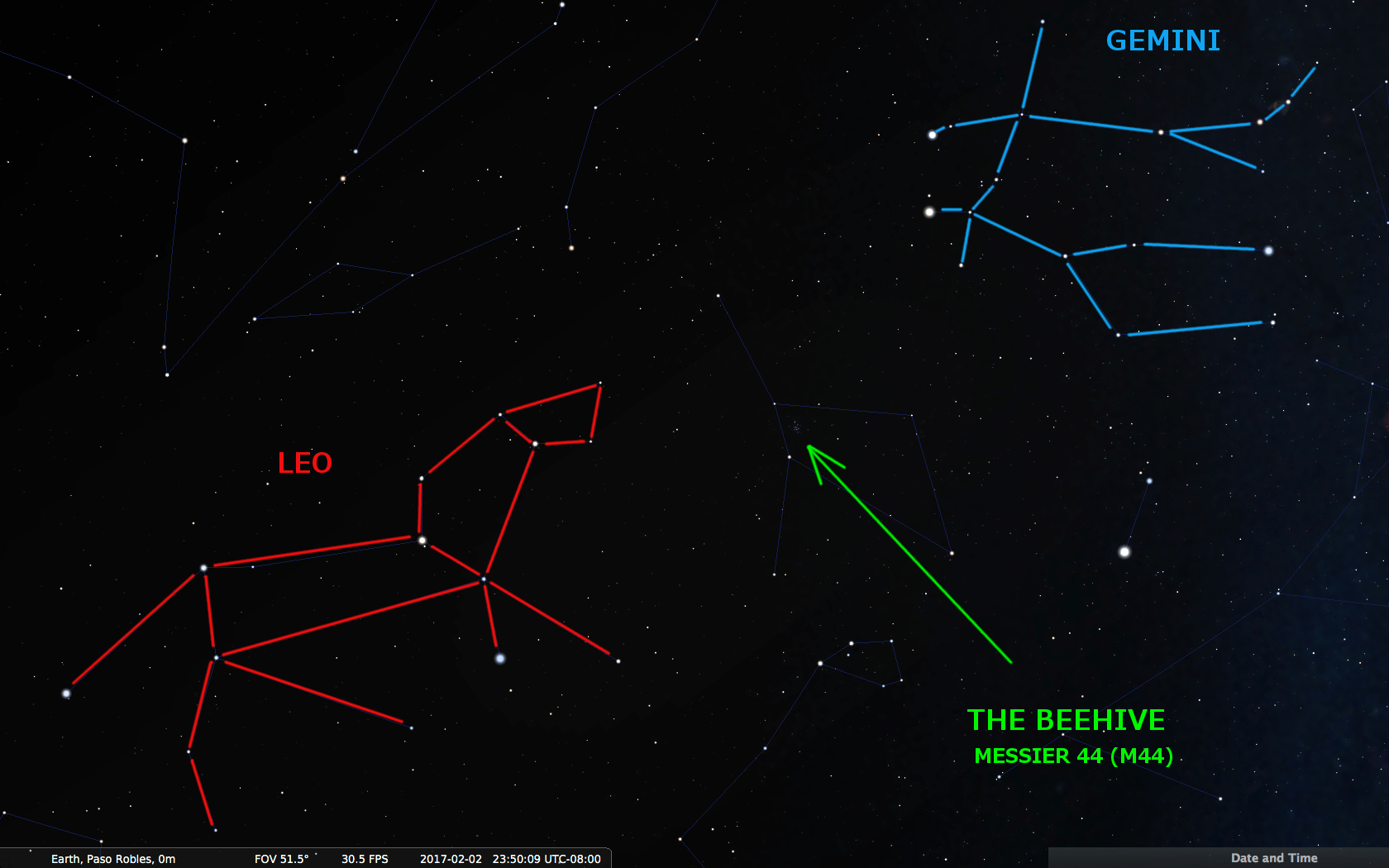
The best way to find the Beehive is to direct your gaze (with the naked eye) to a point about half-way between the head of Leo and the two bright stars that mark the heads of the Twins of Gemini (Castor and Pollux). If you look in about the right direction, I find that you can almost "sense" the presence of the Beehive, even if viewing conditions are not ideal.

However, to truly appreciate this tiny, dazzling cluster of stars it is certainly best to try to get to a dark place, away from city lights (if at all possible).

The Beehive is slightly closer to Leo than it is to Gemini -- it is not exactly half-way in between them. Also, as you can see from the diagram above, the Beehive is more aligned to the "level" of the muzzle of Leo than it is to the direction in which the outline of the Twins is pointing. Therefore, if you are able to locate both Leo and Gemini, look about half-way between them, but more towards Leo than Gemini, and more "on the level" of Leo than of Gemini.

In order to locate Leo, it is helpful to remember that Leo and the Big Dipper are kind of "geared" together in the sky, like two puzzle pieces which fit together but are set out on a table a few inches apart from one another, aligned to fit together but not actually connected. To see what I mean, take a look at this previous post describing the relative locations of the Dipper and the constellation Leo.

In order to locate Gemini, it is probably best to begin with the glorious constellation of Orion, who dominates the night sky during this time of year. This previous post discussing some of the mythological connections from this constellation in the myths of ancient Greece may be helpful in locating Gemini from the constellation of Orion.

Below is a diagram taken from the excellent, free, and open-source planetarium app called Stellarium (available at stellarium.org), which shows the night sky from the point of view of an observer in the northern hemisphere at about 35.6 north latitude, looking towards the south, at approximately 9pm or 2100 hours (the position of the circling sky will be slightly different for you depending on the details of your particular "time zone" and where within the band of that "time zone" you happen to be located when your watch says 9pm).

In the above diagram, east is to the left and west is to the right (because we are facing towards the south), and Orion is just crossing his highest point as he arcs across the sky above the line of "due south."

Note that he will actually appear much larger in the night sky than he does in the screen-shot above, because the planetarium feature on the Stellarium app will distort the size and shape of the constellations in order to create a "wrap-around" effect on the flat screen, such that constellations appear larger when they are on the left or right edges of the rectangular screen, and smaller in the center (to create the illusion of moving from the left to the right of the "dome" of the sky).

In any case, you can see that Leo is rising up out of the eastern horizon on the left edge of the screen -- this will actually be almost 90-degrees to your left if you are standing outside looking due south towards Orion. 

In front of the muzzle of the Lion is the Beehive Cluster, about half-way between Leo and Gemini. 

The Beehive is actually located within the constellation Cancer the Crab -- but this constellation is so dim (and has so few stars) that it is very difficult to see in the sky (it's easier to find the Beehive than it is to see the constellation of Cancer), and it would actually be more distracting to draw in the outline of Cancer the Crab on the image above than it would be to omit it for the sake of directing your attention to the location of the Beehive.

However, if you are able to look at the Beehive using binoculars or using a telescope (locate it with your naked eye first, of course) then you will see that this beautiful cluster of stars is in fact situated between two stars in the Cancer constellation -- and you can see these two stars in the image at the top of this post, if you look just above and below the left edge of the little "cloud" of stars that make up the Beehive, which is situated at the tip of the green arrow that I have drawn-in to the star chart. These two stars of the constellation Cancer will be very noticeable to you, if you use binoculars or a telescope to increase your appreciation of the Beehive.

If you are using binoculars to find the Beehive, I recommend that you lie down on your back and look up at the sky while doing so -- and it is probably best to rest the back of your head against the ground or lawn chair or car hood on which you are lying down, so that you can scan the area between Leo and Gemini in comfort until you locate the Beehive. Either that, or else you can hold the back of your head with your left arm while you hold the binoculars in front of your eyes with your right.

If you use a telescope to observe the Beehive, you will see that it is positively filled with stars, like a cluster of frog's eggs in the grass at the edge of a pond. If you wait until close to midnight, the Beehive will be very high in the sky, almost straight up, and so you will have to position your telescope to point almost vertical in order to find the cluster.

The Beehive has tremendous importance in the world's ancient myths. I have discussed some of these in previous videos, such as "Star Myths: 1,000 times more precious . . . " or "The Samson myth is all about YOU" (those two videos discuss the Beehive Cluster in conjunction with the Star Myths contained in the Old and New Testaments of the Bible, but this same cluster also plays an important role in many other Star Myths from around the world).

Because the Beehive is located in the constellation Cancer the Crab, and because the sun is moving through Cancer the Crab at the very "top of the year" (in the zodiac wheel as positioned during the ancient Age of Aries -- see discussion here for example), entering the sign of Cancer at summer solstice for the northern hemisphere, I believe that Cancer the Crab -- and the Beehive that is located in the "forehead" of the Crab -- have ancient mythical associations with the highest elevation of the spirit-nature.

The outline of Cancer the Crab has "outstretched" or "upraised" arms (as does the sacred Scarab symbol of ancient Egypt) -- and this is a traditional symbol of blessing in cultures around the world. I believe that blessing has to do with raising up the spiritual nature, in ourselves and in others -- reconnecting with the divine nature, reminding ourselves and others that we are more than just physical and material beings in a materialistic universe (the opposite action, cursing, is associated with trying to deny or obscure the divine nature in ourselves or in others, acting as though we or they are defined by the physical and animal nature and nothing more -- which is a lie).

Because the sign of Cancer the Crab is associated with the very pinnacle of the year and the "top of the zodiac wheel" (the point of maximum elevation of the spiritual nature, metaphorically speaking), I also believe that the Beehive Cluster, located in the "forehead" area of the Crab constellation, is a celestial analogue for the pineal gland in the human body, and for the elevation of the spirit nature associated with the highest chakras in the energy body.

Thus, the Beehive Cluster is important indeed -- and well worth gazing upon at this time of year, if at all possible for you. It is perhaps beneficial to bathe our upper chakras and "third eye" with the light from those distant stars, as often as we can do so!

I hope that finding and gazing upon the Beehive Cluster will be a blessing to you.

image: Wikimedia commons (link).


Note: Several previous posts have also endeavored to help readers to locate the Beehive Cluster. If you still need additional help to find it in the sky, try this onethis one, or this one.

No ban, no wall, no willful blindness to the "past"

No ban, no wall, no willful blindness to the "past"

image: Wikimedia commons (link).

image: Wikimedia commons (link).

The executive order signed at the Pentagon on January 27th (Friday) suspending the issuance of visas and other immigration benefits to all immigrants -- as well as green-card holders -- from Iran, Iraq, Libya, Somalia, Sudan, Syria and Yemen for ninety days, and suspending the entire refugee admissions program for one hundred twenty days, is of course reprehensible, and immediately drew outraged protests around the country today.

A judge in Brooklyn issued an emergency stay preventing enforcement of some of its provisions on January 28th (Saturday).

In his speech "But if not," the title of which is taken from Daniel 3: 18 concerning civildisobedience by the three youths to the order of Nebuchadnezzar, Martin Luther King, Jr. declared: 

Ultimately, you must do right because it's right to do right. You've got to say "But if not." You must love ultimately because it's lovely to love. You must be just because it's right to be just. You must be honest because it's right to be honest. [ . . .] You may be 38 years old, as I happen to be, and one day some great opportunity stands before you and calls upon to you to stand up for some great issue, some great principle, some great cause -- and you refuse to do it because you are afraid, you refuse to do it because your want to live longer, you're afraid that you will lose your job, or you're afraid that you will be criticized or that you will lose your popularity, you're afraid that someone will stab you or shoot at you or bomb your house, so you refuse to take the stand. Well, you may go on to live until you are 90, but you are just as dead at 38 as you would be at 90. And the cessation of breathing in your life is but the belated announcement of the earlier death of the spirit. You died when you refused to stand up for right. You died when you refused to stand up for truth. You died when you refused to stand up for justice.

And so it is of course right to stand up against the injustice of this executive order. But as heartening as the protests against it have been, and the publicity that opposition has received, the refugees and immigrants from those countries might be asking themselves where the outrage and the protests and media attention has been regarding the non-stop bombing, invasions, drone strikes, and "support for moderate rebels" over the past sixteen years. 

Those invasions, bombings, and drone strikes have killed and crippled multiple hundreds of thousands of innocent people (including women and children, infants and elderly alike) in Iraq, Libya, Yemen, and Syria (all countries named in the above order), not to mention Afghanistan, Pakistan, and many others -- and the level of protest against those killings and maimings has been almost nonexistent (particularly in contrast to the level of protest among the citizenry during the years of the Vietnam War).  

The executive order suspending issuance of visas and suspending the refugee admissions program, the full text of which can be seen here, explicitly points to the heinous attacks of September 11, 2001 as its justification -- naming those attacks in the first paragraph of section 1, and then repeating that date again in reference to "numerous terrorism-related crimes since September 11, 2001" in the paragraph immediately following.

The same heinous attacks continue to be referenced as justification for the unending invasions, bombings, regime changes, and drone strikes which the federal government of the united states has launched since that date.

And yet there should at this point be grave doubts -- including among members of the military who were present at the Pentagon during the signing of this order -- regarding the veracity of the assertion that (as the order says) "19 foreign nationals" brought down three modern steel-framed skyscrapers at the World Trade Center complex in New York City, and punched a hole through the Pentagon itself. 

In the immediate aftermath of those dreadful attacks, and the massive loss of life that those attacks caused, one could perhaps be expected to uncritically accept that narrative regarding "19 foreign nationals" -- but now, sixteen years later, the amount of evidence and the amount of serious analysis by engineers, architects and scientists which has been produced should suffice to cause everyone on earth to have serious questions regarding the official narrative of the events of that terrible day. For two videos examining just a small sample of that evidence, see this previous post from this past September 11th.

If the massive death and destruction on September 11th, 2001 was not in fact wrought by "19 foreign nationals" as we have been told, and as we continue to be told, then not only is this executive order suspending refugees and immigrants from those war-torn countries outrageous and unjust (and it is in fact both outrageous and unjust, even if you do accept that conventional narrative regarding the mass-murders on September 11th), but the non-stop invasions, regime changes, bombing operations, and drone strikes which also continue to use September 11th as justification are also outrageous and unjust and in fact unlawful and criminal (a case can be made that they are all of these things, even if you do accept the conventional narrative regarding the mass-murders on September 11th).

We should be protesting the executive order which is disrupting and endangering the lives of refugees and immigrants -- but how much more should we be protesting the enormous death and destruction that has been inflicted upon, and that continues to be inflicted upon, the men and women living in six out of the seven countries named in that ban, as well as upon men and women living in many other countries in that part of the world which are not named in the ban?

This weekend's events provide a particularly stark example of one way in which control over the narrative of history can be used to subvert human rights and justice -- and how the ghosts of "past history" which has not been honestly faced and examined will continue to haunt us here in the present moment. Because it isn't actually "the past" in that case, is it?

In the ancient myths, when a horrible crime or an affront to the gods is covered-over, instead of being faced and rectified, the divine realm will continue to send disasters, monsters, signs, and omens until the cause of the disfavor of heaven is discovered and corrected.

It is well and good to be outraged over the injustice of this particular executive order. But until we honestly face and confront the even larger and more terrible outrages and atrocities taking place in non-stop wars of aggression following immediately after September 11, 2001 and continuing to this very moment -- and until we honestly face and confront the terrible events of that awful day -- that outrage will fall short. 

And we will have to ask ourselves, as we listen again to the words of Dr. King from 1967 -- fifty years ago this November -- whether we are refusing to stand up for right, whether we are refusing to stand up for truth, and whether we are refusing to stand up for justice.

Chinese New Year, 2017

Chinese New Year, 2017

image: Wikimedia commons (link).

image: Wikimedia commons (link).

This January New Moon marks the beginning of Chinese New Year, which this year is the Year of the 雞 (the rooster or chicken-fowl in general, the tenth animal in the Chinese zodiac).

The observance of traditions tied to the cycles of the heavens and the alignment of our "motions" here on earth with the motions of the sun, moon, stars and planets is a way of acknowledging our connection with the cosmos around us and the truth of the dictum, "As above, so below."

And, because the heavens above (and the motions of the sun, moon, stars and planets) function as an analogue for the Invisible or Infinite Realm in virtually all of the ancient myths, scriptures and sacred stories found in virtually every culture on our planet, the observance of traditions tied to the cycles of the heavens and the alignment of our motions here below with those cycles is a way of acknowledging our connection with -- and dependence upon -- that Invisible or Infinite Realm.

In fact, the ancient myths can be seen to teach very clearly that everything in the material realm originates and flows from the Invisible Realm, the realm of the gods -- and that when we forget that fact or invert that order, disaster always ensues.

As I have written in previous posts, the Lakota holy man Black Elk, who grew up in a culture that was still connected with and patterned upon the ancient wisdom given to his people (before it was violently disrupted), explained that the immaterial realm was in fact "the real world that is behind this one, and everything we see here is something like a shadow from that world."

Hence, not only does Chinese New Year traditionally mark a tremendous movement of people returning to their family home to celebrate with relatives, it also has strong traditions associated with good fortune, with activities and symbols designed to invite good fortune, and with burning incense to honor one's ancestors.

This article describing some traditions associated with Chinese New Year even notes that it is considered inauspicious to cut one's hair during the fifteen days which begin at the lunar New Year (New Moon), or even for the entire month (just in case), which implies some perceived connection between hair and the spirit world as well (discussed in some previous posts such as this one, and made fairly explicit in some ancient myths such as those surrounding Samson in the Hebrew Scriptures and Dionysos in ancient Greece, among others, possibly including Rapunzel as well).

The observance of Chinese New Year traditionally lasts for fifteen days, culminating in the Lantern Festival. The fact that it culminates in the Lantern Festival, which has numerous symbols and traditions connecting it with the Full Moon, shows that the fifteen-day period in this case is almost certainly lunar in nature. Fifteen days after a New Moon will bring us to the night of Full Moon. For some discussion of the significance of the Lantern Festival -- and for a famous and beautiful poem involving the Lantern Festival -- see this previous post.

I would like to wish all who are reading this blog a very happy, prosperous, and healthy New Year: the Year of the Rooster!

Let's all do what we can to help John Anthony West

Let's all do what we can to help John Anthony West

I recently saw the following notification from Graham Hancock about a health issue facing John Anthony West, the pioneering "rogue Egyptologist" whose work has been foundational to the ongoing paradigm shift in understanding of humanity's ancient past, and John's need for help in his pursuit of treatments not covered by insurance plans:

It has become increasingly obvious that the body of evidence supports a very different view of human history than that advanced by conventional academia and by the organs of political and economic power which support and reinforce the proponents of the conventional view. The decades-long work and brilliant insights of the indefatigable John West have been and continue to be absolutely essential in exposing the flaws in the conventional ways of looking at ancient Egypt and in opening up new perspectives on Egypt -- and on humanity's ancient past.

You can search through this blog using the internal "search" function to find many, many posts in which I have made reference to his insights and his work. One of my favorites is this one from 2013, entitled "John Anthony West on creativity, discipline, and consciousness."

Another is this more recent post tracing some of the outcomes of questions he began asking publicly in the 1970s, which have changed the way we view the timeline of ancient history, and which have continued to be vindicated by startling new discoveries in the decades since.

If you are able to do so, please consider making a donation to help pay for the treatment that he is pursuing at the John Anthony West Project.

And, you might also consider sending a note of encouragement, as well as seeking help from the Invisible Realm, through prayer, meditation, chanting, or drumming -- or whichever you prefer of the many other ways available to us to avail ourselves of the connection to the Infinite, to which we have access at all times, according to the message repeated over and over in all of the ancient wisdom preserved in the myths and sacred traditions around the globe.

Please also send some good vibrations directed to his wife Celesta, son Zeke and daughter Zoe.

Stay strong, John! Your friends are with you!

The incredible antiquity of Yoga and of forms of internal alchemy

The incredible antiquity of Yoga and of forms of internal alchemy

image: Wikimedia commons (link).

image: Wikimedia commons (link).

In the volume containing his translation of the Tao Te Ching based on the Ma Wang Dui texts, Professor of Chinese Language and Literature at the University of Pennsylvania's Department of East Asian Languages and Civilizations Victor H. Mair includes an Afterword and an Appendix which make that volume, in addition to its excellent and accessible translation of the Tao Te Ching itself, an essential addition to every home library of those interested in the ancient wisdom of humanity.

Both the Afterword and the Appendix contain fascinating and insightful discussions of the parallels between the themes and imagery and cosmological outlook found in the ancient Taoist texts and the texts and myths of ancient India, including the Bhagavad Gita in the Mahabharata, as well as early  texts from ancient India dealing specifically with the practice of Yoga (a subject which is also mentioned in the Gita, as Professor Mair points out). 

But the comparison and discussion offered by Professor Mair goes far beyond just an examination of textual evidence to discuss the fact that both Taoism and Yoga can be shown, from antiquity, to "also share a close association with internal and external alchemy" (147).

The internal alchemy, in particular, makes use of meditation, mantras and "sacred syllables," and certain specific postures and movements such as Yoga in ancient India and Taoist movements and postures in ancient China -- and Professor Mair catalogs some of the evidence we have which points to the conclusion that such practices were in use in both cultures from a very ancient period.

In China, Professor Mair points to inscriptions dated to about 380 BC, found on pieces of jade, describing breathing practices describing the movement and cultivation of the "vital breath," and the importance of following the path of this vital breath during our life. 

He also points to a passage dated to about 250 BC, found in the parables of Chuang Tzu (also spelled Zhuangzi) which concerns the cultivation of the vital breath in conjunction with physical movements named after the movements of animals -- in very much the same way that Yoga asanas are named after the movements of animals. 

The passage in question, from Chuang Tzu chapter 15, is part of a section in which the Master is being somewhat critical of different groups of sages and scholars who are trying to pursue the Way (in his summary of this chapter, Professor Mair writes, "Censuring all disciplines and dogmas, ascetic or otherwise, the author propounds instead mere quietude and clarity," page 144). The section containing the description in question reads, in part:

Retiring to bogs and marshes, dwelling in the vacant wilderness, fishing and living leisurely -- all this is merely indicative of non action. But it is favored by the scholars of rivers and lakes, men who flee from the world and wish to be idle. Blowing and breathing, exhaling and inhaling, expelling the old and taking in the new, bear strides and bird stretches -- all this is merely indicative of the desire for longevity. But it is favored by scholars who channel the vital breath and flex the muscles and joints, men who nourish the physical form so as to emulate the hoary age of Progenitor P'eng.

If someone could be lofty without having ingrained opinions, cultivate himself without humaneness and righteousness, govern without merit or fame, be idle without rivers or lakes, and live long without channeling and flexions, he would forget everything, yet he would possess everything. His tranquillity would be unlimited, yet a multitude of excellences would follow in his wake. This is the Way of heaven and earth, the integrity of the sage. 

Therefore it is said, "placidity, mildness, quietude, indifference, emptiness, nonbeing, and non action -- these are the root of heaven and earth, the substance of the Way and virtue." Thus the sage rests in them. Resting, he is peaceful and easeful; peaceful and easeful, he is placid and mild. Hence worries and troubles do not assail him, pernicious influences do not assault him. Consequently, his integrity is intact and his spirit is undiminished. (From Chuang Tzu, translated by Victor H. Mair in his 2000 volume entitled Wandering on the Way, page 145).

Much can be said about the path Chuang Tzu is recommending, which goes beyond and even eschews the use of "channeling and flexions," but the point to be noticed (and the point which Professor Mair is making when he quotes the "bear strides and bird stretches" section in his discussion in the Appendix to his 1990 translation of Tao Te Ching, is the evidence of an ancient tradition involving postures and movements named after (and possibly modeled upon) the movements of animals and birds, and associated with the channeling of the vital breath and the pursuit of health and longevity.

In the Appendix to his translation of Tao Te Ching, Professor Mair then goes on to cite evidence of parallel practices and disciplines in ancient India, including detailed discussions of the cultivation of the vital breath using various meditative practices as well as asanas, in the Vedas (dating to 900 BC or before) and in the Upanishads (700 BC to 300 BC) and in the Yoga Sutras and Yoga Upanishads, dated to not later than the second century BC (discussion found in the Appendix to Professor Mair's translation of Tao Te Ching, pages 156 - 159). 

He also notes that specific asanas and postures are mentioned in Mahabharata, including "the mandukayoga (frog yoga) and virasana (posture of a hero)" (158 - 159).

Finally, to crown the evidence that these disciplines must be extremely ancient indeed, Professor Mair notes that "asana (postures) have been found represented on seals and statuettes from Mohenjo Daro and Harappa, sites of the Indus Valley civilization that date back to 2500 BC" (158).

Mohenjo Daro is one of the most ancient known archaeological remnants of a city on planet Earth,  and one of the most advanced of ancient cities, famous for its large size relative to other ancient cities, its precise layout, its use of standardized brick sizes, and its sophisticated and extensive plumbing system which included numerous baths -- possibly attesting to the importance of daily ritual bathing such as that described frequently in the ancient Sanskrit epics of Mahabharata and Ramayana.

The seals to which Professor Mair is referring have been alleged by some scholars to represent gods or humans engaged in postures which closely resemble Yoga asanas. One of the most oft-cited and famous of these is certainly the much-debated seal known as the Pashupati Seal, shown above.

While some scholars have since cast doubts upon the assertion that the Pashupati Seal represents early evidence of Yogic activity, a fascinating article written by Yan Y. Dhyansky entitled "The Indus Valley Origin of a Yoga Practice" and published in the scholarly journal Artibus Asiae in 1987 examines many of the counterarguments and then notes that most of the critics seem unaware of the difficulty of sitting in a posture such as the one shown in that seal (also known as Seal #420) and other similar seals (such as Seal #222 and Seal #235, in which nearly identical postures are indicated). 

More importantly, he also demonstrates that the critics invariably misidentify the asana which appears to be nearly identical to that shown on the ancient seals from Mohenjo Daro -- which Yan Dhyansky identifies as Mulabandhasana. He points to a photograph taken in the 1930s of the famous Guru, T. Krishnamacharya (1888 - 1989), seated in this exact asana, and notes its striking resemblance to the posture depicted in the Mohenjo Daro seal (to see the photograph from the 1930s juxtaposed with Seal #420, see this website dedicated to the teachings of Sri Krishnamacharya). 

You can also look at the photographs in the landmark book Light On Yoga by B. K. S. Iyengar, who studied Yoga under Sri Krishnamacharya in Mysore, India, to whom Sri Iyengar dedicated the book itself. As Yan Dhyansky points out in the article cited above, B. K. S. Iyengar has photographs on page 344 and 345 of Light On Yoga illustrating Mulabandhasana. There is also discussion of the steps for getting into this very challenging asana, as well as discussion of its benefits:

This asana exercises Muladhara Chakra, the prostate gland and gonads. It also has the wonderful effect of controlling excessive sexual desire and helps to save energy. It therefore controls and stills the mind. 346.

It would appear from the above evidence that the knowledge of specific disciplines related to cultivating the "vital breath" as well as aspects of what is referred to as "internal alchemy" may be very ancient indeed -- as old or even older than the earliest known ancient mythological texts we have available to us at this time (such as the Pyramid Texts of ancient Egypt and the Gilgamesh and other mythical texts from ancient Mesopotamia, both of which sets of texts are roughly contemporary to the Mohenjo Daro excavations). 

In the Afterword to his translation of the Tao Te Ching, Professor Mair writes of the numerous parallels between the distinctive aspects of the ancient Yogic traditions and the ancient Taoist traditions that:

if Indian Yoga did not exert a shaping force upon Chinese Taoism, the only other logical explanation is that both were molded by a third source. Since no such source is known, we can only assume an Indian priority and wait for additional data from future archaeological discoveries. 146.

That passage was published in 1990; since then, the excavation of Gobekli Tepe, and the dating of the site's completion to the incredibly ancient date of 10,000 BC, has opened up a whole new perspective on humanity's ancient past (although its revolutionary impact has yet to fully ripple through and shake up all of the conventional narratives and scholarly structures built upon the older models of history). Although there are no signs (as yet) of asanas being depicted in the artwork found at Gobekli Tepe (as far as I know), the existence of this site certainly speaks to the possibility of an advanced ancient civilization (or civilizations) or ancient culture (or cultures) so far back in time that they might serve as the common ancestor for some of the parallels we see across different cultures that are otherwise difficult to explain.

Furthermore, the existence of undeniable parallels between ancient myths, scriptures and sacred stories found around the world, and the evidence that they are virtually all based upon a shared system of celestial metaphor (a very sophisticated system, and a world-wide system, evidence for which is explored in my books and many blog posts), also points to the possibility of an ancient common predecessor or source-culture. 

The evidence that Gobekli Tepe was deliberately buried, a massive task, not later than 8,000 BC also points to the possibility that the extremely ancient culture (or cultures) might have been wiped out or at least severely disrupted by some sort of disaster, natural or man-made. Professor Robert Schoch has been pursuing the implications of this important piece of evidence in his own research and recent books, such as Forgotten Civilization.

Hypotheses such as those which Dr. Schoch has put forward, in which a sophisticated and extremely ancient predecessor civilization was forced to literally "go underground" for centuries or even millennia in order to survive, might explain the appearance of advanced spiritual traditions such as the Yogic tradition and its associated understanding of "inner alchemy" in some of the earliest cities known to scholars at this time, such as ancient Mohenjo Daro.

I would also posit that clear traditions within disciplines such as Yogic and Taoist meditation of associating various "meridians" and "energy points" in the human body (including the chakra system) with meridians on our planet and with celestial bodies such as the sun, moon, and visible planets points to a connection between these ancient disciplines and the ancient wisdom contained in the myths, and encoded in terms of metaphors which associate the Invisible Realm with the motions of the sun, moon, stars and visible planets in the heavens above.

Whatever the answer to this ancient mystery might be, it is clear that practices such as Yoga, Taoist meditation and internal alchemy, breath work, certain martial arts (especially the "internal" martial arts), and practices such as what is today called chi gung or qigong, may be extremely ancient -- stretching back at least to the time of Mohenjo Daro, more than 4,500 years ago, and perhaps several millennia before that.

This is something to contemplate as you perform your daily asanas (if you have a Yoga practice) or your daily meditation -- and something to consider, if you do not now practice any of those ancient disciplines, but have been thinking of giving one of them a try.