Celestial correspondences in the Pylos Combat Agate connect it to myths and art around the globe

Celestial correspondences in the Pylos Combat Agate connect it to myths and art around the globe

Top image of Pylos Combat Agate from Wikimedia commons (link here), colorized. Bottom image by the author, using stars from the free open-source planetarium app Stellarium.

Top image of Pylos Combat Agate from Wikimedia commons (link here), colorized. 
Bottom image by the author, using stars from the free open-source planetarium app Stellarium.

Previously, I wrote about the amazing and newly-discovered artifact found in the region of Pylos (on the western edge of the Peloponnese), an agate measuring just 37 millimeters across, upon which an ancient artist (or team of artists) had inscribed a combat scene featuring three figures, with a level of anatomical detail and artistic sophistication that has astonished scholars and art historians

The find, dubbed the Pylos Combat Agate, was one of thousands of artifacts contained in a (previously) undisturbed shaft-grave identified as that of a warrior from the Mycenaean civilization and thought to date to approximately 1,500 BC. The archaeologists who worked on the excavations dubbed the warrior who was buried in the grave the "Griffin Warrior," after an ivory plaque with griffin artwork which was found between the legs of the body (see discussion in this fascinating article from the Smithsonian magazine, published in January of 2017, before the limestone-encrusted artwork on the Pylos Agate had been cleaned-off and revealed to the world again after 3,500 years).

One of the archaeologists who led the team involved in the discovery and excavation of the tomb and the discovery of the gemstone, Shari Stocker, stated: "This seal should be included in all forthcoming art history texts, and will change the way that prehistoric art is viewed" (cited in this article from the Telegraph). 

I could not agree more: this find does indeed rank as an extremely important discovery -- all the more so because the artistic conventions in the incredibly small and detailed sealstone image can be shown to match other artwork which corresponds to specific constellations in the night sky, and that this previously-unknown piece belongs to an ancient tradition of reflecting the heavens in art and in myth, a tradition which is found literally around the globe.

When the first images of the Pylos Combat Agate were published, I immediately noticed that the artwork appears to embody aspects of the constellations Hercules, Ophiucus, Scorpio and Sagittarius, in ways that are found in other artwork from other cultures and other centuries. Here is a link to a paper which I wrote within a few hours of seeing the images of the Pylos Agate for the first time, in early November. 

Unfortunately, no scholarly journals devoted to archaeology or ancient history to which I submitted that paper were interested in publishing it. Eventually, a shortened version was published in a popular online magazine, Ancient Origins, which you can read here.

However, due to the limitations of space and scope, neither of those two articles showed the full range of the evidence which supports the conclusion that the scene on the Pylos Combat Agate is patterned upon celestial foundations, and that it displays unmistakable correspondences to mythological details ranging from the Hebrew Scriptures to the Maui cycle of the cultures of the Pacific Islands.

A more complete discussion of those correspondences has now been published on this pageof my primary website, www.starmythworld.com, and that discussion can also be reached via the "Resources" page of that site (a link at the bottom of any page of the site will take you to the "Resources" page).

That discussion shows that the figures on the Pylos Agate line up with the constellations Hercules, Ophiucus, Corona Borealis, Scorpio, and Sagittarius -- correspondences which are also explained in the other two previous essays linked above, my unpublished paper and the shorter article in Ancient Origins. But it also shows that specific conventions found in the Pylos Agate artwork from 1500 BC can be shown to be part of a tradition of celestial correspondences which continued to appear in fine artwork for more than two thousand years after the Pylos Agate was sealed within the tomb of the "Griffin Warrior."

For instance, the figure I call "the Swordsman" in the Pylos Agate artwork (shaded in red on the illustrations in my previous articles and in the image of the sealstone shown above) can be seen to be grasping the curved crest of the helmet of the figure I refer to as "the Spearman."

pylos+detail.png

This detail, in addition to the general outline of the Swordsman's body posture, confirms that the Swordsman corresponds to the figure of the constellation Hercules in the night sky -- for Hercules is located very close to the brilliant arc of stars which form the Northern Crown (Corona Borealis), and there are numerous myths from around the world in which a figure who corresponds to Hercules grasps a figure which corresponds to the Northern Crown.

Among those myths, which I have written about in previous posts, are the story of the Judgment of Solomon from the text of 1 Kings chapter 3, in which Solomon instructs a swordsman to cut a living baby in two (see previous post here and video here):

image: Wikimedia commons (link).

image: Wikimedia commons (link).

In the above painting, from the 1600s, we see a powerful swordsman with a sword held over his back, grasping an infant by the heel. The infant is arching his body vigorously -- as infants will indeed do when they are upset. The swordsman in this case corresponds to the constellation Hercules, and the arching infant corresponds to the Northern Crown, or Corona Borealis, which is close enough to Hercules in the night sky for us to imagine the constellation reaching out to grasp it.

Other myths from around the world also feature a Hercules figure grasping an infant -- notably, the story of baby Maui from the Maui cycle of myths found across the cultures of the islands of the vast Pacific Ocean, from Hawai'i to Aotearoa (New Zealand). In the Maui stories, baby Maui is described as being thrown into the sea foam by his parents, who do not want him. The child is protected by seaweed and jellyfish so that he does not perish, until his mighty grandfather Tama of the Sky rescues the abandoned baby Maui and hangs him up in the rafters to dry above the fire.

In that myth, Tama is again Hercules, and the baby is Corona Borealis (which is indeed located high up in the "rafters" of the sky, not far from the north celestial pole). The fire in this case corresponds to the smoky column of the Milky Way galaxy, which rises up towards Hercules as can be seen in the star chart at the top of this post.

Other myths and stories involving Hercules grasping Corona Borealis which have been discussed in the pages of this blog (as well as in books I have written which were published long before the Pylos Combat Agate artwork was revealed) include the "rapture" described in Revelation chapter 12 (see discussion in this previous post and in this previous video), as well as the story which begins the entire cycle of tales in the Thousand Nights and a Night (also known as the Thousand and One Nights, or the Arabian Nights), in which Shah Zaman departs from his palace to visit his brother King Shahryar, but forgets a string of jewels which Zaman had intended to bring with him as a gift.

When Shah Zaman returns to get the necklace, he discovers his wife in the act of having sexual relations with another man, and immediately draws his scimitar and cuts both his wife and her lover in half (cutting "the two into four pieces," as the text says). Once again, a figure who is reaching for a string of jewels while swinging a mighty sword can be seen to correspond to Hercules and the shining arc of the Northern Crown, as discussed in these two previous posts from October of 2014 (here and here).

Other figures in the Pylos Agate also have correspondences to constellations, as well as to artwork found in cultures around the world. As discussed in my earlier articles linked above, the Spearman has clear correspondences to the outline of the constellation Ophiucus in the night sky. Ophiucus is located immediately below Hercules in the heavens, and thus it is understandable that in some mythical episodes he corresponds to a figure who is slain by a Hercules figure (although in other myths Ophiucus corresponds to a descendent of a Hercules figure, which is also understandable and reveals intriguing aspects of this ancient world-wide system of patterning myths on the stars).

In my book Star Myths of the World, Volume Three (Star Myths of the Bible), published in 2016, I provide an extended discussion which argues that the giant Goliath, slain by David with his sling, corresponds to  the towering figure of Ophiucus in the night sky. There are numerous details in the description of Goliath in the scriptural text (specifically in 1 Samuel chapter 17) which reveal that Goliath corresponds to Ophiucus, including the description of his armor. Note that the Spearman in the Pylos Agate scene is also heavily-armored, and that (like Goliath) he carries a spear.

In the confrontation between David and Goliath, David wields a sling -- and the weapon brandished above the head of the constellation Hercules could easily be envisioned as a sling rather than as the sword or club it usually plays in other myths. Furthermore, after David has stunned Goliath with a stone from his sling, the text describes David as taking the mighty sword of Goliath and cutting off his head. Below is a painting of David slaying Goliath from about the year 1616, in which David can clearly be seen to be portrayed in a manner which corresponds to the outline of Hercules:

image: Wikimedia commons (link).

image: Wikimedia commons (link).

Note that David in the artwork above has placed one foot on the side of Goliath's head -- a detail which can be seen to correspond to the outlines of Hercules and Ophiucus in the heavens (see star chart at the top of this post).

This correspondence shows that the identification of the Swordsman and the Spearman in the Pylos Combat Agate scene with the constellations Hercules and Ophiucus (respectively) is well-founded, and that it also aligns closely with sacred stories from other cultures (as well as with artistic conventions which appear to have continued to be employed for thousands of years after the Griffin Warrior was laid to rest in his tomb).

My previous articles also demonstrate that the goddess Athena almost certainly corresponds to Ophiucus in the heavens. It is well known that artwork depicting Athena often depicts her with a helmet, a spear, and the fringed Aegis -- and a close look at the Pylos Combat Agate will reveal that the Spearman is also depicted as wearing a helmet, wielding a spear, and wearing a sort of fringed garment which can be seen beneath his shield, between his legs.

Finally, the outline of the third figure in the Pylos Agate artwork, whom I refer to as the Fallen Warrior in the scene, can be seen to be depicted with details which correspond to the features of Scorpio and Sagittarius in the heavens, both constellations which are located beneath both Ophiucus and Hercules in the night sky.

As noted in my earlier articles, the constellation Scorpio plays the role of a wounded warrior in other ancient myths, as well as in ancient artwork such as the scene on the Greek bell-krater from the early sixth century BC depicting Artemis slaying the unfortunate young hunter Actaeon:

artemis actaeon sagittarius scorpio.jpg

The correspondences between the figures of Artemis and Actaeon from the ancient artwork and the figures of Sagittarius and Scorpio in the heavens should be obvious.

Additionally, the arrangement of the arms of the Fallen Warrior in the artwork on the Pylos Combat Agate show that the ancient artist (or artists) was using artistic conventions for figures associated with  this region of the sky in other artwork from other centuries, depicting sacred stories from other cultures.

Specifically, I have previously argued that the convention of draping a hand over the head corresponds to the constellation Sagittarius, and that it has to do with the "plume" or line of stars which we can see rising up on the left side of the outline of the head of Sagittarius in the above image (and in the star-chart at the top of this post).

Below is a painting from the year 1665 of the episode in Genesis commonly referred to as "Jacob's Ladder" or "Jacob's Dream," in which Jacob has a vision of a stair or ladder reaching from the earth up to the heavens, and angels ascending and descending upon it (Genesis 28). Jacob is asleep with his head upon the stone at the lower left corner of the painting, in red:

image: Wikimedia commons (link).

image: Wikimedia commons (link).

Note the configuration of the arms of the figure of Jacob as depicted by artist Salvatore Rosa (1615 - 1673) and compare them to the positioning of the arms of the Fallen Warrior in the scene from the Pylos Combat Agate from 1500 BC (or earlier). The correspondence could not be more compelling!

In Star Myths of the World (2016), I spend some time discussing the celestial details in the above painting, and in other depictions of the Genesis 28 episode of "Jacob's Ladder." Artist Salvatore Rosa has clearly envisioned Jacob as corresponding to the position of Sagittarius in the night sky, and the ladder stretching to heaven is of course the shining band of the Milky Way galaxy, which rises up between Sagittarius and Scorpio. The brightest and widest part of the Milky Way is found just above the point where it passes between Sagittarius and Scorpio -- this brightest, widest portion corresponds to the Galactic Core -- and you can see that Salvatore Rosa has painted the clouds in a manner which is suggestive of that very portion of the Milky Way.

The angels which the scriptural text describes as ascending and descending upon the ladder in Jacob's Vision almost certainly correspond to the winged figures of the constellations Aquila and Cygnus, the two great birds of the Milky Way galaxy, one of which can be seen to be flying upwards (or ascending) in the Milky Way band, and the other of which can be seen to be flying downwards (descending). This detail, as well as others in that text, confirm that the sleeping Jacob corresponds to either Sagittarius or Scorpio (or perhaps a combination of the two).

Below is another example, this time from a painting of Bathsheba at her bath, by Artemisia Gentileschi (1593 - 1656):

image: Wikimedia commons (link).

image: Wikimedia commons (link).

This is another painting which I discuss at some length in Star Myths of the Bible (see for example pages 156 - 157 and 530 - 535). Bathsheba almost certainly corresponds to the constellation Sagittarius in the night sky, and I should not have to point out that the positioning of her arms once again corresponds to the positioning of the arms found in the artwork on the Pylos Combat Agate for the figure of the Fallen Warrior.

It is certainly remarkable that this artistic convention appears to be in use in artwork conceived before 1500 BC and in artwork conceived in the 1600s AD (and later)!

Taken together, they form compelling evidence for the existence of a worldwide system of celestial metaphor which informs ancient myth and ancient artwork in cultures literally around the globe and across vast gulfs of time.

The fact that the Pylos Combat Agate was not even unearthed until after I had written about these correspondences makes it an extremely conclusive piece of confirmatory evidence for the widespread operation of this system in antiquity. Added to the fact that it such an early piece of artwork, and such a technically and artistically sophisticated artifact, the Pylos Combat Agate becomes a truly paradigm-shifting discovery.

I wholeheartedly agree with lead archaeologist Shari Stocker when she says that, "This seal should be included in all forthcoming art history texts, and will change the way that prehistoric art is viewed."

In fact, when seen in the context of the world-wide system of celestial metaphor of which it is a stunning example, the Pylos Combat Agate should change the way we view all of ancient history.


Winter solstice, 2017

Winter solstice, 2017

image: Wikimedia commons (link).

image: Wikimedia commons (link).

The earth will pass through the point of December solstice this year on December 21, at 11:28 am eastern time for the northern hemisphere, which is 8:28 am Pacific time and 16:28 UTC.

This marks the winter solstice for the northern hemisphere (and the summer solstice for the southern hemisphere), the point where the sun on its annual journey finally turns back around and begins to travel back upwards towards the summer solstice (and for those in the southern hemisphere, where it turns downward and begins its descent towards winter solstice).

The day contains great spiritual symbolism in the ancient mythological systems that form the inheritance of virtually all the cultures on our planet, for the heavenly cycles are given spiritual significance in order to convey truths regarding the Invisible Realm, and our innate connection to it. The descent of the sun's journey into the "lower half" of the year (beginning at the fall equinox and continuing down to winter solstice and then back up to spring equinox) was used to describe the plunge of the divine and undying soul into matter during this incarnate life, and the winter solstice represents the awakening of the awareness of the divine nature and the subsequent elevation and greater integration with our Higher Self.

Many previous posts have observed that in the ancient Egyptian cycle of Osiris, Isis and Set, the god Osiris is slain by Set and imprisoned in a casket, around which a tree later grows which then becomes the pillar of a king's palace, until Isis finds her beloved after an extended search and restores him to life. The death and restoration of Osiris create a picture of the "horizontal" and "vertical" components of the year, the first representing the plunge down into matter (and the "loss" of the divine spark in the physical nature) and the second representing the restoration of the connection to the divine and the rebirth of the god.

I have also previously written that this "casting down" of the Djed column of Osiris and its later "lifting back up" appear to be displayed for us in the annual and ancient traditions of the Yule log and the Christmas tree found all across the cultures of the European continent -- with the Yule log being an enormous trunk which would be dragged into the home and lit at the winter solstice, using remnants from the previous year's Yule log, and which would then be kept burning for a specified time, thus visually and immediately presenting us with an image of the mortal and physical nature being vivified by the fire of the divine and spiritual nature, a truth which relates to the experience of each and every man and woman in this incarnate life.

The English monk and historian Bede, also known as the Venerable Bede and spelled Baeda in Old English, who lived from about AD 672 to 725, gives us a valuable insight into the origin of the term "Yule" in his text on "The Reckoning of Time." There, on page 54 of the text linked, Bede explains that the English peoples prior to the arrival of Christianity designated two months by the name "Giuli," one month being the month leading up to the day of the winter solstice and the other being the month which follows it. 

This word, "Giuli," can be seen as having a linguistic connection to the word "Yule," and Bede says that they call these months by that name because that word refers to the day that the sun turns back and begins to increase. Thus, the name "Giuli" or "Yule" refers specifically to the winter solstice, and to the turning-point of the sun on its annual cycle.

We can see that this name has linguistic connections to other ancient names connected to the sun, including Helios in ancient Greece, and all the divine names which are associated with the divine name El.

For previous posts discussing many of the profound truths associated with this great turning-point of the year, and its significance to our lives, see for example:

It is also significant that Bede tells us that in ancient times the day of the start of a new year, which followed winter solstice and was celebrated on the day corresponding to the 25th of December, was known as the "Mother's night." He writes: "That very night, which we hold so sacred, they used to call by the heathen word Modranecht, that is, 'mother's night,' because (we suspect) of the ceremonies they enacted all that night" (53). 

This tradition clearly relates to the concept of "Two Mothers" which is also found in myths and sacred stories from around the world, and which involves the concept of the "second birth" or "spiritual birth" -- the first being our birth into the physical nature of the body and the second having to do with the rediscovery of the divine nature, and the journey to reconnect and elevate our awareness of and integration with that inner connection to the Infinite. Although Bede tries to indicate that this concept is "heathen," in fact the celebration of the birth of the divine Christ on this day is clearly connected to this concept of the "second birth" and the "Two Mothers."

Wishing you peace and blessings on this significant day of solstice, 2017!


The Pylos Combat Agate should radically alter our understanding of humanity's ancient past

The Pylos Combat Agate should radically alter our understanding of humanity's ancient past

image: Wikimedia commons (link).

image: Wikimedia commons (link).

Special thank-you to a colleague on Twitter who sent me a link to this article about the newly-discovered Pylos Combat Agate (pictured above) soon after the incredible artifact was first revealed to the public last month.

Upon seeing an image of this ancient treasure, I immediately realized that the artwork on the gem, which scholars believe dates to 1500 BC, contains constellational references similar to those found in other ancient artwork from ancient Egypt, ancient Mesopotamia, ancient Greece (most of the ancient Greek artwork dating to around a thousand years later than the Pylos Agate, which may be Minoan in origin), and other ancient cultures.

My illustrated article describing these celestial relationships in the figures on the Pylos Agate has just been published in Ancient Originshere.

The Pylos Combat Agate is a discovery of great significance. The entire stone measures only 3.4 centimeters, or 1.4 inches, in length, according to the University of Cincinnati articlelinked above -- and the level of detail, and the quality of the artwork, is astonishing. The fact that it depicts a scene which can be decisively linked to specific constellations (namely, Hercules, Corona Borealis, Ophiucus, and Scorpio / Sagittarius) is new and powerful confirmation of a pattern that I have observed in later artwork from ancient Greece (see for example here and here), as well as in artwork from other ancient cultures.

In fact, as the second essay linked in the previous sentence argues (entitled "The predictive power of the Star Myth system"), the ability of a hypothesis to make "predictions" in advance of a discovery is a strong indicator that the hypothesis is correct. The fact that this incredible piece of ancient artwork, which was unknown to the world during the time that I was analyzing the connections of other ancient artwork based on these same constellations, has now surfaced showing some of the very same constellational connections (and on an artifact completely unlike anything else scholars had previously seen from the Minoan and Mycenaean cultures) should have academics looking into the abundant evidence which shows that the world's ancient myths, scriptures and sacred stories -- and the fine art associated with them -- are based upon an even more ancient system of celestial metaphor.

Readers of this blog may recognize that the pattern in the Pylos Combat Agate bears some clear parallels to depictions of the famous scene known as the "Judgment of Solomon" from 1 Kings chapter 3 in the Hebrew Scriptures (also commonly referred to as the Old Testament of the Bible). Here is a blog post I published back in January of 2015 containing numerous paintings by artists down through the centuries incorporating the same celestial references to Hercules and Corona Borealis that I believe form the basis for some of the features in the Pylos Agate. 

And here is a link to a post I wrote after an interview from late 2016 with Alex Tsakiris of Skeptiko, showing ancient artwork from around the world that I believe to be based on the outline of the constellation Hercules in the night sky, and which includes an image from ancient Mesopotamia thought to depict Gilgamesh or Enkidu, and an image of the god Hanuman of ancient India.

Hundreds of other discussions of the connections between ancient artwork and the constellations -- and between ancient myth and the constellations -- can be found in previous essays posted in this blog, as well as in my books. For new visitors to this site or those unfamiliar with my work, you can find sample content of the books in the "Books" section of my primary website, as well as discussions of dozens of myths in the "Myths" section of the same website, and numerous videos in the "Videos" section as well. Additionally, this blog is fully searchable (and now contains over a thousand posts, many of them discussing the connections between the myths and the stars).

Scholars involved with the discovery of the Pylos Combat Agate are already saying that it is changing the way we look at history. I believe that the previously unnoticed correspondences between the artwork on the Pylos Agate and the constellations in our night sky -- correspondences which connect this incredible artifact to ancient artwork and ancient myths from other cultures around the world, even as far away as the cultures of Aotearoa (New Zealand) and the cultures of the islands which stretch across the vast Pacific -- should also create a complete paradigm-shift in the way we look at history.

The Pylos Combat Agate is yet another startling piece of evidence that the conventional understanding of humanity's ancient past stands in need of serious and radical reconsideration.

Skies Over Grimerica: Night Skies and Star Myths for December, 2017

Skies Over Grimerica: Night Skies and Star Myths for December, 2017

I had the opportunity to visit with Darren and Graham for another installment of "Skies Over Grimerica," this time focusing on the stars and heavenly cycles we can observe during the month of December (2017).

During this month's segment, we talked about the best nights for star-gazing in December, the best nights for viewing the Geminid meteor shower, the location of visible planets and why we see Mars and Jupiter in the east prior to sunrise this month, the spiritual meaning of the winter solstice (which, for viewers in the northern hemisphere, corresponds to the December solstice later this month), some of the celestial aspects of the Christmas story as recorded in the gospel accounts, and importance that the world's ancient myths ascribed to the "great turning point" of the winter solstice.

I hope that this segment will help you to go out and enjoy some of the beautiful winter stars for yourself, if at all possible.

Apologies if some of the planetarium images are a little small -- for best results, I recommend watching the video on a laptop or desktop or even larger screen. However, the main thing is to get out to the "infinitely large screen" of the heavens themselves, if it is possible for you to do so.

Thanks again to Graham and Darren for graciously inviting me back to the famous Igloo. I look forward to future installments of the "Skies Over Grimerica" feature.

You can also check out Grimerica's new Aeronautical and Space Administration, which is attempting to launch cameras to an altitude of 40 kilometers or 25 miles (whichever is higher and more impressive) in order to try to observe the curvature of the earth -- and sign up to help fund and be part of this historic adventure yourself, if you are able to contribute to the effort in any way.


---------------

For those wishing to read further about some of the concepts discussed in this month's episode, here are a few links to previous posts:


Monetary imperialism and its links to the privatization of natural resources and even the selling of rivers

Monetary imperialism and its links to the privatization of natural resources and even the selling of rivers

image: Wikimedia commons (link).

image: Wikimedia commons (link).

Last week, Professor Michael Hudson published an important article in Counterpunch entitled "Monetary Imperialism."

It provides a sweeping overview of monetary history from World War I to the present -- which may not sound like a very interesting subject, until you realize that he is explaining the outlines of the political and economic system which has framed a hundred-year period marked by the overthrow of any nations which attempt to restrict the takeover of their peoples' natural resources and their sale to private parties, and (through the lever of foreign-currency debt) the imposition of austerity upon their populations (including the removal of public services, the reduction of pensions, and the sale of utilities, ports, airports, and even rivers and waterways to private "investors," who stand to make a fortune from these assets).

As such, Professor Hudson's article is worth reading and re-reading very carefully and deliberately in order to try to grasp the framework that he is describing, and how it leads directly to consequences that are all too familiar in the world around us.

He explains that after the cessation of open hostilities in 1945 at the end of World War II, the united states controlled seventy-five percent of the world's gold stock. This situation led to the united states dollar becoming the reserve currency, "freely convertible into gold at the 1933 parity of $35 an ounce." And, because other governments wanted to have either gold (largely controlled at that time by the united states) or dollars (which were "as good as gold" and could always be turned into gold at a fixed rate) to back their own currencies, those countries that wanted to participate in the system found that there were a few strings attached when it came to obtaining gold or dollars: they had to accept the trade and investment rules dictated by the united states.

Professor Hudson explains: "These rules called for relinquishing control over capital movements or restrictions on foreign takeovers of natural resources and the public domain as well as local industry and banking systems."

That sentence deserves to be read very carefully for all the points that it is making. It explains how the gifts of nature (or the gifts of the gods) to the people of a country -- such as the waters, the woodlands, and the mineral wealth beneath the surface of the earth -- were privatized (largely by individuals and corporations operating across boundaries and originating in other countries), so that the benefit of those natural riches accrued to a small group of people (from other countries) instead of to the people to whom nature (or the gods) had given those gifts.

However, the reader is probably aware that the united states dollar is no longer readily convertible into gold at the fixed price of $35 an ounce -- that framework ended a long time ago (in 1971), as Professor Hudson's article explains. You will get a lot less than one ounce of gold if you try to convert $35 into gold today. The gold window was closed after the united states spent so much of its gold on military actions around the world beginning in the early 1950s and accelerating in the 1960s, as Professor Hudson explains.  

However, instead of being a defeat for the united states, the severance of the united states dollar's link to gold "was just the reverse of a defeat," Professor Hudson says. Those other countries could no longer easily turn their dollars into gold (and, as Professor Hudson notes, anyone trying to do so met with strong disapproval from the US), so they turned them into united states treasury bills and bonds instead -- and that is the situation that largely continues to this day.

What the reader must understand (and what Michael Hudson points out in his article) is that holding united states treasury debt is the same as making a loan to the united states, without any say in how the proceeds of the loan are used. Thus, the international landscape actually became even more dominated by the united states, which could still dictate that nations had to open their public domain and natural resources and industrial companies and banking firms to foreign takeovers by private individuals and corporations, and at the same time could rely on low-cost loans to finance its own military buildup and reduction of tax rates.

Towards the end of the article, in a section with the heading "US Neoliberalism Promotes Privatization Carve-Ups of Debtor Countries," Professor Hudson explains that the strong economies of industrialized countries like America and Germany were originally founded on "public investment in economic infrastructure," in which prices for essential services such as water and education were subsidized and kept to a minimum (or even provided freely). 

"The aim," Professor Hudson explains, "was to lower the price of living and doing business by providing basic services on a subsidized basis or freely." But after the implementation of neoliberalism, public sectors are "privatized and planning turned over to rent-seeking corporations" -- and the united states is now leading the way in exporting this neoliberal privatizing vision around the globe. 

"The price of resistance," he notes, "involves risking military or covert overthrow." The united states has a demonstrated history of overthrowing democratically-elected governments which oppose privatization of public domain and natural resources, as well as of protecting authoritarian governments which are open to giving away their country's natural wealth and resources (given by nature, or by the gods, to the people of those lands) to privatization. Authoritarian regimes have been invaded and overthrown as well, to be sure -- but the unbroken track record since the end of World War II demonstrates unequivocally that the criteria for the implementation of covert or overt overthrown is whether a nation's government resists privatization of public resources and the public domain or whether that government is open to such privatization. Such overt and covert actions have nothing whatsoever to do with "supporting democracy."

The economic aspect of this system is not very well understood. It is extremely rare to find anyone who can explained it with the clarity that Michael Hudson explains it -- and who can, in addition, bring a rich understanding of the history of economic thought and the debate over these issues stretching back over centuries (and indeed over millennia) that he also provides in his published writings, interviews, and lectures. 

And, while the question of reserve currencies and treasury debt may seem to be far removed from the profound ancient wisdom contained in the world's myths, scriptures, and sacred stories, the question of the privatization of the natural resources and public domain that we see taking place in the world around us at an ever-increasing pace is very much a manifestation of the rejection of that ancient wisdom given to all people around the world. I have discussed this subject in numerous previous posts, including:

And so, what may seem at the outset to be a dry and unappealing subject -- the monetary history of the world since the end of World War I, and the question of reserve currencies and the holding of united states treasury securities in reserves of nations wanting to be part of the international monetary system and trade -- opens a window on the privatization by a few of what actually belongs to the gods, and thus to the people (in whom, the ancient wisdom explains, the gods are present, and at whose birth, the ancient myths tell us, specific divinities -- usually goddesses -- are always present).

The ugly and life-depriving effects of this privatization (note that "deprive" and "private" come from the same root -- a fact Professor Hudson points out elsewhere) is perhaps most dramatically seen when governments who are collaborating with the forces of neoliberalism sell off entire rivers. Here is an article from 2011 about the sale of rivers in India to corporations, who promptly fence them off, barricade their flow and divert it for use in mining, and hire guards to prevent the people from using the water for cooking, cleaning or fishing as they and their parents and ancestors have done for centuries. 

And a similar thing has also been happening in Central and South America, where rivers may not be  blatantly sold off to corporations by the collaborating governments, but where they are "de facto" given over to mining companies, who then barricade them off, prevent the people from using or even accessing the water, and divert their flow to generate power used for mining operations. See this story from early 2016 about the murder of Berta Cacares, who was a vocal leader in the opposition of such privatization of the rivers of her people. As that article shows, she urgently called on humanity to wake up to what is going on, saying: "!Despertemos, humanidad!"  

Articles such as the most-recent article by Michael Hudson, "Monetary Imperialism," provide the kind of big-picture overview of what is taking place that should help us to wake up, and see how the pieces fit together. 

The path that the world is on -- towards privatization, deprivation, and the short-sighted exploitation of the public domain and natural resources given by the gods (or by nature, if you prefer) to all and not just to a few well-connected individuals or corporations -- is by no means inevitable or unstoppable. But we need to be able to see what is going on, explain what is going on to others, and then stand up to what is going on, if we are to change direction before it is too late.

image: Wikimedia commons (link).

image: Wikimedia commons (link).

Time to sign up and send in your questions for the upcoming conversation on Celestial Foundations of the Bible

Time to sign up and send in your questions for the upcoming conversation on Celestial Foundations of the Bible

image: Wikimedia commons (link).

image: Wikimedia commons (link).

I'm looking forward to the upcoming conversation on the celestial foundations of the Bible, which is scheduled for this Saturday, December 2nd at 7pm Pacific time (which equates to 10pm Eastern time on December 2nd, for those in North America, and which equates to 3am UTC on December 3rd).

The web-based interactive class will be ninety minutes long, and I'm planning to give a presentation with visual images and planetarium views for the first fifty minutes, followed by forty minutes for questions and discussion.

You can reserve your space in the webinar by visiting this web page (look for the button that says "Add to Cart"). You can also receive a 50% discount from the price of the class by using the coupon code found on the "Video" page of my website (enter the coupon code during the checkout process, after you click "Add to Cart").

After you sign up, you will receive a link which will allow you to submit questions in advance, in case you prefer to ask questions that way rather than during the live webinar. The class will also be recorded, so that you can view it again later. 

Also, if you are unable to attend the class in person at the time that it is being offered, you can submit questions in advance and watch the recording at a different time, although of course I hope that as many people as possible can attend during the event itself. I will do my best to address all questions that are submitted.

I am planning to discuss a few episodes and characters which I have not addressed in previous blog posts or videos, as well as some of the likely messages that various episodes and figures might be intended to convey to our understanding. 

If you have not already done so, you may find it worthwhile to view the discussion of the spiritual significance encoded in the "annual cycle of the year" which is presented in the previous post's video entitled "Heaven and Hell are celestial metaphors describing the Endless Circle of the Zodiac Wheel." During the presentation, we will see how this framework sheds light on the possible message conveyed by specific episodes in the scriptures of the Old and New Testaments.

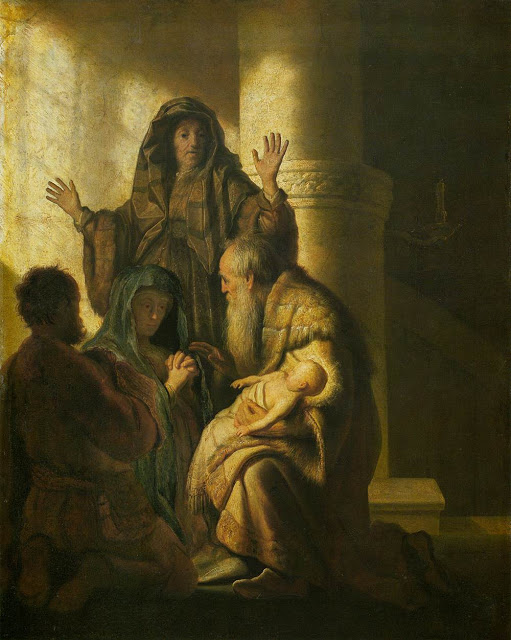
The image above shows a painting by Rembrandt, depicting the scene in which the aged Simeon and Anna encounter the Christ child and prophesy, which is found in the canonical gospel according to Luke, chapter 2. 

I would argue that Rembrandt has incorporated specific references to zodiac signs marking two important points on the Great Wheel of the year (two points which are opposite to one another) in the body posture and hand positions of Simeon and Anna in his painting -- and that in doing so he has by implication incorporated the entire sweep of the full circle of the annual cycle in his depiction of the episode in Luke chapter 2.

Also note, of course, that the very name "Anna" refers to a "ring" or a "circle" and is thus used in the Latin word which signifies "a year" (the Latin words for "annual" and a "year," annualis and annus, are very close to the word anulus, which means "a ring," and although some may argue that they are not in any way related, since one is spelled with two n's and the other with only one, they are certainly very close to one another in sound, as well as conceptually, and thus it seems likely to me that there is some relation between them). In any case, the name "Anna" can be seen to share the same root as that found in familiar words such as "annual" and "anniversary."

The upcoming course is presented in conjunction with Ananda University. I'm very much looking forward to it and hope that you can be part of the conversation!

Heaven and Hell are celestial metaphors

Heaven and Hell are celestial metaphors

Here is a new video I made for you entitled "Heaven and Hell are celestial metaphors describing the Endless Circle of the Zodiac Wheel."

It discusses the abundant evidence which points to the conclusion that the scriptures of the Bible, in common with virtually all the other ancient myths, scriptures and sacred stories found in cultures around the globe, are built on a foundation of celestial metaphor and use the heavenly cycles of the sun, the moon, the visible planets, and the stars and constellations to convey profound truths about the interaction of the Visible and Invisible Realms, the interaction of the physical and spiritual natures, and the journey of our soul down from the realm of pure potentiality and into this incarnate form through which we are all presently sojourning.

The video presents the crucially-important framework expounded by Alvin Boyd Kuhn in a short work he titled Easter: The Birth-day of the Gods, a framework which I find to be incredibly helpful in understanding the "code" or "language" employed by the ancient myths in order to convey their profound message and meaning.

We will see how this framework, and the understanding of the connections between specific characters and episodes in the Bible and specific constellations in the night sky, helps us to hear the profound message in some selected stories of the Old and New Testaments, in my upcoming 90-minute interactive webinar class entitled "Celestial Foundations of Biblical Mythology" (hosted by Ananda University).

In order to receive a 50% discount from the price of that class, enter the coupon code found in the "Video" section of the Star Myth World website when you sign up for your space in the course.

I hope to see you there.

More importantly, I hope that the information about the celestial foundations of the world's ancient myths and scriptures -- including those contained in what we call the Bible -- will help anyone who struggles with the fear of eternal punishment in an afterlife realm called "hell" and based on a literalistic interpretation of ancient scriptures which are actually speaking an esoteric and celestial language.

Please share this video with anyone else who might find it to be helpful, and subscribe to receive notification of future videos as they are published.

You may also wish to revisit this previous post entitled "No hell below us."