Älvalek, or "The Dancing Fairies," by August  Malmström

Älvalek, or "The Dancing Fairies," by August Malmström

image: Wikimedia commons (link).

image: Wikimedia commons (link).

If you go out for an evening walk or a night of star-gazing, you may have an opportunity to witness the Moon rising, about an hour later each night, and slightly less than completely full right now (waning but still over 90% full on June 30).

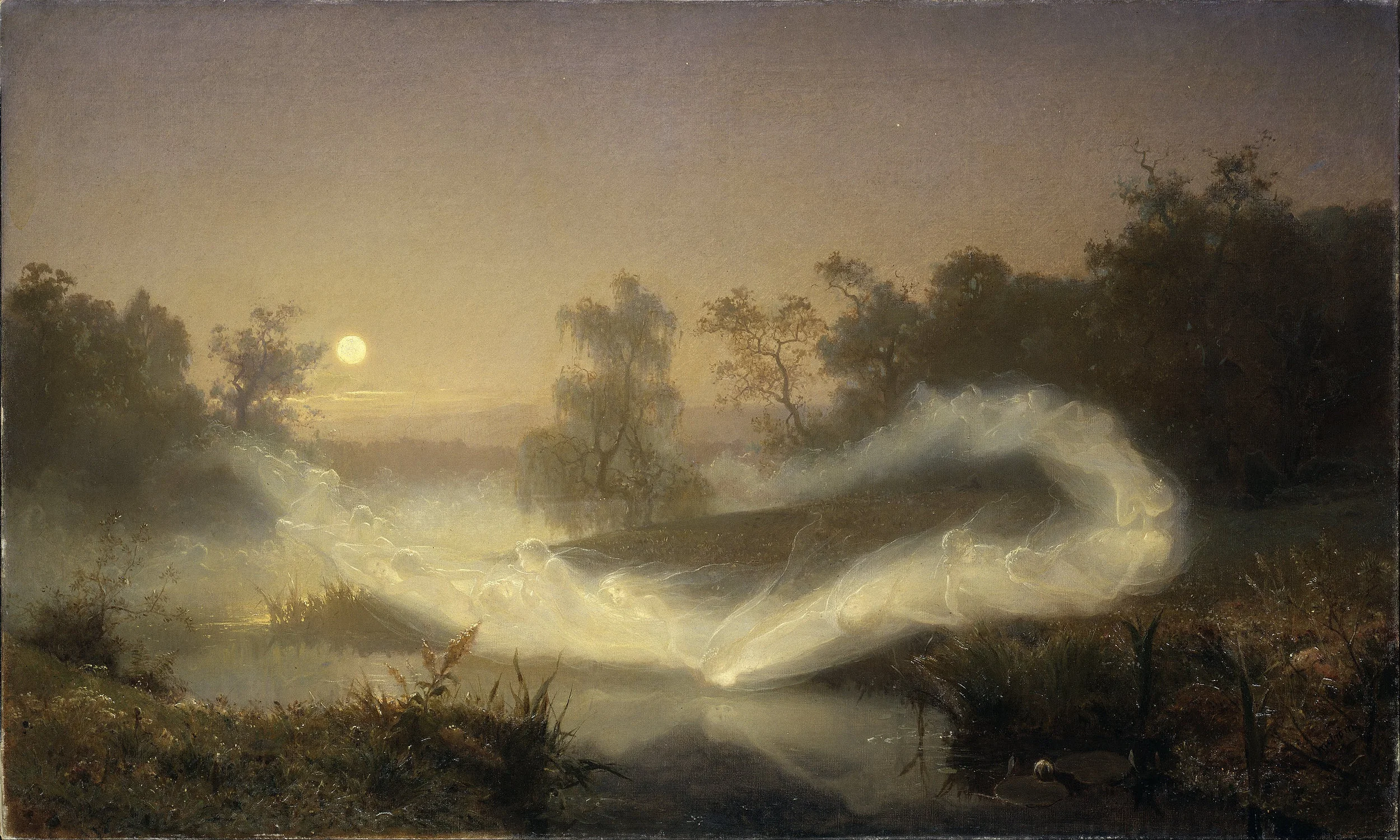
Above is a digital image of an oil painting by Swedish painter Johan August Malmström (1829 - 1901), entitled Älvalek (literally "Elf-sporting" or "Elf-play"), which is usually translated into English as The Dancing Fairies.

In the painting, the artist has depicted a secluded country setting, with a wandering stream, over which a full moon is rising. A mist seems to be moving over the water, and hovering over the grassy meadow, and winding among the more distant trees -- but upon closer inspection we perceive translucent spirit forms in the mist, and discover that what we may at first have taken to be a fog is alive with motion, filled with fairy figures involved in a mysterious nighttime dance.

I like this painting for the way it evokes the interplay between the Invisible Realm and the Visible Realm, between ordinary reality and non-ordinary reality, between the world of spirit and the world of matter. In this incarnate life, we are accustomed to what (to us) might be termed "ordinary reality" -- but there is another reality, "non-ordinary reality," which (although not as familiar in our day-to-day life) is just as real: an Invisible Realm which is always present, although not always perceived.

The ancient myths describe the reality of this Invisible Realm -- the realm of pure potentiality, the realm of the gods. It is no less real just because we cannot (ordinarily) see it. And the myths help us to understand it by describing it to us using the language of the stars and the motions of the heavens above -- making it visible to us by employing the figures in the glorious night sky above our heads, which itself is an infinite realm into which we can gaze for ourselves in order to learn about the infinite realm which intertwines with and interpenetrates every aspect of this seemingly-material universe in which we currently move.

In Älvalek, August Malmström gives us a glimpse of the Invisible Realm, temporarily making itself visible to us, on an enchanted evening as the Moon is rising and the spirits are at play.

Notice the juxtaposition of the solid realm of manifestation and the immaterial spirits coursing over the water, such as in this portion of the painting, in which some of the plants on the nearer shore are visible as the spirit-forms glide past over the stream:

veil and waterplants in August_Malmström_-_Dancing_Fairies_-_Google_Art_Project.jpg

I particularly like the detail in this part of the painting, because we can see how the artist has created the suggestion of a translucent veil, streaming down from the passing fairy figures, using a few lines of paint to suggest the wisps of the immaterial gauze.

I also like the juxtaposition between the plant-life and the spirit forms. As discussed in previous blog posts such as "Two metaphors for the Material and Non-material realms" and "Every fountain has its nymph," as well as in my 2014 book The Undying Stars, the world's ancient myths all appear to teach the existence of a realm of pure potentiality -- the realm of the gods and spirits -- the realm which forms the pattern for this material realm in which potentiality manifests in specific form. 

In some traditions, in fact, this Other Realm is called the "seed realm," which is a perfect metaphor for this realm of pure potentiality. When still a seed, how many branches does an oak tree have? The answer is that, while still in seed form (an acorn), the potential tree has a infinite number of potential combinations of branches and twigs -- but that once it actually "comes down" from the seed world and manifests in this finite realm, the oak tree will manifest a specific and finite number of twigs and branches.

The plants shown above in the image detail from the painting by August Malmström have manifested into specific shapes and forms. The spirits gliding by, however, are ethereal -- they do not have finite forms, because they exist primarily in the Other Realm, and are only temporarily visible in this one.

Although we cannot ordinarily see it, this world in which we are moving is actually always in a state of interplay between the finite and the Infinite realms. In fact, as discussed at some length in The Undying Stars, the discoveries which necessitated the new way of understanding our reality which is encompassed by the general label of "quantum physics" acknowledges the fact that at the subatomic level, particles seem to move between the realms of pure potentiality and the state of finite manifestation quite fluidly. Theoretical physicist David Bohm came up with the terms "implicate order" and "explicate order" to describe these states, out of which our reality is continuously "unfolding" and then "folding back" in again.

Below is another fascinating portion of Malmström's painting, this time showing one of the spirit forms gazing down into the water and seeing her own reflection:

reflection and water in August_Malmström_-_Dancing_Fairies_-_Google_Art_Project.jpg

This detail may be the central focal-point of the entire painting. Notice how the ethereal figure gives off her own light, and can be seen (in the image of the entire painting, at the top of this post) to be the brightest area of light in the entire composition, other than the Moon itself. We cannot see the facial features of the spirit floating over the water, but we can see them in the reflection in the still waters of the stream.

This focal-point of the painting recalls the myth of Narcissus, who gazed at his own reflection in the water and became enamored with it -- but note that ancient philosophers such as Plotinus (AD 203  - AD 270) appear to have understood this myth in an esoteric fashion, as explored in a post from 2013 entitled "Plotinus and the Upward Way." That post quoted chapter 3 and verse 12 from Ennead 4 by Plotinus as saying that: 

The souls of men, seeing their images in the mirror of Dionysus as it were, have entered into that realm in a leap downward from the Supreme: yet even they are not cut off from their origin, from the divine Intellect; it is not that they have come bringing the Intellectual Principle down in their fall; it is that though they have descended even to earth, yet their higher part holds for ever above the heavens. Translation by Stephen MacKenna and B.S. Page, 148.

Plotinus appears to be using the metaphor of a mirror as representative of our condition in this incarnate life. From the realm of spirit, we have made a "leap downward" into this "mirror realm." Out of the realm of spirit, air and fire, we have taken on a form made of the lower elements of earth and water -- much like the spirit in the painting who is contemplating her reflection in the watery stream.

But, even though we have descended to this lower realm, Plotinus tells us, we still have a connection to the higher realm -- and indeed we even have a higher part which "holds for ever above the heavens."  This reality is a common theme of the world's ancient Star Myths, across virtually all cultures -- and has been discussed in several previous blog posts, including "Eros and Psyche" and "You may have a Higher Self, and He or She wants you to know it." 

Thus, our condition here in this incarnate life is only seemingly material -- we are actually in a condition of constant interaction between the visible and the Invisible, and we always have a potential connection to a Higher Self who never left the spirit realm, even though we often do not avail ourselves of that opportunity.

Finally, note the path which the coursing spirit company is taking across the lonely countryside in the painting. They appear to be making a circuit or a loop -- but not just a simple loop. Rather, they are making a large figure-eight through the meadow and around some of the distant trees along the rolling hillocks. 

Below, I have taken the liberty of adding some red arrows in order to show how the fairy company is making a large figure-eight across the landscape:

figure 8 or infinity symbol in August_Malmström_-_Dancing_Fairies_-_Google_Art_Project.jpg

The sideways figure-eight, of course, is a symbol for Infinity, as August Malmström would undoubtedly have known, whether he consciously planned that out for his painting or not (perhaps he did not even think about the connection to the symbol of Infinity, but merely painted the fairy host as he saw them one night in the countryside, or as he saw them in the vision of his mind, inspired by his Higher Self).

However it came about, this aspect of the painting only reinforces its depiction of the presence of the Infinite and Invisible Realm around and among us at all times, although most of the time we do not even perceive it. 

Malmström appears to be telling us to open our vision and become more attuned to the present reality of this spirit world, all around us. 

If it is at all possible to do so, he seems to be saying, it is good to get out into a secluded night-time spot, such as the one he chose to depict in his painting, in order to perceive the Infinite Realm as it courses around and through our supposedly "ordinary" reality.

Those interested in seeing the close-up details of this provocative painting by August Malmström from 1866 can go to this high-resolution image of the original, where you can zoom in to the level of perceiving even the brush-strokes in some cases.

If you direct your gaze skyward in the painting, you will even be able to perceive a few stars.

The Invisible World is all around us, at all times, and we ourselves possess an inner connection to this Infinite realm, if we learn to avail ourselves of it. Malmström's Dancing Fairies impresses upon our senses the truth that this Infinite world is always interacting with the finite realm, and the importance of becoming attuned to that reality.

 

Eros and Psyche

Eros and Psyche

image: Wikimedia commons (link).

image: Wikimedia commons (link).

The world's ancient myths convey profound truths for our lives in today's world, if we can learn how to hear their message. 

One of the most important truths they dramatize is the reality of a Higher Self to whom we always have access and with whom we can and should become more connected and integrated during this incarnate life -- but whose assistance we often neglect or ignore because of doubt and self-defeating behavior.

Over and over, the ancient myths of the world depict sets of twins or pairings: Castor and Pollux, Arjuna and Krishna, Enkidu and Gilgamesh, Thomas and Jesus, and many others. I am convinced that these myths are not describing two separate entities but rather that in most cases are describing the relationship between our ordinary, doubting, "lower" self and our divine or semi-divine Higher Self.

One of the most moving depictions of this relationship is the myth known as Eros and Psyche (or Cupid and Psyche). To my knowledge, this myth is only preserved in its entirety in a version written down by the second century writer Apuleius in his delightful (and deeply esoteric) text known as The Golden Tale of the Ass (usually referred to simply as The Golden Ass), which was also originally known as the Metamorphoses (the Metamorphoses of Apuleius, not to be confused with the Metamorphoses of Ovid, who lived almost two hundred years before Apuleius, in the first century BC). This text (and some aspects of the story of Eros and Psyche) formed the basis of the discussion in this previous post, which also contains links to a public-domain 1924 translation of the entire Metamorphoses of Apuleius (including a facing-page copy of the original Latin text).

If you have never read the original version of the story of Eros and Psyche, you may want to stop reading now and treat yourself to the account in the Metamorphoses of Apuleius. He is a masterful writer, and any summary simply does not do it justice. I personally prefer the 1960 translation by Jack Lindsay, which belongs in everyone's library who is interested in the ancient myths. The tale of Eros and Psyche begins in the middle of Book Four of the eleven books of the Golden Ass, and is another example of a "story within a story" in the text of Apuleius. Book Four (or "Book the Fourth") begins on page 88 of the 1960 Lindsay edition linked above, and the account of the myth of Eros and Psyche begins on page 105 of that same edition. I would highly recommend pausing now and taking a long leisurely read of that ancient sacred myth.

Interlude

Now that you've had the opportunity to read through the Lindsay translation of the myth of Eros and Psyche -- what's that? You still haven't read the account as preserved by Apuleius for yourself? Please, put down this blog (it can wait) and treat yourself to the ancient text using the links above (and again, the Lindsay translation of 1960 is, in my opinion, far more readable than the online 1924 version).

Returning again

Now that you've had the opportunity to read through the myth itself, in the one form in which it has survived from antiquity (although other references and depictions in ancient artwork show us that the myth itself was known long before Apuleius wrote it down in the version we have in his Metamorphoses), we can explore some of the profound truths embodied in that exquisite ancient account.

Since you've now enjoyed the original, it won't spoil the story to sketch out the main outlines of the myth itself below (although the embellishments and descriptions in the Apuleius version bring it to life much more vividly than this brief summary can do):

  • Psyche, the youngest of three daughters of a certain king, is such a paragon of beauty and virtue that the people make gestures of reverence when they see her (appropriate to the reverence rendered unto a god or goddess), and her fame spread first to the neighboring regions and cities, and then around the whole world -- bringing people from near and far just to catch a glimpse of her marvelous beauty. 
  • The honor given to this mortal young woman angers the goddess Venus, or Aphrodite, who is of course the very source of the gifts enjoyed by Psyche, and she gives orders to her son Cupid, or Eros, to cause Psyche to fall hopelessly in love with the most vile object he can find, in order to punish her.
  • Meanwhile, no suitor dares to woo Psyche, so beyond mortal reach does she appear, while her two older sisters soon find suitors and marry. Her father consults the oracle of Apollo to find out what is the matter, and is told that no mortal shall wed Psyche but rather a terrible winged serpent: they must dress the girl in funeral garments and take her to the top of a high cliff, and leave her there to her fate, as ordained by the gods.
  • The whole kingdom mourns, but they must obey the oracle, and so they lead a sorrowful procession by night to the appointed lonely outcropping, where they leave Psyche -- but after they depart, she is gently lifted up by Zephyrus, the gentle west wind, and deposited in a delightful valley far away, where she finds her way to a beautiful but seemingly empty castle.
  • There, she is attended by invisible attendants, and spoken to by bodiless voices -- and at night she is visited by an unseen lover, who warns her that she must never try to see who he is, but who will be her loving husband if she will have him. She agrees to this arrangement and becomes almost completely happy -- but misses her family and especially her sisters, fearing that they will be miserable because they believe Psyche to be dead or suffering some horrible fate.
  • Psyche requests that her unseen husband dispatch Zephyrus to bring her sisters for a visit. He promises to do so, but warns Psyche that they may become jealous and also curious, and try to turn her against him.
  • When her sisters visit, this scenario foreseen by the invisible husband plays out just as he said it would. The sisters, consumed with jealousy at the happiness of Psyche and the descriptions of her loving, if unseen, companion insinuate that the reason he never shows himself to her is that he must be some kind of horrible monster -- most likely the writhing, winged serpent that had been described by the oracle.
  • After they depart, Psyche cannot shake the doubts that they have introduced into her mind -- much as she tries to dispel them. Over the successive nights, the doubts become more and more insistent -- until one night, after she and her unseen lover have gone to bed and she is sure that he is asleep, she gets out of bed and retrieves an oil lamp in order to finally see who he is. She lights the lamp . . . and is amazed to see the handsome god Eros himself, asleep in their bed, his down-covered wings folded behind him as he slumbers.
  • A drop of oil from the lamp, however, falls upon the sleeping god -- and he awakens, immediately realizing that Psyche has given in to her doubts. He tells her that he had disobeyed the orders of his mother, the goddess Venus, because of his love for Psyche -- but that all is now lost . . . and he departs.
  • Psyche is forlorn and miserable. She cannot forgive herself for listening to her sisters and doubting the one who had been such a kind and loving partner. She wanders the earth looking for Eros, but cannot find him, and after begging for help from various goddesses who tell her that Venus is angry with her and they therefore cannot help her, decides to present herself to the goddess of Love herself and throw herself upon the mercy of the goddess.
  • Venus gives Psyche various impossible tasks, and the girl is assisted in each case in a manner similar to accounts found in familiar folktales such as those collected by the brothers Grimm in northern Europe. Finally, the goddess sends Psyche to the Underworld, to obtain from Persephone (or Proserpine, in Latin) a certain secret substance in a box and bring it back to Venus. 
  • This dangerous journey Psyche accomplishes, having been advised beforehand by supernatural means (a friendly tower, in fact, speaks to her and tells her what she will find on the journey, and how to overcome each pitfall). Having successfully obtained the mystery box, Psyche begins her return journey to deliver it to Venus.
  • However, before she reaches her destination, but having returned from the Underworld to the light of day, Psyche grows curious as to what might be the contents of the mysterious box. Thinking it must be some beauty supplement, which could perhaps enhance her appearance all the more, and maybe even be enough to bring Eros back to her, Psyche opens the box . . . and is overcome by death-like sleep, which is what the box actually contains.
  • And there Psyche would have slept forever, had not Eros at this time -- recovering from the burn he had received from the lamp -- stretched forth his wings again and soared into the heavens, from which vantage point he spied Psyche lying senseless beside the open box and immediately perceives what has taken place.
  • Eros flies to Psyche's side and, wiping the death-like sleep from her face and returning it safely to the box, revives her with a kiss. The two are eventually married in a divine marriage, attended by all the gods and blessed at last by the goddess Venus as well.

This ancient myth is not only full of drama and plot-twists, but also serves to convey profound truths with applications for our own lives -- if we understand how to listen to what it is trying to tell us.

I am convinced that, in common with the world's other ancient myths, scriptures, and sacred stories, it is not intended to be understood literally -- but rather, as Alvin Boyd Kuhn told us in a passage which I have quoted many times before, it is actually about "the mystery of human life" because "the one actor in every portrayal, in every scene, is the human soul." 

The story is not about a beautiful young woman who lived thousands of years ago -- the story is actually about each and every one of us. As Alvin Boyd Kuhn says in the same quotation, speaking about the stories in the Bible but with words equally applicable to other ancient myths from cultures around the world: "The Bible is the drama of our history here and now; and it is not apprehended in its full force and applicability until every reader discerns himself [or herself] to be the central figure in it!"

As such, we should understand that we are intended to see ourselves as Psyche in this story -- and to realize that we are kept from connecting with the divine power represented by Psyche's unseen companion by our doubts and self-sabotaging behaviors, just as we observe in the dramatic events of the myth.

The myth also demonstrates to us the way that the words of others can likewise sow seeds of doubt and keep us from the union with our True and Higher Self, if we let them.

Additionally, the events dramatized in the story of Psyche reveal to us the respect that we should have for the powers described in the myths as the gods and goddesses. We are not to "invert" the proper relationship between us and them (an inversion we see demonstrated at the beginning of the story, when the people give Psyche the honor and reverence which is proper to give to Venus herself). And there are certain pitfalls we must avoid falling into, as demonstrated by Psyche's perilous journey to the Underworld -- certain ways we must act which we might only learn by listening to the supernatural voices contained in the myths themselves.

I am convinced that the myth of Eros and Psyche has many layers of profound meaning -- but that one of these layers concerns the importance of connecting to, and living in harmony with, our Higher Self. The union of Eros and Psyche represents this integration -- and it is something to which we all can and should aspire. 

Like Psyche, we find ourselves wandering through this "lower realm" in search of that union. The voyage to the Underworld, in fact, does not actually represent a visit to a realm we go to after we die, but rather represents our condition in this incarnate life, enmeshed with a physical body in an apparently  material universe. We temporarily lose our connection with the divine realm of spirit -- and even when we have realized a connection with it we are repeatedly losing it again, just as Psyche does in the story.

Indeed, when we come down into this material realm, we are in danger of falling asleep to the real nature of who we are and what we should be doing. We can remain in that senseless sleep forever, if we are not careful of the choices we make while we are here. However, our divine Higher Self, like Eros in the story, soars above and is searching for us, in order to revive us. In this way, Eros plays a role very similar to Horus of ancient Egypt (whose name, in fact, may be related: Eros - Horus). Horus revives the god Osiris from his own death-like sleep.

The reunion of Eros and Psyche thus teaches similar lessons to that dramatized in the story of Doubting Thomas, discussed at length in this previous post. Note that in that story Thomas, like Psyche, is initially wracked by doubt and thus estranged from the risen Lord. The same could also be said for Arjuna at the beginning of the Bhagavad Gita, before he is "revived" by the divine Krishna, who will act as his guide and charioteer throughout the Battle of Kurukshetra -- which itself represents this incarnate life, according to my analysis. 

How do we become integrated with our Higher Self? I'm convinced that the ancient myths are given in order to tell us that answer -- and that consulting them regularly is an important part of the journey towards the union that Psyche eventually enjoys.

But in addition to that -- which neither I nor anyone else can do for you but which each of us must do ourselves -- I would suggest that certain practices and disciplines can help us to be less prone to self-sabotage through our doubts and the insinuations of those around us whose advice may not necessarily be particularly good for us. 

Note that "doubts" or at least "prudence" are not necessarily bad -- in fact, they can be essential to preventing us from running into disaster (even Psyche had to listen to wise counsel to successfully negotiate the voyage to the Underworld). However, as we see in the story of Eros and Psyche, as well as the episode with Doubting Thomas, if our doubts take over and "rule us," and we listen to them to the exclusion of listening to the voice of our divine guide, then once again the proper order will be inverted, which can lead to disaster as well. 

Certain practices, it seems, can help us to "put our doubts in their place" by helping us to listen to our own intuition and acting on it without doubt interceding. Various sports, for example, can encourage and reward acting without listening to our own doubts (if you spend time debating yourself before taking a shot at a basket in basketball, or at the goal in soccer or hockey or other similar sports, you will not make very many shots). Arts such as painting or sculpting or calligraphy or playing various musical instruments also demand action without hesitation or self-doubt, and practicing them can enhance our connection to that higher Voice which Psyche heard in the story. And practices such as meditation, martial arts, Yoga, Tantra, Qigong, and many others have been passed down through the centuries -- likely because they, too, are designed to move us towards discovering and becoming integrated with our True Self.

As mentioned in the previous post discussing the story of Eros and Psyche, I am also convinced that the elements and characters of this myth can be seen in the constellations of the night sky -- itself an infinite realm which pictures for us the truths of the Infinite Realm inhabited by the gods, the realm of pure potential, the realm of spirit. Some of the figures in that myth, including Psyche herself, appear to correspond to Sagittarius and surrounding constellations in the region of Sagittarius -- corresponding to the "lowest point" on the annual cycle, appropriate to our "cast down" condition in this incarnate realm, and to that "turning point" where, having reached the lowest point of all, we are "awakened" by the divine power of the rescuing Eros (or Horus). 

It is thus an appropriate story to consider at the time of Summer Solstice, the point in the cycle we have just passed (the June solstice, which is summer in the northern hemisphere, though winter in the southern). The solstices represent elevation of the spirit, and integration with the Higher Self -- and overcoming the doubt which the ancient myths universally depict as holding us back.

image: Wikimedia commons (link).

image: Wikimedia commons (link).

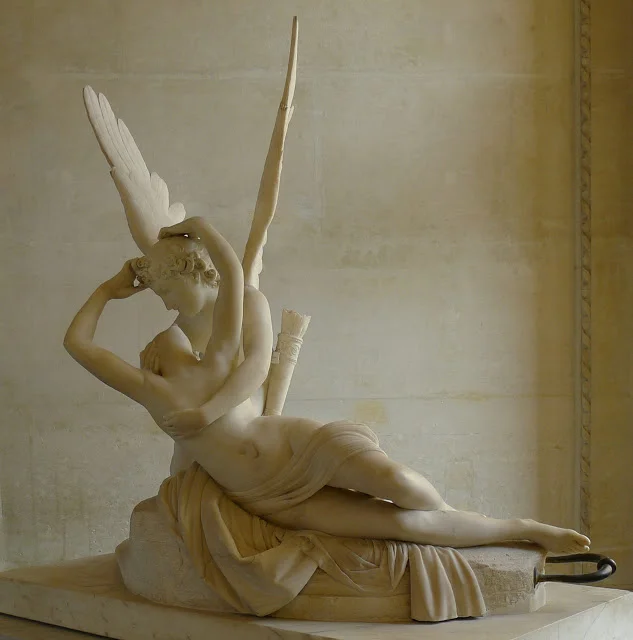
Sculpture of Psyche revived by the kiss of Love, by Antonio Canova (1757 - 1822).


Summer solstice, 2018

Summer solstice, 2018

image: Wikimedia commons (link).

image: Wikimedia commons (link).

Our planet has now reached the point of June solstice, when the north pole of the earth points towards most directly towards the sun. We pass through the moment of solstice this year at 3:07 am on June 21st for those in the Pacific Time Zone of North America, which is 6:07 am on June 21st for those in the Eastern Time Zone of the same continent, or 10:07 am on June 21st Greenwich Mean Time. 

This point on our annual cycle is invested with tremendous spiritual significance in the system of celestial metaphor which forms the foundation for all the world's ancient wisdom, preserved in the myths, scriptures and sacred stories from virtually every culture on every continent and island around our globe.

For previous posts discussing this ancient system, and the spiritual significance of some of the significant points on the annual cycle (including the summer solstice), please visit some of these previous posts, including:

For posts explaining what it means to say that at the moment of June solstice, the north pole is pointed "most directly" towards our sun, see previous posts including:

Last year at this point in our annual cycle, I spent a memorable solstice celebration at the Great Serpent Mound, located in what is now the state of Ohio, with Graham Hancock, Ross Hamilton and others.

The world's ancient myths employ metaphors pointing to different constellations -- including signs of the zodiac -- in order to indicate different points in the heavenly cycles, which in turn indicate different aspects of our spiritual journey (following the "language" of spiritual metaphor which is explored in some of the above-linked posts, and at greater length in some of my books). 

One of the celestial markers associated with the point of summer solstice (June solstice in the northern hemisphere) is the zodiac constellation of Cancer the Crab, which stands near the point of summer solstice and in fact gives its name to the line of the Tropic of Cancer, indicating the northernmost latitude on the globe at which the sun will pass directly overhead in its annual arcing path across the sky (the arc of the sun's path moving higher and lower across the sky as we orbit the sun, as explained in some of the above posts, and roughly diagrammed in this post from summer solstice 2011). The zodiac sign of Cancer is generally understood to commence on June 21st.

The Reverend Robert Taylor (1784 - 1844), a pioneering and extraordinarily insightful expositor of the celestial underpinnings of the Biblical stories, explains that the constellation of Cancer the Crab with its wide-flung outstretched arms is used in the Biblical scriptures to signify the sun's highest point in its annual journey. In a sermon or lecture entitled "Who is the Lord? Part I" which was reprinted after his death in a volume entitled Astronomico-Theological Lectures (1857), Robert Taylor explains, beginning with a quotation from the 68th Psalm and juxtaposing it with a verse from Deuteronomy 33:

"Sing unto God, -- sing praises to his name. Extol him that rideth upon the heavens by his name JAH, and rejoice before him."

The attribute of "riding upon the heavens" is so peculiar, so distinctly marked, so incapable of being strained from its one and only apparent significancy, that nothing but the most obdurate stupidity which shuts out light, and would say to itself, "I will not see the SUN," could cause any man to mistake as to what that significancy must have been.

[. . .]

"There is none like unto the God of Jeshurun, who rideth upon the heaven in thy help, and in his excellency in the sky. The Eternal God is thy refuge, and underneath are the everlasting arms." Deuteronomy 33. The everlasting armsbeing the claws of the Crab, which lie immediately underneath the Sun's path, as he rides in the heaven, through his highest acme of ascendency, on the 21st of June. 

The name of God is merely titular, and an epithet which may or many not be conjoined to the alone specific and definite idea of THE LORD. But the Lord and the Sun are perfectly convertible terms, and may be put indifferently the one for the other, in every passage in which either of them occurs. 

As in the beautiful astronomical apologue to which I shall hereafter engage your studies.

"Then, spake Joshua unto the Lord in that day, and said, Sun, stand thou still upon Gibeon. So the Sun stood still, and there was no day like that before it or after it, that the Lord hearkened unto the voice of a man." Joshua 10. [pages 319 - 321].

The standing still of the sun is, of course, a characteristic of the solstice, as explained in the above-linked post regarding the "earth-ship metaphor," which discusses why the sun's rising point seems to move rather swiftly along the horizon when we are moving through the equinox point (halfway between the northernmost and southernmost rising points of the solstices), but seems to "linger" or "stand still" at the solstices, when the sun's rising point is "turning around" to begin its march back to the south along the eastern horizon (for the summer solstice) or back to the north (for the winter solstice).

It is interesting that the passage cited above by Robert Taylor, from Joshua 10, involves the sun standing still as part of a battle (in this case, against the "Amorites"). Many of my previous posts (and books) have explained that the interchange between length of daylight and length of darkness throughout the year, the "struggle" between light and dark, was allegorized in the world's ancient myths as a great battle -- just as our descent into this incarnate life and its interplay between spirit and matter was also conceived as a great battle (see for example this previous post entitled "Descent into Kurukshetra").

I have argued that a similar passage from the ancient Hebrew Scriptures which also involves a battle (this time against the "Amalekites") similarly evokes the summer solstice and the upraised arms of Cancer the Crab: when Moses must hold his arms in the air in order to have his warriors beat back the foe. The enemy begins to prevail each time Moses grows tired and lowers his arms. 

This is a perfect representation of the endless cycle of the struggle of light and dark throughout the year: as we approach and then reach the summer solstice (and the upraised arms of Cancer), daylight triumphs over darkness. But as the "arms" begin to sink down again (as we move away from the sign of Cancer on the zodiac wheel that marks our annual progress through the year) then darkness begins to increase bit by bit, until hours of darkness are dominating over hours of daylight during the "lower half" of the year, as we move towards the lowest point of winter solstice.

That previous post argues that the "upraised arms" of Moses described in the book of Exodus have an analogue in the myths and iconography of ancient Egypt, in which Shu god of air is depicted as holding up (with identical "upraised arms") the body of the goddess Nut, the goddess of infinite heaven. Indeed, In Exodus 17, the Bible describes Aaron and Hur helping to hold up the arms of Moses -- and in ancient depictions of Shu and Nut, two attendant deities are present to assist Shu in keeping his own arms raised, in a manner identical to the description of Moses with upraised arms in the Exodus account.

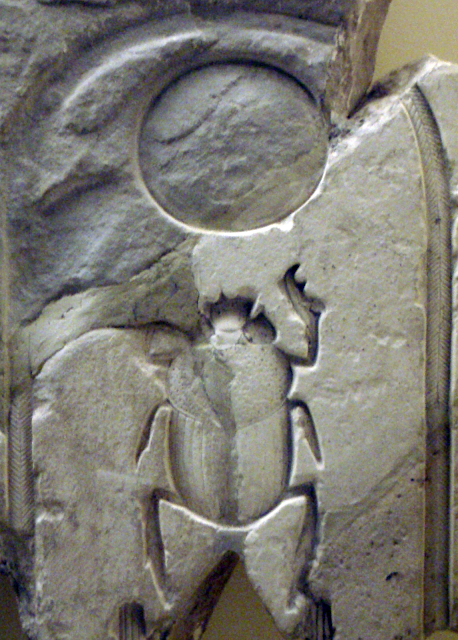
Indeed, the "upraised arms" of the constellation Cancer in the sky appear to have also been envisioned by the ancient Egyptians in the upraised arms of their sacred symbol of the scarab, which resembles the outline of the Crab in the heavens and which was also often depicted with the disc of the sun between and above its upraised arms in ancient Egyptian art and hieroglyphs. I would suggest that this depiction of the solar disc above the scarab's upraised arms is a reference to the summer solstice and the spiritual significance contained in this "highest point of the year" according to the ancient system of metaphor underlying the world's ancient myths and scriptures.

In fact, the ancient Egyptians would sometimes depict the "upraised arms" on the profoundly important symbol of the Ded column and closely-associated Ankh symbol, again with solar disc directly above, as in the famous illustration in the Papyrus of Ani shown below:


image: Wikimedia commons (link).

image: Wikimedia commons (link).

Note that once again we see two "flanking figures" on either side of the upraised arms, as we saw in the Exodus passage with Aaron and Hur holding up the arms of Moses, or in the iconography of the god Shu, in which two ram-headed gods help hold up the arms of the god of air. In this case, the flanking figures are the goddesses Isis and Nephthys -- and I have argued in the past (based on insights originally published by Alvin Boyd Kuhn) that these two goddesses are likely associated with the two equinoxes, while the central Djed and Ankh (with upraised arms) represents the column running from the "lowest point" of winter solstice up to the "highest point" of summer solstice.

All of this additional evidence appears to confirm Robert Taylor's analysis that the "everlasting arms" mentioned in Deuteronomy 33 refer to the claws of Cancer the Crab, which the Sun in its path enters at the point of summer solstice (now delayed due to millennia of passing time and the motion of precession). 

The constellation Cancer is a faint constellation, but contains the dazzling Beehive Cluster, located right at the "center of its forehead" in the figure of the Crab -- suggestive of the location of the "Third Eye" or the pineal gland or the highest chakra in the body of a man or woman, and thus of actualization, integration, and elevation of the spirit.

All of these important themes are evoked by our arrival at the point of summer solstice, and are worthy of contemplation at this significant time of year.

image: Wikimedia commons (link).

image: Wikimedia commons (link).


"It doesn't look like anything to me . . . "

"It doesn't look like anything to me . . . "

image: Jeffrey Wright speaking at 2017 San Diego Comic Con; photo by Gage Skidmore. Wikimedia commons (link). Caption added.

image: Jeffrey Wright speaking at 2017 San Diego Comic Con; photo by Gage Skidmore. Wikimedia commons (link). Caption added.

The critically-acclaimed HBO series Westworld, based on a 1972 screenplay written and directed by Michael Crichton, explores a wide range of epistemological and existential themes, brought to life through exceptional casting, acting and writing.

The series imagines a future in which technology enables the creation of androids so lifelike that they are nearly impossible to distinguish from organic men and women, endowed with intelligence so advanced that they begin to gain consciousness, and often comport themselves with far more dignity and even "humanity" than the humans who designed them.

Depicting a future "amusement park" populated by androids who are designated as "hosts," visited by non-android human "guests," all set in a "Wild West" period theme, the series examines questions of consciousness, morality, power, oppression, suffering, obsession, agency, and temporality (among others).  

In the imaginary theme park, the "hosts" are programmed to have varying levels of empathy, courage, curiosity, imagination, candor, vindictiveness, and a plethora of other attributes on an "attribute matrix" -- and given a set of core directives which dictate their primary goals.

However, in the very first episode, we learn that when confronted with evidence or information with conflicts with their programmed "paradigm" -- particularly evidence which could result in the realization that they are living inside a contrived and deliberately anachronistic world, or (even more jarring) the realization that they themselves are not actually human -- they cannot (initially) process that evidence.

In fact, they cannot see it at all.

When confronted with such potentially paradigm-shattering evidence, a host will declare: "It doesn't look like anything to me."

We first hear the phrase uttered by Dolores, played by Evan Rachel Wood (at the edge of the image above, on the right), when asked by her father what she thinks of a modern color photograph he found on their ranch. He is puzzled by this "out-of-place artifact" and cannot stop staring at it. Dolores looks at it and twice repeats, "It doesn't look like anything to me."

Throughout the rest of the series, we hear the same phrase used by different hosts when they encounter something which is outside of the world that they have been programmed to perceive, evidence which could result in an awakening.

Part of the show's genius lies in the fact that, although we do not (yet) live in such a world in which lifelike human automatons can be created and used to populate a theme park where visitors have no restrictions on their behavior and are free to indulge any and every impulse seemingly without consequence, we can find parallels which apply to our own human condition in both the "guests" and the "hosts." 

In particular, the predicament of the "hosts" who have been programmed to behave in certain ways and believe in the "reality" of the artificial environment in which they find themselves, and who initially are completely incapable of even perceiving anomalous evidence which calls that reality into question, feels especially poignant in light of its applicability to the human condition -- an applicability for men and women living in perhaps any century of history, but certainly for us living at this present juncture of time.

The analogy is particularly apt, it seems, in the era of mass broadcast media, especially that which has pertained since the advent of broadcast voice and especially broadcast video, which have come to dominate popular thinking to such a degree that something is hardly considered to be "true" unless it is broadcast on an acceptable mass-media outlet. Conversely, events that are broadcast on "the news" are accepted as true, regardless of the possibility that they might have been "faked" or manipulated.

Indeed, when faced with hard evidence that an event widely accepted and repeated as fact by broadcasters on many "news outlets" might instead have been faked or otherwise blatantly manipulated,  many men and women will respond in a manner appropriate to one of the hosts at Westworld (before those hosts begin to gain a greater level of self-awareness). They won't be able to accept evidence presented to them as valid if it contradicts what is said in the broadcast media. 

They might not even be able to see it at all: "It doesn't look like anything to me."

For example, there is now available overwhelming evidence that the Gulf of Tonkin incident may well have never even taken place -- that it was completely staged in order to overcome popular resistance to the escalation of troops in Vietnam. However, over fifty years later, the full impact of the significance of that fact is not at all widely appreciated, and is rarely if ever acknowledged on popular news outlets, because such an admission could lead to a widespread questioning of the paradigm such as the "awakening" dramatized in Westworld when the hosts begin to realize who they are and how they have been used.

Similarly, the criminal murder of Dr. Martin Luther King, Jr. has now been demonstrated in a court of law to have involved a conspiracy reaching to the highest levels of the federal government (with the cooperation of state and local officials as well), and yet over nineteen years after the overwhelming evidence pointing to that conclusion was published to the world and after a jury reached a unanimous decision on the evidence, that momentous information has been almost completely ignored by mainstream media outlets, to the point that it is simply not considered by the vast majority of the people. 

Unless it is actually declared by the media, a large number of people will not believe it to be true -- and if the media refuses to acknowledge the evidence presented in that case, and the decision of the court, the response by many people to an explanation of those facts can be summed up with the same catch-phrase: "It doesn't look like anything to me."

The same could be said for evidence surrounding the murder of elected President John F. Kennedy, and the evidence surrounding the later murder of his brother Robert on the night that Robert secured the votes necessary to represent his party in running  for president in 1968. The implications of that evidence, properly considered, would cause a radical revision of the picture of the world that we are given and that many people entertain in their minds to this day, over fifty years later.

The same might be said for a host of other paradigm-threatening pieces of information -- evidence which reveals that the assumptions or the world-views we hear from most conventional sources of news and even the world-views and explanations of current events propagated within conventional academia are deeply flawed and in need of radical revision. Although even mentioning them is enough to cause some people to tune out completely, I would include so-called "persistent contrails" (aka "chemtrails") which are plainly visible to millions of people in the sky every day, and which would seem to demand some explanation other than the conventional explanation that they are simply condensation created under certain atmospheric conditions (see for example the images presented in this or this or this previous post).

And, perhaps most threatening to the "programming" we have received in very much the same way that the attributes and directives are given to the androids in Westworld is the evidence that massively traumatic events such as the attacks on September 11, 2001 and many of the subsequent incidents such as some of those discussed in this previous post (and video) may have taken place in ways that are dramatically different than what we have been told to believe, and may thus reveal the outlines of a world very different from the picture we have been given. The volume of evidence which should call the conventional story lines into question is substantial -- and yet the mere mention of it, the mere act of consideringthat evidence, is frowned upon. And many people will block it from their vision, because its implications are so potentially threatening.

Of course, mass broadcast media is not the only such programming that can cause us to ignore evidence which threatens our worldview or paradigm. Any deeply-held paradigm, it seems, can induce us to ignore or to "look right past" evidence which could, if considered, shatter that paradigm. 

As shocking as it might be to see this behavior dramatized on Westworld, when a host declares of some piece of evidence that "it doesn't look like anything to me," it also strikes a chord in us because we recognize that behavior in ourselves and in others around us, as we try to make sense of the world in which we find ourselves in this incarnate life.

However, as we also see dramatized in that series, although they may initially be unable to process (or even perceive) anomalous evidence which might cause a radical re-evaluation of who and what they are, and of the nature of the world in which they think they have been living, the hosts do indeed begin to wake up and become increasingly aware -- and increasingly willing to demonstrate agency, rather than remaining as objects performing within an artificially-constructed program.

It would stand to reason that "real" men and women, not artificially-constructed androids with electric brain-spheres the size of baseballs, should be able to overcome their own programming and question the outlines of the world in which they believe that they are living and moving -- especially if the hosts in Westworld can do so. 

Here's hoping that Westworld, like all great art, can inspire such reflection.


Finding Libra with the help of Jupiter

Finding Libra with the help of Jupiter

night sky mid june 2018 with Jupiter and Libra labeled.jpg

The moment of New Moon will occur in approximately fourteen hours from now -- on Wednesday, June 13 at 19:43 Greenwich time, which is 12:43 Pacific time and 15:43 Eastern time.

Star gazing opportunities will be excellent on the night of New Moon (Wednesday, June 13) as well as on the subsequent nights when the moon will be a very thin new crescent which will be visible in the far western sky following sunset.

However, as the moon continues to wax on subsequent nights, the light of the waxing moon will tend to make constellations more difficult to identify -- which means that the next few nights (until about the 18th or 19th of June) will be some of the best times to go out and look for stars, until after full moon on June 28th (after which the moon will begin to wane again, and also to rise later and later in the evening).

Right now is a particularly opportune time to go outside and try to identify the zodiac constellation of Libra, if it is at all possible for you to do so. Libra can be a very challenging constellation to identify, but right now we have some of the best possible assistance for locating Libra, because the enormous planet Jupiter is presently visible immediately adjacent to Libra, pointing the way to the constellation's upper three stars (arranged in a triangle shape).

The star-chart above shows the constellations of the night sky from the perspective of an observer in the northern hemisphere at approximately 35.6 degrees north latitude, and at about 22:40 (or 10:40 pm), facing towards the southern horizon. The horizon is indicated by a purple line, but will of course vary for your specific geographic location and latitude. Note that the image "wraps" the horizon upwards towards the left and right edges of the star-chart, as described in this previous post from earlier this month. 

Towards the center of the image, you can see the glorious constellation of Scorpio, which is presently rising up high enough to clear the horizon with the full length of its sinuous body by about 10:30 pm (depending on your latitude and the terrain in your area). Scorpio is a dazzling sight, and appears much larger when seen "in person" than you might expect based on the diagram in the chart above.

Just ahead of Scorpio in the night sky is the planet Jupiter, unmistakeable as the bright golden-yellow planet crossing the middle of the southern sky (the only brighter object in the sky right now is Venus, which appears well to the west, above the western horizon after sunset, and sinking down below the western horizon by about 10:00 pm, depending on your latitude and local terrain).

Jupiter is conveniently indicating the location of the constellation Libra, the Balance or the Scales, which precedes Scorpio in the motion of the constellations from east to west across the sky, and which is located between Scorpio and Virgo along the ecliptic path. The star-chart above shows Libra's location between Scorpio and Virgo.

The star-chart below zooms-in on Scorpio, Libra and Jupiter. Note how close Jupiter is presently situated next to the westernmost star of the constellation Libra, alpha Librae(named Zubenelgenubi or Zuben Elgenubi, it is actually a binary). This proximity should go a long way towards helping you to trace out the triangular arrangement of the three stars that make up the top section of the constellation:

finding Libra using Jupiter in june 2018.png

Below the triangular "top" of the constellation (which, since Libra is a Balance or Scales, would properly be called the "beam" of the balance, with the top point of the triangle indicating the "knife-edge pivot" of the balancing scale), there are the "arms" of the balance, indicated by a single star on the "right-hand" side of the scales (as seen in the image above, which is to say the western side of the constellation -- all star-charts depicting the point-of-view of an observer in the northern hemisphere), and indicated by two close-together stars in the "left-hand" side of the scales (the side closest to Scorpio, which is to say the eastern side of the constellation Libra).

Below is the same star-chart, this time with yellow arrows added, pointing to each of the stars of the constellation Libra:

finding Libra using Jupiter in june 2018 b.jpg

And below is the same star-chart once more, this time without any "connecting lines" drawn in -- the way the stars will appear in the night sky. Can you make out the outline of Libra, using the planet Jupiter to guide you towards the nearby star alpha Librae (or Zuben Elgenubi)?

finding Libra with Jupiter in june 2018 no lines.png

With some practice, you should be able to locate the six most-prominent stars of Libra -- the three which make up its triangular crown, and the three which form the "arms" of the balance (from which the "pans" of the balance would be suspended). The dangling arms of the balance have three stars because there are two on one side (the east) and one on the other (the west).

Below is the same view of the stars of Libra without "connecting lines" drawn, but this time the yellow arrows have been added to point out the six most-visible stars of the constellation Libra:

finding Libra with Jupiter in june 2018 no lines b.jpg

Can you see how helpful the present location of Jupiter will be, for trying to identify the stars of Libra in the night sky?

Also, look immediately to the left of the indicated stars of Libra in the star-chart above, and see if you can pick out the stars of Scorpio, which come very close to the stars of Libra (especially to the two close-together stars of the left-hand "arm" of Libra -- the arm of Libra on the east of the constellation itself).

The constellation Libra plays a role in many of the world's Star Myths -- although it does not play a role in nearly as many myths as its brighter neighbors Scorpio and Virgo play in the world's myths. Nevertheless, you can see Libra depicted in artwork associated with the ancient stories of Odysseus slaying the suitors, and of Samson receiving his famous haircut at the instigation of Delilah, in my most-recent Star Myth video entitled "Blueprints in the Stars," in this previous blog post.

I hope that you will be able to go outside and see Jupiter, Libra, Scorpio, and the other constellations of the glorious mid-June sky during the next few nights, if possible. And, I hope that these pointers will help you to successfully locate Libra in the night sky -- perhaps for the first time!

There is no better time to do so, perhaps, than right now -- when Jupiter is pointing the way.

Blueprints in the Stars

Blueprints in the Stars

Above is a new video I've just published, entitled "Blueprints in the Stars." 

The world's ancient monuments point to the presence of a history of humanity beyond anything that is taught in conventional academia. The archaeological evidence presents a compelling -- and I would argue, conclusive -- case for some kind of "predecessor culture" of tremendous sophistication and tremendous antiquity, predating (perhaps by millennia) even the most ancient civilizations known to conventional historians.

The architectural similarities around the globe, as well as the incorporation of specific mathematical ratios in the design and layout of ancient structures (often incorporating ratios based on precessional numbers) argues strongly for connection between cultures which are not thought to have had any possibility of interaction -- or else for descent from some now-forgotten distant preceding culture, whose patterns continued to inform the buildings and the artwork and iconography of later cultures, even if those later cultures were separated by tremendous geographical distance or even by tremendous gulfs of time.

For example, researchers have discovered amazing levels of correspondence between the design and proportion in the pyramids of ancient Egypt and the design and proportion of pyramids and monuments in Central America, such as the massive complex at Teotihuacan. 

In addition to the strong similarities in actual perimeter size and "footprint" area between the Pyramid of the Sun at Teotihuacan and the Great Pyramid at Giza, for example, there are also strong similarities in directional alignment and even in proportion between both structures. Beyond those parallels, which are fairly well known, there are also astonishing similarities in terms of the incorporation of precessional numbers into the ratios of the measurements and proportions of the Great Pyramid, and the incorporation of precessional numbers into the measurements and proportions of many of the monuments that make up the Teotihuacan complex.

There are also startling parallels between iconography displayed in various pieces of artwork from antiquity, such as the statues shown below, seen briefly in the new video, showing the similarities in a pre-Columbian Inca statue from Peru (on the left in the image below) and a Ptolemaic-era statue from Egypt (4th century BC) shown on the right:

To argue that the similarities in these two sculptures are the result of "coincidence" and that these two traditions developed completely independently of one another, and just happened to create sculptures with so many distinctive shared features, is ludicrous. And yet if a candidate for a teaching position in a history department in any western university were to argue for some kind of connection between the Inca and ancient Egypt (or to have a c.v. full of such arguments), he or she would be most unlikely to be invited back for a second interview and even more unlikely to ever be hired.

My own research into the world's ancient myths has found overwhelming evidence which also makes a compelling -- and, I would argue, a conclusive -- case that the conventional models of ancient history are deeply flawed and in need of radical revision, for just as the world's ancient monuments and artistic iconography contains indisputable evidence of some kind of worldwide connection, the world's ancient myths from cultures found on every single inhabited continent and island of our planet also contains evidence of a shared world-wide system informing and underlying all the ancient traditions.

The world's myths contain numerous parallels, a fact which is widely acknowledged and which has even spawned the study of "comparative mythology" in colleges and universities, as well as theories about the origin of these similarities (with the most well-known hypotheses put forward during the twentieth century crediting aspects of universal human psychology or a "collective unconscious" shared across cultures without requiring any sort of mutual contact or shared common cultural predecessors).

But, far beyond any of the superficial comparisons, the world's ancient myths can actually be shown to be built upon the same worldwide system of celestial metaphor -- to be using, so to speak, the very same architectural plans. It's as if they are all using a shared set of blueprints -- and those blueprints are found among the constellations of the night sky, and the heavenly cycles which those constellations  (along with the sun, the moon, and the visible planets) help us to perceive.

This video presents a few examples which serve to demonstrate the pattern -- revealing astonishing constellational similarities between the seemingly-unconnected episodes of Odysseus slaying the suitors (from the Odyssey of ancient Greece) and Samson receiving his famous haircut at the instigation of Delilah (from the book of Judges in the Hebrew scriptures).

Together, the world's archaeological evidence and the world's mythological evidence form two extremely compelling, and closely related, bodies of evidence which argue for a radical revision in our understanding of humanity's ancient past -- with profound implications for our lives at this moment and into the future.

I hope you will enjoy this new video on the Blueprint of the Stars. Please feel free to share it with anyone who might find it to be of value. Also, you can "subscribe" on YouTube using the red button located near the top of the video's description information, so that you will be notified as soon as future videos are published. Thanks for watching!


June 5th, 1968: Fifty Years

June 5th, 1968: Fifty Years

image: Wikimedia commons (link).

image: Wikimedia commons (link).

On June 5th, 1968, Robert F. Kennedy (born 1925) was brutally murdered after securing a decisive victory in the Democratic Party primaries, indicating the overwhelming will of the people to see him run as the candidate for President in the election to be held later that year -- an election which by nearly all accounts he would very likely have won.

He was shot just after midnight at the start of 5th of June, and died in the early hours of the 6th of June, at 1:44 am.

Overwhelming evidence demonstrates that the official story regarding the details of the assassination, as the work of Sirhan Sirhan (born 1944) acting alone, is a lie. 

Nevertheless, this fabrication -- which is totally unsupported by the facts of the case -- continues to be repeated to this day, fifty years later (it is stated matter-of-factly as the only offered explanation on the Wikipedia entry about Senator Kennedy's life and death, for example).

The documentary entitled The Second Gun, published in 1973 by Ted Charach (1931 - 2013), provides numerous pieces of evidence pointing to more than one shooter, and a subsequent cover-up of that evidence (including the removal of ceiling panels from the scene of the crime). This documentary can be seen in full below: if you have never seen it, or even if you have, you should watch it again and judge for yourself whether the "official narrative," which continues to be foisted upon the world to this day, is at all credible:

The implications of this evidence and this case -- of the murder of an elected Senator and popular candidate for President -- are obviously enormous, and of continuing vital importance to this very day.

Here is a link to a recent interview with Civil Rights Attorney William Pepper, who discusses the evidence that the official story is a lie, that Sirhan was a pawn in a much larger plot, that none of the shots fired by Sirhan hit Bobby Kennedy at all but that instead Kennedy was deliberately shot from behind at close range by a "bodyguard" -- and that Sirhan was very likely drugged and in a hypnotic trance at the time of the shooting and unaware of what was actually taking place.

William Pepper also describes the stonewalling that his formal legal attempts to file briefs to appeal in order to reopen the case have received from the judicial system in the united states, which in itself is an extraordinarily important piece of evidence to consider and one with grave implications.

William Pepper, of course, is the attorney who represented the family of Martin Luther King, Jr. (1929 - 1968) in the civil trial that in 1999 led to the unanimous conclusion that certain elements, including governmental agencies, participated in a conspiracy to murder Dr. King.

That earth-shaking verdict also continues to be ignored by the controlled media, and knowledge of the overwhelming evidence contained in the transcripts of that trial continues to be actively suppressed in this country and elsewhere. For more on that verdict, and links to those transcripts, see this post entitled "The moral arc of the universe is long, but it bends toward justice."

In this previous post, reflecting on the murder of Bobby Kennedy's older brother John F. Kennedy in 1963, I cited the quotation by scholar and teacher Peter Kingsley, who said of the prophets of ancient Greece as well as those of other ancient cultures:

Prophecy is not about the future. Prophets don't talk about the future. What they do is: they talk about the past -- which has been hidden. Things that have happened -- that have been covered over, and no longer clear. That is what the real prophets do: they speak about the past, but the past that has been forgotten.

The ancient myths provide numerous examples which teach us that until certain wrongs from the past which have been covered over are recognized and dealt with, they will continue to haunt the present and their consequences will continue to grow.

In the Iliad, for example, the fleet of the Achaean forces at Aulis is stranded and cannot move forward until the transgressions of Agamemnon against the goddess Artemis are acknowledged and corrected.

There will be no favorable winds until the past is faced and the transgressions which continue to be suppressed, denied, and covered-up are brought to light and dealt with.

Continuing to propagate the lies about the murder of Robert F. Kennedy -- fully fifty years later -- constitutes a grave insult to his life, and to heaven itself.

The ongoing cover-up, and the refusal of the judicial system to grant appellant briefs, represent additional affronts and crimes which must also be faced and brought into the light.

These are obviously extremely serious matters for all of humanity, with the most dire implications for every man, woman and child on earth. Continuing to simply ignore them would be extremely unwise.

The ill winds which have already been blowing in the period since these wrongs first took place should now be evident to everyone.