Paperback version due in one to two months


If you're a fan of the Mathisen Corollary blog and would like to read the book itself, it is available now on just about any device that you might be using right now to read the blog (see this post for links and help on reading the book on a PC, Mac, iPad, iPhone, Android device, or Kindle).

However, if you would prefer to wait for the physical copy to be available, the paperback version is due out in one to two months. The 6" x 9" paperbound version has 315 pages (not counting the index) and over sixty illustrations.

We hope you will enjoy reading it!

Back from the Bay Area and the San Andreas Fault


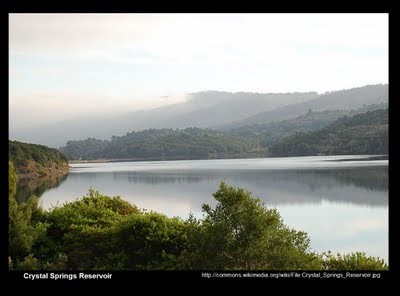
Just back from visiting the Bay Area (where I grew up). Driving along 92 and 280 near Crystal Springs Reservoir as the ocean winds began to bring the fog over the coast ranges from the Pacific brought back memories.

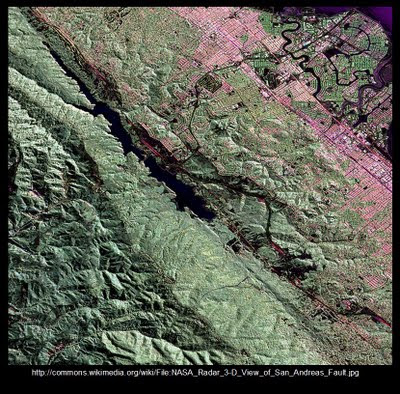
The Crystal Springs Reservoir lies along the line of the San Andreas Fault, seen in the NASA photo below:


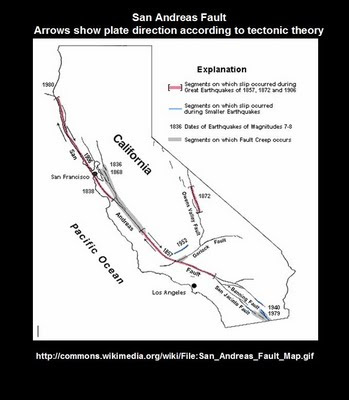
The San Andreas Fault, of course, is quite famous for producing earthquakes. It is one of the longest faults in North America, stretching through the state of California and right through the Peninsula pictured in the image above (which depicts both highway 92, running east-west and bisecting the reservoir where it crosses on a raised causeway before ascending into the redwood-forested ranges on the way to the ocean, and highway 280, which runs generally north-south along the north side of the reservoir in the image above). The length of the fault, as well as the general direction of plate motion that supposedly produce the fault and the earthquakes according to the tectonic theory, is shown in the image below:


The diagram above, originally published by the US Geological Survey (USGS), provides dates of several magnitude 7 and 8 earthquakes registered along the fault throughout the past two centuries.

Whether the fault produces earthquakes is not really up for debate. What is worth discussing, however, is the mechanism which causes such quakes. As we have discussed previously on this blog, the tectonic theory explains earthquakes by the drifting of plates in different directions relative to one another, while the hydroplate theory explains earthquakes via the shifting of the material of the earth (including plates) towards a position of greater equilibrium.

This shifting often takes place towards the great basin of the Pacific Ocean, which was violently sucked downwards during the events surrounding the proposed flood event, and towards which the continents originally slid. Numerous earthquakes still take place around the edges of the Pacific, as part of the continuing recovery phase of that enormous ancient catastrophe.

Walt Brown, the author of the hydroplate theory, notes that the curved shape of the San Andreas Fault -- clearly seen in the map of the fault along the entire state of California in the USGS diagram above -- would mean that the plates supposedly sliding in opposite directions on either side of the fault would not be able to move very far. The curved shape would restrict slippage. However, if the enormous plates were really always trying to move in the opposite directions indicated on the conventional diagrams of the San Andreas Fault, tremendous friction should built up along the curved fault line.

This friction would create intense heat. However, Dr. Brown explains that geological tests have failed to find the heat that should be generated there (91). The fact that such frictional heat has not been found is a clue that the tectonic theory may not be the best explanation for the features and earthquake events that we find on the earth. Other evidence that tends to undermine the tectonic theory is discussed in previous posts such as this one, this one, and this one.

Dr. Brown's theory does not discount the presence of faults -- far from it, the theory recognizes the importance of faults in one type of earthquakes (shallow earthquakes), and the fact that faults were formed by the violent forces that took place during the sliding of the plates during the flood event. Many of these faults exist on the bottom of the Pacific and along its perimeter.

Dr. Brown explains that trapped water under the earth is slowly forced up through these cracks by the great weight of the mass above the water, which can contribute to the initiation of earthquakes along faultlines:
Trapped, subterranean water, unable to escape during the flood, slowly seeps up through cracks and faults formed during the crushing of the compression event. The higher this water migrates through cracks, the more its pressure exceeds that in the walls of the crack trying to contain it. Consequently, the crack spreads and lengthens. (So before an earthquake, the ground often bulges slightly, water levels sometimes change in wells, and geyser eruptions may become irregular.) Simultaneously, stresses build up in the crust, again driven ultimately by gravity and mass imbalances at the end of the flood. Once the compressive stress has risen enough, the cracks have grown enough, and the frictional locking of cracked surfaces has diminished enough, sudden movement occurs. The water then acts as a lubricant. (Therefore, frictional heat is not found along the San Andreas Fault.) Sliding friction instantaneously heats the water, converts it to steam at an even higher pressure, and initiates a runaway process called a shallow earthquake. 108.
This reasoning would also explain why the process of forcing water deep into the ground at high pressures (such as for hydraulic fracking or for the harnessing of geothermal energy) has been alleged to start man-made earthquakes (see for example the article and links at this site, among many others on the web).

The San Andreas Fault appears to supply more evidence in support of the hydroplate theory. Amazingly, aspects of the hydroplate theory would also help explain many of the mysterious aspects of ancient civilization, including features that lie outside the boundaries of the conventional model of mankind's ancient past. This connection is the subject of the Mathisen Corollary.


The eruption on the sun


And, speaking of eruptions, there was a massive eruption yesterday on the solar surface, which was captured in stunning detail by several spacecraft.

Known as a "prominence eruption," the event created a solar flare and a prominence, which -- as astronomer Dr. Phil Plait explains here -- can be defined as a release of pent-up magnetic energy (a solar flare) followed by a physical eruption of gas from the surface of the sun (a prominence).

More footage from the event can be found here, as well as a comparison of the size of the CME ("coronal mass ejection") to the size of the earth. Scientists believe that there is no danger to earth from the solar energy.

The conventional explanations for the origins of the sun itself have some problems of their own. In particular, the so-called "faint young sun paradox," first raised by astronomers Carl Sagan and George Mullen in 1972, describes the problems with the "standard solar model" for the origin of the sun, which argues that a star such as the sun would gradually brighten and become hotter during its early evolution until it reaches a steady state that it stays in for billions of years.

If the sun were 30% cooler and dimmer billions of years ago, then we should see evidence for that (we don't, as explained in the above link) and even more problematic, the earth would have been so cold that life could never have evolved under current models of Darwinian evolution. Also, Dr. Walt Brown has explained that once a young earth became covered with ice, it would reflect more of the sun's heat away from it (think of the fact that a black shirt or car interior becomes hotter on a sunny day than a light-colored shirt or car interior does), creating a kind of "runaway cooling" so that even when the sun warmed up to its present temperatures it would not be enough to melt the permanent ice age that would have formed during the cold period. Other problems with the current Darwinian explanation can be found here and here.

Obviously, the sun is incredibly important to life on earth. The recent solar eruption reminds us of its incredible power and energy, and should cause us to consider the explanations that we accept about the ancient past.

Puyehue erupts


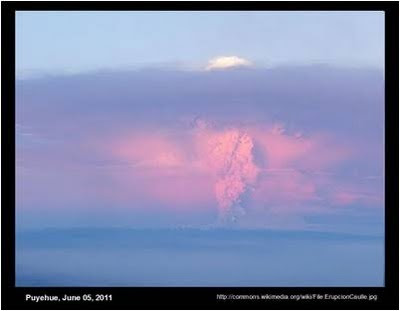
Here is a link to a story covering the eruption of the Puyehue volcano in southern Chile, along with a series of spectacular photographs of the eruption. The last time this particular volcano erupted was in 1960.

The origin of volcanoes is something of a geological mystery under conventional theories, a subject we have already touched on in this previous post.

The hydroplate theory of Walt Brown argues that the magma which erupts in volcanoes originated from the friction of the sliding hydroplates during the cataclysmic flood event. The location of volcanic activity along the "forward edge" of the continents is consistent with this explanation. The volcanoes in Chile, which forms the "leading edge" of the continent of South America, certainly fit this model.

Depending on one's model for the interior of the earth, the origin of magma poses some difficulties. Some models posit a mostly solid crust and mantle region, with a molten outer core. However, the outer core is so deep (1,800 miles below the surface) that it cannot be the origin of volcanic magma.

Also, as Dr. Brown explains in this section of his online book, the existence of extremely hot pockets of magma closer to the surface pose some problems for conventional theories that assume an earth formed billions of years ago. The principles of physics would argue that major heat differences should have evened out in the intervening billions of years. So, what events caused the formation of molten rock close enough to earth's surface to erupt occasionally? Uniformitarian theories have a hard time explaining this molten rock, but the catastrophic events put forward in the hydroplate theory do not.

As you consider the awe-inspiring sight of the erupting volcano in Chile, it is worthwhile to reflect on the origins of volcanoes.


Marlborough Mound, Silbury Hill, and Avebury Henge


Here's a recent article from the Stone Pages Archaeo News describing new results of a radiocarbon dating test conducted on the Marlborough Mound, located in England to the west of London and to the north of Stonehenge. For the first time, such tests have confirmed a very ancient date for the mound -- 2400 BC according to this dating.

The Marlborough Mound is located just to the east of the famous Silbury Hill (shown above), the largest such mound in all of Europe. It is 130 feet high and required an immense amount of technical and physical skill to construct. The base and truncated top were very precise circles, as are the some of the surrounding stone circles which were almost certainly connected in their overall purpose.

While the academic community remains at odds about the purpose of the extensive ancient construction in the area, Martin Doutré has outlined the plausible theory that the entire complex (including the enormous stone circle at Avebury to the southwest of Silbury Hill) functioned as an "open-air university" for the training of initiates in the mathematics and knowledge required for bluewater ocean navigation.

In a series of webpages beginning here, Mr. Doutré describes the significance of the precise measurements and angles present at Avebury Henge, showing that they are directly related to the size of the spherical earth and to a sophisticated of calendar cycles relating to the orbit of the earth around the sun and of the moon around the earth. He also shows that the dimensions and angles of many of these monuments may well be related to those of the pyramids of Giza -- a startling possibility which we have discussed previously with respect to Stonehenge and the Great Pyramid in this post.

After providing close examination of the circles and angles at Avebury, Mr. Doutré says:
The reader-researcher will begin to appreciate the mammoth effort expended by ancient British society to put such an array of structures in place, but will also begin to understand why it was done. One has to remember that at a time when there was no great availability of paper to make text-books of instruction, lessons had to be taught and learnt by grueling rote and repetition, coupled with hands on experience. There was no other avenue available to ancient tutors, but to set out structures across the landscape and commit to memory the refined scientific information incorporated into each position. A purpose-placed stone or marker-mound represented a mnemonic device or memory trigger repository of coded information, but the real knowledge reposed in the mind of the master. (Fourth page in the series, here).
He then puts forward the fascinating possibility that the long double rows of standing stones along present-day West Kennet Avenue (extending south from the Avebury Circle) functioned as a kind of "practice lane" for navigators-in-training to learn their important distances, angles, and navigational concepts. This is personally very plausible to me as a former Infantry officer in the US Army, where we spent plenty of time walking just such practice lanes on the "land nav" courses in the wilderness around Fort Benning, Georgia and other Infantry training sites.

We have already seen extensive evidence that ancient mankind crossed the oceans long before conventional history says it was possible (see this post, for example). Doing so deliberately and successfully is not easy, and so it is perfectly logical that training in advanced concepts of geodesy (the measurement of the size of the spherical earth), astronomy, and navigation must have taken place. As Mr. Doutré points out, "For mariner-navigators especially, the lessons had to be learnt very thoroughly, as the open sea did not abide fools well or forgive them for their ignorance."

Finally, Mr. Doutré discusses Silbury Hill in the ninth webpage of the series, and posits that its size and location enabled observers to view the progress of the students in this complex and enormous outdoor training ground. He then turns his attention to the still-visible remains of three modern "crop-circle" designs located within sight of Silbury Hill. The results of his analysis of the angles and distances from Silbury Hill to the centers of these crop circles are quite remarkable, in that they appear to contain important numerical codes that are certainly not well-known to the general public.

In fact, among other things, the important precessional numbers 108 and 25,920 both appear to be present in these crop circles! That's fairly unexpected.

Whatever the origin of the mysterious crop circles, it is fairly clear that the extensive Avebury - Silbury complex encodes and preserves sophisticated mathematical, astronomical, geodetic, and possibly navigational concepts. The results of continued testing demonstrate that the site has guarded these concepts for well over four thousand years -- and possibly even longer than that. The entire area is an important clue to mankind's ancient past, and powerful evidence that there is far more to the story than conventional theories will currently admit.

Red Ice interview available on iTunes


If you haven't yet had the opportunity to listen to the Red Ice Radio interview with Mathisen Corollary author David Warner Mathisen, this previous post contains links and instructions for both the first and second segments of the interview.

The first segment of the interview is also available on Apple's iTunes, where it can be downloaded at no cost and put onto a portable device or even a CD for listening on the go.

Some parts of the day where having a Red Ice interview on hand can be fortuitous:
  • Going for a run along the beach
  • Working out at the gym
  • Doing the dishes
  • Driving to and from work
  • Cooking dinner
  • Walking the dog
  • Shaping a surfboard
  • Soaking up rays, which is highly beneficial for human health
  • And many other activities
The interview about the Mathisen Corollary can be found by going to iTunes and then searching podcasts for the terms "Red Ice Radio."

If you know someone else who is interested in these matters, be sure to let them know about the possibility of listening via iTunes, and point them to this blog as well.

Gemini, Canis Minor and the Hairy Twin


Here's a post from Urban Astronomer showing the beautiful constellation of Gemini (the Twins) as it dominates the western sky after sundown.

Gemini follows Taurus in the zodiac and is located above and to the left of Orion in the northern hemisphere. The diagram above shows a photograph of the constellation, with lines connecting the stars using the method created by H.A. Rey (discussed in this previous post). In the same photograph of the heavens, the upper stars of the constellation Orion and the edge of the constellation Taurus can be seen, and they are marked and labeled as well.

Also shown and labeled is the constellation Canis Minor (the Little Dog), which is very close to Gemini and associated with them in ancient mythology in a way similar to the association of Canis Major and Orion. Like Canis Major, which contains the brilliant and mythologically important star Sirius (one of the most mythologically important stars in the sky), Canis Minor also contains an important star, Procyon (a name which means "before the dog," which H.A. Rey tells us is because it rises about forty minutes before Sirius, the Dog Star)(44). In the diagram above, the names of important stars are shown in smaller type than the names of the constellations.

Gemini is currently far to the west as the sky turns dark, meaning that it has been making its way across the sky during daylight hours. When the sun goes down, Gemini is far to the west and will be setting soon as well. At latitude 35o north, Gemini's brightest star Pollux (shown in the diagram) rises at 8:18 in the morning on June 6 (after the sun has already come up, so Pollux cannot be seen) and reaches its highest point (known as transit) at 3:49 in the afternoon (when it is again still invisible due to the daylight), and then sets at 11:19 pm. Each day, it will rise and set four minutes earlier due to the progress of earth around the sun (as discussed in this previous post), so that soon Gemini will rise and set entirely during hours in which it is obscured by the sun.

The nearby constellation Canis Minor has only two stars, but both are bright and easy to recognize. The brighter of the two is Procyon, one of the ten brightest stars in our sky. On June 6 at latitude 35o north, Procyon rises at 9:26 am and transits at 3:43 pm (both during daylight hours), and sets at 9:59 pm.

Giorgio de Santillana and Hertha von Dechend have a fascinating discussion of the importance of the Little Dog and the Twins in Appendix 28 of Hamlet's Mill. They note that in mythology, "the hairy partner of the Twins, the 'Dog,' is the prototype of the older one who is cheated out of his primogeniture in various ways" (405).

There are many legends in which there are two heroes who are twins of one another, and one twin is hairy and very much a wild-man or child of nature. The most obvious of these pairs may be Gilgamesh and Enkidu, treated at some length in the Mathisen Corollary and also mentioned in the first hour of the recent Red Ice Radio interview about the book. Enkidu is a wild-man, described in the first tablet of the Gilgamesh series this way (in the online edition of the translation by Maureen Gallery Kovacs):
His whole body was shaggy with hair,
he had a full head of hair like a woman,
his locks billowed in profusion like Ashnan.
He knew neither people nor settled living,
but wore a garment like Sumukan.
He ate grasses with the gazelles,
and jostled at the watering hole with the animals;
as with animals, his thirst was slaked with (mere) water.
These characteristics of Enkidu are important, especially since there are other legends in which one of two twins is described as being covered with hair. De Santillana and von Dechend mention Jacob and Esau from the Hebrew Scriptures: Esau the elder is described as being "red, all over like an hairy garment" in Genesis 25:25, and when Jacob tricks Isaac into giving him the blessing instead of Esau, we are told that his mother Rebekah "put the skins of the kids of the goats upon his hands and upon the smooth of his neck" so that when Isaac felt Jacob's hands, "his hands were hairy, as his brother Esau's hands" (Genesis 27:16 and 27:23).

De Santillana and von Dechend also point out that in the second-oldest text of classical Japan, the Nihongi (also known as the Nihon Shoki) there is a similar set of twins, Hono-susori no-Mikoto (the elder) and Hiho-nonodemi no-Mikoto (the younger). In the account, the older brother serves the younger brother, and bespatters his body with red clay -- an interesting parallel to the account of Jacob and Esau. Also in the account, the younger brother is given two brilliant jewels by his father-in-law, with which he could control the tides of the seas as well as his wild elder brother. Is it possible that these two jewels are related to the two bright stars of Canis Minor?

It is remarkable to find such connections between the ancient accounts from the region of Sumer, Babylon, and Israel and those in Japan. Of course, because the Nihongi is believed to have been written in the year AD 720 (an interesting precessional number, although possibly this is a coincidence), it could be argued that the authors were somehow influenced by the Old Testament account (although not by the Gilgamesh Epic, since the tablets containing the Gilgamesh series had not yet been rediscovered in the ancient library of Asshurbanipal, or the cunieform writing on them deciphered by modern scholars). It is more likely that there was ancient contact that is not included in current historical paradigms.

Even more difficult to explain are connections with legends from the native peoples of the American continents. De Santillana and von Dechend find a dramatic connection here as well, in the legends of the Cherokee, where once again there is a set of twins, one of whom is a wild-man or child of nature like Enkidu. In the 1900 text by James Mooney entitled Myths of the Cherokee: from the nineteenth annual report of the Bureau of American Ethnology, 1897-98, we find the story of the son of Kana'tï and Selu (in chapter 3). These legends were collected from elders among the Cherokee in the nineteenth century; the elder telling this particular story prefaced it by saying, "When I was a boy, this is what the old men told me they had heard when they were boys" (242).

The account that he heard went like this:
Long years ago, soon after the world was made, a hunter and his wife lived at Pilot knob with their only child, a little boy. The father's name was Kana'tï (The Lucky Hunter), and his wife was called Selu (Corn). No matter when Kana'tï went into the wood, he never failed to bring back a load of game, which his wife. would cut up and prepare, washing off the blood from the meat in the river near the house. The little boy used to play down by the river every day, and one morning the old people thought they heard laughing and talking in the bushes as though there were two children there. When the boy came home at night his parents asked him who had been playing with him all day. "He comes out of the water," said the boy, "and he calls himself my elder brother. He says his mother was cruel to him and threw him into the river." Then they knew that the strange boy had sprung from the blood of the game which Selu had washed off at the river's edge.
The parallels to the account of Gilgamesh and Enkidu are striking. Striking too are the parallels to the other accounts we have seen. For example,the account of the twins in the Nihongi, which also places the tale of the two brothers near the beginning of the world, and there are connections between the elder brother and the sea as well. Note that in all the accounts extraordinary skill in hunting plays a role (remember that in the Biblical account, Esau was "a cunning hunter, and a man of the field" (Genesis 25:27).

Note also the connection to the color red -- in the Cherokee account the wild twin sprang from the blood of the animals cleaned in the river, while in the Biblical account Esau is described as being red and hairy and in the Japanese account the elder brother covers himself in red clay.

Even more significant, in the Cherokee account the son of Kana'tï challenges his new companion to a wrestling match and will not let him go until his parents come and bring him home to try to tame him (echoes of both Jacob and Gilgamesh and Enkidu).

How can the conventional historical framework account for these stunning connections across disparate cultures in very remote locations? They are forced to argue that such legends simply grew up independently of one another, perhaps influenced by similar interpretations of the same celestial phenomenon, or else to fall back upon something like Jung's "collective unconscious." But it is very hard to explain how different cultures would all settle on the idea that the two stars next to Gemini resemble a hairy dog, or account for such peculiar details as the presence of the color red. The idea of the collective unconscious has similar difficulties -- especially since there is other (physical) evidence of ancient contact that cannot be explained by the collective unconscious the way that parallels in mythology might be (such as stone inscriptions, and even physical remains such as discussed here, here, and here).

De Santillana and von Dechend correctly observe that the mythological complex of the "Dog Twin" is vast, with important echoes in Ancient Egypt (where the Jackal was known as "the eldest" and associated with the title of Upuaut, "the opener of the way"). They state that it is a topic "of such a size and weight that it cannot be attacked here" and drop the subject, much to their readers' dismay!

However, it is clear that the constellations Gemini and Canis Minor have important connotations that span cultures that conventional history says were never in contact with one another. The common elements of the accounts of the hairy twin provide important additional supporting arguments for a theory of ancient trans-oceanic contact.

Try to take the time to observe the impressive spectacle of Gemini and Canis Minor, along with the waxing crescent of the moon, in the western night sky in the hours after sunset the next few days. When you do, think about these fascinating connections to the accounts left to us from ancient peoples about whom we still know very little.