Giordano Bruno, 1548 - 1600


On this day in history, February 17 in the year 1600, the philosopher Giordano Bruno was burned at the stake.  

In the introduction to their 1977 translation of Bruno's 1584 text The Ash Wednesday Supper, Edward A. Gosselin and Lawrence S. Lerner write that "Giordano Bruno is one of those semi-legendary figures of whom nearly every educated person has heard the name and very little more" (11).  

They go on to say that the commonly-understood "myth" of Bruno's life and importance, while based in the true details of his life, leaves out the full complexity both of the man and the significance of his philosophy.  They summarize "the Bruno myth" as follows:
An itinerant renegade friar, Bruno defied contemporary ecclesiastical authorities and doctrines.  In addition, he vehemently rejected the commonly held Ptolemaic belief that the earth lay at the center of the universe, and engaged in mystical speculation which centered about his pioneering support of the Copernican view.  In connection with his Copernican beliefs, he held also that the universe contains an infinite number of worlds populated with intelligent beings.  On account of these teachings, Bruno was tried for heresy by the Inquisition and burned at the stake in 1600.  He thus became the first martyr of modern science at the hands of the Church, and thereby a precursor of Galileo.  The moral of this nineteenth-century story is that Science, the bearer of knowledge, struggles to an inevitable victory over the Church, the champion of ignorance and superstition.  11-12.
Gosselin and Lerner write that while the "facts in this myth are true" they are "sketchy to the point of poverty and generally misleading in their emphasis" (12).  Rather, they note that while Bruno was among the first to support the Copernican revolution, his emphasis was on its philosophical implications, which run far beyond the merely scientific details of which heavenly object orbits which.  It was Bruno's brilliant insight to perceive that the motion of the bodies in the universe, including the earth, had implications which impacted every aspect of human existence.  Gosselin and Lerner write: "For these movements called upon the whole encyclopedia of human knowledge in their efforts to restore the lost harmonia mundi"(13).  

In his introduction to the collection Giordano Bruno: Cause, Principal and Unity, and Essays on Magic, Alfonso Ingegno writes that Bruno's Ash Wednesday Supper discussion of the work and significance of Copernicus can help us perceive the scope of Bruno's philosophy. Ingegno writes:
Copernicus was primarily a mathematician -- his interest was directed towards astronomy rather than towards natural philosophy, and in this sense his work needed to be further developed.  Certainly he started from a correct and significant physical presupposition, the earth's motion, but he sought only a mathematical description of the movements of the heavens.
In contrast, Bruno presents himself as a natural philosopher, as the one who is destined to become the authentic interpreter of Copernicus' discovery and is called to draw out the conclusions from it, beginning with the physical ones.  [. . .]  Thus in The Ash Wednesday Supper Copernicus becomes the inspired one to whom the gods have entrusted a message, the importance and significance of which he has not realized; he is like a blind fortune teller for whom Bruno acts as the authentic interpreter.  ix.
Ingegno goes on to give a taste of the profundity of Bruno's vision:
The philosopher, therefore, is summoned on a metaphorical journey across the heavens to discover that the traditional crystalline spheres are only a vain fiction, that there is no upper limit to the physical world and thus no end to his journey, and that what opens out in front of him is an infinite space.  The philosopher shows us that the divinity is present in us and in our planet no less than in every other heavenly body, that it is not situated beyond the imaginary limit of a closed and finite universe, in a place which makes it accessible to man.
In other words, Bruno perceived that the work of Copernicus changed everything, because it meant that divinity is not "situated beyond the imaginary limit of a closed and finite universe" (that is to say, that the Eternal did not dwell in a remote location, above the outermost of the "crystalline spheres" of heaven), but that "divinity is present in us" and can be found in a place that is accessible to every man and woman.

Bruno saw this vision as enabling the reconciliation of mankind, and as offering the possibility for overcoming the violent religious wars and controversies which were wracking Europe (and which would ultimately lead to his own violent murder at the hands of religious authorities).  Bruno perceived that Copernicus had broken through the mental fiction upon which was based a system of violence and suppression that had kept human beings in ignorance and poverty, and that the downfall of this fiction opened up the gate to the reconciliation of all human knowledge, and a return to an ancient harmony that had been lost.  

In her groundbreaking 1964 work, Giordano Bruno and the Hermetic Tradition, Frances A. Yates argues that Bruno thus revived the ancient vision of the Hermetic Neoplatonists of the second and third centuries AD, a vision that was eventually crushed by the rise of ecclesiastical and literal Christianity.  It was this vision, rather than his support for the Copernican system, which led to his execution, according to Yates.  She writes that Bruno was perceived as "particularly dangerous because he had had a religious mission"(445).  "Bruno's universal reform," she says, "aimed at returning to a supposedly pre-Christian Hermetic Egyptianism.  Bruno himself, however, would not have regarded this as necessarily anti-Christian since, as we have seen, he entertained the strange hope that the reform would come within an existing framework"(445).

As Alfonso Ingegno tells us, "More than any previous thinker, then, Bruno is aware of the fact that the fall of Aristotelian cosmology implies the end of traditional metaphysics."  But, he thought that others would embrace the metaphysical implications of the death-blow that Copernican science was dealing to the Aristotelian cosmology (of a fixed earth), and in this he was fatally mistaken.

Bruno's philosophy was far-ranging and all-encompassing.  His insight that the universe was infinite, and that it was composed of minute "seeds" which bonded together temporarily and then dissolved to form again, he perceived to have ramifications that ranged from the fate of the soul after the death of the body (he wrote: "Death is nothing more than [. . .] a disintegration.  No spirit and no body ever perishes; rather there is only a continual change of combinations and actualizations," Cause, Principle and Unity) to the concept of "social binding," which is very much analogous to what we might today call "mind control" (he wrote: "even if there were no hell, the thought and imagination of hell without a basis in truth would still really produce a true hell, for fantasy has its own kind of truth," and ""No bonds are eternal.  Rather, things alternate between bondage and freedom, between being bonded and escaping from a bond, or they transfer from one type of bond to another," Cause, Principle and Unity). 

He wrote an entire treatise discussing the ways that the masses can be manipulated by psychological and magical bonds, and on recognizing and escaping from such bonds (entitled De vinculus in genere, or Of bonds in general, it can be found along with other works by Bruno -- albeit in Latin -- here; The Ash Wednesday Supper can be found in English online here).  The quotations in the previous paragraph can be found in this excellent online review by Sonya Bahar of Ingrid Rowland's 2009 biography of Giordano Bruno. 

Ultimately, a philosopher as vast as Giordano Bruno cannot be encompassed, any more than can the infinite cosmos he proclaimed -- the infinite cosmos which the ancient Hermetic wisdom he espoused declares to be present inside every human being.



Galileo Galilei


February 15 is the birthday of Galileo Galilei -- born this day in Pisa, Italy in 1564, four hundred fifty orbits of the earth around the sun ago.  Special thanks to my very good friend J. Y., originally of N. Z., for reminding me of this very important anniversary of Galileo's birth, and sending along this link to the Galileo birthday writeup in the Sydney Morning Herald by past President of the Astronomical Society of Victoria, Perry Vlahos.

Galileo, of course, was possessed of a tremendously curious and incisive mind, and a crucially important figure in the history of physics, astronomy, and science in general.  Perhaps one of the most important paradigm shifts he introduced, and the one which had the most profound impact upon the world, was his almost single-handed invention of the scientific method: the concept of using experiments and allowing the evidence to suggest the hypotheses and theories that explains the evidence, in marked contrast to the methods in use for centuries previous.

As Professors Bruce Rosenblum and Fred Kuttner explain in their outstanding investigation of quantum physics entitled Quantum Enigma: Physics Encounters Consciousness, Galileo pioneered a new approach that propelled human investigation forward in a way that had not been possible previously, when theories were deemed acceptable or not based on religious dogma:

The Church had to stop Galileo's call for independent thought. [ . . .] Found guilty of heresy by the Holy Inquisition, and given a tour of the torture chambers, Galileo recanted his claim of a sun-orbiting Earth.  For his last years, Galileo lived under house arrest -- a lesser penalty than that of another Copernican, Giordano Bruno, who was burned at the stake.
[. . .]
Galileo's ideas were obvious -- to him.   How could he convince others?  Rejecting Aristotle's teaching on the motion of matter was not a minor issue.  Aristotle's philosophy was an all-encompassing, Church-enshrined worldview.  Reject a part, and you appear to reject it all.
To compel agreement with his ideas, Galileo needed examples that conflicted with Aristotle's mechanics, but examples that conformed to his own ideas.  Looking around, he could see few such cases.  His solution: create them!
Galileo would contrive special clear-cut situations: "experiments."  An experiment tests a theoretical prediction.  This may seem an obvious approach, but in that day it was an original and profound idea.
[. . .]
Some faulted Galileo's experimental method.  Though the displayed facts could not be denied, Galileo's demonstrations were "merely contrived situations."  They could be ignored because they conflicted with the intuitively obvious nature of matter.  Moreover, Galileo's ideas had to be wrong because they conflicted with Aristotelian philosophy. 
Galileo had a far-reaching answer: Science should deal only with those matters that can be demonstrated.  Intuition and authority have no standing in science.  The only criterion for judgment in science is experimental demonstration.
Within a few decades, Galileo's approach was accepted with a vengeance.  Science progressed with a vigor never before seen.  25-26.
The authors go on to demonstrate that the results of the foundational experiments of quantum physics, while clearly going against "the intuitively obvious nature of matter" as well as the received wisdom and apparent "authority" of the classical physics that preceded them, create a paradigm shift as fundamental as that which Galileo and his successors accomplished in their day.

While quantum physics is now generally accepted, there are many other areas in which received wisdom and the reigning "authority" continues to try to trump the evidence, or even to suppress the evidence, in order to try to prevent the acceptance of paradigm-shifting new perspectives.  Because of this, the spirit of Galileo will always be necessary to enable mankind to honestly search for the truth, and to face the implications of the results of the evidence, no matter what that evidence appears to tell us.

-----------


Previous posts mentioning Galileo:


It might also be pointed out that without Galileo, there would probably have been no Sherlock Holmes and his version of the "scientific method," and without Sherlock Holmes, there would probably have been no Scooby Doo.

As the above-linked previous blog posts point out, there are many in the "establishment" today who like to invoke Galileo as a way of stifling the very kind of evidence-based dissent that Galileo stood for.    On the four hundred fiftieth anniversary of his birth, it is a good time to consider the spirit of following the evidence, rather than the dictums of the "authority" figures who want to quell dissent by their insistence that the matter is already "settled."

The Big Dipper and the Lion


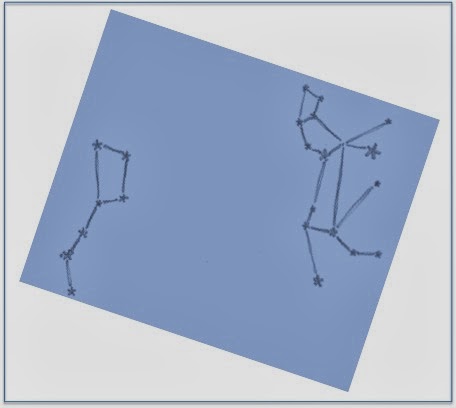
This is a terrific time of year to view the majestic pairing of the Big Dipper and the zodiac sign of Leo the Lion, two constellations which are actually "paired" in the sky.

Right now, in the hours between sunset and midnight (prime viewing hours for those who keep rather "normal" sleep schedules), the almost-universally familiar form of the Big Dipper is standing almost vertical when viewed by observers in the northern hemisphere (see diagram above).  

The constellation of Leo the Lion is actually "geared" to the Big Dipper as shown in the diagram, such that the bottom of the "spoon" of the dipper is roughly parallel to the back of the Lion: they look almost like the coastlines of two continents which are now separated by the Atlantic Ocean but which once fit together, having drifted apart as described by the theory of gradual "continental drift" or by the far more-likely hydroplate theory of Dr. Walt Brown.  

Of course, I am not suggesting that continental drift also took place in the heavens and that the constellations of the Dipper and the Lion were once joined together!  This is just a metaphor to describe the nice parallel "fit" and relative positions of the two groupings of stars, and to help the skywatcher to think of the two constellations as part of the same heavenly mechanism.

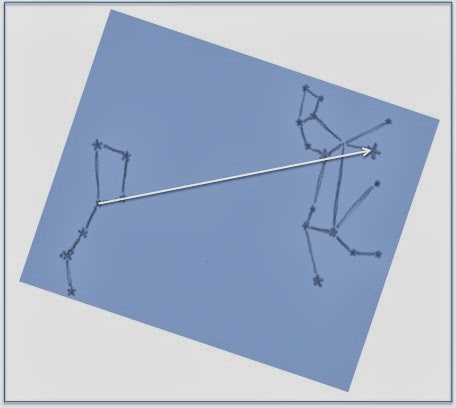
Those who may be familiar with the Big Dipper but not as familiar with the figure of Leo the Lion can find tips on locating Leo in previous posts such as this one and this one.  Also, as beloved author H. A. Rey describes in his wonderful and essential guide The Stars: A New Way to See Them, the rear two stars in the cup of the Dipper can be used to point an arrow directly to Regulus, the brightest star of the Lion (see diagram below).  Of this brightest star in Leo, H. A. Rey writes:
The brightest one, REGULUS, is easy to find when the Big Dipper is high up: use the two stars of the Dipper's bowl next to the handle and draw a straight line toward the Bear's paws and beyond; it will first hit the star in the Lion's shoulder and then Regulus.  Bluish-white Regulus is the faintest of our 1st-mag. stars but even so it shines about twice as bright as Polaris.  It is about 80 light-years away and over 100 times as luminous as the sun.  34.


The Big Dipper, of course, revolves rather closely around the north celestial pole, that point in the heavens around which all the northern hemisphere stars revolve.  In his wonderful and essential guide The Stars: A New Way to See Them, H. A. Rey describes the north celestial pole using the metaphor of the central point in the middle of an opened umbrella (page 22).  The central point is the north celestial pole (marked in our current epoch by the "North Star," Polaris), and the inner surface of the opened umbrella is the night sky.  

If you revolve the umbrella by turning the handle (you should turn it counterclockwise if you want it to revolve in the correct direction around the north celestial pole), you will see the constellations inscribed on the inner surface of the opened umbrella rotate the way the constellations in the night sky rotate around the North Star.  The Big Dipper would be rather close to the North Star, rotating around it each day as the earth revolves on its axis (the axis points to the north celestial pole, which is why the sky seems to revolve around that point).  The stars of the Dipper, in fact, are among the "imperishable" or "undying stars," the name the ancient Egyptians gave to those stars which are close enough to the celestial pole that they never drop below the horizon (the way the stars farther out towards the edges of the "umbrella" do plunge below the horizon at the end of their circuit to the west).

Because the Dipper and the Lion are "geared" together as shown in the diagram above, as the Dipper rotates upward it "drags" along the Lion across the sky.  When the Dipper is rising vertically in the east, as it is doing now in the hours before midnight, the Lion is also rising mostly vertically in the east (as depicted in the diagram).  As the sky continues to revolve (or, more precisely, as the earth itself revolves on its axis through the night), the Dipper continues upward and the Lion proceeds across the sky, as if propelled by the turning of the "inner gear" marked by the Dipper's circle.  

Of course, during some parts of the year, the Dipper is on the lower half of its turning during the nighttime hours, so the Lion is below the horizon during the nighttime hours, and is washed out by the sun during the daytime hours when he is above the horizon.  During those months, the Lion is not visible at night.  Right now, however, he is coming into the best time of year to view his form in the night sky.

(For the next few days, the moon is traveling into the constellation of Leo, and it will be a full moon tomorrow night, so the moon will interfere with an observer's ability to see all the stars of Leo clearly, but after the moon reaches full it will begin to wane and become less and less of a dominant presence in the night sky, on its way to new moon; the moon will also continue to move through the constellations and out of Leo into Virgo after a couple of days).  

The turning motion of the seven stars of the Big Dipper (which are, properly speaking, not a complete constellation but an "asterism" within the constellation of Ursa Major, the Great bear) was invested with great spiritual significance by the ancient sacred traditions found the world over.  In his masterful 1940 book Lost Light: An Interpretation of Ancient Scripture (discussed in this previous post and available to read online via links in that post), Alvin Boyd Kuhn writes of the Big Dipper:
Neith is Hathor, the Egyptian Venus, the mother of life, twofold in character as liquid and aeriform.  Her celestial representative was Ursa Major, the Great Bear (or Bearer, suggests Massey), the great dipper in which the water of life was held, and from which, as it turned around the pole, it was periodically poured out and again dipped up! [. . .] So this great sidereal directory of the heavens became the greatest of astronomical symbols to the ancients, dramatizing the seven great elemetary mother powers of nature that periodically arose out of the waters of life.  Operated by its handle of three stars, typing the solar triad of mind, soul and spirit, it caught up the living waters in its four-starred cup, the fourfold physical basis of all things.  272.
This explication of the Big Dipper, with a three-fold handle that represents the trinity of mind, soul, and spirit, operating a four-fold cup that cyclically pours out and dips up again (representing successive incarnation in the material realm of the four-fold cross of matter, discussed in this previous post and in the numerical system of the ancient Pythagoreans) is amazing and profound.

A lion and a bear are common elements in heraldry and other iconography, and it is more than likely that their pairing originates from the close pairing of the constellations of Ursa Major and Leo the Lion in the heavens.  The connection is further cemented by the frequency in which a single star is paired with the bear in the depictions, whether the bear is by itself (such as in the California flag) or whether the bear is with a lion (such as can be seen, for example, in the logo of the Firestone Walker Brewing Company, here).  The close association of the bear and star symbology no doubt is a direct reference to the close association of the heavenly Bear (and its Big Dipper) with the North Star.

But regardless of its use in earthly symbology, the profound spiritual message of the endlessly revolving Big Dipper, with its seven stars grouped into a handle of three and a cup of four, is even more universal and can be claimed by all human beings.  Over the next few weeks, you may want to spend some time enjoying the glorious sight of the vertical Big Dipper and the companion constellation of the regal Lion, if you are able to do so.

Angkor Wat, Giza, Paracas and the World-Wide Grid


In their outstanding book Heaven's Mirror, Graham Hancock and Santha Faiia point out the undeniable fact that Angkor Wat is located seventy-two degrees east of Giza in Egypt (page 254).  

Seventy-two is an important precessional number.  It is highly unlikely that the site of Angkor Wat would be located such an important number of degrees of longitude from the site of the Great Pyramid at Giza simply by accident, especially because both the Great Pyramid and the art and architecture of Angkor Wat deliberately employ precessional numbers and symbology in their construction and (in the case of Angkor Wat) in their symbology, as Graham Hancock discusses in Heaven's Mirror and other books (including Fingerprints of the Gods).  

The fact that Angkor Wat bears a name which is made up of two sacred Egyptian words -- Ankh and Horus -- makes the connection between Giza and Angkor even more certain to be deliberate and not a coincidence.  Further, as Joseph P. Farrell and Scott D. de Hart discuss in their book Grid of the Gods, both sites contain pyramid structures; the pyramids at Angkor (shown above in an image from Wikimedia commons) happen to be shaped differently than the pyramids of Giza (being taller than they are wide, unlike those at Giza), but that may well be because their purpose is different, as Drs. Farrell and de Hart discuss in their book.

The fact that these two sites are separated by seventy-two degrees of longitude is an important piece of evidence supporting the assertion made by Drs. Farrell and de Hart, and by Graham Hancock and others, that the ancient astronomically-aligned sites on our planet are part of a global "grid" laid out by an ancient civilization or civilizations possessed of deep wisdom and sophisticated scientific understanding.  

Interestingly enough, Heaven's Mirror also reveals that one hundred eight degrees to the west of Giza lies another mysterious site: Paracas, on the Pacific coast of Peru.  One hundred eight is one of the most important and widely used precessional numbers in the mythology and traditions of the world.  It is, of course, 1.5 times 72.  Multiples of 108 which are found in numerous ancient myths and legends include 216, 432, and 540.  

Paracas is located in the Ica region of Peru, home to the mysterious elongated skulls which were recently in the news due to the results of DNA tests which are discussed in this article on the Ancient Origins website.  Paracas is also the home of an ancient geoglyph known as the "Paracas Candelabra" (shown below in an image from Wikimedia commons), which may reflect the constellation of the Southern Cross according to Graham Hancock's analysis in Heaven's Mirror

As Graham Hancock also points out in Fingerprints of the Gods, the ability to measure longitude accurately eluded "western civilization" until the 1700s, when John Harrison finally developed a chronometer accurate enough for precise longitudinal calculation (see discussion here regarding the "Longitude Prize").  The fact that Giza is seventy-two degrees west of Angkor Wat and one hundred eight degrees east of Paracas suggests that the ancients had a way of accurately measuring the globe.  

The fact of an ancient world-wide grid is not simply a piece of "gee-whiz" trivia.  As Drs. Farrell and de Hart discuss in the book linked above, such a grid may have been constructed in order to harness the enormous power of the earth, and potentially the power created by the motions of other planets in our solar system as well.  The fact that we today know little or nothing about such a grid -- and the fact that conventional academia reflexively suppresses such information and ridicules and marginalizes those who choose to investigate the evidence regarding this and other mysteries of mankind's ancient past -- suggests the possibility that vital information about our planet and our relationship to has been deliberately concealed for centuries.

Previous posts discussing the evidence for a world-wide grid can be found here, here, and here.


Fascinating Red Ice interview with Richard J. Dewhurst


Above is an abbreviated version of a fascinating recent interview on Red Ice Radio with Richard  J. Dewhurst, author of The Ancient Giants Who Ruled America: The Missing Skeletons and the Great Smithsonian Cover-Up.

The complete version of the full two-hour interview can be found at the Red Ice Creations website.  Membership is required to listen to the second hour, but a membership there is (in my opinion) well worth the modest price.  The first hour is free at that site.

The interview covers the evidence of ancient peoples in the Americas who do not fit the conventional historical paradigm that has been aggressively and almost exclusively propagated since the early decades of the twentieth century.  Mr. Dewhurst describes discovering extensive reports, both in newspapers and in scholarly publications, detailing finds of skeletons ranging from seven feet to nine feet in height, sometimes even larger, from sources stretching from the early nineteenth to early twentieth centuries.  Then, during the 1930s, he explains that all mention of these finds -- as well as the skeletons themselves and the numerous artifacts that were found along with them -- suddenly and inexplicably ceased or disappeared.

This interview resonates powerfully with many subjects described in previous posts over the years, including:

You can be sure I will be reading Mr. Dewhurst's book with great interest in the near future.  


Gung Hay Fat Choy!


Happy Chinese New Year!

The date of Chinese New Year is determined by the new moon, but also by the winter solstice.  Thus, it is a solar and lunar New Year, as explained in this helpful article.

For discussions of the phases of the moon, and the cause of the new moon, see discussions in previous posts, such as this one and this one.  The above video was stitched together from NASA images, and shows the phases of the moon as well as the phenomenon of lunar libration.  As it orbits the earth, the moon presents the same face towards us at all times, but even as it does so it rocks slightly in a motion which is called "libration," and which can be seen in the video sequence.

For an amazing look at the dance of the earth and the moon in their orbit around the sun, see the video below:


After pondering the beautiful motion of the earth and the moon around their common "barycenter," you will undoubtedly develop a greater appreciation for the fact that the Chinese New Year takes into account both the sun and the moon in relation to the earth!

In Lost Light (discussed in this previous post), Alvin Boyd Kuhn put forth the thesis that the motions of the sun, moon, and other celestial bodies were seen by the ancients -- all over the world -- as typifying the descent of the human soul into incarnation in this life, and its re-ascent to the world of spirit, through the cycles of incarnation and re-incarnation by which, as he paraphrases the Egyptian Book of the Dead, "the soul steppeth onward through eternity"(41).

In discussing this subject, he writes:
Millions of intelligent persons today have looked upon sun and moon throughout the whole of their lives and have never yet discerned in their movements and phases an iota of the astonishing spiritual drama which the two heavenly bodies enact each month, a drama disclosed to our own astonished comprehension only by the books of ancient Egypt.  71.
But now that you know, you can contemplate this profound subject in the majestic cycles of the sun, moon, and stars, including in the cycles which bring about the annual Chinese New Year.

Happy Chinese New Year!  Wishing you all peace, health, freedom, and consciousness in the New Year.

Columba, the Dove


This is an excellent time of year to look for the constellations beneath Orion, because Orion is now arcing highest across the sky in the hours before midnight, allowing viewers in the northern hemisphere especially to gaze at some of the constellations beneath his feet which are not easily visible during other parts of the year.

In particular, the constellation Columba the Dove is a rare treat for star-gazers this time of year, and one with important connotations.

To find Columba, the method that I use is to start from Canis Major, the Big Dog.  Canis Major is very easy to locate because it contains Sirius, the brightest "fixed star" in the sky.  For greater appreciation of the profound importance of Sirius, see the fascinating information discussed in this and this previous post.  Sirius, or Sothis in the Hellenized version of the Egyptian name for this star, was associated with the goddess Isis, the consort of Osiris, and Osiris was associated with the constellation Orion.  Sirius is very easy to locate near the constellation of Orion, following the line of his brilliant and easily-recognized belt towards its "lower" edge as it sits on his body -- for some directions, see this previous post or check out the star chart below, which shows Orion and Canis Major, as well as the location of Columba in relation to them:


Sirius is sitting on the upper shoulder of the Dog, and the four brightest stars of the constellation itself form a long rectangle which is the easiest way to trace the rest of its outline.  The lower two stars of this bright rectangle of Canis Major point right to the fainter stars of Columba the Dove.

Another landmark which can help you locate Columba the Dove is the constellation Lepus the Hare directly under the feet of Orion.  I personally do not really like the way it is outlined in the chart above: the way I prefer to outline it in my mind when I look at the sky is shown in the red lines in the chart below:


Not only is this outline much easier (for me) to trace in the sky, but it also really resembles the "Set Beast," whose distinctive shape is discussed in this previous post.  That post also includes some discussion of the theory advanced by Jane B. Sellers in Death of Gods in Ancient Egypt, in which she provides compelling arguments that the head of Lepus resembles the Set Beast and that its location under the feet of Orion corresponds to an ancient Egyptian myth regarding the judgment of Set by the Ennead of Egyptian powers.

As Lepus is outlined in the red lines of the chart above, his snout-like face is looking down towards Columba: specifically, directly towards the distinctive "triangle" of Columba which you can see in the chart above and which contains Columba's brightest and most important star, Phact (or alpha Columbae).  Using the two guidelines just described (the line drawn by the lower two stars of the rectangle in Canis Major, and the direction of the gaze of the "Set Beast" of Lepus located below the feet of Orion), you should be able to easily spot the triangle of Columba containing the star Phact.

Actually, there will be two "triangles" in the region of Columba if you are able to locate it in the sky.  Those two triangles are shown in the star chart below, where I have indicated them using blue lines to show you what you are most likely to see in the night sky when you go out to try to find the constellation Columba:


Columba is a very faint constellation, and very low in the sky for stargazers in latitudes above about 30 degrees in the northern hemisphere, so you may need to get away from any light pollution, even if you live in a very small town.  Your best bet is probably to drive out to where there are farmer's fields, if possible, and try to go after 9 pm, when Orion and Columba are heading towards their highest point in the heavens, which they reach right about midnight during this time of year.  In fact, as we will see in a moment, the "culmination" of Phact, when it reaches its highest point, takes place at midnight every year on one day in the current epoch, and that day is January 26th (today!), according to the Richard Hinckley Allen book cited below (with links).

The faint constellations below Orion are just about impossible to see except at the time of night at which Orion has gotten high up on his arc across the heavens; if he is lower on his arc (either on his way up from the eastern horizon or back down towards the western) then the constellations below his feet will be more likely to be below the horizon, or washed out by any glow near the horizon caused by electric lights from cities and towns.  Since Columba is below Lepus, and Lepus itself is below the feet of Orion, this means that it is really only during this time of year that northern hemisphere viewers have much chance at all of seeing Columba and Phact.

Columba is often described as a "modern constellation," since it was not included in the forty-eight constellations discussed by the extremely important ancient astronomer Ptolemy in his Almagest. The importance of the forty-eight constellations of Ptolemy is touched upon in this previous post on the "macrocosm" and "microcosm."  The importance of Ptolemy's work for deducing the existence of a far more advanced understanding of precession by ancients who lived thousands of years before Ptolemy is touched upon in this previous post.

While Ptolemy may not have mentioned the Dove, that does not necessarily mean that Columba was not an ancient constellation, however.  For example, in his 1899 publication Star Names: Their Lore and Meaning, talented polymath Richard Hinckley Allen (1838 - 1908) discusses Columba on this page, where he notes that the important esoteric philosopher Clement of Alexandria (c. AD 150 - AD 215) mentions a constellation which he calls Columba and associates it with the Ship.  In fact, Columba is very close to the mighty constellation of Argo Navis (the Ship Argo), which is located below Canis Major and standing somewhat vertically, so that it is mostly below the horizon for northern hemisphere viewers unless they are further south than 30 degrees north latitude.

This association with the Ship constellation brings up the fact that a Dove-Ship combination features very prominently in ancient myth-cycles from multiple cultures.  The most obvious of these include the Dove that helped guide the Argo with Jason and the Argonauts (in Greek legend) through the Clashing Rocks of the Symplegades.  This important myth is discussed in Hamlet's Mill page 318, where the authors hint that the Clashing Rocks represent the March equinox, and that the voyage of those on the Quest for the Golden Fleece defeating the Clashing Rocks represent the movement of the Sun into a new "gateway" for the equinox: in other words, the dawn of a new precessional age (in this case, probably the Age of Aries, since the Argonauts were questing for the Golden Fleece of a Ram).  This connection between the Symplegades and the new equinox gate is discussed in conjunction with other myths of the same nature in Chapter Four of my 2011 book, The Mathisen Corollary (on page 85).

Another important ancient Ship which is clearly associated with a Dove is, of course, the Ark of Noah. Both of these prominent Ship-Dove combinations should be decisive proof that the ancients knew of the constellation we today call Columba, that they saw it as a Dove, and that they paired it with the Ship constellation, which is right next-door to Columba.

These ancient connections should be enough to get you excited about going out to look for Columba yourself, if you can possibly do so.  But there's even more!  In his 1940 book Lost Light: An Interpretation of Ancient Scriptures (discussed in this previous post, which also contains links to enable you to read the whole thing online), Alvin Boyd Kuhn discusses the spiritual significance of the symbol of the dove, and connects this discussion to the constellation Columba and specifically the star Phact (alpha Columbae). 

Noting that in the New Testament, the Holy Ghost is described as descending upon the baptism of Jesus (which he explains on page 395 to be "in itself a complete representation of the incarnational experience"), Kuhn writes:
Then the immersion took place.  And it was at the conclusion of the rite that the spirit from heaven descended upon him in the symbol of the dove.  This bird, sharing the role with the hawk and bennu or phoenix, emblemed primarily the life-giving power of the third element, air (mind).  Dove is traced to "Tef," the breathing force.  It stands in general for the divine energy of the soul.  In the planisphere another star beside Sothis, somewhat farther south, stood in position to announce the coming of the solar year and the sun-god.  This was the star Phact, the Dove.  The hawk, allied to the dove, was the divine symbol of Horus.  When divinized Horus received the hawk, Jesus the dove.  Horus rose as the dove as well as the hawk; for he exclaims: "I am the Dove; I am the Dove!"  396.
Note that in the Richard Hinckley Allen book linked previously, the discussion by that author of Columba and the star Phact includes the following interesting paragraph:
Although inconspicuous, Lockyer thinks that it [that is, Phact] was of importance in Egyptian temple worship, and observed from Edfu and Philae as far back as 6400 BC; but that it was succeeded by Sirius about 3000 BC, as alpha Ursae Majoris was by gamma Draconis in the north.  And he has found three temples at Medinet Habu, adjacent to each other, yet differently oriented, apparently towards alpha [Phact], 2525, 1250, and 900 years before our era: all these to the god Amen.  He thinks that as many as twelve different temples were oriented to this star; but the selection of so faint an object for so important a purpose would seem doubtful.
In that paragraph, Allen is commenting upon (and disagreeing somewhat) with the findings of the famous mathemetician, scientist, golfer, and lover of poetry, Norman Lockyer (who is credited with discovering helium, and who was also an early and influential archeo-astronomer).  Allen argues that so faint a star as Phact would hardly be the object of as many temple-alignments as Lockyer ascribed to the star by the ancient Egyptians, but the passage from Alvin Boyd Kuhn cited just before may argue otherwise.  

Note Kuhn's extremely interesting assertion that our modern English word "dove" is etymologically related to the ancient Egyptian word "Tef" (note that "t" is an unvoiced "d," and "f" is an unvoiced "v," so that the words "Tef" and "dove" are really linguistically close relatives, and nearly linguistically interchangeable).  The Egyptian goddess Tefnut was the twin sister of Shu the air, and the mother of Nut the starry sky and Geb the earth.

For all these reasons, it is important to become familiar with this fascinating (if somewhat difficult to locate) constellation, and the next few weeks will be some of the best times all year to go outside and appreciate it for yourself.