The blindness of Dhritarastra, and Upamanyu at the bottom of the well

The blindness of Dhritarastra, and Upamanyu at the bottom of the well

image: Wikimedia commons (link).

The previous post and video discussing the ancient sacred text of the Bhagavad Gita explored its celestial foundation, showing that like the rest of the world's Star Myths it uses the majestic celestial cycles as an extended metaphor portraying the descent of each human soul into this incarnate life, an incarnate life which can be seen as a sort of "battlefield" characterized by the endless struggle or interplay between the material and spiritual realms (both within the individual and without).

Immediately prior to Arjuna's descent into the battle of Kurukshetra, he is given direct guidance from his divine companion, the Lord Krishna: 

Do your duty to the best of your ability, O Arjuna, with your mind attached to the Lord, abandoning worry and attachment to the results, and remaining calm in both success and failure. [. . .] Therefore, always perform your duty efficiently and without attachment to the results, because by doing work without attachment one attains the Supreme. (2.48 - 49; 3.19).

In fact, over and over throughout the Gita, Lord Krishna's message to Arjuna is basically the same: do what is right, without attachment to the results: instead of attachment to the results, the mind should be attached to the Infinite divine principle.

This Infinite supreme principle is represented in the Gita by Lord Krishna, who shows himself in the Gita to be completely Infinite, beyond definition or categorization by the mind. The same Infinite supreme principle is represented in the chapters immediately preceding the Bhagavad Gita (in the Mahabharata of which the Gita is a small but central part) by the goddess Durga, who is also described in terms which indicate that she too is supremely beyond definition or characterization or containment within boundaries (see discussion and video in this previous post).

While this advice may seem to apply only to those ascetics who withdraw from the hustle and bustle of the daily struggle to make a living and negotiate the mundane world of keeping the dishes washed or the faucets from leaking, I believe that it may well have been given for the benefit of all of us here in this incarnate realm, even if we do not personally dress in flowing robes and retire to a life of full-time meditation and study of the Vedas (although of course it would be of great benefit to us in that particular path of life as well).

Consider, for example, the possibility that some of our greatest times of frustration and anger seem to come at moments when we experience serious self-doubt (such as when changing out the above-mentioned faucet, if that is a task we're not really sure that we will be able to do properly, and we don't have confidence that it will turn out no matter how many times we consult helpful internet videos purporting to show us what to do). It is in those situations (I find) that we seem to be most prone to lashing out (even if we are "only" lashing out at an inanimate faucet, or the entire unfair world of faucets and water-fixtures -- the things we say to inanimate faucets, bolts, washers, and threaded fasteners can in fact be quite ugly and embarrassing to us in later recollection, and things we certainly hope that the neighbors did not overhear).

Or, consider a classic hero in any of your favorite old kung fu movies: if he or she is completely confident in his or her ability to handle the situation, the kung fu master will not show the slightest bit of anger or frustration -- while the villain (who secretly fears he may not be able to handle the abilities of his opponent) gets angrier and angrier and eventually bursts out in a display of rage which lets the audience know that he is in fact about to lose.

Wouldn't we all desire to arrive at the place where we are like that hero in the kung fu movie -- totally secure in our knowledge that we can handle the situation at hand (any situation whatsoever), and therefore completely unflappable and beyond anyone's ability to make us "lose it"?

As we all know, however, the material world seems to be custom-designed to defy the possibility of any one mortal human to have such kung fu (and such knowledge of plumbing repair, automotive mechanics, personal finance, parenting, golf-ball physics, etc) that no situation can ever arise which would be beyond their ability. 

And yet it may well be that Lord Krishna in the Bhagavad Gita is specifically telling us that no matter the situation in which we find ourselves, we can in fact transcend both the heart-clutching self-doubt and the attachment to results that can cause us to fly into a rage (or otherwise say and do and think things which we later regret), and instead become more and more like that enlightened kung fu master in the old movies (as an important side note, some of the asanas of yoga, which are basically impossible to accomplish at first try but which can eventually be achieved after years of disciplined practice, may be teaching this very same thing).

Again, I believe it is very possible that the lessons imparted to Arjuna prior to the great Battle of Kurukshetra are given to us not only for helping us in the extraordinary circumstances or extreme situations in which we might find ourselves, but in ordinary and mundane aspects of everyday life (including changing a faucet, or parenting). 

Even if most of us have not reached the level of the kung fu master for whom no situation could ever arise beyond our personal capability, by following the Bhagavad Gita's directive of doing what is right, to the best of our ability, and attaching our mind to the Infinite -- to which we, in fact, always have immediate access -- we can replace that clawing self-doubt with something completely different.

This may seem to be just too simple, but it may in fact be one of the primary things we are supposed to be practicing here in this material world. Remember, this one piece of advice is in fact the central message that Krishna offers to Arjuna, over and over throughout the Bhagavad Gita, in a variety of different ways. 

And, it certainly does not seem to me to be extremely simple to do consistently, even for one single day. First, it is not always perfectly obvious what it means to "do what is right" or "do your duty" in every possible situation -- we are often pretty good at rationalizing our way out of doing what is right, coming up with excuses to tell ourselves in order to excuse ourselves from doing what we know we should do, as the figure of the blind king Dhritarastra demonstrates very graphically in the Mahabharata. 

In fact, the character of Dhritarastra seems to embody a powerful warning against trying to distort the actual Bhagavad Gita message of "do what's right without attachment to the results" into the false message of "use 'fate' as an excuse to avoid doing what's right," or "leave it all to fate (without attachment to the results)." 

The Mahabharata portrays Dhritarastra's abdication of his responsibility to restrain evil as directly responsible for the chain of events that bring about the Battle of Kurukshetra in the first place. In this case, Dhritarastra fails to curtail the wicked schemes of his own son, and because as the king and the father everyone else defers to him as the one who should act, things get progressively further out of hand. 

Dhritarastra, for his part, consistently declares that all is in the hands of fate, and so he has to accept the outcome. For example, at the end of Book 2 and Section 48, in response to the urging of his wise brother Vidura to stop the disastrous dice game which will eventually lead to the enmity that brings about the cataclysmic battle, Dhritarastra defends his refusal to do his duty by saying, 

Therefore, auspicious or otherwise, beneficial or otherwise, let this friendly challenge at dice proceed. Even this without doubt is what fate hath ordained for us. [. . .] Tell me nothing. I regard Fate as supreme which bringeth all this. 

The ancient scriptures, through the events in the Mahabharata, appear to be showing us that this attitude of Dhritarastra is a perversion of what the Bhagavad Gita teaches: it is not "avoid your duty and abandon attachment to results" but rather "do your duty, to the best of your ability, without attachment to the results."

Because the Mahabharata is using metaphors to convey spiritual teachings, it makes Dhritarastra (whose character I believe to be a metaphorical figure meant to depict an aspect of our human experience in this incarnate life, and not a literal historical king from the ancient past), a blind king, whose failure to see the right course of action and his resulting failure to do what is right lead directly to the disastrous battle between two sides of the same family. 

But, the Mahabharata elsewhere tells us in no uncertain terms that this metaphorical blindness is exactly our condition when we plunge into material existence, until we regain our connection to the Infinite -- which is actually within us and thus potentially available to us at any time, in any situation.

In a fairly short passage found very early in the epic, in Book 1 and Section 3, the Mahabharata gives us the story of a spiritual disciple named Upamanyu, who out of hunger eats leaves from a tree which cause him to go blind. Crawling around on the ground in his blinded condition, Upamanyu proceeds to fall right into a deep well, where he winds up alone, at the bottom of a well, blind.

After his spiritual teacher notices his absence and comes looking for him and calling out his name, Upamanyu answers from the bottom of the well. His teacher comes to the top of the well and asks what has happened: Upamanyu relates the story of his having eaten leaves from a mighty tree, which caused him to go blind, and then fall to the bottom of the well.

The Mahabharata tells us that the teacher says:

"Glorify the twin Ashvins, the joint physicians of the gods, and they will restore thee thy sight." And Upamanyu thus directed by his preceptor began to glorify the twin Ashvins, in the following words of the Rig Veda:
"Ye have existed before creation! Ye first-born beings, ye are displayed in this wondrous universe of five elements! I desire to obtain you by the help of the knowledge derived from hearing, and of meditation, for ye are Infinite! Ye are the course itself of Nature and intelligent Soul that pervades that course! Ye are birds of beauteous feathers perched on the body that is like to a tree! Ye are without the tree common attributes of every soul! Ye are incomparable! Ye, through your spirit in every created thing, pervade the Universe! Ye are golden Eagles! Ye are the essence into which all things disappear! Ye are free from error and know no deterioration! Ye are of beauteous beaks that would not unjustly strike and are victorious in every encounter!"

And Upamanyu's glorification of the Ashvins continues, until the text tells us that "The twin Ashvins, thus invoked, appeared" and restore Upamanyu's sight, and give him a blessing and tell Upamanyu that he shall have good fortune.

Clearly we have here another illustration of the importance -- and the immediate availability -- of the connection to the Infinite. This time, instead of Lord Krishna representing the supreme Infinite or the goddess Durga representing the Infinite, it is the twin Ashvins who are specifically described in terms that indicate that they themselves are beyond categorization, that they are themselves the Infinite and undefinable and unbounded (at one point in the hymn of praise, Upamanyu says that they are both males and females, that they are the givers of all life, and that they are the Supreme Brahma).

And, just as in our previous examination of the Bhagavad Gita we saw clear evidence that Lord Krishna is associated with the celestial figure of the constellation Bootes the Herdsman (as Arjuna the semi-divine archer is associated with the celestial figure of Orion), and just as in our previous examination of the Hymn to Durga we saw clear evidence that the goddess is associated with the zodiac constellation of Virgo the Virgin, in this story of Upamanyu and the Ashvins, we see clear evidence of celestial metaphor at work as well.

The twin Ashvins very clearly correspond to the zodiac constellation of Gemini the Twins, who are located near the "top" of the shining column of the Milky Way galaxy. The Milky Way actually makes a complete ring in the sky, with one half of the ring visible primarily during the summer months and the other half during the winter months: when the part of the Milky Way that the Twins appear to guard (with Orion right nearby) is visible in the sky, the other half (it's "lower end") is not visible, and vice versa. On the other side of the celestial sphere, the Milky Way band is guarded by the constellations Scorpio and Sagittarius. When the Twins and Orion are in the sky, Scorpio and Sagittarius are not (because nearly 180 degrees offset on the celestial sphere), and when Scorpio and Sagittarius are in the sky, then the Twins and Orion cannot be seen.

Below are two frames from the Stellarium digital planetarium app, showing a southern-looking view for an observer in the northern hemisphere, looking at each of the "two sides" of the great Milky Way ring as it rises up from the southern horizon, at two different times of the year. On top is shown an image of the "upper reaches" of the Milky Way column (flanked by the Twins and Orion), and immediately below that is an image of the dramatic "base" of the Milky Way column (with Scorpio drawn in, lurking at the very bottom).

The constellations which I believe figure most prominently in this episode of Upamanyu and the Ashvins are given colorful outlines for ease of identification: if you want to see the same screen-shots without the colorful outlines, I have provided them at the bottom of this post, in the same stacked order (the Twins-side of the band in the top image, and the Scorpio-side in the lower image).

I believe that it is pretty clear that celestial representation of the "well" into which Upamanyu falls when he is blinded by the leaves of the tree is in fact that shining column of the Milky Way itself. Way up at the "top" of the column, we see the Twins of Gemini -- representing in this particular myth the helping deities of the Ashvins, who dwell in the realm of spirit but who will appear immediately when invoked by Upamanyu.

At the very bottom of the column we see the helpless figure of the Scorpion, who may well represent Upamanyu in his blinded condition (there are other important myths in which a figure associated with Scorpio is temporarily blinded, but in any case, we know that Upamanyu is located somewhere at the bottom of the well, which is where Scorpio is to be found).

When Upamanyu's teacher calls down to him in the well, the teacher may be "played" in the myth by the constellation Orion, who is also located (like the Twins) near the "top" of the well when Upamanyu is at the bottom.

In his praise and invocation of the Ashvins, Upamanyu declares that they are many things: they are both males and females, they are the parents of all, they are the ones who set in motion the wheel of time -- which wheel is itself described in imagery which parallels very closely the image of the wheel with "strakes" that is described in the famous Vision of the Prophet Ezekiel in the Hebrew Scriptures.

He also describes them as beautiful birds, as golden Eagles, who have perched on something that is very "like to a tree" -- undoubtedly, this is another celestial clue to help us decipher the constellations underpinning this text. The two birds on the body that is like a tree are the two majestic constellations of Aquila the Eagle and Cygnus the Swan, both of whom are above poor Upamanyu at the bottom of the well.

What is going on here? What is the message?

I believe that this story of Upamanyu, with all of its celestial trappings, is a condensed allegory of our human condition in this incarnate life -- the kind of spiritual teaching that the ancient scriptures almost always try to convey using celestial imagery. 

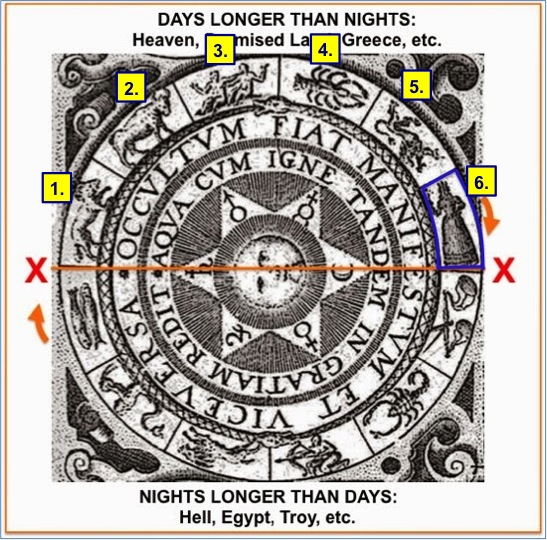
We are cast down into incarnate, material existence in a human body like Upamanyu falling down a deep well. The plunge down into the lower realms of matter is associated with the lower half of the zodiac wheel -- where Scorpio and Sagittarius basically "guard" the lowest point on the annual cycle, just prior to the winter solstice (see the now-familiar zodiac wheel diagram, used in countless previous posts, below):

In this incarnate condition, we are like prisoners at the bottom of the wheel -- like Upamanyu deep at the bottom of the well. We are also spiritually blind, prone to falling prey to all the many attachments and errors against which the Mahabharata and the Bhagavad Gita warn us.

And yet at some point there comes a turn -- a turn in which we look to the realm of spirit, to the connection with the Infinite which has in fact been available to us all along (because we are not, in fact, entirely animal or entirely material, but have within ourselves a divine spark, an inner connection to the Infinite).

When Upamanyu invokes the Ashvins, he is calling to the ones who are located at entirely the other end of the wheel -- at the top of the cycle, in the upper realms of fire and spirit, and at the very top of the Milky Way column that can be envisioned as running from the bottom or "6 o'clock" position on the above zodiac wheel right up to the top or "12 o'clock" point on the circle, right next to the Twins of Gemini.

And so, when we look at Dhritarastra in the Mahabharata, and his disastrous failure to do the right thing, we must realize that he also does not represent an external king who lived thousands of years ago, but that he (like Upamanyu) is meant to depict one aspect of our human condition.

He is frequently wracked by self-doubt, and he also needs to be warned against the specific errors of wrath and anger by his wise brother Vidura, in Book 5 and Section 36 for example. His disastrous (even if often understandable and even at times well-meaning) failure to do what is right is a depiction of our own typical condition in this incarnate existence (as is Upamanyu when he becomes blind and falls down into the well).

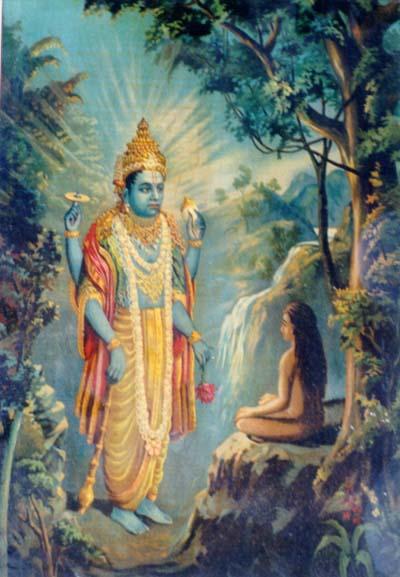
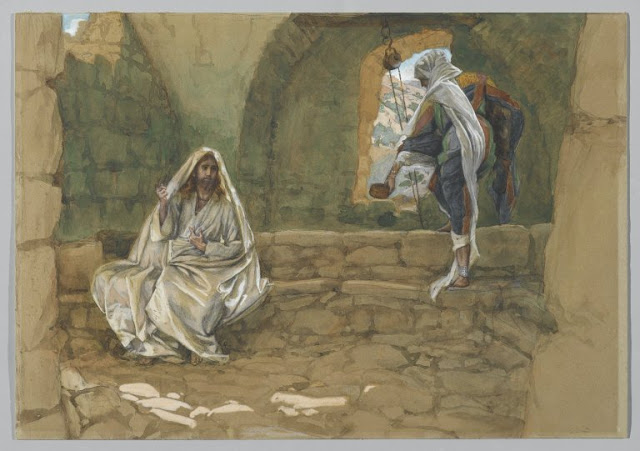
But, although we are in this condition down here at the bottom of the well, we actually have access to the Infinite, right where we are -- as Upamanyu demonstrates when he calls upon the Ashvins and they appear, and restore his sight. This is depicted as the solution to our plight: connection to the Infinite, with which we in fact are already connected, if we could only see it (and even Dhritarastra later invokes through meditation the same connection to the infinity of the invisible realm, which is depicted in the illustration at the top of this post).

In fact, this is the only source of rescue depicted in the text. It is not Upamanyu's wise teacher who rescues Upamanyu: it is Upamanyu's wise teacher who tells Upamanyu to call upon the Ashvins. It is the connection with the Infinite that Upamanyu must achieve or restore in order to escape or transcend the condition in which he originally finds himself at the bottom of the well. 

This is in fact identical to the message that Lord Krishna gives to Arjuna in the Bhagavad Gita, and identical to the message depicted in the invocation of Durga immediately prior to the Bhagavad Gita. All three parts of the Mahabharata are in fact telling us and showing us the very same message -- they are just employing different metaphors (and different celestial entities, whether Bootes, Virgo, or the Twins of Gemini) in order to convey that message.

And so, I hope, this discussion helps to remind us that these teachings are for all of us, all the time. The esoteric metaphors in the Mahabharata and the Bhagavad Gita are not just for full-time yogis, or kung fu masters, or those facing extraordinary circumstances. We have all of us  eaten from the leaves that have temporarily blinded us, and we have all of us fallen into a deep well, so to speak. 

If that is the case, then these teachings are for everyone who finds himself or herself cast down into this physical existence, this deep well (which is, I'm sure, just about everyone who is reading this blog right now).

The solution is simple, but it is one that can occupy us for a lifetime. In the words of the ancient text: 

Do your duty, to the best of your ability, with your mind attached to the Lord [to the Infinite, to the goddess Durga, to the twin Ashvins, to Krishna the divine charioteer], abandoning worry and attachment to the results, and remaining calm in both success and failure.

(below are the screenshots of the Milky Way band, with the Ashvins on top and Upamanyu at the bottom of the well, without the annotated constellation outlines):

The Gospel of Philip and the Zodiac Wheel

The Gospel of Philip and the Zodiac Wheel

images: Wikimedia commons link 1link 2link 3.

The previous two posts have attempted to demonstrate that ancient texts buried beneath a cliff near modern-day Nag Hammadi, likely placed there during the second half of the fourth century AD after authorities promoting what can generally be called a literalist approach as opposed to a gnostic approach had declared these texts to be heretical and suppressed their teachings, can be shown to be using esoteric metaphors to convey the very same ancient wisdom found in other myth-systems the world over.

In particular, the preceding posts argued that specific metaphors in the Gospel of Thomas, an extremely important text found in Codex 2 when the Nag Hammadi codexes were unearthed in the twentieth century, after spending perhaps sixteen centuries beneath the ground, are conveying the same message found in the ancient Sanskrit scriptures of the Bhagavad Gita and the Mahabharata concerning the nature of human incarnation, the constant interplay between the material realm and the realm of spirit, and the reality of each individual to have inner access to the infinite -- the higher self, the supreme self, the Atman -- at all times.

For those discussions, please see the previous posts entitled 

These discussions can be seen to be related to the larger pattern of the world's ancient myths, all of which can be shown to be very deliberately and intentionally using the celestial cycles to convey profound spiritual truths, most often within the framework of the great wheel of the zodiac and the great solar cross formed by the "horizontal" line running between the equinoxes (which generally relates to the "casting down" of the spirit into material incarnation in this life) and the "vertical" line running between the solstices (which generally relates to the "raising up" or "calling forth" of the spiritual aspect present -- though often hidden or forgotten -- in ourselves and indeed within every aspect of the apparently physical universe).

Numerous previous posts have discussed this overall pattern -- often relating it to the ancient Egyptian metaphor of the "casting down" and the "raising back up" of the Djed column: see for instance previous posts such as "The Zodiac Wheel and the Human Soul," "The Djed column everyday: Earendil" and many others.

Very significantly, there are passages in the Nag Hammadi texts which I would argue can be shown to explicitly declare the major outline of this very same mythological zodiac metaphor:

the metaphor which forms the foundation for Star Myths from virtually every continent and culture around the globe.

In another important text from the same collection, the Gospel of Philip, which was also contained in codex 2 of the texts buried in the large jar beneath the cliffs near Nag Hammadi along the Nile River in Egypt, there is a specific passage in the subsection labeled (for ease of reference) as "Sowing and Reaping" by translator Marvin Meyer, which plainly tells us:

Whoever sows in winter reaps in summer. Winter is the world, summer is the other, eternal realm. Let us sow in the world to reap in summer. 

This passage is completely consistent with the metaphor-system which previous posts have alleged can be seen to be operating in myths literally around the world, stretching across time from the civilizations of ancient Egypt and Sumer and Babylon, all the way up through the present day in cultures where the connection to the ancient wisdom remains to some degree intact.

The system uses the "lower half" of the cycle of the heavenly bodies (from the daily cycle created by the rotation of the earth on its axis, to the monthly cycle of the moon and the yearly cycle created by earth's annual path around the great cross of the year, as well as some other cycles which are even longer than these) to describe our incarnation in "this world" -- that is to say, in the familiar, visible, material realm. 

The system uses the "upper half" of the same cycles to describe "the other, eternal realm" -- the invisible realm, the realm of spirit.

Each day the turning of the earth causes the stars (including our own sun, the Day Star) to appear to rise up out of the eastern horizon and arc their way into the celestial realm: the realm of the air, the realm of celestial fire -- a perfect metaphor for the realm of spirit, the invisible realm. But the same turning of the earth also causes the stars (including the sun) to plunge down again into the western horizon, disappearing into the "lower elements" of earth and water -- a perfect metaphor for this "lower realm" of matter, in which we find ourselves in this incarnate life.

And, using the annual cycle of the year (which has certain advantages over the daily cycle, because it is conveniently broken up into much smaller sub-sections which can be conveniently discussed using the twelve subdivisions of the zodiac signs which precisely indicate very specific parts of the annual cycle) we can use the same general metaphor. This time, the "lower half" of the year -- the half which runs from the autumnal equinox down through the winter solstice and up to the crossing point of the spring equinox -- represents the same thing that night-time represents for the daily cycle: the incarnate realm, the material realm, the imprisonment in a body of earth and water, plowing through the "underworld" of the physical universe. 

The "upper half" of the year -- the half which runs from the spring equinox up through the summer solstice and down again to the autumnal equinox -- represents the realm of spirit, the invisible realm, all that is eternal, unbounded and infinite.

The ancient Egyptian myth cycles depicted this same principle using the gods Osiris and Horus. Osiris, god of the dead, ruler of the underworld, represents the sun in the "lower half" of the cycle: when it is plowing through the lower realm of incarnate matter, "cast down" into incarnation. Horus represents the "upper half" of the cycle, when the sun soars upwards "between the two horizons" into the celestial realms of air and fire -- the realm of spirit.

Here in the Gospel of Philip, buried for those long centuries among the other texts in the Nag Hammadi collection, we find an explicit confirmation of this pattern: "Winter is the world, summer is the other, eternal realm." 

It could hardly be more clear if the text were to tell us: "The lower half of the wheel represents this world: this material realm -- the upper half, or the summer months on the annual circuit, are used as a metaphor for the other realm, the invisible realm, the eternal realm, the realm of spirit."

This in itself is remarkable, and it has tremendous implications for our understanding of the scriptures included in what today is called the Bible, but all of it might still be (mistakenly) dismissed by some as being of limited practical value. 

"So what?" they might ask. "How does this matter to my daily life?"

The answer, according to the Nag Hammadi texts themselves, is: plenty.

Because, just as we have seen in the previous examinations of the Bhagavad Gita or the Mahabharata, and just as Peter Kingsley has argued in his powerful book

In the Dark Places of Wisdom, the ancient texts which were literally "driven underground" and buried in the urn at Nag Hammadi tell us something remarkable about the location of this eternal realm, and where we need to go in order to have access to it.

In section 3 of the Gospel of Thomas, for example, we find another explicit statement which can perhaps be profitably juxtaposed with this "zodiac wheel explanation" from the Gospel of Philip. There, giving the words which "Thomas" the twin has heard from his divine counterpart Jesus, the scripture tells us:

Jesus said, "If your leaders say to you, 'Look, the kingdom is in the sky,' then the birds of the sky will precede you. If they say to you, 'It is in the sea,' then the fish will precede you. Rather, the kingdom is within you and it is outside you. 

Notice how this passage can be interpreted, in light of all we have discussed above, as telling us that both halves of the cycle -- the upper half of the "sky" and the lower half of the "sea" -- are talking about something that really has nothing to do with physical location (neither sky nor sea). What is being discussed is the invisible realm with which we already have intimate contact, right inside of us. 

And, this same invisible realm with which we already have contact (within) is also present within and behind every single molecule of the seemingly physical realm all around us as well -- it is both "within you" and it is "outside you," the Thomas Gospel tells us.

And this is knowledge with absolutely world-changing implications for each of us. Because, as Peter Kingsley explains so powerfully in the beginning sections of In the Dark Places of Wisdom

, western civilization has somehow been cut off from that truth (very likely, I would argue, by ancient events that were part of the very same chain of events which led to the burying of the Nag Hammadi texts that we have just now been considering), and because of being cut off from that truth has spent the better part of the past sixteen or seventeen centuries trying to find external substitutes for something that is already internally accessible, right now, in "the peace of utter stillness" (and see further discussion of this concept in the previous post entitled "Two Visions").

The previous posts and accompanying videos exploring the significance of the invocation of the goddess Durga in the Mahabharata (immediately prior to the Bhagavad Gita) and the significance of the relationship between Arjuna and his divine charioteer, who is none other than Lord Krishna whose form is shown to be without limits, impossible to define or delineate or describe or bound with words, also indicates the practical impact that this ancient wisdom can have on our daily lives. 

Because it would argue that we can have access to this divine higher self literally every day, at any time (and the passage in the Mahabharata containing the Hymn to Durga specifically advises making the calling upon her divine presence a daily habit -- first thing each day, in fact). For more discussion of this subject, see previous posts such as "Self, the senses, and the mind" and "The Bodhi Tree."

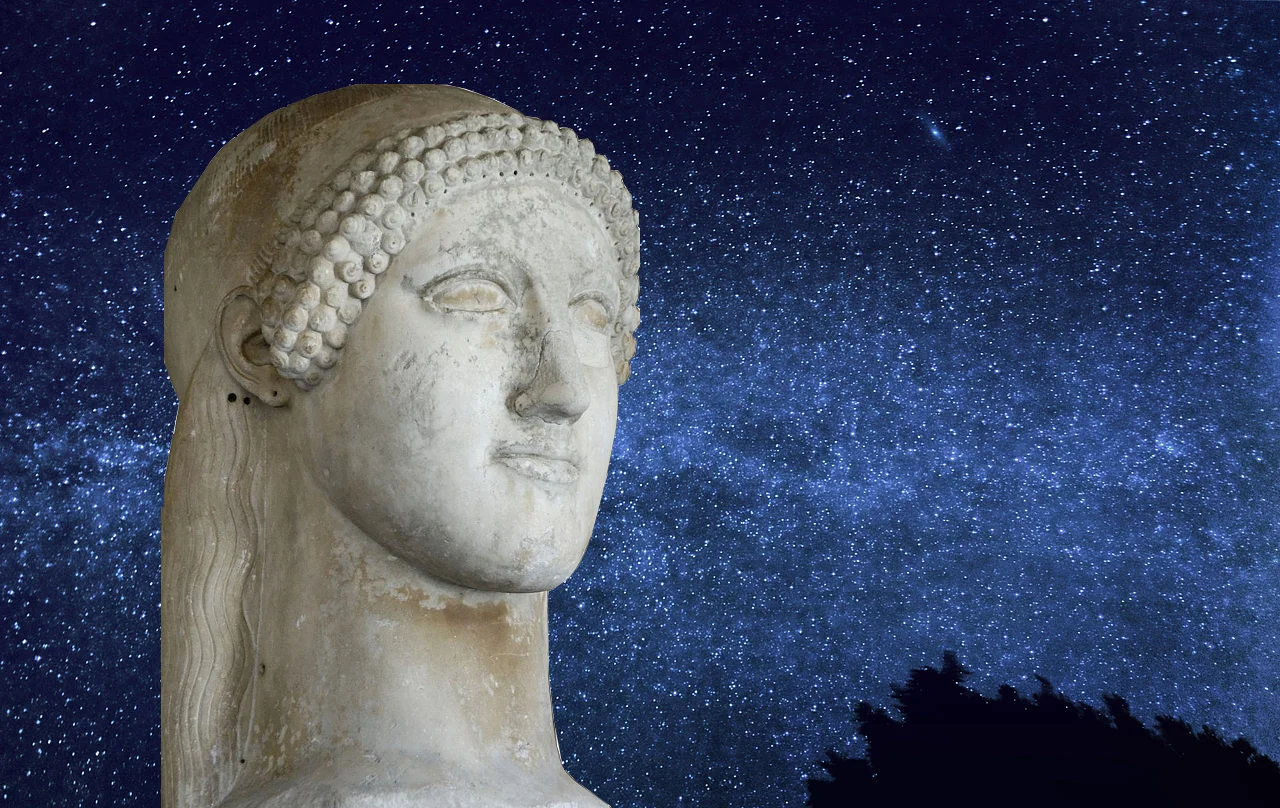
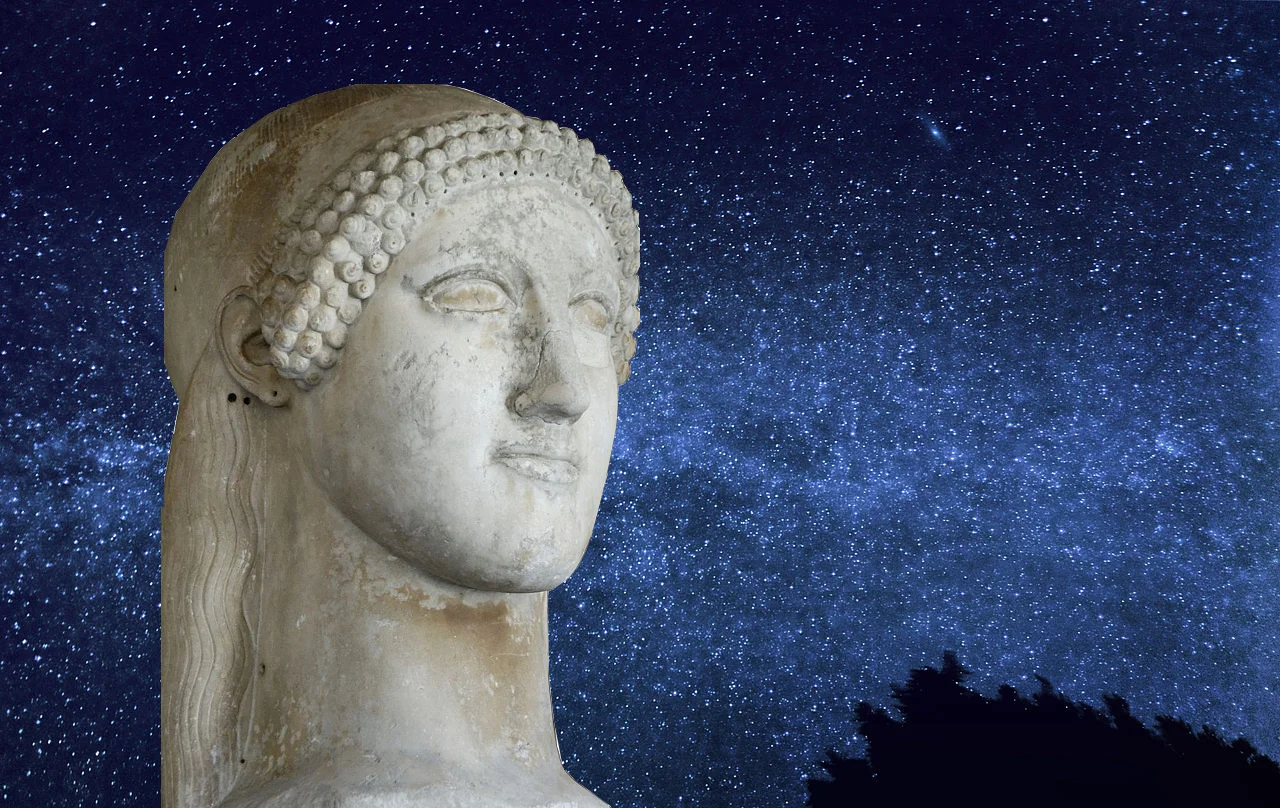
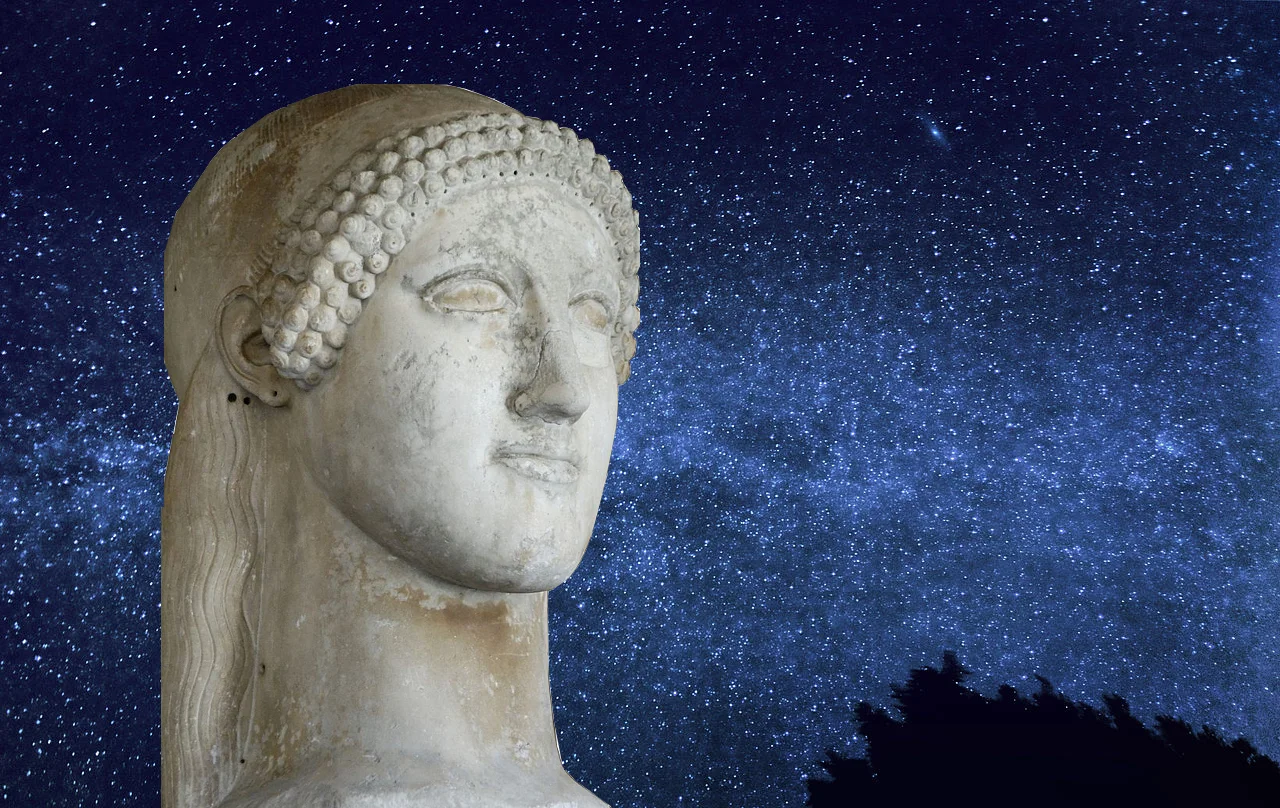
Below is a famous statue from ancient Egypt of the king Khefren or Khafra (who probably reigned for over two decades around the year 2560 BC), showing the king with the falcon-god Horus spreading his wings over and behind his head.

It is a powerful image, and one which can be interpreted as depicting the very teaching conveyed by the Gospels of Thomas and Philip above, as well as by the section of the Mahabharata dramatizing invocation of Durga or the Bhagavad Gita's dramatization of Arjuna and Krishna in the chariot, prior to the battle of Kurukshetra.

It appears to indicate the state in which we are in contact with, in communion with, in harmony with, and under the guidance and protection of the higher self, the supreme soul, the infinite and unbounded principle which both Durga and Krishna declare themselves and reveal themselves to be, and which the Gospel of Philip plainly says is symbolized by the "upper half" of the great annual wheel: the summer half, the Horus half.

The infinite to which we each have access, within ourselves, in the peace of utter stillness, without going anywhere.

This is the truth of which the world's ancient scriptures and myths all testify.

image: Wikimedia commons (link).

The Gospel of Thomas and the Everlasting Spring

The Gospel of Thomas and the Everlasting Spring

image: Wikimedia commons (link).

We're currently engaged in an examination of some of the ancient texts found buried at the base of the Jabal al-Tarif near Nag Hammadi in Egypt, for evidence of teachings which resonate with the teachings conveyed by other Star Myths around the world.

The previous post examined the Gospel of Thomas, found in Nag Hammadi codex 2, and argued that it is using a powerful esoteric metaphor to teach us that we are beings composed of two natures, that we are like a "set of twins," but contained within one being. We have our human, incarnate, doubting side -- but one privileged with the gift of direct access to and intimate communication with the divine, the Christ within, who declares in another manuscript contained in Nag Hammadi codex 2 that Thomas is indeed his twin , his true companion , and the one who will be called his brother.

In section 13 of the Gospel of Thomas, we find the following exchange:

Jesus said to his disciples, "Compare me to something and tell me what I am like."
Simon Peter said to him, "You are like a just messenger."
Matthew said to him, "You are like a wise philosopher."
Thomas said to him, "Teacher, my mouth is utterly unable to say what you are like."
Jesus said, "I am not your teacher. Because you have drunk, you have become intoxicated from the spring that I have tended."
And he took him, and withdrew, and spoke three sayings to him. When Thomas came back to his friends they asked him, "What did Jesus say to you?"
Thomas said to them, "If I tell you one of the sayings he spoke to me, you will pick up rocks and stone me, and fire will come from the rocks and devour you." [link to this translation].

This passage is noteworthy for many reasons.

First, it is very clearly a parallel to an episode found in the canonical gospels (those which, unlike those texts buried at Nag Hammadi, were included in the "approved list" of texts that eventually came to be called the "New Testament"): specifically, the mountaintop experience recounted in Matthew 16, Mark 8 and Luke 9, in which Jesus asks "Whom do men say that I the Son of Man am?" and then "But whom say ye that I am?" 

In the versions included in the canonical gospels, it is Simon Peter who gives an answer that Jesus approves. In this version, it is Thomas -- and the answer that Thomas gives is different from that given by Peter in the canonical gospels. Thomas here says, in answer to the question, that his mouth is "utterly unable to say" what Jesus is like.

This answer is actually very profound, in that it is expressing the idea that the one with whom Thomas is conversing cannot be defined, cannot be labeled, cannot be delineated: he is utterly unable to be framed or contained by the faculty of language. This answer immediately points to the previous discussion in the posts: "Self, the senses and the mind," in which a distinction is made between the mind (with its endless attempts to define and describe and discriminate and delineate) and the infinite and ineffable Supreme Source which is behind and above mind, and of which Sri B. K. S. Iyengar, in commenting upon the teaching of the Vedas upon this subject, declares:

The mind cannot find words to describe the state and the tongue fails to utter them. Comparing the experience of samadhi with other experiences, the sages say: 'Neti! Neti!' -- 'It is not this! It is not this!' The state can only be expressed by profound silence. The yogi has departed from the material world and is merged with the Eternal. There is then no duality between the knower and the known for they are merged like camphor and flame. Light on Yoga, 52.

Note how well the above statement reflects the sentiment dramatized in the Thomas Gospel. Thomas declares that he can only say, "I am unable to say!" In other words, he must declare "Neti! Neti!" like the sages described by B. K. S. Iyengar and the teachings of ancient India. 

Further, in the description of Sri Iyengar, we see the assertion that there is in fact a merging of the yogi with the Eternal: there is no duality between the two; they merge like camphor and flame. The previous post makes the argument that the Nag Hammadi texts express this same idea by declaring that Thomas and the one who is ineffable, who cannot be described, are in fact twins. They are, in some mysterious sense, merged. There is no duality between them. In the words of the Hebrew scriptures in the book of Proverbs, the heavenly friend is the one who "sticketh closer than a brother" (Proverbs 18: 24).

In other words, the Nag Hammadi text of the Thomas Gospel is trying to convey to us that in our incarnate condition we are like Thomas: we are intimately connected to the infinite, the ineffable, the Eternal -- so closely that we are "twinned;" we are "merged like camphor and flame." 

And, this one with whom we are so close is in fact the un-namable, the undefinable: the Ultimate. In the Bhagavad Gita, this is expressed by Arjuna's divine companion and confidant, the Lord Krishna, who declares that: "The entire universe is pervaded by me" (section 9),  "I am the origin of all. Everything emanates from me. [. . .] There is no end of my divine manifestations" (section 10). Krishna then displays his ultimate form, and shows Arjuna that his divine companion is indeed unbounded, unlimited, unable to be described with words, endless and infinite.

The same is declared in the Hymn to Durga which is found in the Mahabharata immediately prior to the Bhagavad Gita, in which the goddess Durga is also declared to be "identical with Brahman [. . .] the unconsciousness [. . .] the beauty of all creatures [. . .]" (Book I, section 23). The fact that she appears to Arjuna immediately upon his meditation upon her and his hymn of praise to her indicates the same teaching that we have been exploring above: there is so little distance between the human being and the deity that they are as close as the camphor and the flame, they are closer than even the closest of brothers, they are twinned: the mortal with the immortal (like Castor and Pollux).

After Thomas declares that his mouth is utterly unable to say what the divine one is like, Jesus then declares to him that: 1) Jesus is not his teacher, and 2) that Thomas has drunk from the spring which Jesus has tended, and it is this spring which has made Thomas drunk.

This aspect of the passage is also extremely noteworthy. Thomas began his "confession" by saying "Teacher," but Jesus in a sense rebukes him and says "I am not your teacher." This might be interpreted as telling us that he is not separate from Thomas: there is not an external one to whom Thomas must look for guidance. The divine is within Thomas himself.

This interpretation might be seen as comporting very well with the declaration of Paul in the epistle to the Galatians, in chapter 1 and verse 16, in which Paul can be interpreted as saying that when God revealed the Christ in him, he did not confer with any teacher. 

This interpretation is strengthened by the next metaphor, in which Jesus declares that Thomas has obtained this insight because Thomas has drunk from the spring which Jesus has tended. In other words, according to this passage in the Nag Hammadi text, Jesus is here declaring that his role is as the one who tends to the spring (almost like a barista who tends to the coffee that is given to those who come looking for it). 

This declaration is very interesting in light of the passage in the canonical gospel of John describing the episode of Jesus' encounter with the Samaritan woman at the well (at Jacob's well, in fact): Jesus tells her that he has living water that one can have and never thirst again, and then explains that this living water is within her. In verse 14 of John 4, Jesus says that this water can be in anyone a well of living water (unending water, unlimited water), "springing up into everlasting life." In other words, he is tending a spring which is infinite in nature, but which is available to each person internally

Based on this declaration found in John 4:14, and the declaration found here in the Thomas Gospel section 13 that Jesus is tending the spring, it does not seem too far of a stretch to conclude that the spring from which Thomas has drunk is the everlasting or infinite and Eternal spring within himself (within Thomas). Thomas is connected with the infinite, not externally but in himself.

Again, it bears repeating that this passage of ancient scripture is not intended to be understood as describing some ancient enlightened being named Thomas, who was different from ourselves. It is intended to convey to us a truth about each and every human soul who comes into this material life: we, like the "Thomas" in the text, are actually a composite being, a dual being -- a "set of twins," in which we usually identify with only the human aspect but which has a hidden or forgotten connection to the divine or the infinite or the eternal: a "divine twin," but our divine twin is not external to ourselves. 

Switching to a different metaphor, the text shows us that the divine or infinite or Eternal is already within us, like an everlasting or unending spring, from which we can drink.

In the beginning of the Gospel of Thomas, Jesus declares: "When you know yourself, then you will be known, and you will understand that you are children of the living Father. But if you do not know yourselves, then you live in poverty, and you are the poverty" (section 3). This parallels the metaphor discussed in the previous post regarding the Gospel of Thomas, which says we are like one who has a field but is unaware of the treasure buried within that field.

Ultimately, then, the purpose of this ancient text seems to be identical to the famous dictum of the temple at Delphi: "Know thyself." 

Note that the temple at Delphi was closed under the reign of the Emperor Theodosius, after the literalists took control of the Roman Empire, in the year AD 390 -- during the same second half of the fourth century AD in which scholars believe the Nag Hammadi texts were hidden and buried, possibly due to persecution by the ascendent literalist hierarchy.

The Gospel of Thomas is telling us that if we know the truth, we are actually connected intimately with the ultimate -- with the divine. We are, like Thomas, a twin: a twin to divinity (like Castor was a twin to Pollux). We contain within us a bubbling spring which is connected to Eternity. But, if we remain in ignorance of this fact, we are like the one who had a treasure buried in his or her own field, and never knew about that treasure.

Peter Kingsley, who writes about the ancient knowledge of this internal connection to the infinite, says that when we are disconnected from that infinite source, we become impoverished indeed -- filled with a longing we can never satisfy, and with a hollowness that drives us to chase after substitute after substitute for what we perceive to be missing. This hollowness and chasing after substitutes, not surprisingly, characterizes western civilization (because western civilization almost by definition is directly descended from those cultures that are heir to the Roman Empire which had shut down the temple at Delphi and declared heretical the texts buried at Nag Hammadi). 

As the Gospel of Thomas tells us, if we do not know this truth, this treasure, then we will live in poverty, and will in fact be that poverty (clearly describing spiritual poverty, rather than material poverty, since the rushing after substitutes which Peter Kingsley describes can in many cases produce material wealth, although without corresponding release from the spiritual hollowness).

The worst part about this situation is that the actual solution is already within our grasp: the bubbling spring is already available to each of us. It is that Tao which cannot be named, that Krishna who declares that there is no end to his manifestations, that one of whom Thomas says the mouth is utterly incapable of describing or defining.

But that is also the best part, as well.

The Gospel of Thomas and the Divine Twin

The Gospel of Thomas and the Divine Twin

image: Wikimedia commons (link).

Why was an entire "library" of ancient texts carefully sealed in a large storage jar at the base of the steep cliffs of the massif known today as the Jabal al-Tarif, along the banks of the Nile River in Egypt not far from the ancient city of Thebes, sometime during the second half of what we label today as the fourth century AD (the fourth century being the years in the 300s, since the first century AD consists of the years with numbers below 100, such as for example AD 60 or AD 70, causing all the subsequent centuries to have numbers "one higher" than the "hundred multiple" on the year-numbers, which is why the years in the 1900s were the "twentieth century")?

What would be the purpose of carefully sealing an upside-down bowl over the top of the large jar containing these texts, and burying them some distance from the city, underneath the talus at the base of the cliffs?

What was so important about the texts that someone would want to bury them? Were they worried about the texts being stolen? Or was there some other reason?

After this ancient jar was rediscovered in the 1940s (more details about that, along with some maps showing the location of the discovery, are in this previous post), and scholars began to decipher the ancient manuscripts, one possible reason these texts were buried began to suggest itself: these were ancient texts that were not included on the lists of approved writings that church authorities began to publish in the second half of that same fourth century -- and texts that did not make it onto the list of approved writings were no longer safe to have in one's possession (often texts excluded from the approved list were specifically denounced as heretical and spurious by the authorities).

Thus, it is quite possible that someone or some group who personally treasured these texts and their teachings, but did not feel it was safe to keep them in their immediate possession as the pressure against "heretical" texts ratcheted up during the second half of the fourth century, took them up the Nile to the cliffs away from the city and buried them there, fully intending to come back to them at some point in the future.

Apparently they never got the opportunity to go back.

These ancient texts, along with some others that have come to light in more recent discoveries, as well as a very few other fragments and manuscripts that had been found or preserved prior to those found in the jar at the Nag Hammadi, suggest to some researchers a very different history of the early centuries of the Christian church than has traditionally been taught. Some of the evidence can be interpreted as indicating that early teachings very different from what we today think of as "Christian teaching" were forcibly suppressed and driven underground (literally driven "under ground" in the case of the texts buried at Nag Hammadi) during the second, third, and especially fourth centuries, and replaced by an "approved list" of texts and teachings, which were to be interpreted from a primarily literalist perspective. 

In the next few posts, let's briefly examine a few of the ancient texts that were pretty much lost to history for nearly 1,600 years, surviving (as far as we know) only inside that sealed jar buried under the earth beneath the cliffs of Nag Hammadi and safely out of the way for the spread of literalist teachings until that jar was unearthed again in the twentieth century.

When we do so, we will find some teachings which seem to strongly resonate with some of the themes we have been examining recently in our examination of some of the "Star Myths" in the Mahabharata of ancient India, and in the

Bhagavad Gita that is part of the Mahabharata. In fact, we will find teachings in some of those long-buried Nag Hammadi texts that I believe have clear affinity with much that is found in the ancient wisdom preserved in myth and sacred stories literally around the world -- and indeed, that is even found in the texts of what we think of today as the Bible (the texts that did  make it onto those approved lists), but which are more evident in those Biblical texts when they are understood as esoteric allegory rather than as literal accounts.

Previous posts have presented evidence that the stories of the Bible were not intended to be understood as literal history but as esoteric allegory, and that forcing a literal reading onto them has resulted in an interpretation that is pretty much the polar opposite of their intended teaching -- see, for example, this discussion of the Easter cycle, or this discussion of the specific parts of the Easter cycle between the Triumphal Entry and the Betrayal, or this discussion of the Judgment of Solomon.

The entire "library" of texts that have survived from the discovery of that jar at Nag Hammadi (apparently, not all of the texts found in the jar survived, because when they were first found a few of the texts were actually burned as fuel for a cooking fire, according to stories surrounding the discovery) can be found online here, as well as in print form in various translations and collections (such as this collection edited by Nag Hammadi scholar and translator Marvin Meyer).

Out of that collection, we'll just look at a few passages from a couple of texts over the next few days or weeks. However, those interested in learning more can go straight to the Nag Hammadi texts themselves -- although the passages often appear cryptic at first, sometimes quite strange and alien, and even downright off-putting, remember that they are intended to be understood (I believe) as esoteric  allegory and that as such they are intended to convey spiritual truths which our literal or rational mind would "choke on" or reject, but which can often be best absorbed through powerful stories or metaphors.

Remember also that these texts were considered precious enough by someone living in ancient times to bury them, possibly at some risk to themselves, because they couldn't bear to see them destroyed -- and remember as well that the teachings in these texts was apparently considered so dangerous by those trying to spread a different system that these specific texts were literally unavailable after a certain point; they were completely or nearly completely eradicated. 

And, it should be noted, these texts were not marginal or unimportant texts: some of them (such as the one we will discuss in a moment) were mentioned quite often by ancient authors (including literalist Christian authorities, who were denouncing the texts), and so their titles were know to modern scholars even though -- until the discovery of the Nag Hammadi library -- their contents could not be consulted (except, in a few very limited cases, in a few fragments that survived, including in one case fragments which survived in a rubbish heap).

One of the most well-known and important of the texts found in that long-buried jar from Nag Hammadi is the text known as The Gospel of Thomas, which introduces itself as a record of the "secret sayings that the living Jesus spoke and Didymos Judas Thomas recorded" (this is the translation version found here, by Stephen Patterson and Marvin Meyer; there are several other versions of English translations available and linked from that location, and it is interesting to read the different translations to try to get additional perspectives on the ancient text). 

This opening line itself offers us some extremely important insights, based on the name "Didymos Judas Thomas" -- the title "Didymos" or "Didymus" for Thomas is also found in the canonical gospel of John (in chapters 11, 20, and 21) and it means "Twin" (as does the name Thomas itself, apparently, but Didymos comes from the Greek word for "Twin" and Thomas comes from the Aramaic word for "Twin").   

Of course, a character specifically identified as a Twin might suggest a connection to the Twins of Gemini, to those who have become familiar with the patterns found in Star Myths around the world, and it is certainly possible that the Thomas character has some connection to the zodiac constellation of Gemini.

However, it is also quite possible that something even more interesting is at work here, something related to the previous discussion entitled "Why divinities can appear in an instant: The inner connection to the Infinite." That post argued that the ancient Star Myths are intended to convey the knowledge to us that even in this incarnate existence, we have inside of us a connection to the infinite: a connection to the divine, what is also described as the "hidden divine spark" or the "god within" (and see other related discussions on this very important subject, such as "Namaste and Amen," or any of the many previous posts about Osiris and the casting down and raising-up-again of the Djed).

How does the character of "Didymos Judas Thomas" convey a related message? The answer comes when we ask, "if Thomas is a twin, who is the other twin in the pair?" After all, that is a natural question to ask if we are reading a story and we are told that a character is a twin, but we are not immediately introduced to the other twin.

Interestingly enough, in another of the Nag Hammadi texts -- and in fact in a text which was bound up together with the Gospel of Thomas in the book-form or "codex" known to Nag Hammadi scholars as "Codex II" -- a text called

The Book of Thomas the Contender, we get a startling answer as to who the other twin of Thomas might be (in the esoteric allegory).

In Section II of The Book of Thomas the Contender, which is called "Dialogue between Thomas and the Savior," we read these words in a sub-section regarding the subject of ignorance and self-knowledge:

The savior said, "Brother Thomas, while you have time in the world, listen to me and I will reveal to you the things you have pondered in your mind. Now, since it has been said that you are my twin and true companion, examine yourself, and learn who you are, in what way you exist, and how you will come to be. Since you will be called my brother, it is not fitting that you be ignorant of yourself . . ."

Stop! 

What?

Did this text just say that the Savior addressed Thomas as "my twin"?

Yes, that is what was asserted in this text. Now, if you are one who wants to interpret literally ancient texts about what the Savior said, then you are probably going to reject this text as being heretical. If you try to take this text literally, it will cause big problems with other texts, such as the scriptures describing the birth of the Savior (in which it is never said that he was born as one in a set of twins, for instance).

But, if you are not troubled with a need to force every ancient scripture into a literal mold, and if you believe that they were not intended to be understood that way, then you can ask yourself what this assertion that Thomas was the twin of the Savior might mean -- what it might have been intended to convey.

As you did so, you might remember that in other ancient mythologies, most notably perhaps in Greek myth, there are sets of twins in which one twin is divine or immortal, and the other twin is human and mortal. These Thomas narratives in the Nag Hammadi texts seem to be resorting to this same metaphor: we have a divine twin ("the living Jesus" as he is called in the opening line of the Gospel of Thomas, and "the Savior" as he is called in the Book of Thomas the Contender), and we have the mortal counterpart, the human twin: Thomas, the one who writes down the sayings for us, which he received from the divine twin.

Now, as we saw at the end of the preceding discussion regarding the "inner connection to the Infinite," there is a passage in the wisdom-book of Proverbs which declares "there is a friend that sticketh closer than a brother." As that post argued, and presented evidence from myth (particularly myths in which a god or divine being appears instantly, which also happens to be one of the characteristics of the risen Christ) this teaching may well be trying to convey to us the knowledge that our connection to the infinite, to the realm of the gods, is not external to us: it is within us already.

The metaphor of a divine twin and a human twin, such as the Gemini Twins in Greek mythology of Pollux (divine) and Castor (human), may well be referring to just such a concept or teaching. Expressing it in this way can convey this truth to us in a powerful, metaphorical, esoteric manner.

If that is the case, then what we see here in the Gospel of Thomas (and in the Book of Thomas the Contender) may well be conveying the very same truth, just in a slightly different form than it is found in (for example) the Greek myth of Pollux and Castor. In the Nag Hammadi texts mentioned here, Jesus is the divine twin and Thomas is the human twin, but they are not in fact two different entities. This is a teaching about the "Christ within" (which is a teaching also found in the writings of the apostle who called himself Paul, a name which the Reverend Robert Taylor points out is very much linguistically related to Pollux and to Apollo).

We are already, perhaps, getting a sense as to why these texts ended up buried in a large jar in a secret location, where the authorities who had declared such teachings to be "heretical" could not find them and destroy them.

There is much within the Gospel of Thomas itself to back up the interpretation that has been suggested above. In future posts we may have occasion to examine a few more of them, but for now let's just look at another metaphor, offered as a saying of Jesus, found in section 109 of the Gospel of Thomas.

There, in the translation of Stephen Patterson and Marvin Meyer, Jesus says:

The (Father's) kingdom is like a person who had a treasure hidden in his field but did not know it. And [when] he died he left it to his [son]. The son [did] not know about it either. He took over the field and sold it. The buyer went plowing, [discovered] the treasure, and began to lend money at interest to whomever he wished.

This is a very interesting metaphor, and one that suggests that the "treasure" of the infinite is buried away deep inside us like the treasure in the story that lies buried under a field, which can remain there our entire lives without our knowing it. But it is something which we actually already have, if we just knew.

The scriptures appear to be trying to break through our ignorance on this subject, to tell us that we already are connected to something that is actually inexpressible in its infinity (that cannot be quantified or defined or even named, as the opening lines of the Tao Te Ching declare, and that thus lies beyond all the quantifying and labeling and chattering of the part of us that we call our mind).

Thomas is telling us the words of Jesus, but perhaps "Thomas" received these sayings from a divine source that was not external to him (though none the less divine and none the less real for that). In fact, we should not think of the Gospel of Thomas as being about some "twin" who lived thousands of years ago: as Alvin Boyd Kuhn advised us in a passage quoted in several previous posts, we won't understand ancient texts unless we realize that they are about us. Each and every individual soul that incarnates in this world is, according to such a reading, like Thomas: a twin to a living infinite inner divinity, possessed of a friend that sticketh closer than any "external twin" (as close as literal twins are to one another, this twin is even closer).

This teaching is also portrayed in the Mahabharata and the Bhagavad Gita, with Arjuna and his companion and divine charioteer, the Lord Krishna (as well as in the episode in which Durga appears before the battle: see videos here and here and additional discussion here).

These are not the messages that are traditionally drawn from the scriptures of the Bible when they are approached with a literalist hermeneutic (because literalist readings necessarily start off by seeing the characters in the text as primarily external to us, since those characters are understood to be literal-historical figures). But they are messages which resonate strongly with all the other myths and sacred traditions of the world -- and they are in fact the messages which I believe these texts were intended to convey to us, before something happened and that message was all but wiped out, around the period of time that the Nag Hammadi library was being sealed away.

New! "Terrain map" to help navigate this site

New! "Terrain map" to help navigate this site

I've just posted a new series of "subject-headings" over at a website called

davidmathisen.com

which I hope will provide a sort of "terrain map" or "table of contents" to assist visitors in navigating through the wide range of related and interconnected subjects explored in this blog.

As I explain in a section of that site entitled "Welcome and Thank You for Visiting," during the course of pursuing and writing about these inter-related topics since this blog's inception in April of 2011, the discussion has ranged over such a wide landscape that I felt the need to define some general "regions" or "ecosystems" within the overall terrain.

The subjects that I have selected as categories are not exhaustive, nor are they the only way to try to group the different aspects of the investigation, but I hope that they will prove to be a helpful way of organizing the material and serve to make it somewhat more accessible, especially to those who may be new to the conversation.

These subject-headings can be thought of somewhat like the "chapters" in a large online book: if you read through all the sections and follow some of the links found in each one, you should get a fairly comprehensive overview of many of the issues which I feel are profoundly important for each of us as individuals and as part of a larger community of human beings on a planet which we share with all the other beings in our connected universe.

Those chapters or subject headings, as they stand right now, include:

and

With these sections now broadly defined, visitors can choose to read through them in roughly that order, or to skip around from one to another at their leisure. Now that this new "overview" or "directory" site is up and running, that might be the best place to direct friends or family members who you think might be interested in exploring these topics.

It is my sincere wish that these writings and discussions will be a blessing to those who, like me, are seeking to know and to apply this ancient profound wisdom which was given to all of humanity as a precious inheritance.

Namaste _/\_

Why divinities can appear in an instant: The inner connection to the Infinite

Why divinities can appear in an instant: The inner connection to the Infinite

image: Wikimedia commons (link).

Why do the deities in the Mahabharata often appear instantly, upon the recitation of a mantra, the singing of a hymn, or even simply upon being remembered? 

I believe that this characteristic was included in the ancient scriptures in order to show us that we have access to the infinite at all times -- and indeed that in a very real sense we can and should avail ourselves of that access on a regular basis, in this life.

Many previous posts have explored the critically important assertion of Alvin Boyd Kuhn which is in many ways a key to our understanding of the ancient myths, scriptures and sacred stories of humanity, in which Kuhn (addressing the stories of the Bible in particular) declares:

Bible stories are in no sense a record of what happened to a man or a people as historical occurrence. As such they would have little significance for mankind. They would be the experience of a people not ourselves, and would not bear a relation to our life. But they are a record, under pictorial forms, of that which is ever occurring as a reality of the present in all lives. They mean nothing as outward events; but they mean everything as picturizations of that which is our living experience at all times. The actors are not old kings, priests and warriors; the one actor in every portrayal, in every scene, is the human soul. The Bible is the drama of our history here and now; and it is not apprehended in its full force and applicability until every reader discerns himself [or herself] to be the central figure in it! [For full quotation and source with links, see this previous post].

Now, what Kuhn asserts in the above paragraph is just as true for the world's other myths. Let's see how it applies to the specific aspect of the Mahabharata mentioned above (the ability to summon the gods and goddesses at a moment's notice). 

If we apply this paragraph directly to the Mahabharata, we can paraphrase some of these assertions as follows:

The episodes in the Mahabharata in which men or women are depicted as summoning powerful deities through the recitation of a mantra, the singing of a hymn of praise, or even by simply thinking upon that deity and wishing for him or her to appear, are in no sense a record of what happened to a man or woman long ago in a more magical (or imaginary time and place). As such, while they might be tremendously entertaining, they would have little significance for our lives today. They would be the (miraculous and extraordinary) experience of a people not ourselves, and would not bear a relation to our life. But these events are actually recorded in these myths to provide us with a vivid picture of something that is in fact a verifiable reality of a situation that is present in your life and in mine -- indeed, a reality in all lives. They mean nothing as outward events: the beautiful wives of Pandu, for instance, did not summon gods outwardly. Nor was Arjuna's invocation of the goddess Durga an outward event. These are picturizations of truths which are part of our living experience at all times. We indeed are in contact with those same mighty supernatural powers -- with Krishna and Durga and the heavenly Twins or Ashvins -- right at this present moment. The actors in these myths are not beautiful wives or powerful warriors: in every single episode, these actors are none other than the human soul possessed by each and every one of us. The Mahabharata (and all the other myths and scriptures and sacred stories) is a drama of our lives -- our lives right here, right now, in this modern life, in the city where you live, in the situations you experience -- and it is not apprehended in its full force and applicability until every reader discerns himself or herself to be the central figure, present in every single scene!

In the previous post, we discussed some of the unusual marriage activity recorded in the Mahabharat, in which the two wives of Pandu take five different divine gods to be the fathers of the five powerful sons who collectively become the heroes of the story, the Pandavas (a name which means descendants of Pandu). The summoning of the five different gods is done through the recitation of a mantra: immediately upon its recitation, the desired god appears. 

Elsewhere in the Mahabharata, as we saw, Arjuna (one of the Pandavas) recites a hymn of praise to the goddess Durga, at which the powerful goddess appears and blesses him, telling Arjuna that he will be victorious and that in fact it would be completely impossible for him to be defeated in the upcoming battle.

At other points in the epic poem, such as in Book I and section 3, the celestial Twins called the Ashvins are summoned by a disciple named Upamanyu, who has consumed some leaves of a tree that made him blind, causing him to stumble into a deep well, where he was trapped until he called upon the Ashvins for succor. 

And there is also a powerful sage or rishi named Vyasa or Vyasadeva who is the mythical author of the Mahabharata itself and who also appears as a character who weaves in and out of the various scenes, appearing when he is needed before retreating again to his contemplation and disciplines in the remote mountains. Vyasa also has the characteristic of being able to appear whenever he is thought upon: at his birth (recounted in Book I and section 63) he tells his mother "As soon as thou remembers me when occasion comes, I shall appear unto thee." 

What are we to make of these wondrous episodes in the Mahabharata, each one of which is surrounded by all kinds of memorable action and human drama? These depictions of the gods and goddesses  (and, in the case of Vyasa, this epic poet and bringer of inspired verse) appearing at an instant when a human man or woman concentrates upon them are not to be understood as outward events, in Kuhn's argument, but rather as an inward reality, as a depiction of our experience in the here and now.

If Kuhn is right, then what (oh what) could these specific episodes be depicting?

I believe the answer is hinted at in yet another earlier post exploring the powerful teaching contained in the Mahabharata -- an examination of the Bhagavad Gita, which is a section within the Mahabharata itself. There, we saw compelling evidence that the conversation between the semi-divine bowman Arjuna and his companion and divine charioteer, the Lord Krishna, relate to the "metaphor of the chariot" found in other ancient Sanskrit scriptures. 

In that metaphor, the chariot helps us understand aspects of our incarnate condition. The war-cart itself is our body, and the mighty horses which pull it are our senses and our desires (both of which can easily run completely out of control, and threaten to wreck the entire enterprise). The reins in the metaphor, we are told in another Sanskrit scripture, are our mind, through which the horses can be controlled.

But obviously, there must be someone or something else behind and above the reins in order to direct the chariot: behind and above "the mind" itself, that is. This concept of a someone or something else, standing apart from the mind and above it, was discussed in the first blog post of this series, entitled "Self, the senses, and the mind." This higher self is referred to by many names, among them the True Self, the Supreme Self, the Lord in the chariot, and (in the Sanskrit text cited for this metaphor) the Atman. In other cultures and other traditions there are many other names to refer to the same concept.

But in all cases we are dealing with a Higher Self who is in some sense and to some degree connected to the infinite and the ultimate. This is the infinite, the ultimate, the un-definable: the divine charioteer who is beyond the "chattering" and the "endless transforming" and the "labeling and defining and delineating" of the mind (and again, the mind is not a negative or bad tool, any more than the reins on the chariot are a bad tool -- it is an essential tool, but it is not the one who should be driving the chariot).

We get in contact with this infinite aspect by standing apart from our mind, our senses, and our desires (not by getting these to somehow "go away" or "stop" being what they are -- the horses on the chariot will not go away, nor will they turn into something other than horses -- but we can stand apart from and above them in order to see that we are not them and we do not have to go wherever they want to pull us, that in fact we can tell them where we want them to take us). 

Practices we have at our disposal for getting into contact with the infinite include mantras, chanting or singing of hymns, prayer, meditation, yoga, rhythmic drumming, and more.

The gods and goddesses in the stories show up quite suddenly and instantly because they are, in a very real sense, already there. We are already connected with them. This does not mean that they are simply "our imagination" or "not real" (as if our "imagination" is not connected to the very same vital flow of infinity that is completely unlimited in its potential and its power). As we see in Kuhn's quotation above, which is so valuable that we can and should return to it in analysis like this, just because the myths are depicting inner realities as outward events does not mean that they are not "real" if they do not take place in the outward space. These myths are dramatizing truths about our living experience at all times. You and I are in contact with Krishna and with Durga right now: if we do not realize it, that is only because we are allowing the chatter of our minds or the horses of our senses to keep us from connecting with the power of the unbounded, the undefined, and the infinite (unbounded aspects of which Krishna and Durga show themselves to be in the Mahabharata).

It is also noteworthy to point out that divinities who can appear at a moment's notice are also found in other esoteric mythologies and scriptures around the world. The Norse god Thor, for instance, was notable for being able to appear whenever his name was called by the other gods, in time of need (which they had to do on more than one occasion). The other gods usually had to call on him when they were being bested by a powerful jotun, and thus Thor usually appeared in a fighting rage (or, if he wasn't in a rage when he appeared, one glance at the menacing jotun usually caused Thor to go into battle mode).

image: Wikimedia commons (link).

But, it should be noted that Thor's ability to appear in an instant means that he, too, is somehow representative of that divine charioteer who is above mind and above even the physical world, and yet somehow available to us at all times, if we just learn how to direct our focus in the right direction.

It is also not inappropriate, I believe, to point out that the risen Christ in the stories of the New Testament also displays the ability to simply appear out of nowhere amongst the disciples, sometimes when they are least expecting him to do so. 

In the preceding post, which looked at the two wives of Pandu who used a mantra to call upon divine gods to appear, we also saw that the pattern of five husbands in the Mahabharata appears to have an echo in the New Testament episode of the encounter of Jesus with the Samaritan woman at the well, who likewise is said to have had five husbands. In that encounter, the previous post points out that Jesus tells the woman that she can have everlasting water, living water, springing up unto everlasting life -- and that this living water is somehow "within." 

I believe that this again is a "pictorial form" (in Kuhn's words) of something that is in fact a "present reality" in the life of each and every human soul. This "picture" is one of an unbounded, an infinite, and a life-giving stream, available for the asking because it is already "within" us. We already have access to this living water, but we need someone to tell us that it is something that we can actually get in touch with. That is what the ancient myths and scriptures are there to do.

By his demonstrated ability to simply appear out of nowhere and disappear again at will, the risen Christ in the gospels would also, under this interpretation, be pointing us towards connecting with the infinite within ourselves. And this, according to some analysts, is exactly what Paul in his epistles declares to his listeners, using the strongest language possible in some cases:

O foolish Galatians, who hath bewitched you [. . .]? Are ye so foolish? having begun in the spirit, are ye now made perfect by the flesh? (Galatians 3:1-3)

Gerald Massey (1828 - 1907) and others have argued that the writer who calls himself Paul is pointing his listeners to a spiritual truth, not an external flesh-and-blood individual. He is pointing them to what he elsewhere declares to be "Christ in you, the hope of glory" (Colossians 1:27). 

This is not to say that Paul did not believe what he was talking about to be "real" or that he did not believe it to have life-altering power: on the contrary, the tenor of his letters indicates that he knew what he spoke of to be absolutely real, and absolutely earth-shaking in its ability to transform. Nowhere in the above discussion should anything be taken to indicate that the infinite, the ultimate, the un-limitable and truly un-bounded divine power -- which the Bhagavad Gita describes as the Lord Krishna and which the Hymn to Durga addresses as Kali, as Maha-Kali, as Uma, and as "Durga, who dwelleth in accessible regions," and as "identical with Brahman" -- is in any way not real

But, as the quotation from Alvin Boyd Kuhn tells us, these are not stories about ancient events that happened to someone else: these are aspects of our life, right here and right now. They are telling us about a divine aspect to which we have access right here and right now, and with which we are already internally connected in some mysterious way.

As the verse in the Old Testament wisdom-book of Proverbs tells us, "There is a friend that sticketh closer than a brother" (Proverbs 18:24). 

Even closer than a brother, because not external to us at all.

Glorious Jupiter and Venus, and the Five-Husband Pattern in the Mahabharata and John 4

Glorious Jupiter and Venus, and the Five-Husband Pattern in the Mahabharata and John 4

image: Stellarium (stellarium.org).

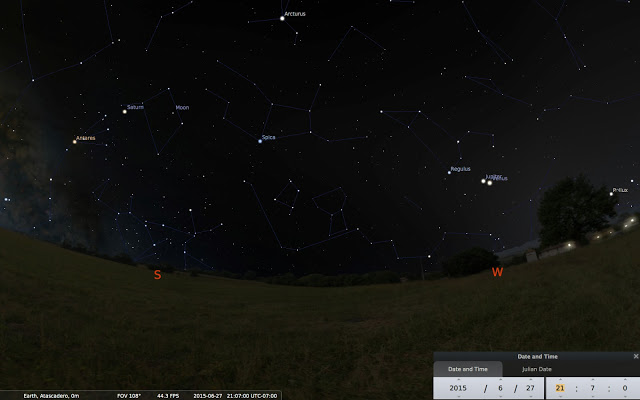
Observers of the night sky have for some time now been watching with great anticipation the steady approach of the planet Jupiter to dazzling Venus in the western sky during the hours after sunset. 

The two are now extremely close, just over one degree apart on June 28. As described in the always-helpful "This Week's Sky at a Glance," from Sky & Telescope, the two will be a mere 0.6 degrees apart on June 29, and reach their closest point on June 30 when they will close to 0.3 degrees before Jupiter passes on and continues on his way. (Note that these dates are based on the the date effective for an observer located in most of the western hemisphere and North America in particular, but if you are located in another part of the globe you should be able to easily find a site on the web that will tell you what the calendar date will be in your area when these passages take place).

In the image above, you can see Jupiter approaching Venus directly above the letter "W" that signifies the cardinal direction west. Jupiter is located higher in the sky and towards the "left" for an observer facing west in the northern hemisphere -- Jupiter has been approaching Venus from further east on the ecliptic path that both the planets generally follow: that is to say, from the direction of the star Regulus which is also marked on the diagram above and which is located in the zodiac constellation of Leo the Lion, the importance of which will be discussed a bit later.

It is not hard to imagine why the approach of one significant celestial body to another in this manner was frequently allegorized as a seduction or a sexual liaison in the world's mythologies. During the buildup to a previous "close approach" of Jupiter to Venus, back in 2012, I discussed the fact that Zeus (Jupiter) was described in ancient mythology as pursuing Aphrodite (Venus) but being rejected by her and not actually having direct sexual relations with her, and that this detail from the myths is no doubt derived from the fact that Jupiter always passes close to Venus but the two never actually conjoin in the sky.

One might wonder why Venus is very often depicted as a female goddess, while Mars, Jupiter and Saturn are depicted as male gods. I believe it has to do with the fact that as an interior planet -- with an orbit that is within the orbit of the earth, relative to the sun (Venus orbiting on a path closer to the sun than does the earth) -- an observer on earth must always look in the general direction of the sun in order to see Venus (if you are having trouble visualizing this, there are some outstanding diagrams on the excellent website of Nick Anthony Fiorenza, here, and some further discussion of the celestial mechanics of our observation of Venus in a previous blog post here).

What this means is that Venus will never be seen to be very far from either the western horizon that the sun has just disappeared beneath (when the sun sets and Venus is on the part of her orbit when she is seen in the west) or from the eastern horizon whence the sun is preparing to burst forth in the morning (when the sun is getting ready to rise and Venus is on the part of her orbit when she is seen in the east). In other words, Venus will always be "tethered" to the sun and thus will never be seen ranging across the middle of the sky at midnight: Venus will always be seen above either the western horizon or the eastern horizon, in fairly close company to the sun (currently, Venus is seen above the western horizon, after the sun sets).

On the other hand, the "outer planets" whose orbits are outside of the earth's orbit around the sun (they orbit at a distance from the sun greater than the distance of earth's orbit) can be seen to range across the entire night sky. They always follow the same general "track" of the ecliptic path ( the path that the sun also follows, as well as the moon, although the moon like the planets can deviate by a small number of degrees either above or below the ecliptic line that the sun follows), but along this track they can be seen across the entire width of the sky -- unlike the interior planets who are "tethered" to the sun.

This means that Jupiter, Mars, and Saturn can be seen crossing the middle of the sky at midnight, when an observer on earth is turned completely away from the sun. A planet in the middle of the sky at midnight can only be located outside the orbit of the earth (because an observer on earth looking into the center of the sky at midnight is looking out into the heavens in the opposite direction from the sun, which is on the other side of the earth at that time). So Venus can never be seen out in that direction (neither can Mercury, whose characteristics will be addressed in a moment).

Because of these mechanics, Jupiter, Mars and Saturn can all approach Venus from the center of the sky, as Jupiter is doing now, and when they do so, they resemble a man pursuing a woman, or advancing their cause with a woman to seek either marriage or an amorous liaison with her.

Of course we all know that it is also possible for a woman to pursue a man, and such pursuits are certainly portrayed in the ancient myths -- but when Jupiter is striding across the sky in a long, purposeful pursuit of the beautiful shining Venus, as he has been doing for some time now and getting closer every night, the ancients allegorized this behavior in mythology as the confident but amorous leader of the gods chasing after the goddess of beauty in order to have an affair with her.

As for Mercury, his orbit is even closer to the sun than that of Venus, and so he can only be seen under the same conditions that we see Venus, but "even more so." Tethered even more tightly to the sun, Mercury can only be observed above the eastern horizon just before the sun comes up, or above the western horizon just after the sun goes down, and the planet has an even more limited range above the horizon (and away from the sun) than does Venus. Thus, Mercury is usually seen being approached by Venus, rather than the other way around -- and so he is the one who is described in myth as being pursued by the love goddess.

Once we understand that it was very common for these close conjunctions of celestial bodies to be described in mythology as sexual affairs, we can perhaps unravel what seems to be a very important theme found in more than one myth across different cultures: the situation in which a woman is described as having five husbands.

In the Mahabharata, for instance, one of the two epic Sanskrit poems of ancient India (and which by itself is equal to about 7.2 times the combined length of the Iliad and the Odyssey), the five principle heroes of the story -- the Pandavas or "sons of Pandu" -- are actually the children of the two wives of Pandu but by five different gods or divinities.

Pandu's two wives are Kunti (also known as Pritha) and Madri. Because of an incident in which the glorious Pandu while out hunting thoughtlessly shot a stag while it was mating, which turned out to be no ordinary stag but rather a powerful rishi in the form of a stag, who before expiring told Pandu that he would meet his death the next time he approached one of his wives out of desire, Pandu took vows of strict austerity and abstinence. Therefore, in order to obtain children, Pandu instructed his wives to use a powerful mantra which could instantly summon the celestial powers, which they did.

Kunti first summoned the god of justice in his spiritual form, and from their union was born the eldest of the Pandavas, Yudhishthira. After that, she used her mantra to cause to appear the god of wind in his spiritual form, and from their union was born the mighty Bhima, who is also known as Vrikodara. Then, a third time, she used the mantra, and this time summoned Sakra, the king of the gods, and from their union was born the great hero Arjuna.

Then, Kunti told Madri the secret of the mantra, who used it to summon the divine Twins, known as the Ashvins, and from their union Madri herself had twins, whose names were Nakula and Sahadeva. The description of the births of Yudhishthira, Bhima, Arjuna, and the twins Nakula and Sahadeva can be found in Book I and sections 123 and 124.

Together, these five heroes were known as the Pandavas. The Mahabharata relates many stories of their adventures during their upbringing, and how they were versed in the Vedas and in all the martial arts as they grew up. Their tremendous prowess caused their cousins, the descendants of Pandu's brother Dhritarastra, to become very jealous of them, leading to intense rivalry and eventually to the battle of Kurukshetra, which forms some of the central action of the Mahabharata, the celestial and spiritual aspects of which have been discussed in the two preceding blog posts and accompanying videos: here  and here (with videos here and here).

Interestingly enough, when the mighty archer Arjuna won the hand of Draupadi, the Princess of Panchala and the most beautiful woman in the world, in a heroic test of his prowess designed by her father to test her many suitors, she becomes the common wife of all five of the brothers!

This situation arises because as they returned to the hut where Kunti was waiting for them, and called out to Kunti to see what they had won, she said (before they came into her view): "Enjoy ye all what hath been obtained," which leads them to decide to all share Draupadi (she appears to be amenable to this situation) but which is so directly contrary to custom and to the directives found in Vedic scripture that it leads to several discussions with leading human figures and with gods about whether or not such an arrangement can be proper, before it is finally decided that it is not usual but it can be condoned in certain situations (see Book I and sections 193 and following -- note that the Roman numerals used in the online version of the Mahabharata linked here are incorrect in this instance: the second "L" should be a "C," according to my analysis of the chapters and my understanding of the system).

However, as with so many other events described in the ancient myths, scriptures, and sacred stories, this is a situation which I believe has a celestial foundation and in no way reflects something that we should interpret literally -- any more than we should interpret literally the Old Testament stories about the rash vow of the reluctant general Jephthah, or about the two she-bears summoned by the prophet Elisha to rend the youths who taunted him.

To understand why this situation of Draupadi marrying all five Pandava brothers is almost certainly a celestial myth and not mean to be understood literally, first consider the fact that it seems to mirror very closely the five different divine fathers of the Pandavas themselves (although with two different women, Kunti and Madri, rather than with a single woman). What is it about five different "husbands" in mythology?

While we ponder that question, readers who are familiar with the scriptures of the Bible may be asking themselves whether there could be any relationship between these "five-husband" situations in the Mahabharata and the famous episode described in the New Testament book of John, chapter 4. There, Jesus is described as going through a city of Samaria, and coming to Jacob's well, and being wearied with his journey sitting down to rest at the well, where he encounters a woman of Samaria, and asking her for drink.

During the course of the conversation, he tells her to call her husband, and she tells him she has no husband, whereupon Jesus replies:

Thou hast well said, I have no husband:
For thou hast had five husbands; and he whom thou now hast is not thy husband: in that saidst thou truly [John 4:17 - 18].

This passage has been the subject of much interpretation and debate amongst those who try to understand it as if it were describing a literal and historical event, but I believe that here again we are dealing with a celestial allegory. It is certainly remarkable to find a situation with five "husbands" in the New Testament scriptures which parallels so closely the "five-husband pattern" that we have just observed operating not once but twice in the stories contained in the Mahabharata of ancient India (which scholars believe to have been in existence in many of its central details by about 400 BC, and to  contain stories and episodes whose origin goes back many centuries earlier than that).

I believe that we can begin to unravel the celestial metaphor at work in these "five-husband" myths, based on the understanding of the pattern of sexual allegory observed in the approach of Jupiter to Venus with which we began this discussion, above, and which can also be seen operating in other ancient myths such as the Greek myth of the dalliance between Aphrodite and Ares described in the Odyssey, in which the rightful husband of Aphrodite, Hephaestus, springs a trap for his unfaithful wife -- and which the author's of Hamlet's Mill (basing their analysis on the work of previous researchers from the eighteenth century and even from ancient times) argue is an allegorization of a conjunction between the planets Venus and Jupiter in the vicinity of the Pleiades (which represent the shimmering net with which Hephaestus traps the adulterous couple).

Now, it is certainly possible to interpret the identity of the Samaritan woman at the well in John 4 as being associated with the zodiac constellation of Virgo -- and indeed, I believe the story contains clues to make an identification with Virgo in this particular story a correct connection, as we will see in a moment.

However, I believe that the part of the story of the woman at the well in which we learn that she has "five husbands" comes from somewhere other than the sign or constellation of Virgo.

Seeing that the woman in many ancient myths is often related somehow to the sign and the constellation of Virgo, we might first try to use that knowledge to find the origin of the multiple husbands. We might ask ourselves, how would an identification with Virgo explain this persistent pattern of "five husbands" which we have observed in both the Mahabharata and the John 4 episodes?

What could there be in the heavens that add up to the number five and that somehow pursue Virgo in a way that could be allegorized in this way? Well, we know that there are five visible planets which an observer on earth can easily see with the naked eye: Mercury, Venus, Mars, Jupiter and Saturn. It could be that the "five husbands" represent the five visible planets, passing through the constellation Virgo at various times, and giving rise to these myths about one woman having five husbands -- but I do not believe that this is the correct interpretation, for a couple of reasons.

First, as we have already seen, out of the five visible planets, Venus and Mercury are "interior planets" and thus they stay closely "tethered" to the sun. Because of this fact, and because of the planet's brilliance and beauty in the sky, Venus is usually depicted as a female goddess, who is "pursued" by the outer planets. This would seem to disqualify Venus from being one of the "husbands" if we are trying to count the five visible planets as the five husbands.

More importantly, the interpretation of the "five-husband pattern" as being based upon the constellation Virgo being visited by the five different visible planets does not work very well as an interpretation of the myth of the birth of the five Pandavas by the two wives of Pandu, Kunti and Madri, because Madri is specifically described as calling upon the twin Ashvins using the mantra, and by union with these divine Twins she herself bears the twin Pandavas, Nakula and Sahadeva. The celestial Twins are associated not with two of the visible planets (none of which can really be described as a "twin" to any of the others), but rather with the constellation of Gemini, the Twins. Because the Twins of Gemini do not "make their way" across the sky to the constellation Virgo, it is likely that the solution to the "five-husband pattern" is something else.

I believe that in the case of the two wives of Pandu, Kunti and Madri, we are dealing with the two interior planets, Venus and Mercury -- with Kunti (the primary consort of Pandu) corresponding to Venus and Madri corresponding to Mercury. Additional evidence to support this interpretation is found in an episode related in Book I, section 125: after the birth of the five Pandavas, Pandu forgets his vows when he is overwhelmed by Madri's beauty as they are alone in a place of great natural beauty during the spring when all the trees are blossoming, and as he approaches her in his passion, he perishes because of the curse described above (from the time he shot the rishi, who had taken the shape of a stag).

Madri, stricken with grief, decides to immolate herself upon Pandu's funeral pyre. Again, I believe that this event is not to be taken literally, but rather that it describes quite well the behavior of the planet Mercury, which is very close to the sun and always seen near the sun (not far above the western horizon after sunset, or not far above the eastern horizon before the dawn). Mercury can only be seen by an observer on earth when its orbit takes it farthest out from the sun: during much of its orbit, Mercury is either in front of the sun or behind the sun, or too close to the sun on one side or the other to be seen by an observer from earth. To an observer on earth, Mercury is often "swallowed up" by the sun as its orbit takes it too close to the blazing orb to be seen by us.

I believe that in these myths, Pandu is the sun itself (and specifically the sun in the upper half of the zodiac wheel, as is Achilles in the Iliad), and his two wives Kunti and Madri are Venus and Mercury, respectively: the two planets closest to the sun, and always appearing in his close vicinity.

Who, then, can be the five husbands who become the divine fathers of the five Pandauvas? They cannot be the three remaining visible planets, which obviously do not add up to five, and who would not account for the fact that Madri has union with the divine Twins (and, as we have just observed with the planet Jupiter, its orbit does not bring it close enough to Venus to actually "consummate" the union: the two pass one another on either side of the ecliptic line).

The answer, I believe, lies in the detail of the Twins who are the divine progenitors of Nakula and Sahadeva: the five husbands are five bright stars along the ecliptic path, found in different zodiac constellations, whose location in the sky will cause them to pass close enough to Venus (or Mercury) to be envisioned as having a "sexual union" with them.

When one of the planets actually covers another celestial object (from the perspective of an observer on earth), this is known as "occultation" (similar to a solar eclipse, which uses the term "occultation" to describe the covering of the sun by the intervening moon). If Venus were to completely cover a bright first-magnitude star, for example, this would be referred to as "occulting" that star -- and it would create a situation that would allegorically resemble sexual union (even more than what will take place in the next few days between Jupiter and Venus).

It just so happens that there are three first-magnitude stars which are close enough to the path of the ecliptic to be occulted by the planets -- including by Venus. They are the stars

  • Regulus (in Leo the Lion, which is along the line created by Jupiter and Venus right now, and a little above and to the left of the two approaching planets, for observers in the northern hemisphere above the tropics), 
  • Antares (in the heart of the Scorpion), 
  • and Spica (the brightest star in Virgo).

I believe that these are the three celestial divinities who, in their spiritual forms, fathered the first three Pandavas by Kunti (producing Yudhishthira, Bhima, and Arjuna).

The other two bright stars in the zodiac close enough to the celestial equator to be contenders are in fact the two bright stars who form the heads of the Twins of Gemini: Pollux and Castor. However, they are not close enough to be occulted, although in the distant past it is likely that they were (due to the changing of the earth's obliquity over the millennia, and the motion of precession). In spite of the fact that they do not currently lie in a location that can allow them to be directly occulted, because the Mahabharata specifically states that Madri summoned the celestial Twins, it is almost certain that these two stars constitute the other two "husbands" and round out the five.

In the case of Draupadi, we no longer are dealing with "two wives of Pandu" but only "one wife of all five Pandauvas," and since she is described as being the most beautiful and the most dazzling woman on earth, she is almost certainly the brilliant planet Venus (Mercury is not part of this particular "five-husband metaphor"). But, she still takes as her husbands the three first-magnitude zodiac stars Regulus (probably Yudhishthira), Antares (probably Bhima) and Spica (probably Arjuna), plus the stars of the Twins: Pollux and Castor (Nakula and Sahadeva).

Here is a diagram of the night sky facing to the south for an observer in the northern hemisphere, showing Venus and Jupiter, as well as Regulus just to their "left" (or east of them), Pollux and Castor (to their "right" or west, not far from the glow of the sun which can be seen setting in the west), and further east the first-magnitude stars Spica and Antares:

Note that Spica and Antares are actually located "below" or south of the celestial equator, which is the "latitude line" of zero degrees that can be seen arcing between the letters "E" and "W" in the simulated celestial "globe" above. The "latitude line" (properly termed the "parallels of declination") above that celestial equator zero-line is the ten-degree parallel: stars located along it are said to have a "declination" of ten degrees north, or "plus-ten" degrees. The parallel of declination below (to the south) of the zero-line of the celestial equator is the minus-ten parallel. Stars along it have a declination of ten degrees south, or "minus-ten" degrees. Because the line of the ecliptic "yawns" above and below the celestial equator as we go throughout the year by as much as 23.4 degrees (due to the tilt of the earth's axial rotation, also called "the obliquity of the ecliptic"), the planets and the sun and moon (which basically follow the track of the ecliptic) can "occult" the stars north and south of the celestial equator.

Thus, it is my present belief that the "five-husband" pattern found in the Mahabharata and in the New Testament book of John with the Samaritan woman at the well can be understood as mythologizing the allegorical "unions" of the brilliant feminine planet Venus with the five stars Regulus, Antares, Spica, and the Twins of Gemini.

Trying to make sense of the Samaritan woman at the well when interpreted literally  rather than celestially causes some difficulties, as the perceptive analysis here (from someone who believes the story was intended to describe a literal-historical event) points out. That analysis first discusses the textual clue of Jesus arriving at the well "at about the sixth hour" (John 4:6). He argues that this means the time corresponding to what we would call six in the evening, not twelve noon as other literalist interpreters have tried to argue as part of their thesis that the woman must have been an outcast (due to the community's rejection of her having had five husbands).

How could she have obtained five husbands, if she was supposedly rejected by the community, this interpreter asks? And why would the community have listened to her after her encounter with Jesus? And, most importantly, if the whole community rejected her because of her five husbands, then the fact must have been common knowledge, and the fact that Jesus told it to her would not have been all that surprising, and would certainly not have led to her realization that he was the Messiah!

These kinds of literal analyses, however, are probably missing the point of the story as celestial allegory. While I believe that the "five-husband" pattern found in this New Testament story is a feature of ancient myth (as evidenced by its existence in the Mahabharata, from many hundred years BC), I believe that the "sixth hour" reference in this passage specifically refers to the constellation Virgo.

As already discussed at some length in the video about the goddess Durga, and the reason that Arjuna is urged by Lord Krishna to utter his hymn to Durga upon "the eve of battle," the zodiac sign of Virgo is located at the very "gateway" to the lower half of the zodiac wheel: metaphorically the half of the wheel associated with incarnation, where we undergo the endless interaction and struggle between the realms of matter and spirit, and the half of the wheel allegorized as the underworld, as well as with the ocean (and with water, one of the two "lower elements," along with earth).

Hence, the "woman at the well" -- at the edge of the lower element of water -- would correspond nicely with the sign of Virgo: and the fact that Virgo is the SIXTH sign of the zodiac during the Age of Aries (as counted from Aries, the first sign after the "upward crossing" at the spring equinox, the beginning of the sacred year in many ancient cultures) makes the connection between the woman at the well and the zodiac sign of Virgo almost a certainty.

We are also told specifically in the New Testament passage that the Samaritan woman "left her water pot, and went her way into the city" in John 4:28. This is another detail which helps connect her with Virgo -- because right besides Virgo in the heavens is the sinuous form of Hydra, the Serpent, who carries on his back the constellations of Corvus the Crow (a bright little constellation very close to Virgo, and always staring at her brightest star Spica, in fact) and Crater the Cup -- which is also near to Virgo and which can certainly be said to resemble a "water pot," thus accounting for this detail in the text.

Now, the reader may be wondering at this point, "But what does all this mean?"

I believe, in fact, that the meaning of these Star Myths is quite profound, and that the message they are intended to convey is extremely helpful to us in our daily lives -- even extremely practical. Some aspects of that message are discussed in the previous posts and videos linked already (in the discussions of the Bhagavad Gita and of the Hymn to Durga, both found in the Mahabharata). See also the discussion and metaphor found in the post just prior to those, entitled "Self, the senses, and the mind."

Those previous discussions, of aspects of the Mahabharata, explained that these Star Myths may well be intended to convey the knowledge that we have access -- immediately and at all times -- to what we might call "the infinite" or "the absolute" or "the unbounded" (and which cannot in fact be defined, because the very act of "defining" something means to draw a boundary around it), and that this access to the infinite is found within us.

I believe that we can see this message being conveyed again in the mythical birth of each of the Pandavas, in which Kunti and Madri are depicted as uttering a powerful mantra which has the ability to immediately summon a divine celestial power. If reciting a mantra can summon divinity, and if that divinity actually appears immediately, then these are two clues to point us towards the possible conclusion that the divinity is actually within us, all along.

But we can also, I believe, see the same message being conveyed in the story of the woman at the well. There, Jesus says to the woman that if she would ask, he would have given her "living water." This water, he says, is such that whosoever drinketh of it shall never thirst: "but the water that I shall give him shall be in him a well of water springing up into everlasting life" (John 4:14).

Note that this water is described as being "everlasting" -- it is, in fact, infinite. It has no ending, and thus no "boundary" in at least one direction.

Secondly, note that the promised water is found "within" the one who is given it. The contact with the infinite, in other words, is somehow inside of us.

And, just like the story of Kunti and Madri, all we actually have to do in order to obtain this intimate union with the infinite, is ask.

When they ask, the divine powers appear immediately.

In the teaching of John chapter four, the infinite well of living water is obtained in a similar fashion: by simply asking -- because we are already in contact with the infinite.

Ultimately, these stories are not just there to entertain us: they have a very powerful message, and one that can actually transform our lives.

This gives us plenty to meditate upon, as we watch the beautiful near-conjunction of Venus and Jupiter taking place in the celestial realms this week.

image: Wikimedia commons (link).