"Who controls the past controls the future: who controls the present controls the past"

"Who controls the past controls the future: who controls the present controls the past"

"Who controls the past," ran the Party slogan, "controls the future: who controls the present controls the past."  
                                             -- George Orwell, Nineteen Eighty-Four (page 32 in the Signet reprint of the 1949 hardcover).


In a recent episode of his commentary and podcast entitled News & Views from the Nefarium, Dr. Joseph P. Farrell said:

I think now is the time that we have to drive the linguistic agenda -- and we have to drive it deliberately, and with very, very careful thought. We need to rename -- hear me now -- we need to re-name the "alternative media," with a new name that cannot allow it to be dismissed as a "fringe group" of people, because clearly, it's not. We need a new name for it. 

We need a new name for the "mainstream media" -- I've always called it the "lamestream media." [. . .] But we need to use these names on a regular basis, and again: drive it into the conversation. News & Views from the Nefarium: November 10, 2016.

Dr. Farrell suggests the "free media" for the alternative media, and "globalist, corporate media" or "global corporatist media."

I would offer as possible labels the terms "captive media" (or "captured media") for those platforms that pay their employees and other production costs based on either corporate advertising dollars or government funding, and "independent media" for those that pay for their production costs based entirely on subscriptions or donations by individual listeners (or without any donations, government funding, or advertising revenues whatsoever).

As most people are now aware, there has been a sudden rise in "mainstream media" rhetoric -- and government rhetoric --  against what I would call "independent media" in the past week, from voices ranging from the editorial board of the New York Times, to the Chancellor of Germany, to the Parliament of the European Union.

The quotation above, from George Orwell's classic warning, that those who wish to control the future will take steps in the present to control our understanding of history, is very timely today. In the same passage of his book, Orwell's narrator explains that "if all records told the same tale, then the lie passed into history and became truth" (cited in this previous post).

This warning is as pertinent to recent history as it is to ancient history -- and it should be abundantly evident that there are powerful forces at present, at this very moment in time, who wish to  control the narrative of both recent history and ancient history, in order to control the future.

Anyone who doubts that the narrative of ancient history is important to understanding more recent history -- and to understanding the forces at present which seek to control the future -- might consider making an effort to re-watch the original 1968 film version of Planet of the Apes.

I would also recommend including as much "independent media" as possible in one's daily media consumption, including the many quality podcasts which are now available -- and I would also recommend supporting independent media financially with subscriptions and/or donations as much as possible, as well.

"Prophets don't talk about the future: they talk about the past -- which has been hidden"

"Prophets don't talk about the future: they talk about the past -- which has been hidden"

image: Wikimedia commons (link).

image: Wikimedia commons (link).

Peter Kingsley, a prophetic scholar of ancient philosophy and ancient Greek philosophers, explains "what prophecy really is" in one of the lectures in his outstanding collection entitled The Elders.

In that talk, Peter Kingsley explains:

Prophecy is not about the future. Prophets don't talk about the future. What they do is: they talk about the past -- which has been hidden. Things which have happened -- that have been covered over, and no longer clear. That is what the real prophets do: they speak about the past, but the past that has been forgotten.

I have written about this profound observation in previous posts, such as here and here.

As Dr. Kingsley goes on to explain, the ancient Greek myths frequently illustrate the problem of "things which have happened -- that have been covered over [. . . ] the past that has been forgotten," in the scenario in which a transgression has never been admitted and repaired, resulting in ongoing punishment by the gods until the prophet is called upon, who can identify the cause of the problem (the covered-over transgression) and the problem can be addressed:

And you can see it also at the very beginning of Homer's Iliad, when there is a whole plague. The soldiers are devastated, by sickness and plague. They're suffering; they're dying. And what happens, in this case? They find a prophet, and they ask him what's going wrong. And he says: "Apollo -- these are the arrows of Apollo. He's shot these arrows of plague, into the troops, because you did something wrong, you offended Apollo." And then it all becomes very simple. Because you see, once you know what's wrong, then you can sort it out -- you can make amends. It's very, very precise. That is what prophecy is.

A very similar scenario is recounted in the lead-up to the Trojan War, when the ships of the Achaeans cannot sail for Troy, because Agamemnon has offended Artemis, and a prophet must be found who can explain what the leader has done wrong and how to remedy the problem.

This is a very powerful truth, expounded in the ancient wisdom of the myths, and by the prophetic Peter Kingsley.

It is especially important to consider this profound and inalterable truth on this particular day, November the 11th, the anniversary of the murder of President John F. Kennedy -- a situation where the truth has been covered over for fifty-three years by lies, and has never been adequately admitted, addressed, or remedied.

Because of this failure to confront the truth, the consequences continue to manifest in an ongoing tragedy. 

This article by Gary Weglarz, published today, explains the ongoing ramifications succinctly and powerfully. In that article, the author cites a poignant and bitter observation by Charles de Gaulle, upon returning from the funeral of President Kennedy:

They don't want to know. They don't want to find out. They won't allow themselves to find out.

Prophecy is not about the future. Prophets don't talk about the future. What they do is: they talk about the past -- which has been hidden.

And, in most of the ancient myths which illustrate this profound truth, the actual root of the problem is known by those who want to remain in denial about the situation. But the problem cannot be remedied until it is admitted, and addressed.

Join me for another visit to "Where Did the Road Go?" with Seriah

Join me for another visit to "Where Did the Road Go?" with Seriah

This interview was recorded on November 19, 2016.

A special thank you to Seriah Azkath for having me back for a second visit to his radio show and podcast, Where Did the Road Go?

You can listen to the podcast by downloading it from the Where Did the Road Go? website, or by "right-clicking" (or "control-clicking") on this link and then selecting "download linked file."

You can also listen to the interview as audio in the above YouTube video (and here is the link for that).

I enjoyed our conversation and hope that you will also!

If you'd like to go back and listen to our first interview, recorded on July 16, 2016, you can find that here (blog post contains embedded YouTube video, as well as links to that previous show along with links to further reading on some of the topics we discussed back then).

If you're interested in reading further on some of the topics discussed in this most recent show, here is a list of some links to previous posts or videos containing additional material:

  • The constellation-outlining and envisioning system published by H. A. Rey (link).
  • The "wax on / wax off" illustration from the original Karate Kid movie, and how it relates to the concept of the esoteric (link).
  • The profound work of Peter Kingsley (link -- note that for some reason I could not recall Dr. Kingsley's family name at the particular moment that I wanted to mention his work during the interview).
  • Evidence in the world's myths for a lost ancient civilization (see video here).
  • Discussion of the outline of the constellation Hercules and visual evidence from ancient pottery showing the correlation between the figure of Heracles or Hercules in ancient myth and the outline of the constellation itself (see for instance this previous post, as well as some of the examples shown in the videolinked in the previous point about a lost ancient civilization).
  • The famous but still little-understood ancient Mysteries of Eleusis (link).
  • The importance of the archaeological site being unearthed at Gobekli Tepe, and how it may point towards the almost-unbelievably ancient civilization(s) or culture(s) which could be the source of the common system of celestial metaphor which underlies the ancient myths and sacred stories of virtually every culture on our planet (link).
  • and the story of Adam and Eve and the Serpent, from the book of Genesis (see videos here and here).

I think you'll agree that the questions Seriah asked and the comments that he made during the conversation led the discussion in some interesting and important directions. 

I believe we are in a "Golden Age of Podcasting" in which talented producers and hosts (and producer-hosts) are creating platforms for the examination of questions of vital significance to our lives and to our planet, on subjects which are often ignored or even completely misrepresented in the traditional channels of examination and exploration (such as conventional media and conventional academia, both of which have been captured  or at least heavily influenced to varying degrees by major corporate interests and other powerful forces). 

Therefore, I believe that listening to podcasts and voices from a variety of other platforms should be an important part of staying informed and exploring new perspectives, and one that can be incorporated into daily life (perhaps while riding on the bus or driving back and forth to work, or while doing the dishes or working out in the garden). I also believe that we should support the efforts of producers and hosts of quality podcasts to whatever degree we are able to do so.

Thanks again to Seriah and to the wider Where Did the Road Go? community for having me over for another visit to their neck of the woods!

image: Wikimedia commons (link).

image: Wikimedia commons (link).

The Tribute Money in the Mouth of the Fish

The Tribute Money in the Mouth of the Fish

image: Wikimedia commons (link)

image: Wikimedia commons (link)

In the northern hemisphere of our planet, the hours of darkness are now growing much longer than the hours of daylight, as we plunge towards the point of winter solstice, now just about one month away.

You may wish to take advantage of the extra hours of night-time to go outside and observe some of the constellations, if it is at all possible: the constellation Aquarius in particular has been visible during the "prime-time" viewing hours for the past couple of months but continues to move steadily westward as earth makes its way along its annual track, making this an excellent time to look for Aquarius during the hours just after sundown.

Aquarius is found in a rather dark and relatively "empty" section of the night sky which is located between two "more exciting" regions of the sky: between the region containing brilliant constellations and celestial figures such as Sagittarius, Aquila, Deneb, and the Milky Way's brightest section (all of which are now rotating down to the west and out of the picture), and the region containing brilliant constellations and celestial figures such as Orion, Perseus, the Pleiades and the Hyades in Taurus, Auriga, and the small but distinctive figure of Aries the Ram (all of which are now rising in the east during the hours after sunset, and will be dominating our night sky during the northern hemisphere's winter months).

As the sun goes down and the stars come out, the last members of that first "brilliant region" are still visible, although they are heading far down to the west -- the Milky Way's brightest portion, which rises between Scorpio and Sagittarius and contains Aquila the Eagle and Cygnus the Swan (Cygnus is still quite visible, because highest up of the group, although it too is getting pretty far to the west). At the same time, the dazzling stars of that second "brilliant region" are shining in the east as they rise: Perseus and the Pleiades, and the looming figure of Orion rising up over the eastern horizon, and between Orion and the Pleiades the distinctive V-shape of the Hyades, containing orange-colored Aldebaran.

Between these two regions is a relatively emptier section which H. A. Rey refers to in his essential guide The Stars: A New Way to See Them as the "Wet Region" of our sky: "a dull region with few bright stars," he says (56).

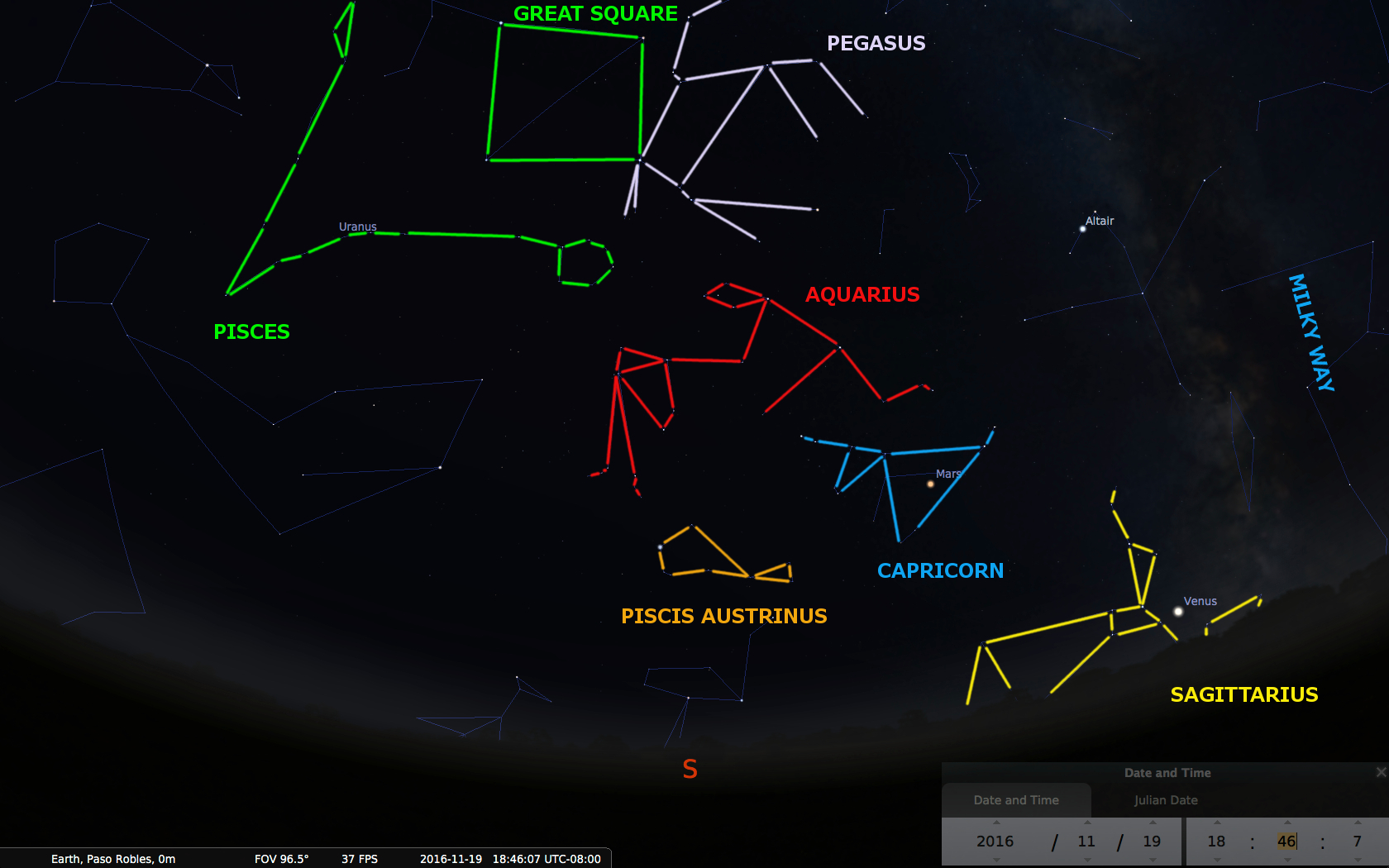
This relatively dark region does, however, contain Aquarius, holding a pitcher or water-vessel and pouring down two distinctive streams of water upon the Southern Fish (Piscis Austrinus). Below is a star-chart showing the current locations of Aquarius and Piscis Austrinus in the early night sky, for a viewer located in the northern hemisphere at about 35 north latitude, at about 6:45 in the evening (by which time it is already plenty dark at this time of year):


As you can see from the chart, the Great Square of Pegasus is now high in the sky, and should be very easy for you to locate if you look pretty high up above the southern horizon (for viewers in the northern hemisphere). The Great Square actually functions as the wing of the winged horse of Pegasus (also outlined in the diagram above), but I have chosen to outline it in the same green color as I have outlined the Fishes of Pisces, because the Great Square is often connected with the Fishes of Pisces in many Star Myths of the World, as well as in iconography found around the planet and across the millennia, as shown in a discussion in Appendix 39 of Hamlet's Mill by Hertha von Dechend and Giorgio de Santillana (see in particular the illustrations between pages 434 and 435).

The faint but delightful constellation Pisces can be seen to either side of the lower edge of the Great Square, and is well worth trying to observe if you can get to a viewing-point away from too much light pollution. Pisces is one of the most challenging of the zodiac constellations to see, but now is one of the best times of year to give it a try.

Now is also a good time to try to find Aquarius, shown above in the star-chart of 6:46 pm at the constellation's highest point in its arc, directly above the "due south" direction for viewers in the northern hemisphere. Aquarius has a distinctive "running forward" outline, and carries a water-vessel that pours its streams down towards Piscis Austrinus, the Southern Fish. 

The star at the front of the Southern Fish is called Fomalhaut, and is easily the brightest star in the dark region of the sky containing Aquarius. Of this star, H. A. Rey says:

You can hardly fail to see it when it is up; a line through the two bright stars on the Pegasus side of the Great Square and far downward points straight to brilliant Fomalhaut, solitary in a very dull region. In case you find another bright star halfway between the Great Square and Fomalhaut, it's not a star but a planet passing through the Water Carrier. Fomalhaut is one of our closer neighbors, about 22 light-years away and 13 times as luminous as the sun. 56.

In the diagram above you can see the line to which H. A. Rey is referring -- the edge of the Great Square on the right-hand side as we look at the screen above can be extended downwards towards the bright star Fomalhaut:

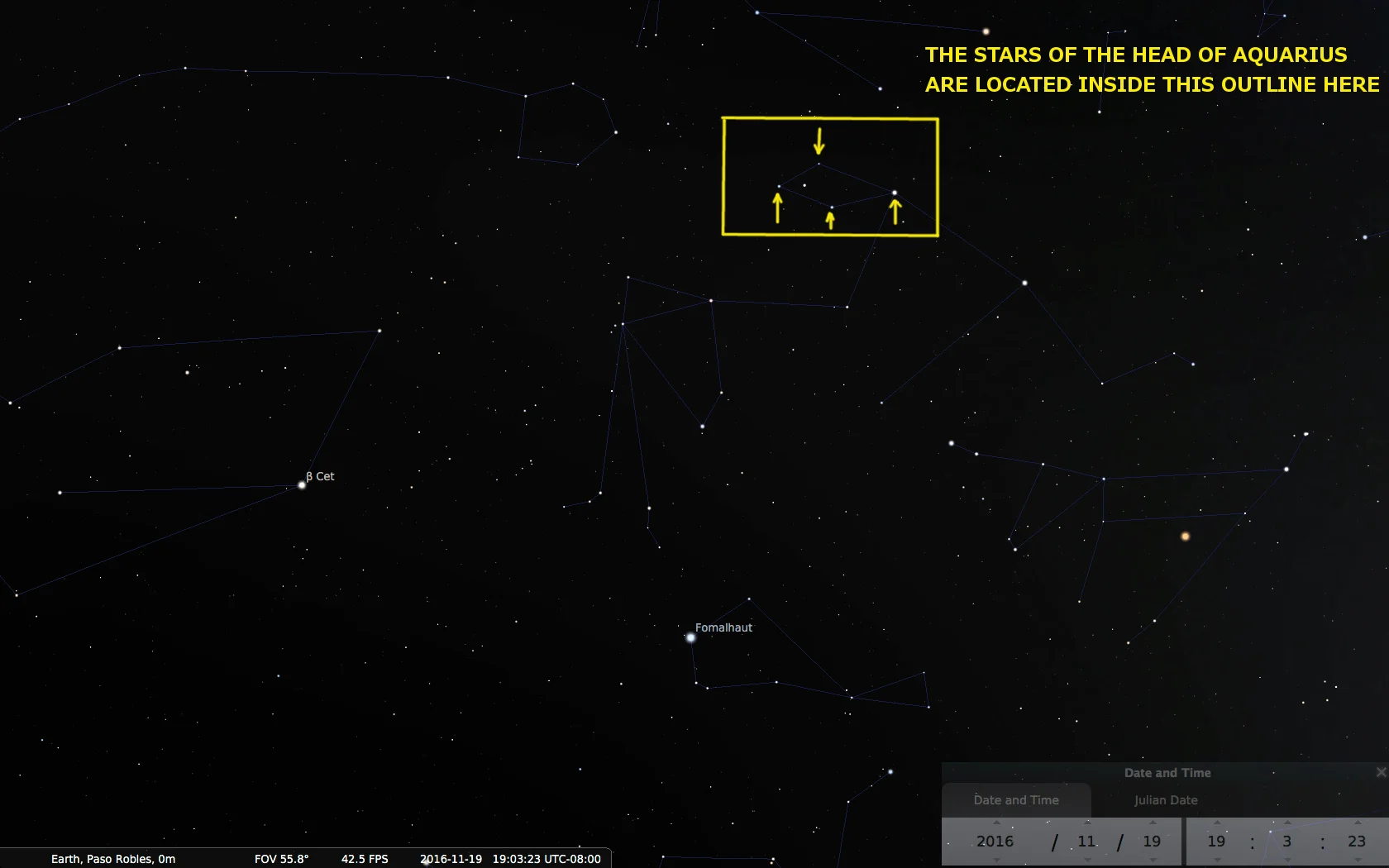
I usually find the Southern Fish by looking to the form of the constellation Aquarius, however, and following the distinctive streams pouring out of the water-vessel. The easiest way to find Aquarius is to look for the diamond-shaped head of the constellation, consisting of an outline of four stars plus a fifth star in the center which functions as an "eye" of the constellation.

Below is a close-up of Aquarius and the Southern Fish. Of these stars in the head of the constellation, the three bottom stars plus the "eye" are the most visible: the top star in the diamond-shape is much more difficult to spot. I have placed a yellow rectangular outline around the stars that make up the head of Aquarius:

In the diagram below, I have added arrows pointing to each of the stars which make up the diamond-shaped outline of the head of Aquarius. I did not add an arrow pointing to the star that makes up the "eye" in the center of the head, but that is clearly visible inside the diamond-outline:

From there, you can trace out the complete figure of Aquarius, including the water-vessel (very narrow at the bottom), and its streams of water. The streams themselves are envisioned based on the faint silvery stars which curve in either direction at the bottom of the imaginary streams of water:

In the diagram above, the faint stars that curve off in either direction from the two streams pouring out of the water-pitcher have not been outlined, but you should be able to make them out, curving away from the base of the two lines of water pouring down from the jug of Aquarius.

These lines point in the general direction of the bright star Fomalhaut at the front of the Southern Fish, as does the long "forward leg" of the running figure of Aquarius.

Fomalhaut is labeled in the diagram above, and is by far the brightest of any of the stars in the vicinity (note, however, that the planet Mars is not far away right now, and is the bright orange object seen below the rear foot of the running figure of Aquarius; Mars is moving through Capricorn at present, as you can see from the first two star-charts on this page).

The name Fomalhaut is derived from a phrase which means "mouth of the fish" in Arabic -- and this bright star at the front of Piscis Austrinus is undoubtedly responsible for a briefly-described miracle found in the account of the Gospel According to Matthew, chapter 17. The miracle is recounted immediately after Jesus has told his disciples that "The Son of man shall be betrayed into the hands of men: And they shall kill him, and the third day he shall be raised from the dead" (Matthew 17: 22 - 23).

The next verses tell us:

24 And when they were come to Capernaum, they that received tribute moneycame to Peter, and said, Doth not your master pay tribute?
25 He saith, Yes. And when he was come into the house, Jesus prevented him, saying, What thinkest thou, Simon? of whom do the kings of the earth take custom or tribute? of their own children, or of strangers?
26 Peter saith unto him, Of strangers. Jesus saith unto him, Then are the children free.
27 Notwithstanding, lest we should offend them, go thou to the sea, and cast an hook, and take up the fish that first cometh up; and when thou hast opened his mouth, thou shalt find a piece of money: that take, and give unto them for me and thee.

This episode almost certainly involves the Southern Fish with its brightest star Fomalhaut at the "mouth of the fish," representing the coin paid for the tribute at Capernaum.

Aquarius in this case plays the role of Peter, who is instructed to hook the fish and find the coin in its mouth. We find similar references to Aquarius and the Southern Fish in a Star Myth from the Indigenous Aborigines of Australia which is discussed in Star Myths of the World, Volume One (there, the brilliant star Fomalhaut is described as the blazing eye of a monstrous fish, which can be seen glowing in the depths of the water-hole where the fish is hiding).

Aquarius-figures in the world's Star Myths are often headstrong and hasty -- as is the figure of Peter throughout many of the gospel stories. This ancient convention, which is found in myths around the globe, probably derives from the "pitched forward" or "headlong" running posture of the constellation Aquarius.

In the painting below by Jacob Jordaens, painted during the first half of the 1600s, we can see Peter in a fairly "Aquarian" pitched-forward posture, pulling a fish out of the sea to obtain the tribute money:

You will find Peter on the right-hand side of the painting, as you face it on the screen. Note that the artist appears to have included the Great Square of Pegasus -- can you locate it in the painting?

Yes, there it is -- the sail of the fishing boat, which is located in the correct general region relative to the figure of Peter who represents Aquarius.

Note that the artist has also included two figures "leaning away" from the rectangular outline of the sail, in very much the same way that the two Fishes of Pisces frame the lower angles of the Great Square in the night sky:
 

The elements of this composition, as with so many other paintings through the centuries, strongly indicate that the celestial origins of the story of the miraculous tribute coin in the mouth of the fish were known by some group and passed along through secret channels from generation to generation, even as the wider public was taught that these stories were intended to be understood literally.

Unfortunately, the messages of these stories can be greatly distorted when we try to force them into a literal and historical framework. The Star Myths of the world allegorize the motions of the players in the celestial realms, and I believe that they do so in order to depict for us truths relating to the Invisible Realm, the realm of spirit which is very real, even though we cannot see it.

The ancient wisdom imparted to humanity teaches that the Invisible World, the Spirit World, is in fact "the real world that is behind this one," in the words of the holy man Black Elk of the Lakota. He further says that "everything we see here is something like a shadow from that world."

In other words, everything in the visible realm -- the material realm -- actually flows from and has its origins in the "real world that is behind this one." However, because that realm of spirit is invisible, the ancient myths use the realm of the stars as a means of conveying knowledge about that Infinite Realm to our understanding.

In this brief account of the miraculous paying of the tribute using a coin from the mouth of the fish, the ancient scriptures demonstrate in dramatic fashion the superiority of the divine realm over the material realm, and the ability of the higher realm to provide for even the most mundane of our needs.

There is also a teaching that in some sense, we are "children" and not "strangers" and therefore "free" -- probably having to do with the understanding that when we come down into this material realm and take on a mortal body, we continue to possess a connection to the higher realm which transcends the limitations of the lower mortal realm through which we are presently traveling.

Nevertheless, while we are here ("lest we offend") we are also wise to observe the exigencies of life here in the physical world.

While we are here in our incarnate form, however, we do in some way have immediate access to that Invisible Realm, and all of its benefits and power -- if we can only understand what the ancient Star Myths are trying to convey to our deeper understanding (the understanding may well involve integration with the Higher Self).

You can, in fact, go out this very night and have access to that same miraculous coin that was promised to Peter in Matthew 17.

Namaste _/\_


How to obtain signed copies

How to obtain signed copies

You can obtain personally-inscribed copies of any of my books by visiting the "Books" section of the Star Myth World website and scrolling towards the bottom of the page.

There, you will find a link which takes you to this page.

There you can order copies of any of my books, as well as indicate a name for inscription to obtain a signed copy.

Just in time for all of your holiday shopping pre-planning!

(Just 36 days between today and Winter Solstice 2016 -- which takes place this year on December 21st).

Lunar Gazing

Lunar Gazing

image: Wikimedia commons (background link, foreground link).

image: Wikimedia commons (background link, foreground link).

By now, everyone who has been able to watch the November full moon rising over the horizon will know from personal experience that it is in fact visibly, stunningly, and breathtakingly larger and even more awe-inspiring than usual (and that all the articles saying that the difference from other moons is too slight to be perceived are patently wrong).

If you've been able to personally watch the moon rising on the past couple nights, you also know that seeing the moon can have a powerful effect on us.

But we don't have to wait for a lunar perigee coinciding with a full moon to experience the power of the moon. In fact, ancient practices made use of regular and deliberate lunar gazing as a practice for aligning our internal cycles with the cycles of the heavens (and in this case, the cycle of the moon).

In White Moon on the Mountain Peak: The Alchemical Firing Process of Nei Dan, Daoist teacher Damo Mitchell describes the discipline and benefits of lunar gazing.

This practice is from the Shen Gong () aspect of the Daoist arts, which is a system translated as 'skill of working with the spirit.' Shen Gong exercises are some of the most abstract of all Daoist practices as they generally involve connection of the spirit to various entities; they also combine the use of hand positions, breathing methods, stepping patterns and other more esoteric aspects of the tradition. Shen Gong exercises work because they are empowered practices handed down through the ages; they are a direct link back to Daoism's shamanic roots. It can take a lifetime of cultivation before a person is able to work fully with Shen Gong methods, but some of the more simple practices can be accessed early on, particularly by women, who have a higher degree of natural sensitivity and a strong connection to environmental energies. One such practice is 'lunar gazing,' which is very simple and useful for all women to get used to.

In order to 'lunar gaze,' a woman needs to go outside and look up a t the moon every two to three nights over the course of a full lunar month. If she is able to go every night, then that is even better. Betweem the hours of 11pm and 1am is the best time to practise, although this can be difficult for many due to life commitments, so it is OK to go as soon as it gets dark. When trying this practice, a woman should go out and stand in a correct Qi Gong posture and look up towards the moon. Try to still the mind and be as calm as possible as you do this. Simply look up to the moon and place your awareness upon it in the same way that you may lightly drop your awareness into the lower Dan Tien during Qi Gong or Nei Dan practice. Breathe deeply and then, after a few minutes of looking up at the moon, gently bring your awareness back to rest upon the Heart centre and lightly keep your mind there while still looking at the moon. Stay with this practice for around 20 minutes and then close down as you would normally for any Qi Gong training. Repeat this process over the course of a lunar month, beginning with the full moon and returning to the full moon through the entire lunar cycle. 

For the first few times you try this, little will happen. After some time, though, you will find that there begins a slight magnetic pull between you and the moon as you bring your mind back into the Heart centre. It can even sometimes be strong enough to pull you forward off your feet; if this happens, don't worry, it is all part of the process. 217 - 218.

Damo Mitchell explains that, although both men and women are connected to the moon and its various phases, "it was a far greater concern for women to work with the energy of the moon because it was largely the Blood that was affected by the energy coming down from the moon's surface" (216).

Connecting with the cycles of the heavenly bodies, including our earth's own awe-inspiring moon, is clearly held as being of the utmost importance by the ancient wisdom entrusted to humanity in the very earliest past.

I further believe that, because the celestial realms very directly represent the Invisible Realm or the Infinite Realm in the ancient system (being in fact infinite in nature), the incorporation of the cycles of the heavenly motions in to our lives is a way of acknowledging the truth that everything in the visible and material realm in fact flows from, has its origin within, and indeed depends upon the Invisible Realm -- the realm of the gods.

By bringing our lives into closer harmony with the heavenly cycles, we may be able to facilitate our integration with the divine realm, which may well be a large part of our purpose here in this incarnate life.

-------

Please note that the image above is a composite image, in which a photograph of the actual moon of November 14 has been juxtaposed with an ancient temple of the goddess Artemis.

Let me disclose, O Gilgamesh, a matter most secret: the mystery of the Flood

Let me disclose, O Gilgamesh, a matter most secret: the mystery of the Flood

image: Wikimedia commons (link).

image: Wikimedia commons (link).

I have encountered so much evidence that the world's ancient myths, scriptures and sacred stories are based on a common system of celestial metaphor that the conclusion is, to me, beyond doubt.

This evidence includes virtually all of the stories included in the texts commonly referred to as the Old and New Testaments of the Bible. My most recent publication, Star Myths of the Bible, stretches to 766 pages, with over 270 color illustrations, including over 130 full-color star charts related to the events and episodes described in the ancient texts -- and even at that length, I had of necessity to leave out many more Star Myths which can be found in the Biblical scriptures and can be shown to be based upon the motions of the sun, moon, stars, and visible planets.

One important episode which is explored in detail is the Deluge or Biblical Flood account, which is clearly based upon specific constellations we can still see in our night sky. The discussion in Star Myths of the Bible also makes reference to the Deluge accounts found in the ancient Mesopotamian texts, which were only re-discovered and translated in the nineteenth century (and subsequent decades).

These accounts, including the account of Uta-napishti (or Utnapishtim) found in Tablet XI of the Gilgamesh series, and the related accounts of Ziusudra in a Sumerian version and of Atrahasis in an Akkadian version, all contain very close parallels to the account of the Biblical Deluge found in Genesis, including common elements such as the reason for the Flood itself, the advanced warning given to a virtuous man who is instructed to build a box-like ark in which to ride out the flood with his family and with animals, the unleashing of waters for a certain number of days and nights (seven days and seven nights in most of the ancient Mesopotamian accounts, and forty days and forty nights in the Genesis account), the opening of a window in the ark and the release of certain birds including a dove (to see if the waters have subsided enough), and the offering of a sacrifice of thanksgiving once the Flood has ended.

There is also, in both the Genesis account and the ancient Mesopotamian accounts, an explanation that the lifespan of men and women will be limited after the Flood -- the Mesopotamian accounts actually make the reason for this element of the Flood story a little more understandable, tying it back to the reason the gods released the Flood in the first place.

The important point to observe is the abundant evidence which can be seen in both the Genesis account and the various ancient Mesopotamian parallels which indicate that the Deluge stories as they are presented in the texts are built upon celestial metaphor from start to finish.

This means that the accounts in the ancient sacred texts are not primarily intended to be understood literally, but rather that they are intended to convey some knowledge other thana record of literal and historical events.

Please note that I did not just say that I do not believe there is abundant evidence on our planet's surface to support the conclusion that the earth has experienced cataclysmic flooding: I believe this evidence is overwhelming, and have discussed it extensively in this blog. However, I am convinced by the evidence in the texts themselves that the Deluge accounts as they are presented in the ancient Mesopotamian tablets and in the Genesis account are based upon celestial metaphor -- and thus were not intended to be understood as literal and historical accounts.

In Star Myths of the Bible I present discussion and illustrations which argue that the overstepping of boundaries which precipitate the unleashing of the Flood, the "windows" or "floodgates" of heaven which are opened up, the "fountains of the great deep" which are broken up, the ark itself, the figure of Noah himself, the animals two-by-two, the "mountains of Ararat" upon which the ark comes to rest, the sending out of the birds to fly to-and-fro, and the altar with the sweet savor or pleasing aroma can all be shown to be related to specific constellations and celestial features in our night sky.

Previous posts on this blog, such as this post, as well as another chapter in Star Myths of the Bible also explore the evidence that the story of Noah and his sons Shem, Ham and Japheth (as well as Noah's vineyard) is also built upon celestial metaphor, which argues very strongly that Shem, Ham and Japheth and the act of walking backwards with the sheet to cover Noah's embarrassed condition are all celestial in nature and are not intended to be understood as literal, terrestrial history of events which took place on earth following the Flood.

But if the stories are not intended to be understood as teaching literal historical events in the ancient past, then what are they intended to convey?

I believe that the ancient Mesopotamian accounts give us a very strong clue. 

In the eleventh tablet of the Gilgamesh series, the semi-divine hero Gilgamesh has come to Uta-napishti the Distant in order to discover the secret of "the life eternal" (XI. 7). The account of the journey of Gilgamesh to Uta-napishti's abode actually takes place in Tablet X: Gilgamesh is distraught over the death of his companion Enkidu (note here the parallels to the weeping of Achilles over the death of Patroclus, and the weeping of Jesus over the death of Lazarus -- both of which I would argue to be esoteric myths intended to teach the very same thing as the story of Gilgamesh and Enkidu). 

Uta-napishti greets Gilgamesh with these words (translations are from Andrew George, found in this edition of the Epic of Gilgamesh): 

'Why are your cheeks so hollow, your face so sunken,
your mood so wretched, your visage so wasted?
Why in your heart does sorrow reside,
and your face resemble one come from afar?
Why are your features burnt by frost and by sunshine,
and why do you wander the wild in lion's garb?' X. 213 - 218. page 83.

And Gilgamesh replies:

'I look at you, Uta-napishti:
your form is no different, you are just like me,
you are not any different, you are just like me.
I was fully intent on making you fight,
but now in your presence my hand is stayed.
How was it you stood with the gods in assembly?
How did you find the life eternal?' XI. 2 - 7. page 88.

Then Uta-napishti says to Gilgamesh:

'Let me disclose, O Gilgamesh, a matter most secret.
to you I will tell a mystery of gods.' XI. 9 - 10. page 88.

Uta-napishti then relates the entire account of the Deluge, concluding with the offering which Uta-napishti makes "to the four winds" at the conclusion of the Flood (an offering which consists of incense placed at the peak of the mountain upon which his ark has come to rest -- seven flasks of incense which Uta-napishti burns upon a fire of reed, cedar and myrtle wood; XI. 157 - 160).

The text tells us that this sacrifice produces a sweet savor (the similarity to the Genesis account is very clear), after which the god Enlil, whose name means "Lord Wind," comes to Uta-napishti and his wife. Uta-napishti relates what happens:

'Enlil came up inside the boat,
he took hold of my hand and brought me on board.
He brought aboard my wife and made her kneel at my side,
he touched our foreheads, standing between us to bless us:
"In the past Uta-napishti was a mortal man,
but now he and his wife shall become like us gods!
Uta-napishti shall dwell far away, where the rivers flow forth!"
So far away they took me, and settled me where the rivers flow forth.' XI. 199 - 206. page 95.

Although there is plenty of room for debate over the interpretation of these passages, I would argue that the implication is this: Uta-napishti and his wife achieved "the life eternal, the mystery of the gods" by going through the Flood!

Now, that may not seem very helpful to you and me, since you may be saying to yourself, "Well, that's all very nice for Uta-napishti and his wife -- but I didn't go through that Flood, so it doesn't do me much good to know that."

But that is exactly where we must remember that, based upon what I would argue to be a super-abundance of evidence in the texts themselves, this Flood of which we read in the ancient Star Myths of the world is not a literal Flood!

Of course there may well have been literal flood-cataclysms in earth's ancient past -- I do not deny that and in fact would argue that the evidence for such cataclysms is undeniable. But the account of Uta-napishti in Gilgamesh Tablet XI and the account of Noah and his family in the scriptures of Genesis are esoteric celestial metaphors -- and I would argue that they are intended to teach us about an entirely different Flood: one that each of us goes through and one that in fact each of us is going through right now!

It is the very same "Flood" that Odysseus can also be shown to go through, in the Odyssey of ancient Greece, in which the hero is thrown into the ocean by the wrath of Poseidon and goes through a series of "spin cycles" which can also be shown to relate to the very same parts of the heavenly sphere which are referenced in the Uta-napishti account above. 

That place "where the rivers flow forth" which Gilgamesh Tablet XI refers to in lines 205 and 206 probably correspond to the celestial features in the vicinity of Pisces, the Great Square, and Cetus: a region of the sky which plays an important role in many of the episodes of the Odyssey as well (the adventures of Odysseus and their possible esoteric meaning are discussed at length in Star Myths of the World, Volume Two).

I would submit to the reader that the Flood through which Uta-napishti must pass, and through which Odysseus must pass, is an esoteric reference to this incarnate life through which each of us must also pass -- and through which each of us are in fact traveling right now. 

This metaphor is extremely widespread -- it can be found in the myths and sacred traditions around the world. 

In the Mahabharata of ancient India, for instance, the beautiful Draupadi cries out to Krishna during the awful humiliation at the dice-game that she is being dragged down into the Kuru sea (Krishna provides her with divine sustenance and aid during that ordeal). See for instance Mahabharata Book 2, sections 67 and 69.

Here is another previous post which discusses the same concept using some of the profound ancient knowledge that appears to be encoded within the Chinese characters that constitute one of the oldest writing systems still in use on earth today.

I am convinced that the ancient wisdom given to humanity as a precious inheritance in the Star Myths of the World has to do, at one level, with the goal of transcending the "spin cycle" of this incarnate life, and achieving the situation described in the metaphorical language of the myths as finding the life eternalstanding with the gods in assemblybecoming as the gods, and other ways of describing the integration with the divine realm.

In addition to the myths themselves, there are also ancient disciplines which have survived from ancient times which appear to have as their goal the same sort of integration and transformation, including Yoga, Tai Chi, Chi Gung and related forms of internal energy work, Tantric disciplines, shamanic practices, and the many types of meditation which are practiced around the world.

Some of these traditions also contain specific references to the development of the "light body" or the "energy body" or the "diamond body."

I believe that the ancient Flood accounts may have more to do with "crossing the sea in order to gain a light body" than they have to do with historical descriptions of a literal flood on earth -- even though I believe there is plenty of evidence for cataclysmic floods in earth's ancient history.

In fact, we might even go so far as to see a connection to the famous story of the crossing of the Red Sea in Exodus as well, another story which I believe can be definitively shown to be based on specific celestial references (see discussion and video here, as well as extensive discussion in Star Myths of the Bible). As Alvin Boyd Kuhn points out in various writings, our physical human body itself contains a sort of "Red Sea," which means that the "crossing of the Red Sea" can also be understood as a metaphor referring to our sojourn within this incarnate life.

The message of Uta-napishtim to Gilgamesh -- and to us -- is that this crossing of the Flood (in which we are all presently engaged) has a very important purpose, and one which we should not be neglecting.

The purpose is not to gain immortality here in this physical body -- the remainder of Tablet XI details Gilgamesh's unsuccessful attempts to gain a plant of immortality, as well as his unsuccessful attempts to go without sleep, which Shakespeare calls "death's counterfeit" (see Macbeth II. iii, as well as a similar allusion in Hamlet).

I believe the message is that we should be paying very close attention to the wisdom in the ancient texts and sacred stories, as well as the practices preserved in some of the disciplines listed above, which give us pointers towards the "mystery of gods" which we should be focused upon as we pass through this Flood.

image: Wikimedia commons (link).

image: Wikimedia commons (link).