Revelation chapter 22 and the Egyptian Book of the Dead

Revelation chapter 22 and the Egyptian Book of the Dead

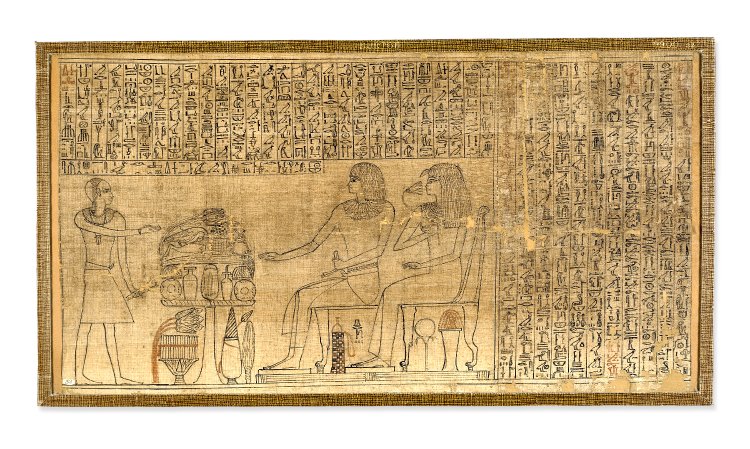
above: text and illustration from the Papyrus of Nebseny, showing Nebseny and his wife Senseneb. British Museum. 

above: text and illustration from the Papyrus of Nebseny, showing Nebseny and his wife Senseneb. British Museum.


My most recent book, Star Myths of the World and how to interpret them, Volume Three(Star Myths of the Bible), examines hundreds of stories, characters, events and themes in the Old and New Testaments of the Bible to show that they are based on the same system of celestial metaphor which forms the foundation for virtually all of the other ancient myths, scriptures, and sacred stories from around the world.

The book totals 766 pages, with over two hundred seventy full color images, including well over one hundred star charts showing connections between specific constellations and aspects of various episodes in the scriptures. Even so, due to the limitations of space, many important events and episodes had to be left out.

The apocalyptic literature in the book of Revelation is touched upon in one section, which deals specifically with events described in Revelation chapters 9, 10 and 12. An entire book could of course be written about the celestial metaphor present in the book of Revelation alone -- in fact, it would probably take up more than one volume. Therefore, I did not deal with the imagery found in the final chapter of Revelation, chapter 22 -- although it is of course full of important material worthy of study.

Recently, Moe Bedard, host of the Gnostic Warrior podcast and website, invited me back for another interview (you can find the previous interview, which was published in October of 2014, here). Moe asked me about a specific passage in Revelation 22, into which I had not previously delved deeply (as I had selected other parts of Revelation, which have more obvious and unambiguous connections to specific constellations, to study more closely instead, when preparing Star Myths of the Bible).

However, because it is a very important chapter, and because listeners to the podcast might be wondering what my analysis of Revelation 22 would contain, I promised to look into it further and follow up with some thoughts on the contents of the passage in question.

The final chapter of Revelation 22 can be found online in many places; one good resource where you can view this text in various translations is the Blue Letter Bible project online.

The verse in chapter 22 which Moe focused on in his question is verse 16, which reads: "I Jesus have sent mine angel to testify unto you these things in the churches. I am the root and offspring of David, and the bright and morning star." The translators of the King James version, which is cited here, italicize words which they added based on their assessment of the best syntax to convey in English what they felt the text was conveying in the original language -- thus, in the final sentence, the actual text does not contain the word for "and" in between the two titles, but simply declares, "I am the root and offspring of David, the bright and morning star." That's why the final "and" in the sentence is written in italics.

The imagery in Revelation 22, like the imagery in the rest of the book of Revelation, can be shown to incorporate celestial imagery which points to specific regions of the night sky. For examples which support the argument that the text of Revelation consists of celestial metaphor, see this previous post  from 2012 discussing some of the imagery in Revelation 9, or this previous post and accompanying video from January of this year, discussing Revelation 12.

For example, at the beginning of the chapter, the narrator is describing what is being shown to him by the angel described in the previous chapter's ninth verse. The text begins:

"And he showed me a river of water of life, clear as crystal, proceeding out of the throne of God and of the Lamb. In the midst of the street of it, and on either side of the river, was there the tree of life, which bare twelve manner of fruits, and yielded her fruit every month: and the leaves of the tree were for the healing of the nations" (Revelation 22: 1 - 2).

This river of water of life is almost certainly the shining band of the Milky Way galaxy, which features prominently in many of the metaphors contained in the book of Revelation, and which is described as a river in many other stories in the Bible (including the river in which Jacob wrestles at the time that his name is changed to Israel, in Genesis 32, which is discussed at length in Star Myths of the Bible), as well as in many other Star Myths from other cultures around the world.

For evidence that the Milky Way plays the role of a river in certain ancient myths and stories, see for example the discussion of the story of King Midas in the myths of ancient Greece found in this previous post from October 2014, in which I present evidence that the River Pactolus described in the Midas myths can be identified with the Milky Way band.

The river is described in verse 1 as proceeding out of the throne of God and of the Lamb -- both of which can be identified with specific constellations discussed in Star Myths of the Bible, beside which the Milky Way flows: the constellations Hercules and Aries.

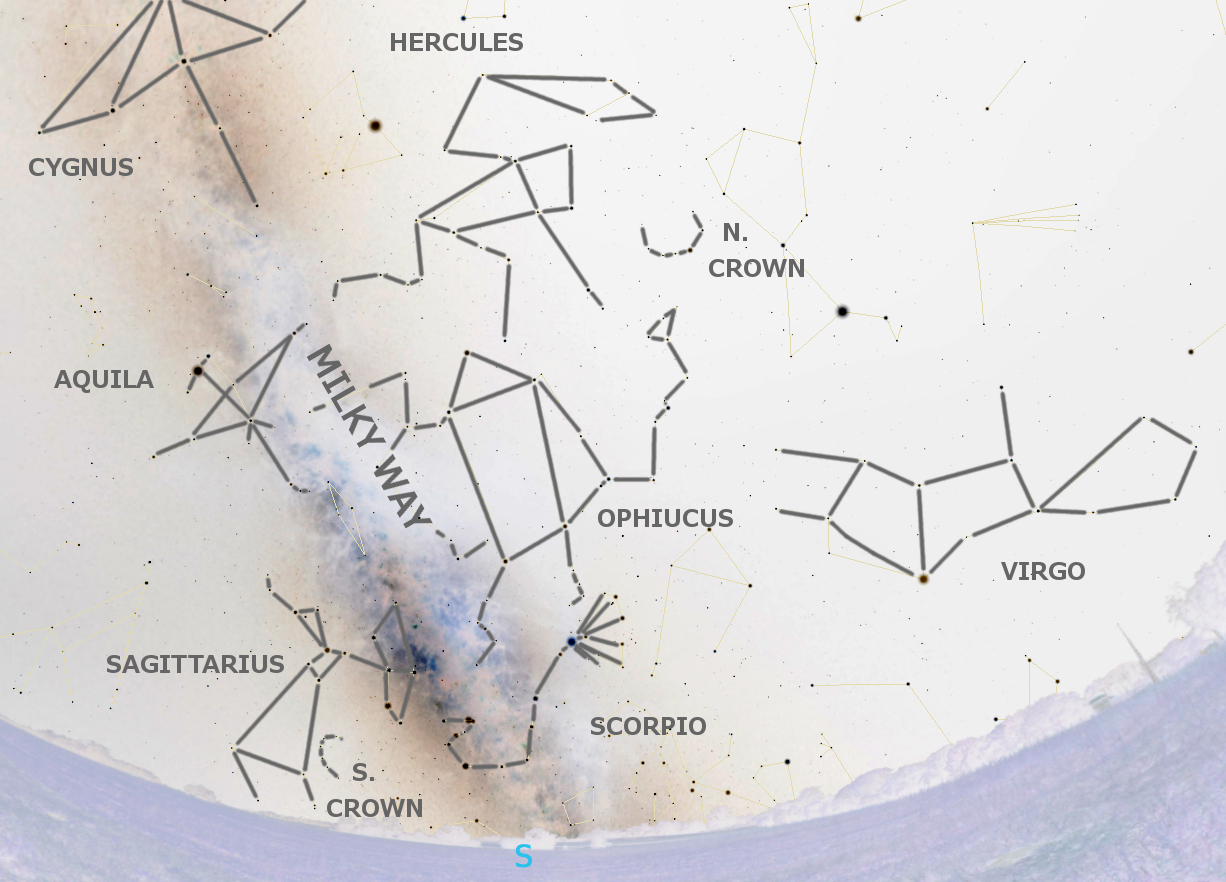
The tree in the midst of the river of water of life, described as being both "in the midst of the street of it" and also "on either side of the river," may well describe the constellation Ophiucus, which can be seen to be "standing" with one foot in the river in the star-chart below. The serpent which is held by Ophiucus, and which stretches out to either side of the constellation, is very frequently associated with a tree in numerous Star Myths from around the world -- especially the upper part of the half of the serpent on the west side of the body of Ophiucus (the "head-end" of the serpent, on the right side as we face the image below, in which the view is taken as though facing towards the south from a point in the northern hemisphere):

Many such examples of the upper part of the western half ("head-end") of the serpent of Ophiucus being associated with descriptions of a tree in various myths can be found in the Star Myths of the World series -- especially in Volumes Two (Greek mythology) and Three (the Bible).

However, as we saw a moment ago, the text of Revelation 22: 2 states very specifically that the tree in the "midst" of the river is also "on either side of the river," and so part of it must be envisioned as being on the east side of the Milky Way (that is to say, the left side in the image above).

If Ophiucus is indeed playing the role of a branching tree which stretches to either side of the river, then what stars in the chart above could represent the branches of the tree on the east of the river? I would propose that some of the stars of the constellation Aquila the Eagle may be envisioned as being connected to the eastern half of the serpent that Ophiucus is holding.

Note that the upper part of the Ophiucus serpent comes very close to the outline of Aquila -- and note that of course there are no actual "connecting lines" between the stars in the sky, which means that we can imagine a line connecting Ophiucus and Aquila if we want to do so, or imagine no line between them. There are many Star Myths which I have analyzed in which an "optional line" appears to have been envisioned by the originators of the ancient myths, such as those in which a connection is envisioned between the "head-end" of the serpent of Ophiucus (on the west or right side of the image above) and the "downward-reaching arm" of the constellation Hercules.

Note also that the rest of the description in Revelation 22: 2 goes on to describe the fruits of the tree as being twelve in number or in type, and to be produced "every month." Any time we find a reference to the number twelve such as this reference in Revelation 22, a possible explanation to consider would of course be the idea that the passage may be referring to the stations of the zodiac -- and indeed, I believe that this is a good explanation for this reference to the twelve fruits of the tree.

The confirmatory detail which the text provides in order to increase our confidence in this conclusion is the statement that the tried "yielded her fruit every month." The earth's annual orbit around the sun causes the sun to move through the twelve signs of the zodiac as we go through the year, spending about one month in each. Thus, the tree's twelve types of fruit, which are yielded each month, are almost certainly a reference to the zodiac band, which stretches out to either side from the base of the tree -- almost like fruit that has fallen down periodically, once per month.

Note in the image above that the zodiac band does indeed stretch outwards on either side of the upright form of Ophiucus. The constellations of the zodiac visible in the chart above are outlined in yellow, beginning with Aquarius on the left side of the image (the east side) and proceeding to Capricorn, Sagittarius, Scorpio, Libra and Virgo. These zodiac constellations, I'm convinced, represent the "fruit" that the tree of life has "yielded" (or "given up") each month, described in Revelation 22: 2.

There are many other examples of celestial metaphor in this chapter of Revelation, many of them using the very same constellations but clothing them in different metaphor. For example, in verse 8, the text tells us: "And I John saw these things and heard them. And when I had heard and seen, I fell down to  worship before the feet of the angel which showed me these things" (Revelation 22: 8).

In this particular part of the chapter, I believe that the same constellation Ophiucus, which was just a moment before playing the role of the tree of life in the midst of the pure river of water of life, is now playing the role of the angel, before whose feet John says he fell down to worship. Note that just below the feet of the outline of Ophiucus we find the constellation Scorpio, a constellation with a "bowing down" posture, and one which will sometimes play just such a role (of a person bowing down) in the world's various myths.

Immediately after this, the angel tells John not to bow down in this way, and then goes on to make a series of declarations, including the declaration in verse 13: "I am the Alpha and Omega, the beginning and the end, the first and the last," as well as the later declaration in verse 16 cited above: "I Jesus have sent mine angel to testify unto you these things in the churches. I am the root and offspring of David, and the bright and morning star."

This series of declarations seems a little confusing, since at its outset it is clearly the angel who is addressing the narrator, but the unbroken series of proclamations then continues to the statement "I am the Alpha and Omega" and the declaration "I Jesus have sent mine angel to testify."

However, I believe any difficulty is resolved by the understanding that we are still dealing with the constellation Ophiucus, a constellation which actually does have a few of its stars crossing the ecliptic path of the sun, thus qualifying it as being part of the zodiac band, even though Ophiucus is not normally associated with the twelve signs of the zodiac. For this reason, Ophiucus is sometimes described as being the "thirteenth zodiac sign."

This placement of Ophiucus, above the majority of the constellations arrayed along the ecliptic path, but still crossing with some of its lower stars into the zodiac band, undoubtedly accounts for statements such as "I am the Alpha and Omega, the beginning and the end, the first and the last." All of these statements are appropriate for a point on an endless ring or circle, which describes the zodiac itself. Any point on a circle can be described as being both a "beginning and end," or as being both "first and last" in a procession of figures arranged in a great circle.

When the one speaking to John then identifies himself by the specific name of Jesus and gives his descriptions as "the root and offspring of David" as well as "the bright and morning star," I believe we should also look to the constellation Ophiucus.

The constellation Ophiucus can indeed be seen as both "the root and offspring of David," if we understand that the figure of King David in the Old Testament is almost always associated with the powerful outline of the constellation Hercules, located immediately above Ophiucus. The evidence to support this assertion is provided in the lengthy examination of the figure of David found in Star Myths of the Bible, particularly in pages 145 through 157 and pages 515 through 542.

The image below, showing a painting by Flemish master Peter Paul Rubens (1577 - 1640), shows David in a posture that is almost identical to the outline of the constellation Hercules in the sky (and reveals that the connection between the figure of David and the constellation Hercules must have been known in previous centuries):

image: Wikimedia commons (link).

image: Wikimedia commons (link).

The constellation Ophiucus, being directly beneath Hercules, can be said to be the "root" of that constellation in the same way that a root of a tree is directly beneath a tree, and supports it from under the ground. Alternately, the constellation Ophiucus can also be seen as the "offspring" of the constellation Hercules, in that it is directly below Hercules in the sky and thus "descended" from it, metaphorically speaking.

Thus, the heavenly speaker showing these visions to the narrator in the 22nd chapter of Revelation, who in verse 16 explicitly identifies himself as "I Jesus," is also one and the same with the tree of life, which stands in the midst of the pure river of the Milky Way, and whose "fruit" is yielded up each month and identified with the circular band of the zodiac, and who is both "the first and the last" of that same zodiac ring, and whose leaves are "for the healing of the nations."

But what about the declaration that accompanies the description in verse 16 of the "root and offspring of David," the proclamation that the speaker is also "the bright and morning star"? There certainly do not seem to be any bright morning stars in the constellation Ophiucus, which is a constellation without any extremely bright stars, and one that is not extremely easy to locate (although once you know how, it is not too difficult, but instead extremely satisfying, to locate Ophiucus -- this previous post gives some tips, although you will need to look for Ophiucus during a time when the other constellations in the star chart shown above are also visible in the sky).

For help with this question, I turned to the indispensable Alvin Boyd Kuhn (1880 - 1963), who in Lost Light (1940) argues that this phrase "the morning star" was anciently identified by the Egyptians with the star Sothis -- the Greek version of their name for the star we call Sirius, brightest of all the stars in the heavens (other than the sun itself, of course).

There, on page 545, Kuhn declares:

The morning star (at one time) was Sothis: the watch-dog that barked to announce the coming of the Day-Star from on high, as the ape clicked at the rising sun.

We know from ancient texts that the ancient Egyptians eagerly awaited the first morning re-appearance of the star Sothis or Sirius (the heliacal rise of Sirius) and began their year with it. For some explanation of the "heliacal rise" of Sirius, see for example this previous postfrom 2011.

The fact that the rising of Sirius in the morning marked the beginning of a new year in ancient Egypt (as well as in some other ancient civilizations), is a strong argument for the possibility that Sirius is indeed the "bright and morning star" mentioned in the text. Not only was Sirius eagerly awaited in the morning, but Sirius is also the brightest of stars in our heavens, and what's more, the heliacal rise of Sirius marked a new year.

It should be quite obvious that the start of a new year can be accurately described as "a beginning and end."

It is also perhaps significant that the constellation Ophiucus and the star Sirius are almost 180 degrees apart from one another in the void of space, meaning that they will rise about twelve hours apart from one another. By saying that he is both "the root and offspring of David" (associated with Ophiucus) and also "the bright and morning star" (probably associated with Sirius), the speaker in this passage is identifying not only with one particular point on the great wheel of the year, but rather with the whole thing (both halves of the ring).

But there is still more significance to the assertion by Alvin Boyd Kuhn that the identity of the morning star is the bright star Sirius, the morning star of ancient Egypt whose appearance marked the end of one year and the beginning of the next. Because the presence of that reference, in a passage in the New Testament which also contains a reference to "the beginning and the end, the first and the last," betrays a clear connection to the sacred traditions of ancient Egypt -- and the possibility that the imagery in this "New" Testament text has roots that are much, much older than is commonly understood.

And, on the very same page that he makes the identification of the morning star with Sothis, Alvin Boyd Kuhn cites a passage from a translation of the Book of the Dead as found on the papyrus of Nebseny (also commonly rendered "Nebseni") which contains clear resonance with verses in Revelation 22.

Nebseny was a scribe and probably a priest of ancient Egypt, believed to have lived during Eighteenth Dynasty of ancient Egypt, which is thought to have stretched from about 1550 BC to 1298 BC and to include famous rulers such as Hatshepsut, Amenhotep I, Amenhotep II, Amenhotep III, Akehnaten, and Tutankhamun, among others. Some scholars believe that Nebseny was probably writing during the period around the time of the reign of Thutmose IV, whose reign is believed to have lasted from about 1398 BC to 1388 BC. 

The texts which we know today as the Egyptian Book of the Dead were not actually fixed in number or in order or sequence in ancient times, but appear to have been selected from a larger corpus of possible sayings or spells. The Pyramid Texts found in the pyramid of Unas, for example (who is thought to have reigned from 2375 BC to 2345 BC), which form some of the earliest texts which have been preserved to modern times, are actually versions of this same corpus.

The version of the Book of the Dead which was buried with Nebseny contains illustrations of very high artistic quality. There is some evidence for scholars to conclude that Nebseny might have prepared these extensive texts himself, which makes them especially interesting and poignant. They contain illustrations of Nebseny as well as his wife Senseneb, and three of his children (see discussion on page 279 in Journey Through the Afterlife, edited by John H. Taylor).

The papyrus of Nebseny is now located in the British Museum in London (I wonder what he would have thought about that), and has been since the 1830s. It was one of the first versions of the Book of the Dead to be translated. The first translation by Samuel Birch (1813 - 1885), from the 1860s, can be found online here. A translation into the French language from 1885 can be found online here.

The passage from the papyrus of Nebseny cited in Lost Light on page 545 comes from chapter (or "spell") 149, which can be found in its entirety here. It reads (in the translation by Birch):

Made the day of the month of festival of the Sixth and the festival of the Fifth, of the festival of the Lintel, that of Thoth, that of the birthday of Osiris, of Skhem, and the night of the festival of Haker, the mysteries of the Gate, and of traversing the secret place in Hell, prevailing against the Evil, pawing the secret valleys, the mouth and path of which are unknown, corroborating the Spirit who stretches his legs, to go his journey correctly or making a hole in it to pass through it with the God. No man sees it except a king and a priest, no slave's face looks at it. Every Spirit for whom this book has been made having come and gone round, his Soul comes away on the day with the living, he has prevailed as the Gods do, he is not stopped in true linen for a million or times. The Gods, they approach him, they touch him, for he is like one of them; he lets [them] know what he has done in this secret book of truth. There is not known any such anywhere or ever; no men have spoken it, no eye has perceived it, no ear has heard it, not any other face has looked in it to learn it. Do not though multiply its chapters, or do not thou let any face except thy own [see it] and eat thy heart, doing it in the midst of the Hall of Clothes, it is put forth by the God with all his power. It is a true secret; when it is known, all the providers in all places supply the Spirits in Hades, food is given to his Soul on earth, he is made to live for ever, nothing prevails against him. 

The wording as quoted by Kuhn is slightly different, and comes from a version contained in publications by Gerald Massey (1828 - 1907), who lived before Kuhn and whose work Kuhn held in high regard (though Kuhn differed with Massey on a few important points). I suspect the version cited by Massey and Kuhn might have been Massey's own translation of Nebseny. It reads:

By this book the soul of the deceased shall make its exodus with the living and prevail amongst, or as, the gods. By this book he shall know the secrets of that which happened in the beginning. No one else has ever known this mystical book or any part of it. It has not been spoken by men. No eye hath deciphered it. No ear hath heard of it. It must only be seen by thee and the man who unfolded its secrets to thee. Do not add to its chapters or make commentaries on it from the imagination or from memory. Carry it out in the judgement hall. This is a true Mystery unknown anywhere to those who are uninitiated.

Massey had already noted, on page 726 of his Ancient Egypt, the Light of the World, the startling similarity between the language of this ancient text from the Book of the Dead and the passage in the Apocalypse of John (the book of Revelation included in the New Testament canon), chapter 22 and verses 18 and 19. Alvin Boyd Kuhn adds the further connection to the language of the writer who calls himself Paul in Ephesians chapter 3, and who (Kuhn says): "speaks in quite similar terms of a mystery made known to him 'which in other ages was not made known unto the sons of men; as it is now revealed unto his holy apostles and prophets by the spirit'" (545).

Kuhn also should have added that in 1 Corinthians 2: 9, the same writer Paul (citing Isaiah 64: 4) says, "But as it is written, Eye hath not seen, nor ear heard, neither have entered into the heart of man, the things which God hath prepared for them that love them," both passages being clear derivatives from the Egyptian Book of the Dead as cited in the passage above from the papyrus of Nebseny.

It would seem from these connections that the wisdom encoded in the so-called "New" Testament is in fact extremely ancient indeed!

And that is by no means the end of the parallels between the celestial imagery in the book of Revelation and that found in the Book of the Dead. There are many others -- and parallels to other parts of the New Testament as well. For example, in the version found in the papyrus of Ani, an Egyptian priest and scribe thought to have lived around 1250 BC (over a hundred years after Nebseny), the 149th chapter describes the ship which rows in the Field of Reeds, and declares, "I know the gate in the middle of the Field of Reeds from which Re goes out into the east of the sky, of which the south is the Lake of Waterfowl and the north is the Waters of Geese," and also says, "I know those two trees of turquoise between which Re goes forth, and which have grown up at the Supports of Shu at that door of the Lord of the East from which Re goes forth" (translation by Dr. Raymond O. Faulkner, found on page 121 of this version of the complete reproduction and translation of Papyrus of Ani).

This imagery is celestial, and has clear parallels to the celestial explication of Revelation 22 we have just been exploring. The "gate" in the "middle of the Field of Reeds" is the same constellation Ophiucus we see described as standing in the "midst" of the crystal river in Revelation. If you look at the star-chart above, you can see why Ophiucus often plays the role of a gate in ancient myth (many examples can be found in Star Myths of the World, especially Volumes Two and Three). The description of the "Waters of Geese" which are located to the north undoubtedly describe the portion of the Milky Way in which the constellation Cygnus the Swan can be seen to be flying, just a little ways above (that is, just north) of the constellation Aquila in the star-chart. And, "those two trees of turquoise between which Re goes forth" are undoubtedly related to the tree of life described in the vision of John the Revelator, as well as to trees described in the visions in the Old Testament scriptures, such as those of Daniel and of Ezekiel.

What, then, could be the message of Revelation 22? What are all these celestial metaphors trying to convey?

I personally believe that the best approach to the ancient wisdom contained in the scriptures, myths, and sacred stories of the world would be to seek those answers in the myths themselves, rather than to rely upon the interpretation of any individual. I believe that the myths (or our Higher Self) will tell us the answer, if we approach them in the right way (and I also believe it helps if we understand the celestial and metaphorical language that they are speaking).

I also believe that the message has many layers, and may be literally bottomless in its profundity, for any very ancient scripture or myth.

Nevertheless, in order to try to helpfully point readers what I believe to be the right direction regarding the verses found in Revelation 22, I would begin with some of the assertions Alvin Boyd Kuhn makes in the pages surrounding the observations cited in the above discussion.

He says, for example, that:

The Messianic Son came ever as the manifested and witness for the father, who had sunk his life in matter to reproduce himself in his next generation. According to Herodotus (2: 43) the Egyptian Jesus with the title of Iu-em-hetep was one of the eight great gods who were in the papyri twenty thousand years ago! He bore a different name according to the cult [in other words, each different "cult" or culture gave him a different name]. To the sages of old time the coming was a constantly recurring and only typical event. The ancient Messiah was a representative figure coming from age to age, cycle to cycle. He came "each day" in the Ritual; he came periodically; he came "regularly and continuously." He came once through the cycle; but his solar and lunar and natural types came cyclically and in eternal renewal. The Egyptian Messiah was one whose historical coming was not expected at any date, at any epoch. The type of his coming was manifest in some phenomenon repeated as often as the day, the year, or the lunation came around. The constant repetition of type was the assurance of its unfailing fulfillment. [. . .]
The coming was taking place in the life of every man at all times. Each man had his evolutionary solstice, his Christmas; and he would have his Easter. The symbols were annuals; the actual events they typed in mankind's history were perennials. In nature every process is but typical and repetitive. But it is typical of all other process of life in its entirety.
Horus, a form of Iu-em-hetep, was not an individual historical person. For he says: "I am Horus, the Prince of Eternity." Jesus was with the Father before the foundation of the worlds. Horus calls himself "the persistent traveler on the highways of heaven," and "the everlasting one." "I am Horus who steppeth onward through eternity." Here is wisdom to nourish the mind and lead it out of its infantile stage into maturity of view. Horus declares himself forever above the character of a time-bound personage, an indestructible spirit that advances onward through one embodiment after another to endless days. 546 - 547.

All of these themes can clearly be seen to be present in the passages of Revelation 22 we've been exploring, with their declarations of "the beginning and the end" and of the "bright and morning star" which marks the renewal of the year.

It should be quite clear that the book of the Apocalypse is not about a literal "end of the world" but rather about renewal, which is figured or "typed" in all the heavenly cycles,  and that it is not just about the heavenly cycles themselves but about the way in which these majestic and awe-inspiring heavenly motions convey to us truths about our own cycle of descent of the spirit or divine nature into matter (in our incarnation) and its elevation and restoration, which involves transfiguration and transformation (related to the central theme of alchemy).

As Alvin Boyd Kuhn reminds us in a related passage in Who is this King of Glory? (1944):

It is ever to be remembered that the "deceased" in the Egyptian Ritual is the living mortal, not the earthly defunct; and therefore its making its exodus among the living is a reference to its coming to full development in the life on earth. The great Mystery is of course the whole import and reality of life in the cycles, the secret wisdom that the soul picks up throughout its whole peregrination through the kingdoms of organic existence. It unfolds in course as the cycling spiral of experience extends. 408.

Our examination of Revelation 22 has thus furnished yet further powerful evidence that the ancient myths of the world are all closely related, and based upon a now largely-forgotten system of celestial metaphor.

They are designed to impart profound spiritual wisdom for our benefit in this life -- for our soul's uplifting, its renewal, its blessing, and its transformation.

A very noteworthy interview with Marin Spivack 默灵

A very noteworthy interview with Marin Spivack 默灵

Here is a link to a very noteworthy interview between Ken Gullette, host of the Internal Fighting Arts podcast, and Marin Spivack 默灵, the senior western disciple of Chen Family Taijiquan Gongfu master Chenyu 陈瑜.

The interview linked above is actually part two of a longer interview, recorded in late 2014 and posted in two separate segments of approximately one hour each (not counting introductory commentary at the beginning of each segment).

While both parts of the entire interview are very worthwhile, it is one particular aspect towards which the discussion in the second part of the interview relentlessly moves that I wanted to call attention to here: namely, the question of the value and purpose of years-long disciplined pursuit of mastery of one of the arts handed down through the centuries such as Taiji (among many others preserved in various cultures around the globe).

Marin Spivack has clearly spent decades in just such a disciplined pursuit of mastery, and has clearly thought deeply about this subject, and as such what he has to say on the question is especially valuable.

Beginning about the 58:00 minute mark in the second segment of the interview, linked above, 默灵 says:

It's for individuals who want to cultivate themselves. They want to cultivate strength, health, maybe some wisdom if they're lucky [ . . . ] and they want to cultivate martial ability. Now, martial ability can be cultivated. Maybe it will save your life, maybe it won't -- that depends on you, how far you want to take that -- but fighting ability can definitely be cultivated. And then, the other part of it, which is the Taiji side, meaning: yinyang, and the cultivation, the flow that we get involved with, the transformation side of it, okay. There is a qi gong that is part of this gong fu. And so, when you cultivate it to intermediate and to advanced level, then you are cultivating martial arts and qi gong at the same time. And so essentially it's like a practice of cultivating yourself into like a forged weapon, and at the same time as cultivating your balance, so you're not an aggressive weapon but you're this -- you become a stronger person. It's like self-actualization, you know. You become a stronger person. Not just because you can fight and all that, but you will increase your confidence in that area: that's an old tried and true saying in martial arts. But you also just cultivate your actual person -- your character, your strength of character, having gone through something that requires that kind of perseverance -- and you also, you know, if you really cultivate this kind of gong fu, you start to establish a space that is outside of mainstream society and mainstream thought. You're establishing a private place for you to cultivate yourself. And I don't mean your "self" like the one that Buddhism wants to dissolve. I mean just your own existence. You're cultivating that container, that awareness that you exist within, using martial arts as a vehicle for that [ . . . ].

There is much more in the discussion of this important subject that is worthy of careful consideration, including the importance of finding authentic transmissions of received traditions such as the one Marin Spivack is describing (as opposed to commercialized or even we might say "westernized" versions of ancient traditions that have lost their connection to the ancient stream), as well as the pitfalls of ego and "politics" that can develop among groups of individuals who are studying a difficult and demanding art that takes years to pursue (and in which the temptation to compare one's progress or status versus others in the group can become a serious distraction or obstacle to the actual pursuit of the goals described in the quotation above).

I would argue that many of the insights expressed by 默灵 Marin Spivack in the passage cited above resonate with insights that John Anthony West has expressed concerning his analysis of what the culture of ancient Egypt was about -- at one point saying that Egypt's art and culture appears to have been aimed towards "a continuous exercise in the development of individual consciousness" (Serpent in the Sky, page 90).

In that discussion in Serpent in the Sky, John West considers the question of why they ancient Egyptians chose to work their sculpture in some of the hardest and most difficult materials, including diorite and granite, and concludes that "achievement takes place only in the face of commensurate opposition" and that "by forcing artists to work with the most intractable material [ . . . ] the sages of Egypt provided their artists with a challenge that gave them an opportunity to achieve a pitch of mastery they might never achieve left to their own devices" (89).

A few pages later, he reproduces part of an Old Kingdom illustration showing "ritual dance movements" which he notes are "curiously similar to those practiced today in certain groups devoted to 'inner development'" -- in other words, they appear to be an ancient Egyptian form of Yoga, or something related to kung fu and Taiji (page 93).

In other words, the benefits and concepts that Marin Spivack has observed through his own discipline appear to be part of a very ancient stream, one that was central to the cultures of antiquity found in different parts of the world, and one from which modern western society has too often been disconnected.

It is also noteworthy that the motions of arts such as Taiji are often explicitly connected to the natural world, as well as to the infinite realm of the heavens.

The very name of the art of Taiji -- written with the Chinese characters  which is pronounced "tai" (Mandarin) or "taai" (Cantonese) and means "ultimate," "highest" or "utmost," and 極 (in the traditional characters, or in simplified characters) and means "roof beam," "throne," "ultimate," "highest degree" -- appears to have a possible celestial reference. The second of those two words, indicated by the second of the two characters, which contains the "tree" radical 木 to indicate its "pole-like" nature, is also used to refer to the North Star (which we call Polaris) -- and thus contains an implicit reference to the great axis of the heavens, the point around which the celestial realms all turn (as a function of our earth's own rotation upon its axis).

Further, as I have noted in numerous previous discussions, the number of motions in some traditional Taiji forms is 108, which is a number filled with celestial significance, related to the longest of all the celestial cycles preserved in the world's mythology: the great and inexorable turning of the ages of precession.

Precessional numbers such as 72 (the number of years it takes for the heavens to be "delayed" by one degree due to the motion of precession), 108, 216, 432, and so on are preserved in the Vedic texts of ancient India, in the Norse myths of Scandinavia, in the Odyssey of ancient Greece, and in countless other myth-traditions from around the globe.

Precessional numbers are also preserved in the specific ratios of numerous ancient stone monuments around our planet -- some of which are separated from one another by 108 degrees of longitude.

Many traditions encourage the repetition of mantras 108 times per chanting session.

And, other martial arts also incorporate the number 108 -- the famous wooden man post 木人樁 (or "wooden dummy") of Wing Chun is also traditionally understood to contain 108 movements or 108 applications (this tradition is not a secret and can be found in many places on the web using a simple search for the words "wooden dummy 108" or similar searches).

Martin Spivack in his valuable interview also makes reference to the number 108, at approximately the 20:00 minute mark in the same "part 2" interview linked above -- in this case, discussing the different ways that power can be generated, and noting that some people mistakenly criticize Taiji as having "only eight" words for generating power, while their art has 108 or another number.

The importance of these numbers, I believe, is the fact that the celestial realm -- the heavenly realm -- is consistently used in the ancient wisdom (preserved in the ancient myths, as well as in ancient disciplines which have survived in some cultures, such as Yoga in India or Tantra in Tibet or certain arts in China such as those streams of which Taiji and other martial arts clearly are surviving manifestations) as representative of the Infinite and Invisible Realm. I would suggest that the references to numbers such as 108, found in disciplines such as meditation, reciting mantras, and some martial arts are indicative of the fact that these practices are vehicles (in the word used by Marin Spivack in the quotation cited above) for the cultivation of qualities which are beyond the merely physical, and which relate to some of the very qualities he was explaining in that quotation.

I believe that it is truly valuable (in ways that are perhaps impossible to fully express) to connect ourselves to an authentic ancient tradition or discipline such as Marin Spivack has done -- although finding such a tradition is by no means easy (since they have been relentlessly suppressed by various forces over the centuries), and pursuing such a discipline long enough to achieve mastery equally difficult.

Thus, we should be grateful that he has chosen to share some of his experiences and insights in the interview on Internal Fighting Arts with Ken Gullette, and that he is teaching and passing down what he has learned to those who are fortunate enough to train with him.

I also believe that there are other ancient practices (some of which are mentioned above) which one can choose to pursue deeply in a very similar way -- and note that John Anthony West indicates that art such as sculpture and music can serve the same function, although mastery in any of these usually takes years of discipline.

And I further believe that the ancient myths which were given to humanity as a precious inheritance  serve as a valuable guide to assist us in such pursuits.


--------------------
Note that the web player linked above does not seem to have the ability to "fast forward" to different points in the interview, but that you can download the interview onto a mobile device or onto a music-playing application (such as iTunes) which should allow you to jump to any point in the interview (in order to find the passages cited above, for example), by going to this page and clicking on "download."


An important article from Bibhu Dev Misra on evidence of Yoga in ancient Central America

An important article from Bibhu Dev Misra on evidence of Yoga in ancient Central America

image: Wikimedia commons (link).

image: Wikimedia commons (link).

For those still not fully convinced of the importance of the ancient art of Yoga, discussed in numerous previous posts including:

and

check out an article published on the Graham Hancock website and written by researcher Bibhu Dev Misra, entitled "Olmec Yogis with Hindu Beliefs: Did They Migrate from Ancient China?"

In the article, and in his website entitled "Myths, Symbols and Mysteries," the author applies his knowledge and insight to explore evidence of connections between ancient cultures and civilizations which point to the conclusion that important aspects of humanity's ancient history has been overlooked or excluded from the conventional academic narratives and theories.

For example, the article linked above which appeared on Graham Hancock's website presents overwhelming evidence that specific Yoga asanas are depicted in numerous figurines from Central America attributed to the Olmec civilization (1500 BC to 400 BC, with cultural connections stretching back as early as 2500 BC according to some scholars) and to the Western Mexico shaft tomb culture  from the region of modern-day Jalisco, Nayarit and Colima (generally dated to the period 400 BC to AD 300, but with evidence of activity which also stretches back to 1500 BC).

For example, Bibhu Dev Misra identifies the ancient figurine above, from Colima, as demonstrating the Vrschikasana, or Scorpion asana. Readers can find various images of Yoga practitioners performing this asana using a simple web search, and can find the posture discussed on pages 386 to 388 in Light on Yoga by Sri B.K.S. Iyengar, who writes of this asana:

The lungs expand fully while the abdominal muscles are stretched. The entire spine is vigorously toned and remains healthy. The asana has also psychological significance. The head which is the seat of knowledge and power is also the seat of pride, anger, hatred, jealousy, intolerance and malice. These emotions are more deadly than the poison which the scorpion carries in its sting. The yogi, by stamping on his head with his feet, attempts to eradicate these self-destroying emotions and passions. By kicking his head he seeks to develop humility, calmness and tolerance and thus to be free of ego. The subjugation of the ego leads to harmony and happiness. 388.

And there are many more examples in Bibhu Dev Misra's article -- so many, and with such clear correspondence to known Yoga asanas, that to maintain that these surviving ancient sculptures and figurines of Central America do not represent asanas would be ridiculous.

With this article, Mr. Misra has simultaneously established first that Yoga was anciently practiced by cultures separated by vast distances (cultures which conventional academic historical paradigms and narratives will vehemently maintain could have had no contact with one another) and also that the discipline of Yoga as it has survived in India to this day represents a stream of ancient wisdom flowing down from antiquity in a form that is clearly recognizable in extensive artistic representations dating back thousands of years, and in a part of the world undisturbed (until more recent centuries) by the violent suppression of the ancient wisdom which, under literalist Christianity, set about cutting off that stream in centers such as Delphi and Eleusis during the late Roman empire, and then subjugating and forcibly converting cultures and sacred traditions such as those found in western Europe and later continuing under European imperialism and colonialism to much of the rest of the world.

I would argue that this violent interruption of the stream of ancient wisdom given to humanity in extreme antiquity is directly responsible for much of the disconnection that characterizes "modern society," as well as the ongoing manifestations of violence, colonialism and imperialism which plague our world to this day.

Mr. Misra's important article examining evidence of Yogic practice in the ancient Americas also points to artistic and stylistic parallels between specific Central American statues and paintings and elements of ancient Sanskrit sacred texts, such as the conch shells that feature prominently in the action described in the Mahabharata, or the distinctive features of the god Shiva which bear striking correspondence to the Olmec-period cave art at Juxtlahuaca.

That cave painting, as Bibhu Dev Misra explains, shows a gigantic figure with abundant cascading locks of thick black hair, wearing a jaguar-skin garment, bearing a serpent in one hand and a trident-shaped implement in the other, and wearing a head-dress from which emanate wavy blue-green lines -- all of which have direct correspondences to the figure of the Lord Shiva.

I would add that these distinctive features can also be shown to have direct correspondence to ancient depictions and descriptions of the god Dionysos or Dionysus -- and that there are numerous ancient sources which explicitly link Dionysos to India and state that the god came from there, or traveled there ,and had devotees in that part of the world. Links between some of the aspects of Dionysos and the traditional practices of Hindu sadhus (as well as to the Nazarite vow described in the Old Testament, and the Rastafari tradition which has connections to both the Nazarite vow and to the sadhus of India) can be found in a discussion in this previous post.

Mr. Misra presents arguments and evidence that the Yogic influence in Central America may have originated in trans-Pacific contact between Asia and the Americas in ancient times -- and I do not by any means deny that this is a strong probability. I myself believe that overwhelming evidence supports the likelihood of ancient contact across the oceans between various cultures that the conventional academic paradigm vehemently disallows. I have listed just a small sample of such evidence in a blog post from 2011, and many more could be listed -- such as the amphorae submerged off the coast of Brazil, the ancient copper minesof upper Michigan, the inscriptions near Hidden Mountain in New Mexico, or those in Picture Canyon in Colorado, or the inscribed stone carried by Chief Thunder Rolling Down the Mountain (Chief Joseph), and many, many other examples.

However, I would also add that there is evidence that Yoga and similar disciplines were extremely widespread among some of the earliest ancient civilizations -- including the Indus-Sarasvati civilization (see the first image in Bibhu Dev Misra's article, often referred to as the Pashupati seal), as well as the civilization of ancient Egypt as early as the Old Kingdom (see discussion in John Anthony West's essential study Serpent in the Sky, on pages 92 - 93).

In my own discussion of the Pashupati seal and its significance, I also point to evidence for the antiquity and geographic dispersion of Yoga-like disciplines found in texts from ancient China cited by Professor Victor H. Mair which involve development of the "vital breath" and the use of physical movements taking their names from the movements of animals, such as "bear strides and bird stretches."

I believe it is very likely that, like the ancient system of celestial metaphor which can be shown to underlie the myths found around the world (including the stories collected in the Bible), disciplines such as silent meditation and "moving meditation" (such as Yoga and its parallels in other ancient cultures) may also originate with the same extremely ancient and now-forgotten source, possibly predating the earliest known civilizations by thousands of years (and of which the incredibly ancient site of Gobekli Tepe may provide some of the most concrete evidence discovered thus far).

I am also convinced that the purpose of the ancient wisdom preserved in the world's myths, scriptures and sacred stories, and the purpose of ancient disciplines such as Yoga, are very much related -- and that they both involve connection with an Infinite realm, one which (according to the ancient wisdom) is always present at every point and at all times in this finite and material realm, and to which we actually have access at all times (see for instance "The Inner connection to the Infinite" and "Why divinities can appear in an instant").

Finally, although much more could be said about Mr. Misra's excellent article and about the other important and extensive research found on his website, I would also point out that the fascinating connection he has uncovered between the Juxtlahuaca cave painting and the characteristic depictions of the god Shiva can also be shown to have connections to distinctive features of the constellation Ophiucus, a constellation who plays central roles in numerous Star Myths from around the world (and who often plays the role of various gods and goddesses).

Below is a star-chart showing Ophiucus, along with some of the characteristic features of the Lord Shiva which Bibhu Dev Misra lists in his article, and which are also present in the Juxtlahuaca cave art:

image: Juxtaposition of star chart showing Ophiucus and Milky Way (from Stellarium, with added outlines and labels) and the Juxtlahuaca figure (Wikimedia commons: link).

image: Juxtaposition of star chart showing Ophiucus and Milky Way (from Stellarium, with added outlines and labels) and the Juxtlahuaca figure (Wikimedia commons: link).

Again, those similarities between the Juxtlahuaca and the characteristics of Lord Shiva pointed out by Bibhu Dev Misra include:

  • A serpent in one hand: this probably corresponds to the left (or east) side of the constellation Ophiucus in the above star-chart; this side of Ophiucus (the Serpent-bearer) is usually envisioned as the "tail" of the serpent the figure is holding.
  • A trident-shaped implement in the other hand: this probably corresponds to the right (or west) side of the constellation Ophiucus in the above star-chart; this side of Ophiucus (the Serpent-bearer) is usually envisioned as the "head" of the serpent the figure is holding, but note that it has three stars and could be envisioned as a "small trident," just as we see in the Juxtlahuaca painting -- and note also that the mighty hero Bhima in the Mahabharata at one time encounters a powerful serpent described as having four teeth -- which is almost certainly the same part of the serpent of Ophiucus, counting the three stars that make up the tines of this "trident" plus the fourth star from which these tines emanate.
  • A jaguar-skin garment: this is not as easy to definitively identify as a distinctive characteristic of the constellation Ophiucus, but note that the short legs of the constellation as outlined could give rise to the hanging-down "tail" of the jaguar pelt (or leopard- or tiger-skin, in other cultures and other mythologies) -- and note also that the Juxtlahuaca figure only shows clearly one of the man's two legs (the other is obscured), plus the hanging-down tail.
  • A head-dress from which emanate numerous wavy green lines, which Bibhu Dev Misra sees as corresponding to the long and elaborate matted locks of the god Shiva, from which the heavenly stream of the Ganga or Ganges river flows down to earth: this celestial stream, identified with the lengthy unshorn hair of the Lord Shiva, is undoubtedly representative of the brilliant stream of the Milky Way galaxy, which can be seen to "flow gently down to earth" from the heavens immediately adjacent to the constellation Ophiucus, in the star-chart shown above.

Despite the attempts of some to suppress or even eliminate the ancient wisdom imparted to humanity, the evidence around the world -- as well as surviving streams such as Yoga which are still connected to that ancient inheritance -- continues to seek to convey the truth to our understanding.

We should all be grateful to researchers such as Bibhu Dev Misra for the insights and knowledge he is sharing in his articles and on his website, which includes knowledge of traditions, artwork, and cultural understanding from India itself which gives him invaluable, unique and essential insights that might otherwise go unnoticed.

And, even if we are not able ourselves (at least at this time) to perform some of the very challenging asanas such as the Vrschikasana (Scorpion asana), we can to whatever degree possible incorporate ancient disciplines such as vital breathing, meditation, other asanas, or related ancient arts, in order to diminish pride, anger, hatred, jealousy, intolerance and malice ("more deadly than the poisons which the scorpion carries in its sting") and "to develop humility, calmness, tolerance and thus to be free of ego."

Mt. Aetna and Typhon

Mt. Aetna and Typhon

And now, just after posting a discussion about the possible relationship of the ancient Egyptian god Set to solar eclipses on February 25, Sicily's Mount Aetna (or Etna) commenced a spectacular eruption on February 27th, and on through the 28th (which is the current date as I write this in California). See video footage above, and elsewhere on the web.

Mount Aetna is an active volcano which has been erupting intermittently since ancient times. According to some ancient sources, Zeus pinned the monster Typhon, who was associated with the ancient Egyptian god Set by numerous ancient authorities, including Plutarch, underneath Mount Aetna.

For example, Pindar in his first Pythian Ode (thought to have been written in 470 BC) tells the listener:

But those whom Zeus does not love are stunned with terror when they hear the cry of the Pierian Muses, on earn or on the irresistible sea; among them is he who lies in dread Tartarus, that enemy of the gods, Typhon with his hundred heads. Once the famous Cilician cave nurtured him, but now the sea-girt cliffs above Cumae, and Sicily too, lie heavy on his shaggy chest. And the pillar of the sky holds him down, snow-covered Aetna, year-round nurse of bitter frost, from whose inmost caves belch forth the purest streams of unapproachable fire. In the daytime her rivers roll out a fiery flood of smoke, while in darkness of night the crimson flame hurls rocks down to the deep plain of the sea with a crashing roar. That monster shoots up the most terrible jets of fire; it is a marvelous wonder to see, and a marvel even to hear about when men are present. Such a creature is bound beneath the dark and leafy heights of Aetna and beneath the plain, and his bed scratches and goads the whole length of his back stretched out against it. (Diane Arnson Svarlien, trans.)

And, in the drama Prometheus Bound, traditionally attributed to Aeschylus the Athenian in the same century as Pindar, the character of Prometheus describes his pity at the fate of his fellow Titans who rebelled against the Olympian gods:

For even if I am in sore plight, I would not wish affliction on everyone else. No, certainly, no! since, besides, I am distressed by the fate of my brother Atlas, who, towards the west, stands bearing on his shoulders the pillar of heaven and earth, a burden not easy for his arms to grasp. Pity moved me, too, at the sight of the earth-born dweller of the Cilician caves curbed by violence, that destructive monster of a hundred heads, impetuous Typhon. He withstood all the gods, hissing out terror with horrid jaws, while from his eyes lightened a hideous glare, as though he would storm by force the sovereignty of Zeus. But the unsleeping bolt of Zeus came upon him, the swooping lightning brand with breath of flame, which struck him, frightened, from his loud-mouted boasts; then, stricken to the very heart, he was burnt to ashes and his strength blasted from him by the lightning bolt. And now, a helpless and a sprawling bulk, he lies hard by the narrows of the sea, pressed down beneath the roots of Aetna; while on the topmost summit Hephaestus sits and hammers the molten ore. There, one day, shall burst forth rivers of fire, with savage jaws devouring the level fields of Sicily, land of fair fruit -- such boiling rage shall Thypho, although charred by the blazing lightning of Zeus, send spouting forth with hot jets of appalling, fire-breathing surge. (Herbert Weir Smyth, trans.)

Another notable aspect of the Typhon myth is the tradition, recorded primarily in fragments from writers in Roman times around the first century BC and first century AD (including Ovid in his Metamorphoses), that the power of Typhon at first so terrified the Olympian gods and goddesses, that they all fled to Egypt and took on animal forms -- thus explaining the correspondence that ancient writers indicate between Zeus and Ammon, Hermes and Thoth, Apollo and Horus, and many others.

And, as noted above, many ancient writers from the Greek and Roman traditions understood there to be an identification between Set and Typhon, such that the two were actually the same entities understood under different names. Plutarch, for instance, in his important account of the cycle of myths surrounding Isis and Osiris, consistently refers to Set as Typhon throughout the narrative.

This understanding among the various cultures of the ancient world that the gods and goddesses of their culture's sacred traditions were in fact the same entities as the gods and goddesses described in other cultures' sacred traditions, is a very noteworthy and significant point.

It is an understanding which is very much in keeping with the evidence showing that virtually all the world's ancient myths, scriptures, and sacred traditions are built upon a common, worldwide system of celestial metaphor.

And, it is an understanding that stands in stark contrast to the later literalistic Christian teaching propagated by those who insisted upon seeing the scriptures of the Bible as being fundamentally different from the rest of the world's sacred traditions -- even though the stories in the Bible can also be conclusively shown to be built upon the very same system of celestial metaphor which underlies the myths of ancient Greece, of ancient Egypt, and of virtually every other culture around the globe.

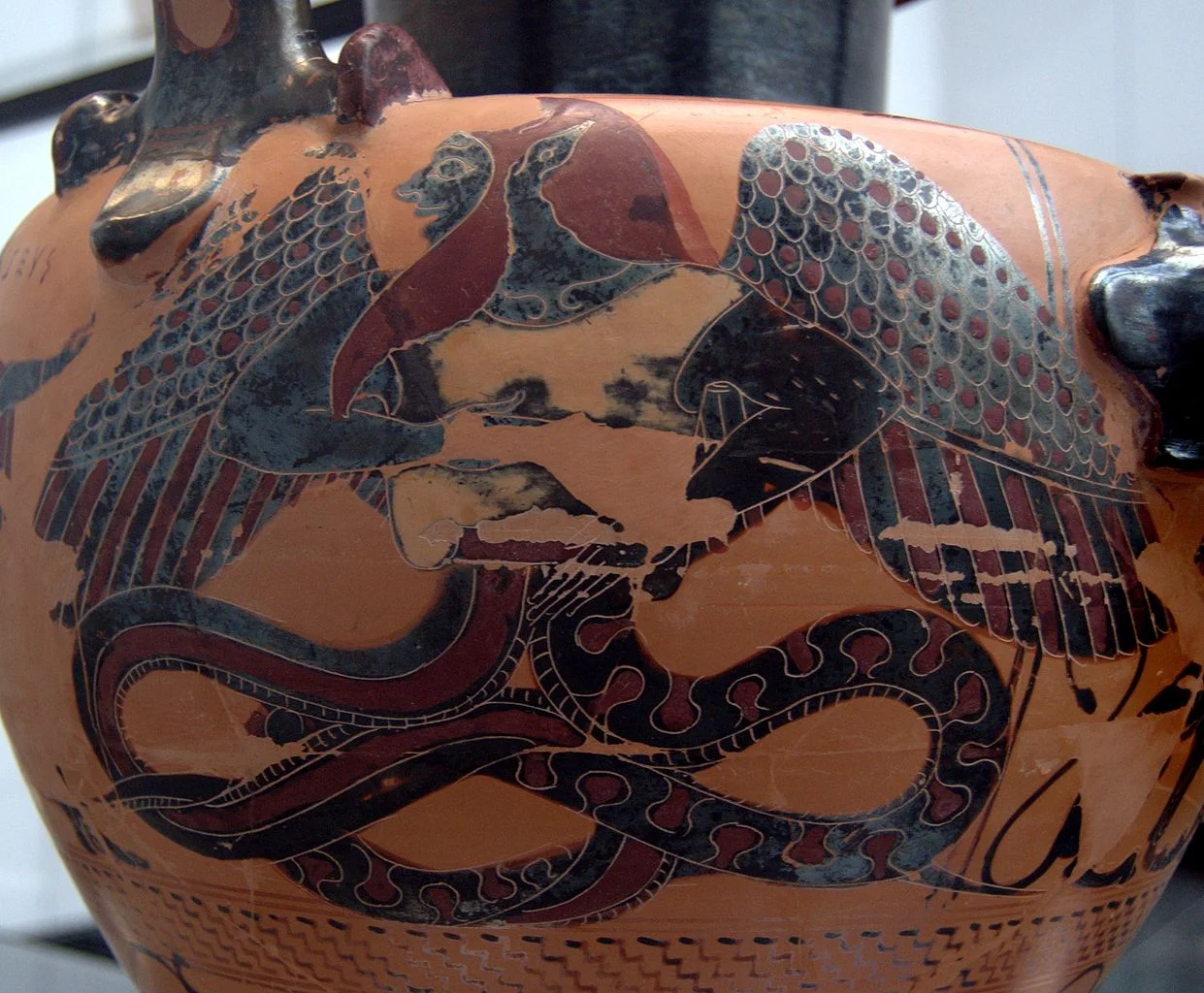
The descriptions of Typhon that we find in some of the most ancient sources, including Hesiod, make it clear to me that he is also a figure based upon the celestial system of metaphor that informs other Greek myths. Typhon is described by some ancient sources (such as the Greek poet of the second-century AD known as Pseudo-Apollodorus) as being so large that his head reached to the stars, and as having a man-like form down to the thighs, but below that point his body took the form of great coils of vipers:

image: Wikimedia commons (link).

image: Wikimedia commons (link).

This description sounds to me very much like a description of a monster based on the form of the towering figure of the constellation Ophiucus, which is a figure that appears to have very short legs, and positioned directly above the constellation Scorpio, which was frequently envisioned in numerous ancient myths as a serpent-figure with multiple heads.

To make the connection more certain, the ancient writer known today as Pseudo-Apollodorus tells us that Typhon had two great hands, one reaching to the west and the other to the east, and to from these we are told by Pseudo-Apollodorus and other ancient sources that Typhon also had serpents sprouting. This is definitely in keeping with the theory that Typhon corresponds to Ophiucus over Scorpio, because Ophiucus has arms which protrude to either side, one on the east of the constellation and the other on the west, and in these arms (or from these arms) we see the sinuous form of the serpent (or serpents) that Ophiucus is carrying, and from which the constellation gets its name as the "Serpent-bearer."

Below is a star-chart showing the positions of Ophiucus above Scorpio. Can you see why the ancient authors tell us that Typhon had a body that was in the form of a man, down to the thighs -- but that below that he became a coil of vipers?

Note that directly above Ophiucus we see the menacing figure of Hercules. As I demonstrate in Star Myths of the World, Volume Two, using  numerous examples from ancient Greek authorities -- including the texts of the Iliad and the Odyssey themselves -- the great Olympian god Zeus, wielder of the thunderbolt, can be shown to correspond to the powerful figure of constellation Hercules in the night sky.

And, indeed, it is Zeus who destroys Typhon with a thunderbolt and hurls him down to earth, where the monster will be imprisoned beneath the fiery mountain to belch forth lava down through the millennia.

Below is an artist's rendition of the complete scene from the ancient piece of pottery shown above, in which Zeus is sallying forth to do battle with Typhon. Can you see from the position of the rear leg of Zeus in the ancient artist's depiction of the Olympian that the rear leg in the artwork is evocative of the outline of the constellation Hercules in the night sky?

image: Wikimedia commons (link).

image: Wikimedia commons (link).

The arm arching above the head of Zeus is holding the thunderbolt, and corresponds to the arm above the head of Hercules holding a mighty weapon, often envisioned as a club or sword, but in many cultures also envisioned as a thunderbolt-weapon (to include the myths of the Maya in Central America, the myths of the Norse in Scandinavia, and the descriptions in the Vedas of ancient India). The other hand of Zeus is reaching out towards Typhon -- just as the lower hand of the constellation Hercules is reaching down towards Ophiucus in the night sky.

The ancients clearly appear to have had some understanding that their myths reflected the figures in the stars, from the heavens above, which is truly representative of the infinite realm (because it is indeed infinite).

The fact that they also saw these patterns reflected on the earth, and described geographical locations such as Mount Aetna itself as the location of the blasted body of Typhon, and also as "the pillar of the sky" (in the ode from Pindar cited above) shows that the ancients also saw the earth as reflective of the heavenly realm -- embodying the esoteric teaching, "As above, so below."

And so, as we observe the spectacular eruption of Mount Aetna, we have the opportunity to reflect upon the ancient wisdom imparted to the human race, an ancient treasure which (properly understood) should be seen as uniting all men and women -- because all the world's sacred traditions can be seen to be based upon the same worldwide system, and all the gods and goddesses seen to be the same, just under different names.
 

Solar eclipses 2017

Solar eclipses 2017

image: Wikimedia commons (composite of two images -- foreground and background).

image: Wikimedia commons (composite of two images -- foreground and background).

The point of New Moon takes place when our moon passes the point in its orbit which places it most directly between our planet and the sun. 

From an "overhead" or "top-down-looking" viewpoint, this would mean that the sun, moon, and our planet Earth would be perfectly aligned, with the moon in between the earth and the sun. At the point of Full Moon, they are aligned again, and from the same top-down viewpoint would be perfectly aligned, but this time with the earth in between the sun and the moon.

As you can envision from the above description, a solar eclipse can only occur at the point of New Moon, because a solar eclipse takes place when the moon blocks out the sun from the point of view of observers on earth. Likewise, a lunar eclipse can only occur at the point of Full Moon, because a lunar eclipse takes place when the shadow of the earth passes across the face of the moon (said another way, a lunar eclipse occurs when the earth blocks out the sun from the point of view of an observer on the moon).

However, we all know that solar eclipses and lunar eclipses do not occur at every single New Moon and Full Moon. The reason they don't is that, if we shift our point of view from a "top-down" viewpoint to a "side-on" viewpoint, the plane of the moon's orbit around the earth will be seen to be at an angle relative to the plane of the earth's orbit around the sun. That is to say, if the plane of earth's orbit around the sun is envisioned as a glass disc or plate, the plane of the moon's orbit around the earth would be a smaller glass disc or plate which intersects the larger plate at an angle (an "oblique angle," in one sense, which is why this divergence between the two planes is referred to as an "obliquity").

The moon, in its path around the smaller "plate," will only pass through the larger "plate" (the plane of earth's orbit around the sun) at two points -- one of them going "up" (towards the north pole, if we imagine north to be "up" in this case, although there is no real "up" in space) and one of them going "down."

If you are able to envision all of this, you will realize that an eclipse of either kind (with the moon obscuring the sun for those on earth, or the earth obscuring the sun for those on the moon) can only occur when the moon is passing through one of those two points of intersection with the plane or "plate" of earth's orbit around the sun. For this reason, the plane of earth's orbit around the sun is known as the "ecliptic" (because eclipses can only occur when the moon crosses this particular plane).

In fact, an eclipse of either the sun or the moon can only take place when the earth, sun, and moon are aligned from the perspective of both the "top-down" view and the "side-on" view. 

The two points at which the moon's path crosses the ecliptic plane (one going "up" and the other going "down") are known as the lunar "nodes." An eclipse occurs when the moon is passing through one of its two nodes at the same time that it is lined up from the "top-down" perspective -- either when it is passing through the top-down point of being directly between the sun and the earth (a solar eclipse) or when it is passing through the top-down point of having earth directly between the moon and the sun (a lunar eclipse).

Previous posts have examined these lunar nodes and their role in creating eclipses, and have included helpful diagrams and videos to help envision all of the celestial mechanics described in the above discussion -- see for instance here and here.

As most readers who have spent any time looking at news sites on the web this past week are undoubtedly aware, the moon's orbit is presently aligned such that the lunar nodes are in-line with the earth and the sun, such that tomorrow's New Moon will create a solar eclipse when the moon passes between the earth and the sun at the same time it is passing through a lunar node -- in this case, the South Node (moon is crossing "down" towards the southern hemisphere, also known as the "descending node").

Because the earth is so much larger than the moon, a earth's shadow completely covers the face of the moon during a lunar eclipse -- but because the moon is smaller than the earth, the shadow of the moon only covers a portion of our planet's surface during a solar eclipse. Thus, the eclipse can only be seen along a certain path created by the "line" between the sun and the moon where it "impacts" the surface of the earth. In this case, that line of the shadow's path will be entirely in the southern hemisphere, and will spend most of its time speeding across the Atlantic Ocean, crossing the continent of South America from Chile to Argentina, then crossing the vast Atlantic between South America and Africa, and making "landfall" in Angola, crossing a bit of Zambia, and finishing up in the Democratic Republic of Congo. Numerous websites can show you the path of this solar eclipse -- one such site can be found here.

Those who do not live near this line of the shadow's path and unable to make the trip to see it will have another opportunity in August of this year, when a highly-anticipated total solar eclipse is set to take place, during the point of New Moon when the moon is again crossing the ecliptic plane, this time at an "ascending node," on August 21. (Note that the moon, of course, passes through each of the two nodes once a month -- but that, as discussed earlier, the nodes do not always line up with the points of New Moon and Full Moon).

If you are at all able to do so, you should begin to make your plans now to find a point along the line of the moon's shadow in order to experience the total eclipse of the sun in August 2017. You can find numerous maps and descriptions of the path of totality on the web.

As part of your preparations, you may want to obtain a copy of Death of Gods in Ancient Egypt, by Jane B. Sellers (1992). The book's descriptions of the experience of a total eclipse should put to rest any question of whether or not it is worth making the effort to travel to a point underneath the line of the moon's shadow during the total eclipse of August 2017, if it is at all possible for you to do so.

Additionally, Jane Sellers makes a strong case that the cycle of myths surrounding the "Contendings of Set and Horus" in ancient Egypt are related to the effects visible from earth during solar eclipses, whether they are annular (such as the eclipse of February 26, 2017) or total (such as the eclipse of August 21, 2017). 

As an aside, the difference between and annular and a total eclipse is caused by the distance that the moon is from the earth at the point of eclipse -- if it is further away, it appears slightly smaller and does not cover the entire face of the sun, but if it is closer it will "just fit" over the sun's face. Many observers down through the centuries have marveled at the amazing serendipity or Providence of the fact that the moon's size and orbital distance are so perfectly calibrated to create such incredible effects during solar eclipses (much more incredible information about the harmonies between the size of the earth and the moon are available in the in the mind-blowing work and discoveries of Scott Onstott, at Secrets In Plain Sight).

Jane Sellers in Death of Gods in Ancient Egypt also makes a strong case that many aspects of the cycle of myths involving Isis and Osiris, Set and Horus, originate in the constellations and the cycles of their motions throughout the year -- and throughout the "Great Year" of the precessional cycle. In doing so, she follows along ground broken by Hertha von Dechend and Giorgio de Santillana in their seminal work Hamlet's Mill (1969), whose work Sellers acknowledges and references throughout her own book. 

In fact, she begins her book with an epigraph from Hamlet's Mill --

It is not the beliefs and religions which circle around and fight each other restlessly; what changes is the celestial situation.

In Death of Gods in Ancient Egypt, Jane Sellers makes an argument that solar eclipses were seen and allegorized as a battle between Set (or Seth) and the sun-god Horus. She also makes the case, particularly in the discussion on pages 106 through 108, that when the trial of Set by the gods declares that he shall be put "under Osiris," this refers to the placement of the constellation Lepus underneath Orion in the celestial realm. The outline of Lepus, as Sellers shows on page 107, very much resembles the "long-eared Seth animal" found in ancient Egyptian artwork depicting the god Set or Seth.

Right now happens to be a particularly good time of year for stargazers to observe the glorious constellation Orion, and the outline of Lepus directly below Orion. Orion is still very high in the sky during the "prime-time" viewing hours after sunset and before midnight, as earth's daily rotation on its axis causes the stars to move from east to west across the night sky. 

As we continue along our orbital path, however, we "pass up" the different constellations, causing them to move just a bit further "towards the west" each day (that is to say, stars along the ecliptic will be located about four degrees further towards the west at the exact same time on successive nights). Thus, each night at midnight (for example), the stars of Orion (and Lepus, and nearby Canis Major, which contains the brilliant star Sirius, associated with the goddess Isis) will all be four degrees further towards the west than they were at midnight the night before. 

As they get further and further towards the west, they will become less and less easy to observe, until the day when they will be so far to the west at sunset that they will not be visible in the sky at all during the hours of darkness (until they reappear in the east at sunrise, about seventy days later).

Thus, as you prepare for the eclipse in August, you might want to be reading Jane Sellers' book now -- and also going out at night to observe the stars of Orion, Lepus, and Canis Major, if it is at all possible to do so.

As the eclipse takes place tomorrow, you can consider these ideas, and make your plans -- and if you are in a part of the globe that allows you to see tomorrow's eclipse, I wish you fair skies and happy (and safe) viewing!

Below are two diagrams showing the relative locations of Orion, Lepus, and Canis Major in the night sky (first with the outlines and labels, and then without):

and, the exact same stars but without the labels and outlines:

All the World's Myths are Written in the Stars

All the World's Myths are Written in the Stars

Above is a new video I have just published, entitled "All the World's Myths are Written in the Stars."

Many readers will recall that after a recent podcast interview with Alex Tsakiris on Skeptiko, I participated in a forum on the Skeptiko message boards. Because many in that audience had not been previously exposed to or familiar with my work, I found that many comments expressed the sentiment that they were having a difficult time getting a general understanding of the overall thesis that I am advancing. 

Although I have now written several books containing thousands of pages, and a blog containing over nine hundred posts, that obviously doesn't constitute an easy-to-grasp summary (one can hardly be expected to wade through all of the blog posts in order to find out!). 

There is, of course, plenty of sample content to explore on the "Books" page linked above, including the introductory material from each book (just click on any of the book-cover images on that page, or on the links provided below the cover-images). 

There is also a "Myths" page with links to numerous individual myths from around the world, as well and to discussion of the celestial foundations of each of those myths (now up to forty-one examples linked from that page).

And, of course, there is a "Videos" page with links to videos in which I attempt to explain various aspects of the ancient system of celestial metaphor which underlies all the world's ancient myths and sacred stories.

Nevertheless, some readers suggested adding a kind of "introductory" and summary video, to help give a general vision of the overall theory. I agreed that something like a "TED talk" video would probably be helpful for those unfamiliar with this subject -- and that, while we're waiting for the people over at TED to get one of those queued-up (don't hold your breath), I would think about trying to put together an introductory video that might help to provide some overall context in a fairly efficient manner.

Above is one attempt to do so -- although the subject matter is admittedly vast and deep and thus difficult to summarize in one sitting.

Nevertheless, I hope that it will be helpful and beneficial.

Please feel free to share and to provide feedback! Thanks for watching.

The Massacre at Sand Creek

The Massacre at Sand Creek

Cheyenne Chiefs, left to right as we face the image:

seated left: Standing-in-the-Water, murdered in the Sand Creek Massacre, November 1864.

seated center: Lean Bear, murdered while peacefully approaching troops under the command of Colorado cavalry Lieutenant George Eayre, May 1864.

standing right: War Bonnet, murdered in the Sand Creek Massacre, November 1864.

Interpreter (standing in back in western clothing, name unknown). image: Wikimedia commons (link).

The Sand Creek Massacre began with a treacherous dawn attack by approximately 675 men of the 3rd Colorado Regiment and part of the First, all of them under the direct command of Colonel John Chivington, upon a camp of Cheyenne and Arapahoe who had been told by messages sent out by Colorado Governor John Evans to camp along the north bank Sand Creek near Fort Lyon for safety and to help the Colorado forces distinguish between peaceful and violent groups during heightened fear of attacks and violence. 

As many as 230 Cheyenne and Arapaho would be murdered in the ensuing massacre, between two-thirds and three-quarters of that number women and children. Another two hundred men, women and children would be wounded. The encampment was a chief's camp, composed primarily of leaders and their families. It prominently flew an American flag and directly underneath it a white flag, as the leaders had been instructed to do in order to demonstrate their peaceful intentions. Among the dead were thirteen council chiefs and four soldier chiefs, including White Antelope, War Bonnet, Standing-in-the-Water, Left Hand, Bosse, Heap of Buffalos, and Lone Bear.

The massacre took place beginning in the pre-dawn hours of November 29, 1864 and continued all that day and the following day. There was little resistance -- some of the chiefs were killed while running towards the troops waving their hands in the air and yelling "Stop! Stop!" in English, or while trying to stop the fighting. Some of the Cheyenne and Arapaho did try to fight back, but were at a severe  disadvantage against the cavalry because the troopers had driven away most of the camp's horses at the beginning of the attack.

This despicable massacre is tragically not widely taught or discussed or contemplated today, although it should be, because the issues that it raises are so significant, and because these issues are by no means confined to the past but are extremely relevant to this day. And, of course, Sand Creek remains a painful and living memory to the Cheyenne and Arapaho people, and to other Native American nations -- many of which suffered similar atrocities.

I would strongly recommend that, among other examinations of the awful import of the Sand Creek Massacre, everyone who is able to do so take the time to read the 2016 book Massacre at Sand Creek: How Methodists Were Involved in an American Tragedy, by Gary L. Roberts.

The examination by Roberts is extremely thoughtful and thought-provoking, working very hard to avoid stereotypical responses, easy answers, or armchair moralizing. He presents evidence that, while a large portion of society (including many high-ranking US military officers and field commanders) condemned the atrocities at Sand Creek once the details of the massacre began to emerge in the days and weeks following Chivington's assault, even those who were spoke out against it reflexively assumed that the Native American way of life would have to give way to the encroaching march of "civilization." Most of all, the book shows that the blindnesses and assumptions of that time are still very much an issue to be wrestled with and confronted today -- that the blindnesses and assumptions that led to the genocide of the Native American peoples were not peculiar to men and women living in previous centuries but continue to be very much present and real forces at work in the world right up to the present moment.

Roberts writes:

The bloody ground at Sand Creek is a symbol of a terrible blindness in the American experiment that "fixed a stain" on the national honor, as Henry Knox predicted it would before the Constitution of the United States became the governing rule of law. It is a reminder that bigotry is not merely the illness of wicked and profligate people but a disease that can become an epidemic even among those who think of themselves as good and decent and God-fearing. It can hide itself within thickets of rationalization and fields of good intentions. Sand Creek is also a reminder that humans should not be so quick to judge past generations while deluded into believing that they are inoculated against the effects of arrogance and prejudice themselves. 237.

As the title of the book indicates, a singular aspect of the tragic massacre which is explored in great depth by Gary L. Roberts in his book is the role of the Protestant Christian denomination of the Methodist Church in the United States at that time (which was a time of great change within that denomination, especially as the Civil War was raging). Both Colorado Governor John Evans and the commanding officer directly responsible for ordering the massacre, Colonel John Chivington, were active Methodists. Colonel Chivington, in fact, was a Methodist preacher and minister before becoming a military officer. 

Gary Roberts' book provides abundant evidence, including dozens of extremely disturbing quotations, which make it undeniably clear that the unquestioning belief in the superiority of their way of life among the members of the invading culture that the American Indians would have to give way, give up their way of life, and give up their lands drew much of its inspiration from, and was provided with false justification by, assumptions common to literalist Christian teachings and doctrines.

A sampling of quotations will give some measure of the impact -- but the book contains many more. In fact, the quality of the selection of quotations which Gary L. Roberts presents in the book is one of its strongest aspects.

Here is an example presented in the book, which Roberts found in a book published in 1863, just a year prior to Sand Creek:

Again we come to the great law of right. The white race stood upon this undeveloped continent ready and willing to execute the Divine injunction, to replenish the earth and SUBDUE it. The savage races in possession of it either refused or imperfectly obeyed this first law of the Creator. On the one side stood the white race in the command of God, armed with his law. On the other, the savage, resisting the execution of that law. The result could not be evaded by any human device. God's law will ever triumph, even through the imperfect instrumentality of human agency. In the case before us, the Indian races were in the wrongful possession of a continent required by the superior right of the white man. This right, founded in the wisdom of God, eliminated by the ever-operative law of progress, will continue to assert its dominion, with varying success, contingent on the use of means employed, until all opposition is hushed in the perfect reign of the superior aggressive principle. (Bryant and Murch, A History of the Great Sioux Massacre by the Sioux Indians in Minnesota, 46 - 49; cited in Roberts 101).

While the modern reader is immediately drawn to the explicit racism in the above passage and the language it employs, this should not cause us to miss the fact that the authors are here trying to present a justification, based on passages from the Book of Genesis, for the taking of the continent from the Native American peoples, and to argue that not only is doing so not wrong but that it is in fact required by God's law (that it would, in fact, be wrong to not take over their lands). It should go without saying that I believe the above argument is completely wrong, that it is morally objectionable in the highest degree, and that it is based on an entirely incorrect understanding of the ancient scriptures (incorrect to the point that the authors actually invert the message, getting the ancient scriptures "one hundred eighty degrees" the wrong way).

One more quotation following the same pattern is presented, this from a bishop in the Methodist church who spoke up in defense of Colonel Chivington and Governor Evans in the months following the massacre, when public opinion was turning strongly against the events at Sand Creek, and the actions of Chivington were being roundly criticized, and a military commission was being established to investigate the reported killing of women and children in an encampment that was flying the American flag and a white flag of truce. Bishop Calvin Kingsley, along with six other Colorado ministers, drafted a letter of support for Chivington, in which they called the colonel "a model for large-hearted liberality and Christian energy" and said that "We believe that our only hope for safety as a territory lies in the repetition of like battles with the same result" (152). Later, Bishop Kingsley declared:

These Indians being yet in a state of childhood, so far as intellectual and educational development is concerned, need occasional chastising. Nothing else will do. To the questions, "What shall be done with the Africans and the Indians?" I have short answers. Make men of them. I have no fellowship with that sentimentalism which is ready to die of grief because the red man is not allowed to hold back civilization and Christianity just for the sake of being a savage. There is no reason why an ignorant savage should be allowed land enough for hunting ground to sustain a thousand civilized and Christianized persons living in accordance with the precepts of the Gospel. 154.

Once again, what strikes us most violently in the quotation above is the explicit racism of the speaker -- but it should also be noted that in addition to his ugly and objectionable racism, the speaker is again offering what he believes to be a justification and an argument which will excuse the destruction of the Native American's way of life -- an argument that it would be wrong to allow it to continue.

It should be noted in passing that central to both of the arguments in the two passages cited above is a "religious" argument, a subject which we will examine momentarily, as well as an economic argument -- an argument having to do with the use of land. Gary Roberts does a very good job in the book of illustrating the fact that the biggest draw of the westward expansion of the United States, beginning with the first settlers but continuing to the towns, was the lure of land. This prize was far more powerful of an attraction than even the gold and minerals that also played an important (but secondary) role. In fact, during the book we see that John Evans, long before he became governor of the Colorado territory, was an active land speculator and city planner. 

While Gary Roberts does not go so far in his own book, this subject (land-grabbing and land-speculation) is of critical and enduring importance in the history of economic thought and practice -- in fact, the great Norwegian-American economist Thorstein Veblen (1857 - 1929) lived through the time period Roberts examines in his book about the Sand Creek Massacre, and saw land-speculation by insiders in towns small and large, who could collude to "boost" the land values in order to make themselves wealthy, as a central problem and illustrative of a wider problem in economic life, unless checked (see for instance this essay by Michael Hudson on the importance of Thorstein Veblen's analysis, and in particular the "block quotation" from Veblen about the "boosting" and "booming" of real estate, following a pattern repeated without fail from towns with names like Spoon River and Gopher Prairie, to bigger cities with names like Emporia and Columbia).

Quotations provided by Gary L. Roberts in his book make it abundantly clear that literalist Christian doctrines, as understood in the nineteenth century (and, in many cases, as still understood to this day), were used to provide "intellectual cover" or supposed "moral justification" not only to the violent extermination of millions of Native Americans and their way of life, but also to the economic system of land-grabbing and land-speculation that Veblen decried and that John Evans (and countless others) participated in with enthusiasm. 

Roberts cites a recent Report of the John Evans Study Committee at Northwestern University (a university of which Evans himself was a founder) which found that in the view common during the time of Evans' life, "working hard and fostering beneficial social institutions affirmed a person's spiritual development and gave worldly evidence of grace" (cited on page 91 of Roberts). Gary Roberts adds: 

Railroads were a part of that list, too, because railroads would hasten the growth of civilization and the transformation of the wilderness into a garden. For him, as for many white Americans, the connection between Christianity and civilization was inseparable. One could not exist without the other. 91.

Roberts provides some supporting quotations, such as the statement from Methodist Bishop Matthew Simpson (a contemporary of John Evans, although one who never publicly expressed an opinion one way or the other on the Sand Creek Massacre, in contrast to other church leaders who tried to defend it) that: "I would say it with all reverence, God cannot do without America," and: "Hath not he who placed Moses in Mount Sinai to utter law over the wilderness, placed us on this continent to shout the Gospel over two oceans? Will he suffer the mission to be confounded?" (91).

While there are undoubtedly some today -- even many today -- who would agree with Bishop Simpson's sentiments, I would argue that such an understanding is closely related to the same assumptions of a supposed right to change the way others think and live their lives that led to the criminal destruction of the Native American way of life and the seizure by violence of the land on which they had lived for millennia. 

Not only that, but I would also argue that assertions such as those just cited from Matthew Simpson are based upon a mistakenly literal and thus externalized understanding of the ancient scriptures contained in what has come to be known as the Bible, and that in fact "the gospel" that Simpson believes needs to be "shouted over two oceans" is actually based on scriptures which -- properly understood -- would be seen to express the very same teachingswhich the American Indians already knew and understood from their own sacred traditions and ancient stories, and which can be found among the ancient cultures of Asia, Australia, and the Pacific islands (across one ocean) and among the ancient cultures of Africa, Europe, and the Mediterranean (across the other ocean), as well as among the original peoples found further north and south within the continents of the Americas.

In fact, Gary L. Roberts' remarkable examination of the Sand Creek Massacre provides outstanding quotations to this effect as well. He cites a statement from a man of the Northern Cheyenne named Wooden Leg, who fought Custer at the battle of the Little Bighorn in 1876, and who said:

I think the white people pray to the same Great Medicine we do in our old Cheyenne way. I do not go often to the church, but I go sometimes. I think the white church people are good, but I do not believe all the stories they tell about what happened a long time ago. The way they tell us, all of the good people in the old times were white people. I am glad to have the white man churches among us, but I feel more satisfied when I make my prayers in the way I was taught to make them. My heart is much more contented when I sit alone with my medicine pipe and talk with the Great Medicine about whatever may be troubling me. 241.

Roberts also cites a medical doctor of the Santee Sioux, named Ohiyesa Charles Eastman Alexander, who wrote in 1911:

It is my personal belief, after thirty-five years' experience of it, that there is no such thing as "Christian civilization." I believe that Christianity and modern civilization are opposed and irreconcilable, and that the spirit of Christianity and of our ancient religion is the same" (240).

Note that Ohiyesa was emphatically not saying that the Christianity he saw in the churches was the same -- or even that it should be labeled "Christianity." Elsewhere in the same book, he says that there "was undoubtedly much in primitive Christianity" and in the "hard sayings" attributed to Jesus about the rich that were appealing to him, but that what he found in the churches was basically the very opposite.

Both of these men, based on their personal knowledge of their inherited traditions and their observations of Christianity, expressed the belief that they were in fact the same -- but Ohiyesa explicitly contrasts this with what he sees in the churches, and Wooden Leg implicitly tells us much the same thing, when he says he prefers a different way of relating to and interacting with the Great Medicine -- and when he tells us that he "does not believe" all the things they tell him, especially about  the stories of "all the good people in the old times" being white people.

In fact, I believe it can be shown with irrefutable evidence that all those ancient stories in the Bible are describing the motions of the stars, and thus are not actually about "white people" at all. See for example discussions about the episode of the sons of Noah and their father's drunkenness, or about the encounter of John the Baptist and Jesus for evidence that these stories are based upon the stars. 

If the sons of Noah (Shem, Ham and Japheth) are all based on constellations -- and I am convinced that they are, and that the evidence in this case is nearly irrefutable -- then the ancient scriptures are not telling us that they are the literal progenitors of people of any particular race (since no one is literally descended from loose groupings of stars which we see as shapes in the sky, but which are actually many thousands of light-years apart). Said another way, Wooden Leg was absolutely right about the fact that all the stories in the Bible about the "good people in the old times" could not have been about "white people" -- because they are actually about the stars, and are intended to describe truths about the Invisible World which apply to all people. 

Said yet another way, if Adam and Eve -- our "first parents" -- can be shown to be figures who are based upon the stars (and I am convinced that they can be shown to be based upon the stars), then these stories are telling us something different than what those who take the Bible literally believe them to be saying. They may well be telling us -- just as Lakota Holy Man Black Elk tells us -- that we all come from the spirit world, and that everything we see here in this world actually comes from the spirit world.

According to that understanding of the ancient wisdom, every single man, woman or child you ever meet contains the very same infinite divine spark which you yourself also contain -- and thus it is infinitely wrong to do violence to any one of them. And, according to that same understanding, it is this invisible and spiritual aspect of everyone that unites us all, and that is the same in all the "descendants of Adam and Eve." Denigrating anyone for the color or tone of their skin (or any other external or physical aspect) is a denial of the spiritual aspect which unites us all, and thus becomes an inversion of the real teaching of the ancient wisdom imparted to humanity in the world's various myths and sacred stories.

I believe that the ancient traditions of the peoples of the Americas can also be shown to be based upon the cycles of the heavens and the motions of the sun, moon, stars and planets -- no less than all the other ancient myths and sacred traditions around the globe. I have written about some of these in previous blog posts, and in some of my books

In fact, I find it very interesting that the council chiefs of the Cheyenne people wear a single eagle feather in their hair, pointing to the right. You can see this in the image at top, in which both Lone Bear (seated, center) and War Bonnet (standing, right) have a single eagle feather, pointing to their right (our left as we look at the picture). Standing-in-the-Water is a soldier chief, not a council chief. He seems to have a feather in this photo, but he does not have the same single eagle feather in this photo, and in other photos he has multiple feathers which do not appear to be eagle feathers.

While I have no way of proving this, I suspect that it is a possibility that the single eagle feather, pointing to the right, relates to the constellation Sagittarius. 

The image below shows Sagittarius. You can see that the constellation itself appears to have a single "feather" or "horn" atop its head. Note that in my analysis published in Star Myths of the Bible, I show that this constellation is closely associated with the priestly function in many Old Testament Scriptures, and in Star Myths of the World, Volume Two I show that this constellation is also associated with certain important gods in the myths of ancient Greece -- all of which may be related to the reason that council chiefs among the Cheyenne might also be associated with Sagittarius, and which would explain the single eagle feather pointing to the right:

sagittarius 01.jpg

Note that in many images on ancient Greek pottery, in which a god or goddess whom I believe to be related to Sagittarius is depicted, the artwork itself will often feature a single plume or other item which corresponds to this "feather" atop the head of the constellation Sagittarius in the sky.

Regardless of whether or not this single eagle feather relates to the mysterious and potent figure of Sagittarius in the sky (and to Sagittarian figures in ancient myths), the fact remains that the Native Americans appear to have retained a much more accurate understanding of the true message underlying the world's sacred traditions -- as evidenced by the two quotations above, from Wooden Leg and from Ohiyesa (among much other evidence).

Is it possible that this fact has something to do with the awful centuries-long campaign to exterminate their leaders, destroy their culture, and convert their children to Christian ways in forced residential schools? There is little doubt that can remain after reading Massacre at Sand Creek: How Methodists Were Involved in an American Tragedy that these efforts were closely related to the established literalist Christian institutions (not just Methodists, although Methodists played a disproportionately large role in the Sand Creek Massacre). The administration of the forced education facilities was almost exclusively turned over to different Christian religious groups, as was the administration of the reservations and agencies in some cases.

It is also clear from the book that, although Chivington himself was actually something of a monster, apparently never repenting of his actions in instigating the massacre and even wearing it as a badge of pride, as well as engaging in other reprehensible behavior including insurance fraud, stealing from the dead during a brief stint as a coroner, marrying the widowed daughter of his own son while she was still pregnant and later abandoning her, and allegedly beating his third wife, he was never formally censured by the Methodist denomination for which he continued to preach (albeit in an informal capacity) for the rest of his life.

Because of the horrible nature of Chivington himself, the reader might be tempted to conclude that the tragic massacre at Sand Creek was simply the product of one psychopathic "loose cannon." Unfortunately, this conclusion would be unwarranted: there were many other such massacres, including the massacre at the Washita four years later, where Black Kettle (a chief who survived the Sand Creek massacre) would be murdered in cold blood, as well as many other such massacres including the Bear River Massacre and the Massacre at Wounded Knee.

There are also the records of atrocities and massacres in previous centuries perpetrated against the indigenous peoples of Central and South America (and the deliberate and systematic destruction of most of their written records and the murder of their priests and wisdom-keepers).

Based on all of this evidence, we might conclude that something else is going on.

Whatever we might conclude, it should be obvious that this is a subject of horrible and enduring importance. It is a subject that touches on many aspects of modern society, and raises uncomfortable questions that deserve careful contemplation and greater examination than we are perhaps giving them.

Gary L. Roberts deserves credit for writing such a thorough and thought-provoking examination of the terrible events of Sand Creek in 1864. It is a book that deserves to be read, although it is a book that will shake you, and that may well make you cry (either on the inside or on both the inside and the outside).

Near its conclusion, Gary Roberts writes:

Little profit is found in damning past actions or declaring great visions to be fraudulent if such responses do not yield clearer understanding and a keener sense of the present generation's own sense of moral superiority, including its own deviations from moral vision. Sanctimonious judgment of the past serves little purpose if it does not elevate the present's commitment to underlying principles of freedom, justice, and equality. The past cannot be changed, but it can be confronted and better understood without trying to rationalize its injustices or blaming past generations for not anticipating everything that the present generation now believes and knows. [ . . . ] The capacity to distort remains surprisingly vital not so much because individuals and groups wish to distort as because they have agendas -- often selfish and sinister, but sometimes unconscious and even well-meaning -- that trump the moral imperatives. 246.