The Difficult Crossing

The Difficult Crossing

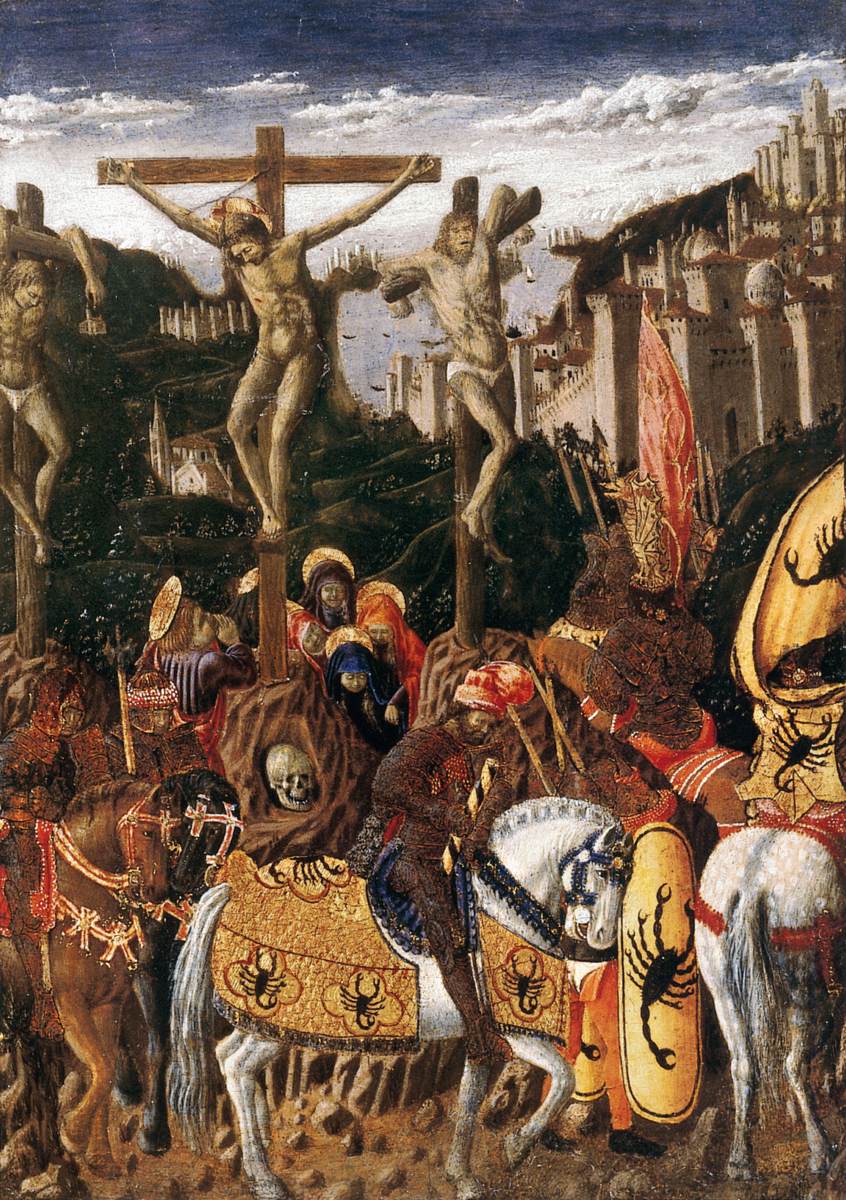
image: Crucifixion, Giovanni di Piermatteo Bocatti, c. 1420, Umbria. Wikimedia commons (link).

image: Crucifixion, Giovanni di Piermatteo Bocatti, c. 1420, Umbria. Wikimedia commons (link).

In a passage quoted many times before on this blog, Alvin Boyd Kuhn declares:

Bible stories are in no sense a record of what happened to a man or a people as historical occurrence. [ . . . ] They mean nothing as outward events; but they mean everything as picturizations of that which is our living experience at all times. The actors are not old kings, priests and warriors; the one actor in every portrayal, in every scene, is the human soul. The Bible is the drama of our history here and now; and it is not apprehended in its full force and applicability until every reader discerns himself [or herself] to be the central figure in it! 

From the lecture "The Stable and the Manger," delivered in 1936.

This pronouncement holds true for all the stories preserved in what we call the Old and New Testaments of the Bible, as well as for the rest of the myths, scriptures and sacred stories preserved in cultures found on every inhabited continent and island across our planet -- all of which can be shown to be closely related, and built upon the same world-wide system of celestial metaphor which appears to pre-date even the most ancient civilizations known to conventional historical paradigms, including those of ancient Egypt, ancient Mesopotamia, ancient China, and the ancient Indus-Saraswati civilization.

In Lost Light, published in 1940, Kuhn notes that the "three-day pause" found in the gospel accounts of the Crucifixion and the Resurrection, as well as in the account of the crossing over Jordan to enter the Promised Land which also involves a three-day pause (see Joshua chapters 1 through 3, and particularly Joshua 1: 11 and Joshua 3: 2), "is emblematic of the three 'days' in the bleak underworld without the sustenance of the solar light" which takes place at the winter solstice during the annual cycle each year, as well as during the monthly cycle of the moon at the time of New Moon each month, and that the Passover and Easter observations thus involve both the cycles of sun and moon, at the restoration of the sun at spring equinox and the first Full Moon after that crossing-point on the annual cycle (405).

Many writers who have perceived that the world's myths involve connections to the cycles of the sun, moon, stars and visible planets tend to stop there, as if the connection to those heavenly cycles were the entire purpose of the myths, and that these connections thus indicate some kind of "nature worship" (whether sun-worship, or moon-worship, or star-worship, or nature-worship in general), but as the first quotation from Kuhn indicates, the ancient myths use the heavenly cycles themselves to explain the experience of the individual human soul -- and that the meaning is not apprehended in its full power until we understand that the drama in every case applies to our own situation at this very moment in our lives.

According to Kuhn's understanding of the myths, an understanding which is supported by an overwhelming volume of evidence, every single human soul is in fact experiencing the Crucifixion and the Passover while "crossing" through this incarnate life, in which spirit is "crossed" with matter and the two struggle together in order to elevate both.

Many previous posts have shown the great "cross" of the year which informs myths from around the world, in which the spirit is cast-down into matter at the point of fall equinox, and upon which the "lower crossing" of the cycle represents the struggle to re-erect the Djed-column which has been thrown down:

This "lower crossing" is the one through which we are all now struggling, crucified in a sense between matter and spirit. The same concept is presented in many different metaphors and stories in the world's myths -- Samson, for example, has his hair shorn off and his strength taken from him, but as the verses immediately following those describing his shaving, blinding, and enslavement tell us, "the hair of his head began to grow again after he was shaven" (Judges 16: 22).

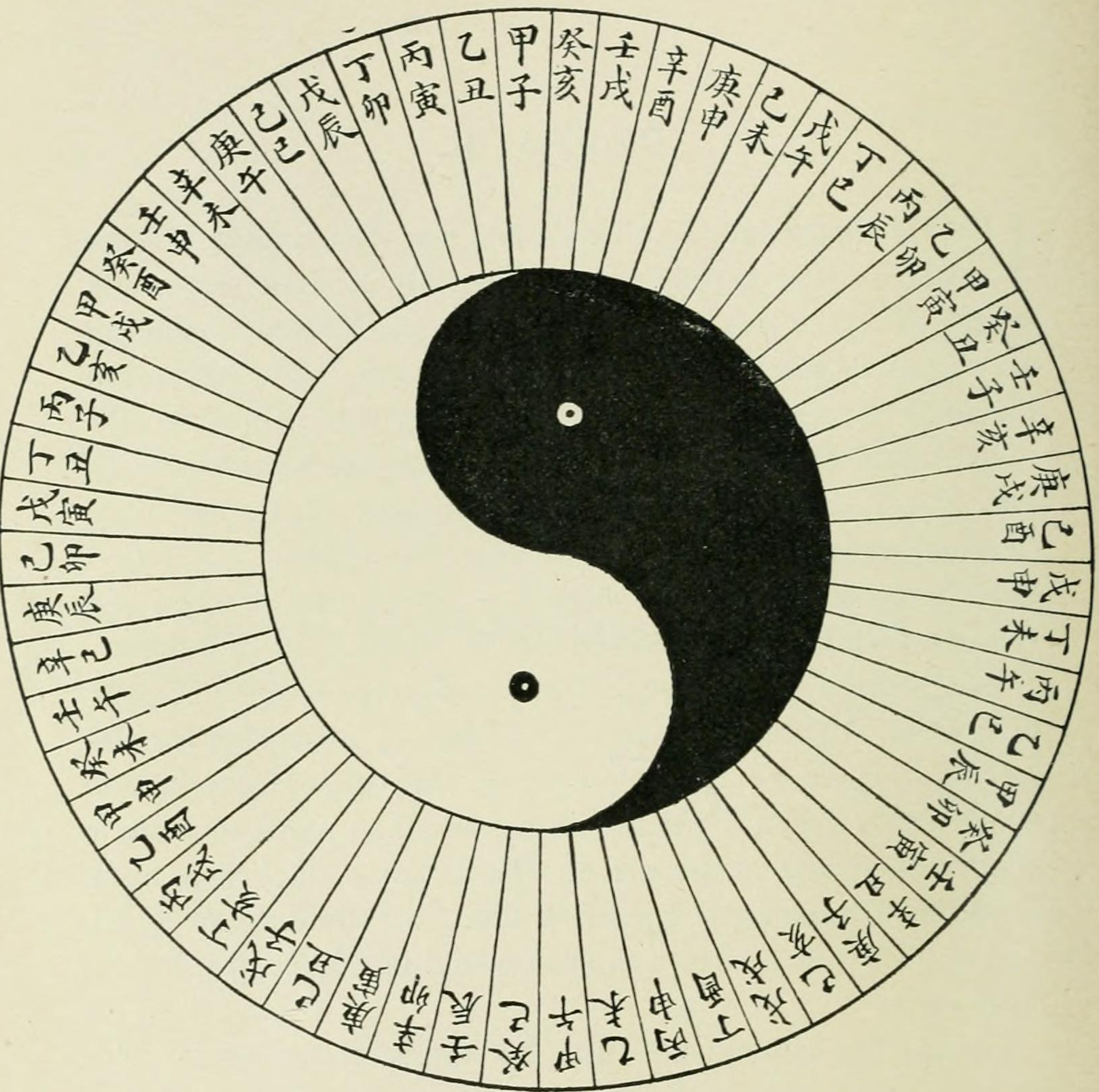
Kuhn argues that the accounts of Easter and of Passover may be seen as relating specifically to the precise point at the far end of this "lower crossing" (the ascending crossing-point, at spring equinox, seen on the left-hand side or "nine o'clock" position of the circle in the above diagram), but they can also be seen as referring to the entire process the soul undergoes in this incarnate life as it struggles through the experience of this arduous journey. He writes (at one point referring to the soul by the Latin term "manes"):

The significance, then, of the Passover festival becomes clear in relation to the only cosmic or anthropological datum to which it could have any reference. In its widest sense it memorialized simply the passing of the soul over the flowing stream of this life. It was the pilgrimage of the Manes across the sea of experience that lay between the mortal and immortal life. It must never be lost sight of that the Jordan was a stream that marked the boundary line between the desert and the Promised Land. To migrate from animal existence to godlike stature of being we must cross the boundary line separating the two kingdoms. The soul plunges in this water on the western marge, swims or sails across and reaches the "farther shore" on the eastern boundary where he rises to a new day like the sun. As the final stage and termination of the passing over came at the equinox of spring, this date, the first full moon after the equinox, was invested with cumulative and culminating significance of the whole pass-over. It was the fourteenth or the fifteenth of the Hebrew month Nisan. But after all it is a question of minor difference whether the term "Passover" is taken to embrace the whole extent and duration and experience of the passing across life's sea, or more specifically the crossing of the final boundary line at the Easter equinox; whether the passage is over the lines at beginning and end of the journey, or over the entire space between then. It may mean the passing into, the passing out of, or the passage across, the realm of bodily life, and has apt significance in any case. 405.

The fact that these events are commemorated at times relating to the first full moon after the spring equinox indicates that they have to do with heavenly cycles and not with literal and terrestrial history. 

But this realization does not "rob" them of their significance -- in fact, as Kuhn indicates in the first quotation above, the world's ancient myths convey their full force and power when we realize that they signify internal truths and an internal struggle which applies to each and every man and woman, and a connection to an Infinite Realm to which we actually have constant access even during the depths of this material incarnation, rather than signifying external events which represent something that is outside of us, applying only to one specific person or one group of people, a misunderstanding which tends to focus our attention on external things we must chase after, or external factors which are actually the very opposite of the internal truths which the stories were intended to convey.

The gospel accounts of the Crucifixion and Resurrection contain numerous details which indicate that, like the rest of the world's Star Myths, they are based upon celestial metaphor rather than terrestrial history. Many of these have been discussed in previous posts and videos, such as this one and this one, and many more are discussed in greater detail (with diagrams) in Star Myths of the World, Volume Three (Star Myths of the Bible). 

Many of the pieces of fine art down through the centuries dealing with the subjects described in the Biblical narratives, including the Crucifixion and the Resurrection, include details which suggest that the celestial foundation of these narratives was preserved and passed down from generation to generation in some way, although the extent to which those individual artists understood the connections they were depicting remains a mystery. 

For instance, in the painting at the top of this post, by the Umbrian artist of the early Renaissance period Giovanni di Piermatteo Bocatti, thought to have been completed around the year 1420, we see a number of noteworthy details which can be argued to correspond to celestial antecedents (in this case, very specific constellations), including the contorted postures of the two outer victims (a common feature in Crucifixion scenes: see for instance herehere and here), the skull positioned at the base of the central Cross, and -- unique to this particular depiction by Bocatti from the 1400s -- the plethora of scorpions depicted on shields, on banners, and on the trappings of the horse and riders included in the scene!

Additionally, while the outward form of the world's myths vary significantly in their details and characters and storyline, common patterns which manifest across cultures and which can also be shown to relate to specific characteristics of well-known constellations indicate that the Star Myths of the world are all in fact closely related in some way. Most likely, in my opinion, is the possibility that they all preserve the remnants of a system of incredible spiritual sophistication from a culture or cultures in remote antiquity predating all the world's known ancient civilizations, perhaps from a culture predating the construction of Gobekli Tepe

The entire cycle of the gospel narrative, for example, can be shown to have very strong parallels to events described in the Odyssey -- which is itself a narrative of an "ocean crossing" (a crossing-over). While the characters and action of the Odyssey are (on their surface) very different from the characters and events described in the gospels, I am convinced that both are informed by the same system of celestial metaphor and treat the same profound themes relevant to the life of each and every man and woman undergoing the "arduous crossing" of the lower realm in which we now find ourselves. 

Examples of parallels found in the Odyssey include the descent of the goddess Leucotheiain the form of a bird prior to the "plunge into water" that Odysseus undergoes during his initial escape from Ogygia, the foot-washing scene in which Eurycleia recognizes the returning Odysseus by a scar from a wound he received as a youth, and the rolling-away of the stone at the mouth of the cave of the Cyclops, which has parallels to the rolling-away of the stone at the mouth of the tomb at Easter and which I believe to be based on the very same constellations and region of the sky in both cases. 

The celestial connections in the Odyssey are explored in great depth in six chapters in Star Myths of the World, Volume Two (which focuses on the myths of ancient Greece).

As Kuhn also notes in Lost Light, strong parallels exist in other myths from around the world and across the millennia -- and this should not surprise us if in fact the world's Star Myths are descended from some very ancient common source. 

For example, he references the early twentieth-century translations by E. A. Wallis Budge of the Pyramid Texts of ancient Egypt, which constitute some of the most ancient surviving physical texts anywhere on the planet, dating to 2300 BC (and incorporating material which was already well-developed at the time of their inscription at that remote date) in which a rebirth after three days is indicated. In Volume Two of Osiris and the Egyptian Resurrection(1911), which is available online in its entirety here (and Volume One is available here), a text from the pyramid of Pepi II (who reigned as king during the period from 2246 BC though 2152 BC) is cited which declares:

They transport father Osiris Pepi in their boat, to the eastern side of heaven, to the place where the gods were born . . . father Osiris Pepi is brought forth there in the place where the gods are born. This star cometh on the morrow, and on the third day (page 338, in the translation of Spell 614).

This passage clearly describes another "water crossing" which parallels those Kuhn describes in his discussion of the Passover cited above (which involves the crossing of the Red Sea and which is later echoed by the crossing of the Jordan at the edge of the Promised Land), as well as the arduous "water crossing" undergone by Odysseus. It is a crossing which is described as going to the "eastern side of heaven," which is the place where the stars (including the sun) can be seen to re-emerge from the "underworld crossing" and which is described as "the place where the gods are born." 

Elsewhere in the study of Osiris and the Egyptian Resurrection (also in Volume Two), Wallis Budge also points to a myth from the Nandi people of what is today the country of Kenya, which was recorded by Alfred Claude Hollis in The Nandi: Their language and folk-lore (1908), in which a dog requests of the people that he be fed milk from their own drinking-gourd and beer through their own drinking-straw, and that if they will do this for him, he promises that in return, the dog says, "If you do this, I will arrange for you to go to the river when you die, and to come to life again on the third day" (Volume Two, page 146).

Kuhn notes that here, once again, we have the pattern of the third day, as well as the pattern of the crossing of the river (akin to the crossing of Jordan in the book of Joshua). None of the commentators noted above seem to have noticed that the giving of beer and milk from a gourd and through a straw could also be seen as being a strong parallel to the giving of Jesus wine and vinegar from a sponge lifted up on a reed during the accounts of the Crucifixion (see for instance Mark 15: 36). In both cases, I believe that distinctive features of the constellation Ophiucus (located immediately above the constellation Scorpio, whose symbol is so prominently featured in the painting by Bocatti) are involved.

It is in my opinion most regrettable and indeed tragic and also criminal that the incredible myths given to humanity have been used to divide us, and to teach that we need to pursue something (some salvation or redemption) external to ourselves, and that based upon literalistic interpretations of these esoteric stories entire cultures have had their own preserved sacred traditions destroyed at the hands of those desiring to impose literal interpretations of other stories in their place.

Because of these kinds of abuses, many people today also have such strong negative reactions to the stories in the Bible that they have a difficult time realizing that, like all the other world's ancient myths, they have incredible truths to offer for our benefit today -- because they are describing the very "crossing" that we ourselves are currently going through. We should be able to maintain a clear distinction in our minds between the ancient stories themselves and the teachings and actions of those who interpret them in subsequent centuries -- no matter which ancient stories we are talking about.

Overwhelming evidence points to the conclusion that all of the world's ancient myths, scriptures and sacred stories are surviving streams from some even more ancient common source -- and that they therefore constitute a precious inheritance that should unite all of us, and should be treasured as a gift from those very ancient ancestors, and consulted as a source of guidance, benefit and blessing for our journey across this difficult sea.

Holy Week 2017

Holy Week 2017

image: by Bernardo Belotto (1721 - 1780). Wikimedia commons (link).

image: by Bernardo Belotto (1721 - 1780). Wikimedia commons (link).

Palm Sunday marks the beginning of Holy Week in the Christian calendar. That day is observed by those following the western calendar on April 09 this year (today).

Holy Week consists of those episodes in the scriptures which begin with the Triumphal Entry of Christ into Jerusalem, and conclude with the Crucifixion on Good Friday and the Resurrection on Easter Sunday.

The events described in the gospel accounts corresponding to the Holy Week cycle can be conclusively demonstrated to be celestial in nature, as can virtually all the ancient myths, scriptures, and sacred stories from cultures on every inhabited continent and island on our planet. 

The evidence is overwhelming that they are based on celestial allegory -- and what is more, they are all based upon the same common world-wide system of celestial allegory. This fact upends conventional paradigms of human history, and thus probably keeps academia from embracing the overwhelming evidence, because embracing it would force a lot of other theories to be re-examined and in many cases rejected.

However, it would be a serious mistake to jump to the conclusion that just because the world's ancient myths and sacred traditions are based upon celestial allegory, they are therefore somehow "not true." To the contrary, some truths are so profound that the only way to grasp them is through metaphor (or at least, the best way to grasp them is through metaphor).

I believe that the world's ancient myths and sacred stories are all designed to point us towards the apprehension of deep and vital truths, for our benefit and blessing in this incarnate life. As I explain in this video entitled "All the world's myths are written in the stars," the myths are like a blanket or a covering that enables us to see the shape of the structures underneath. The "blankets" found in different cultures differ from one another in their superficial details -- but the underlying forms which these blankets are enabling us to perceive are the same.

The events of Palm Sunday are, beyond doubt, based on celestial foundations. These events include the Triumphal Entry in which Jesus rides upon a donkey colt into the city and the multitude spread their clothes along the road, and also cut down palm branches and spread them along the way as well. The description of Jesus beholding the city and lamenting over it is also included in this section, along with his prophecy that it shall be compassed round about with a trench and cast down even with the ground, such that not one stone would be left upon another.

The next event described in most of the accounts involves the cleansing of the Temple (although it is notable that the account found in the Gospel according to John places the cleansing of the Temple much earlier in the ministry of Christ, and does not associate it with the Holy Week cycle).

The account found in the Gospel according to Luke transitions immediately from the description of the Triumphal Entry to the description of the cleansing of the Temple.  In the Mark account, the cleansing of the Temple is described as taking place the next morning. The cursing of the fig tree is also associated with the account of the cleansing of the Temple, although in the Mark account the encounter with the fig tree is described as taking place immediately prior to the cleansing of the Temple, and in the Matthew account it is described as taking place immediately afterwards.

All of the most memorable events of Holy Week are discussed in some detail, along with commentary on selected historical paintings and star-charts, in two complete chapters in Star Myths of the World, Volume Three (Star Myths of the Bible). These events include the Triumphal Entry, the encounter with the fig tree, and the cleansing of the Temple (among many other episodes during the Holy Week cycle).

Again, the celestial foundations of these well-known stories are not presented in order to "take anything away" from the deep meaning of these ancient texts: to the contrary, I believe that the ancient myths and sacred stories have absolutely essential messages which they desire to convey to us -- and I am convinced that we are in far better position to grasp their message if we begin to listen to them in the language that they are actually speaking, which is a language of celestial metaphor.

I am also convinced that the celestial nature of these Biblical stories has been understood for centuries, and that their celestial details have been faithfully encoded in artistic depictions of the various stories by artists who were either privy to the constellational connections or (more likely) who were taught that "this is the way" to depict specific characters and events, and who were allowed a certain degree of artistic license within the established boundaries, but always in a way that preserved the crucial celestial clues.

The depictions of Christ cleansing the Temple is an excellent case-study in this regard. Certain details are almost always present -- and they can greatly help to confirm our celestial interpretation of the texts. Note that I firmly believe the textual clues themselves are always primary: the artistic clues of course came much later, but they can be helpful to the degree that they correspond with and confirm the textual interpretation. 

In the account of the cleansing of the Temple, certain elements are present in some of the gospel accounts but not in others. For example, the description of Jesus making a "scourge of small cords" with which to drive all the money-changers out of the Temple, along with the sheep and the oxen, is only found in John 2: 15. However, note that the depictions of the cleansing episode down through the centuries always depict Jesus holding this scourge of small cords aloft -- and that they almost always depict this  scourge as being held by Jesus in the same hand (his right hand). 

The gospel accounts do not say in which hand he held the scourge, nor do they tell us anywhere that Jesus is right-handed. One might say that since most people are in fact right-handed, and since left-handedness was actually considered to be some sort of moral defect for many centuries (up to very recently in some places, in fact), that of course the artists would depict Jesus holding the scourge in his right hand. 

However, you might also want to consider the possibility that the constellation in the sky which plays the role of Jesus in this particular episode might actually have an outline which suggests someone holding aloft a "scourge of small cords" -- and that this feature of the constellation itself might be located on the same side as we look at the constellation as the artists place the scourge in their paintings. 

If you consider this possibility, and then consider the constellations that might play the role of Jesus in this particular episode, I believe you will find the answer rather readily (it would help, of course, if you use the constellational outlining system published by the ingenious H. A. Rey).

Below is a painting by Nicolaus Haberschrack of Poland, from the 1400s, showing Jesus holding aloft the scourge. You will also note a series of small sheep and goats and oxen included in the painting as well:

image: by Nicolaus Haberschrack, c. 1468. Wikimedia commons (link). 

image: by Nicolaus Haberschrack, c. 1468. Wikimedia commons (link).


The next important detail to observe is the table of the money-changers. This is almost invariably depicted by the artists down through the centuries as being on the right-hand side of the image relative to the figure of Jesus, as we face the painting (as it is in the painting above). Note the angle at which the surface of the table is drawn in the image -- this angle is another very common feature in the various artists' renditions of the scene.

Once again, we might simply assume that the choice of depicting the table at an angle such that it basically forms a "diamond" shape as we look at it in the painting is a mere coincidence, or a random choice by the artist in question. However, you might also consider the possibility that the angle at which the table is almost invariably depicted could correspond to some celestial feature in the sky (and if you did consider this possibility, I believe it might help you to decipher this particular episode).

Another very interesting aspect of the paintings by different artists down through the centuries is the positioning of a distinctive architectural archway directly above the figure of Jesus -- and usually with the column or pillar on the left-hand side of this archway (as we face the image) coming down very close to the side of the figure of Christ (beside his rear foot and his upraised hand with the scourge, in other words). 

Again, one might conclude that this is simply some kind of artistic convention without much significance, or one might even argue that the Temple itself had some kind of distinctive arches (although its actual architectural details are not described in the gospel accounts at any time, and of a certainty no soaring arches are specified anywhere). However, if you were investigating the possibility that the episode in question might be based upon a system of celestial metaphor, you might ask yourself what heavenly features seem to "arch across the sky" -- and if you did, your answer might help confirm whether or not your deductions regarding the identities of the upturned table and of the figure holding the scourge of cords were on the right track.

Below is another image of the cleansing of the Temple episode, this time by the French painter Valentin de Boulogne (1590 - 1632), who is sometimes called "Le Valentin." He has apparently dispensed with the archway detail in his depiction of the scene, but the angle of the table is still present, and the positioning of the hand holding the scourge, as well as the relative location of Jesus to the table itself, are preserved:

image: by Valentin de Boulogne (1590 - 1632). Wikimedia commons (link).

image: by Valentin de Boulogne (1590 - 1632). Wikimedia commons (link).

In this painting, note in particular the outline of the figure in the very lower left-hand corner as we face the image. The artist has depicted the figure of a bearded man, who has obviously fallen from his seat such that he is splayed-out almost horizontally, raising one hand up in the air with his palm upturned and fingers pointing out to the left while his thumb points over towards the right. The knee of his upper leg is pointing towards and almost touching the corner of the table.

I believe that Le Valentin is here providing us with a very important celestial clue, whether or not he understood its constellational significance. It is fairly certain that Le Valentin never read The Stars: A New Way to See Them by H. A. Rey (since that book was not published until 1952, over three hundred years after the time of the artist who made this painting). However, it is quite certain that this splayed-out figure in the lower-left corner of the painting contains a very strong resemblance to one of the constellations outlined in H. A. Rey's book -- and what's more, this constellation is quite close to the celestial figure that almost certainly plays the role of the table, as well as to the celestial figure which almost certainly plays the role of Jesus with the upraised scourge of small cords (sheep and oxen might be nearby as well).

The figure in the lower right-hand corner of the painting by Le Valentin -- on the other side of the table -- is also undoubtedly a celestial clue, if we know what we are looking for. This figure, whom the artist has depicted with a long greying beard, has also been upset from his seat. Note that one of his legs is well forward, very close in fact to his outstretched, reaching hand. The part of his face that we can see, which is well illuminated with light (Le Valentin was known as a member of the "tenebrist" or "tenebroso" school, in which lighting plays an important role and the compositions often have strong contrasts between areas of bright light and dark shadows) is roughly diamond-shaped itself, and only one eye is visible. All of these details could of course be coincidental -- but they might also point us to a constellation in the night sky.

Finally, continuing our movement through the centuries (which we began with a painting from the 1400s, followed by a painting from the 1600s) let's take a look at the painting shown at the very top of this post, which was painted in the 1700s by the Italian artist Bernardo Belotto:

Here once again we see some of the same distinctive features we have already observed in the paintings from previous centuries. There is the soaring archway, with its left-hand side (as we face it) descending just beside the portion of Christ's body on the left side, as we look at the image (his right-hand side, because he is depicted as facing towards us, the viewers), on the same side as his hand holding the scourge. There is the table, depicted at the same angle that it is depicted in the other paintings from previous centuries. There again are the sheep and the oxen described in the text. And, just as with the painting by Le Valentin, in the depiction by Belotto we see the figure of one of the money-changers falling over with his arms and legs splayed out (this figure is in green, in the painting by Belotto).

I believe that this figure in green corresponds to a very specific constellation in the night sky, and one that is close to the celestial feature that corresponds to the table, as well as being close to the constellation which plays the role of Jesus holding aloft the scourge.

I am convinced that the ancient myths do not just encode the constellations "for the fun of it," or as some kind of intellectual exercise or puzzle -- but rather, I believe that they use the infinite heavens to convey to us profound truths about the Invisible Realm, the Infinite Realm, which is very real and which is present at every point in this material realm, at all times. What's more, as Alvin Boyd Kuhn explains in many of his indispensable books and lectures, different points on the heavenly cycles correspond to different points on our own spiritual cycle (for more on this correspondence, see previous posts such as this one and this one). If we understand what constellations are depicted in a certain myth or sacred story, we can often discern what part of the great cycle that story or episode is pointing us towards, and thus be more receptive to the spiritual truths that it might be intended to convey.

Ultimately, I believe that all the world's ancient myths, scriptures and sacred traditions are the remnants of an extremely ancient and spiritually enlightened system, predating even the most ancient civilizations known to history, including the civilizations of ancient Egypt, ancient China, ancient Mesopotamia, and the ancient Indus-Saraswati civilizations as well. I am convinced that these ancient myths contain profound wisdom and that they are a precious inheritance, designed for our blessing and benefit, in order to help us become attuned to our own spiritual nature, and to help us raise that awareness in ourselves and (to whatever extent we can) in others as well.

They are not intended to beat others down, to oppress or to exploit or to take advantage of others -- nor should they ever be used as supposed "justification" or "intellectual cover" for such actions (which, of course, do the very opposite of blessing and of lifting up the spiritual nature in oneself or in others).

In fact, the story of Jesus chasing out the money-changers at the Temple can be seen as illustrating this very principle. The Temple was intended to be a place of connecting with the divine and with the Infinite -- and this episode depicts Jesus driving away those who had basically erected a bunch of "toll-booths" to make money off of those in need of spiritual sustenance, exploiting them instead of uplifting them.

It is my sincere hope that Holy Week, and the scriptures that tell us about the episodes in the Holy Week cycle of events, will be a blessing to all those in need of blessing -- and that they will never be used to divide, to exploit, or to oppress.

Circular Flow

Circular Flow

image: Wikimedia commons (link).

image: Wikimedia commons (link).

The oldest known extant text to use the term feng shui is the  

葬書

literally, "Burial Book," pronounced Zang Shu in Mandarin and Zong Syu in Cantonese.

It is attributed to Guo Pu (AD 276 - 324), and can be read in an English translation by Dr. Stephen L. Field here.

The text outlines the principles of the flow of vital qi energy through the contours of the earth, explaining where and how it accumulates and where and how it dissipates or is dispersed. The text is particularly discussing the flow of earth energy in regards to selecting proper and propitious burial sites, but understanding the principles governing the flow of this vital qi energy can be applied to all other aspects of harmonizing with the principles of this flow in order to create beneficial energy in one's surroundings.

The term feng shui itself,

風水

pronounced feng shui in Mandarin and fung seoi in Cantonese, literally signifies "wind - water." In the section on "The Flow of Qi" in the "Burial Book," we are told that the term originates in an older text, upon which Guo Pu was commenting, the Burial Classic ( 葬經 ), which is now lost. 

Guo Pu writes (in the translation linked above):


The Classic says: Qi rides the wind and scatters, but is retained when encountering water.The ancients collected it to prevent its dissipation, and guided it to assure its retention.Thus it was called fengshui.According to the laws of fengshui, the site which attracts water is optimum, followed by the site which catches wind.


In general the principles of feng shui aim to encourage healthy flow of vital qi energy in physical spaces, while seeking to minimize both stagnation of qi and scattering or dispersion of qi.

It is very interesting that in the introductory section in the "Burial Book" of Guo Pu, the author says that:  "the blessings of ghosts extend to the living. This is why, when Copper Mountain collapsed in the west, the palace bell tolled in the east."

This portion of the text appears to be conveying to us a sense of the connection between the Invisible Realm and the Visible Realm -- between the realm of spirit and the material realm with which we are more familiar in this incarnate life. 

The author illustrates this principle with a story (explained in footnote 4), about a bronze bell in Weiyang Palace which suddenly rang out for no apparent reason. The famous 方士 (fang shi, a term which signifies "esoterist," "alchemist," "geomancer," "mystic," or "wizard," among other meanings) named Dongfang Shuo (or Dungfong Sok in Cantonese) explained to the emperor that the reason that the bell had tolled was that the mines at Copper Mountain had collapsed. 

As the footnote goes on to explain, several days later news arrived from far to the west that Copper Mountain had indeed collapsed. When asked how he could have known this from the tolling of the bell, Dongfang Shuo told the court that "Copper is extracted from mountains, and qi mutually resonates, just like people receive their bodies from their father and mother." 

Thus, things which do not appear to be connected in the visible world may be connected through resonances and harmonies found in the invisible world -- because every aspect of the Visible Realm is in fact interpenetrated by and interconnected with the Invisible Realm at every point and at all times.

In an even older text known as the 

黃帝內經

or Huang Di Nei Jing in Mandarin and the Wong Dei Noi Ging in Cantonese (which signifies "Yellow Deified-Ancestor Internal Classic"), the second section of the text which deals with needle therapy (or "acupuncture") also emphasizes the importance of encouraging beneficial flow of qi and remedying stagnation of qi as well as preventing its loss or dispersal.

A translation of this second section of the Nei Jing, by Paul Unschuld, can be found here.

The text tells us at one point, speaking of encouraging the proper flows of qi and eliminating the harmful flows:  "Confronting them and pursuing them, seeking to balance them, that is all there is to the Way of Needling!" (page 38). It goes on to say that what is insufficient in vital qi must be built up or replenished, but what is stagnant must be drained, and what is malevolent must be eliminated.

It is very interesting that the section on needle therapy in the Nei Jing describes the channels and energy lines of the human body, through which the qi flows and cycles, in terms of rivers and streams, hills and mountains, seas and oceans -- paralleling the discussion of qi flow in feng shui

Clearly, this correspondence reveals a deep awareness of the concept of microcosm and macrocosm, found in ancient wisdom around the world, which understands the individual man or woman as containing and reflecting the infinite cosmos. The same invisible flows which course through the earth and which relate to the cycles of the heavens were also understood to flow through the individual man or woman.

I also find it very noteworthy that the distinguished contemporary economist Michael Hudson, who has devoted extensive study to the ancient world as well as to the history of economic thought and philosophy in more recent centuries, describes the goal of classical economic philosophers in terms of "circular flow," as discussed in the preceding post.* 

According to Professor Hudson, the classical economists teach that the circular flow of producing goods and services for others, and buying goods and services one needs from others, is beneficial -- but  that the diversion or dispersion of flow out of this cycle is harmful and detrimental, and should be minimized. This description is very similar to the goal of feng shui and of needle therapy as described in the ancient texts cited above. The goal is not to eliminate the beneficial flow -- beneficial flow is positive and should be encouraged -- but rather the goal is to encourage positive flow while finding and reducing the "leakage" from the system in the form of negative flows which divert from the circular flow of production and consumption.

I believe that these ancient principles apply to many aspects of life in this material realm, and that they are therefor worthy of careful consideration. It appears that the ancients devoted extensive contemplation to these matters.

----------------

Later note: As Professor Hudson explains in his new book and other writings and teachings, the first known modern economist to explain this cycle in terms of "circular flow" was the influential classical economist Francois Quesnay (1694 - 1744).


Siphoning-off the gifts of the gods behind a cloak of Orwellian mind control

Siphoning-off the gifts of the gods behind a cloak of Orwellian mind control

Above is a recent interview between economist Michael Hudson and Adam Simpson of the Next System Project, published on March 23, 2017 and available for downloading or embedding here. An edited transcript is available here on Michael Hudson's website.

This may be the first podcast on economic matters to mention Gobekli Tepe, the incredibly important archaeological site which provides evidence for the existence of sophisticated civilization predating ancient Egypt and Mesopotamia by many thousands of years (as many thousands of years as those civilizations precede the modern day) and that the commonly-taught paradigm of ancient human history is deeply  and fatally flawed.

As it turns out, the ancient texts and myths of the world which appear to preserve knowledge going back to that time long before the civilizations of Egypt and Mesopotamia and ancient India and China (because the earliest texts of those ancient civilizations already use the same world-wide system) have a lot to say about economic and political matters, including the concept of credit and debt -- which Professor Hudson sees as the most critical issue facing economies today.

The concepts of credit and debt are actually crucial to economic activity, but the ancients clearly recognized that these financial instruments also have the capability of destroying society, and that like many other powerful tools they can be used for the benefit of others but they can also be used to beat down, oppress, and enslave others.

Professor Hudson describes a model of economic activity in terms of "circular flow" of production and consumption, but notes that while financial activities such as credit and debt can contribute to production, they can also fall into the category of economic rents which act to divert or siphon-off the means of living out of the circle of the "real economy" through activity which basically amounts to the collecting of tolls on the activity of others. Certain forms of interest payments on debt could fall into this category.

Professor Hudson explains that the most ancient evidence (as well as many ancient scriptures) indicates that the "host-destroying" potential these diversions from circular flow were well understood in ancient times, and that there were systems in place to mitigate this danger which can be seen in the periodic debt-cancellation practiced in many ancient cultures, such as we find in ancient Babylon under the code of Hammurabi (for instance), or in the Jubilee system described in the ancient Hebrew scriptures.

These debt cancellations did not apply to business debts, which theoretically contribute to the growth of the circular flow (and if they don't, the business which borrowed the money will generally disappear and the lender will lose the money loaned) but rather to personal debts, which have the potential to reduce individuals to slavery.

In the interview, Professor Hudson describes the rise of Rome as a military power was a watershed event which overthrew the more ancient system -- and that Rome was "the first society not to cancel personal debts." This situation eventually led to the feudalism of the Middle Ages, during which a majority of the population was reduced to serfdom while a small percentage of the population enjoyed unearned income in the form of economic rents.

The classical economists of the 1700s and 1800s sought to find ways to undo the conditions that led to serfdom -- and they did so primarily by focusing on the rentier activities that siphoned-off the wealth from the circular flow, including land rent but also financial activity including non-productive credit and debt. But, as Professor Hudson explains, by the 1890s the rentier interests launched an effective counter-attack, which included an aggressive campaign to depict rent-seeking activities as beneficial rather than detrimental to society and the economy.

This campaign continues today -- to the point that (as he explains in the interview), many people have no idea what the classical economists really taught, because their teachings are diligently kept out of economics departments in major universities, and to the point that (as he explains in a different interview) economics is deliberately mystified in order to make it more difficult for people to figure out what is going on.

In the preface to his most-recent book, Michael Hudson says that "today's vocabulary of Orwellian Doublethink and Newspeak dominates the mainstream media, the teaching of economics and even the statistical representation of how the economy works -- as if there is no exploitation, barely any economic rent (unearned income), and no quantification of capital gains derived farm asset price inflation [ . . . ]" and that the promoted economic models "exclude the political, environmental and legal ramifications of debt in today's rentier economies" (11). He wryly notes that the motto seems to be, "If thine eye offends thee, pluck it out" (found in Matthew 18: 9 and Mark 9: 47).

Recognizing that the actual language of economics has been hijacked in order to invert the teachings of the classical economists who wanted to free societies from economic rents, unearned income and parasitic wealth, Professor Hudson's new book J is for Junk Economicsgoes through the alphabet to explain the terms that promoters of this inverted system use "to increase their time-honored 'free lunch' at society's expense" (5) -- and to provide an introduction to the classical economic thought "from Francois Quesnay and Adam Smith to E. Peshine Smith, John Stuart Mill and Karl Marx to Michael Flurscheim, Simon Patten and Thorstein Veblen" and their recommendations for reducing the diversions of economic rent and thereby creating a more just and less oppressive society (12).

That this campaign of inversion has been incredibly effective is best evidenced by the popularity of the so-called "libertarian" model and the Austrian economists they revere -- including among those who recognize the deceptive, oppressive, and world-destroying aspects of the prevailing neoliberal model and who are therefore desperately seeking an alternative to the neoliberal world order.

As the entry for "libertarianism" in J is for Junk Economics notes (in part):

The aim of libertarian planning is privatization, leading to economic polarization, oligarchy, debt peonage and neofeudalism. What the libertarian (that is, financialization) argument leaves out of account is that taxing land rent and other unearned rentier income requires a strong enough government to rein in the vested interests. Opposing government has the effect of blocking such public power. Libertarianism thus serves as a handmaiden to oligarchy as opposed to democracy. 142.

The interview linked above also goes into this issue and the subject of the Austrian economists (note that based on some of his other interviews and writings it appears to me that Professor Hudson is more positive on the economic thought of Joseph Schumpeter as opposed to the two other primary Austrian economists, Friedrich Hayek and Ludwig von Mises).

The issue of privatization is a crucial aspect of the economic model of circular flow and diversions from the circular flow described in the interview and in the discussion above. The classical economists (and the activities of ancient societies) argue that the gifts of nature -- the land itself and the sunshine and the air and the mineral resources and the favorable ports and the fertility of the soil -- provide blessings that basically come from the gods, and that at least some of the surplus value they produce (over and above the labor and other costs required to grow the crops on the land or run the ports at the sea's edge) should be yielded back to the gods and ultimately back to the population in the form of infrastructure which acts to benefit the population at large. 

Note that in my understanding of the world's ancient myths, scriptures and sacred stories, the gods  in some sense actually live in men and women as well as in the realm of the gods -- which is very helpful for understanding why the surplus of the land (which is a gift of the gods) should be used to benefit the population of that land as a whole and not to enrich just a few privileged individuals or families.

Infrastructure that is provided by governments out of such taxation actually reduces the siphoning-off from the circular flow of production and consumption of goods and services. In the United States, for example, the interstate system of highways has traditionally not been covered with tollbooths every few miles (although there are some parts of the country where it has been covered with tollbooths, and more are popping up in new parts of the country all the time); the ability to use these roads without paying tolls enables the production of goods and services (whether your business involves baking bread or playing in a rock band) without bleeding out additional costs to pay tolls every time you get on or off the highways.

Extreme libertarians (and privatizers in general) would like to sell off the roads to those who would then have the right to charge whatever the market will bear to anyone who wants to drive on them. The classical economists argued that by building up infrastructure in general (including the roads, the electric grid, the water system, the sewer system, and even things like education and healthcare) and providing it without added toll-booth fees and charges, the society's ability to increase the circular flow of goods and services is enhanced. The more costs and toll-booths one erects in front of necessities such as education, healthcare, access to electricity or water, etc., the more will be diverted out of the positive cycle of flow.

Privatization essentially takes the gifts of nature (which the ancient scriptures and myths would call the gifts of the gods) and gives connected individuals, families, or corporations a license to squat in front of them with a toll booth for their own enrichment, creating a diversion from the circular flow to the detriment of the society in general. Privatization takes what comes from the gods and should belong to the people as a whole and gives it to a few connected individuals, families or corporations (who then will usually erect toll-booths on it and further detract from society at large). Little wonder, then, that  the fortunes of many of the wealthiest families in the world can be traced to the privatization of their country's telephone systems, oil and gas resources, mineral treasures, and especially real estate (and in particular, real estate in locations particularly blessed with the gifts of nature, or made more desirable by the infrastructure spending of the government in the forms of roads or railroads or ports).

Professor Hudson's criticism of the Austrian economists (especially Hayek and Mises) always prominently mentions their views on the origin of money and credit itself -- because, as it turns out, money and credit can also be seen as a form of infrastructure, which can and should be provided at the lowest possible cost rather than giving certain individuals, families or corporations a license to provide it  at inflated and even exorbitant costs -- thus providing a cloak of invisibility to the most lucrative privatization in the world today. In the interview above, Professor Hudson explains that public banking rather than private banking (or at least a public option alongside of private options) would be an enormous step forward for circular flow.

One of the most important aspects of Professor Hudson's work and of his arguments is his perception of the existence of deep, widespread, and institutionalized deception and obfuscation in order to defraud, oppress, and enslave -- and his perception of the use of violence as the final backstop when the "softer" weapons of deception and obfuscation fail.

In other words, he is not afraid to declare that the real problem is not that we don't know the right answers and that well-meaning people ignorantly enact bad policies -- but rather, that principles that have been known for literally thousands of years have been deliberately obscured, suppressed, and written out of the history books and the economics books in order to facilitate widespread exploitation and oppression.

Ultimately, the issue comes down to one of mind control -- and to the control of language, with which thoughts and ideas are formed and communicated. Because George Orwell was the most incisive thinker and writer to express the power of language control and of mind control, it is fitting that Professor Hudson's book opens with a quotation from George Orwell, on page 13. But, as noted above, Professor Hudson also does not shy away from the reality that those who want to privatize resources  do in fact resort to brutal violence when "Orwellian" mind control efforts fall short (actually, this violence is usually accompanied by, and "excused" or "justified" by, even more intense Orwellian reality distortion efforts). He mentions a few recent and ongoing examples in the interview above, including Central and South America, Libya, and Syria -- and literally hundreds more could be listed from the past seventy years alone.

Obviously, the various gifts from nature (gifts from the gods) described above should belong to the people of various countries, to be developed by them in order to benefit their own infrastructures and thus enhance the circular flow in their own country (which will ultimately feed into the circular flow of neighboring countries and theoretically the rest of the world as well) -- and with a mind to the long-term impacts on the country and the planet itself. An especially valuable part of the interview above is the fact that privatization of large-scale infrastructure projects tends to "externalize" damage to the environment in general, because private corporations are forced by their very nature to have a short-term perspective -- whereas a government which is truly representative of the people would only be acting in accordance with its mandate if it takes a long-term view that involves not poisoning and destroying the environment and the planet itself.

I would personally recommend listening to the above-linked interview more than one time -- and then going to Michael Hudson's website to check out his other interviews, articles and books.

I would also submit that the patterns discussed in this interview and in Michael Hudson's work -- including the deliberate suppression of history and scholarship (including in the universities), the inversion of the principles taught in the ancient scriptures and traditions and practiced in the ancient world, a major break with the more-ancient ways during the rise of Rome, and the use of what can only be described as mind control and language control of the very kind that Orwell warned us about -- should be extremely familiar to readers of this blog and those familiar with the work of other researchers who have found evidence that humanity's ancient history has been deliberately obfuscated and suppressed.

I would even suggest that the inversion of the teachings found in the world's ancient myths and scriptures has been -- and continues to be -- used to assist and enable the stealthy inversion of economic philosophy that Professor Hudson observes taking place in history, going back to ancient times.


-----------

p.s. --

For a previous essay on this subject, discussing the economic insights of Michael Hudson and pointing to the destructive suitors in the Odyssey as an example of the rentier mentality, see this previous post.

Apple-trees and divinities

Apple-trees and divinities

image: Wikimedia commons (link).

image: Wikimedia commons (link).

In 1919, author James Rendel Harris of England (Doctor of Letters, Doctor of Theology, Master of Arts, among other degrees) published a remarkable study entitled Origin and Meaning of Apple Cults, which had previously been published in the Bulletin of the John Rylands Library.

In it, the author advances the argument that the gods and goddesses are actually personifications of various trees -- and that there may thus be a connection between the god Apollo and the apple tree, whose name bears a linguistic similarity to that of the deity.

That there are connections between the gods of the myths and the trees of the world cannot be disputed -- the oak, for example, is well-known as the tree of Zeus, and Odin is of course closely associated with the mighty ash-tree Yggdrasil, upon which he hanged himself for nine days and nine nights in order to bring back the secret of the runes. 

Of course, it does not necessarily follow that the associations with the trees came first, or that the trees themselves furnished the archetypes for the gods and goddesses -- but even if we disagree with that aspect of Harris's starting point, his study of the "apple cult" as he calls it, in search of mythological connections within certain folk practices surviving in the British isles until recent centuries, contains numerous fascinating and important insights.

Much of the book consists of a collection of accounts describing the practice of "wassailing the apple trees," also known as "Apple-howling," which apparently lasted until the first decades of the 1800s in several English counties, but which subsequently disappeared and was largely forgotten, even in Harris's time.

In this practice, groups of youths and young women, or of grown men and women, would go out to the apple orchards, either on Christmas Eve or on the eve of Twelfth Night ("Twelfth Day Eve," the night before the day of Epiphany, observed twelve days after Christmas). There, they would perform variations on a tradition involving offering wassail (in this case, made of apple cider mixed with ale and other liquors and containing pieces of baked apple) and pieces of cake or toast to the apple-trees, in some cases dipping the twigs on the branches into the wassail or pouring it over the roots or even throwing it at the trees after drinking some of it, placing the cake or toast upon a bough of the largest apple-tree in the orchard, and singing a special toast to the trees several times.

The words of this toast are recorded by various observers from the 1600s and 1700s. Versions include:

Here's to thee, old apple-tree,
Whence thou mays't bud, and whence thou mays't blow!
And whence thou mays't bear apples enow!
Hats full, caps full!
Bushel -- bushel -- sacks full,
And my pockets full too! Huzza!

or:

Health to thee, good apple-tree,
Well to bear, pocket-fulls, hat-fulls,
Peckfulls, bushel-bag-fulls!

or:

Stand fast root,
Bear well top,
Pray God send us
A good howling crop.
Every twig
Apples big.
Every bough
Apples enow.
Hats full, caps full,
Full quarter sacks full.
Holla, boys, holla! Huzza!

Another version recorded says:

Wassaile the Trees, that they may bear
You many a Plum, and many a Peare:
For more or less fruit they will bring
As you do give them Wassailing.

Several other variations are recorded as well. In all cases, at the end of the singing, the accounts tell us that a huge amount of noise would be made, by shouting and by banging upon metal pans (in some cases the wassail was carried to the trees in metal pans for this very purpose), and even by firing off guns at the trees!

This aspect of the custom, Harris notes, may have been preceded in earlier centuries by the use of bows and arrows or other weapons, before firearms were available. And, indeed, in some of the accounts from the 1700s, it was said that the trees would be struck with sticks and cudgels.

J. Rendel Harris then goes on to make a series of insightful and valuable possible connections to ancient mythology, including the myths of ancient Greece in which Ganymede and Hebe were the cupbearers to the gods and goddesses of Olympus, and as such were sometimes depicted giving drink to the divine birds who perched in the divine trees. He also makes connections to the Soma described in the Vedas, which is simultaneously a drink, a deity, and a plant or a tree.

Most intriguing of all the connections, however, is the connection that Dr. Harris makes to the myth of the god Balder, from the Norse mythology. Beginning on page 43, he writes (quoting James George Frazer beginning in the third sentence):

The story of Balder the Beautiful and of his tragic death by an arrow of mistletoe is well known. He was the darling of the northern gods, and of the goddess Frigg in particular. She, Frigg, "took an oath from fire and water, iron and all metals, stones and earths, and from trees, sicknesses, and from poisons, and from all four-footed beasts, birds, and creeping things, that they would not hurt Balder. When this was done, Balder was deemed invulnerable: so the gods amused themselves by setting him in their midst, while some shot at him, others hewed at him, and others threw stones at him."
But Frigg had forgotten to include the mistletoe among the possible enemies of Balder: so had not the malicious Loki, who fashioned an arrow out of mistletoe and showed the blind god Holdr how to aim it at Balder. So Balder died by the mistletoe, and there was much wailing of gods and goddesses on his account. 44.

Harris argues that the "howling" of the apple-trees, and the attacking of the tree with sticks and stones that are not meant to hurt it (and in later centuries with guns) is an enactment of the Balder-myth, with the apple-tree personifying the god Balder.

Harris then argues, based on evidence he presented in previous lectures at the Rylands Library, that:

Another reason why we say that Balder is the Northern Apollo and the personified apple-tree is that his name invited the supposition. We have shown (in the Rylands Library Lecture on "Apollo") that the word "apple," in its primitive form "abal," had the accent on the second syllable; when suffixes were attached to the word, the forward accent released the initial vowel, and left the syllable "bal."
Now the name for "apple-tree" is found in early charters as a place-name in the form "Appledore," "Apuldre," closely related to which are the forms Apfalter, Affalter, Affolter, in the Middle High Dutch. Upon these names I remarked as follows in the Rylands Lecture on the "Cult of Artemis": --
"It has occurred to me that perhaps the 'apel-dur,' 'apel-dre,' and 'appeldore,' which we have been considering may be the origin of Balder (and of Paltar of Grimm's hypothesis), in view of the occurrence of the corresponding forms mentioned above in the Middle High Dutch. If, for instance, the original accent in apple (abal) is, as stated above, on the second syllable, then it would be easy for a primitive apal-dur to lose its initial vowel, and in that case we should not be very far from the form Balder, which would mean the apple-tree originally and nothing more." 63 - 64.

Of course, I tend to disagree with J. Rendel Harris in his starting hypothesis that the gods and goddesses originated as trees, because I have found so much compelling evidence which points to the conclusion that the gods and goddesses the world over reflect specific constellations and heavenly bodies in the celestial realms. That said, I do not for a moment deny that there are also very real connections between specific gods and goddesses and trees and other beings on our planet -- such as the possible connections between the apple-tree and the god Apollo or the god Balder.

And there is much more of interest in the little study on the "apple cult" written nearly one hundred years ago by Harris. It is a short read, and worth looking through in its entirety (using the link above).

At the end of the book, Harris adds an appendix based the recollections of one Mr. P. G. Bond who contacted him after the main part of the book was written, and who remembers participating as a young boy of eight years old in the wassailing of the apple-trees on a farm in the County of Devon, around 1860. Mr. Bond remembers that "the drink offered was warmed cider in which were placed baked apples. The cake offered was a good currant cake, there was no deficiency of fruit. The health of the household was drunk, and the health of the apple-trees" (49).

Mr. Bond goes on to say that although he himself does not recollect so many details from that custom, he heard it described "from many a source." He says:

My father was born in 1806, my grandfather in 1774, my great-grandfather in 1754, and my great-great-grandfather in 1730, my great-great-great-grandfather in 1697, all on farms; all were farmers, and the account of the old custom has been passed on. I have not heard of it during the past fifty-five years. 
I regret very much the passing away of the old folk-lore and legends of the past. On a winter's evening to sit around the old hearth-fire eating apples and drinking warm cider in the fitful light of the burning wood, and where the conversation became general, dulness did not take hold of the company, and tradition was passed on as in the old Icelandic Sagas. 
How can we resuscitate English country life with all its old charms fast disappearing? 49-50.

It seems to me that the author of the above sentiments, as well as the author of the book in which they appear, are aware that in these old customs, which were already rapidly disappearing a hundred years ago, something important was being lost.

I would hazard to point out a few of these things, among many others that could be mentioned.

  • First and perhaps most important is the understanding implied in the blessing of the trees themselves, and of offering them wassail and toast or cakes -- an understanding that the world of spirit flows through and is present in every living thing on earth, and indeed in all the rocks, stones and streams as well. This understanding is characteristic of the worldview found in the ancient myths and sacred traditions the world over -- myths and traditions to which this particular custom J. Rendel Harris clearly establishes a connection. This understanding, that "every fountain has its nymph" is clearly associated with the worldview of ancient Greek tradition, but I would argue that it is in fact characteristic of all the world's ancient wisdom.
  • Second, it is noteworthy that the various blessings which were offered to the apple-trees are in every case given in the form of songs or of rhymed meter. I believe we can find evidence that group song and recitation of verse was much more common in previous generations than is the case today -- perhaps because of the rise of radio and television and with them a process by which some people become "singers" for everyone else. There is plenty of evidence that in traditional cultures, chanting and singing was considered important for everyone to do. See previous posts such as "Mantras: sacred words of power" and "Your song."
  • Third, it is my contention that by enacting customs with clear parallels to the ancient myths -- such as the connection between the now-forgotten tradition of "Apple-howling" and the myth of Balder which J. Rendel Harris has discovered, those who participate in these traditions are deliberately aligning their motions with the motions of the heavenly realm, the infinite realm: the realm of the gods. It is an incorporation into cultural practice of the meaning of the powerful esoteric dictum, "As above, so below." Traditions in which we align our motions with those of the heavens are becoming scarcer and scarcer. They have in many places been deliberately stamped out (such as by religious authorities), or ridiculed and discouraged (often by "scientific" authorities, who seem to have sprung up to finish off any remnants of ancient culture that were not successfully stamped out by the religious authorities). A few ways in which people still to this day align their motions with the cycles of the heavens include observation of birthdays, observation of celebrations corresponding with the solstices and equinoxes and cross-quarter days, or specific intervals before or after solstices and equinoxes and cross-quarter days, and participation in disciplines such as Yoga or Tai Chi or other traditional arts which incorporate forms that may have precessional numbers in their sequence, for example.

I am grateful to J. Rendel Harris for preserving the record of this now-forgotten folk-custom, a custom which was already barely remembered when he investigated it a century ago. 

Perhaps it will inspire some readers to decide to plant an apple tree near their home, if possible . . . and to "wassail" it on Twelfth Day eve!

image: Wikimedia commons (link).

Welcome to new visitors from the Gnostic Warrior radio show -- and returning friends!

Welcome to new visitors from the Gnostic Warrior radio show -- and returning friends!

For those who enjoyed the recent essay (and blog post) entitled "Revelation chapter 22 and the Egyptian Book of the Dead," and who want to know how that essay came about, check out my interview with Moe Bedard of the Gnostic Warrior Radio program, recorded on March 16, 2017 and available for listening or downloading here.

If you're having trouble getting it to play, try the "Play in a new window" button -- or "right-click" (or "control-click") on the "Download" link, to save the file so you can listen to it on a mobile device while working in the garden or riding the bus or the train to work.

During that interview, Moe asks specifically about Revelation 22 and verse 16 -- and I'm so glad that he did, because although I had not specifically examined that particular chapter of Revelation in great detail, I promised Moe that I would look into it.

The next day, I wrote the essay linked above, discussing some of the celestial metaphor which appear to be operating in Revelation 22, as well as the clear parallels to the ancient Egyptian Book of the Dead (or the "The Book of Coming Forth By Day"), and some thoughts about the themes and wisdom being conveyed to us in that ancient text.

This is another example of a time when I did not know the answer when I started out, but just one day or two later the answers seemed to come out of the text, and out of the Other Realm to illuminate the text. You can listen to the interview and hear for yourself that I clearly did not have all the connections that later came into view when I wrote the essay about Revelation 22 just a day and a half later (the interview was on Thursday afternoon and I wrote "Revelation chapter 22 and the Egyptian Book of the Dead" on Saturday).

I'm very grateful that Moe decided to reach out and invite me on for another visit to the Gnostic Warrior Radio show. Welcome to any new visitors coming to the website for the first time as a result of that interview. Our previous conversation was posted back in October of 2014, discussing the book The Undying Stars, published earlier that year.

Below are some links to previous posts for those who wish to explore further some of the subjects that came up during this most recent conversation:

I hope that you will enjoy the conversation! Thanks to Moe and the Gnostic Warrior community for graciously inviting me over for a discussion of these important subjects.

At the East of Heaven: Spring Equinox 2017

At the East of Heaven: Spring Equinox 2017

image: Wikimedia commons (link).

image: Wikimedia commons (link).

The earth is hurtling towards the point of March equinox for 2017, passing through that point less than twenty-four hours from now, at 06:29 tomorrow morning on the east coast of North America (03:29 in the morning on the west coast of North America, and 10:29 in the morning along the Greenwich meridian). 

It is the moment when the path of the sun's arc across the sky matches the line of the celestial equator,  that line in the sky that is ninety degrees from the celestial north pole and the celestial south pole, and the arc of the sun's path will continue further and further north of that celestial equator as we continue towards the summer solstice.

You can visualize the cause of this motion if you envision the earth orbiting the sun while also rotating around its axis. The rotation on the earth's axis causes the "daily cycle" by which heavenly bodies are seen to move from east to west across the sky. Because the axis of rotation is tilted relative to the plane of earth's annual orbit around the sun, the path that the sun traces out to an observer on the rotating earth will either be above or below that "ninety-degrees down" line of the celestial equator, except at the equinoxes. 

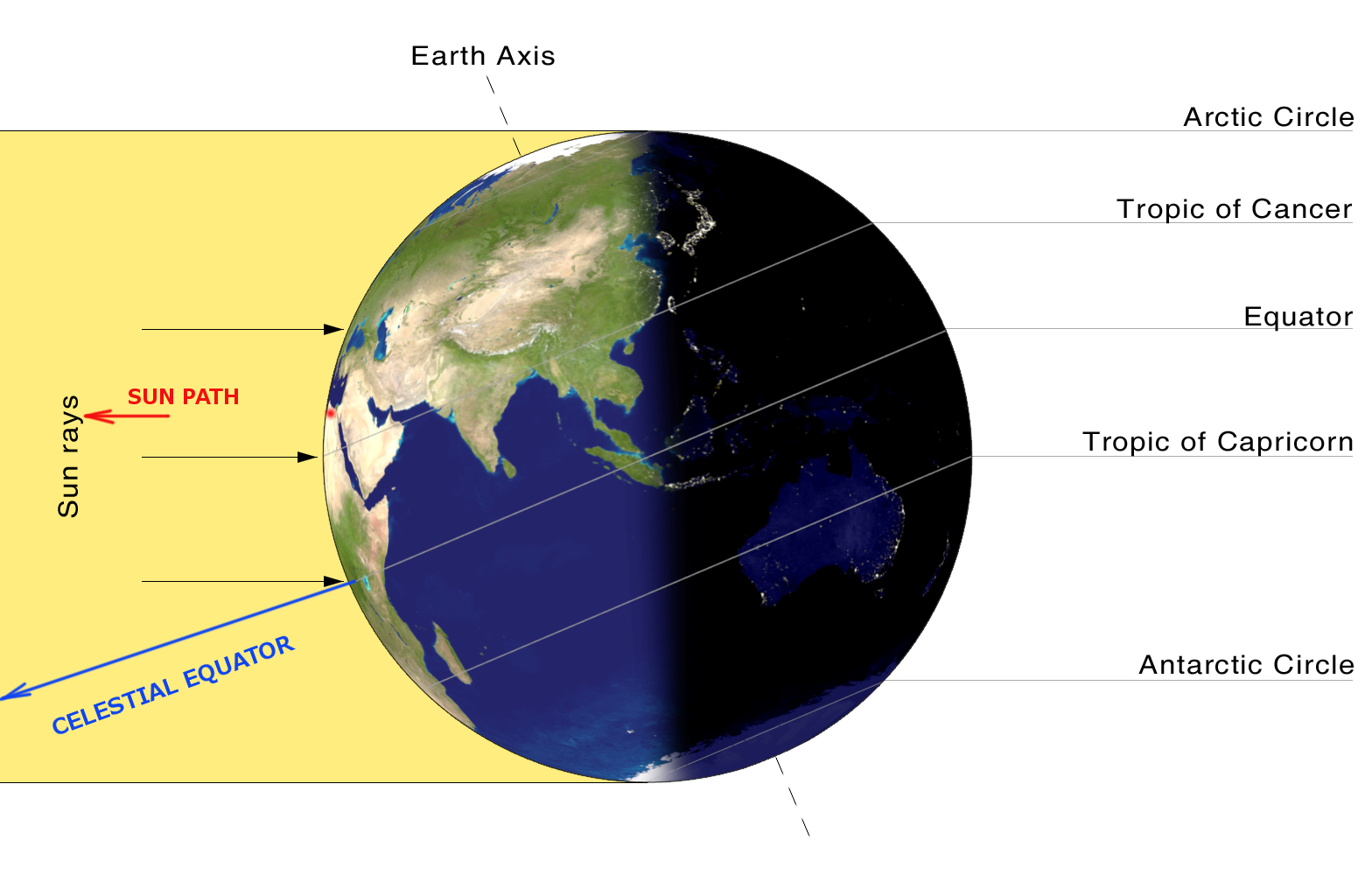
This phenomenon is easiest to envision by imagining the earth at one of the solstices, such as the June solstice -- which is the solstice at which earth's north pole axis of rotation is tilted most directly towards the sun, causing the line of the sun's path to be well "above" the line of the celestial equator for observers in the northern hemisphere:

image: Wikimedia commons (link); modified.

image: Wikimedia commons (link); modified.

In the image, depicting the earth at the point of June solstice, when the north pole is "most directly" pointed at the sun, we can see that an observer in the northern hemisphere (such as one positioned at the tiny red dot located in the region of Egypt in north Africa) will see the sun's arc across the sky traced out by a line indicated by the direction of the red arrow labeled "Sun Path." If that red arrow were a  red laser-pointer, in other words, the rotating earth would cause that laser pointer to burn an arc through the sky that would indicate the path of the sun through the sky on summer solstice. 

Note that the arc would be well above the line of the celestial equator, which can be envisioned as the arc across the sky that is ninety-degrees down from the point of the celestial north pole, around which the entire sky appears to rotate (this is most visible at night, when the stars are visible). The line of the celestial equator is indicated by the blue arrow in the diagram; if the blue arrow were a blue laser-pointer (or a purple laser-pointer, since creating a blue laser is actually very difficult), then the rotation of the earth around its axis would cause that laser pointer to trace out the great circle of the celestial equator.

The above diagram helps us understand why the sun's path arcs so high above the celestial equator at summer solstice, and the reverse is true at winter solstice, when the sun's path arcs well below the line of the celestial equator as the sun traverses the sky. 

Obviously, if the arc of the sun's path gets so far above the celestial equator at one solstice, and so far below it at the other, then there must be times when the sun's path crosses the equator -- and that takes place two times a year, at each of the equinoxes, crossing once on the way down (fall equinox) and once on the way back up (spring equinox). 

Within the incredible system of celestial metaphor underlying the world's ancient myths, scriptures and sacred stories, this annual cycle (along with the many other celestial cycles) was imbued with spiritual significance, to convey truths about infinite and invisible subjects difficult for our mind to grasp except through metaphor. For an in-depth discussion of that system, including the spiritual significance implied by the positions of summer and winter solstice, as well as each equinox, see for example this previous post from 2015.

The sun's crossing back upwards at spring equinox, from the "submerged" position that it has occupied during the "lower half" of the year when its line was below the celestial equator, can obviously be seen to represent a rebirth, a soaring back heavenwards out of the "underworld" condition of the winter months. 

In a very valuable chapter in Lost Light, entitled "At the East of Heaven" (the east being the place of rising and renewal), Alvin Boyd Kuhn explains how these themes come to life in the Isis-Osiris-Horus cycle of myths of ancient Egypt, and how these same themes animate the events described in the New Testament scriptures -- including those in the book of Revelation discussed in the previous post exploring the many parallels in Revelation and the so-called "Book of the Dead," which is more appropriately called the "Coming forth by Day."

As I write in Star Myths of the World and how to interpret them, Volume Three (Star Myths of the Bible):

At the risk of over-simplifying the elaborate explication provided in Kuhn's massive study, he argues that Osiris the god of the underworld in one sense represents the "shattered divinity," sleeping in the realm of the dead -- our very condition in this life -- and that Horus the son of Osiris represents the resurrection force which comes to restore the sleeping divinity, in exactly the same way that Jesus does when he stands at the tomb of Lazarus and shouts "Lazarus, come forth!" Our underworld journey, in which the divine spark of our spirit is joined to the dead matter of our body, is all for the purpose of bringing us to a state that we could never have achieved without experiencing incarnation.

"The soul, by incarnation," Kuhn explains, with reference to a passage in the Pyramid Texts in the pyramid of Unas (some of the oldest surviving extended texts to which the human race has access at this time), "becomes mightier than the virgin deities that have never been wedded to matter. In the texts of unas there is described the terror of the gods when they see Teta (the soul) arriving triumphant. They discover that he is mightier than they."

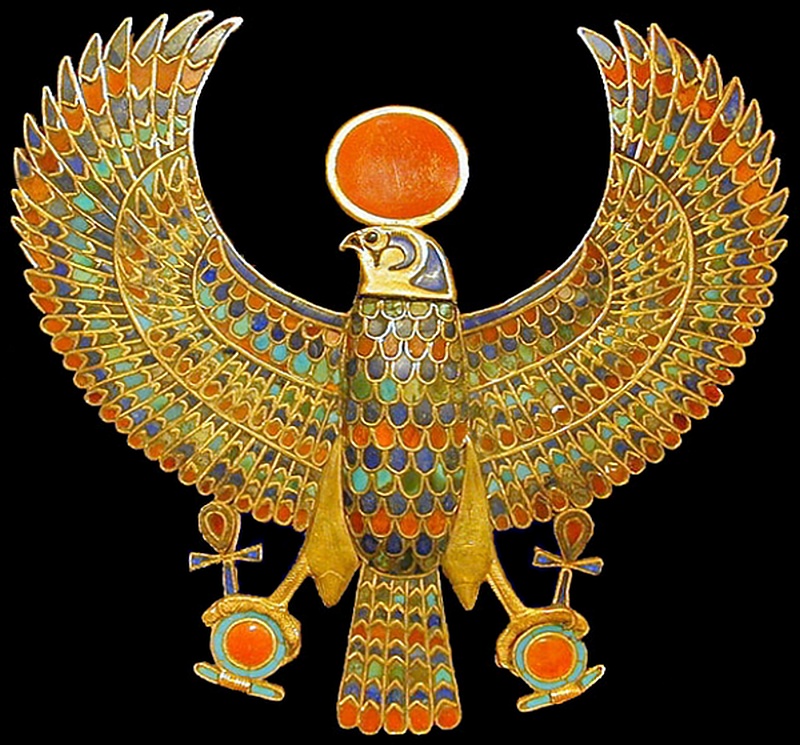
Horus is the "above the line" counterpart to Osiris, described as the son of Osiris because representative of renewal, rebirth, new life which arises out of the underworld experience of the Osiris journey. Horus describes himself as "the persistent traveler on the highways of heaven" and his job description is to go "wherever there lieth a wreck in the field of eternity," Kuhn explains, citing passages from the Book of the Dead (or the Book of the Going Forth by Day, also known in earlier generations including Kuhn's simply as The Ritual). We ourselves are those wrecks, scattered between the horizons beneath the line of matter -- and Horus comes to re-animate the "shattered wreckage" and reawaken it to spiritual life and resurrection. 706 - 707.

Readers are invited to read the entire original chapter in Kuhn's work for his full explication of this beautiful ancient wisdom.

The soaring of Horus above the two horizons is specifically associated with the spring equinox (where the sun finally leaps upwards out of the underworld), and thus with the "upper half" of the year between the two "horizon-points" of the equinoxes, with the summer solstice at the apex. But, as the quotations in the above-cited passage hint, the "persistent traveler on the highways of heaven" is not only present at one particular point on the cycle, or at one particular point in our lives: the figure of Horus restoring the "shattered wreckage" of the hulks strewn across the plane of incarnation is present and available to us at all times. That is the purpose and mission of his persistent travels upon the highways of heaven.

In reality, the realm of the invisible and infinite is not "somewhere else," in some far-removed "heaven," but present and available at every point in this seemingly-material life: the material realm in fact proceeds from and is sustained by it everywhere and at every moment. 

And, we are working with our spiritual self at every moment even as we go through this incarnate life. As Alvin Boyd Kuhn declares in a passage from the same chapter which was quoted at greater length in the preceding post: 

The ancient Messiah was a representative figure coming from age to age, cycle to cycle. He came "each day" in the Ritual; he came periodically; he came "regularly and continuously." He came once through the cycle; but his solar and lunar natural types came cyclically and in eternal renewal. The Egyptian Messiah was one whose historical coming was not expected at any date, at any epoch. The type of his coming was manifest in some phenomenon repeated as often as the day, the year, or the lunation came around. The constant repetition of type was the assurance of its unfailing fulfillment. [ . . . ] The coming was taking place in the life of every man at all times. 546 (Italics as in the original).

It should be noted that Kuhn explicitly states that he is referring to both men and women in several places in his writing -- his use of masculine nouns and pronouns should not be mistaken to indicate otherwise but rather as a convention from the period in which his writings were being published.

Just as Durga says to Arjuna immediately prior to the battle of Kurukshetra in the Mahabharata of ancient India that "within a short time thou shalt conquer thy foes, O Pandava [ . . . ] Thou art incapable of being defeated [ . . . ]" (Mahabharata 6: 23), so also the ancient sacred texts of Egypt promise that this process of transformation through our cycle of incarnations in the material realm cannot be stopped and will inevitably result in the restoration of the divinity that has been cast down. 

In chapter 84 of the Ritual, the chapter "of making the transformation into a heron," we read: "the light is beyond your knowledge and ye cannot fetter it; the times and seasons are in my body." Kuhn says of this passage: "To know of a certainty that with all our stupidity we can not fetter the light, is a truth that should be republished and pondered by an age intent only upon outward accomplishment and heedless of the light within" (552).    

The inevitable and endless return of the equinox, and the soaring upwards of the sun -- representative of the soaring of Horus upwards to his place between the two horizons -- was anciently seen as "the assurance of the unfailing fulfillment" of these truths. This unstoppability should give us great comfort and great confidence as we toil along through this material incarnation.

However, this same inevitability should not serve to make us complacent. As Kuhn points out at the beginning of the chapter, "At the East of Heaven," the writer who calls himself Paul proclaims that "the body is the temple of the living God, and emphasizes that 'the temple of God is holy, which temple ye are (I Cor 3: 17)." 

Kuhn asserts that Paul is speaking literally at this point, "that Paul was delineating an actual physiological fact" (537). He argues that E. A. Wallis Budge (1857 - 1934), writing in his introductory treatise upon the Egyptian Book of the Dead, was mistaken when he says that the Egyptians conceived "the sahu, or spiritual body, the ka, or double, the ba, or soul, the ab, or heart, the khu, or shining spirit, the sekhem, or vital force, the ren, or name, and the khabit, or shade, all as coming forth into existence after death" (537). On the contrary, Kuhn writes, "these inner bodies are vital to the very existence of the physical, and must subsist with it. Man is on earth to bring these subtle bodies into development" (537).

In this task, the ancient wisdom given to humanity in the world's sacred myths and traditions are here to  help us. And they point us towards that "persistent traveler" who soars across the "highways of heaven," ready go wherever there is a "wreck in the field of eternity." 

image: Wikimedia commons (link).

image: Wikimedia commons (link).