Still time to order inscribed copies of Star Myths of the World!

Still time to order inscribed copies of Star Myths of the World!

There's still time to order and receive signed copies of any of my books prior to your favorite winter-solstice-related celebrations or observances, for most locations in North America. 

To order signed copies, please visit this page

Payment options include PayPal, Visa, MasterCard, Discover, American Express, and most bank cards. You will see PayPal as the top payment option when you begin the ordering process, but down below the "buy now with PayPal" button will be another button for other payment options.

There will also be an opportunity to specify names and spelling for a personalized inscription.

Signed copies purchased through that site do require shipping and tax. The site is set up for shipping rates within the united states -- there is a contact page linked at that location for those wishing to order shipments to other locations, or those who wish to purchase multiple copies or place other unusual orders.

Of course, you can also order the books through your local bookstore and avoid paying shipping (as well as avoiding sales tax, if you happen to live in a state that does not charge sales tax), although it may take some time for them to get them in stock, so you want to do that right away if you need it prior to the winter solstice period. They won't be able to order inscribed copies, however.

You can also order the books through online retailers such as Barnes & Noble, Books-a-Million, and others -- some of them offer free shipping. Of course, they won't be able to obtain signed copies either.

All of my books are also typically available through Amazon as well. Strangely, Star Myths of the World, Volume Three (Star Myths of the Bible) has been "temporarily out of stock" on Amazon for over a month on their united states website. Repeated attempts to get them to figure out the problem have so far not met with success. They do have the book available in sites for some other countries. 

Amazon's inability (or refusal) to figure out their inventory stocking issues on their united states site during the entire month of December and almost all of November appears to be their own internal issue, since the book has been available on other sites such as Barnes & Noble for the entire time (here is the link to the book on Barnes & Noble, who can get it to you in two days and usually offer free shipping).

I'm also sure that Amazon will eventually figure out their inventory issues for that title, as they have all of my others available in stock. Unless they really just don't like Star Myths of the Bible over there (or winter solstice holiday sales) and wish to discourage purchases by listing it as "temporarily" out of stock.

If you do order any of my books at this time of year, from whatever sales channel, I hope that they will be a blessing to you, or to whoever reads them!

Table of contents and some sample internal content for each title is available for web viewing here.

Evidence of an ancient conspiracy in the works of Josephus

Evidence of an ancient conspiracy in the works of Josephus

In my 2014 book, The Undying Stars, I spend a fair amount of time examining the theory of Joseph Atwill outlined in Caesar's Messiah: The Roman Conspiracy to Invent Jesus.

Joseph Atwill has discovered undeniable parallels between the events described in the gospel accounts of the New Testament and the events described in the history of the first-century-AD Roman military campaign in Judea which culminated in the destruction of the Temple at Jerusalem. 

As his research and analysis clearly shows, there are even parallels between the sequence of events as described in the history of that Roman war and the sequence of events as presented in the so-called "synoptic" gospel accounts.

In Caesar's Messiah, Joseph Atwill interprets these remarkable and undeniable parallels as pointing to the conclusion that the gospel accounts must therefore be "a skillful satire" of the Roman conquest of Judea -- a massive Roman inside joke (Caesar's Messiah, 10). 

The purpose for this elaborate inside joke, he argues, would have been primarily twofold. First, it would have been an attempt to defuse the potential for ongoing rebellions of a Messianic nature among the Jewish diaspora within the empire, by skillfully arguing that the Messianic prophecies pointed to a Roman Messiah, in the person of the conquering Flavian generals (Vespasian and his son, Titus). Second, it would have functioned to feed what Mr. Atwill describes as "the overwrought vanity of the Roman Caesars, desiring the populace to worship them as gods" (10).

However, without denying the clear parallels which Joseph Atwill has discovered between the account of the campaign in Judea and the accounts in the New Testament gospels, I would argue that the conclusion he reaches -- that the gospel accounts must be an elaborate inside joke and satire built upon the events of that campaign -- is by no means the only possible interpretation of the evidence at hand.

Simply put, as Mr. Atwill himself freely acknowledges, the only source for the details of the Flavian campaign in Judea which form the basis for his comparison are those provided in the history written by Josephus. 

While the Roman conquest certainly took place, and while it certainly resulted in the destruction of the rebellion and the sacking of the Temple (as we can see from the relief images included in the Arch of Titus, constructed as part of the joint triumph awarded by Rome to Vespasian and his son Titus), the only source for the narrative of certain specific events which parallel the events described in the gospels is Josephus himself.

And Josephus is by no means a reliable narrator.

In fact, he is a deeply compromised narrator, as Mr. Atwill once again freely acknowledges. 

Josephus, by his own account, was one of the military leaders of the Jewish rebellion against the Romans, as well as a very high-ranking priest from a highly-regarded family. In his account of the Roman conquest, Josephus describes how he went over to Vespasian in order to save his own life, more than two years before the eventual sacking of the Temple and conclusion of the war -- and how he was afterwards rewarded by the Flavian family with a new life in Rome, including an apartment in Vespasian's own villa (where Vespasian himself had lived, before he built a new palatial villa for himself after becoming emperor), an annual pension for the rest of his life, a new wife (he said he was tired of his old one) selected from among the prisoners, a large quantity of land in Judea which furthermore would be free from taxation, punishment of those who dared to accuse Josephus, and finally ongoing "kindnesses" and "respect" from all of the Flavian emperors and their own families.    

In other words, Josephus was a collaborator with the conquering Romans -- and judging by the incredible rewards he was accorded by the Flavians, the services he provided in his collaboration were extremely valuable to them. The emperor basically adopted Josephus into his family: in fact, Josephus took the emperor's family name, Flavius, which is why you will often see his name given as "Flavius Josephus."

Far from requiring us to conclude that the gospel accounts are a "skillful satire" and vanity-piece for the Flavian emperors, mirroring the supposed "history" given to us by Josephus in his account of the conquest, we should also consider the possibility that the history written by Josephus and perhaps even the events themselves as he describes them are part of a skillful manipulation by Josephus himself.

In fact, there is overwhelming evidence that this is the case: that Josephus fashioned the events of his supposed history after patterns that can be found in the world's ancient mythology, patterns which are also incorporated into the gospel accounts. These patterns are mythological in nature. For whatever reason, Josephus was creating a narrative which was based upon clearly-recognizable mythological patterns. 

And note that, as a high-ranking priest who was intimately familiar with the ancient Hebrew Scriptures which form the basis for what has historically come to be called the "Old Testament" of the Bible, Josephus would have been very familiar with these mythological patterns -- because (as I show with extensive examples in my most recent book, Star Myths of the Bible) the stories of the Hebrew Scriptures are based upon these very same mythological patterns.

In short, the parallels that Joseph Atwill have discovered are very real, and they expose a very real and very important deception -- but it is a deception on the part of Josephus. The patterns in the gospel accounts, which are also found in the "history" of Josephus, are part of a very ancient mythological pattern which can be shown to predate Josephus by thousands of years.

Please note that all of this is not to say that Josephus and his fellow-collaborators might not have had a hand in the final format in which these myths are arranged in the canonical gospel accounts. In fact, it is very likely (as I argue in The Undying Stars) that the story of literalist Christianity as it came to exist in the centuries following the conquest of Judea was part of a deliberate campaign to subvert the ancient wisdom given to humanity in the world's sacred myths, and to replace it with a belief that these sacred stories are actually supposed to be interpreted as literal and historical accounts.

Let's briefly examine a couple of important scenes from the account of Josephus, for which Joseph Atwill finds parallels in the gospel accounts, and show that these scenes are patterned upon more-ancient myths that can be found elsewhere (and which, I would argue, probably never took place, either in the campaign of the Romans or in the events related in the gospel accounts, which are actually part of the same mythological tradition).

One of the very first events that Joseph Atwill examines is the account in Wars of the Jewsby Josephus, in which at the sea of Galilee: "Titus begins his campaign with a battle in which Jews fall into the water and are fished out" (Caesar's Messiah, 399). In his account, which is found in Book 3 and chapter 10 (and subsection 9 within that chapter), Josephus describes the destruction of fleeing Jewish vessels upon the lake by the Romans, and the subsequent slaughter of those who leaped into the water -- with Romans "running them through with their long poles" (spearing them like fish).

Joseph Atwill argues that this scene from Josephus' history parallels the accounts of the beginning of Jesus' ministry, where he too is described at the sea of Galilee, and calls his disciples with the promise to make them "fishers of men" (Matthew 4:19 and Mark 1:17).

However, before we conclude that this parallel means that the gospel accounts are a skillful satire, an inside joke, and an imperial vanity piece, we should note that battle scenes in which unfortunate combatants are "speared like fish" are actually found in myths which long predate the first-century-AD Roman campaign in Judea.

For example, in an episode which I discuss in Volume Two of my Star Myths of the Worldseries, the unfortunate companions of Odysseus are speared like fish by the gigantic and cannibalistic Laestrygonians, in Book 10 of the Odyssey.

Here is the account, as presented in the superlative translation of Professor Robert Fagles:

Straightway she summoned royal Antiphates from assembly,
her husband, who prepared my crew a barbarous welcome.
Snatching one of my men, he tore him up for dinner --
the other two sprang free and reached the ships.
But the king let loose a howling through the town
that brought tremendous Laestrygonians swarming up
from every side -- hundreds, not like men, like Giants!
Down from the cliffs they flung great rocks a man could hardly hoist
and a ghastly shattering din rose up from all the ships --
men in their death-cries, hulls smashed to splinters --
They speared the crews like fish
and whisked them home to make their grisly meal. Book 10, lines 125 - 136.

As I show in Volume Two, this scene and virtually every other episode in the Odyssey can be shown to be based upon the same system of celestial metaphor which underlies the ancient myths, scriptures and sacred stories of the world.

The fact that Josephus works into his account a scene in which his own unfortunate countrymen are speared like fish is probably evidence that Josephus was well acquainted with the ancient myths of humanity (in fact, I would argue that he was probably well versed in their deeper esoteric meaning, and with their celestial foundation as well -- some evidence of this knowledge on the part of Josephus is discussed in The Undying Stars). In fact, in the narrative presented in the "history" of Josephus, he also works into his account of this particular massacre the throwing of rocks!

Another of the parallels which Joseph Atwill has discovered involves the building by Titus of "a siege wall around Jerusalem" in AD 70, described in Book 5, chapter 12 of the history presented by Josephus (see for example Caesar's Messiah page 400 and elsewhere). He finds parallels to this and other aspects of the siege of Titus to the "predictions" of a siege of Jerusalem made by Jesus in the gospel accounts (Jesus describes the compassing of Jerusalem by armies of Gentiles in Luke chapter 21 and in Matthew chapters 24 and 25).

Unless you take the accounts as literal history and believe that they describe accurate predictions made decades prior to the Roman campaign which culminated in the sacking of the Temple by Titus, then these details do indeed appear to indicate that the New Testament gospel accounts as we have them today were indeed composed after the sacking of the Temple (we can be fairly certain that the Temple was indeed sacked by Titus and his forces, because scenes of the Temple artifacts being led away in triumph are included in the Arch of Titus, and the people alive at that time probably saw the triumphal procession itself, which according to the account of Josephus included those artifacts as a central feature). 

However, once again the feature of a wall as described by Josephus in this instance is a very common feature of ancient myth, and one that can be tied to a celestial pattern -- I detail several instances of cities or citadels surrounded by just such a wall in the Odyssey, in Volume Two of Star Myths of the World. And, in Volume Three of the series (Star Myths of the Bible), I show that the prediction or prophecy included in the gospel accounts that the Temple will be cast down to the ground such that not a single stone remains upon another is almost certainly celestial as well (involving a celestial Temple).

Indeed, if it involved the physical Temple in Jerusalem, then even literalist Christians would have to admit that the prophecy did not take place as described in the gospels, since the Western Wall is still standing to this day -- which shows that the description that "there shall not be left one stone upon another," found in Luke 21:6 and Matthew 24:2 did not take place in the literal and historical events. Indeed, the fact that the prediction about not one stone being left upon another but that all of them would be thrown down can be seen not to have taken place (and could have been seen not to have taken place during the period of ancient Rome) should cause us to question the conclusion that the gospels were intended as a way of making the populace worship the Flavians as gods. 

The prophecy is celestial in nature, and involves a constellation of stars setting in the west (down to the level of the ground), as I discuss in Star Myths of the Bible.

In fact, we can see in Old Testament accounts that Jerusalem is also compassed by a wall, such as in the passage at the beginning of 1 Kings chapter 3, in which we are told that Solomon "made affinity with Pharaoh king of Egypt" until he had finished building "his own house, and the house of the LORD, and the wall of Jerusalem round about" (italics added for emphasis). I believe that these details are given as celestial clues (and again, there are many episodes in the Odyssey of ancient Greece in which similar celestial clues are given, pointing to the same region of the night sky).

Joseph Atwill also asserts that the references to the coming of the Son of man, which are a frequent feature in certain discourses of Jesus found in the gospel accounts, are intended to refer to the coming of the Flavian generals and specifically Titus (the son of Vespasian), as part of the "skillful satire" and the desire to make the population "worship them as gods."

However, I would argue that the context of the passages again points to a celestial identity for the figure described as the Son of man. As I explain in The Undying Stars, during the Olivet Discourse (sometimes called the "Little Apocalypse") found in Matthew chapters 24 and 25, Jesus describes the coming of the sign of the Son of man in the heavens, moving from east to west, and separating the sheep from the goats (see especially Matthew 24: 27 through Matthew 25: 33).

As the star-chart diagram below shows, and as I explain in greater detail in The Undying Stars, the sign of the Son of man almost certainly corresponds to the zodiac constellation of Aquarius. Aquarius does indeed move from the east to the west (as do all the stars, due to the rotation of the earth upon its axis, towards the east), and Aquarius does indeed separate the sheep from the goats as well (he separates Aries the Ram from Capricorn the Goat):

An astute reader will notice that as we face towards the south (which is the direction that those in the northern hemisphere above the line of the tropics must face in order to see the zodiac), the "sheep" of Aries appear to be on the left, while the "goats" of Capricorn appear to be on the right -- and in the Matthew 25 passage, it is clearly stated that the sheep will be "on his right hand, but the goats on the left" (Matthew 25: 33). 

That's because, as they say in the army when an instructor is facing a group and referring to directions such as left and right, from the perspective of the constellation Aquarius (if his front is facing towards us), the sheep are on "my right, your left" and the goats are on "my left, your right." The Biblical passage clearly says that the sheep on on his right hand, not ours as we face the sky.

In short, the Biblical narrative can be shown to be based from first to last upon celestial patterns that inform all of the ancient myths, scriptures and sacred stories of humanity. They are not simply a clever Roman fiction, a skillful satire, an inside joke, or a Flavian vanity-piece. They actually contain profound ancient wisdom, which (like the wisdom contained in all the other ancient sacred stories of the world) is vital to our lives and can be profoundly beneficial, if interpreted in the language that it is actually speaking to us, which is a celestial and esoteric language.

I am convinced that overwhelming evidence exists to argue that this ancient wisdom was deliberately subverted by those who wanted to create a sophisticated campaign to cause men and women to take these stories literally, and to ignore their esoteric meaning. I am also convinced that Josephus and his associates were central to that campaign -- perhaps in part because people like the author we know as "Paul" were busily teaching the Gnostic and esoteric understanding of the ancient doctrine of the "Christ within," and those who did not want that secret to be given to the masses wanted to contain it and "put the cat back into the bag" by promoting a falsely literal and historical version of that message instead.

Joseph Atwill has provided extremely valuable evidence regarding this ancient deception, with his perceptive analysis comparing the gospel accounts and the histories of Josephus. While I disagree with the main conclusions that he has reached, I believe that his are understandable conclusions to suggest as one possible explanation for the evidence at hand, particularly if the celestial metaphors are not understood, and the connections of those same patterns to other myths (including but not limited to those which we find in the Odyssey of ancient Greece, as well as strong parallels to the mythology of ancient Egypt not discussed in the above examination). 

One thing should be fairly certain from all of the above discussion, and that is that the events in the gospel accounts are not literal and historical in nature, but rather metaphorical. I happen to believe that they are actually metaphors intended to convey profound truths about our human condition and about the nature of the simultaneously physical-and-spiritual universe in which we presently find ourselves, and that they should not be dismissed as a clever Roman satire.

Now, thanks to the insights of Joseph Atwill, we can see that the works of Josephus are almost certainly not completely literal and historical in nature either -- and that Josephus is almost certainly part of an ancient conspiracy involving the transition to literalist Christianity, a conspiracy which has resulted in the suppression of that beneficial message for centuries (and which later resulted in the destruction or suppression of the ancient wisdom preserved in the traditions of other cultures around the world).

One solid foundation

One solid foundation

This is one of my favorite songs, "One Foundation" by the Wailers, sung by Peter Tosh.

I have previously written out what I believe to be the lyrics, in a previous post here.

When we realize that all the world's ancient myths, scriptures, and sacred traditions share a common celestial foundation, it should truly unite us and cause us to see that we all share a very ancient common heritage. The clear connection between the constellations and the world's sacred stories provide more than enough evidence which can be easily examined to demonstrate this common foundation.

And one of the primary and central messages of that ancient wisdom tells us that the most important part of each and every man and woman is invisible -- the divine spark inside each one of us -- not our external, physical body of clay.

Respect.

Shango and Oya of the Yoruba

Shango and Oya of the Yoruba

image: Wikimedia commons (composite image, foreground and background).

image: Wikimedia commons (composite image, foreground and background).

Abundant evidence from myths found around the world, on every single inhabited continent on our planet -- as well as the inhabited islands of the vast Pacific Ocean -- points to the incredible conclusion that these ancient myths all appear to be built upon a common system of celestial metaphor.

This same worldwide system underlies the stories of what we call the Old and New Testaments of the Bible, as well as the myths, scriptures and sacred traditions of ancient India, ancient Greece, ancient China, ancient Japan, ancient Egypt, ancient Mesopotamia, the peoples of various part of Europe, and of the Americas, and other parts of Asia, and the islands of Polynesia and Micronesia, and the same system can even be seen to form the basis for myths and sacred traditions found in Australia and in Africa.

Some of the myths and sacred traditions of Africa are explored in Star Myths of the World, Volume One, which seeks to provide an overview of representative Star Myths from numerous cultures on different continents (whereas Star Myths of the World, Volume Two and Star Myths of the World, Volume Three focus more deeply on myths from Ancient Greece and from the Bible, respectively).

Because Volume One tries to give a broad introduction to the vast scope of this ancient worldwide system, only a few myths from each different continent could be highlighted. Entire multi-volume sets could of course be written on the Star Myths of each of the different traditions, showing ways that the myths of all these different cultures appear to be based on the motions of the constellations and other heavenly bodies and heavenly cycles.

Many more myths and sacred stories from the continent of Africa and its many different cultures and myth-systems could be explored in addition to those featured in Volume One of the Star Myths of the World series.

One of the myth-cycles that could be explored would be the myths and traditions surrounding two important Yoruba deities or Orisha: Shango and Oya.

Shango is a powerful Orisha of fire and of thunder and lightning.

In his 1980 study of Yoruba oral tradition and divination entitled Sixteen Cowries, William Bascom writes of Shango (sometimes also spelled Xango):

Shango is a God of Thunder. Living in the sky he hurls thunderstones to earth, killing those who offend him or setting their houses afire. His thunderbolts are prehistoric stone celts which farmers sometimes find while hoeing their fields; they are taken to Shango's priests, who keep them at his shrine in a plate supported by an inverted mortar, which also serves as a stool when the heads of initiates are shaved (cf. Bascom 1972: 6). The stones in Shango's sacrifices may be an allusion to his thunderbolts, and in one verse Shango kills a leopard by putting an inverted mortar over it. [ . . . ]

He was noted for his magical powers and was feared because when he spoke, fire came out of his mouth. One verse has Shango lighting a fire in his mouth with itufu, oil-soaked fibers from the pericarp of the oil palm, which is used in making torches and starting fires. In a state of possession it is said that a Shango worshiper may eat fire, possibly using itufu, carry a pot of live coals on his head, or put his hand into live coals without apparent harm. 44.

Shango is a formidable deity or Orisha -- but so is his favorite consort, the goddess Oya. William Bascom describes her thusly:

Oya is the favorite wife of Shango, the only wife who remained true to him until the end, leaving Oyo with him and becoming a deity when he did. She is Goddess of the Niger River, which is called the River Oya (odo Oya), but she anifests herself as the strong wind that precedes a thunderstorm. When Shango wishes to fight with lightning, he sends his wife ahead of him to fight with wind. She blows roofs off houses, knocks down large trees, and fans the fires set by Shango's thunderbolts into a high blaze. When Oya comes, people know that Shango is not far behind, and it is said that without her, Shango cannot fight. The verses tell that Oya is the wife of Shango, "The wife who is fiercer than the husband." Her town is Ira, which is said to be near Ofa. 45.

Bascom also notes that Oya is associated with buffalo's horns, and that a set of buffalo horns will be rubbed with cam wood to make them red and placed on Oya's shrine. In another book discussing the mythology of the Yoruba, Yoruba Myths by Ulli and Georgina Beier (1980), we learn that one time, when Shango and Oya were having a fight, 

she charged him with mighty horns. But Shango appeased her by placing a big dish of akara (bean cakes) in front of her. Pleased by the offering of her favourite food, Oya made peace with Shango and gave him her two horns. When he was in need, he only had to beat these horns one against the other and she would come to his aid. 32 - 33.

Based on these details from the different sacred traditions involving Shango and Oya, I believe we can very confidently identify Shango and Oya with the constellations Hercules and Virgo. Below is a star-chart showing some of the features of these constellations which correspond to aspects of the mythology of Shango and Oya:

The details of the stories may have already tipped you off to this conclusion, if you have worked your way through previous Star Myth examinations presented on this blog or in the "Myths" section of the Star Myth World website, as well as some of the "Videos" on the same website, and especially if you have worked your way through any of the volumes of the Star Myths of the World series of books.

In nearly every ancient myth-system, the powerful figure who wields a thunderbolt weapon will be associated with the figure of Hercules in the sky, whether that thunderbolt weapons is wielded by a god in the Maya account contained in the Popol Vuh, or by a god in the myths of ancient Greece and Rome, or in the myths of the Norse.

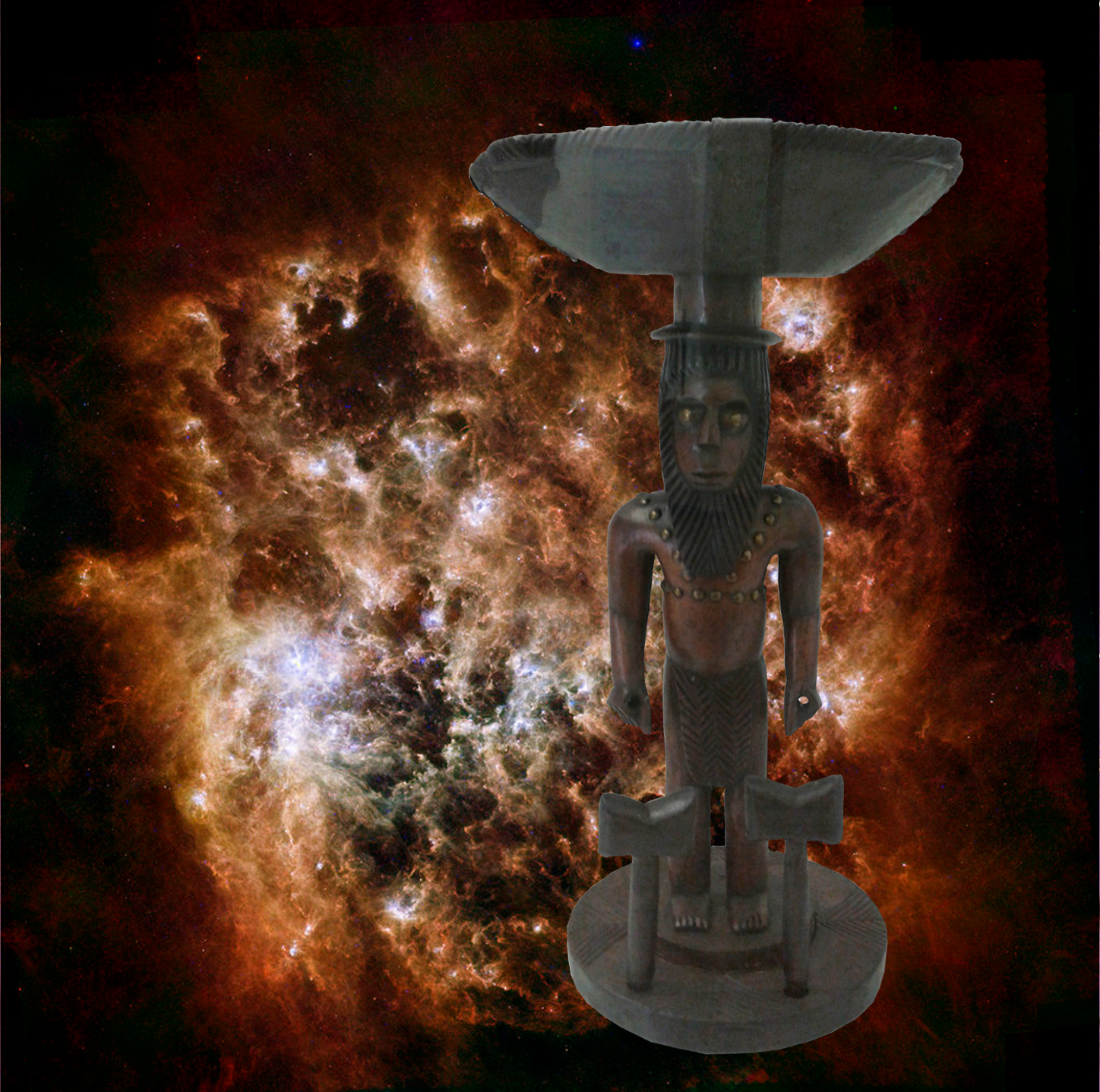
Images of Shango and symbolic scepters sacred to Shango usually feature a double-axe motif, a potent symbol which is also found around the world. The carved wooden image of Shango shown at top features a wide double-axe above the figure's head, as well as two more smaller double-axes placed in front of the image in the carving.

It is possible that the great weapon held menacingly aloft by the constellation Hercules in the sky, which in some myths becomes a club or a sword, can also be seen as an enormous double-axe shape, especially if the "blade-shaped" outline of Lyra the Lyre nearby is also envisioned as being part of the same weapon (see star-chart above).

There are other details in the myths which give added certainty to the identification of Shango with the constellation Hercules, which we will examine in a moment. First, however, let's look at the identity of the goddess Oya, who is so powerful that Shango cannot fight without her, and who is described as going ahead of Shango in everything.

I am convinced that Oya is associated with the constellation Virgo: can you see how this arrangement gives rise to the tradition that Oya always precedes Shango? The motion of the stars each night is from east to west (just like the motion of the sun each day -- both are caused by the rotation of the earth towards the east on its daily rotation). In the star chart above, which looks towards the south, east is on the left and west is on the right, and the constellations move from left-to-right in the diagrams.

The definitive clue that Oya is associated with Virgo is the fact that she is sometimes called the "Mother of Nine" (Iyansan, or 'Yansan) in Yoruba tradition (Bascom, 45). The constellation Virgo, as we have seen in many myths from around the world, is often envisioned as a mother about to give birth, due to her posture in the sky, lying on her back with feet elevated. 

Virgo is sometimes envisioned as giving birth to the multi-headed figure of Scorpio, which follows Virgo in the sky. Scorpio, as seen in many of the discussions in the Star Myths of the World books, is sometimes envisioned as having nine heads.  The fact that Oya is called "Mother of Nine" pretty much seals her association with the constellation Virgo in the heavens.

You can also see the "buffalo horns" which Oya gave to Shango, almost certainly identified with the beautiful arc of stars known as the Northern Crown (or Corona Borealis), very close to Shango-Hercules in the sky and included in the diagram above.

What about the details of the story in which Shango breathes fire out of his mouth? The star chart below shows that the "lower arm" of the constellation Hercules (the arm not holding a club or weapon) can be envisioned as proceeding out of the mouth of the constellation. I believe this is very likely the source of the association of "breathing fire" with this particular Orisha. 

There is also a "torch" in the sky not far from Hercules and Virgo, in the form of the constellation Coma Berenices, which actually plays the role of a torch in many other Star Myths (some of them discussed in the Star Myths of the World books). This may be the itufa torch that appears in the myths of Shango:

The aspect of the myth in which Shango is described as killing a leopard by crushing it beneath "an inverted mortar" no doubt have to do with the constellation Ophiucus, directly beneath the constellation Hercules. The body of Ophiucus has a distinctive oblong shape with triangle at top (as outlined by the ingenious outlining system proposed by H. A. Rey). This almost certainly represents the inverted mortar (a mortar and pestle are tools for crushing up grains and spices: the mortar usually a stone bowl with a depression or hole in the center, and this shape also gives its name to the later weapon known as a mortar, which shoots shells out of a tube -- Ophiucus could be envisioned as a tall mortar, turned upside down so that its conical base is at the top).

Note that the head and tail of the unfortunate leopard can be seen protruding from either side of the upturned mortar of Ophiucus!

Note also that Shango is sometimes described as defeating his enemies with a cudgel, which is another weapon very closely associated with the outline of the constellation Hercules (and Hercules-figures throughout the world will often carry a club or cudgel as their favorite weapon). William Bascom cites Yoruba verses in which Shango uses a cudgel in the verse labeled "L1" in Sixteen Cowries, and he mentions this fact on page 44 as well. This cudgel is yet another clue that Shango corresponds to the constellation Hercules -- in addition to all the other clues, I believe we can be quite confident in associating Shango with Hercules, and Oya with Virgo.

In another set of verses cited by William Bascom, we learn of Shango that: "He drove away the hartebeeste that had been eating the children of the people of Ijagba, and became the deity that all the people of Ijagba worshipped" (45).

A hartebeeste is a large African ungulate, with majestic curving horns. As you can see in the image below, it is very possible that this hartebeest which Shango drives away might be associated with the outline of the horned figure of Taurus the Bull, which can also be said to resemble a hartebeeste:

image: Wikimedia commons (link).

image: Wikimedia commons (link).

As the constellations Virgo and Hercules rise over the horizon in the east, the constellation Taurus can be seen to be sinking down into the west. This perfectly describes the situation in which Shango (Hercules) "drives away" the hartebeest (Taurus). There are other Star Myths from around the world in which the arrival of a god or goddess associated with Hercules or Virgo signifies the demise of a figure associated with Taurus (for instance, the traditions associated with the goddess Durga -- see here and here).

Below is a star-chart showing Hercules rising in the east, as Taurus sinks down in the west:

Note that in the diagram, the planetarium app distorts the size of constellations along the east and west, in order to simulate the "wraparound" effect you would see outside (the left and right of the image represent turning towards the eastern and western horizons, respectively; looking to the center of the image represents looking towards the southern horizon: the planetarium app from Stellarium.org makes constellations look smaller when they are in the middle of the diagram, and larger when they are near the east or the west to your left and right).

In Yoruba Myths, we read that the goddess Oya was originally an antelope who periodically took off her antelope skin to reveal a beautiful woman:

Oya was an antelope who transformed herself into a woman. Every five days, when she came to the market in town, she took off her skin in the forest and hid it under a shrub. 

One day Shango met her in the market, was struck by her beauty, and followed her into the forest. Then he watched, as she donned the skin and turned back into an antelope.

The following day Shango hid himself in the forest, and when Oya had changed into a woman and gone to market he picked up the skin, took it home and hid it in the rafters. 33.

We learn that Shango's other two wives become jealous of Oya, who bears Shango twins, and they tell Oya where to find her skin, hanging in the rafters. She dons the antelope form again and disappears into the forest.

I believe that this story is also based upon the same celestial mechanics shown in the star-chart above. When Virgo takes off her antelope skin and hides it beneath a bush, Taurus is sinking down into the horizon (into the bushes of the horizon, you might say). 

The part about hanging the skin up in the rafters resonates with a very common theme in Star Myths around the world -- for instance, in the Maui myths of the Pacific, Maui's grandfather hangs Maui up in the rafters when he is a baby! In that case, the grandfather is undoubtedly Hercules, and Maui the infant is almost certainly Corona Borealis (the Northern Crown). This identification is discussed in greater detail in Star Myths Volume One. The Northern Crown, oddly enough, plays a baby in many other Star Myths.

In the story of Shango and Oya and the hanging of Oya's skin in the rafters, I believe the constellation Coma Berenices fits the identification of the skin better than the nearby Northern Crown. There are other Star Myths we could look at which make this identification the likely answer to the celestial source of this sacred Yoruba story.

When the other wives tell Oya where her skin is hanging (they do this using a chant, in which they sing about its location), she resumes her antelope form and bounds away into the forest so that Shango cannot find her. Again, this detail probably stems from the fact that, when Hercules rises in the east, Taurus sinks down out of sight in the west.

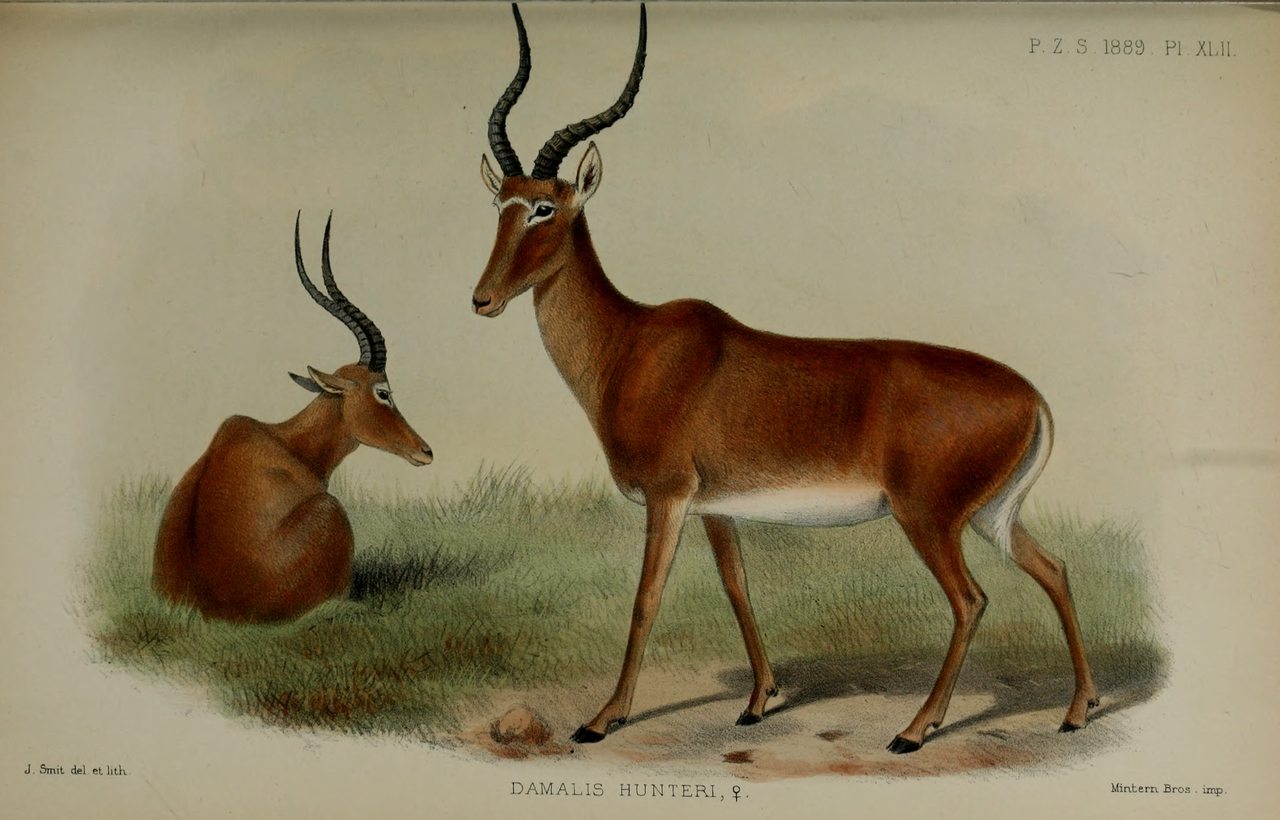
For those who wonder whether Taurus could play the role of the female antelope which is one of the shapes of the goddess Oya, note that in Africa the female of the many species of antelope often has horns, in addition to the horns of the male antelope. 

Below is an illustration of the female Hirola, an antelope found in the areas where the Yoruba cultures traditionally have lived for thousands of years:

image: Wikimedia commons (link)

image: Wikimedia commons (link)

There are still more stories of Oya and Shango which point to a celestial foundation associated with the constellations Virgo and Hercules. One of the stories involves the mother of Shango, the goddess of the River Yemoja (odo Yemoja), which flows through Yoruba lands. In one version of the story, Yemoja was pursued by her husband Okere (who is not the father of Shango) and he knocks her down, causing her to turn into a river which flows out of pots of water she was also carrying (Bascom, 46). 

This story may also involve the constellation Virgo, which is located in the sky adjacent to the constellations Crater the Cub and Hydra the Snake (see star-chart above). When Shango's mother Yemoja falls down (and note that Virgo is recumbent), she may become the river which is associated with the flowing form of Hydra, directly beneath Virgo and beneath the water-cup-like outline of the constellation Crater.

Shango and Oya are very important deities in the Yoruba mythology, with many devotees around the world to this day. Their clear celestial parallels provide still more evidence which argues that the system of celestial metaphor which we can see operating in the stories of the Bible and in the other myths of the world, is in fact a common system which somehow provides the underlying bedrock upon which all the world's ancient traditions have their foundation.

Shango is a god of fire. I believe that the world's Star Myths convey powerful truths regarding the Invisible World -- the realm of spirit, the realm of the gods, the Infinite Realm. 

One of the lessons that they teach is that, just as the stars themselves can be seen to rotate down to sink into the western horizon, so also we ourselves came down to this incarnate realm from a spirit realm -- and that we all contain a divine spark, an internal divine fire, through which we have immediate access to that Invisible Realm at all times, if we learn how to become re-acquainted with that aspect of our nature.

I am convinced that the ancient myths, scriptures and sacred stories which were entrusted to humanity the world over are here to help show us how to do that.

Welcome to new visitors from Alchemy! (and returning friends)

Welcome to new visitors from Alchemy! (and returning friends)

this interview was recorded on 11/22/2016.

this interview was recorded on 11/22/2016.

Big thank you to John and Steve Gibbons for having me back to their show Alchemy for a new conversation about Star Myths and related subjects!

In addition to being a talented musician, John is a fantastic interviewer and host, and really guided the discussion into what I felt were some very productive channels.

I very much enjoyed our conversation, and hope that you will as well.

It was really fascinating to me how "in-synch" John was with what I was intending to talk about -- and I have to disclose that we absolutely did not co-ordinate on any of the topics prior to the show!

We discussed the overarching Star Myth system, as well as specific Star Myths which are featured in my two most-recent books: Star Myths of the World, Volume Two (Greek Myths) and Star Myths of the World, Volume Three (Star Myths of the Bible).

First, John asked me to select something from the Greek myths to discuss, and I chose to talk about some of the aspects of the goddess Artemis -- and John pointed out that she was one of his favorites, and made some very insightful comments regarding the role of Artemis in protecting women and presiding over all childbirth (a function that is of course vital to the preservation of life and the continuation of humanity on earth).

After some further discussion involving the encounter between Odysseus and the Cyclops, we moved on to discussing some episodes from both the Old Testament and New Testament texts of the Bible, and John presented a list of suggested stories to discuss which included Noah and the Genesis Flood, the story of Adam and Eve, and something from the book of Revelation!

I was astonished, because before the show, I had prepared a list of some good Biblical episodes to discuss, which included those very passages! Below is a photograph of my notes, showing that all three of those areas were ones that I had selected as well (again, John and I did not do any corroborating prior to the show regarding what myths we should talk about, or even what general subjects we should visit):

Throughout the show, John intuitively steered the conversation towards some very important areas of discussion, which helped to bring out new perspectives and insights that I would not have brought out on my own. His guidance also helped keep things on track, as I can sometimes tend to take some long tangential side-tracks down interesting corridors and away from the original topic of discussion!

Below are some links to previous posts and videos that deal with some of the topics that we touched upon during this most recent interview, as well as links to the two previous visits I've had with John on Alchemy in the past (one from 2015 and one from 2014):

  • The use of the winter solstice as a marker for the "soul's turning point" of awareness of and greater integration with the spiritual nature and the divine realm.
  • The two visions articulated by the holy man Black Elk of the Lakota, one of abundance fed by deep connection with the Other Realm (the source of everything in this realm), and one of greed driven by separateness and division and an underlying belief in scarcity (see also this previous post).
  • Our (often-forgotten) inner connection to the Infinite Realm, which is the reason "why gods appear in an instant" in many of the Star Myths of the ancients.
  • The concept of the "divine twin" and the "Higher Self" which appear to be part of a major theme running through so much of the ancient wisdom imparted to humanity in the myths.
  • The theme of reincarnation, which appears to run through many ancient myths, including possibly some of the Biblical texts (and see also the quotation in this previous post about the concept that souls go along the Milky Way on their way to rebirth, found in the sacred traditions of many cultures in the Americas including the Pawnee, the Cherokee and the Sumo of Central America).
  • The evidence that Noah is also associated with the figure of Aquarius (with additional evidence to be found in the story of Shem, Ham and Japheth).
  • We referred a lot to the concept of precession, but did not explain its mechanics in detail. If you want to see some video discussion of the mechanics of the phenomenon of precession, and its delaying of the "background of stars," you may wish to start with this video, in which I use the "metaphor of the dining room table."
  • Some discussion on the importance, if at all possible for your situation, of incorporating ancient disciplines such as YogaChi Gungmeditation or other similar ancient practices in your daily life.


Finally, as I have mentioned in posts regarding other appearances on podcasts, I believe that we are at a very critical point in time in which the deliberate deceptions of the "captive media" are becoming more and more obvious to a larger and larger number of people -- and the role of the "independent media" is becoming more and more significant.

I believe it is very important to listen to -- and, to whatever degree possible, support -- independent sources of research and analysis, such as that provided by John and Steve Gibbons on Alchemy (as well as other outlets such as The Higherside ChatsGrimericaWhere Did the Road Go?, and others like them).

You can also check out John's music at his official site and facebook page.

Thank you to the listening audience of Alchemy -- hope you enjoyed the conversation, please check out all that the Star Myth World website has to offer, and hope you will visit again soon!
 

The Dioscuri

The Dioscuri

image: Dioscuri from ancient red-figure kalix (link), modified and superimposed on Medusa nebula (link).

image: Dioscuri from ancient red-figure kalix (link), modified and superimposed on Medusa nebula (link).

Now is a perfect time of year to observe the Twins of Gemini, and to contemplate the layers of meaning which the ancient Star Myths associated with the Twins may have been intended to convey for our understanding.

As the constellations associated with winter in the northern hemisphere begin to come into view during the hours after sunset -- including the magnificent constellation of Orion -- the Twins of Gemini can be observed nearly "straight out" from Orion's trailing shoulder (the easternmost shoulder of the massive figure of Orion).

Below is a depiction of the eastern horizon with the constellation of Orion rising, still in a horizontal position (the constellation rises in a horizontal attitude and then rotates into a vertical posture as the figure of Orion crosses the sky -- for some animation which illustrates this phenomenon, see this video discussing the relation of Orion to Osiris and to the Djed Column):

Note that the two bright stars which mark the heads of the Twins of Gemini are located straight out from Orion's lower shoulder (his trailing shoulder, marked by the orange giant star Betelgeuse). Until you are familiar with the constellation of Gemini, it can be easy to mistake the two brightest stars of the constellation Auriga the Charioteer for the heads of the Twins, because these are located almost the same distance out from Orion, but ahead of the Twins as they cross the sky (see arrows in the illustration above).

The easiest way to identify the constellation Auriga, so that you don't confuse its stars with the stars of Gemini, is to locate the "V-shaped" Hyades, which are located almost exactly halfway between Orion and the Pleiades (you can see the V-shape of the Hyades in the illustration above). If you find the Hyades in the night sky, you can draw an imaginary line out from either tip of the "V" of the Hyades, and find the tips of the horns of Taurus the Bull: the jawline of the lantern-jawed Charioteer of Auriga is just above the tips of the horns.

The diagram below reproduces the chart above, but this time the outlines of the constellations are included:

Can you see the two tips of the horns of Taurus, and how the jawline of Auriga the Charioteer (outlined in red, above) cuts down directly adjacent to the horns of the Bull? Following the "V" of the Hyades will help you to positively identify the outline of Auriga (who appears as a huge, disembodied head in the outlining system proposed by H. A. Rey). That way, you will not confuse Auriga's bright stars with the two brightest stars of Gemini, which make up the heads of the Twins.

The bright stars of the heads of the Twins are much closer to one another in the sky than are the bright stars of Auriga. The outlines of the two figures of the Twins are very linear in nature when you observe them in the sky, forming two parallel lines pointing towards the lower shoulder of Orion.

In ancient Greek mythology, the Twins were known as Kastor and Polydeukes (or Castor and Polydeuces); their names became Castor and Pollux in Latin. In the sky, the brightest stars of the constellation still bear these names: Castor being slightly ahead of Pollux but not as bright (in the illustration above, Castor is above Pollux as the constellation is rising out of the eastern horizon -- Castor is further to the west of Pollux and not quite as bright as its twin).

The Twins are actually figures of tremendous importance in ancient Greek myth, although their significance is sometimes not fully appreciated. The two were known as the Dioskouroi(or the Dioscuri), a name which signifies the youths (kouroi) of Zeus (Dios). You can see the linguistic relation between the name of Zeus and the word Dios -- in fact, the name of the god Dionysos or Dionysus signifies literally "Zeus (Dios) of Mount Nysa." 

The Dioscuri were in fact the twin sons of Zeus by the beautiful mortal woman Leda, whom Zeus seduced while in the form of a great swan (note that the constellation of the Swan is still visible in the night sky right now, flying away into the west even as the Twins are rising in the east). However, in many of the versions of the Dioscuri myth, only Polydeuces is actually the son of Zeus, while Castor is the son of Leda's husband Tyndareus, king of Sparta. 

Castor and Polydeuces are mentioned in many of the earliest Greek sources, including Hesiod. They were famous horsemen and tremendous boxers. The most famous aspect of their story, however, concerns the mortality of Castor and the decision by Polydeuces to give up his own full immortality in order to share it with his mortal brother -- thereby taking on an aspect of Castor's mortality himself.

According to most versions of the story of the Twins, Castor and Polydeuces were attacked by the two sons of the brother of Tyndareus, Idas (gigantic in stature) and Lynkeus (who could see in the dark, like a lynx) as part of a long-running feud over some cattle (and note the proximity of the Twins of Gemini to the constellation of Taurus the Bull, as well as to the hulking figure of Orion, who features as a giant in some myths).

As the prolific poet Pindar relates the story, in his tenth Nemean Ode (almost certainly written near the middle of the fifth century BC), Castor was mortally wounded by a huge block of stone hurled by Idas, but Polydeuces killed Lynkeus, and the god Zeus himself finished off Idas with a thunderbolt. Pindar continues:

Swiftly Polydeuces the son of Tyndareus went back to his mighty brother, and found him not yet dead, but shuddering with gasps of breath. Shedding warm tears amid groans, he spoke aloud: "Father, son of Cronus, what release will there be from sorrows? Order me to die too, along with him, lord. A man's honor is gone when he is deprived of friends; but few mortals are trustworthy in times of toil to share the hardship." So he spoke. And Zeus came face to face with him, and said these words: "You are my son. But Castor was begotten after your conception by the hero -- your mother's husband -- who came to her and sowed his mortal seed. But nevertheless I grant you your choice in this. If you wish to escape death and hated old age, and to dwell in Olympus yourself with me and with Athena and Ares of the dark spear, you can have this lot. But if you strive to save your brother, and intend to share everything equally with him, then you may breathe for half the time below the earth, and for half the time in the golden homes of heaven." When Zeus had spoken thus, Polydeuces did not have a second thought. He opened the eye, and then released the voice of the bronze-clad warrior, Castor. [translation by Diane Arnson Svarlien, as found on the Tufts University ancient text collection here]

Here we have an extremely powerful image: the divine twin who rescues the mortal twin, sharing his immortality with his mortal counterpart. I would argue that this exact pattern is found throughout the ancient Star Myths of the world, and that it is intended to illustrate for our deeper understanding the reality of our divine nature, even while encased in this mortal body, and the reality of the Higher Self (discussed in previous posts such as this one and this one).

In the above scene as dramatized in Pindar's ode, we see that Polydeuces could enjoy uninterrupted immortality in Olympus, but that he chooses to share his immortal nature with Castor, and in return Polydeuces himself must "breathe for half the time below the earth" -- in the realm of death, in fact. In most versions of the myth, the Twins then alternate between the realm of the gods and the tombs of Therapnai.

Again, I believe that this ancient myth, like so many other myths, is intended to dramatize to us the condition of the human soul -- which chooses to leave the realm of pure spirit to sojourn for a time within the "body of death" (as the apostle Paul calls our mortal condition, in the seventh chapter of the epistle to the Romans) -- and which may spend many lifetimes alternating between the realm of the gods and "this mortal coil" in which we all presently find ourselves.

The dramatic scene of the death of Castor, described by Pindar above (and described by many other ancient poets, both before and after Pindar), actually contains strong parallels with many other ancient Star Myths in which the divine twin grieves over the mortal condition of the mortal twin. 

We find the same pattern in the Gilgamesh cycle of ancient Mesopotamia, in which the semi-divine Gilgamesh laments over his twinned counterpart Enkidu. 

We find a similar scene in ancient Egypt, with the lamentations over the death of Osiris, the slain god -- and in the eastern Mediterranean lamentations over the death of Tammuz. 

We find the same pattern again in the Iliad, in which the semi-divine Achilles laments loudly over the death of Patroclus.

And we see a very similar pattern in the New Testament account of Jesus at the tomb of Lazarus, in the eleventh chapter of the Gospel according to John.

That a profound mystery lies at the heart of the ancient myth of Castor and Polydeuces is evident from the fact that one of the most important of the ancient Mysteria or Mysteries (the significance of which is discussed at some length in my 2014 book The Undying Stars) was dedicated to the Great Gods or the Nameless Gods, who were referred to as the Kabeiroiand associated with the Dioscuri by at least some ancient sources (see Undying Stars, pages 210 and following). These Mysteries were extremely ancient, and appear to have been held in the same awesome regard as the Mysteries of Eleusis

It may be that the Mysteries of Samothrace somehow dramatized for the deeper understanding of their participants the very same message about our human condition that is conveyed by the overall myth of the Dioscuri themselves, and by the other Star Myths mentioned above.

In fact, as we have seen in previous discussions of the concept of the "divine twin" and the Higher Self, the story of "Doubting Thomas" in the New Testament also involves a twin: Thomas is known as Didymos or "the twin," even though none of the canonical texts tell us the identity of his counterpart twin. 

However, as discussed in the previous post entitled "The Gospel of Thomas and the Divine Twin," the Nag Hammadi library discovered in the twentieth century contains a the text known as The Book of Thomas the Contender, in which we find out the identity of the twin counterpart of Thomas: according to that text, it is Jesus himself! Again, I would argue that this corresponds almost exactly to the ancient pattern found in the myth of Castor and Polydeuces, in which the divine twin rescues the mortal twin -- and that it is intended as a powerful illustration of our actual condition in this mortal life.

And note that in the story of Castor and Polydeuces, it is not just the divine twin who condescends to take on mortality in order to rescue the mortal twin: the mortal Castor is raised from death to share in the immortality of the divine Polydeuces. In other words, the myth illustrates that, even in our seemingly mortal condition here in "the underworld" of this life, we actually have a divine nature as well. Castor, although mortal, becomes a divine figure.

A similar illustration of a mortal who becomes divine is provided in the Odyssey, in the figure of the goddess Leucothea, who was once a mortal woman named Ino (see this previous post discussing the important figure of Leucothea). And in the New Testament account of the miraculous descent of the Spirit at Pentecost, the image of flames coming down and resting above the heads of the congregants is one that is also found in ancient Greek myths involving the Dioscuri, as discussed in this previous post.

As the Dioscuri, Castor and Polydeuces (or Castor and Pollux) became the gods who were called upon by all travelers, horsemen,  sailors, and athletes in the ancient worlds of Greece and Rome. They were also the special gods of Sparta, to whom the Spartans most commonly swore oaths, and upon whom the Spartan practice of always having two kings was said to have been based. 

However, like the many other twins who appear in the ancient Star Myths given to humanity, I believe that Castor and Polydeuces are in fact best understood not as two different individuals but as a picture of our own twinned nature. We each embody both Castor and Polydeuces -- just as we each embody both Ino and Leucothea, or Patroclus and Achilles, or Enkidu and Gilgamesh. They are depicted as two different persons because in this strange mortal condition, we find ourselves (like Polydeuces) having taken on a mortal nature, and we are now have two very different "selves."

We tend to temporarily forget, and become estranged from, our Higher Self -- but we are supposed to remember that other nature and become more integrated with that Higher Self during this life. In fact, that may be one of the important things that we are here to accomplish -- and one of the important purposes of the ancient myths may have been to convey this truth to our knowledge and understanding.

In fact, as the insightful Robert Taylor pointed out in the nineteenth century, the apostle who called himself "Paul" was previously known (according to the story presented in the New Testament book of Acts) as "Saul" -- and both of these names seem to have celestial import (see Devil's Pulpit, page 102). 

The sound that makes up the name "Saul," of course, is found in the world sol, which signifies the sun. And the sound that makes up the name "Paul," Taylor notes, is found in the name of the god Apollo -- and also in the name of the god Pollux or Polydeuces. Both Saul and Paul, Taylor notes, "are one and the same persons" -- but, like Castor and Polydeuces, who alternated between the realm of death and the realm of the gods, the transformation of Saul-Paul dramatizes the same powerful teaching.

The Dioscuri, then, are figures of tremendous importance, capable of imparting a message with deep layers of ancient wisdom for our benefit in this life.

If at all possible, you may wish to try to go out into the night sky over the coming weeks and months to gaze upon the stars of Gemini directly and in person. And as you do so, think back across the millennia to a time when men and women understood the Dioscuri as standing always ready to appear and to give succor to those tossed upon the stormy sea of this life.