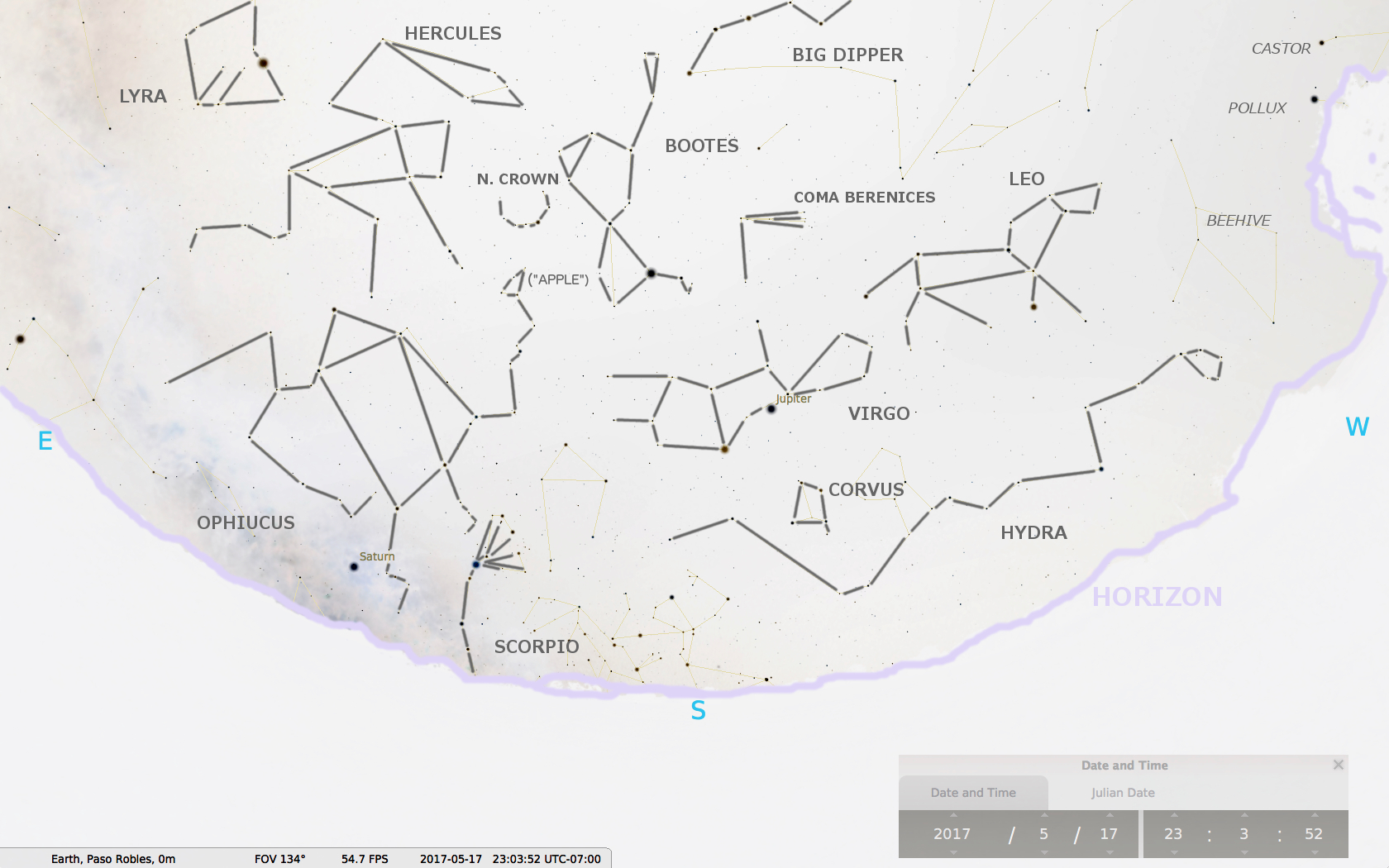
Scorpio appears in many myths as a serpent or similar monster with multiple heads -- sometimes seven, sometimes eight, and sometimes nine. Thus, I have drawn it as having multiple heads in the chart above, although depending on the light pollution in your area you will probably only be able to see the three brightest stars (which give it a "T" shape as it rises up from the horizon, as mentioned), due to the ambient light that is usually present near the horizons.
Directly above Scorpio, you may be able to make out the enormous form of Ophiucus, the Serpent-bearer, who holds the next of the four celestial serpents that you can see during this time of year. Ophiucus is not easy to identify unless you are fairly familiar with the constellation's outline -- although once you become familiar with it then it becomes fairly easy to see when Ophiucus is in the sky.
At present, Ophiucus will be "lying" almost horizontal to the eastern horizon as it rises in the east, above (or "to the left of") the vertical form of Scorpio rising. As Scorpio and Ophiucus make their way across the middle of the sky, Scorpio will become more horizontal and Ophicucus will turn upwards and become more vertical, but when they are just rising in the east, then Scorpio will be vertical and Ophiucus will be horizontal. The diagram above "curves" the horizon upwards on the left and right sides of the image, to simulate the 180 degrees of horizon arc that you would be able to see if you were actually standing outside. Thus, if you think about that left horizon as being more "level" (as it will be when you are outside), you will realize that Ophiucus will also seem much more horizontal when you are trying to identify the constellation's outline in the heavens (outdoors) than it seems to be in the above image.
Here is a previous post that provides some tips on tracing the outline of Ophiucus in the sky. My favorite method for seeing the constellation involves finding the "triangle" at the top of the massive body of the constellation. The "forward foot" of the constellation Hercules comes very close to the "triangle" of Ophiucus, as you can see from the diagram above. Knowing this fact can help you to identify the triangle at the top of Ophiucus.
The constellation Ophiucus, as his name implies, is holding a great serpent. This serpent is actually seen in two "halves" which are found on either side of the body of the constellation of Ophiucus. The serpent of Ophiucus plays an important role in many ancient myths -- sometimes in the role of a serpent, but often in the role of other sinuous things as well, including various forms of vegetation. The serpent halves can be described as having a "tail" half (on the left as we look at the image above -- the eastern half) and a "head" half (on the right as we look at the image above -- the western half).
You can see that the "head" of the serpent of Ophiucus resembles a small triangle or diamond-shape. Note also that the constellation Hercules can be seen to be reaching down towards the "head" of the serpent of Ophiucus with his lower outstretched arm.
There are a great many myths from around the world in which a serpent or serpent-figure guards a tree bearing special fruit (often, divine fruit). For instance, in the myth of Heracles (also known in Latin as Hercules), the hero must retrieve an apple from the garden of the Hesperides -- and that apple tree is guarded by a fearsome dragon. You can see Hercules gathering an apple from a tree around which a large serpent is winding in the ancient mosaic shown above.
I am convinced that the "head" of the serpent held by Ophiucus represents the apple in this particular myth, which Hercules reaches out his hand to grasp -- just as the constellation Hercules can be seen to be doing in the night sky. The "dragon" which guards the base of the tree in this myth is of course Scorpio, which is found around the region of the base of the constellation Ophiucus. There are many other myths around the world in which a dragon resides at the roots of a tree -- such as the Norse myths, for example, in which Nidhogg the dragon gnaws at the roots of Yggdrasil, the World-Tree.
Of course, there is also a story about a serpent and a tree with fruit at the beginning of the text of Genesis -- and the clear echoes of this particular episode to other ancient myths involving trees and serpents (and sometimes fruit as well) shows once again that the sacred texts included in the so-called Old and New Testaments of the Bible are closely related to the world's other ancient myths, scriptures and sacred stories, and that they are all based upon the same system of celestial metaphor.
Moving on to the third important celestial serpent, we can also see not far away the constellation Hydra, which stretches below Virgo (all directions in the above descriptions are for observers in the northern hemisphere -- the constellation Hydra will be "above" Virgo for viewers in the southern hemisphere). Hydra also plays a role in numerous ancient Star Myths, many of which are detailed in the volumes of the series entitled Star Myths of the World, and how to interpret them.
At this time of year, you can see the entire length of the constellation Hydra, at the same time that you can see Scorpio rising, with Ophiucus above Scorpio holding the two halves of the Ophiucus-serpent, and also Draco far above. Hydra is so long that its body actually continues on past Virgo and runs underneath the length of the constellation Leo (who precedes Virgo in the sky, as shown above). The head of Hydra is actually quite a bit further west than the nose or forward feet of Leo. You can make out the small oddly-shaped head of Hydra ahead of Leo (and below it), and if you do so it may give you a nice feeling of accomplishment.
Note that in the above diagram I have also indicated the stars Castor and Pollux, which are setting in the west but still visible in the star-chart above. They will be roughly level with one another (once again, the horizon in the chart above is curved upwards to try to simulate the "wrapping" of the horizon to your right as you face south in the northern hemisphere, so although the stars of Castor and Pollux appear to be stacked one above the other in the diagram, they are actually next to each other in a line that parallels the horizon, when you go outside at night). This previous post gives more tips on locating Castor and Pollux in the west at this time of year.
Note also that between the muzzle of the Lion of Leo and the heads of the Twins of Gemini you can still see the delightful Beehive Cluster, whose general location is also labeled in the above star-chart. Here is a previous post (one of many) discussing the location of this important celestial feature.
Those three celestial serpents -- Scorpio, the serpent of Ophiucus, and Hydra -- should all be visible at this time of year to most observers located in either hemisphere. The fourth of the important heavenly serpents which is also easily observable at this time of year, for viewers in the northern hemisphere, is the Dragon of Draco. This constellation winds its way between the stars of the Big Dipper and the Little Dipper, and is best found by first locating those two fairly familiar constellations.
The Big Dipper is one of the most well-known constellations in the northern sky. Its front two stars (the two front stars in its "bowl") are known as the "pointers," and they point to the North Star, Polaris.
Polaris itself forms the tip of the handle of the Little Dipper: once you locate Polaris, you can trace the arcing handle of the Little Dipper forward to the small "bowl" of that constellation, whose front two stars are relatively bright and easy to spot. Below is a diagram showing the two Dippers, with Draco in between: